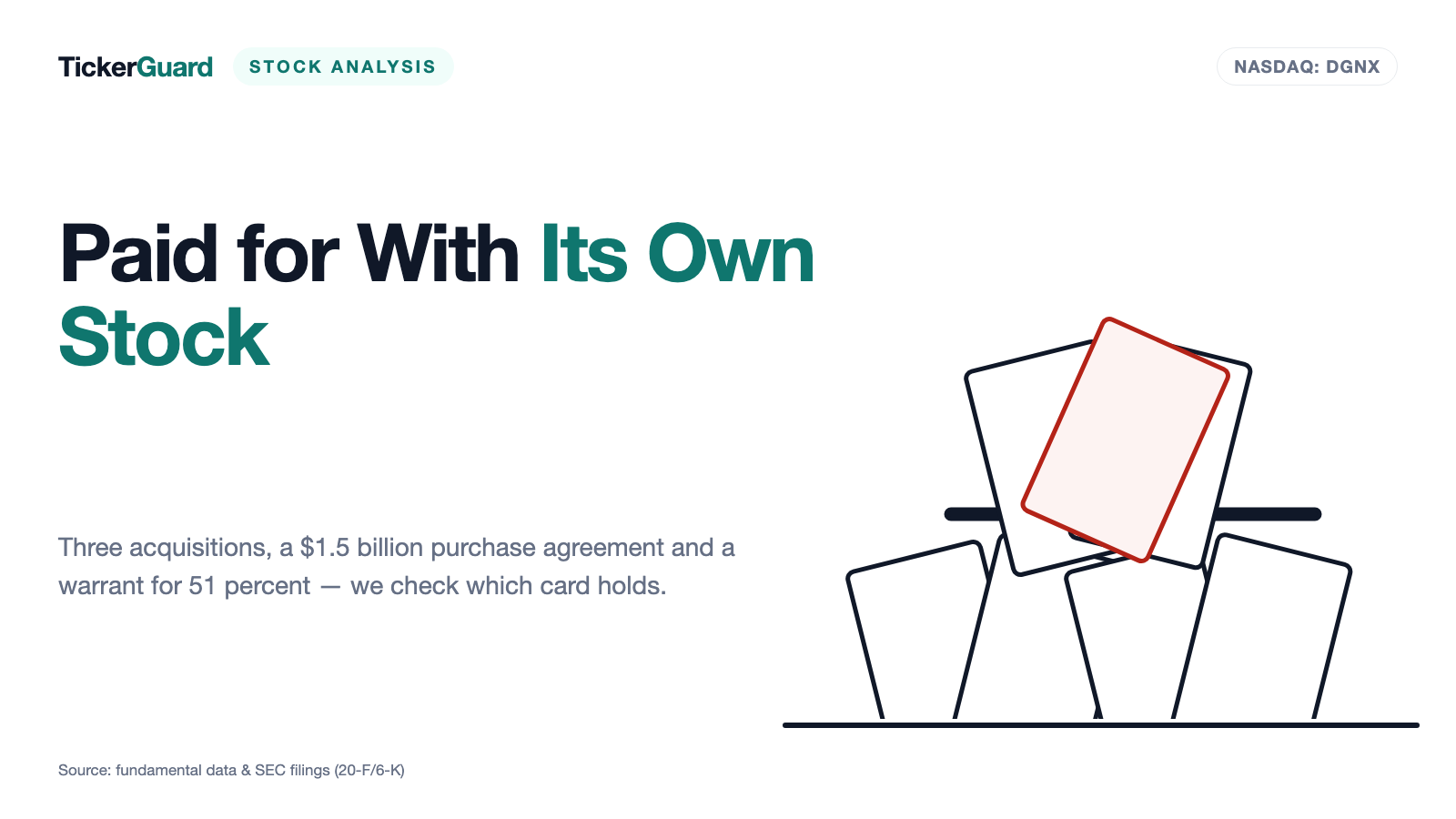
Diginex: $3.6 Million in Revenue — and a $1.5 Billion Purchase Agreement Payable in Stock
Diginex sells sustainability reporting software and bought three companies in fiscal 2026, paying almost entirely with its own shares. The annual report filed with the U.S. securities regulator, the SEC, on August 13, 2026 shows what that cost: $3.62 million of revenue, a net loss of $31.15 million, $4.87 million of cash and an audit report carrying a going concern emphasis of matter. Running alongside is a purchase agreement worth $1.5 billion, payable in 1,133,333,333 new shares against 50,130,130 outstanding. And above all of it sits a warrant that does not grant a fixed number of shares but always 51 percent. We read the filings line by line and check who ends up owning what.
 Thomas Mücke
Founder & Publisher
Thomas Mücke
Founder & Publisher
As of Today
As of: September 28, 2026
- Closing price
- 1.40 $ +4.40%
- Market Capitalisation
- 0.0 $B
- Growth Score
- 5/10
- AAQS
- 2/10
This analysis has a cut-off date. The Stock Guard tells you when something material changes in the numbers. Reserve your free spot
Chart
Interactive price chart (TradingView).
52-week range: 0.44 $ to 31.40 $ · Last price: 1.40 $ (As of: September 28, 2026)
Note: pure fact-based analysis, not investment advice and not a solicitation to buy or sell. All figures without guarantee.
There is an investor trap you only notice once you do the arithmetic — call it the play-money trap. It springs whenever a company pays not with cash but with its own shares. The press release then carries a big number: "acquisition valued at $13 million," "purchase price $1.5 billion." It sounds like strength. Nothing leaves the bank account, so to everyone involved it feels free. Except somebody does pay: you do, with your slice of the company. And if that same share is worth a fraction shortly afterwards, the real price was something else entirely. Diginex Limited (NASDAQ: DGNX) is the textbook case. It reached our desk not through a price spike but through two unremarkable entries in the new-filings feed of the U.S. securities regulator, the SEC: a notification of late annual filing on July 31, 2026 and, two days earlier, an SEC order declaring one of the company's registration statements abandoned. The annual report itself followed on August 13, 2026. So here is the deal: before you read any headline about the next billion-dollar takeover, let us read together what Diginex told the SEC. A filing like that is honest under penalty of law. What you make of it is up to you.
What Diginex actually does — sustainability paperwork, turned into software
Diginex sells sustainability reporting software. In plain terms: large companies now have to disclose every year how much carbon dioxide they emit, where their inputs come from and under what conditions people work there. That used to be consultants with spreadsheets. Diginex builds the tools that automate the collection: diginexESG guides users through the reporting process and drafts disclosures, diginexLUMEN screens supply chains for risk, diginexAPPRISE surveys workers in supply chains directly in multiple languages, and diginexCLIMATE calculates the carbon footprint. Since July 2022 the bank HSBC has referred its own clients to diginexESG at a 20 percent discount, an arrangement extended to December 31, 2027.
Legally, Diginex is a Cayman Islands company headquartered in London, listed on Nasdaq since its initial public offering on January 23, 2025 (2,250,000 shares at $4.10). As a foreign private issuer it files no quarterly reports on Form 10-Q; instead it files an annual report on Form 20-F and interim reports on Form 6-K. The fiscal year ends March 31, so "fiscal 2026" means essentially calendar 2025 plus the first quarter of 2026. During fiscal 2026 the company acquired three businesses: Matter DK ApS of Copenhagen (sustainability data for investors, 23 staff), The Remedy Project of Hong Kong (human rights advisory for supply chains, 5 staff) and PlanA.earth GmbH of Berlin (carbon accounting, more than 220 clients, 51 staff). Plan A co-founder Lubomila Jordanova has been group chief executive of Diginex since early 2026. That frames the central tension of this analysis, and it runs through every chapter: Diginex grows almost entirely by paying with its own shares — and the value of that currency fell by more than 98 percent over the same period.
How the stock reached our desk
No momentum hit, no value signal, no message-board storm. Diginex surfaced during the daily review of new filings on EDGAR, the SEC's public filing register. Three entries in four days drew attention: on July 29, 2026 an SEC order declaring a registration statement that had been on file for more than nine months (file number 333-289001) abandoned, because the company had not responded to a notice; on July 31, 2026 a notification that the annual report would not be ready on time; and on August 13, 2026 the annual report itself. That combination — an abandoned registration, a late annual report, a company in the middle of several acquisitions — is the classic prompt to read everything rather than just the headlines. Keep the principle in mind from the start: not every interesting stock announces itself with a price move. Some announce themselves with what they failed to file on time.
The numbers over the years — given their due
First, what genuinely works in Diginex's favour. Revenue is growing, and clearly so: $3.62 million in fiscal 2026, after $2.04 million in fiscal 2025 and $1.30 million in fiscal 2024 — close to a tripling in two years. More important is the shift in revenue mix: predictable software subscriptions rose from $0.44 million to $2.74 million, while project-based advisory fees fell from $0.86 million to $0.31 million. For a software business a subscription is by far the better kind of revenue — it returns every year without anyone having to sell it again. The Matter acquisition also added a data business for the first time ($0.57 million). Regionally, Asia-Pacific leads at $2.00 million, while Europe more than quadrupled to $1.24 million thanks to Plan A. Headcount grew from 32 to 114 people, spread across Germany (42), Hong Kong (25), Denmark (20), the United Kingdom (8) and France (6). And equity is positive: $20.32 million at March 31, 2026, up from $4.56 million a year earlier.
Now the other side of the same table, and it is impossible to miss:
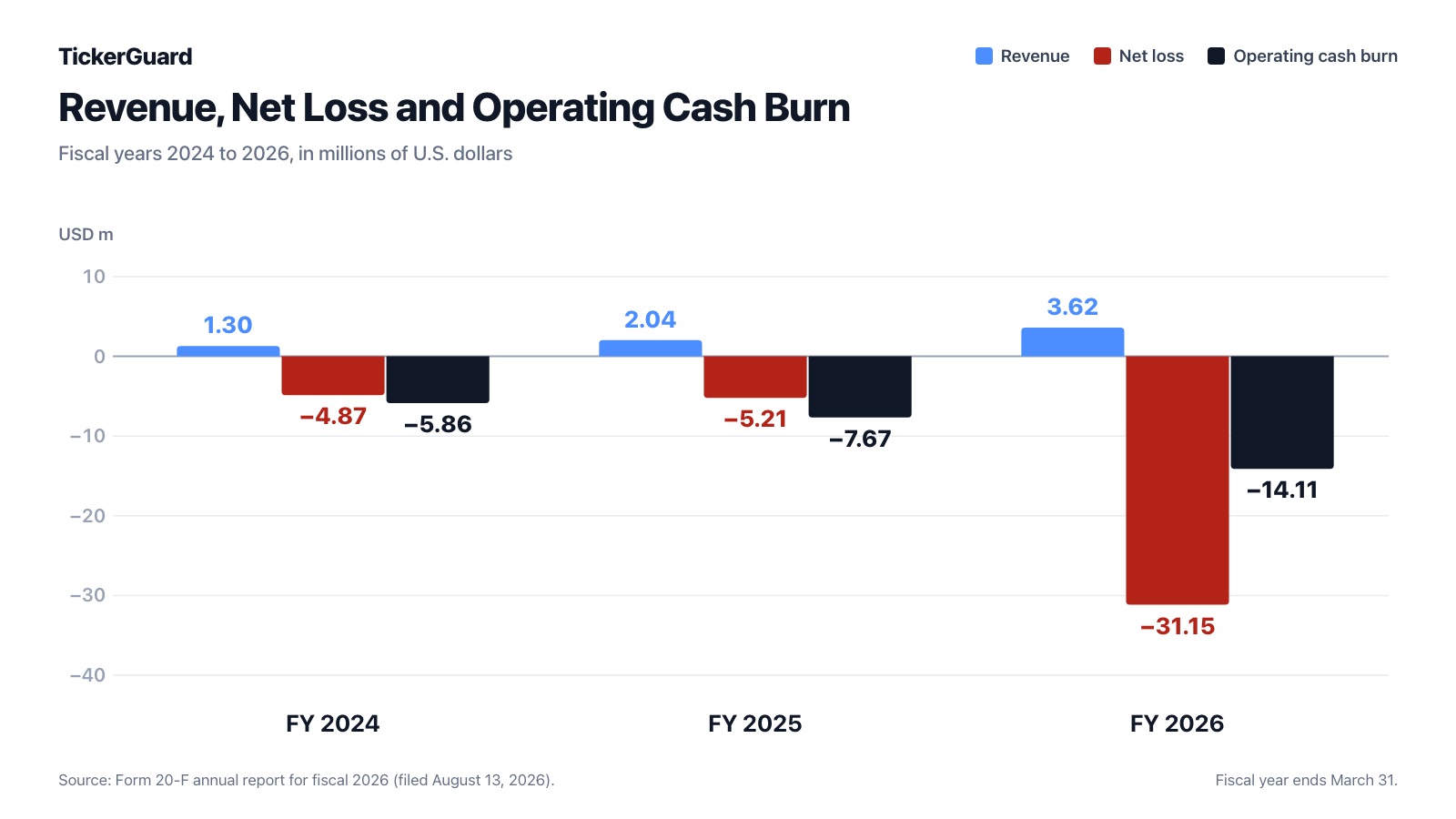
Two qualifications, so the numbers look neither better nor worse than they are. First, of the $1.58 million of additional revenue, at least $1.2 million came from acquisitions — Matter contributed $0.6 million since purchase and Plan A another $0.6 million. Organic growth was therefore markedly slower than the headline suggests. Second, general and administrative expenses jumped from $10.34 million to $28.50 million. The largest item is staff costs at $13.29 million (from $4.82 million), followed by $3.74 million of pure deal costs — advisers, audits and due diligence around the acquisitions. Those $3.74 million alone exceed everything the company earned in revenue all year. Hold that image: in fiscal 2026 Diginex spent more on buying companies than it took in from selling its own software. Which brings us to the uncomfortable truths.
What the filings say — the uncomfortable truths
Uncomfortable truth no. 1: the auditor puts a going concern emphasis into the report
A going concern emphasis of matter is the gravest sentence an auditor can write without qualifying the opinion. In plain terms, the auditor is not saying "the numbers are wrong" but "the numbers are right — whether the company still exists in twelve months depends on fresh money arriving." That is exactly what UHY LLP wrote on August 13, 2026:
"As discussed in Note 2 to the consolidated financial statements, the Company has incurred a net loss and experienced negative cash flows from operating activities for the year ended March 31, 2026 and has a working capital deficit as of March 31, 2026."
— Diginex Limited, Form 20-F for fiscal 2026, report of the independent registered public accounting firm (UHY LLP)
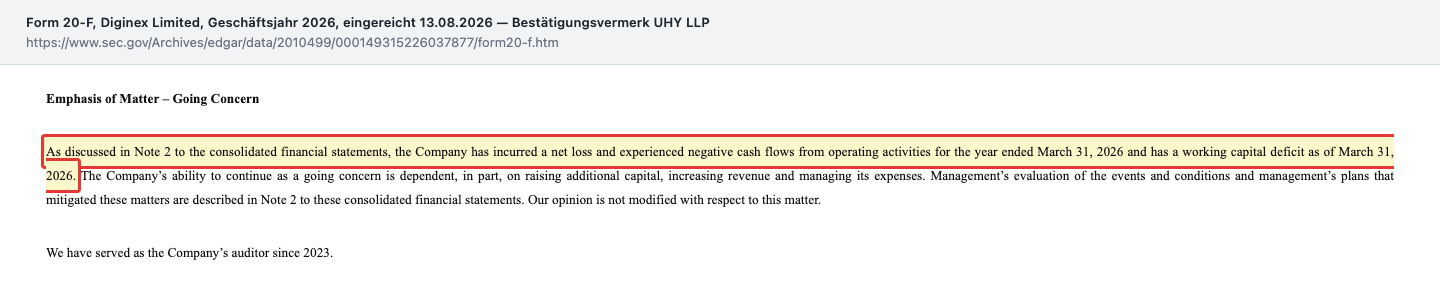
The numbers behind it: at March 31, 2026 cash stood at $4.87 million (plus $0.38 million restricted), while $14.11 million flowed out of operations during the year. Extrapolate crudely and the cash lasts about four months. The working capital deficit is not visible at first glance either: the balance sheet reports net current assets of plus $6.26 million. The reason for the apparent contradiction sits one line above — current assets include a receivable of $6.32 million from Resulticks, the company's own takeover target. Strip that loan out and $8.65 million of current assets face $8.72 million of current liabilities. That is precisely what the auditor means. The company disagrees and justifies the going concern basis in the notes expressly by reference to the $20 million capital raise subscribed in July 2026. How solid that argument is comes up in truth no. 4.
Uncomfortable truth no. 2: a warrant that grants no share count, but always 51 percent
The single most important sentence in the whole annual report sits in the section on indebtedness — easy to skim past because it looks like a technical footnote:
"There are 4,170,520 Founder Warrants that allow the holder to purchase 51% of the outstanding Ordinary Shares at time of exercise at a price of $6.13 per warrant."
— Diginex Limited, Form 20-F for fiscal 2026, Item 5.B "Indebtedness"

The difference from an ordinary warrant is enormous. Picture a pizza where somebody is contractually entitled not to "three slices" but to "half plus one" — however many slices are eventually cut. Every additional share Diginex issues dilutes all other shareholders, but not this claim: it grows with them automatically. The holder is Rhino Ventures Limited, a Cayman Islands company wholly owned and managed by founder and chairman Miles Pelham. At the filing date the warrants equated to 25,566,366 shares; together with directly held stock and three further warrant tranches (at $8.20, $10.25 and $12.30) the report attributes 49.2 percent beneficial ownership to Pelham, and 50.9 percent to all directors and executive officers as a group.
On March 20, 2026 the company extended these warrants by two years to May 27, 2029. Accounting-wise that was a turning point: after the modification the fixed-for-fixed condition under IAS 32 was no longer met, and the warrants moved out of equity into liabilities at a fair value of $28.55 million. That is close to eight times annual revenue and the largest liability on the entire balance sheet. In fairness: exercise costs $6.13 apiece, and the warrants originated in a genuine $8.0 million capital injection back in 2023. But the structure stands: as long as this claim exists, no outsider can ever hold a majority of Diginex.
Uncomfortable truth no. 3: $1.5 billion of purchase price — payable in 1.13 billion new shares
On April 16, 2026 Diginex signed an agreement to acquire Resulticks Global Companies Pte. Limited, a Singapore-based customer engagement software provider. The terms are in the annual report:
"The aggregate consideration is US$1.5 billion, payable entirely in equity through the issuance of 1,133,333,333 newly issued ordinary shares of the Company (the “Consideration Shares”) to the Sellers pro rata to their respective ownership at an average DGNX stock price of US$1.32 per share."
— Diginex Limited, Form 20-F for fiscal 2026, Item 10.C "Material Contracts"
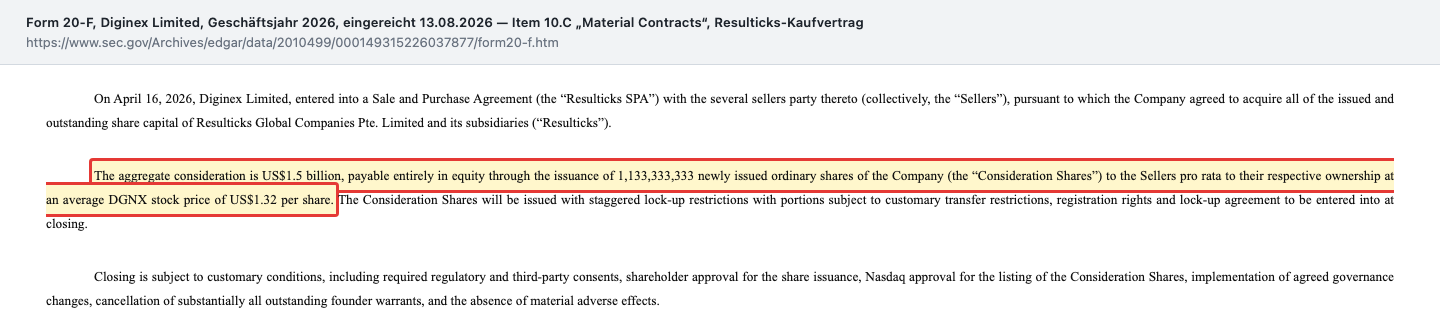
Put the magnitudes side by side, because everything hangs on them. On August 10, 2026 Diginex had 50,130,130 shares outstanding. The consideration is 1,133,333,333 shares — roughly twenty-two times the current count. Existing shareholders would be left with a little over 4 percent of the company. There is a second, very concrete obstacle: authorized share capital — the constitutional ceiling on shares that may be issued — has stood at 495,000,000 ordinary shares since April 28, 2026. The agreed consideration exceeds that ceiling by more than a factor of two, so without a further increase approved by shareholders the contract as written cannot be performed. The report itself lists the remaining conditions: shareholder approval, Nasdaq approval for listing the new shares, agreed governance changes, and cancellation of substantially all the founder warrants from truth no. 2.
Nothing has closed so far. The long stop date moved from May 29 to June 12 and on to August 12, 2026; on that day Diginex said both sides were in the final stages of the transaction documents. The report adds its own sober caveat: "There can be no assurance that the Company's acquisition of Resulticks will be completed on the terms described above, or at all." One further commitment is worth noting: after closing, 85 percent of all capital injections through March 31, 2027 are to fund Resulticks, up to $200 million. Fresh money that investors give Diginex would therefore be earmarked overwhelmingly for the acquisition, not for its own software business.
Uncomfortable truth no. 4: the capital raise is issued — it gets paid for by March 2027
The going concern paragraph in the notes leans expressly on "the successful subscription of the $20 million capital raise in July 2026." What exactly was subscribed is set out in the interim report of August 10, 2026 — and the mechanism is unusual:
"Pursuant to the SPAs, the Investors shall pay the purchase price over time and the Investors will receive the Shares upon payment of the initial payment under the SPAs and the Investors shall receive the Warrants upon the payment of the final payment under the SPAs."
— Diginex Limited, Form 6-K dated August 10, 2026, "Diginex Private Offering of Securities"
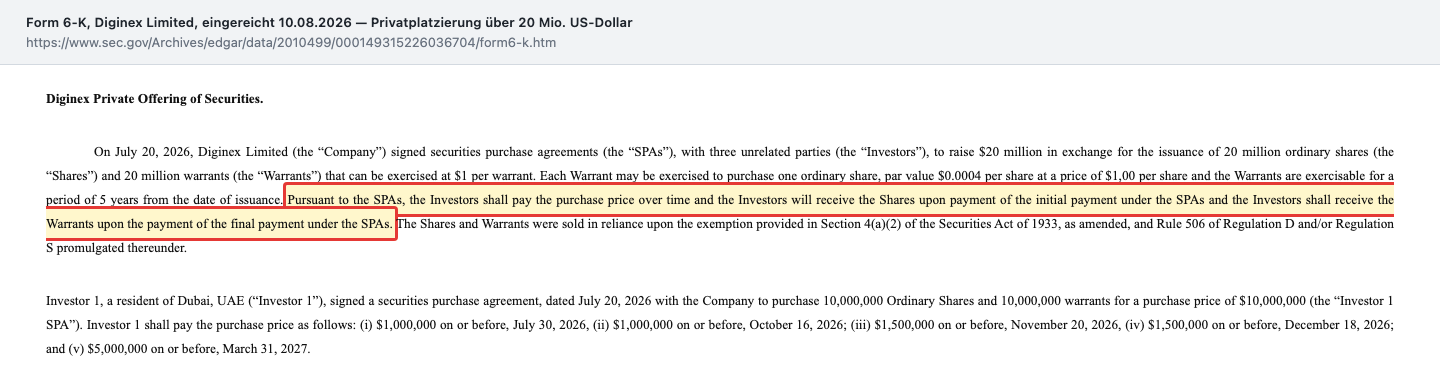
In detail: Investor 1, a resident of Dubai, subscribes for 10,000,000 shares and 10,000,000 warrants for $10.0 million, paying in five instalments — $1.0 million by July 30, 2026, then $1.0 million and $1.5 million in October and November, $1.5 million in December, and the final $5.0 million by March 31, 2027. Investors 2 and 3 each subscribe for 5,000,000 shares with a $750,000 down payment and a $4.25 million balance. On top comes a $1 million introducer fee to VB Capital Limited, also in shares. The effect has already landed in the ownership table: on August 10, 2026 there were 50,130,130 shares outstanding against 29,130,130 on March 31, 2026 — up 72 percent in roughly four months. The three subscribers already appear as major holders at 19.9, 9.9 and 9.9 percent. The money, by contrast, is largely still to come. How completely a capital structure can overshadow the actual investment question is something we described in a different form in our analysis of Autolus — there it was claims ranking ahead of shareholders, here it is the sheer number of shares.
Which brings us to the currency question that holds this analysis together. Diginex paid for its acquisitions in its own shares, at prices its own report discloses:
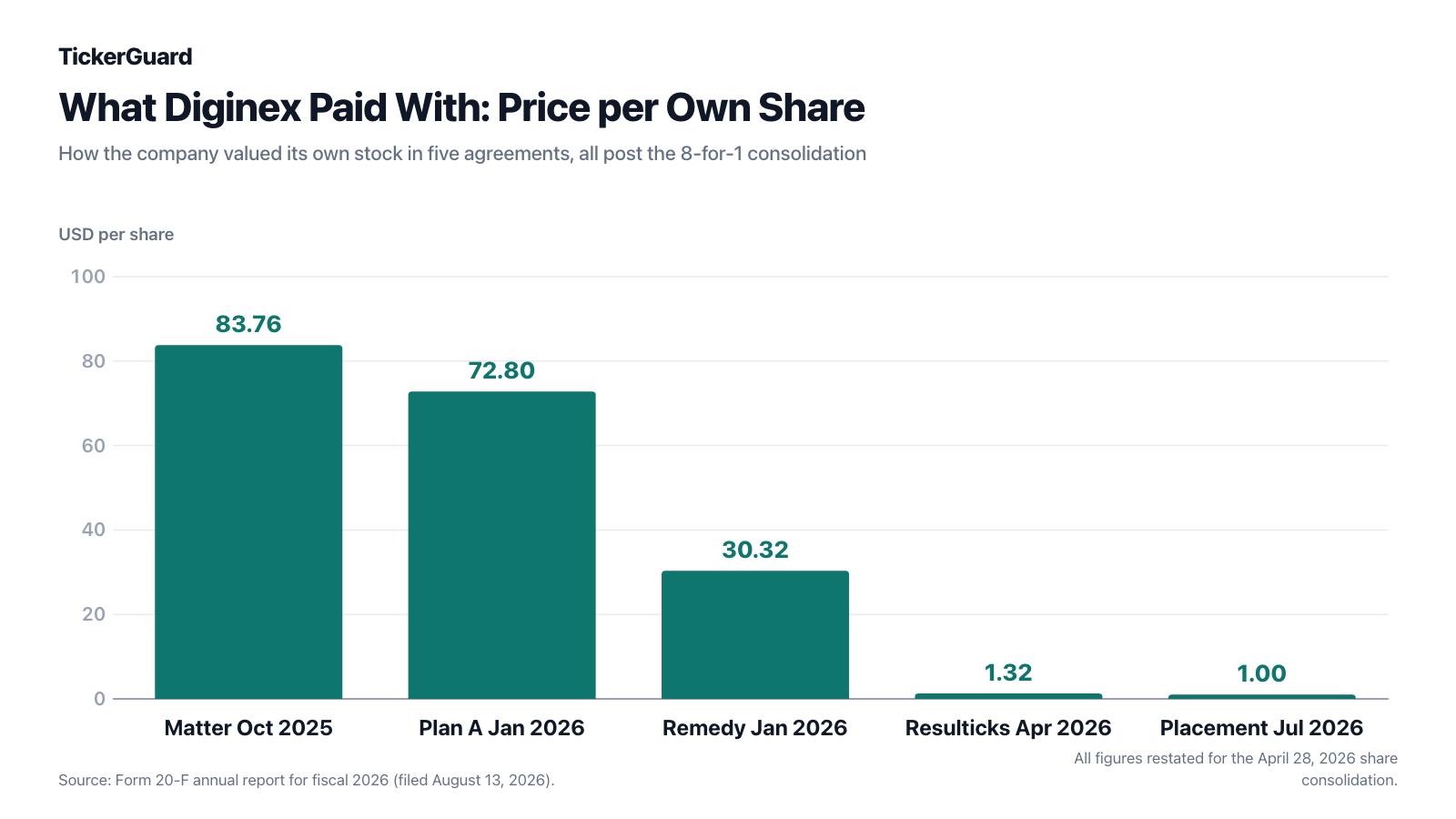
That chart is the play-money trap in one picture. When Diginex bought the Danish firm Matter in October 2025, the parties set its own share price at $10.47 — after the later 8-for-1 consolidation, $83.76. By closing the price had risen to a restated $131.76, which inflated the accounting purchase price to $20.5 million while independent valuers put Matter at $13.5 million. The result: $7.0 million of goodwill was written off in the very year of purchase. For Plan A the assumed price was $72.80 per share, for Remedy $30.32. In July 2026 the same company sold new shares at $1.00. Anyone who was a shareholder in October 2025 therefore paid for Matter in a currency that nine months later was worth barely one percent of the price assumed. The balance sheet still carries $37.60 million of goodwill and $6.63 million of other intangibles from the three deals — together more than twelve times annual revenue and three quarters of total assets. Keep this sentence: goodwill is not an asset but a promise — and this promise was made in a currency that no longer exists at that value.
Uncomfortable truth no. 5: the listing hangs on one dollar — and the second chance is used up
On March 23, 2026 Nasdaq notified Diginex that its shares had failed the $1.00 minimum bid price over 30 consecutive business days. The company responded with an 8-for-1 share consolidation effective April 28, 2026 — eight old shares became one new one, multiplying the price arithmetically. On July 28, 2026 Nasdaq confirmed compliance had been regained. The report also states the price of that rescue:
"However, under Nasdaq Listing Rule 5810(c)(3)(A)(iv), because we completed a reverse split on April 28, 2026, in the event the Company's closing bid price falls below $1.00 for 30 consecutive business days within one year of April 28, 2026, then we will not be eligible for a 180-day cure period."
— Diginex Limited, Form 20-F for fiscal 2026, Item 3.D risk factors
In plain terms: if the price slips back below a dollar before April 28, 2027 and stays there for a month, there is no grace period left — Nasdaq issues a staff delisting determination immediately, and the shares can move to the over-the-counter market. For scale: the July 2026 private placement was subscribed at exactly $1.00. Two further points belong in the picture. First, since the consolidation the shares are quoted on neither the Frankfurt Stock Exchange nor Tradegate, so European investors depend on Nasdaq. Second, Diginex has been named since 2026 in three purported class actions before the Supreme Court of the State of New York, filed on March 24, April 13 and July 23, 2026. They target more than a hundred issuers and their underwriters and allege a coordinated pattern of pump-and-dump schemes around nano-cap and micro-cap offerings. In fairness: Diginex considers the claims wholly without merit, points out that beyond naming it in the caption the complaints contain no company-specific allegations, and has been served in only one of the three actions, on August 5, 2026.
Valuation: multiples that barely measure anything
With a net loss of $31.15 million there is no meaningful price-to-earnings ratio. That leaves a revenue multiple, and for that we need a valuation anchor that does not depend on today's price. The filings supply two: the subscription price of the private placement at $1.00 (July 2026) and the average price assumed in the Resulticks agreement at $1.32 (April 2026). Applied to the 50,130,130 shares outstanding on August 10, 2026, that implies a market value between roughly $50 million and $66 million — broadly 14 to 18 times the $3.62 million of annual revenue. For a growing software business with a high subscription share that would not be absurd in principle; for a software business producing three times as much loss as revenue, whose growth is mostly bought, it is a bet. And the calculation still ignores two claims that would change everything if exercised: the founder warrants on 51 percent and the 20 million warrants from the July placement, also at $1.00. How quickly cash flow can overshadow every valuation question is something we walked through in our analysis of Ballard Power. Remember: a revenue multiple only measures something when the share count is roughly settled. At Diginex it is not.
Opportunities and risks at a glance
What speaks for Diginex:
- The market is real and growing: sustainability reporting is mandated by law in Europe, and Diginex serves it with a finished product suite — diginexESG, LUMEN, APPRISE, CLIMATE — rather than a statement of intent.
- Revenue mix is improving: predictable subscription revenue rose to $2.74 million in fiscal 2026 from $0.44 million two years earlier, while project-based advisory fees declined. Deferred revenue grew to $2.37 million.
- The acquisitions bring substance: Berlin-based Plan A has more than 220 clients and a TÜV Rheinland certification; Matter supplies sustainability data to platforms including Nasdaq eVestment. Headcount grew from 32 to 114.
- Named distribution partners: HSBC has referred its own clients to diginexESG since July 2022, extended to the end of 2027, and Resulticks is to resell the Diginex platforms across the United States, South-East Asia, the Middle East and India.
- Equity is positive at $20.32 million as of March 31, 2026, and Nasdaq compliance was restored on July 28, 2026.
What speaks against it:
- Going concern emphasis in the audit report dated August 13, 2026: net loss $31.15 million, operating cash burn $14.11 million, cash $4.87 million — roughly four months of runway on a crude extrapolation. The going concern basis rests on a capital raise whose instalments run to March 31, 2027.
- Dilution without a brake: 50,130,130 shares on August 10, 2026 after 29,130,130 on March 31, 2026, up 72 percent, plus 20 million new warrants at $1.00 and 4,170,520 founder warrants that always reach 51 percent of shares outstanding (a $28.55 million liability).
- The $1.5 billion Resulticks purchase would require 1,133,333,333 new shares — more than twice the 495,000,000 authorized and roughly twenty-two times the current count; after closing, 85 percent of all capital injections through March 31, 2027 would fund the target.
- Balance sheet quality: $37.60 million of goodwill and $6.63 million of intangibles stand against $3.62 million of annual revenue; $7.0 million on Matter was written off in the purchase year. And $6.32 million of current assets is a loan to the company's own takeover target, of which $4.0 million of principal and $0.7 million of interest were still outstanding on August 13, 2026.
- Listing risk without a net: if the price falls below $1.00 for 30 trading days before April 28, 2027, the 180-day cure period no longer applies and Nasdaq issues a delisting determination immediately. Frankfurt and Tradegate have not quoted the shares since the consolidation, and there are three pending class actions plus a registration statement the SEC declared abandoned on July 29, 2026.
A human conclusion
Back to the play-money trap. Its core is not that Diginex has a bad product — the software solves a real problem, the acquired businesses are real businesses with real customers, and the chief executive came out of one of them. Its core is that paying in shares makes the price invisible. The agreements carried big numbers: $13 million for Matter, 55 million euros for Plan A, $1.5 billion for Resulticks. What was actually handed over were stakes in a company with $3.62 million of annual revenue — and whoever already owned those stakes pays the bill without being asked. That is why the most revealing line in the annual report is not a revenue figure but the share count: 29,130,130 on March 31, 2026; 50,130,130 four months later; another 1,133,333,333 written into a contract. So the honest question is not "is sustainability software a good market?" but: do you want to co-own a company where neither the number of shares tomorrow nor who ends up holding the majority is settled? If your answer is yes and you can live with the going concern emphasis, you have a thesis. If not, you have read a good story. What you make of it is your call. And that is exactly as it should be.
Sources
Every original document used in this analysis, for you to read yourself:
- Diginex Limited — SEC Form 20-F annual report for fiscal 2026 (filed August 13, 2026)
- Diginex Limited — SEC Form 6-K dated August 10, 2026 ($20 million private placement)
- Diginex Limited — SEC Form 6-K dated July 31, 2026 (Nasdaq minimum bid price compliance regained)
- Diginex Limited — SEC Form NT 20-F dated July 31, 2026 (notification of late annual filing)
- U.S. Securities and Exchange Commission — Order dated July 29, 2026 declaring registration statement 333-289001 abandoned (PDF, sec.gov)
- Diginex Limited — SEC Form 6-K dated May 29, 2026 (extension of the Resulticks long stop date)
- Complete SEC filing history of Diginex Limited: EDGAR overview (sec.gov)
- Fundamental data (listing, share count cross-check), as of August 14, 2026, reconciled with the SEC filings.
Transparency and disclaimer: this analysis is journalistic commentary on publicly available information. It is not investment advice, not a research report in a regulatory sense and not a solicitation to buy or sell securities. Equity investments carry substantial risk up to total loss. All information without warranty; the as-of date of each figure is stated in the text. Positions held by the operator are disclosed daily; where one exists, it appears as a notice at the top of this deep dive.
Key figures at a glance
All monetary figures in millions of $; earnings per share as reported.
| Metric | 2022 | 2023 | 2024 | 2025 | 2026 |
|---|---|---|---|---|---|
| Revenue | 1.1 | 1.6 | 1.3 | 2.0 | 3.6 |
| Operating Income (EBIT) | -7.4 | -7.3 | -8.1 | -8.3 | -20.4 |
| Net Income | -13.0 | -9.3 | -4.9 | -5.2 | -25.5 |
| Net Margin | -1,157.7% | -569.4% | -374.9% | -255.5% | -706.4% |
| Earnings Per Share | -0.57 $ | -0.41 $ | -0.22 $ | -0.30 $ | -7.90 $ |
Source: fundamental data & SEC filings (annual and quarterly reports, 10-K/10-Q)
Our Bottom Line at a Glance
- Business model and market positive
- Sustainability reporting software addresses a regulator-created need, and Diginex serves it with a finished product suite. Predictable subscription revenue rose to $2.74 million in fiscal 2026 from $0.44 million two years earlier, and deferred revenue to $2.37 million. HSBC has referred its own clients to diginexESG since July 2022, extended to the end of 2027.
- Quality of growth neutral
- Revenue rose by $1.58 million to $3.62 million in fiscal 2026 — but at least $1.2 million of that came from the acquisitions of Matter ($0.6 million since purchase) and Plan A ($0.6 million since purchase). Organic growth was therefore considerably slower, and headcount tripled from 32 to 114 in the same stretch.
- Financial substance negative
- The audit report dated August 13, 2026 carries a going concern emphasis: net loss $31.15 million, operating cash burn $14.11 million, cash $4.87 million — roughly four months of runway. The reported net current assets of $6.26 million consist almost entirely of a loan to the company's own takeover target Resulticks ($6.32 million net).
- Dilution and capital structure negative
- The share count rose from 29,130,130 (March 31, 2026) to 50,130,130 (August 10, 2026), up 72 percent in roughly four months — yet the underlying placement is paid only in instalments running to March 31, 2027. Add 20 million new warrants at $1.00 and 4,170,520 founder warrants that always reach 51 percent of shares outstanding (a $28.55 million liability).
- Balance sheet quality negative
- The three fiscal 2026 acquisitions left $37.60 million of goodwill and $6.63 million of intangibles on the balance sheet — together more than twelve times the $3.62 million of annual revenue. Goodwill of $7.0 million on Matter was written off in the purchase year itself, because the company's own share price had risen between signing and closing.
- Listing and litigation negative
- After the 8-for-1 consolidation of April 28, 2026 the 180-day cure period is unavailable until April 28, 2027: if the closing bid price again falls below $1.00 for 30 trading days, Nasdaq issues a delisting determination immediately. Three purported class actions are pending (filed March 24, April 13 and July 23, 2026; only the third served, on August 5, 2026), and the SEC declared a registration statement abandoned on July 29, 2026.
Diginex sells sustainability reporting software into a market created by legislation — and in fiscal 2026 it bought three companies, paying almost entirely with its own stock. The annual report filed August 13, 2026 shows the price: $3.62 million of revenue, a $31.15 million net loss, $14.11 million of operating cash burn, $4.87 million of cash and an audit report carrying a going concern emphasis. The share count rose 72 percent to 50,130,130 in roughly four months, an agreement for a further 1,133,333,333 shares sits on the table, and a single block of warrants always reaches 51 percent of the whole. Investing here buys less of a software business than an open question about your own stake. Not investment advice.
What Our Rating Means
Substance risk
We found at least one documented issue that threatens the company itself — regardless of how the stock is currently valued.
The quality rating stands at red because several substance risks are documented — and they come from the August 13, 2026 annual report itself, not from the share price. Auditor UHY LLP added a going concern emphasis to its report; operating cash burn of $14.11 million faces $4.87 million of cash, roughly four months of runway, and the positive net current assets consist almost entirely of a loan to the company's own takeover target whose June instalment was still unpaid on the filing date. Add a listing risk without a net: no cure period is available until April 28, 2027 if the price slips back below one dollar. None of this is a statement about the price of the stock — a cheaper share would change none of these points. It is a statement about the company: whether it continues in this form for another twelve months depends on payments that still have to arrive. Yellow would require a dependable financial base, and where the evidence sits between two levels the more cautious one applies. The decision is yours.
A journalistic assessment by our editorial team at the time of the deep dive, based on public sources — not investment advice and not a solicitation to buy or sell. Your personal circumstances (investment goals, risk capacity, taxes) cannot be taken into account. What our levels mean, how verdicts are formed, and what conflicts of interest exist →
Worth Noting
- Diginex reached our research list through a review of new EDGAR filings: an SEC order of July 29, 2026 declaring registration statement 333-289001 abandoned, and the July 31, 2026 notification that the annual report would be late. The Form 20-F followed on August 13, 2026 and is the basis of this analysis.
- The U.S. securities regulator treats Diginex as a foreign private issuer, so it files no Form 10-K and no quarterly reports on Form 10-Q, but an annual report on Form 20-F plus interim reports on Form 6-K. The fiscal year ends March 31, so comparisons with calendar-year filers need shifting accordingly. Half-year figures appear as an exhibit to a Form 6-K, most recently on December 9, 2025 for the six months to September 30, 2025.
- All price and share figures are restated for the 8-for-1 consolidation of April 28, 2026, as the annual report itself does. The valuation anchors quoted ($1.00 from the July 2026 private placement, $1.32 from the April 2026 Resulticks agreement) come from the filings and are deliberately not intraday prices. On identity: the SEC register records no former names for CIK 0002010499, and the ticker DGNX has belonged to this company since its January 2025 IPO.
Stock Watch
This analysis is as of August 26, 2026. Stock Watch will tell you what's changed at DGNX since then.
Later $1 a month per stock — signing up is free, and you'll be the first to know when it launches.
The full analysis as a PDF for later
We will send you this analysis as a PDF — to print, file away, and read at your own pace. And we will add you to the free Stock Watch list for Diginex Limited (DGNX), so you hear about it when something material in this analysis changes.
Frequently Asked Questions
Diginex Limited (NASDAQ: DGNX) sells sustainability reporting software. Its suite includes diginexESG for report creation, diginexLUMEN for supply chain risk, diginexAPPRISE for multilingual worker surveys in supply chains, and diginexCLIMATE for carbon footprints. The company is incorporated in the Cayman Islands, run out of London, and employed 114 people as of March 31, 2026 across Germany, Hong Kong, Denmark, the United Kingdom and France.
Because the U.S. securities regulator, the SEC, treats Diginex as a foreign private issuer. Such companies file no Form 10-K and no quarterly reports on Form 10-Q; instead they file an annual report on Form 20-F plus event-driven interim reports on Form 6-K, with half-year figures furnished as an exhibit to a 6-K. The fiscal year ends March 31, so fiscal 2026 covers calendar 2025 plus the first quarter of 2026.
Revenue rose to $3.62 million from $2.04 million a year earlier. General and administrative expenses jumped from $10.34 million to $28.50 million, producing an operating loss of $24.89 million and a net loss of $31.15 million (prior year $5.21 million). Operations consumed $14.11 million of cash, and cash stood at $4.87 million on March 31, 2026. Basic loss per share was $1.20.
Auditor UHY LLP notes in its August 13, 2026 report that Diginex incurred a net loss and negative operating cash flows in fiscal 2026 and reports a working capital deficit as of March 31, 2026. Continuing as a going concern depends in part on raising additional capital, increasing revenue and managing expenses. The opinion itself is not modified — but the emphasis is an explicit warning about financial substance.
They are 4,170,520 warrants held by Rhino Ventures Limited, a company wholly owned by founder and chairman Miles Pelham. They entitle the holder not to a fixed number of shares but to 51 percent of the ordinary shares outstanding at the time of exercise, at $6.13 per warrant, running to May 27, 2029. Since the maturity extension of March 20, 2026 they are carried as a liability at a fair value of $28.55 million.
There were 29,130,130 ordinary shares on March 31, 2026, restated for the 8-for-1 consolidation of April 28, 2026. After the July 2026 private placement of 20 million new shares plus 1 million shares paid as an introducer fee, the count reached 50,130,130 by August 10, 2026 — up 72 percent in roughly four months. Authorized share capital has been 495,000,000 ordinary shares since April 28, 2026.
The agreement signed April 16, 2026 provides for $1.5 billion payable entirely in 1,133,333,333 new Diginex shares at an assumed price of $1.32. The long stop date was extended several times, most recently to August 12, 2026; on that day Diginex said both sides were in the final stages of documentation. The annual report states expressly that there is no assurance the deal will close. Diginex has also lent Resulticks $8.0 million, of which $4.0 million was still outstanding on August 13, 2026.
Nasdaq flagged a breach of the $1.00 minimum bid price on March 23, 2026. Diginex restored compliance through an 8-for-1 consolidation effective April 28, 2026 and received confirmation on July 28, 2026. Under Listing Rule 5810(c)(3)(A)(iv), however, the 180-day cure period is unavailable until April 28, 2027: if the closing bid price again falls below one dollar for 30 consecutive business days, Nasdaq issues a staff delisting determination immediately.
Found an error?
Did you spot a factual error, an outdated number, or a typo in this deep dive? Let us know briefly — your report goes straight to the editorial team.