Sunonwealth: More Data Center on the Slide Than in the Revenue
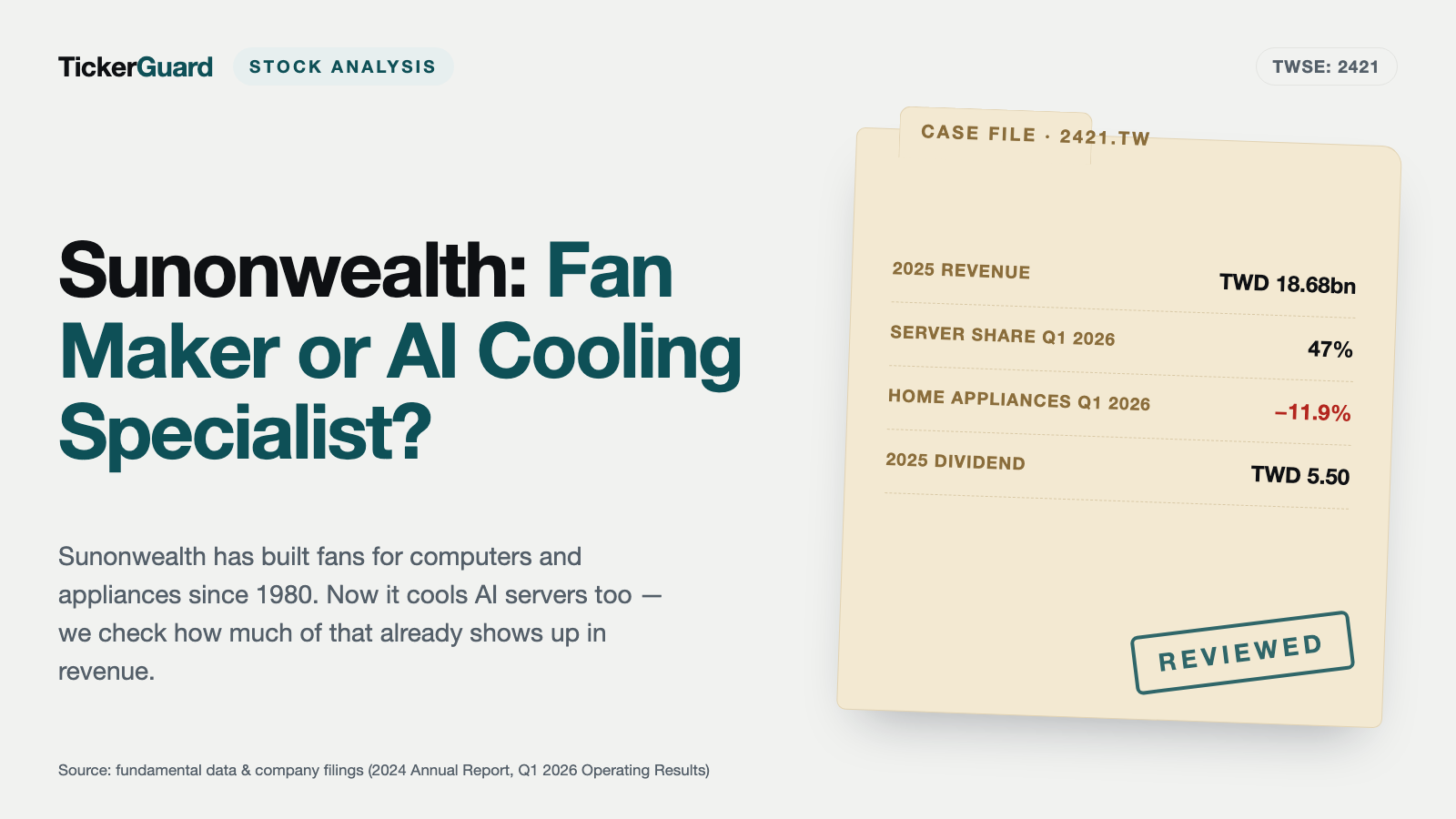
Sunonwealth's investor presentation is full of Amazon Trainium servers and Nvidia HGX racks — yet the company has mostly built fans for computers and home appliances since 1980. We read the annual report and the quarterly numbers: the server share of revenue climbed from 21 to 47 percent — but the celebrated liquid-cooling business, by the company's own timeline, isn't set to deliver its first meaningful revenue contribution until the second half of 2026. No buy or sell recommendation.
 Thomas Mücke
Founder & Publisher
Thomas Mücke
Founder & Publisher
Psychologists call it the salience effect: what is vivid, visual and emotionally loaded weighs more heavily in our judgment than what actually matters — even when the vivid part is only a small piece of the full picture. That is exactly what happens when you flip through Sunonwealth's 29-page investor presentation: renderings of Amazon Trainium servers, Nvidia HGX racks and entire liquid-cooling systems for AI data centers, page after page. Look only at those images, and you'd take Sunonwealth for a pure-play AI infrastructure company. The annual report next to it tells a more sober story: a cooling-fan maker founded in Kaohsiung in 1980, whose server business is genuinely growing fast, but whose celebrated liquid-cooling unit has, by the company's own timeline, yet to deliver its first meaningful revenue contribution. We read the 2024 annual report and the latest investor presentation to see how much of the story has actually reached revenue. Every figure in this analysis is evergreen and carries its own date; the price of TWD 163.50 serves only as a valuation anchor as of August 28, 2026.
What Sunonwealth Actually Does
Every computer, every server and most home appliances generate heat while running that has to be carried away — otherwise the chips inside throttle or fail. That has been Sunonwealth's business for 45 years: the company designs and manufactures cooling fans (DC, AC and so-called EC fans with electronically commutated motors), thermal modules (heat pipes, vapor chambers, heat sinks) and, as its newest product line, liquid-cooling components: cold plates (water-cooled contact plates mounted directly on the chip), coolant distribution units (CDUs) and circulation pumps. By its own count, Sunonwealth holds more than 3,400 patents worldwide and employs more than 420 people in research and development alone, into which it targets annual investment of 5 to 8 percent of revenue.
The company itself frames its history in the investor presentation as three phases: from 1980 to 2000, Sunonwealth mainly supplied motors and fans to industrial machinery and early PCs (revenue then under TWD 6 billion). From 2001 to 2021 came an expansion into notebooks and the IT industry broadly (revenue TWD 6 to 13 billion). Since 2022, Sunonwealth describes itself as being in a third phase built around "AI factories, smart cities and smart living" as growth drivers, with both air and liquid cooling as core products — targeting a self-set revenue corridor of TWD 15 to 20 billion and a gross margin of 25 to 30 percent. Under the 2024 accounts, the traditional core business — DC cooling fans, modules and blower fans — still made up 74.9 percent of group revenue, AC fans another 2.9 percent, and materials/components the remaining 22.2 percent (2024 Annual Report, Business Overview). Manufacturing runs across six sites plus one R&D center: the development center in New Taipei, the original plant in Kaohsiung, a plant in the Philippines (Bataan, in mass production since 2022, with a second plant at the same site under construction per the investor presentation), a plant in Huizhou (Guangdong province, liquid- and air-cooling modules) and two plants in Beihai (Guangxi province) plus one in Kunshan (Jiangsu province).
Anyone selling this company as "the next Nvidia supplier stock" is cutting corners: Sunonwealth is first and foremost a diversified cooling-technology manufacturer with a growing, but not yet dominant, AI-server segment — a pattern similar to other Taiwanese suppliers to the AI infrastructure buildout whose numbers we've already put under the microscope, such as Taiwan Union Technology (circuit-board materials) or Hon Precision (IC test handlers).
Company history for investors
-
1980
Founded in Kaohsiung
Sunonwealth starts out making motors and fans for industrial machinery — 45 years before today's AI-cooling story.
-
2019
Board approves Philippines plant
On November 1, 2019, the company commits $25 million to a new plant in the Philippines — geographic diversification years ahead of the current tariff turmoil.
-
2022
Philippines plant starts mass production
The fourth quarter of 2022 marks the start of mass production in Bataan — an additional manufacturing site outside China.
-
2024
Social-engineering ransomware attack
On February 19, 2024, external attackers obtain employee credentials and deploy ransomware on internal servers — the company discloses the incident.
-
2024
Board re-election creates dual role
On June 14, 2024, the shareholders' meeting re-elects the board of directors; the chairman has since also served as president.
-
2026
First cold-plate deliveries
In the first quarter of 2026, Sunonwealth begins initial deliveries of liquid-cooling components — the full revenue contribution isn't announced until the second half of the year.
How This Stock Landed On Our Desk
The trigger for this analysis is exactly that contrast: an investor presentation full of AI-data-center imagery, next to an annual report that shows a considerably more broadly based company. This kind of story — "traditional manufacturer turns AI winner" — creates exactly the pull that leads investors to price a stock on the strength of its slide deck rather than its actual revenue mix. We wanted to know how solid the AI-cooling story really is — and what the annual report says about risks that never show up in any investor presentation.
The Numbers Over the Years
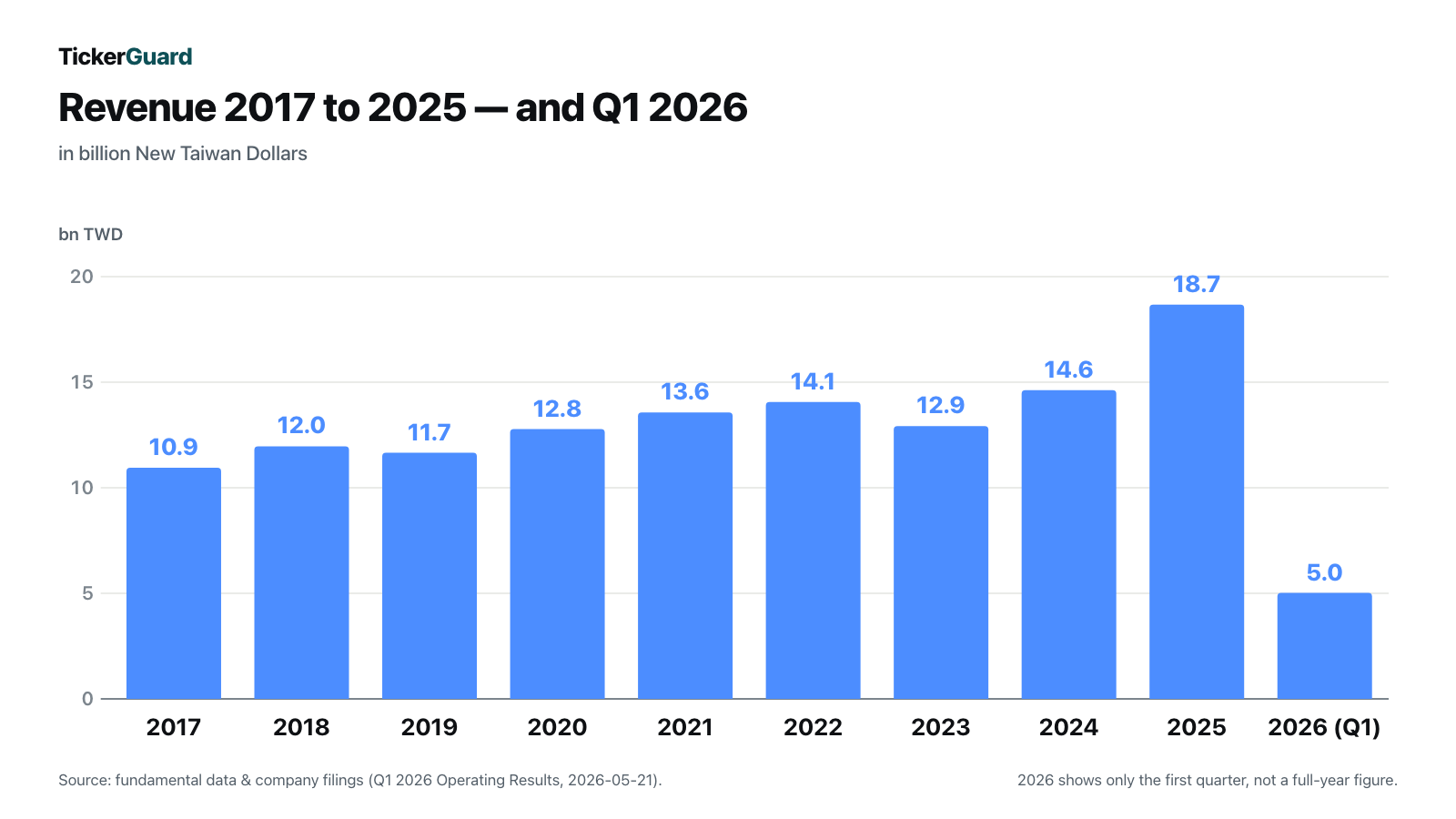
Sunonwealth's revenue moved within a fairly narrow band of TWD 11 to 14.6 billion from 2017 through 2024 — with a notable dip in 2023 (TWD 12.92 billion, down 9.2 percent), when an industry-wide inventory correction in industrial equipment, notebooks, home appliances and distribution channels weighed on demand. Only in 2025 did the company break out of that pattern: TWD 18.68 billion in revenue, up 27.7 percent — the strongest growth in at least eight years. The first quarter of 2026 set a further record at TWD 5.02 billion, up 20.6 percent year over year.
Earnings per share followed the same pattern, with one notable exception: even in the weak revenue year of 2023, EPS rose from TWD 4.34 to TWD 5.16 — margin expanded while revenue shrank, a sign of cost discipline rather than pure revenue dependence. From there it kept climbing: TWD 5.46 (2024), TWD 7.94 (2025) and TWD 2.36 in the first quarter of 2026 alone (versus TWD 1.73 in the first quarter of 2025). The second quarter of 2026 added TWD 2.41 per fundamental data, for a first-half 2026 total of roughly TWD 4.77 in earnings per share.
Gross margin climbed from 27.9 percent (2023) through 28.4 percent (2024) to 31.7 percent in the first quarter of 2026, and operating margin from 11.9 to 15.7 percent over the same span — both record levels for a first quarter per the investor presentation (the fourth quarter of 2025 ran even slightly higher, at 32.8 and 16.5 percent). That margin expansion is carried mainly by the growing server share of the revenue mix, as the next chapter shows.
What the Investor Presentations Show
An honest note up front: no publicly available call transcripts with a question-and-answer section exist for Sunonwealth — an automated check of our transcript database (as of August 31, 2026) found zero entries for ticker 2421.TW. Instead, we reviewed the official "2026 Q1 Operating Results" investor presentation (published May 21, 2026) and an independent written summary of the associated earnings call held on May 8, 2026. That is weaker evidence than a verbatim transcript — we flag that deliberately rather than gloss over it.
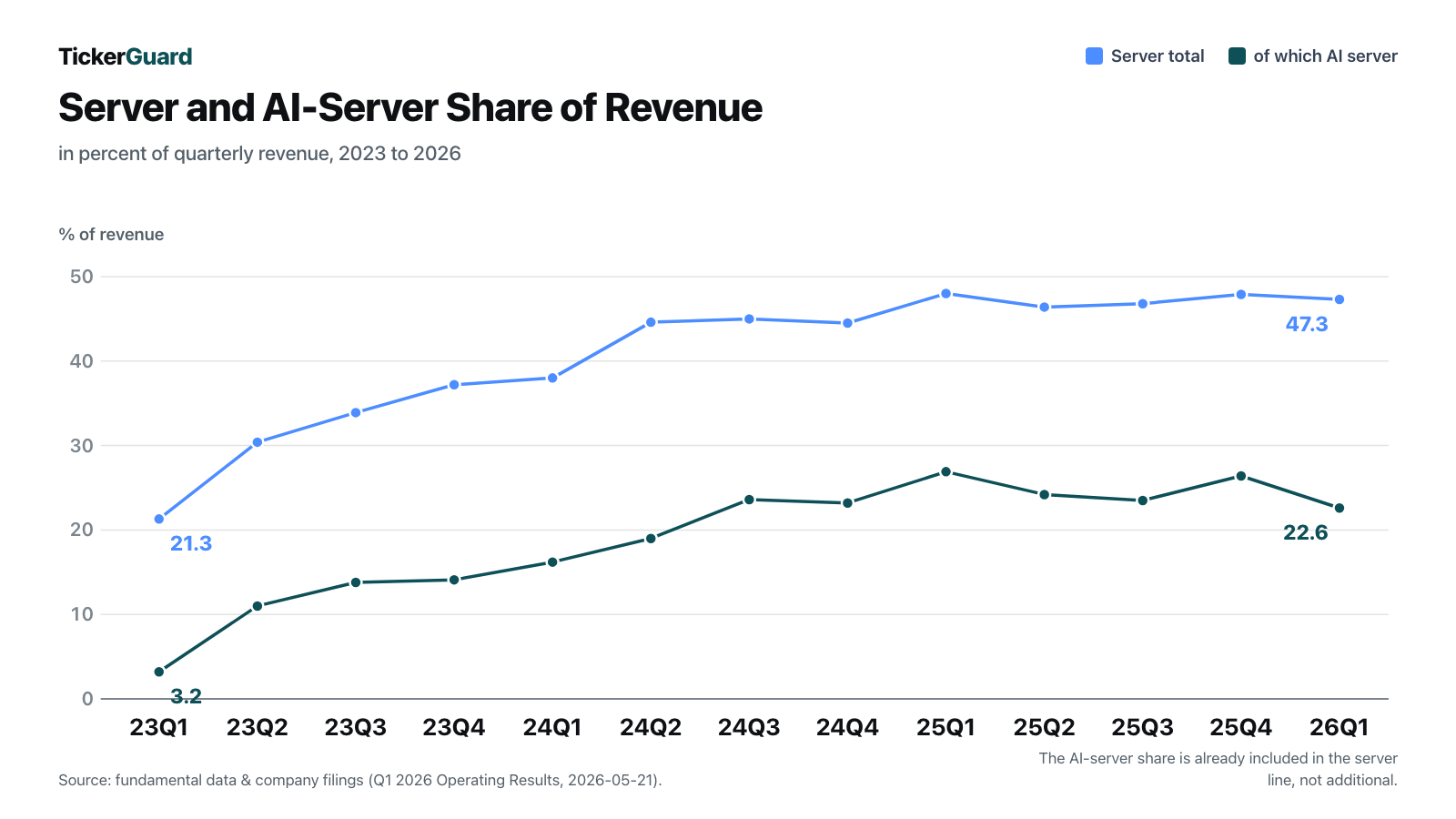
The central finding from both sources: the server share of revenue climbed from 21.3 percent in the first quarter of 2023 to 47.3 percent in the first quarter of 2026 — more than doubling in three years. Within that server segment, the pure AI-server share rose from 3.2 to 22.6 percent over the same period. Per the independent summary of the May earnings call, management named ASIC customers (custom chips, as opposed to standard graphics processors) as a growth driver, with mass production for these customers expected to ramp starting in the third quarter of 2026.
What takes up noticeably more space in the slides than today's revenue contribution justifies is liquid cooling: by the company's own roadmap, 2025 was the year of building research and production capacity, and the first half of 2026 the phase of initial deliveries of cold plates and cooling modules — the "revenue contribution" from cooling plates is slated for the second half of 2026, not for today. Per the independent summary of the May earnings call, management also referenced a "world-first" 800-volt EC fan product for data centers, with deliveries starting in August 2026 — again a promise for the future, not revenue already booked.
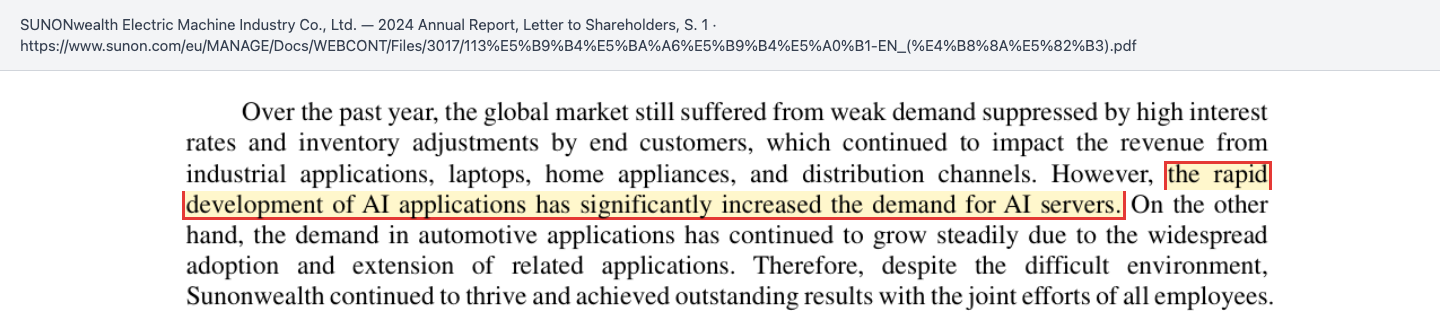
"The rapid development of AI applications has significantly increased the demand for AI servers."
— Sunonwealth, 2024 Annual Report, Letter to Shareholders, p. 1
What the Filings Show — the Uncomfortable Truths
Uncomfortable truth no. 1: The celebrated liquid-cooling business still has almost no revenue — and growth is already slowing
The investor presentation devotes several full pages of renderings and product photos to cold plates, CDUs and liquid-cooling racks for AI data centers. By the company's own timeline, however, 2025 was only the year of building capacity, and the first half of 2026 the phase of initial deliveries — the actual revenue contribution is announced for the second half of 2026, not yet delivered. At the same time, revenue growth has already slowed: 20.6 percent in the first quarter of 2026, but only about 16.2 percent in the second (our own calculation: TWD 5,418.6 million versus TWD 4,663.3 million in the prior-year quarter). Net income, by contrast, grew 84.5 percent in the same quarter — carried by a rising margin, not by additional volume. Anyone buying this stock today for the liquid-cooling story is buying a promise with a concrete date attached (second half of 2026) — not yet a revenue record.
Uncomfortable truth no. 2: Almost half of revenue now hangs on a single cyclical theme
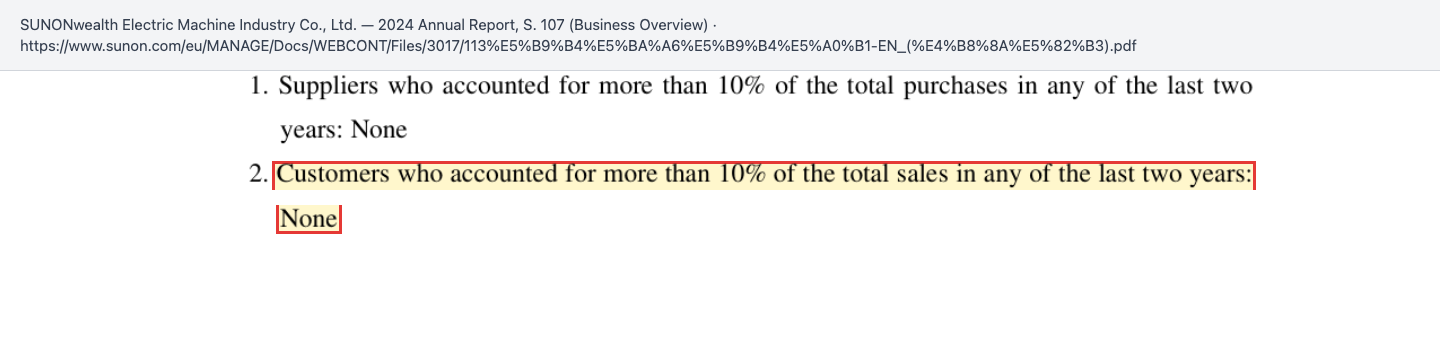
The 47.3 percent server share of revenue (first quarter of 2026) means that almost every second Taiwan dollar of revenue is now tied to the investment cycles of the cloud and AI infrastructure industry. In fairness, there's a counterargument straight from the annual report itself: neither in 2023 nor in 2024 did a single customer account for more than 10 percent of group revenue — unlike companies with genuine concentration risk tied to one large customer, Sunonwealth's customer base is broadly spread, even within the server business. That reduces single-customer risk, but it does not remove the thematic risk: the 2023 revenue decline (down 9.2 percent, before the AI boom) shows that the industry as a whole is cyclical — if cloud providers' investment appetite falters, that now hits almost half of group revenue at once, even without any single customer being responsible. How unevenly that growth is now distributed shows up in the investor presentation's breakdown by application: in the first quarter of 2026, the Telecom & Server segment grew 24.5 percent and IT & OE (original equipment) as much as 31.9 percent — while the Home Appliances segment shrank 11.9 percent over the same period, and Distribution (up 16.1 percent), Industrial/Medical Equipment (up 12.1 percent) and Automotive (up 1.8 percent) all lagged well behind server growth.
Uncomfortable truth no. 3: A cyberattack hit the company's own servers — and the chairman has run the company doubly ever since
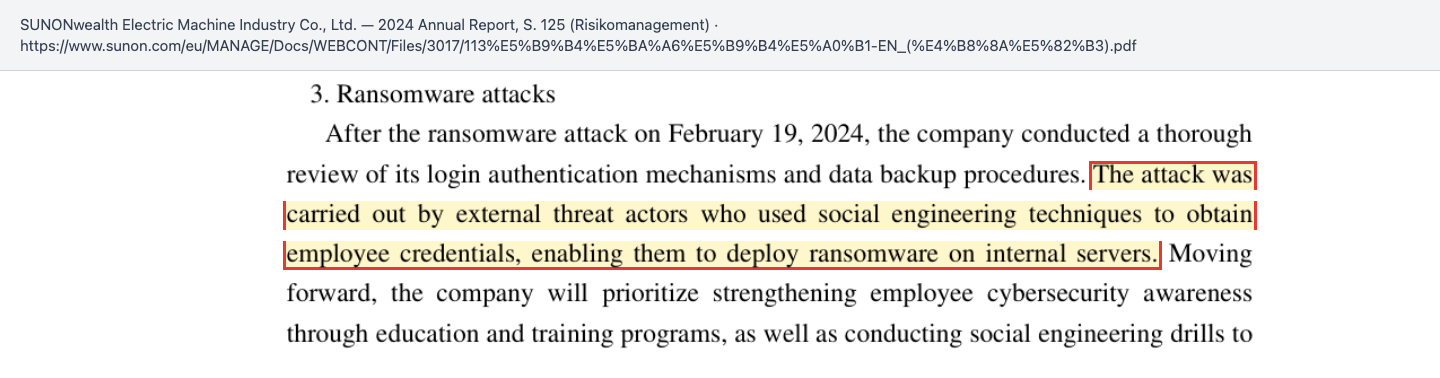
On February 19, 2024, external attackers obtained employee credentials through social engineering and used them to deploy ransomware on internal servers — Sunonwealth discloses this itself in the 2024 annual report and classifies the financial impact as not material, despite holding ISO 27001 certification since 2023. A few months later, on June 14, 2024, the shareholders' meeting re-elected the board of directors — with the result that Chairman Ching-Shen Hong now also serves as President. The annual report itself frames this as continuity without a control risk; from an outsider's perspective, however, it means oversight and operating management now sit with the same person.
"The attack was carried out by external threat actors who used social engineering techniques to obtain employee credentials, enabling them to deploy ransomware on internal servers."
— Sunonwealth, 2024 Annual Report, p. 125
Valuation
With 286,040,000 shares outstanding and a price of TWD 163.50 (August 28, 2026), Sunonwealth's market capitalization works out to roughly TWD 46.77 billion — about $1.48 billion or €1.27 billion (exchange rates as of August 30, 2026: $1 = TWD 31.65, €1 = TWD 36.76). Against book value per share of TWD 36.79, that puts the price-to-book ratio at roughly 4.4.
On price-to-earnings: based on trailing-twelve-month earnings per share of TWD 9.57, the stock trades at a P/E of about 17 — a moderate figure for a growing cooling-technology maker with an AI tailwind, noticeably lower than some other Taiwanese stocks riding a similar story. Using the consensus estimate for the current 2026 fiscal year (TWD 10.57 earnings per share) works out to a P/E of roughly 15.5; for the 2027 estimate (TWD 12.91), roughly 12.7 — the valuation gets even more favorable against future earnings, assuming those estimates hold. The "forward P/E" figure supplied in the fundamental data diverges meaningfully from this own calculation and is deliberately not cited, because it does not reconcile with the consensus earnings estimates reported alongside it.
Dividend yield sits at roughly 3.4 percent (a TWD 5.50 dividend for fiscal year 2025 against the current price), on a payout ratio that ranged between 60 and 88 percent of earnings over the past ten years (69 percent most recently). The balance sheet shows a net cash position: as of December 31, 2025, cash of TWD 5.26 billion stood against TWD 1.08 billion in short- and long-term bank loans combined (TWD 470 million plus TWD 613 million, per the investor-presentation balance sheet; net surplus cash of roughly TWD 4.17 billion); by March 31, 2026, long-term bank loans had been paid down to zero entirely, while cash kept rising to TWD 6.01 billion (March 31, 2026) and TWD 6.54 billion (June 30, 2026). The current analyst consensus price target, per fundamental data, stood at TWD 197.25 — about 20.6 percent above this analysis's valuation anchor; like any price target, that is an estimate, not a guarantee.
Opportunities and Risks at a Glance
Opportunities: a structurally growing server and AI-server business (revenue share up from 21 to 47 percent in three years), a liquid-cooling unit not yet reflected in revenue but with a concrete ramp date (second half of 2026), manufacturing spread across six sites in three countries (Taiwan, China, the Philippines), a solid net-cash position with essentially no bank debt, a dividend paid without interruption for over ten years and recently raised significantly, and a valuation that is moderate compared with some other AI-supplier stocks (trailing P/E around 17) at a below-average beta of 0.90. Risks: almost half of revenue now hangs on a single cyclical theme (server/AI-server), as shown by the real-world scenario of the 2023 revenue decline (down 9.2 percent); the celebrated liquid-cooling business remains a promise, not yet a revenue driver; growth already slowed from the first to the second quarter of 2026; a social-engineering ransomware attack on internal servers was disclosed in 2024; the chairman and president roles have been combined in one person since June 2024; and shares outstanding rose 3.7 percent in a single quarter for reasons not evident from the sources available.
A Human Verdict
The salience effect is a tricky one, because the eye-catching images aren't wrong — Sunonwealth genuinely does build cold plates for AI servers, its server revenue share genuinely is growing fast, and the company genuinely has a "world-first" 800-volt EC fan product in its pipeline. What the slides don't show is timing: liquid cooling isn't set to deliver its revenue contribution until the second half of 2026, while growth in the already-running server business had already slowed from the first to the second quarter of 2026. Anyone who looks at Sunonwealth and sees only the AI-data-center renderings misses a company that has been building unglamorous fans for 45 years, and whose core competence — reliable, broadly diversified cooling-technology manufacturing — is more the reason for its success than any single hot product line. Anyone who looks only at the sober numbers, in turn, misses that this same reliability — net cash, a broad customer base, no single customer above 10 percent — is exactly what lets the company invest in liquid cooling without putting its balance sheet at risk. The honest answer sits in between: a solid, diversified cooling-technology company with a real, but still unproven, AI option on top — and two documented governance and security issues that no investor slide deck shows. No buy or sell recommendation.
Sources
This analysis draws on: the 2024 Annual Report of Sunonwealth Electric Machine Industry Co., Ltd. (140 pages, sunon.com, published March 30, 2025); the "2026 Q1 Operating Results" investor presentation (29 pages, sunon.com, published May 21, 2026); an independent written summary of the May 8, 2026 earnings call (blog.fugle.tw, retrieved August 30, 2026); and fundamental data (pricing, valuation and balance-sheet metrics plus analyst consensus estimates, data as of August 28-30, 2026). No publicly available earnings-call transcripts exist for 2421.TW; our transcript research found no entry for this ticker (checked August 31, 2026). Note: this analysis is a journalistic contextualization of publicly available information, not investment advice, and not a recommendation to buy or sell.
Our Bottom Line at a Glance
- Growth positive
- Revenue rose 27.7 percent in 2025 to TWD 18.68 billion, carried by the server business (revenue share up from 21 to 47 percent in three years). Even in the weak revenue year of 2023, margin kept expanding — a sign of cost discipline, not just top-line growth.
- Growth pace in detail neutral
- Revenue growth already slowed from the first to the second quarter of 2026 (20.6 down to roughly 16.2 percent year over year), while net income grew 84.5 percent in the second quarter — carried by margin, not additional volume. The celebrated liquid-cooling business is not set to deliver a revenue contribution until the second half of 2026.
- Balance sheet and liquidity positive
- Net cash position of roughly TWD 4.17 billion as of December 31, 2025; long-term bank loans paid down to zero by March 31, 2026 per the investor-presentation balance sheet, with cash continuing to rise to TWD 6.54 billion (June 30, 2026). No signs of liquidity strain.
- Customer concentration vs. thematic concentration neutral
- No single customer above 10 percent of revenue in 2023 or 2024 (annual report) — this reduces single-customer risk. But almost half of revenue now hangs on the cyclical server/AI-server theme; the 2023 revenue decline (down 9.2 percent) shows the industry as a whole reacts cyclically.
- Governance and security negative
- A social-engineering ransomware attack on internal servers (February 19, 2024) was disclosed; the chairman has also served as president since a board re-election on June 14, 2024. Both are documented, but not existential, findings.
- Valuation positive
- A trailing price-to-earnings ratio of about 17 (TWD 163.50, August 28, 2026), roughly 15.5 or 12.7 against the 2026/2027 consensus estimates — moderate for a company with a growing AI-server business, at a beta of just 0.90.
Sunonwealth shows a business that is genuinely and structurally growing: the server share of revenue has more than doubled in three years, margin has expanded for years, and the balance sheet is solid with a net cash position. But the liquid-cooling business celebrated in investor presentations remains a promise with a concrete date (second half of 2026), not yet a realized revenue driver, and growth already slowed in the most recent quarter. On top of that come two documented, but not existential, governance and security findings: a 2024 ransomware attack and the combined chairman/president role. Not investment advice.
What Our Rating Means
Quality confirmed
Business model, numbers and balance sheet hold up to our review. Whether the current price supports an entry is a separate question — it hangs on the price, not on the company.
The business model has held up for 45 years, the numbers are consistently verifiable across multiple sources, the balance sheet is healthy with a net cash position and essentially no debt, and there is no existential dependence on a single customer. The ransomware incident and the combined chairman/president role are documented governance questions, but not balance-sheet or governance breaches under the criteria — they belong in the risk assessment, not the quality rating. That the stock currently rides an AI story whose revenue contribution has not yet fully materialized is a valuation argument, not a quality one.
A journalistic assessment by our editorial team at the time of the deep dive, based on public sources — not investment advice and not a solicitation to buy or sell. Your personal circumstances (investment goals, risk capacity, taxes) cannot be taken into account. What our levels mean, how verdicts are formed, and what conflicts of interest exist →
Worth Noting
- The hook for this analysis: the contrast between the AI-data-center imagery of the investor presentation and the still largely traditional actual revenue mix.
- Data as of: 2024 Annual Report (March 30, 2025), "2026 Q1 Operating Results" investor presentation (May 21, 2026), fundamental data through June 30, 2026 (data as of August 28-30, 2026).
- Naming note: Sunonwealth (TWSE: 2421, cooling technology) is not the same entity as other "Sunon"-affiliated names within the wider corporate group (e.g., Sunon Corporation Japan) — this analysis refers exclusively to the listed parent company, SUNONwealth Electric Machine Industry Co., Ltd.
The full analysis as a PDF for later
We will send you this analysis as a PDF — to print, file away, and read at your own pace.
Frequently Asked Questions
Sunonwealth Electric Machine Industry Co., Ltd. (TWSE: 2421) of Kaohsiung, Taiwan, has designed and manufactured cooling fans, thermal modules and, increasingly, liquid-cooling components (cold plates, coolant distribution units) since 1980, for computers, servers, AI data centers, industrial equipment, vehicles and home appliances. The server business made up about 47 percent of group revenue in the first quarter of 2026.
No. Sunonwealth manufactures physical cooling hardware that, among other uses, goes into AI servers — the company benefits from its customers' investment cycle in AI infrastructure, but sells neither AI software nor AI models itself.
Sunonwealth is listed on the Taiwan Stock Exchange (TWSE) and is not registered with the U.S. SEC — there is no 10-K, no 10-Q. Instead, it must publish an annual report and quarterly financial disclosures. This analysis relies on the 2024 annual report and the investor presentation for the first quarter of 2026.
By the company's own timeline, still very little: 2025 was the year of building capacity, and the first quarter of 2026 saw initial deliveries of cold plates. The actual revenue contribution is announced, per the investor presentation, for the second half of 2026.
Per the 2024 annual report, no single customer accounted for more than 10 percent of group revenue in either 2023 or 2024 — so there is no single-customer risk in the narrow sense. However, almost half of total revenue is now tied to the cyclical server/AI-server theme, even though it is spread across many individual customers.
On February 19, 2024, external attackers obtained employee credentials through social engineering and used them to deploy ransomware on internal servers. The company discloses the incident in its 2024 annual report and classifies the financial impact as not material.
At a price of TWD 163.50 (August 28, 2026), the stock trades at a trailing price-to-earnings ratio of about 17. Against the 2026 consensus estimate (TWD 10.57 earnings per share) that works out to roughly 15.5, and against the 2027 estimate (TWD 12.91) to roughly 12.7 — assuming those estimates come in as expected.
Yes. For fiscal year 2025, the company paid TWD 5.50 per share, a yield of roughly 3.4 percent on the current price. The payout ratio ranged between 60 and 88 percent of earnings over the past ten years.
Found an error?
Did you spot a factual error, an outdated number, or a typo in this deep dive? Let us know briefly — your report goes straight to the editorial team.