Hon Precision: 200,157 People Wanted In Before They Saw the Numbers
When Hon Precision priced its November 2025 IPO at TWD 1,495 a share — reportedly the highest issue price in Taiwan Stock Exchange history — 200,157 retail investors applied for shares. A textbook case of the fear of missing out. Nine months later the stock trades at TWD 6,490 (August 27, 2026), more than four times the issue price, and revenue at the IC test-handler specialist more than doubled in 2025 to TWD 30.27 billion (roughly €824 million). The catch: almost all of that growth rests on a handful of never-named customers from the world of AI chips. We read the half-year and shareholder-meeting filings to see how solid that really is. No buy or sell recommendation.
 Thomas Mücke
Founder & Publisher
Thomas Mücke
Founder & Publisher
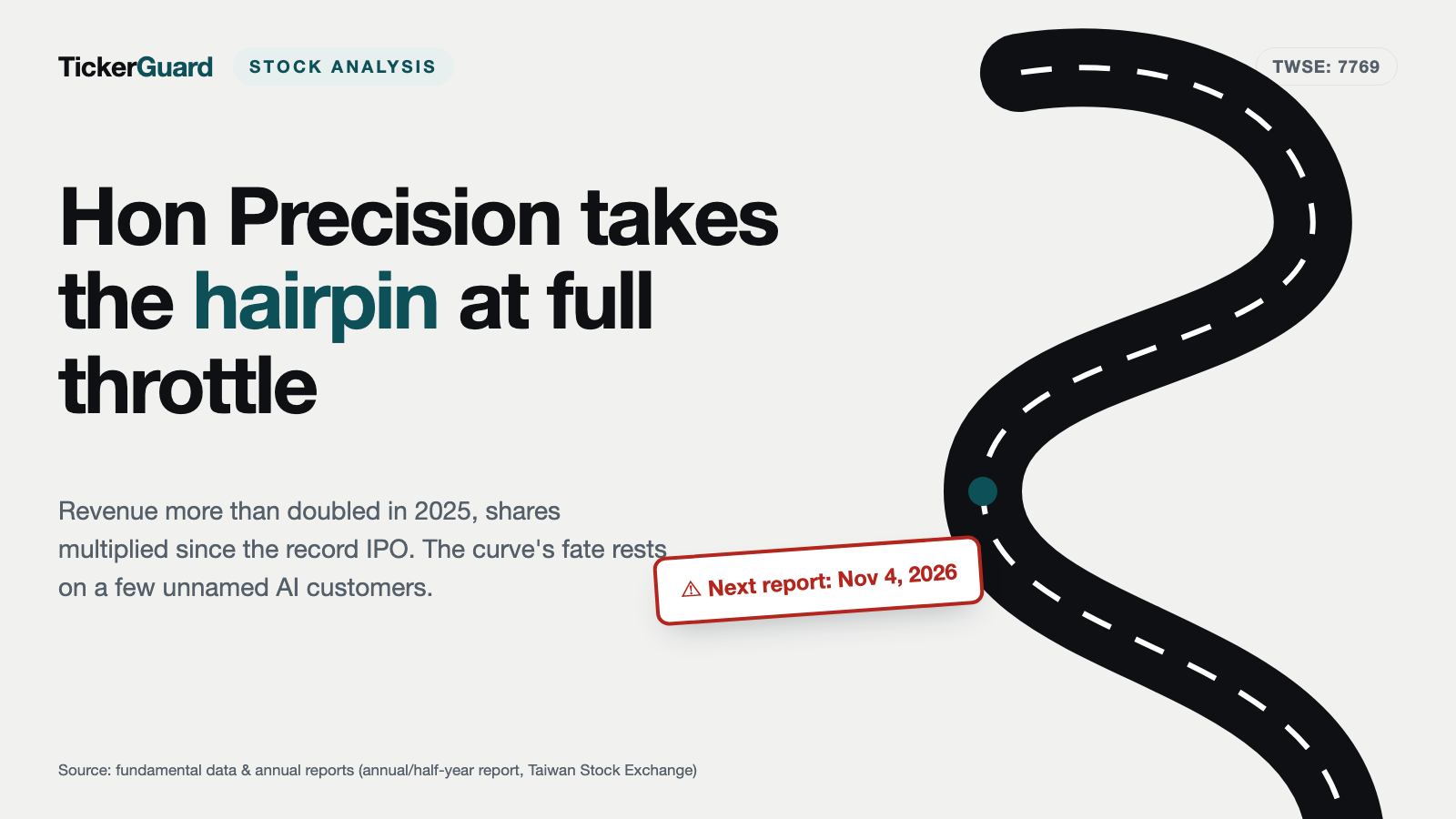
Anyone who has ever seen a line of people waiting outside a bank branch to subscribe to a hot IPO knows a certain reflex — even though today that line is digital. When 200,157 other people desperately want in, it is hard not to want in too. That is exactly what happened in Taiwan in November 2025. Hon Precision, a maker of test equipment for computer chips, listed its shares at TWD 1,495 apiece — reportedly the highest issue price in Taiwan Stock Exchange history up to that point. 200,157 retail investors applied for an allocation, even though a single board lot (1,000 shares) cost nearly TWD 1.5 million. On the first day of trading the stock opened at TWD 2,710, briefly touched around TWD 3,000, and closed roughly 100.66 percent above the issue price. Nine months later, on August 27, 2026, the stock trades at TWD 6,490 — more than four times what the 200,157 hopeful subscribers would originally have had to pay, had they all been allocated shares.
Numbers like that create a very specific pull: the fear of missing out on something everyone else has apparently already understood. But the honest question is not "what did I miss?" — it's "what do the filings actually say?" We read Hon Precision's investor presentations, its shareholder-meeting handbook and the available financial data to find out. Every figure in this analysis is evergreen and carries its own as-of date; the TWD 6,490 price serves only as a valuation anchor from August 27, 2026.
What Hon Precision Actually Does
Before a computer chip leaves the factory and ends up in a smartphone, a server or a car, someone has to check whether it actually works — in heat, in cold and under load, not just at room temperature. That is exactly the business of Hon. Precision, Inc., based in Taichung, Taiwan: the company builds test handlers — machines that pick up individual chips, place them in a test chamber, run electrical measurements under controlled temperatures, and then sort them by quality. On its own product page, the company describes itself as a maker of final test, system-level test, flash/DRAM test and burn-in handlers, as well as "Active Thermal Control" (ATC) systems that deliberately heat or cool a chip during testing, because some defects only show up under heat or cold. On top of that come cold-plate liquid cooling systems, which are increasingly being deployed directly at customer sites in continuous operation, not just in the test lab.
"Operations expanded from the R&D and production factory in Taiwan to the investment and establishment of subsidiaries in China and the United States."
— Hon. Precision, Inc., company profile, honprec.com/en/about/ (retrieved 2026-08-29)
Per TWSE disclosures around the IPO, the company holds more than 600 patents in Taiwan, the United States, China, South Korea and Japan, with a focus on thermal control, high-speed parallel testing and optical imaging. One detail matters for what follows: on its own product page, Hon Precision explicitly distances itself from an obvious misunderstanding. Its so-called AOI handler — equipment that inspects components for visible defects with a camera — is explicitly not described as an artificial-intelligence product:
"The AOI (automatic optical inspection) handler is one such equipment that inspects and handles electronic elements by applying optical technologies."
— Hon. Precision, Inc., product page, honprec.com/en/products/ (retrieved 2026-08-29)
That is not a throwaway line: Hon Precision does not sell a single product marketed as "artificial intelligence" — instead, the company benefits from the fact that its customers build AI chips, and those chips need to be tested. The difference between "sells AI" and "tests what AI chips are made of" runs through this entire assessment.
Company history for investors
-
1999
Predecessor "Hon. Technology, Inc." founded
The predecessor company is founded to develop test handlers — the starting point of today's business.
-
2015
Today's "Hon. Precision, Inc." founded
Today's parent company is founded; a year later the Suzhou, China subsidiary follows.
-
2022
New "Longshan" plant begins operation
With the Longshan plant and the U.S. subsidiary, the manufacturing and sales footprint expands beyond Taiwan.
-
2025
IPO with record issue price
On November 27, 2025 the stock lists on the Taiwan Stock Exchange for the first time, at TWD 1,495 per share — reportedly the highest IPO price in Taiwan Stock Exchange history, with 200,157 subscription applications.
-
2026
First dividend, 50 percent capacity expansion announced
The 2026 shareholder meeting approves a distribution of TWD 65 per share for fiscal year 2025; the company announces a 50 percent capacity expansion by 2027, driven by AI/HPC/ASIC demand.
How This Stock Landed On Our Desk
The reason for this analysis is unremarkable, and honestly worth naming as such: an IPO with the highest issue price in Taiwanese history and a share price that more than quadrupled within nine months is a story readers inevitably encounter — in forums, in press coverage, in tips from friends. That pull of record numbers and a lack of English-language context is exactly what prompted us to read the original filings rather than rely on the price chart. What became of the 200,157 subscription applications and the record issue price is the subject of the rest of this analysis.
The Numbers Over the Years — an Honest Accounting
Anyone looking only at the trailing twelve months misses the backstory. Hon Precision's revenue was anything but a straight line up: TWD 13.47 billion (2022), a decline to TWD 9.49 billion (2023), then a recovery to TWD 13.99 billion (2024) and finally a jump to TWD 30.27 billion (2025) — up 116.3 percent in the most recent year, equal to roughly €824 million or about $956 million (exchange rates as of August 29, 2026: €1 = TWD 36.74, $1 = TWD 31.67). Gross margin stood at 56.54 percent in 2025, net margin at 40.83 percent — both exceptionally high for a machinery maker.
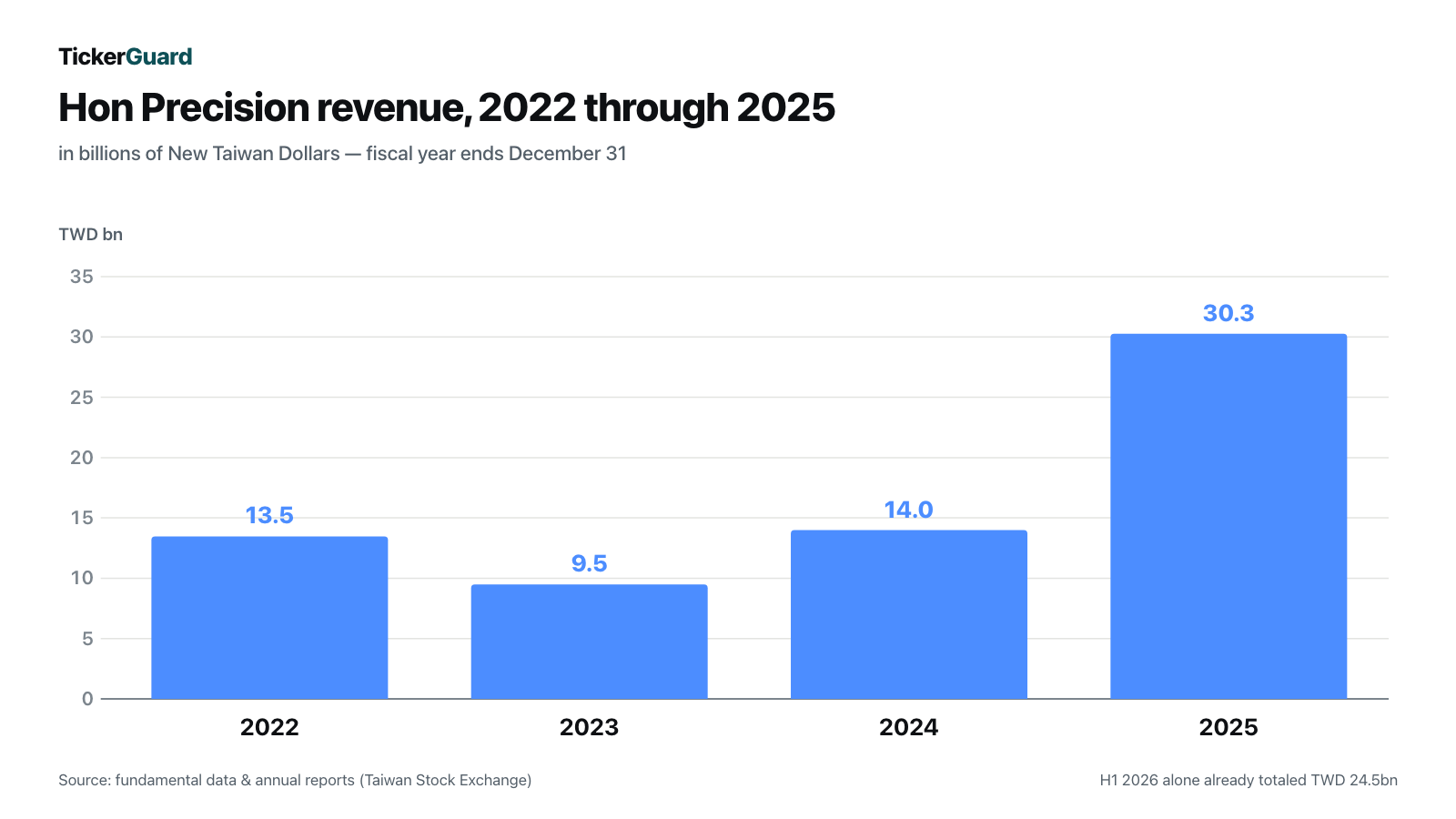
The first half of 2026 topped even that pace: TWD 24.52 billion in revenue in just six months — already 81 percent of the entire prior-year revenue —, at a gross margin of 56.15 percent and earnings per share of TWD 56.14 (prior-year period not separately disclosed, as it predates the IPO). Q2 2026 alone brought in TWD 13.79 billion, after TWD 10.73 billion in Q1 2026 — both figures already exceed the entire 2023 annual revenue.

What the Investor Presentations Show — Without Earnings-Call Transcripts
An honest caveat up front: for Hon Precision, there are no publicly available transcripts of analyst calls — unlike many U.S. stocks, where verbatim records of the question-and-answer sessions exist. Instead we reviewed the written investor presentations for the first and second quarters of 2026 (dated 2026/05 and 2026/07) that the company itself publishes. That is weaker evidence than a verbatim transcript — we flag that deliberately here rather than glossing over it.
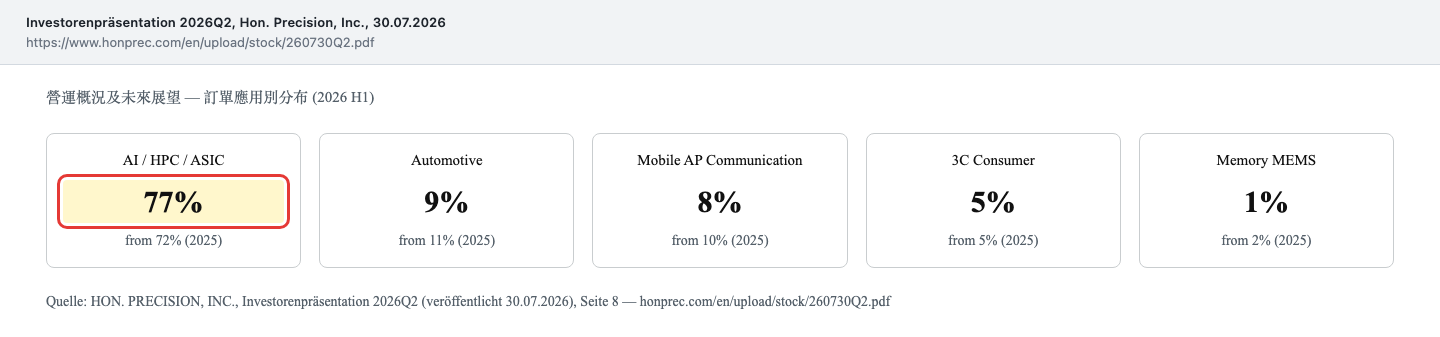
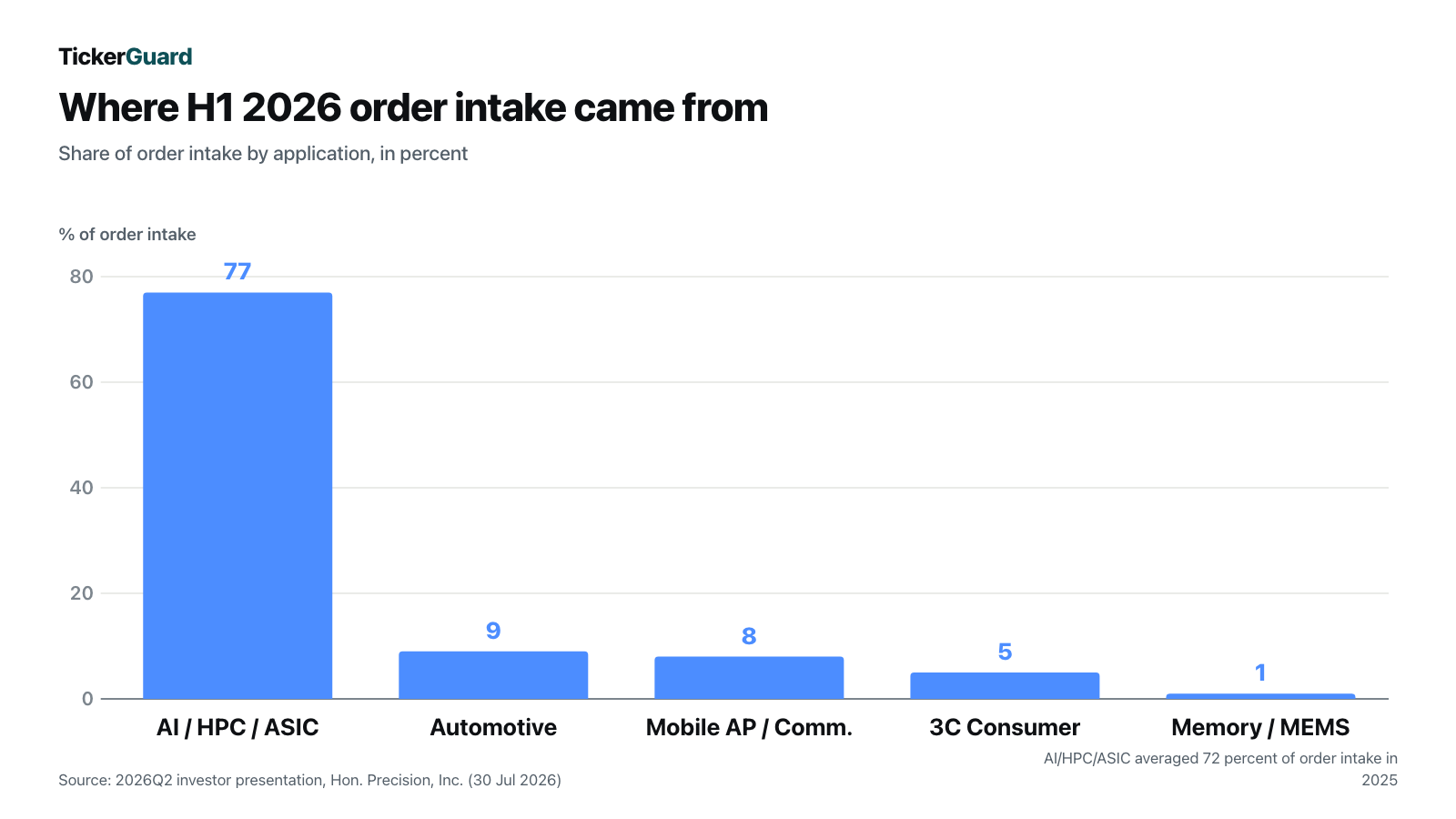
What these presentations do show is still revealing. The order mix has shifted noticeably within a year: AI, HPC and ASIC customers accounted for 72 percent of order intake on average across 2025 — by the first quarter of 2026 that had already reached 78 percent, and 77 percent across the first half of 2026 overall. On the other side, automotive shrank (from 11 to 9 percent), mobile AP/communications (from 10 to 8 percent), and memory/MEMS (from 2 to 1 percent); 3C consumer electronics stayed roughly flat at 5 percent (with minor swings over the year).
Specifically, the Q2 2026 presentation names several development threads without disclosing customer names: a "major U.S. EV customer" is expected to start volume shipments of the highest-end machines from the second half of 2026; a "major TPU maker" (tensor processors for AI data centers) is expected to ship in volume to Taiwanese and Singaporean contract manufacturers in the second half of 2026 — an ecosystem of outsourced semiconductor assembly and test (OSAT) providers that also includes Asian semiconductor-supply-chain names we have already put under the microscope, such as South Korea's MK Electron — and a "U.S. cloud customer" is said to be raising the specification for its next CPU-plus-TPU generation to more than 10 kilowatts of cooling capacity, a level that pushes existing systems to their limits. On capacity, the company is guiding to a 50 percent expansion by 2027: a new plant in Deshen (Taiwan, production start Q1 2027, plus 15 percent capacity), local manufacturing in China (Q1 2027, plus 20 percent), and an expansion at the existing headquarters (plus 15 percent). On top of that come new customer-dedicated plants in Thailand (H2 2026 through 2027, for a U.S. auto-chip maker) and planned OSAT sites in the United States, Singapore and the U.S. state of Arizona.
What the Filings Show — the Uncomfortable Truths
Uncomfortable Truth No. 1: Growth Hangs on Customers Nobody Names
77 to 78 percent of order intake comes from a single application area — AI, HPC and ASIC chips. That is not a footnote; it is the entire growth foundation of the company. And yet none of the reviewed presentations names a single customer. Instead there is talk of a "major U.S. EV customer," a "U.S. customer in Austin" (working on the next CPU generation), an "Israeli customer" for ASIC switches, and a "U.S. cloud customer" for TPU successors. That is not unusual in the semiconductor supply chain — non-disclosure agreements with chip designers are industry standard — but it does not change the fact that a reader cannot independently verify the concentration risk. Should even one of these unnamed major customers delay orders or switch to a competitor, it would show up in order intake immediately, without the public ever knowing in advance which customer it was.
Uncomfortable Truth No. 2: Equity Shrank Despite a Record Profit — for a Good Reason
Anyone tracking only the balance sheet total might get a scare: equity fell from TWD 62.72 billion (March 31, 2026) to TWD 56.80 billion (June 30, 2026) — a decline of TWD 5.92 billion, even though the company earned TWD 5.48 billion in net profit in the second quarter of 2026 alone. The reason is spelled out in the 2026 meeting handbook: for fiscal year 2025, the shareholder meeting approved a distribution of TWD 55 per share from retained earnings plus TWD 10 per share from the capital reserve — TWD 65 in total, the first dividend since the IPO.
「擬自可分配保留盈餘中提撥新台幣9,894,665,000元,每股配發現金股利新台幣55元。」
Translation: "It is proposed to appropriate NT$9,894,665,000 from distributable retained earnings and to distribute a cash dividend of NT$55 per share."
— Hon. Precision, Inc., 2026 Annual Shareholders' Meeting Handbook, page 5

Together that is roughly TWD 11.69 billion (9,894,665,000 plus 1,799,030,000) — paid out on July 30, 2026 per fundamental data, but already booked as a liability as of June 30, 2026, which is why liabilities swelled from TWD 17.87 billion to TWD 28.48 billion over the same period. The drop in equity is therefore not a warning sign but an unusually generous capital return to shareholders within the first year after the IPO — though it also shows that a substantial part of what was once a well-stocked war chest has since been paid out rather than reinvested, at the same time as a 50 percent capacity expansion is due by 2027.
Uncomfortable Truth No. 3: Nine Months of Trading History Carries a P/E of 64
Hon Precision has only been officially listed on the Taiwan Stock Exchange since November 27, 2025. At a price of TWD 6,490 (August 27, 2026) and trailing-four-quarter earnings per share of about TWD 100.60 (TWD 22.34 + TWD 22.15 + TWD 25.70 + TWD 30.41 for Q3/2025 through Q2/2026), the price-to-earnings ratio works out to roughly 64.5 — a valuation that usually presumes years of growth history, resting here on less than a year of public financial reporting. There is also a methodological trap in the often-cited "52-week range": the arithmetic annual low of TWD 1,695 dates from August 27, 2025 — more than three months before the official IPO, i.e. from pre-IPO trading on Taiwan's Emerging Stock Market (興櫃), where Hon Precision previously traded as the so-called "king of pre-IPO stocks." A price comparison that blends this phase unremarked into the "52-week range" of a regularly listed stock overstates the comparability.
Valuation — Expensive by Every Metric, but With Substance Behind It
With 179,930,000 shares outstanding (2026 Shareholders' Meeting Handbook, as of April 17, 2026) and a price of TWD 6,490, market capitalization works out to roughly TWD 1,167.7 billion — about $36.9 billion or €31.8 billion (exchange rates as of August 29, 2026). The price-to-sales ratio on trailing-twelve-month revenue (H2 2025 plus H1 2026 from the investor presentation, TWD 41.99 billion combined) stands at roughly 27.8, enterprise value to trailing-four-quarter operating profit (TWD 20.32 billion; not a true EBITDA figure, since depreciation and amortization are not separately disclosed) at roughly 54.9, and price-to-book at roughly 20.6 — by every one of these metrics, one of the most expensive stocks this newsroom has analyzed in recent months.
What makes the high valuation more tolerable than at some other AI beneficiaries: there is real, already-delivered substance behind it. Gross margin has stayed above 55 percent for three years running, net margin above 40 percent, the company is essentially debt-free, and free cash holdings of TWD 52.7 billion (June 30, 2026) equal roughly 4.5 percent of the entire market capitalization. The analyst consensus price target reported by fundamental data stands at TWD 9,210, about 42 percent above the current price — though that is an aggregated consensus figure without an individual breakdown, so the spread of opinions cannot be traced.
Opportunities and Risks at a Glance
Opportunities: a structurally growing end market (AI and HPC chips require more demanding testing than classic consumer chips, because more compute means more heat and more failure risk), an immaculate balance sheet with essentially no debt, an already-approved 50 percent capacity expansion with concrete plant timelines through 2027, a high and so far stable gross margin above 55 percent, and management that already returned a substantial dividend to shareholders in its first year as a public company. Risks: extreme, publicly unverifiable customer concentration in a handful of AI/HPC major customers; a valuation that leaves virtually no room for disappointment (P/E near 64, P/S near 28); a trading history of just nine months with no tested business-cycle downturn; a buyback program that was barely executed at a fraction of today's price; and a cyclical core business — semiconductor test-equipment makers have historically always gone through downturns whenever chipmakers paused their capacity expansions.
A Human Verdict
In November 2025, 200,157 people wanted in without being able to see the 2026 half-year numbers — they knew only the company's reputation, the scarcity of the shares, and the prospect of a first-day pop. Nine months later, it turns out the underlying business really has grown impressively, not just the stock price. But that is exactly what makes the real lesson harder than a simple "hype or substance": both are true at once. Revenue really has more than doubled, margins really are high, the balance sheet really is robust — and yet almost all of that growth rests on a handful of customers nobody can name, in a market that has swung up and down before. Anyone buying in today at TWD 6,490 is no longer buying a story — they are already paying for a slice of the future, and taking on a risk the 200,157 first-time subscribers in November 2025 did not yet carry at that price. No buy or sell recommendation.
Sources
This analysis draws on: the 2026Q1 (May 2026) and 2026Q2 (July 30, 2026) investor presentations of Hon. Precision, Inc.; the meeting handbook of the 2026 annual shareholders' meeting; the TWSE Market Insights announcement of the IPO; the corporate and product pages of honprec.com; fundamental data (balance sheet, income statement, cash flow, price and valuation metrics, as of August 27-29, 2026); and press coverage of the IPO (bnext.com.tw, businesstoday.com.tw, statementdog.com, ettoday.net, all retrieved August 29, 2026). No publicly available analyst-call transcripts exist for 7769.TW. Note: this analysis is journalistic interpretation of publicly available information, not investment advice and not a buy or sell recommendation.
Our Bottom Line at a Glance
- Growth positive
- Revenue rose 116.3 percent in 2025 to TWD 30.27 billion; the first half of 2026 already added TWD 24.52 billion — 81 percent of the entire prior-year revenue. Growth is carried by AI/HPC test demand, which climbed from 72 to 77-78 percent of order intake between 2025 and 2026.
- Customer and segment concentration negative
- More than three-quarters of order intake comes from a single application area (AI/HPC/ASIC), spread across a handful of major customers that none of the reviewed sources names. A demand shock at even one of these customers would show up in order intake immediately, without the public knowing in advance which customer was affected.
- Balance sheet and liquidity positive
- Essentially debt-free: short-term financial debt of just TWD 32.1 million, no long-term debt. Cash of TWD 52.7 billion (June 30, 2026) equals roughly 4.5 percent of the entire market capitalization. The equity decline in Q2 2026 (TWD 62.7 to 56.8 billion) is fully explained by the approved TWD 65-per-share distribution, not by operating losses.
- Valuation negative
- At TWD 6,490 (August 27, 2026) and trailing-four-quarter earnings per share of about TWD 100.60, the stock trades at a P/E ratio near 64.5, a P/S ratio near 27.8 and a P/B ratio near 20.6 — by every classic metric, one of the most expensive stocks this newsroom has recently analyzed.
- Trading history and data depth neutral
- Only officially listed since November 27, 2025 — less than a year of solid public financial reporting, and no tested business-cycle downturn as a public company. The widely cited "52-week range" partly still blends pre-IPO trading on the Emerging Stock Market with regular exchange trading. No analyst-call transcripts available, only written investor presentations.
- Capital return to shareholders positive
- Already in its first year after the IPO, the company approved a distribution of TWD 65 per share (roughly TWD 11.69 billion) plus an employee bonus pool of TWD 850 million (5 percent statutory pre-bonus base, about 6.9 percent of reported 2025 net profit) — an unusually shareholder- and employee-friendly start for a freshly listed company.
Hon Precision is operationally delivering on what the record IPO subscription promised: 116.3 percent revenue growth in 2025, high and stable margins, an essentially debt-free balance sheet, and already a substantial dividend in its first year as a public company. But almost all of that growth hangs on a handful of never-named AI/HPC major customers, the valuation leaves little room for disappointment at a P/E near 64, and the trading history at nine months is too short for a real business-cycle test. Not investment advice.
What Our Rating Means
Open questions
The business works in principle, but one material question is open. As long as it stays open, our findings do not carry a quality verdict.
Yellow here is not about an existential question — the balance sheet is essentially debt-free, the cash pile of TWD 52.7 billion (June 30, 2026) is well stocked, margins with more than 55 percent gross margin rank among the highest in machinery manufacturing, and the company already pays a substantial dividend in its first year as a public company. Yellow stands because two operating questions remain open that are central to the durability of the business model: first, 77 to 78 percent of order intake hangs on a single, strongly cyclical application area (AI/HPC/ASIC chip testing), spread across a handful of customers named in no source — a concentration that neither threatens the company's existence nor counts as a pricing argument, but ties the growth story to a small, unverifiable customer group. Second, the public financial history at nine months since the IPO (Nov 27, 2025) is too short to judge how the company would weather a real demand downturn in the cyclical semiconductor test-equipment business — a pattern the industry has repeatedly experienced historically. The business model itself — niche leadership in demanding AI-chip testing with documented capacity utilization through year-end 2026 — clearly holds up; whether the customer base broadens and how the company handles its first real downturn will show at the earliest in the Q3 2026 report.
A journalistic assessment by our editorial team at the time of the deep dive, based on public sources — not investment advice and not a solicitation to buy or sell. Your personal circumstances (investment goals, risk capacity, taxes) cannot be taken into account. What our levels mean, how verdicts are formed, and what conflicts of interest exist →
Worth Noting
- This analysis first appeared on 2026-08-29. All company figures come from the 2026Q1 (May 2026) and 2026Q2 (July 30, 2026, most recent period report reviewed) investor presentations and the meeting handbook of the 2026 annual shareholders' meeting — not from press reports. Price, share count and valuation metrics carry an as-of date of August 27-29, 2026; the trailing-twelve-month earnings per share was added up by us from the four most recently reported quarterly figures, not taken unchecked from a data feed.
- No publicly available analyst-call transcripts exist for 7769.TW (checked 2026-08-29: none found). The chapter on the investor presentations therefore relies on written presentation material rather than verbatim transcripts.
- IPO press coverage (bnext.com.tw, businesstoday.com.tw, statementdog.com, ettoday.net) are external, named sources with dates — they do not come from Hon Precision's own corporate reports and are labeled accordingly.
The full analysis as a PDF for later
We will send you this analysis as a PDF — to print, file away, and read at your own pace.
Frequently Asked Questions
Hon. Precision, Inc. (TWSE: 7769), based in Taichung, Taiwan, builds IC test handlers — machines that automatically pick up computer chips after manufacturing, run electrical tests under controlled temperatures, and sort them by quality. On top of that come active thermal control systems and cold-plate liquid cooling. Core products are final test, system-level test, flash/DRAM test and burn-in handlers.
No. The company describes its camera-based inspection system (the AOI handler) on its own product page explicitly as "automatic optical inspection" using "optical technologies," not as an AI product. Hon Precision benefits from the fact that its customers build AI chips that need to be tested — the company itself does not sell AI software or AI hardware.
Hon Precision is listed on the Taiwan Stock Exchange, not in the United States — there is no SEC registration, no 10-K, no 10-Q. Instead the company must file annual and half-year reports plus investor presentations, published through the Taiwan Stock Exchange and its own investor-relations page. This analysis draws on the 2026Q1 and 2026Q2 investor presentations and the 2026 shareholder-meeting handbook.
Very heavily, without being precisely quantifiable: 77 percent of order intake in the first half of 2026 (78 percent in Q1 2026) came from the AI/HPC/ASIC segment, up from 72 percent on average in 2025. The investor presentations only use vague labels like "major U.S. EV customer" or "U.S. customer in Austin" — no customer names.
Yes, for the first time since the IPO: for fiscal year 2025, the 2026 shareholder meeting approved a distribution of TWD 55 per share from retained earnings plus TWD 10 per share from the capital reserve — TWD 65 in total, paid out on July 30, 2026.
At a price of TWD 6,490 (August 27, 2026) and trailing-four-quarter earnings per share of about TWD 100.60, the price-to-earnings ratio works out to roughly 64.5. The price-to-sales ratio stands at about 27.8, price-to-book at about 20.6 — a very high valuation by every one of these metrics.
Since November 27, 2025, on the Taiwan Stock Exchange, at an issue price of TWD 1,495 per share — reportedly the highest IPO price in Taiwan Stock Exchange history up to that point. Before that, the stock traded on the pre-IPO Emerging Stock Market (興櫃). The predecessor company "Hon. Technology, Inc." was founded in 1999, today's "Hon. Precision, Inc." in 2015.
From TWD 13.99 billion (2024) to TWD 30.27 billion (2025, +116.3 percent). In the first half of 2026, TWD 24.52 billion was already added — 81 percent of the entire prior-year revenue. Revenue had still fallen by roughly 30 percent in 2023 versus 2022, though, before the recovery began.
Found an error?
Did you spot a factual error, an outdated number, or a typo in this deep dive? Let us know briefly — your report goes straight to the editorial team.