MK Electron: A World Leader on a Golden Thread
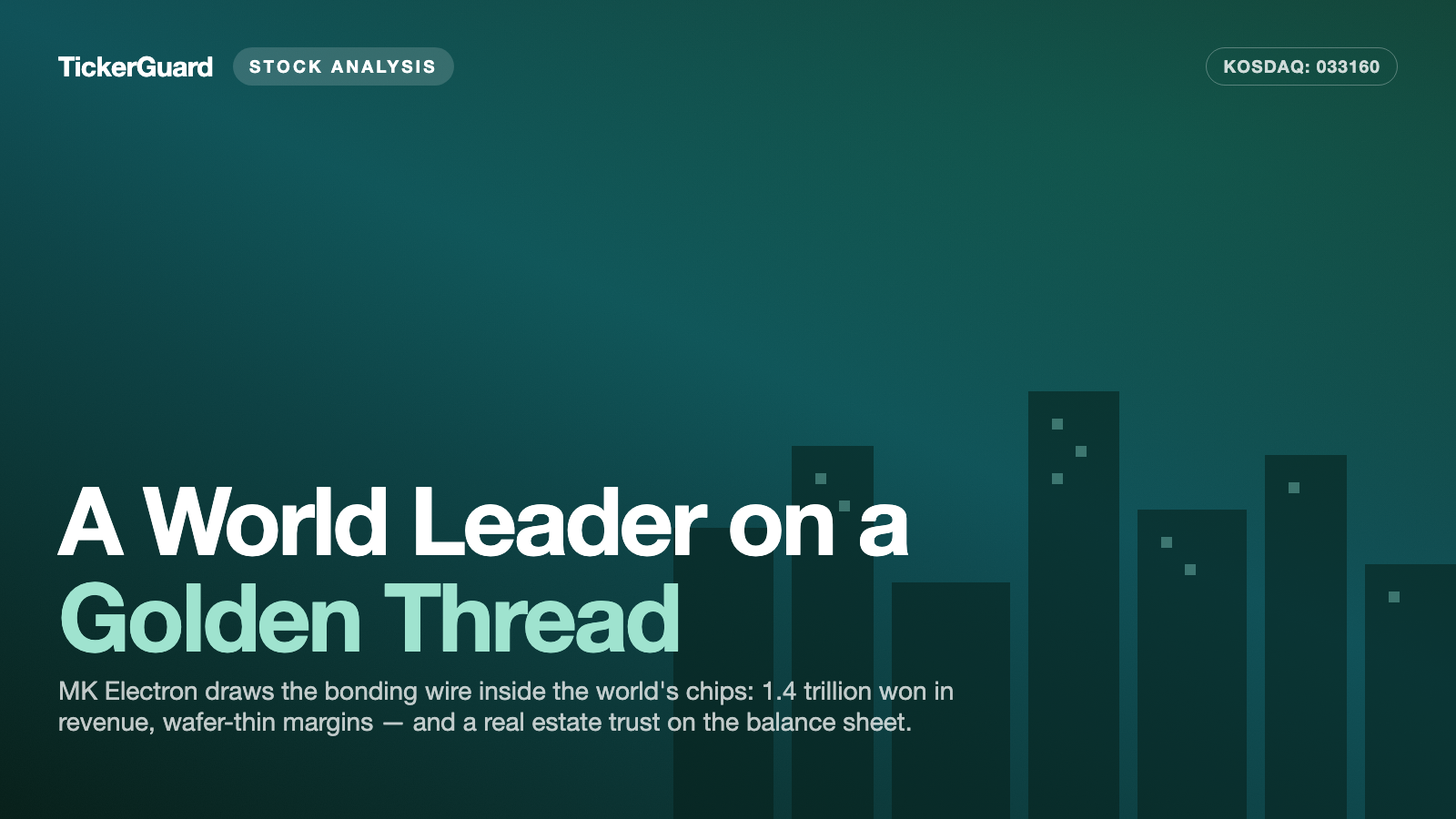
MK Electron (KOSDAQ: 033160) draws the bonding wire that carries signals inside billions of chips — by its own account the global market share leader in 2022. In 2025 the group booked KRW 1,403.8 billion in revenue, roughly $1.0 billion. Shareholders were left with KRW 1.33 billion of it — about $1 million. In between sit a raw material that makes up 99.1 percent of purchasing and has doubled in price since 2024, a real estate trust the company consolidates with a 35.46 percent stake, and a stock that more than quadrupled in the spring of 2026 and then lost more than half. No buy or sell recommendation — just the question of how much sticks when a river of gold merely flows through.
 Thomas Mücke
Founder & Publisher
Thomas Mücke
Founder & Publisher
There is a moment when an investor turns into a chaser: the stock he has been watching for weeks suddenly closes higher every single day — without him. The fear of missing the only thing that is working right now has a name: FOMO. At MK Electron you could watch it operate in the spring of 2026. The stock traded as low as KRW 8,210 in March and hit KRW 34,200 on May 22 — more than four times higher within eleven weeks. On August 21, 2026 it stood at KRW 13,750: down more than half from the peak, yet still far above where the year began. Whoever bought in May because everyone was buying sits on a 60 percent loss. Whoever knew the numbers in March is up roughly two-thirds.
The deal for this piece: no recommendation, no price target. We read the half-year report filed August 13, 2026, the audited annual reports and the mandatory disclosures in Korea's DART filing system — and work out what this company actually earns. The central tension that runs through every chapter: billions flow through MK Electron — gold on the purchasing side, won on the revenue side. Almost nothing sticks. And inside the balance sheet sits a second company that has nothing to do with wire.
What MK Electron actually does — and what else comes attached
MK Electron, based in Yongin near Seoul, has made bonding wire since 1982: a metal filament about one tenth the thickness of a human hair that connects the silicon die to the package leads in classically packaged semiconductors. Without this thread, no signal leaves billions of chips — in cars, phones, appliances and, increasingly, in memory modules for data centers. Add solder balls, tiny spheres for more modern package types, plus smaller lines such as sputtering targets, solder paste and palladium alloys for chip test pins. In the first half of 2026, KRW 747.2 billion of KRW 816.6 billion in product revenue came from bonding wire — 91.5 percent. The market is an oligopoly: per the half-year report, four suppliers share the global business — MK Electron from Korea alongside German and Japanese groups. In 2022, MK Electron says it was the global market share leader; its trophy shelf runs from Texas Instruments and Toshiba through the big packaging houses ASE, Amkor and JCET to an award as outstanding partner company of 2023 from Samsung Electronics in March 2024. Production sits in Korea (Yongin, Eumseong) and in Kunshan, China.
So much for the wire company. Open the consolidated balance sheet, however, and you find total assets of KRW 2,679.4 billion as of June 30, 2026 — more than five times what the parent itself holds. The reason is called Korea Land Trust: a listed real estate trust company that finances and executes construction projects. MK Electron holds — directly and through an intermediate vehicle — only 35.46 percent, yet consolidates it in full, because the remaining shares are widely dispersed and the company's votes have effectively carried every shareholder meeting. In practice, that means the loans, property funds, litigation and completion guarantees of a trust firm with KRW 1,754.5 billion in assets sit on the books of a wire maker. One thing matters for everything that follows: there is no 10-K and no 10-Q for MK Electron — its filings live in Korea's DART system, accounting is K-IFRS, and the fiscal year equals the calendar year. That is why every number in this analysis carries the line "Source: fundamental data & corporate reports (annual/half-year report, DART/Korea Exchange)" instead of "SEC filings".
Company history for investors
-
1997
KOSDAQ listing
Founded in 1982 as Migyeongsa, the wire maker lists on KOSDAQ on November 10, 1997 — and passes through several ownership changes; since 2009 the circle around today's Ocean B Holdings has been in charge.
-
2021
Dongbu Entec acquired
MK Electron buys 100 percent of environmental services firm Dongbu Entec in August 2021 — five years later exactly this stake is sold to fund the core business.
-
2022
World market share leader
By its own account MK Electron reaches the largest share of the global bonding wire market in 2022 — proof the core business is world class even when the group numbers obscure it.
-
2025
Gold price eats the margin
Record revenue of KRW 1,403.8bn, but operating profit collapses 74.7 percent to KRW 14.2bn — shareholders keep KRW 1.33bn. The gold price outruns selling prices.
-
2026
Quadrupled, then halved
AI memory hype and the profit turn drive the stock from 8,210 (March) to 34,200 won (May 22); by August 21 it falls back to 13,750 won. Whoever followed the herd lost 60 percent from the top.
-
2026
Dongbu sale and record half
In June the sale of the environmental unit raises KRW 55.5bn in working capital; in August the half-year report shows KRW 41.5bn in operating profit — and convertible bond no. 15 is swapped into shares at KRW 8,117 in full.
How the stock landed on our desk
MK Electron did not arrive via a screener hit but via the KOSDAQ price board: a near-quadrupling in eleven weeks gets noticed. The monthly table in the half-year report documents the run drily: January 2026 low KRW 8,400, March low KRW 8,210, April high KRW 30,450, May high KRW 34,200 — on monthly volumes that at times topped 36 million shares, more than the entire free float. The run was fueled by the narrative that AI server memory (think LPDDR5 and SOCAMM modules) is once again wire-bonded — and by numbers that backed the narrative: on February 13, 2026 the company reported its return to profit, and on May 15 a first-quarter revenue of KRW 450.1 billion, up about 59 percent year over year.
Worth noting is who stepped in after the pullback: asset manager Mirae Asset stood at 5.77 percent in the shareholder register as of June 30, 2026, and on August 21, 2026 the value boutique VIP Asset Management disclosed a new position of 1,191,711 shares — 4.85 percent, filed as crossing the five-percent threshold with a reporting date of August 13, 2026, the day of the half-year report. A crash that professional value investors buy into is, for us, a reason to read the filings — not a substitute for reading them. One more thing: earnings call transcripts do not exist for this company; more on that below.
The numbers over the years — honestly weighed
First, what genuinely impresses: group revenue grew from KRW 1,023.2 billion in 2022 through KRW 1,117.0 billion (2023) and KRW 1,170.6 billion (2024) to KRW 1,403.8 billion in 2025 — roughly $1.0 billion at the ECB reference rate of August 21, 2026 (KRW 1,384.23 per dollar). The first half of 2026 brought the leap: KRW 915.4 billion in revenue from continuing operations, up 65 percent year over year, of which about KRW 817 billion from products and KRW 98.9 billion from the trust subsidiary's financial business. Operating profit quadrupled from KRW 9.9 billion to KRW 41.5 billion, KRW 25.2 billion of it in the second quarter alone. Parent shareholders were left with KRW 25.7 billion in half-year profit — after KRW 5.5 billion a year earlier. The annual report explicitly credits the AI wave:
"별도 매출액은 AI 인프라 투자 확대와 HBM 등 고성능 반도체 수요가 시장은 견인하며 생산량 확대로 전년대비 2,394억원 증가한 7,954억원으로 43% 증가하였습니다."
Translation: "Separate-entity revenue — carried by expanding AI infrastructure investment and demand for high-performance semiconductors such as HBM — rose through higher production volumes by KRW 239.4 billion to KRW 795.4 billion, up 43 percent year over year."
— MK Electron, fiscal 2025 annual report (사업보고서), section IV, MD&A, filed March 23, 2026
Part of that leap has an address: the segment note shows a new domestic key customer, "Company A", with KRW 145.3 billion in half-year revenue — against zero in the prior-year half. A single new buyer accounts for roughly 43 percent of the entire product revenue increase. That is a genuine growth story — and a genuine concentration risk.
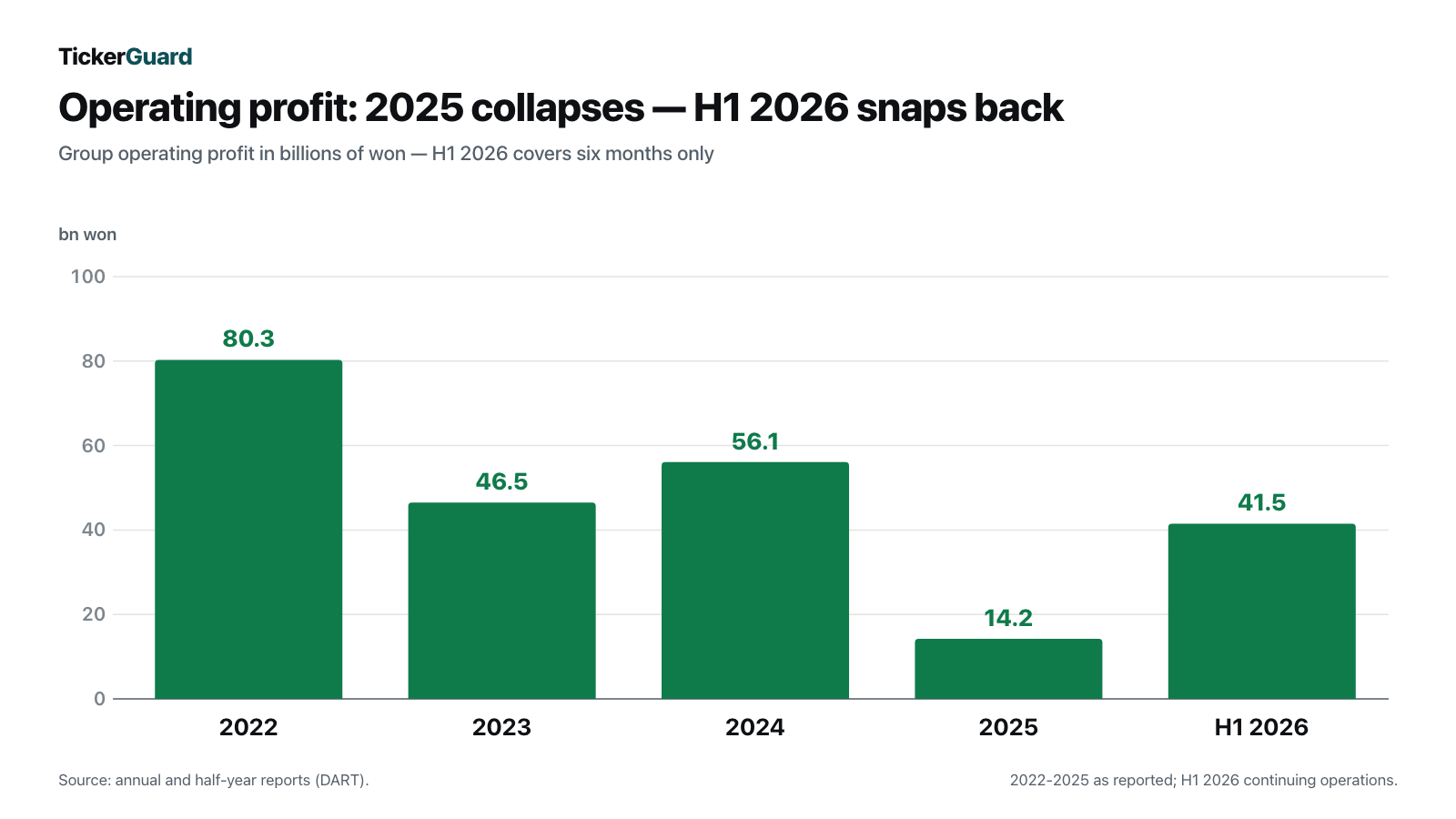
Now the honest cross-check. Below the revenue line the air gets thin: the group gross margin fell from 10.6 percent (2022) through 6.5 and 7.3 percent to 3.5 percent in 2025. Group net income reads accordingly: plus KRW 3.1 billion (2022), minus 39.1 (2023), minus 37.7 (2024), plus 13.8 billion (2025) — of which parent shareholders kept all of KRW 1.33 billion, about $1 million on a billion dollars of revenue. And the cash account tells its own story: group operating cash flow was deeply negative in 2023 at minus KRW 325.7 billion and in 2025 at minus KRW 159.3 billion (2024: plus 166.4), and negative again at minus KRW 111.2 billion in the first quarter of 2026 — growth, gold inventory and the trust unit's loan book devour cash while the income statement shows profits. Memorize this: at MK Electron, revenue measures the gold price, not the company. Why, the first uncomfortable truth explains.
What management promised — and what came of it
First, the transparency footnote: there are no publicly available earnings call transcripts for MK Electron — we queried our transcript archive on August 24, 2026 (zero hits for this company) and checked the usual providers. The company does hold investor events (per DART notices most recently on August 18, 2025, April 23, June 29 and August 13, 2026) but publishes no verbatim records. What management has promised can therefore only be reconstructed from the MD&A chapters of the annual reports, the value-up plan and the mandatory disclosures — the most reliable material available, but written by the company itself.
Promise 1: the cycle. The fiscal 2024 annual report (filed March 2025) forecast growth for 2025 from AI, robotics and servers — the revenue record duly arrived, but operating profit collapsed 74.7 percent to KRW 14.2 billion because the gold price outran selling prices. The fiscal 2025 report (March 2026) doubled down and called a "supercycle" for 2026. This time the direction was right: first-half 2026 operating profit nearly tripled the whole of 2025. One hit, one miss — while the tone swung from cautious (delayed recovery, slower growth than expected) to euphoric.
Promise 2: the new businesses. For years the reports have announced that solder paste, test palladium and silicon anode material for batteries would complement the gold wire business; the wording on anode "market leadership" appears nearly verbatim in both the fiscal 2024 and fiscal 2025 reports. The fiscal 2025 report promised specifically that test palladium and solder paste would "grow in earnest from 2026 and contribute to operating profit". The interim tally in the H1 2026 report: sputtering targets, solder paste and all other lines together brought in about KRW 37 billion — under 5 percent of product revenue. Research spending was KRW 3.4 billion, 0.42 percent of revenue. A group that has researched battery material since 2010 and funds it with less than half a percent of revenue is promising more future than it finances.
Promise 3: the shareholders. On April 1, 2026 — in the middle of the rally — the company published its first corporate value-up plan under Korea's value-up program:
"고사양 패키지 (소캠 등) 물량 대응을 위한 본딩와이어 사업 운전자금 확보 및 Capa 확장 검토 […] 매출 확대, 수익성 개선을 통한 배당 재원 확보"
Translation: "Securing working capital for the bonding wire business and reviewing capacity expansion to serve volumes for high-end packages (such as SOCAMM) […] securing dividend resources through revenue expansion and profitability improvement."
— MK Electron, corporate value-up plan (기업가치 제고 계획, voluntary disclosure), published April 1, 2026
The same plan certifies the firm as a "high-dividend company" for tax purposes — with a payout ratio of 194 percent for 2025. That sounds generous and translates to: the KRW 2.58 billion dividend (KRW 120 per share) was nearly double the profit attributable to shareholders. The dividend has been paid for 15 consecutive years — reliable, but lately out of substance rather than earnings. The fair summary: the operating promises about the core business came true in 2026; the new-business and return promises have been running ahead of the numbers for years.
What the filings say — the uncomfortable truths
Uncomfortable truth no. 1: revenue measures the gold price
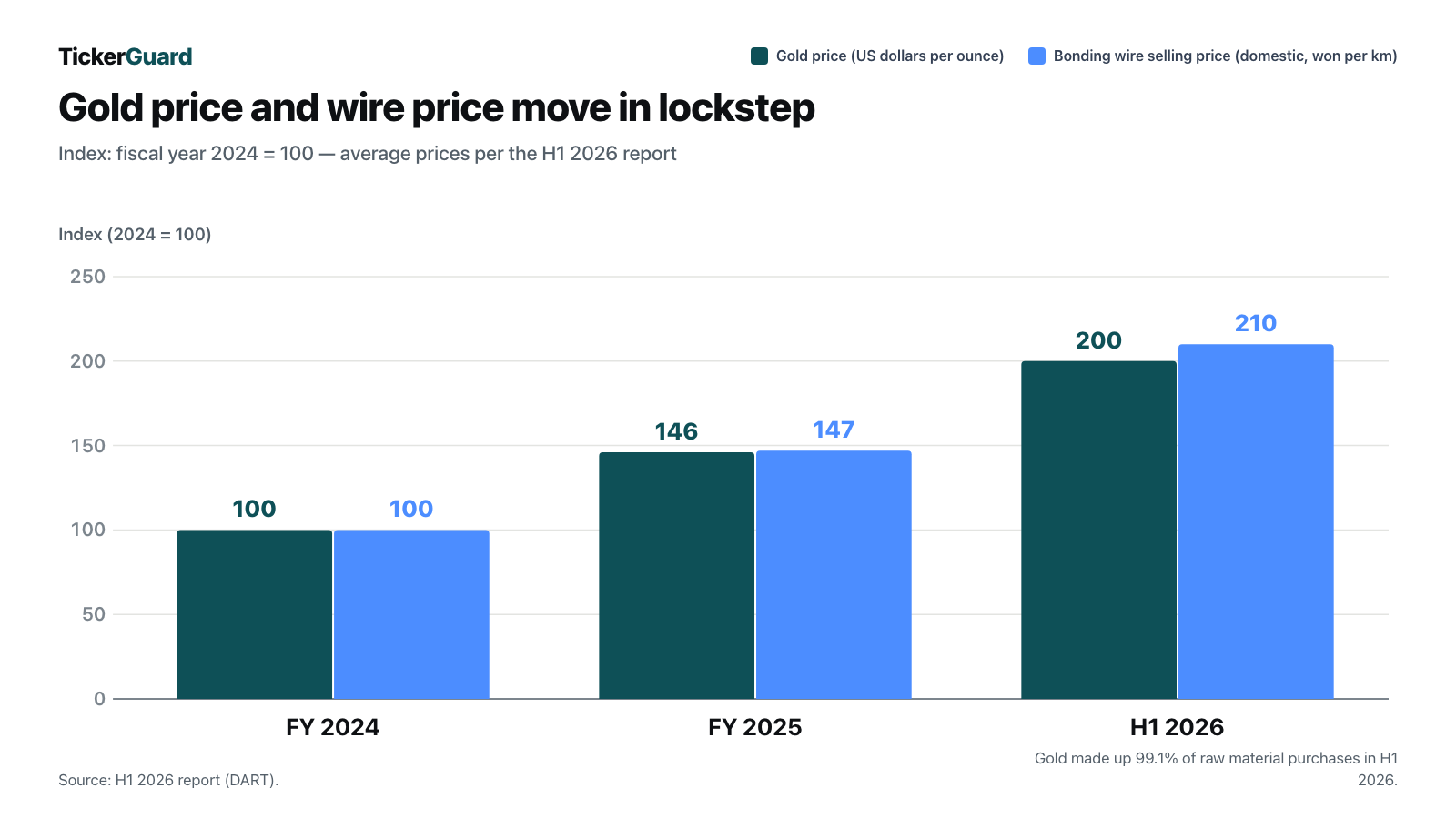
Bonding wire is made of gold, silver or copper depending on grade — and for the revenue driver, gold wire, the metal is practically the entire input. The half-year report quantifies it exactly: 99.10 percent of raw material purchases in H1 2026 were gold, KRW 717.8 billion in six months. The company passes the gold price through to customers via pricing formulas and hedges swings with futures. The consequence sits in the report's price tables: the average gold purchase price rose from $2,374.64 per ounce (fiscal 2024) through $3,472.54 (2025) to $4,748.05 in H1 2026 — up 100 percent. The domestic selling price for bonding wire rose over the same span from KRW 504,491 to KRW 1,059,962 per kilometer — up 110 percent. Revenue "grows" because the pass-through metal gets dearer.
How much "company" is left inside that revenue? The utilization table answers: gold wire lines ran at 58.29 percent utilization in H1 2026, copper wire at 65.66, solder balls at 57.30 percent. A world market leader in a "supercycle" with more than 40 percent idle capacity — that puts the revenue jump in perspective. To be fair: the real value added — drawing, coating, quality — did grow in 2026, or operating profit would not have jumped. But anyone calling this stock cheap on price-to-sales is dividing the market value by the gold price.

Uncomfortable truth no. 2: a 35.46 percent stake, 100 percent of the balance sheet
The second truth sits in a footnote of the consolidation notes — and it explains why this stock is comparable to no other wire maker:
"지배기업은 이러한 보유 의결권의 상대적 규모와 다른 의결권 보유자의 주식 분산 정도, 과거 주주총회의 참석 양상 등을 종합적으로 고려하여 지배기업이 ㈜한국토지신탁에 대하여 사실상 지배력을 보유하고 있는 것으로 판단하고 있습니다."
Translation: "Considering the relative size of its voting rights, the dispersion of the other voting right holders and attendance patterns at past shareholder meetings, the parent company judges that it holds de facto control over Korea Land Trust Co., Ltd."
— MK Electron, half-year report H1 2026 (반기보고서), consolidation note 1, footnote (*2), filed August 13, 2026
With 35.46 percent of the votes (an effective 40.34 percent once the subsidiary's treasury shares are netted out), MK Electron consolidates the trust in full — along with 12 fund and property vehicles beneath the trust. That is why, of the group's KRW 1,062.9 billion in equity, only KRW 415.5 billion belongs to MK Electron's shareholders; KRW 647.4 billion — 61 percent — belongs to minority holders, above all those of Korea Land Trust. Whoever buys the MK Electron share is, for the most part, buying a window onto other people's equity. And the risks come attached: as of June 30, 2026 the trust stood behind completion and payment guarantees with a frame of KRW 1,795.7 billion (loans drawn beneath it: KRW 1,215.4 billion), was a defendant in 135 lawsuits with KRW 194.7 billion in dispute, and had drawn guarantee lines of KRW 5,587.2 billion from the state housing guarantee agency — all standard tools of Korea's developer trust model, but tools that turn live in a property downturn. The first half of 2026 went fine for the subsidiary (KRW 10.7 billion profit); in 2023 and 2024, write-downs from the finance and property block dragged the group into pre-tax losses despite operating profits: minus KRW 45.5 and minus KRW 44.7 billion.

Uncomfortable truth no. 3: growth on credit — at 7.5 percent interest
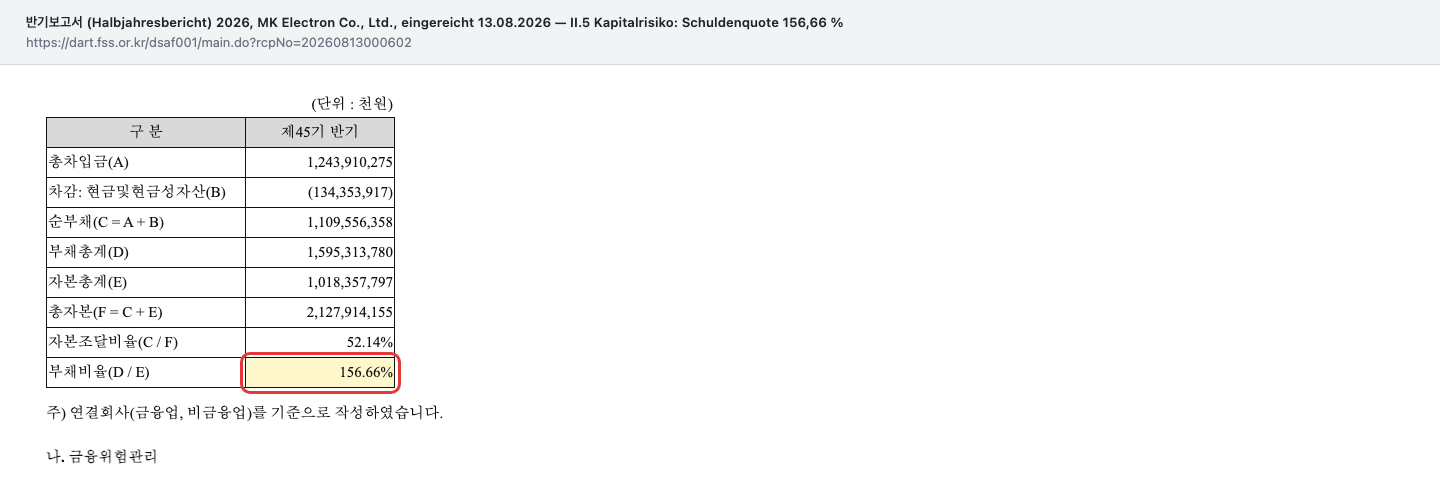
A business model that must hold its working capital in gold devours capital the moment it grows — and that capital has become expensive. The half-year report does the math itself: total borrowings and bonds of KRW 1,243.9 billion stand against KRW 134.4 billion in cash, net debt KRW 1,109.6 billion (about $800 million), debt ratio 156.66 percent. The parent's credit rating has sat at BB+ with Korea Ratings since 2023; NICE D&B cut its grade from BBB− to BB+ in April 2025 and confirmed it in April 2026 — below investment grade. What that costs shows in the bond table: in March 2026 the company placed private bonds at 6.5 and 7.5 percent interest. Group interest coverage in 2025 was 0.68 — operating profit of KRW 14.2 billion did not cover interest expense of roughly KRW 21 billion; only the strong 2026 half lifted it back above one.
How tight the working capital corset sits is revealed by a June 2026 transaction: MK Electron sold Dongbu Entec, the profitable environmental services subsidiary acquired in 2021, in full — for KRW 55.5 billion. The stated purpose:
"하반기 물량증가 대비 위한 운영자금 확보, 신사업 시설투자를 위한 투자자금 확보"
Translation: "Securing working capital to prepare for the volume increase in the second half; securing investment funds for facility investment in new businesses."
— MK Electron, resolution on the disposal of shares in another company (타법인주식및출자증권처분결정), DART disclosure of June 19, 2026
Selling the family silver to fund the gold inventory. The same disclosure holds a detail for readers of fine print: the Dongbu Entec shares were pledged as collateral for convertible bond no. 15 and had to be released by the creditor before the sale. Nor was the divested unit dead weight — it still contributed KRW 57.9 billion in revenue and KRW 3.2 billion in operating profit in H1 2026, earnings that will now be missing.
Uncomfortable truth no. 4: your slice of the pie shrinks — and the February numbers are a sketch
Dilution means the company issues new shares and your slice of the whole gets smaller. At MK Electron this has lately run through convertible bonds — IOUs the creditor can swap into shares. At the end of 2022 there were 21,807,689 shares; by June 30, 2026, already 24,194,466. On August 13, 2026 — the very day of the half-year report — the holder of convertible bond no. 15 exercised in full: 369,592 new shares at a conversion price of KRW 8,117, while the stock traded around KRW 18,000 (the close on conversion day: KRW 17,950). That makes 24,564,058 shares — 12.6 percent more than at the end of 2022. Diluted half-year earnings per share came in at KRW 1,081, below the basic KRW 1,145 accordingly. A second observation from the disclosures fits the pattern: the preliminary 2025 group profit of KRW 21.6 billion reported on February 13, 2026 shrank to KRW 13.8 billion in the audited annual report of March 23 — minus 36 percent in a good five weeks, on practically unchanged revenue. In a group full of fund vehicles, derivatives and trust positions there is a lot of room between preliminary and audited. Both findings also sit in our side-finds feed with concrete watch points.
Uncomfortable truth no. 5: three quarters of the control block sits with lenders
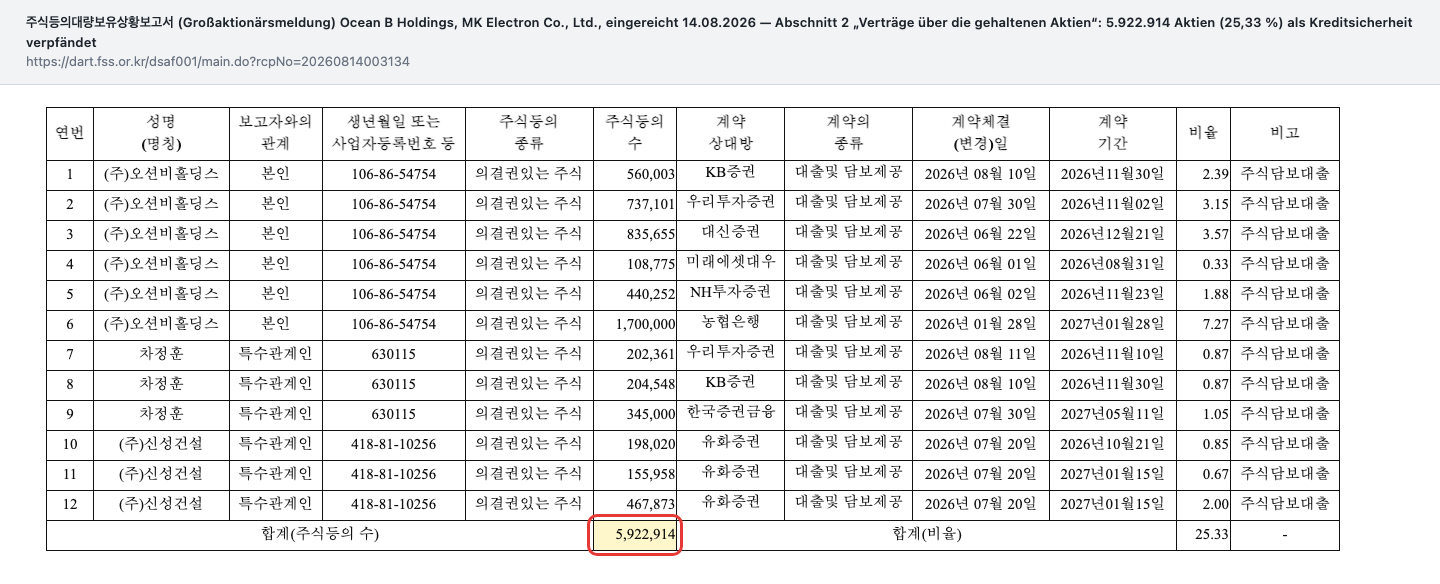
One day after the half-year report, on August 14, 2026, the holding company of the largest shareholder — Ocean B Holdings — disclosed a change to its share contracts. Section 2, "contracts concerning the shares held", lists twelve rows, each carrying the same label: 주식담보대출, a securities loan against pledged shares. Together 5,922,914 shares are pledged; the filing puts that at 25.33 percent — roughly three quarters of the 33.43 percent block Ocean B holds with its related parties. Eight lenders are involved: six brokerages, NongHyup Bank and the Korea Securities Finance Corporation. The loan amounts add up to about KRW 32.1 billion, roughly $23 million, at interest rates between 5.04 and 6.90 percent.
The column that matters is headed 담보유지비율 — the maintenance collateral ratio — and it runs from 110 to 180 percent. Translated: the pledged shares must be worth 1.1 to 1.8 times the loan at all times. If they slip below that, the lender can call for more collateral and, in the worst case, sell — precisely when the price is already falling. For a stock that lost about 60 percent between May 22 and August 21, 2026, that is not an abstraction. The frequency shows how tight things are: between June 26 and August 14, 2026, Ocean B filed five contract amendments, and the shortest terms expire as early as October and November 2026. A control block that has to be refinanced continuously is not a steady anchor — it is a second lever on the same share price.
Valuation: what the market pays for the world leader
At the August 21, 2026 close (KRW 13,750, about $9.90) and with 24,564,058 shares, MK Electron costs about KRW 337.8 billion on the exchange — roughly $244 million. Against that stand KRW 415.5 billion in equity attributable to parent shareholders: a price-to-book ratio of about 0.8. On earnings, everything depends on the year you plug in: on the audited 2025 attributable profit of KRW 1.33 billion the price-earnings ratio would be in the hundreds; annualize the first half of 2026 (KRW 25.7 billion) and you land at a P/E of roughly 6 to 7 — with every caveat against extrapolating an exceptional half in a cyclical business. We deliberately do not offer price-to-sales as a valuation argument: with 99 percent gold in purchasing it measures the metal price (truth no. 1). For the demand backdrop, our Micron analysis looks at the memory cycle from the chipmaker's side — the same AI server demand that fills MK Electron's order books. And how deceptive optically cheap Korean holding structures can be is something our analysis of the Lotte Corporation shows — there, too, the accounts explain the discount themselves.
Upside and risks at a glance
Upside:
- A real demand cycle: half-year revenue up 65 percent, operating profit quadrupled, the second quarter of 2026 stronger than the first (KRW 25.2 billion after 16.2 billion) — carried by AI server memory and automotive chips (half-year report filed August 13, 2026).
- Oligopoly position: one of four major bonding wire makers worldwide, self-reported global share leader in 2022, a "World-Class Product" designation from the trade ministry for gold bonding wire in November 2025, supplier awards from Samsung Electronics, Texas Instruments and ASE.
- Idle capacity as leverage: 57 to 66 percent utilization also means the next demand push needs hardly any new machine capital.
- Professional buyers: Mirae Asset at 5.77 percent (June 30, 2026), value investor VIP Asset Management newly at 4.85 percent (disclosure of August 21, 2026) — and 15 consecutive annual dividends.
Risks:
- Interest and debt: net debt of KRW 1,109.6 billion, a 156.66 percent debt ratio, a BB+ rating, new bonds at up to 7.5 percent (March 2026); 2025 interest coverage was below one.
- Cash drain despite profits: operating cash flow of minus KRW 325.7 billion in 2023, minus 159.3 in 2025 and minus 111.2 billion in Q1 2026 — gold inventory and the trust loan book absorb the cash the income statement shows.
- Real estate cluster: through the 35.46 percent consolidation, group balance sheet and earnings hang on Korea's developer market — in 2023 and 2024 exactly this block turned operating profits into pre-tax losses.
- Customer and metal risk: a single new customer supplies KRW 145.3 billion in half-year revenue; if the gold price falls, revenue shrinks optically with it — and the inventory valuation too.
- Dilution: 12.6 percent more shares since the end of 2022; the convertible bond stays in the company's toolbox.
- Pledged control block: 5,922,914 shares (25.33 percent per the disclosure of August 14, 2026) secure securities loans of about KRW 32.1 billion — with maintenance ratios of 110 to 180 percent, a further slide in the price can trigger additional selling pressure.
A human bottom line
Back to the FOMO from the start. The surge from KRW 8,210 to 34,200 had a true core — the strongest half-year report in years, a real demand cycle, a world leader with idle capacity. And it carried a surplus of fantasy that the market has since corrected on its own: minus 60 percent from the peak. What remains is a company with two faces. One draws a thread from gold that half the chip industry needs, and currently earns better on it than it has in years. The other lugs around a real estate trust, a BB+ rating and a gold inventory bought on credit — and left shareholders exactly KRW 1.33 billion of the record 2025 revenue. If the next spike in this stock tempts you, first read footnote (*2) in the consolidation notes and the raw material table — five minutes that spare you the most expensive shortcut of all: buying because everyone is buying. What you do with it is your decision. And that is a good thing.
Sources
- MK Electron — half-year report H1 2026 (반기보고서, filed August 13, 2026) — most recent periodic report; source of the half-year figures, segments, raw material and price tables, utilization, control footnote (*2), capital risk table, bond and convertible overview, shareholder structure, monthly share prices, and Korea Land Trust contingencies
- MK Electron — fiscal 2025 annual report (사업보고서, filed March 23, 2026) — audited consolidated accounts, 2023-2025 figures, MD&A
- MK Electron — fiscal 2024 annual report (사업보고서, filed March 21, 2025) — 2022 figures, MD&A comparison
- MK Electron — Q1 2026 quarterly report (분기보고서, filed May 15, 2026) — quarterly revenue of KRW 450.1 billion, up about 59 percent year over year
- MK Electron — disclosure of a change in revenue or profit structure exceeding 30 percent (February 13, 2026) — preliminary 2025 figures
- MK Electron — resolution on the disposal of the Dongbu Entec stake (June 19, 2026) — sale price KRW 55.5 billion, use of proceeds, collateral release
- MK Electron — corporate value-up plan (기업가치 제고 계획, April 1, 2026) — targets, dividend policy, 194 percent payout ratio
- MK Electron — disclosure on the exercise of conversion rights (August 13, 2026) — 369,592 new shares at KRW 8,117, convertible bond no. 15 fully converted
- Ocean B Holdings — large holding disclosure (주식등의대량보유상황보고서, August 14, 2026) — section 2 "contracts concerning the shares held": twelve share-pledge loans, 5,922,914 shares (25.33 percent), loan amounts, interest rates and maintenance ratios
- VIP Asset Management — large holding disclosure (주식등의대량보유상황보고서, August 21, 2026) — new position of 1,191,711 shares (4.85 percent)
- Fundamental data — share prices, interest expense and operating cash flows 2023-2025; data as of August 21, 2026. Exchange rates: ECB reference rates of August 21, 2026 (1 euro = KRW 1,619.41, 1 US dollar = KRW 1,384.23)
Disclosure: This analysis is a journalistic assessment of publicly available information. It is not investment advice, not a recommendation to buy or sell, and not a solicitation to buy or sell securities. Stocks can fluctuate in price up to and including total loss. No publicly available earnings call transcripts exist for MK Electron; the chapter on management statements relies exclusively on the company's mandatory filings and investor relations publications. Positions held by the operator are disclosed daily; where one exists, it appears as a notice at the top of this deep dive., Ltd. at the time of publication.
Our Bottom Line at a Glance
- Market position positive
- One of four major bonding wire makers worldwide, self-reported global share leader in 2022; supplier awards from Samsung Electronics (March 2024), Texas Instruments and ASE, "World-Class Product" designation for gold bonding wire (November 2025).
- Operating momentum positive
- H1 2026: revenue up 65% to KRW 915.4bn, operating profit quadrupled to KRW 41.5bn, Q2 stronger than Q1; carried by AI server memory demand and a new key customer with KRW 145.3bn in half-year revenue (report filed Aug 13, 2026).
- Earnings quality negative
- Gold makes up 99.10% of raw material purchases — revenue breathes with the gold price; the 2025 gross margin was just 3.5%, and operating cash flow was deeply negative in 2023, 2025 and Q1 2026 even as the income statement showed profits.
- Balance sheet and funding negative
- Net debt KRW 1,109.6bn, debt ratio 156.66% (June 30, 2026), BB+ rating; private bonds at up to 7.5% in March 2026, 2025 interest coverage below one, and the profitable environmental unit Dongbu Entec sold in June 2026 for KRW 55.5bn to raise working capital.
- Group structure negative
- Full consolidation of the real estate trust Korea Land Trust on a 35.46% stake: 61% of group equity belongs to minorities, completion guarantees with a KRW 1,795.7bn frame and 135 lawsuits ride along on the balance sheet; in 2023/2024 this block turned operating profits into pre-tax losses.
- Ownership and payout negative
- 15 consecutive annual dividends (2025: KRW 120 per share) and a value-up plan since April 2026 — but a 194% payout ratio, 12.6% more shares since the end of 2022 via convertibles (last conversion Aug 13, 2026 at KRW 8,117), and a control block that is three quarters pledged: 5,922,914 shares (25.33%) secure securities loans of about KRW 32.1bn at maintenance ratios of 110 to 180% (disclosure of Aug 14, 2026).
MK Electron is one of four major bonding wire makers and says it held the largest global market share in 2022; its first half of 2026 was operationally its best in years — and at the same time it is a highly indebted group whose revenue measures the gold price, whose balance sheet mostly belongs to other shareholders, and whose 2025 operating profit did not cover the interest bill. The stock's quadrupling and halving in 2026 mirrors exactly these two faces. Not investment advice.
What Our Rating Means
Substance risk
We found at least one documented issue that threatens the company itself — regardless of how the stock is currently valued.
The red rating measures substance, not the strong half-year: in fiscal 2025 operating profit (KRW 14.2bn) did not cover interest expense (about KRW 21bn), operating cash flow was deeply negative in two of the last three years and again in Q1 2026 despite reported profits, the BB+ rating sits below investment grade — and through the Korea Land Trust consolidation, property guarantees on a trillion-won scale hang in the balance sheet. The 2026 operating comeback is real and could turn the picture; a full cycle of proof does not exist yet. The decision is yours.
A journalistic assessment by our editorial team at the time of the deep dive, based on public sources — not investment advice and not a solicitation to buy or sell. Your personal circumstances (investment goals, risk capacity, taxes) cannot be taken into account. What our levels mean, how verdicts are formed, and what conflicts of interest exist →
Worth Noting
- Hook: the stock's near-quadrupling March-May 2026 (KRW 8,210 → 34,200) followed by a halving; the half-year report filed Aug 13, 2026 is the most recent periodic report and fully incorporated.
- Not an SEC filer: evidence chain via DART (반기보고서/사업보고서), K-IFRS, fiscal year = calendar year; no earnings call transcripts exist (transcript archive checked Aug 24, 2026: zero hits).
- Do not confuse: the fundamental data market cap (KRW 307.6bn) uses the outdated share count; with 24,564,058 shares including the Aug 13, 2026 CB conversion it is about KRW 337.8bn.
The full analysis as a PDF for later
We will send you this analysis as a PDF — to print, file away, and read at your own pace.
Frequently Asked Questions
MK Electron (KOSDAQ: 033160) of Yongin, South Korea, makes bonding wire — a metal filament of gold, silver or copper that connects the chip to its package leads inside semiconductors. It also makes solder balls and smaller material lines. In the first half of 2026, 91.5 percent of product revenue came from bonding wire; in 2022 the company says it was the global market share leader.
Because most of the revenue is passed-through gold: 99.10 percent of raw material purchases in H1 2026 were gold. When the gold price rises, revenue rises almost automatically — the group gross margin in 2025 was just 3.5 percent, and shareholders kept KRW 1.33 billion of the KRW 1,403.8 billion in revenue.
MK Electron holds 35.46 percent of the listed real estate trust Korea Land Trust and fully consolidates it on the basis of de facto control (H1 2026 report, footnote *2). That puts property loans, completion guarantees with a KRW 1,795.7 billion frame and 135 lawsuits onto the group balance sheet — and 61 percent of group equity belongs to minority shareholders.
From March to May 2026 the stock ran from an intraday 8,210 to 34,200 won, driven by AI memory demand (LPDDR5, SOCAMM), the reported return to profit and a roughly 59 percent first-quarter revenue jump. Profit-taking followed; on August 21, 2026 the stock closed at 13,750 won — about 60 percent below the peak but far above the start of the year.
Yes, for 15 consecutive years. For fiscal 2025 it paid KRW 120 per share (a yield of about 1.4 percent on the year-end price). The KRW 2.58 billion payout, however, equaled 194 percent of the profit attributable to shareholders — the dividend partly came out of substance rather than earnings.
As of June 30, 2026 the group reported net debt of KRW 1,109.6 billion and a debt ratio of 156.66 percent. The credit rating is BB+ (NICE D&B, April 2026), below investment grade; in March 2026 the company paid up to 7.5 percent on private bonds. In 2025, operating profit did not cover interest expense.
The disclosure of August 14, 2026 shows 5,922,914 shares — 25.33 percent — pledged as collateral for twelve securities loans totalling about KRW 32.1 billion. The agreed maintenance ratios run from 110 to 180 percent: if the price falls far enough that the pledged shares drop below that value, the lender can demand more collateral or sell — additional selling pressure exactly in a downturn.
MK Electron trades on Korea's KOSDAQ under code 033160; the half-year report filed August 13, 2026 names no secondary listing. Buying therefore requires a broker with access to the Korea Exchange, and it adds won currency risk and, depending on the broker, higher order fees.
Found an error?
Did you spot a factual error, an outdated number, or a typo in this deep dive? Let us know briefly — your report goes straight to the editorial team.