Lotte: The Holding Company Trades at a Third of Book Value — and Paid a Dividend Out of a Loss Year
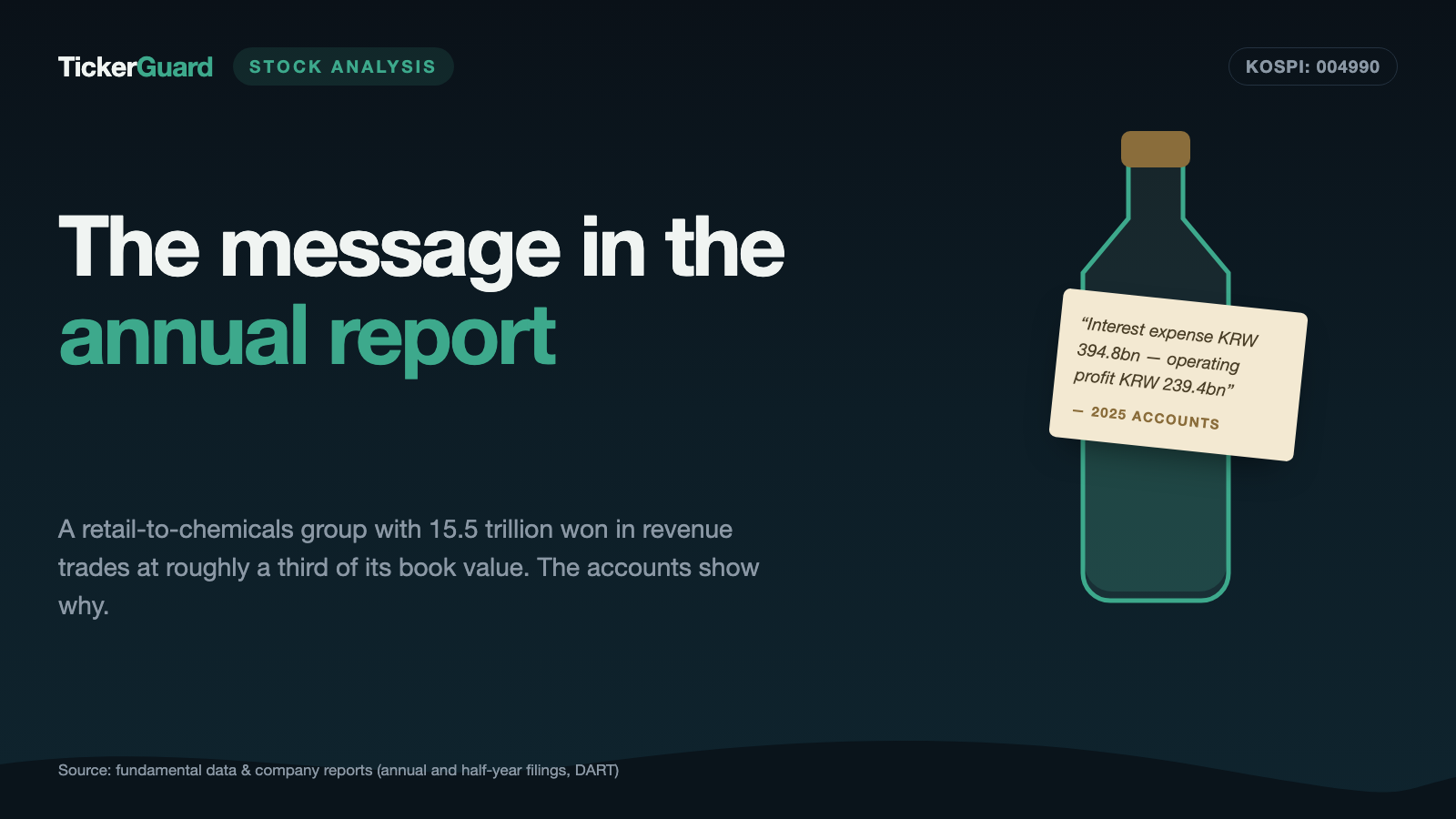
LOTTE Corporation (KOSPI: 004990) is the control room of South Korea's fifth-largest conglomerate: KRW 15,539.6 billion in group revenue in 2025, roughly 9.6 billion euros. On August 21, 2026 the market valued all shares outstanding at about KRW 1,751.8 billion — a good quarter of the equity the balance sheet assigns to the holding company's own shareholders, and barely a third once the hybrid capital is stripped out. The accounts supply the explanation themselves: since 2024 the debt has cost more than the operating business earns, and the turn to profit in the first half of 2026 came from a stake the holding company owns only about a quarter of. The dividend for the loss-making year 2025 was paid anyway, KRW 96.0 billion of it. No buy or sell recommendation — only the question of what a book value is worth when the interest bill shrinks it every year.
 Thomas Mücke
Founder & Publisher
Thomas Mücke
Founder & Publisher
There is one number that triggers a verdict in your head before anybody has done the arithmetic: the price-to-book ratio. If it reads below 1, the brain says "bargain". Call it the book-value reflex. It works so reliably because it feels like mathematics. There is a value on the balance sheet, there is a smaller one on the exchange, and surely someone will eventually collect the difference.
At LOTTE Corporation (KOSPI: 004990), the holding company of South Korea's fifth-largest business group, that difference is unusually wide. Equity attributable to the holding company's own shareholders stood at KRW 6,395,557 million on June 30, 2026 — roughly 3.95 billion euros. On August 21, 2026 the market valued all common and preferred shares outstanding at about KRW 1,751.8 billion, or some 1.08 billion euros. That is a little over a quarter. Strip out the hybrid capital, which is equity in law but does not belong to shareholders, and you land just under 30 percent.
The deal for this piece: no recommendation, no price target. We read the half-year report filed on August 14, 2026, the audited annual report filed on March 16, 2026 and the company's own English investor materials — and see whether the gap is an oversight by the market or a calculation somebody has already done. The central tension running through every chapter: what the balance sheet says, and what is left of it after interest.
What Lotte actually is: a holding company with 325 employees and 80 subsidiaries
Picture a conglomerate as a tree. At the very top sits a company that makes nothing and sells nothing: it holds stakes, collects brand royalties, management fees, rent and dividends — and decides where the money goes. That is exactly what LOTTE Corporation is. Its own IR presentation of May 27, 2026 describes the main business simply as "Pure Holding Company" and puts the workforce at 325 people. Beneath it hang 80 companies — 19 subsidiaries, 43 sub-subsidiaries, 6 lower-tier entities and 12 family-owned businesses — of which nine are listed.
The group underneath is a cross-section of Korean consumer business: confectionery and beverages (Lotte Wellfood, Lotte Chilsung), department stores, supermarkets and convenience stores (Lotte Shopping, Korea Seven), petrochemicals (Lotte Chemical), hotels and the Lotte World theme park, plus construction, logistics, IT systems and, for a few years now, contract manufacturing for pharmaceuticals (Lotte Biologics). The original company was founded on March 24, 1967 and was called Lotte Confectionery until the holding company restructuring of October 1, 2017 — a candy maker that became a corporate headquarters.
The segment note in the half-year report shows where the money is actually made. Of KRW 7,715.2 billion of group revenue in the first half of 2026, KRW 4,882.5 billion came from food and KRW 2,293.6 billion from retail. On the profit line the distribution is even more lopsided: food contributed KRW 231.8 billion of operating profit, IT systems KRW 22.1 billion and "other" KRW 139.6 billion — while retail lost KRW 15.6 billion and pharmaceutical manufacturing lost KRW 121.3 billion. And 80.2 percent of revenue comes from Korea itself.
One point matters for everything that follows: there is no 10-K and no 10-Q for Lotte. The company is not a filer with the U.S. securities regulator, the SEC; its mandatory reports sit in the Korean disclosure system DART, run by the Financial Supervisory Service. It reports under K-IFRS and its fiscal year matches the calendar year. Every figure in this analysis therefore carries the line "Source: fundamental data & company reports (annual and half-year filings, DART/Korea Exchange)" rather than "SEC filings".
Company history for investors
-
2017
A candy maker becomes the corporate headquarters
On October 1, 2017 Lotte Confectionery became the holding company. In the process it acquired 39 percent of all outstanding shares as treasury stock — the overhang that persists today.
-
2018
First cancellation of treasury shares
Ten percent was canceled, including shares acquired through appraisal rights. For shareholders it was the first proof that the overhang can shrink.
-
2024
November: covenant breached, tower pledged
After a covenant breach at Lotte Chemical the group pledged the Lotte World Tower on November 27, 2024. Investors saw double-digit losses across several group stocks within days.
-
2024
November: value-up plan and management overhaul
Lotte filed a plan to raise corporate value on November 26, 2024, and two days later replaced 21 chief executives. For shareholders it brought the first binding return target.
-
2025
June: five percent of treasury shares sold
The sale to a group company raised KRW 147.7 billion and served the financial structure, the company said. The overhang stayed inside the group rather than leaving the market.
-
2026
March: five percent canceled, dividend raised
On March 31, 2026 the company canceled 5,245,461 common shares and paid KRW 1,250 per share for 2025. The treasury holding fell from 27.51 to 23.69 percent.
-
2026
August: first profitable half-year in three years
The report filed on August 14, 2026 showed plus KRW 42.1 billion for holding company shareholders. The turn was carried by the equity-accounted result, not by operations.
How the stock reached our desk
Honesty first: Lotte did not arrive through a recommendation, a newsletter or an analyst note, but through a combination in the fundamental data that rarely appears together. As of August 23, 2026 the data showed a group with KRW 15.5 trillion of annual revenue whose shares trade at roughly 0.27 times reported book value, which offers a dividend yield above 5 percent for its last fiscal year — and which reported billion-won losses in each of the two years before that.
Combinations like that almost always have a reason. Sometimes it is a misunderstanding by the market; more often it is a calculation already reflected in the price and not yet in the book value. Which of the two applies here is decided by the filings, not by ratios. So we read them: the half-year report of August 14, 2026 with the balance sheet as of June 30, 2026; the audited annual report of March 16, 2026 covering 2023 through 2025; the dividend resolution of February 9, 2026; and the English investor documents — the progress report on the value-up plan dated March 25, 2026 and the IR presentation of May 27, 2026.
One note on the evidence, because it shapes everything: there are no earnings-call transcripts for this company. We checked our own transcript archive — 21,116 transcripts, none of them for LOTTE Corporation — as well as the usual commercial providers and the company's own IR archive. Lotte does hold question-and-answer sessions with investors; the May 27, 2026 presentation has a slide dedicated to one. None of it is published. The chapter on management's promises therefore rests on IR publications rather than transcripts, and says so at every turn.
The numbers over the years, honestly appraised
First what genuinely holds. Revenue at this group is large and stable: KRW 15,159.8 billion in 2023, KRW 15,757.0 billion in 2024 and KRW 15,539.6 billion in 2025. Converted at the ECB reference rate of August 21, 2026, that is about 9.6 billion euros a year. The first half of 2026 brought in KRW 7,715.2 billion, 1.1 percent more than a year earlier. A group turning over roughly 15 trillion won a year does not vanish overnight.
Operationally it has also been in the black for years, though the trend points down: operating profit was KRW 493.7 billion in 2023, KRW 340.5 billion in 2024 and KRW 239.4 billion in 2025. In the first half of 2026 it rose again by 9.3 percent to KRW 175.1 billion. The balance sheet is no paper shell either: total assets of KRW 23,652.5 billion as of June 30, 2026, of which KRW 9,894.4 billion is equity — though KRW 3,498.9 billion of that belongs to minority shareholders in the subsidiaries rather than to the holding company's own investors.
And then comes the number that puts everything else in context. To place it properly, look two years further back: in 2021 an operating profit of KRW 216.4 billion faced KRW 116.5 billion of interest expense, and in 2022 it was KRW 489.8 billion against KRW 209.4 billion. Back then there was still a clear surplus after interest every time.
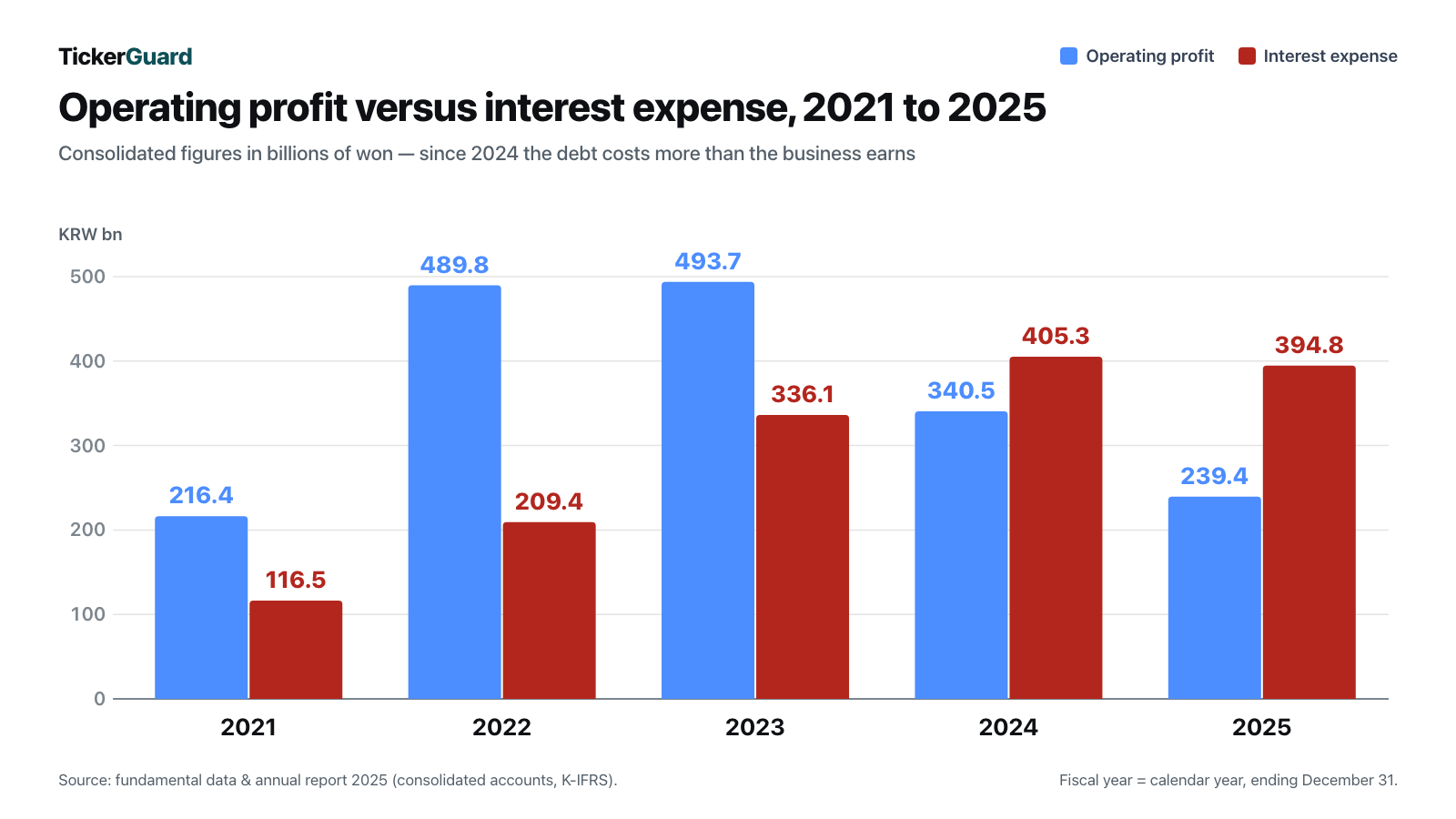
The ratio behind it is called interest coverage, and it is one of the most honest there is: operating profit divided by interest expense. It answers a single question — how many times over could a company pay its interest bill out of current operations? In 2023 the answer was 1.47 times. In 2024, 0.84. In 2025, 0.61. Anything below 1 means the operating business no longer covers the interest. The difference has to come from investment income, from asset sales or from new borrowing.
That mechanism explains the results of 2024 and 2025.
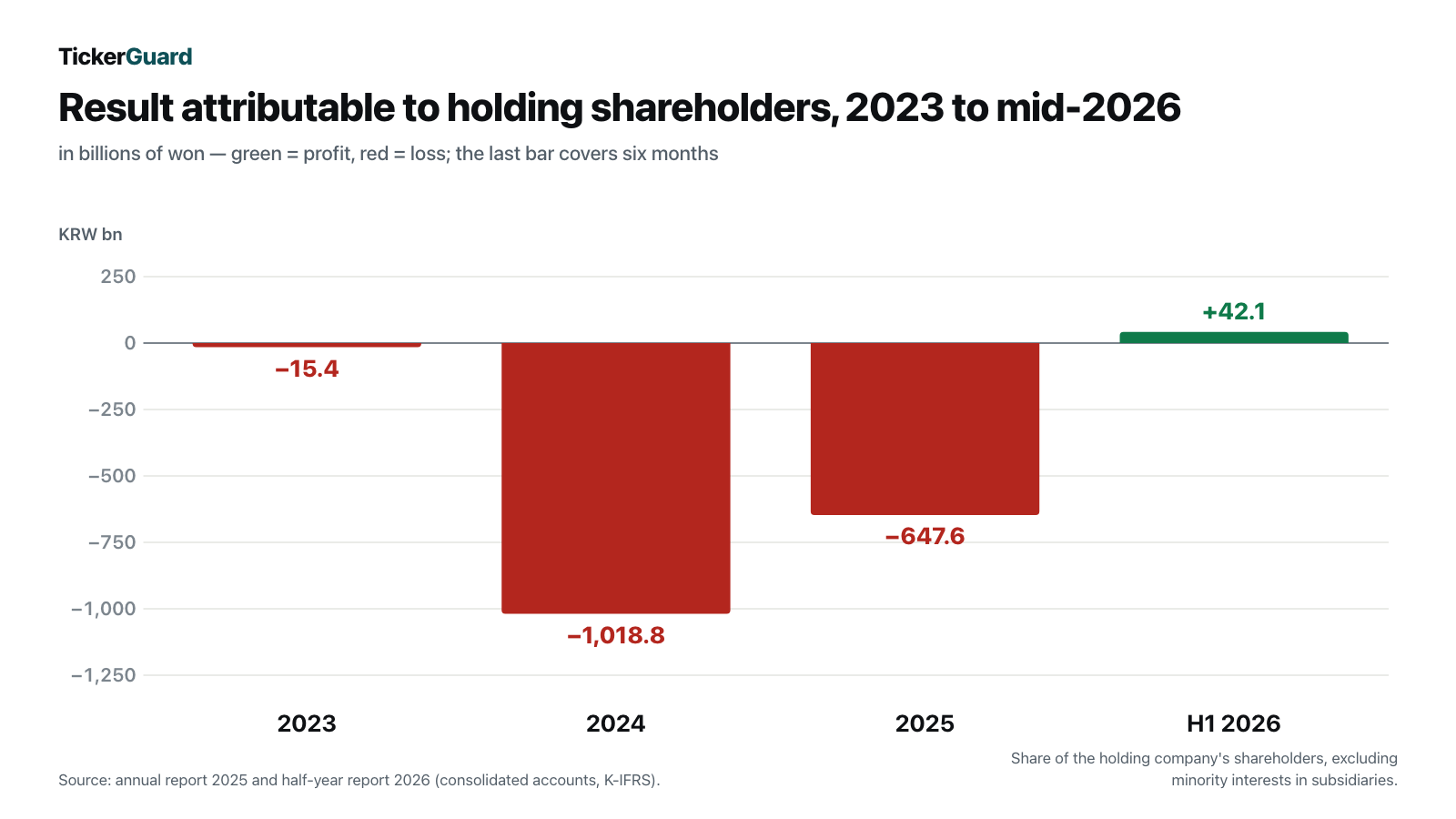
One subtlety you have to know, or the arithmetic goes wrong: the consolidated accounts report two bottom lines. For 2025 they show a loss of KRW 595.0 billion for the group as a whole and KRW 647.6 billion for the share attributable to the holding company's shareholders. The difference arises because minority shareholders in the subsidiaries were allocated a profit of KRW 52.6 billion in the same year. For an investor holding LOTTE Corporation shares, the second figure is the relevant one. The progress report on the value-up plan dated March 25, 2026 puts the KRW 595 billion figure in the foreground of its table — so anyone comparing the two documents should check carefully which line they are looking at.
For the first half of 2026 the corresponding number reads: plus KRW 42.1 billion for the holding company's shareholders, after minus KRW 204.9 billion a year earlier. Earnings per common share came to KRW 330. That is a genuine turn — just not where you would look for it.
What management promised, and what came of it
Because there are no earnings-call transcripts, management has to be measured against what it has published in writing. There is plenty of that, and it is unusually well documented. On November 26, 2024 Lotte filed a "Corporate Value-up Plan" with the Korea Exchange — a voluntary programme under which Korean companies have disclosed since February 2024 how they intend to raise their market value. A progress report followed on March 25, 2026. Both exist in English, and the second audits the first. That is rare, and it makes the assessment straightforward.
Three things were promised in 2024: a shareholder return ratio of at least 35 percent, a review of an interim dividend, and a review of a treasury share cancellation. Targets for the listed subsidiaries came on top. The half-year report of 2026 states the policy in its own words:
“당사는 주주환원 정책의 일환으로 지난 24년 11월 기업가치제고계획 발표를 통해 3개년(24~26년) 중장기 주주환원정책을 발표한 바 있으며, 현금배당과 기보유 자사주 소각 검토를 통해 안정적이고 예측가능한 정책 운영으로 주주환원율 35% 이상(별도기준 당기순이익) 지향하고 있습니다.”
Translation: "As part of our shareholder return policy we announced a medium-term three-year shareholder return policy (2024 to 2026) in November 2024 together with the corporate value-up plan. Through cash dividends and a review of the cancellation of treasury shares already held, and with stable and predictable policy management, we are aiming for a shareholder return ratio of at least 35 percent (based on separate-entity net income)."
— LOTTE Corporation, half-year report H1 2026, section 6 on dividends, filed August 14, 2026
Delivered: the share cancellation (5,245,461 common shares on March 31, 2026), the dividend increase from KRW 1,200 to KRW 1,250 per share, and the reform of the dividend record date, under which the payout is now fixed before the record date — a real improvement for investors, who no longer have to buy blind.
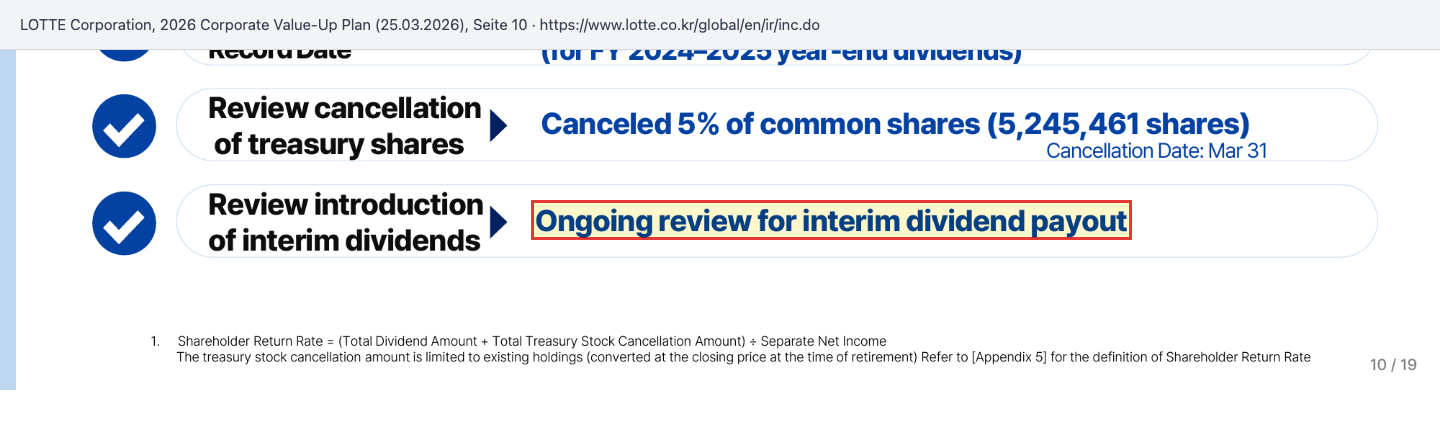
Not delivered: the interim dividend. It has been on the list since November 2024. The progress report of March 2026 notes, a year and a half later:
At the subsidiaries the record is more mixed, and the progress report puts target and actual side by side. Lotte Chilsung was to reach KRW 5.5 trillion of revenue by 2028; the target was cut to KRW 4.8 to 5.0 trillion by 2030, the 2025 actual was KRW 4.0 trillion, return on equity came to 3.1 percent against a target of 10 to 15 percent, and the debt ratio stood at 167.7 percent against a target below 100 percent. Lotte Wellfood reached an overseas revenue share of 29.0 percent against 35 percent targeted for 2028, and a return on equity of 3.3 percent against 8 to 10 percent. Lotte Shopping stands at KRW 13.7 trillion of revenue and KRW 547 billion of operating profit; the 2030 targets are KRW 20.3 trillion and KRW 1.3 trillion.
More telling than the numbers is the tone, and it can be dated. In July 2024 the group declared an emergency management system. Chairman Shin Dong-bin's new year address of January 2, 2026 read, as reported by the Korea Herald: "These conditions make it imperative to pursue a turnaround focused on qualitative growth." And the closing slide of the IR presentation of May 27, 2026 lists four priorities, not one of which sounds like growth: restore profitability of core businesses by securing fundamental competitiveness; improve financial structure through portfolio restructuring; manage group debt by aligning investments within EBITDA; and only then continue investing in new growth businesses, "based on financial stability". Two years earlier the same group had put compound annual growth rates of 15.8 percent for revenue and 37.8 percent for operating profit across 2018 to 2023 on the front pages of its value-up plan.
What the filings say: the uncomfortable truths
Uncomfortable truth no. 1: the turn came from a stake, not from the business
The first half of 2026 is the good news of this analysis — it just does not come from where you would look. Group operating profit did rise 9.3 percent to KRW 175.1 billion. In the second quarter alone, however, it fell 9.3 percent to KRW 129.0 billion. What turned the overall result sits one line further down the income statement.
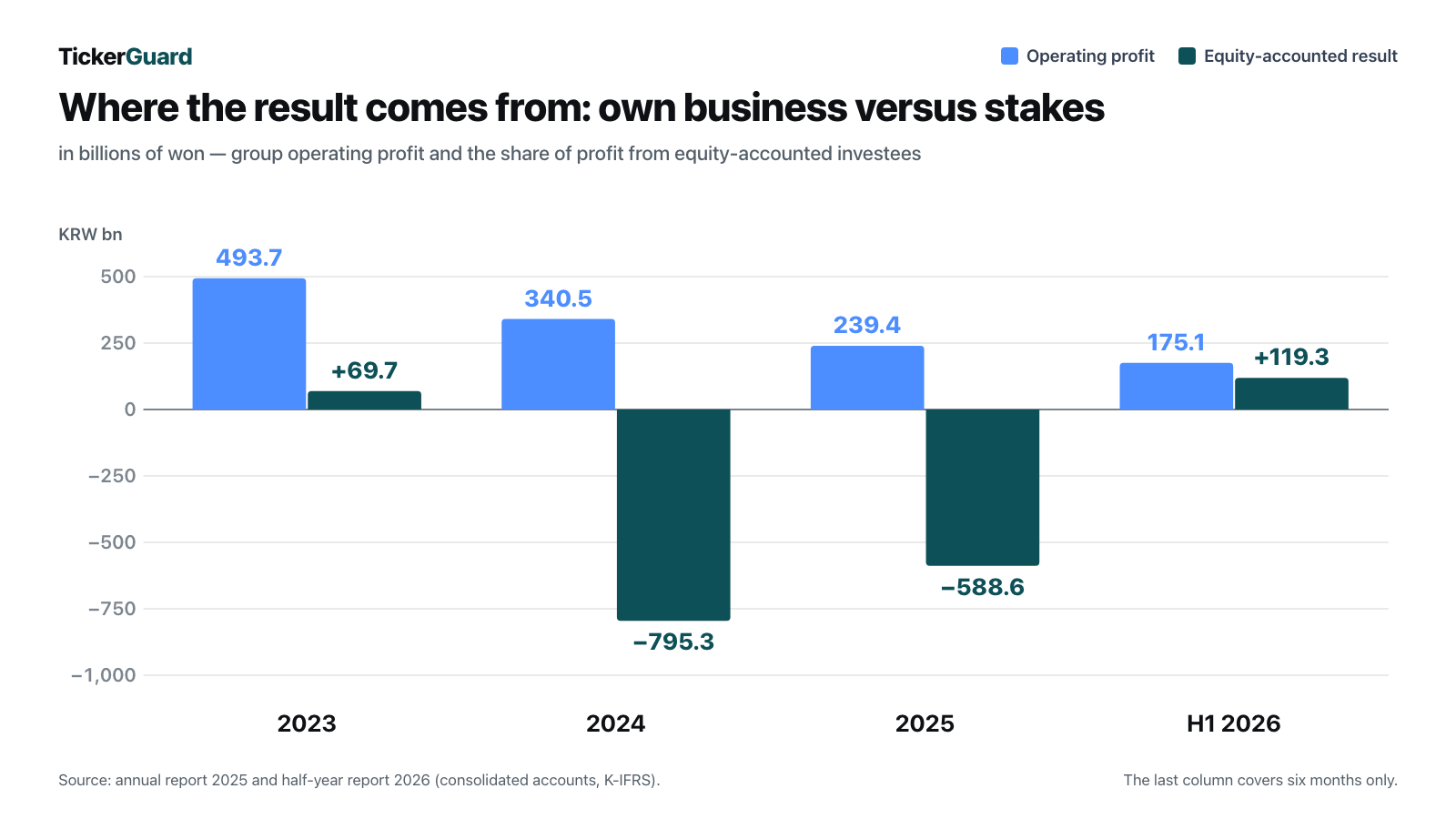
The line is the share of profit or loss of equity-accounted investees. These are holdings the group does not fully consolidate but accounts for under the equity method: it shows its proportionate share of what those companies earned or lost inside its own income statement. That line read plus KRW 69.7 billion in 2023, minus KRW 795.3 billion in 2024, minus KRW 588.6 billion in 2025 — and plus KRW 119.3 billion in the first half of 2026, after minus KRW 174.2 billion a year earlier.
Note 12 of the half-year report shows who is behind it. Of the minus KRW 588.6 billion in 2025, minus KRW 538.6 billion came from Lotte Chemical — 91.5 percent of the total. In the first half of 2026 the same stake delivered plus KRW 71.0 billion. Lotte Shopping contributed plus KRW 28.1 billion after minus KRW 48.7 billion the year before. Put differently: the holding company's turnaround is essentially Lotte Chemical's turnaround — a company in which the holding owns just 25.31 percent and whose result depends on Asian petrochemical prices.
Uncomfortable truth no. 2: five percent of treasury shares sold, then five percent canceled
Treasury shares — shares a company holds in itself — have been a political topic in Korea for years, because they can help a controlling shareholder secure control without paying for it. Lotte holds an unusually large block: as of June 30, 2026 it was 23,613,015 of 99,663,776 issued common shares, or 23.69 percent. They stem from the holding company restructuring of 2017 and 2018, during which the company by its own account acquired 39 percent of all outstanding shares.
The IR presentation of May 27, 2026 sets out the timeline of the past two years — and two entries sit immediately below one another:
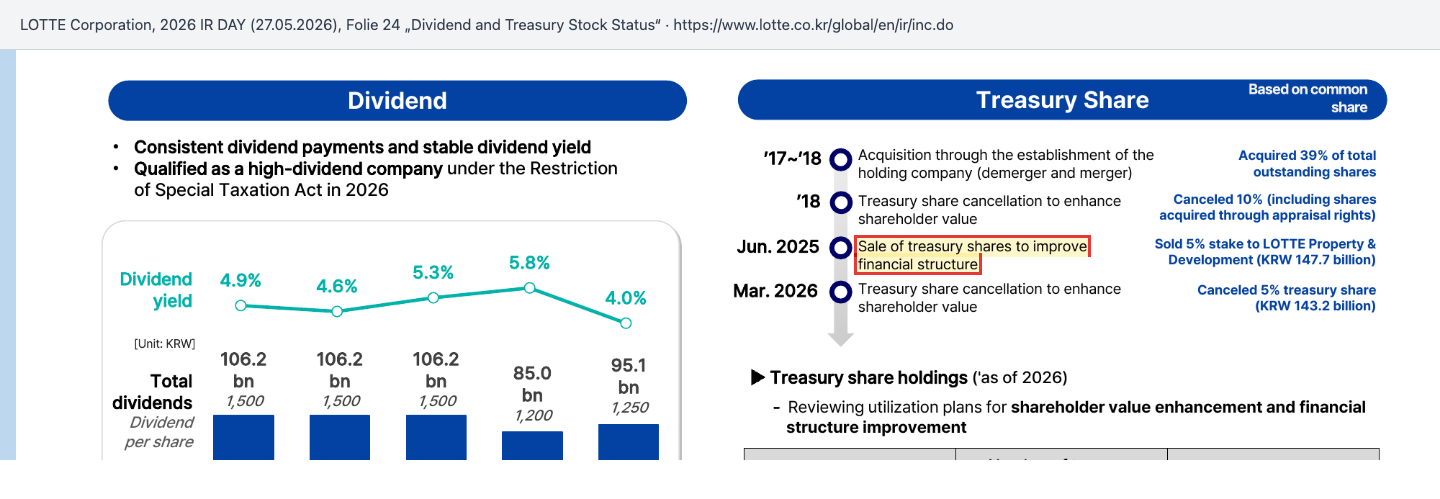
“Jun. 2025 — Sale of treasury shares to improve financial structure — Sold 5% stake to LOTTE Property & Development (KRW 147.7 billion). Mar. 2026 — Treasury share cancellation to enhance shareholder value — Canceled 5% treasury share (KRW 143.2 billion).”
— LOTTE Corporation, 2026 LOTTE Corporation IR DAY, slide 24 "Dividend and Treasury Stock Status", May 27, 2026
Both transactions are entirely lawful in themselves and were properly disclosed. Read side by side, however, they add up to an uncomfortable sum: within nine months five percent of the treasury shares went to a group company, and then five percent went into cancellation. The overhang weighing on the share price is roughly as large afterwards as before — it stood at 27.51 percent before the cancellation and 23.69 percent after, because the total share count fell along with it. The two steps were disclosed separately, the second explicitly as a contribution to shareholder value.
Uncomfortable truth no. 3: the dividend exceeds the profit it invokes
For fiscal 2025 Lotte paid out KRW 96.0 billion, 11.8 percent more than the year before — in a year when the holding company's shareholders were allocated a loss of KRW 647.6 billion in the consolidated accounts. That is possible because the payout policy expressly refers not to the consolidated accounts but to the separate-entity accounts of the holding company — the company on its own, without its subsidiaries. There, according to the progress report, 2025 showed net income of KRW 75 billion.
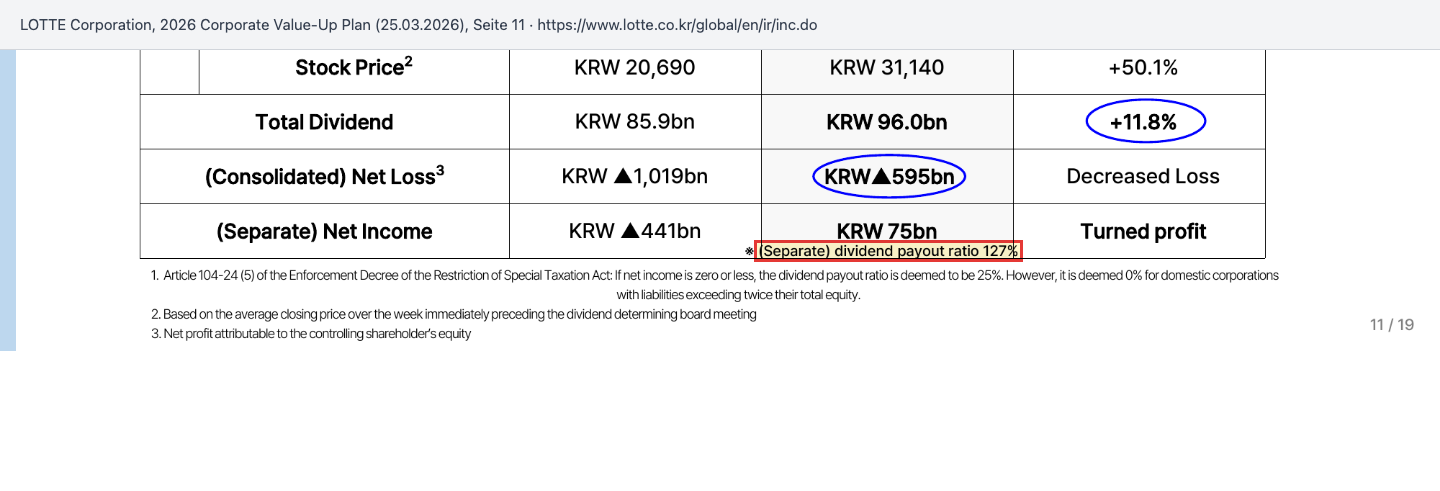
“Turnaround to net income in 2025, with a dividend of KRW 1,250 per share. (Separate) Shareholder return ratio: 127%, dividend yield: 4%”
— LOTTE Corporation, 2026 Corporate Value-Up Plan, page 10, March 25, 2026
Two things there need explaining. First the ratio: 127 percent means more was distributed than the holding company earned on its own in the same year. For a single year that is not a scandal — a holding company lives off dividends from its subsidiaries, and those fluctuate. As a permanent state it would be an erosion of substance. Second the yield: the 4 percent quoted is a Korean mandatory disclosure that refers to the average closing price of the week before the dividend resolution — KRW 31,140, measured in early February 2026. At this analysis's valuation anchor, the closing price of KRW 22,800 on August 21, 2026, the same KRW 1,250 per share works out at 5.5 percent. The difference is not generosity on the company's part but a share price decline of roughly 27 percent since February.
Uncomfortable truth no. 4: a quarter of the equity is capital that does not belong to shareholders
Back to the book-value reflex. Of the KRW 9,894.4 billion of equity on the consolidated balance sheet as of June 30, 2026, KRW 3,498.9 billion belongs to minority shareholders in the subsidiaries — money that sits on the balance sheet but belongs to other investors. That leaves KRW 6,395.6 billion for the holding company's own shareholders. And inside that figure, according to Note 24, sits another KRW 625,000 million of hybrid capital: perpetual bonds issued by Lotte itself.
Hybrid capital is a hybrid in more than name. In law it counts as equity because it has no fixed maturity and coupon payments may be deferred. Economically it is expensive permanent debt: Note 25 lists coupons between 4.72 and 6.31 percent on group issues with a total face value of KRW 775,000 million, 30-year terms with extension options, and step-up clauses of two percentage points after two years that rise further thereafter. Three of these instruments were newly issued on March 30, 2026. Anyone calculating book value per share should deduct this money — it ranks ahead of the shareholders.
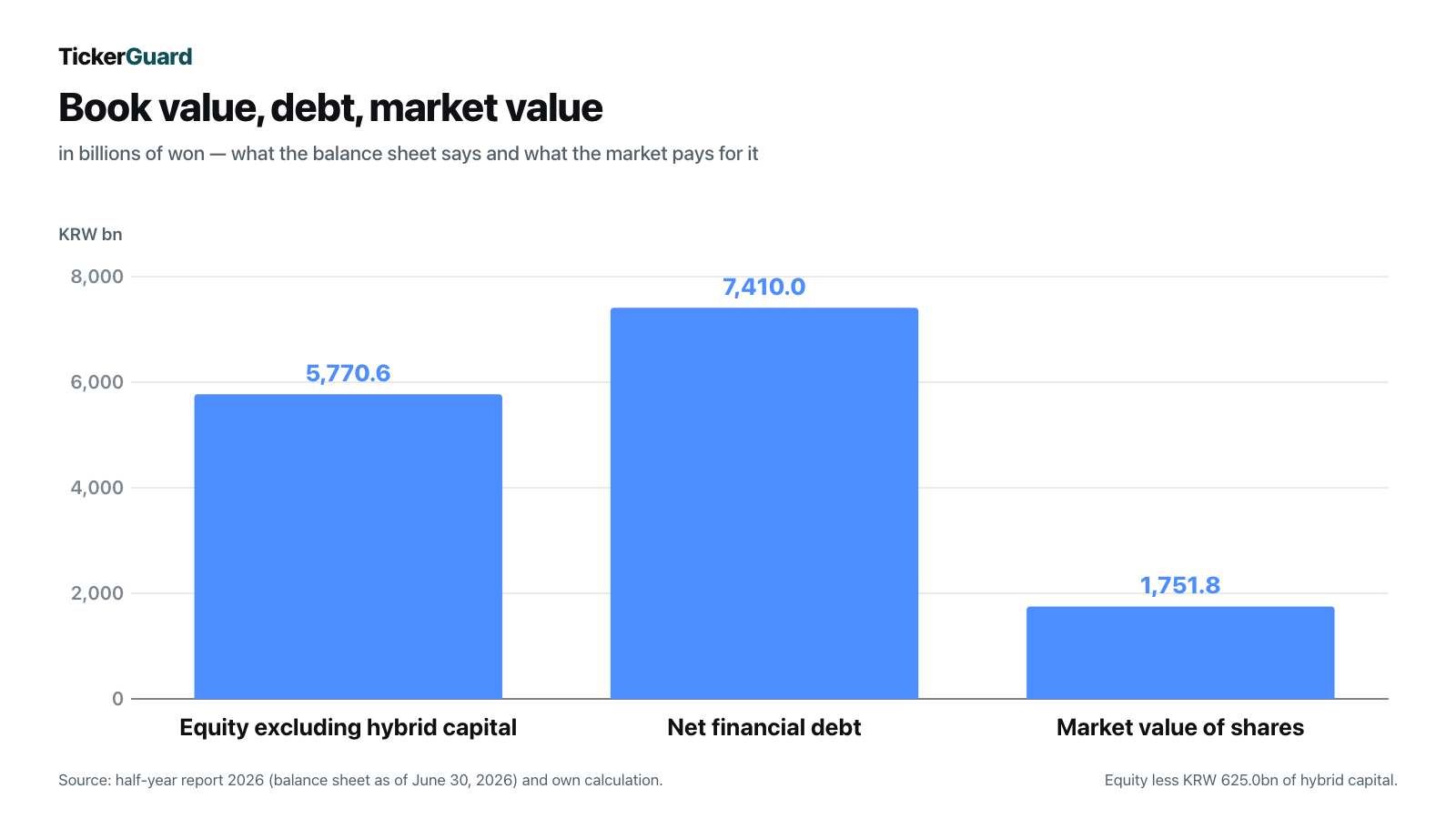
The third bar belongs to the same calculation. Group financial debt as of June 30, 2026 came to KRW 4,040.8 billion short-term and KRW 4,605.4 billion long-term, KRW 8,646.2 billion in total. Less KRW 1,236.2 billion of cash, that leaves roughly KRW 7,410 billion of net financial debt — about 4.58 billion euros, and more than the balance sheet assigns the holding company's shareholders in equity. None of it is free: Note 17 lists interest rates of 3.65 to 12.95 percent on short-term bank loans, up to 13.74 percent on foreign-currency loans, and 2.09 to 4.94 percent on the holding company's own bonds.
November 2024 showed how tight that can get. Rumours of a group insolvency circulated; LOTTE Corporation, Lotte Chemical and Lotte Shopping stated in regulatory filings in mid-November 2024 that it was "groundless" that the group faced a liquidity crisis. The trigger was real: bonds issued by Lotte Chemical carried a covenant requiring earnings before interest, taxes, depreciation and amortization to be at least five times interest expense. In the third quarter of 2024 the ratio fell to 4.3 times — the covenant was breached and creditors could have demanded early repayment. The fix came in two steps: on November 27, 2024 the group pledged the Lotte World Tower as additional collateral, and on December 19, 2024 holders of 14 bond series totalling roughly KRW 2.04 trillion voted to remove the earnings covenant. If you want to see what a heavily indebted group looks like after an experience like that, our analysis of TUI offers a European comparison.
Valuation: what the market pays for the holding company
At a price of KRW 22,800 (August 21, 2026), with 76,050,761 common shares outstanding plus 726,275 preferred shares, the market value works out at roughly KRW 1,751.8 billion — about 1.08 billion euros or 1.27 billion U.S. dollars at the ECB reference rates of the same day. Measured against 2025 group revenue of KRW 15,539.6 billion, that is a price-to-sales ratio of about 0.11. Spectacular as it sounds, it says little at a holding company: most of that revenue belongs to subsidiaries in which other shareholders participate.
Book value is more informative — and there you have to decide which convention to use. Dividing equity attributable to holding company shareholders of KRW 6,395.6 billion by the 76,050,761 common shares outstanding gives KRW 84,096 per share and a price-to-book ratio of 0.27. Deduct the hybrid capital and put both share classes in the denominator, and you get KRW 75,160 per share and 0.30. Korean market data portals, by contrast, calculate market capitalization from all issued shares including treasury stock and arrive at KRW 2,272.3 billion and a ratio of 0.36. All three are arithmetically correct and all three describe the same company. We consider the middle one the most honest: about 0.30 — treasury shares excluded from both numerator and denominator, hybrid capital deducted.
So what does that mean? A price-to-book ratio of 0.30 says the market does not trust the book value. Two reasons for that sit in the filings themselves. First the interest bill — a company that earns less from operations than it pays in interest is consuming book value rather than building it; group retained earnings fell from KRW 5,215.2 billion at the end of 2022 to KRW 3,072.2 billion at the end of 2025. Second the carrying value of the stakes: Lotte Chemical and Lotte Shopping together sit on the books at KRW 5,312.3 billion, while the same holdings were worth roughly KRW 1,682 billion on the exchange on August 21, 2026. Under K-IFRS that is not an error — a write-down is only required if the recoverable amount falls below the carrying amount. For an investor betting on book value, it is nevertheless the single most important open question.
To put the pattern in context: holding companies trade below the sum of their stakes almost everywhere, because an extra layer of administration costs money and because the shareholder does not decide what gets sold. Lotte names this discount in its own value-up plan and benchmarks itself there against six other Korean holding companies. How strongly a control structure can weigh on a valuation is also visible in our analysis of Biglari Holdings, where a single individual steers a holding company that trades persistently below its net asset value.
At Lotte the control is just as clear: as of March 31, 2026 the largest shareholder and related parties held 45.74 percent — Chairman Shin Dong-bin 13.73 percent, Hotel Lotte 11.68 percent, Lotte Aluminum 5.33 percent, Lotte Property & Development 5.26 percent and a further 9.74 percent. On top of that sit the 23.69 percent of treasury shares, which carry no votes but can be transferred to a friendly third party at any time. In September 2025, 687 retail shareholders holding 839,468 shares between them — just under 0.8 percent — formed an alliance and demanded, among other things, that all treasury shares be canceled.
Opportunities and risks at a glance
What speaks for Lotte:
- First turn to profit in three years: the first half of 2026 delivered KRW 42.1 billion for the holding company's shareholders after minus KRW 204.9 billion a year earlier, with operating profit up 9.3 percent at KRW 175.1 billion.
- Large, stable revenue base: KRW 15,539.6 billion in 2025 and KRW 7,715.2 billion in the first half of 2026, up 1.1 percent, carried by the food business with KRW 231.8 billion of half-year operating profit.
- A wide valuation gap to book value: about 0.30 after deducting hybrid capital, against an average of 0.5 for the six Korean peer holding companies Lotte itself cites in its value-up plan.
- A dividend of KRW 1,250 per share for 2025, paid after the record date of March 31, 2026 — about 5.5 percent at the valuation anchor of KRW 22,800, with the payout per share up 4.2 percent year on year.
- Group restructuring with completed steps: the sale of Lotte Rental to TPG for KRW 1,310.5 billion (agreement signed August 11, 2026, closing subject to regulatory approval), the cancellation of 5,245,461 treasury shares on March 31, 2026, and the reform of the dividend record date.
What speaks against it:
- Interest coverage below 1 in two consecutive years: 0.84 in 2024 and 0.61 in 2025. In the first half of 2026 financial expenses of KRW 251.0 billion still exceeded operating profit of KRW 175.1 billion.
- Net financial debt of roughly KRW 7,410 billion as of June 30, 2026 — more than the KRW 6,395.6 billion of equity attributable to holding company shareholders; interest rates run up to 12.95 percent on short-term bank loans.
- The turn to profit hangs on a 25.31 percent stake: KRW 71.0 billion of the KRW 119.3 billion equity-accounted result in the first half of 2026 came from Lotte Chemical, whose earnings depend on Asian petrochemical prices.
- The carrying value of the two largest stakes (KRW 5,312.3 billion) sits about three times above their market value (roughly KRW 1,682 billion on August 21, 2026); KRW 27,811 million was already written off Lotte Global Logistics in the first half of 2026.
- The pharmaceutical segment burned KRW 121.3 billion of operating losses on just KRW 23.9 billion of revenue in the first half of 2026 — about 69 percent of the entire group operating profit.
- 23.69 percent of treasury shares with no published plan for their use, alongside a controlling group holding 45.74 percent as of March 31, 2026 — the free float decides very little.
A human conclusion
Back to the book-value reflex. In this case it did not lie: the book value is real, it sits in an audited balance sheet, and the gap to the share price is wide. The reflex simply answers the wrong question. It asks "how much substance am I buying?" — and overlooks that substance is not a state but a balance. A group that earns KRW 239.4 billion from operations and pays KRW 394.8 billion in interest shrinks its substance every year. Retained earnings fell from KRW 5,215.2 billion at the end of 2022 to KRW 3,072.2 billion at the end of 2025. That is the real discount, and the market did not invent it — it wrote it down.
On the other side stands a first half of 2026 that was better than the three half-years before it, a restructuring with completed disposals, and a legislature that from September 10, 2026 forces holding companies to explain themselves on their own shares. Both are true, and both belong in the same analysis.
The honest question for you is therefore not "is the stock cheap because it trades below book?" but: do you trust a holding company to close an interest bill that has exceeded its operating profit for two years running, out of a business it owns only in part? What you make of it is your decision. And that is exactly as it should be.
Sources
Every original document used in this analysis, for you to read yourself:
- LOTTE Corporation — half-year report H1 2026 (filed August 14, 2026) — most recent periodic report; source of the June 30, 2026 balance sheet, the segment, investee and debt notes, and the share count
- LOTTE Corporation — annual report for fiscal 2025 (filed March 16, 2026) — audited consolidated accounts; source of the 2023 to 2025 figures
- LOTTE Corporation — dividend resolution of February 9, 2026 — dividend per share, total payout, record date
- LOTTE Corporation — 2026 Corporate Value-Up Plan (March 25, 2026) and 2026 LOTTE Corporation IR DAY (May 27, 2026) — English originals; source of the quotes on dividends, treasury shares and group priorities
- LOTTE Corporation — 2024 Sustainability Report (English, reporting year 2024) — source of the group-wide AI strategy disclosures
- Korea Exchange / KIND — listing status and administrative issue list, retrieved August 23, 2026: regular KOSPI listing, no proceedings pending
- European Central Bank — reference rates of August 21, 2026: EUR 1 = KRW 1,619.41, USD 1 = KRW 1,384.23
- Fundamental data (prices, interest expense 2021 to 2025, valuation ratios; as of August 23, 2026), reconciled against the company reports.
Transparency & disclaimer: this analysis is journalistic commentary on publicly available information. It is not investment advice, not a regulated financial analysis and not a solicitation to buy or sell securities. Equity investments carry substantial risk up to total loss; foreign shares add currency risk. All information without warranty; the date of each data point is stated in the text. Positions held by the operator are disclosed daily; where one exists, it appears as a notice at the top of this deep dive.
Our Bottom Line at a Glance
- Business base and revenue positive
- Group revenue has been stable at roughly KRW 15.5 trillion for three years — 15,159.8 billion in 2023, 15,757.0 in 2024, 15,539.6 in 2025 — and grew 1.1 percent to KRW 7,715.2 billion in the first half of 2026. The food business contributed KRW 231.8 billion of operating profit there, 30.5 percent more than a year earlier.
- Interest coverage negative
- Operating profit covered interest expense only 0.84 times in 2024 and 0.61 times in 2025 — KRW 340.5 billion against 405.3 billion, and 239.4 billion against 394.8 billion. In the first half of 2026 financial expenses of KRW 251.0 billion still exceeded operating profit of KRW 175.1 billion. The difference has to come from investees, disposals or new borrowing.
- Leverage negative
- As of June 30, 2026, KRW 8,646.2 billion of financial debt faced KRW 1,236.2 billion of cash — roughly KRW 7,410 billion net, more than the KRW 6,395.6 billion of equity attributable to holding company shareholders. Note 17 lists rates up to 12.95 percent on short-term bank loans and up to 13.74 percent on foreign-currency loans.
- Source of the earnings turn neutral
- The share of the result attributable to holding company shareholders turned to plus KRW 42.1 billion in the first half of 2026 after minus KRW 204.9 billion. It was carried by the equity-accounted result, which swung from minus KRW 174.2 billion to plus 119.3 billion — of which KRW 71.0 billion came from the 25.31 percent stake in Lotte Chemical. Second-quarter operating profit fell 9.3 percent to KRW 129.0 billion over the same period.
- Carrying value of the stakes negative
- Lotte Chemical and Lotte Shopping sit on the books at KRW 5,312.3 billion combined as of June 30, 2026; the same holdings were worth roughly KRW 1,682 billion on the exchange on August 21, 2026. K-IFRS permits this because the recoverable amount governs — but KRW 27,811 million was already written off Lotte Global Logistics in the first half of 2026, after KRW 54,698 million in 2025.
- Ownership and capital measures neutral
- The controlling group held 45.74 percent as of March 31, 2026, alongside 23.69 percent of treasury shares with no published plan for their use. In June 2025 a 5 percent treasury stake went to a group company for KRW 147.7 billion; in March 2026, 5 percent was canceled for KRW 143.2 billion. From September 10, 2026 the reformed Commercial Act requires a decision on the remaining block.
LOTTE Corporation is a pure holding company with a stable revenue base whose operating profit has fallen since 2023 and has not covered its interest bill since 2024. Two loss years for holding company shareholders (KRW 1,018.8 billion and KRW 647.6 billion) gave way to a KRW 42.1 billion profit in the first half of 2026, almost all of which came from the equity-accounted result. The discount to book value is wide but explainable: shrinking retained earnings, net financial debt above the equity attributable to holding company shareholders, and investee carrying amounts far above the market value of the same stakes. Not investment advice.
What Our Rating Means
Substance risk
We found at least one documented issue that threatens the company itself — regardless of how the stock is currently valued.
The rating is red because one finding concerns substance rather than price: interest coverage stood at 0.84 in 2024 and 0.61 in 2025 — the group earned less from operations than it paid in interest, and even in the most recent half-year financial expenses of KRW 251.0 billion exceeded operating profit of KRW 175.1 billion. Alongside that sit net financial debt of roughly KRW 7,410 billion against KRW 6,395.6 billion of equity attributable to holding company shareholders, and retained earnings that fell from KRW 5,215.2 billion at the end of 2022 to KRW 3,072.2 billion at the end of 2025. This is explicitly not a judgement on price — the fact that the stock looks cheap at about 0.30 times book value changes none of the arithmetic, and the first-half 2026 turn is real but hangs on a 25.31 percent stake. Where the evidence sits between two levels, the more cautious one applies. The decision is yours.
A journalistic assessment by our editorial team at the time of the deep dive, based on public sources — not investment advice and not a solicitation to buy or sell. Your personal circumstances (investment goals, risk capacity, taxes) cannot be taken into account. What our levels mean, how verdicts are formed, and what conflicts of interest exist →
Worth Noting
- Data basis: half-year report H1 2026 (filed 2026-08-14, most recent periodic report), audited annual report 2025 (2026-03-16), dividend resolution (2026-02-09) and the English investor documents "2026 Corporate Value-Up Plan" (2026-03-25) and "2026 LOTTE Corporation IR DAY" (2026-05-27). Price and valuation data as of 2026-08-23.
- Not an SEC filer: there is no 10-K, no 10-Q and no 20-F. Mandatory reports sit in the Korean DART disclosure system and are prepared under K-IFRS.
- No publicly available earnings-call transcripts exist for 004990. The chapter on management promises therefore relies on IR publications, and the article says so.
- Two bottom lines to keep apart: the 2025 consolidated accounts show a KRW 595.0 billion loss for the group as a whole and KRW 647.6 billion for the share attributable to holding company shareholders. The second figure is the relevant one for holders of the share.
- Three conventions for market value: KRW 1,751.8 billion from shares outstanding (used here), KRW 1,750.5 billion per fundamental data, and KRW 2,272.3 billion under the Korean portal convention that includes treasury shares. Anyone comparing ratios has to name the basis.
- Easily confused: the Korean holding company listed as KOSPI 004990 is not the Japanese Lotte Holdings; English-language media occasionally translate both as "Lotte Holdings".
The full analysis as a PDF for later
We will send you this analysis as a PDF — to print, file away, and read at your own pace.
Frequently Asked Questions
LOTTE Corporation (KOSPI: 004990) is the pure holding company of South Korea's Lotte Group. It makes nothing itself; it holds stakes in 80 companies, nine of them listed, and earns brand royalties, management fees, rent and dividends. The group spans food and beverages, department stores and supermarkets, petrochemicals, hotels, construction, logistics, IT and pharmaceutical contract manufacturing. Its own headcount is 325 (as of March 31, 2026).
Because the book value has been shrinking for years. In 2025 the group earned KRW 239.4 billion from operations and paid KRW 394.8 billion in interest; retained earnings fell from KRW 5,215.2 billion at the end of 2022 to KRW 3,072.2 billion at the end of 2025. On top of that, the two largest stakes sit on the books at KRW 5,312.3 billion while the same holdings were worth roughly KRW 1,682 billion on the exchange on August 21, 2026.
For fiscal 2025 it paid KRW 1,250 per common share and KRW 1,300 per preferred share, with a record date of March 31, 2026; the total payout was KRW 96.0 billion. At the closing price of KRW 22,800 on August 21, 2026 that is a yield of about 5.5 percent. The company itself quotes 4.0 percent — a Korean mandatory disclosure based on the higher average price of KRW 31,140 in the week before the February 2026 resolution.
As of March 31, 2026 the largest shareholder and related parties held 45.74 percent: Chairman Shin Dong-bin 13.73 percent, Hotel Lotte 11.68 percent, Lotte Aluminum 5.33 percent, Lotte Property & Development 5.26 percent and a further 9.74 percent. On top of that sit 23.69 percent of treasury shares held by the company itself, which carry no votes. The freely traded portion is correspondingly small.
In November 2024 rumours circulated that the group could not meet its obligations. The trigger was a bond covenant at Lotte Chemical requiring earnings before interest, taxes, depreciation and amortization to be at least five times interest expense; in the third quarter of 2024 the ratio fell to 4.3 times. On November 27, 2024 the group pledged the Lotte World Tower as additional collateral, and on December 19, 2024 holders of 14 bond series totalling about KRW 2.04 trillion removed the covenant.
Because LOTTE Corporation is listed solely on the Korea Exchange and is not a filer with the U.S. securities regulator, the SEC. Its mandatory reports appear in the Korean disclosure system DART, run by the Financial Supervisory Service: an audited annual report, a half-year report and two quarterly reports. It reports under K-IFRS, and its fiscal year matches the calendar year.
The third amendment was promulgated on March 6, 2026 and its main provisions take effect on September 10, 2026. It requires treasury shares to be canceled within one year of acquisition, with a six-month transition period for existing holdings. A company that wants to keep them needs a retention plan endorsed by the annual general meeting every year. As of June 30, 2026 Lotte held 23,613,015 treasury common shares — 23.69 percent — with no published plan.
As of June 30, 2026, KRW 4,040.8 billion of short-term and KRW 4,605.4 billion of long-term financial debt faced KRW 1,236.2 billion of cash — roughly KRW 7,410 billion net, or about 4.58 billion euros. That is more than the KRW 6,395.6 billion of equity attributable to holding company shareholders. Note 17 puts interest rates at 2.03 to 12.95 percent on won loans and up to 13.74 percent on foreign-currency loans.
Found an error?
Did you spot a factual error, an outdated number, or a typo in this deep dive? Let us know briefly — your report goes straight to the editorial team.