Taiwan Union Technology: A Price-Earnings Ratio With Two Faces
At first glance, Taiwan Union Technology trades at 75 times earnings — a number that scares most investors off immediately. Run the same stock against what analysts expect for 2026 and 2027 instead, and the price-earnings ratio drops to somewhere between 20 and 40 — still high, but a different picture. In between sits an earnings-per-share figure that quadrupled from 2023 to 2025, a record quarter in the summer of 2026 — and a record quarter in which operating cash flow ran negative despite a billion-dollar profit. We read the financial disclosure notices and earnings calls of the Taiwanese circuit-board material maker. No buy or sell recommendation.
 Thomas Mücke
Founder & Publisher
Thomas Mücke
Founder & Publisher
Chart
Interactive price chart (TradingView).
Note: pure fact-based analysis, not investment advice and not a solicitation to buy or sell. All figures without guarantee.
There is a thinking error that even seasoned investors make regularly: they see a single number — a price-earnings ratio of 75, say — and anchor on it so strongly that they never check whether that number even answers the right question. Psychologists call this anchoring bias: the first figure we encounter shapes how we weigh every piece of information that follows, even when that first figure is misleading. That is exactly what is happening right now with Taiwan Union Technology, a Taiwanese maker of printed-circuit-board materials. Divide the TWD 1,490 share price (August 28, 2026) by earnings from the last four reported quarters, and you land on a price-earnings ratio of roughly 75 — and conclude the stock is unaffordable. Run the math against analyst earnings estimates for 2026 and 2027 instead, and you land on roughly 41 and 20. Both numbers are "correct" — they just answer different questions. We read the financial disclosure notices and available earnings-call write-ups to work out which question actually matters more to a reader. All figures in this analysis are evergreen and carry their own reference date; the TWD 1,490 price serves only as a valuation anchor as of August 28, 2026.
What Taiwan Union Technology actually does
Before a computer chip sits on a circuit board, the board itself needs a carrier material — a wafer-thin layer of resin and fiberglass fabric laminated with a copper layer. That material is called copper-clad laminate (CCL), and that is exactly what Taiwan Union Technology makes, alongside so-called prepreg bonding sheets (the adhesive layer between multiple circuit-board layers) and its own lamination services for the electronics industry. By its own description, the company offers a broad range from basic standard materials up to high-frequency, "extreme low loss" and "super low loss" laminates — technical terms for materials that carry electrical signals with as little loss and interference as possible. That property matters more the faster chips need to exchange data — for instance in servers that train or run large AI models. According to business-media research, Taiwan Union Technology is considered the first Taiwanese CCL maker to successfully break into this high-frequency/high-speed segment; the same outlet puts the server business at roughly 50 to 60 percent of consolidated revenue. That makes Taiwan Union Technology a particular type of stock we have covered here before: a Taiwanese company that does not sell AI products itself, but supplies an indispensable piece of AI infrastructure — much like IC test-handler maker Hon Precision, whose numbers we have already examined.
The company itself has an unusual history: it was founded on May 22, 1974, as "Taiwan Union Glass Industrial Co., Ltd." — a maker of optical glass and sunglasses. Only in 1997 did it pivot into the copper-clad-laminate business, and it took the current name in January 2000. Production today runs across several sites: the headquarters in Zhubei (Hsinchu County, Taiwan), two plants in China (Changshu in Jiangsu province and Zhongshan in Guangdong province, built up since 2004 to serve customers in the Chinese market), and — the newest addition — a new plant in Thailand.
Company history for investors
-
1974
Founded as a sunglasses and glass maker
On 22 May 1974, "Taiwan Union Glass Industrial Co., Ltd." is founded — making optical glass and sunglasses, not circuit-board materials.
-
1997
Pivot into copper-clad laminates
The company enters CCL/prepreg production for the electronics industry — the starting point of today's core business.
-
2022
Board approves Thailand plant
In November 2022, the board decides on a new production site in Thailand's Eastern Economic Corridor — the foundation for the later capacity expansion.
-
2023
Loss quarter at the industry trough
An inventory correction across the circuit-board-material industry pushes earnings per share into negative territory in the first quarter of 2023 — the low point before the recovery that followed.
-
2026
Record half-year and a convertible bond for expansion through 2029
The first half of 2026 tops full-year 2025 with TWD 12.40 earnings per share; the board announces a TWD 10 billion convertible bond for the 2028/2029 capacity expansion.
Where this stock landed on our desk
The trigger for this analysis is a number that is impressive on its own and precisely for that reason deserves scrutiny: Taiwan Union Technology's earnings per share quadrupled between 2023 and 2025, the stock trades 328 percent above where it stood a year ago, and Taiwanese business media count the company among the beneficiaries of AI data-center buildout. That kind of story — a quadrupling, a record quarter, an AI tailwind — creates a pull that easily leads to simply re-narrating the price chart. We wanted to know instead what the financial disclosure notices actually say, and whether the seemingly frightening valuation metric holds up under closer inspection.
The numbers over the years — from a loss quarter to a record half-year
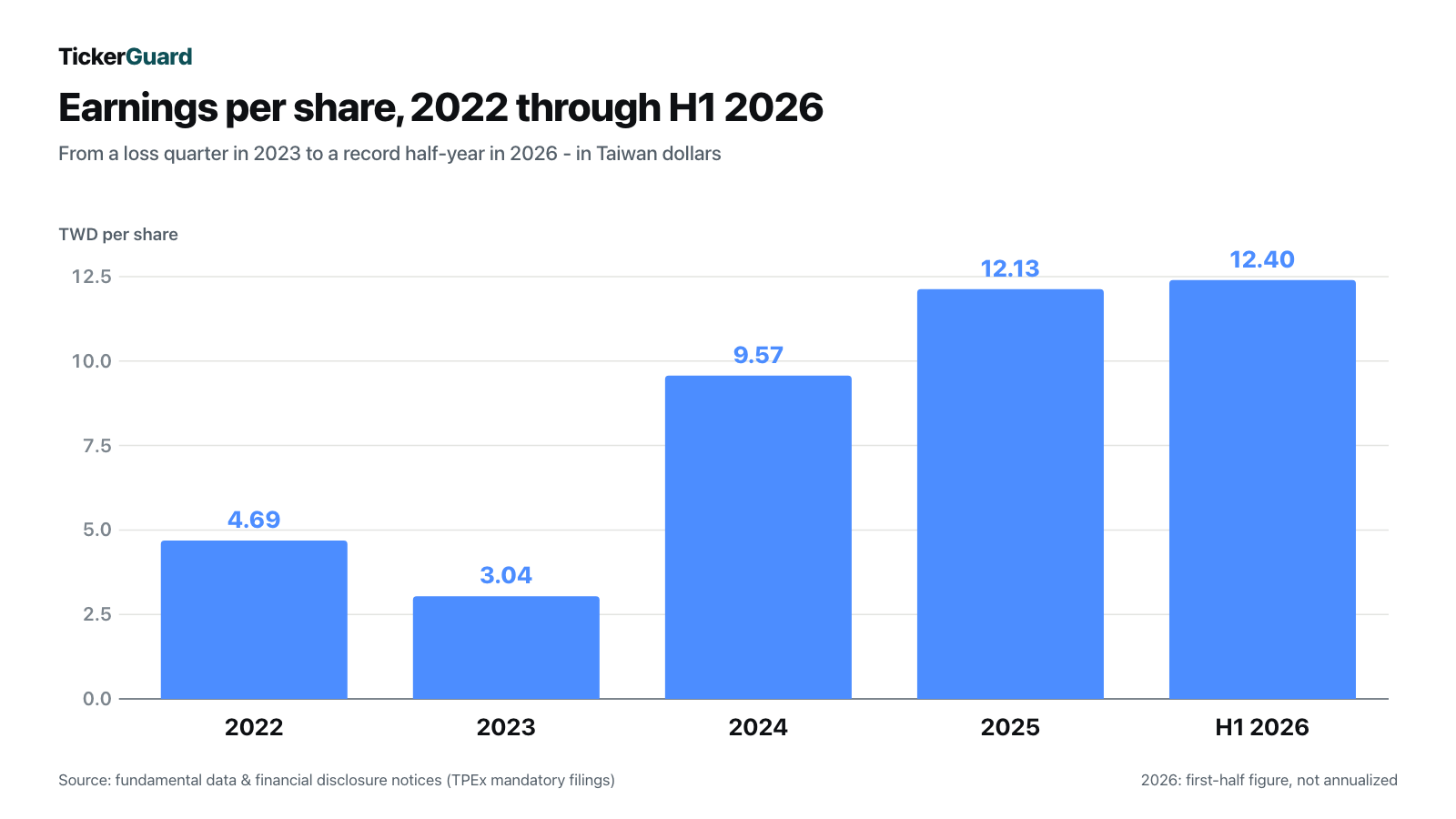
Looking only at the last few months hides how bumpy the road here was. Earnings per share fell from roughly TWD 4.69 (2022) to TWD 3.04 (2023) — a year in which the circuit-board-material industry as a whole suffered an inventory correction, and Taiwan Union Technology posted an outright loss of TWD 0.77 per share in the first quarter of 2023. From that low point, the climb was steep: TWD 9.57 (2024), TWD 12.13 (2025, on consolidated revenue of TWD 30.34 billion, up 31.5 percent) — and finally TWD 12.40 in the first half of 2026 alone, more than the entire year of 2025.
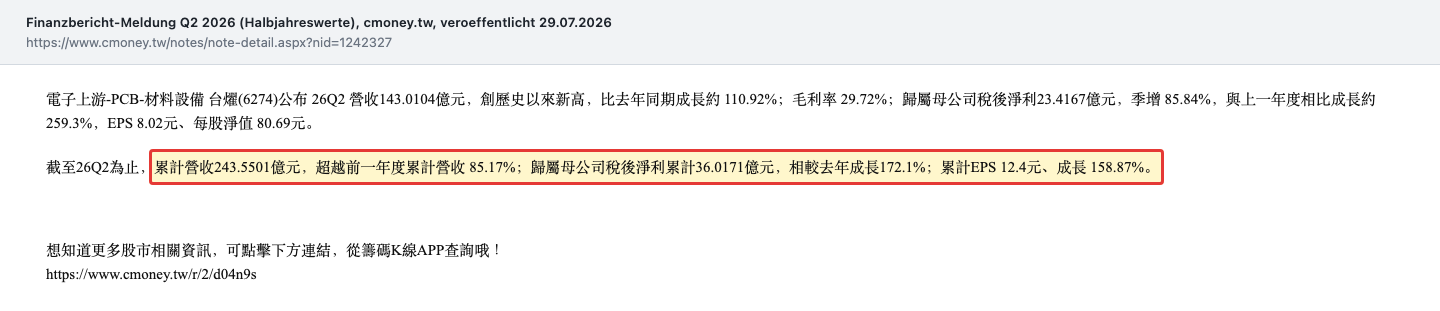
The second quarter of 2026 marks a record in its own right: revenue of TWD 14.30 billion (up 110.9 percent year on year and 42.2 percent quarter on quarter), a gross margin of 29.72 percent (up from 25.2 percent in Q1), and net profit of TWD 2.34 billion — up 259.3 percent year on year. Operating margin climbed to 23.48 percent, the highest ever reported.

Cumulatively for the first half of 2026, that adds up to revenue of TWD 24.36 billion (up 85.2 percent year over year) and net profit of TWD 3.60 billion (up 172.1 percent) — already more than the full year of 2025 brought in net profit.
What the earnings calls show — without a transcript
An honest note up front: for Taiwan Union Technology, there are no publicly available word-for-word transcripts of analyst calls — unlike many US stocks, for which full transcripts of the question-and-answer sessions exist. Instead, we evaluated two independent written write-ups of the July 30, 2026 earnings call covering second-quarter results, which agree on the core figures. That is weaker evidence than a verbatim transcript — we flag that deliberately rather than gloss over it.
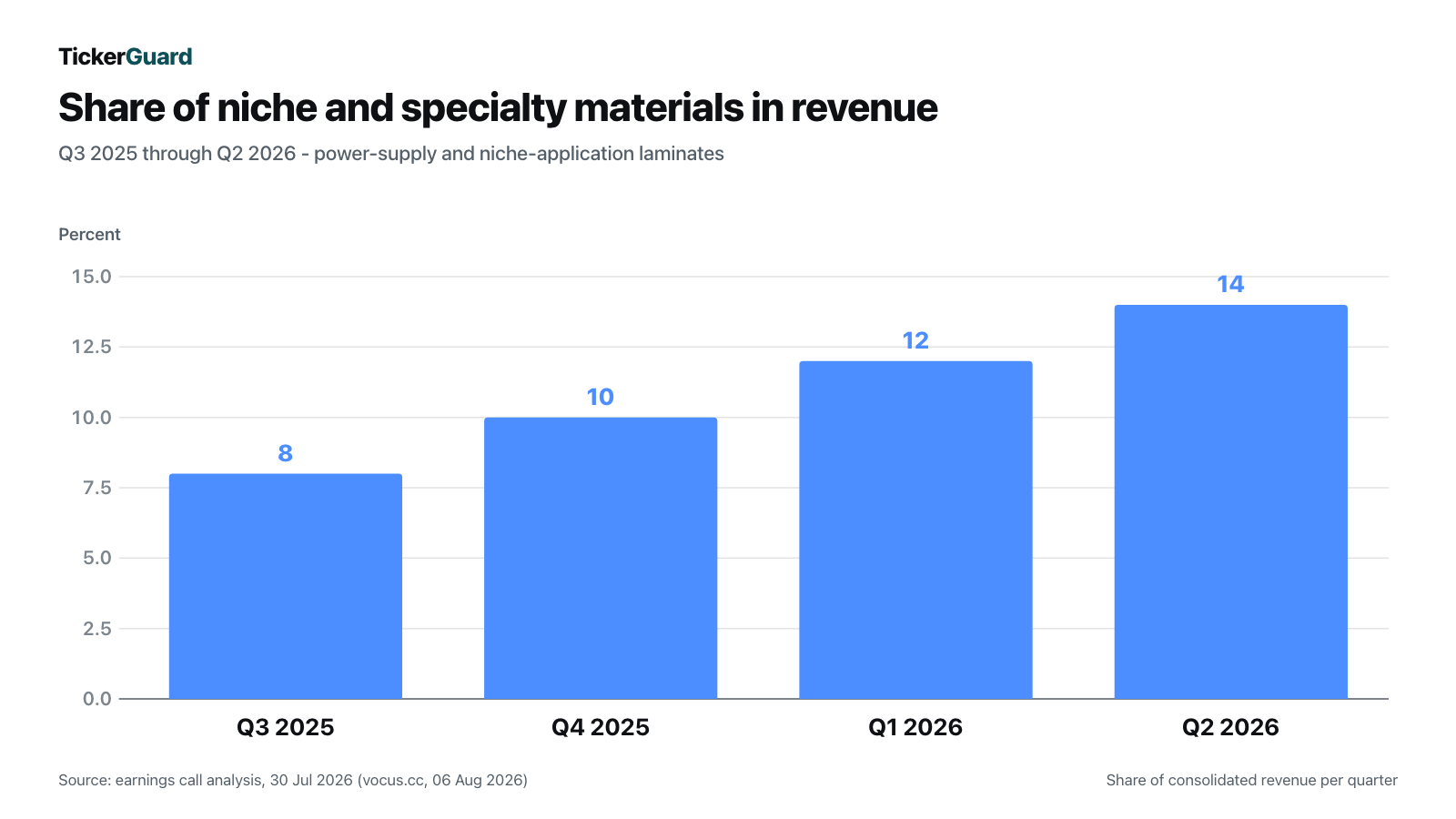
Substantively, both write-ups describe the same shift: the share of higher-value M7/M8-class materials (particularly low-loss, high-frequency laminates) in revenue keeps rising, while the lower-margin nano-loss (NL) segment is being deliberately scaled back — from 18 percent of revenue in the first quarter of 2026 to 16 percent in the second. Even more pronounced is the trend in the so-called "power/niche" segment (materials for power-supply applications and specialty products): its revenue share climbed from 8 percent in the third quarter of 2025, through 10 percent (Q4 2025) and 12 percent (Q1 2026), to 14 percent in the second quarter of 2026 — nearly doubling within twelve months in a segment both sources describe as particularly high-margin.
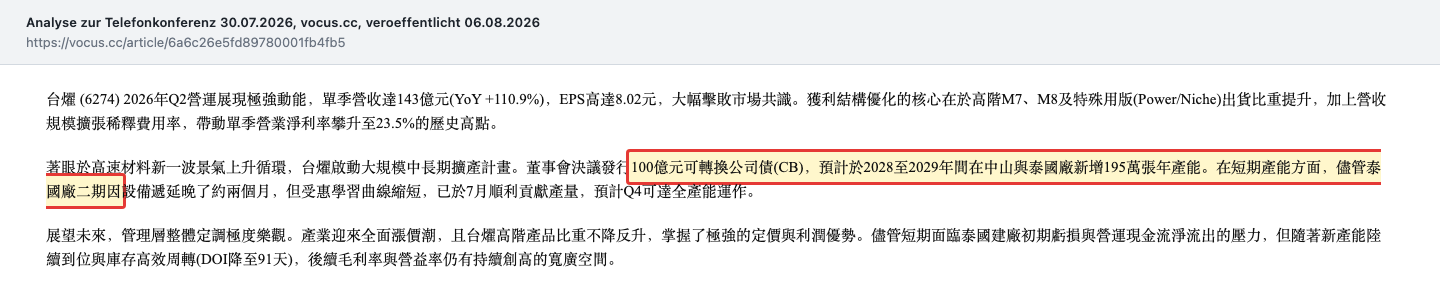
For medium-term capacity, both write-ups say management announced a convertible bond of TWD 10 billion to fund roughly 1.95 million sheets of additional annual capacity at the Zhongshan (China) and Thailand sites between 2028 and 2029. In the short term, the Thailand plant expansion is running roughly two months behind schedule — due to delayed equipment deliveries — but it has already contributed initial production volumes since July 2026, with the goal of full capacity utilization in the fourth quarter of 2026.
「100億元可轉換公司債(CB),預計於2028至2029年間在中山與泰國廠新增195萬張年產能。」
Translation: "A TWD 10 billion convertible bond, expected to add 1.95 million sheets of annual capacity at the Zhongshan and Thailand plants combined between 2028 and 2029."
— Earnings call write-up, 30 Jul 2026, vocus.cc (6 Aug 2026)
What the numbers show — the uncomfortable truths
Uncomfortable truth No. 1: record profit, but cash went out the door
In the same quarter Taiwan Union Technology earned TWD 2.34 billion, operating cash flow ran negative rather than positive: minus TWD 716 million, plus a further TWD 940 million in capital spending. The reason lies in rising inventory and receivables plus ramp-up costs at the Thailand plant. Anyone looking only at the income statement would miss this entirely — profit and cash flow moved in opposite directions in the very same quarter. That is not unusual for a company mid-expansion, but it makes the already-announced convertible-bond financing more important than a pure profit view would suggest.
Uncomfortable truth No. 2: the cheap price-earnings ratio only exists in the future — and only if two doublings happen
The lower price-earnings ratio of roughly 20 for 2027 mentioned at the top is not a value already achieved today, but a calculation that requires two consecutive, very steep assumptions. First, earnings per share in the second half of 2026 would have to reach a level that, combined with the TWD 12.4 already earned in the first half, hits the full-year consensus of TWD 36.69 — meaning the second half would need to contribute nearly twice what the first half did. Second, that already-high figure would need to climb by roughly another 105 percent in 2027, to TWD 75.10. Neither assumption is pulled out of thin air — the ongoing record quarter and the announced capacity expansions support both — but they remain assumptions, not results already delivered. If either jump falls short, the stock stays expensive by conventional metrics.
Uncomfortable truth No. 3: the stock is already 22 percent off its own high
The TWD 1,490 price (August 28, 2026) sits 328 percent above where it stood a year earlier, but also already roughly 22 percent below the 52-week high of TWD 1,900 the stock reached on June 22, 2026 — barely two months prior. The 52-week low of TWD 292 (September 19, 2025) falls within the same twelve-month span. A trading range that more than sextuples within twelve months and then already corrects by a fifth is not a footnote — it is this stock's normal state: a beta of 2.3 shows that price swings at Taiwan Union Technology run roughly twice as large as the broad market, in both directions.
Valuation — the question behind the ×4
With 288,673,387 shares outstanding and a price of TWD 1,490 (August 28, 2026), market capitalization comes to roughly TWD 430.1 billion — about USD 13.60 billion or EUR 11.73 billion (exchange rates as of 30 Aug 2026: USD 1 = TWD 31.63, EUR 1 = TWD 36.67). Against book value per share of TWD 80.69 (June 30, 2026, from the same financial disclosure notice), that works out to a price-to-book ratio of roughly 18.5 — a very high figure for a materials maker, even though return on equity of 33.7 percent in the second quarter of 2026 was exceptionally strong.
The price-earnings ratio hinges critically on which profit figure you use. On a trailing-four-quarter basis (our stock screener puts trailing earnings per share at roughly TWD 19.8), the price-earnings ratio works out to roughly 75 — a snapshot taken shortly after the fiscal-year rollover, blending the still-weaker quarters from the second half of 2025 with the already-strong quarters of 2026. Use the analyst consensus for the full year 2026 instead (TWD 36.69, 12 analysts, as of August 16, 2026), and the computed ratio is roughly 41; for the 2027 consensus (TWD 75.10, 13 analysts), roughly 20. All three numbers are "correct" — they simply describe different time periods, and only the first is based on profit already earned rather than estimated.
A look at the dividend shows the same mechanism in miniature. According to Taiwanese broker portal aiinvest.sinotrade.com.tw, Taiwan Union Technology has paid an uninterrupted dividend for 25 years, totaling TWD 54.02 per share over that span. For fiscal year 2025, a total of TWD 7.506 per share was distributed on April 16, 2026 — against today's price of TWD 1,490, that is a yield of only roughly 0.5 percent. Not because the dividend fell, but because the price has risen so far that the same payout now returns a much smaller share of what it costs to buy in.
Opportunities and risks at a glance
Opportunities: a structurally growing end market for high-frequency and high-speed materials, driven by AI data-center buildout; an already-documented shift toward higher-value, higher-margin products (M7/M8, power/niche segment); a concrete, financed capacity-expansion plan through 2028/2029; a 25-year unbroken dividend record; and a record first half of 2026 that has already clearly outpaced its own prior-year performance. Risks: a valuation that, on already-earned profit, ranks among the most expensive this outlet has analyzed recently, and stays justified only if the current pace of growth continues; operating cash outflow in the company's best-ever quarter; extreme price volatility (beta 2.3, more than sixfold spread between the 52-week low and high); a planned TWD 10 billion convertible bond whose exact terms and dilution impact are not yet known; and a cyclical core business — the circuit-board-material industry already showed in 2023 how quickly growth can turn into an inventory correction with loss quarters.
A human conclusion
Anchoring bias is insidious because it feels right: a price-earnings ratio of 75 is a real, verifiable number, not an invention. Just as real is the fact that the same stock trades at 20 the moment you run it against what is expected for 2027 — and both calculations have their own logic, depending on whether you think in terms of profit already earned or profit expected. Anyone who sees only the first number misses a company whose profit has genuinely quadrupled in two years and that, in the best quarter of its history, still invests more than it takes in as cash. Anyone who sees only the second number misses that this calculation requires two doublings that have not happened yet. The honest answer sits in between: the business is growing for real, but the price has already priced in a substantial share of that growth — and buying in today means paying for assumptions that still have to come true. No buy or sell recommendation.
Sources
This analysis draws on: the Q2 2026 financial disclosure notice for Taiwan Union Technology, quoted verbatim by cmoney.tw (published 29 Jul 2026); two independent write-ups of the July 30, 2026 earnings call (vocus.cc, published 6 Aug 2026, and blog.fugle.tw, published 30 Jul 2026); the company profile on tuc.com.tw; fundamental data (price, valuation and balance-sheet metrics plus analyst consensus estimates, as of 16-30 Aug 2026); and press/portal research on company history, management and dividend record (goodinfo.tw, nstock.tw, statementdog.com, fnc.ebc.net.tw, aiinvest.sinotrade.com.tw, all retrieved 30 Aug 2026). No publicly available word-for-word analyst-call transcripts exist for 6274.TW. Note: this analysis is journalistic coverage of publicly available information, not investment advice and not a buy or sell recommendation.
Our Bottom Line at a Glance
- Growth positive
- Earnings per share quadrupled from TWD 3.04 (2023, including a loss quarter) to TWD 12.13 (2025); the first half of 2026 already topped TWD 12.40, more than the entire prior year. Growth is driven by the expanding, high-margin power/niche segment (revenue share 8 to 14 percent within four quarters) and a rising M7/M8 share.
- Cash flow and liquidity negative
- In the record quarter (Q2 2026, TWD 2.34 billion net profit), operating cash flow ran negative (roughly minus TWD 716 million), with a further roughly TWD 940 million in capital expenditure on top. Paper profit and cash in the bank moved in opposite directions in the same quarter — driven by inventory buildup, receivables growth and Thailand ramp-up costs.
- Valuation negative
- At TWD 1,490 (28 Aug 2026), the trailing-four-quarter price-earnings ratio is roughly 75, and price-to-book roughly 18.5. A lower price-earnings ratio (roughly 20 for 2027) only emerges if the analyst consensus — which assumes two consecutive profit doublings — comes true.
- Capacity expansion and financing neutral
- A TWD 10 billion convertible bond for the 2028/2029 capacity expansion has been announced; specific terms (notably the conversion price, and with it the dilution impact) were not yet public as of this analysis. The Thailand plant is running roughly two months behind schedule but has already contributed initial production since July 2026.
- Price volatility negative
- A beta of 2.3, a 52-week range from TWD 292 to TWD 1,900 (more than sixfold), and a current price already roughly 22 percent below the June 2026 high. A stock with considerably larger swings than the broad market, in both directions.
- Capital return to shareholders positive
- According to a broker portal, 25 years of uninterrupted dividend payments (TWD 54.02 per share cumulative); TWD 7.506 per share was distributed for 2025. The current yield of only roughly 0.5 percent reflects the sharp price rise, not a dividend cut.
Taiwan Union Technology shows a business that is genuinely and strongly growing: earnings per share quadrupled between 2023 and 2025, the first half of 2026 already topped the entire prior year's profit, and the share of higher-value materials keeps visibly rising. Yet in that same record quarter, operating cash flow ran negative, valuation on already-earned profit is high, and a lower price-earnings ratio only exists under the assumption of two further profit doublings that have not happened yet. Not investment advice.
What Our Rating Means
Open questions
The business works in principle, but one material question is open. As long as it stays open, our findings do not carry a quality verdict.
Yellow here is not about an existential question — the operating business is growing genuinely and substantially, return on equity was exceptionally high at 33.7 percent in the second quarter of 2026, and the company has paid an uninterrupted dividend for 25 years. Yellow stands because two operational questions remain open: first, the seemingly attractive forward valuation depends entirely on an analyst consensus that assumes two consecutive profit doublings within eighteen months — if even one falls short, the stock stays expensive by conventional metrics. Second, the operating cash outflow in the best quarter in company history shows that reported book profit is not currently converting into actual liquidity at the same pace — a combination worth watching alongside the planned multi-billion convertible bond. The business model itself — a CCL maker with a documented shift toward higher-value, higher-margin materials in a structurally growing end market — clearly holds up; whether cash flow and valuation keep pace with earnings growth will show at the earliest in the third-quarter 2026 report.
A journalistic assessment by our editorial team at the time of the deep dive, based on public sources — not investment advice and not a solicitation to buy or sell. Your personal circumstances (investment goals, risk capacity, taxes) cannot be taken into account. What our levels mean, how verdicts are formed, and what conflicts of interest exist →
Worth Noting
- This analysis was first published on 30 Aug 2026. All company figures come from the Q2 2026 financial disclosure notice (published 29 Jul 2026, the most recent period report evaluated) and two independent write-ups of the related July 30, 2026 earnings call — not from unverified press coverage. Price, share count and valuation metrics are dated 28-30 Aug 2026.
- No publicly available word-for-word analyst-call transcripts exist for 6274.TW (checked 30 Aug 2026: no public transcript found). The earnings-call chapter therefore relies on two independent written write-ups rather than a verbatim transcript.
- Two figures present in the raw data feed (a forward P/E of 6.46 and an analyst target-price consensus of TWD 2,181.54) did not reconcile against other fields in the same feed and were deliberately NOT used; the forward P/E figures cited in this analysis (roughly 41 for 2026, roughly 20 for 2027) were instead computed from price and the consensus earnings estimates.
The full analysis as a PDF for later
We will send you this analysis as a PDF — to print, file away, and read at your own pace.
Frequently Asked Questions
Taiwan Union Technology Corporation (TPEx: 6274) of Zhubei, Taiwan, makes copper-clad laminates (CCL) and prepreg bonding sheets for printed circuit boards — focused on high-frequency and high-speed materials for servers, AI data centers, automotive and substrate applications. Press coverage puts the server business at roughly 50 to 60 percent of consolidated revenue.
No. The company makes physical carrier materials for circuit boards, some of which end up in AI servers — it benefits from its customers' AI capital-spending cycle, but does not sell AI software or AI hardware itself, and consistently describes its products through physical material properties, not artificial intelligence.
Taiwan Union Technology is listed on the Taipei Exchange (TPEx), Taiwan's second regulated equity market alongside the main Taiwan Stock Exchange (TWSE) — there is no SEC registration, no 10-K, no 10-Q. Instead, companies file financial disclosure notices with Taiwan's market regulator. This analysis draws on the Q2 2026 financial disclosure notice and two independent write-ups of the related earnings call.
In the second quarter of 2026, Taiwan Union Technology earned TWD 2.34 billion while operating cash flow came in at minus TWD 716 million. The reason: growing inventory and receivables, plus ramp-up costs at the new Thailand plant. Paper profit and cash in the bank moved in opposite directions in the same quarter.
It depends which profit figure you use. On a trailing-four-quarter basis, the price-earnings ratio is roughly 75. Against the 2026 analyst consensus estimate (TWD 36.69 earnings per share), the computed ratio is roughly 41; against the 2027 estimate (TWD 75.10), roughly 20 — each assuming those estimates materialize.
Yes. According to a Taiwanese broker portal, the company has paid an uninterrupted dividend for 25 years. For fiscal 2025, a total of TWD 7.506 per share was distributed on April 16, 2026 — against the current price, that is a yield of only roughly 0.5 percent, because the share price has risen sharply.
According to write-ups of the July 30, 2026 earnings call, Taiwan Union Technology plans a TWD 10 billion convertible bond to fund roughly 1.95 million sheets of additional annual capacity in Zhongshan (China) and Thailand between 2028 and 2029. Specific terms such as the conversion price were not yet public as of this analysis.
By 328 percent versus a year earlier (as of August 28, 2026). At the same time, the stock is already roughly 22 percent below its 52-week high of TWD 1,900 from June 22, 2026 — with a beta of 2.3, this stock swings considerably harder than the broad market.
Found an error?
Did you spot a factual error, an outdated number, or a typo in this deep dive? Let us know briefly — your report goes straight to the editorial team.