The Sale-Tag Trap at Safehold: One Third of Book Value — and Why the Discount Has a Reason
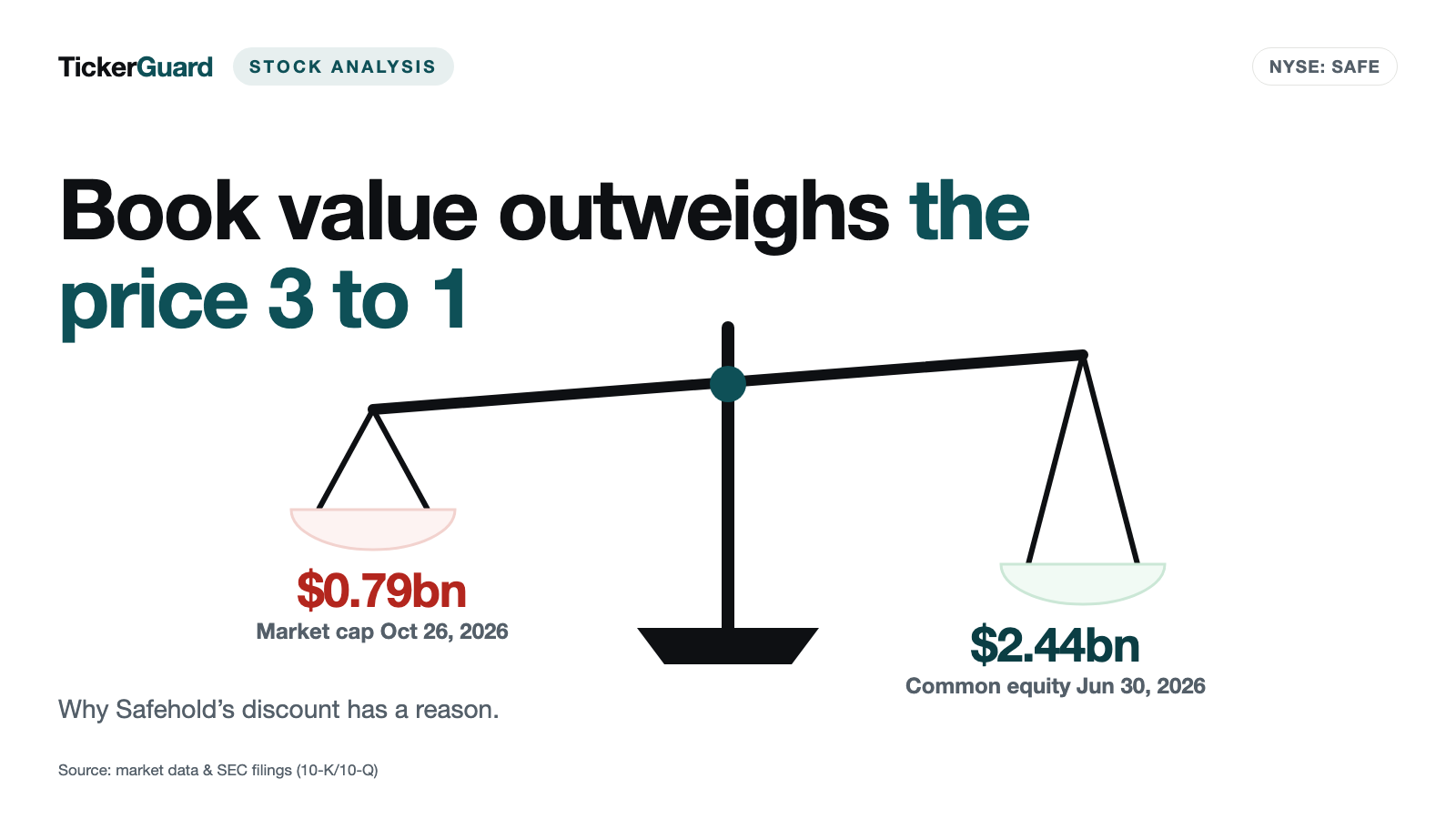
Safehold owns the land under 172 buildings in major U.S. cities and reports $2.44 billion of common equity. On October 26, 2026, the market valued the whole company at about $0.79 billion. A 67 percent markdown? The SEC filings show that the rent brings in 3.8 percent in cash while the debt costs 3.9 percent — and the dividend exceeds the cash coming in. Not investment advice — just a second look at a tempting price tag.
 Thomas Mücke
Founder & Publisher
As of Today
As of: October 26, 2026
- Closing price
- 11.20 $ -0.70%
- Market Capitalisation
- 0.8 $B
- Growth Score
- 3/10
- AAQS
- 3/10
Price change since October 26, 2026: +0.4%
This analysis has a cut-off date. The Stock Guard tells you when something material changes in the numbers. Reserve your free spot
Chart
Interactive price chart (TradingView).
52-week range: 10.70 $ to 17.20 $ · Last price: 11.20 $ (As of: October 26, 2026)
Note: pure fact-based analysis, not investment advice and not a solicitation to buy or sell. All figures without guarantee.
You know the feeling from the department store: a red tag promises “67 percent off,” and suddenly you stop asking whether you need the jacket and only ask whether they have your size. That is the sale-tag trap: the crossed-out price becomes the anchor, and the question of why something is marked down disappears. Safehold’s stock (NYSE: SAFE) carries just such a tag. As of June 30, 2026, the company reported $2.44 billion of common equity, or $34.33 per share. On October 26, 2026, the stock closed at $11.15. With 70,816,280 shares outstanding (as of July 28, 2026), that is a market value of about $0.79 billion — barely one third of book value.
Before you ask for your size, let’s read the label together: the annual reports (10-K) and quarterly reports (10-Q) Safehold filed with the U.S. securities regulator, the SEC, the current reports (8-K) through October 2026, and the quarterly report of its large shareholder Star Holdings. Anyone who files false statements with the SEC risks penalties, which is why these reports are among the most reliable sources there are. At the end, the decision is yours.
What Safehold Actually Does — the Landlord Beneath the Skyscraper
Safehold does not own skyscrapers; it owns the ground beneath them. A developer or owner sells Safehold the land and immediately leases it back, usually for 99 years. The building stays with the owner, who pays ground rent that rises every year — at a fixed rate or tied to inflation. Taxes, insurance and maintenance are on the tenant. And at the end of the term, or if the tenant defaults, the contract says that not just the land but also the building reverts to Safehold, at no cost to Safehold. Think of it as a landowner collecting rent under a long-term building lease, only in major U.S. cities and at scale. The company describes itself like this:
“We believe that our business has characteristics comparable to a high-grade, fixed income investment business, but with certain unique advantages.”
— Safehold Inc., SEC annual report 10-K for 2025, Item 1 “Business”
So Safehold sees itself as a kind of bond with a bonus. As of June 30, 2026, its core portfolio comprised 172 ground leases with $7.1 billion of gross book value and an average remaining term of 92 years (including extensions). By book value, 44 percent sat under multifamily properties, 39 percent under office buildings, 9 percent under hotels and 6 percent under life science labs. The New York metro area alone made up 28 percent. On average, according to the earnings presentation, the buildings generated 3.4 times the rent they owe Safehold. As of December 31, 2025, Safehold had 72 employees.
Today’s company is the product of a merger: on March 31, 2023, the old Safehold merged into its former largest shareholder, iStar; iStar took the Safehold name and first spun off the remains of its old lending business as Star Holdings. For accounting purposes the old Safehold is treated as the acquirer, so the figures before 2023 are its numbers. That sets up the central tension of this analysis, and it runs through every chapter: Safehold sells itself as a safe bond with upside — yet in late October 2026 the market valued it at one third of book value. One of the two is wrong, and the filings help answer which.
Company history for investors
-
2017
IPO of the old Safehold
In June 2017, the ground lease company founded by iStar goes public. For investors, the experiment begins: trading ground rent like a bond with upside.
-
2023
Merger with iStar, Star Holdings spin-off
iStar acquires the old Safehold and its name; the legacy businesses move into Star Holdings. Shareholders get one company — and ties that still matter today.
-
2023
$145.4 million goodwill write-off
The goodwill booked in the merger is written off in full, and the year ends with a $55.0 million loss. For shareholders, a one-off with no cash outflow.
-
2025
Termination notice to Park hotels
On October 22, 2025, Safehold terminates hotel tenant Park's lease on five hotels and sues. Safehold tests its right to terminate a major tenant's lease in court.
-
2026
Two hotels back, termination in Manhattan
Since January 1, Safehold runs two hotels itself; in May it terminates the 135 West 50th Street lease, and a court halts that for now. Tenant risk becomes concrete.
How the Stock Landed on Our Desk
No metrics screen flagged Safehold first; other investors’ attention did: in late October 2026, our in-house Reddit hype scanner picked up the ticker SAFE. That is not a buy recommendation and not a signal — it is a hint that someone in the forums is telling a story. The story is obvious: from July 31, 2026 ($16.18) to October 26, 2026 ($11.15), the stock lost about 31 percent, and on October 21, 2026 it closed at $10.66, its lowest close since the merger. On merger day, March 31, 2023, it had closed at $29.37. No SEC filing explains the fall decline.
According to fundamental data (as of October 26, 2026), about 3.3 million shares were sold short, roughly 4.6 percent of all shares (our own math: 3.26 million divided by 70.8 million shares) — a noticeable but not extreme bet on falling prices, not an all-out attack. At first glance, the metrics on our scanner pages look like a find: price-to-book around 0.3, a P/E below 7, a dividend yield above 6 percent. Those are exactly the numbers you see on a sale tag. So remember this from the start: a low price-to-book ratio only tells you the market does not trust the book value — not that the market is wrong.
The Numbers Over the Years — An Honest Assessment
First, what genuinely impresses. Revenue more than doubled from $187.0 million (2021) to $385.6 million (2025), and in the second quarter of 2026 it rose 22 percent year over year to $114.6 million — although $15.9 million of that came from two hotels Safehold has been operating itself since January 2026. Except for 2023, Safehold was profitable every year: $114.5 million for common shareholders in 2025 and $59.0 million in the first half of 2026. According to the 10-Q, none of the leases accounted for as financing receivables was past due as of June 30, 2026. Per its earnings presentation, the three major rating agencies rate Safehold solidly investment grade (Moody’s A3, Fitch and S&P A- each), and nothing comes due at the corporate level before 2029 (excluding mortgages on individual properties).
The 2023 loss has a simple explanation: after the merger, Safehold wrote off $145.4 million of goodwill in full — the premium booked in the acquisition above the value of the assets. More important than that one-off is another line in the chart — the green one:
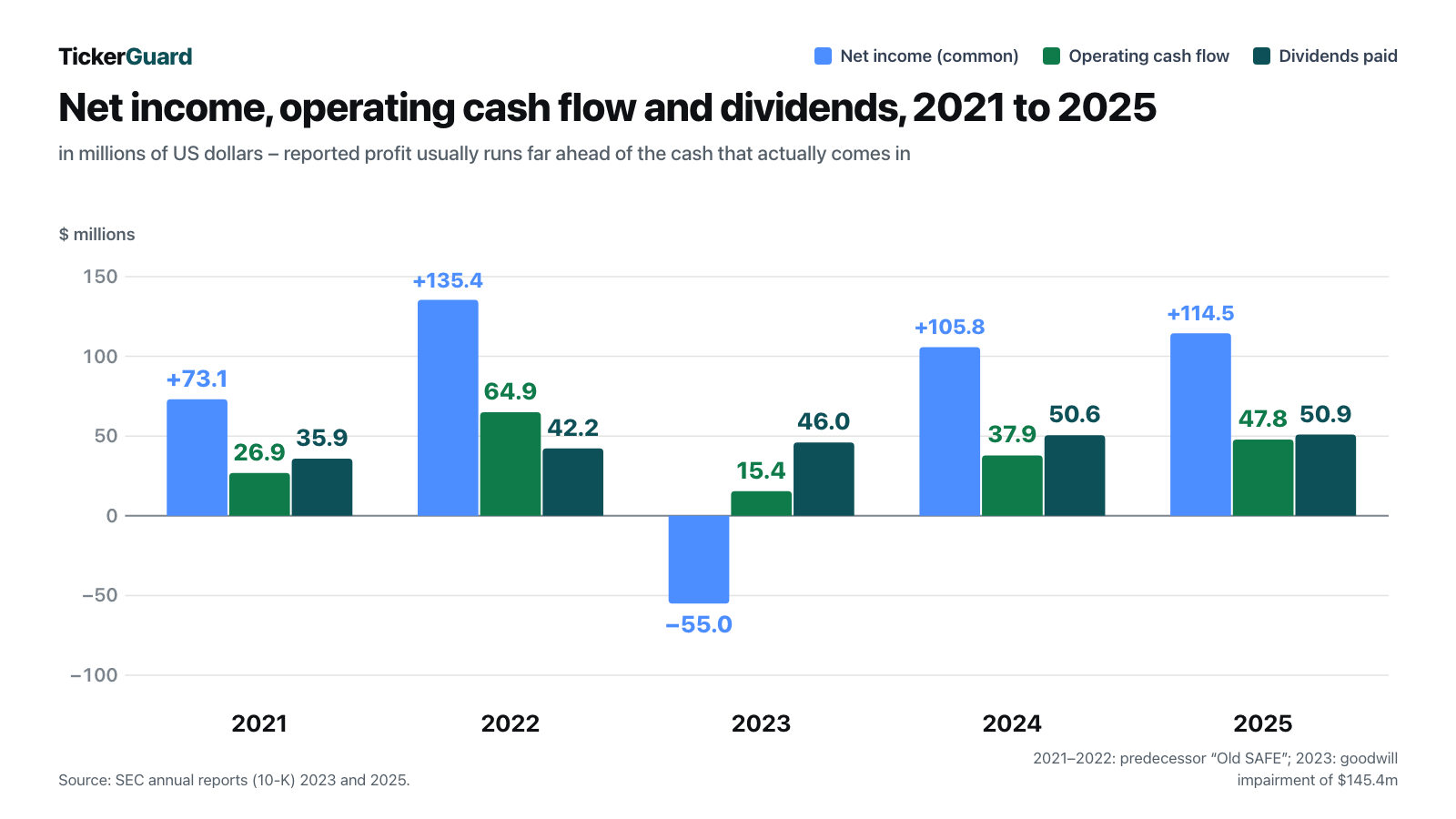
Costs grow too: interest expense rose from $79.7 million (2021) to $206.7 million (2025), consuming 54 percent of revenue at the end, up from 43 percent in 2021. Earnings before interest and taxes covered the interest bill about 1.6 times in 2025. In short: Safehold grows and reports profits — but the cash that actually comes in is much smaller than the profit, and more than half of revenue goes to lenders.
What the Filings Say — the Uncomfortable Truths
Uncomfortable Truth No. 1: Much of the Profit Is Paper Profit — the Dividend Exceeds the Cash
Why are profit and cash so far apart? Safehold’s rent starts low and rises over 99 years. Accounting, however, spreads the total contractual rent evenly over the term. In the early decades Safehold therefore books more revenue than tenants actually pay; the difference builds up as a receivable on the balance sheet, to be paid at some point in the distant future. That is correct accounting, not a trick — but it means a large part of the profit is a promise, not a bank balance.
The cash flow statement in the 2025 annual report quantifies it: $101.5 million of “non-cash interest income from sales-type leases” plus $30.3 million of accrued but unpaid rent — together $131.8 million of non-cash revenue against net income of $114.6 million (before noncontrolling interests; $114.5 million was attributable to common shareholders). Operating cash flow was $47.8 million, dividends paid $50.9 million. In the first half of 2026, operating cash flow covered the dividend narrowly ($26.0 million versus $25.8 million), but not the additional $16.1 million of share buybacks. The Q2 2026 earnings presentation supplies the matching comparison: the rent actually paid equals an annualized cash yield of 3.8 percent on cost — while Safehold’s debt carries an average cash interest rate of 3.9 percent. Only with the non-cash components does the portfolio yield reach 5.5 percent against an effective interest rate of 4.4 percent.
Picture it this way: you rent out an apartment whose rent only rises meaningfully in many years, and you bought it almost entirely on credit. Today the rent barely covers the interest; the profit lives mainly in the lease contract. The lesson: with Safehold you have to tell profit from cash — today the dividend is funded not by operating cash alone but also by new borrowing.
Uncomfortable Truth No. 2: Leverage Sits at the Company’s Own Ceiling
How much debt does Safehold want to carry? The annual report sets a clear limit:
“Our current strategy is to generally target overall leverage at an amount that is approximately 25% of the aggregate Combined Property Value of our portfolio, but not to exceed an overall ratio of 2:1 relative to our total equity.”
— Safehold Inc., SEC annual report 10-K for 2025, Item 1 “Financing Strategy”
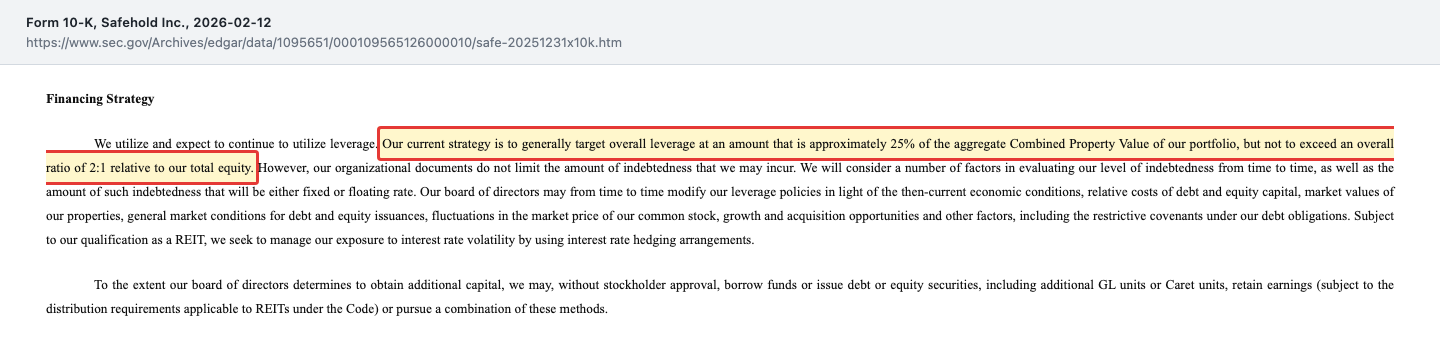
The Q2 2026 earnings presentation (Exhibit 99.2 to the 8-K of July 30, 2026) lists $4.98 billion of debt against $2.47 billion of equity — a ratio of 2.01x. Safehold uses its own definitions there: debt includes its share of joint venture debt (the balance sheet shows $4.65 billion), and equity excludes $159 million of a partner’s interest in seven ground leases. The ceiling has been reached. Right next to the policy, the report notes that the board may change it at any time; it is not a straitjacket. But it shows the dilemma: Safehold grows by buying new land, and that takes capital. More debt breaks its own limit. Issuing new shares at one third of book value would dilute existing shareholders at a clearance price — your slice of the pie would shrink without the pie growing by as much.
So Safehold turns to partners: in the second quarter of 2026 it formed a $348 million joint venture with Brookfield on seven ground leases, with Brookfield holding 49 percent; on top of that, $400 million of investment capacity remains open in a joint venture with a sovereign wealth fund. And Safehold buys back its own stock: 1.1 million shares for $16.3 million in the first half of 2026, another 0.2 million for $3.7 million in July. The lesson: a growth model that needs capital gets stuck when debt is at the ceiling and the stock is too cheap to issue new shares.
Uncomfortable Truth No. 3: The Stress Test Is Here — an Office Tower, a Hotel Portfolio, Two Lawsuits
The entire safety thesis rests on one sentence: if the tenant defaults, Safehold gets the building. Whether that works as smoothly in practice is being tested right now in Manhattan. The land under the office tower at 135 West 50th Street is the second-largest single position in the portfolio at 5.0 percent of gross book value. The quarterly report states:
“The tenant at 135 West 50th Street defaulted on a forbearance agreement in connection with the tenant’s failure to pay property taxes, and we sent the tenant a lease termination notice in May 2026.”
— Safehold Inc., SEC quarterly report 10-Q for June 30, 2026, Item 2 MD&A “Our Portfolio”
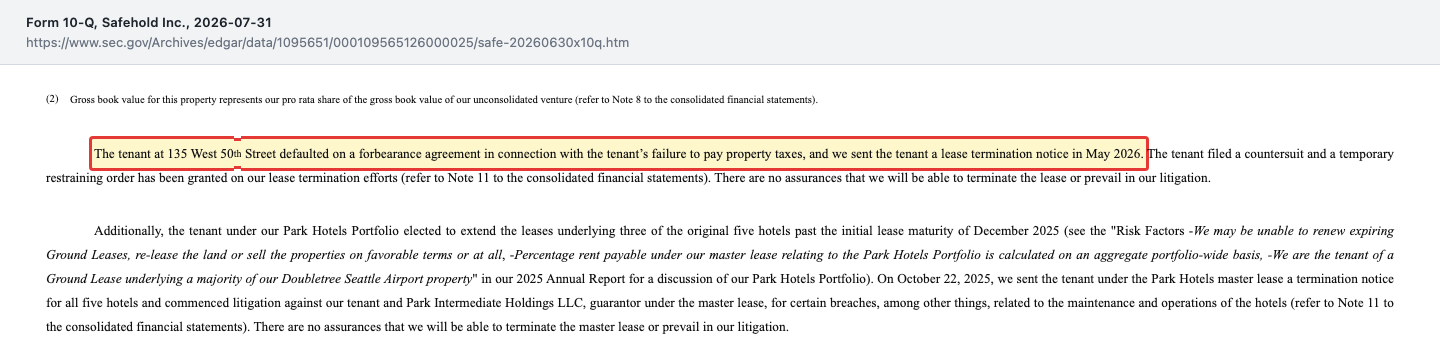
The tenant is fighting back: it countersued, and on June 4, 2026, a New York court entered a temporary restraining order that, for now, prevents Safehold from enforcing the termination. Safehold considers the termination valid but concedes there is no assurance it will win. The second dispute concerns five hotels that operator Park leased under a single master lease. Two of them reverted to Safehold on January 1, 2026 — since then Safehold has run two hotels itself through third-party operators, with $25.8 million of revenue and $26.1 million of costs in the first half of 2026. On October 22, 2025, Safehold sent a termination notice for all five hotels and has been suing in the Delaware Court of Chancery over maintenance and operating breaches; Park disputes the right to terminate.
Behind this sits the bigger office question. Office land makes up 39 percent of the portfolio, and that is where the cushion is thinnest: according to the earnings presentation, building income covers the ground rent only 2.9 times, and Safehold’s book value equals 71 percent of the estimated value of land and building combined — versus 38 percent for multifamily. Safehold itself warns that appraisals are updated only every 12 to 24 months and may not fully capture the decline in office values. The lesson: the reversion clause is a right, not an automatic payout — and what it is worth is being decided by courts right now.
Uncomfortable Truth No. 4: A Fifth of the Shares Is Pledged to a Bank — and the Star Holdings Ties Remain
The 2023 merger left an umbilical cord. Star Holdings, the spun-off remains of the old iStar, holds about 13.5 million Safehold shares, roughly 19.0 percent as of June 30, 2026. Those shares secure a $94.5 million margin loan from Morgan Stanley. Star Holdings describes the risk itself:
“Declines in the market value of the Safe Shares could require us to make prepayments of some or all of the outstanding borrowings under the Margin Loan Facility or post additional cash collateral.”
— Star Holdings, SEC quarterly report 10-Q for June 30, 2026, Item 2 MD&A “Investment in Safe”

On June 30, 2026, the shares were worth $212.3 million at $15.70. At the October 26, 2026 close they would be worth about $151 million by our math — the loan would equal roughly 63 percent of the collateral instead of 45 percent. At the same time, Safehold is Star Holdings’ lender: a $115.0 million term loan at 8 percent. On September 29, 2026, Safehold extended that loan by a year to March 2029 (for a $2.4 million fee), permitted Star Holdings voluntary prepayments of up to $50 million (plus restricted cash held by the margin lender), allowed Star Holdings to buy back up to $10 million of its own shares once the margin loan has been paid down by at least $40 million, and raised the fee Star Holdings would owe on terminating the management agreement from $55.0 million to $62.5 million (8-K of October 2, 2026). Because Safehold also manages Star Holdings — worth $11.7 million in management fees in 2025.
Several Safehold executive officers are also executive officers of Star Holdings; the annual report spells out the potential conflicts of interest. A second incentive system comes on top: as of June 30, 2026, officers and employees held 15.4 percent of the outstanding Caret units, which participate in the value of the buildings that revert (8-K of July 30, 2026); CEO Jay Sugarman held 6.1 percent of the authorized units directly and indirectly at the end of 2025. Part of that only vests if the stock averages at least $60 over 30 consecutive trading days by March 31, 2027. The lesson: a fifth of the shares sits with a large holder that might itself be forced to sell — this could act as a lid on the price for as long as that is unresolved.
Valuation: One Third of Book Value — and What the Market Counts Against It
Let’s check the price tag. On October 26, 2026, the stock closed at $11.15; with 70,816,280 shares (as of July 28, 2026), that is about $0.79 billion of market value. For comparison: on September 9, 2026, director Robin Josephs sold 9,500 shares at an average of $14.56 (insider filing, Form 4) — at that price the market value was still about $1.03 billion. Against this stands $2.44 billion of common equity, or $34.33 per share as of June 30, 2026. The price-to-book ratio is therefore about 0.32 — you pay 32 cents for a dollar of book value. The chart shows how the gap has opened:
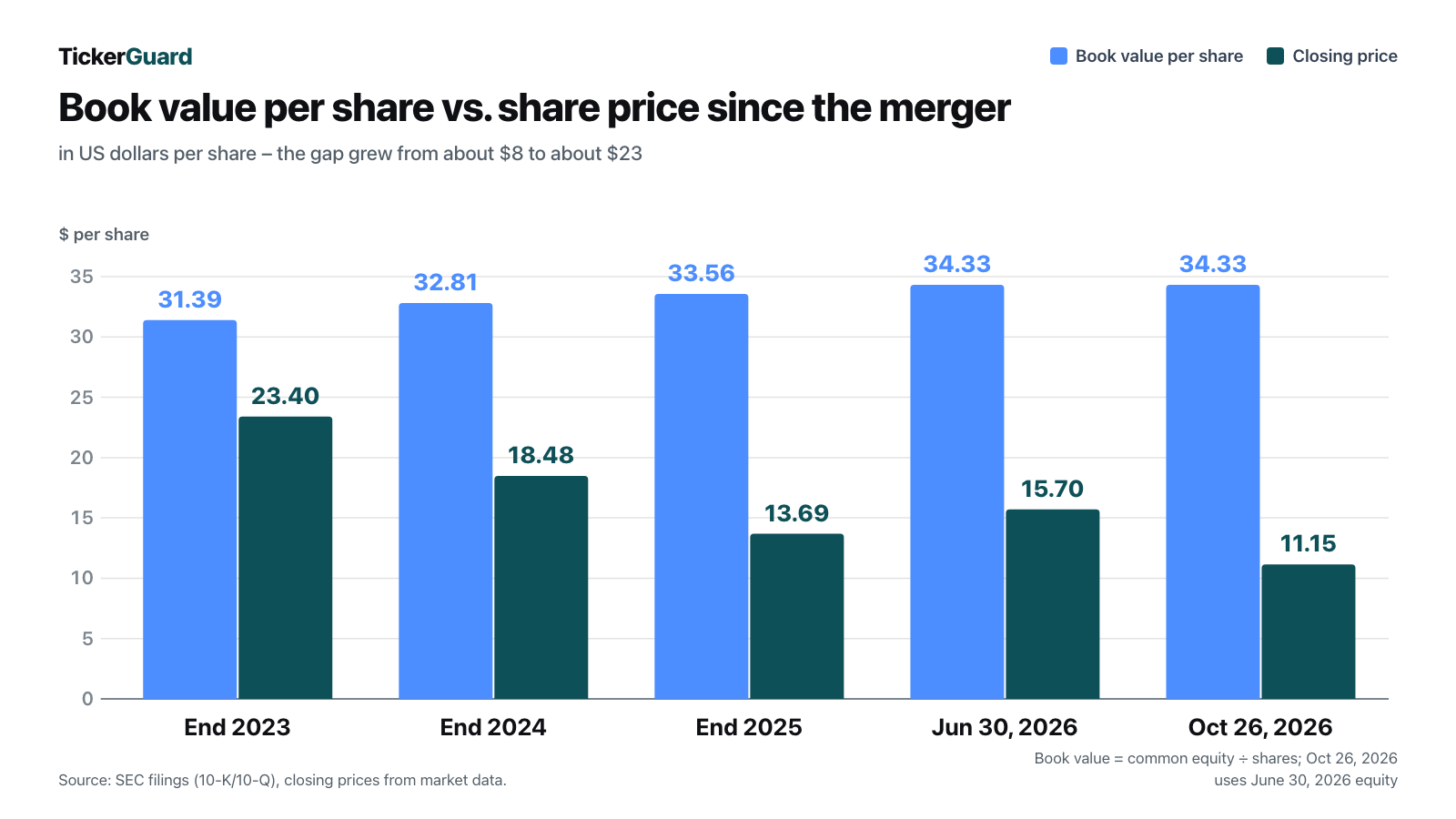
The other metrics look like a bargain too. With $1.61 of earnings per share over the four quarters through June 2026, the P/E is about 7. The quarterly dividend of $0.177 annualizes to $0.708 — about a 6.3 percent yield at the October 26, 2026 price. And then there is the number Safehold itself promotes: the estimated appreciation of the buildings that will one day revert, called unrealized capital appreciation, or UCA. As of June 30, 2026, Safehold put it at $9.77 billion (8-K of July 30, 2026) — on paper more than twelve times the market value. But here too, the fine print sits in the annual report:
“There can be no assurance that we will realize any incremental value from the UCA in our owned residual portfolio or that the market price of our common stock will reflect any value attributable thereto.”
— Safehold Inc., SEC annual report 10-K for 2025, Item 1A “Risk Factors”

Most leases still have about 90 years to run. A dollar that arrives in 90 years is worth almost nothing today; in addition, just under 17 percent of that appreciation belongs to Caret unit holders, not shareholders (Safehold held 83.4 percent as of June 30, 2026). So why does the market pay so little? The filings give four reasons: profit is mostly non-cash, the dividend exceeds the cash, debt is at the ceiling, and lawsuits are running in the office book. Add what Safehold really does share with a bond: when long-term interest rates rise, the value of long, fixed cash flows falls — and few companies have longer ones than Safehold.
The professionals’ view is split accordingly: according to fundamental data (as of October 26, 2026), 3 of 11 covering analysts rate the stock a buy, 6 a hold and 2 a sell. The average price target is about $15.78. Average here means all price targets added up and divided by their number; a single very optimistic or pessimistic analyst moves it noticeably. Even that target sits far below book value of $34.33 — so even the optimists do not trust the label. The next hard test is the quarterly report for September 30, 2026; last year Safehold filed it on November 6. So remember: a discount to book value is only a bargain if you can explain how that book value turns into cash — at Safehold, much of the cash lies decades in the future.
Upside and Risks at a Glance
What speaks for Safehold:
- An established specialty business: 172 ground leases under buildings in major U.S. cities, $7.1 billion of gross book value, an average 92-year term with contractually rising rent (6/30/2026).
- Revenue more than doubled ($187.0 million in 2021, $385.6 million in 2025), profitable every year except 2023; no lease accounted for as a financing receivable was past due as of 6/30/2026.
- Strong credit ratings (Moody’s A3, Fitch and S&P A-), no corporate-level maturities before 2029, $1.4 billion of cash and undrawn credit.
- A large average cushion: building income covers ground rent 3.4 times; Safehold’s book value equals 52 percent of the estimated value of land and building combined (an average across all ground leases — everything added up, so individual high or low values move it; for office it is 71 percent).
- The stock trades at about one third of book value (10/26/2026); Safehold is buying back shares, with $33.7 million left under its authorization as of 6/30/2026.
What speaks against it:
- Profit is mostly non-cash: $131.8 million of non-cash revenue against $114.6 million of net income (2025); a 3.8 percent cash yield against a 3.9 percent cash interest rate on debt (Q2 2026).
- Dividends exceeded operating cash flow in four of five years (2021–2025).
- Leverage at the company’s own ceiling (2.01x), interest consuming 54 percent of revenue (2025); new equity would be expensive at the current price.
- Office concentration (39 percent of the portfolio, book value at 71 percent of estimated value) and two pending lawsuits: 135 West 50th Street and the Park hotel portfolio.
- Star Holdings holds 19 percent of the shares as collateral for a margin loan; possible conflicts of interest through shared executives and loan and management agreements.
A Human Conclusion
Back to the sale tag from the beginning. “67 percent off” is not a lie at Safehold: the balance sheet really does show $34.33 of equity per share, and in late October 2026 the market asked about $11. But the tag does not say why the goods are marked down. The filings do: the profit is mostly a promise of rent that will only flow in earnest decades from now, the dividend exceeded operating cash flow in 2025, debt is at the ceiling, office tenants are testing in court how safe the reversion clause really is, and a fifth of the shares is pledged to a bank. That does not mean the stock is too expensive — the market may well be overreacting. It means you are not betting on book value but on interest rates, office markets and courts playing along. So the honest question for you is not “How big is the discount?” but: Would you still buy Safehold if there were no price tag on it — only the cash flow statement? What you make of that is your decision. And that is as it should be.
If you want to compare real estate stocks: our Realty Income analysis looks at a landlord that lives mainly on current rent, and the Medical Properties Trust analysis asks what happens when big tenants actually fail.
Sources
All original documents used in this analysis — so you can check them yourself:
- Safehold Inc. — SEC quarterly report 10-Q for June 30, 2026 (filed July 31, 2026)
- Safehold Inc. — SEC current report 8-K of July 30, 2026, Exhibit 99.1 (second-quarter 2026 results)
- Safehold Inc. — SEC current report 8-K of July 30, 2026, Exhibit 99.2 (second-quarter 2026 earnings presentation)
- Safehold Inc. — SEC current report 8-K of July 30, 2026, Item 8.01 (estimated UCA as of June 30, 2026)
- Safehold Inc. — SEC current report 8-K of October 2, 2026 (Star Holdings agreements)
- Safehold Inc. — SEC quarterly report 10-Q for March 31, 2026 (filed May 1, 2026)
- Safehold Inc. — SEC annual report 10-K for 2025 (filed February 12, 2026)
- Safehold Inc. — SEC annual report 10-K for 2023 (filed February 13, 2024)
- Star Holdings — SEC quarterly report 10-Q for June 30, 2026 (filed August 7, 2026)
- Robin Josephs — Insider filing (Form 4) of September 11, 2026 (sale of 9,500 shares)
- Full SEC filing history including the funds’ Schedule 13G filings: EDGAR overview for Safehold (sec.gov)
- Fundamental data (prices, short interest, analyst ratings; as of October 26, 2026), cross-checked against the SEC filings.
Transparency & disclaimer: this analysis is journalistic commentary on publicly available information. It is not investment advice, not a regulated investment research product and not a solicitation to buy or sell securities. Equity investments carry substantial risk up to and including total loss. All information is provided without warranty; the as-of date for each figure is stated in the text. Positions held by the operator are disclosed daily; where one exists, it appears as a notice at the top of this analysis.
Key figures at a glance
All monetary figures in millions of $; earnings per share as reported.
| Metric | 2021 | 2022 | 2023 | 2024 | 2025 |
|---|---|---|---|---|---|
| Revenue | 187.0 | 270.3 | 352.6 | 365.7 | 385.6 |
| Operating Income (EBIT) | 65.5 | 135.6 | -77.1 | 87.1 | 307.6 |
| Net Income | 73.1 | 135.4 | -55.0 | 105.8 | 114.5 |
| Net Margin | 39.1% | 50.1% | -15.6% | 28.9% | 29.7% |
| Earnings Per Share | 6.36 $ | 10.49 $ | -0.82 $ | 1.48 $ | 1.59 $ |
Source: fundamental data & SEC filings (annual and quarterly reports, 10-K/10-Q)
Our Bottom Line at a Glance
- Business model & growth positive
- 172 ground leases with $7.1 billion of gross book value and contractually rising rent (6/30/2026); revenue up from $187.0 million (2021) to $385.6 million (2025).
- Earnings quality & dividend negative
- In 2025, $131.8 million of non-cash revenue sat against $114.6 million of net income; dividends ($50.9 million) exceeded operating cash flow ($47.8 million).
- Leverage & funding negative
- Debt to equity of 2.01x against a self-imposed 2-to-1 ceiling (Q2 2026); interest at 54 percent of revenue (2025). On the plus side: A3/A-/A- ratings, no corporate-level maturities before 2029.
- Office & tenant risk negative
- No financing-lease receivable was past due as of 6/30/2026 and rent is covered 3.4 times on average; but office is 39 percent of the portfolio, with lawsuits over 135 West 50th Street and the Park hotels.
- Ties to Star Holdings negative
- Star Holdings owns about 19 percent of the shares, pledged for a $94.5 million margin loan (6/30/2026); Safehold is also its lender ($115.0 million) and manager.
- Valuation neutral
- About one third of book value and a P/E around 7 (10/26/2026); the discount reflects non-cash earnings, the leverage ceiling and office risk.
Safehold illustrates the sale-tag trap: on October 26, 2026, the stock cost about one third of its $34.33 book value. The SEC filings show why the discount has a reason — mostly non-cash earnings, a dividend above operating cash flow, debt at the company's own ceiling, lawsuits in the office book and 19 percent of the shares pledged by Star Holdings. Not investment advice.
What Our Rating Means
Open questions
The business works in principle, but one material question is open. As long as it stays open, our findings do not carry a quality verdict.
Safehold is not a turnaround case: its lease receivables were current as of 6/30/2026, the rating agencies see solid credit, and nothing comes due at the corporate level before 2029. Yellow because a material operating question is open: whether the model holds when the cash yield barely exceeds the cash interest rate, leverage is at the ceiling and the reversion clause is being tested in court with office tenants. The decision is yours.
A journalistic assessment by our editorial team at the time of the deep dive, based on public sources — not investment advice and not a solicitation to buy or sell. Your personal circumstances (investment goals, risk capacity, taxes) cannot be taken into account. What our levels mean, how verdicts are formed, and what conflicts of interest exist →
Worth Noting
- Why we looked: our in-house Reddit hype scanner picked up the ticker in late October 2026. Price references (closing prices, market data): $29.37 (3/31/2023, merger day), $16.18 (7/31/2026), $14.62 (9/9/2026), $10.66 (10/21/2026, lowest close since the merger), $11.15 (10/26/2026); documented in filings: $15.70 (6/30/2026, Star Holdings 10-Q), $14.56 (9/9/2026, Form 4).
- Data as of: the latest periodic report is the 10-Q for 6/30/2026 (filed 7/31/2026); the 10-Q for 9/30/2026 had not been filed as of 10/27/2026. Figures for 2021 and 2022 are those of the old Safehold, the accounting acquirer in the 2023 merger.
- Our own calculations: market value = 70,816,280 shares × $11.15; book value per share = $2,439.1m common equity ÷ 71.057m shares (6/30/2026); 2025 non-cash revenue = $101.5m non-cash interest income from sales-type leases + $30.3m deferred operating lease income; value of Star Holdings' shares at the 10/26/2026 price = about 13.5m shares × $11.15. Leverage of 2.01x, 3.8% cash yield and 3.9% cash interest rate per the earnings presentation (Exhibit 99.2 to the 8-K of 7/30/2026), on Safehold's own definitions.
- Short interest and analyst ratings come from market data, not SEC filings. Not to be confused with: SAFE on the NYSE is Safehold Inc. (CIK 0001095651, formerly iStar) — not Safe Bulkers (SB) and not London-listed Safestore (SAFE).
Stock Watch
This analysis is as of October 27, 2026. Stock Watch will tell you what's changed at SAFE since then.
Later $1 a month per stock — signing up is free, and you'll be the first to know when it launches.
The full analysis as a PDF for later
We will send you this analysis as a PDF — to print, file away, and read at your own pace. And we will add you to the free Stock Watch list for Safehold Inc (SAFE), so you hear about it when something material in this analysis changes.
Frequently Asked Questions
Safehold (NYSE: SAFE) is a New York real estate investment trust that owns the land under other owners' buildings and leases it out, usually for 99 years. The rent rises every year, and the building reverts to Safehold at the end. As of June 30, 2026, it held 172 ground leases with $7.1 billion of gross book value, 39 percent of it under office buildings.
On October 26, 2026, the stock cost $11.15 against $34.33 of book value per share (6/30/2026). The SEC filings point to the reasons: profit is mostly non-cash, the dividend exceeds operating cash flow, leverage sits at the company's own 2-to-1 ceiling, and lawsuits are pending over office land.
Not fully. In 2025 Safehold paid $50.9 million in dividends against $47.8 million of operating cash flow; in the first half of 2026 it was $25.8 million against $26.0 million. In four of five years from 2021 to 2025 the dividend exceeded cash flow. Net income is higher because 2025 included about $131.8 million of non-cash revenue.
On March 31, 2023, the old Safehold merged into iStar; iStar took the Safehold name and spun off its legacy businesses as Star Holdings. Star Holdings owns about 19 percent of Safehold's shares, pledged for a Morgan Stanley margin loan. Safehold lends Star Holdings $115 million at 8 percent and manages the company.
The land is Safehold's second-largest single position at 5.0 percent of gross book value (6/30/2026). The tenant defaulted on a forbearance agreement over unpaid property taxes; Safehold terminated the lease on May 11, 2026. On June 4, 2026, a New York court halted enforcement for now, and the litigation continues.
As “uses AI”: Safehold does not sell AI, but according to its 2025 annual report it uses AI throughout the business, including to extract key details from financial statements and legal agreements. Safehold does not describe AI as a threat to its business; the risk factors concern its own use of the technology.
Found an error?
Did you spot a factual error, an outdated number, or a typo in this deep dive? Let us know briefly — your report goes straight to the editorial team.