Whirlpool: A Tariff Winner on Paper — Yet in 2026 Its Operating Profit Won’t Cover Its Interest Bill
Whirlpool builds about 80 percent of the major appliances it sells in the U.S. at home — tariffs on imported machines were supposed to help. Instead, in 2026 the company suspended its dividend, raised new equity at $69 a share, secured its bonds with collateral and, on October 26, 2026, cut its full-year outlook sharply: ongoing operating profit of roughly $293 million against roughly $350 million in interest expense. The stock closed that day at $26.45. We check whether a low price is already a cheap price — or just a low one.
 Thomas Mücke
Founder & Publisher
As of Today
As of: October 26, 2026
- Closing price
- 26.50 $ -5.90%
- Market Capitalisation
- 1.7 $B
- Growth Score
- 2/10
- AAQS
- 1/10
Price change since October 26, 2026: +0.2%
This analysis has a cut-off date. The Stock Guard tells you when something material changes in the numbers. Reserve your free spot
Chart
Interactive price chart (TradingView).
52-week range: 26.50 $ to 92.80 $ · Last price: 26.50 $ (As of: October 26, 2026)
Note: pure fact-based analysis, not investment advice and not a solicitation to buy or sell. All figures without guarantee.
There is an investor trap that feels like common sense: the anchoring trap. Your brain remembers an old price and measures every new one against it. With Whirlpool, that anchor sits high. On May 7, 2021, the stock closed at $252.95; on October 26, 2026, it closed at $26.45 — about 90 percent lower. The brain does the math instantly: “Ninety percent off a company whose washer is sitting in my basement — that has to be a bargain.” That is exactly where the trap snaps shut. An old price says nothing about what a company earns today. So let’s make a deal: before you think about buying, let’s read together what Whirlpool itself has reported to the U.S. securities regulator, the SEC — the 2025 annual report (10-K), the 2026 quarterly reports (10-Q) and the third-quarter earnings release of October 26, 2026. At the end, you decide.
What Whirlpool actually does — and why tariffs were supposed to help
Whirlpool makes major home appliances: refrigerators, washers, dryers, ranges and dishwashers — plus stand mixers and food waste disposers. You probably know some of the brands from your own kitchen: Whirlpool, KitchenAid, Maytag, JennAir, Amana, InSinkErator and, in Brazil, Brastemp and Consul. In 2025, the company generated $15.52 billion in net sales and employed about 41,000 people. Since the end of 2025 it has reported three segments: major appliances North America, major appliances Latin America and small appliances worldwide. Whirlpool contributed its European business to a joint venture with Turkish appliance maker Arçelik (Beko Europe) on April 1, 2024, and sold its remaining 25 percent stake to Arçelik in June 2026. In India, its stake fell from 51 to about 40 percent in November 2025; since then the Indian unit has no longer been fully consolidated.
The core is North America: in Q3 2026, $2.50 billion of the $3.68 billion in net sales came from that segment. And on paper, the starting position there looks strong. The 2025 annual report says about 80 percent of the major appliances sold in the U.S. are produced in the U.S., and about 96 percent of the steel used there is sourced domestically. If Washington puts tariffs on imported appliances, that should mainly hit the Asian competition — or so the thinking went. That defines the central tension of this analysis: Whirlpool has its factories in the right place and the better-known brands — yet in 2026 the company expects to earn less from operations than its debt costs. The filings explain why.
Part of the answer is already in the 2025 annual report. Tariffs cut both ways:
“These actions have increased the cost of certain raw materials and components, led to "pre-loading" of finished product inventories by foreign competitors in advance of tariff implementation, and created significant uncertainty and potential risks for our business.”
— Whirlpool Corporation, SEC annual report 10-K for 2025, Item 1A “Risk Factors”
In plain terms: tariffs also raise the cost of Whirlpool’s own inputs, and competitors filled their warehouses before the tariffs took effect — so the hoped-for advantage arrives late, or not at all. In Q3 2026, North American net sales fell 8.3 percent to $2.50 billion, and the segment margin dropped from 4.9 to 3.0 percent. The earnings release cites soft industry demand and cost inflation on raw materials, fuel and logistics.
Company history for investors
-
2021
Record year: $21.99 billion in sales, $1.78 billion profit
Whirlpool generates $1.65 billion of free cash flow; the stock closes at $252.95 in May 2021. For investors, the high-water mark against which the later decline is measured.
-
2024
Europe handed to Arçelik, Maytag written down
On April 1, 2024, Europe moves into a joint venture with Arçelik (loss on disposal: $298 million); the Maytag trademark is impaired by $381 million. The company gets smaller and more American.
-
2025
India majority sold, free cash flow down to $81 million
In November 2025, the stake in Whirlpool India falls from 51 to about 40 percent. Free cash flow of $81 million for the year no longer covers the $300 million in dividends paid.
-
2026
Equity raise, dividend stop, secured notes
New shares at $69 and preferred stock (February), dividend suspension, $2.0 billion of secured notes (June). Shareholders pay for the stabilization through dilution and forgone payouts.
-
2026
Outlook cut: −$1.30 per share
On October 26, 2026, the outlook drops from +$2.50–3.00 to −$1.30 in ongoing EPS. Expected ongoing EBIT of about $293 million is below about $350 million of interest expense.
How the stock landed on our desk
Whirlpool made our research list through our in-house Reddit hype scanner, which tracks how often retail investors discuss a stock in Reddit forums (as of October 27, 2026). The trigger is obvious: on October 26, 2026, Whirlpool reported third-quarter results and cut its full-year outlook. The stock closed that day at $26.45 — the lowest close in our price series, which goes back to January 2016. The highest intraday price of the preceding 52 weeks was $94.82. One important caveat: a Reddit signal measures attention, not quality. It tells you what people are talking about — not whether it is worth talking about. Keep this in mind: with Whirlpool, the review starts not with the share price but with the question of whether the business can carry its debt.
The numbers over the years — an honest assessment
First, what speaks for Whirlpool. This is not a start-up with an idea but an established manufacturer with plants, brands and a retail network. In 2025, on $15.52 billion in net sales, it earned ongoing operating profit (“ongoing EBIT,” earnings before interest and taxes excluding one-time items) of $729 million, a margin of 4.7 percent. The small-appliance business around KitchenAid is doing well: in Q3 2026 its segment margin was 18.6 percent (prior-year quarter: 16.5 percent). And the company has generated cash from operations every year, even in weak ones.
But the direction is clear. Net sales fell from $21.99 billion (2021) to $19.72 billion (2022), $19.46 billion (2023), $16.61 billion (2024) and $15.52 billion (2025) — partly because Europe and India were handed off, partly because of weaker demand. Net earnings swung from a $1.78 billion profit (2021) to losses of $1.52 billion (2022) and $323 million (2024) and a $318 million profit (2025). Free cash flow shows it most clearly — in plain terms, the money left over after investing in plants and machinery, available to pay down debt or fund dividends.
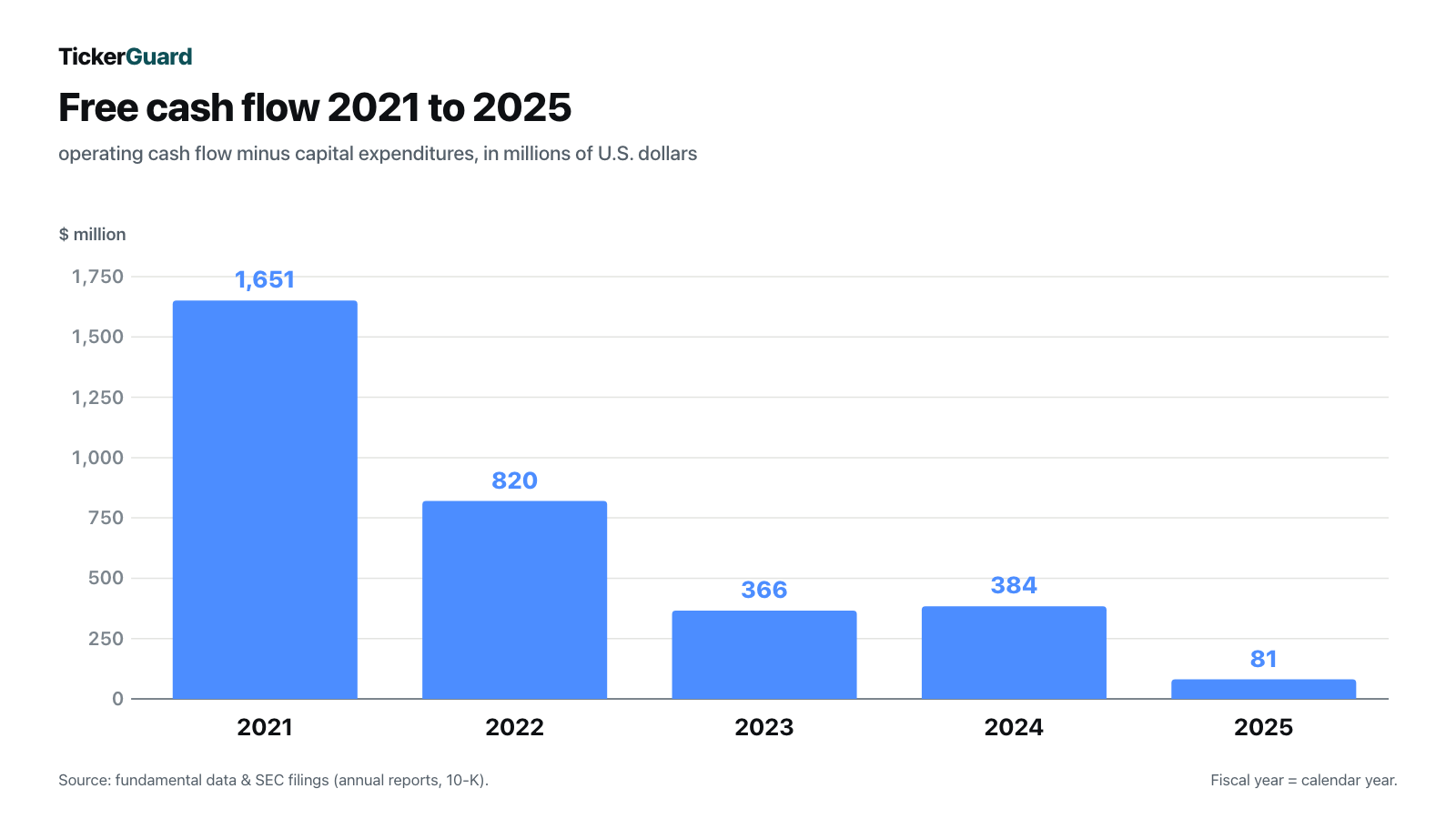
$81 million of free cash flow in 2025 — with a quarterly dividend of $1.75 per share in the first half and $0.90 from the third quarter on. Whirlpool paid $300 million in dividends in 2025. The payout had long stopped being covered by the business. In 2026 the margin collapse came on top:
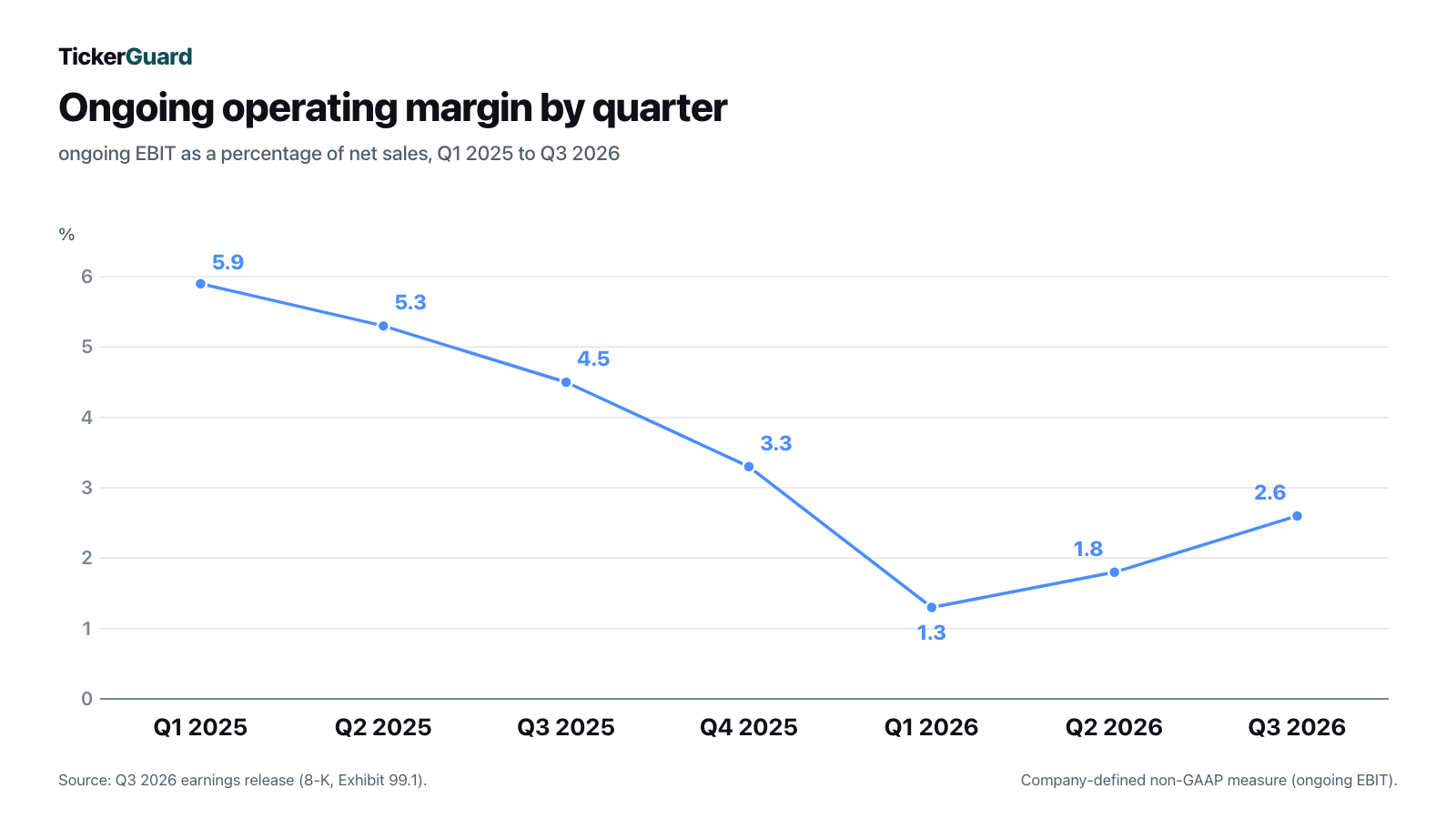
To be fair: the curve has been turning up since Q1 2026, driven by price increases and cost cuts, and management itself points to progress. But a 2.6 percent margin means that out of every $100 in sales, $2.60 is left before interest and taxes. With about $6.85 billion in debt, that does not go far — which brings us to the uncomfortable truths.
What the filings say — the uncomfortable truths
Uncomfortable truth No. 1: the 2026 outlook fell from plus $2.50 to minus $1.30 per share in twelve weeks
On August 3, 2026, Whirlpool still sounded confident. The second-quarter release reaffirmed the revenue and margin outlook and pointed to “our largest price increase in over a decade.” For 2026 the company expected net sales of about $15.0 billion, an ongoing operating margin of about 4.0 percent and ongoing earnings per share of $2.50 to $3.00. Twelve weeks later, on October 26, 2026, the table looked different: net sales of about $14.5 billion, an ongoing operating margin of 2.0 to 2.2 percent, ongoing earnings per share of minus $1.30 — and minus $4.95 under U.S. accounting rules (GAAP). The CEO put it this way:
“Our structural cost take out and pricing realization drove consecutive margin progress through Q3. While the pace of recovery is slower than expected, these actions are setting a clear path for further improvements in 2027.”
— Marc Bitzer, Chairman and CEO, Whirlpool Q3 2026 earnings release (8-K, Exhibit 99.1, October 26, 2026)
Now for the math that follows from these outlook figures. The new outlook assumes ongoing operating profit of roughly $293 million for 2026 and interest expense of roughly $350 million. Interest coverage — how many times operating profit can pay the interest — is therefore about 0.8. On a GAAP basis, including restructuring charges, impairments and other one-time items, Whirlpool expects only about $55 million in earnings before interest and taxes. Think of it as a household whose take-home pay is smaller than its loan payment: it gets by only because it still has savings or borrows more. For context: regular depreciation of plants and machinery is not a cash outflow, and before it, ongoing earnings still cover the interest. But investment in the plants — about $400 million according to the 2026 outlook — costs real money. Rule of thumb: until the operating margin rises meaningfully, Whirlpool is working mainly for its creditors in 2026.
Uncomfortable truth No. 2: dividend suspended, new shares at $69, bonds now secured
For decades, Whirlpool was seen as a reliable dividend payer: according to its annual report, 2025 marked its 70th year of quarterly dividends. In spring 2026 that ended. The quarterly report for March 31, 2026, states:
“Subsequent to quarter end, the Board of Directors made the decision to suspend our regular quarterly cash dividend on our common stock, which had previously been paid at a rate of 0.90 per share.”
— Whirlpool Corporation, SEC quarterly report 10-Q for March 31, 2026, section “Dividends”

Shortly before, on February 27, 2026, Whirlpool had raised fresh equity: 7,898,550 new common shares at $69 each (about $524 million net) and mandatory convertible preferred stock paying 8.50 percent (about $557 million net). About $900 million of that went to pay down the revolving credit facility. In plain terms: whoever bought at $69 in February held a share worth $26.45 in October. And existing shareholders were diluted — your slice of the pie got smaller because more people are eating from it.
In June came the debt overhaul. On June 16, 2026, Whirlpool issued two notes of $1.0 billion each at 7.500 percent (due 2031) and 7.875 percent (due 2034) — secured by company assets — and replaced its existing credit facility with a $2.0 billion facility backed by receivables, inventory and other assets. For a company that used to borrow without collateral, that is a step down. The rating agencies saw it the same way:
“During the second quarter of 2026, our senior unsecured debt was further downgraded by Fitch Ratings, Inc. to BB- from BB and Moody's to Ba3 from Ba2.”
— Whirlpool Corporation, SEC quarterly report 10-Q for June 30, 2026, section “Financial Condition and Liquidity”
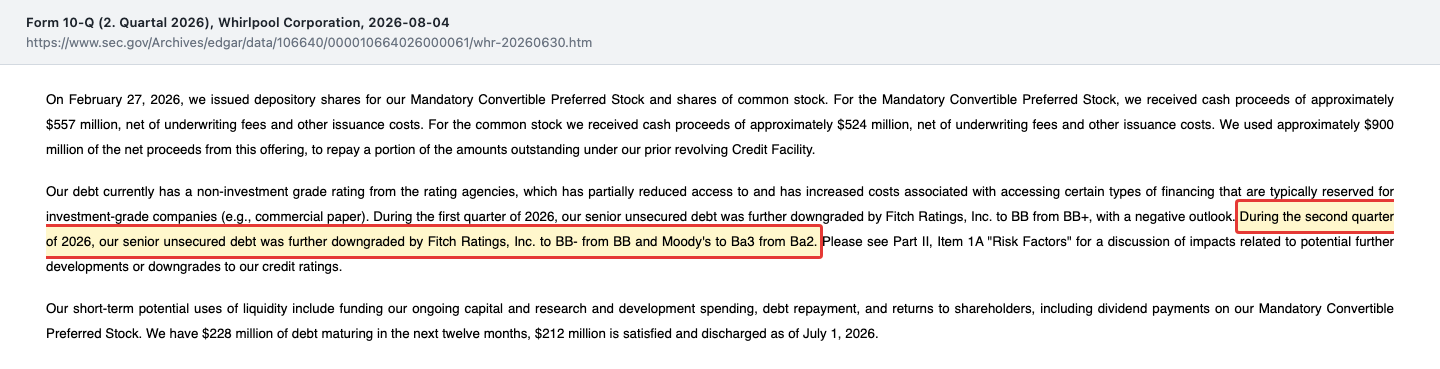
In fairness: the overhaul worked. According to the second-quarter release, debt maturities are cleared until 2028; according to the quarterly report (10-Q) of October 27, 2026, the new credit facility was undrawn as of September 30, 2026, the company held $1.10 billion in cash, and only $14 million of debt matures over the following twelve months. An acute liquidity squeeze is not in evidence. But the calm came at a price: interest expense rose from $63 million in Q2 to $102 million in Q3 2026.
Uncomfortable truth No. 3: one retailer brings 15 percent of sales — and another went into reorganization
Whirlpool does not sell to you directly but through retailers. One of them matters more than the rest:
“Sales to Lowe's represented approximately 15%, 13%, and 13% of our consolidated net sales in 2025, 2024 and 2023, respectively. Lowe's represented approximately 44% and 38% of our consolidated accounts receivable as of December 31, 2025 and 2024, respectively.”
— Whirlpool Corporation, SEC annual report 10-K for 2025, Item 1 “Other Information”
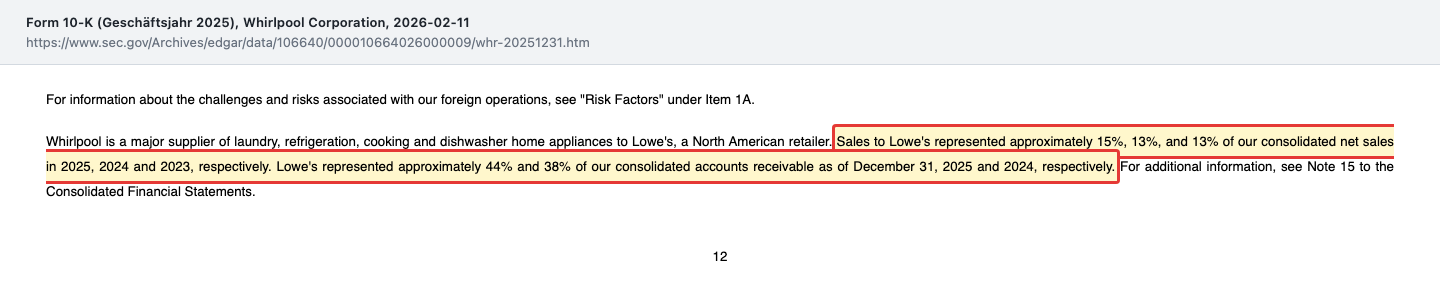
Nearly half of all open invoices with one customer — that is a negotiating position in which the retailer has a big say over prices. That a major customer can also fail was shown in Latin America in Q3 2026. According to the earnings release, a “significant trade customer” there went through a bankruptcy reorganization, and Whirlpool had to write down receivables:
“This charge includes $46 million of trade customer credit losses, net of expected credit insurance recoveries (reflecting $157 million of gross accounts receivable impairments, net of $112 million of expected credit insurance recoveries), and $8 million of other direct charges resulting from the event.”
— Whirlpool Corporation, Q3 2026 earnings release (8-K, Exhibit 99.1), footnote e
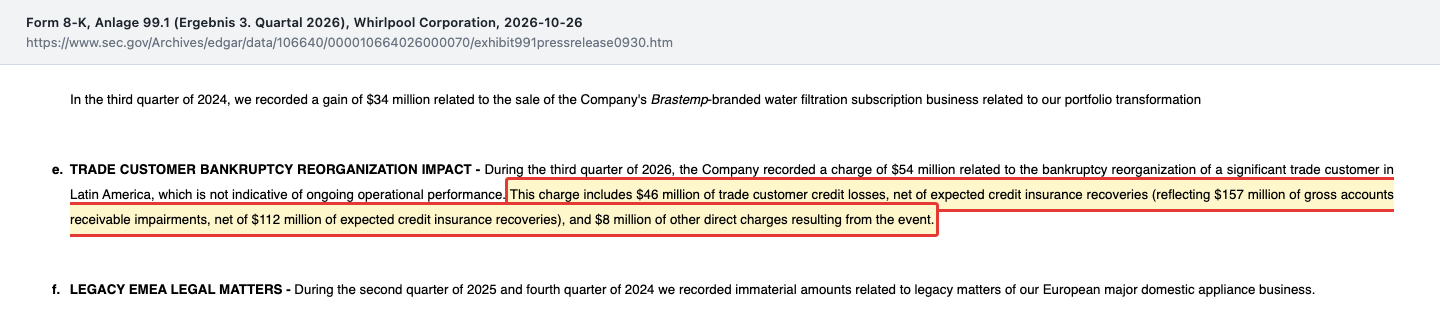
The footnote does not name the customer, but the quarterly report (10-Q) of October 27, 2026, does: it is the Brazilian retailer Casas Bahia. It also shows how the loss arose. Whirlpool’s Brazilian subsidiary guarantees credit lines that banks extend to selected retailers to buy inventory; according to the report, the $46 million was recorded under this guarantee. As of September 30, 2026, such guarantees still totaled 1.7 billion Brazilian reais, about $320 million. The Latin American segment margin fell from 5.7 to 2.0 percent. Rule of thumb: if you sell through a few big retailers, you carry their risk too — as open invoices on your own balance sheet.
Uncomfortable truth No. 4: the full-year target depends on an unusually strong fourth quarter
Whirlpool is sticking to roughly $300 million of free cash flow for 2026 (in August it still said “over $300 million”) and now even expects net debt below $4.5 billion at year-end (previously below $5 billion). After nine months, free cash flow stood at minus $1.08 billion. For the full-year target to hold, the fourth quarter alone would have to deliver about $1.38 billion of free cash flow. Part of that is seasonal: retailers pay for their fall and holiday stock at year-end, and Whirlpool runs down inventory. Last year’s cross-check shows how much: in 2025, free cash flow was minus $907 million after nine months and plus $81 million at year-end — so Q4 2025 brought about $988 million. In 2026 it would need to be about $390 million more, after third-quarter net sales came in 8.8 percent lower. Net debt shows the same gap: on September 30, 2026, $6.85 billion of debt faced $1.10 billion of cash, for net debt of about $5.75 billion. Getting below $4.5 billion means about $1.25 billion has to flow back in the final quarter. That is possible — but it is a promise, not a reported number. The quarterly report (10-Q) of October 27, 2026, confirms the third-quarter figures from the earnings release; it contains no forecast for the final quarter.
Valuation: 90 percent below the high — but measured against what?
At the closing price of $26.45 on October 26, 2026, and 65,736,711 shares outstanding (as of October 23, 2026, cover of the quarterly report), the market value was about $1.74 billion. That looks tiny next to $14.5 billion in sales. A price-to-sales ratio of about 0.12 means the market pays twelve cents for every dollar of revenue. A price-to-earnings ratio cannot be calculated for 2026, because Whirlpool itself expects a loss per share. Book equity attributable to Whirlpool shareholders was $3.73 billion on September 30, 2026, including the preferred stock — so the market values the company at less than half of that.
But this is exactly where the anchoring trap bites twice. First, much of that equity is not factories or cash but goodwill and brand value: $3.10 billion of goodwill and $2.55 billion of other intangibles on September 30, 2026. Subtract them and the remaining equity is negative, at about minus $1.92 billion. That such brand values do not last forever is shown by the impairments of the Maytag (2024: $381 million) and JennAir (2025: $106 million) trademarks; according to the September 30, 2026, quarterly report, JennAir, InSinkErator, Maytag and Amana remain at risk. Whirlpool also had to write down its remaining India stake by $124 million to its market value of $471 million in the third quarter. Second, shareholders own only what is left after the creditors. Add net debt of about $5.75 billion and the preferred stock with its $575 million liquidation preference, and enterprise value comes to about $8 billion — roughly 27 to 28 times the ongoing operating profit Whirlpool expects for 2026. That is a price for a recovery, not for the status quo. The professionals’ view fits: of 13 analyst ratings on record, 10 say hold and 3 say sell, none buy; the average price target was $45.08 (fundamental data, as of October 27, 2026 — possibly not yet adjusted for the new outlook). For a look at another maker of durable consumer goods with the same exposure to interest rates and housing, see our Mohawk Industries stock analysis; for how tariffs change the math for a U.S. brand owner, see our Carter’s analysis.
Upside and risks at a glance
What speaks for Whirlpool:
- Manufacturing in the right place: about 80 percent of the major appliances sold in the U.S. come from U.S. plants, and about 96 percent of the steel used there is domestic (2025 annual report) — an advantage if tariffs on imported appliances stick.
- Well-known brands and a strong small-appliance business: KitchenAid and co. earned an 18.6 percent segment margin in Q3 2026.
- The margin is turning: ongoing 1.3 percent (Q1 2026), 1.8 percent (Q2) and 2.6 percent (Q3); for Q4, price increases of 7 percent in North America and up to 10 percent in Latin America have been announced.
- Time bought: maturities cleared until 2028, $1.10 billion in cash and an undrawn $2.0 billion credit facility on September 30, 2026.
- Low valuation relative to sales: market value of about $1.74 billion against about $14.5 billion in expected 2026 net sales.
What speaks against it:
- Operating profit does not cover interest: about $293 million ongoing versus about $350 million of interest expense per the 2026 outlook; about $55 million on a GAAP basis.
- The outlook has already been cut sharply in 2026, from plus $2.50–3.00 to minus $1.30 in ongoing earnings per share; management says the recovery is “slower than expected.”
- More expensive, lower-ranking financing: secured notes at 7.500 and 7.875 percent, downgrades to Ba3 and BB-, common dividend suspended.
- Customer concentration: Lowe’s accounts for 15 percent of sales and 44 percent of receivables (2025); at Brazilian key customer Casas Bahia, in bankruptcy reorganization, $157 million was written down gross in Q3, and in Brazil Whirlpool guarantees a total of about $320 million of retailers’ bank loans (September 30, 2026).
- Dilution built in: if the price stays below $69 until February 2029, the preferred stock turns into about 8.33 million new common shares — roughly 12.7 percent of the share count on October 23, 2026.
A human conclusion
Back to the anchoring trap from the start. The anchor is $252.95, and it whispers that $26.45 must be a gift. The filings tell a more sober story. Whirlpool is not a broken company: the plants are where trade policy wants them, the brands are well known, the cash pile is full and maturities are handled until 2028. But the company whose stock traded at $253 in 2021 earned $1.78 billion back then. Today’s company expects a loss for 2026, no longer pays a common dividend and earns less from operations than its debt costs. The price did not fall even though the company stayed the same — it fell because the company did not. So the honest question for you is not “How big is my discount?” but: Do you trust Whirlpool to lift its margin far enough to cover its interest comfortably again — and are you willing to wait until the filings prove it? If yes, you have a thesis you can test against every quarterly report. If not, it was only an anchor. What you make of it is your decision. And that is how it should be.
Sources
All original documents used in this analysis — for you to read yourself:
- Whirlpool Corporation — SEC quarterly report 10-Q for September 30, 2026 (filed October 27, 2026, latest periodic report)
- Whirlpool Corporation — Q3 2026 earnings release, 8-K Exhibit 99.1 (filed October 26, 2026)
- Whirlpool Corporation — SEC quarterly report 10-Q for June 30, 2026 (filed August 4, 2026)
- Whirlpool Corporation — Q2 2026 earnings release, 8-K Exhibit 99.1 (filed August 3, 2026)
- Whirlpool Corporation — 8-K Item 2.05 on the closure of the Supsa plant in Apodaca, Mexico (filed July 1, 2026)
- Whirlpool Corporation — SEC quarterly report 10-Q for March 31, 2026 (filed May 7, 2026)
- Whirlpool Corporation — SEC annual report 10-K for 2025 (filed February 11, 2026)
- Whirlpool Corporation — SEC annual report 10-K for 2024 (filed February 13, 2025)
- Whirlpool Corporation — SEC annual report 10-K for 2023 (filed February 14, 2024; cash flow for 2021 and 2022)
- Whirlpool Corporation — 8-K Item 5.02 on the appointment of Karin Risi to the Board (filed October 20, 2026)
- Full SEC filing history: EDGAR overview Whirlpool Corporation (sec.gov)
- Fundamental data (prices, market value, analyst consensus; as of October 26/27, 2026), cross-checked against the SEC filings and the SEC’s XBRL data series.
Transparency & disclaimer: this analysis is journalistic commentary on publicly available information. It is not investment advice, not a regulated investment research product and not a solicitation to buy or sell securities. Equity investments carry substantial risk up to and including total loss. All information is provided without warranty; the as-of date for each figure is stated in the text. Positions held by the operator are disclosed daily; where one exists, it appears as a notice at the top of this deep dive.
Key figures at a glance
All monetary figures in millions of $; earnings per share as reported.
| Metric | 2021 | 2022 | 2023 | 2024 | 2025 |
|---|---|---|---|---|---|
| Revenue | 21,983.0 | 19,724.0 | 19,457.0 | 16,606.0 | 15,524.0 |
| Operating Income (EBIT) | 2,344.0 | 1,205.0 | 1,200.0 | 870.0 | 727.0 |
| Net Income | 1,783.0 | -1,519.0 | 481.0 | -323.0 | 317.0 |
| Net Margin | 8.1% | -7.7% | 2.5% | -1.9% | 2.0% |
| Earnings Per Share | 28.35 $ | -27.17 $ | 8.71 $ | -5.86 $ | 5.64 $ |
Source: fundamental data & SEC filings (annual and quarterly reports, 10-K/10-Q)
Our Bottom Line at a Glance
- Market position and brands positive
- Whirlpool describes itself as the only major U.S.-based maker of kitchen and laundry appliances, with brands such as KitchenAid, Maytag and JennAir. About 80 percent of the major appliances it sells in the U.S. come from U.S. plants (2025 annual report). The small-appliance segment earned an 18.6 percent margin in Q3 2026.
- Profitability negative
- The ongoing operating margin fell from 5.9 percent (Q1 2025) to 1.3 percent (Q1 2026) and was 2.6 percent in Q3 2026. On October 26, 2026, the 2026 outlook was cut to ongoing earnings of −$1.30 per share (August 3, 2026: +$2.50 to +$3.00).
- Debt and interest negative
- Net debt of about $5.75 billion on September 30, 2026. Ongoing EBIT of about $293 million for 2026 does not cover expected interest expense of about $350 million. Since June 2026, secured notes at 7.500 and 7.875 percent; downgrades to Ba3 and BB-.
- Liquidity neutral
- Cash of $1.10 billion and an undrawn $2.0 billion credit facility on September 30, 2026; maturities cleared until 2028 according to the company. Free cash flow was −$1.08 billion after nine months of 2026; for the full year, Whirlpool expects about +$300 million.
- Shareholder returns negative
- Common dividend suspended in 2026 (previously $0.90 per quarter), equity raise at $69 per share in February 2026, mandatory conversion of the preferred stock on February 15, 2029, into up to 8.33 million new shares.
Whirlpool is an established appliance maker with well-known brands and U.S. plants whose earnings power has collapsed in a short time. Free cash flow fell from $1.65 billion (2021) to $81 million (2025), and the 2026 outlook dropped within twelve weeks from +$2.50–3.00 to −$1.30 in ongoing earnings per share. The company has bought time — new shares, preferred stock, secured notes, a suspended dividend — and holds $1.10 billion in cash. Whether the price increases lift the margin enough to cover interest again will only show in the next filings. Not investment advice.
What Our Rating Means
Substance risk
We found at least one documented issue that threatens the company itself — regardless of how the stock is currently valued.
Red because of a documented substance criterion: according to its own outlook of October 26, 2026, Whirlpool will generate ongoing operating profit of about $293 million in 2026 against about $350 million in interest expense — interest coverage below 1, and well below on a GAAP basis (about $55 million). Add the suspended dividend, the collateral on the new notes and the downgrades to Ba3 and BB-. An acute liquidity squeeze is not in evidence: no going-concern warning, $1.10 billion in cash and an undrawn $2.0 billion credit facility on September 30, 2026, and maturities cleared until 2028. Red here therefore does not mean “insolvency ahead” but: the business currently does not carry its debt on its own. That the stock trades about 90 percent below its 2021 high plays no role in this rating; that is a price argument, not a quality argument. The decision is yours.
A journalistic assessment by our editorial team at the time of the deep dive, based on public sources — not investment advice and not a solicitation to buy or sell. Your personal circumstances (investment goals, risk capacity, taxes) cannot be taken into account. What our levels mean, how verdicts are formed, and what conflicts of interest exist →
Worth Noting
- This analysis was prompted by our in-house Reddit hype scanner (as of October 27, 2026) together with the Q3 2026 earnings release of October 26, 2026.
- Data as of October 27, 2026. The latest periodic report is the 10-Q for September 30, 2026 (filed October 27, 2026); it confirms the figures of the earnings release of October 26, 2026 (8-K Item 2.02, Exhibit 99.1). All filings since August 4, 2026, were also reviewed, including the 8-K Item 5.02 of October 20, 2026, and insider and ownership filings.
- Ongoing measures (“ongoing EBIT,” ongoing EPS) are company-defined non-GAAP figures that exclude restructuring, impairments and transaction effects. The interest coverage of about 0.8 is our own calculation from the company’s outlook figures (about $293 million ongoing EBIT, about $350 million interest expense).
- Comparability: 2025 includes the India business until its deconsolidation on December 1, 2025; the European business moved into the joint venture with Arçelik on April 1, 2024. The revenue decline since 2021 is therefore only partly a decline in demand.
- The average analyst price target of $45.08 (fundamental data, 13 ratings, as of October 27, 2026) is third-party information for context, not an editorial price target; it may not yet reflect the outlook cut of October 26, 2026.
Stock Watch
This analysis is as of October 27, 2026. Stock Watch will tell you what's changed at WHR since then.
Later $1 a month per stock — signing up is free, and you'll be the first to know when it launches.
The full analysis as a PDF for later
We will send you this analysis as a PDF — to print, file away, and read at your own pace. And we will add you to the free Stock Watch list for Whirlpool Corporation (WHR), so you hear about it when something material in this analysis changes.
Frequently Asked Questions
Whirlpool Corporation (NYSE: WHR), based in Benton Harbor, Michigan, makes major home and kitchen appliances: refrigerators, washers, dryers, ranges and dishwashers under brands such as Whirlpool, KitchenAid, Maytag, JennAir, Amana and InSinkErator, plus Brastemp and Consul in Brazil. In 2025 the company generated $15.52 billion in net sales and employed about 41,000 people. Most of the business is in North and Latin America.
Because the business earns far less than it used to. Free cash flow fell from $1.65 billion (2021) to $81 million (2025), and the ongoing operating margin dropped from 5.9 percent (Q1 2025) to 1.3 percent (Q1 2026). On October 26, 2026, Whirlpool cut its 2026 outlook to ongoing earnings of minus $1.30 per share, after guiding to plus $2.50 to $3.00 in August.
Not on its common stock. According to the quarterly report (10-Q) for March 31, 2026, the Board suspended the regular quarterly dividend after quarter end; it had previously been $0.90 per share. The stated reason was to strengthen the balance sheet. The mandatory convertible preferred stock issued in February 2026 continues to receive its 8.50 percent annual dividend, so far in cash.
On September 30, 2026, Whirlpool had about $6.85 billion in debt and $1.10 billion in cash, for net debt of about $5.75 billion. For 2026 the company expects about $350 million in interest expense against ongoing operating profit of about $293 million. In June 2026 it issued two secured notes of $1.0 billion each at 7.500 and 7.875 percent; according to the company, maturities are cleared until 2028.
That was the expectation, but so far it does not show in the numbers. According to the 2025 annual report, about 80 percent of the major appliances sold in the U.S. are made domestically. At the same time, tariffs raised the cost of raw materials and components, and foreign competitors stocked up before they took effect. In Q3 2026, North American net sales fell 8.3 percent and the segment margin was 3.0 percent.
On February 15, 2029, each of the 575,000 preferred shares automatically converts into 12.3340 to 14.4920 common shares. If the applicable market value is below $69.0036, the maximum applies. At the $26.45 close on October 26, 2026, that would mean about 8.33 million new shares, roughly 12.7 percent of the 65,736,711 shares outstanding on October 23, 2026. Until then, the preferred dividend ranks ahead of any common dividend.
Found an error?
Did you spot a factual error, an outdated number, or a typo in this deep dive? Let us know briefly — your report goes straight to the editorial team.