Ardmore Shipping: $51,870 a Day — Then Only $29,600 Booked
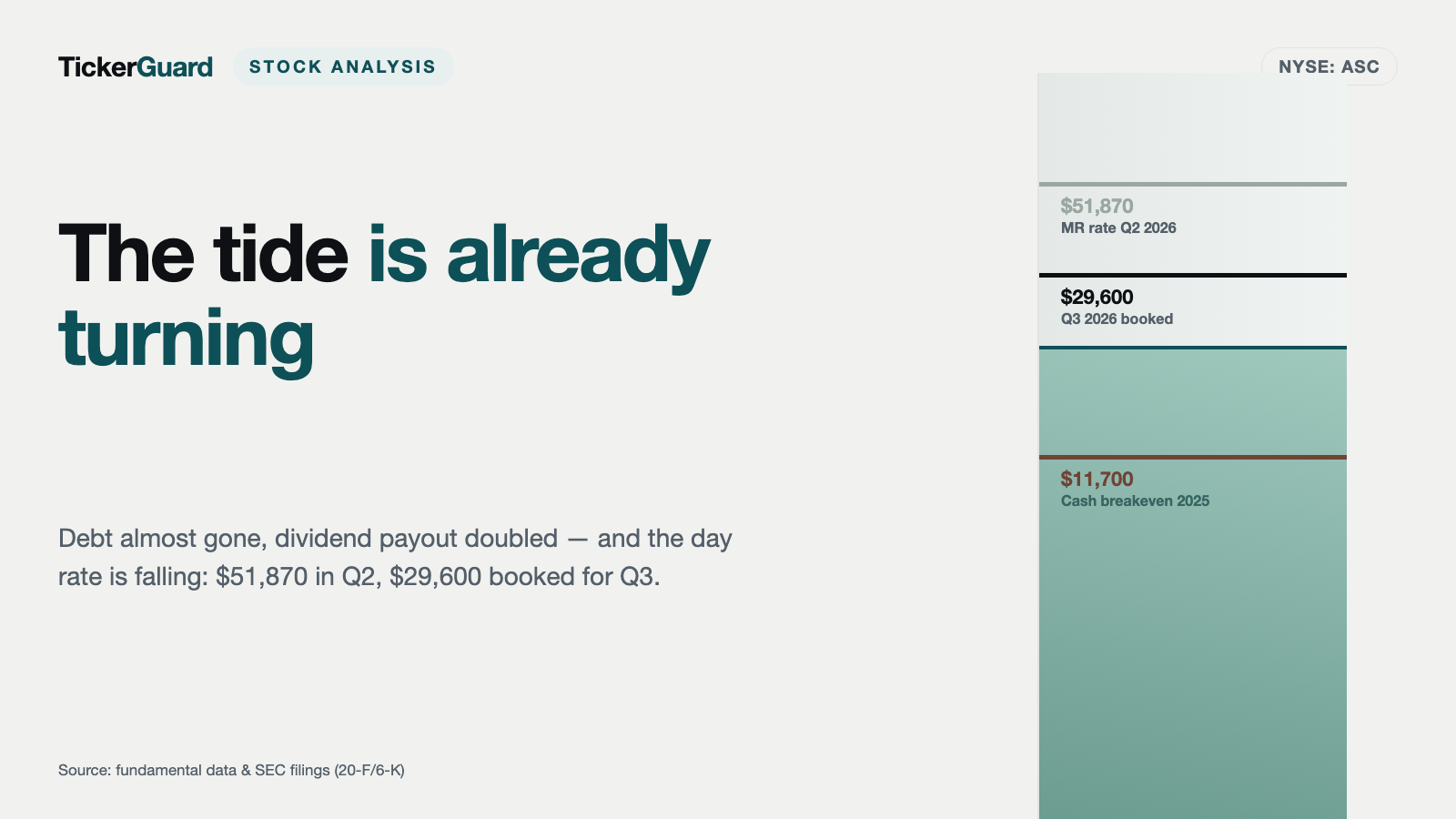
In the second quarter of 2026, an Ardmore MR tanker earned $51,870 a day in the spot market, net income jumped to $60.5 million, bank debt fell to $33.4 million and the dividend rose to $0.79 per share. By late July, Ardmore had booked about 45 percent of its third-quarter days — at $29,600. Mistake the early-summer water level for the normal tide, and you are measuring the wrong sea.
 Thomas Mücke
Founder & Publisher
As of Today
As of: October 26, 2026
- Closing price
- 20.70 $ +3.30%
- Market Capitalisation
- 0.8 $B
- Growth Score
- 5/10
- AAQS
- 5/10
This analysis has a cut-off date. The Stock Guard tells you when something material changes in the numbers. Reserve your free spot
Chart
Interactive price chart (TradingView).
52-week range: 10.50 $ to 20.10 $ · Last price: 20.70 $ (As of: October 26, 2026)
Note: pure fact-based analysis, not investment advice and not a solicitation to buy or sell. All figures without guarantee.
There is an investor trap best understood at the harbor. Call it the high-tide trap: you arrive at the quay at high tide, see the water lapping just below the edge — and take that for the normal level. Tie up a boat without thinking about low tide and you get a surprise six hours later. In the summer of 2026, the water at Ardmore Shipping (NYSE: ASC) stood very high: a tanker earned almost $52,000 a day in the spot market, quarterly profit was more than six times the year-earlier figure, the dividend jumped. The stock has nearly doubled since the start of the year. So let’s make a deal: before you mistake the summer level for the normal tide, let’s read together what Ardmore has reported to the U.S. securities regulator, the SEC — the annual report on Form 20-F for 2025, the interim reports on Form 6-K for March 31 and June 30, 2026, and the earnings releases, reviewed through October 27, 2026. Ardmore is a so-called foreign private issuer: instead of the U.S. forms 10-K and 10-Q, it files an annual report on Form 20-F and interim reports on Form 6-K. Making false statements to the SEC carries penalties, which is why these filings are among the most reliable public sources available. In the end, the decision is yours.
What Ardmore actually does — tankers for diesel, gasoline and chemicals
Ardmore is a shipowner. The company was incorporated in the Marshall Islands on May 14, 2013, continues the business of a predecessor that began operating in April 2010, and is headquartered in Hamilton, Bermuda; Ardmore completed its IPO on the New York Stock Exchange on August 6, 2013 (annual report 20-F for 2025), and the stock has traded there since August 1, 2013 (fundamental data). As of June 30, 2026, Ardmore had 25 vessels in operation: 19 so-called MR tankers (medium range, 45,000 to 50,200 deadweight tons, 18 owned and one chartered in) and six owned chemical tankers of 25,000 to 37,800 tons. MR tankers are the delivery trucks of the oil world: they do not haul crude from the wellhead to the refinery, but finished products such as diesel, gasoline and jet fuel from the refinery to the ports that need them. The chemical tankers carry vegetable oils, chemicals and other liquids. 24 of the 25 vessels are so-called Eco-Design ships, which Ardmore’s annual report describes as having electronically controlled engines and improved hull forms — in plain terms, they burn less fuel per nautical mile.
There are two ways to earn money. Most vessels trade in the spot market — chartered voyage by voyage at the going rate, like a taxi that negotiates every fare. As of March 6, 2026, that was 21 of the 26 vessels Ardmore had at the time; the “Ardmore Engineer” was sold in June 2026. The rest sail on time charters, for months or years at a fixed daily rate — more like a company car on a lease. Everything is measured by the TCE rate (time charter equivalent): voyage revenue minus fuel and port costs, divided by the days. In plain terms: what a ship brings in per day, net, before crew, maintenance and interest are paid. As of December 31, 2025, Ardmore employed 57 full-time staff onshore, and about 940 seafarers served the fleet through a joint venture in which Ardmore holds half. For a larger shipowner with similar product tankers in the same market, see our International Seaways analysis.
That defines the central tension of this analysis, and it runs through every chapter: Ardmore is solidly built — almost debt-free, with a modern fleet and a low cost base. But what is left as profit is set by a day rate Ardmore does not control, and by the company’s own bookings that rate was already well lower right after the strong second quarter.
Company history for investors
-
2013
IPO on the NYSE
From 08/01/2013 Ardmore trades on the New York Stock Exchange; the IPO closes on 08/06/2013. Shareholders buy into a pure tanker business whose results follow freight rates.
-
2021
A loss year in the rate trough
On $192.5M of revenue Ardmore loses $36.8M, after a $6.0M loss in 2020. Proof that even a solid shipowner loses money in a weak market.
-
2022
The market turns
Revenue of $445.7M, net income of $138.5M. Through 2024, annual profit stays above $115M — the years in which Ardmore pays down debt.
-
2025
Profit slump, preferred stock redeemed
Profit falls to $41.0M. Ardmore buys three MR tankers, signs a $350M credit facility and redeems its preferred stock for $30.6M on 10/31/2025.
-
2026
Strong quarter, doubled payout ratio
In Q2 an MR tanker earns $51,870 per day and profit rises to $60.5M. Ardmore doubles its payout ratio, orders four newbuilds — and books Q3 at $29,600.
How the stock landed on our desk
The stock nearly doubled in 2026: it closed at $10.59 on December 31, 2025, and at $20.70 on October 26, 2026, its highest close of the past twelve months — a gain of about 95 percent (fundamental data). The lowest close of that period was $10.45 on January 2, 2026. Ardmore made our research list through our in-house Reddit hype scanner: 5 mentions in 24 hours, rank 69, after not appearing in the ranking the day before (ApeWisdom, retrieved October 27, 2026). Not a storm, but a flicker that fits the share price chart.
The two analysts who provide a rating in our fundamental data rate the stock a strong buy; their average price target is $22.50 (as of October 27, 2026), about 9 percent above the October price. Average here means: the price targets added up and spread evenly — with only two votes, a single opinion moves the figure a lot. These are third-party views, not a TickerGuard forecast, and we do not adopt them. A forum buzz and a doubled share price are snapshots. The question for this analysis is what the filings say.
The numbers over the years — honestly appraised
First, what impresses. In the first half of 2026, revenue rose to $204.1 million (prior year: $146.0 million) and net income to $84.1 million (prior year: $15.9 million). The second quarter alone brought $116.2 million in revenue and $60.5 million in net income, including a $12.2 million gain on the sale of the 2014-built tanker “Ardmore Engineer” for $35.5 million. Excluding that one-off, Ardmore reports adjusted earnings of $48.3 million, or $1.18 per share. Operating cash flow reached $82.2 million in the first half — more than double the year-earlier $37.5 million. The fleet-wide average TCE rate was $38,073 per day in the second quarter, up from $22,468 a year earlier. Average here means: all of the fleet’s revenue days added up and spread evenly; individual especially strong or weak voyages are folded into it.
Over the years, you can see what that depends on. In 2021, Ardmore posted a net loss of $36.8 million on $192.5 million in revenue, after a loss of $6.0 million in 2020. Then the market turned: 2022 brought $445.7 million in revenue and $138.5 million in net income, and profit stayed above $115 million in 2023 and 2024. In 2025 it fell to $41.0 million, with revenue down 24 percent to $310.2 million. Operating cash flow halved from $160.4 million to $81.6 million.
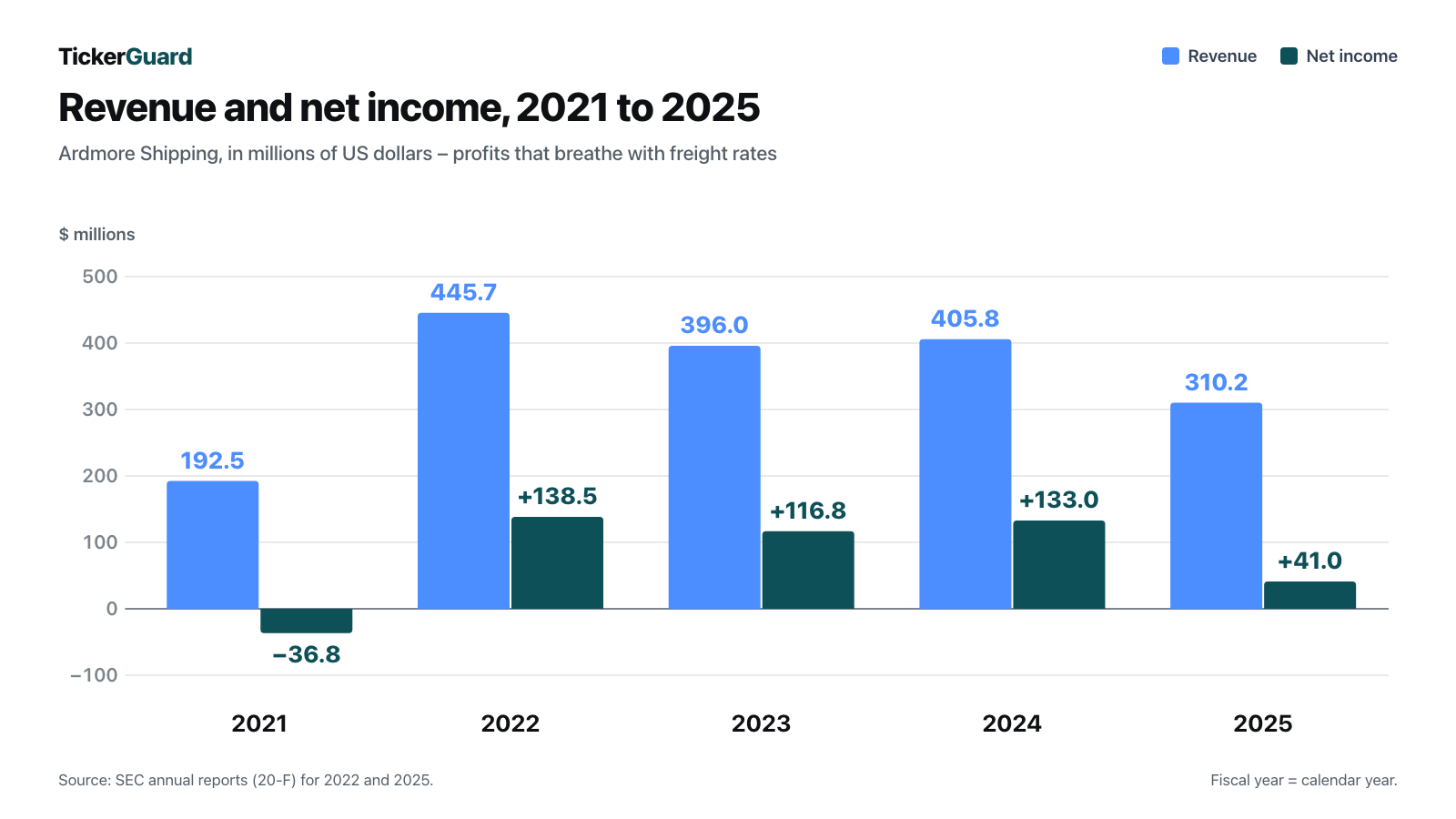
What Ardmore did right during this period shows on the balance sheet. At the end of 2025, bank debt stood at $127.0 million because Ardmore had bought three MR tankers in the third quarter of 2025 and drawn on its credit lines to pay for them. By June 30, 2026, the company had repaid $100.0 million, leaving $33.4 million of debt against $48.1 million of cash — net cash, on paper. Equity rose to $700.0 million, undrawn credit lines came to $294.0 million, and together with cash Ardmore reports $342.1 million of available liquidity. All loan covenants were met. Ardmore fully redeemed its remaining preferred stock on October 31, 2025, for $30.6 million. The picture that sticks: Ardmore used the good years to lighten the ship — in case the sea gets rough again.
What the filings say — the uncomfortable truths
Uncomfortable truth No. 1: profits hinge on a rate Ardmore does not set
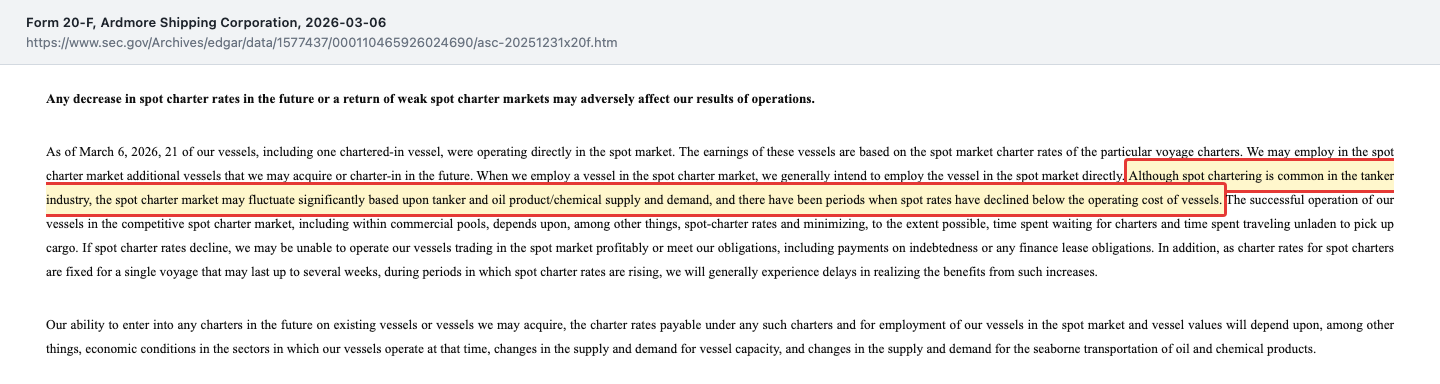
A spot-market shipowner is a price taker. It can cut costs, deploy its ships well and choose smart routes — the day rate is set by the market. Ardmore says so itself in its annual report:
“Although spot chartering is common in the tanker industry, the spot charter market may fluctuate significantly based upon tanker and oil product/chemical supply and demand, and there have been periods when spot rates have declined below the operating cost of vessels.”
— Ardmore Shipping Corporation, SEC annual report 20-F for 2025, Item 3.D “Risk Factors”
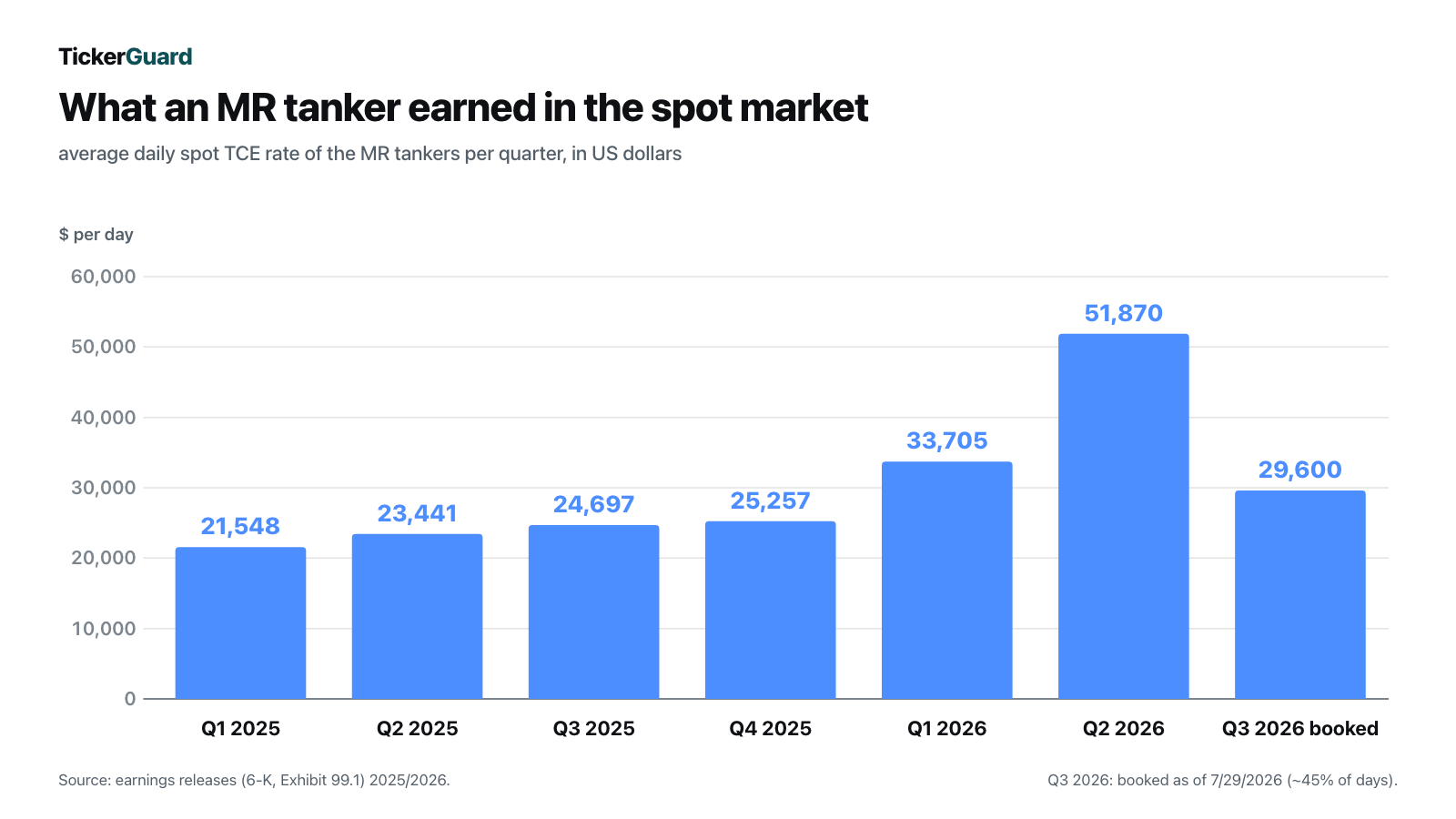
How fast that can turn shows in the company’s own second-quarter earnings release. In one breath it gives the high rate for the second quarter and the booking position for the third:
“Based on approximately 45% of total revenue days currently fixed for the third quarter of 2026, the average spot TCE rate is approximately $29,600 per day for MR tankers; based on approximately 50% of revenue days fixed for the third quarter of 2026, the average spot TCE rate for chemical tankers is approximately $25,000 per day.”
— Ardmore Shipping Corporation, SEC Form 6-K of July 29, 2026, Exhibit 99.1 (second-quarter 2026 earnings release)

$29,600 instead of $51,870 — for the MR tankers, that is a decline of about 43 percent. The number is a snapshot: more than half of the days were still open at the end of July, and the second half of a quarter can go better or worse. It can still be put in context. It is above every quarter of 2025, but far below early summer. For scale: Ardmore’s own cash breakeven was $11,700 per day in 2025, according to its letter to shareholders. So $29,600 is still profitable — it is just a different quarter from the one the stock is currently being valued on. How the third quarter actually ended will only show in its earnings release; in 2025, Ardmore published it on November 5. Ardmore had not published a newer booking position by October 27, 2026 — after July 29, no further SEC filing with business figures followed.
Remember: a spot-market shipowner does not sell ships, it sells days — and every day has its own price.
Uncomfortable truth No. 2: the tailwind comes from conflicts, and conflicts can end
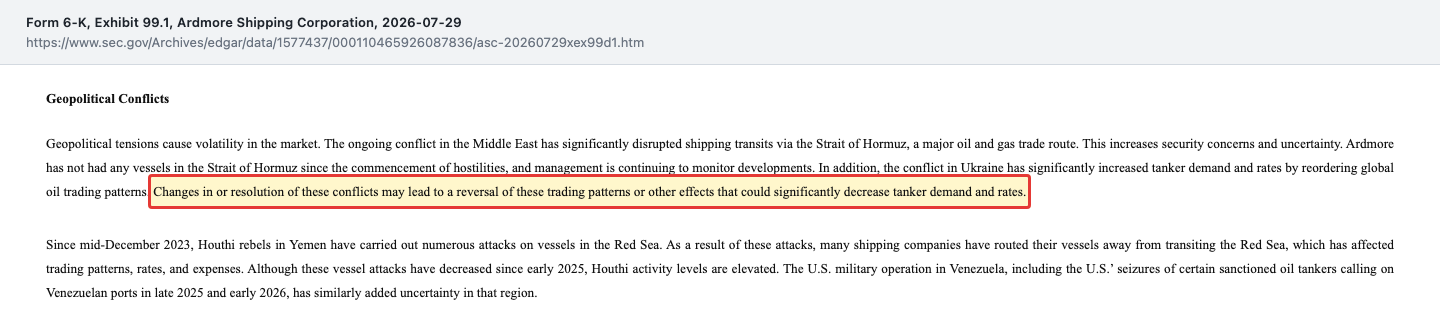
Why were rates so high in 2026? In its earnings release, Ardmore cites strong refining margins, trade displacement and a heightened focus on energy security. Behind the trade displacement are wars: the conflict in the Middle East has, in Ardmore’s words, significantly disrupted transits through the Strait of Hormuz; Ardmore has not had a vessel there since hostilities began. The war in Ukraine has reordered the world’s oil flows, and Houthi attacks have kept many shipowners out of the Red Sea. Longer detours mean more days at sea per cargo — and therefore scarcer ships. But Ardmore also says what happens when that ends:
“Changes in or resolution of these conflicts may lead to a reversal of these trading patterns or other effects that could significantly decrease tanker demand and rates.”
— Ardmore Shipping Corporation, SEC Form 6-K of July 29, 2026, Exhibit 99.1, section “Geopolitical Conflicts”
Then there is supply. According to the annual report, the global orderbook for new MR product tankers stood at about 13.4 percent of the existing fleet at the end of 2025, and at 20.2 percent for chemical tankers. If these ships are delivered and not as many old ones are scrapped, the fleet grows — and with it the pressure on rates. Ardmore is ordering ships itself (more on that in a moment). Remember: if you earn money from detours, you earn it from a situation nobody can guarantee.
Uncomfortable truth No. 3: the dividend rises with the tide — and falls with it
Ardmore does not pay a fixed dividend but a share of the prior quarter’s adjusted earnings. Until early 2026 that was one-third; in May 2026 the board doubled it:
“The Company is doubling its dividend payout ratio on its shares of common stock to two-thirds (increased from one-third) of Adjusted earnings.”
— Ardmore Shipping Corporation, SEC Form 6-K of May 7, 2026, Exhibit 99.1 (first-quarter 2026 earnings release)

The amounts show the effect: $0.09 per share for the fourth quarter of 2025, $0.39 for the first quarter of 2026 and $0.79 for the second; that payout alone costs about $32.3 million. This is the high-tide trap in its purest form: multiply $0.79 by four and you get $3.16 a year, a little over 15 percent of the October price of $20.70. But that math extrapolates the strongest quarter since early 2025. With a variable payout, the dividend follows the rate — and the third-quarter bookings were 43 percent lower. Ardmore itself warns in its annual report that there is no guarantee of future dividends and that the board can change the policy at any time.
At the same time, Ardmore is investing. In April and June 2026 it ordered four new 40,500-ton Handysize tankers from Wuhu Shipyard at $44.9 million each, for delivery from late 2028; options on two more come on top. According to the July 29, 2026, earnings release, about $165.2 million in installments is still outstanding, most of it in 2028 and 2029. With $342.1 million of liquidity, that is manageable. But it shows where the high-tide money goes: two-thirds to shareholders, the rest into ships that will start earning in two to three years — in a market whose orderbook is already growing. Remember: a variable dividend is a mirror of the rate, not a promise.
Valuation: about $846 million for a fleet at high tide
At the October 26, 2026, close of $20.70, the 40.85 million shares (as of July 29, 2026) are worth about $846 million. In the four quarters through June 2026, Ardmore earned $105.6 million for common shareholders, or $96.1 million adjusted for the vessel sale and earlier one-time items. That puts the price-to-earnings ratio at about 8 to just under 9 — in plain terms, the market pays eight to nine times what Ardmore earned in a year. Equity of $700.0 million (June 30, 2026) is valued at 1.2 times by the market. The sale of the “Ardmore Engineer” at a $12.2 million gain shows that older ships fetched more in the market in spring 2026 than their book value.
That looks cheap — and that is how shipping stocks almost always look when rates are high. A P/E of 8 at Ardmore says nothing about the future, only about the past four quarters, the strongest of which was the second quarter of 2026. Ardmore’s own numbers show what a year with more normal rates looks like, using two real years. In 2024, an MR tanker earned an average of $32,102 a day in the spot market, and Ardmore earned $128.6 million for common shareholders — a P/E of about 6.6 on the October 2026 market value. In 2025 it was $23,874 a day and only $36.1 million of profit — a P/E of about 23. Adjusted earnings in 2025 were $0.95 per share; two-thirds of that would be about $0.63 of dividends a year, a little over 3 percent of the October price. This is not a forecast but a look back, with one caveat: in 2024 and 2025 Ardmore still carried more debt and preferred stock. As a rule of thumb for sensitivity: as of June 30, 2026, 19 vessels traded in the spot market. Every $1,000 difference in their day rate shifts annual earnings by almost $7 million over 365 days, or about 17 cents per share — before drydock and waiting time. Worth noting: in May 2026, five directors and officers sold a combined 59,348 shares at prices between $18.93 and $19.38 (insider filings, Form 4). Measured against 40.85 million shares that is small and may have personal reasons — but it is not a sign of special confidence from management either. For how a large crude tanker owner rides the same cycles, see our Frontline analysis. Remember: with cyclical companies, a low P/E is often the sign that high rates are already priced into the math.
Upside and risks at a glance
What speaks for Ardmore:
- Strong balance sheet: bank debt of $33.4 million against $48.1 million of cash, equity of $700.0 million, $342.1 million of available liquidity (June 30, 2026); all covenants met.
- High earning power in a good market: $84.1 million of net income and $82.2 million of operating cash flow in the first half of 2026.
- Low costs: cash breakeven of $11,700 per day in 2025, per Ardmore; even the third-quarter booking position ($29,600) is far above it.
- Shareholder-friendly capital allocation: two-thirds of adjusted earnings paid out since May 2026, preferred stock fully redeemed in October 2025.
- Modern fleet, actively renewed: 24 of 25 vessels of Eco-Design build (June 30, 2026), a 2014-built tanker sold at a gain, four newbuilds from late 2028.
What speaks against it:
- Spot-market exposure: 21 of the then 26 vessels in the spot market (March 6, 2026); Ardmore lost money in 2020 and 2021.
- Rates already falling: third-quarter 2026 booking position of $29,600 per day, about 43 percent below the second quarter.
- Tailwind from conflicts: Ardmore itself warns that a resolution could reverse trade flows and significantly lower rates.
- Growing supply: orderbook at year-end 2025 of 13.4 percent of the MR fleet and 20.2 percent of the chemical tanker fleet.
- Variable dividend: it follows adjusted earnings and falls when rates fall; about $165.2 million in newbuild installments outstanding through 2029.
- Shareholder rights: incorporated under Marshall Islands law, which per the annual report may offer less protection than U.S. law.
A human conclusion
Back to the quay. The high-tide trap is not about good or bad water — the water at Ardmore really was high in the summer of 2026, and the company used it well: debt almost gone, cash full, dividend high. The trap is mistaking high water for the norm. Ardmore itself has already seen the level drop and put it in its earnings release, and 2025 offers a reference point for lower water: an MR rate of just under $24,000 and $36.1 million of profit. So the honest question for you is not “Is a P/E of 8 cheap?” It is: what is Ardmore worth if the day rate is not $52,000 but $25,000 — and would you still be happy with that answer? If yes, you are looking at a shipowner with a strong balance sheet and a low breakeven. If not, you may just be looking at the tide. What you make of it is your decision. And that is exactly as it should be.
Sources
All original documents used in this analysis — so you can read them yourself:
- Ardmore Shipping Corporation — SEC Form 6-K with interim financial statements for June 30, 2026 (filed July 29, 2026)
- Ardmore Shipping Corporation — SEC Form 6-K of July 29, 2026, Exhibit 99.1 (second-quarter 2026 earnings release)
- Ardmore Shipping Corporation — SEC Form 6-K with interim financial statements for March 31, 2026 (filed May 7, 2026) and Exhibit 99.1 (first-quarter 2026 earnings release)
- Ardmore Shipping Corporation — SEC annual report 20-F for 2025 (filed March 6, 2026)
- Ardmore Shipping Corporation — SEC annual report 20-F for 2024 (filed March 7, 2025)
- Ardmore Shipping Corporation — SEC annual report 20-F for 2022 with comparison year 2021 (filed March 24, 2023)
- Ardmore Shipping Corporation — SEC Form 6-K of February 12, 2026, Exhibit 99.1 (fourth-quarter 2025 earnings release) and of November 5, 2025 (third quarter 2025)
- Ardmore Shipping Corporation — SEC Form 6-K of May 1, 2026 (proxy statement with letter to shareholders)
- Insider filings (Form 4) of May 6, 13, 14 and 19, 2026: EDGAR overview for Ardmore Shipping (sec.gov)
- Fundamental data (prices, analyst ratings; as of October 26 and 27, 2026), cross-checked against the SEC filings.
- Reddit mentions: ApeWisdom (as of October 27, 2026); surfaced via our in-house Reddit hype scanner.
Transparency & disclaimer: this analysis is journalistic commentary on publicly available information. It is not investment advice, not a regulated investment research product and not a solicitation to buy or sell securities. Equity investments carry substantial risk up to and including total loss. All information is provided without warranty; the as-of date for each figure is stated in the text. Positions held by the operator are disclosed daily; where one exists, it appears as a notice at the top of this deep dive.
Key figures at a glance
All monetary figures in millions of $; earnings per share as reported.
| Metric | 2021 | 2022 | 2023 | 2024 | 2025 |
|---|---|---|---|---|---|
| Revenue | 192.5 | 445.7 | 396.0 | 405.8 | 310.2 |
| Operating Income (EBIT) | -14.8 | 163.6 | 131.7 | 128.3 | 81.0 |
| Net Income | -36.8 | 138.5 | 116.8 | 133.0 | 41.0 |
| Net Margin | -19.1% | 31.1% | 29.5% | 32.8% | 13.2% |
| Earnings Per Share | -1.09 $ | 3.61 $ | 2.79 $ | 3.16 $ | 1.00 $ |
Source: fundamental data & SEC filings (annual and quarterly reports, 10-K/10-Q)
Our Bottom Line at a Glance
- Balance sheet & liquidity positive
- Bank debt of $33.4M against $48.1M of cash, equity of $700.0M, available liquidity of $342.1M (06/30/2026); debt cut by $93.6M in H1 2026, covenants met.
- Earning power in a good market positive
- Net income of $84.1M and operating cash flow of $82.2M in H1 2026; cash breakeven of $11,700 per day in 2025, per Ardmore.
- Spot-market exposure negative
- 21 of the then 26 vessels in the spot market (03/06/2026). MR rate Q2 2026: $51,870 per day, Q3 booking position: $29,600 (−43%). Losses in 2020 and 2021 (−$6.0M and −$36.8M).
- Market & supply negative
- Tailwind from conflicts (Strait of Hormuz, Ukraine, Red Sea) whose end could significantly lower rates, per the 6-K of 07/29/2026; orderbook at year-end 2025: 13.4% of the MR and 20.2% of the chemical tanker fleet.
- Capital allocation neutral
- Payout ratio of two-thirds of adjusted earnings since 05/07/2026 (Q2 2026: $0.79 per share), preferred stock redeemed in 2025; at the same time about $165.2M in newbuild installments outstanding through 2029.
Ardmore is a textbook case of the high-tide trap: the second quarter of 2026 was exceptionally strong, the balance sheet is almost debt-free and the dividend has multiplied. But profits hinge on a spot rate Ardmore does not set — and the company’s own third-quarter bookings were about 43 percent below the second quarter. The low P/E rests on four quarters of high rates; on 2025 earnings alone it would be above 20. Not investment advice.
What Our Rating Means
Open questions
The business works in principle, but one material question is open. As long as it stays open, our findings do not carry a quality verdict.
Yellow, because the central operating question is open: how much profit is left when rates fall? Ardmore made money in every year from 2022 to 2025 but lost money in 2020 and 2021, and profit already dropped 69 percent in 2025. That lack of consistency rules out green; nothing rules in red: with $33.4 million of bank debt against $700.0 million of equity, the balance sheet is very strong, the breakeven low and all covenants met. More telling than today’s P/E is what Ardmore earns at an average rate: in 2025, at an MR rate of $23,874, it was $36.1 million. The decision is yours.
A journalistic assessment by our editorial team at the time of the deep dive, based on public sources — not investment advice and not a solicitation to buy or sell. Your personal circumstances (investment goals, risk capacity, taxes) cannot be taken into account. What our levels mean, how verdicts are formed, and what conflicts of interest exist →
Worth Noting
- Ardmore made our research list via our in-house Reddit hype scanner (5 mentions in 24 hours, rank 69, ApeWisdom, as of October 27, 2026).
- Ardmore is a foreign private issuer: annual report on Form 20-F, quarterly results and interim financial statements on Form 6-K; there is no 10-K or 10-Q. Incorporated in the Marshall Islands, headquartered in Bermuda.
- Market cap computed by us: 40,851,870 shares (earnings release of 07/29/2026) × closing price of $20.70 (10/26/2026). Cross-check against the sale prices in the May 2026 Form 4 filings ($18.93 to $19.38): deviation under one-fifth, explained by the share price rise since.
- Booking positions for a running quarter are snapshots as of the earnings release date (here 07/29/2026, about 45% of MR days) and not a company forecast for the full quarter.
- P/E range: $105.6M of earnings for common shareholders and $96.1M of adjusted earnings in the four quarters Q3 2025 to Q2 2026, each per the four earnings releases.
Stock Watch
This analysis is as of October 27, 2026. Stock Watch will tell you what's changed at ASC since then.
Later $1 a month per stock — signing up is free, and you'll be the first to know when it launches.
The full analysis as a PDF for later
We will send you this analysis as a PDF — to print, file away, and read at your own pace. And we will add you to the free Stock Watch list for Ardmore Shpng (ASC), so you hear about it when something material in this analysis changes.
Frequently Asked Questions
Ardmore Shipping Corporation (NYSE: ASC) is a shipowner headquartered in Bermuda. As of June 30, 2026, it operated 25 tankers: 19 MR product tankers for diesel, gasoline and jet fuel, and six chemical tankers. Most of the fleet trades in the spot market, chartered voyage by voyage at the going day rate.
Net income was $84.1 million in the first half of 2026 and $60.5 million in the second quarter alone ($12.2 million of it from a vessel sale). For full-year 2025 it was $41.0 million, versus $133.0 million in 2024. Ardmore lost money in 2020 and 2021 — profits swing with freight rates.
Ardmore pays a variable quarterly dividend: since May 2026, two-thirds of adjusted earnings, previously one-third. That meant $0.79 per share for the second quarter of 2026, $0.39 for the first and $0.09 for the fourth quarter of 2025. If earnings fall, the dividend falls with them.
Hardly any. As of June 30, 2026, bank debt of $33.4 million stood against $48.1 million of cash; at the end of 2025, debt was still $127.0 million. Undrawn credit lines added $294.0 million. Equity was $700.0 million, and all loan covenants were met.
By July 29, Ardmore had booked about 45 percent of its third-quarter 2026 MR days at an average of $29,600, after $51,870 in the second quarter. Ardmore cites refining margins and conflicts such as the disrupted Strait of Hormuz and the war in Ukraine as drivers, and warns that their end could lower rates.
Ardmore is incorporated in the Marshall Islands and headquartered in Bermuda. As a foreign private issuer, it files an annual report on Form 20-F with the SEC and reports quarterly results and other news on Form 6-K. Its fiscal year matches the calendar year.
Found an error?
Did you spot a factual error, an outdated number, or a typo in this deep dive? Let us know briefly — your report goes straight to the editorial team.