Frontline: Revenue Jumped 96 Percent — and Companies Tied to the Controlling Shareholder Sold the Company New Ships for $1.2 Billion
Frontline reported the best quarterly profit in company history for the second quarter of 2026: $659.2 million, more than eight times the year-ago quarter. Revenue jumped from $480 million to $943 million within twelve months, as the Middle East crisis pushed oil tanker charter rates to unprecedented levels. In that same record year, the company agreed to buy nine new tankers for $1.224 billion — from companies attributed to its own controlling shareholder, John Fredriksen. We read the annual report, five earnings releases and five earnings calls from the last twelve months to figure out how much of this record holds up and how much disappears with the next de-escalation in the Gulf. Not investment advice — just the question of who is actually sailing for whom.
 Thomas Mücke
Founder & Publisher
Thomas Mücke
Founder & Publisher
As of Today
As of: September 17, 2026
- Closing price
- 54.00 $ +0.70%
- Market Capitalisation
- 12.0 $B
- P/E
- 13.4
- Growth Score
- 4/10
- AAQS
- 5/10
Price change since September 4, 2026: +17.1%
This analysis has a cut-off date. The Stock Guard tells you when something material changes in the numbers. Reserve your free spot
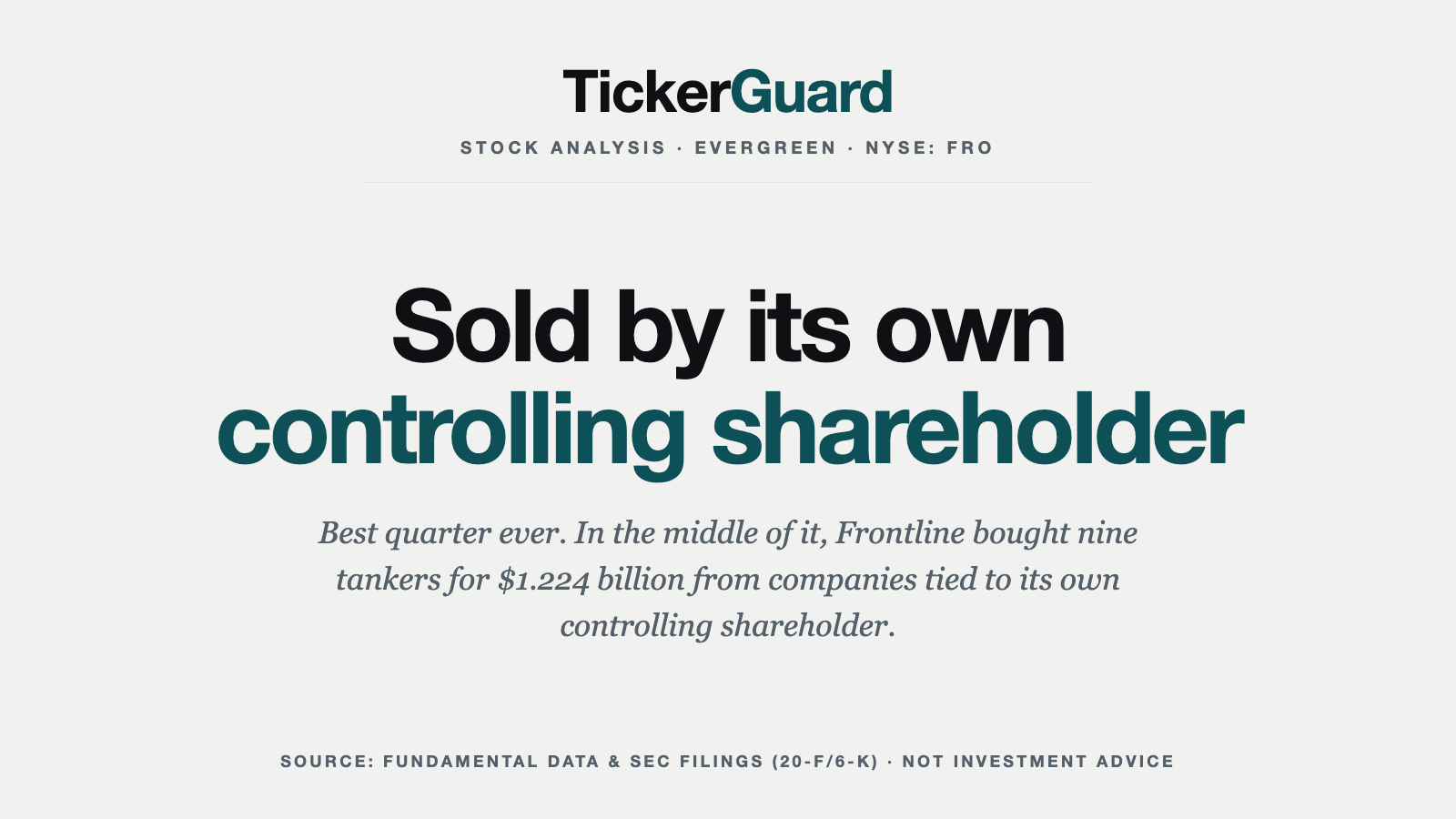
Chart
Interactive price chart (TradingView).
52-week range: 20.60 $ to 53.70 $ · Last price: 54.00 $ (As of: September 17, 2026)
Note: pure fact-based analysis, not investment advice and not a solicitation to buy or sell. All figures without guarantee.
There is an investor weakness that strikes exactly when a stock has just produced a headline: the record-print trap. A company announces "best quarterly profit ever," the share price jumps, and the brain automatically thinks: this has to keep going. The truth is usually more complicated — and in no industry more instructive than tanker shipping, where the result depends not on a product the company sells itself, but on a price none of them control: the charter rate. Frontline plc (NYSE and Oslo Børs: FRO) delivered exactly that kind of headline on August 28, 2026 — the best quarterly profit in company history, $659.2 million. And in that same record year, the company closed a deal worth paying attention to: in January 2026, it agreed to buy nine new tankers for $1.224 billion — from companies attributed to its own controlling shareholder. We read the Form 20-F annual report for 2025, five earnings releases and five earnings calls from the last twelve months to answer one question: how much of this record is the company — and how much is just geopolitics that could vanish tomorrow?
What Frontline actually does
Frontline is a tanker owner — think of it as a lessor of very large trucks, except the trucks carry crude oil across oceans and the rental price can change by the hour. The company owns and operates three vessel classes: VLCCs (Very Large Crude Carriers, the largest crude tankers, roughly 2 million barrels of cargo), Suezmax tankers (smaller, able to transit the Suez Canal fully laden) and LR2/Aframax tankers (smaller still, more flexible). After delivery of the remaining newbuildings and two planned disposals, the fleet will comprise 77 vessels — 40 VLCCs, 19 Suezmax tankers and 18 LR2/Aframax tankers with a combined capacity of roughly 17.1 million DWT and an average age of about 6.6 years, one of the youngest fleets in the industry.
Money is made two ways: in the spot market (a single voyage booked at the prevailing daily rate) or through time charters (a customer leases a vessel for months or years at a fixed daily rate). The industry measures both in a common metric: the TCE rate (Time Charter Equivalent) — the revenue left over per day of vessel hire after deducting voyage costs. This number is the pulse of the business, and it is the reason a tanker owner can post record profits one quarter and losses the next without anything changing in the underlying operation. Frontline is heavily spot-exposed: as of the report date of August 28, 2026, only 17 vessels were on time charters with initial periods exceeding twelve months — the bulk of the fleet is fully exposed to the swings of the daily market. That is the core tension of this analysis: a business whose result depends almost entirely on a price the company itself does not set — and the question of whether the current price is a new normal or an exceptional situation that could disappear as fast as it arrived.
Company history for investors
-
2022
Redomiciliation from Bermuda to Cyprus, renamed "Frontline plc"
Effective 12/30/2022, the legal domicile moved to Cyprus — changes the regulatory and tax framework, not the operating business.
-
2023
Failed combination with Euronav, sale of the CMB.TECH stake
The exit brought in $251.8 million in cash but left behind a lawsuit from FourWorld Capital Management that is still ongoing.
-
2025
Annual meeting authorizes the board to issue up to 377.4 million new shares without pre-emption rights
A shareholder-relevant dilution authorization (169% of shares outstanding) runs until 12/08/2026 — unused so far.
-
2026
January 2026: purchase of nine VLCC newbuildings from Hemen-affiliated companies for $1.224 billion
The largest single investment of the year came from companies attributed to the 35.6% controlling shareholder.
-
2026
July 2026: sale of two VLCC tankers for $270 million, special dividend announced
The proceeds flow back to shareholders as a $0.80 special dividend instead of into the balance sheet or new investments.
-
2026
August 2026: best quarterly profit in company history, $659.2 million in the second quarter
This record quarter is the freshest evidence of the revenue trend that put Frontline on the scanner's hit list — the basis for the question of how sustainable it is.
How the stock landed on our desk
Frontline reached our research list through the in-house "Revenue Accelerator" stock scanner (as of September 6, 2026, 31 hits): rank 7. The scanner criterion is precise — at least two consecutive quarters with revenue growth of 30 to 70 percent versus the same quarter a year earlier, following four prior quarters that each grew below 15 percent, on a revenue base of at least $100 million. Frontline fits exactly: after four weak or declining quarters (fourth quarter 2024: +2.6%, first through third quarter 2025: -26.0%, -13.7% and -11.8%), revenue accelerated to +46.7% in the fourth quarter of 2025 and +66.9% in the first quarter of 2026 versus the respective year-ago quarter — both cleanly inside the 30-to-70-percent band. The now-reported second quarter of 2026, at +96.5%, already exceeds that band and would no longer be captured by the pattern itself; we reviewed it anyway because it is the freshest and most important data point.
The real tension, though, is not the scanner hit itself but the question behind it: is this acceleration organic, acquired, a price effect or a volume effect — and does it hold beyond the next quarter? Upfront: Frontline's big fleet purchase lies two to three years back — in 2023/2024 the company bought 24 VLCCs for $2,350.0 million from Euronav (see "uncomfortable truths" below). Between the second quarter of 2025 and the second quarter of 2026, the comparison period behind the current revenue jump, fleet size stayed roughly flat at about 80 vessels — purchases and disposals largely offset each other. The 2026 revenue jump over that period is therefore almost entirely a price effect: more money for the same fleet, the same crews, the same fuel. Whether that price holds is the question that carries the rest of this analysis. For comparison, it is worth looking at the neighbors in the same waters: we have already covered International Seaways and its dependence on the spot market as well as Nordic American Tankers with 115 consecutive quarterly dividends and Teekay, where shareholders own only a fraction of the tankers it operates — three very different constructions in the same cyclical industry.
The numbers over the years — a business with a heartbeat
Before looking at 2026, it is worth looking at the ten years before it — they show that 2026 is not a statistical accident but the latest chapter of a recurring pattern.
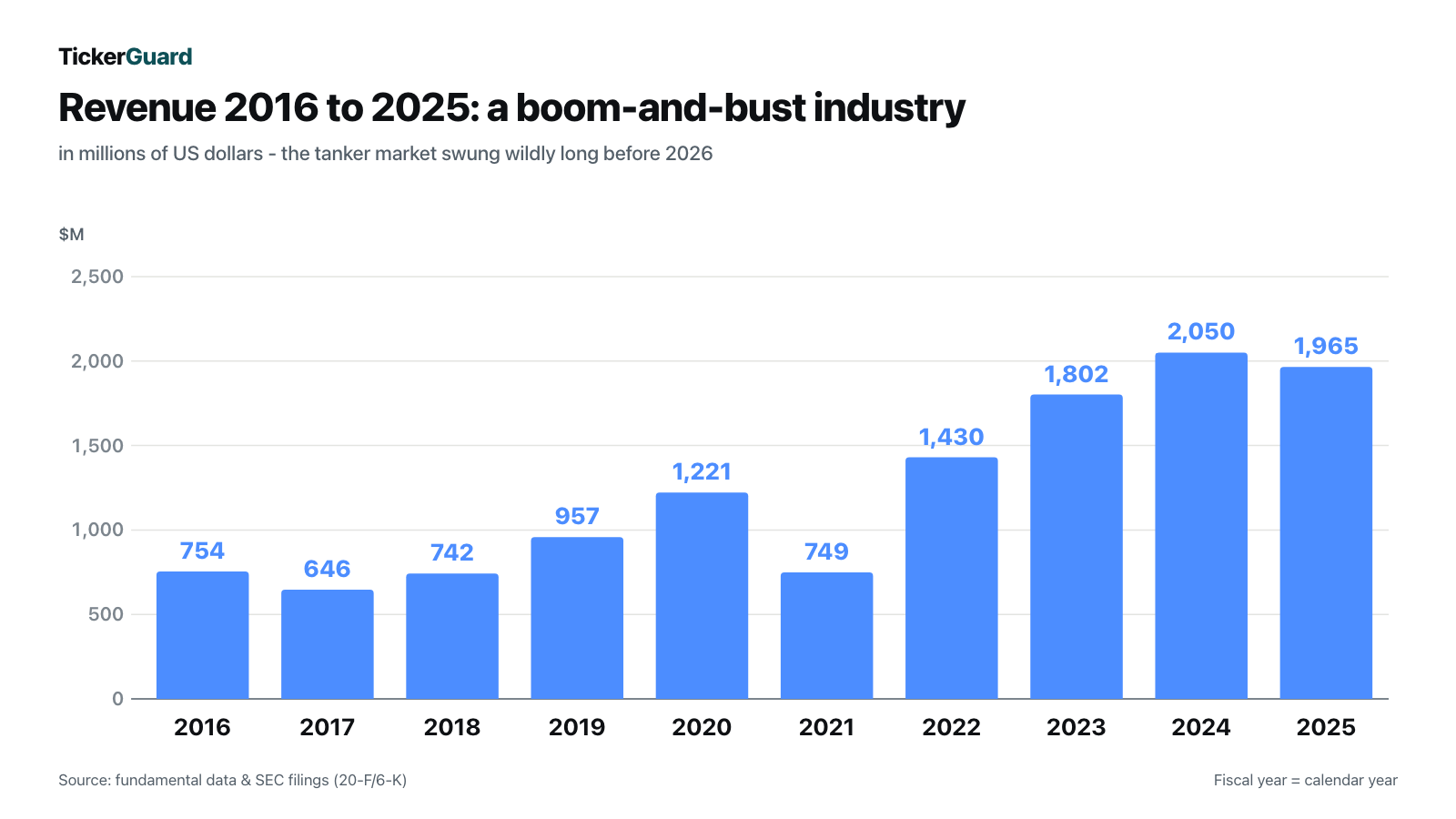
That series ends in 2025 with $1,965.1 million of revenue and $379.1 million of net income — solid, but far from the record revenue year 2024 ($2,050.4 million) and the record profit year 2023 ($656.4 million). Then came 2026. In the first half of 2026, Frontline reported $1,657.5 million of revenue (H1 2025: $907.9 million, +82.6%) and $1,218.3 million of profit (H1 2025: $110.8 million — nearly eleven times as much). The reason comes down to a single metric: the charter rate.
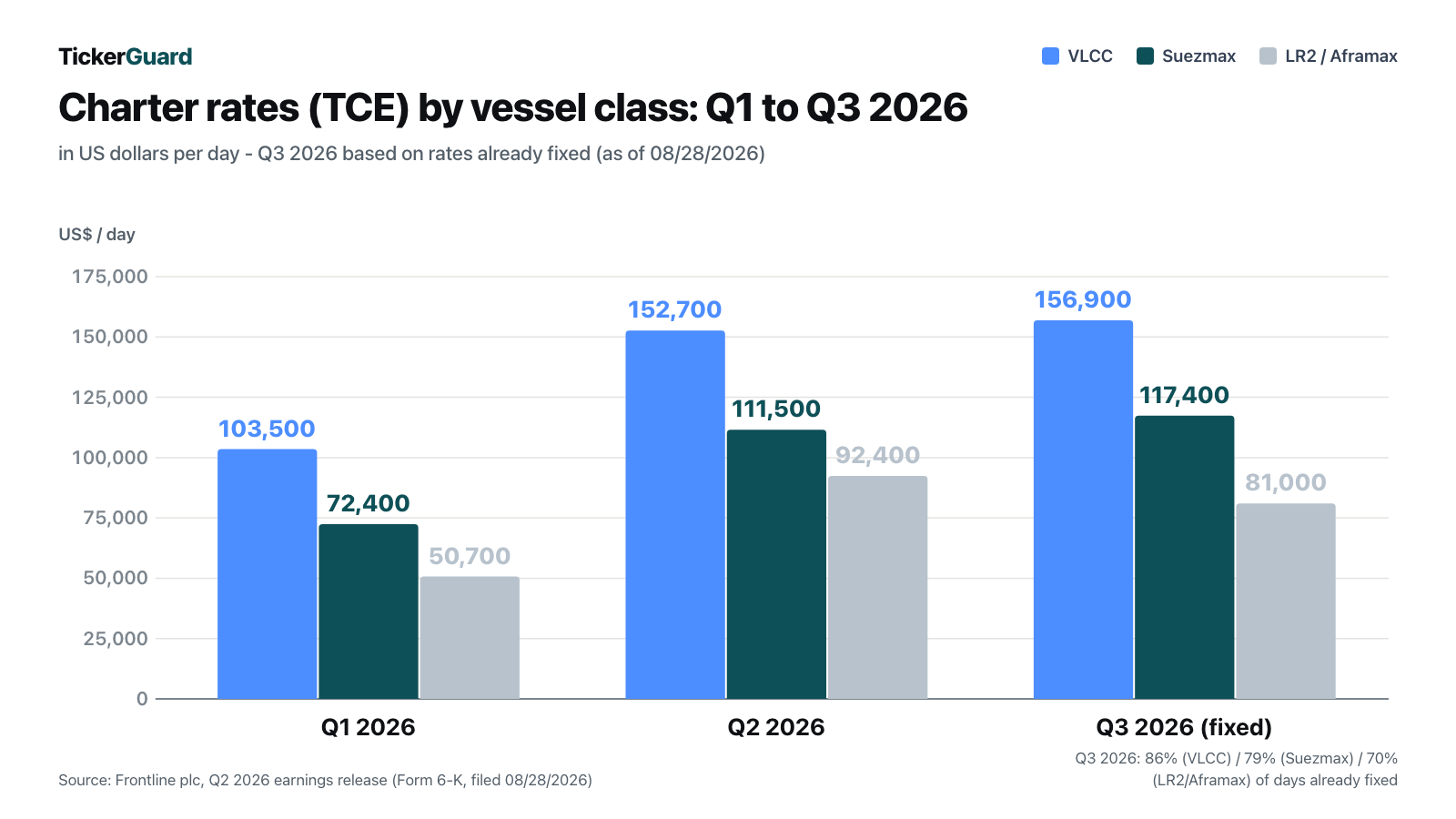
For comparison: the estimated cash breakeven — the minimum daily rate Frontline needs to cover operating costs and debt service — sits at roughly $23,800 (VLCC), $25,700 (Suezmax) and $22,200 (LR2/Aframax) per day for the next twelve months, per the company\'s own estimate. At current VLCC rates of $150,000 to $157,000, that is a margin that is historically exceptional — and precisely for that reason should not be treated as the normal state of affairs.
"We report profit of $659.2 million for the second quarter ended June 30, 2026, compared with profit of $559.1 million in the previous quarter. The adjusted profit was $580.2 million for the second quarter of 2026 compared with adjusted profit of $344.9 million in the previous quarter. This is the best quarterly profit and adjusted profit ever recorded by the Company."
— Frontline plc, Form 6-K, Exhibit 1, August 28, 2026

What management actually said on the earnings calls
We reviewed five earnings calls from the last twelve months — from the second quarter of 2025 through the second quarter of 2026 — deliberately weighting the question-and-answer portion more heavily than the prepared remarks, because that is where a management dodges when it has something to hide, and where a tone shows up that no press release will show. Frontline\'s tone flipped completely within that one year. In August 2025, on the second-quarter call, CEO Lars H. Barstad still sounded tentative: the company was "hopefully seeing the contours of change" in the market. By November 2025, on the third-quarter call, the caution was gone:
"We have previously argued that this market owes us money, and we have finally started to collect some of it."
— Lars H. Barstad, CEO of Frontline Management AS, third-quarter 2025 earnings call, November 21, 2025
In February 2026, on the fourth-quarter 2025 call, Barstad quoted a phrase making the rounds among market participants: "what a time to be alive." In August 2026, finally, after the record quarter, an analyst (Jonathan Chappell, Evercore ISI) asked the obvious question: whether the company, given this "generational" market, might use the opportunity to meaningfully reduce leverage instead of continuing to pay out nearly everything. Barstad\'s answer was unambiguous:
"No, I would say it is not really a part of our DNA. […] You know, our proposition to investors is continues to be is to pay everything out and then leave to the investor to decide whether if he wants to reinvest."
— Lars H. Barstad, CEO of Frontline Management AS, second-quarter 2026 earnings call, August 28, 2026
That is the single most important sentence in this entire piece of research: management explicitly declined the opportunity, in an extraordinary market environment, to structurally lower leverage — in favor of the existing policy of paying out essentially everything. For shareholders that is attractive in the short term (see the valuation chapter below), but it also means: if the market turns again, there is no built-up buffer that has not already been paid out. The transcript of the fourth-quarter 2024 call was also available for this analysis; it shows the same capital policy already in a weaker market phase, which supports the consistency of the statement but leaves the risk unchanged.
What the filings say — the uncomfortable truths
Uncomfortable truth #1: the record profit is, to a large extent, a geopolitical windfall
The second-quarter 2026 earnings release itself is unambiguous about the cause of the rate spike: the escalating situation in the Middle East, attacks on shipping in the Red Sea, and uncertain transit through the Strait of Hormuz, which forces many vessels into delays and detours in the Persian Gulf. The preceding fourth-quarter 2025 earnings release adds further context: intensified U.S. sanctions enforcement by the Treasury's Office of Foreign Assets Control (OFAC), rising floating storage of sanctioned crude, and a "shadow fleet" of sanctioned tankers with shrinking employment opportunities, handing more market share to compliant, sanction-free tonnage. That has two effects: longer voyage distances (more ton-miles per barrel transported) and a tighter available fleet of modern vessels like the ones Frontline operates. That is real and documented — but it is also, by definition, a condition, not a trend. Should the situation in the Gulf calm down, more sanction-free tonnage would likely return to regular routes, and rates would plausibly fall again — as they have done multiple times between 2021 and 2025 (see the revenue chart above). The company itself expects lower spot rates in the third quarter of 2026 than currently fixed, "due to the impact of ballast days" — an early, small hint of normalization.
Uncomfortable truth #2: companies tied to the controlling shareholder sold the company ships for $1.224 billion
In that same record year, Frontline made one of the largest investment decisions in its history — with a counterparty worth knowing well. The annual report is unambiguous about who Frontline\'s largest shareholder is:
"C.K. Limited is the trustee of two trusts (the \'Trusts\') that indirectly hold all of the shares of Hemen Holding Limited (\'Hemen\'), our largest shareholder. Accordingly, C.K. Limited, as trustee, may be deemed to beneficially own the 79,145,703 of our ordinary shares, representing 35.6% of our outstanding shares that are owned by Hemen. Mr. Fredriksen established the Trusts for the benefit of his immediate family."
— Frontline plc, Form 20-F for 2025, Item 3.D "Risk Factors"
And it was from companies attributed to that same Hemen sphere that Frontline bought nine new VLCC tankers in January 2026:
"In January 2026, the Company announced that it had entered into agreements to acquire nine latest-generation, scrubber-fitted ECO VLCC newbuildings from affiliates of Hemen, for an aggregate purchase price of $1,224.0 million."
— Frontline plc, Form 6-K, Exhibit 1, August 28, 2026, "Newbuilding update" section

For context: $1.224 billion equals roughly 21% of total assets as of June 30, 2026 — not a side deal. The annual report does list, in a separate note, the ongoing and comparatively modest business with Hemen-affiliated companies (a combined $9.8 million of revenue against $4.1 million of expenses in 2025) — but an independent fairness review or a special committee of independent directors for the $1.224 billion newbuilding contract itself is not mentioned in the filings reviewed. That does not have to mean anything improper — newbuilding contracts held by Hemen-affiliated entities at Chinese shipyards (Hengli and Dalian) are a long-standing business practice in this corporate sphere, and the deal was only signed in 2026, so it does not yet appear as a completed related-party transaction in the 2025 annual report. But it does mean: a shareholder holding 35.6% of the voting power, to which several board members are closely tied, stood in effect on both sides of this billion-dollar deal — as seller, and, through its voting power and the board members tied to it, indirectly also on the buyer's side.
Uncomfortable truth #3: an unresolved lawsuit from a failed merger attempt continues to follow the company
Frontline had sought a combination with the Belgian shipowner Euronav NV in 2022; in January 2023, Frontline withdrew from that agreement, after which Euronav initiated arbitration against Frontline. On October 9, 2023, the two sides settled: Frontline bought 24 VLCCs from Euronav (which subsequently renamed itself "CMB.TECH NV") for $2,350.0 million; in exchange, Frontline sold its existing stake of 13,664,613 CMB.TECH shares for $251.8 million to Compagnie Maritime Belge (CMB) in November 2023 — together with Hemen-affiliated Famatown Finance Limited, which held additional shares, the combined stake came to 57,479,744 shares, or roughly 26%, and all mutual claims from the failed combination were settled. One side effect of this episode is not yet legally resolved:
"In the year ended December 31, 2024, certain funds managed by FourWorld Capital Management LLC (\'FourWorld\') began proceedings before the Antwerp Enterprise Court (Belgium) […]. FourWorld claims that the transactions should be rescinded and in addition has requested the court to order CMB and Frontline to pay damages in an amount to be determined during the course of the proceedings, which are ongoing. The Company finds the claims to be without merit and continues to vigorously defend against them."
— Frontline plc, Form 20-F for 2025, Note 21 "Commitments and Contingencies"

The damages sought are unquantified, the proceedings have been running before a Belgian court since 2024, and an outcome cannot be predicted from the filings available. On its own, this risk is unlikely to threaten the balance sheet of a profitable company with roughly $3.15 billion of equity — but it fits the pattern from uncomfortable truth #2: the largest single investment of the current record year — the $1.224 billion newbuilding purchase — also ran through the Fredriksen sphere.
Valuation: expensive, cheap, or simply uncertain?
At a price of $46.10 (closing price, September 4, 2026) and 222,622,889 shares outstanding, market capitalization works out to roughly $10.3 billion — the share count has been unchanged since 2023 per the statement of changes in equity, so the calculation can be checked directly against the filing. Based on reported earnings per share for the last four quarters (Q3 2025: $0.18, Q4 2025: $1.02, Q1 2026: $2.51, Q2 2026: $2.96 — a total of $6.67), the trailing price-to-earnings ratio works out to roughly 6.9 — the figure shown automatically in this page's metrics box may differ, because it is based on an older data snapshot from before the second-quarter 2026 results were published; the figure calculated and dated here is the one this analysis relies on. That is remarkably cheap — but a P/E based on a record year is a look in the rearview mirror: it implicitly assumes recently reported earnings are representative of the future. For a cyclical tanker owner, that is about the riskiest assumption one can make, as the ten-year revenue chart above shows.
More informative is a look at the balance sheet and the payout. The debt-to-equity ratio improved markedly within six months: at year-end 2025, $3,067.7 million of debt (current and long-term) stood against $2,510.9 million of equity — a ratio of 1.22. As of June 30, 2026, it was only $2,434.8 million of debt against $3,154.7 million of equity — a ratio of 0.77. Anyone reading this metric off the 2025 annual report therefore sees an outdated, meaningfully worse figure than the current interim reality; we use only the more recent figure here. At the same time, the average financing margin on floating-rate debt fell from 178 to 126 basis points through several refinancings in the second and third quarters of 2026 — the balance sheet has therefore been strengthened not just by profit, but also actively by management.
On the payout side, the policy CEO Barstad confirmed on the call above holds: essentially the entire adjusted profit is paid out as dividends — $2.61 per share for the second quarter of 2026, payable in late September 2026, plus a planned $0.80 special dividend from the proceeds of two vessel sales. Adding up the last four declared quarterly dividends ($0.19 + $1.03 + $1.55 + $2.61), the running dividend yield at the September 4, 2026 price works out to roughly 12 percent — attractive, but also a yield that can fall as fast as it rose in the next weak quarter, because it is tied directly to profit rather than a fixed base payout. Analyst estimates as of August 31, 2026 reflect exactly that expectation: consensus earnings per share for fiscal 2026 stand at $7.90, but only $4.36 for 2027 — an expected decline of roughly 45 percent that already prices in a normalization.
Opportunities and risks at a glance
What speaks for Frontline:
- One of the youngest fleets in the industry (average age roughly 6.6 years, 77 vessels after deliveries and disposals), fully ECO-standard, with a meaningful cost advantage over the aging competitor fleet (18.3% of the global VLCC fleet is already older than 20 years).
- Markedly improved balance sheet: debt-to-equity fell from 1.22 (year-end 2025) to 0.77 (June 30, 2026), financing margin reduced from 178 to 126 basis points, no meaningful maturities before 2030.
- Fixed charter rates for the third quarter of 2026 already exceed the already-strong second-quarter levels for VLCC ($156,900) and Suezmax ($117,400); only LR2/Aframax sits slightly below at $81,000. The earnings boost therefore holds for at least one more quarter across most of the fleet.
- Consistent capital return: essentially a 100% payout ratio on adjusted profit, plus special dividends from vessel sales.
- Structural supply tightness: per the Q2 2026 earnings release, the shipyard order book stands at roughly a quarter (25.4%) of the existing fleet, and 18.3% of the global VLCC fleet is already older than 20 years — a significant share of the older fleet will cross that threshold in the coming years.
What speaks against it:
- The 2026 earnings boost is, to a significant degree, geopolitically driven (Middle East conflict, Red Sea, Strait of Hormuz) — a condition, not a structural trend, as the 2016-to-2025 revenue history with multiple up-and-down cycles shows.
- A purchase of nine tankers for $1.224 billion (roughly 21% of total assets) was made from companies attributed to the 35.6% controlling shareholder Hemen/Fredriksen, with no independent price review mentioned in the filings reviewed.
- An unquantified damages lawsuit by FourWorld Capital Management before a Belgian court over the failed 2023 Euronav transaction remains ongoing.
- Management explicitly declines to use the current exceptional environment for structural deleveraging — essentially the entire profit is paid out, with no buffer for the next weak market phase.
- An authorization to issue new shares equal to 169% of the existing share count without pre-emption rights runs until December 2026 (unused so far).
- Analysts themselves expect a roughly 45% earnings decline for 2027 versus 2026 — the market already prices in normalization.
A human conclusion
Back to the record-print trap from the start. Its core is not that Frontline\'s numbers are false or invented — on the contrary, they are as impressive as reported, and the fleet behind them really is one of the youngest and most efficient in the industry. Its core is that a headline like "best quarterly profit ever" makes you feel you must act immediately, before asking the three questions that actually come first with a cyclical tanker owner: who sets the price? What happens when it falls again? And who is actually sitting on which side of the negotiating table? At Frontline, the answers are: a geopolitical crisis nobody can predict sets the price. If it falls, there is no built-up buffer, because essentially everything gets paid out. And in the largest single investment of this record year — $1.224 billion for nine new ships — the company\'s own controlling shareholder sat on the seller\'s side. None of this makes Frontline a bad company. But it does make it a company where the headline and the question of who actually benefits from it are two different things. What you make of that is your decision. And that is exactly how it should be.
Sources
All original documents used in this analysis — for further reading:
- Frontline plc — Form 20-F for 2025 (filed March 27, 2026)
- Frontline plc — Second-quarter 2026 earnings release (Form 6-K, Exhibit 1, filed August 28, 2026)
- Frontline plc — First-quarter 2026 earnings release (Form 6-K, Exhibit 1, filed May 26, 2026)
- Frontline plc — Fourth-quarter 2025 earnings release (Form 6-K, filed February 27, 2026)
- Frontline plc — Third-quarter 2025 earnings release (Form 6-K, filed November 21, 2025)
- Frontline plc — Second-quarter 2025 earnings release (Form 6-K, filed August 29, 2025)
- Full SEC filing history for Frontline plc: EDGAR overview (sec.gov)
- Earnings call transcripts for the second quarter of 2026 (08/28/2026), first quarter of 2026 (05/22/2026), fourth quarter of 2025 (02/27/2026), third quarter of 2025 (11/21/2025) and second quarter of 2025 (08/29/2025) — Q&A sections reviewed.
- Fundamental data (price, market capitalization, analyst estimates; as of September 4, 2026), cross-checked against the SEC filings.
- Comparison articles: International Seaways, Nordic American Tankers, Teekay.
Transparency & disclaimer: This analysis is a journalistic assessment of publicly available information and does not constitute investment advice, a regulated financial analysis, or a solicitation to buy or sell securities. Equity investments carry substantial risk, including total loss. All information is provided without guarantee; the as-of date for each figure is noted in the text. We disclose any position the operator holds on the day of publication; if one exists, it is noted at the start of this analysis.
Key figures at a glance
All monetary figures in millions of $; earnings per share as reported.
| Metric | 2021 | 2022 | 2023 | 2024 | 2025 |
|---|---|---|---|---|---|
| Revenue | 749.4 | 1,430.2 | 1,802.2 | 2,050.4 | 1,965.1 |
| Operating Income (EBIT) | 8.5 | 445.6 | 746.7 | 781.7 | 592.7 |
| Net Income | -15.0 | 475.5 | 656.4 | 495.6 | 379.1 |
| Net Margin | -2.0% | 33.2% | 36.4% | 24.2% | 19.3% |
| Earnings Per Share | -0.08 $ | 2.22 $ | 2.95 $ | 2.23 $ | 1.70 $ |
Source: fundamental data & SEC filings (annual and quarterly reports, 10-K/10-Q)
Our Bottom Line at a Glance
- Fleet quality positive
- One of the youngest fleets in the industry (average age roughly 6.6 years, fully ECO-standard), a meaningful cost advantage over the aging competitor fleet.
- Balance sheet and leverage positive
- Debt-to-equity fell from 1.22 (12/31/2025) to 0.77 (06/30/2026), financing margin reduced from 178 to 126 basis points.
- Earnings quality negative
- The 2026 record profit rests substantially on geopolitically driven charter rates, not on structural business growth — the 2016-to-2025 history shows repeated sharp up-and-down cycles.
- Related-party transaction negative
- Purchase of nine tankers for $1.224 billion (roughly 21% of total assets) from Hemen-affiliated companies, with no documented independent price review in the filings reviewed.
- Capital policy neutral
- Essentially full payout of adjusted profit instead of structural deleveraging during the current record environment — attractive for shareholders short-term, with no buffer for the next weak market phase.
- Legal risk neutral
- Unquantified FourWorld lawsuit before a Belgian court over the failed 2023 Euronav transaction remains ongoing; outcome unresolved.
Frontline posts record 2026 numbers driven mostly by a geopolitically fueled charter-rate spike, combined with an improving balance sheet and a very high payout ratio. At the same time, the company's largest single investment of the year was bought from companies attributed to its own controlling shareholder, with no documented independent review. Not investment advice.
What Our Rating Means
Open questions
The business works in principle, but one material question is open. As long as it stays open, our findings do not carry a quality verdict.
The operating business and the balance sheet are sound and have recently improved — the open question is not the substance of the company but two other points: how much of the current record holds up beyond the geopolitical exceptional situation, and how the $1.224 billion purchase from the controlling shareholder's own affiliates should be judged from a governance standpoint when no independent review is documented. Both are open operating and governance questions, not a proven solvency risk — hence yellow rather than red or green.
A journalistic assessment by our editorial team at the time of the deep dive, based on public sources — not investment advice and not a solicitation to buy or sell. Your personal circumstances (investment goals, risk capacity, taxes) cannot be taken into account. What our levels mean, how verdicts are formed, and what conflicts of interest exist →
Worth Noting
- Hook for this analysis: in-house "Revenue Accelerator" stock scanner, rank 7 of 31 hits (as of 09/06/2026).
- Filing data as of: Form 20-F for 2025 (03/27/2026), Q2 2026 earnings release (08/28/2026, the most recent filing as of this analysis).
- Price/market-cap/analyst-estimate data as of: September 4, 2026 (price) and August 31, 2026 (analyst estimates).
- AI classification: neutral — no substantive AI relevance in the filings reviewed, only generic cybersecurity boilerplate.
Stock Watch
This analysis is as of September 6, 2026. Stock Watch will tell you what's changed at FRO since then.
Later $1 a month per stock — signing up is free, and you'll be the first to know when it launches.
The full analysis as a PDF for later
We will send you this analysis as a PDF — to print, file away, and read at your own pace. And we will add you to the free Stock Watch list for Frontline Ltd (FRO), so you hear about it when something material in this analysis changes.
Frequently Asked Questions
Frontline plc (NYSE and Oslo Børs: FRO) is a tanker owner headquartered in Limassol, Cyprus. The company owns and operates a fleet of VLCC, Suezmax and LR2/Aframax crude tankers — after the delivery of the remaining newbuildings and two disposals, 77 vessels with an average age of roughly 6.6 years. Revenue is earned mostly in the spot market at prevailing charter rates (TCE).
Revenue rose to $943.3 million in the second quarter of 2026 (Q2 2025: $480.1 million, +96.5%) because charter rates (TCE) climbed sharply amid geopolitical disruption — the Middle East conflict, attacks in the Red Sea, and uncertain transit through the Strait of Hormuz. Fleet size itself barely changed over the comparison period; the revenue jump is almost entirely a price effect.
Partly. High rates are already fixed for the third quarter of 2026 (VLCC: $156,900 per day at 86% booked), so the earnings boost holds for at least one more quarter. The company itself expects lower spot rates in the third quarter than currently fixed. Because the increase is substantially rooted in geopolitical disruption, a return to lower rates once the situation eases is likely — analyst estimates project a roughly 45% earnings decline for 2027 versus 2026.
The largest shareholder, with 35.6% of the shares, is Hemen Holding Limited, linked per the annual report to shipowner John Fredriksen's family through two trusts. Several Frontline board members also sit, per the annual report, on the boards of other Fredriksen-affiliated companies such as SFL Corporation, Archer Limited, Flex LNG or Paratus Energy (Hemen exited an earlier stake in Golden Ocean in March 2025).
In January 2026, Frontline agreed to buy nine new VLCC tankers for $1.224 billion from newbuilding contracts the earnings release attributes to "affiliates of Hemen" — Hemen being Frontline's largest shareholder at 35.6%. The filings reviewed do not mention an independent review of this purchase price; such newbuilding contracts held by Hemen-affiliated entities at Chinese shipyards are, however, a long-standing business practice in this corporate sphere.
Yes, and a very large one: the company pays out essentially its entire adjusted profit — $2.61 per share for the second quarter of 2026, payable in late September 2026, plus a planned $0.80 special dividend from two vessel sales. Because the dividend is tied directly to quarterly profit rather than a fixed base payout, it swings with the market cycle.
FourWorld Capital Management initiated proceedings before a court in Antwerp, Belgium, in 2024 over the failed 2023 merger with Euronav NV: the former Euronav NV acquired a company called CMB.TECH NV in December 2023 and has carried that name itself ever since. FourWorld seeks to rescind the transactions and demands unquantified damages from CMB and Frontline. Frontline considers the claims without merit; the proceedings remain ongoing per the 2025 annual report.
Both owners are heavily spot-market exposed and benefited from the same high charter rates in 2026. International Seaways generated roughly 82% of its TCE revenue from the spot market in 2025 per our own analysis; at Frontline, only 17 vessels were on time charters exceeding twelve months as of the report date, August 28, 2026 — a comparably low fixed share. The main difference lies in ownership: Frontline has a very present controlling shareholder in Hemen/Fredriksen, who also acts as a business counterparty.
Found an error?
Did you spot a factual error, an outdated number, or a typo in this deep dive? Let us know briefly — your report goes straight to the editorial team.