Nordic American Tankers: 115 Straight Quarterly Dividends — Paid Out of the Pot Shareholders Filled
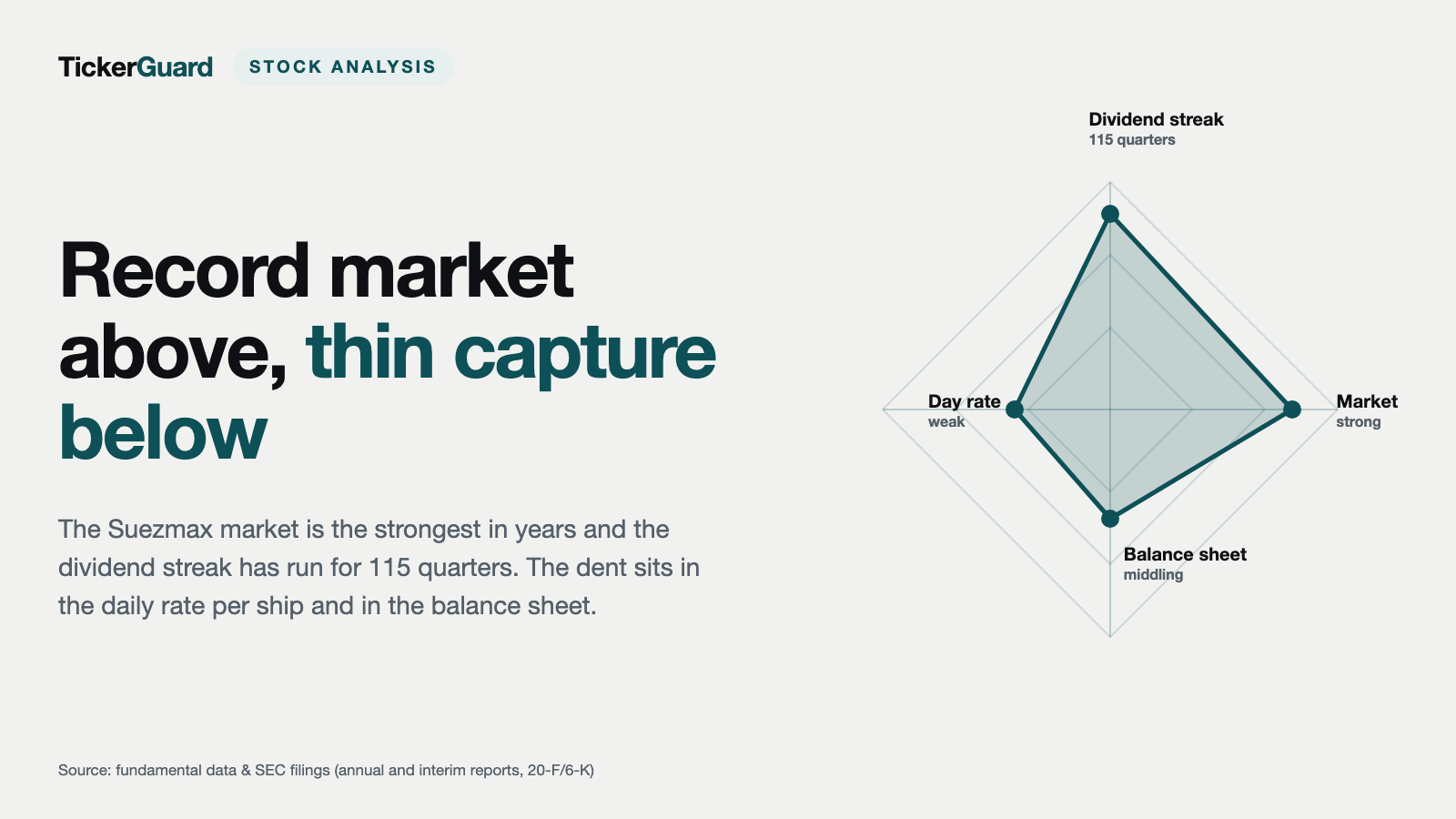
Nordic American Tankers (NYSE: NAT) runs Suezmax crude tankers carrying about a million barrels of oil each, and the market is the strongest it has been in decades. The company earned $46.3 million in the first quarter of 2026 — more than in all of 2025, when it made $12.3 million. The dividend has run for 115 consecutive quarters. Only, according to the annual report, it does not come out of profit: it is charged against the contributed surplus account, the pot shareholders paid into, which fell from $404.8 million at the end of 2023 to $245.0 million at the end of 2025. And per ship day the company earned $27,681 in 2025 against an indicative market rate of $54,709. Not investment advice — just the question of which pot the 115th straight dividend actually came from.
 Thomas Mücke
Founder & Publisher
Thomas Mücke
Founder & Publisher
As of Today
As of: October 6, 2026
- Closing price
- 8.20 $ -1.80%
- Market Capitalisation
- 1.7 $B
- P/E
- 30.1
- Growth Score
- 3/10
- AAQS
- 2/10
Price change since August 21, 2026: +17.6%
This analysis has a cut-off date. The Stock Guard tells you when something material changes in the numbers. Reserve your free spot
Chart
Interactive price chart (TradingView).
52-week range: 3.20 $ to 8.40 $ · Last price: 8.20 $ (As of: October 6, 2026)
Note: pure fact-based analysis, not investment advice and not a solicitation to buy or sell. All figures without guarantee.
There is an investor weakness as old as the stock market itself, and it still finds fresh victims every year: the interest illusion. It works like this — you read "12.6 percent dividend yield" and your brain quietly translates that into "12.6 percent interest." But interest is something somebody owes you. A dividend is owed by nobody: it is a decision, not a claim, and it can come out of profit — or out of a pot you yourself once paid into. Nordic American Tankers Limited (NYSE: NAT) is the textbook case. The Bermuda-based shipowner has paid 115 consecutive quarterly dividends since it became stock listed on September 15, 1996, without missing one. And the market is currently the strongest it has been in decades: in the first quarter of 2026 the company earned $46.3 million — more than in all of 2025, when it made $12.3 million. So let us make a deal. We will read together what Nordic American Tankers told the U.S. securities regulator, the SEC — the annual report on Form 20-F for 2025 filed April 29, 2026, and the interim report on Form 6-K filed June 1, 2026 carrying the figures as of March 31, 2026 — and find out where the money for that streak actually came from. What you do with it is your call.
What Nordic American Tankers actually does — 18 employees, one ship type, one spot market
NAT is a crude oil tanker owner with a deliberately simple design. It owns exactly one vessel class: the Suezmax. The name only tells you how large the ship may be to still fit through the Suez Canal — roughly 157,000 to 164,000 deadweight tons, in practice about one million barrels of crude per cargo. Because the ships are nearly identical, they can be swapped for one another, which is a real advantage for an oil major that needs a cargo moved from A to B at short notice.
The business model is time-based renting. Most of the ships trade in the spot market, voyage by voyage at whatever the going rate is. Put in everyday terms: NAT is not a landlord with a ten-year lease, it is a cab driver. When plenty of passengers are waiting, the fare climbs by the hour; when nobody is at the curb, the cab sits. The single metric everything in this industry hangs on is the TCE rate, or time charter equivalent — simply the net revenue left per ship per day after bunkers, port charges and canal tolls.
The fleet shrank and got younger in quick succession: 20 Suezmaxes as of December 31, 2025 (built between 2003 and 2022), 18 as of March 31, 2026 and 17 as of the annual report date in late April 2026, because the oldest units — among them the 2003-built Nordic Pollux and the 2005-built Nordic Skier — were sold. In January 2026 the company signed contracts for two new Suezmaxes at a South Korean shipyard, due for delivery in 2028.
And now the figure you have to read twice at a company with roughly $900 million of total assets: as of December 31, 2025 Nordic American Tankers had about 18 shore-based employees. The crews come through three technical managers who operate the ships under the company's instructions. Running the whole thing since its founding in 1995 is one man: Herbjørn Hansson, founder, chairman, president and chief executive officer in a single person; his son Alexander Hansson has been vice chairman since February 2024. That sets up the central tension of this analysis, and it runs through every chapter: the tanker market is delivering the best backdrop in decades — and yet, over recent years, the famous dividend streak did not come out of the business but out of an account shareholders themselves had filled.
One note on finding the source documents, because it saves time with this company: Nordic American Tankers is incorporated in Bermuda and is therefore treated by the SEC as a foreign private issuer. There is no annual report on Form 10-K and no quarterly report on Form 10-Q here. The annual report is a 20-F, the interim reports are 6-K filings. Reporting is still under U.S. GAAP in U.S. dollars, and the fiscal year is the calendar year. Anyone hunting for a 10-Q will come up empty — and miss the actual numbers on the way.
Company history for investors
-
1996
Stock listing and the first quarterly dividend
The company became stock listed on September 15, 1996. A cash dividend has followed every quarter since — the 115th in an unbroken run by the first quarter of 2026.
-
2011
Renamed Nordic American Tankers Limited
Until June 29, 2011 the company was called "Nordic American Tanker Shipping Ltd." Nothing changed for shareholders, but a great deal changed for anyone searching older SEC documents.
-
2021
The loss year — and a dividend anyway
On revenue of $195.8 million came a loss of $171.3 million and an operating cash outflow of $44.5 million. Shareholders still received $9.7 million in dividends.
-
2025
New bank financing and an idle share program
February 2025 brought the five-year $150 million Beal Bank facility; March brought a $60 million at-the-market program that was still unused as of late April 2026.
-
2026
Rate spike after the closure of the Strait of Hormuz
The first quarter of 2026 produced $46.3 million of net income, more than all of 2025. The quarterly dividend rose to 22 cents and two newbuilds were ordered for 2028.
How this stock landed on our desk
NAT did not reach our research list through a screening signal but through a contradiction. Annualize the most recently declared quarterly dividend of 22 cents (declared May 28, 2026, payable June 24, 2026) and you get roughly 12.6 percent at the closing price of $6.97 on August 21, 2026. Take instead the four dividends actually declared most recently — 10, 13, 17 and 22 cents, or 62 cents — and you get 8.9 percent. Both are calculations, not commitments. And both sit next to a price-to-earnings ratio of about 27 on the last twelve reported months (data as of August 22, 2026). A double-digit payout yield and a P/E of 27 do not usually belong on the same line — which is exactly why we looked.
The share price has already moved: the 52-week range ran from $2.575 to $7.20 as of August 22, 2026. Anyone who caught the low is sitting on a triple; anyone buying in the summer of 2026 is buying a business that lives off a geopolitical event named in its own annual report — the temporary closure of the Strait of Hormuz. Fix the finding in your mind right at the start: with a spot-market shipowner you are not measuring the company, you are measuring the price somebody is paying for a ship day right now. How fast that price turns is the next chapter. If you want to see the same mechanism at a dry bulk operator, it is laid out in our Safe Bulkers analysis, where quarterly earnings went from $1.7 million to $35.2 million within a year on a virtually unchanged fleet.
The numbers over the years — given their due
First, what genuinely impresses. The first quarter of 2026 was an exceptional quarter for Nordic American Tankers: $106.5 million of voyage revenue, of which $77.5 million net after bunkers, port charges and canal tolls, adjusted EBITDA of $54.0 million and net income of $46.3 million, or 22 cents a share. The comparable quarter a year earlier produced $4.2 million; the fourth quarter of 2025 produced $11.7 million. The company itself notes that the first quarter of 2026 beat the full twelve-month result of 2025 — and it did: 2025 closed with $12.3 million.
Price did all of it. The daily rate rose from $27,490 per ship in the third quarter of 2025 to $35,000 in the fourth quarter and $47,600 in the first quarter of 2026. For the second quarter of 2026 the company reported roughly 90 percent of the fleet booked at about $68,000 a day — against operating costs of less than $10,000 per ship per day. To see the leverage: almost every additional dollar of daily rate lands in earnings, because the cost of a ship day barely moves with it. Across 17 ships and 90 days in a quarter, a $10,000 difference in rate shifts roughly $15 million of quarterly income.
The balance sheet visibly improved in that single quarter too. As of March 31, 2026 the books showed total assets of $901.3 million, shareholders equity of $455.9 million (up from $445.5 million at the end of 2025) and cash of $81.1 million — close to double the $45.9 million held on December 31, 2025. The company puts its net debt at $250.4 million, or $13.9 million per ship. Against the secondhand prices modern Suezmaxes currently fetch, that is a comfortable figure.
And now the chart this analysis is really about. It sets two things side by side that you rarely see together: how much cash the business actually produced over five years — and how much went out to shareholders in those same years.
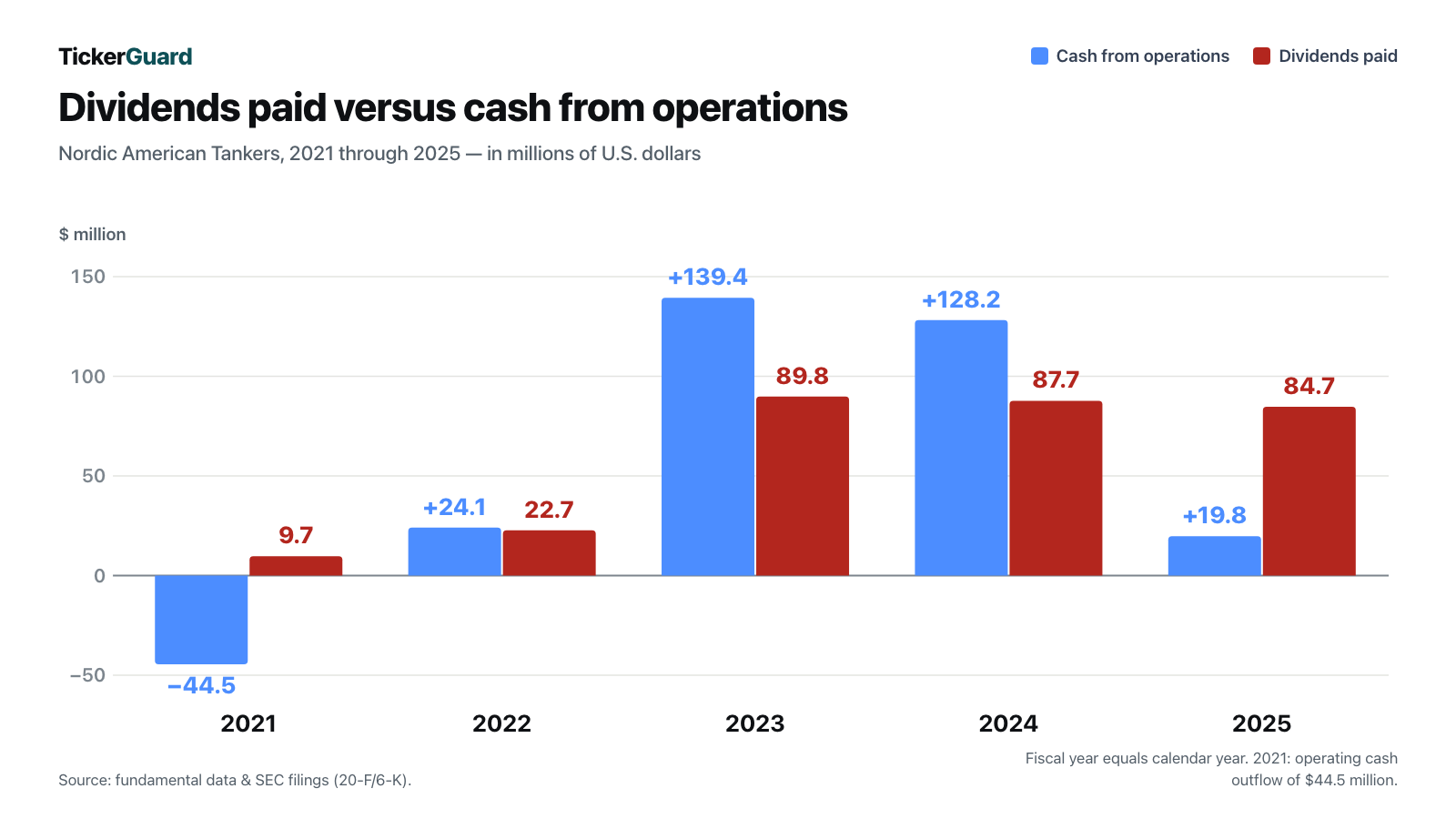
The first quarter of 2026 did not change that pattern either: cash from operations of $29.7 million met $36.0 million of dividends paid. Cash still grew, thanks to $50.4 million of proceeds from vessels sold. Which brings us to the uncomfortable truths.
What the filings say — the uncomfortable truths
Uncomfortable truth No. 1: The dividend comes out of the paid-in pot, not out of profit
Most companies pay dividends out of retained earnings — what has been earned over the years and not distributed. Nordic American Tankers does something else, and the annual report says so without hedging: the dividend is charged against the contributed surplus account. In everyday terms that is not a savings account built from profit, it is the club treasury filled by past member contributions: capital shareholders paid in at earlier share issues, which under Bermuda law may be distributed whether or not the company is making money.
"As indicated by the laws governing the Company, the Contributed Surplus Account can be used for dividend distribution and to cover accumulated losses from its operations. There are no legal or regulatory restrictions, other than approval by the Board of Directors, that limit the Company's ability to authorize dividend distributions from contributed surplus."
— Nordic American Tankers Limited, SEC annual report on Form 20-F for 2025, Note 12 "Shareholders' Equity"

What that does over time shows up in the account balance. It shrinks year after year by almost exactly the dividend:
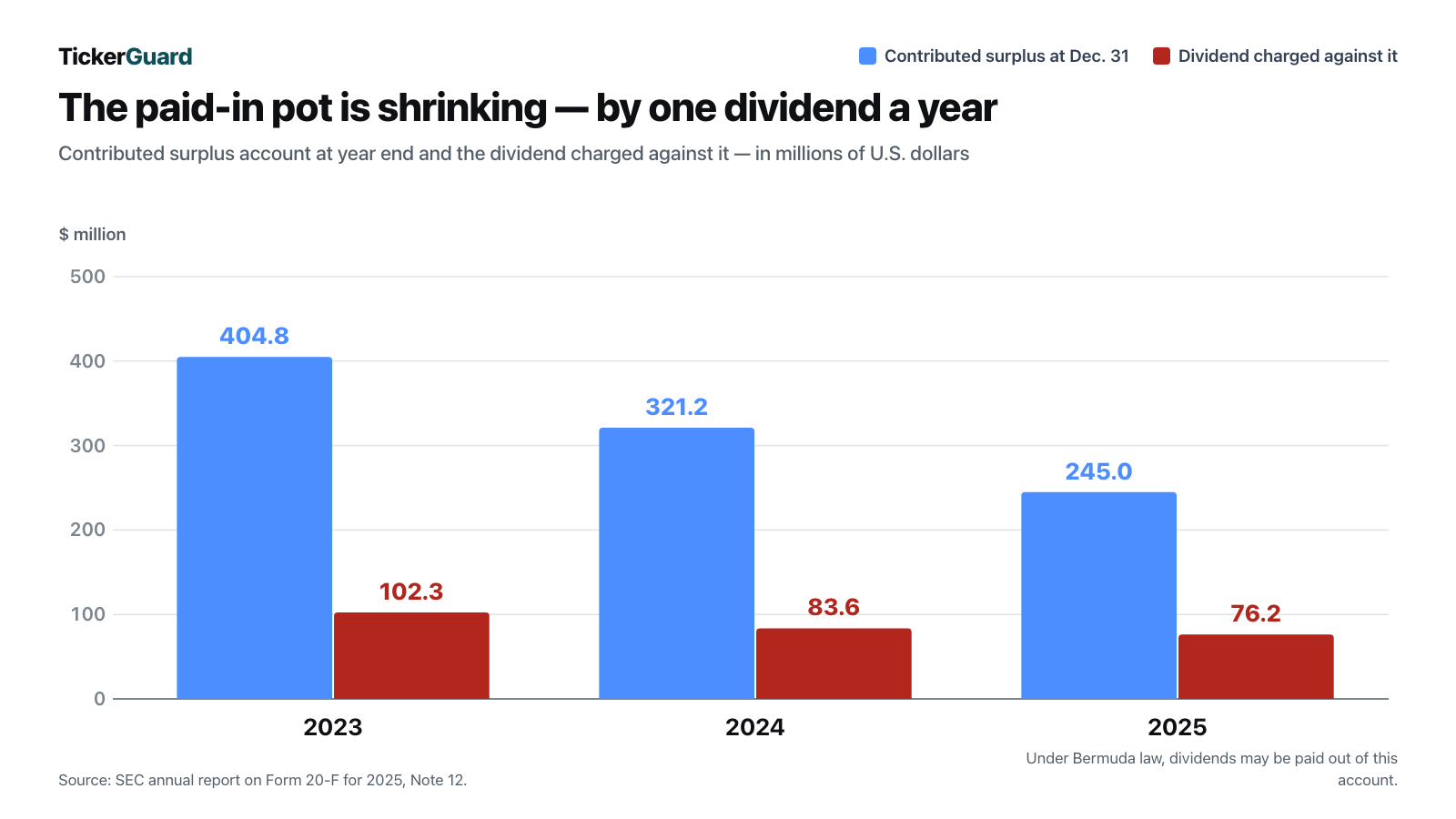
At the most recent annual charge of $76.2 million, the remaining $245.0 million would last roughly three more years on paper. That is not a forecast — if earnings keep running as they did in the first quarter of 2026, the business refills the pot on its own and the question fades. But it explains why this dividend is not interest. The company puts it plainly in its own dividend policy:
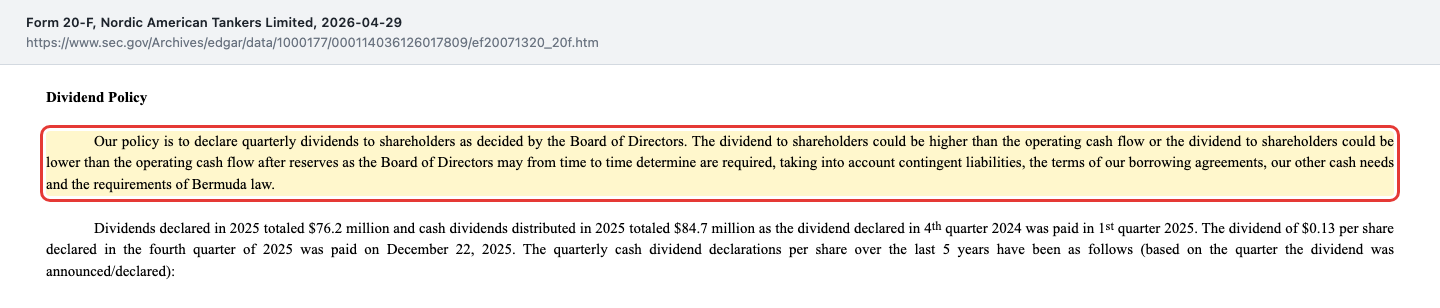
"The dividend to shareholders could be higher than the operating cash flow or the dividend to shareholders could be lower than the operating cash flow after reserves as the Board of Directors may from time to time determine are required."
— Nordic American Tankers Limited, SEC annual report on Form 20-F for 2025, Item 8.A "Dividend Policy"
Uncomfortable truth No. 2: Per ship day, NAT earns less than the market offers
When an owner runs a single vessel type almost entirely in the spot market, its daily rate ought to track the market. At Nordic American Tankers 2025 ran the other way — and the annual report does the arithmetic itself: its own daily rate fell 12.4 percent to $27,681, while the indicative rate from Clarkson Research rose 15.2 percent to $54,709. That is not a small gap; it is roughly half.
"With regards to ii), the TCE rate per day decreased by $3,922 or 12.4%, from $31,603 in 2024 to $27,681 in 2025. The indicative rates presented by Clarkson Research increased by 15.2% for the twelve months of 2025 compared to the same twelve months in 2024 to $54,709 from $47,473, respectively."
— Nordic American Tankers Limited, SEC annual report on Form 20-F for 2025, Item 5.A "Operating Results"

Fairness requires the reasons, and NAT gives them. First, a timing lag — voyages are fixed weeks ahead, so the good rates of the fourth quarter of 2025 only reached the income statement in 2026. Second, a comparability problem: the Clarkson averages, the company says, include routes carrying Russian oil that NAT does not serve. Third, the shipyard: off-hire days rose from 197 in 2024 to 744 in 2025, because six vessels rather than three went through planned maintenance. A ship in the yard earns nothing — and against 7,312 fleet calendar days, 744 is roughly every tenth ship day.
All three explanations are plausible. None of them changes what matters to you as a shareholder: over three years the company's own daily rate ran $40,522 (2023), $31,603 (2024) and $27,681 (2025) — a steady decline in a market that turned back up in 2025. Fix the image in your mind: the market rate is the ceiling, not the revenue.
Uncomfortable truth No. 3: Part of the profit comes from selling the ships
Reported net income of $12.3 million for 2025 looks thin but positive. It contains, however, $16.6 million of book gains on the sale of two vessels — the Nordic Apollo and the Nordic Castor. Strip that out and 2025 closes with a loss of about $4.4 million. Same pattern in the first quarter of 2025: $4.2 million of reported profit, including $9.5 million of disposal gains — without them, a loss of $5.3 million. And even in the strong first quarter of 2026, $14.4 million of the $46.3 million is a book gain on vessel sales; about $31.9 million is operating.
This is not an accusation: selling older ships when secondhand prices are strong is exactly what an owner should do, and the units disposed of were built between 2003 and 2005, so the fleet is younger for it. But a gain on the sale of substance is harvest, not yield: it cannot be repeated, because every ship sold is also a ship no longer carrying cargo. Anyone sizing up this company's earning power has to back the disposal gains out — which is what the company itself does when it reports adjusted EBITDA ($54.0 million in the first quarter of 2026, after deducting the $14.4 million).
Uncomfortable truth No. 4: Half the fleet sits in expensive sale-and-leaseback deals
Nordic American Tankers has exactly two lenders. One is Beal Bank, through a five-year secured credit agreement of $150 million signed February 6, 2025 and maturing in February 2029, secured on seven vessels; $140.9 million was outstanding as of March 31, 2026. The agreement requires minimum liquidity of $20 million, a maximum loan-to-value ratio of 70 percent, and sweeps excess cash into prepayment twice a year.
The other lender is Ocean Yield, and there the structure is not a classic mortgage but a sale-and-leaseback: NAT sells the ship and charters it back for eight or ten years, with an obligation to buy it back at a fixed price at the end. In everyday terms that is a lease with a mandatory buyout — you drive the car, but you only own it again after the last installment. Eight ships sit in these arrangements, with $277.9 million outstanding as of March 31, 2026. The price is in the annual report: SOFR plus a margin of 4.50 to 4.76 percent, plus a credit adjustment spread of 0.26 percent — for the Nordic Galaxy and Nordic Moon delivered in 2025, a lower margin of 3.70 percent.
What that costs shows up in a single line of the income statement: interest expense was $35.8 million in 2025 — nearly three times that year's net income of $12.3 million. Put differently: net operating income of $46.3 million covered interest only 1.3 times in 2025. In the first quarter of 2026, with $54.6 million of operating income against $8.6 million of interest, it looked far better at roughly 6.3 times. That is precisely the tension: this financing is comfortable in a strong market and tight in a weak one.
Uncomfortable truth No. 5: Five people cost more than half of 2025 profit
Finally, a sentence from the annual report that opens up a scale. For fiscal 2025 the company paid $7.8 million of cash compensation to five people — the board and the executive team together. It earned $12.3 million that same year. That is roughly 64 percent of net income for five individuals, at a company with about 18 shore-based employees and a general and administrative expense line of $28.1 million.
"During the year ended December 31, 2025, we have paid aggregate cash compensation of $7.8 million to our directors and executive officers (five persons). The amount includes the cash compensation paid for managing our operations in Monaco."
— Nordic American Tankers Limited, SEC annual report on Form 20-F for 2025, Item 6.B "Compensation"

The second half of the finding fits right in: the audit committee consists, per the same report, of a single independent director, and as a foreign private issuer the company is expressly permitted to opt out of many of the corporate governance requirements the New York Stock Exchange applies to U.S. issuers. All of this is disclosed and none of it is improper. For a minority shareholder the question still remains who challenges the numbers if they need challenging.
Valuation: three times book for a fleet of secondhand tankers
At the closing price of $6.97 on August 21, 2026 and 211,750,663 shares outstanding, the market capitalization is about $1.48 billion. As a cross-check, the annual report cites a share price of $6.03 as of April 17, 2026, which would produce $1.28 billion — the two figures are 15.6 percent apart and consistent with one another.
Against that market capitalization stands shareholders equity of $455.9 million (March 31, 2026), or $2.15 a share. The market is therefore paying roughly 3.2 times book value. At an industrial company that would be unremarkable; at a shipowner it is a statement. Because a shipowner's book value essentially is its fleet — $703.4 million of vessels net, plus $30.6 million of units held for sale. Whoever pays 3.2 times book today is not buying the ships, but the expectation that today's daily rates hold.
The remaining metrics as of August 22, 2026 tell the same story: a price-to-earnings ratio of about 27 on the last twelve reported months — which include the two loss-making quarters of 2025 — and a forward P/E of roughly 8 on the analyst estimate of $0.835 in earnings per share for 2026. For 2027 the same estimates drop to $0.375, barely half. The professionals are correspondingly cautious: three analysts cover the stock (one strong buy, two holds) and the average price target is $6.00 — below the anchor price. Also notable: 7.84 percent of the float was sold short, so there is a visible bet against.
For context it helps to look at a neighbor in the same trade: how a broader tanker group handles the same cycle is written up in our Teekay analysis.
Upside and risks at a glance
What speaks for Nordic American Tankers:
- A market unlike any in years. Roughly 90 percent of the fleet was booked for the second quarter of 2026 at about $68,000 a day against operating costs below $10,000 per ship per day. The leverage to the upside is enormous because costs barely move with the rate.
- The proof is already on the table. Net income of $46.3 million in the first quarter of 2026 — more than in all of 2025. Cash rose in that same quarter from $45.9 million to $81.1 million.
- Manageable debt. Net debt of $250.4 million on the company's own numbers, or $13.9 million per ship as of March 31, 2026, against $455.9 million of shareholders equity.
- A younger, uniform fleet. The ships built between 2003 and 2005 have been sold or reported sold, and two South Korean newbuilds arrive in 2028. Uniformity is a genuine selling point for oil majors — about half the fleet is chartered by them, according to the company.
- The family is buying. Herbjørn Hansson reported the acquisition of 100,000 shares at $5.26 on June 4, 2026; Alexander Hansson reported 300,000 shares at $5.16 on May 29, 2026 and a further 145,000 at $6.44 on June 25, 2026 (insider filings on Form 4). Together they hold 11.6 million shares afterwards.
- The share issuance program is idle. The at-the-market program of $60 million launched in March 2025 had not been used as of the annual report in late April 2026; the share count has stood unchanged at 211,750,663 since December 31, 2024.
What speaks against:
- The dividend is not a return on earnings. $76.2 million was charged against the paid-in pot in 2025, cutting it from $321.2 million to $245.0 million. At that pace the remainder lasts roughly three years on paper.
- Two loss-making quarters in 2025. The second quarter of 2025 lost $0.9 million and the third $2.8 million — on the same fleet that earned $46.3 million half a year later.
- The company's own daily rate trailed the indicative market rate, $27,681 against $54,709 in 2025. Even with all the explanations the company offers, a structural gap remains visible.
- Yard time eats days. 744 off-hire days in 2025 after 197 the year before — roughly every tenth ship day without revenue.
- Expensive financing with mandatory buyouts. Eight ships in sale-and-leaseback at SOFR plus 4.50 to 4.76 percent, $277.9 million outstanding, plus fixed repurchase obligations at the end of each charter. Interest expense in 2025: $35.8 million.
- Governance in family format. $7.8 million of cash compensation to five people in 2025, an audit committee consisting of a single independent director, and the exemption from many NYSE governance rules available to foreign private issuers.
- The industry order book is growing. In mid-May 2026 the world fleet counted 622 conventional Suezmaxes, per the company, against an order book of 178 ships — 28 percent of the existing fleet. New vessels eventually press on rates.
- The rate hangs on geopolitics. The rate spike of the first quarter of 2026 traces, per the company's own report, to the closure of the Strait of Hormuz. What one event gave, another can take back.
A human bottom line
Back to the beginning, to the interest illusion. The 115 consecutive quarterly dividends are a real achievement — hardly any listed shipowner in the world can show that, and nobody keeps a streak like it going without taking it seriously. It is just not interest. It is a decision by the board, covered in good years by the business and in weak years by a pot that shareholders paid into at earlier share issues. The annual report does not bury that in the fine print; it states it in the dividend policy: the payout may exceed operating cash flow.
What you buy today is therefore two things at once: a well-maintained, young and uniform fleet of Suezmax tankers with manageable net debt — and a bet that the price of a ship day stays high. If the market keeps running as it did in the first quarter of 2026, the business refills the pot by itself and the payout becomes a genuine share of profit. If it falls back to 2025 levels, the company keeps paying — only out of substance, and the 3.2 times book valuation would have very little underneath it.
Both are possible, both are documented, and neither is within the company's control. What you make of that is your decision. And that is exactly how it should be.
Sources
Every original document used in this analysis, for you to read yourself:
- Nordic American Tankers Limited — SEC annual report on Form 20-F for 2025 (filed April 29, 2026)
- Nordic American Tankers Limited — SEC interim report on Form 6-K filed June 1, 2026, Exhibit 1 (income statement, balance sheet and cash flow as of March 31, 2026)
- Nordic American Tankers Limited — SEC interim report on Form 6-K filed March 2, 2026, Exhibit 99.1 (fourth quarter of 2025)
- Nordic American Tankers Limited — SEC annual report on Form 20-F for 2024 (filed April 29, 2025)
- Nordic American Tankers Limited — SEC annual report on Form 20-F for 2023 (filed April 29, 2024)
- Insider filings on Form 4 dated May 29, June 4 and June 25, 2026 (Herbjørn and Alexander Hansson) — EDGAR list of Form 4 filings (sec.gov)
- Complete SEC filing history of Nordic American Tankers Limited: EDGAR overview (sec.gov)
- Fundamental data (price, market capitalization, valuation metrics, analyst votes, short interest; data as of August 22, 2026), reconciled with the SEC filings.
Transparency and disclaimer: this analysis is journalistic commentary on publicly available information. It is not investment advice, not a regulated financial analysis and not a solicitation to buy or sell securities. Equity investments carry substantial risk up to and including total loss. All information is provided without warranty; the as-of date of each figure is noted in the text. Positions held by the operator are disclosed daily; where one exists, it appears as a notice at the top of this deep dive.
Key figures at a glance
All monetary figures in millions of $; earnings per share as reported.
| Metric | 2021 | 2022 | 2023 | 2024 | 2025 |
|---|---|---|---|---|---|
| Revenue | 195.8 | 339.3 | 391.7 | 349.7 | 292.4 |
| Operating Income (EBIT) | -84.2 | 36.2 | 127.9 | 77.3 | 29.0 |
| Net Income | -119.4 | 15.1 | 98.7 | 46.6 | 12.3 |
| Net Margin | -61.0% | 4.5% | 25.2% | 13.3% | 4.2% |
| Earnings Per Share | -0.73 $ | 0.07 $ | 0.47 $ | 0.22 $ | 0.06 $ |
Source: fundamental data & SEC filings (annual and quarterly reports, 10-K/10-Q)
Our Bottom Line at a Glance
- Market backdrop & operating leverage positive
- The daily rate rose from $27,490 in the third quarter and $35,000 in the fourth quarter of 2025 to $47,600 in the first quarter of 2026; for the second quarter of 2026 the company reported roughly 90 percent of the fleet booked at about $68,000 a day, against operating costs below $10,000 per ship per day. The result: $46.3 million of net income in the first quarter of 2026 after $12.3 million for all of 2025.
- Balance sheet & leverage neutral
- As of March 31, 2026 the books showed $455.9 million of shareholders equity and $81.1 million of cash against $415.4 million of debt; the company puts net debt at $250.4 million, or $13.9 million per ship. But interest expense came to $35.8 million in 2025 and was covered only 1.3 times by net operating income — against roughly 6.3 times in the first quarter of 2026.
- Earnings quality negative
- The 2025 result of $12.3 million contains $16.6 million of book gains on vessel sales; without them the year would have closed with a loss of $4.4 million. Two of the four quarters of 2025 were negative (losses of $0.9 million and $2.8 million). The company's own daily rate fell three years running, from $40,522 (2023) to $27,681 (2025), while the indicative market rate rose to $54,709 in 2025.
- Dividend & capital return negative
- The 115 consecutive quarterly dividends since 1996 are a real achievement, but the coverage is missing: $84.7 million was distributed in 2025 against $19.8 million of cash from operations, and the $76.2 million declared was charged against the contributed surplus account, which fell from $404.8 million (2023) to $245.0 million (2025). In the first quarter of 2026, too, $36.0 million of payout exceeded $29.7 million of operating cash flow.
- Ownership & governance negative
- Founder Herbjørn Hansson is chairman, president and chief executive in one person, with his son as vice chairman. In 2025, $7.8 million of cash compensation went to five people against $12.3 million of net income; the audit committee consists, per the annual report, of a single independent director, and as a foreign private issuer the company may opt out of many NYSE governance rules.
- Valuation neutral
- At the anchor price of $6.97 (August 21, 2026) market capitalization is about $1.48 billion, or 3.2 times shareholders equity of $455.9 million — a lot for a shipowner whose book value is essentially its fleet. The P/E is about 27 on twelve reported months and roughly 8 on the 2026 analyst estimate; the average price target of three analysts was $6.00.
Nordic American Tankers runs Suezmax crude tankers almost entirely in the spot market and is currently benefiting from an unusually strong market: $46.3 million of net income in the first quarter of 2026 after $12.3 million for all of 2025, with roughly 90 percent of the fleet booked for the second quarter of 2026 at about $68,000 a day. The famous streak of 115 quarterly dividends is not covered by the business: 2025 saw $84.7 million distributed against $19.8 million of cash from operations, and the $76.2 million declared was charged against the shareholders' paid-in pot, which fell from $404.8 million to $245.0 million. Add a daily rate below the indicative market rate, $16.6 million of disposal gains inside 2025 earnings, and eight ships in sale-and-leaseback at SOFR plus 4.50 to 4.76 percent. Not investment advice.
What Our Rating Means
Open questions
The business works in principle, but one material question is open. As long as it stays open, our findings do not carry a quality verdict.
Yellow — and because of an operating question, not because of the price. There is no case for red: no going-concern warning, positive shareholders equity that grew to $455.9 million in the first quarter of 2026, cash up from $45.9 million to $81.1 million, net debt the company puts at $250.4 million across a fleet of 17 Suezmaxes, and interest cover that stayed above one even in the weak year 2025 at 1.3 times. But green is out of reach on the reliability of earning power: the 2025 result contained $16.6 million of book gains on vessel sales — without them a loss of $4.4 million — two of four quarters in 2025 were negative, and the company's own daily rate fell three years running to $27,681 while the indicative market rate climbed to $54,709. On top of that sits a payout pattern the business does not cover: $84.7 million of dividends paid against $19.8 million of cash from operations in 2025, charged against a paid-in account that shrank from $404.8 million to $245.0 million in two years. That is an open operating question rather than a threat to substance — and between two levels the more cautious one applies. Whether the stock is expensive or cheap at this price deliberately plays no part in this rating. The decision is yours.
A journalistic assessment by our editorial team at the time of the deep dive, based on public sources — not investment advice and not a solicitation to buy or sell. Your personal circumstances (investment goals, risk capacity, taxes) cannot be taken into account. What our levels mean, how verdicts are formed, and what conflicts of interest exist →
Worth Noting
- The hook was the striking combination of a dividend yield of about 12.6 percent annualized from the most recently declared quarterly payout and a price-to-earnings ratio of roughly 27 (data as of August 22, 2026) — not a screening criterion. The substance of this analysis rests exclusively on the company's SEC filings and metrics derived from them.
- Nordic American Tankers is a foreign private issuer incorporated in Bermuda and therefore files no 10-K and no 10-Q. The basis here is the annual report on Form 20-F for 2025 (filed April 29, 2026), the interim report on Form 6-K of June 1, 2026 carrying the figures as of March 31, 2026, and the annual reports for 2024 and 2023. Reporting is under U.S. GAAP in U.S. dollars; the fiscal year equals the calendar year.
- Name change: until June 29, 2011 the company was named "Nordic American Tanker Shipping Ltd." Older SEC documents appear under that name; the SEC identifier (CIK 0001000177) is unchanged. There is also a risk of confusion with the former sister company Nordic American Offshore, which is not covered here.
- Data as of and cross-check: the anchor price of $6.97 is the close on August 21, 2026; multiplied by 211,750,663 shares that produces $1.476 billion, matching the market capitalization from the fundamental data. The $6.03 price documented in the annual report as of April 17, 2026 would produce $1.277 billion, a 15.6 percent gap. Fleet size is a moving target: 20 ships as of December 31, 2025, 18 as of March 31, 2026, 17 as of the annual report date.
- The report for the second quarter of 2026 was still outstanding at the time of writing; the most recent filing carrying figures is the Form 6-K of June 1, 2026. After that date and through August 23, 2026, only three insider filings on Form 4 were submitted — no Form 15, no Form 25 and no further periodic report.
Stock Watch
This analysis is as of August 26, 2026. Stock Watch will tell you what's changed at NAT since then.
Later $1 a month per stock — signing up is free, and you'll be the first to know when it launches.
The full analysis as a PDF for later
We will send you this analysis as a PDF — to print, file away, and read at your own pace. And we will add you to the free Stock Watch list for Nordic American Tankers Limited (NAT), so you hear about it when something material in this analysis changes.
Frequently Asked Questions
Nordic American Tankers Limited (NYSE: NAT), headquartered in Hamilton, Bermuda, owns and operates Suezmax crude oil tankers exclusively, each carrying about one million barrels. The fleet counted 20 vessels built between 2003 and 2022 as of December 31, 2025, 18 as of March 31, 2026 and 17 as of the annual report date in late April 2026. Most ships trade in the spot market, voyage by voyage.
It is a board decision, not a claim. For 2025 the company declared $76.2 million, or $0.36 a share, and according to the Form 20-F charged it against the contributed surplus account — the pot shareholders paid into, not retained earnings. That account fell from $404.8 million on December 31, 2023 to $245.0 million on December 31, 2025. The company states explicitly that the dividend may exceed operating cash flow.
It depends on the calculation. The most recently declared quarterly dividend was 22 cents (declared May 28, 2026, payable June 24, 2026). Annualized that is 88 cents, or about 12.6 percent at the anchor price of $6.97 on August 21, 2026. Take the four most recently declared dividends together (10, 13, 17 and 22 cents, or 62 cents) and the figure is 8.9 percent. In 2021 and 2022 the annual dividends were 6 and 11 cents.
Because the company is incorporated in Bermuda and is therefore treated by the U.S. securities regulator, the SEC, as a foreign private issuer. Such companies file an annual report on Form 20-F instead of a 10-K, and interim reports on Form 6-K instead of quarterly reports on Form 10-Q. Reporting is still under U.S. GAAP in U.S. dollars, and the fiscal year equals the calendar year.
Yes. Until June 29, 2011 the company was named "Nordic American Tanker Shipping Ltd," and it has been "Nordic American Tankers Limited" since. The legal entity and the SEC identifier (CIK 0001000177) are unchanged, so older documents appear under the old name. The stock has traded on the New York Stock Exchange under the symbol NAT since November 16, 2004; it has been stock listed since September 15, 1996.
Because almost everything hangs on the daily price for a ship day, which the company does not control. The time charter equivalent rate was $40,522 in 2023, $31,603 in 2024 and $27,681 in 2025, then $47,600 in the first quarter of 2026. Net income accordingly ranged from a loss of $171.3 million (2021) through a profit of $98.7 million (2023) to $12.3 million (2025); the first quarter of 2026 alone produced $46.3 million.
As of March 31, 2026 the balance sheet showed $380.0 million of long-term debt plus a current portion of $35.4 million; the company puts net debt at $250.4 million, or $13.9 million per ship. Of that, $140.9 million relates to the $150 million Beal Bank facility maturing in February 2029 and $277.9 million to sale-and-leaseback agreements with Ocean Yield priced at SOFR plus a margin of 4.50 to 4.76 percent.
At the anchor price of $6.97 (August 21, 2026) and 211,750,663 shares, market capitalization is about $1.48 billion. That is 3.2 times shareholders equity of $455.9 million ($2.15 a share) — at a shipowner whose book value is essentially its fleet. The price-to-earnings ratio is about 27 on twelve reported months and roughly 8 on the analyst estimate for 2026. The average price target of three analysts was $6.00, below the anchor price.
Found an error?
Did you spot a factual error, an outdated number, or a typo in this deep dive? Let us know briefly — your report goes straight to the editorial team.