Safe Bulkers: A $1.7 Million Quarter Became a $35.2 Million One — With Almost the Same Fleet
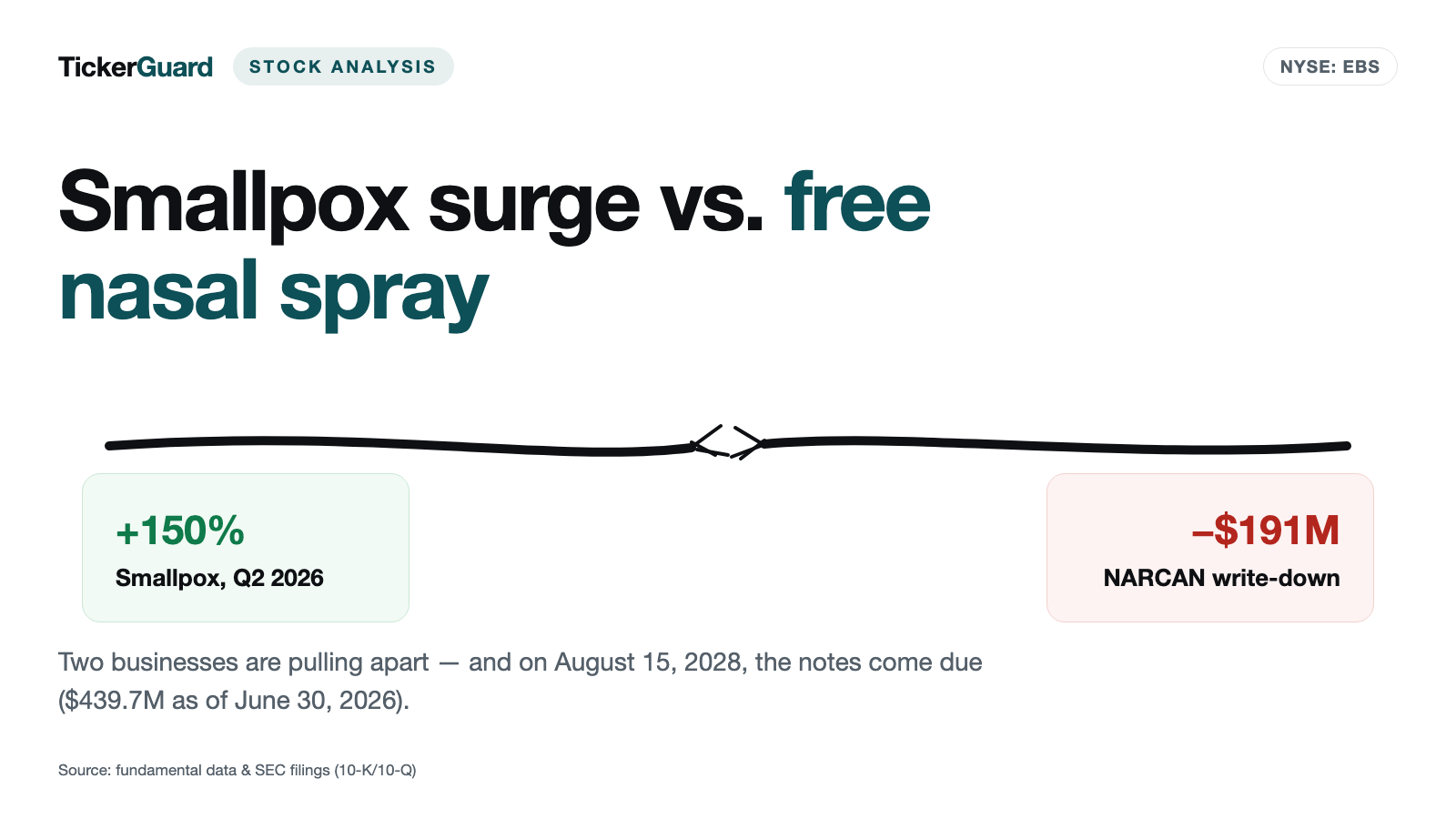
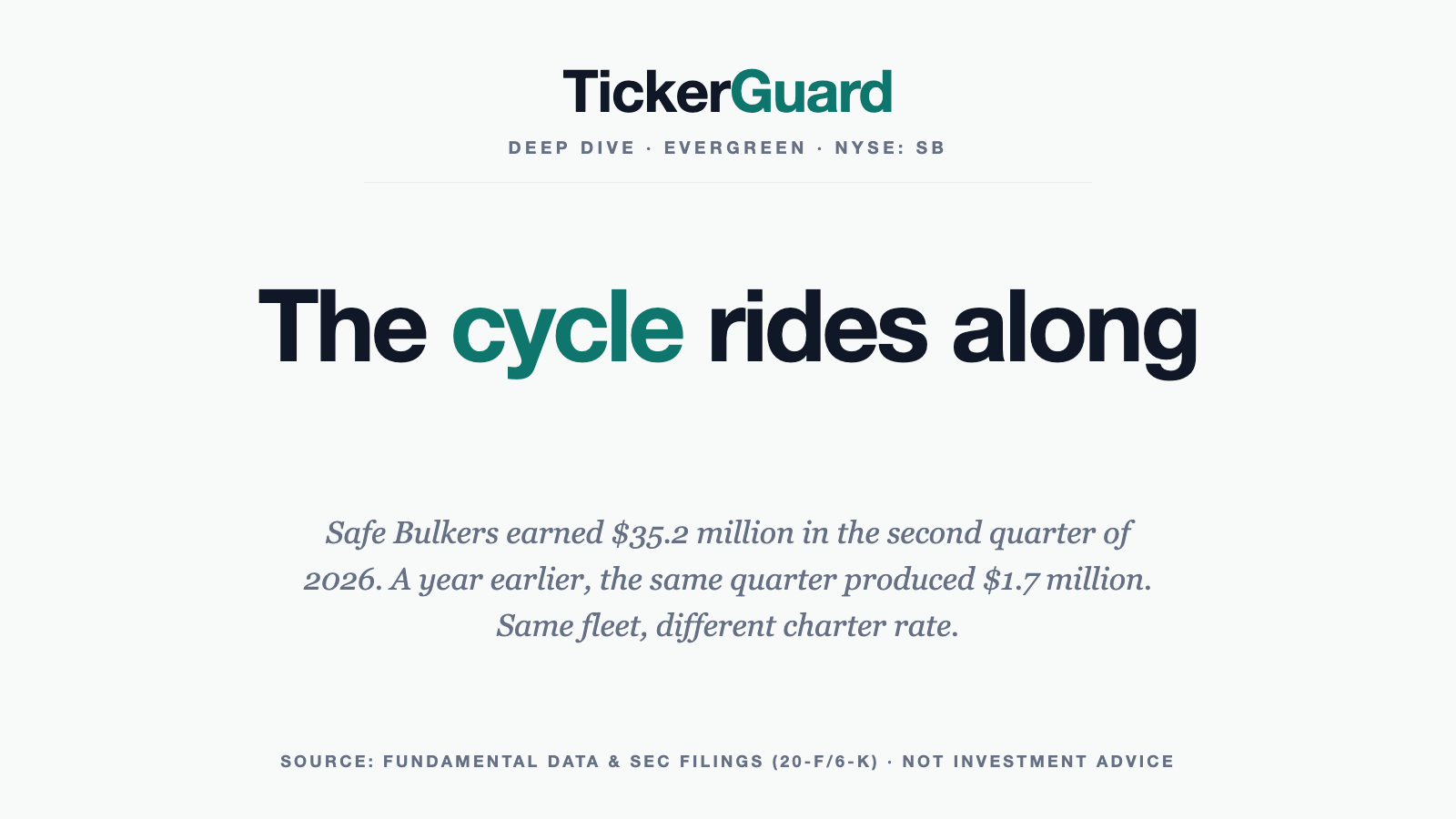
Safe Bulkers, Inc. (NYSE and, since June 2026, Euronext Athens: SB) operates 46 dry bulk carriers hauling grain, coal and iron ore. In the second quarter of 2026 the company earned $35.2 million. A year earlier the same quarter produced $1.7 million. What changed was not the fleet but the price: $20,642 a day per vessel instead of $14,857. The balance sheet is unusually conservative for the industry (leverage of about 30 percent against vessel market values, interest cover of 7.7 times in the first half of 2026) and the dividend was raised to 7.5 cents. Even so, only 10 percent of 2027 ownership days are under contract. Not investment advice — just the plain question of how long the price that produced this profit is going to last.
 Thomas Mücke
Founder & Publisher
Thomas Mücke
Founder & Publisher
As of Today
As of: October 5, 2026
- Closing price
- 8.80 $ -0.70%
- Market Capitalisation
- 0.9 $B
- Growth Score
- 4/10
- AAQS
- 3/10
Price change since August 21, 2026: +3.2%
This analysis has a cut-off date. The Stock Guard tells you when something material changes in the numbers. Reserve your free spot
Chart
Interactive price chart (TradingView).
52-week range: 4.10 $ to 9.20 $ · Last price: 8.80 $ (As of: October 5, 2026)
Note: pure fact-based analysis, not investment advice and not a solicitation to buy or sell. All figures without guarantee.
There is an investor weakness that strikes precisely when the numbers look great: the rear-view reflex. It works like this — you read one strong quarter, your mind draws a line through the last few dots and extends it to the right. "Earned $35 million" quietly becomes "earns $35 million." Safe Bulkers, Inc. (NYSE and, since June 2026, Euronext Athens: SB) is an unusually clean place to watch that reflex at work. The shipping company earned $35.2 million in the second quarter of 2026. In the same quarter a year earlier, with practically the same fleet, it earned $1.7 million. Nothing about the ships changed — only the price somebody pays for a vessel day: $20,642 instead of $14,857. So let us make a deal: we read together what Safe Bulkers told the U.S. securities regulator, the SEC — the annual report on Form 20-F for 2025, filed March 4, 2026, and the interim report on Form 6-K of July 29, 2026 with the figures to June 30, 2026 — and see how long the price that produced this profit is likely to last. You decide for yourself at the end.
What Safe Bulkers actually does — 46 ships and not one employee of its own
Safe Bulkers is a dry bulk shipping company. Its vessels carry everything you can pour rather than pack into a container: grain, coal, iron ore. The business model is, in everyday terms, a rental business. The company owns the ships, crews them and maintains them — and rents them out by the day to commodity traders, steelmakers and utilities. The renter, called the charterer, pays a daily rate and covers fuel, port fees and canal dues itself. So everything hinges on two numbers: what does a ship bring in per day, and what does it cost per day?
As of July 24, 2026 the fleet consisted of 46 vessels, two of which were held for sale: eight Panamax, 14 Kamsarmax, 17 post-Panamax and seven Capesize. The class names only describe size and which canal a ship still fits through — a Panamax is dimensioned for the old Panama Canal locks, a Capesize is too big for them and has to go around the Cape of Good Hope. Together the fleet carries 4.5 million deadweight tons at an average age of 10.4 years. Fourteen ships meet the strictest emission tiers of the International Maritime Organization and were built from 2022 onward; 20 carry exhaust gas scrubbers, including all seven Capesize vessels, which earn extra compensation for them. Ten further newbuilds are on order — nine Kamsarmax, two of them methanol dual-fuel, and one Capesize — with deliveries running from 2026 to 2029.
And now the feature you may need to read twice for a company of this size: Safe Bulkers has no employees of its own, not even its own executives. The annual report puts it plainly:
"Our Managers, pursuant to the terms of the applicable Management Agreements, have historically provided to us our executive officers. For the year ended December 31, 2025, none of the executive officers and senior management were employed directly by us."
— Safe Bulkers, Inc., SEC annual report on Form 20-F for 2025, Item 6.B
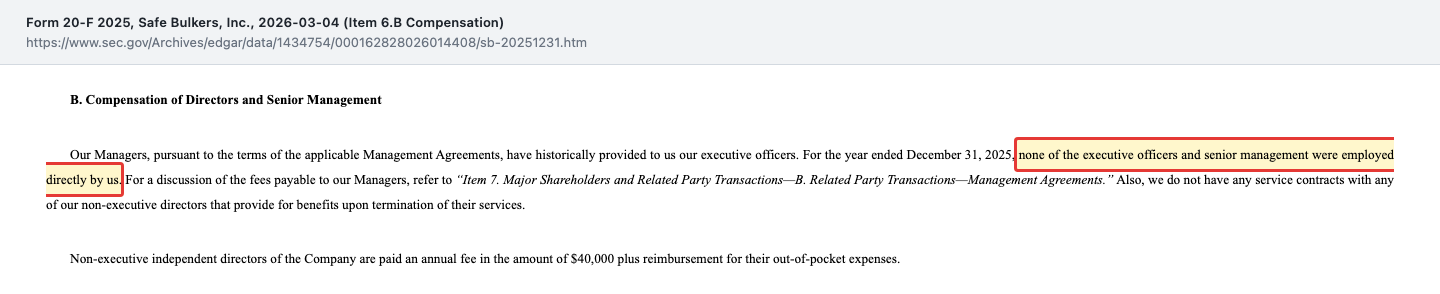
The work is done by three outside companies — Safety Management Overseas S.A., Safe Bulkers Management Monaco Inc. and Safe Bulkers Management Limited — which as of December 31, 2025 had roughly 933 seafarers and 174 shore-based staff on their payrolls. According to the annual report, those managers are controlled by Polys Hajioannou, chief executive and largest shareholder of Safe Bulkers. We will come back to that in detail. It also names the central tension of this analysis, and it runs through every chapter: the balance sheet is about as cautiously managed as a shipping balance sheet can be, and the revenue side is about as unhedged as a revenue side can be left.
Company history for investors
-
2008
Initial public offering on the New York Stock Exchange
Safe Bulkers listed on the NYSE in 2008 — the year the Baltic Dry Index hit its all-time high of 11,793 points. Anyone buying then bought at the top of a cycle.
-
2016
Bottom of the freight cycle
The Baltic Dry Index fell to its all-time low of 290 points in 2016 and net income to a loss of $56.0 million. A year later the books showed a further $84.7 million loss.
-
2021
Best year in company history
With net income of $174.3 million, Safe Bulkers earned more in 2021 than in the eight preceding years combined. The index reached a five-year high of 5,650 points on October 7, 2021.
-
2022
A 100 million euro bond and the return of the dividend
In February 2022 the company issued an unsecured bond at 2.95 percent maturing February 2027; in March 2022 it paid its first quarterly dividend in years, initially 5 cents.
-
2025
Weakest profit year since 2020 — and a new buyback program
Net income fell to $38.6 million, 60 percent below 2024. In December 2025 the board authorized the repurchase of up to 10 million of its own shares.
-
2026
Second listing in Athens and a higher dividend
The common stock has traded on Euronext Athens as well since June 2026. After a quarterly profit of $35.2 million, the dividend was raised to 7.5 cents on July 28, 2026.
How the stock reached our desk
The starting point was a hit from our Reddit hype scanner on August 22, 2026 — an attention signal from investor forums, explicitly not a metric and not a reason to buy. No reliable mention count from a public measurement source was available at the editorial deadline; everything substantive in this analysis comes from the company's SEC filings and ratios derived from them.
Before the first number came the housekeeping, which matters unusually much for this ticker. "SB" on the NYSE is the common stock. Two preferred issues trade on the same exchange, SB.PR.C and SB.PR.D, each carrying a fixed 8.00 percent coupon on a $25 par value. Anyone who reads about an eight percent yield at Safe Bulkers is probably looking at those securities rather than the common. One more thing matters: Safe Bulkers is incorporated in the Republic of the Marshall Islands, is administered from Monaco and therefore counts as a foreign private issuer with the SEC. Such companies file no 10-K and no 10-Q. The annual report arrives on Form 20-F and interim reports on Form 6-K. Accounting is still under U.S. GAAP, and the fiscal year equals the calendar year. Anyone hunting the SEC archive for a quarterly report will not find one — and should not read that as opacity. Similar translation work was needed for other deeply cyclical suppliers, for instance in our analysis of RPC, Inc., where revenue hit a seven-year high in 2025 and less profit was left than in 2021.
The numbers over the years — given their due
First the case for Safe Bulkers, and it is a real one. The company posted a profit in seven of the last ten years. It has paid a dividend every single quarter since March 2022, most recently raised: 5 cents a share in February 2026, 6 cents in June 2026 and 7.5 cents declared on July 28, 2026. It buys back and cancels its own shares. It renews the fleet out of operating cash flow, selling older tonnage into strong markets — in 2026, for example, the 2012-built Michalis H for a gross price of $35.2 million and a $4.1 million book gain — and it keeps operating costs in check: $5,445 per vessel per day in the second quarter of 2026 excluding dry-docking, three percent below the year before. And it is rarely stretched: leverage stood at about 30 percent as of June 30, 2026, measured against the market value of the ships.
Now the curve that explains everything else — net income over ten years:
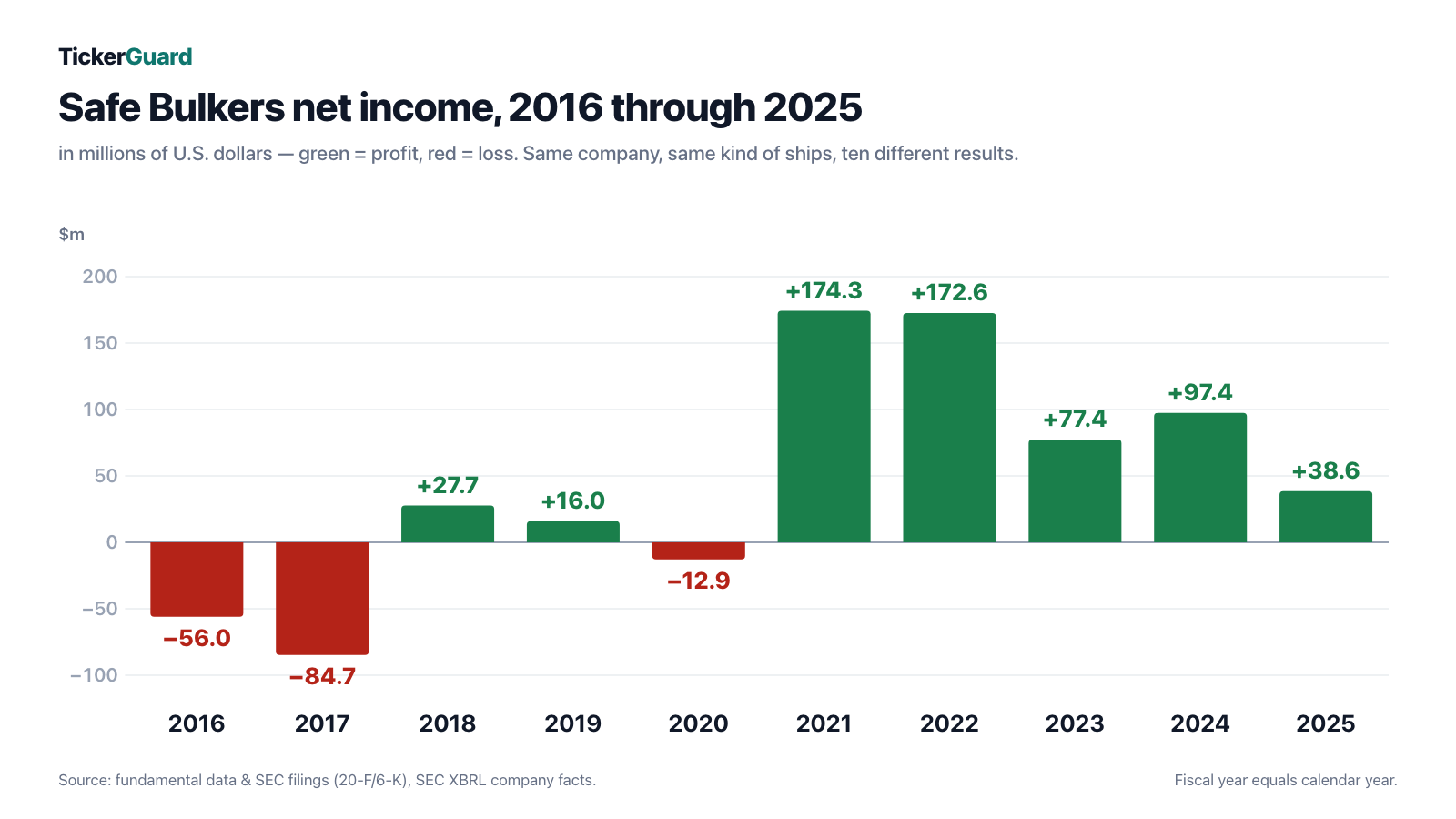
That curve has no trend. It has a rhythm. In 2016 and 2017 Safe Bulkers lost a combined $140.7 million, and another $12.9 million in 2020; in 2021 and 2022 the same company earned a combined $346.9 million. And the latest reading is not a return to a plateau: $38.6 million in 2025 was 60 percent below 2024 ($97.4 million). Only in 2026 did it turn again — the first half brought net income of $57.4 million against $8.9 million a year earlier.
The second chart shows why. It puts the daily rate a ship earns next to the operating cost the same ship incurs that day:
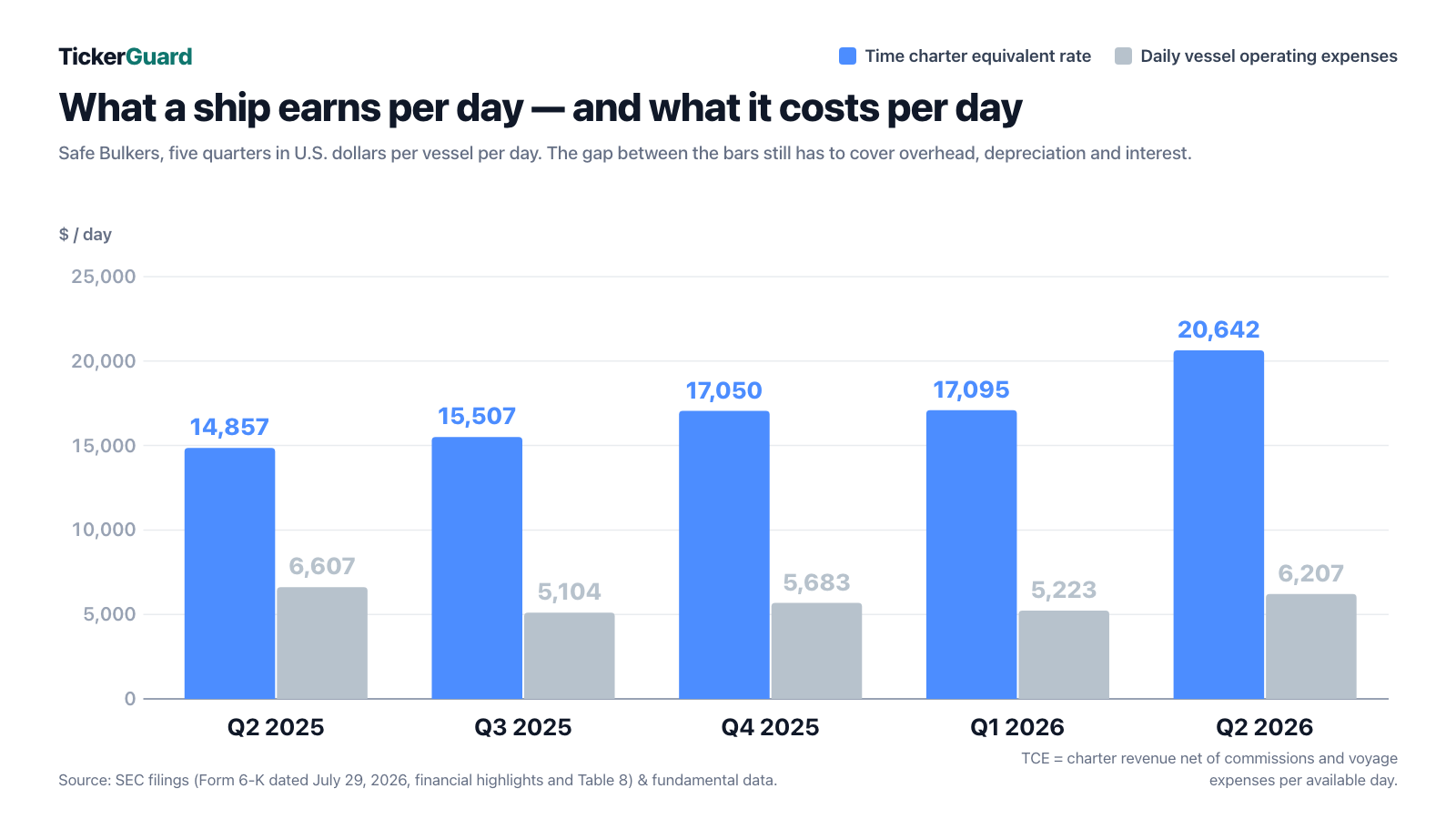
Remember that picture, because it is the heart of the company: management controls the grey side. It does not control the blue side. And because the grey side is fairly rigid, every move in the blue side runs almost unbraked to the bottom line. In the second quarter of 2026 net revenues rose 33 percent to $87.5 million — over the same period operating income rose from $10.5 million to $40.0 million, or 281 percent. That leverage works in both directions.
What the filings say — the uncomfortable truths
Uncomfortable truth No. 1: the forward book lasts barely five months
If price decides earnings, the crucial question is how long the price is locked in. The answer sits in table 1 of the interim report of July 29, 2026, and it is uncomfortable. As of July 24, 2026 the average remaining duration of all charter contracts was 0.4 years — barely five months. Fourteen vessels were employed or contracted to be employed in the spot market, meaning periods of up to three months, and 33 on longer contracts, of which only six originally ran beyond two years — the two figures add up to more than the 46 ships in the fleet because individual vessels move between both forms within the same period.
Looking forward makes it starker. The report states what share of ownership days is already contracted: 79 percent for full-year 2026, 10 percent for 2027 and 3 percent for 2028. Translated: for the year after next, nine out of ten vessel days have no price yet. Contracted revenue amounts to about $164.2 million net — of which $105.4 million comes from the seven Capesize vessels alone, which at an average daily hire of $24,580 and a remaining duration of 1.7 years form the only genuinely secured corner of the fleet.
This is not carelessness but a deliberate bet: staying in the spot market earns more in a rising market and less in a falling one. The company tells its shareholders exactly that, with a bluntness rarely found in quarterly reports:
"The maritime dry bulk shipping industry is inherently volatile and cyclical in nature, subject to significant market fluctuations and geopolitical disruptions … and accordingly, past financial performance should not be considered indicative of, or relied upon as a basis for, future results, projections, or investment decisions."
— Safe Bulkers, Inc., SEC interim report on Form 6-K dated July 29, 2026, section "Market trend information"

How wide the swings can be is shown in the annual report through the Baltic Dry Index, the standard thermometer for freight rates: an all-time high of 11,793 points in 2008 and an all-time low of 290 points in 2016. In 2025 alone the range ran from 715 points on January 30 to 2,845 points on December 3 — a factor of nearly four within one calendar year.
Uncomfortable truth No. 2: the third-largest cost line is addressed to the chief executive's family
Because Safe Bulkers employs nobody itself, it buys in its entire operating management — from three manager companies which the annual report says are controlled by chief executive Polys Hajioannou. The price is in the contract: 950 euros per vessel per day plus an annual fee of 5.0 million euros, plus a commission of 1.0 percent on the price of every vessel bought and sold and a supervision fee of $550,000 per newbuild. That added up to $24.1 million in 2025, after $21.4 million the year before. For comparison, net income in that same year 2025 was $38.6 million. The manager fees therefore equalled roughly 62 percent of net income — and just under nine percent of net revenues.
The decisive sentence sits in the risk factors:
"The management fees are payable whether or not our vessels are employed, and regardless of our profitability, and we have no ability to require our Managers to reduce the management fees if our profitability decreases, which could have a material adverse effect on our business, financial condition and results of operations."
— Safe Bulkers, Inc., SEC annual report on Form 20-F for 2025, Item 3.D Risk Factors
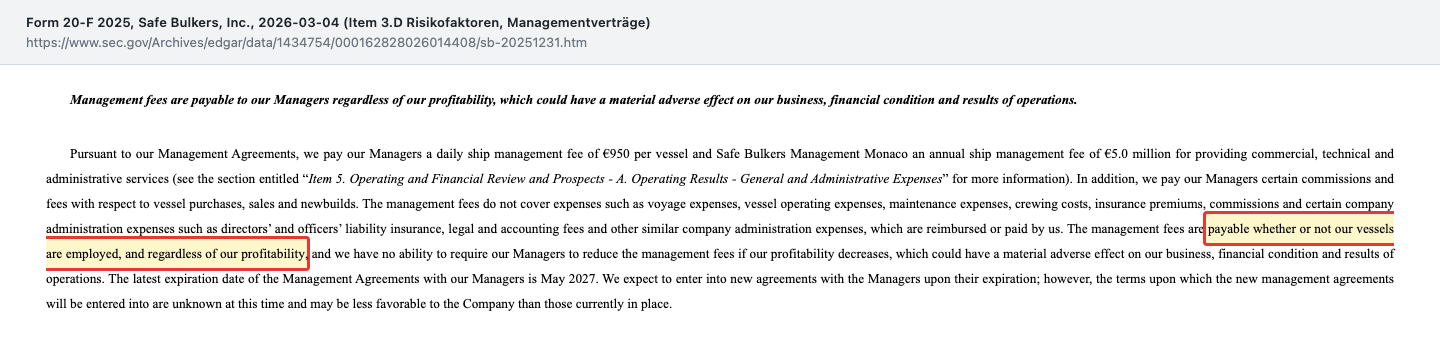
The contract, in other words, knows no bad year. In a cycle where net income swings between a loss of $84.7 million and a profit of $174.3 million, that is a structural advantage for one side and a structural risk for the other. Two further details belong here. First, the management agreements expire on May 29, 2027, and the report says explicitly that the terms of any successor agreements are not yet known and may be less favorable to the company than the current ones. Second, there is a clause worth remembering: if the board changes such that even one member is no longer a "continuing director" under the agreements, the manager may terminate — and the company must then pay it the management fees of the preceding 36 months in cash. At roughly $24 million a year most recently, that is a break fee in the order of $70 million. A hostile bid or a shareholder revolt becomes very expensive.
Fairness demands the counter-argument: external management is the norm rather than the exception in the Greek shipping tradition; the agreements are fully disclosed; and operating performance does not argue against the managers — daily operating expenses per vessel in the first half of 2026 came in at $5,297 excluding dry-docking, five percent below the prior year. You are not buying poor operations here. You are buying operations whose price does not breathe with the cycle.
Uncomfortable truth No. 3: the credit facilities require the family to stay on board
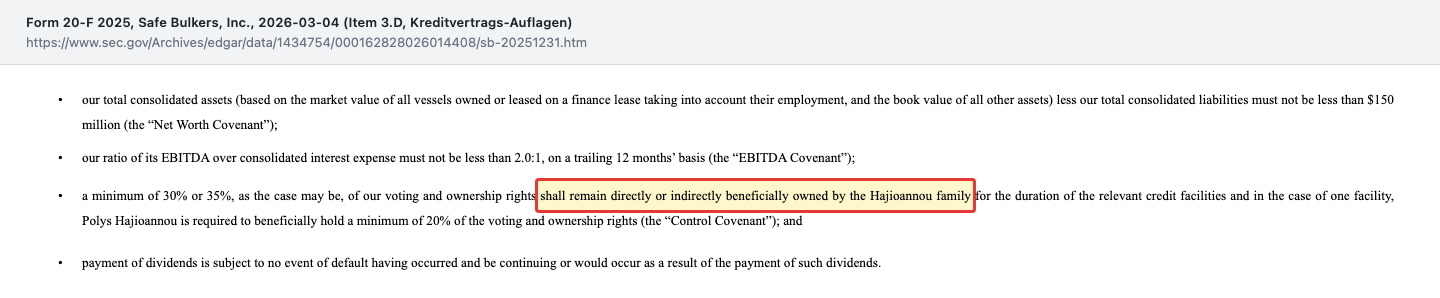
Now to ownership. As of May 15, 2026, six entities owned or controlled by Polys Hajioannou together held 48,381,427 shares, or 47.5 percent of the share capital. On its own that is an ordinary ownership structure. What is unusual is what the credit agreements say. Alongside the customary financial covenants — a net worth of at least $150 million and interest cover of at least 2.0 on a trailing twelve-month basis — the secured facilities require the following:
"a minimum of 30% or 35%, as the case may be, of our voting and ownership rights shall remain directly or indirectly beneficially owned by the Hajioannou family for the duration of the relevant credit facilities and in the case of one facility, Polys Hajioannou is required to beneficially hold a minimum of 20% of the voting and ownership rights (the “Control Covenant”)"
— Safe Bulkers, Inc., SEC annual report on Form 20-F for 2025, Item 3.D, credit facility covenants
In everyday terms: the bank finances the house only as long as the same family lives in it. For you as a shareholder that has two sides. The friendly one: the family cannot simply dump its stake without endangering the financing — the largest shareholder is contractually tied to the company. The unfriendly one: a change of control, a takeover at a premium, an activist wanting to change something — all of that is effectively ruled out. It is reinforced by a shareholder rights plan that triggers at ten percent ownership, with Polys Hajioannou and his brother Nicolaos Hadjioannou expressly excluded. And because Safe Bulkers qualifies as a foreign private issuer, it may opt out of several NYSE governance rules, including the requirement that a majority of the board be independent. After the board was expanded from nine to eleven seats on April 15, 2026, five of the eleven members are classified as independent; the two new members are the independent banker Jeffrey Bunzel and Vassilis Hajioannou.
Uncomfortable truth No. 4: 100 million euros come due in one go in February 2027
A look at the balance sheet shows a shift that is easy to miss. As of December 31, 2025, the current portion of debt was $42.4 million. Six months later, at June 30, 2026, it was $171.6 million — four times as much. The reason is not a new loan but the calendar: the unsecured bond of 100 million euros with a fixed 2.95 percent coupon, issued in February 2022, matures in February 2027 and has therefore moved into current liabilities. In dollars that is $114.1 million; together with scheduled amortization on the secured facilities, $180.4 million falls due in 2027 — more than in any other year of the repayment schedule.
Is that dangerous? On the record, not acutely. Against it stand $142.9 million of cash as of June 30, 2026, including time deposits and restricted cash, and $200.1 million of undrawn committed credit lines; as of July 24, 2026 the figures were $153.2 million and $204.5 million. Two vessels are debt-free, nine newbuilds can be financed upon delivery, and the two vessels held for sale will bring in $27.5 million gross. Interest cover in the first half of 2026 was 7.7 times (EBITDA of $97.0 million against $12.6 million of interest expense), far above the contractual floor of 2.0. But a 2.95 percent loan from 2022 will not be replaced at 2.95 percent in 2027. The company's weighted average interest rate was already 5.10 percent in the second quarter of 2026. In parallel, $277.2 million of remaining payments are due on the nine undelivered newbuilds, $61.4 million of it in 2026 and $81.5 million in 2027. The flexibility today's balance sheet shows already has appointments in 2027.
Valuation: a little above book value, well below ship value
The dated valuation anchor is the closing price of August 21, 2026: $8.53. With 101,833,473 shares outstanding as of July 24, 2026 that gives a market capitalization of roughly $868.6 million — effectively identical to the figure from fundamental data. Against net income of about $87 million over the last twelve reported months, $8 million of which goes to the preferred holders, that is a price-to-earnings ratio of about eleven. It sounds moderate — but for a cyclical company it is the least reliable metric of all: at the top of the cycle a P/E of eight looks cheap and is not, and at the bottom there is no P/E at all.
The more honest yardstick is substance, and there are two readings of it. The book value reading: reported shareholders equity was $870.3 million as of June 30, 2026. Of that, $100.0 million belongs to the preferred holders (4,000,000 shares with a $25 liquidation preference each), leaving roughly $770 million for the common — about $7.56 a share. At the anchor price that is 1.13 times book.
The ship value reading arrives somewhere else, and it comes from a disclosure of the company itself. Safe Bulkers puts its leverage at "approximately 30 percent," measured against a total asset base in which the vessels are carried not at book value but at the market valuations of independent ship brokers at quarter end. The liabilities are known: $558.9 million. Working backwards gives total assets at market value of roughly $1.86 billion — a good $430 million above the balance sheet carrying amount. After deducting debt and the preferred capital, a net asset value of roughly $11 to $12.50 per common share would remain. That range is deliberately wide, because the whole calculation hangs on the rounding to "approximately 30 percent": at 31 percent the result sits at the lower end, at 29 percent at the upper one. What is reliable is not the point estimate but the direction — the stock trades below what the ships are likely worth in the market. That is not unusual for shipping companies; it is the customary discount for cyclicality and outside control. We saw a comparable gap between substance and price in our analysis of Smart Sand, where five years of revenue records likewise did not translate into a valuation premium.
Two further reference points round out the picture. First, scrap value: the report puts it at $313.6 million for the fleet excluding the vessels held for sale. Net debt per vessel was $8.0 million, or $368.5 million in total — so the steel alone covers roughly 85 percent of it. Even in a disaster scenario this balance sheet would not face a hole. Second, the payout: annualized, 7.5 cents a quarter is 30 cents, which at the anchor price is about 3.5 percent. That number is not a promise, though — the board decides afresh every quarter, and in the lean years from 2016 to 2021 there was no common dividend at all. Anyone buying the yield here buys the cycle with it. Analyst coverage is thin: as of August 21, 2026 the fundamental data set records just two ratings with an average price target of $8.50 — essentially the anchor price itself.
Opportunities and risks at a glance
What speaks for Safe Bulkers:
- A solid balance sheet by shipping standards: $870.3 million of shareholders equity, leverage of about 30 percent against vessel market values, interest cover of 7.7 times in the first half of 2026 against a contractual floor of 2.0, plus $142.9 million of cash and $200.1 million of undrawn committed lines as of June 30, 2026.
- A modern, systematically renewed fleet: average age 10.4 years, 14 vessels meeting the strictest IMO emission tiers and built from 2022 onward, 20 vessels with scrubbers including all Capesize, ten newbuilds on order and 25 vessels environmentally upgraded as of July 24, 2026.
- Full cyclical leverage to the upside: because 90 percent of 2027 ownership days are open, a rising charter rate flows through almost unbraked — in the second quarter of 2026, 33 percent more net revenues turned into 281 percent more operating income.
- Capital return is running: a dividend in every quarter since March 2022, most recently raised to 7.5 cents declared July 28, 2026, plus a buyback program of up to 10 million shares since December 2025, from which 515,469 shares had been cancelled by July 24, 2026.
- A substance discount: at an anchor price of $8.53 (August 21, 2026) the stock sits at 1.13 times the common book value of $7.56 — and clearly below the net asset value of roughly $11 to $12.50 derived from the market value of the vessels.
What speaks against it:
- Earnings are not plannable: net income between 2016 and 2025 ranged from a loss of $84.7 million to a profit of $174.3 million, and 2025 alone fell 60 percent to $38.6 million. The Baltic Dry Index moved between 715 and 2,845 points in 2025.
- Almost no downside protection: the average remaining duration of charter contracts was 0.4 years as of July 24, 2026, with only 10 percent of 2027 ownership days and 3 percent of 2028 ownership days contracted.
- Fixed management fees payable to a counterparty controlled by the chief executive: $24.1 million in 2025 against $38.6 million of net income, payable regardless of employment and profitability. The agreements expire on May 29, 2027 and the successor terms are open.
- A control structure with no exit: 47.5 percent in family hands, a credit covenant enforcing 30 to 35 percent family ownership, a rights plan that exempts the Hajioannou brothers, governance carve-outs as a foreign private issuer, and a break fee of 36 months of management fees on a board change.
- The 2027 calendar: $180.4 million of repayments including the 100 million euro bond at 2.95 percent maturing in February 2027, which will not be replaced on the same terms at today's rates (the weighted average was most recently 5.10 percent), plus $81.5 million of remaining newbuild payments.
A human conclusion
Back to the rear-view reflex. Its core is not that the number in the mirror is wrong — $35.2 million in the second quarter of 2026 is real, audited by the market and there to be read. Its core is that we mistake a snapshot for a condition. Safe Bulkers does not even make it hard: the company writes into its own report that you should not extrapolate from the past, and it discloses in the same table that only ten percent of 2027 vessel days carry a price. Whoever buys this stock buys a well-run, conservatively financed, modern fleet — and, unavoidably, a bet on the freight market of the coming years, garnished with an operating management whose invoice arrives even when the ships sit idle.
So the honest question is not "was that a good quarter?" — it plainly was. The question is: can you hold a company whose most important number nobody inside the company sets, and will you still be on board when the same fleet posts a $56 million loss again, as it did in 2016? If yes, you have a thesis and a time horizon. If no, you had a good quarter. What you make of that is your decision. And that is exactly as it should be.
Sources
Every original document used in this analysis, for you to read yourself:
- Safe Bulkers, Inc. — SEC interim report on Form 6-K dated July 29, 2026 (results to June 30, 2026, tables 1 through 9)
- Safe Bulkers, Inc. — SEC annual report on Form 20-F for 2025 (filed March 4, 2026)
- Safe Bulkers, Inc. — SEC annual report on Form 20-F for 2024 (filed March 10, 2025)
- Safe Bulkers, Inc. — SEC interim report on Form 6-K dated June 18, 2026 (first quarter 2026 results)
- Safe Bulkers, Inc. — SEC interim report on Form 6-K dated April 16, 2026 (board expanded to eleven seats)
- Vorini Holdings Inc. and others — SEC ownership filing Schedule 13D/A No. 7 dated May 18, 2026
- Complete SEC filing history of Safe Bulkers, Inc.: EDGAR overview (sec.gov)
- Fundamental data (price, market capitalization, valuation ratios, analyst ratings; data as of August 21, 2026), reconciled with the SEC filings and the SEC XBRL company facts.
- Trigger: the editorial Reddit hype scanner, run of August 22, 2026; accessed through our in-house stock scanner.
Transparency and disclaimer: this analysis is journalistic commentary on publicly available information. It is not investment advice, not a regulated financial analysis and not a solicitation to buy or sell securities. Equity investments carry substantial risk up to and including total loss. All figures are provided without warranty; the as-of date is noted in the text. Positions held by the operator are disclosed daily; where one exists, it appears as a notice at the top of this deep dive.
Key figures at a glance
All monetary figures in millions of $; earnings per share as reported.
| Metric | 2021 | 2022 | 2023 | 2024 | 2025 |
|---|---|---|---|---|---|
| Revenue | 329.0 | 349.7 | 284.4 | 307.6 | 275.7 |
| Operating Income (EBIT) | 172.4 | 184.6 | 93.8 | 111.9 | 69.2 |
| Net Income | 174.3 | 172.6 | 77.4 | 97.4 | 38.6 |
| Net Margin | 53.0% | 49.3% | 27.2% | 31.7% | 14.0% |
| Earnings Per Share | 1.53 $ | 1.43 $ | 0.68 $ | 0.91 $ | 0.37 $ |
Source: fundamental data & SEC filings (annual and quarterly reports, 10-K/10-Q)
Our Bottom Line at a Glance
- Balance sheet and financing positive
- As of June 30, 2026 the books showed $870.3 million of shareholders equity, $142.9 million of cash and $200.1 million of undrawn committed credit lines; leverage stood at about 30 percent of vessel market values and interest cover at 7.7 times in the first half of 2026, against a contractual floor of 2.0. Even the pure scrap value of the fleet ($313.6 million) covers roughly 85 percent of net debt of $368.5 million.
- Fleet and operations positive
- Average age 10.4 years as of July 24, 2026, 14 vessels meeting the strictest IMO emission tiers and built from 2022 onward, 20 with scrubbers, ten newbuilds on order and 25 vessels upgraded. Daily operating expenses per vessel excluding dry-docking fell five percent to $5,297 in the first half of 2026.
- Earnings quality and predictability negative
- Net income swung between a loss of $84.7 million and a profit of $174.3 million from 2016 to 2025, and fell 60 percent to $38.6 million in 2025 alone. As of July 24, 2026 the average remaining duration of charter contracts was 0.4 years; 10 percent of 2027 ownership days were contracted and 3 percent of 2028.
- Cost structure of the operating management negative
- The company employs nobody itself and paid $24.1 million of management fees in 2025 (2024: $21.4 million) to three entities controlled by the chief executive — roughly 62 percent of net income. Per the annual report the fee is payable regardless of employment and profitability; the agreements end on May 29, 2027 and the successor terms are open.
- Ownership and governance negative
- The Hajioannou family held 47.5 percent as of May 15, 2026; the credit facilities permanently require 30 to 35 percent family ownership, a rights plan triggering at ten percent expressly exempts the Hajioannou brothers, and as a foreign private issuer the company may opt out of the NYSE requirement for a majority-independent board. A change of control is effectively ruled out.
- Valuation and capital return neutral
- At the anchor price of $8.53 (August 21, 2026) market capitalization is about $868.6 million, the twelve-month price-to-earnings ratio about eleven and the price 1.13 times the common book value of $7.56 — arithmetically below the net asset value of roughly $11 to $12.50 derived from vessel market values. A dividend has been paid every quarter since March 2022, most recently 7.5 cents.
Safe Bulkers runs 46 dry bulk carriers on a balance sheet that is conservative by industry standards: leverage of about 30 percent against vessel market values, interest cover of 7.7 times in the first half of 2026 and a dividend in every quarter since March 2022. Earnings remain unplannable all the same, because they hang almost entirely on the charter rate: $35.2 million of quarterly profit in the second quarter of 2026 after $1.7 million a year earlier, and a ten-year range from a loss of $84.7 million to a profit of $174.3 million. Little of that is hedged — the average remaining charter duration was 0.4 years and only 10 percent of 2027 ownership days were contracted. On top of that come $24.1 million of fixed management fees payable to a counterparty controlled by the chief executive and a credit covenant that writes family control into the loan documents. Not investment advice.
What Our Rating Means
Open questions
The business works in principle, but one material question is open. As long as it stays open, our findings do not carry a quality verdict.
Yellow, and because of an operating question rather than the share price. Nothing points to red: there is no going concern warning, shareholders equity is positive and grew in the first half of 2026 to $870.3 million, interest cover of 7.7 times sits far above the contractual floor of 2.0, and $142.9 million of cash plus $200.1 million of undrawn committed lines stand against a fleet scrap value of $313.6 million that almost covers net debt on its own. What is missing for green is reliability of earning power: net income swung between a loss of $84.7 million and a profit of $174.3 million over ten years on a fleet that has barely changed, and the company has deliberately left that swing unhedged — the average remaining charter duration was 0.4 years as of July 24, 2026 and only 10 percent of 2027 ownership days were contracted. Alongside it sits a cost line that does not breathe: $24.1 million of management fees in 2025 to a counterparty controlled by the chief executive, payable in loss-making years too, with the contract renewal in May 2027 still open. That is not a threat to the substance of the business but an open operating question — and between two levels the more cautious one applies. Whether the stock is expensive or cheap at this price deliberately plays no part in this rating. The decision is yours.
A journalistic assessment by our editorial team at the time of the deep dive, based on public sources — not investment advice and not a solicitation to buy or sell. Your personal circumstances (investment goals, risk capacity, taxes) cannot be taken into account. What our levels mean, how verdicts are formed, and what conflicts of interest exist →
Worth Noting
- The trigger was a hit from our Reddit hype scanner on August 22, 2026. No reliable mention count from a public measurement source was available at the editorial deadline; everything substantive in this analysis comes from the company SEC filings and ratios derived from them.
- Safe Bulkers is a foreign private issuer incorporated under the law of the Marshall Islands and therefore files no 10-K and no 10-Q. This analysis rests on the annual report on Form 20-F for 2025 (filed March 4, 2026), the interim report on Form 6-K of July 29, 2026 with the figures to June 30, 2026, and further Form 6-K filings from 2026. Accounting is under U.S. GAAP in U.S. dollars and the fiscal year equals the calendar year.
- Easy to confuse: three securities trade under the same name on the NYSE — the common stock SB and the preferred shares SB.PR.C and SB.PR.D, each carrying a fixed 8.00 percent coupon on a $25 par value. An eight percent yield refers to the preferred shares, not the common stock. Since June 2026 the common stock has also traded on Euronext Athens under the same symbol (ISIN MHY7388L1039).
- Valuation data dated and evergreen: the price anchor of $8.53 is the close of August 21, 2026; multiplied by 101,833,473 shares (as of July 24, 2026) it gives $868.6 million and matches the market capitalization from fundamental data. The derived net asset value of roughly $11 to $12.50 a share is our own back-calculation from the company disclosure of leverage at around 30 percent of vessel market values and reacts sensitively to that rounding — it is an order of magnitude, not a price target.
Stock Watch
This analysis is as of August 26, 2026. Stock Watch will tell you what's changed at SB since then.
Later $1 a month per stock — signing up is free, and you'll be the first to know when it launches.
The full analysis as a PDF for later
We will send you this analysis as a PDF — to print, file away, and read at your own pace. And we will add you to the free Stock Watch list for Safe Bulkers Inc (SB), so you hear about it when something material in this analysis changes.
Frequently Asked Questions
Safe Bulkers, Inc. (NYSE: SB) is a dry bulk shipping company administered from Monaco and incorporated in the Republic of the Marshall Islands. Its vessels carry mainly grain, coal and iron ore. As of July 24, 2026 the fleet comprised 46 ships — eight Panamax, 14 Kamsarmax, 17 post-Panamax and seven Capesize — with 4.5 million deadweight tons of capacity and an average age of 10.4 years. Ten further newbuilds are on order through 2029.
Because earnings depend almost entirely on a charter rate the company cannot influence. Daily operating expenses per vessel ranged between $5,104 and $6,607 across five quarters, while the daily charter rate rose from $14,857 to $20,642. Across ten years net income therefore runs from a loss of $84.7 million (2017) to a profit of $174.3 million (2021); 2025 came in at $38.6 million, 60 percent below 2024.
The board declared a quarterly dividend of 7.5 cents per common share on July 28, 2026, payable August 26, 2026. It had previously paid 6 cents (June 2026) and 5 cents (February 2026). Annualized, 7.5 cents a quarter is 30 cents, or about 3.5 percent at the anchor price of $8.53 from August 21, 2026. That is not a commitment: between 2016 and 2021 the company paid no common dividend at all.
As of May 15, 2026, six entities owned or controlled by chief executive Polys Hajioannou together held 48,381,427 shares, or 47.5 percent (SEC filing Schedule 13D/A No. 7). The credit facilities additionally require that at least 30 or 35 percent of the voting and ownership rights remain with the Hajioannou family, and under one facility Polys Hajioannou must personally hold at least 20 percent.
Because the company is incorporated under the law of the Marshall Islands and therefore counts as a foreign private issuer with the U.S. securities regulator, the SEC. Such companies file an annual report on Form 20-F instead of a 10-K, and interim reports on Form 6-K instead of quarterly reports on 10-Q. Accounting is nonetheless under U.S. GAAP in U.S. dollars, and the fiscal year equals the calendar year.
As of June 30, 2026 gross debt before deferred financing costs was $519.2 million, of which $405.1 million was secured and $114.1 million unsecured. Against it stood $142.9 million of cash and $200.1 million of undrawn credit lines. The current portion rose from $42.4 million to $171.6 million because the unsecured bond of 100 million euros at 2.95 percent, issued in February 2022, matures in February 2027.
At the anchor price of $8.53 (August 21, 2026) and 101,833,473 shares, market capitalization is about $868.6 million and the price-to-earnings ratio on the last twelve reported months is roughly eleven. Book value per common share is about $7.56; from the company's own disclosure of leverage at around 30 percent of vessel market values, a net asset value of roughly $11 to $12.50 can be derived. For a cyclical shipping company, such metrics depend heavily on when you take the reading.
Found an error?
Did you spot a factual error, an outdated number, or a typo in this deep dive? Let us know briefly — your report goes straight to the editorial team.