RPC, Inc.: Revenue Hit a Seven-Year High in 2025 — and Less Profit Was Left Than in 2021
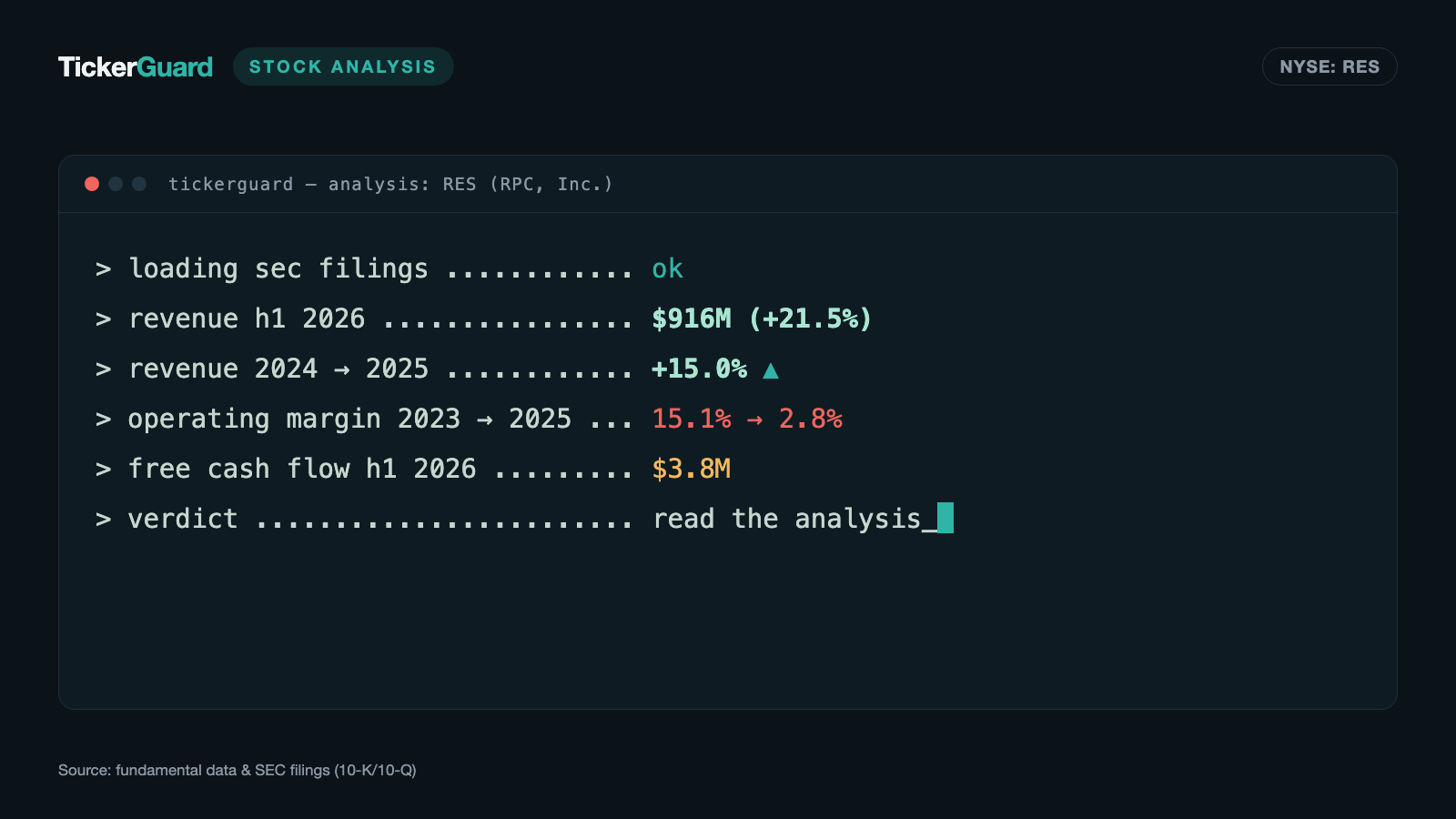
RPC, Inc. pumps, cements and perforates oil and gas wells across Texas, Oklahoma and Appalachia, and in 2025 it booked $1,626.6 million of revenue, its highest since 2018. The catch: 2023 produced almost exactly the same revenue and left $245.0 million of operating income. In 2025 that number was $44.7 million. Revenue then rose another 21.5 percent in the first half of 2026 while operating income fell 37.7 percent. The balance sheet, meanwhile, is spotless — $1.1 billion of equity, $179.5 million of cash and nothing drawn on the credit facility. No recommendation here, just one question: how long can a company look robust while its earning power quietly disappears?
 Thomas Mücke
Founder & Publisher
Thomas Mücke
Founder & Publisher
As of Today
As of: October 5, 2026
- Closing price
- 6.10 $ +4.10%
- Market Capitalisation
- 1.4 $B
- P/E
- 64.1
- Growth Score
- 4/10
- AAQS
- 5/10
Price change since August 21, 2026: -4.2%
This analysis has a cut-off date. The Stock Guard tells you when something material changes in the numbers. Reserve your free spot
Chart
Interactive price chart (TradingView).
52-week range: 4.20 $ to 8.00 $ · Last price: 6.10 $ (As of: October 5, 2026)
Note: pure fact-based analysis, not investment advice and not a solicitation to buy or sell. All figures without guarantee.
There is an investor weakness that feels like plain common sense, which is exactly why it works so well: the size trap. We read "a historic high" and hear "the company is making money again." We watch a revenue line climb and draw the profit line in our heads without ever having seen it. That is not a beginner's mistake. It is the natural shortcut of a brain that would rather finish a good story than sit with an unfinished one.
RPC, Inc. lets you check that shortcut unusually cleanly, because the company delivered two nearly identical years — 2023 and 2025 — while being two completely different businesses. We will read it together here: the annual report, the quarterly report, the earnings release. What comes out at the end is not a recommendation but a single question you have to answer for yourself.
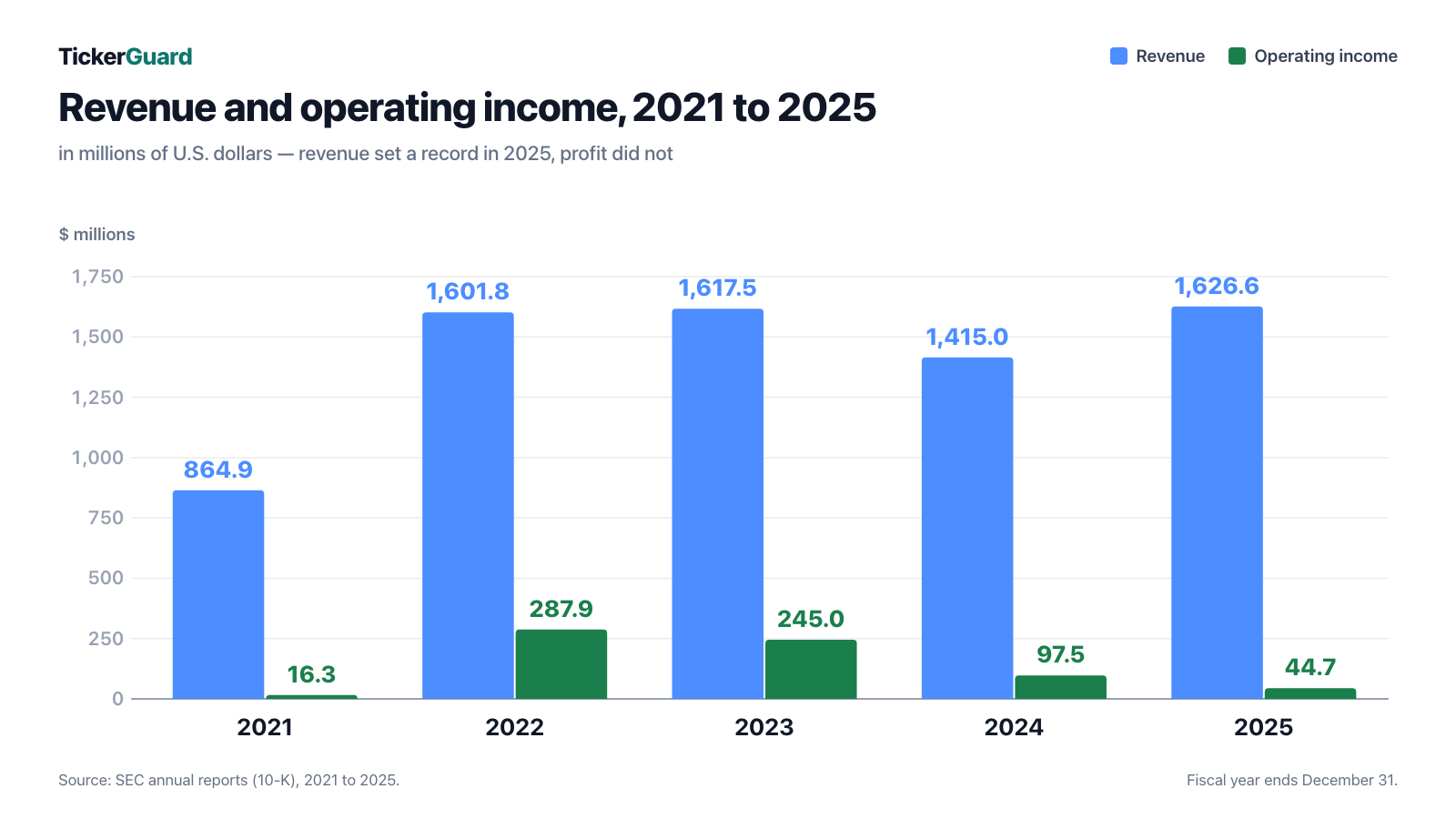
That sets up the tension running through this analysis: a balance sheet that could hardly be healthier carries a business whose earning power has all but vanished since 2022. Both statements are true, both are documented, and each one leads to a completely different investment case.
What RPC Actually Does
RPC, Inc. does not produce oil. That is the first thing to grasp, because it explains nearly everything else. The company is a Delaware corporation headquartered in Atlanta, Georgia, and it is a holding company over five service brands: Cudd Energy Services, Cudd Pressure Control, Thru Tubing Solutions, Pintail Completions and Patterson Services. What those businesses do translates easily into plain language.
A producer has drilled a hole in the ground. For anything to come out of it, the rock at the bottom has to be fractured. RPC pumps water, sand and chemicals down there under enormous pressure — that is pressure pumping, the largest single line at $485.0 million of revenue in 2025. To keep the well sealed, the space between the casing and the rock is filled with cement (cementing, $54.8 million in the first half of 2026). To put holes in the steel casing at exactly the right depth, a wireline tool travels down and fires charges (wireline). And when a well jams, sticks or goes out of control, Cudd Pressure Control shows up with coiled tubing, nitrogen and specialist gear.
So the sentence that matters most to investors is this: RPC does not earn from the oil price, it earns from producers' capital budgets. If the oil price rises but producers keep their spending disciplined and flat, RPC sees none of it. That is precisely what the quarterly report for the period ended June 30, 2026 describes: the average oil price in the second quarter of 2026 was $96.54 per barrel, 49.1 percent above the prior-year quarter — yet the average U.S. rig count was 554, or 3.0 percent lower (sources named in the report: Baker Hughes and the U.S. Energy Information Administration). If you want the other side of that trade, the producers themselves, our analysis of Range Resources gives the contrast; for a direct competitor in the same market conditions, see our analysis of Liberty Energy.
Structurally RPC splits into two segments: Technical Services (work at the wellsite, $872.4 million of revenue in the first half of 2026) and Support Services (pipe rental, inspection, storage, $43.2 million). International work is a footnote at 1.7 percent of revenue in the first half of 2026. The company employed 2,893 people as of December 31, 2025.
Company history for investors
-
2021
The trough after the demand collapse
Revenue of $864.9 million produced $16.3 million of operating income. Anyone buying then bought a company with no earnings — but also with no debt.
-
2022
The best year: an 18.0 percent operating margin
Revenue of $1,601.8 million and operating income of $287.9 million. That figure remains the benchmark against which every later year has to be measured.
-
2025
April 1: Pintail for $245 million
The acquisition brought the wireline service line and 4,545,454 new shares for the sellers. It explains the 2025 revenue jump — and part of the higher depreciation.
-
2025
Highest revenue since 2018, residual profit
Revenue of $1,626.6 million, the most since 2018 — operating income of $44.7 million. For shareholders the decade's most important lesson: size does not protect the margin.
-
2026
June 16: the chief executive steps back
Ben M. Palmer announces his retirement after 30 years, effective no later than December 31, 2026. No successor had been named as of the August 22, 2026 cut-off.
-
2026
July 30: a half year with $3.8 million of free cash flow
Revenue up 21.5 percent, operating income down 37.7 percent. The same day, the board declares the quarterly dividend of $0.04 unchanged.
How This Stock Landed on Our Desk
The starting point was a hit in our editorial Reddit hype scanner on August 22, 2026 — an attention signal from investor forums, not a financial metric. Before that could become an analysis, one piece of homework had to come first, and with this particular stock it matters more than with almost any other: verifying the identity.
"RES" is a three-letter ticker, and it sounds like "Resources." There are indeed half a dozen U.S.-listed companies you could confuse it with — RGC Resources, Range Resources, EOG Resources, Solaris Resources. Price databases and forums mix such tickers up routinely. What settles it is not a name in a database but the registration held by the U.S. securities regulator, the SEC. There, identifier CIK 0000742278 carries exactly one ticker ("RES") and exactly one exchange ("NYSE"), and the name attached to it is RPC, Inc. The only former name, RPC Energy Services, Inc., was dropped in 1995. There is no deregistration (Form 15), no delisting (Form 25) and no move to over-the-counter trading.
Keep that step in mind — it costs two minutes and spares you embarrassing mistakes: a ticker is a label, a CIK number is an identity. Only then does the real work begin, and with RPC it begins with a run of numbers you have to read twice.
The Numbers Over the Years, Fairly Told
Start with what genuinely impresses. RPC came through 2020 and 2021, two years that pushed half the industry into bankruptcy: 2020 produced an operating loss of $309.6 million, and in 2021 revenue of $864.9 million left just $16.3 million of operating income. RPC emerged from that stretch without an equity raise, without a distressed sale and without bank debt. In this business that is an achievement, not a given.
Then came the recovery, and it was violent. Revenue jumped to $1,601.8 million in 2022 and operating income to $287.9 million — an operating margin of 18.0 percent. 2023 was nearly as good: $1,617.5 million of revenue, $245.0 million of operating income, a 15.1 percent margin. Net income reached $195.1 million, or $0.90 per diluted share.
Now the second half of the run. In 2024 revenue fell to $1,415.0 million and operating income to $97.5 million, a 6.9 percent margin. In 2025 revenue rose again — to $1,626.6 million, up 15.0 percent and the highest level since 2018. Operating income did not follow. It fell further, to $44.7 million. Margin: 2.8 percent. Net income was $32.1 million, or $0.15 per diluted share.
Which leaves the number everything else turns on: 2023 and 2025 differ by $9.1 million in revenue — and by $200.2 million in operating income. In plain terms: a contractor writes almost identical invoices in both years but keeps 15 cents on the dollar in the first and barely 3 cents in the second. Revenue is not the problem.
The first half of 2026 continues the pattern, only faster. Revenue rose 21.5 percent to $915.6 million, mainly because Pintail (more on that shortly) counted for a full six months for the first time. Operating income fell 37.7 percent to $17.4 million. Operating margin: 1.9 percent. Net income halved to $12.9 million.
Uncomfortable Truth No. 1: Highest Revenue Since 2018, Residual Profit
Why does RPC earn almost nothing on nearly the same revenue? The answer is not in an analyst note but in the company's own quarterly report, and it is unusually blunt:
"Management believes the oilfield services completion market continues to be over-supplied and efficiency gains are contributing to excess capacity in the industry."
— RPC, Inc., Form 10-Q for the period ended June 30, 2026, "Results of Operations"
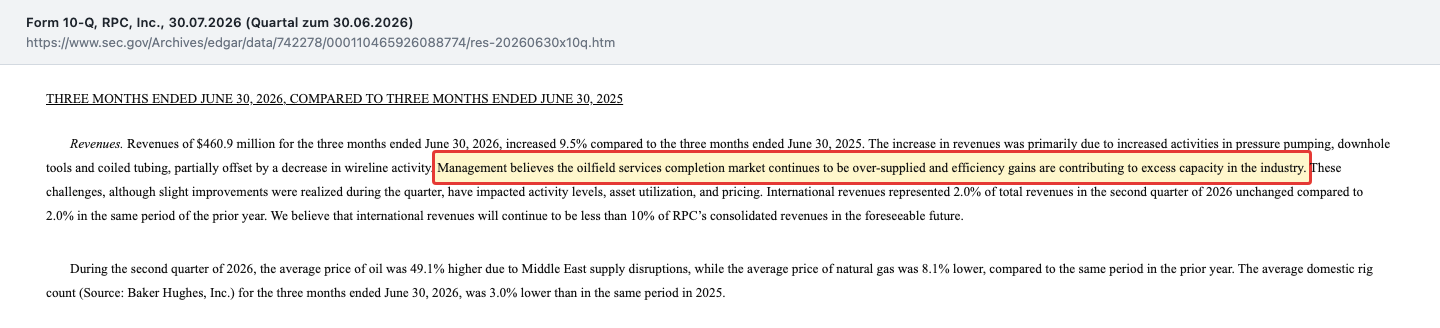
Translated: there are too many pumps chasing too few wells, and producers keep getting more efficient — they need fewer jobs for the same output. In a market like that, the customer sets the price, not the supplier. You can see it in the numbers: in the first half of 2026 cost of revenues rose 24.9 percent to $701.3 million while revenue rose only 21.5 percent. Costs are outrunning the top line.
Two more items add to the pressure. Depreciation and amortization rose 10.1 percent to $85.8 million in the first half of 2026, a consequence of the Pintail acquisition and prior-year capital spending ($219.9 million in 2024 alone). And the income statement carries its own line of $14.6 million labeled "acquisition related employment costs." Those are not cash payments but accounting accruals from the Pintail purchase, tied to certain employees staying and amortized over three years. They weigh on reported earnings but not on cash — and they are excluded from adjusted EBITDA of $119.5 million.
To be fair: the margin falls on an adjusted basis too. Adjusted EBITDA was 13.0 percent of revenue in the first half of 2026, against 14.6 percent a year earlier. And the second quarter of 2026 did improve on a weak first quarter: 14.3 percent after 11.8 percent, with Technical Services segment operating income of $27.6 million after $16.0 million. The release itself speaks of "reasons for optimism with some improved pricing and activity visibility." One quarter is not a trend, though — 2024 produced interim recoveries of that kind as well.
Uncomfortable Truth No. 2: The Dividend Comes Out of the Cash Box
RPC has paid a quarterly dividend of $0.04 per share for years. That sounds small, but on 221,657,012 shares it is roughly $35 million a year. And that sum is now larger than what the business leaves over in free cash.
Free cash flow — the money left after all investment in the company's own equipment — was $3.770 million in the first half of 2026. Dividends paid in the same period were $17.729 million. That is 4.7 times as much. Cash fell accordingly, from $210.0 million to $179.5 million.
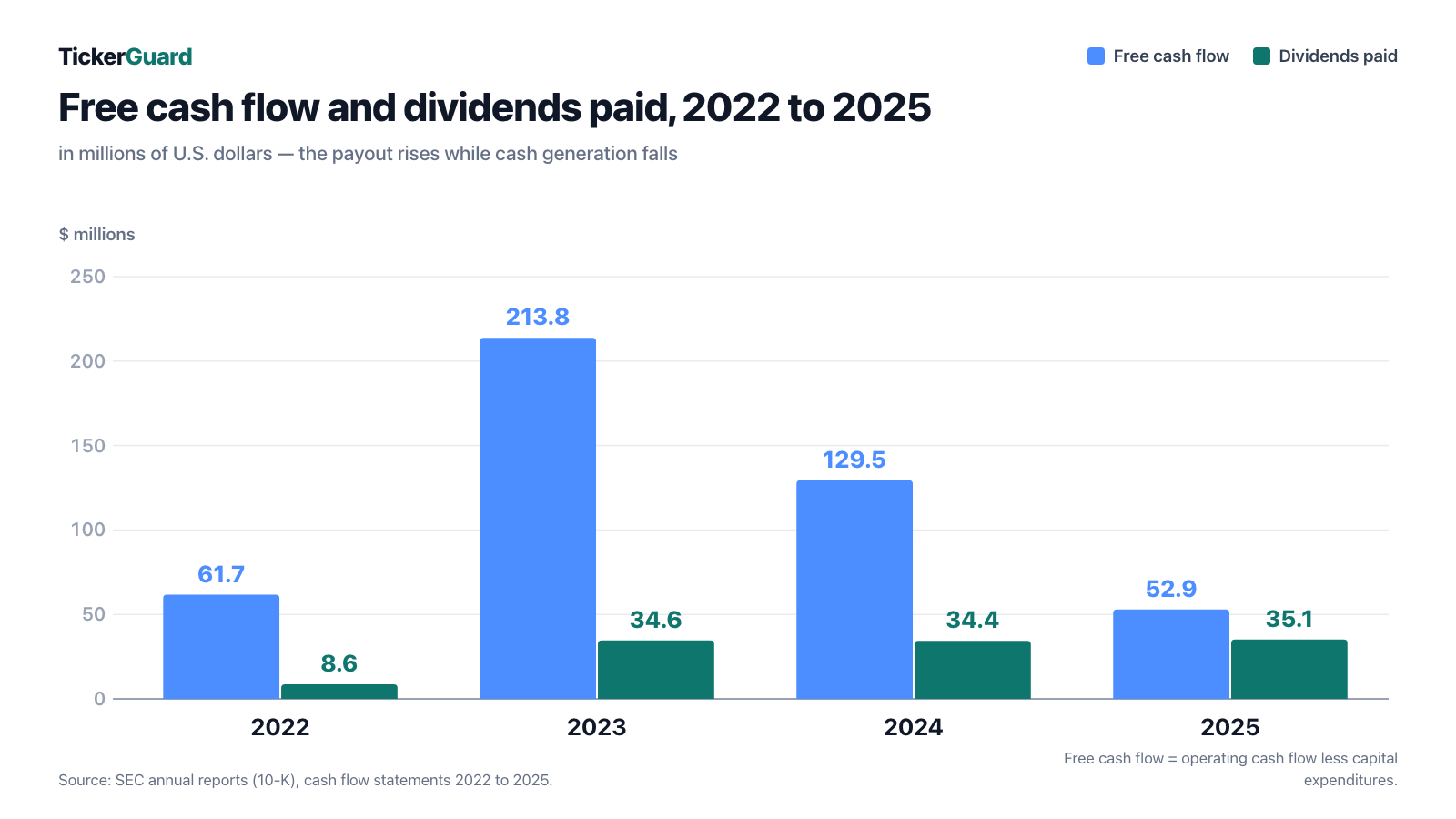
Part of that gap is technical and to some degree reversible. Operating cash flow was $74.6 million in the first half of 2026 against $92.9 million a year earlier, and the decline came mostly from working capital: $51.0 million more in receivables because more jobs were running, plus $13.2 million from satisfying a customer prepayment. Receivables eventually get paid. The other part is not technical. Capital expenditures were $70.8 million, and for full-year 2026 RPC plans $170 million to $190 million. That is more than the last two years of operating income combined.
On July 28, 2026 the board nonetheless declared the next quarterly dividend of $0.04 per share, payable September 10, 2026 to holders of record on August 10, 2026. This is not an alarm signal — with $179.5 million of cash and an undrawn credit facility, RPC can keep this up for years. But hold on to the distinction, because with dividend stocks it is the single most important one: a payout from earnings is a share of profit. A payout from the cash box is a return of your own money.
Uncomfortable Truth No. 3: The Big Acquisition Is Already Shrinking
On April 1, 2025, RPC bought Permian Basin perforation specialist Pintail Alternative Energy through its subsidiary Thru Tubing Solutions. The price: $245 million for 100 percent of the equity — roughly $170 million in cash, $25 million in RPC stock (4,545,454 restricted shares) and a $50 million secured seller note. Measured against today's market value of roughly $1.41 billion (August 21, 2026 data snapshot), RPC spent about 17 percent of its own worth on a single acquisition.
The purchase became the wireline service line, and the effect was spectacular: from $18.9 million of revenue in 2024 to $315.5 million in 2025. That is 19.4 percent of consolidated revenue. Without Pintail, 2025 would not have reached the highest revenue since 2018 — it would have been another year of decline.
Except the line is already shrinking. Wireline booked $88.594 million in the second quarter of 2026, against $103.924 million in the prior-year quarter, which was its first full quarter under RPC. That is a decline of 14.8 percent. It fell sequentially too: the first quarter of 2026 produced $103.213 million (derived from the six-month figure of $191.807 million), or 14.2 percent more than the second. The earnings release of July 30, 2026 says so itself: double-digit gains in snubbing, cementing and downhole tools were "mostly offset by lower Pintail Wireline revenues."
None of this makes it a bad acquisition. Perforation work is especially price-sensitive, and a decline in an oversupplied market says nothing yet about the quality of the business bought. But it shifts the burden of proof. The balance sheet at June 30, 2026 carries $81.2 million of goodwill and $93.8 million of other intangible assets, and those items live on the acquired earnings actually arriving. The picture at the company's oldest line is starker still: pressure pumping fell from $771.5 million of revenue in 2023 through $587.1 million in 2024 to $485.0 million in 2025 — down 37 percent in two years. In the first half of 2026 it recovered to $280.6 million from $242.8 million. So the acquisition did not just add growth; it also masked a decline in the core.
Uncomfortable Truth No. 4: One Customer, One Family, One Share Block
The last three findings belong together because they all describe the same thing: concentration. At RPC, an unusual amount depends on an unusually small number of parties.
First, the customer. The annual report for 2025 states:
"One of our customers, a private E&P company, accounted for approximately 15% of the Company's revenues in 2025 and 13% of the Company's revenues in 2024."
— RPC, Inc., Form 10-K for 2025, Item 1 "Business" and the note on Concentration of Credit Risk
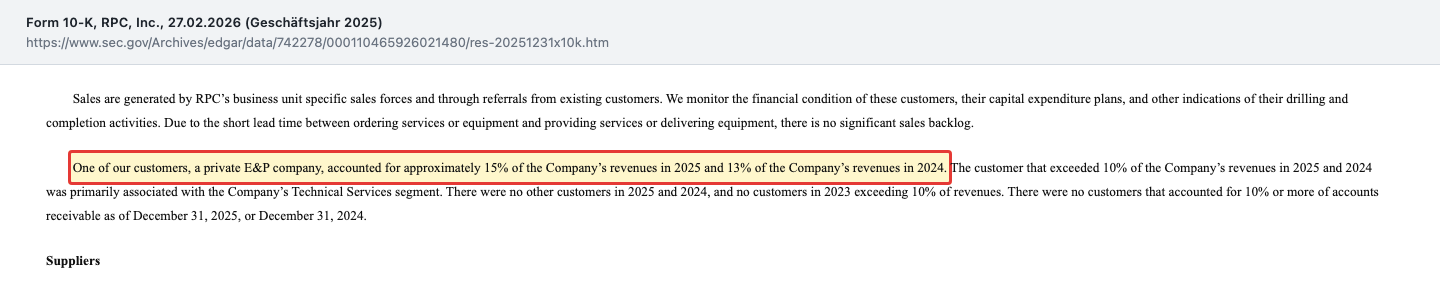
So roughly $244 million of revenue hangs on a single customer relationship that RPC does not even have to name, because the company is private. In 2023 no customer crossed the 10 percent threshold at all. The report flags the risk itself: losing this customer could have "a material and disproportionate adverse impact" on revenue and operating results.
Second, the owners. The quarterly report for the period ended June 30, 2026 records that a group including directors Amy R. Kreisler and Timothy C. Rollins, certain family members and companies under their control holds more than 50 percent of the voting power. This is no revelation — RPC has been a listed family business for decades — but it has consequences: takeovers are effectively impossible, activist investors have no lever, and the tradable portion is small. The annual report put the public float at $421.4 million as of June 30, 2025.
Third — and this is the finding easiest to skim past — a ready-made selling rail already exists for that family block:
"The Form S-3 shelf registration statement registers the resale of up to 127,235,202 shares of our common stock, which represents most of the Company securities held by the Selling Stockholders."
— RPC, Inc., Form 10-Q for the period ended June 30, 2026, "Related Party Transactions"

An important qualifier: this is not an intention to sell. A shelf registration is permission, not action — much like a valid passport, which says nothing about whether the holder plans a trip. The family has held its majority for decades. But the scale deserves attention: 127,235,202 shares are 57.4 percent of the 221,657,012 outstanding, and the registration runs through May 5, 2028. With a float this size, even a small slice of it would be a market event of its own.
And a fourth point fits here, which is strictly speaking not a concentration but a gap. On June 16, 2026, chief executive Ben M. Palmer notified the board of his retirement after 30 years with the company:

A change at the top is normal and was clearly prepared in an orderly way. What stands out is the timing: it falls in the phase when the margin is thinnest and a strategic answer to the oversupplied market has to be found. Lead independent director Jerry W. Nix also did not stand for reelection at the 2026 annual meeting (current report of January 28, 2026). As of this analysis' cut-off — August 22, 2026 — no successor for the chief executive role had been disclosed.
What the Stock Costs
Now the order of magnitude, without turning a daily quote into a thesis. As of the August 21, 2026 data snapshot the share price was $6.37 and market value roughly $1.41 billion. The 52-week range ran from $4.07 to $8.06 — so within a single year the stock nearly doubled and nearly halved, depending on where you started.
Three yardsticks, each with a different message. Against trailing twelve-month revenue of about $1.79 billion the price-to-sales ratio is roughly 0.8 — which sounds cheap but is fair enough for a service provider running a 2.8 percent operating margin: revenue that does not become profit is not worth much. Against shareholders' equity of $1,108.7 million at June 30, 2026 — about $5.00 per share — you get roughly 1.3 times book value. And against trailing twelve-month earnings of $0.11 per share you get a price-to-earnings ratio of about 58, a number that looks absurd on its own and in truth says only one thing: earnings collapsed, the price did not.
That is where the real valuation question sits. For a cyclical company a high price-to-earnings ratio at the trough is normal and sometimes even an argument to buy — provided it is the trough. Run RPC at its 2022 margin (18.0 percent on $1.63 billion of revenue would be roughly $293 million of operating income) and the stock looks very cheap. Run it at the first-half 2026 margin of 1.9 percent and it looks expensive. Both calculations are legitimate, and neither is a forecast. The analyst consensus, with an average target of $6.40 as of the August 21, 2026 data snapshot, sits essentially at the current level — the professionals do not trust themselves on this question either.
One anchor from the filings rounds out the picture: the public float was reported at $421.4 million as of June 30, 2025. The market is therefore pricing a company of which only a fraction is genuinely tradable. The dividend yield was roughly 2.5 percent as of the August 21, 2026 data snapshot.
Upside and Risks at a Glance
What argues for RPC, Inc.:
- A balance sheet with few peers in oilfield services: $1,108.7 million of shareholders' equity against $351.0 million of liabilities, only $30.0 million of it interest-bearing; $179.5 million of cash at June 30, 2026 and an untouched $100 million revolver running to June 30, 2031.
- Heavy operating leverage to the upside: in 2022 the same company turned $1,601.8 million of revenue into $287.9 million of operating income. If the cycle turns, that cost base works the other way — with no equity raise required.
- Breadth across seven service lines rather than one: snubbing, cementing and downhole tools all grew by double digits in the second quarter of 2026 while wireline fell back. Downhole tools delivered a steady $393.8 million of revenue in 2025.
- Operating cash flow stayed clearly positive at $74.6 million even through the weak first half of 2026, and much of the shortfall sits in receivables still to be collected.
- An owner with a very long horizon: the Rollins family group has held the majority for decades and carried the company through 2020 without diluting shareholders.
What argues against it:
- Earning power has all but disappeared: operating margin fell from 15.1 percent in 2023 to 2.8 percent in 2025 and 1.9 percent in the first half of 2026, on essentially unchanged revenue. The company itself blames an oversupplied market in which it has no pricing power.
- The roughly $35 million annual dividend was not earned in the first half of 2026: $17.7 million paid out against $3.8 million of free cash flow, with a full-year capital expenditure plan of $170 million to $190 million.
- Customer concentration: one private producer accounted for roughly 15 percent of 2025 revenue (13 percent in 2024) — losing it would hit results disproportionately, as the annual report itself states.
- The $245 million Pintail acquisition already delivers less than in its first year: wireline fell to $88.6 million in the second quarter of 2026 from $103.9 million a year earlier, while $81.2 million of goodwill and $93.8 million of intangibles sit on the balance sheet.
- Leadership and ownership: the chief executive role has been open for succession since June 16, 2026, the family group holds more than 50 percent of the votes, and 127,235,202 shares — 57.4 percent of the share count — are registered for resale through May 2028.
A Human Conclusion
Back to the size trap from the opening. Its point is not that revenue does not matter — without those $1.63 billion in 2025, RPC would not even be worth discussing. Its point is that a big number spares us the effort of asking about the second number. Read only the highest revenue since 2018 at RPC and you see a recovery. Read one line lower and you see a company that sold almost as much in 2025 as in 2023 and earned $200 million less doing it.
Fairness demands the other half: this company has no bank debt, $179 million in the bank and a credit facility it has not touched in years. It can sit this out, and when the cycle turns, the same leverage that points down today points up again. There are worse starting positions for a bet on better times.
Because that, honestly, is what this is: an investment in RPC is not a bet on a good company — the quality is not in dispute — but a bet on timing. So the honest question is not "Is RPC a good business?" It is this: do you believe the completion market works off its excess capacity before the cash box thins out — and are you willing, in the meantime, to collect a dividend that is currently coming out of that cash box? If yes, you have a thesis. If no, you had a seven-year revenue high. What you make of it is your decision. And that is exactly as it should be.
Sources
Every original document used in this analysis, for you to read yourself:
- RPC, Inc. — Form 10-Q for the period ended June 30, 2026 (filed July 30, 2026)
- RPC, Inc. — Form 8-K of July 30, 2026 (Item 2.02, second-quarter 2026 earnings release including Exhibit 99.1)
- RPC, Inc. — Form 10-K for 2025 (filed February 27, 2026)
- RPC, Inc. — Form 10-K for 2024 (filed February 28, 2025)
- RPC, Inc. — Form 10-Q for the period ended March 31, 2026 (filed May 8, 2026)
- RPC, Inc. — Form 8-K of June 23, 2026 (Item 5.02, retirement of the chief executive officer)
- RPC, Inc. — Form 8-K of April 7, 2025 (acquisition of Pintail Alternative Energy effective April 1, 2025)
- U.S. Securities and Exchange Commission — registration data for CIK 0000742278 (ticker, exchange, former names)
In addition: fundamental data for price, market value and the ratios derived from them (August 21, 2026 data snapshot). Industry figures for oil price, gas price and rig count come from the earnings release of July 30, 2026, which cites Baker Hughes and the U.S. Energy Information Administration.
Disclaimer: This article is journalistic analysis of publicly available company filings. It is expressly not investment advice, not a solicitation to buy or sell securities and not a recommendation. Stocks can lose substantial value and a total loss is possible. The figures cited are taken from the original documents linked in the source list and carry the reporting dates stated there. Positions held by the operator are disclosed daily; where one exists, it appears as a notice at the top of this deep dive. Form your own view and seek independent advice if in doubt.
Key figures at a glance
All monetary figures in millions of $; earnings per share as reported.
| Metric | 2021 | 2022 | 2023 | 2024 | 2025 |
|---|---|---|---|---|---|
| Revenue | 864.9 | 1,601.8 | 1,617.5 | 1,415.0 | 1,626.6 |
| Operating Income (EBIT) | 16.3 | 287.9 | 245.0 | 97.5 | 56.9 |
| Net Income | 7.2 | 218.4 | 195.1 | 91.4 | 32.1 |
| Net Margin | 0.8% | 13.6% | 12.1% | 6.5% | 2.0% |
| Earnings Per Share | 0.03 $ | 1.02 $ | 0.92 $ | 0.43 $ | 0.15 $ |
Source: fundamental data & SEC filings (annual and quarterly reports, 10-K/10-Q)
Our Bottom Line at a Glance
- Balance sheet positive
- At June 30, 2026, $1,108.7 million of shareholders' equity stood against $351.0 million of liabilities, only $30.0 million of which carries interest (the Pintail seller note, reduced by $20.0 million during the second quarter of 2026). The $100 million revolver is untouched and, after the extension in the second quarter of 2026, runs to June 30, 2031. Cash was $179.5 million.
- Earning power negative
- Operating margin fell from 15.1 percent in 2023 through 6.9 percent in 2024 to 2.8 percent in 2025, and to 1.9 percent in the first half of 2026. Revenue in 2023 and 2025 differs by less than one percent ($1,617.5 million against $1,626.6 million); operating income differs by $200.2 million. Management attributes this to a persistently oversupplied market (Form 10-Q for the period ended June 30, 2026).
- Shareholder payout negative
- In the first half of 2026, $17.729 million of dividends stood against $3.770 million of free cash flow — 4.7 times as much. In 2025 the $35.1 million payout was still covered by $52.9 million. The difference comes out of the cash balance, which fell $30.5 million to $179.5 million over the half year. On July 28, 2026 the board declared the next quarterly dividend of $0.04 unchanged.
- Pintail acquisition neutral
- The $245 million purchase (April 1, 2025) lifted the wireline service line from $18.9 million of revenue in 2024 to $315.5 million in 2025 and carried the first-half 2026 increase. At the same time wireline fell to $88.594 million in the second quarter of 2026 from $103.924 million a year earlier, down 14.8 percent; the earnings release of July 30, 2026 explicitly names "lower Pintail Wireline revenues" as the drag.
- Concentration risk negative
- A single private exploration and production company accounted for roughly 15 percent of consolidated revenue in 2025 (13 percent in 2024; no customer above 10 percent in 2023). A group including directors Amy R. Kreisler and Timothy C. Rollins controls more than 50 percent of the voting power, and a resale registration covers 127,235,202 of their shares — 57.4 percent of the share count, effective through May 5, 2028.
- Leadership neutral
- Chief executive Ben M. Palmer notified the board on June 16, 2026, after 30 years with the company, that he will retire on the earlier of a successor being named or December 31, 2026; an independent search firm has been engaged. Lead independent director Jerry W. Nix did not stand for reelection at the 2026 annual meeting (Form 8-K of January 28, 2026). No successor had been disclosed as of August 22, 2026.
RPC, Inc. is a nearly debt-free U.S. oilfield services company with 2,893 employees that booked $1,626.6 million of revenue in 2025, its highest since 2018 — on operating income of $44.7 million. The same revenue produced $245.0 million in 2023. In the first half of 2026 revenue rose another 21.5 percent while operating income fell 37.7 percent; free cash flow was $3.8 million against $17.7 million of dividends paid. Against that sits a balance sheet few competitors can match: $1.1 billion of equity, $179.5 million of cash, $30 million of interest-bearing debt and an undrawn credit facility running to 2031. Not investment advice.
What Our Rating Means
Open questions
The business works in principle, but one material question is open. As long as it stays open, our findings do not carry a quality verdict.
We rate business quality amber. The case for green is the balance sheet, and it is a strong one: $1,108.7 million of shareholders' equity against $30.0 million of interest-bearing debt, an untouched credit facility running to June 2031, $179.5 million of cash, and operating cash flow that stayed clearly positive at $74.6 million even through a weak first half of 2026. There is no solvency risk, no going-concern language and no listing threat — red has no basis here. What keeps it from green is one open operating question, and it is a heavy one: earning power fell by more than four fifths between 2023 and 2025 on essentially unchanged revenue, and the trend continued into 2026. The company itself blames an oversupplied market in which it has no pricing power; on top of that sit a customer worth 15 percent of revenue and an acquisition whose service line is already shrinking in its second year. Whether this is the floor of an ordinary cycle or a structurally thinner margin will be settled in the next few quarterly reports — until then the question is open, not answered. Price deliberately played no part in this rating: whether $6.37 is a lot or a little is a valuation question, not a quality question. The decision is yours.
A journalistic assessment by our editorial team at the time of the deep dive, based on public sources — not investment advice and not a solicitation to buy or sell. Your personal circumstances (investment goals, risk capacity, taxes) cannot be taken into account. What our levels mean, how verdicts are formed, and what conflicts of interest exist →
Worth Noting
- The starting point was a hit in our editorial Reddit hype scanner on August 22, 2026. No reliable mention count from a public measurement source was available at press time; the substance of this analysis rests solely on the company's SEC filings and figures derived from them.
- Risk of confusion: "RES" is a very generic ticker. On the New York Stock Exchange it belongs to RPC, Inc. (CIK 0000742278) — not to RGC Resources, Range Resources, EOG Resources or other companies with "Resources" in their names. The SEC registration data lists exactly one ticker ("RES") and exactly one exchange ("NYSE") for that identifier. The only former name is RPC Energy Services, Inc. (until 1995).
- Data as of: the Form 10-Q for the period ended June 30, 2026 (filed July 30, 2026) was reviewed in full, together with the current report on Form 8-K filed the same day (Item 2.02, earnings release) and its Exhibit 99.1. No further filing was made between July 30, 2026 and the August 22, 2026 cut-off. Price, market value and ratios derived from them use the August 21, 2026 data snapshot.
- The industry figures in the filings (average oil price of $96.54 per barrel in the second quarter of 2026, up 49.1 percent year over year; natural gas at $2.94 per Mcf, down 8.1 percent; an average of 554 active U.S. rigs, down 3.0 percent) come from the earnings release of July 30, 2026, which cites Baker Hughes and the U.S. Energy Information Administration. RPC attributes the higher oil price to Middle East supply disruptions.
- The $14.583 million of "acquisition related employment costs" in the first half of 2026 are, per the quarterly report, non-cash accounting adjustments from the Pintail acquisition that are contingent on continued employment and amortized over three years. They weigh on reported operating income but not on cash, and they are excluded from the $119.5 million of adjusted EBITDA.
Stock Watch
This analysis is as of August 26, 2026. Stock Watch will tell you what's changed at RES since then.
Later $1 a month per stock — signing up is free, and you'll be the first to know when it launches.
The full analysis as a PDF for later
We will send you this analysis as a PDF — to print, file away, and read at your own pace. And we will add you to the free Stock Watch list for RPC Inc (RES), so you hear about it when something material in this analysis changes.
Frequently Asked Questions
RPC, Inc. is a U.S. oilfield services company based in Atlanta. Its subsidiaries Cudd Energy Services, Cudd Pressure Control, Thru Tubing Solutions, Pintail Completions and Patterson Services stimulate wells under pressure, cement them, perforate them with wireline tools, run coiled tubing into them and rent out drill pipe. RPC is paid by oil and gas producers, not by the oil price itself. The company had 2,893 employees as of December 31, 2025.
Because the completion market is oversupplied, by the company's own account. In the quarterly report for the period ended June 30, 2026, management writes that the market remains "over-supplied" and that customer efficiency gains are adding excess capacity, which weighs on utilization and pricing. RPC is therefore selling more work at worse prices. Depreciation and amortization of $85.8 million in the first half of 2026 and $14.6 million of non-cash acquisition-related employment costs add to the pressure.
RPC pays $0.04 per share each quarter, or $0.16 a year — roughly $35 million annually on 221,657,012 shares. In 2025 that was still covered by free cash flow of $52.9 million. In the first half of 2026, $17.7 million of dividends stood against $3.8 million of free cash flow. The difference came out of the cash balance, which fell from $210.0 million to $179.5 million.
A group including directors Amy R. Kreisler and Timothy C. Rollins, certain family members and companies under their control holds more than 50 percent of the voting power, per the quarterly report for the period ended June 30, 2026. The largest single stockholder is LOR, Inc. The freely tradable portion is correspondingly small: the annual report put the public float at $421.4 million as of June 30, 2025.
Ben M. Palmer, with the company for 30 years, notified the board on June 16, 2026 of his decision to retire as director, president and chief executive officer — effective on the earlier of a successor being named or December 31, 2026. He is expected to stay on in an advisory role. The board has engaged an independent executive search firm. As of August 22, 2026, no successor had been disclosed.
At the August 21, 2026 data snapshot the share price was $6.37 and market value roughly $1.41 billion. Against trailing twelve-month revenue of about $1.79 billion that is a price-to-sales ratio of roughly 0.8. Against shareholders' equity of $1,108.7 million at June 30, 2026 — about $5.00 per share — it is roughly 1.3 times book value. The price-to-earnings ratio sits near 58 because earnings have collapsed.
Very little. At June 30, 2026 the balance sheet showed $30.0 million of interest-bearing debt, the remainder of the seller note from the Pintail acquisition, of which $20.0 million was repaid during the second quarter of 2026. Nothing was drawn on the $100 million revolving credit facility; $18.2 million was committed as letters of credit and $81.8 million was available. The maturity was extended during the second quarter of 2026 from June 2027 to June 30, 2031.
Yes. On the New York Stock Exchange, RES is unambiguously RPC, Inc., SEC identifier CIK 0000742278; the regulator's registration data lists exactly one ticker ("RES") and exactly one exchange ("NYSE") for that identifier. Confusion with RGC Resources, Range Resources, EOG Resources or other companies with "Resources" in their names is understandable but wrong. The only former name is RPC Energy Services, Inc., changed in 1995.
Found an error?
Did you spot a factual error, an outdated number, or a typo in this deep dive? Let us know briefly — your report goes straight to the editorial team.