Smart Sand: Five Years of Revenue Records — and Through 2025, the Profit Came From the Tax Man, Not the Sand
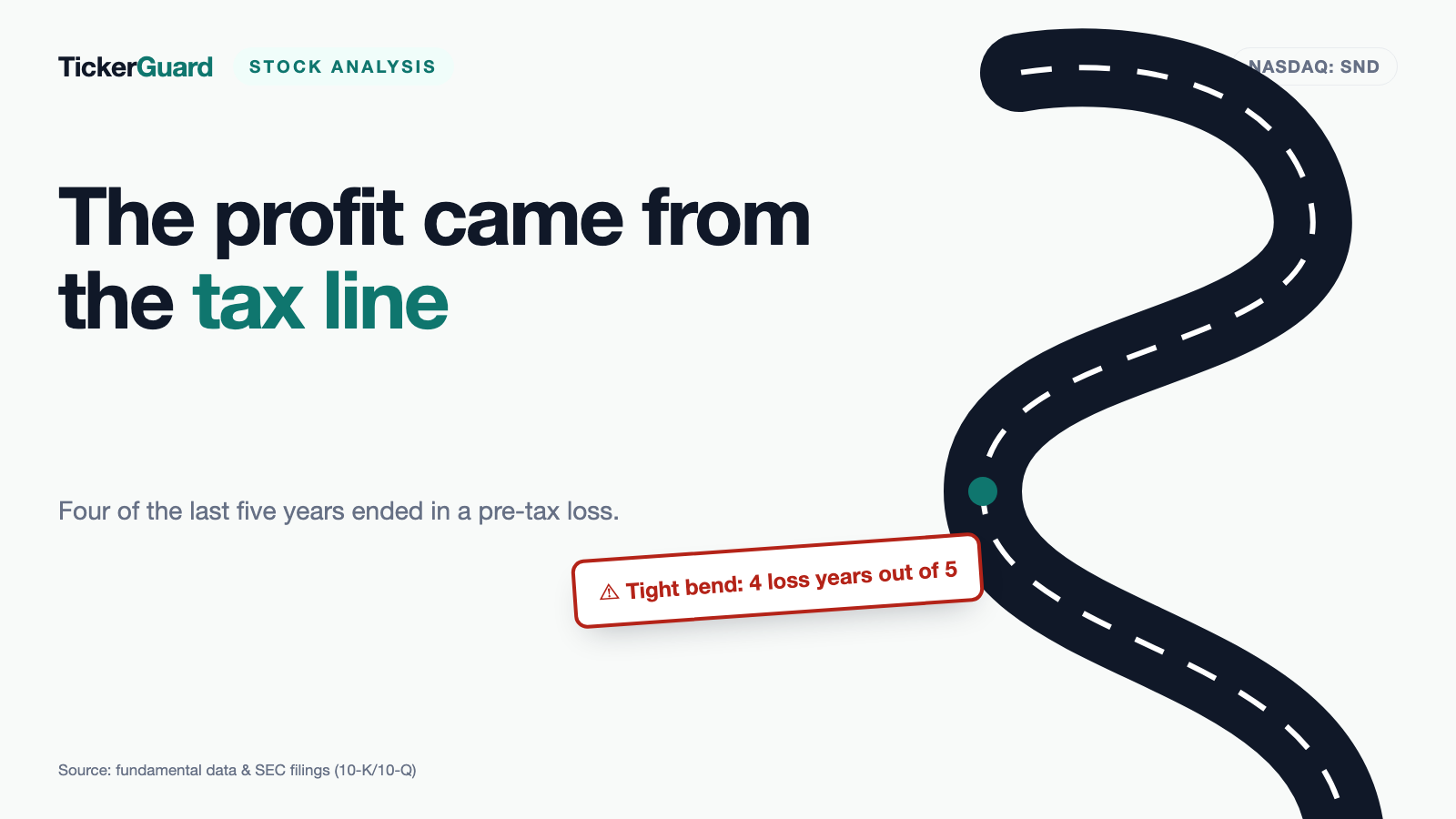
There is an investor habit that feels like a shortcut: the bottom-line trap. We scroll past every metric straight to the last line of the income statement, see a plus sign, and stop asking where it came from. Smart Sand, Inc. (Nasdaq: SND) mines and sells frac sand for the oil and gas industry, and it reported small net profits in 2023, 2024 and 2025 — while actually posting a loss before taxes in four of those five years. Only in the first half of 2026 did Smart Sand earn a genuinely meaningful operating profit for the first time in years, capped by a record second quarter — even as its reliance on a handful of large customers kept growing. Let's make a deal: we read the annual report (10-K) for 2025, the quarterly report (10-Q) for June 30, 2026, and two mandatory filings (8-K) from the summer of 2026 together, and look closely at where the profit actually came from. The decision stays yours — but the bottom line alone won't make it for you.
 Thomas Mücke
Founder & Publisher
Thomas Mücke
Founder & Publisher
As of Today
As of: October 2, 2026
- Closing price
- 5.30 $ +3.50%
- Market Capitalisation
- 0.2 $B
- P/E
- 9.5
- Growth Score
- 5/10
- AAQS
- 1/10
Price change since August 17, 2026: +7.9%
This analysis has a cut-off date. The Stock Guard tells you when something material changes in the numbers. Reserve your free spot
Chart
Interactive price chart (TradingView).
52-week range: 2.00 $ to 5.80 $ · Last price: 5.30 $ (As of: October 2, 2026)
Note: pure fact-based analysis, not investment advice and not a solicitation to buy or sell. All figures without guarantee.
There is an investor habit that feels like a shortcut: the bottom-line trap. We scroll past every metric and jump straight to the last line of the income statement, see a plus sign there, exhale, and stop asking where that plus sign came from. Smart Sand, Inc. (Nasdaq: SND) is a textbook case. From 2023 through 2025 the bottom line showed a small net profit every single year — and in four of the five years from 2021 through 2025 the company actually posted a loss before income taxes. The gap between those two lines was almost always an income tax benefit, not operating performance. Only in the first half of 2026 did the picture flip: a record quarter, a genuinely operating-driven profit — and, at the same time, customer concentration that kept climbing. Let's make a deal: we read the annual report (10-K) for 2025, the quarterly report (10-Q) for June 30, 2026, and two mandatory filings (8-K) from the summer of 2026 together, line by line, not just the last one.
What Smart Sand actually does
When an oil or gas company fractures rock deep underground under high pressure to reach trapped oil or gas, it creates fine cracks in the rock. Those cracks would snap shut again the moment the pressure eases — like a door swinging closed on its own. That is where Smart Sand comes in: the company mines and sells Northern White sand, extremely round and hard grains of quartz that get pumped into those cracks and wedge them open, the way a doorstop holds a door — engineers call this a proppant. Without it, no oil or gas can flow back through the cracks to the surface.
Smart Sand runs three of its own mines, all rail-connected so the sand doesn't have to travel cross-country by truck convoy: Oakdale in Wisconsin (processing capacity of roughly 5.5 million tons a year, operating since July 2012, served by Canadian Pacific and Union Pacific), Ottawa in Illinois (roughly 1.6 million tons, acquired 2020, served by BNSF) and Blair in Wisconsin (roughly 2.9 million tons, acquired 2022, operating since May 2023, served by Canadian National). A fourth deposit, New Auburn in Wisconsin, has no operations planned for the foreseeable future. Together that gives Smart Sand roughly 10.0 million tons of annual processing capacity. How long the sand lasts is no mystery: an independent expert (John T. Boyd) estimated proved and probable reserves at December 31, 2025 with an implied mine life of roughly 67 to 149 years per site — Smart Sand isn't going to run out of sand any time soon.
To get that sand where the drilling happens, Smart Sand also runs five owned transload terminals across North America's major production regions: North Dakota (Bakken), Pennsylvania and Ohio (Appalachia), and Oklahoma. Two smaller businesses round out the model: SmartSystems are mobile, vertical sand silos parked right at the wellsite — a rolling sand tank instead of loose bags, patented, and part of the portfolio since 2018. And since late 2021 Smart Sand has also sold industrial sand outside the oil patch, to customers in glass, foundry, construction, filtration, geothermal and ceramics — currently about 5 percent of the business, per the 2025 annual report. At December 31, 2025 the company employed 318 people, 31 of them under a collective bargaining agreement in Illinois running through April 30, 2027.
Company history for investors
-
2016
IPO on the Nasdaq
Smart Sand went public on November 4, 2016. It has reported openly on volumes, pricing and costs every quarter since.
-
2021
Low point: $50.674 million net loss
On $126.648 million of revenue, the pretax loss reached $59.691 million — the starting line for the five-year climb back.
-
2023
First net profit in years — carried by the tax man
$4.649 million net income despite a $2.252 million pretax loss. A $6.901 million income tax benefit made the difference.
-
2024
New credit line of up to $30 million
The FCB ABL facility, closed September 3, 2024, runs through September 2029 — fully undrawn as of June 30, 2026.
-
2026
Buyback program and first special dividend
A two-year, up-to-$20 million buyback started February 23, 2026; the first $0.10-per-share special dividend followed May 5, 2026.
-
2026
Record quarter and three brothers announced at the top
On August 11, 2026 Smart Sand reported its best quarter ever and announced that three Young brothers will hold CEO, COO and CFO from 2027.
How the stock landed on our desk
This time the trigger wasn't a hit in our in-house stock scanner — for a cyclical commodity company like Smart Sand, that tool is a starting point at best, never a verdict. What put the stock on our desk was the quarterly report (10-Q) for June 30, 2026, filed on August 11, 2026 together with a mandatory filing (8-K) and its accompanying earnings release: a record quarter for sales volume and revenue, plus a forecast that's unusually clear-cut for a commodity company. CEO Charles Young put it this way in the earnings release:
"The second quarter was one of the best quarters in Smart Sand's history. We achieved record quarterly sales volumes and revenues and, excluding one-time items, generated record contribution margin and Adjusted EBITDA."
— Smart Sand, Inc., second-quarter 2026 earnings release, Exhibit 99.1 to the mandatory filing (8-K) of August 11, 2026
Alongside that came full-year guidance: 10 to 20 percent higher sales volumes in 2026 versus 2025, and — stated as a goal for the first time in years — positive free cash flow for the full year. The share price move is worth noting too: as of August 16, 2026 the 52-week range stood at $1.78 to $5.79, meaning the stock has run a long way from its yearly low. That's an observation, not a buy signal — a stock that has run says nothing about whether the numbers underneath actually hold up. Readers comparing cyclical energy suppliers may want our analysis of SandRidge Energy, a U.S. oil and gas producer, and our analysis of DMC Global, a supplier for well completion. Both businesses ride the same drilling cycle Smart Sand does — just from different points along the chain.
The numbers over the years — given their honest due
First, what genuinely impresses, because it's real: Smart Sand's revenue grew from $126.648 million in 2021 through $255.740 million (2022) and $295.973 million (2023) to $311.372 million (2024) and $330.153 million in 2025 — more than two and a half times over in four years. There's no accounting trick behind it: tons sold rose over the same span from 3.19 million to 5.44 million, up roughly 71 percent. The balance sheet holds up too — Smart Sand carries essentially no net financial debt, its revolving credit line of up to $30.0 million with First-Citizens Bank & Trust stood fully undrawn at June 30, 2026, and its estimated reserves run for another 67 to 149 years depending on the site.
And yet: anyone who only looks at the revenue curve sees half the story. What was left at the bottom didn't follow that curve at all.
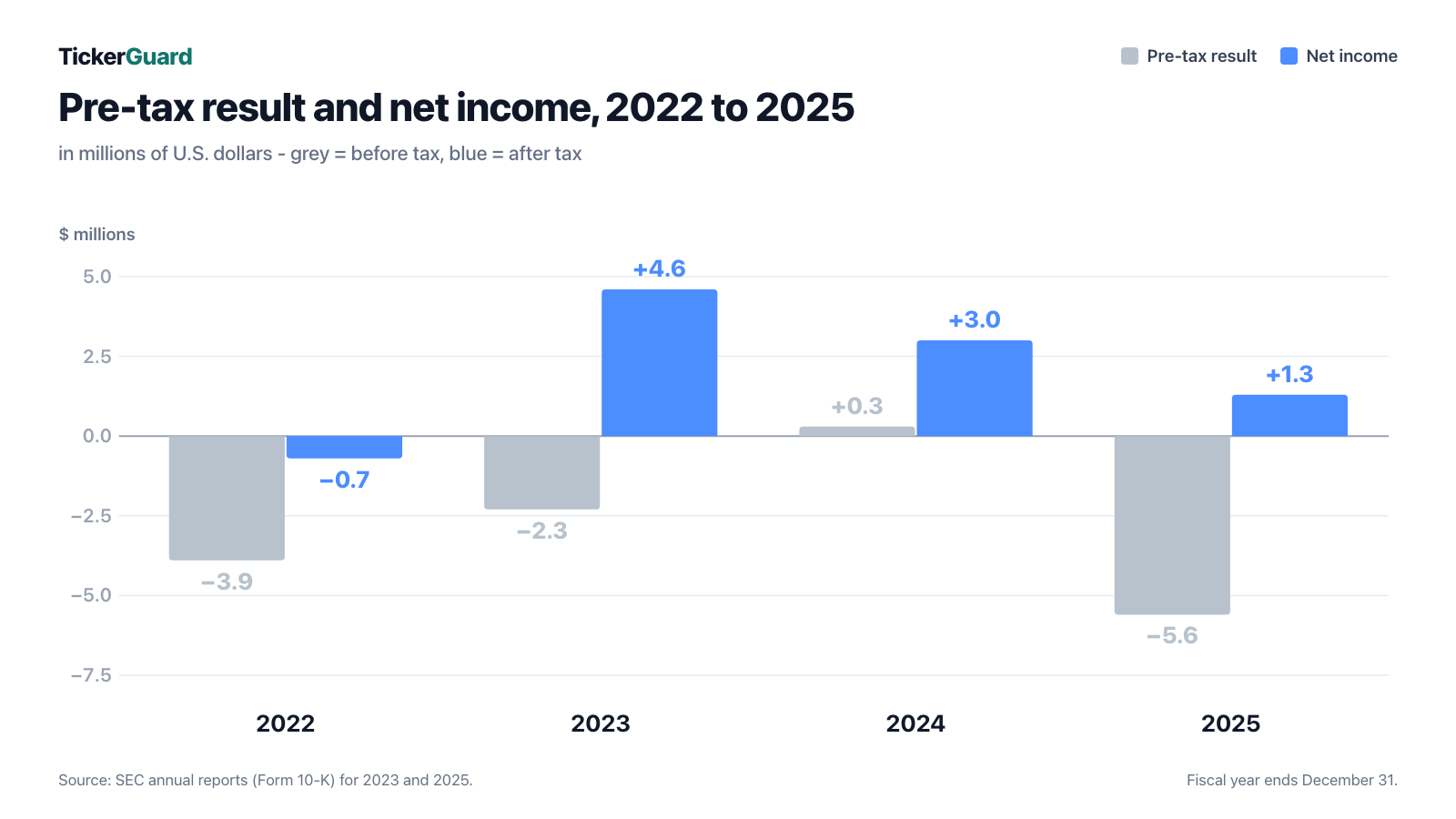
That gap between the gray and blue bars isn't a one-year fluke. It runs through the filings — and that's exactly where we look next.
What the filings say — the uncomfortable truths
Uncomfortable truth no. 1: the profit came from the tax man
Look closely at 2021 through 2025. The company posted a pretax loss of $59.691 million in 2021, $3.908 million in 2022, $2.252 million in 2023 and $5.586 million in 2025 — only 2024 came in barely positive at $0.252 million before income taxes. Yet in every single one of those five years, Smart Sand recorded an income tax benefit — a credit from the tax authorities rather than a charge — large enough to more than offset the pretax loss: $9.017 million in 2021, $3.205 million in 2022, $6.901 million in 2023, $2.740 million in 2024 and $6.931 million in 2025. The result: small net profits in 2023, 2024 and 2025 ($4.649 million, $2.992 million and $1.345 million), even though 2021 and 2022 still closed with net losses despite the tax benefit.
How large that swing can be in a single quarter shows up when comparing two second quarters. In the second quarter of 2025, Smart Sand reported net income of $21.396 million ($0.55 per share) — a strong-looking quarter at first glance. But that same quarter posted a pretax loss of $0.327 million; the profit came entirely from a $21.723 million income tax benefit. The company itself states the effective tax rate for that quarter at 6,643.1 percent. In the second quarter of 2026, by contrast, the effective tax rate was just 0.5 percent, on income before income taxes of $10.220 million — a quarter that carried itself on operating performance, not a tax credit.
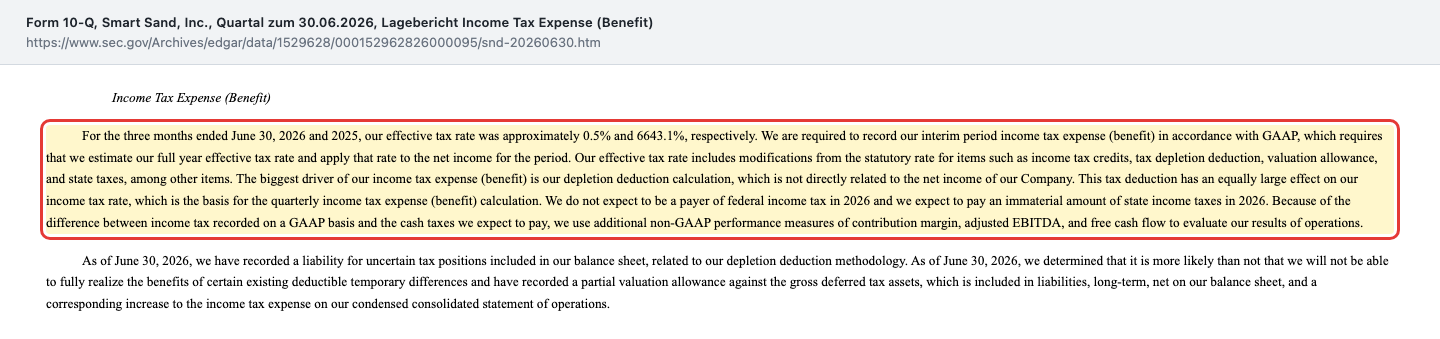
Why does this happen at all? Smart Sand names the reason itself in the MD&A of the quarterly report, and looks ahead:
"We do not expect to be a payer of federal income tax in 2026 and we expect to pay an immaterial amount of state income taxes in 2026."
— Smart Sand, Inc., quarterly report (10-Q) for June 30, 2026, MD&A
The driver, per the company, is the depletion deduction on its raw material reserves that is not tied directly to reported net income. In plain terms: the statutory rate is 21.0 percent, but Smart Sand can deduct a portion of its in-ground sand reserves for tax purposes regardless of whether the operating year was strong or weak. In lean years, that can be enough to turn a pretax loss into a net profit — as it did in 2023, 2024 and 2025. Keep this mechanism in mind: a net profit that largely comes from the tax man says little about whether the core business is carrying its own weight.
Uncomfortable truth no. 2: four customers, 68 percent of receivables
Frac sand is a business with a small number of very large buyers — drilling contractors and oil and gas operators who order tens of thousands of tons at a time for a single wellsite. That explains why the business clusters around a handful of customer relationships. Note 13 of the June 30, 2026 quarterly report puts a number on it:
"As of June 30, 2026, four customers accounted for 68% of the Company's total accounts and unbilled receivables."
— Smart Sand, Inc., quarterly report (10-Q) for June 30, 2026, note 13 "Concentrations"

At December 31, 2025 the same figure was 57 percent, also spread across four customers — so concentration has risen noticeably in six months, not fallen. Revenue tells the same story: three customers made up 54 percent of second-quarter 2026 revenue (Q2 2025: just two customers, 39 percent), and 61 percent of first-half 2026 revenue (prior-year period: 54 percent). The other side of the ledger looks similar: a single supplier accounted for 24 percent of accounts payable at June 30, 2026, and three suppliers made up 48 percent of cost of goods sold in the first half of 2026. Picture a contractor whose workshop is running at full capacity — but two of the four biggest jobs come from clients who could just as easily walk across the street to a competitor. The utilization is real. The negotiating leverage is not with Smart Sand.
Uncomfortable truth no. 3: cash flow hangs on working capital — and, in 2025, on a prepayment
Growth costs cash before it produces cash — selling more sand means mining more sand first, filling more trucks and railcars, and waiting longer to get paid. Free cash flow — what's actually left in cash after capital spending — shows that at Smart Sand in both directions. Full-year 2025 came in at a positive $32.521 million, well above 2024 ($10.854 million) and 2023 ($7.960 million). The first half of 2026, by contrast, came in at negative $0.513 million despite record volumes, and the second quarter of 2026 at negative $1.355 million; the prior-year figures were worse still, at negative $2.625 million for the first half of 2025 and negative $7.813 million for the second quarter of 2025.
The swing from 2025 into 2026 is no accident, and Smart Sand names the reasons itself. The annual report (10-K) for 2025 lists two unusual items inside the $44.116 million of cash provided by operating activities: a $9.2 million customer payment tied to prior-year contractual volume targets, and a $9.8 million customer prepayment for sand sales in 2026, carried as deferred revenue at year end. The quarterly report (10-Q) states in Note 2 that all $9.838 million of that deferred revenue was recognized in the six months ended June 30, 2026 — the cash arrived in 2025, the deliveries fell in 2026. Deferred revenue shrank accordingly, from $9.838 million to $1.583 million.
The balance sheet shows the same thing from the other side: cash fell from $22.551 million at December 31, 2025 to $10.197 million at June 30, 2026, while accounts receivable rose from $30.519 million to $45.048 million over the same period. In plain terms: a sizeable slice of the growth is still sitting in unpaid invoices rather than in the bank. On top of that come the $15.0 million to $20.0 million of capital expenditures planned for full-year 2026, of which only $6.969 million had been spent by June 30.
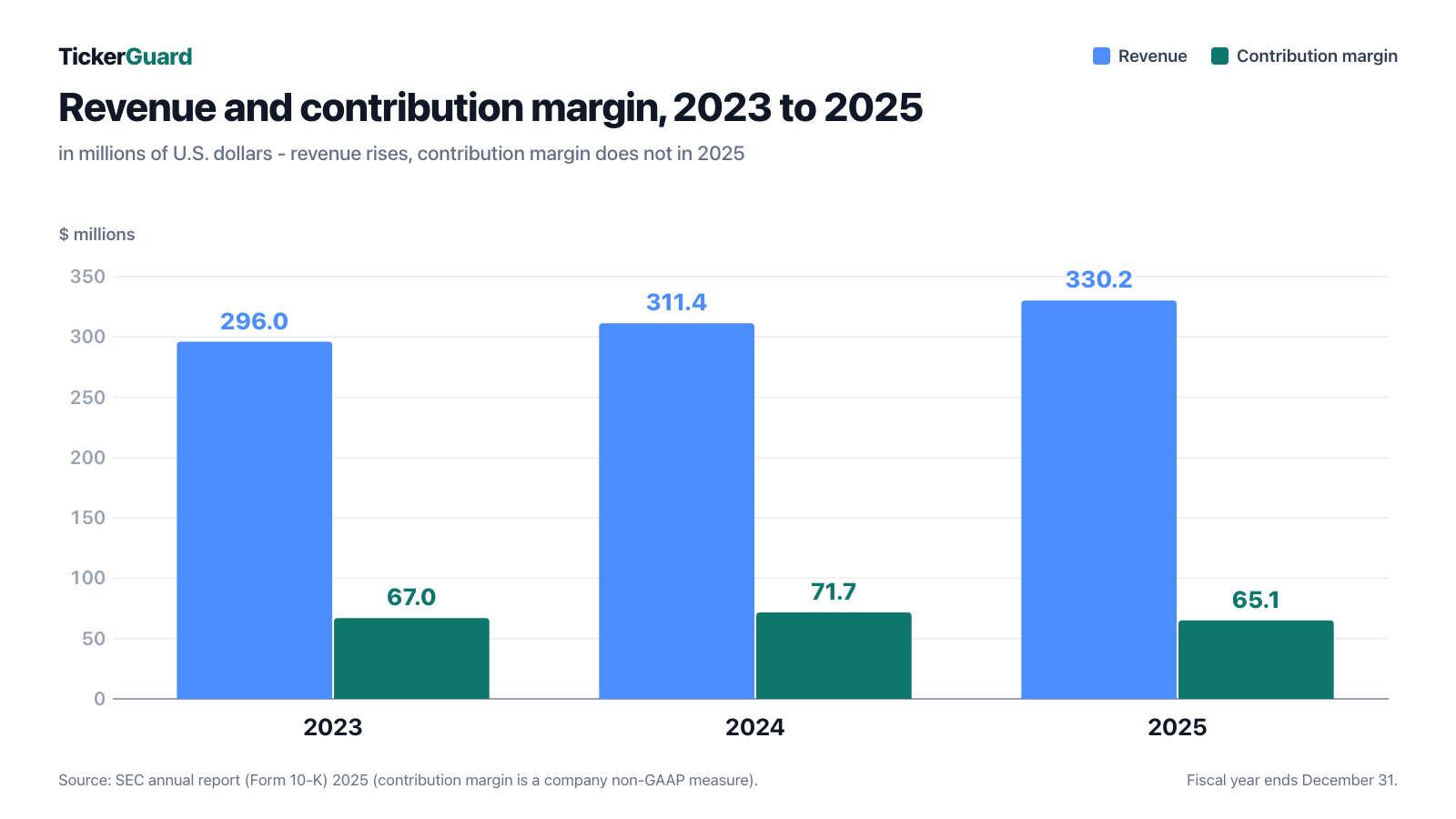
For 2026, the company itself promises a turnaround: "We expect to generate positive free cash flow in 2026," CEO Charles Young said in the same August 11, 2026 earnings release. After the first half the goal is still open — free cash flow was slightly negative, though far less so than a year earlier. That makes the guidance a bet that has to be measured against the coming quarterly reports, not a promise already kept.
Uncomfortable truth no. 4: three brothers at the top
On August 11, 2026, Smart Sand didn't just report a record quarter — the same mandatory filing (8-K) also announced a change atop the finance department. CFO Lee Beckelman steps down from the role effective January 1, 2027 but stays with the company through May 31, 2030 as a full-time advisor to the CFO, at $200,000 a year in 2027 and $150,000 a year after that. His successor, effective January 1, 2027, is James Young, 47, Executive Vice President, General Counsel and Secretary at Smart Sand since June 2017 and previously a partner at Fox Rothschild LLP. The filing itself explains why that name stands out:
"Mr. Young is the brother of Charles E. Young, our Chief Executive Officer and member of our board of directors, and William John Young, our Chief Operating Officer."
— Smart Sand, Inc., mandatory filing (8-K) of August 11, 2026, Item 5.02

This is neither a scandal nor a rule broken — family businesses with several relatives in leadership are not unusual on public markets, and Smart Sand discloses the relationship rather than hiding it. Still, it's worth naming: starting in 2027, Charles, William John and James Young — three brothers — will hold the company's three most important operating leadership positions, the CEO, COO and CFO seats. Anyone who values independent checks and balances in a public company should be aware of that concentration. Insiders held roughly 30.0 percent of shares as of August 16, 2026, per fundamental data.
At the same time, the pie that each share represents a slice of is getting bigger. On June 2, 2026, shareholders approved two new equity programs at once: the "2026 Equity Incentive Plan," authorizing up to 2.4 million new shares for employee grants, and the "2026 Employee Stock Purchase Plan," reserving 3.0 million shares that employees can buy at 85 percent of the lower of the opening or closing price of a six-month offering period. The quarterly report puts it plainly:
"Subject to adjustment pursuant to the terms of the 2026 ESPP, 3.0 million shares of the Company's common stock have been reserved for issuance under the 2026 ESPP."
— Smart Sand, Inc., quarterly report (10-Q) for June 30, 2026, note 12 "Stock-Based Compensation"

Together, the two plans make roughly 5.4 million new shares available — measured against the 38,958,338 shares outstanding at June 30, 2026, that's about 13.9 percent of potential additional dilution if the programs are fully used. There's a counterweight, though: on February 23, 2026, the board approved a two-year buyback program of up to $20.0 million, and 2026 has already brought two special dividends of $0.10 per share each (paid May 5 and August 12, 2026). According to CEO Charles Young, that added up to roughly $12.1 million returned to shareholders through the August 12, 2026 dividend. Growth funded with fresh shares is never entirely free — but Smart Sand is handing some of it back at the same time.
Valuation: what the market pays for a tax-driven profit
At the August 17, 2026 closing price of $4.91 and 42,399,061 shares outstanding (per the 10-Q cover page, as of August 4, 2026), Smart Sand's market value was roughly $208 million. Measured against trailing-twelve-month revenue of roughly $387 million, that's a price-to-sales ratio of about 0.5 — low for a cyclical commodity stock. The price-to-earnings ratio stood at roughly 20 as of August 16, 2026, based on trailing-twelve-month earnings per share of $0.25. That number needs context: as we've just seen, reported earnings have leaned heavily on tax effects for much of the past several years — a P/E of 20 on that kind of earnings base says less than it would for a company whose profit comes entirely from operations.
Book value tells a steadier story: equity stood at $238.097 million at June 30, 2026, or roughly $5.62 per share on 42,399,061 shares. The $4.91 price on August 17, 2026 sat below that — a price-to-book ratio of about 0.9. Subtracting net financial debt ($14.662 million in debt against $10.197 million in cash, about $4.5 million net) gives an enterprise value of roughly $213 million. Against full-year 2025 adjusted EBITDA of $29.891 million, that's about seven times; adjusted EBITDA for the first half of 2026 alone ($22.428 million) already exceeded the entire prior-year period, and if that pace holds, the annualized multiple would come in noticeably lower.
An analyst price target of $3, per fundamental data as of August 16, 2026, sat below the price at the time. That's the professionals' view, not the truth — for a small, thinly covered company like this one the data set shows a single estimate behind that target, and it can go stale quickly. Also worth noting: the proportion of shares sold short is high. As of August 16, 2026, roughly 1.91 million shares were sold short, about 6.7 percent of a roughly 26.5 million-share float — a sign that part of the market is explicitly betting against the stock.
Upside and risks at a glance
What speaks for Smart Sand:
- Genuine operating tailwind: the first half of 2026 delivered income before income taxes of $5.188 million for the first time in years, and the record second quarter of 2026 carried an effective tax rate of just 0.5 percent.
- Record second-quarter 2026 sales volume of roughly 1,864,000 tons, up 31 percent from a year earlier.
- Clear company guidance: 10 to 20 percent higher sales volume in 2026 and a stated goal of positive free cash flow for the full year.
- Minimal net financial debt, with a $30.0 million credit line fully undrawn at June 30, 2026.
- Reserves that run for another 67 to 149 years depending on the mine.
- Remaining performance obligations of $191.874 million at June 30, 2026, with $80.387 million already booked for 2027.
- Capital returned to shareholders: a buyback program of up to $20.0 million plus two special dividends in 2026.
What speaks against it:
- Rising customer concentration: four customers accounted for 68 percent of receivables at June 30, 2026, and three customers made up 61 percent of first-half 2026 revenue.
- The company posted a pretax loss in four of the five years from 2021 through 2025; the net profits from 2023 through 2025 were mostly tax-driven.
- Free cash flow swings hard with working capital: full-year 2025 came in at a positive $32.521 million — helped by a $9.8 million customer prepayment for 2026 deliveries — while the first half of 2026 came in at negative $0.513 million. The 2026 positive-free-cash-flow guidance is therefore still open.
- Cash fell from $22.551 million to $10.197 million in six months, while receivables rose from $30.519 million to $45.048 million.
- Starting January 1, 2027, three brothers hold the CEO, COO and CFO seats.
- Potential dilution of roughly 13.9 percent from two new 2026 equity programs.
- SmartSystems revenue has fallen for years ($4.391 million in 2025, down from $8.494 million in 2023) as fleet utilization declined.
- Roughly 17 percent of first-half 2026 revenue went to Canada and Mexico — currently tariff-free, but a political risk if that changes.
A human conclusion
Back to the bottom-line trap from the opening. Anyone who read only the last line of Smart Sand's income statement for 2023 through 2025 would have checked the same box three years running: profit, profit, profit. Look one line higher and you find a pretax loss in four of five years — and understand that the tax man paid for a substantial share of those black numbers, not the operating business. That's not deception; every figure sits openly in the mandatory filings. But it's exactly the kind of gap the bottom-line trap systematically hides.
The first half of 2026 still deserves credit: for the first time in years, the operating business carried itself, not the tax line. Whether that becomes a pattern or stays a single strong half-year will be decided by the coming quarterly reports — along with the question of whether rising customer concentration eventually becomes a problem, should one of the four large customers pull back or push harder on price. What you make of those two observations is your decision. And that is exactly as it should be.
Sources
- Annual report (10-K) for 2025, filed February 26, 2026
- Annual report (10-K) for 2023, filed March 11, 2024
- Quarterly report (10-Q) for June 30, 2026, filed August 11, 2026
- Mandatory filing (8-K) of August 11, 2026, Items 2.02/5.02
- Exhibit 99.1 to the mandatory filing (8-K) of August 11, 2026, earnings release
- Mandatory filing (8-K) of July 20, 2026 on the dividend (event dated July 16, 2026)
- Mandatory filing (8-K) of May 15, 2026 on the 10b5-1 trading plan
- SEC EDGAR filer overview (CIK 0001529628)
This analysis is a journalistic contextualization of publicly available information and is not investment advice or a solicitation to buy or sell securities. Buying stocks carries the risk of loss, including total loss. Positions held by the operator are disclosed daily; where one exists, it appears as a notice at the top of this deep dive. as of publication.
Key figures at a glance
All monetary figures in millions of $; earnings per share as reported.
| Metric | 2021 | 2022 | 2023 | 2024 | 2025 |
|---|---|---|---|---|---|
| Revenue | 126.6 | 255.7 | 296.0 | 311.4 | 330.2 |
| Operating Income (EBIT) | -63.5 | -3.1 | -1.5 | 3.0 | -5.0 |
| Net Income | -50.7 | -0.7 | 4.6 | 3.0 | 1.3 |
| Net Margin | -40.0% | -0.3% | 1.6% | 1.0% | 0.4% |
| Earnings Per Share | -1.21 $ | -0.02 $ | 0.12 $ | 0.08 $ | 0.03 $ |
Source: fundamental data & SEC filings (annual and quarterly reports, 10-K/10-Q)
Our Bottom Line at a Glance
- Revenue and volume growth positive
- Revenue grew from $126.648 million (2021) to $330.153 million (2025), tons sold from 3.19 million to 5.44 million; the record second quarter of 2026 added $115.050 million in revenue and roughly 1,864,000 tons sold.
- Earnings quality 2021-2025 negative
- The company posted a loss before income taxes in four of the five years 2021-2025; net profits from 2023-2025 only existed because of an income tax benefit (2025: a $6.931 million tax benefit against a $5.586 million pretax loss).
- First half of 2026 positive
- Income before income taxes of $5.188 million for the first time in years; in the record second quarter of 2026 the effective tax rate was just 0.5 percent, versus 6,643.1 percent a year earlier.
- Customer concentration negative
- Four customers accounted for 68 percent of receivables at June 30, 2026 (December 31, 2025: 57 percent); three customers made up 61 percent of first-half 2026 revenue (prior-year period: 54 percent).
- Balance sheet and liquidity neutral
- Equity of $238.097 million, minimal financial debt ($14.662 million), a $30 million credit line fully undrawn at June 30, 2026 — but cash fell from $22.551 million to $10.197 million, and free cash flow was negative $0.513 million in the first half of 2026 after a positive $32.521 million for full-year 2025.
Smart Sand has shown genuine revenue and volume growth for five years, but net profits from 2023 through 2025 leaned mostly on the tax man, not the core business. Only the first half of 2026 delivered an operating-driven profit — alongside rising customer concentration and a new, family-heavy leadership structure starting in 2027. Not investment advice.
What Our Rating Means
Open questions
The business works in principle, but one material question is open. As long as it stays open, our findings do not carry a quality verdict.
One material operational question remains open: whether the operating profit of the first half of 2026 marks a durable pattern or a single strong half-year cannot yet be said with confidence, coming after pretax losses in four of the last five years — and customer concentration has risen to 68 percent of receivables among just four customers as of June 30, 2026. This is a judgment on the business model, not on the current stock price. The decision is yours.
A journalistic assessment by our editorial team at the time of the deep dive, based on public sources — not investment advice and not a solicitation to buy or sell. Your personal circumstances (investment goals, risk capacity, taxes) cannot be taken into account. What our levels mean, how verdicts are formed, and what conflicts of interest exist →
Worth Noting
- This analysis was triggered by the June 30, 2026 quarterly report's record quarter and guidance (August 11, 2026) — not a hit in our in-house stock scanner.
- Valuation figures are dated August 16-17, 2026; every operating figure carries its own balance-sheet or reporting cut-off date.
- Do not confuse tickers: SND (Smart Sand) is neither SNDK (Sandisk) nor SD (SandRidge Energy) — three entirely different companies with similar-sounding tickers.
Stock Watch
This analysis is as of August 26, 2026. Stock Watch will tell you what's changed at SND since then.
Later $1 a month per stock — signing up is free, and you'll be the first to know when it launches.
The full analysis as a PDF for later
We will send you this analysis as a PDF — to print, file away, and read at your own pace. And we will add you to the free Stock Watch list for Smart Sand Inc (SND), so you hear about it when something material in this analysis changes.
Frequently Asked Questions
Smart Sand (Nasdaq: SND) mines and sells Northern White sand as a proppant for hydraulic fracturing — it props open the fractures created deep in the rock so oil and gas can flow. The company also sells industrial sand (roughly 5 percent of the business per the 2025 annual report) and mobile wellsite sand silos through its SmartSystems unit.
Because an income tax benefit — a credit rather than a charge — outweighed the pretax losses. In 2025, for example, a $6.931 million tax benefit was recorded against a $5.586 million loss before income taxes, leaving $1.345 million of net income. The company attributes this to percentage depletion on its raw material reserves.
Much better: revenue rose 38 percent to $208.161 million, income before taxes turned positive at $5.188 million, and net income reached $6.308 million. CEO Charles Young called the second quarter of 2026 one of the best quarters in the company's history, with record sales volumes and revenue.
Heavily, and increasingly so. As of June 30, 2026, four customers accounted for 68 percent of total accounts and unbilled receivables (year-end 2025: 57 percent). In the first half of 2026, just three customers generated 61 percent of revenue, up from 54 percent a year earlier. Losing one would hit the balance sheet immediately.
CEO Charles Young and COO William John Young already run the company. Effective January 1, 2027, according to an August 11, 2026 filing, their brother James Young becomes CFO, succeeding Lee Beckelman — putting three brothers in the company's three top operating leadership roles.
No regular dividend, but two special dividends in 2026: $0.10 per share declared April 9 and paid May 5, 2026, and another $0.10 per share declared July 16 and paid August 12, 2026. Both were explicitly designated special dividends, not a recurring quarterly payout.
Found an error?
Did you spot a factual error, an outdated number, or a typo in this deep dive? Let us know briefly — your report goes straight to the editorial team.