International Seaways: $12.61 of Dividends in Twelve Months — and Wall Street Models 57 Percent Less Profit for 2027
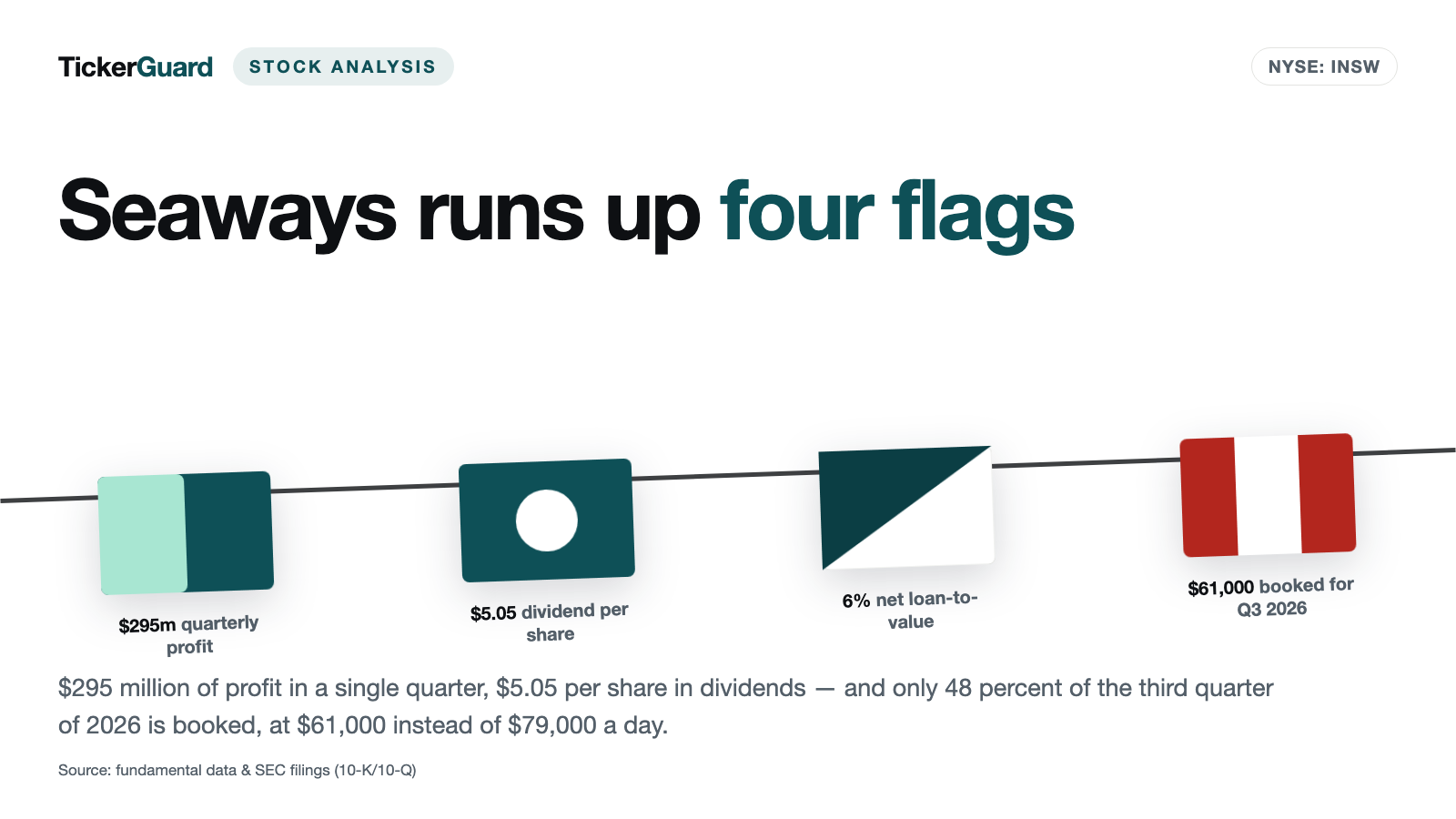
The tanker owner International Seaways (NYSE: INSW) reported the largest profit in its history for the quarter ended June 30, 2026: $294.9 million, together with the biggest quarterly dividend the company has ever declared. Seaways itself puts the dividend yield of the past twelve months at 21 percent. And yet the stock trades at only about six times annual earnings — because 82 percent of revenues are renegotiated daily on the spot market, part of the profits of earlier years came from selling old ships, and only 48 percent of the third quarter of 2026 is booked, at $61,000 instead of $79,000 a day. Not a recommendation, but the question of what you are actually paying for in a cyclical business.
 Thomas Mücke
Founder & Publisher
Thomas Mücke
Founder & Publisher
As of Today
As of: October 8, 2026
- Closing price
- 121.80 $ +4.20%
- Market Capitalisation
- 5.9 $B
- Growth Score
- 5/10
- AAQS
- 5/10
Price change since August 21, 2026: +22.4%
This analysis has a cut-off date. The Stock Guard tells you when something material changes in the numbers. Reserve your free spot
Chart
Interactive price chart (TradingView).
52-week range: 43.30 $ to 121.80 $ · Last price: 121.80 $ (As of: October 8, 2026)
Note: pure fact-based analysis, not investment advice and not a solicitation to buy or sell. All figures without guarantee.
There is a moment when the dividend yield on the screen turns double-digit and the brain stops reading. Twenty-one percent. At International Seaways the number is printed in the company's own release: "Declared dividends of $12.61 per share over the last twelve months represent a 21% yield." That is not a marketing promise. It is an arithmetic fact — and it is still a trap.
Because the number looks backward. It measures what was paid out in the twelve months to August 2026, a stretch in which war in the Middle East and the effective closure of the Strait of Hormuz drove the fleet's average daily rate in the second quarter of 2026 to nearly three times the year-ago level — $79,000 against $27,500. It is the rear-view mirror, not the windshield. And the rear-view mirror of a cyclical business is the least reliable adviser the stock market has to offer: it flatters the past most precisely when the past is about to end.
So let's make a deal. We set the yield aside for a moment and read instead what International Seaways, Inc. (NYSE: INSW) filed, under penalty of law, with the U.S. securities regulator, the SEC — the annual report (10-K) for 2025, the quarterly report (10-Q) for the period ended June 30, 2026, the current reports (8-K), and the transcripts of the ten earnings calls since the start of 2024. By the end you will know what the market is paying for here — and what it is not.
The tension that runs through every chapter is easy to state: the present is a record; the share price is a bet that the record will not last. That is exactly why, at $99.52 (as of August 21, 2026), the stock trades at roughly six times the profit of the past twelve months. A price-to-earnings ratio of 6 is not a bargain signal. It is a vote of no confidence in the durability of the earnings.
What International Seaways Actually Does
International Seaways moves oil across the ocean. Nothing more, nothing less. The company owns tankers and rents them out — sometimes for a single voyage, sometimes for a few years. As of August 1, 2026, the earnings release put the fleet at 70 vessels: 64 trading, 6 newbuildings under construction, together roughly 8.08 million deadweight tons.
The fleet splits in two. The crude tankers — 10 VLCCs (the largest, around 300,000 tons), 13 Suezmaxes, 4 Aframaxes — carry unrefined oil from the producing country to the refinery. The product carriers — 1 LR2, 8 LR1s, 28 MRs — deliver the finished output to the consuming country: diesel, gasoline, jet fuel. The distinction matters more than it sounds. The two markets do not move in lockstep. When crude shipping is expensive, diesel shipping need not be, and the other way round. That split is the only buffer built into the business model.
All of it is run by remarkably few people. The annual report (10-K) for 2025 puts headcount at December 31, 2025 at exactly 2,763 — of which 2,697 are seafarers aboard the ships and 66 work ashore. Sixty-six office employees in New York steer a balance sheet of $3.02 billion (as of June 30, 2026). If you wonder how a shipping company can earn so much so quickly, part of the answer sits here: the shore-side cost base is tiny, and everything depends on the price the ships fetch out at sea.
That price is called the TCE rate in the industry — time charter equivalent, in plain words: what is left at the end of a day after voyage costs, expressed as one day of vessel hire. Remember this number; it is the pulse of the business. In the quarter to June 30, 2026, it averaged $79,000 a day across the fleet. A year earlier it was $27,500. Same ships, same crews, same fuel — three times the price.
Company history for investors
-
2016
Spun off from Overseas Shipholding Group, listed on the NYSE
The parent's international business becomes its own stock. Price series from before that date describe a different company.
-
2021
Merger with Diamond S Shipping completed July 16, 2021
The fleet grew sharply, paid for in stock. The year still ended with a $133.5 million loss — scale is no protection against the cycle.
-
2023
Record year: $1,071.8 million of revenue, $556.4 million of profit
The dividend reached $6.29 per share. Anyone who booked that yield as normal saw it more than halved two years later.
-
2025
Second consecutive year of decline: $309.3 million of profit
The payout fell to $2.93 per share while debt dropped sharply — the balance sheet grew stronger as earnings grew weaker.
-
2026
January: full acquisition of the Tankers International pool
Seaways controls for the first time the pool in which most of its VLCCs trade. The balance sheet takes on $7.4 million of goodwill for it.
-
2026
April and May: takeover defense to 2029, a $200 million share-selling window
Both decisions touch shareholders directly: less takeover optionality, more potential dilution — neither forced by need.
-
2026
August: best quarter in company history, largest dividend
On August 10, 2026, Seaways reported $294.9 million of quarterly profit and declared $5.05 per share — and named a demand risk for the first time.
How the Stock Landed on Our Desk
No scanner, no forum, no recommendation. The trigger is the SEC's own filing list. On August 10, 2026, International Seaways filed two documents on a single day — the quarterly report (10-Q) for the period ended June 30, 2026, and the earnings release as a current report (8-K, Item 2.02). The release uses the word "Record" four times in its first five lines: record net income, record adjusted EBITDA, record free cash flow, largest quarterly dividend in company history.
When a company writes "record" four times in five lines, that is the moment to read the numbers yourself — not the moment to buy. Because the three most interesting filings of this year were not in that release at all: a current report of May 11, 2026, about a share-selling program; one of April 9, 2026, extending a takeover defense to 2029; and one of June 12, 2026, carrying the shareholder vote on it. All three come up below.
For context, the neighbors in the same waters are worth a look. We have already examined Nordic American Tankers and its 115 consecutive quarterly dividends, as well as Teekay, where shareholders own only 30.7 percent of the tankers the group runs. Three shipowners, three entirely different constructions — and each time the real story sits in the structure, not in the rate.
The Numbers Over the Years — Honestly Credited
Start with what genuinely impresses. In the quarter ended June 30, 2026, International Seaways booked $467.3 million of shipping revenues, up from $195.6 million in the year-ago quarter. Net income came to $294.9 million, or $5.91 per diluted share, against $61.6 million and $1.25 a year earlier. That is a fourfold increase in profit in twelve months, and it is real: unlike the quarter before it, those $294.9 million contain no one-time item at all.
The balance sheet deserves credit too. At June 30, 2026, total assets of $3,018.9 million stood against $2,265.3 million of equity; financial debt was $645.6 million ($39.2 million current, $606.4 million long-term), against $159.4 million of cash and $250.0 million of short-term investments. The company puts total liquidity at roughly $935 million and the net loan-to-value of the fleet at about 6 percent — six dollars of net debt for every hundred dollars of vessel value. For a capital-intensive shipowner, that is unusually low.
And now the look back that puts it in place.
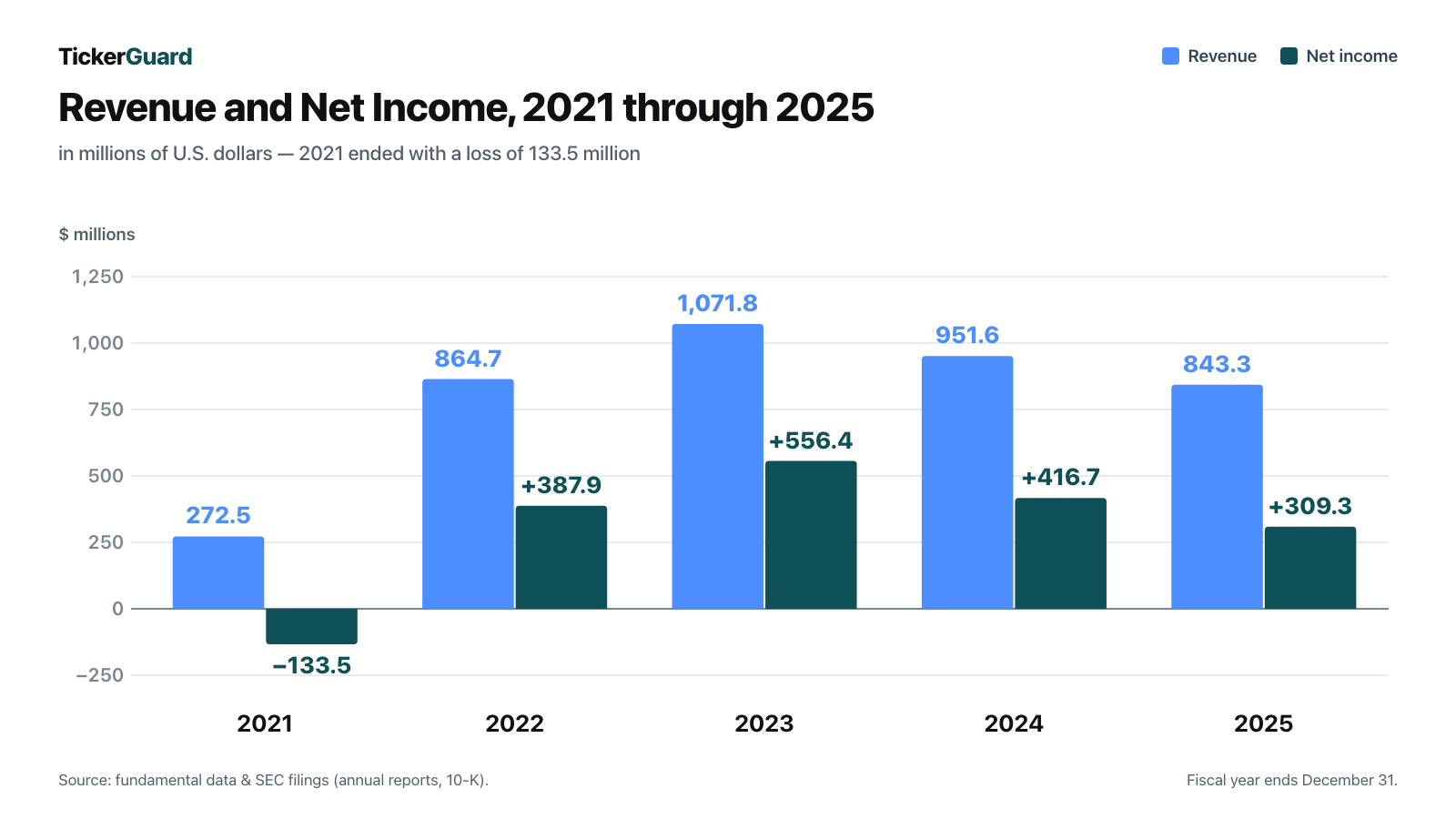
Same company, same ships, same people. In 2021, a loss of $133.5 million on $272.5 million of revenue. In 2023, a profit of $556.4 million on $1,071.8 million. And then, out of that record year, two years downhill: $416.7 million in 2024, $309.3 million in 2025. Anyone who treated the dividend yield of early 2024 as the benchmark saw it halved by 2025 — $2.93 per share, against $6.29 in 2023.
Keep this in mind for the rest of the article: for a cyclical business, a low price-to-earnings ratio is not a discount. It is a forecast.
How Much of It Was Actually Earned at Sea: The One-Time Items
Here is the uncomfortable part, and that is why it sits up front rather than in a footnote. A meaningful share of the reported profits of recent years did not come from ships carrying oil. It came from ships being sold.
The line in the annual report reads "Gain on disposal of vessels and other assets, net of impairments." It amounted to $35.9 million in 2023, $32.7 million in 2024 and $42.5 million in 2025. Against 2025 net income of $309.3 million, that is close to 14 percent of the result coming from the sale of the company's own substance.
In the first quarter of 2026 it became a third. The company sold seven vessels — five MRs with an average age of 18 years and two VLCCs averaging 15 years — for roughly $216 million net, and booked a gain of about $88 million on them. On top came a $3.9 million holding gain on the previously held stake in the tanker pool Tankers International, which Seaways took over entirely in January 2026. Together, $92.0 million. Reported quarterly net income was $286.1 million; profit from the ongoing business was $194.1 million.
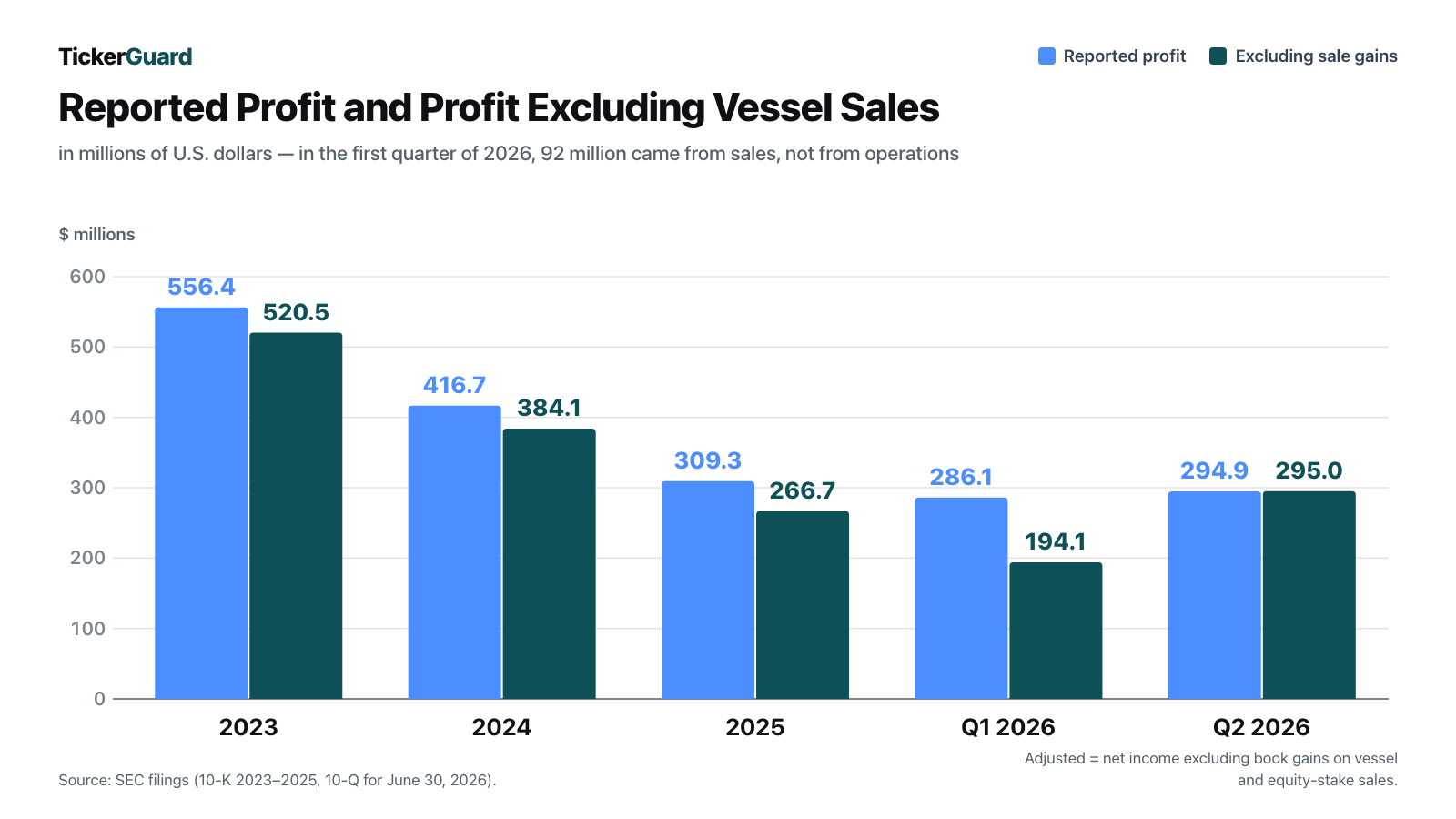
Two things follow, and they point in different directions. First: anyone judging Seaways' earning power over time has to strip this line out, or they are counting asset disposals as operating profit. Second, and in fairness: that effect is absent from the record quarter. The $294.9 million of the second quarter of 2026 were earned at sea, not sold off the books. The company itself reports adjusted net income of $295.0 million — practically identical.
One more detail worth noticing: the dividend is measured against adjusted earnings, not reported earnings. That is the more conservative and the more honest construction — it prevents a vessel sale from turning into a payout the business did not earn.
What Management Promised — and What the Earnings Calls Made of It
We read the transcripts of the ten quarterly earnings calls from the first quarter of 2024 through the second quarter of 2026. The question-and-answer section is the richer half: in the prepared remarks an executive says what he wants to say; in the answer to the same analyst's fourth follow-up he says what he has to.
Delivered: the payout ratio. In the fourth quarter of 2024, chief financial officer Jeffrey Pribor set the marker that shareholders should expect "seventy-five percent or a minimum of seventy-five percent payout ratio." That commitment held for six consecutive quarters and was restated in each call. In the first quarter of 2026, chief executive Lois Zabrocky raised it to "a new payout ratio of 85%, which you can expect from us going forward as a practice" — and the next quarter duly brought the largest quarterly dividend in company history at $5.05 per share. On dividends, taking management at its word has not disappointed anyone so far.
Not delivered, first: the fixed dividend. The base quarterly dividend has stood unchanged at $0.12 per share for years; everything above it is variable. In the first quarter of 2024, an analyst asked whether it would ever rise. Pribor's answer: "in the fullness of time, I think that's probably likely." Two years later, in the first quarter of 2026, a different analyst asked the same thing. The answer:
"That $0.12, no one is really thinking about it right now when you have such a high amount of income that 85% is way more than that, right?"
— Jeffrey Pribor, Chief Financial Officer, first-quarter 2026 earnings call, May 7, 2026
Why it matters: the fixed portion is the only part an investor could lean on in a downturn. It comes to $0.48 a year. Against a price of $99.52, that is 0.5 percent. Everything else in the double-digit yield hangs on the freight market.
Not delivered, second: the cost side. In nine of the ten calls management says it will keep pushing the breakeven lower; across the four calls from the second quarter of 2025 through the first quarter of 2026 the wording is literally identical: "We continue to explore ways to lower our breakeven cost even more." The cash breakeven — the rate at which a ship covers its own costs including interest and debt amortization — did fall, from roughly $13,600 a day in early 2024 to about $13,000 in mid-2025. Then it turned. In the first quarter of 2026 the company cited roughly $14,900 a day; in the second quarter of 2026, "below $14,500 per day over the next year." Back in the first quarter of 2025, answering an analyst's question about refinancing, Pribor had explicitly held out "several hundred dollars a day reduction in breakevens." What arrived was the opposite — roughly $1,500 a day above the low. On some 20,000 revenue days a year, that is on the order of $30 million annually.
The most candid aside in the whole record came in the first quarter of 2026, again in the question-and-answer section. Pribor explained what the 85 percent ratio is actually measured against:
"we are at 85% of net income on a 25-year basis. Anecdotally, that's probably close to 100% on a 20-year depreciation basis, but we're at 85% on a 25-year basis."
— Jeffrey Pribor, Chief Financial Officer, first-quarter 2026 earnings call, May 7, 2026
In plain language: how much profit a ship reports depends on how many years you spread its loss of value across. Seaways assumes a 25-year useful life. Assume 20 years instead — hardly exotic in this industry — and by the finance chief's own arithmetic the payout would be close to the entire profit. That is not an accusation; the assumption is disclosed and the balance sheet carries it. But it answers the question of how much headroom sits inside that ratio: not much.
The change of tone. Between two consecutive calls the mood shifts visibly. For the fourth quarter of 2025, Zabrocky still said: "The spot market is just going from strength to strength." One quarter later, for the first quarter of 2026, the same presentation opened with: "The current tanker market is as volatile as it has been in some time, particularly in reaction to the conflict in the Strait of Hormuz." And in the second quarter of 2026, a downside scenario appeared in the prepared remarks for the first time:
"Alternatively, if these disruptions persist for an extended period, the risk shifts to consumption. Sustained disruption of this magnitude could ultimately weigh on the global economy and oil demand, which would have broader implications for the tanker market."
— Lois K. Zabrocky, President and Chief Executive Officer, second-quarter 2026 earnings call, August 10, 2026
That is remarkably open. The same event that drove rates up can, if it lasts, destroy the demand the rates feed on. Management says so itself — in the quarter of the largest profit in company history.
And the buyback that never came. A $50 million repurchase program has been in place for years. It was used exactly once: in the third quarter of 2024, Seaways bought back and retired more than 500,000 shares at an average price below $50. Across four calls — from the second quarter of 2024 through the first quarter of 2026 — four different analysts asked whether more would follow, and got four versions of the same answer. The shortest dates from August 2024: "we will look at that opportunistically. But we stuck with the dividend." The quarterly report for the period ended June 30, 2026, records that no shares at all were repurchased in the first half of 2026. The program expires at the end of 2026.
What the Filings Say: Five Uncomfortable Truths
No. 1 — Four out of five revenue dollars are renegotiated daily. The annual report (10-K) for 2025 quantifies, in its risk section, how much of the business hangs on the spot market — single voyages at the day's price rather than multi-year contracts:
"In the years ended December 31, 2025, 2024 and 2023, INSW derived approximately 82%, 86% and 91%, respectively, of its TCE revenues in the spot market."
— International Seaways, Inc., SEC annual report on Form 10-K for 2025, Item 1A Risk Factors

For comparison: as of July 1, 2026, the company had 13 vessels on time charters with an average remaining duration of 1.5 years and future contracted revenue of roughly $240 million. Against first-half revenue of $792.8 million, that is a thin floor. The business is built to earn the maximum in a good market — and to fall with it immediately in a bad one. 2021 was the bad one.
No. 2 — The dividend is a choice, not an obligation. That is stated in the annual report, and it repays close reading:
"INSW has no obligation to, and may not be able to, declare or pay dividends on its Common Stock."
— International Seaways, Inc., SEC annual report on Form 10-K for 2025, Item 1A Risk Factors
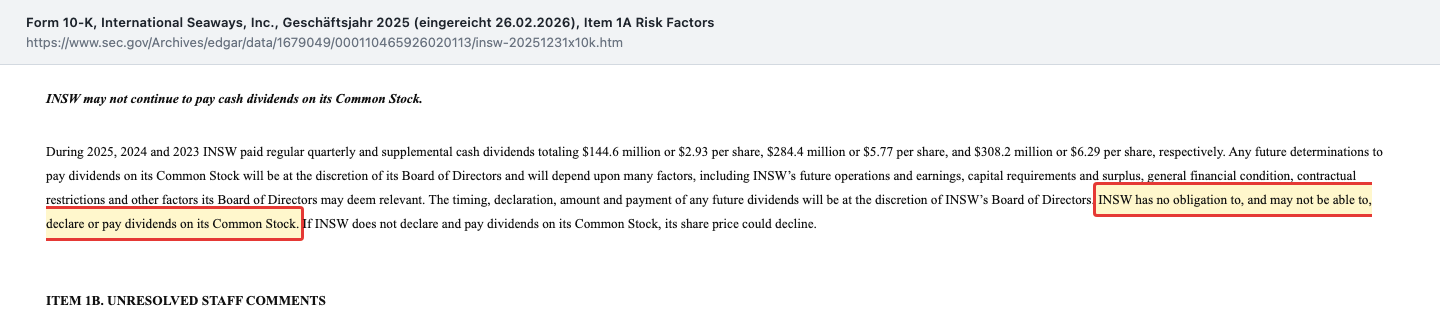
The sentence is legal routine. The numbers in the same paragraph are not: $6.29 per share in 2023, $5.77 in 2024, $2.93 in 2025. The 21 percent yield this article started with would, two years earlier and on the same share price, have been a fraction of that. This is the rear-view-mirror trap in numbers.
No. 3 — Seaways does not market most of its own ships. Tankers are often traded in so-called pools: several owners contribute vessels, a pool manager charters them out, and earnings are distributed by formula. The benefit is better utilization. The price is loss of control. At December 31, 2025, according to the annual report, nine of twelve VLCCs traded in the Tankers International pool, eleven of thirteen Suezmaxes in the Maersk Tankers pool, all seven LR1s in the Panamax pool, and 27 of 33 MRs in two further pools. The notes record that the pools accounted for 95 percent of voyage receivables at December 31, 2025 (2024: 98 percent). And the risk section states that any participant in any of these pools may withdraw upon notice.
To be fair: since January 2026, one of those pools — Tankers International — belongs entirely to Seaways. That takes the edge off exactly one of the concentrations, and it explains the $7.4 million of goodwill that appears on the balance sheet for the first time at June 30, 2026.
No. 4 — A window to sell up to $200 million of its own shares stands open. On May 11, 2026, the company terminated an older equity distribution agreement and signed a new one: up to $200 million of common stock may be sold through four banks "at the market," meaning continuously over the exchange. Dilution, in everyday terms: the cake stays the same size, but new slices are cut — and your slice gets smaller. At $99.52 a share, $200 million is roughly 2.0 million shares, or about 4 percent of the 49,531,311 shares outstanding as of August 6, 2026.
"As of the date hereof, the Company has neither sold or undertaken to sell any shares pursuant to the Distribution Agreement."
— International Seaways, Inc., SEC quarterly report on Form 10-Q for the period ended June 30, 2026, Item 5

So far, then, a possibility rather than an act. It is still notable that a company with $935 million of liquidity, 6 percent net loan-to-value and $260.7 million of free cash flow in the second quarter alone keeps a window open to sell its own shares at all — while the repurchase program runs out unused at the end of 2026.
No. 5 — A third of the votes went against the takeover defense. Since May 2022, International Seaways has had a shareholder rights plan — a poison pill, in market shorthand. It lets all other shareholders buy new stock cheaply if an unwelcome buyer accumulates a stake, diluting that buyer. On April 9, 2026, the board extended it to April 8, 2029, and raised the purchase price from $50 to $95. At the annual meeting on June 8, 2026, 27,238,846 shares voted in favor and 14,456,177 against — 34.7 percent of the votes cast said no. For comparison: the auditor was ratified in the same meeting with 99.8 percent, executive compensation with 98.9 percent.

A poison pill is not bad in itself — it guards against a creeping takeover without a premium. But it also removes takeover optionality from shareholders, and a third of votes against is a loud signal at any annual meeting. For a company worth roughly $4.9 billion in a famously fragmented industry, that is not a side issue.
Valuation: What the Market Has Already Priced In
Let's add it up. At $99.52 a share (as of August 21, 2026) and 49,531,311 shares outstanding, the market capitalization is roughly $4.93 billion. Over the past four quarters — the third quarter of 2025 through the second quarter of 2026 — the company earned some $779 million in total, or $15.64 per diluted share. That works out to a price-to-earnings ratio of about 6.4.
Strip out the sale gains of those four quarters and roughly $666 million remain, or $13.36 per share — a price-to-earnings ratio of about 7.4. Book value per share stood at $45.74 at June 30, 2026, putting the price-to-book ratio at about 2.2. The price-to-sales ratio is about 3.9.
A P/E of 6 sounds like a gift. It is not one — it is a forecast, and you can do the arithmetic. For the current year 2026 the average earnings estimate is $14.82 per share (four firms, as of August 21, 2026). For 2027 it is only $6.30 (five firms) — a decline of 57 percent. Measured against that estimate, the price-to-earnings ratio is not 6.4 but about 15.8.
The professionals' view is therefore oddly split: six firms publish a rating, five of them a strong buy and the sixth a buy. The average price target is $100 — essentially the current price. A buy rating with no upside is the polite way of saying that what you are really being sold is the dividend.
Run the dividend through that estimate and the rear-view mirror turns into a windshield: $6.30 of earnings per share, at least 85 percent of it distributed under the company's own policy, comes to roughly $5.36 a year — a yield of a good 5 percent on the August 21, 2026 price, rather than 21. That is still respectable. It is simply not the same number.
The most solid forward number comes from the company itself. On the earnings call of August 10, 2026, it disclosed the booking position for the third quarter of 2026: roughly 48 percent of expected revenue days were fixed at a fleet-wide spot TCE of about $61,000 a day. In the second quarter of 2026, the realized figure had been $79,000. The peak, in other words, is already behind the company — not dramatically, but measurably, and evidenced by its own order book. Against that stands a cash breakeven below $14,500 a day; even at $61,000, this fleet earns very well.
Upside and Risks at a Glance
What speaks for International Seaways
- The balance sheet is unusually robust: $2,265.3 million of equity against $645.6 million of financial debt, roughly $935 million of total liquidity, and a net loan-to-value of about 6 percent (as of June 30, 2026).
- The gap between cost and revenue is currently enormous: a cash breakeven below $14,500 a day against $79,000 realized in the second quarter of 2026.
- The distribution policy is explicit, quantified and has been honored in every single quarter since the fourth quarter of 2024 — most recently at $5.05 per share, declared on August 7, 2026.
- The fleet is being renewed on schedule: of the original six-vessel LR1 newbuilding program, four had been delivered as of June 30, 2026, with the final two expected in the third quarter of 2026; four more were ordered for $244 million with delivery in the second half of 2028 — according to the company at essentially the price level of three years ago.
- The tax burden is minimal: in the quarter to June 30, 2026, pre-tax income of $294.9 million carried an income tax benefit of $1,000. That is no trick but a consequence of Marshall Islands registration and the Section 883 exemption under U.S. tax law, which the annual report explains.
What speaks against it
- 82 percent of TCE revenues came from the spot market in 2025. What earns $79,000 today earned $27,500 in the year-ago quarter — and 2021 ended with a loss of $133.5 million.
- Earnings estimates fall from $14.82 to $6.30 per share in 2027. At a payout ratio of 85 percent, that arithmetically comes to roughly $5.36 of dividends a year — a good 5 percent on the August 21, 2026 price rather than 21.
- The fixed part of the dividend has stood unchanged at $0.12 per quarter for years — 0.5 percent yield on the August 21, 2026 price. Everything above it depends on the freight market.
- Results in 2023 through 2025 included $35.9 million, $32.7 million and $42.5 million of book gains on vessel sales, and $92.0 million in the first quarter of 2026. Selling old ships is not a repeatable strategy.
- The cash breakeven has risen despite repeated guidance to the contrary: from roughly $13,000 a day in mid-2025 to below $14,500 for the next twelve months (as of August 10, 2026).
- A window to sell up to $200 million of the company's own shares has been open since May 11, 2026, while the $50 million buyback program expires unused at the end of 2026.
- The takeover defense runs to April 8, 2029, ratified against 34.7 percent of votes opposed.
A Human Verdict
Back to the rear-view mirror. The 21 percent dividend yield is not a lie — it is a precise measurement of the past. It simply says nothing about what is coming through the windshield. And the company itself put both into the same presentation on its last earnings call: the record, and the scenario in which the disruption that produced the record ends up eating the demand.
What we have here is a very well run, very solidly financed business operating in a market nobody controls. The balance sheet is strong enough to sit out a downturn — 2021 proved that, though with considerably more debt than today. Management says what it does and does what it says; the one commitment it has not honored concerns costs. And the market pays six times annual earnings for all of it, because it does not believe those earnings will last.
Whether that is a buy therefore rests on a single question, and it is not a balance-sheet question: how long do the rates stay up? Nobody has a defensible answer — not the six analysts with their $100 price target, and not management, which names the record and the risk in the same breath. Anyone buying here is not buying a dividend stock. They are buying a position in a cycle, and being paid while the voyage lasts.
What you make of that is your decision. And that is exactly as it should be.
Sources and Disclosures
- SEC quarterly report on Form 10-Q for the period ended June 30, 2026 (filed August 10, 2026)
- SEC current report on Form 8-K of August 10, 2026, Exhibit 99.1 — second-quarter 2026 earnings release
- SEC annual report on Form 10-K for 2025 (filed February 26, 2026)
- SEC annual report on Form 10-K for 2024 (filed February 27, 2025)
- SEC quarterly report on Form 10-Q for the period ended March 31, 2026 (filed May 7, 2026)
- SEC current report on Form 8-K of May 11, 2026 — equity distribution agreement for up to $200 million
- SEC current report on Form 8-K of April 9, 2026 — extension of the rights agreement to April 8, 2029
- SEC current report on Form 8-K of June 12, 2026 — voting results of the annual meeting of June 8, 2026
- SEC current report on Form 8-K of January 27, 2026 — full acquisition of the Tankers International pool
- SEC current report on Form 8-K of July 16, 2021 — completion of the merger with Diamond S Shipping
- Transcripts of the ten quarterly earnings calls from the first quarter of 2024 through the second quarter of 2026; every verbatim quotation was checked against the transcript.
- Source: fundamental data & SEC filings (annual and quarterly reports, 10-K/10-Q). Price and ratio data as of August 21, 2026.
Disclosure: This article is a journalistic assessment of publicly available company filings. It is not investment advice, not a recommendation to buy or sell, and not a solicitation to buy or sell securities. Shares can lose substantial value, and a total loss is possible. Every figure carries the cut-off date of its source. Positions held by the operator are disclosed daily; where one exists, it appears as a notice at the top of this deep dive.
Key figures at a glance
All monetary figures in millions of $; earnings per share as reported.
| Metric | 2021 | 2022 | 2023 | 2024 | 2025 |
|---|---|---|---|---|---|
| Revenue | 272.5 | 864.7 | 1,071.8 | 951.6 | 843.3 |
| Operating Income (EBIT) | -90.3 | 443.4 | 615.4 | 455.2 | 306.4 |
| Net Income | -133.5 | 387.9 | 556.4 | 416.7 | 309.3 |
| Net Margin | -49.0% | 44.9% | 51.9% | 43.8% | 36.7% |
| Earnings Per Share | -3.48 $ | 7.78 $ | 11.26 $ | 8.39 $ | 6.24 $ |
Source: fundamental data & SEC filings (annual and quarterly reports, 10-K/10-Q)
Our Bottom Line at a Glance
- Balance sheet and funding positive
- At June 30, 2026, equity of $2,265.3 million stood against $645.6 million of financial debt, with roughly $935 million of total liquidity and a net loan-to-value of about 6 percent. The company was in compliance with all financial covenants at the reporting date.
- Earning power of the ongoing business positive
- The $294.9 million of quarterly net income (June 30, 2026) contains no one-time item; the company reports adjusted net income of $295.0 million. Against a cash breakeven below $14,500 a day, the fleet realized $79,000.
- Predictability of revenues negative
- 82 percent of TCE revenues came from the spot market in 2025 (2024: 86 percent, 2023: 91 percent). As of July 1, 2026, only 13 vessels were on time charter, carrying roughly $240 million of future contracted revenue. In 2021 the same business ended the year with a $133.5 million loss.
- Quality of reported earnings neutral
- Book gains on vessel sales contributed $35.9 million (2023), $32.7 million (2024) and $42.5 million (2025), and $92.0 million of the $286.1 million reported in the first quarter of 2026. In the second quarter of 2026 the effect is absent entirely.
- Distribution policy neutral
- The ratio of at least 85 percent of adjusted net income has been honored since it was announced in the first quarter of 2026, preceded by six quarters of at least 75 percent. The fixed component, however, remains unchanged at $0.12 per quarter — a 0.5 percent yield on the August 21, 2026 price.
- Shareholder position negative
- The takeover defense was extended on April 9, 2026 to April 8, 2029 and ratified at the annual meeting of June 8, 2026 against 14,456,177 opposing votes (34.7 percent of votes cast). In parallel, a window to sell up to $200 million of the company's own shares has been open since May 11, 2026.
International Seaways is exceptionally solidly financed and earns a great deal of money in the current freight market — more in the quarter to June 30, 2026 than ever before. The low valuation is not an oversight by the market but the priced-in expectation that these rates will not last; the analyst consensus expects earnings of $6.30 per share in 2027 against $14.82 for 2026. Not investment advice.
What Our Rating Means
Open questions
The business works in principle, but one material question is open. As long as it stays open, our findings do not carry a quality verdict.
The business model works, the balance sheet is genuinely healthy at roughly 6 percent net loan-to-value and $935 million of liquidity, and there is neither an existential dependence on a single customer nor any accounting or governance breach. What remains open is one material operating question: profitability swings violently — from a $133.5 million loss in 2021 to $581.1 million of profit in the first half of 2026 — because 82 percent of revenues are renegotiated daily on the spot market and rates depend on events the company does not control. Under the tie-break rule, the more cautious grade applies. This is expressly not a price judgment: whether the stock is attractive at today's price is not what this rating decides. The decision is yours.
A journalistic assessment by our editorial team at the time of the deep dive, based on public sources — not investment advice and not a solicitation to buy or sell. Your personal circumstances (investment goals, risk capacity, taxes) cannot be taken into account. What our levels mean, how verdicts are formed, and what conflicts of interest exist →
Worth Noting
- Trigger: the Form 10-Q and the Form 8-K earnings release (Item 2.02) of August 10, 2026, both filed on the same day.
- Price and valuation data as of August 21, 2026. All balance-sheet and earnings figures carry the cut-off date of their respective SEC filing.
- Possible confusion: International Seaways was spun off from Overseas Shipholding Group (OSG) in 2016 and was temporarily named OSG International, Inc.; the former Diamond S Shipping Inc. has been a subsidiary since July 16, 2021.
- Quotations from earnings calls come from the transcripts of the quarterly conference calls and are not SEC filings; each was verified verbatim against the transcript.
Stock Watch
This analysis is as of August 26, 2026. Stock Watch will tell you what's changed at INSW since then.
Later $1 a month per stock — signing up is free, and you'll be the first to know when it launches.
The full analysis as a PDF for later
We will send you this analysis as a PDF — to print, file away, and read at your own pace. And we will add you to the free Stock Watch list for International Seaways Inc (INSW), so you hear about it when something material in this analysis changes.
Frequently Asked Questions
International Seaways owns and operates tankers. Crude tankers move unrefined oil from producing countries to refineries; product carriers deliver diesel, gasoline and jet fuel onward. As of August 1, 2026, the fleet comprised 70 vessels totaling roughly 8.08 million deadweight tons. The company is headquartered in New York and registered in the Marshall Islands.
The figure measures payouts over the trailing twelve months, a period of exceptionally high freight rates. The payout moves with earnings: $6.29 per share in 2023, $5.77 in 2024 and only $2.93 in 2025. The only firmly committed portion is $0.12 per quarter.
Book gains on vessel sales added $35.9 million to 2023 earnings, $32.7 million in 2024 and $42.5 million in 2025. In the first quarter of 2026 they were $92.0 million out of $286.1 million of reported profit — roughly a third. In the second quarter of 2026 there was no such effect.
The company is registered in the Marshall Islands and claims the Section 883 exemption under U.S. tax law for its shipping income. In the quarter to June 30, 2026, pre-tax income of $294.9 million carried an income tax benefit of $1,000. The annual report names the conditions of that exemption explicitly as a risk.
In a pool, several owners contribute vessels, a pool manager charters them out jointly and distributes the earnings. That raises utilization but costs control. At December 31, 2025, pools accounted for 95 percent of Seaways' voyage receivables, and any participant may withdraw upon notice.
The average earnings estimate is $14.82 per share for fiscal 2026 (four firms) and only $6.30 for 2027 (five firms, as of August 21, 2026) — a decline of roughly 57 percent. Six firms publish a rating, and the average price target is $100, close to the August 21, 2026 share price.
The cash breakeven is the daily rate at which a vessel covers its operating costs including interest and debt amortization. For the twelve months from August 2026 the company cites below $14,500 a day. In the quarter to June 30, 2026 the fleet actually realized $79,000 a day; for the third quarter of 2026, roughly $61,000 was booked.
Found an error?
Did you spot a factual error, an outdated number, or a typo in this deep dive? Let us know briefly — your report goes straight to the editorial team.