Oramed: A Single Holding Is Worth More Than the Whole Company — the Insulin Hope Became a Basket of Stakes
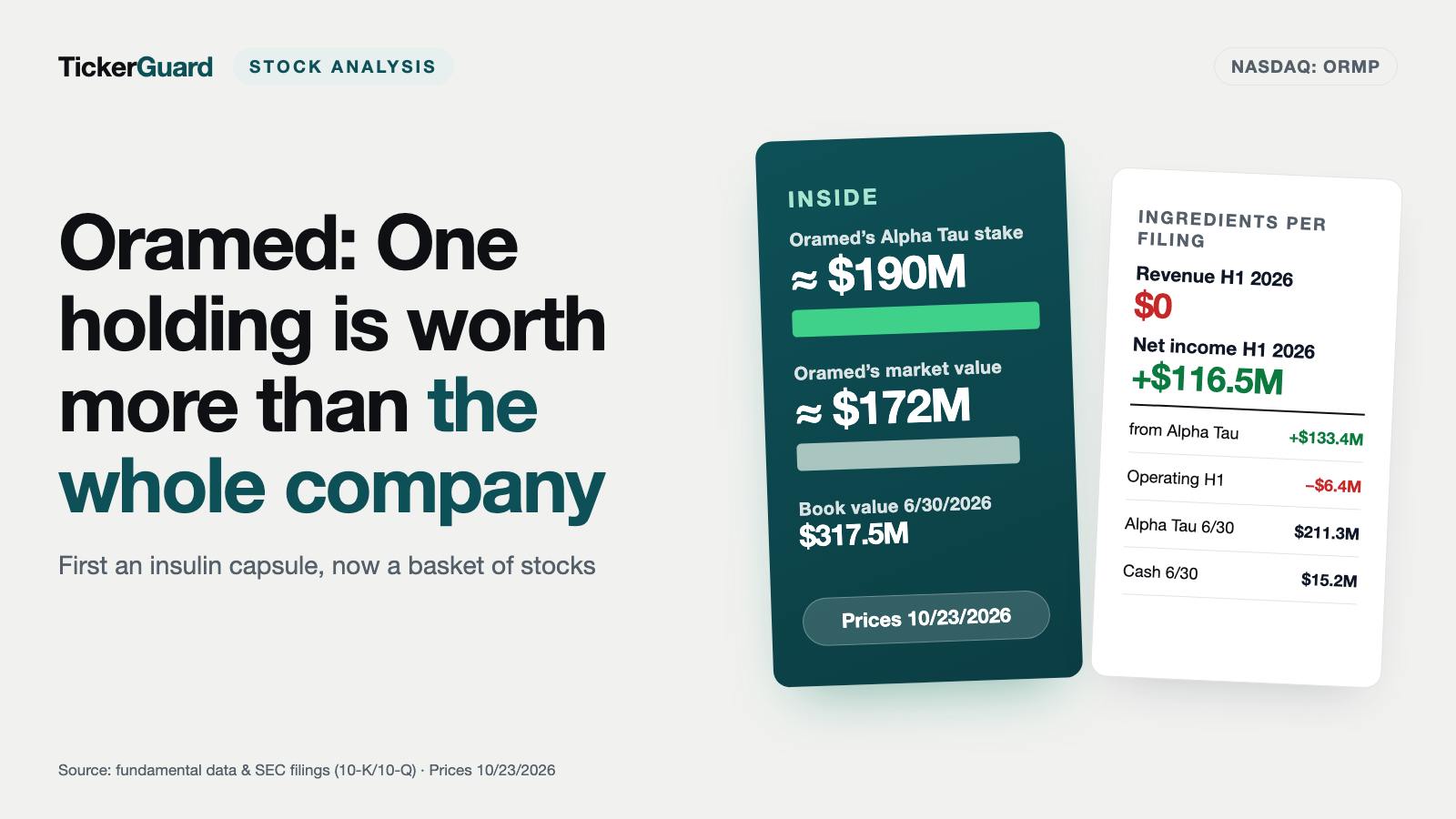
Oramed set out to bring insulin to market as a capsule. Today it has no product of its own, yet it booked $116.5 million in net income in the first half of 2026 — almost all of it from the rising share price of a single holding. On October 23, 2026, that Alpha Tau share package alone was worth about $190 million, all of Oramed on the stock market about $172 million. We read the annual and quarterly reports, the current reports and the filings of its most important borrower through October 2026. What we found is a holding company whose value sits on paper and whose use is decided by a board shielded from takeovers.
 Thomas Mücke
Founder & Publisher
As of Today
As of: October 23, 2026
- Closing price
- 4.10 $ +0.20%
- Market Capitalisation
- 0.2 $B
- P/E
- 1.6
- Growth Score
- 4/10
- AAQS
- 5/10
Price change since October 23, 2026: -0.7%
This analysis has a cut-off date. The Stock Guard tells you when something material changes in the numbers. Reserve your free spot
Chart
Interactive price chart (TradingView).
52-week range: 2.20 $ to 5.30 $ · Last price: 4.10 $ (As of: October 23, 2026)
Note: pure fact-based analysis, not investment advice and not a solicitation to buy or sell. All figures without guarantee.
We all sort the world by labels. If the box says “Pharmaceuticals” and the industry field says “biotechnology,” we picture a lab, a clinical trial, a drug whose approval we are betting on. Psychologists call this the representativeness heuristic: we judge something by how closely it resembles the picture we have of its category — and stop checking what is actually inside.
With Oramed Pharmaceuticals, the ingredients list is worth a look. The company became known for an insulin capsule meant to spare people with diabetes the needle. Today Oramed has no product of its own and no revenue — and still booked $116.5 million in net income in the first half of 2026. Let’s make a deal: before we talk about a “cheap biotech stock,” let’s read the filings with the U.S. securities regulator, the SEC, together and see what this box really contains.
The tension running through this analysis: on paper, Oramed is rich — equity stood at $317.5 million on June 30, 2026, well above its market value. But two thirds of that wealth consists of the shares of a single other company, another part of claims on a borrower with going-concern doubts, and every decision about it rests with a board that has adopted a rights plan against takeovers. In the end, the call is yours.
What Oramed actually does today
The short version is in Note 1 of the latest quarterly report: since selling its insulin technology, Oramed no longer runs clinical development itself and has no business that generates revenue. In its management’s discussion, the company describes itself as a “strategic healthcare operating company” that takes stakes in other companies and aims to guide them actively. The word “operating” is no accident — uncomfortable truth No. 3 shows why.
“Following the transfer of the Company’s oral insulin (POD™) technology and related intellectual property to OraTech and the closing of the Lifeward Transaction, the Company no longer conducts clinical development activities directly and has no revenue-generating operations.”
— Oramed Pharmaceuticals, Quarterly report on Form 10-Q for Q2 2026, Note 1

What is left looks more like a mixed basket than a drug company. As of June 30, 2026, it mainly held:
- Alpha Tau Medical (Nasdaq: DRTS) — about 17 percent of an Israeli developer of a radiation therapy that places tiny radioactive sources directly inside a tumor. Oramed paid about $38.2 million for 14,469,335 shares, roughly $2.64 apiece, and also received warrants on 3,237,000 shares for providing investor relations services. Carrying value: $211.3 million. How Alpha Tau itself is funded is covered in our analysis of Alpha Tau Medical.
- A real estate loan in Jerusalem — $26.9 million paid out in April 2025 to a project company to buy a property, at 12 percent interest, secured by a lien. On March 31, 2026, the maturity was extended to April 2, 2028 and the loan was converted into 100 million shekels. Fair value: $38.4 million.
- Claims on Scilex — what is left of a $101.9 million loan made in 2023 to the U.S. pain-medication company, plus a convertible note and royalties. Fair value: $35.4 million.
- Lifeward (Nasdaq: LFWD) — the maker of the ReWalk exoskeleton, a kind of robotic walking aid for people with spinal cord injuries. It took over the insulin technology in March 2026 and paid in its own stock and warrants: at closing, Oramed received 45 percent of Lifeward’s shares, plus warrants and 4 percent of ReWalk revenue for up to ten years. In addition, Oramed used its own cash at closing to buy a $9 million Lifeward convertible note with further warrants. Fair value of all Lifeward positions: $28.4 million.
- Nano Dimension — shares of an Israeli 3D-printing specialist worth $21.9 million, plus put and call options on Nano shares worth a net $0.3 million. Oramed showed up at Nano as an activist shareholder in January 2026. On July 20, 2026 it sold a block of 8.2 million shares at $1.55 and was left with 6,879,708 shares; the same day, according to its ownership filing, it unwound its Nano options (including buying back written calls on 8.2 million shares for about $1.26 million). Closing all options brought net proceeds of about $1.19 million by August 10, 2026, according to the quarterly report; since then Oramed holds no option positions.
- Cash — $15.2 million, down from $45.9 million at year-end 2025.
Smaller items add up to $18.8 million: a plot of land near Jerusalem, participations in two U.S. real estate loans, a profit-sharing loan for an Israeli real estate project, a fund interest, and other investments and receivables. In July 2026, a joint venture for self-storage facilities in Buffalo, New York, was added. A pharmaceutical company investing in storage units — at this point the label no longer matches the box.
The oral insulin lives on at Lifeward. Before the sale, Oramed gave the new subsidiary OraTech $6.5 million for a 60-patient trial and, per the quarterly report, has to manage it. If the trial costs more, Oramed alone bears the excess; by its own estimate it does not expect that to happen.
Company history for investors
-
2006
Integrated Security Technologies becomes Oramed
Incorporated in 2002 (Iguana Ventures until 2004, then Integrated Security Technologies), the company has been called Oramed since 2006, with Nadav Kidron as CEO.
-
2023
Phase 3 failure, Scilex loan
In January, the Phase 3 trial misses its endpoints. In September, Oramed lends Scilex $101.9M — the start of its conversion into a holding company.
-
2025
Stake in Alpha Tau
In April, Oramed buys about 17% of Alpha Tau at $2.612 per share. In November, a rights plan against takeovers at 15% follows.
-
2026
Insulin to Lifeward, profit from Alpha Tau
Special dividend of $0.25 in January, sale of the insulin technology on 03/25, first-half net income of $116.5M from revaluations. Close on 10/23: $4.13.
How the stock landed on our desk
Oramed made our research list through wallstreet-online’s list of the most discussed and most searched stocks among German retail investors (October 2026). That is an attention signal, not a quality signal.
The Oramed stock page (as of October 24, 2026) shows a split picture. The stock appeared in 15 strategies of our in-house stock scanner, 14 of them trend and breakout scanners such as “Stan Weinstein: Stage 2” or “Near 52-week high” — the share price had run. The fifteenth is a warning scanner built on our study of 792 U.S. bankruptcies. It counts, among other things, negative operating cash flow over four quarters and late filings; Oramed filed for an extension of its first-quarter report on May 15, 2026. For a company with $317.5 million in equity and no debt, that is not a bankruptcy signal, but it is a hint: the ongoing business consumes cash.
The Piotroski score, a health check made of nine yes-or-no questions on profit, cash flow, leverage and efficiency, stands at 3 out of 9. That is weak; a rock-solid company scores 7 to 9. The Altman Z″, an early-warning system for insolvency risk, reads 13.77, “resilient” — no surprise for a balance sheet without loans. Both scores apply yardsticks built for operating companies to a holding company, which explains the contradiction.
Oramed is a Delaware corporation headquartered in New York with a research subsidiary in Israel, and it reports to the SEC as a domestic issuer. Its fiscal year is the calendar year. We reviewed the annual reports (10-K) for 2024 and 2025, the quarterly reports (10-Q) through the second quarter of 2026, filed on August 10, 2026 — the latest periodic report — all current reports (8-K) through September 17, 2026, the proxy statement, ownership and insider filings (Form 4) through October 2, 2026, and the quarterly report and current reports of the borrower Scilex through September 29, 2026. Oramed’s third-quarter report was not yet available on October 24, 2026.
The numbers over the years — given their due
First, what genuinely impresses. After the Phase 3 trial failed in January 2023, Oramed could have become one of the many biotech shells that slowly burn through their cash — how rarely late-stage trials succeed is the subject of our Phase 3 study. Instead, equity grew from $163.8 million at the end of 2023 to $146.3 million (2024), $199.7 million (2025) and $317.5 million on June 30, 2026. That is about $7.68 per share.
Some decisions clearly paid off. The Alpha Tau shares cost about $2.64 on average and stood at $12.58 on June 30, 2026. According to the annual report, Scilex had repaid $69.2 million of the 2023 loan by March 2026 and paid $28.5 million to buy back warrants. Oramed has no debt, bought back 1,155,367 of its own shares at $2.23 from its former partner HTIT in October 2025 (about $2.6 million) and paid a special dividend of $0.25 per share in January 2026, a little over $10 million to shareholders in total. And head-office costs are modest: according to the annual report, 13 people worked for Oramed at the end of 2025.
Where the profits come from is visible in the income statement over the years:
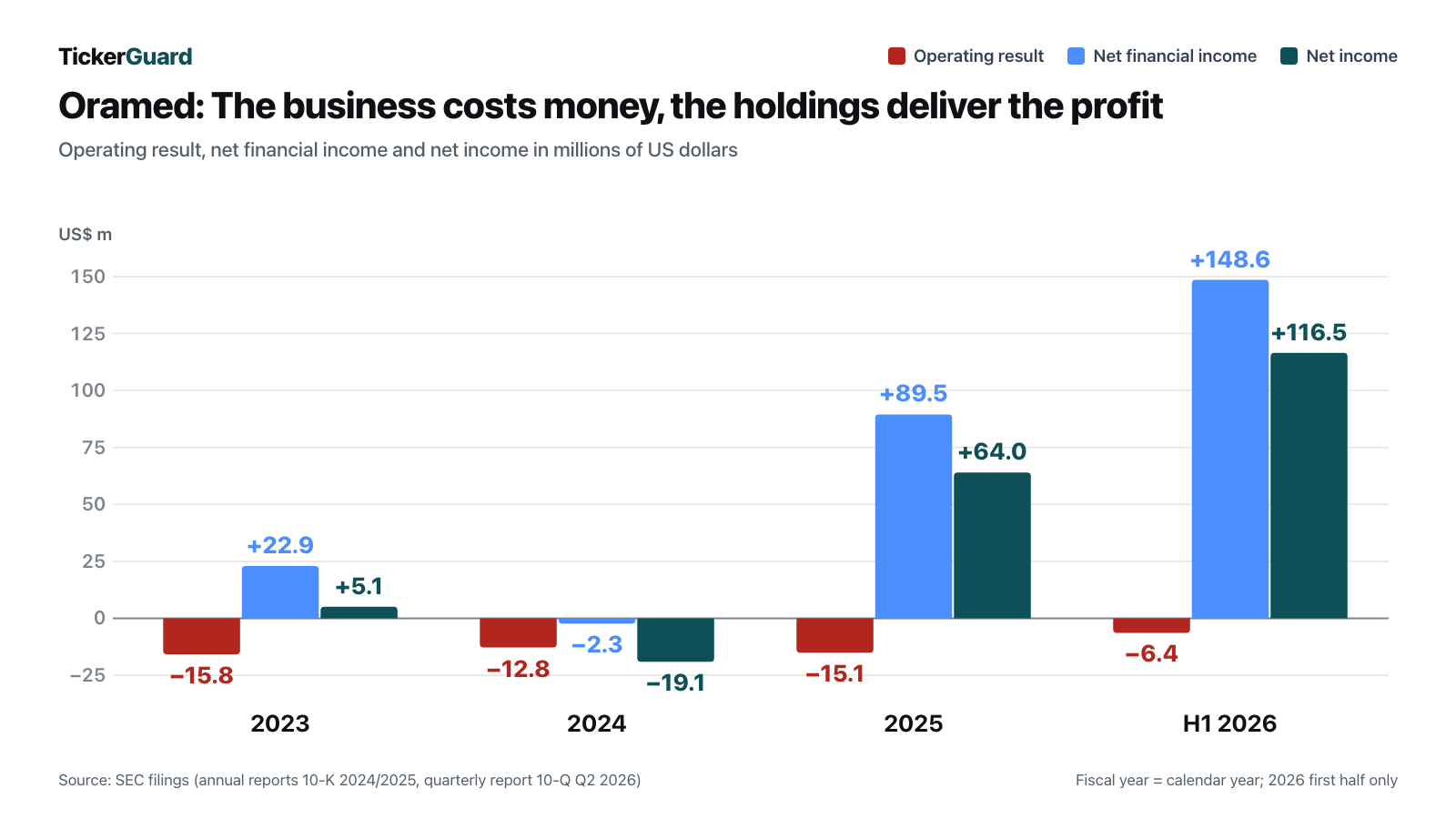
The picture is unambiguous: the actual business has not made money in any year. Operating cash flow — the cash that actually comes in from running the business — was negative in each of those periods as well: minus $10.3 million, minus $8.4 million, minus $9.1 million and minus $3.1 million. The profits come overwhelmingly from net financial income, meaning interest and changes in the value of the stakes. On top of that, the first half of 2026 brought $8.9 million of other income, mainly a $5.8 million gain on the sale of the insulin rights and $2.0 million from a terminated license agreement for South Korea — both one-offs. The bottom line: net income of $5.1 million (2023), a net loss of $19.1 million (2024), net income of $64.0 million (2025) and $116.5 million in the first half of 2026. Rule of thumb: a profit that comes from another company’s stock quote is real wealth — but it is not cash flowing into the till.
So much for the good news. Now for what lies behind it.
What the reports say — the uncomfortable truths
A filing with the SEC is made under penalty of law. What follows is in there — you just have to read all the way into the notes.
Uncomfortable truth No. 1: The profit is Alpha Tau’s stock quote
Oramed carries its Alpha Tau stake at market value. When Alpha Tau’s share price rises, Oramed’s profit rises — without a single dollar changing hands. Between December 31, 2025 ($4.95) and June 30, 2026 ($12.58), the price more than doubled. The consequence is in Note 8:
“For the six and three months ended June 30, 2026, the Company recognized an unrealized gain of $133,418 and $96,985, respectively, on its investment in Alpha Tau, which was recorded within ‘financial income, net’ in the consolidated statement of comprehensive income.”
— Oramed Pharmaceuticals, Quarterly report on Form 10-Q for Q2 2026, Note 8a (amounts in thousands of dollars)

The Alpha Tau gain alone ($133.4 million) was larger than total first-half net income ($116.5 million). What that means for the balance sheet shows up in the breakdown of assets:
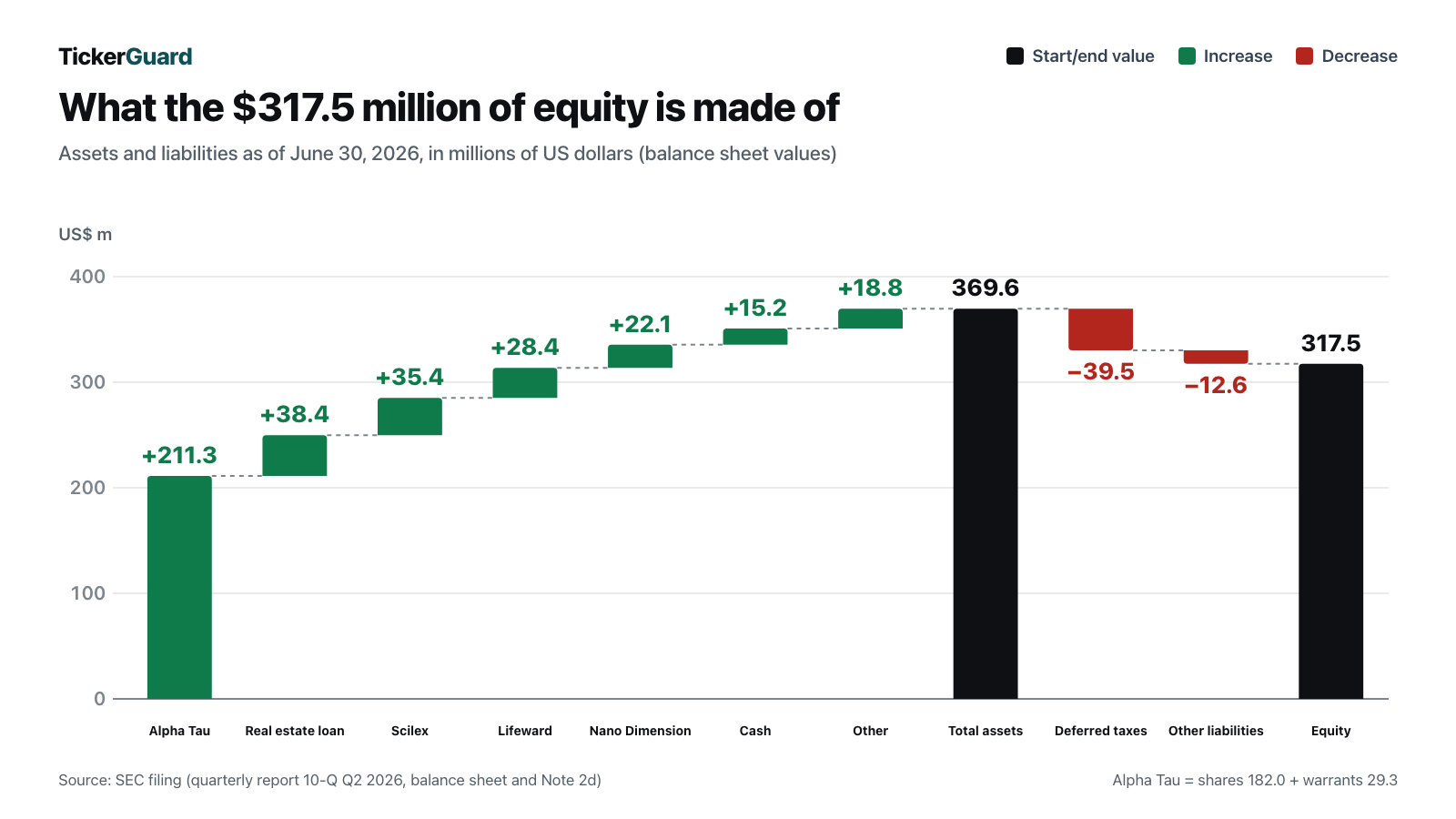
Two thirds of equity therefore hinge on a single stock — and Alpha Tau itself is, according to Oramed’s report, a “clinical-stage oncology company” that lost $68.8 million in the first half of 2026. Imagine your neighbor proudly telling you his net worth has doubled — and only mentioning when asked that two thirds of it sits in the stock of a single cancer-research company. That need not be a bad thing — but it is not a drug company. And it moves with the stock: if Alpha Tau’s price fell by half, the value of the shares alone ($182.0 million on June 30, 2026) would drop by about $91 million — about $2.20 per Oramed share before taxes, against a book value of about $7.68. The deferred tax liability of $39.5 million also shows that selling at a gain would cost taxes; per Note 15, it was “mainly related to the increase of the fair value investment in Alpha Tau.” And a 17 percent block of a stock that, as Oramed itself writes in its annual report, has “relatively low trading volume” cannot be sold at the quoted price in an afternoon.
Uncomfortable truth No. 2: The second-largest borrower is short of cash itself
In 2023, Oramed lent the U.S. pain-medication company Scilex $101.9 million, secured by substantially all of Scilex’s assets. Much of it has come back. The rest has been deferred again and again, most recently on June 25, 2026: $0.5 million immediately, $5 million by July 31 and the balance by September 30, 2026. As of June 30, 2026, $29.5 million was still outstanding under Tranche A. Then this sentence:
“As of August 10, 2026, the Company had not yet received the $5,000 payment due on July 31, 2026.”
— Oramed Pharmaceuticals, Quarterly report on Form 10-Q for Q2 2026, Note 4a (amount in thousands of dollars)

How the borrower is doing, Scilex reported to the SEC itself:
“As of June 30, 2026, we had cash and cash equivalents of approximately $0.6 million. Our management has concluded that there is substantial doubt about our ability to continue as a going concern for one year after the date that the unaudited condensed consolidated financial statements are issued.”
— Scilex Holding, Quarterly report on Form 10-Q for Q2 2026, Item 2 (MD&A)
On September 25, 2026, Scilex also expanded an uncommitted credit line — one with no obligation to lend — for Vivasor, a company whose CEO is also Scilex’s CEO, from $20 million to $30 million (current report filed September 29, 2026). For Oramed as a creditor, that is a warning sign: a borrower with hardly any cash expands an uncommitted credit line for a company run by its own CEO to up to $30 million while, as of the last reported status on August 10, the July installment owed to Oramed was still outstanding. The filing does not say whether any money was drawn. Whether Scilex paid the balance by September 30, 2026, Oramed had not disclosed in any current report as of October 24, 2026. If Scilex does not pay, Oramed may keep the first $1.5 million as a fee, and the rest is to be settled in Scilex stock — on terms still to be agreed. Oramed values its Scilex positions at $35.4 million, about 11 percent of equity. To value Tranche A, it applies a discount rate of about 112 percent, according to Note 4 — a sign of how high it rates the default risk itself.
Uncomfortable truth No. 3: A pharma company that no longer is one — and is not allowed to become a fund
With the Lifeward sale, Oramed has not abandoned the oral insulin, but handed it over. Whatever the trial yields reaches Oramed only through its Lifeward stake (45 percent of the shares at closing, plus warrants) — a company that, according to Oramed’s report, lost $10.8 million in the first quarter of 2026 alone (the report gives no more recent Lifeward figures). Under certain conditions, Lifeward can require Oramed to buy another $9 million of convertible notes. And the $6.5 million trial budget is capped only for Lifeward, not for Oramed.
At the same time, Oramed faces a legal constraint that the annual report spells out: whoever mainly holds securities quickly counts as an investment company in the U.S. and falls under the strict 1940 law for funds.
“In order not to be regulated as an investment company under the 1940 Act, unless we can qualify for an exclusion, we must ensure that we are engaged primarily in a business other than investing, reinvesting or trading in securities and that our activities do not include investing, reinvesting, owning, holding or trading ‘investment securities’ constituting more than 40% of our total assets (exclusive of U.S. government securities and cash items) on an unconsolidated basis.”
— Oramed Pharmaceuticals, Annual report on Form 10-K for 2025, Item 1A (Risk Factors)
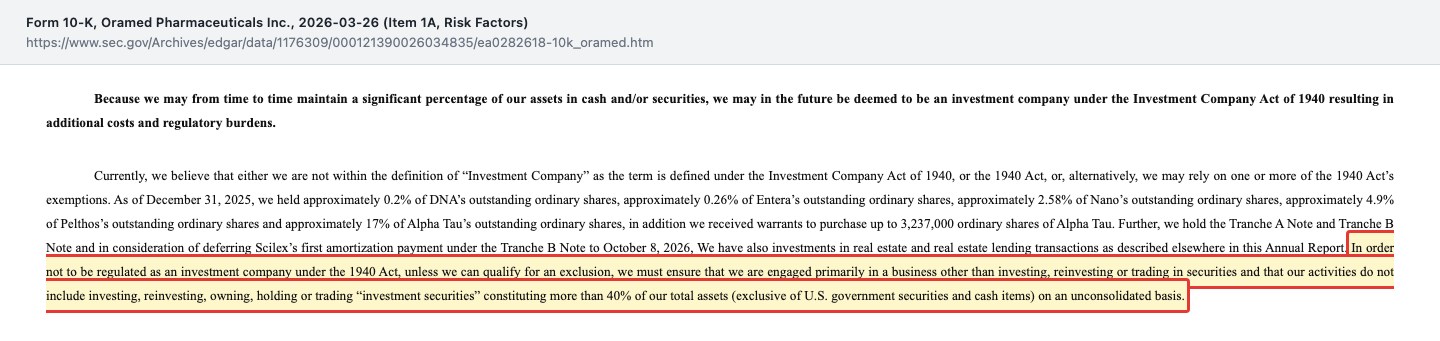
Oramed writes that it believes it either falls outside the Act or can rely on an exemption. One factor is likely that stakes with significant influence, such as Alpha Tau (with the right to nominate two of eight directors) and Lifeward, can be treated differently from pure financial investments; the report does not explain this in detail. If the threshold applied, Oramed would have to register as a fund or dispose of holdings. Rule of thumb: a company that may be neither a drug developer nor a fund has to keep proving what it is.
Uncomfortable truth No. 4: Shareholders pay in shares
Without revenue, one cost center remains: the head office. General and administrative expenses rose to $4.8 million in the first half of 2026 (prior year: $3.8 million); in the second quarter alone they were $2.8 million versus $1.5 million. A large part is paid in stock: per the statement of changes in equity, equity compensation added 2.04 million new shares in the first half of 2026, from 39.28 million to 41.31 million — up 5.2 percent in six months. The related expense was $3.1 million. Dilution means your slice of the pie gets smaller every time new slices are cut.
The compensation table in the proxy statement lists 2025 pay of $4.77 million for CEO Nadav Kidron (2024: $2.10 million), $2.17 million for Chief Scientific Officer Miriam Kidron, his mother, on whose research the insulin technology is based, and $1.88 million for Chief Operating and Business Officer Joshua Hexter — $8.8 million in total, mostly stock awards at grant-date value. On September 15, 2026, shareholders added another 3 million shares to the equity plan, bringing it to 12.5 million, with 11.34 million votes for and 6.08 million against. Three million shares would be a little more than 7 percent of the 41.6 million shares outstanding on August 10, 2026.
Uncomfortable truth No. 5: A shield against takeovers
On November 17, 2025, Oramed adopted a rights plan, known on Wall Street as a “poison pill.” If anyone buys 15 percent or more of the stock, all other shareholders may buy new shares cheaply and the buyer’s stake gets diluted. The plan runs for three years. It makes a takeover against the board’s will considerably harder — and with it the route by which a buyer could close the discount to book value for all shareholders.
The irony: at Nano Dimension, Oramed itself appeared as an activist shareholder in January 2026. In its ownership filing, Oramed and Nadav Kidron announced they wanted to discuss with Nano’s management, among other things, the share price “relative to the value of the Issuer’s assets” and the composition of the board. That is exactly the question at Oramed itself. At the September 15, 2026 annual meeting, up to about a third of the votes cast went against individual directors; according to the proxy, officers and directors together held 20.77 percent of the shares, Nadav Kidron alone 8.21 percent. Kidron also sits on the board of Alpha Tau and, since March 2026, on that of Lifeward, there together with Miriam Kidron and Oramed director Yehuda Reznick — the threads of the large holdings run through the same leadership.
Valuation: what the market pays for Oramed
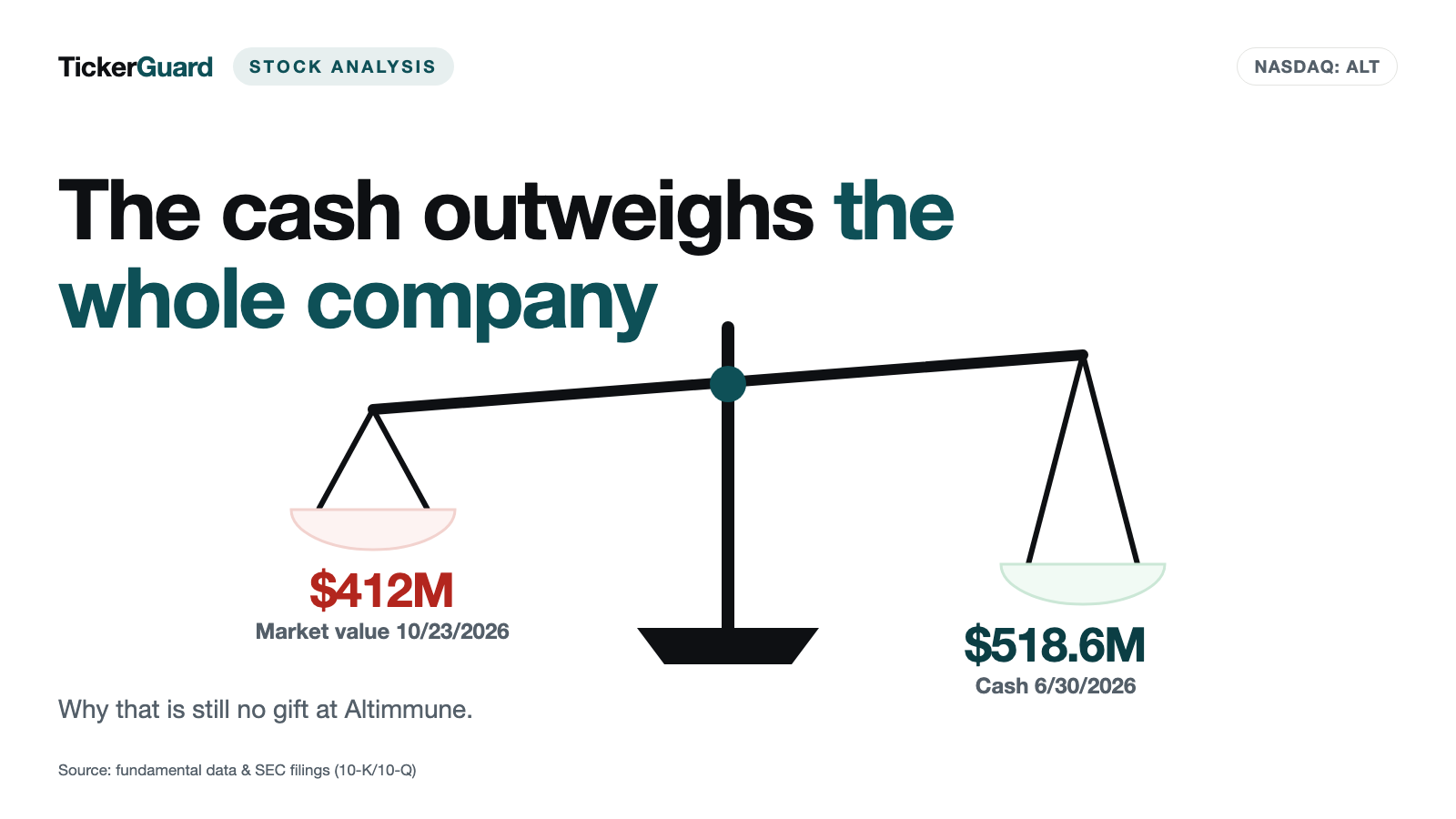
At the October 23, 2026 close of $4.13 and 41,597,354 shares (as of August 10, 2026, cover page of the quarterly report), Oramed is worth about $172 million. That implies:
- a price-to-book ratio of about 0.54 (equity on June 30, 2026: $317.5 million, about $7.68 per share). The market deducts almost half of book value;
- a price-to-earnings ratio that says nothing: earnings per share were $2.85 in the first half of 2026 and consist almost entirely of revaluation gains that could just as easily turn into losses in the next half;
- a sum of the parts that hinges on one number: at Alpha Tau’s October 23, 2026 close of $13.16, the 14,469,335-share package was worth about $190 million, more than Oramed’s entire market value. Arithmetically, the Alpha Tau package already covers the market value; the other positions — real estate loan, Scilex, Lifeward, Nano, cash — would not be paid for in it. Net, it is tighter: subtract the full $39.5 million of deferred taxes (as of June 30, 2026, mainly from the rise in Alpha Tau’s value, per Note 15) and add the $15.2 million of cash, and you get about $166 million — just below the market value. Because Alpha Tau’s October price was above its June 30 level, the tax burden at the October price would, if anything, be somewhat higher. The arithmetic difference of about $6 million stands against the other positions, with a combined fair value of $124.4 million (June 30, 2026), and the Alpha Tau warrants; against that stand head-office costs and the risks in Scilex and Lifeward.
Why does the market pay so little? Holding companies almost always trade at a discount to their parts, and at Oramed many reasons come together: taxes on a sale, a large block that is hard to sell, running costs without income, claims on a wobbly borrower, a management team that decides over the assets and is shielded from takeovers by the rights plan, and a strategy that does not have a name yet. How such a discount can persist for years at a founder-controlled holding company is shown in our analysis of Biglari Holdings.
The professionals’ view does not help much: as of October 23, 2026, the fundamental data contain only a single price target of $7 for Oramed, without saying how many analysts stand behind it. That is no consensus.
Opportunities and risks at a glance
What speaks for Oramed:
- Substance below the share price. Equity of $317.5 million on June 30, 2026; market value on October 23, 2026 about $172 million.
- A purchase that paid off. Alpha Tau shares bought at about $2.64 on average, at $12.58 on June 30, 2026; the ReSTART pivotal trial is expected to report data in late 2026 or early 2027.
- No debt. The balance sheet carries no loans. Administrative costs ($4.8 million in the first half of 2026) are small relative to the assets — but noticeable against a market value of about $172 million: the three top executives alone received a combined $8.8 million for 2025, about 5 percent of it.
- Cash returned to shareholders. Buyback of 1.16 million shares in October 2025 and a special dividend of $0.25 in January 2026.
- A second chance for the insulin. Through 45 percent of Lifeward and a revenue share, Oramed keeps a stake in the capsule; the trial is prefunded with $6.5 million of Oramed’s money.
What speaks against it:
- Concentration risk. Two thirds of equity hinge on Alpha Tau, a clinical-stage company with a $68.8 million first-half loss.
- Shaky borrower. $35.4 million of Scilex claims on a borrower with $0.6 million in cash and going-concern doubts; one installment was overdue.
- No business. Zero revenue, negative operating cash flow every year; the strategy is a list of possibilities.
- Open-ended trial costs. If the insulin trial costs more than the $6.5 million provided, Oramed bears the overrun alone — the budget is capped only for Lifeward.
- Dilution. Share count up 5.2 percent in one half-year through compensation, equity plan raised by another 3 million shares.
- Control. Rights plan against takeovers, Nadav Kidron as CEO and chairman, combined 2025 pay of $8.8 million for the three top executives.
- Regulation. The 40 percent threshold for investment companies limits how Oramed may deploy its assets.
A human conclusion
Remember the label from the beginning — “Pharmaceuticals,” industry biotechnology? After reading the filings, it is clear that the box contains something other than what the label says. Whoever buys Oramed is not buying an insulin hope, but mainly a block of Alpha Tau shares, plus an Israeli real estate loan, claims on a cash-strapped pain-medication company and a minority stake in an exoskeleton maker — run by Nadav Kidron and a board that has adopted a rights plan against takeovers.
To be fair: this is not a broke company burning its last dollars. Oramed has no debt, its most important bet has paid off, and money went back to shareholders. Whether the discount is an opportunity or deserved depends on three things: how the Alpha Tau trial turns out, whether Scilex pays, and what management intends to do with the assets. The next milestones are the third-quarter 2026 report and Alpha Tau’s trial data. The next time you come across a “cheap biotech stock,” read the ingredients list first.
What you make of it is your decision. And that is how it should be.
Sources and data
- Quarterly report on Form 10-Q for Q2 2026 (August 10, 2026, latest periodic report) and 10-Q for Q1 2026 (May 19, 2026; extension via NT 10-Q of May 15, 2026)
- Annual report on Form 10-K for 2025 (March 26, 2026) and 10-K for 2024 (March 27, 2025); quarterly reports for Q3 2025 and Q2 2025
- Current reports on Form 8-K: HTIT share repurchase, end of joint venture, shareholder letter (October 24, 2025), rights plan (November 17, 2025), Scilex warrant repurchase (December 30, 2025), special dividend (January 7, 2026), Lifeward agreement (January 14, 2026), Lifeward closing (March 31, 2026), bylaws and Scilex extension (June 30, 2026), annual meeting results (September 17, 2026)
- Proxy statement (DEF 14A, August 3, 2026) with compensation table and ownership
- Oramed ownership filings: Nano Dimension, Schedule 13D (January 29, 2026) and 13D/A (July 22, 2026), Lifeward, Schedule 13D (May 14, 2026)
- Counterparty Scilex: quarterly report on Form 10-Q for Q2 2026 (August 14, 2026) and 8-K on the Vivasor credit line (September 29, 2026)
- Price and ratio data: source fundamental data, as of October 23, 2026; scanner hits and ratio tiles per the stock page, as of October 24, 2026
Data as of: company figures as of December 31, 2025 and June 30, 2026 (latest periodic report of August 10, 2026); current reports on Form 8-K reviewed through September 17, 2026, ownership and insider filings through October 2, 2026, no further Oramed current report through October 24, 2026. Prices: closing prices of October 23, 2026. The filings state amounts in thousands of dollars; we round to millions. Computed values (market value, price-to-book ratio, book value per share, value of the Alpha Tau package at the October price, share of equity) are our own back-of-the-envelope calculations and labeled as such. The ratio tiles on this page show the current database state and may differ from the values used here.
Disclaimer: This article is journalistic commentary and not investment advice. It is not a recommendation or a solicitation to buy or sell securities. Stocks can be highly volatile; you can lose some or all of the money you invest. We disclose the operator’s own positions daily; if one exists, it is noted at the top of this analysis.
Key figures at a glance
All monetary figures in millions of $; earnings per share as reported.
| Metric | 2021 | 2022 | 2023 | 2024 | 2025 |
|---|---|---|---|---|---|
| Revenue | 2.7 | 2.7 | 1.3 | 0.0 | 2.0 |
| Operating Income (EBIT) | -24.2 | -40.6 | -15.8 | -12.8 | -15.1 |
| Net Income | -22.2 | -37.8 | 5.5 | -19.1 | 64.1 |
| Net Margin | -822.7% | -1,397.1% | 412.3% | – | 3,202.5% |
| Earnings Per Share | -0.78 $ | -0.97 $ | 0.14 $ | -0.47 $ | 1.51 $ |
Source: fundamental data & SEC filings (annual and quarterly reports, 10-K/10-Q)
Our Bottom Line at a Glance
- Substance positive
- Equity of $317.5M on 06/30/2026 with no debt; market value on 10/23/2026 about $172M (price-to-book about 0.54).
- Operating business negative
- No revenue-generating business since 03/25/2026; operating result and operating cash flow negative in every year since 2023 (H1 2026: −$6.4M and −$3.1M).
- Earnings quality negative
- First-half 2026 net income of $116.5M rests on revaluation gains, $133.4M unrealized on Alpha Tau alone; against it, $39.5M of deferred taxes.
- Concentration and counterparties negative
- Alpha Tau $211.3M (two thirds of equity); Scilex claims of $35.4M on a borrower with $0.6M in cash and going-concern doubts.
- Capital returns positive
- Buyback of 1,155,367 shares at $2.23 (October 2025) and a special dividend of $0.25 per share (January 2026).
- Governance negative
- Rights plan at 15% since 11/17/2025; 2.04M new shares through compensation in H1 2026 (+5.2%); combined 2025 pay of the three top executives $8.8M.
Oramed is no longer a drug company but a holding company without an operating business, and two thirds of its value hinge on its Alpha Tau shares. The balance sheet is debt-free and equity is well above the market value, but the profit consists of revaluation gains, an important borrower is short of cash, and a rights plan makes takeovers harder. Not investment advice.
What Our Rating Means
Open questions
The business works in principle, but one material question is open. As long as it stays open, our findings do not carry a quality verdict.
Yellow, because Oramed has had no business of its own since March 2026, and its profit hangs almost entirely on the share price of a single stock (Alpha Tau) and on the cash of a struggling borrower (Scilex). It is not red: the company has no debt, its filings contain no going-concern doubt, and the cash outflow from operations of about $9 million a year is covered for years by cash and listed holdings. That no cash comes from operations despite the profit is due to the openly disclosed fair-value accounting for its stakes — a warning sign, but not an accounting breach. The low share price relative to book value is a price question and does not change the color. The decision is yours.
A journalistic assessment by our editorial team at the time of the deep dive, based on public sources — not investment advice and not a solicitation to buy or sell. Your personal circumstances (investment goals, risk capacity, taxes) cannot be taken into account. What our levels mean, how verdicts are formed, and what conflicts of interest exist →
Worth Noting
- This analysis was prompted by wallstreet-online’s list of the most discussed and searched stocks among German retail investors (October 2026), not by a scanner hit; in our in-house stock scanner the stock also appeared in 15 strategies (as of 10/24/2026).
- Risk of confusion: industry classification and company descriptions in databases sometimes still describe Oramed as a developer of an insulin capsule in Phase 3. The August 10, 2026 quarterly report governs: no revenue-generating business of its own since the Lifeward sale on March 25, 2026.
- Basis: annual reports 10-K 2024 and 2025, quarterly reports 10-Q Q2 2025 through Q2 2026 (latest periodic report 08/10/2026), all 8-Ks through 09/17/2026 (the latest Item 2.02 8-K dates from 11/17/2025), DEF 14A of 08/03/2026, ownership and insider filings through 10/02/2026, Scilex 10-Q Q2 2026 and Scilex 8-K of 09/29/2026. As of 10/24/2026, Oramed had not disclosed whether the Scilex balance due 09/30/2026 was paid.
- Computed values are our back-of-the-envelope figures: market value from 41,597,354 shares (08/10/2026) times the $4.13 close on 10/23/2026; book value per share $317.473M divided by 41,314,211 shares (06/30/2026); Alpha Tau share package 14,469,335 shares times $13.16 (10/23/2026); two-thirds share $211.3M of $317.5M.
Stock Watch
This analysis is as of October 24, 2026. Stock Watch will tell you what's changed at ORMP since then.
Later $1 a month per stock — signing up is free, and you'll be the first to know when it launches.
The full analysis as a PDF for later
We will send you this analysis as a PDF — to print, file away, and read at your own pace. And we will add you to the free Stock Watch list for Oramed Pharmaceuticals Inc (ORMP), so you hear about it when something material in this analysis changes.
Frequently Asked Questions
Since selling its insulin technology to Lifeward on March 25, 2026, Oramed says it has no revenue-generating operations. It holds stakes and claims: about 17 percent of Alpha Tau Medical, 45 percent of Lifeward, claims on Scilex, a real estate loan in Jerusalem and shares of Nano Dimension. According to its quarterly report, it is evaluating “strategic alternatives.”
The Phase 3 trial ORA-D-013-1 missed its endpoints in January 2023. Oramed then moved the technology into its subsidiary OraTech and sold it in March 2026 to exoskeleton maker Lifeward, in exchange for 45 percent of Lifeward’s shares, warrants and a revenue share. Oramed is to manage a 60-patient trial, for which it handed over $6.5 million.
Oramed carries its stakes at market value. In the first half of 2026, Alpha Tau’s share price rose from $4.95 to $12.58, producing a $133.4 million unrealized gain. That led to $148.6 million in net financial income and $116.5 million in net income, even though the operating result was a loss of $6.4 million.
Oramed owns 14,469,335 Alpha Tau shares, about 17 percent, bought for about $38.2 million, plus warrants on 3,237,000 shares at $3.474 to $3.90. On June 30, 2026, the package was carried at $211.3 million, two thirds of equity. Oramed has the right to nominate two of Alpha Tau’s eight directors.
Oramed carries claims on Scilex at a fair value of $35.4 million (June 30, 2026). On that date Scilex had about $0.6 million in cash and reports substantial doubt about its ability to continue as a going concern. A $5 million installment due July 31, 2026 had not arrived by August 10; the rest was due by September 30, 2026, otherwise in Scilex stock.
At the October 23, 2026 close of $4.13, the market value was about $172 million, against equity of $317.5 million on June 30, 2026. The discount has reasons: two thirds sit in one stock, $39.5 million of deferred taxes, the Scilex risk, ongoing costs without revenue and a rights plan against takeovers.
Oramed paid a one-time special dividend of $0.25 per share in January 2026, about $10.1 million to shareholders in total, funded according to its current report from surplus capital. There is no regular dividend. In October 2025, Oramed also bought back 1,155,367 of its own shares at $2.23 from its former partner HTIT.
Found an error?
Did you spot a factual error, an outdated number, or a typo in this deep dive? Let us know briefly — your report goes straight to the editorial team.