The Wallet Trap at Altimmune: More Cash Than Market Value — and a Trial That Lives on It Until 2029
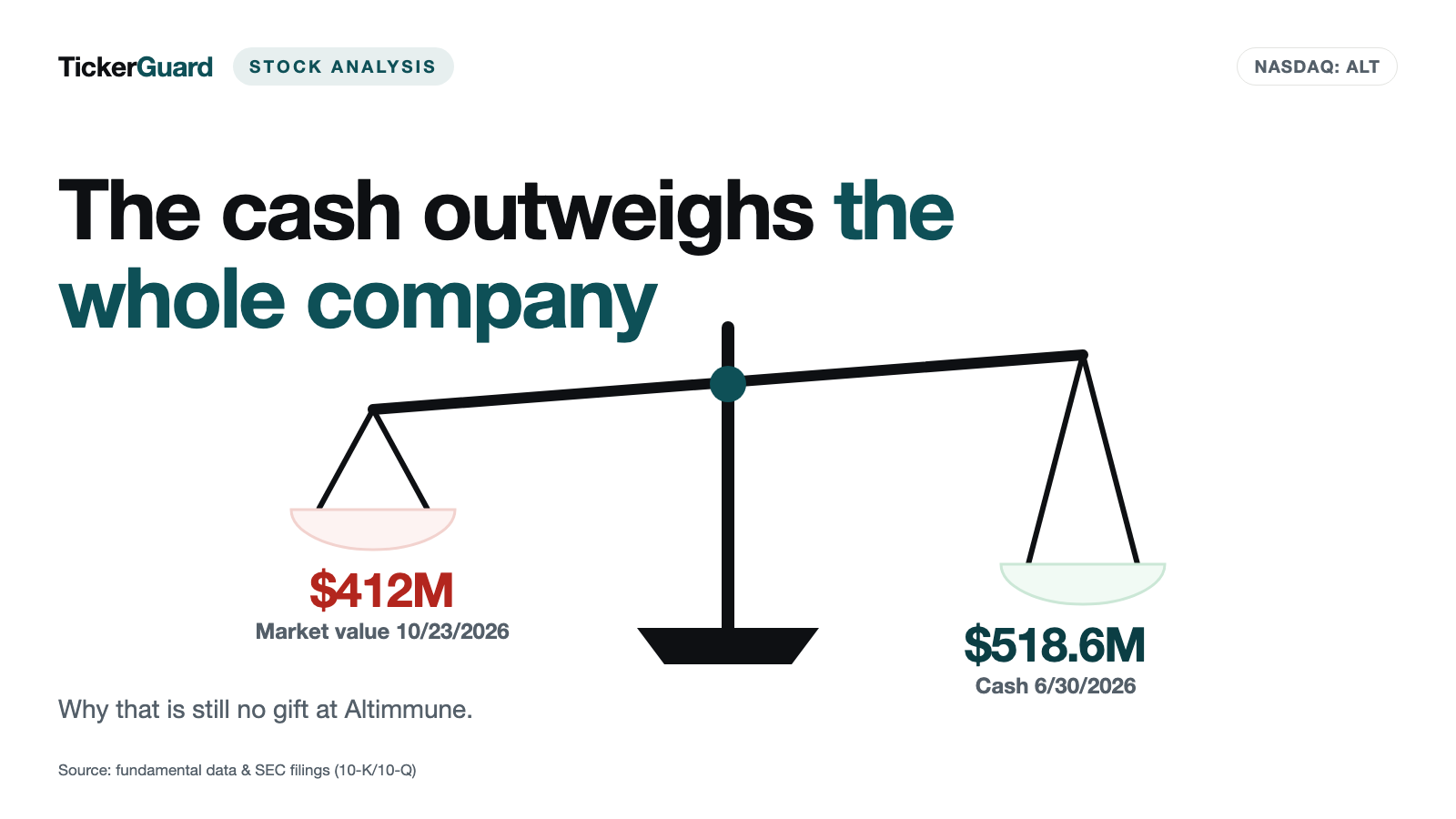
Altimmune held about $519 million in cash and securities as of June 30, 2026; on October 23, 2026, the market valued the entire company at about $412 million. A gift? No: the money belongs to a Phase 3 trial whose first answer does not arrive until 2029 — and per its own quarterly report, Altimmune still has to keep raising capital. Not investment advice — just a look inside a wallet that empties itself.
 Thomas Mücke
Founder & Publisher
As of Today
As of: October 23, 2026
- Closing price
- 2.10 $ -2.30%
- Market Capitalisation
- 0.4 $B
- Growth Score
- 4/10
- AAQS
- 1/10
Price change since October 23, 2026: -0.9%
This analysis has a cut-off date. The Stock Guard tells you when something material changes in the numbers. Reserve your free spot
Chart
Interactive price chart (TradingView).
52-week range: 2.10 $ to 6.20 $ · Last price: 2.10 $ (As of: October 23, 2026)
Note: pure fact-based analysis, not investment advice and not a solicitation to buy or sell. All figures without guarantee.
Imagine someone offers you a wallet. Inside are 100 dollars; the asking price is 80. Who would say no? That is exactly the feeling a stock triggers when its market value sits below the money the company has in the bank. This is the wallet trap: you count what is in the wallet, but not whose hand is already in it. At Altimmune (Nasdaq: ALT), a biotech company from Maryland, the contents are spelled out in black and white in the quarterly report:
“As of June 30, 2026, we had $63.1 million of cash, cash equivalents and restricted cash and $455.5 million of investments in marketable securities, of which $263.3 million is in short-term investments.”
— Altimmune, Inc., SEC quarterly report 10-Q for June 30, 2026, Item 2 MD&A “Capital Resources”
Together, that is $518.6 million. On October 23, 2026, the stock closed at $2.12; with 194,517,701 shares outstanding (as of August 7, 2026), that works out to a market value of about $412 million. In other words, the market paid less for the whole company than it had in the bank. The catch: this wallet empties itself — in the first half of 2026 alone, operations used $45.2 million in cash. Before you pocket the wallet, let’s look inside together: at the annual reports (10-K) and quarterly reports (10-Q) Altimmune filed with the U.S. securities regulator, the SEC, and at the current reports (8-K) through October 2026. Anyone who files false statements with the SEC risks penalties, which is why these reports are among the most reliable sources there are. At the end, the decision is yours.
What Altimmune Actually Does — One Company, One Drug, Three Liver Diseases
Altimmune develops drugs but does not sell any yet. According to its quarterly report, the company has “not generated any revenues from the sale of any products.” Everything rides on one drug candidate: pemvidutide. It acts on two docking points in the body at once, the receptors for glucagon and for GLP-1. You probably know GLP-1 from the big drugmakers’ weight-loss shots: it dampens appetite and cravings. Glucagon is meant to act directly on the liver and break down fat there. Think of pemvidutide as one key that opens two doors at once — one to appetite, one to the liver.
The drug is being tested in three diseases. First, MASH, an inflammatory fatty liver disease (formerly called NASH) in which the liver gradually scars. Second, alcohol use disorder (AUD), and third, alcohol-associated liver disease (ALD). Altimmune bought the drug in July 2019 by acquiring Spitfire Pharma; if pemvidutide hits certain sales targets after an approval, Altimmune owes up to $80 million under that deal. As of December 31, 2025, Altimmune had 57 full-time employees. Since January 1, 2026, the company has been run by Jerry Durso, the former CEO of liver specialist Intercept Pharmaceuticals; Altimmune plans to move its headquarters from Gaithersburg, Maryland, to Morristown, New Jersey, during 2026.
That defines the central tension of this analysis, and it runs through every chapter: Altimmune holds more cash than the market paid for the entire company in late October 2026 — but that money belongs to a Phase 3 trial whose first answer arrives in 2029.
Company history for investors
-
2019
Acquisition of Spitfire Pharma
With Spitfire, Altimmune buys pemvidutide. If it hits certain sales targets after an approval, up to $80 million in milestone payments come due.
-
2025
IMPACT data: inflammation yes, fibrosis not significant
On June 26, the close falls from $7.71 to $3.61. For shareholders, the moment the hope for quick fibrosis proof burst.
-
2025
New CEO, 48-week data
Jerry Durso takes over on January 1, 2026; the December 48-week data show better liver markers without a histology readout, yet the stock still drops 23%.
-
2026
Offering with warrants
In April, Altimmune raises $211.1 million net at $3.00 per package and issues 75 million warrants. More cash, but also far more shares.
-
2026
Phase 3 starts, RECLAIM positive
In July, RECLAIM meets its primary endpoint; in August, PERFORMA starts enrolling. For shareholders, the long wait for Phase 3 data in 2029 begins.
How the Stock Landed on Our Desk
No screening filter flagged Altimmune. Other investors’ attention did. Our in-house Reddit hype scanner recorded the ticker ALT on October 24, 2026 with 2 mentions in 24 hours, at a market capitalization of about $422 million according to fundamental data (based on the October 22, 2026 close). That is neither a recommendation nor a signal — it is a hint that somebody in a forum is telling a story.
The story is easy to see: the stock’s closing price fell from its 2026 high of $6.18 (January 27, 2026) to $2.12 on October 23, 2026, which is also the lowest close of the past twelve months. Since October 1, 2026 ($2.76) alone, it dropped 23 percent; no filing explains that decline. At the same time, according to fundamental data (as of October 23, 2026), about 46 million shares were sold short, just under a quarter of all 194.5 million shares outstanding — many investors are betting on further declines. On our scanner pages, the usual valuation metrics do not help much with Altimmune: without revenue or profit, there is neither a price-to-sales nor a price-to-earnings ratio. So keep this in mind from the start: at Altimmune, the cash is the only hard number — the question is how long it lasts and who ends up owning it.
The Numbers Over the Years — Honestly Assessed
First, what genuinely impresses — and at Altimmune, that is its ability to raise money. In 2026 alone, the company raised $70.3 million net through a registered direct offering with a new institutional investor (January), $211.1 million through an offering with warrants (April) and $8.7 million through at-the-market share sales (first half). After the April offering, four funds each reported stakes of at least 5 percent (Schedule 13G): health care specialists Deep Track Capital, RA Capital Management and TCG Crossover, plus Viking Global Investors. Add a $35.0 million loan from Hercules Capital. The result: $518.6 million in cash and securities as of June 30, 2026, almost double the $273.5 million at year-end 2025. Interest on that cushion alone brought in $4.5 million in the second quarter of 2026.
There is medical progress, too. In January 2026, the U.S. Food and Drug Administration (FDA) granted pemvidutide “Breakthrough Therapy” designation in MASH — a kind of fast lane for drugs that show clear advantages in early data. In July 2026, Altimmune reported that pemvidutide met the primary endpoint of the RECLAIM alcohol trial in 100 patients: heavy drinking days per week fell by 4.20 after 24 weeks, versus 2.75 on placebo. That is the good news. The chart shows the other side:
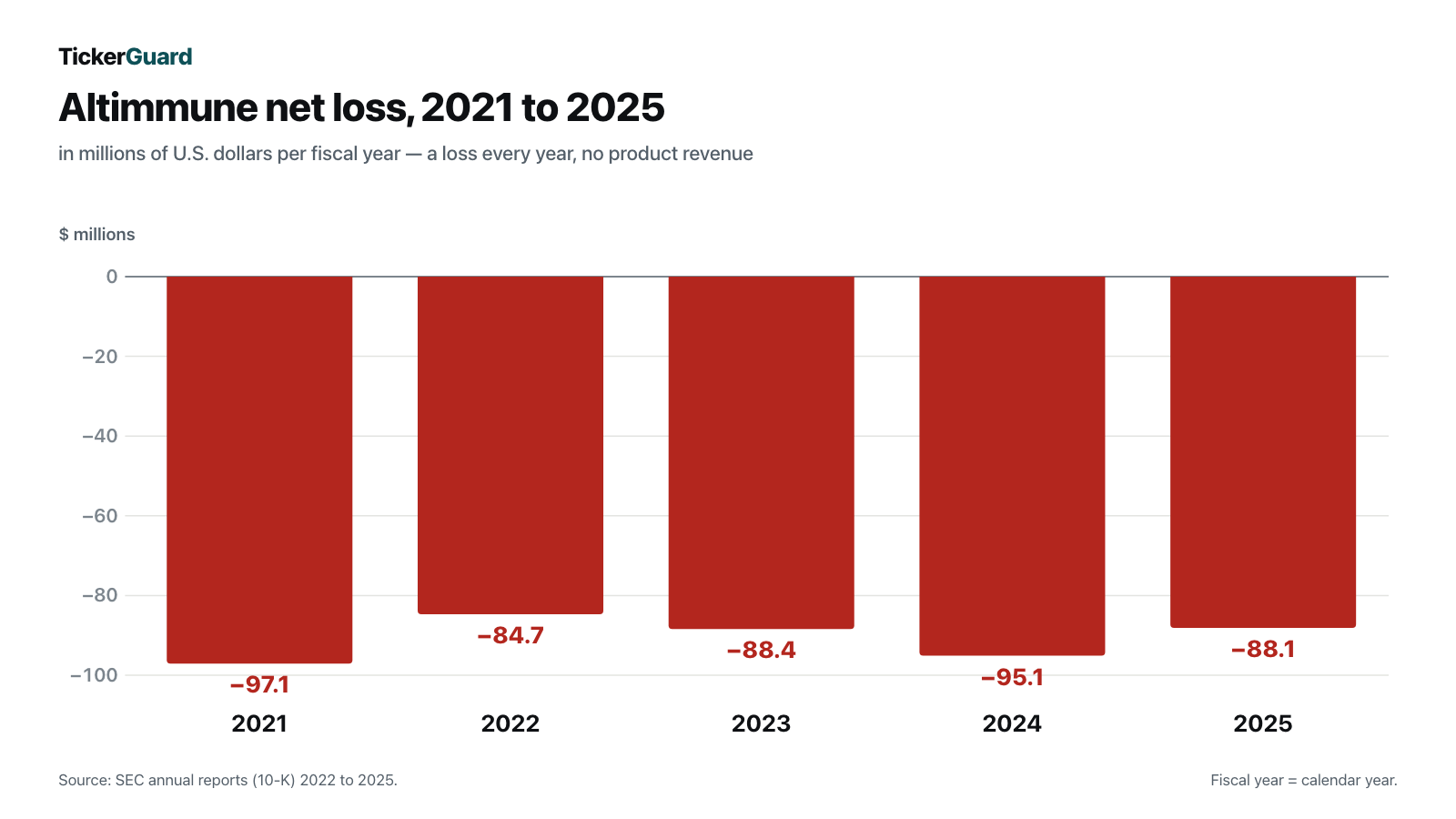
That adds up to $453.4 million of losses in five years; the accumulated deficit since inception stood at $694.9 million as of June 30, 2026. The first half of 2026 added $45.4 million, and operations used $45.2 million in cash (operating cash outflow) — about $23 million per quarter. Research and development expenses rose 8 percent to $18.7 million in the second quarter, general and administrative expenses 33 percent to $7.6 million. And the most expensive phase is only beginning: on August 3, 2026, Altimmune announced the start of patient enrollment in its Phase 3 trial in MASH. In short: Altimmune can raise money and has delivered trials — but it has not yet earned a single dollar, and spending is more likely to rise than fall with Phase 3.
What the Filings Say — the Uncomfortable Truths
Uncomfortable Truth No. 1: The Cash Is Spoken For — and the Company Itself Says It Needs More Capital
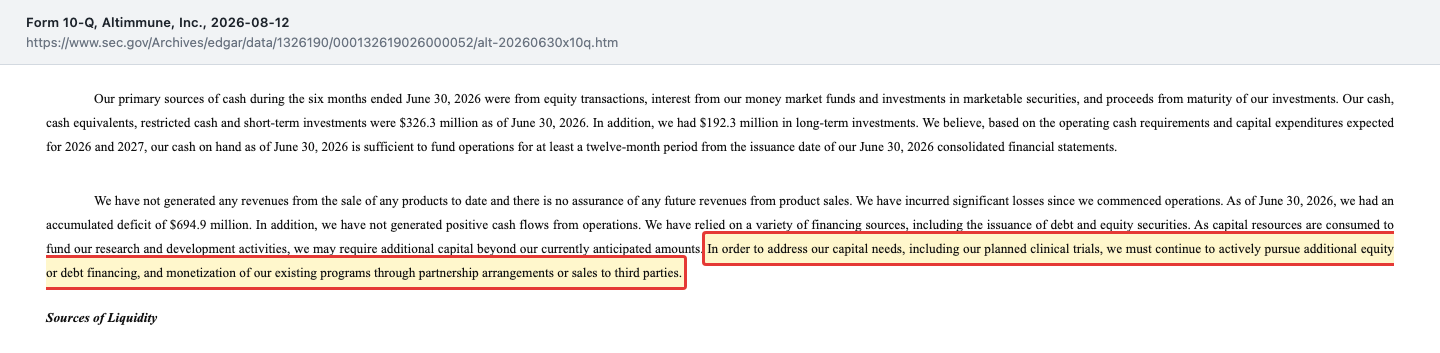
The wallet from the opening has a catch: its contents are already allocated. According to the quarterly report, the PERFORMA Phase 3 trial is designed to run about 60 months, with an interim analysis after 52 weeks to support accelerated approval. On top of that, the RESTORE trial in ALD is running (data expected in the second half of 2027), and the next steps in alcohol use disorder are being prepared. How long the cash lasts, Altimmune answers cautiously: the money is sufficient “for at least a twelve-month period” from the issuance of the quarterly financial statements. Right next to it is the sentence that turns the wallet math around:
“In order to address our capital needs, including our planned clinical trials, we must continue to actively pursue additional equity or debt financing, and monetization of our existing programs through partnership arrangements or sales to third parties.”
— Altimmune, Inc., SEC quarterly report 10-Q for June 30, 2026, Item 2 MD&A “Liquidity and Capital Resources”
How far does the money really go? Let’s do the math ourselves — this is our own back-of-the-envelope estimate, not a company figure. At the first-half 2026 pace (about $23 million of cash burn per quarter), $483.6 million of net cash would last a little over 20 quarters, which on paper reaches into 2031 and past the 2029 Phase 3 data. But that pace dates from before Phase 3 began enrolling patients. If burn doubles to about $46 million per quarter, the same cash lasts only a little over two and a half years — on paper until about early 2029, right into the year the decisive data are due, with no cushion at all. That gap is exactly where the sentence from the quarterly report comes in. Why does the answer take until 2029? Patients have only been enrolling since August 2026, and each of them then has to be treated for 52 weeks before the biopsies can be evaluated.
Then there is the loan: $35.0 million from Hercules Capital at a rate of at least 9.70 percent, maturing January 1, 2029. Altimmune pays only interest through December 2027 (extendable into 2028 under certain conditions); principal payments start after that. The loan is secured by substantially all of the company’s assets, and compliance with a financial covenant is only conditionally waived once the market value exceeds $800 million. As of June 30, 2026, Altimmune was in compliance with all covenants. The lesson: if you buy the cash, you are not buying $519 million — you are buying a share of a research budget, and the budget itself says it won’t be the last one.
Uncomfortable Truth No. 2: Your Slice of the Pie Keeps Shrinking — and Has for Years
How Altimmune raises money shows in the share count. Every capital raise cuts the same pie into more slices — that is dilution: your stake in the company shrinks even if you never sell a single share.
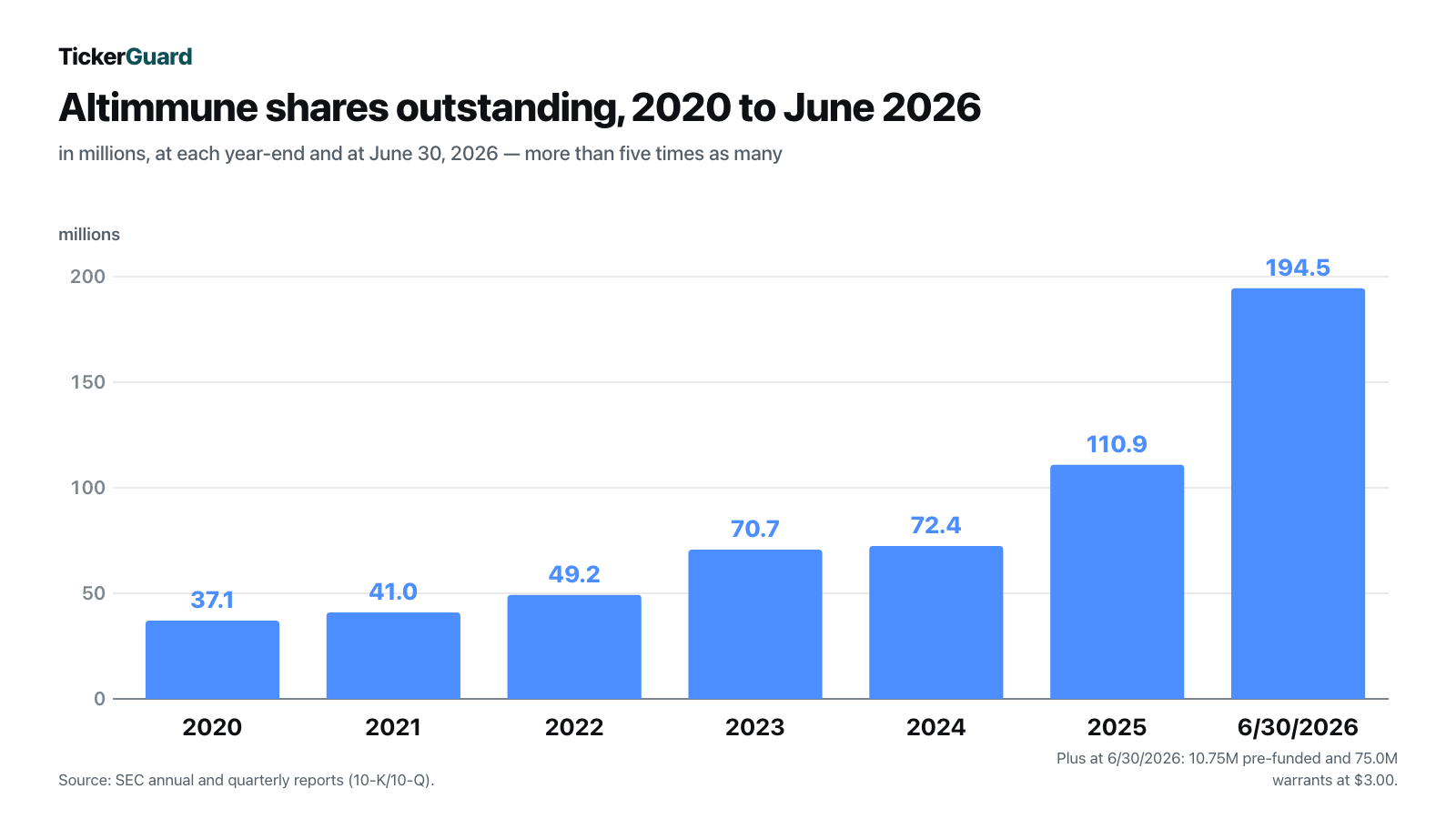
And that is not everything that can come. In the April 2026 offering, buyers paid $3.00 for a package of one share and one warrant — the right to buy another share at $3.00 until April 2031. As of June 30, 2026, 75.0 million of these warrants were outstanding, plus 10.75 million pre-funded warrants (practically shares, with only $0.001 left to pay), 12.1 million employee stock options and 2.0 million restricted stock units. Together with the shares, that is about 294 million — about 51 percent more than the shares issued. The quarterly report puts a number on what the warrants would bring:
“If all of the common stock warrants sold in the April 2026 Offering were to be exercised in cash at their exercise price, we would receive additional gross proceeds of $225 million.”
— Altimmune, Inc., SEC quarterly report 10-Q for June 30, 2026, Item 2 MD&A “April 2026 Offering”
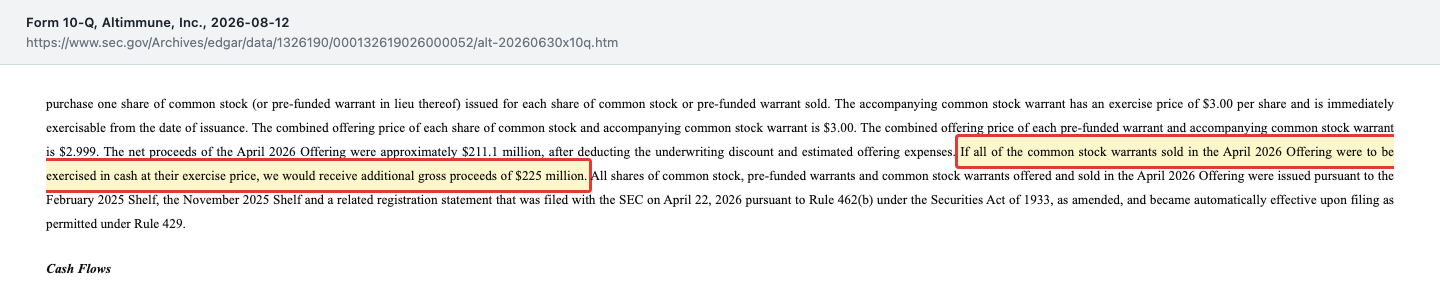
For the wallet math, that means two things. First, if the stock rises above $3.00, up to 75 million new shares come into play — bringing money, but also new co-owners of the same cash. Second, in April 2026 the professionals were willing to pay $3.00 per package; on April 22, the day the underwriting agreement was signed, the stock had still closed at $3.47. In April 2026, Altimmune also obtained approval to issue up to 400 million shares instead of 200 million. Keep in mind: a market value below cash is calculated on 194.5 million shares — the company itself is already planning for more.
Uncomfortable Truth No. 3: The Scarring Isn’t Proven Yet — the Answer Comes in 2029
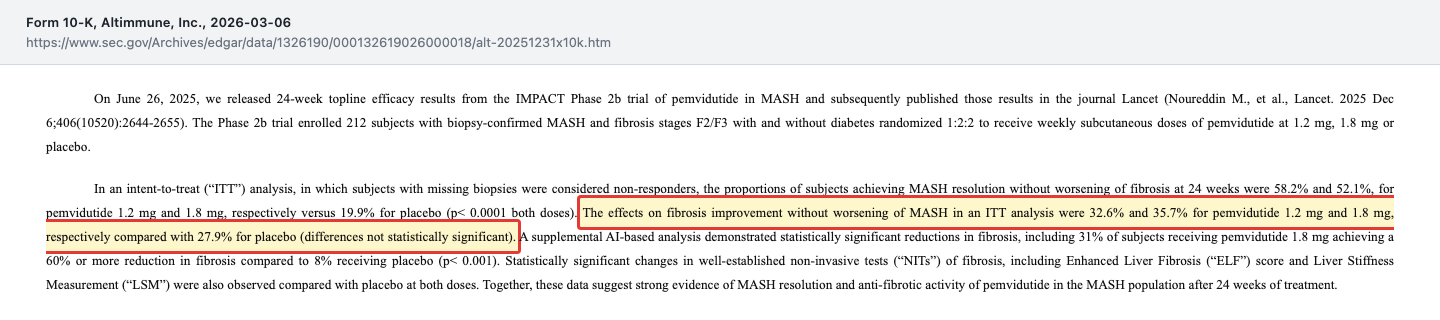
In MASH, what ultimately matters is liver scarring, or fibrosis: it decides whether a fatty liver turns into cirrhosis. After 24 weeks, the IMPACT Phase 2b trial in 212 patients produced a split picture. Inflammation resolved markedly (58.2 and 52.1 percent of patients vs. 19.9 percent on placebo). On fibrosis, however, Altimmune itself writes:
“The effects on fibrosis improvement without worsening of MASH in an ITT analysis were 32.6% and 35.7% for pemvidutide 1.2 mg and 1.8 mg, respectively compared with 27.9% for placebo (differences not statistically significant).”
— Altimmune, Inc., SEC annual report 10-K for 2025, Item 1 “Business”
The market reacted harshly: on June 26, 2025, the day of the release, the closing price fell from $7.71 to $3.61. Shareholder lawsuits followed; according to the 2025 annual report, they were “subsequently voluntarily dismissed without prejudice” — withdrawn, but with the option to refile. Altimmune points to a supplemental AI-based analysis of the biopsies that showed a statistically significant reduction in fibrosis, and to the 48-week data from December 2025, in which blood-based and ultrasound-based liver markers improved markedly. By design, however, the 48-week data did not include a biopsy (histology) readout. On December 19, 2025, the stock fell from $5.05 to $3.90. The real answer in tissue will come only from Phase 3:
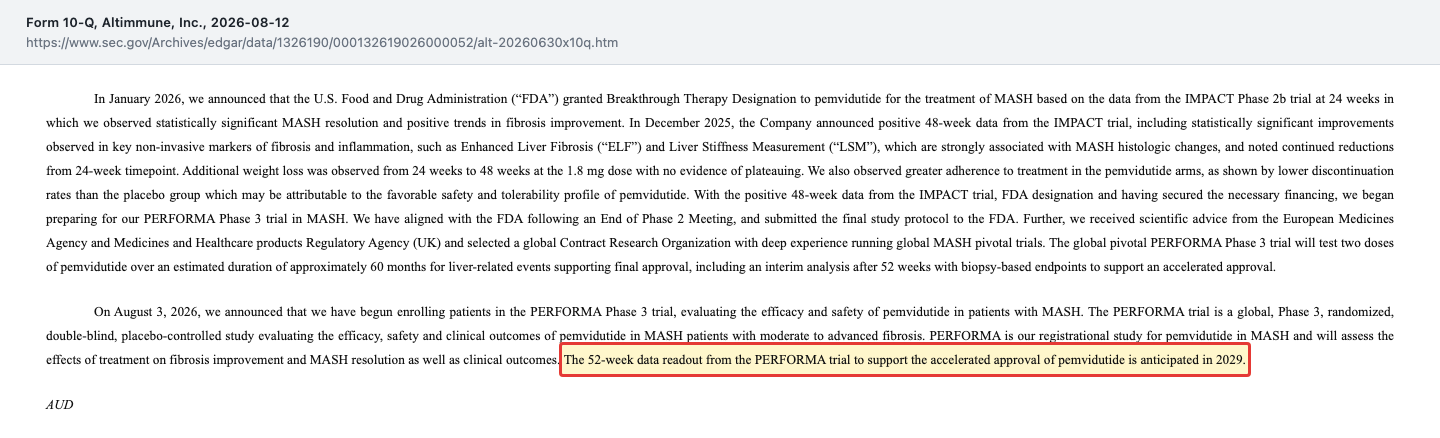
“The 52-week data readout from the PERFORMA trial to support the accelerated approval of pemvidutide is anticipated in 2029.”
— Altimmune, Inc., SEC quarterly report 10-Q for June 30, 2026, Item 2 MD&A “Ongoing Clinical Trials”
Until then, shareholders have to sit through several years of cash burn. One detail stands out: according to the annual report, the FDA agreed that Phase 3 biopsies will be read with AIM-MASH AI Assist, which Altimmune describes as the first FDA-qualified AI pathology tool for MASH clinical trials. It is meant to standardize how biopsies are scored. But even the best tool can only answer whether pemvidutide improves fibrosis in tissue once the data are in. The lesson: what carries the stock today are interim markers and hope — the proof an approval depends on is penciled in for 2029.
Uncomfortable Truth No. 4: The Competition Is Called Lilly and Novo — and the Side Effects Aren’t Zero
Pemvidutide plays in a field where some of the world’s largest drugmakers want to earn billions. The annual report names them plainly:
“Large and established companies such as Eli Lilly, Roche, Novo Nordisk, Pfizer, AstraZeneca, Amgen, Boehringer Ingelheim and Merck, among others, compete in the same general therapeutic areas as our product programs.”
— Altimmune, Inc., SEC annual report 10-K for 2025, Item 1 “Competition”
According to the same report, Merck/Hanmi and Boehringer Ingelheim are also developing glucagon/GLP-1 dual agonists, and Eli Lilly is testing its drug mazdutide in alcohol use disorder, too. You can read how the two GLP-1 market leaders stack up in our Eli Lilly analysis and our Novo Nordisk analysis. Altimmune counters with two differentiators: the direct effect on the liver and tolerability. In MASH, only 0 and 1.2 percent of patients stopped treatment due to side effects after 48 weeks, versus 3.5 percent on placebo. In the RECLAIM alcohol trial at the higher 2.4 mg dose, things looked less smooth: 44 percent of patients reported nausea (placebo: 24 percent), and 10 percent stopped treatment due to drug-related side effects (placebo: 0 percent), as the current report of July 28, 2026 shows. Altimmune points to a new, simpler dose-escalation scheme. The lesson: a small player with one drug only beats global giants with a clear advantage — and that advantage still has to show up in Phase 3.
Valuation: Less Than the Cash — and Why That Is No Gift
Let’s redo the wallet math. On October 23, 2026, the stock closed at $2.12; with 194,517,701 shares (as of August 7, 2026), that is a market value of about $412 million, or about $435 million including the 10.75 million pre-funded warrants. Against that stand $518.6 million in cash and securities as of June 30, 2026 — after deducting the $35.0 million loan, net cash of $483.6 million. Even if you subtract another quarter of cash burn at the first-half pace (about $23 million, our own estimate through the third-quarter report), the cash remains in the same range as the market value. The market therefore values pemvidutide and all trials combined at roughly zero — in late October 2026 even slightly below. Professionals call this a negative enterprise value: market value minus net cash comes to about minus $71 million. Put simply, whoever bought the whole company would get the research program for free plus some cash on top — as long as the cash has not been spent. That discount melts away once the warrants come into play, though: at $3.00, the price at which exercising them pays off, about 280 million shares (excluding employee options) worth about $841 million would face net cash that is $225 million higher, at about $709 million — the market value would then sit clearly above the cash. Even without the warrants, the math looked different not long ago: at the October 1, 2026 price ($2.76, documented in an insider filing), the market value was still about $537 million.
Why does the market pay so little? The filings offer three reasons. First, the cash will be spent on trials in the coming years — about $23 million per quarter even before Phase 3 ramps up. Second, 75 million warrants at $3.00 hang over the stock. Third, the decisive answer does not come until 2029. There is no price-to-sales or price-to-earnings ratio, given no revenue and no profit. The view from Wall Street is very different: according to fundamental data (as of October 23, 2026), seven of ten tracked analysts rate the stock a strong buy, and the average price target is about $17 — eight times the closing price. Average here means all price targets added up and divided; a single very optimistic analyst pulls it up sharply. Biotech price targets also usually assume trial success. A different kind of signal: CEO Jerry Durso bought 15,000 shares at $2.95 on August 13, 2026, about $44,000 out of his own pocket (Form 4). The next hard test is the quarterly report for September 30, 2026 — last year, Altimmune filed it on November 6. It will show whether cash burn is already rising with the Phase 3 start and whether any warrants were exercised. So remember: a stock below cash value is not a discount on money — it is the price the market charges for a bet on a trial. You only get the cash if it isn’t spent.
Upside and Risks at a Glance
What speaks for Altimmune:
- A big cash pile: $518.6 million in cash and securities as of June 30, 2026, with only $35.0 million of debt; stockholders’ equity of $474.2 million.
- Regulatory tailwind: FDA Breakthrough Therapy designation in MASH (January 2026), Fast Track in MASH and AUD, a Phase 3 design aligned with the FDA.
- Three shots on goal with one drug: Phase 3 in MASH has been enrolling since August 2026, RECLAIM in AUD met its primary endpoint in July 2026, and RESTORE in ALD reads out in the second half of 2027.
- Four funds, including health care specialists, each reported at least 5 percent after the April 2026 offering; the CEO bought shares in August 2026.
- Good tolerability in MASH: after 48 weeks, 0 and 1.2 percent discontinuations due to side effects, versus 3.5 percent on placebo.
What speaks against it:
- No product revenue, a loss every year since 2021 (most recently $88.1 million in 2025), about $23 million of cash burn per quarter in the first half of 2026.
- Per its quarterly report, Altimmune must keep actively pursuing capital or partners; by its own account, the cash lasts at least twelve months.
- Heavy dilution: the share count has more than quintupled since the end of 2020, plus 75 million warrants at $3.00 and 400 million authorized shares.
- Fibrosis improvement in tissue was not significant after 24 weeks; the decisive Phase 3 data arrive only in 2029.
- Overpowering competition (Eli Lilly, Novo Nordisk, Roche, Boehringer Ingelheim, Merck and others) and more side effects at the higher dose in the alcohol trial.
A Human Conclusion
Back to the wallet from the opening. The math of “100 dollars for 80” only works if you can snap the wallet shut and put it in your pocket. With Altimmune, you can’t: the money belongs to a research program that spends it quarter after quarter, the company itself says it must seek more capital, and 75 million warrants are waiting to let new co-owners into the same cash at $3.00. That does not mean the stock is too expensive. It means you are not betting on the cash but on pemvidutide — and on data that arrive in 2029. So the honest question for you is not “How much money is in the wallet?” but: would you buy Altimmune if the cash were gone and only the trial remained? Because that is exactly where the money will go if everything goes to plan. What you make of it is your decision. And that is how it should be.
Sources
All original documents used in this analysis — for your own reading:
- Altimmune, Inc. — SEC quarterly report 10-Q for June 30, 2026 (filed August 12, 2026)
- Altimmune, Inc. — SEC current report 8-K of August 12, 2026, Exhibit 99.1 (second-quarter 2026 results)
- Altimmune, Inc. — SEC current report 8-K of July 28, 2026, Exhibit 99.1 (RECLAIM trial results)
- Altimmune, Inc. — SEC quarterly report 10-Q for March 31, 2026 (filed May 13, 2026)
- Altimmune, Inc. — SEC annual report 10-K for 2025 (filed March 6, 2026)
- Altimmune, Inc. — SEC annual report 10-K for 2024 (filed February 27, 2025)
- Altimmune, Inc. — SEC annual report 10-K for 2023 (filed March 27, 2024)
- Altimmune, Inc. — SEC annual report 10-K for 2022 (filed February 28, 2023)
- Altimmune, Inc. — SEC annual report 10-K for 2021 (filed March 15, 2022)
- Altimmune, Inc. — SEC current report 8-K of June 26, 2025, Exhibit 99.1 (IMPACT 24-week data)
- Altimmune, Inc. — SEC current report 8-K of December 1, 2025 (CEO transition)
- Altimmune, Inc. — SEC current report 8-K of December 19, 2025, Exhibit 99.1 (IMPACT 48-week data)
- Altimmune, Inc. — SEC current report 8-K of September 29, 2026 (new principal accounting officer)
- Jerome B. Durso — Insider filing (Form 4) of August 13, 2026 (purchase of 15,000 shares)
- Full SEC filing history, including the funds’ Schedule 13Gs: EDGAR overview Altimmune (sec.gov)
- Fundamental data (prices, short interest, analyst ratings; as of October 23, 2026), cross-checked against the SEC filings.
Transparency & disclaimer: this analysis is journalistic commentary on publicly available information. It is not investment advice, not a regulated investment research product and not a solicitation to buy or sell securities. Equity investments carry substantial risk up to and including total loss. All information is provided without warranty; the as-of date for each figure is stated in the text. Positions held by the operator are disclosed daily; where one exists, it appears as a notice at the top of this deep dive.
Key figures at a glance
All monetary figures in millions of $; earnings per share as reported.
| Metric | 2021 | 2022 | 2023 | 2024 | 2025 |
|---|---|---|---|---|---|
| Revenue | 4.4 | -0.1 | 0.4 | 0.0 | 0.0 |
| Operating Income (EBIT) | -96.9 | -87.7 | -95.9 | -103.2 | -94.5 |
| Net Income | -97.1 | -84.7 | -88.4 | -95.1 | -88.1 |
| Net Margin | -2,201.6% | 124,577.9% | -20,762.2% | -475,295.0% | -214,861.0% |
| Earnings Per Share | -2.35 $ | -1.81 $ | -1.66 $ | -1.34 $ | -1.00 $ |
Source: fundamental data & SEC filings (annual and quarterly reports, 10-K/10-Q)
Our Bottom Line at a Glance
- Cash & funding positive
- $518.6 million in cash and securities against a $35.0 million loan (6/30/2026); about $290 million net raised through offerings in 2026 alone.
- Clinical data neutral
- MASH inflammation improved markedly after 24 weeks, but fibrosis in tissue did not reach statistical significance; the RECLAIM alcohol trial met its primary endpoint in July 2026; Phase 3 MASH data only in 2029.
- Losses & cash burn negative
- No product revenue, a loss every year since 2021 (2025: $88.1 million), $45.2 million operating cash outflow in the first half of 2026; per the 10-Q, more capital is needed.
- Dilution negative
- Share count up from 37.1 million (end of 2020) to 194.5 million (6/30/2026); 75 million warrants at $3.00 and 400 million authorized shares.
- Competition negative
- Per the 2025 annual report, Eli Lilly, Novo Nordisk, Roche, Boehringer Ingelheim and Merck, among others, compete in the same therapeutic areas, some with similar dual agonists.
Altimmune is the wallet trap in its purest form: on October 23, 2026, its market value of about $412 million sat below net cash of $483.6 million as of June 30, 2026. The SEC filings, however, show what the money is for: a Phase 3 trial with first data in 2029, ongoing losses, further capital needs and 75 million warrants at $3.00. Buyers are betting on pemvidutide, not on the cash. Not investment advice.
What Our Rating Means
Open questions
The business works in principle, but one material question is open. As long as it stays open, our findings do not carry a quality verdict.
The balance sheet is solid for a biotech — more than $500 million of cash, little debt, no going-concern doubt. Yellow, because the entire company rests on a single drug candidate, and the decisive question of whether pemvidutide improves liver fibrosis in tissue will only be answered by the Phase 3 data in 2029. The decision is yours.
A journalistic assessment by our editorial team at the time of the deep dive, based on public sources — not investment advice and not a solicitation to buy or sell. Your personal circumstances (investment goals, risk capacity, taxes) cannot be taken into account. What our levels mean, how verdicts are formed, and what conflicts of interest exist →
Worth Noting
- Reason for the analysis: recorded by our in-house Reddit hype scanner on 10/24/2026 (2 mentions in 24 hours, market value about $422 million per fundamental data). Price references: $7.71 → $3.61 (6/25–6/26/2025), $5.05 → $3.90 (12/18–12/19/2025), $6.18 (1/27/2026), $3.47 (4/22/2026), $2.76 (10/1/2026), $2.12 (10/23/2026; closing prices, fundamental data).
- Data as of: the latest periodic report is the 10-Q for 6/30/2026 (filed 8/12/2026); the 10-Q for 9/30/2026 was not yet available on 10/24/2026. The deduction of about $23 million for the third quarter is our own estimate, based on first-half 2026 operating cash outflow ($45.2 million).
- Valuation dated and evergreen: market value from 194,517,701 shares × $2.12 (10/23/2026); net cash = $518.6 million in cash and securities minus the $35.0 million loan principal (excluding the $2.2 million end-of-term charge). Short interest and analyst ratings from fundamental data, not SEC filings.
- Not to be confused: the ticker ALT on Nasdaq belongs to Altimmune, Inc. (CIK 0001326190, formerly PharmAthene); the drug was previously known as ALT-801.
Stock Watch
This analysis is as of October 24, 2026. Stock Watch will tell you what's changed at ALT since then.
Later $1 a month per stock — signing up is free, and you'll be the first to know when it launches.
The full analysis as a PDF for later
We will send you this analysis as a PDF — to print, file away, and read at your own pace. And we will add you to the free Stock Watch list for Altimmune Inc (ALT), so you hear about it when something material in this analysis changes.
Frequently Asked Questions
Altimmune (Nasdaq: ALT) is a Maryland biotech company with no product revenue. It is developing a single drug candidate, pemvidutide, which targets the glucagon and GLP-1 receptors. It is being tested in inflammatory fatty liver disease (MASH, Phase 3), alcohol use disorder (AUD) and alcohol-associated liver disease (ALD). Net loss in 2025 was $88.1 million.
On October 23, 2026, the market value was about $412 million, while net cash stood at $483.6 million as of June 30, 2026. The reasons, per the SEC filings: the money is earmarked for trials running to at least 2029, the company must keep raising capital, and 75 million warrants at $3.00 can push the share count higher.
As of June 30, 2026, Altimmune had $63.1 million in cash and $455.5 million in securities, $518.6 million in total, against a $35.0 million loan. Operations used $45.2 million in the first half of 2026. Altimmune itself only says the money is sufficient for at least twelve months from its August 2026 quarterly report.
For alcohol-associated liver disease (RESTORE trial), Altimmune expects topline data in the second half of 2027. The 52-week readout of the PERFORMA Phase 3 trial in MASH, meant to support accelerated approval, is expected in 2029. In alcohol use disorder, Altimmune first plans to request an End-of-Phase 2 meeting with the FDA.
Shares outstanding rose from 37.1 million at the end of 2020 to 194.5 million on June 30, 2026, more than five times as many. On top come 10.75 million pre-funded warrants and 75.0 million warrants at $3.00, 12.1 million employee stock options and 2.0 million restricted stock units. Since April 2026, Altimmune may issue up to 400 million shares.
As “uses AI”: Altimmune does not sell AI, but uses it in its trials. According to the 2025 annual report, the FDA agreed that biopsies in the Phase 3 trial will be read with the AI tool AIM-MASH AI Assist; in Phase 2b, a supplemental AI-based analysis already supported the fibrosis results.
Found an error?
Did you spot a factual error, an outdated number, or a typo in this deep dive? Let us know briefly — your report goes straight to the editorial team.