The Rescuer Trap at Lee Enterprises: He Bought at $3.25 — You Pay the Market Price
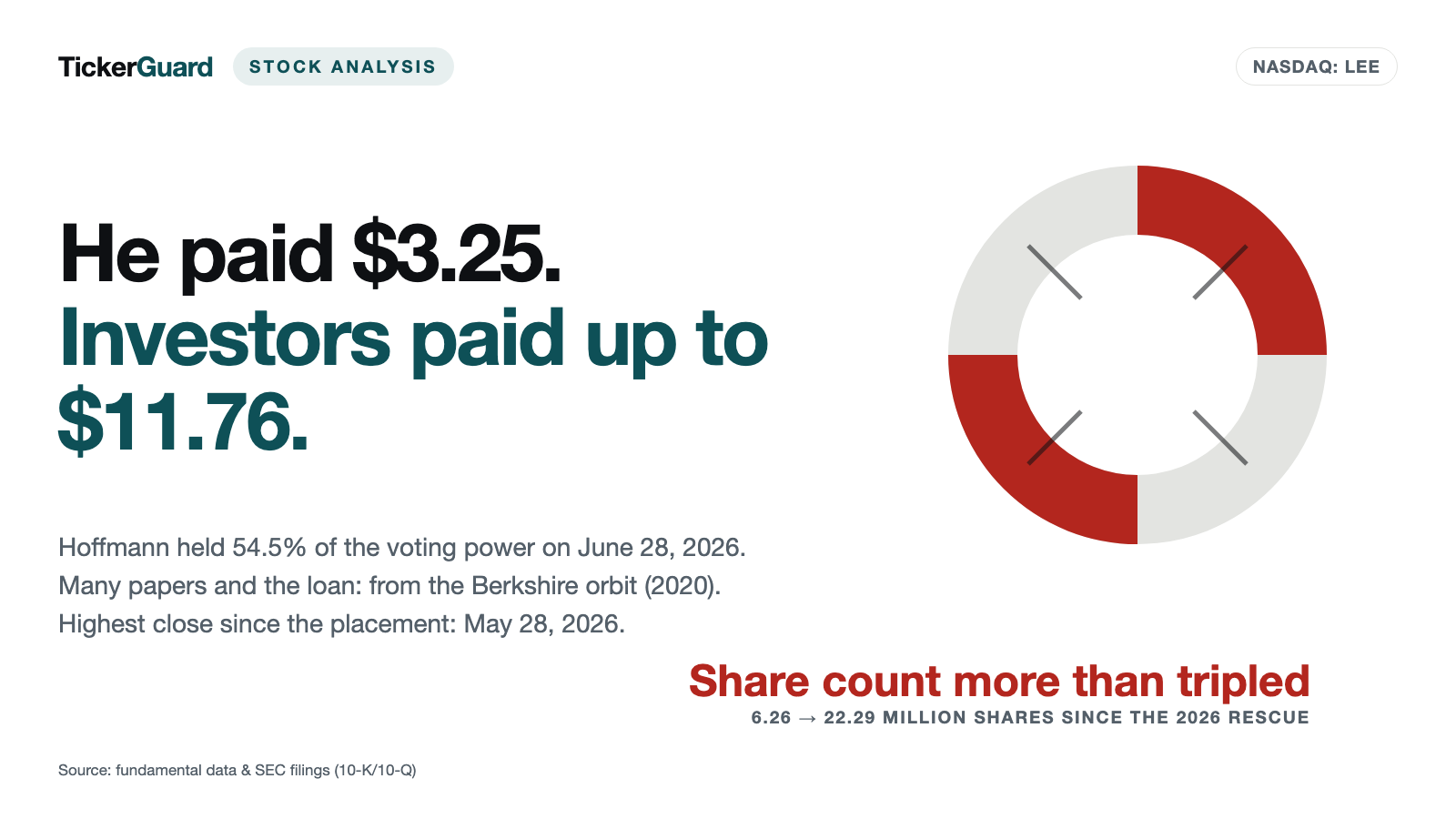
In February 2026, businessman David Hoffmann bought 10.9 million new shares of newspaper publisher Lee Enterprises at $3.25 apiece and has controlled the company since; the stock has since closed as high as $11.76 (highest close, May 28, 2026) and stood at $6.47 on October 22, 2026. In return, Berkshire-linked lender BH Finance cut the rate on $455 million of debt from 9 to 5 percent, and the third quarter brought the first profit in at least six quarters. The filings with the U.S. securities regulator, the SEC, also show this: revenue has been falling for years, digital-only subscriptions are shrinking instead of growing, and equity attributable to shareholders is still negative. Not investment advice — just the question of whether you follow the rescuer or his numbers.
 Thomas Mücke
Founder & Publisher
As of Today
As of: October 22, 2026
- Closing price
- 6.50 $ -1.20%
- Market Capitalisation
- 0.1 $B
- Growth Score
- 3/10
- AAQS
- 1/10
Price change since October 22, 2026: +0.5%
This analysis has a cut-off date. The Stock Guard tells you when something material changes in the numbers. Reserve your free spot
Chart
Interactive price chart (TradingView).
52-week range: 3.40 $ to 11.80 $ · Last price: 6.50 $ (As of: October 22, 2026)
Note: pure fact-based analysis, not investment advice and not a solicitation to buy or sell. All figures without guarantee.
There is a moment when investors stop checking: when a rich man buys in. When a successful entrepreneur buys millions of shares, the mind says, “He surely looked harder than I did” — and borrows his judgment instead of forming its own. That is the rescuer trap. It has a catch that is easy to miss: the rescuer buys at his price and on his terms, not yours. At Lee Enterprises (Nasdaq: LEE), one of the large local newspaper groups in the U.S., you can read exactly how that works in the mandatory filings:
“As of June 28, 2026, David H. Hoffmann, our Chairman of the Board, ("Mr. Hoffmann") beneficially owns 54.5% of the aggregate voting power of our outstanding capital stock.”
— Lee Enterprises, Incorporated, SEC quarterly report 10-Q for June 28, 2026, Item 1A “Risk Factors”
In February 2026, Hoffmann paid $3.25 for each new share — a little less than the market charged before the announcement: on December 29, 2025, the last trading day before the current report (8-K) of December 30, 2025, the stock closed at $3.73. On March 3, 2026, the last reported price stood at $8.94 according to a prospectus, and on October 22, 2026, the stock closed at $6.47. Before you lean on the rescuer, let’s read together what Lee has told the U.S. securities regulator, the SEC — the annual reports (10-K) for fiscal 2024 and 2025, the quarterly reports (10-Q) through June 28, 2026, and the current reports (8-K) since then. Filing false information with the SEC carries penalties, which makes these documents some of the most reliable sources there are. In the end, the decision is yours.
What Lee Enterprises Actually Does — Local Newspapers on Their Way Online
Lee Enterprises publishes daily and weekly newspapers in the U.S. — according to its annual report for fiscal 2025, in 72 mid-sized communities across 25 states. Its best-known markets include St. Louis, Buffalo, Omaha and Richmond; in Madison and Tucson, Lee participates through joint ventures (MNI and TNI Partners). Part of the portfolio came from the Berkshire Hathaway orbit: in 2020 Lee bought the BH Media newspaper group and The Buffalo News and financed the purchase, along with all of its existing debt, through a single 25-year loan from Berkshire-affiliated BH Finance. As of September 28, 2025, Lee employed about 2,500 people, including about 270 part-timers.
The money comes from three pots. First, subscriptions — print and digital. Second, advertising: in its own newspapers and on its own websites, but above all through the Amplified Digital agency, which buys online ads, runs search engine marketing and builds websites for local businesses (third quarter of fiscal 2026: $27.1 million in revenue). Third, services, mainly the BLOX Digital publishing software, 82.5 percent owned by Lee and also used by other publishers. Think of Lee as a bakery that sells less bread every year — and therefore opens a delivery service and a catering business in the same shop. The question is whether the new businesses grow faster than the bread disappears.
In the third quarter of fiscal 2026 (April through June 2026), 56.8 percent of revenue came from digital. Sounds like a completed turnaround — but only partly, because the share is also rising because print is shrinking faster. That defines the central tension of this analysis, and it runs through every chapter: Lee’s balance sheet was propped up in 2026 — cheaper money, fresh capital, a majority owner. The business itself keeps shrinking, in print and in digital.
Company history for investors
-
2020
BH Media purchase, loan from the Berkshire orbit
Lee acquires BH Media and The Buffalo News and finances everything with a 25-year, $576 million loan from BH Finance — since then the company has depended on a single lender.
-
2024
Goal: 1.2 million digital subscribers by 2028
The annual report cites over 771,000 digital-only subscribers and sets a goal of over 1.2 million by 2028. Not quite two years later there are 584,000.
-
2025
Cyberattack and interest deferral
A cyberattack on February 3 costs $10.5 million in cash flows, according to the annual report; BH Finance defers the interest payment for three months. The fiscal year ends with a $37.6 million loss.
-
2026
Hoffmann takes the majority
Lee issues 16 million new shares at $3.25, rate cut from 9% to 5% for five years, new CEO. For existing shareholders: far more shares outstanding, but a lighter interest burden.
How the Stock Landed on Our Desk
Lee Enterprises landed on our desk because something fundamental shifted at the top in 2026. On February 5, 2026, Lee reported a change in control under Item 5.01, “Changes in Control of Registrant,” of a current report (8-K). Lee issued 16 million new shares at $3.25 each; Hoffmann and other investors bought 15.38 million of them, Hoffmann himself 10,909,440. The remaining 0.62 million went to service providers as expense reimbursement. On the same day, longtime CEO Kevin Mowbray voluntarily retired and Hoffmann became Chairman. By June 28, 2026, he had bought another 600,000 shares, bringing him to 54.5 percent. Since September 24, 2026, his son Gregory Hoffmann has also sat on the board.
The stock reacted sharply: it closed at $3.73 on December 29, 2025, before the announcement, at $5.53 on the day of the placement (February 5, 2026), at $11.76 on May 28, 2026, and at $6.47 on October 22, 2026 (closing prices, fundamental data). Anyone who followed the rescuer in spring 2026 paid a multiple of Hoffmann’s entry price. Classic valuation metrics from our scanners help only so much with Lee, because its debt is more than three times its market value. So keep this in mind from the start: With Lee, what matters is not the share price, but whether the business can carry the debt.
The Numbers Over the Years — An Honest Look
First, what Lee pulled off in 2026 — and it is not nothing. In the third quarter of fiscal 2026 (through June 28, 2026), Lee shareholders were left with a $4.7 million profit, after a $1.9 million loss in the prior-year quarter. It is the first quarterly profit after at least six consecutive loss-making quarters. Costs fell sharply: Cash Costs dropped 14.5 percent to $109.4 million, and compensation expense fell 14.2 percent over the first nine months. Adjusted EBITDA — operating profit before interest, taxes, depreciation and special items, as Lee itself defines it — rose 23.0 percent in the quarter to $18.4 million. On August 6, 2026, Lee raised its fiscal 2026 outlook to 22 to 28 percent higher Adjusted EBITDA.
That is the good news. The chart puts it in context — revenue and Adjusted EBITDA over four fiscal years:
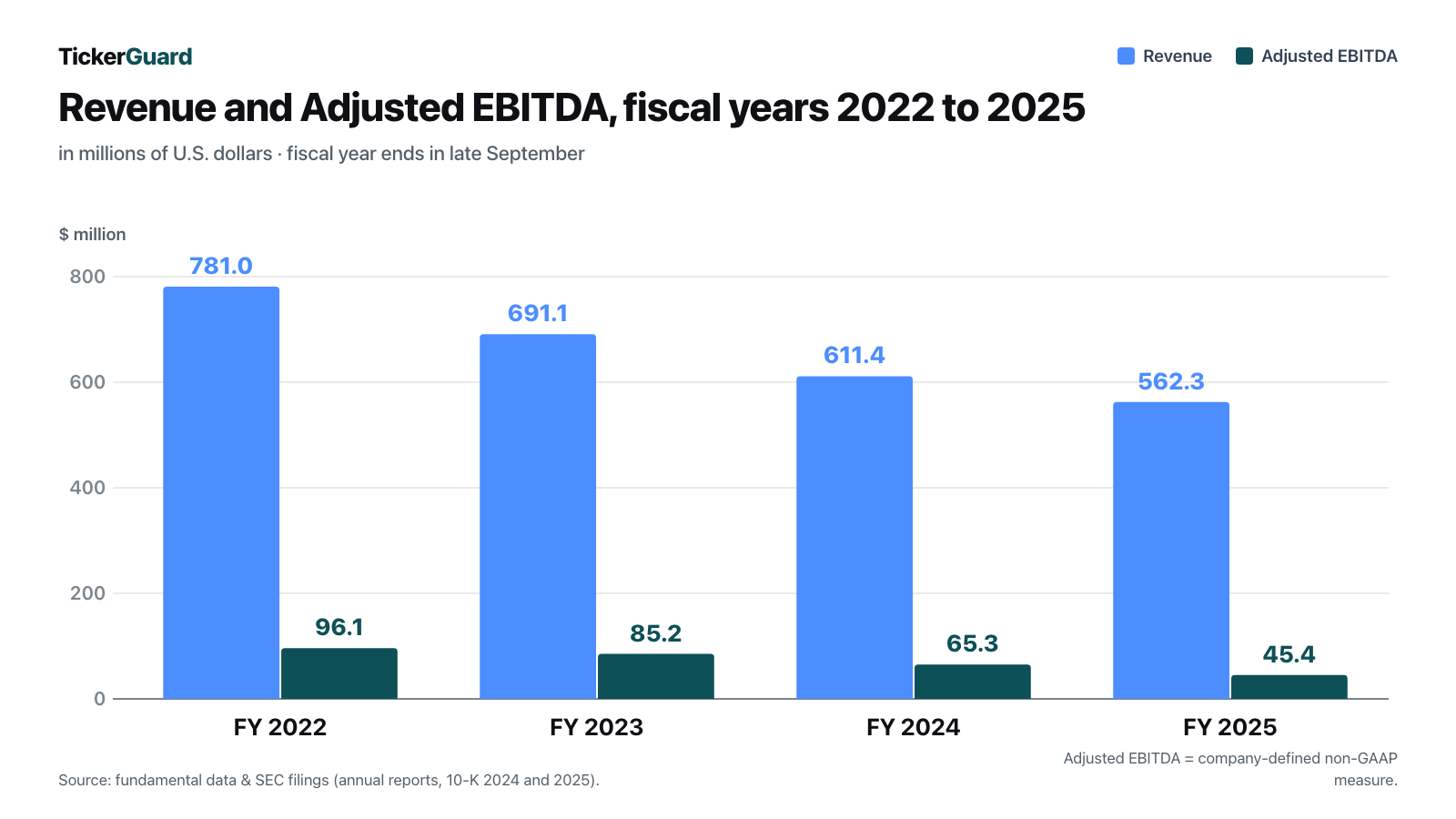
In three years, Lee lost 28 percent of its revenue and more than half of its Adjusted EBITDA. Lee shareholders absorbed losses of $5.3 million, $25.8 million and $37.6 million in fiscal 2023 through 2025. Fiscal 2025 was also hit by a cyberattack on February 3, 2025, which according to the annual report cost Lee $10.5 million in cash flows; how much revenue was lost cannot, in Lee’s own words, be cleanly separated from other factors. And revenue keeps shrinking in 2026: down 10.7 percent to $378.0 million in the first nine months and down 10.8 percent to $126.0 million in the third quarter. Part of that comes from deliberately discontinued products; on a same-store basis the quarterly decline was 8.7 percent. In short: Lee is earning more again in 2026, but on a smaller business — the profit turnaround comes from costs, not from growth.
What the Filings Say — The Uncomfortable Truths
Uncomfortable Truth No. 1: One shareholder decides — and also does business with Lee
With 54.5 percent of the votes, Hoffmann is no longer a large shareholder but the owner. Under Nasdaq rules, Lee is now a “controlled company.” Picture a homeowners’ meeting where one neighbor holds more than half of the votes: you can speak up, but the vote is decided before it starts. The quarterly report spells it out very clearly:
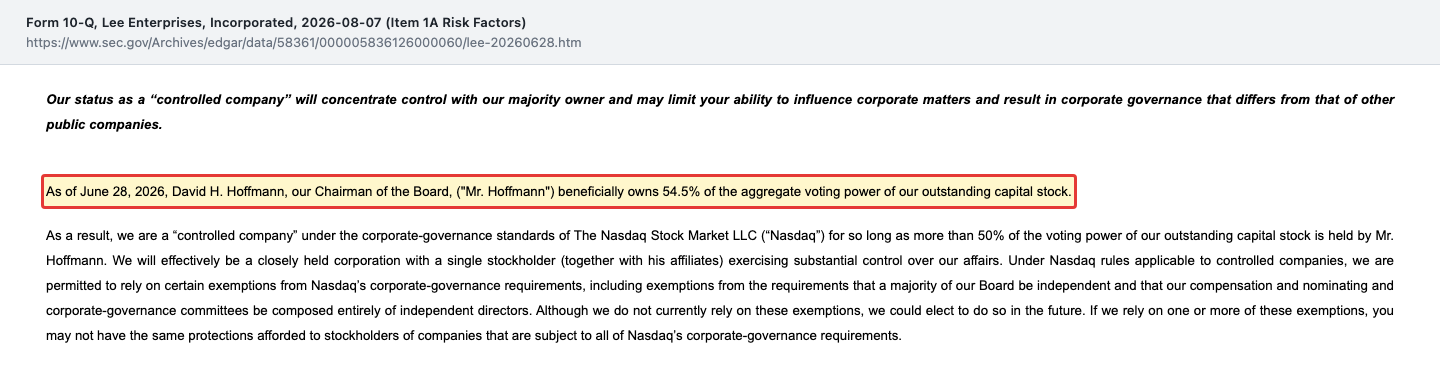
The same section warns that Hoffmann’s interests may differ from those of other shareholders, for example because of tax or estate planning. On top of that come related-party transactions that Lee discloses — with the majority shareholder’s own company and with a company in which the second-largest shareholder holds a stake: since June 1, 2026, Lee has managed newspapers owned by Hoffmann’s own Hoffmann Media Group under a five-year agreement (signed on May 14, 2026) — for a fixed fee of $135,000 per quarter plus 20 percent of the EBITDA of newly acquired titles. And on October 16, 2026, Lee and BLOX Digital signed software agreements with Quintype, in which Quint Digital holds a stake — Lee’s second-largest shareholder with about 14.38 percent. According to the filing, the agreements run for an initial three years, are billed on a time-and-materials basis and are backed by guaranties from Quint Digital; Lee expects annual net savings of more than $1 million from them. The Hoffmann Media Group agreement, according to the quarterly report, was approved by the board under its related-party transaction policies, with Hoffmann recusing himself. The bottom line: Buying Lee stock means buying a minority position next to an owner who, per the quarterly report, can exert significant influence over every shareholder vote.
Uncomfortable Truth No. 2: $455 million owed to one lender — and the cheap rate has an expiry date
Lee has exactly one loan: $454.7 million from BH Finance, which the annual report describes as affiliated with Berkshire Hathaway, at a fixed rate and not due until March 16, 2045. There are no fixed principal payments and no financial performance covenants. How dependent Lee is on this one lender became clear in 2025: after the cyberattack, BH Finance deferred the interest payments for March, April and May 2025 — the filing calls it a waiver, but the amounts were added to the loan, and together with deferred lease payments the debt rose by $11.3 million through September 28, 2025. The capital injection of February 2026 then brought the rate cut:
“The amendments include among other things, a reduction of the applicable margin on our 25-year term loan from 9.00% to 5.00% for a period of five years following the closing and amending the definition of “Excess Cash Flow” such that any cash-on-hand balance above $64.0 million held by us would be deemed Excess Cash Flow for a period of five years.”
— Lee Enterprises, Incorporated, SEC quarterly report 10-Q for June 28, 2026, Item 2 MD&A “Credit Agreement Amendment”
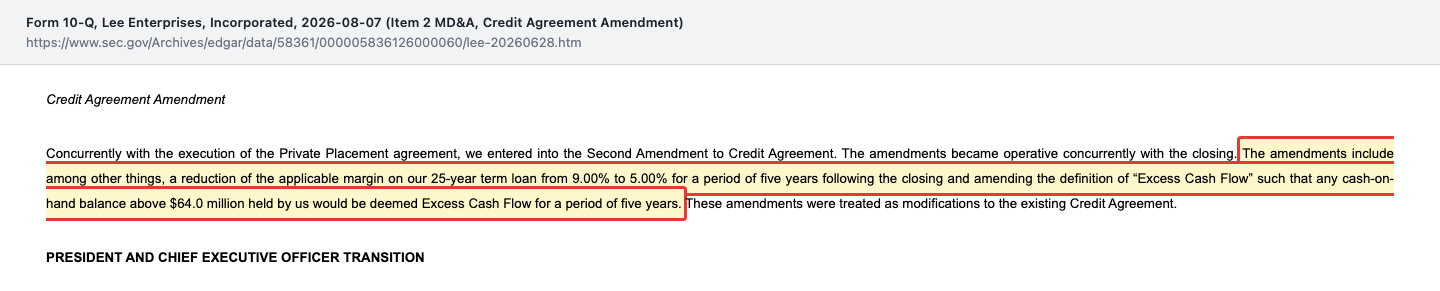
Four percentage points on $454.7 million mean about $18 million less interest per year — a huge lever compared with fiscal 2025 Adjusted EBITDA of $45.4 million. Third-quarter interest expense already fell 45 percent to $5.6 million. The same sentence contains a relief and a limit. The relief: until then, according to the fiscal 2025 annual report, any cash above $20.0 million at quarter-end counted as excess and went toward repaying the loan; that threshold is now $64.0 million. The limit: both the rate cut and the higher threshold apply for only five years from February 5, 2026, which means until early 2031. And the principle remains: cash above the threshold is swept to repay the loan, and under the annual report, net cash proceeds from asset sales above $0.5 million in any 90-day period also go entirely toward repayment. So Lee may now hold a larger cushion than before, but not an unlimited one; it held $59.4 million in cash as of June 28, 2026. And the balance sheet shows how thin the cover is: equity attributable to Lee shareholders stood at −$2.2 million despite $50 million of fresh capital (September 28, 2025: −$43.3 million), while the asset side carries $370.5 million of goodwill and other intangibles. The upshot: Lee has bought time — five years of cheap money — but not independence.
Uncomfortable Truth No. 3: Digital subscriptions are shrinking instead of growing
Lee’s entire strategy rests on one idea: digital subscribers are supposed to replace lost newspaper readers. In its annual report for fiscal 2024, it still sounded like this: “With these efforts, we aim to achieve substantial growth in digital-only subscribers, targeting over 1.2 million by 2028.” At the time, there were over 771,000; a year later, the annual report for fiscal 2025 cited only more than 633,000. And the trend keeps going the other way:
“Digital-only subscribers decreased 12.8% to 584,000 at June 28, 2026 compared to 670,000 at June 29, 2025.”
— Lee Enterprises, Incorporated, SEC quarterly report 10-Q for June 28, 2026, Item 2 MD&A “Operating Revenue”
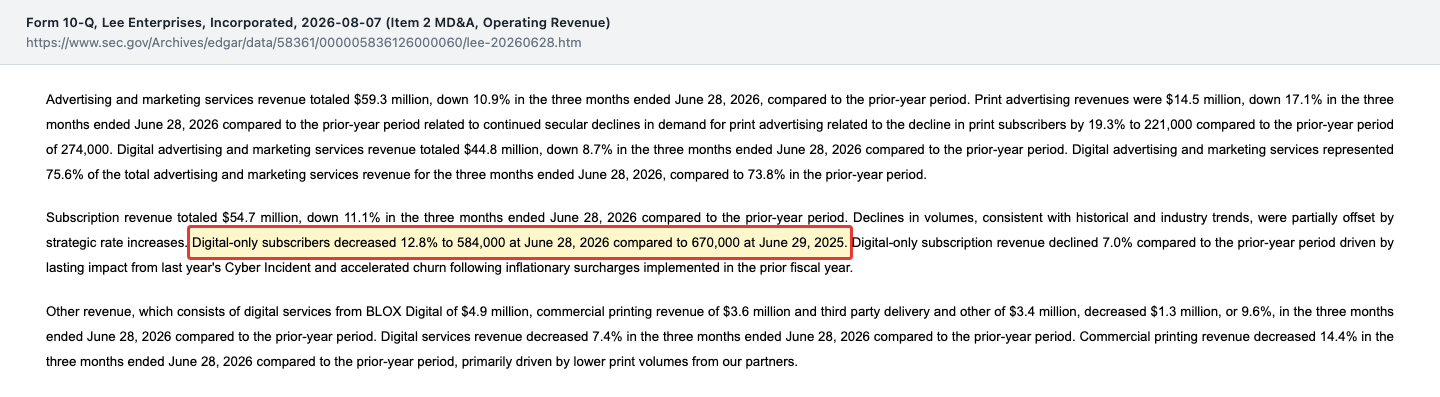
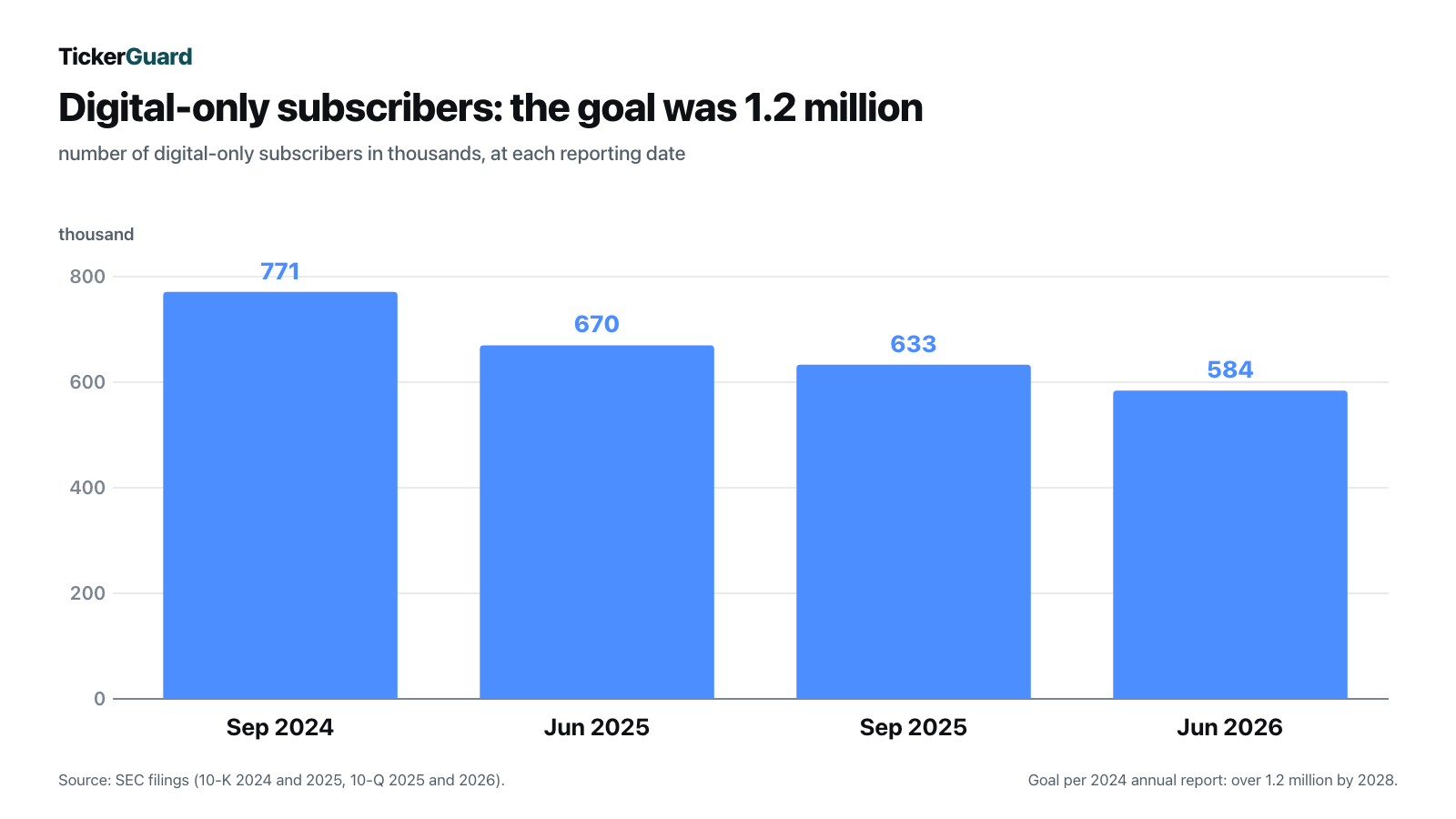
Lee cites two reasons for the third-quarter decline in digital subscription revenue (−7.0 percent): the lasting impact of the cyberattack and higher churn after price surcharges in the prior year. That explains part of it, but it does not change the direction. The other digital building blocks are not growing either: total digital revenue fell 8.1 percent to $71.6 million in the third quarter, digital advertising fell 8.7 percent and digital services revenue (mainly BLOX Digital) fell 7.4 percent. Print subscribers dropped 19.3 percent to 221,000 at the same time. Back to the bakery: the bread is disappearing, and the delivery service is losing customers too, just more slowly. Hence: A rising digital share is no proof of growth at Lee — it rises because print is shrinking faster than digital.
Uncomfortable Truth No. 4: Lee sells AI — and fears it at the same time
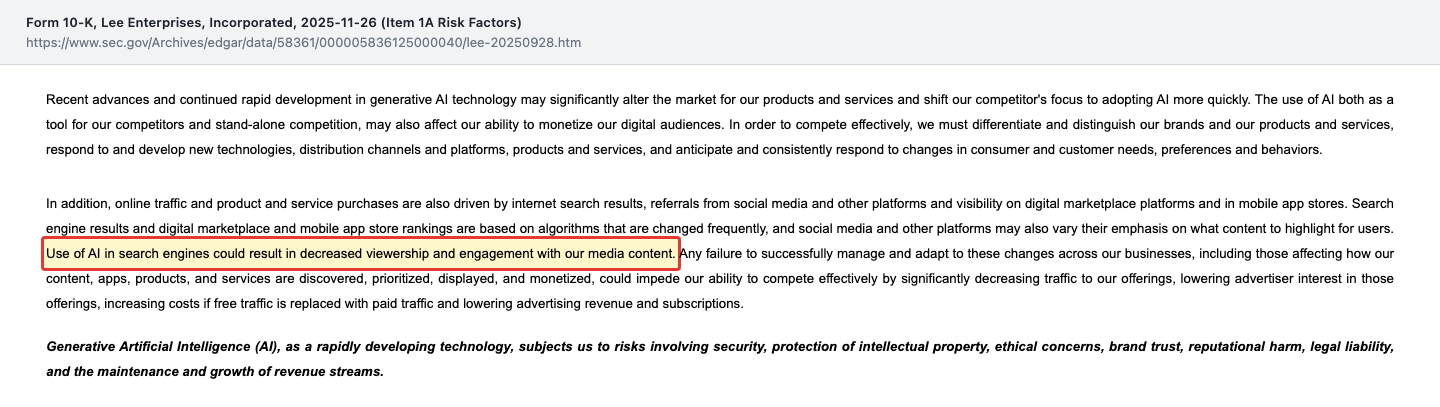
In its annual report for fiscal 2025, Lee explicitly describes its Amplified agency as a “suite of AI-powered solutions,” and according to the fiscal 2024 annual report, the BLOX Digital publishing software gained an AI assistant tool, among other features. Our AI classification therefore lists Lee as “sells AI” — with a caveat: Lee does not report any separate AI revenue, and “AI-powered” is Lee’s own label for a digital marketing business. The other side is more dangerous. Online, a local newspaper lives on readers finding its articles through search engines. That is exactly the path Lee sees under threat:
“Use of AI in search engines could result in decreased viewership and engagement with our media content.”
— Lee Enterprises, Incorporated, SEC annual report 10-K for fiscal 2025, Item 1A “Risk Factors”
Lee is not alone in this. How a large online publisher describes the same danger is covered in our People Inc. analysis; how a digital media company is taking AI firms to court, in the Ziff Davis analysis. For Lee the risk is especially unpleasant because digital revenue is already shrinking. From the software agreements with Quintype signed on October 16, 2026, Lee expects, among other things, a better ability to integrate AI tools for clients. Whether that turns into revenue is not stated in any filing. The lesson: A company that lives on search-engine readers may sell more advertising with an AI label — and may lose more readers to AI answers.
Uncomfortable Truth No. 5: The first profit had a tailwind from one-time items
The quarterly profit of $5.2 million (including noncontrolling interests) is real, but not entirely self-made. It included a one-time $2.3 million settlement gain from transferring retiree life insurance obligations to an insurer and $0.6 million of business interruption insurance proceeds related to the cyberattack. Without both items, pre-tax income would have been about $3.7 million instead of $6.6 million. Over nine months, $6.4 million of insurance proceeds flowed into Adjusted EBITDA. Lee says as much in its earnings release of August 6, 2026:
“Excluding the insurance proceeds received this year related to last year’s cyber event, that still translates to year-over-year Adjusted EBITDA growth near 10%.”
— Nathan Bekke, President and CEO, SEC current report 8-K of August 6, 2026, Exhibit 99.1 (third quarter of fiscal 2026)
Roughly 10 percent underlying growth on shrinking revenue is a respectable achievement — and it comes from cost cuts. Two more points belong in this chapter. On September 2, 2026, the audit committee decided to replace auditor BDO with Grant Thornton after the fiscal 2026 audit; according to the filing there were no disagreements, but it mentions a control weakness in revenue recording that was remediated in 2024. And on August 6, 2026, Lee granted its CEO and CFO one-time equity awards with target values of $1.75 million and $900,000. Remember: The cost turnaround is documented — whether it holds without one-time items and further job cuts will only show in the annual report for fiscal 2026.
Valuation: Cheap on Revenue, Expensive on Debt
With 22,292,044 shares (as of July 31, 2026) and a closing price of $6.47 on October 22, 2026, Lee’s market value was about $144 million. Measured against about $517 million in revenue over the last four quarters, that is a price-to-sales ratio of roughly 0.28 — which sounds like a bargain. But at Lee, the loan is part of the valuation: add $454.7 million of debt and subtract $59.4 million of cash, and the whole company costs about $540 million. Set that against the fiscal 2026 outlook — 22 to 28 percent more Adjusted EBITDA than fiscal 2025’s $45.4 million, so roughly $55 million to $58 million — and you land at about 9 to 10 times. Net debt equals roughly seven times expected Adjusted EBITDA. A meaningful price-to-earnings ratio does not exist: the first nine months still ended in a loss. How cautiously even Lee views its own loan shows in one number from the quarterly report: as of June 28, 2026, Lee puts the fair value of the $454.7 million debt at $332.5 million. In plain terms: by that estimate, a buyer would pay only about 73 cents for every dollar of that IOU.
A second point concerns the stock itself. Besides Hoffmann (10.91 million), other investors bought about 4.48 million shares at $3.25 in February 2026 — roughly 20 percent of all shares; per the prospectus (S-3) of March 6, 2026, they are Quint Digital (2.45 million), Solas Capital Management (1.55 million), Bergen Asset Partners (0.35 million) and Niraj Javeri (0.12 million); together 15.38 million, plus 0.62 million for service providers, make up the 16 million new shares. Lee registered all 15.38 million investor shares — Hoffmann’s included, but not the service providers’ shares — for resale in a prospectus (S-3), and the 180-day lock-up has expired. Over the 60 trading days through October 22, 2026, only about 38,000 shares traded per day on average (fundamental data). We do not have a reliable number of analyst price targets for Lee. So remember: Buying Lee mostly means buying a stake in the question of whether $455 million of debt stays manageable for a shrinking business — the low price per revenue dollar is the result of that question, not the answer.
Upside and Risks at a Glance
What speaks for Lee Enterprises:
- Cheaper money: the rate on the only loan fell from 9 to 5 percent for five years, about $18 million less interest per year; no fixed principal payments, no financial covenants, maturity not until 2045.
- The cost turnaround is working: third quarter of fiscal 2026 with a $4.7 million profit for Lee shareholders, Adjusted EBITDA +23.0 percent, fiscal 2026 outlook raised to +22 to +28 percent.
- An owner with money and commitment: Hoffmann put about $35 million into new shares, bought another 600,000 shares after the placement through June 28, 2026, and has Lee manage newspapers he owns.
- More room in the cash box: $59.4 million as of 6/28/2026, up from $10.0 million three quarters earlier; operating cash flow rose to $6.1 million over nine months.
- Pension risks are shrinking: the fully funded pension plan is being terminated, with completion expected in fiscal 2027.
What speaks against it:
- Revenue has been shrinking for years: −28 percent from fiscal 2022 to 2025, another −10.8 percent in the third quarter of fiscal 2026; digital revenue is falling too (−8.1 percent).
- Digital-only subscribers fell from over 771,000 to 584,000 instead of heading toward 1.2 million by 2028.
- Equity attributable to Lee shareholders is negative (−$2.2 million as of 6/28/2026), and net debt is about seven times expected Adjusted EBITDA; the cheap rate lasts only five years.
- A majority shareholder plus related-party transactions (Hoffmann Media Group, Quintype); minority shareholders have little say.
- AI in search engines may cut the reach of local news; plus pending lawsuits (Associated Press since June 2026, Lineup Systems over $7.0 million) and an auditor change after fiscal 2026.
A Human Conclusion
Back to the rescuer trap from the beginning. Its core is not that the rescuer is wrong — Hoffmann has achieved a lot for Lee: cheaper money, fresh capital, a first quarterly profit. Its core is that his entry feels like a verdict on the business, when it is mostly a verdict on his own price. Hoffmann bought at $3.25, alongside a lender that cut its rate at the same time. Anyone buying afterward pays the market price, with no board seat and no say. So the honest question for you is not “What does the rescuer know?” but: Would you buy Lee if you didn’t know who had already bought? Then you would be looking at a shrinking newspaper business, a digital business that is not growing yet, and $455 million of debt with five years of breathing room. Three numbers will decide whether that breathing room becomes a turnaround: the number of digital subscribers, same-store revenue and Adjusted EBITDA without insurance money. What you make of it is your decision. And that is how it should be.
Sources
All original documents used in this analysis — so you can read them yourself:
- Lee Enterprises, Incorporated — SEC quarterly report 10-Q for June 28, 2026 (filed August 7, 2026)
- Lee Enterprises, Incorporated — SEC current report 8-K of August 6, 2026, Exhibit 99.1 (third-quarter results and fiscal 2026 outlook)
- Lee Enterprises, Incorporated — SEC quarterly report 10-Q for March 29, 2026 (filed May 8, 2026)
- Lee Enterprises, Incorporated — SEC annual report 10-K for fiscal 2025 (filed November 26, 2025)
- Lee Enterprises, Incorporated — SEC annual report 10-K for fiscal 2024 (filed December 13, 2024)
- Lee Enterprises, Incorporated — SEC current report 8-K of December 30, 2025 (announcement of the placement at $3.25)
- Lee Enterprises, Incorporated — SEC current report 8-K of February 5, 2026 (placement, credit amendment, change in control)
- Lee Enterprises, Incorporated — SEC prospectus S-3 of March 6, 2026 (resale of the placement shares)
- Lee Enterprises, Incorporated — SEC current report 8-K of August 11, 2026 (one-time equity awards for the CEO and CFO)
- Lee Enterprises, Incorporated — SEC current report 8-K of September 9, 2026 (change of auditor)
- Lee Enterprises, Incorporated — SEC current report 8-K of September 30, 2026 (Gregory Hoffmann joins the board)
- Lee Enterprises, Incorporated — SEC current report 8-K of October 22, 2026 (agreements with Quintype)
- Full SEC filing history: EDGAR overview Lee Enterprises (sec.gov)
- Fundamental data (prices, trading volume; as of October 22, 2026), cross-checked against the SEC filings.
Transparency & disclaimer: this analysis is journalistic commentary on publicly available information. It is not investment advice, not a regulated investment research product and not a solicitation to buy or sell securities. Equity investments carry substantial risk up to and including total loss. All information is provided without warranty; the as-of date for each figure is stated in the text. Positions held by the operator are disclosed daily; where one exists, it appears as a notice at the top of this analysis.
Key figures at a glance
All monetary figures in millions of $; earnings per share as reported.
| Metric | 2021 | 2022 | 2023 | 2024 | 2025 |
|---|---|---|---|---|---|
| Revenue | 794.6 | 781.0 | 691.1 | 611.4 | 562.3 |
| Operating Income (EBIT) | 56.6 | 51.6 | 45.2 | 30.4 | 19.9 |
| Net Income | 22.7 | -2.0 | -5.3 | -25.8 | -37.6 |
| Net Margin | 2.9% | -0.3% | -0.8% | -4.2% | -6.7% |
| Earnings Per Share | 3.90 $ | -0.35 $ | -0.90 $ | -4.35 $ | -6.15 $ |
Source: fundamental data & SEC filings (annual and quarterly reports, 10-K/10-Q)
Our Bottom Line at a Glance
- Revenue & business model negative
- Revenue fell from $781.0 million in fiscal 2022 to $562.3 million in fiscal 2025 (−28 percent) and another 10.8 percent in the third quarter of fiscal 2026; digital revenue is falling too (−8.1 percent).
- Costs & earnings positive
- Third-quarter fiscal 2026 Cash Costs −14.5 percent, Adjusted EBITDA +23.0 percent, first quarterly profit ($4.7 million) after at least six loss-making quarters; fiscal 2026 outlook raised to +22 to +28 percent (about +10 percent excluding insurance money).
- Balance sheet & debt negative
- $454.7 million loan from a single lender from whom Lee already had to obtain an interest deferral in 2025; equity attributable to Lee shareholders −$2.2 million (6/28/2026); the 5 instead of 9 percent rate applies for only five years.
- Digital strategy negative
- Digital-only subscribers fell from over 771,000 (end of fiscal 2024) to 584,000 (6/28/2026) against a goal of over 1.2 million by 2028; the annual report lists AI in search engines as a risk to reach.
- Ownership & governance neutral
- Majority shareholder David Hoffmann (54.5 percent) brought capital and cheaper money but controls the company; related-party transactions (Hoffmann Media Group, Quintype) and an auditor change after fiscal 2026.
Lee Enterprises illustrates how the rescuer trap works: a businessman takes the majority in February 2026, the lender cuts the rate, and the third quarter brings the first profit in a long time. The SEC filings also show revenue that has been shrinking for years, falling digital subscriptions, negative equity attributable to shareholders and $455 million of debt owed to a single lender. Buyers are betting that five years of cheap money are enough for a real turnaround. Not investment advice.
What Our Rating Means
Substance risk
We found at least one documented issue that threatens the company itself — regardless of how the stock is currently valued.
The balance sheet was propped up, not repaired: equity attributable to Lee shareholders is negative despite $50 million of fresh capital, and the $455 million of debt is owed to a single lender from whom Lee already had to obtain an interest deferral in 2025. Red, because that is a documented substance risk, even though the 2026 cost turnaround is real and the cheap rate buys time. The decision is yours.
A journalistic assessment by our editorial team at the time of the deep dive, based on public sources — not investment advice and not a solicitation to buy or sell. Your personal circumstances (investment goals, risk capacity, taxes) cannot be taken into account. What our levels mean, how verdicts are formed, and what conflicts of interest exist →
Worth Noting
- The trigger for this analysis is the change in control of 2/5/2026 (8-K, Item 5.01): issuance of 16 million shares at $3.25 (15,384,615 to investors, 10,909,440 of them to David Hoffmann; 615,385 to service providers as expense reimbursement); price reference: $3.73 (12/29/2025, last trading day before the announcement in the 8-K of 12/30/2025), $5.53 (2/5/2026), $8.94 (3/3/2026, per S-3), $11.76 (5/28/2026), $6.47 (10/22/2026; closing prices, fundamental data).
- Data as of: the latest periodic report is the 10-Q for 6/28/2026; the annual report for fiscal 2026, which ended 9/27/2026, had not been filed as of 10/23/2026. The interest savings (about $18 million per year) are our own calculation: 4 percentage points on $454.7 million. The $55 million to $58 million EBITDA range follows from the outlook (+22% to +28%) applied to fiscal 2025’s $45.4 million.
- Not to be confused: the ticker LEE on Nasdaq belongs to Lee Enterprises, Incorporated (CIK 0000058361), not to the jeans brand of the same name. Valuation dated and evergreen: market value from 22,292,044 shares × $6.47 (10/22/2026).
Stock Watch
This analysis is as of October 23, 2026. Stock Watch will tell you what's changed at LEE since then.
Later $1 a month per stock — signing up is free, and you'll be the first to know when it launches.
The full analysis as a PDF for later
We will send you this analysis as a PDF — to print, file away, and read at your own pace. And we will add you to the free Stock Watch list for Lee Enterprises Incorporated (LEE), so you hear about it when something material in this analysis changes.
Frequently Asked Questions
Lee Enterprises (Nasdaq: LEE), based in Davenport, Iowa, publishes local newspapers in 72 mid-sized U.S. communities across 25 states, including St. Louis, Buffalo, Omaha and Richmond. It also runs the Amplified Digital agency, which organizes online advertising for local businesses, and the BLOX Digital publishing software. In fiscal 2025, Lee generated $562.3 million in revenue.
The majority shareholder is businessman David Hoffmann, Chairman since February 2026. On February 5, 2026, he bought 10.9 million new shares at $3.25 and held 54.5 percent of the voting power as of June 28, 2026. That makes Lee a controlled company under Nasdaq rules. The second-largest shareholder is Quint Digital with about 14.38 percent (October 16, 2026).
Lee has a single loan of $454.7 million from BH Finance, an affiliate of Berkshire Hathaway, due March 16, 2045 (as of June 28, 2026). Since February 2026, it has carried a 5 instead of a 9 percent rate for five years. There are no fixed principal payments or financial covenants; cash above $64.0 million (until February 2026: $20.0 million) is swept as excess to repay the loan. Net of $59.4 million in cash, net debt was $395.3 million.
The fiscal year ends on the last Sunday in September. Fiscal 2026 ran through September 27, 2026, and fiscal 2025 through September 28, 2025. The third quarter of fiscal 2026 therefore covers April through June 2026. Lee usually files its annual report (10-K) in November or December.
For the first time in at least six quarters, yes: in the third quarter of fiscal 2026 (through June 28, 2026), Lee shareholders were left with a $4.7 million profit, driven by 45 percent lower interest expense, lower costs and one-time items. The first nine months still showed a $3.1 million loss, and fiscal 2023 through 2025 each ended in a loss (most recently $37.6 million).
As “sells AI”: in its fiscal 2025 annual report, Lee describes the Amplified agency as a suite of AI-powered solutions, and BLOX Digital gained an AI assistant tool in 2024. Lee does not report separate AI revenue, though. The same report lists AI in search engines as a risk, because it could reduce traffic to Lee’s news sites.
Found an error?
Did you spot a factual error, an outdated number, or a typo in this deep dive? Let us know briefly — your report goes straight to the editorial team.