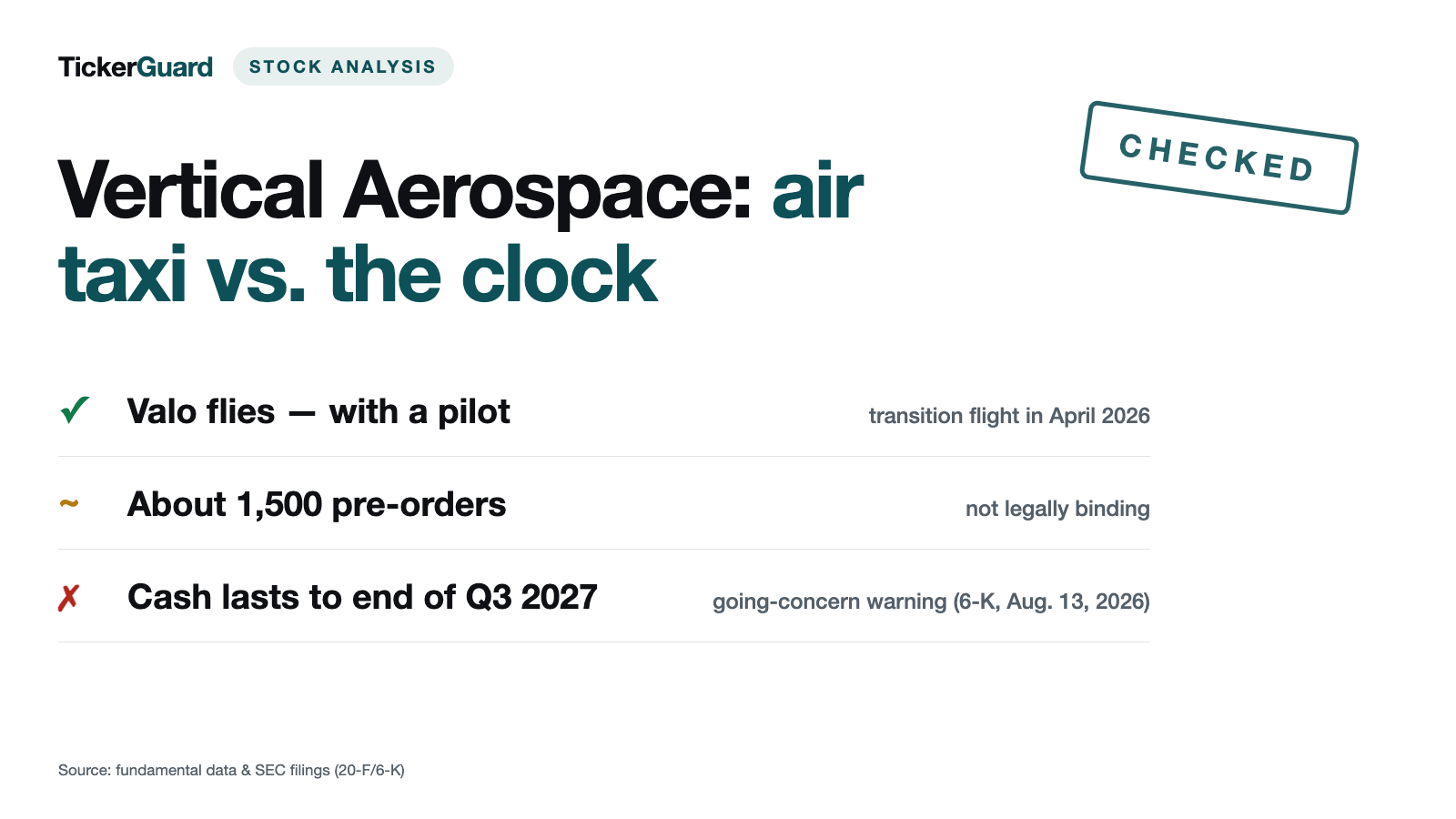
CorMedix: A Holiday-Bonus P/E — the Medicare Add-On Is Mostly Gone
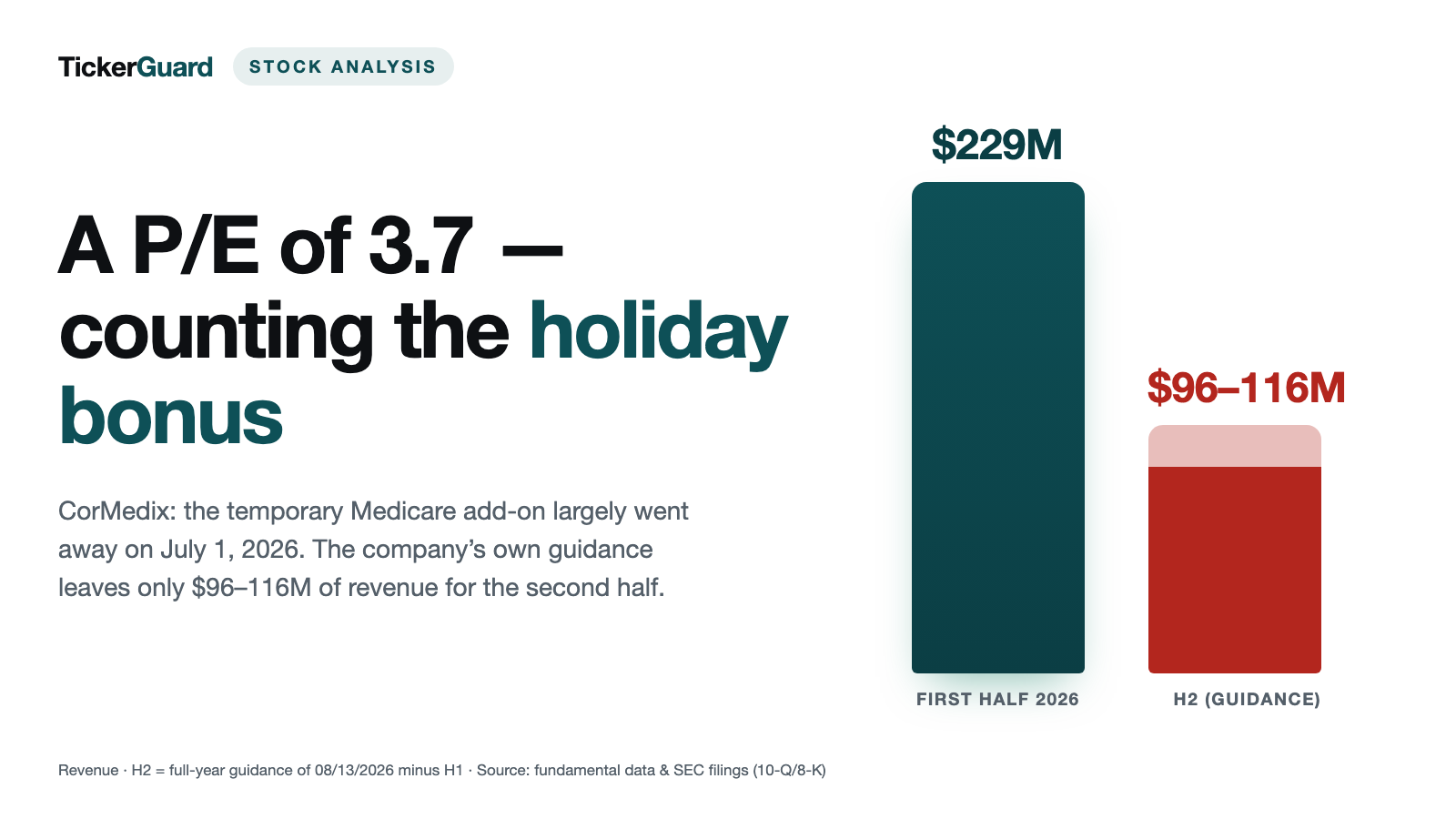
A paycheck with a holiday bonus on it is not an annual salary — and that is exactly how to read CorMedix’s low price-to-earnings ratio. After $229.4 million of revenue in the first half of 2026, the company’s own guidance leaves only about $96 million to $116 million for the second. The reason: the $163.1 million profit of 2025 came mostly from a temporary Medicare add-on payment for the dialysis drug DefenCath, and on July 1, 2026 that turned into a much smaller follow-on payment.
 Thomas Mücke
Founder & Publisher
As of Today
As of: October 20, 2026
- Closing price
- 7.60 $ +2.60%
- Market Capitalisation
- 0.6 $B
- P/E
- 3.6
- Growth Score
- 5/10
- AAQS
- 4/10
Price change since October 20, 2026: +0.4%
This analysis has a cut-off date. The Stock Guard tells you when something material changes in the numbers. Reserve your free spot
Chart
Interactive price chart (TradingView).
52-week range: 6.30 $ to 12.70 $ · Last price: 7.60 $ (As of: October 20, 2026)
Note: pure fact-based analysis, not investment advice and not a solicitation to buy or sell. All figures without guarantee.
Imagine you want to know what you earn in a year — and you take the December pay stub with the holiday bonus on it. Multiply by twelve, done. Sounds absurd, yet investors do exactly that all the time. Psychologists call it extrapolation: we simply project whatever just happened into the future. No metric tempts us more than the price-to-earnings ratio (P/E) — the share price divided by what the company most recently earned per share. For CorMedix (Nasdaq: CRMD), it stood at about 3.7 on October 20, 2026, according to fundamental data. For a profitable drug company, that looks like a fire sale. So let’s make a deal: before you annualize the holiday bonus, let’s read together what CorMedix has told the U.S. securities regulator, the SEC — the annual report (10-K) for 2025, the quarterly reports (10-Q) through June 30, 2026 and the current reports (8-K) through October 2026. Making false statements to the SEC carries penalties, which is why these filings are a reliable source. And they show quite precisely where the bonus came from — and that most of it has stopped arriving since July 1, 2026. In the end, the decision is yours.
What CorMedix actually does — a lock for dialysis catheters and an acquired anti-infective shelf
People with severe kidney disease are often hooked up to dialysis three times a week. Many of them get a catheter for it, a thin tube that stays in a large vein. Between treatments it is “locked” with a fluid so it does not clog. That is where DefenCath, CorMedix’s main product, comes in: a lock solution combining heparin (against clots) and taurolidine (against germs). It is meant to reduce bloodstream infections through the catheter — a feared and expensive complication. The U.S. Food and Drug Administration (FDA) approved DefenCath on November 15, 2023, after earlier attempts had failed. It has been sold to hospitals since April 2024 and to outpatient dialysis centers since July 2024.
Since August 29, 2025, CorMedix has also owned Melinta Therapeutics, a supplier of hospital antibiotics and antifungals (including REZZAYO, MINOCIN for injection and VABOMERE). The price: $260 million in cash, 3.3 million new shares and future payments tied to sales and approvals (2025 annual report). Part of the financing came from $150 million of convertible notes. CorMedix is based in Parsippany, New Jersey, and had about 191 full-time employees on February 28, 2026. That defines the central tension of this analysis, and it runs through every chapter: the profits of 2025 and early 2026 are real — but they were earned with a temporary Medicare add-on that has largely gone away since July 2026.
Company history for investors
-
2021
Shareholder suit over the approval filing
Investors sue over allegedly misleading statements about the DefenCath application and FDA complete response letters. Per the 10-Q for 06/30/2026, the case is still ongoing.
-
2023
FDA approval for DefenCath
On 11/15/2023 the FDA approves DefenCath. For shareholders, the turning point from a research shop without revenue to a product company.
-
2024
Launch with a Medicare add-on
Sales start in hospitals in April and in dialysis centers in July — when the temporary TDAPA add-on begins on 07/01/2024. Revenue 2024: $43.5 million.
-
2025
Record year and Melinta deal
$311.7 million of revenue and $163.1 million of profit. On 08/29/2025 CorMedix acquires Melinta, financed in part with $150 million of convertible notes.
-
2026
Add-on ends, auditor changes
On 07/01/2026, TDAPA turns into a much lower follow-on payment; guidance leaves about $96–$116 million of revenue for H2. On 10/19/2026 CorMedix reports that the FDA has accepted the REZZAYO application.
How the stock landed on our desk
CorMedix made our research list through our in-house Reddit hype scanner (3 mentions in 24 hours, ApeWisdom, October 21, 2026) — little noise, but exactly the kind of conversation where people say things like “P/E of 3, the company is profitable, you can’t go wrong.” A look at the chart shows the market disagrees: the highest close of 2025 was $16.56 on June 23; at the end of 2025 it was $11.63, and on October 20, 2026 it was $7.57 (fundamental data).
The decisive contrast is a different one, because two camps face each other. The six analysts covering the stock according to fundamental data all rate it positively (three “buy”, three “strong buy”); their average price target is about $15.33 — a third-party view, not a statement of ours. On the other side are about 15.4 million shares sold short — about a fifth of all 77.9 million shares outstanding (fundamental data, as of October 20, 2026). A short seller borrows shares to bet on a falling price; a ratio this high shows that a noticeable part of the market expects the price to fall. So keep this in mind from the start: when a P/E of about 3.7 meets a bet by a fifth of the shares against the company, it pays to read the footnotes yourself.
The numbers over the years, given their due
First, what is genuinely impressive. For years CorMedix was a company with no meaningful revenue: about $0.1 million came in during 2022, nothing at all in 2023, alongside losses of $29.7 million and $46.3 million. Then came the approval — and the curve turned as steeply as it rarely does. 2024 brought $43.5 million of revenue, 2025 $311.7 million. A loss of $17.9 million became net income of $163.1 million, and operating cash flow — the money that actually flows into the bank account from the business — swung from minus $50.6 million to plus $175.0 million. That is not an accounting trick, that is cash in the bank.
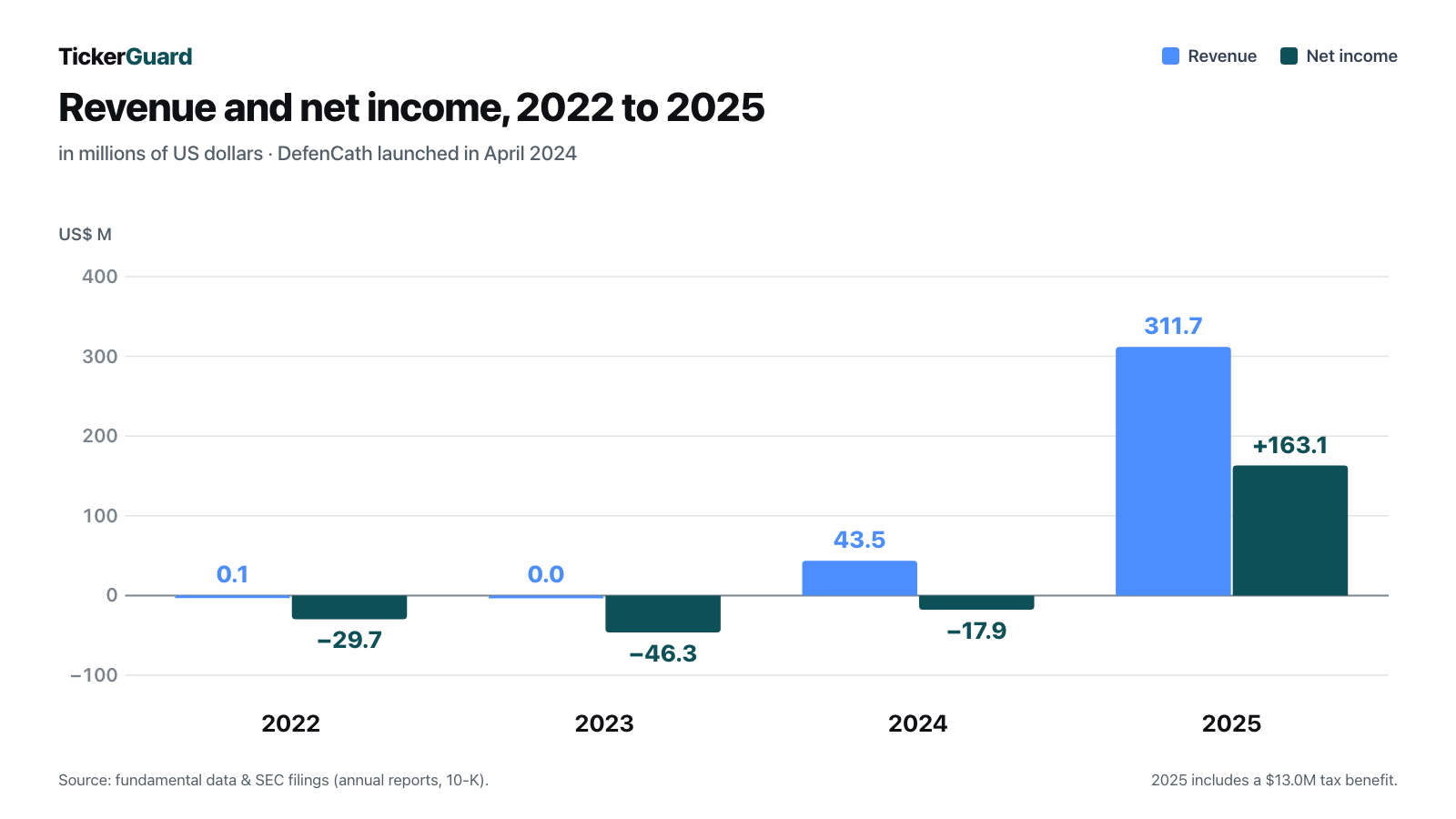
To be fair, there is already an asterisk here. The $163.1 million profit includes a $13.0 million tax benefit: in 2025, CorMedix for the first time recognized tax assets from old losses ($61.5 million) as recoverable. Before taxes, the company earned $150.0 million. It now pays regular taxes — its effective tax rate was 31.6 percent in the first half of 2026. The first half of 2026 was strong as well: $229.4 million of revenue, $64.6 million of net income and $128.6 million of operating cash flow. With that money CorMedix bought back 2.4 million of its own shares for $17.5 million, under a program of up to $75 million that runs through the end of 2027. Keep this picture in mind: the numbers through June 2026 show what DefenCath could earn with the add-on. They do not show what it earns without it.
What the filings say — the uncomfortable truths
Uncomfortable truth No. 1: The add-on that carried the profit has largely been gone since July 1, 2026
To understand this, you need to know how Medicare — the U.S. government health insurance for older people and for dialysis patients — pays for dialysis. Centers get a flat rate per treatment that covers all the usual drugs. A new drug therefore gets a transition aid: for a time, Medicare pays an add-on equal to the drug’s average sales price on top, the TDAPA (Transitional Drug Add-on Payment Adjustment). Think of it as a launch rebate like the old electric-car incentive. As long as it runs, customers buy happily. For DefenCath, it ran from July 1, 2024 to June 30, 2026. After that, only a smaller add-on remains until mid-2029, recalculated every year and — according to the annual report — spread across all Medicare dialysis payments. What that means is spelled out in the quarterly report for June 30, 2026:
“On July 1, 2026, DefenCath’s TDAPA reimbursement transitioned into a post-TDAPA Add-On Adjustment, the calculation of which is determined by CMS. As a result of the methodology utilized by CMS, the level of reimbursement provided to institutions treating dialysis patients significantly declined, and as a result, CorMedix expects a corresponding reduction to its net pricing, resulting in lower net sales, for DefenCath in the second half of 2026 relative to historical periods.”
— CorMedix Inc., SEC quarterly report 10-Q for June 30, 2026, Item 2 “Management’s Discussion and Analysis”

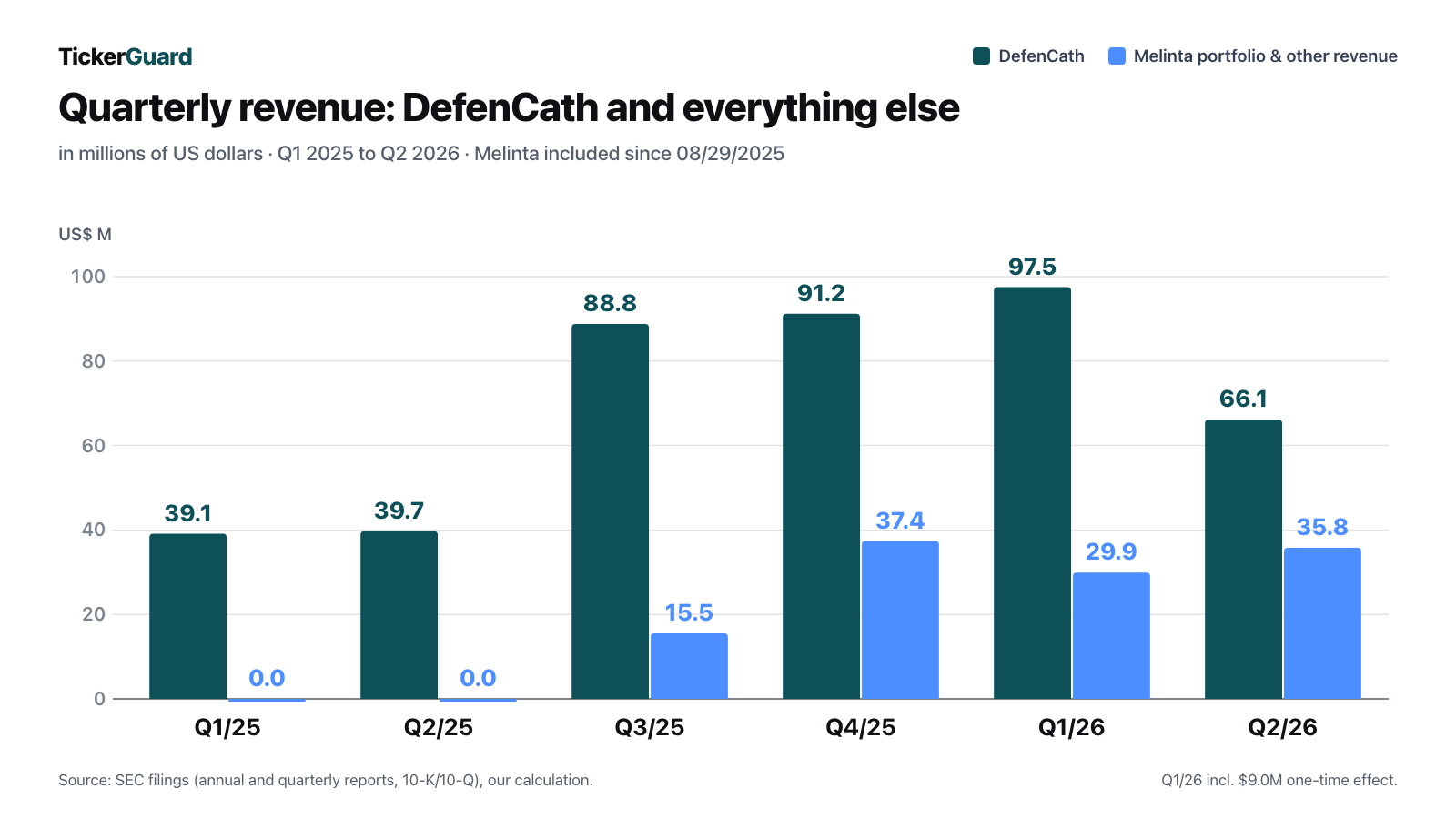
How much DefenCath has mattered so far shows in the split: in 2025, $258.8 million of the $311.7 million of revenue came from this one product, about 83 percent. And something else stands out when you line up the quarters: already in the second quarter of 2026, still with the add-on, DefenCath revenue fell from $97.5 million to $66.1 million. Even after stripping the one-time $9.0 million estimate change out of the first quarter, a decline of about a quarter remains. The quarterly report offers no explanation for this sequential decline — which makes it the most important open number for the next quarterly report: did volume fall even before the add-on ended, or only the price per pack?
CorMedix is not the first company to go through this. At Lantheus, a similar transitional payment for the cancer imaging agent PYLARIFY expired at the end of 2024. In 2025 its revenue shrank 6.5 percent to $989.1 million, according to the annual report mainly because of the lower net price. The details are in our Lantheus stock analysis. Keep in mind: a drug whose price is set by a government agency only half belongs to the company. The other half belongs to the reimbursement formula.
Uncomfortable truth No. 2: The company’s own guidance leaves little for the second half
CorMedix does not hide the drop — it actually spells it out, you just have to do the subtraction yourself. In its earnings release of August 13, 2026, the company confirmed its full-year guidance:
“The Company maintains full-year 2026 consolidated revenue guidance of $325 to $345 million, and raises full-year adjusted EBITDA guidance to a range of $125 to $140 million.”
— CorMedix Inc., SEC current report 8-K of August 13, 2026, Exhibit 99.1 (second-quarter 2026 earnings release)
“Raises” sounds good. Now the subtraction: in the first half of 2026, CorMedix already generated $229.4 million of revenue and $128.7 million of adjusted EBITDA ($70.0 million plus $58.7 million; adjusted EBITDA is earnings before interest, taxes, depreciation and amortization, stock compensation and special items). That leaves, on our math, about $96 million to $116 million of revenue for the second half — at most about half of the first —and adjusted EBITDA between roughly minus $4 million and plus $11 million. In other words, the company’s own guidance describes a second half roughly at breakeven. The professionals do similar math: for full-year 2026 they expect earnings of about $0.50 per share, according to fundamental data — less than the $0.72 (diluted) CorMedix already earned in the first half — and only about $0.06 for 2027 (as of October 21, 2026).
The hope is called 2027. On January 1, 2027, the follow-on payment will be recalculated, and CorMedix expects considerably more:
“If CMS utilizes the same methodology to calculate the 2027 post-TDAPA Add-On Adjustment, which will be effective on January 1, 2027, we estimate the value of the Add-On Adjustment will be three to five-times higher than that granted for the third and fourth quarters of 2026, which we expect would result in higher DefenCath sales prices in 2027 relative to the second half 2026.”
— CorMedix Inc., SEC annual report 10-K for 2025, Item 1 “Business,” section “Outpatient Reimbursement”
That is the company’s estimate, not a commitment by the agency. Only a few sentences later, the same annual report says: “There can be no assurance that the level of reimbursement determined by CMS will improve.” And even the plan from January 2026 projected only $100 million to $140 million of DefenCath revenue for 2027 (8-K of January 8, 2026), after $258.8 million in 2025. Keep in mind: three times very little is still less than before.
Uncomfortable truth No. 3: Few customers — and about $59 million of cash gets locked up for one of them
The U.S. dialysis market is dominated by a few large chains, and that is reflected at CorMedix:
“Sales to our top three customers accounted for 79% of our total revenue for the year ended December 31, 2025, and we had three customers that accounted for 41%, 23% and 20% of our accounts receivable, respectively, for the year ended December 31, 2025. These customers have no purchase commitments and may cancel, change or delay purchases with little or no notice or penalty.”
— CorMedix Inc., SEC annual report 10-K for 2025, Item 1A “Risk Factors”
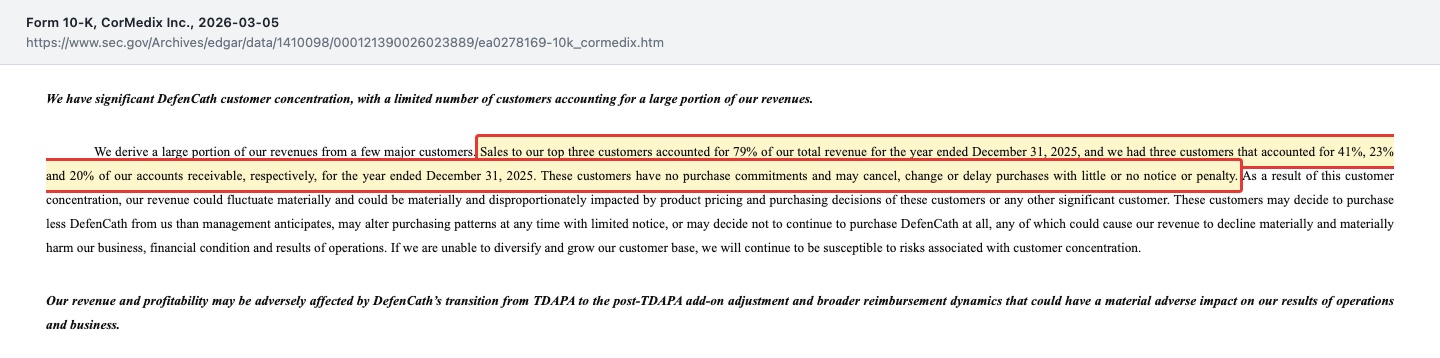
In the second quarter of 2026, the picture spread out somewhat — four customers stood at 25, 20, 27 and 10 percent of revenue — and according to the earnings release CorMedix now has supply agreements with all of the five largest U.S. dialysis providers. But one footnote shows how tightly the company is tied to individual buyers. After quarter-end, CorMedix agreed with a customer to pay the volume-based rebates it owes that customer later than usual — and secures that obligation with bank guarantees:
“Subsequent to June 30, 2026, the Company entered into an arrangement with a customer pursuant to which the parties agreed to defer the timing of certain volume-based contractual rebate payments beyond normal payment terms. The Company agreed to secure the cash required to settle the net obligations by issuing letters of credit, for which the customer will be the beneficiary through the settlement of the liabilities. The Company intends to establish the first letter of credit in the third quarter of 2026 totaling approximately $59 million.”
— CorMedix Inc., SEC quarterly report 10-Q for June 30, 2026, Note 14 “Subsequent Events”
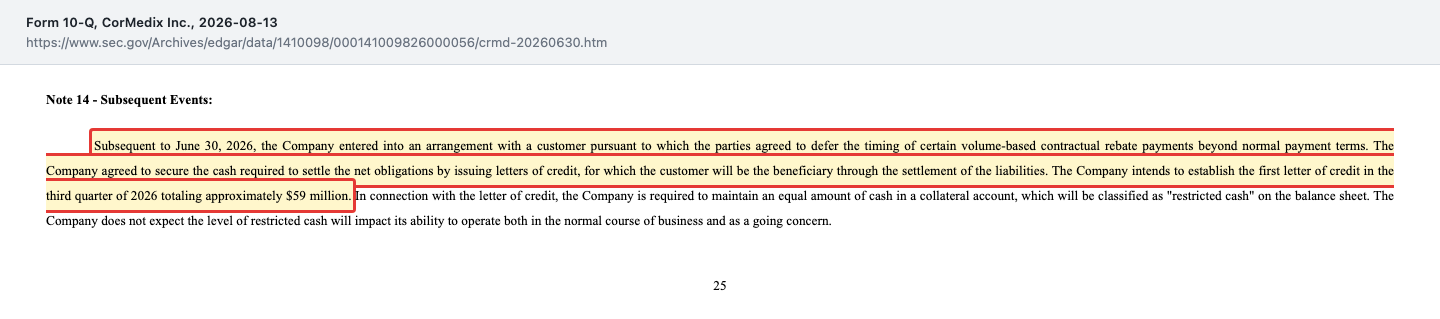
A letter of credit here is essentially a bank guarantee: the bank promises the customer the payment, and CorMedix has to park the same amount in a blocked account. About $59 million is roughly 23 percent of the unrestricted cash at June 30, 2026. CorMedix gains no liquidity from this: the money that flows to the customer later is locked up until then. The report does not say why the arrangement was made or who the customer is; CorMedix only writes that it does not expect the restricted amount to affect its ongoing business or its ability to continue as a going concern. Keep in mind: when a company locks up almost a quarter of its cash for a single customer, it shows how heavily it depends on that customer.
Uncomfortable truth No. 4: The accounting is not keeping up — and the auditor was replaced
A fast-growing company with a large acquisition puts pressure on its finance team. At CorMedix this has been stated in black and white in every filing since the 2025 annual report: a material weakness in internal control over the review of large, non-routine transactions. Put simply, there was no one reliably taking a second look at the big entries.
“This material weakness resulted from capacity constraints within the finance function during a period of significant transaction activity, including a large acquisition and a convertible debt offering, and reliance on third-party accounting resources, and it has not been remediated as of June 30, 2026.”
— CorMedix Inc., SEC quarterly report 10-Q for June 30, 2026, Item 4 “Controls and Procedures”
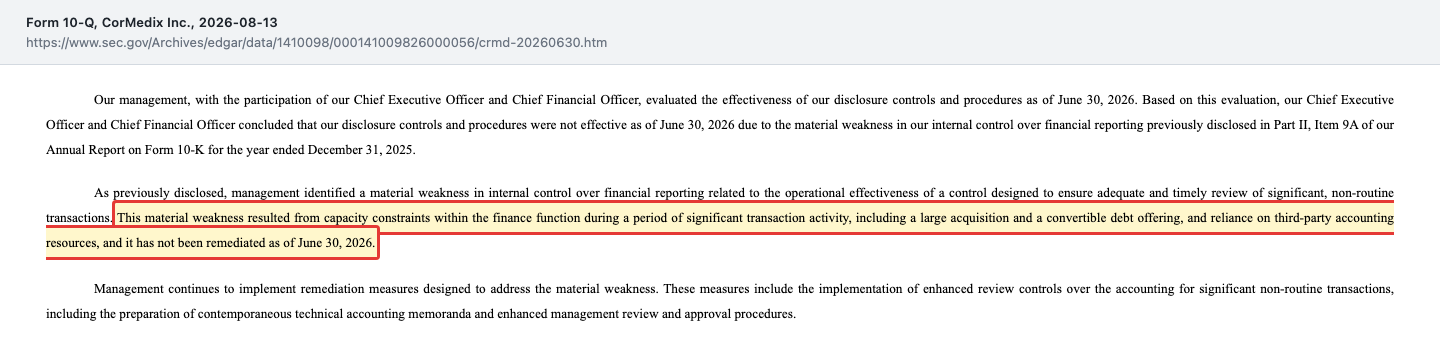
That fits with a current report of July 1, 2026 (8-K, Item 4.01): on June 25, 2026, the audit committee dismissed its previous auditor, CBIZ, and appointed Ernst & Young for fiscal 2026. According to the filing there were no disagreements; the only reportable event it names is the control weakness. A switch to a large audit firm can even be a good sign. But it also means the first annual audit under the new auditor is exactly the one in which the consequences of the add-on’s end will be booked. A few days later, on June 29, 2026, CorMedix also reshuffled its leadership: chief operating officer Elizabeth Hurlburt took over all commercial functions as well, and executive Michael Seckler left the company (8-K of July 2, 2026). And a shareholder class action from 2021 over earlier statements about the approval process is still ongoing (quarterly report for June 30, 2026). For the related shareholder derivative suits, a court preliminarily approved a settlement on July 24, 2026 (8-K of August 7, 2026). CorMedix had not reported the outcome of the final hearing scheduled for September 23, 2026 in an 8-K as of October 21, 2026. Keep in mind: a control weakness is not fraud. It is simply the reason to trust the numbers a little less blindly.
Valuation: a P/E below 4 — for profits that, by the company’s own guidance, won’t come back in this form
CorMedix reported 77,944,324 shares as of August 10, 2026. At the closing price of $7.57 on October 20, 2026, the company is worth about $590 million on the stock market (as a cross-check: in May 2026 CorMedix bought back its own shares at an average of $7.85). Add the $150 million of convertible notes and subtract $256.7 million of cash, and the enterprise value is about $483 million. Against full-year guidance of $125 million to $140 million of adjusted EBITDA, that is only about 3.5 to 3.9 times. Counting the $111.6 million of contingent consideration from the Melinta deal as debt (June 30, 2026), it is about $595 million, or 4.2 to 4.8 times. Still sounds cheap. But it is cheap only if the first half of 2026 is the yardstick — and that is exactly the holiday-bonus math from the beginning. If the second half really lands at adjusted EBITDA around zero, the ratio simply says nothing about the future.
Two balance sheet items deserve a second look. First, the contingent consideration from the Melinta deal: $111.6 million at June 30, 2026, which may flow to Melinta’s former owners depending on sales and approvals. Second, the convertible notes: 4 percent interest, due August 1, 2030, convertible at about $13.47 per share, far above the October 2026 price. Unless the stock rises substantially, CorMedix will have to repay the $150 million in cash in 2030. Of the $460.8 million of equity, $388.5 million is goodwill and intangible assets, mainly the rights to the Melinta products. For certain acquired product rights, including KIMYRSA and ORBACTIV, CorMedix itself considers a material impairment in a future period “reasonably possible” (quarterly report for June 30, 2026). What suggests the valuation still has some cushion: cash of about $3.29 per share (gross, that is, before the convertible notes and before the roughly $59 million that is to be restricted) covers a large part of the share price, and the Melinta business alone contributed $35.8 million of revenue in the second quarter of 2026, including licensing and grant income.
Opportunities and risks at a glance
What speaks for CorMedix:
- An approved product with real demand: DefenCath brought in $258.8 million in 2025, and CorMedix now has supply agreements with all of the five largest U.S. dialysis providers (earnings release of August 13, 2026).
- A strong cash position: $256.7 million at June 30, 2026, operating cash flow of $175.0 million (2025) and $128.6 million (first half of 2026), share buybacks under a $75 million program.
- A second pillar: together with licensing and grant income, the Melinta portfolio contributed $65.7 million of revenue in the first half of 2026; in June 2026 a U.S. appeals court upheld the MINOCIN patents against a generic challenger.
- A near-term catalyst: the FDA is reviewing REZZAYO for preventing fungal infections in stem cell transplants under priority review, with a decision due in the first quarter of 2027 (8-K of October 19, 2026); a study of DefenCath in patients fed intravenously is also running.
- The hope for 2027: CorMedix estimates the Medicare follow-on payment from January 1, 2027 at three to five times the payment in the second half of 2026.
What speaks against it:
- The add-on is gone: since July 1, 2026, Medicare reimbursement for DefenCath has significantly declined, according to the quarterly report; the company’s own guidance leaves about $96 million to $116 million of revenue and adjusted EBITDA around zero for the second half.
- Even before the cutoff, DefenCath revenue fell from $97.5 million in the first quarter of 2026 to $66.1 million in the second.
- Concentration risk: three customers with 79 percent of 2025 revenue, no purchase commitments, and about $59 million of cash locked up as collateral for one customer.
- Debt from the acquisition: $150 million of convertible notes through 2030 and $111.6 million of contingent consideration; $388.5 million of equity is goodwill and intangibles.
- Ineffective financial controls since the 2025 annual report, an auditor change in June 2026 and a shareholder class action pending since 2021.
A human conclusion
Back to the pay stub with the holiday bonus. Nobody claims the bonus was not real — it landed in the account. CorMedix is the same: the $163.1 million of 2025 profit, the $175 million of operating cash flow, the $256.7 million of cash — all of it is real and documented in the filings with the SEC. It was just earned with an add-on that has largely gone away since July 1, 2026. Reading a P/E of about 3.7 as a fire sale means multiplying December by twelve. The more honest question for you is therefore not “How cheap is the stock compared with 2025?” but: What does CorMedix earn in a year without a special payment — and will Melinta, REZZAYO and higher reimbursement from 2027 be enough to close the gap? The first real answers will be in the quarterly report for the third quarter of 2026, the first entirely without the add-on. If you have an answer that satisfies you, you have a thesis. If not, all you have is a pay stub. What you make of it is your decision. And that is how it should be.
Sources
All original documents used in this analysis — so you can read them yourself:
- CorMedix Inc. — SEC quarterly report 10-Q for June 30, 2026 (filed August 13, 2026)
- CorMedix Inc. — SEC quarterly report 10-Q for March 31, 2026 (filed May 14, 2026)
- CorMedix Inc. — SEC annual report 10-K for 2025 (filed March 5, 2026)
- CorMedix Inc. — SEC annual report 10-K for 2024 (filed March 25, 2025)
- CorMedix Inc. — SEC quarterly report 10-Q for September 30, 2025 (filed November 12, 2025)
- CorMedix Inc. — SEC current report 8-K of January 8, 2026, Exhibit 99.1 (2026 guidance and 2027 estimate)
- CorMedix Inc. — SEC current report 8-K of May 14, 2026, Exhibit 99.1 (first-quarter 2026 results)
- CorMedix Inc. — SEC current report 8-K of July 1, 2026 (Item 4.01, change of auditor)
- CorMedix Inc. — SEC current report 8-K of July 2, 2026 (Item 8.01, leadership change)
- CorMedix Inc. — SEC current report 8-K of August 13, 2026, Exhibit 99.1 (second-quarter 2026 results and guidance)
- CorMedix Inc. — SEC current report 8-K of October 19, 2026, Exhibit 99.1 (REZZAYO application accepted)
- Complete SEC filing history: EDGAR overview CorMedix (sec.gov)
- Fundamental data (share price, analyst ratings, short interest; as of October 20 and 21, 2026), cross-checked against the SEC filings.
- Reddit mentions: ApeWisdom (as of October 21, 2026); accessed via our in-house Reddit hype scanner.
Transparency & disclaimer: This analysis is a journalistic assessment of publicly available information and does not constitute investment advice, financial analysis in the regulatory sense, or a solicitation to buy or sell securities. Investing in stocks involves substantial risks, up to and including total loss. All information is provided without guarantee; the data date is noted in the text. We disclose the publisher’s own positions on a current basis; if one exists, it appears as a note at the top of this analysis.
Key figures at a glance
All monetary figures in millions of $; earnings per share as reported.
| Metric | 2021 | 2022 | 2023 | 2024 | 2025 |
|---|---|---|---|---|---|
| Revenue | 0.2 | 0.1 | 0.0 | 43.5 | 311.7 |
| Operating Income (EBIT) | -29.4 | -30.6 | -49.0 | -22.4 | 150.1 |
| Net Income | -28.2 | -29.7 | -46.3 | -17.9 | 163.1 |
| Net Margin | -14,774.7% | -45,409.9% | – | -41.2% | 52.3% |
| Earnings Per Share | -0.75 $ | -0.74 $ | -0.91 $ | -0.30 $ | 2.03 $ |
Source: fundamental data & SEC filings (annual and quarterly reports, 10-K/10-Q)
Our Bottom Line at a Glance
- Business model & product neutral
- DefenCath is approved (11/15/2023) and in demand, and CorMedix has contracts with all of the five largest U.S. dialysis providers. But its price depends on Medicare reimbursement, and in 2025 about 83 percent of revenue came from this single product.
- Earnings power after the add-on negative
- Since 07/01/2026, TDAPA reimbursement has turned into a significantly lower follow-on payment. The company’s guidance of 08/13/2026 leaves about $96 million to $116 million of revenue and adjusted EBITDA of roughly minus $4 million to plus $11 million for the second half.
- Balance sheet & liquidity positive
- $256.7 million of cash at 06/30/2026, operating cash flow of $175.0 million (2025) and $128.6 million (first half of 2026). Against that stand $150 million of convertible notes due 2030 and $111.6 million of contingent consideration.
- Customers & concentration negative
- Three customers accounted for 79 percent of 2025 revenue, with no purchase commitments. For deferred rebate payments to one customer, CorMedix is locking up about $59 million of cash as collateral from the third quarter of 2026.
- Controls & governance negative
- Material weakness in internal control since the 2025 annual report, not remediated as of 06/30/2026; auditor changed to Ernst & Young on 06/25/2026; shareholder class action pending since 2021.
- Pipeline positive
- REZZAYO for preventing fungal infections: acceptance of the FDA application under priority review announced on 10/19/2026, decision due in the first quarter of 2027. Plus an ongoing study of DefenCath in patients fed intravenously.
CorMedix is a textbook case of holiday-bonus math: $163.1 million of 2025 profit and a P/E of about 3.7 look like a bargain, but were mostly earned with a temporary Medicare add-on for DefenCath that largely went away on July 1, 2026. The company’s own guidance leaves about $96 million to $116 million of revenue and adjusted EBITDA around zero for the second half of 2026. Cash and the Melinta business provide support, REZZAYO and higher reimbursement from 2027 provide hope. Not investment advice.
What Our Rating Means
Open questions
The business works in principle, but one material question is open. As long as it stays open, our findings do not carry a quality verdict.
The cash pile is full, the business makes money, and there is no question of survival — hence not red. But the most important operating question is open: what does CorMedix earn without the Medicare add-on that carried its 2025 profit? Its own guidance points to a second half of 2026 around breakeven, three customers account for most of its revenue, and its financial controls are rated ineffective. The low P/E is a rear-view number. If you wait, check the quarterly report for September 30, 2026 to see how far DefenCath revenue falls without the add-on. The decision is yours.
A journalistic assessment by our editorial team at the time of the deep dive, based on public sources — not investment advice and not a solicitation to buy or sell. Your personal circumstances (investment goals, risk capacity, taxes) cannot be taken into account. What our levels mean, how verdicts are formed, and what conflicts of interest exist →
Worth Noting
- CorMedix made our research list through our in-house Reddit hype scanner (3 mentions in 24 hours, ApeWisdom, as of October 21, 2026).
- The second-half 2026 figures are our calculation: full-year guidance of 08/13/2026 minus the reported first-half figures. Adjusted EBITDA is a company metric, not a U.S. GAAP measure.
- Valuation at the closing price of $7.57 on 10/20/2026; share count 77,944,324 per the quarterly report (as of 08/10/2026).
Stock Watch
This analysis is as of October 22, 2026. Stock Watch will tell you what's changed at CRMD since then.
Later $1 a month per stock — signing up is free, and you'll be the first to know when it launches.
The full analysis as a PDF for later
We will send you this analysis as a PDF — to print, file away, and read at your own pace. And we will add you to the free Stock Watch list for CorMedix Inc (CRMD), so you hear about it when something material in this analysis changes.
Frequently Asked Questions
CorMedix Inc. (Nasdaq: CRMD) of Parsippany, New Jersey, mainly sells DefenCath, a lock solution for dialysis catheters that reduces bloodstream infections and was approved on November 15, 2023. Since August 29, 2025, it has also owned Melinta Therapeutics, with hospital antibiotics and antifungals. In 2025, CorMedix had $311.7 million of revenue, $258.8 million of it from DefenCath.
TDAPA is a temporary Medicare add-on that pays dialysis centers for new drugs on top of the flat per-treatment rate. For DefenCath it ran from July 1, 2024 to June 30, 2026. Since July 1, 2026, only a lower follow-on payment remains; according to its quarterly report, CorMedix therefore expects lower DefenCath net pricing and sales in the second half of 2026.
On August 13, 2026, CorMedix confirmed revenue guidance of $325 million to $345 million for 2026 and raised expected adjusted EBITDA to $125 million to $140 million. Because the first half already brought $229.4 million of revenue and $128.7 million of adjusted EBITDA, the second half is left with about $96 million to $116 million of revenue and adjusted EBITDA around zero.
So far, yes. CorMedix earned $163.1 million in 2025, including a $13.0 million tax benefit, and $64.6 million in the first half of 2026. But those profits were mostly earned with the Medicare add-on for DefenCath, which ended on July 1, 2026. The company’s own guidance points to adjusted EBITDA of roughly minus $4 million to plus $11 million for the second half of 2026.
At June 30, 2026, CorMedix had $256.7 million of unrestricted cash. Against that stand $150 million of convertible notes (4 percent, due August 1, 2030, conversion price about $13.47 per share) and $111.6 million of contingent consideration from the Melinta deal. About $59 million of the cash is to be restricted as collateral for one customer from the third quarter of 2026.
REZZAYO (rezafungin) is a once-weekly antifungal from the Melinta portfolio. For prevention in stem cell transplant patients, CorMedix announced on October 19, 2026 that the FDA had accepted the supplemental application under priority review; a decision is due in the first quarter of 2027. CorMedix plans to start promoting the new use in the second half of 2027.
Found an error?
Did you spot a factual error, an outdated number, or a typo in this deep dive? Let us know briefly — your report goes straight to the editorial team.