Aeva Technologies: Plenty of Laser Tech, No Volume Contract Yet — and One Big Holder Sits on Every Side of the Table
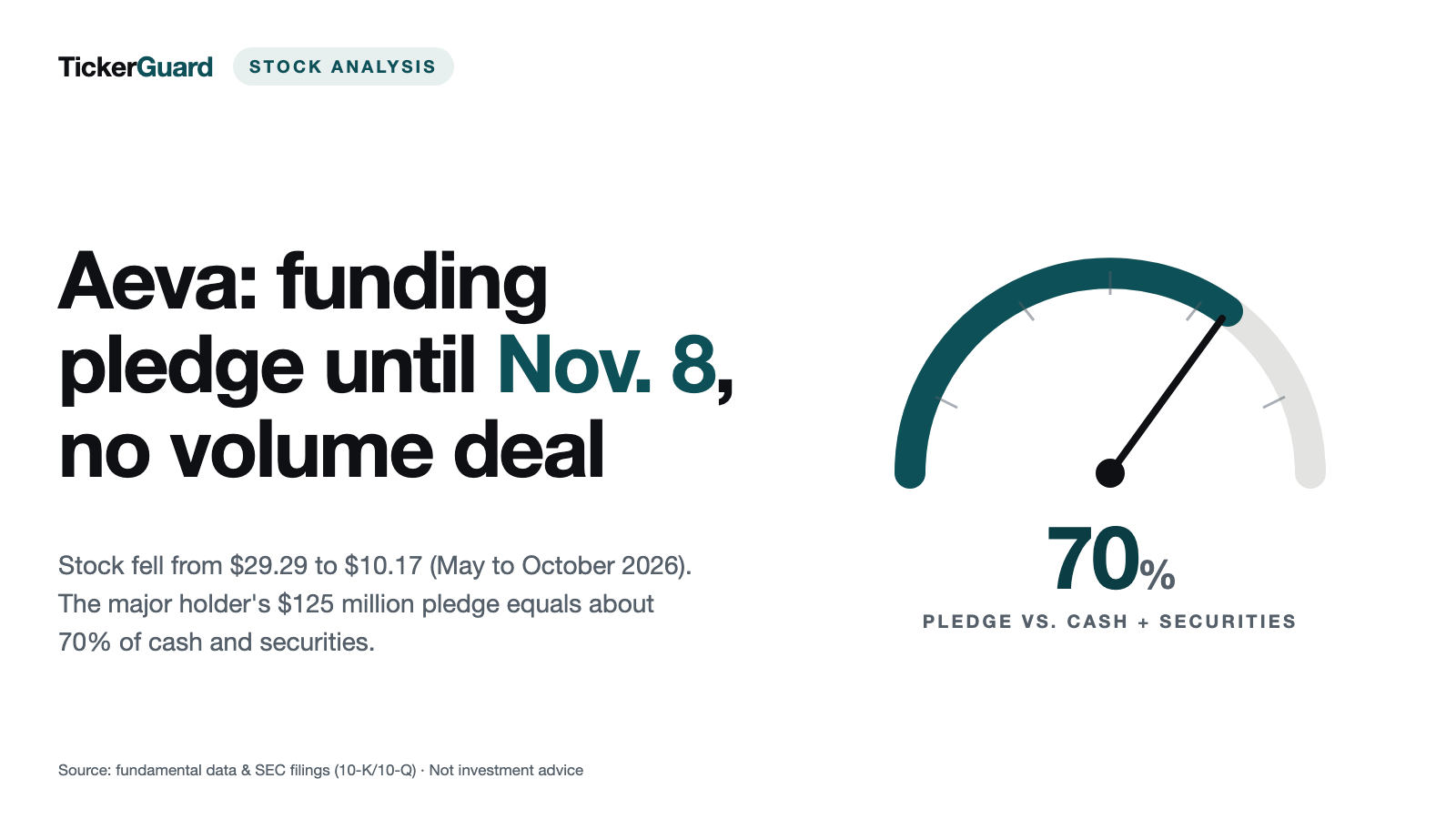
On November 8, 2026, major holder Sylebra’s $125 million funding pledge expires — one of the pillars of Aeva’s twelve-month funding statement — and per the annual report no customer has signed a volume production agreement yet. All this for lidar sensors that see not only where something is but how fast it is moving. The stock fell from $29.29 in May to $10.17 in October 2026; 2025 revenue was $18.1 million, while operations burned $115.1 million. Whether the technology becomes a business will be decided not in the lab, but in a contract that does not exist yet.
 Thomas Mücke
Founder & Publisher
As of Today
As of: October 23, 2026
- Closing price
- 10.20 $ +2.90%
- Market Capitalisation
- 0.7 $B
- Growth Score
- 5/10
- AAQS
- 5/10
Price change since October 23, 2026: +0.3%
This analysis has a cut-off date. The Stock Guard tells you when something material changes in the numbers. Reserve your free spot
Chart
Interactive price chart (TradingView).
52-week range: 9.20 $ to 29.30 $ · Last price: 10.20 $ (As of: October 23, 2026)
Note: pure fact-based analysis, not investment advice and not a solicitation to buy or sell. All figures without guarantee.
There is an investor trap that feels like a bargain. It is called the anchor trap: your mind memorizes the highest price it has seen and measures every later price against it. In May 2026, shares of Aeva Technologies (Nasdaq: AEVA) briefly cost $29.29. In June the company sold new shares at $22.25; in August both founders sold stock at prices around $24. At the end of October 2026 the stock sits at about $10 — and your mind whispers: “Two-thirds off. That is a discount.” Let’s make a deal: before you hold on to an old price, we read together what Aeva reported to the U.S. securities regulator, the SEC — the annual report (10-K) for 2025, the quarterly report (10-Q) for June 30, 2026, and the current reports (8-K) and other filings, reviewed through October 24, 2026. Filing false information with the SEC carries penalties, which is why these reports are among the most reliable publicly available sources. In the end, the decision is yours.
What Aeva actually does — a laser that sees speed
Per its annual report, Aeva was founded in 2017 by former Apple engineers Soroush Salehian (now CEO) and Mina Rezk (President and CTO) and is based in Mountain View, California. The company builds lidar sensors — devices that use laser light to measure a three-dimensional picture of their surroundings, for cars, trucks, robots or factories. The difference from most competitors: conventional lidar fires short pulses of light and times the echo (time of flight). Aeva uses a continuous-wave laser with a changing frequency (FMCW, frequency modulated continuous wave) and measures how the frequency of the reflected light shifts. Picture it this way: it is a police speed trap, only with a laser — the sensor sees not just where an object is, but instantly how fast it is moving. Aeva calls this “4D lidar” and puts the optical components on a silicon chip; at December 31, 2025, the company held about 296 issued patents and 127 pending applications, with 239 full-time employees.
According to its earnings release of August 5, 2026, Aeva is working on programs with Daimler Truck, one of the ten largest European passenger-car makers and the NVIDIA DRIVE Hyperion vehicle platform; commercial-vehicle supplier Bendix has selected Aeva for the next generation of its driver assistance for heavy trucks, and sensor maker SICK has launched a first industrial sensor using Aeva technology. Korean supplier LG Innotek has been a strategic investor since August 2025, buying 3.51 million shares at $9.26. New since August 2026 is a third leg: under the name “Optical Connectivity,” Aeva wants to supply its laser sources to operators of AI data centers. A first joint development agreement with a major customer for a hyperscaler — one of the big cloud companies — has been signed; initial deployment is targeted for the second half of 2027, the production ramp for 2028. The release gives no size, term or revenue for that agreement — nor a start-of-production year for the Daimler Truck or Bendix programs. A second leg to stand on? Not proven yet. The quarterly report for June 30, 2026 does not yet mention the new business, though — so far the story lives in the press release, not in the numbers. It is proven only once a quarterly report shows revenue from it. For a classic lidar maker that already ships in volume, see our Ouster analysis. That names the central tension of this analysis, and it runs through every chapter: the technology collects selections and development work — but not a single volume production contract yet, and much of the money for the road ahead comes from one major holder who sits on every side of the table.
Company history for investors
-
2017
Founded by two former Apple engineers
Soroush Salehian and Mina Rezk start Aeva around FMCW lidar. Until the listing, the company is privately funded.
-
2021
Listing via the InterPrivate SPAC
The merger closes on 03/12/2021; its proceeds fund the loss years that follow, with operating outflows of $82 million to $119 million a year.
-
2023
Sylebra steps in big
In November: purchase of new shares at $2.90 and a $125 million standby equity facility; in December, 3 million warrants at $5. Sylebra becomes the central backer.
-
2024
1-for-5 reverse split
On 03/18/2024 every five shares are combined into one. Shareholders’ stakes do not change; the price is mechanically five times higher afterwards.
-
2025
LG Innotek and a convertible note
LG Innotek buys 3.51 million shares at $9.26, and a $100 million convertible note follows in November. Revenue doubles to $18.1 million.
-
2026
Offering at $22.25, then a slide
In June, 5.17 million new shares bring in $108.8 million net. By October the stock falls to about $10; the CFO was set to leave in September.
How the stock landed on our desk
Aeva made our research list through our in-house Reddit hype scanner: 2 mentions in 24 hours, rank 162, after not appearing in the ranking the day before (ApeWisdom, retrieved October 24, 2026). That is not a storm, more a flicker — typical of a stock that has fallen hard and whose story is easy to tell. The highest close of the past twelve months was $29.29 (May 27, 2026); on October 23, 2026 the stock closed at $10.17, down about 65 percent (fundamental data). A year earlier, on October 24, 2025, it had closed at $17.27.
Aeva did not go public through a classic IPO but on March 12, 2021, through a merger with a blank-check company, a so-called SPAC: InterPrivate Acquisition Corp. In March 2024 Aeva combined every five shares into one (a 1-for-5 reverse split); all share figures in this article are adjusted accordingly. The stock first traded on the New York Stock Exchange (NYSE); effective January 28, 2025, Aeva moved its common stock and warrants to Nasdaq (8-K of January 16, 2025). The Forms 25 on EDGAR — the form used to strike a security from an exchange — cover the old SPAC units (2021), that move (January 27, 2025) and the public warrants from the SPAC era, which expired on March 12, 2026 (Nasdaq’s form of March 11, 2026). None of them is a delisting of the stock: the common stock remains listed on Nasdaq.
The analysts who cover the stock are mostly upbeat: of five, three rate it a strong buy and two a hold; their average price target is $29 (fundamental data, as of October 24, 2026) — close to the May high and nearly three times the October price. Average here means the five targets added up and spread evenly; a single very high or very low target pulls it a long way. Those are third-party views, not a TickerGuard forecast, and we do not adopt them. Remember this: a price target is just another anchor — one somebody else dropped for you.
The numbers over the years — honestly appraised
First, what impresses: revenue doubled to $18.1 million in 2025 (2024: $9.1 million), and it keeps growing. The first half of 2026 brought in $12.4 million after $8.9 million a year earlier, the second quarter $6.1 million after $5.5 million. And more of it sticks: gross profit — revenue minus direct production and project costs — was $2.2 million in the second quarter of 2026, after a negative $2.7 million a year earlier. The customer list in the earnings release includes well-known names in the industry.
Over the years the picture looks different. Revenue swung from $9.3 million (2021) to $4.2 million and $4.3 million (2022 and 2023), back to $9.1 million (2024) and only in 2025 clearly beyond that. Operating cash outflow — the money day-to-day operations actually consume — ran between $82 million and $119 million in each of those years, $115.1 million in 2025.
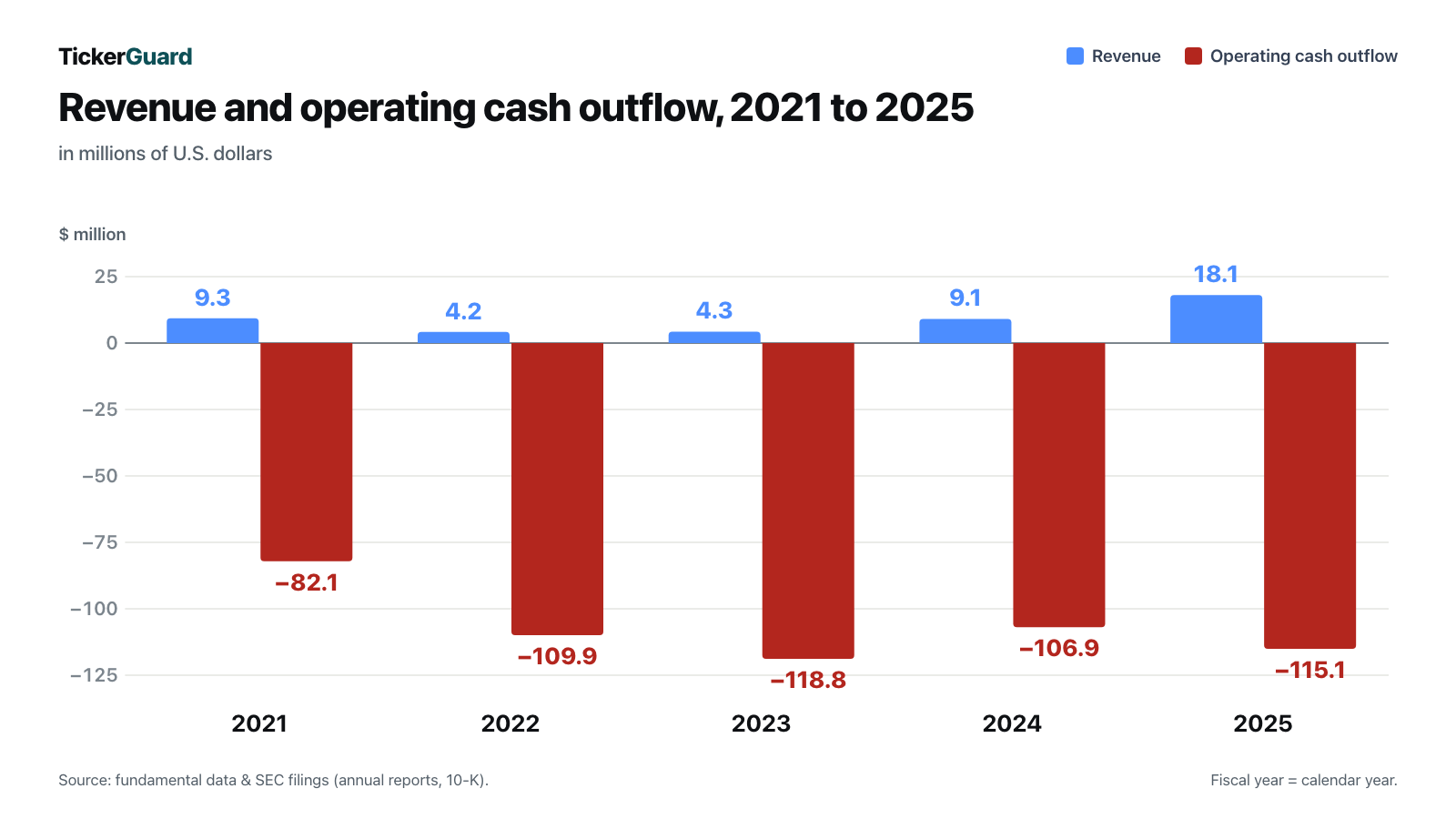
In the first half of 2026, operations consumed $57.0 million, or about $28.5 million per quarter on average. The accumulated deficit since inception reached $871.9 million at June 30, 2026. Over the years this was paid for with money from the SPAC merger, with new shares and with a convertible note. The picture that remains: for every dollar of revenue in 2025, Aeva’s operations spent a good six dollars more than came in.
What the filings say — the uncomfortable truths
Uncomfortable truth no. 1: No customer has signed a volume production contract yet
Program selections sound like orders. In the lidar business they are not, yet. Aeva calls them “design wins” and explains in its annual report what that means — and what it does not. The key sentence sits in the risk factors:
“We currently provide prototypes and non-recurring engineering services to customers for purposes of R&D and have not yet commercialized our products or services in a material amount.”
— Aeva Technologies, Inc., SEC annual report 10-K for 2025, Item 1A “Risk Factors”
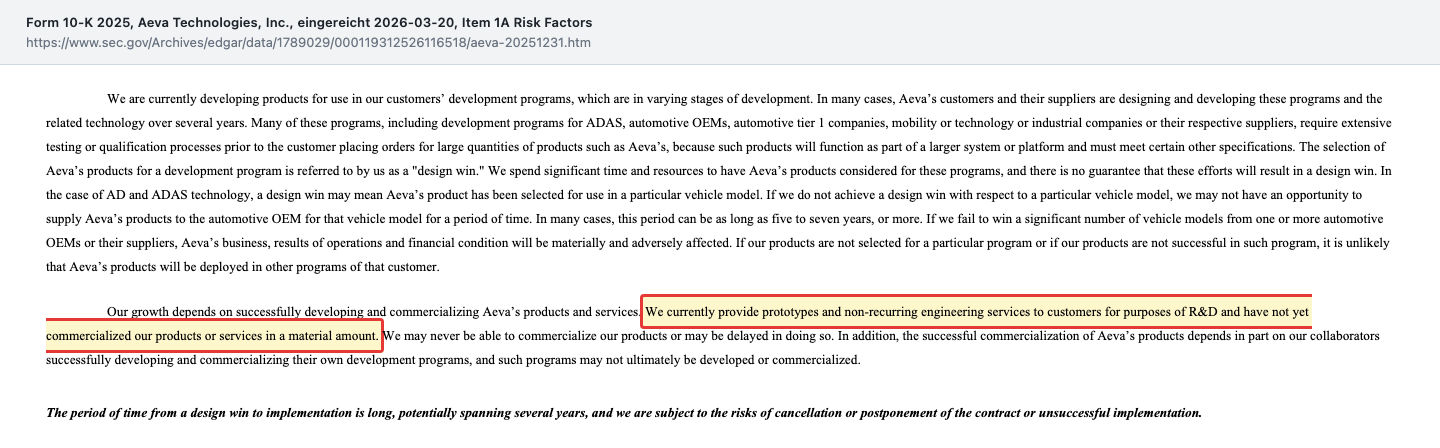
A few paragraphs later the report gets even clearer:
“As of the date of this report, none of our customers have completed their on-going testing and validation or entered into definitive volume production agreements with us and there is no assurance or guarantee that any of our customers, including any for which we have announced a ‘design win’, will ever complete such testing and validation or enter into a definitive volume production agreement with us, or that we will receive any revenues in connection with such win.”
— Aeva Technologies, Inc., SEC annual report 10-K for 2025, Item 1A “Risk Factors”
The quarterly report for June 30, 2026 reports no material change to these risk factors. The numbers fit: in the second quarter of 2026, $3.6 million of the $6.1 million in revenue came from services (prior year: $1.3 million), while product revenue fell from $4.2 million to $2.5 million. Growth, in other words, comes mainly from paid engineering work, not from sensors sold. For contracts longer than one year, Aeva reports $28.7 million of unsatisfied performance obligations at June 30, 2026, about 30 percent of it expected within the next twelve months. Remember: a “design win” is an invitation to audition, not a record deal.
Uncomfortable truth no. 2: One backer sits on every side of the table — and its facility expires in November
Aeva’s most important backer is the fund manager Sylebra Capital. It is major shareholder, creditor, warrant holder and facility provider at once — and it has a seat on the board through Daniel Gibson (2025 annual report: “related party”). On November 8, 2023, Sylebra and Adage Capital agreed to buy new shares at $2.90, and Sylebra signed a so-called standby equity facility with Aeva; after stockholder approval in December 2023, Sylebra received 3 million warrants with a $5 exercise price for it (both prices adjusted for the later reverse split). The facility works like this: Aeva may sell Sylebra up to $125 million of non-voting preferred stock, in tranches of $25 million to $50 million. According to its ownership filing (Schedule 13D/A of July 6, 2026), Sylebra held 16.2 million shares and $50 million of convertible notes at June 30, 2026, together 29.3 percent of the stock (based on the share count of March 2026). The quarterly report describes the facility this way:
“We also have the ability to draw on the Facility Agreement up to $125.0 million through November 8, 2026 in exchange for the issuance of preferred shares, and we intend to draw down on the Facility Agreement if and as required by our capital needs.”
— Aeva Technologies, Inc., SEC quarterly report 10-Q for June 30, 2026, Item 2 “Liquidity and Capital Resources”
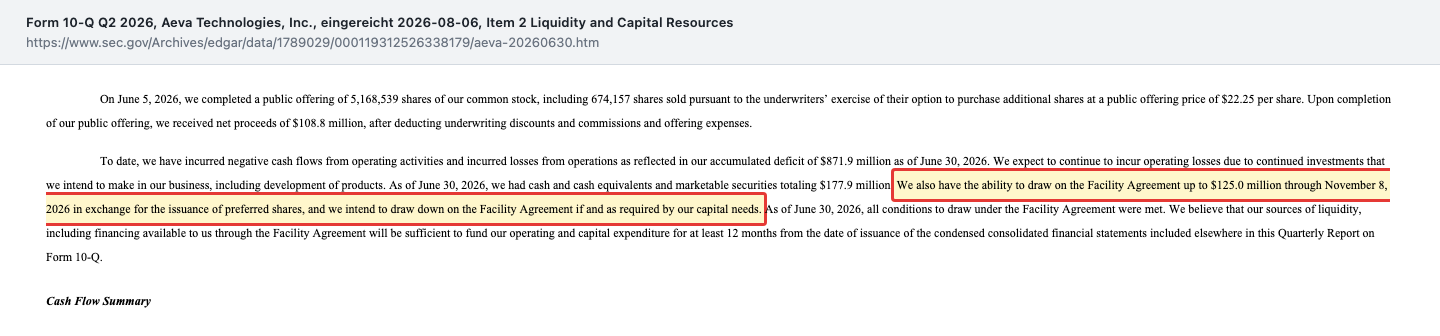
Why the date matters is spelled out in the first note of the same report. There, management explains why the money lasts at least twelve months — and names the facility explicitly:
“Management believes that existing cash and cash equivalents, marketable securities, and the Standby Equity Purchase Agreement (the “Facility Agreement,” Note 10) will be sufficient to fund operating and capital expenditure requirements through at least 12 months from the date of issuance of these condensed consolidated financial statements.”
— Aeva Technologies, Inc., SEC quarterly report 10-Q for June 30, 2026, Note 1 “Principles of Consolidation and Liquidity”
For context: the $125 million pledge equals about 70 percent of the $177.9 million of cash and marketable securities at June 30, 2026. Without it, that cushion at about $28.5 million of operating cash outflow per quarter (first half of 2026) lasts roughly six quarters from June 30, 2026, on our math. That is no acute squeeze. It does mean the twelve-month assurance could lose one of its legs three months after it was given — unless Aeva draws or extends. Either would be a deal with Sylebra. Then there is the second role: in November 2025 Aeva sold a $100 million convertible note (4.375 percent interest, due 2032, conversion price about $15.86) to funds affiliated with Apollo; half of it has sat in newly formed Sylebra funds since June 30, 2026. Remember: when one backer is shareholder, creditor and standby funder at the same time and sits on the board, it brings several interests to the table in every financing deal with it.
Uncomfortable truth no. 3: Net income dances with the share price
Look only at net income and Aeva is a roller coaster: a loss of $192.7 million in the second quarter of 2025, a profit of $107.5 million in the third quarter of 2025, a loss of $79.6 million in the second quarter of 2026. The operating loss, by contrast, stayed steady between $29 million and $35 million in all six quarters.
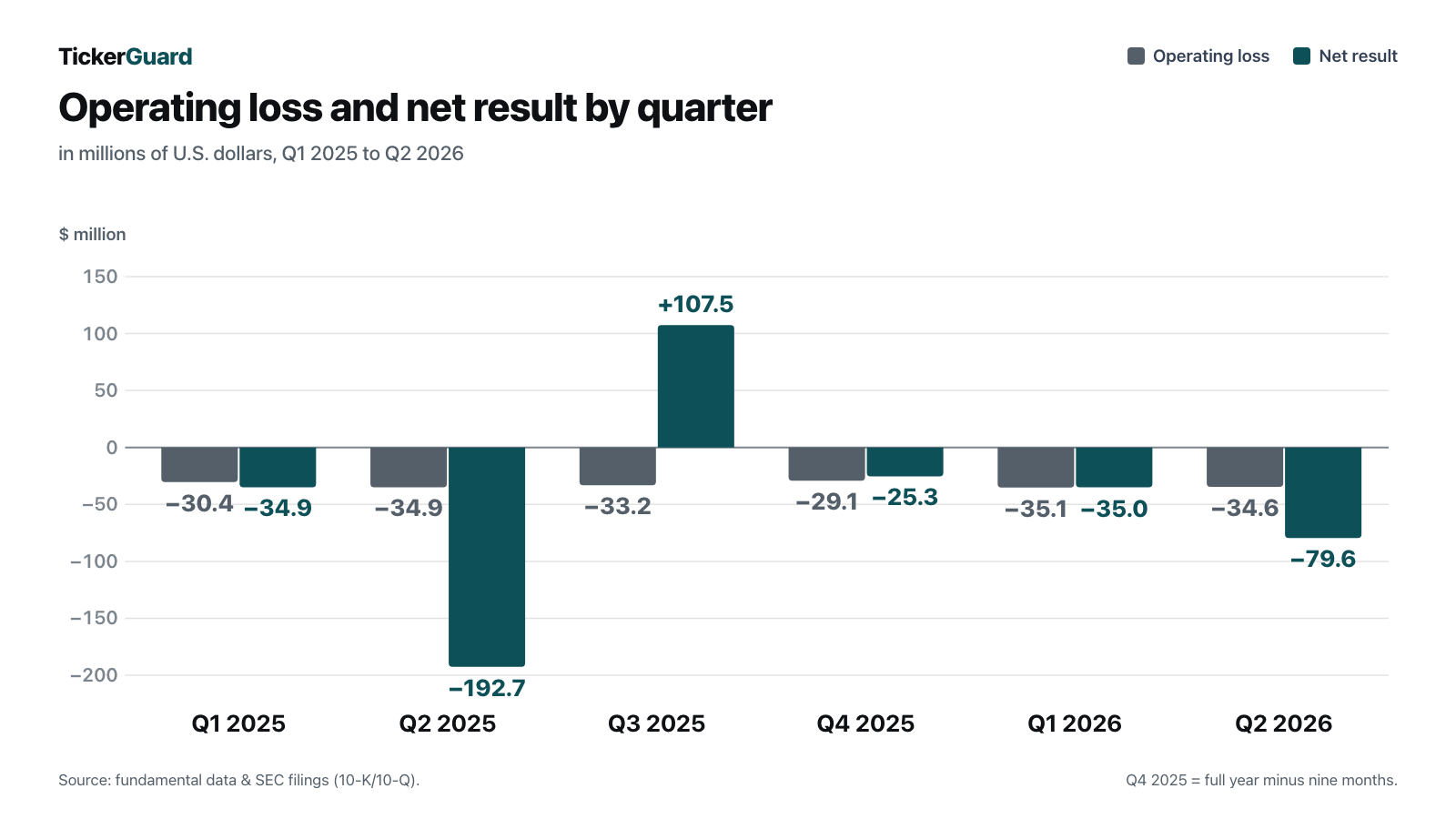
The cause is fair-value accounting. Sylebra’s 3 million warrants are carried as a liability on the balance sheet and remeasured at market value every quarter — at $74.0 million on June 30, 2026. At the end of 2025 the total warrant liability was $29.7 million, which then still included the SPAC-era warrants that expired in March 2026. When the stock rises, the liability grows and the increase shows up as a loss; when it falls, a paper gain appears. The quarterly report puts it in one sentence:
“The change in fair value of the warrants is due to the change in the stock price of the Company.”
— Aeva Technologies, Inc., SEC quarterly report 10-Q for June 30, 2026, Item 2, section “Fair value of warrant liability”

In the second quarter of 2026 the warrants cost $44.7 million in paper losses. In 2025 a second item joined in: LG Innotek’s investment commitment, which was also marked to market until the shares were issued — a $70.0 million loss in the second quarter of 2025, a $71.6 million gain on settlement in the third quarter, plus a $68.5 million gain on the warrants. Hence the quarterly “profit” of $107.5 million. The mechanism works going forward too: the stock fell from $28.72 on June 30 to $14.04 on September 30, 2026, to less than half — which points to a paper gain in the third quarter that has nothing to do with the business. Remember: at Aeva, the operating loss tells you how the company is doing; net income mostly tells you how the stock did.
Uncomfortable truth no. 4: Three customers, nearly two-thirds of revenue
A young technology company with a handful of large partners is nothing unusual. At Aeva, though, the concentration is pronounced — and the annual report names it openly:
“In fiscal year 2025, Aeva’s top three customers accounted for 64% of revenue.”
— Aeva Technologies, Inc., SEC annual report 10-K for 2025, Item 1A “Risk Factors”
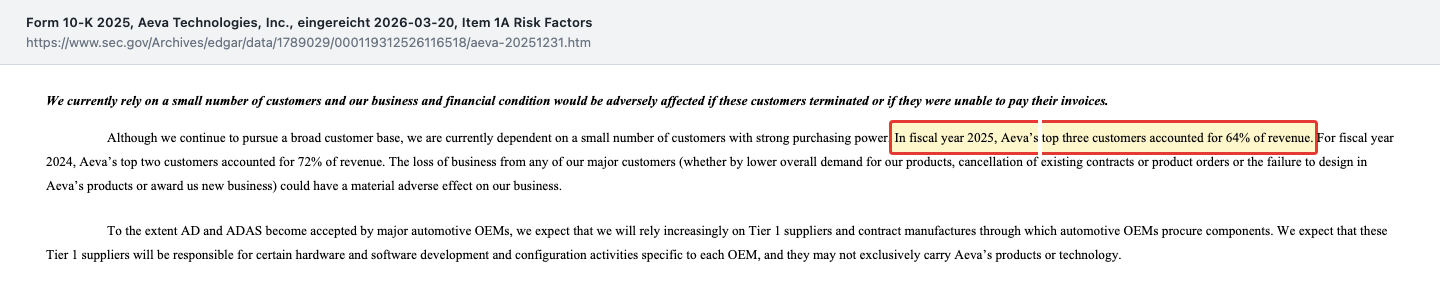
In 2024 it was even 72 percent from just two customers. Among receivables, three customers accounted for 72 percent at the end of 2025, a single customer for 28 percent at June 30, 2026 (10-Q). The regional mix shifts quickly, too: in the second quarter of 2026, 42 percent of revenue came from Europe, the Middle East and Africa, up from 9 percent a year earlier. Picture it this way: if your neighbor says his shop is booming, but three regulars pay nearly two-thirds of the rent — would you swallow for a second? As long as this is development work, it is normal. It turns dangerous if one of the three postpones its program.
Uncomfortable truth no. 5: Your slice of the pie gets smaller — and the founders sold in August
On June 5, 2026, Aeva closed an offering of 5,168,539 new shares at $22.25, for net proceeds of $108.8 million (10-Q for June 30, 2026). The share count rose from 61.6 million at the end of 2025 to 68.7 million at June 30, 2026 and 69.7 million on July 30, 2026. On top come potential new shares listed in the quarterly report’s per-share calculation: 6.30 million from the convertible note, 3.0 million from the Sylebra warrants, 7.29 million from restricted stock units (RSUs) for employees, 1.70 million from performance-based awards and 2.30 million from options — 20.6 million in total, just under 30 percent of the shares outstanding. Aeva has so far also paid interest on the convertible note in stock: 149,037 new shares on May 15, 2026. In plain terms: your slice of the pie gets smaller when new slices keep getting cut — growth paid for with fresh stock is never quite free.
Then there are the people at the top. On August 10, 2026, a few days after the earnings release, CEO Soroush Salehian sold 274,585 shares and CTO Mina Rezk sold 100,000 shares at weighted average prices between about $23.80 and $25.70 (Forms 4 of August 12, 2026). Salehian sold another 30,514 shares on August 11, for a total of 305,099. Per the filings, both founders sold under pre-arranged Rule 10b5-1 trading plans, where timing and size are fixed months in advance; both still hold shares in the millions. CFO Saurabh Sinha, who per the quarterly report adopted such a plan for up to 267,000 shares on May 19, 2026, sold 70,000 shares under that plan on August 18, 2026, at about $21.21; on September 2, another 34,146 shares were sold automatically to cover taxes on vested employee stock awards (Forms 4 of August 20 and September 4, 2026). Per the August 5, 2026 announcement, Sinha was set to leave Aeva on September 5 for a new role outside the sensing industry. Per the same announcement, the VP Corporate Controller, Rupesh Maheshwari, steps in as interim CFO; his first insider filing (Form 3) came in on September 14, 2026. No permanent successor had been announced as of October 24, 2026. What remains: an insider who sells does not have to know anything you don’t — but the price he sold at is an anchor worth knowing.
Valuation: about $0.7 billion for a laser without a volume contract
At the October 23, 2026 close of $10.17, the 69.7 million shares are worth about $709 million together. For comparison: at the June offering price ($22.25) it would have been about $1.55 billion. Against that market value stood $177.9 million of cash and marketable securities and the $100 million convertible note at June 30, 2026; the cash balance for September 30, 2026 will only come with the next quarterly report. Stockholders’ equity was $27.5 million at June 30, 2026 — positive, but thin, because the $871.9 million accumulated deficit has eaten up nearly everything shareholders ever paid in.
There is no price-to-earnings ratio, since operations make no profit. The price-to-sales ratio is about 33 (revenue for the four quarters through June 2026: $21.6 million) — in plain terms, the market pays 33 times what Aeva takes in over a year. For a company that has just doubled its revenue, that number alone is no verdict. What matters is whether the selections turn into production contracts before the next financing is needed. For what it looks like when cash runs short before the production contract, see our MicroVision analysis. Remember: a stock two-thirds below its high is not a discount as long as you don’t know whether the high was ever justified.
Upside and risks at a glance
What speaks for Aeva:
- Distinct technology: FMCW lidar on a silicon chip that captures velocity per point; about 296 issued patents (December 31, 2025).
- Well-known partners per the August 5, 2026 earnings release: Daimler Truck, a top-10 European carmaker, NVIDIA DRIVE Hyperion, Bendix, SICK; LG Innotek as strategic investor.
- Growth: 2025 revenue doubled to $18.1 million, first-half 2026 revenue up 40 percent to $12.4 million; gross profit of $2.2 million in the second quarter of 2026 after −$2.7 million a year earlier.
- Cash cushion: $177.9 million of cash and marketable securities (June 30, 2026), roughly six quarters at the first-half 2026 burn rate.
- New field: a first development agreement for laser sources in AI data centers, deployment targeted from the second half of 2027.
What speaks against it:
- No volume production agreement: per the 2025 annual report, no customer has completed testing; product revenue fell from $4.2 million to $2.5 million in the second quarter of 2026.
- Heavy cash burn: $115.1 million used in operations in 2025, accumulated deficit of $871.9 million (June 30, 2026).
- Dependence on Sylebra: major holder (29.3 percent per the 13D/A), noteholder, warrant holder and facility provider; the $125 million facility expires on November 8, 2026.
- Customer concentration: three customers with 64 percent of 2025 revenue.
- Dilution: 20.6 million potential new shares (June 30, 2026) next to 69.7 million outstanding; convertible note interest so far paid in stock.
- Leadership change: per the announcement, the CFO was set to leave on September 5, 2026; no permanent successor had been reported by October 24, 2026; founder sales in August 2026.
A human conclusion
Back to the anchor trap from the start. Its core is not that $29 is wrong and $10 is right — or the other way round. Its core is that an old price tells you nothing about what a company is worth. At Aeva the technology is real, the partner list impressive and the growth measurable. But per its own annual report, no customer has yet signed up to buy in volume, operations burn about $28.5 million a quarter, and the most important backer is also the most important shareholder, whose funding pledge expires on November 8, 2026. So the honest question for you is not “Is the stock cheap now?” It is: what would have to happen for you to buy it without thinking of $29 — and is any of that already in a filing? If you have an answer that satisfies you, you have a thesis. If not, you only have an anchor. What you make of it is your decision. And that is exactly as it should be.
Sources
All original documents used in this analysis — so you can read them yourself:
- Aeva Technologies, Inc. — SEC quarterly report 10-Q for June 30, 2026 (filed August 6, 2026)
- Aeva Technologies, Inc. — SEC quarterly report 10-Q for March 31, 2026 (filed May 8, 2026)
- Aeva Technologies, Inc. — SEC quarterly report 10-Q for September 30, 2025 (filed November 7, 2025)
- Aeva Technologies, Inc. — SEC annual report 10-K for 2025 (filed March 20, 2026)
- Aeva Technologies, Inc. — SEC annual report 10-K for 2024 (filed March 21, 2025)
- Aeva Technologies, Inc. — SEC current report 8-K of August 5, 2026, Exhibit 99.1 (second-quarter 2026 earnings release, CFO transition)
- Aeva Technologies, Inc. — SEC current report 8-K of June 4, 2026 (offering at $22.25) and prospectus supplement 424B5 of June 4, 2026
- Sylebra Capital — ownership filing Schedule 13D/A of July 6, 2026 (as of June 30, 2026)
- Nasdaq — Form 25 of March 11, 2026 (removal of the expired warrants)
- Aeva Technologies, Inc. — SEC current report 8-K of January 16, 2025, Item 3.01 (transfer of listing from the NYSE to Nasdaq) and Form 25 of January 27, 2025 (voluntary withdrawal from the NYSE)
- Insider filings (Form 4) of August 12, August 14, August 20 and September 4, 2026, and Form 3 of September 14, 2026: EDGAR overview for Aeva Technologies (sec.gov)
- Fundamental data (prices, analyst ratings; data as of October 23 and 24, 2026), cross-checked against the SEC filings.
- Reddit mentions: ApeWisdom (as of October 24, 2026); surfaced via our in-house Reddit hype scanner.
Transparency & disclaimer: this analysis is journalistic commentary on publicly available information. It is not investment advice, not a regulated investment research product and not a solicitation to buy or sell securities. Equity investments carry substantial risk up to and including total loss. All information is provided without warranty; the as-of date for each figure is stated in the text. Positions held by the operator are disclosed daily; where one exists, it appears as a notice at the top of this deep dive.
Key figures at a glance
All monetary figures in millions of $; earnings per share as reported.
| Metric | 2021 | 2022 | 2023 | 2024 | 2025 |
|---|---|---|---|---|---|
| Revenue | 9.3 | 4.2 | 4.3 | 9.1 | 18.1 |
| Operating Income (EBIT) | -104.2 | -152.0 | -147.8 | -158.4 | -127.6 |
| Net Income | -101.5 | -147.3 | -149.3 | -152.3 | -145.4 |
| Net Margin | -1,095.6% | -3,514.0% | -3,463.2% | -1,679.7% | -804.4% |
| Earnings Per Share | -2.53 $ | -3.39 $ | -3.29 $ | -2.85 $ | -2.55 $ |
Source: fundamental data & SEC filings (annual and quarterly reports, 10-K/10-Q)
Our Bottom Line at a Glance
- Technology & partners positive
- FMCW lidar on a silicon chip with per-point velocity measurement, about 296 issued patents (12/31/2025). Programs with Daimler Truck and a top-10 European carmaker, selection by Bendix, first industrial sensor with SICK per the earnings release of 08/05/2026.
- Revenue & production readiness negative
- 2025 revenue doubled to $18.1 million, but per the 2025 10-K there is no volume production agreement yet. In Q2 2026, $3.6 million of $6.1 million came from services; product revenue fell from $4.2 million to $2.5 million.
- Earnings power & cash burn negative
- Operating loss 2025: $127.6 million, operating cash outflow $115.1 million; $57.0 million of outflow in H1 2026. Net income swings with warrant remeasurement (Q2 2026: −$44.7 million).
- Liquidity neutral
- $177.9 million of cash and marketable securities (06/30/2026), roughly six quarters on our math. The twelve-month statement also relies on the $125 million Sylebra facility, which expires on 11/08/2026.
- Capital structure & dependence negative
- Sylebra is major holder (29.3 percent per 13D/A), noteholder, warrant holder and facility provider. 20.6 million potential new shares next to 69.7 million outstanding; offering of 5.17 million shares in June 2026.
Aeva is a textbook case of the anchor trap: the stock sits about two-thirds below its May high, and that feels like a discount. The technology is distinct, the partner list long, and revenue doubled in 2025. But per the annual report there is no volume production contract yet, operations used $115.1 million in 2025, and funding leans heavily on one major holder whose funding pledge expires on November 8, 2026. Not investment advice.
What Our Rating Means
Open questions
The business works in principle, but one material question is open. As long as it stays open, our findings do not carry a quality verdict.
Yellow, because the decisive operating question is open: will the program selections turn into a production contract? Per the 2025 annual report, no customer has signed yet. Red would require a documented threat to the company itself, and that is missing: $177.9 million of cash and marketable securities lasts roughly six quarters at the first-half 2026 burn rate, equity is positive ($27.5 million), and management affirms funding for twelve months. The distance to red is not large, though: that assurance also rests on the Sylebra facility that expires on November 8, 2026. If you wait, check the next quarterly report for what happened to the facility and whether a customer ordered in volume. The decision is yours.
A journalistic assessment by our editorial team at the time of the deep dive, based on public sources — not investment advice and not a solicitation to buy or sell. Your personal circumstances (investment goals, risk capacity, taxes) cannot be taken into account. What our levels mean, how verdicts are formed, and what conflicts of interest exist →
Worth Noting
- Aeva made our research list through our in-house Reddit hype scanner (2 mentions in 24 hours, rank 162, ApeWisdom, as of October 24, 2026).
- Aeva was called InterPrivate Acquisition Corp. until the merger on 03/12/2021 (same CIK 0001789029). A 1-for-5 reverse split followed in March 2024; all share figures are adjusted. The Form 25 of 01/27/2025 belonged to the move from the NYSE to Nasdaq (8-K of 01/16/2025, Item 3.01); the one of 03/11/2026 covered only the expired warrants — neither concerned the stock.
- Market value calculated by us: 69,705,758 shares (10-Q cover page, 07/30/2026) × $10.17 close (10/23/2026). Price cross-check against the offering price in the 424B5 prospectus supplement ($22.25, 06/03/2026); the gap is explained entirely by the decline in the share price since then.
- The fourth quarter of 2025 in the quarterly chart is calculated as the full year (2025 10-K) minus the first nine months (10-Q for 09/30/2025).
Stock Watch
This analysis is as of October 24, 2026. Stock Watch will tell you what's changed at AEVA since then.
Later $1 a month per stock — signing up is free, and you'll be the first to know when it launches.
The full analysis as a PDF for later
We will send you this analysis as a PDF — to print, file away, and read at your own pace. And we will add you to the free Stock Watch list for Aeva Technologies, Inc. (AEVA), so you hear about it when something material in this analysis changes.
Frequently Asked Questions
Aeva Technologies, Inc. (Nasdaq: AEVA) of Mountain View, California, develops lidar sensors that use a frequency-modulated continuous-wave (FMCW) laser to capture the velocity of every point in addition to its distance. Customers include car and truck makers, suppliers and industrial companies; since August 2026 Aeva also aims to supply its laser sources to AI data centers.
No. In 2025, $18.1 million of revenue stood against an operating loss of $127.6 million, and operations used $115.1 million of cash. In the second quarter of 2026 the operating loss was $34.6 million; the net loss was $79.6 million because of the remeasurement of warrants. The accumulated deficit reached $871.9 million at June 30, 2026.
Per the 2025 annual report, no customer has completed its testing or signed a definitive volume production agreement. So far Aeva delivers prototypes and engineering services. Aeva is working on programs with Daimler Truck and a top-10 European carmaker; truck supplier Bendix has selected Aeva. Such selections (“design wins”) guarantee no revenue, per Aeva.
At June 30, 2026, Aeva had $177.9 million in cash and marketable securities. At the first-half 2026 operating cash outflow ($57.0 million), that lasts roughly six quarters on our math. On top comes a $125 million standby equity facility from major holder Sylebra (a pledge to buy preferred stock on request), which per the quarterly report can only be drawn through November 8, 2026.
Sylebra Capital is Aeva’s largest backer: per its July 6, 2026 filing it owns 29.3 percent (including $50 million of convertible notes), holds 3 million warrants at $5, provides a $125 million standby equity facility and has a seat on the board. That means a large part of Aeva’s funding depends on a single partner.
No. Nasdaq’s Form 25 of March 11, 2026 covered only the public warrants from the SPAC era, which expired on March 12, 2026. The Form 25 of January 27, 2025 belonged to the move from the NYSE to Nasdaq. The AEVA common stock remains listed on Nasdaq; there is no deregistration filing (Form 15).
Found an error?
Did you spot a factual error, an outdated number, or a typo in this deep dive? Let us know briefly — your report goes straight to the editorial team.