MicroVision: Fifteen Shares Become One — and 2025 Revenue Was Smaller Than the Cost of Making It
Since August 1, 2026, every fifteen MicroVision shares have been combined into one. On the quote screen the stock now looks fifteen times more valuable — inside the company not a single cent moved. The filings with the U.S. securities regulator, the SEC, show what is actually at stake: $1.208 million of revenue in fiscal 2025 against $18.548 million of cost of revenue, and a net loss of $94.981 million. The accumulated deficit since inception reached exactly $982.556 million as of March 31, 2026. Shares outstanding grew from 194.7 million at the end of 2023 to 344.6 million on May 28, 2026, and a Nasdaq minimum bid price deadline is still running. We read what led up to the split — and what it changes about the arithmetic underneath.
 Thomas Mücke
Founder & Publisher
Thomas Mücke
Founder & Publisher
As of Today
As of: September 17, 2026
- Closing price
- 1.60 $ 0.00%
- Market Capitalisation
- 0.6 $B
- Growth Score
- 4/10
- AAQS
- 4/10
This analysis has a cut-off date. The Stock Guard tells you when something material changes in the numbers. Reserve your free spot
Chart
Interactive price chart (TradingView).
52-week range: 0.24 $ to 4.70 $ · Last price: 1.60 $ (As of: September 17, 2026)
Note: pure fact-based analysis, not investment advice and not a solicitation to buy or sell. All figures without guarantee.
There is an investor trap that has nothing to do with greed and still works reliably — the share-count illusion. It goes like this: your brain mistakes the number on the price tag for the value in the basket. A stock at 36 cents — that is what it cost on June 11, 2026 according to the company’s own prospectus supplement — feels like a lottery ticket, like “I can buy a thousand of those”. Arithmetically the same stock at $5.40 feels more serious, more grown up, like a real investment. At MicroVision, Inc. (NASDAQ: MVIS) you can watch that switch happen live: since August 1, 2026, every fifteen old shares have been combined into one new share; split-adjusted trading was scheduled for August 3, 2026 according to the company’s own filing. Nothing about the company itself changed by a single cent — it is the same cake, cut into fewer slices. So let us make a deal: before you look at the new label, we read together what is inside. The sources are the reports MicroVision itself filed with the U.S. securities regulator, the SEC — the annual report (10-K) for 2025 filed on March 4, 2026, the quarterly report (10-Q) as of March 31, 2026 filed on May 15, 2026, and everything that came after. These documents are truthful under penalty of law. And they describe a company that has been listed since 1996, whose cost of revenue exceeds its revenue by a multiple, and which has a Nasdaq deadline breathing down its neck. In the end, the decision is yours.
What MicroVision actually does — lasers that look at the world
MicroVision builds lidar sensors. The word stands for “light detection and ranging”, and in everyday terms it is simple: a lidar is a bat with a laser. It fires pulses of light, measures how long they take to reach an obstacle and bounce back, and assembles a three-dimensional picture of the surroundings from millions of measurement points per second. Such sensors sit inside driver assistance systems, driverless construction machines, and security and defense equipment. The company is based in Redmond, Washington, employed roughly 190 people at the end of fiscal 2025, and has been listed since 1996 — an unusually long run for a firm still working toward its breakthrough.
The product shelf is now broad: MOVIA for short and mid range, MAVIN built on the in-house micro-mirror technology, plus the long-range sensors IRIS and HALO acquired in 2026 and the Scantinel sensor for very long range. Almost all of it came out of somebody else's insolvency. On January 31, 2023, MicroVision acquired assets of the German company Ibeo Automotive Systems GmbH out of its insolvency proceedings — that is where the flash-based MOVIA sensor and the German engineering site come from, which since then employs more people than the U.S. operation. Effective January 1, 2026 came the German company Scantinel Photonics GmbH, likewise out of insolvency proceedings, for $2.244 million, and in February 2026 the worldwide lidar sensor business of Luminar Technologies for $33.177 million after approval by a U.S. bankruptcy court. Three acquisitions, three insolvencies. That frames the central tension of this analysis, and it runs through every chapter: MicroVision has now collected the technology of half its industry — but the bill that comes with it is not being paid by customers, it is being paid by new shares. Anyone sizing up the stock should therefore look less at the sensors and more at who funds the development. How hard this entire industry finds the jump from technology to business is something we worked through elsewhere — in our analysis of lidar competitor Ouster.
How the stock landed on our desk
This time it was not a metric hit from one of our scanners, but the filing trail at the SEC itself. Between the last quarterly report on May 15, 2026 and August 4, 2026 — the data cut-off for this analysis — MicroVision filed an unusually dense sequence of capital-markets documents in under three months: a notice of a listing-tier transfer and an amendment to the running at-the-market program (June 12), a registration statement (June 12, effective June 23), a prospectus supplement for up to $42 million (June 24), another $50 million shelf (July 13, effective July 15), the annual meeting results (July 13) and finally the reverse stock split (July 22). Six capital measures in eleven weeks are not a coincidence, they are a pattern. In between sit three filings carrying pure business news (June 10, June 25, July 7) — we will come back to those, because one of them holds the only hard forward-looking number in this analysis.
Note the finding right at the start: when a company publishes more prospectuses than products within a few weeks, the financing is the real story. That is exactly how we built this analysis — first the numbers, then the documents that explain them.
The numbers over the years — honestly credited
Let us begin with what genuinely speaks for MicroVision, because there is something. In the first quarter of 2026, revenue rose to $0.935 million from $0.589 million in the prior-year quarter — up roughly 59 percent. Gross profit came in at $0.363 million, almost ten times the prior-year quarter ($0.039 million) — and back in positive territory after the full year 2025 posted a gross loss. The company also bought real assets rather than promises: of the Luminar purchase price, $13.2 million was allocated to property and equipment, $3.8 million to inventory and $9.4 million to developed technology. In the Scantinel deal the fair value of the assets acquired was even higher than the purchase price, producing a bargain purchase gain of $0.147 million. And as of March 31, 2026, cash stood at $46.120 million, with no long bank facilities to service.
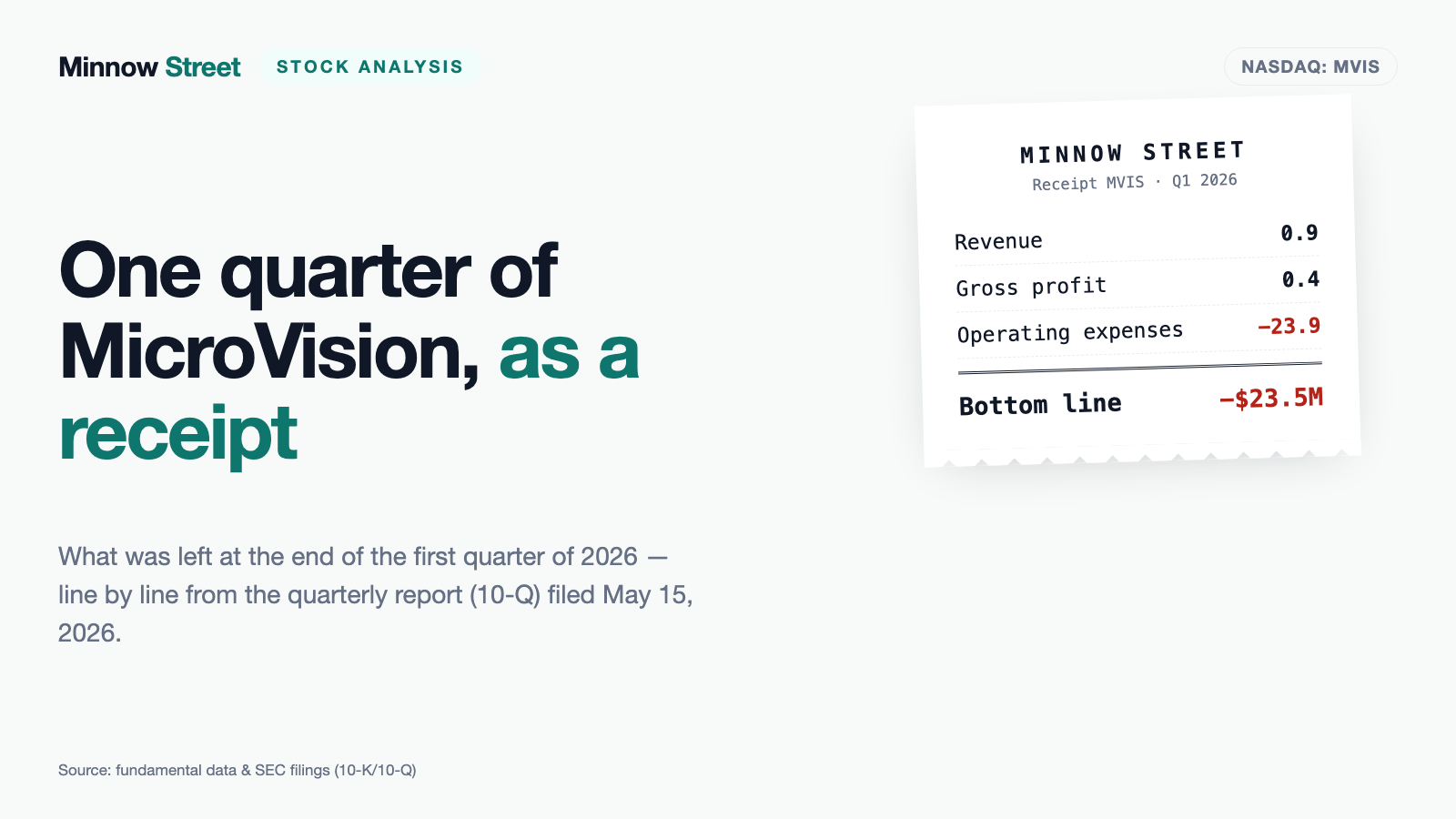
Read as a receipt — the way the cover image of this analysis presents it — the first quarter of 2026 comes down to four lines: $0.9 million of revenue, of which $0.4 million gross profit, against $23.9 million of operating expenses, bottom line minus $23.5 million. The earnings release of May 13, 2026 summarizes the quarter in exactly that order of magnitude.
Now the chart that puts everything else in a different light. It shows what a sale brings in — and what making the product costs.
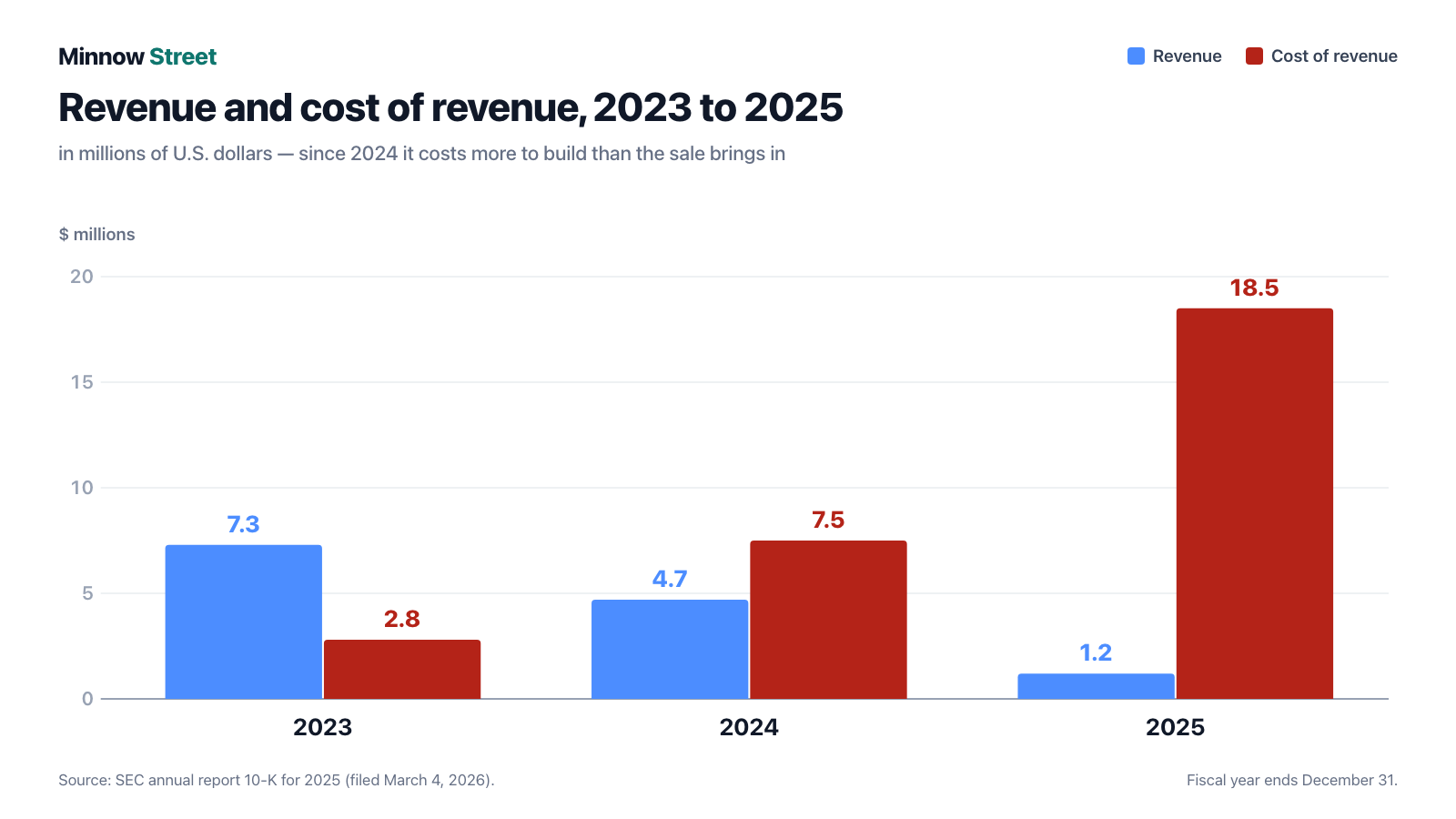
Revenue in the last three fiscal years: $7.259 million (2023), $4.696 million (2024), $1.208 million (2025). It shrank to one sixth in two years. Cost of revenue ran the other way: $2.772 million (2023), $7.530 million (2024), $18.548 million (2025). The net loss stayed stubbornly high: $82.842 million (2023), $96.915 million (2024), $94.981 million (2025). Per share that was a loss of $0.35 in 2025 before the split — translated onto the new share, a loss of $5.25 per share. Operating loss in 2025 came to $82.828 million, including $31.720 million of research and development, $20.325 million of selling, marketing, general and administrative expense, and $13.443 million of impairments on intangible assets, lease right-of-use assets and property and equipment. Note the picture: a full year of revenue in 2025 was not even enough to cover one week of operating costs — $65.488 million of operating expenses a year works out to roughly $1.3 million a week. Which brings us to the uncomfortable truths.
What the filings say — the uncomfortable truths
Uncomfortable truth No. 1: in 2025, every sensor sold made the loss bigger
Most loss-making companies at least earn something on what they sell — the loss then arises in research, marketing and administration. At MicroVision that was not the case in fiscal 2025. The annual report shows $1.208 million of revenue and $18.548 million of cost of revenue, producing a gross loss of $17.340 million. In everyday terms: the baker sells a loaf for one dollar that cost him fifteen dollars in flour, power and labor — and the more loaves he sells, the deeper he sinks. Part of that is explainable, and the annual report puts numbers on it: cost of revenue in 2025 includes $9.9 million of obsolete inventory tied to older configurations of the short-range MOVIA L sensor and $3.2 million of adverse purchase commitments from the same production run — together more than the entire increase over 2024 ($11.0 million). So a good part of it is legacy, not current production. But the direction is unmistakable, because cost of revenue already exceeded revenue in 2024, at $7.530 million against $4.696 million.
The good news sits in the quarterly report: in the first quarter of 2026 gross profit was positive again at $0.363 million, on $0.935 million of revenue and $0.572 million of cost of revenue. One quarter is not a trend, however — and it comes nowhere near covering operating costs, which in the same quarter came to $23.857 million, of which $14.445 million went to research and development. That produced an operating loss of $23.494 million and a quarterly net loss of $25.294 million.
Uncomfortable truth No. 2: the acquisition carried $14.3 million of quarterly revenue on paper — $0.7 million actually arrived
The notes to the quarterly report contain a calculation MicroVision makes itself: what would the combined business of MicroVision and the acquired Luminar lidar operation have looked like had the deal closed on January 1, 2025? The answer for the first quarter of 2025: $14.346 million of revenue — against a loss of $106.845 million. In the actual first quarter of 2026, revenue of the combined entity was $0.935 million. That is a decline of roughly 93 percent against the company’s own comparison. From the closing date of February 3, 2026 through quarter end, the acquisition contributed $0.7 million of revenue and $2.3 million of loss.
This is not an accounting nicety, it is the core question of the whole investment: MicroVision paid $33.177 million for the technology of a company that went bankrupt itself — and the customers who once bought that technology evidently did not come along. Anyone who wants to know whether the price was right should look not at the product brochure but at the revenue line of the coming quarters. Note the yardstick: an acquisition has only worked once it shows up in revenue — not already when it shows up on the balance sheet.
MicroVision has already demonstrated how that yardstick can come out. The 2023 Ibeo purchase left perception software on the balance sheet. As of December 31, 2025, the impairment test showed the carrying amount was no longer recoverable from future cash flows — $10.1 million was written off, fully clearing the asset. The auditor singled out precisely that test as a critical audit matter. None of this proves the Luminar acquisition will end the same way — but it is the reason to keep an eye on the $9.4 million of “developed technology” and the $3.1 million of customer relationships in the coming quarterly reports.
Uncomfortable truth No. 3: new shares pay the bill — $12.6 million of debt became 23.6 million shares
When a company burns cash and no bank will lend it enough, there are two routes: issue new shares, or take on debt that later converts into shares. MicroVision does both at once. How fast that shrinks existing holders’ stakes — dilution, or in everyday terms: your slice of the cake gets smaller because the cake is cut into more pieces — is visible in the share count.
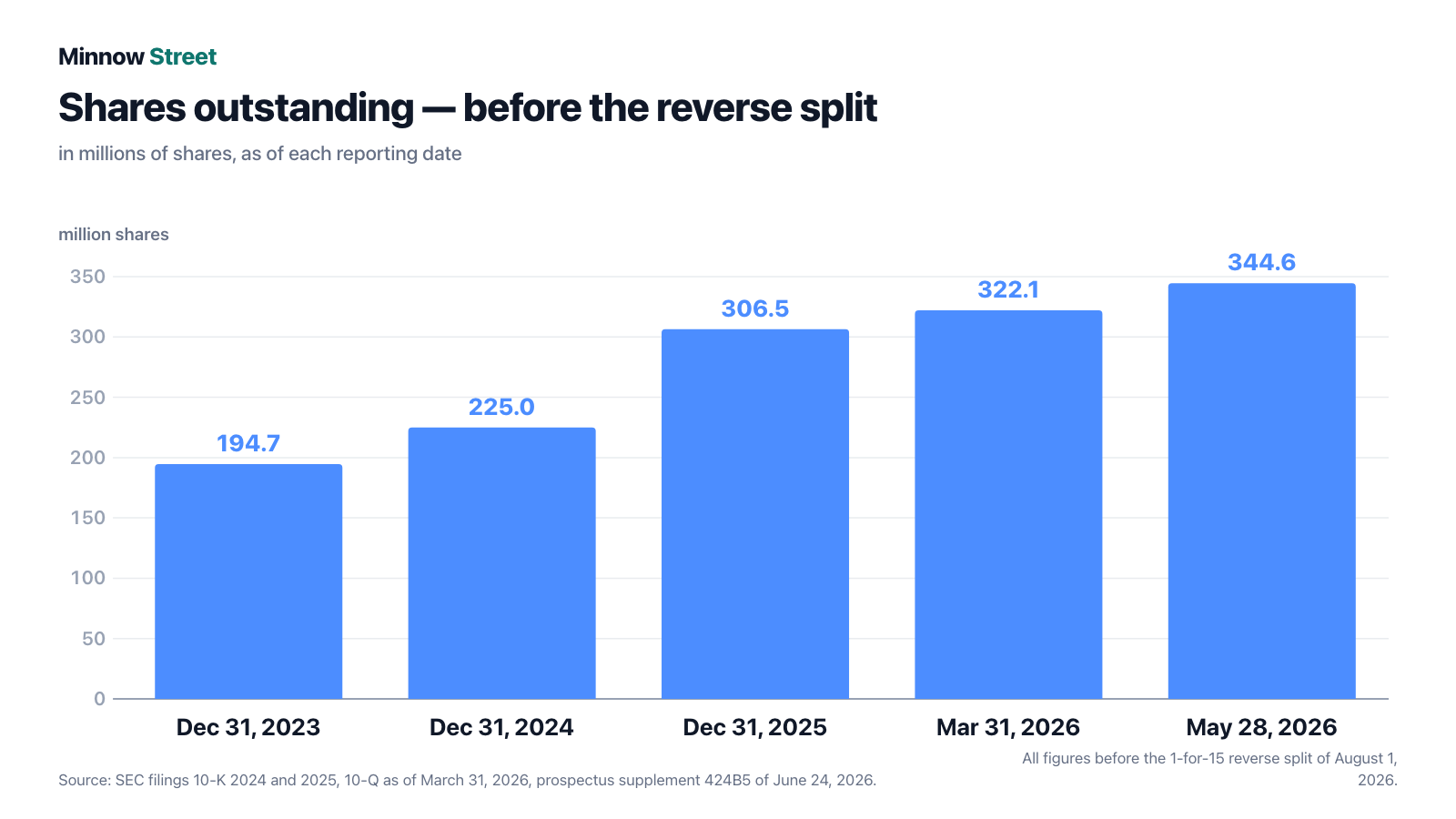
The engine behind it sits in the notes to the quarterly report. On February 23, 2026, MicroVision issued two senior secured convertible notes totaling $43.0 million to a single institutional investor — one in exchange for the prior note, one for fresh cash. The notes carry no coupon, run to March 1, 2028 and are repaid at maturity at 110 percent of the outstanding balance. Zero coupon does not mean free, however: because the repayment premium and the original issue discount are amortized over the term, the first quarter of 2026 alone carried $2.753 million of interest expense in the income statement. The repayment mechanism is what matters:
"Immediately upon closing and monthly beginning on April 1, 2026, the Holder may elect to require the Company to partially redeem the Notes. The Company has the right to optionally convert any partial redemption of the Notes to shares of the Company’s common stock, subject to certain conditions."
— MicroVision, Inc., SEC quarterly report 10-Q as of March 31, 2026, Note 7 “Notes Payable and Derivative Liability”

What that means in practice appears a few lines later in the same report: on March 16, 2026 the holder converted $0.5 million into 984,292 shares, on March 20 another $6.7 million into 13,342,613 shares, on April 20 $2.8 million into 4,857,985 shares and on May 5 $2.6 million into 4,423,468 shares. Together: $12.6 million of debt became 23.6 million new shares in seven weeks. After those conversions, $34.7 million remained outstanding as of May 5, 2026. The mechanism has an unpleasant property: the lower the share price, the more shares the same repayment requires — and the harder that supply presses on the price. On top of that comes the at-the-market program: as of June 12, 2026, roughly $42 million of it remained unsold, and on July 13, 2026 a further $50 million shelf was added, effective July 15, 2026. We have unpacked similar financing patterns at another capital-hungry technology supplier — see our analysis of Eos Energy.
And that is only the part that has already flowed. How many additional shares could still be created sits in a footnote no price feed shows: the schedule of securities excluded from the loss-per-share calculation because including them would have been anti-dilutive. As of March 31, 2026 those came to 86.3 million shares — 72.8 million from conversion of the notes, 5.8 million from warrants, 7.1 million from unvested restricted and performance stock units and 0.6 million from stock options. Measured against the 322.1 million shares outstanding at that date, that is a good quarter on top; translated onto the new share it is roughly 5.8 million shares, which fit comfortably inside the 150 million of authorized stock. Note this: what dilutes a shareholder next rarely shows up on the quote screen and almost always shows up in the footnotes.
Uncomfortable truth No. 4: the split cuts authorized capital — and still multiplies the room to issue
Now to the reverse split itself. The filing of July 22, 2026 combines two steps in a single sentence:
"… to (i) effect a reverse stock split (the “Reverse Stock Split”) of the Company’s common stock, par value $.001 per share (“Common Stock”), at a ratio of 1-for-15, with every fifteen shares of issued and outstanding Common Stock being combined into one share of Common Stock, and (ii) simultaneously reduce the total authorized number of shares of the Company’s capital stock to 175,000,000 shares, consisting of (a) 150,000,000 shares of Common Stock and (b) 25,000,000 shares of preferred stock, $.001 par value."
— MicroVision, Inc., SEC Form 8-K of July 22, 2026, Item 3.03

The second part reads like a concession to shareholders — less authorized capital means less room for new shares. Measured against the actual share count, the picture flips. Before: 344,645,965 shares outstanding (as of May 28, 2026) against 510 million authorized common shares — headroom of roughly 165 million shares, or 48 percent of shares outstanding. After: roughly 23.0 million shares outstanding against 150 million authorized — headroom of roughly 127 million shares, or 553 percent of shares outstanding. Measured by how many new shares MicroVision could issue relative to what is already out there, the split did not shrink the room, it made it roughly eleven times larger. The annual meeting on July 10, 2026 also expressly cleared share issuance under the convertible notes — on the split itself, 153,463,657 votes were cast in favor and 57,527,379 against. One more detail for context: the resolution allowed a ratio between 1-for-5 and 1-for-15; the board chose the maximum.
Uncomfortable truth No. 5: the reason for the split is a Nasdaq deadline
Reverse splits rarely have cosmetic reasons. At MicroVision the trigger is stated in black and white in a filing dated June 12, 2026:
"As previously disclosed in the Company’s Current Report on Form 8-K filed on January 16, 2026, the Company received a notification letter from Nasdaq notifying the Company of its failure to maintain the $1.00 minimum bid price required for continued listing on The Nasdaq Global Market under Nasdaq Listing Rule 5450(a)(1) (the “Minimum Bid Price Requirement”)."
— MicroVision, Inc., SEC Form 8-K of June 12, 2026, Item 3.01

The sequence was set from there: a move from The Nasdaq Global Market to the smaller Nasdaq Capital Market (effective July 20, 2026), an additional 180-calendar-day compliance period there, and to use it the closing price must reach at least $1.00 on ten consecutive business days. A 1-for-15 combination satisfies exactly that condition in one stroke — arithmetically. Whether it holds is up to the market.
And then there is the sentence that appears in every risk section and should be read anyway:
"If adequate capital resources are not available on a timely basis, we may consider limiting our operations substantially and we may be unable to continue as a going concern."
— MicroVision, Inc., SEC quarterly report 10-Q as of March 31, 2026, Part II, Item 1A “Risk Factors”

In fairness: that is a risk factor, not a formal going-concern opinion from the auditor. In the same report MicroVision writes expressly that, based on its current operating plan including expected financing activities, it anticipates sufficient cash to fund operations for at least the next twelve months. The subordinate clause is the point: the runway depends on future share sales. Let us do the arithmetic — with $46.120 million of cash as of March 31, 2026 and operating cash outflow of $16.443 million in the first quarter of 2026, that works out to just under three quarters. For comparison: at the end of 2025 cash and investment securities together still stood at $74.834 million; in three months the balance shrank by $28.7 million, because the Luminar purchase price also went out. Current liabilities stood at $51.763 million as of March 31, 2026 against $54.223 million of current assets — current assets therefore cover current liabilities with a buffer of only about $2.5 million.
Uncomfortable truth No. 6: almost half the cash cannot be spent at all
The runway math above is in fact too generous, because one sentence in the liquidity section of the quarterly report ties part of the money down:
"Pursuant to terms of the securities purchase and exchange agreement, the Company will maintain minimum cash liquidity of the lesser of $21.5 million or 110% of the then outstanding balance of the senior secured convertible notes for the remaining duration of their term."
— MicroVision, Inc., SEC quarterly report 10-Q as of March 31, 2026, Note 1 “Liquidity”
Work it through. As of May 5, 2026, $34.7 million of notes was outstanding; 110 percent of that would be $38.2 million, so the lesser of the two figures is the $21.5 million. That much cash has to stay in the account permanently, or the agreement is breached. Of the $46.120 million reported as of March 31, 2026, only roughly $24.6 million is genuinely available — against $16.443 million of operating cash outflow per quarter, that is arithmetically not even one and a half quarters. In everyday terms: there is $46,000 in the account, but $21,500 of it is the deposit the landlord insists on seeing. You can only spend the rest. Note the yardstick: runway is not set by the cash balance but by the freely available part of it.
What the company promises for 2026 — and how you can measure it
So far we have only looked backward. Fairness demands the other side of the table too, and it comes from the company itself. In a business update for shareholders that MicroVision filed with the SEC as an exhibit on June 25, 2026, sits the only concrete forward number in this analysis: revenue guidance of $10 million to $15 million for full-year 2026 and a target gross margin of 35 to 40 percent. The presentation also cites more than 100 live customer engagements — over 15 with automotive OEMs, more than 30 with security and defense companies, more than 70 with industrial OEMs and resellers — and puts the resulting bookings opportunity for 2026 through 2030 at over $500 million. In a further round of shareholder answers on July 7, 2026, the company reaffirmed that it is working to deliver against that guidance.
It is backed by a piece of news from June 10, 2026: MicroVision announced a master development agreement with what it describes as the world’s leading manufacturer of construction and mining equipment, with an initial program description dated June 1, 2026. Initially two IRIS sensors are to sit on each off-highway hauling truck, with the successor HALO sensors as a possible later step. The filing does not name the partner — but a customer from the same industry, described in the quarterly report as “a leading global manufacturer of construction and mining equipment”, already delivered 22 percent of revenue in the first quarter of 2026. Much suggests the relationship is widening rather than starting; the documents, however, do not confirm that the two are the same company.
Now the reality check you can run yourself. The first quarter of 2026 put $0.935 million of revenue on the table. To reach $10 million for the year, the remaining three quarters together have to deliver roughly $9 million; for $15 million it would be roughly $14 million — on average three to five times the first quarter, quarter after quarter. That is not trivial, and it is not impossible either if the acquired sensors really ship out of inventory. But it is a promise, not a figure from an audited statement — guidance of this kind is expressly subject to the forward-looking-statement caveat. The next quarterly report (10-Q) is therefore the most honest test there is: quarterly revenue of three million or more, and the guidance is reachable. Another number starting with a one, and it is not.
Valuation: what the market pays for $1.2 million of revenue
Caution is warranted here, and we will say why openly: after a reverse split, almost every automatically computed metric is unusable for a while, because data providers restate historical per-share figures at different speeds. We therefore deliberately leave aside the market capitalization reported by fundamental data and use the only price that appears in an original document: in the prospectus supplement of June 24, 2026, MicroVision names $0.36 as the last reported sale price, dated June 11, 2026 — translated onto the new share, $5.40. With the 344,645,965 shares outstanding as of May 28, 2026, that gives a market value of roughly $124 million as of that date.
Those $124 million are the honest valuation anchor. Held against fiscal 2025 revenue of $1.208 million, that is roughly one hundred times annual revenue. Calculate more generously and annualize the first quarter of 2026 ($0.935 million times four, so roughly $3.7 million), and it is still around thirty times. And even if the company’s own 2026 guidance of $10 million to $15 million lands in full, the June 11, 2026 anchor still works out to roughly eight to twelve times annual revenue — for a company that would still be loss-making. A price-earnings ratio cannot be formed at all, for lack of earnings. For comparison: book equity stood at $39.543 million as of March 31, 2026 — so on June 11, 2026 the market paid a good three times book value for a company that lost $25.3 million in the quarter. Note the yardstick: what is being valued here is not the current business but the hope of a future one. And because that hope is spread across more heads with every new share, the decisive metric for the coming quarters is not the price but the ratio of revenue growth to share growth.
Opportunities and risks at a glance
What speaks for MicroVision:
- A broad product shelf after two acquisitions out of insolvency: short, medium, long and very long range (MOVIA, MAVIN, IRIS, HALO, Scantinel) — acquired for $2.244 million (Scantinel, January 2026) and $33.177 million (the Luminar lidar business, closed February 3, 2026), including $13.2 million of property and equipment and $3.8 million of inventory.
- Revenue and gross profit pointed upward in the first quarter of 2026: $0.935 million of revenue after $0.589 million in the prior-year quarter, and gross profit positive again at $0.363 million after $0.039 million.
- A broader customer mix than before: in the first quarter of 2026, 54 percent of revenue came from a top-ten global automotive maker, 22 percent from a construction and mining equipment manufacturer and 17 percent from a European robotics supplier in the security and defense sector.
- No classic bank debt: the convertible notes, last reported at $34.7 million (as of May 5, 2026), carry a zero coupon and there is no credit facility to service; cash stood at $46.120 million as of March 31, 2026.
- The cost side is being addressed: after the acquisitions, the workforce was cut by roughly 15 percent according to the earnings release of May 13, 2026, and engineering was consolidated from Redmond to Orlando.
- A quantified forward statement for the first time: $10 million to $15 million of revenue and a 35 to 40 percent gross margin for 2026, more than 100 live customer engagements and a resulting bookings opportunity of over $500 million for 2026 through 2030 (business update of June 25, 2026, reaffirmed July 7, 2026).
- A master development agreement dated June 10, 2026 with the world’s leading manufacturer of construction and mining equipment, initial program description dated June 1, 2026 — two IRIS sensors per off-highway hauling truck, with HALO as a possible successor.
What speaks against it:
- The core business did not carry in 2025: $1.208 million of revenue against $18.548 million of cost of revenue, a gross loss of $17.340 million and a net loss of $94.981 million; the accumulated deficit reached $982.556 million as of March 31, 2026.
- Cash runway below four quarters: $46.120 million as of March 31, 2026 against $16.443 million of operating cash outflow in the quarter — and $21.5 million of that is tied down as a minimum cash covenant under the note agreement, leaving only roughly $24.6 million freely available. The company’s own twelve-month statement is expressly conditioned on “expected financing activities”.
- The 2026 guidance demands a jump: $0.935 million of first-quarter revenue has to turn into roughly $9 million to $14 million across three quarters — a forward-looking statement from a shareholder presentation, not an audited figure.
- Ongoing dilution with a mechanism attached: $12.6 million of note debt became 23.6 million shares between March 16 and May 5, 2026; shares outstanding rose from 194.7 million (end of 2023) to 344.6 million (May 28, 2026), plus roughly $42 million of unsold at-the-market capacity and a $50 million shelf.
- Listing risk: a Nasdaq notification dated January 16, 2026 over the $1.00 minimum bid price, a transfer to the smaller tier on July 20, 2026, and the 1-for-15 combination on August 1, 2026 — the closing price must reach at least $1.00 on ten consecutive business days.
- The acquisition has not shown up in revenue yet: the company’s own pro forma calculation puts combined first-quarter 2025 revenue at $14.346 million, while actual first-quarter 2026 revenue was $0.935 million — of which $0.7 million came from the Luminar business. The previous insolvency purchase ended in a full write-off: the perception software capitalized from the 2023 Ibeo deal was cleared entirely with a $10.1 million charge as of December 31, 2025.
A human bottom line
Back to the share-count illusion from the beginning. It is stubborn precisely because it is not stupid: an arithmetic price of $5.40 is objectively something different from the 36 cents of June 11, 2026 — it changes who is allowed to buy the stock, which funds may hold it, and whether the exchange keeps listing it. For MicroVision the combination is therefore not cosmetic but existential: without it the Nasdaq deadline would run out. What it does not change is the arithmetic underneath. Annual revenue of $1.2 million stays annual revenue of $1.2 million, no matter how many shares you carve it into. An accumulated deficit of $982.6 million stays an accumulated deficit of $982.6 million. And an operating plan that expressly counts on “expected financing activities” stays a plan whose success depends on strangers being willing to buy new shares.
That does not mean nothing can be built here. MicroVision has just collected the technology of two failed competitors at fire-sale prices; if lidar really does go into series production in construction, industrial and security applications, the company is sitting on a shelf it could never have afforded to build. And since June 25, 2026 there is even a number to measure it against: $10 million to $15 million of revenue for 2026. The honest question for you is therefore not “is the stock now more expensive or cheaper?”, but: are you willing to check every quarter whether revenue grows faster than the share count — and to walk away when it does not? If yes, you have a thesis and a checkpoint. If no, you have a label. What you make of that is up to you. And that is exactly as it should be.
Sources
All original documents used in this analysis — for reading yourself:
- MicroVision, Inc. — SEC annual report 10-K for 2025 (filed March 4, 2026)
- MicroVision, Inc. — SEC annual report 10-K for 2024 (filed March 26, 2025)
- MicroVision, Inc. — SEC quarterly report 10-Q as of March 31, 2026 (filed May 15, 2026)
- MicroVision, Inc. — SEC Form 8-K of May 13, 2026, Item 2.02 (first quarter 2026 results)
- MicroVision, Inc. — SEC Form 8-K of June 10, 2026, Item 7.01 (master development agreement with a construction and mining equipment manufacturer)
- MicroVision, Inc. — SEC Form 8-K of June 12, 2026 (Items 1.01 and 3.01: at-the-market program, Nasdaq tier transfer)
- MicroVision, Inc. — SEC Form 8-K of June 25, 2026, Item 7.01 (business update with 2026 revenue guidance of $10 million to $15 million)
- MicroVision, Inc. — SEC Form 8-K of July 7, 2026, Item 7.01 (answers to shareholder questions, guidance reaffirmed)
- MicroVision, Inc. — SEC prospectus supplement 424B5 of June 24, 2026 (share count as of May 28, 2026, price of June 11, 2026)
- MicroVision, Inc. — SEC registration statement S-3 of July 13, 2026 ($50 million shelf)
- MicroVision, Inc. — SEC Form 8-K of July 13, 2026, Item 5.07 (results of the annual meeting of July 10, 2026)
- MicroVision, Inc. — SEC Form 8-K of July 22, 2026 (Items 3.03 and 5.03: 1-for-15 reverse stock split)
- Complete SEC filing history for MicroVision, Inc.: EDGAR overview (sec.gov)
- Fundamental data (metric series; data as of August 4, 2026), reconciled with the SEC filings. The market capitalization reported by that data was not used, because data feeds mix prices and share counts from both bases immediately after a reverse stock split; the only valuation anchor is share count times documented filing price.
Transparency & disclaimer: This analysis is journalistic commentary on publicly available information. It is not investment advice, not a research report in any regulatory sense, and not a solicitation to buy or sell securities. Equity investments carry substantial risk up to and including total loss. All information without warranty; the data cut-off is noted in the text. Positions held by the operator are disclosed daily; where one exists, it appears as a notice at the top of this deep dive.
Key figures at a glance
All monetary figures in millions of $; earnings per share as reported.
| Metric | 2021 | 2022 | 2023 | 2024 | 2025 |
|---|---|---|---|---|---|
| Revenue | 2.5 | 0.7 | 7.3 | 4.7 | 1.2 |
| Operating Income (EBIT) | -43.9 | -53.9 | -88.9 | -85.5 | -69.4 |
| Net Income | -43.2 | -53.1 | -82.8 | -96.9 | -95.0 |
| Net Margin | -1,728.0% | -7,995.6% | -1,141.2% | -2,063.8% | -7,862.7% |
| Earnings Per Share | -4.03 $ | -4.80 $ | -6.80 $ | -6.94 $ | -5.22 $ |
Source: fundamental data & SEC filings (annual and quarterly reports, 10-K/10-Q)
Our Bottom Line at a Glance
- Earning power of the core business negative
- In fiscal 2025, $1.208 million of revenue faced $18.548 million of cost of revenue — a gross loss of $17.340 million. Revenue shrank from $7.259 million (2023) to $1.208 million in two years. In the first quarter of 2026 gross profit was positive again at $0.363 million, but it covered only 1.5 percent of the $23.857 million of operating expenses.
- Balance sheet and cash runway negative
- As of March 31, 2026, cash stood at $46.120 million against operating cash outflow of $16.443 million in the quarter — arithmetically just under three quarters, but only roughly one and a half once the contractually required minimum cash balance of $21.5 million is deducted. Current assets ($54.223 million) cover current liabilities ($51.763 million) with a buffer of only about $2.5 million. The accumulated deficit since inception reached $982.556 million.
- Dilution and financing negative
- Shares outstanding rose from 194.7 million (end of 2023) to 344.6 million (May 28, 2026). Between March 16 and May 5, 2026, $12.6 million of note debt was converted into 23.6 million shares, leaving $34.7 million outstanding. On top of that sit roughly $42 million of unsold at-the-market capacity (June 12, 2026) and a $50 million shelf (July 13, 2026).
- Listing and deadlines negative
- A Nasdaq notification over the $1.00 minimum bid price has been running since January 16, 2026. The transfer to The Nasdaq Capital Market took effect on July 20, 2026, and the 1-for-15 reverse split on August 1, 2026. Compliance is only regained once the closing price reaches at least $1.00 on ten consecutive business days.
- Technology and product shelf neutral
- After two acquisitions out of insolvency — Scantinel Photonics for $2.244 million (January 2026) and the Luminar lidar business for $33.177 million (closed February 3, 2026) — MicroVision covers every range from short to very long. Whether the price was right is open: the company's own pro forma calculation puts combined first-quarter 2025 revenue at $14.346 million, while actual first-quarter 2026 revenue was $0.935 million.
- Guidance 2026 and order pipeline neutral
- In the business update of June 25, 2026, MicroVision put a number on its expectations for the first time: $10 million to $15 million of revenue and a 35 to 40 percent gross margin for 2026, plus more than 100 live customer engagements and a bookings opportunity of over $500 million for 2026 through 2030; the guidance was reaffirmed on July 7, 2026. It is supported by a master development agreement dated June 10, 2026 with the world's leading manufacturer of construction and mining equipment. After $0.935 million of revenue in the first quarter of 2026, however, the guidance requires roughly $9 million to $14 million across the remaining three quarters — a forward-looking statement, not an audited figure.
MicroVision has collected the technology of two failed lidar suppliers at fire-sale prices and now covers every range — but that is being paid for by the capital markets, not by customers. In fiscal 2025, $1.208 million of revenue faced $18.548 million of cost of revenue and a net loss of $94.981 million; the accumulated deficit reached $982.556 million as of March 31, 2026. Cash of $46.120 million covers roughly three quarters at a burn of $16.443 million per quarter — only about one and a half once the $21.5 million minimum cash covenant is deducted — and the 1-for-15 reverse split of August 1, 2026 was forced by a Nasdaq deadline. Against that stands the company's own guidance of $10 million to $15 million of revenue for 2026 (business update of June 25, 2026), which makes the next quarterly report the test. Not investment advice.
What Our Rating Means
Substance risk
We found at least one documented issue that threatens the company itself — regardless of how the stock is currently valued.
Red here stands for documented risk to the substance, not for a judgment on the technology. Three findings converge: cash runway is roughly three quarters ($46.120 million as of March 31, 2026 against $16.443 million of operating outflow per quarter) and shrinks to roughly one and a half once the contractually required minimum cash balance of $21.5 million is deducted, the company expressly names the possibility of being unable to continue as a going concern in its risk section, and the listing hangs on a Nasdaq deadline that the 1-for-15 reverse split has only just satisfied arithmetically. On top of that sits dilution with a mechanism attached: $12.6 million of note debt became 23.6 million shares in seven weeks, and unissued headroom has risen to roughly 553 percent of shares outstanding after the split. The product shelf built through the acquisitions is real and broad, gross profit was clearly positive at $0.363 million in the first quarter of 2026, and with revenue guidance of $10 million to $15 million for 2026 there is a checkable target for the first time — none of which changes the fact that continuing operations currently depend on outside investors being willing to buy new shares. The decision is yours.
A journalistic assessment by our editorial team at the time of the deep dive, based on public sources — not investment advice and not a solicitation to buy or sell. Your personal circumstances (investment goals, risk capacity, taxes) cannot be taken into account. What our levels mean, how verdicts are formed, and what conflicts of interest exist →
Worth Noting
- MicroVision landed on the research list through its filing trail at the U.S. securities regulator, the SEC: six capital-markets documents between June 12 and July 22, 2026 (tier transfer, amendment of the at-the-market program, two registration statements, prospectus supplement, annual meeting results, reverse stock split). Data cut-off for this analysis: August 4, 2026.
- Every share count and per-share figure in this analysis is expressly labeled as “before” or “after” the 1-for-15 reverse split of August 1, 2026. According to the Form 8-K of July 22, 2026, split-adjusted trading was scheduled to begin on August 3, 2026 under the unchanged symbol MVIS and with a new CUSIP number, 594960403. In phases like this, automatically computed metrics from data feeds routinely mix both bases.
- The 2026 revenue guidance of $10 million to $15 million and the 35 to 40 percent gross margin target come from a shareholder presentation that MicroVision filed on June 25, 2026 as Exhibit 99.1 to a Form 8-K (Item 7.01), and were reaffirmed on July 7, 2026. These are forward-looking statements by the company, not audited results — the next quarterly report (10-Q) is the first hard reconciliation.
- The market capitalization reported by the fundamental data was deliberately not used, nor any metric derived from it: immediately after a reverse stock split, data feeds mix prices and share counts from before and after the effective date, so the reported figure is not comparable. The only valuation anchor used is the calculation of 344,645,965 shares (May 28, 2026) against the last price documented in a filing, $0.36 on June 11, 2026 (prospectus supplement 424B5) — roughly $124 million.
Stock Watch
This analysis is as of August 26, 2026. Stock Watch will tell you what's changed at MVIS since then.
Later $1 a month per stock — signing up is free, and you'll be the first to know when it launches.
The full analysis as a PDF for later
We will send you this analysis as a PDF — to print, file away, and read at your own pace. And we will add you to the free Stock Watch list for Microvision Inc (MVIS), so you hear about it when something material in this analysis changes.
Frequently Asked Questions
MicroVision, Inc. (NASDAQ: MVIS), based in Redmond, Washington, develops and sells lidar sensors — laser instruments that scan their surroundings in three dimensions — together with the accompanying software. The products are called MOVIA (short and mid range), MAVIN (micro-mirror technology) and IRIS, HALO and Scantinel (long range). Customers include automotive makers, industrial and construction equipment suppliers and security and defense firms. At the end of fiscal 2025 the company employed roughly 190 people.
Since August 1, 2026, at 5:00 p.m. Eastern Time, every fifteen old MicroVision shares have been combined into one new share; split-adjusted trading was scheduled to begin on August 3, 2026 under the unchanged symbol MVIS with a new CUSIP number, 594960403. The stake in the company does not change: 1,500 old shares become 100 new ones, and the arithmetic price per share multiplies by fifteen. Fractional shares are rounded up to the nearest whole share (Form 8-K of July 22, 2026).
The trigger is a Nasdaq deadline. On January 16, 2026, Nasdaq notified MicroVision that it was not maintaining the $1.00 minimum bid price under Listing Rule 5450(a)(1). On July 20, 2026 the company transferred to the smaller Nasdaq Capital Market tier, where it gains the prospect of an additional 180 calendar days. To regain compliance, the closing price must reach at least $1.00 on ten consecutive business days.
No. In fiscal 2025, revenue was $1.208 million (2024: $4.696 million; 2023: $7.259 million). Cost of revenue alone came to $18.548 million in 2025, producing a gross loss of $17.340 million. The net loss was $94.981 million. In the first quarter of 2026, revenue rose to $0.935 million while the quarterly net loss was $25.294 million. For full-year 2026 MicroVision itself points to $10 million to $15 million of revenue (business update of June 25, 2026).
As of March 31, 2026, cash stood at $46.120 million against operating cash outflow of $16.443 million in the first quarter of 2026 — arithmetically just under three quarters. Of that, however, $21.5 million is tied down as a minimum cash covenant under the note agreement, leaving roughly $24.6 million freely available. The company itself states that, based on its current operating plan including expected financing activities, it anticipates sufficient cash for at least twelve months. On top of that sit roughly $42 million of unsold at-the-market capacity (as of June 12, 2026) and a $50 million shelf (Form S-3 of July 13, 2026).
Effective January 1, 2026 MicroVision acquired assets of the German company Scantinel Photonics GmbH out of insolvency proceedings for $2.244 million. On February 3, 2026, after approval by a U.S. bankruptcy court, it closed the purchase of the worldwide lidar sensor business of Luminar Technologies for $33.177 million, including the long-range IRIS and HALO sensors. From the closing date through March 31, 2026, the Luminar acquisition contributed $0.7 million of revenue and $2.3 million of loss.
Shares outstanding rose from 194.7 million (December 31, 2023) through 225.0 million (2024) and 306.5 million (2025) to 344,645,965 as of May 28, 2026 — an increase of roughly 77 percent in two and a half years, in each case before the reverse split. Between March 16 and May 5, 2026 alone, the holder of the convertible notes converted $12.6 million of debt into 23.6 million new shares.
Because after a reverse stock split, automatically computed metrics are unreliable for a while: data providers restate historical per-share figures at different speeds. We therefore use only the price documented in an original filing, $0.36 as of June 11, 2026 (prospectus supplement 424B5). With 344,645,965 shares that gives roughly $124 million of market value as of that date — about one hundred times fiscal 2025 revenue.
Found an error?
Did you spot a factual error, an outdated number, or a typo in this deep dive? Let us know briefly — your report goes straight to the editorial team.