Agibank, a Bank for Brazil's Retirees: Pre-Tax Profit Down Two-Thirds, and a Tax Benefit Props Up Net Income
Sound familiar? You remember the IPO price and judge the stock by it. For Brazil's Agibank, that number is $12 from the February 2026 listing; on Oct. 23, 2026, the stock closed at $7.58, 37% lower. The filings show why: pre-tax profit fell by more than two-thirds in a year, and three-quarters of the loans depend on the INSS pension agency, which partially suspended the bank twice in 2025. Picture most of your paycheck depending on one client who has already cut you off twice.
 Thomas Mücke
Founder & Publisher
As of Today
As of: October 23, 2026
- Closing price
- 7.58 $ +4.26%
- Market Capitalisation
- 1.2 $B
- P/E
- 7.1
- Growth Score
- 4/10
- AAQS
- 3/10
This analysis has a cut-off date. The Stock Guard tells you when something material changes in the numbers. Reserve your free spot
Chart
Interactive price chart (TradingView).
52-week range: 5.50 $ to 12.00 $ · Last price: 7.58 $ (As of: October 23, 2026)
Note: pure fact-based analysis, not investment advice and not a solicitation to buy or sell. All figures without guarantee.
The IPO-Price Anchor: Why $12 Feels Like Fair Value
On Feb. 10, 2026, AGI Inc, the holding company of Brazil's Agibank, priced its initial public offering: $12.00 per share, 20 million new shares, $240 million gross. On Oct. 23, 2026, the stock closed at $7.58, 36.8 percent lower (source: fundamental data). And this is where one of the most stubborn investor biases kicks in: anchoring. The first number we hear about a stock becomes the yardstick in our heads. Anything below it feels like a discount, anything above it like a bubble — whether or not anything about the business has changed.
But an IPO price is not a verdict on value. It is the outcome of a negotiation among banks, existing shareholders and large investors on a single day. Whether $7.58 is cheap or expensive is not decided by February; it is decided by what the filings have said since. The central tension of this analysis: Agibank is winning customers and market share (active customers up 36.4 percent in a year, INSS market share 9.60 percent) — yet its pre-tax profit fell by more than two-thirds in a year, and in the second quarter of 2026 the tax line is what kept the bottom line steady. So here is the deal: let's forget the $12 for a moment and read together what the bank has reported to the U.S. securities regulator, the SEC. No recommendation, no forecast — just the filings.
Company history for investors
-
1999
Founded as Agiplan
Marciano Testa founds Agiplan as a college student, the origin of today's Agibank. He still controls the company.
-
2025
Record profit and two INSS suspensions
Net income of R$1,046.6 million. The INSS suspends pension payments to new beneficiaries in August and new payroll deductions in December; settlements with enhanced supervision follow.
-
2026
IPO at $12, pre-tax profit slumps
NYSE listing since Feb. 11, 2026, lock-up through August. In Q2, pre-tax profit falls to R$115.0 million; net income holds up thanks to a tax benefit.
What Agibank Actually Does
AGI Inc, based in Campinas in the state of São Paulo, is the holding company of Banco Agibank S.A. The business was founded by Marciano Testa — according to the annual report, in 1999 while he was still a college student, under the name Agiplan. Today Agibank is a bank for people with small but steady incomes: above all retirees and pensioners of Brazil's state social security agency INSS (Instituto Nacional do Seguro Social), plus public-sector and private-sector employees. As of June 30, 2026, the bank had 7.6 million active customers (up 36.4 percent from a year earlier), 1,115 branches it calls "smart hubs," and 5,068 employees.
Its core product is what Brazilians call "consignado," a payroll-deductible loan. In everyday terms: the borrower does not send the installment; it is deducted straight from the pension or paycheck before the money ever reaches the account. For the bank, that is almost as safe as a standing order the customer cannot cancel — which is why rates are lower than on an ordinary personal loan. The catch: to make the deduction work, the bank needs technical cooperation agreements with the INSS. Agibank also pays out pensions on behalf of the INSS. Customers who receive their pension at Agibank are easier to turn into borrowers, and the loan book grows with them.
Two formalities up front. First, AGI Inc is incorporated in the Cayman Islands and reports as a foreign private issuer: instead of an annual report on Form 10-K and quarterly reports on Form 10-Q, it files an annual report on Form 20-F and current reports on Form 6-K; quarterly figures come as an earnings release and unaudited IFRS interim financial statements. So far there is exactly one annual report, the one for 2025 filed on April 30, 2026. Second, the bank reports in Brazilian reais while the stock trades in U.S. dollars. On Oct. 23, 2026, one dollar bought 4.9654 reais (source: fundamental data). The fiscal year is the calendar year.
How the Stock Landed on Our Desk
AGI Inc made our research list through the Reddit hype scan of Oct. 24, 2026 — that is, through chatter in investor forums, not through a metric in our in-house stock scanner. The price history since the IPO explains why. The stock began trading on the New York Stock Exchange on Feb. 11, 2026, closed its first day at $10.75 and got back to a $12.00 close in late February and early March — it has never closed higher since. After the second-quarter results, it fell to $6.36 on Aug. 6, 2026, and to its lowest close so far, $5.45, on Oct. 1, 2026. By Oct. 23, it had recovered to $7.58, up 39 percent from the low (source: fundamental data).
Between those dates came a milestone every IPO investor should know: according to the prospectus, existing shareholders agreed not to sell for 180 days after Feb. 10, 2026. That lock-up therefore expired in August 2026. Here is what the required filings show since then: through Oct. 24, 2026, only one insider reported a sale, chief technology officer Vinicius Aloe (on Sept. 23, 2026, AGI Inc announced Rafael Siqueira as its new CTO). According to his Form 4 filed on Sept. 2, 2026, on Aug. 31 he disposed of 256,386 Class A shares held through the vehicle AGI Partners at $11.99 per share (plus 406 directly held shares at $5.96; 176,423 shares remained with AGI Partners, in which, per a footnote, he disclaims beneficial ownership beyond his own interest) — on a day when the stock traded between $6.08 and $6.28 (source: fundamental data). The price was far above that day's market price; the filing does not say who the buyer was or why the sale was made at that price. The filings from May and June 2026 point the other way: founder Marciano Testa bought 28,000 shares at about $7.15 on May 7, and six other executives bought smaller blocks at prices between $6.90 and $7.38. Major shareholder Lumina still reported 11,130,936 Class A shares as of June 30, 2026, or 18.96% of that share class (Schedule 13G/A filed July 21, 2026); no newer filing had appeared as of Oct. 24, 2026. The rule of thumb for the rest of this analysis: a stock trading about a third below its IPO price is not automatically cheap — it is only cheaper than it was in February.
The Numbers Over the Years — Credit Where It Is Due
First, the impressive part. According to the Form 20-F, net income rose from R$426.1 million (2023) to R$794.4 million (2024) and R$1,046.6 million (2025); total revenues climbed from R$7,284.4 million (2024) to R$10,694.2 million (2025). Agibank itself cites average net income growth of 82.3 percent a year from 2022 to 2025 and considers its 2023–2025 earnings growth the fastest in Brazil — measured against the five largest traditional banks, excluding the two largest digital banks, which were not yet profitable in 2023. Growth continued in 2026: as of June 30, 2026, the loan book stood at R$37,075.8 million, up 21.2 percent from a year earlier, and market share in INSS payroll loans rose by 0.6 percentage points in the second quarter alone, to 9.60 percent. The share of loans more than 90 days past due fell from 3.6 percent in the first quarter of 2026 to 3.3 percent in the second.
The balance sheet is well cushioned. The Basel III capital adequacy ratio was 18.7 percent as of June 30, 2026, against a regulatory minimum of 10.5 percent; the Tier 1 ratio was 17.6 percent (minimum 8.0 percent). Equity grew to R$4,799.2 million thanks to the IPO and retained earnings. All three major rating agencies upgraded Agibank on Brazil's national scale in 2026: Moody's Local to AA.br on June 15, Fitch to AA(bra) on July 30, and S&P to brAA on Aug. 20. How another Brazilian financial group listed in the U.S. stacks up is covered in our XP analysis.
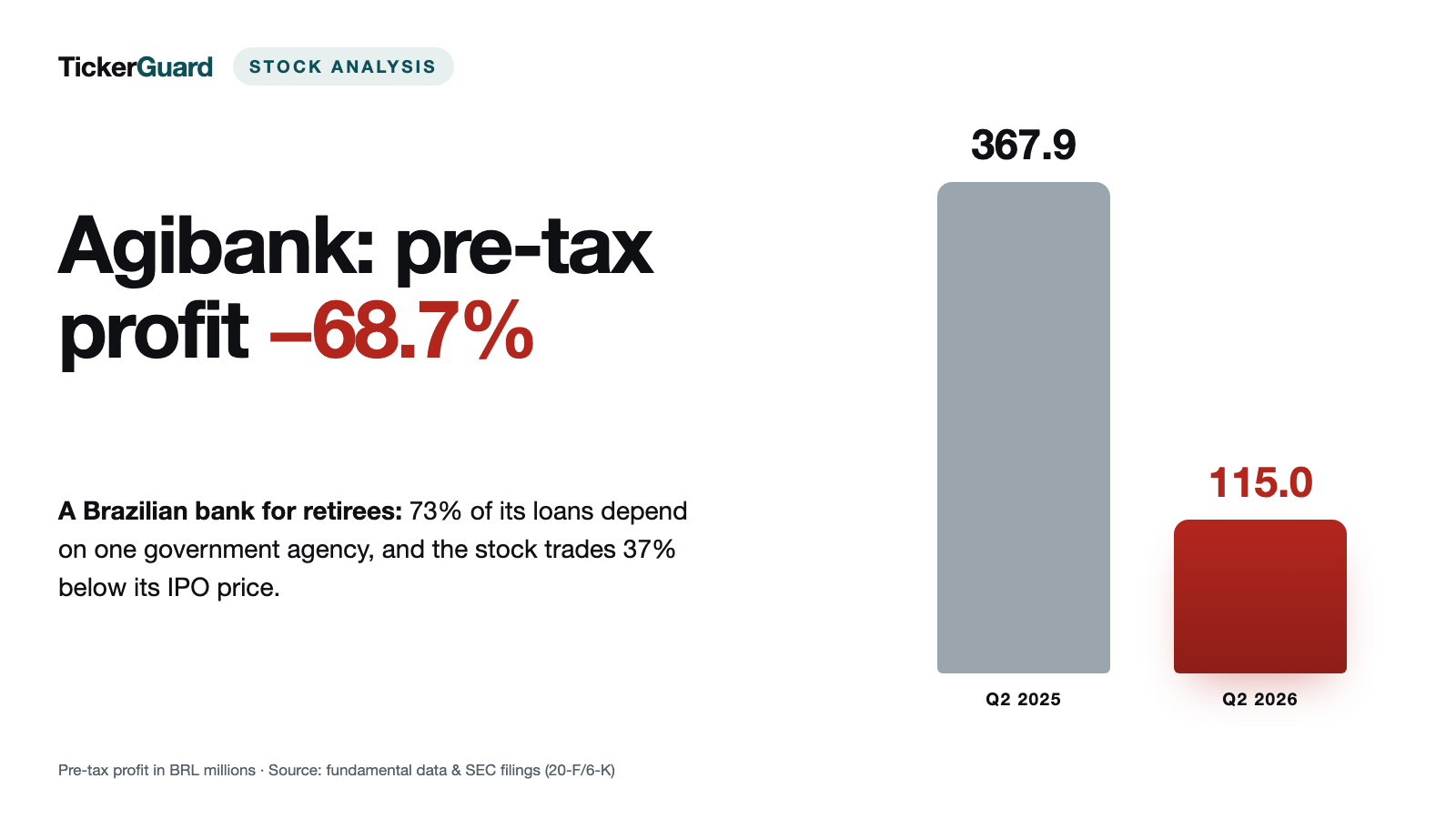
And then comes the chart that shows the tension:
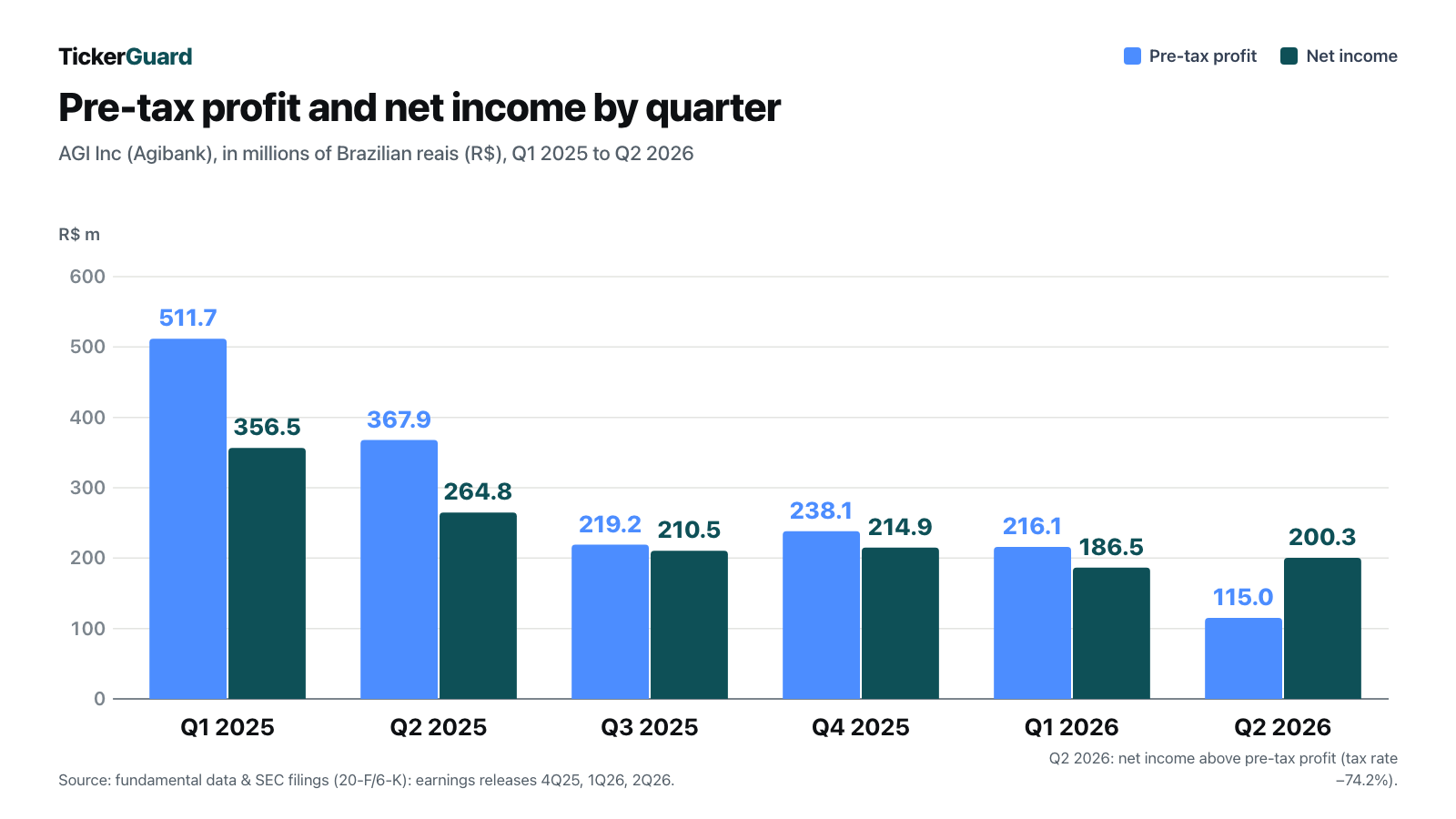
Keep this picture in mind: the loan book grew by a fifth, but pre-tax profit shrank to less than a quarter of its level within five quarters — and net income only looks stable because the tax bill disappeared. The filings explain why.
What the Filings Say — the Uncomfortable Truths
Uncomfortable Truth No. 1: Three-Quarters of the Loans Depend on a Single Agency
The second chart shows what the loan book consisted of as of June 30, 2026. Of R$37,075.8 million, R$27,154.4 million are payroll loans to INSS retirees — 73.2 percent (our calculation). Personal loans without payroll deduction account for R$4,431.2 million; all other segments combined, R$5,490.2 million.
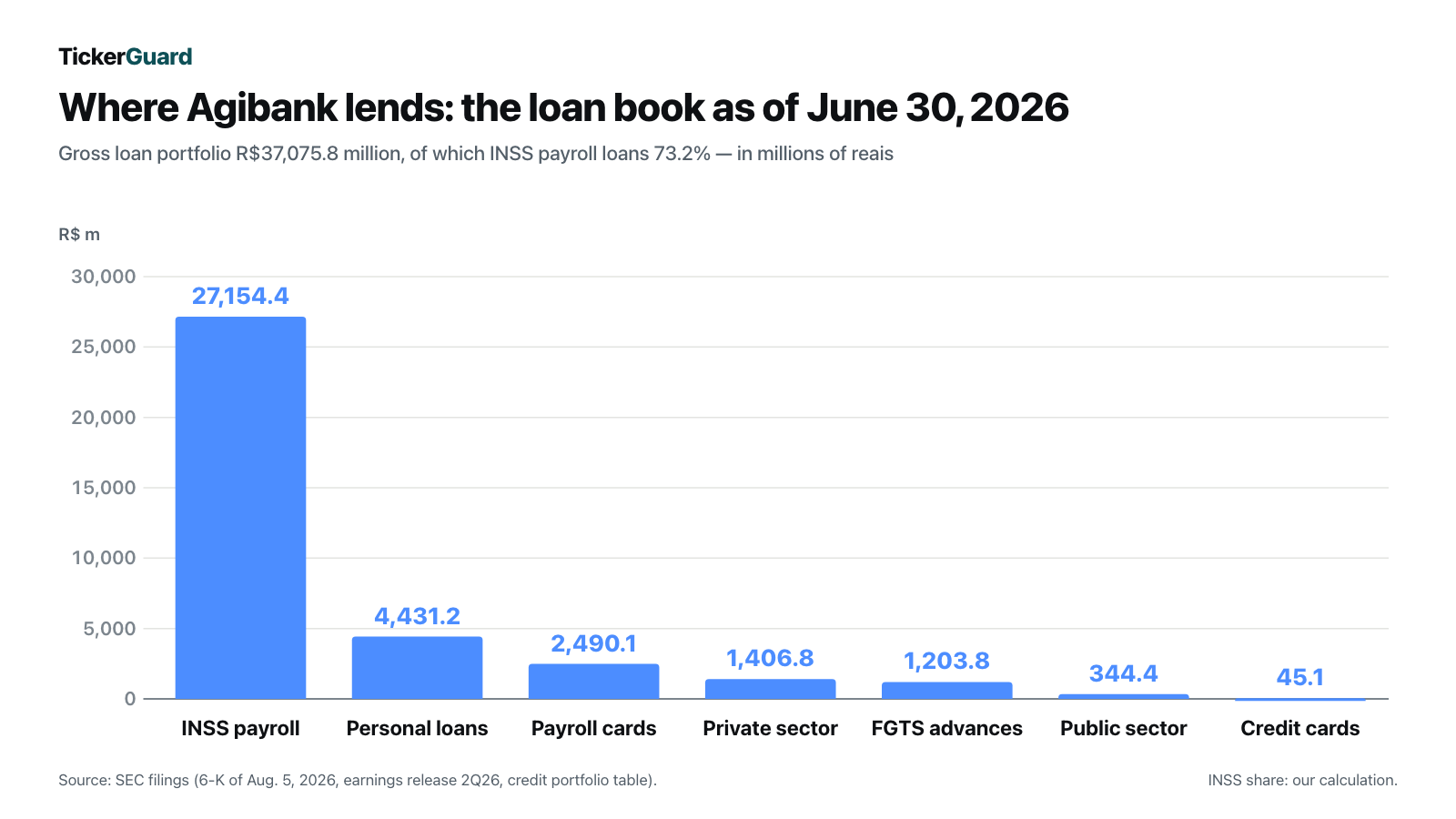
How vulnerable that makes the bank is spelled out in the annual report, as the very first risk factor:
"A significant portion of our revenues is tied to the maintenance of our agreements with the INSS, the loss, suspension or termination of which would materially and adversely affect our results of operations, financial condition and reputation."
— AGI Inc, Form 20-F for 2025, Item 3.D "Risk Factors"
This is not theory. In 2025, the INSS partially suspended Agibank twice. In August 2025, it suspended benefit payment services for new beneficiaries, initially for 60 days, alleging that the bank had failed to comply with certain contract terms; a settlement on Nov. 12, 2025, lifted the suspension. Then, in December 2025, came the harder blow:
"In December 2025, the INSS issued a press release announcing that a federal audit conducted by the CGU found alleged irregularities and allegedly harmful practices against INSS beneficiaries and, as a result, INSS issued a precautionary suspension of new payroll loan deductions by Banco Agibank under ACT No. 106/2025, and Agi Financeira S.A. - Sociedade de Crédito, Financiamento e Investimento under ACT No. 221/2025."
— AGI Inc, Form 20-F for 2025, Item 3.D "Risk Factors"
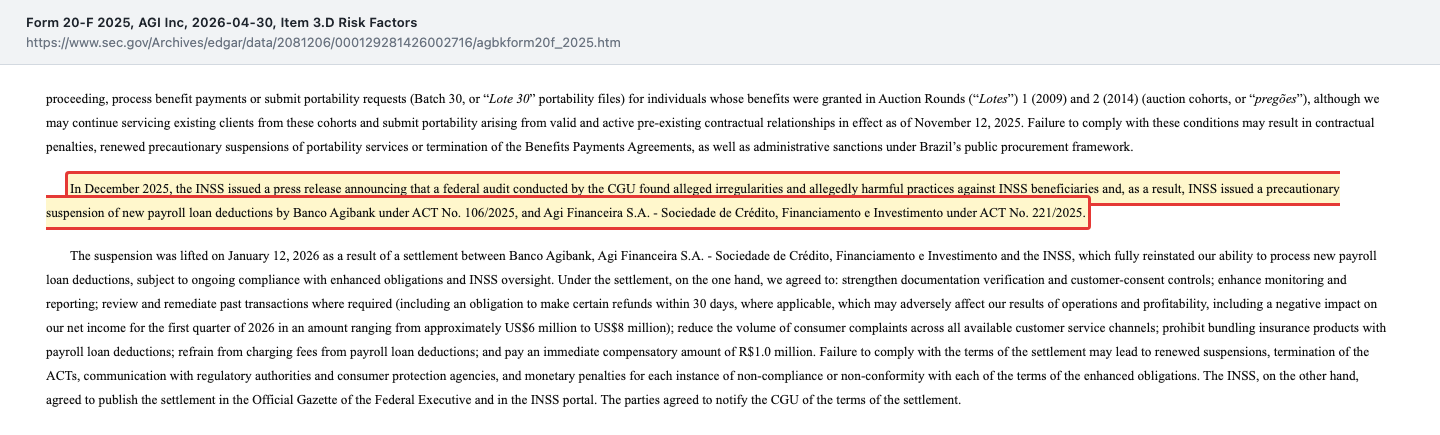
The suspension ended on Jan. 12, 2026, again through a settlement. The price is listed in the same section: tighter controls on customer consent, periodic reports to the INSS, refunds to customers (which the annual report estimated would reduce first-quarter 2026 net income by about $6 million to $8 million; unusually, the annual report states this figure in dollars rather than reais), fewer customer complaints, and no more insurance bundled with payroll loans. Breaching these terms, the annual report says, could lead to renewed suspensions or termination of the agreements. In May 2026 came the next change from outside, this time for all banks: the government's "Desenrola 2.0" program cut the share of income that may be deducted for payroll loan installments from 45 to 40 percent and extended the maximum term from 96 to 108 months. In its second-quarter 2026 earnings release, Agibank calls this a net positive because it rewards large, fast-moving lenders. The first visible effect was on fees: as other banks originated fewer loans, they also took over fewer Agibank loans, so the cost reimbursements Agibank receives when a loan moves to another bank (“portability”) fell. Put plainly: Agibank's most important distribution channel is a contract with a government that can step in and change the rules — and did so three times between August 2025 and May 2026.
Uncomfortable Truth No. 2: Lately, the Tax Line Has Been Holding Up Net Income
Back to the first chart. In the second quarter of 2026, AGI Inc earned R$115.0 million before taxes, down from R$367.9 million a year earlier (−68.7 percent). The bottom line showed R$200.3 million of net income, because the tax line booked not an expense but a benefit of R$85.3 million. The effective tax rate was −74.2 percent; in the first half of 2025 it had been +29.4 percent. The earnings release explains it in a single sentence:
"Our effective tax rate additionally benefited from the tax-efficient allocation of IPO proceeds and Agibank’s cash into eligible instruments, which is a feature of our capital management."
— AGI Inc, Q2 2026 earnings release, Exhibit 99.1 to the Form 6-K of Aug. 5, 2026
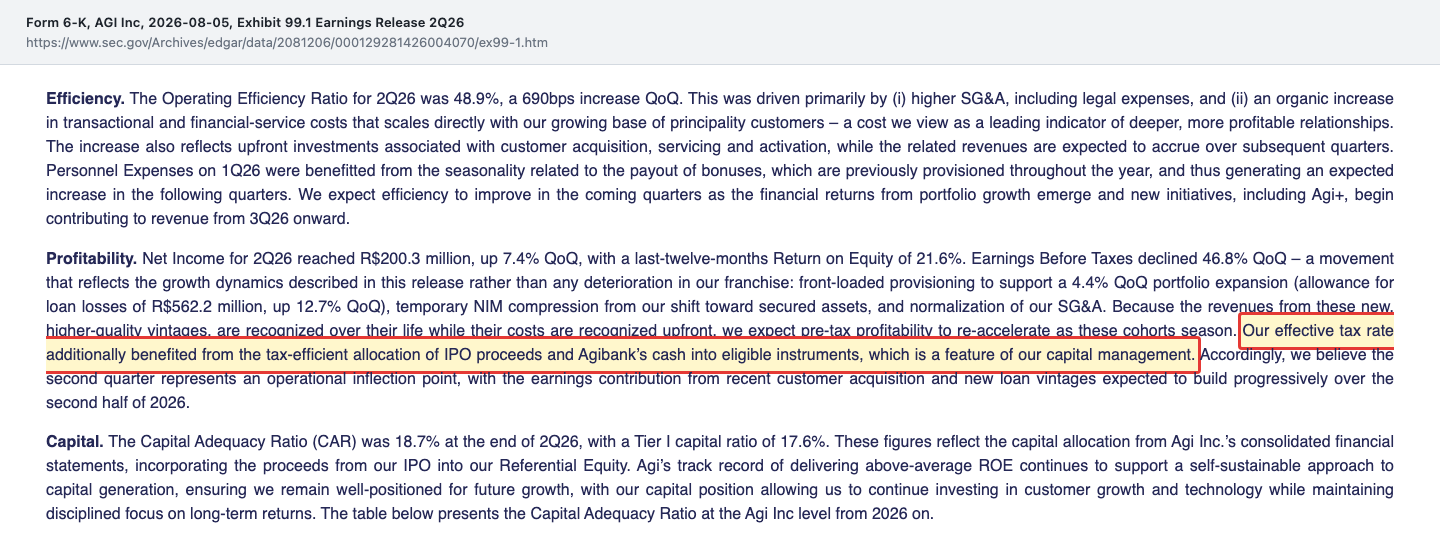
The earnings release calls this part of its capital management, and it is not unusual in Brazil — banks there face a tax rate of up to 45 percent (the tax reconciliation in the interim statements as of June 30, 2026, uses rates of 45 and 34 percent), and parking money in tax-advantaged instruments saves money. But it is not income from lending, and the IPO proceeds that make it possible were a one-time inflow. A one-off had already helped in the fourth quarter of 2025. According to the Q1 2026 earnings release, a revised model for civil lawsuit provisions reduced administrative expenses by R$96.6 million; without it, pre-tax profit would have been R$141.5 million instead of R$238.1 million, and net income R$161.8 million instead of R$214.9 million. In household terms: if you balance your budget with a tax refund and a released reserve, you had a good year — but you did not get a raise.
Uncomfortable Truth No. 3: Margins Are Shrinking, Provisions Are Rising — and the Turnaround Is Still a Promise
Why is pre-tax profit falling while the loan book grows? The earnings release has the numbers. The net interest margin (what the bank earns in interest minus what it pays, relative to its interest-earning assets) fell from 14.1 to 11.9 percent annualized between Q2 2025 and Q2 2026. After loan loss provisions — the money the bank sets aside for expected defaults — it was 6.8 percent instead of 9.9 percent. Provisions themselves rose 60.0 percent from the year-earlier quarter, to R$562.2 million in Q2 2026 (up 12.7 percent from the prior quarter). The ratio of loans more than 90 days past due was 3.3 percent, above the 2.7 percent of a year earlier, and provision coverage of those loans fell from 240.4 to 182.6 percent.
Then there are costs. The efficiency ratio rose to 48.9 percent in Q2 2026 from 42.9 percent a year earlier: of every real of revenue, almost 49 centavos went to personnel, administration and depreciation. Fee income fell 34.4 percent from the year-earlier quarter to R$135.6 million, though it rose 34.6 percent from the prior quarter; within the quarter it was held back partly because other banks took over fewer Agibank loans through refinancing — Agibank receives a cost reimbursement for each such transfer. The trailing twelve-month return on equity roughly halved, from 41.2 to 21.6 percent, partly because the IPO enlarged the equity base. And funding is shifting: retail deposits fell from 54.4 to 38.5 percent of funding within a year, while collateralized issuances, including credit funds (FIDCs) backed by INSS payroll loans, rose from R$6,912.9 million to R$12,372.7 million. These funds run long (the second FIDC, launched in April 2026, for ten years) but depend on the appetite of institutional investors rather than on customers' savings accounts.
Founder Marciano Testa sees this as the cost of growth: provisions and customer acquisition hit immediately, while interest and fees arrive over years. His promise is specific:
"We expect this operating resurgence to support sequentially stronger earnings beginning in the third quarter, with a more pronounced financial contribution in the fourth quarter."
— Marciano Testa, founder, chairman and CEO, Q2 2026 earnings release, Exhibit 99.1 to the Form 6-K of Aug. 5, 2026
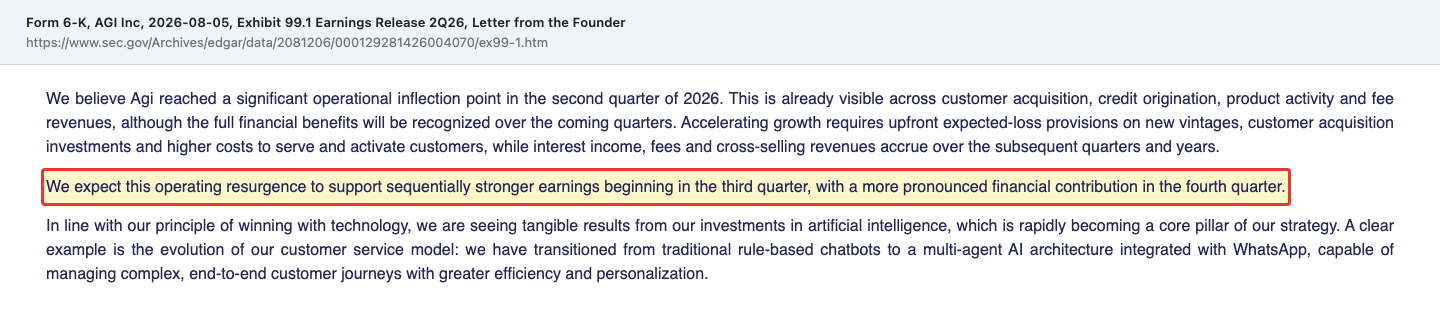
To be fair, some things point that way. Gross loan origination topped R$7 billion in the second quarter, the new "Agi+" subscription bundle passed 250,000 subscribers within 45 days, and the delinquency ratio improved from the prior quarter. But a promise is not proof. It should be measured against pre-tax profit in the coming quarters, not net income — otherwise you are measuring the tax line again.
Uncomfortable Truth No. 4: One Man Holds 94.5 Percent of the Votes
Buying AGBK means buying Class A shares with one vote each. Founder Marciano Testa owns all Class B shares, with ten votes each. As of June 30, 2026, that was 101,229,359 of 160,135,072 shares, or 63.2 percent of the share capital — and nearly all of the votes:
"Our controlling shareholder owns all of our outstanding Class B common shares, which represent approximately 94.5% of the voting power of our issued share capital. This concentration of ownership and voting power limits your ability to influence corporate matters."
— AGI Inc, Form 20-F for 2025, Item 3.D "Risk Factors"
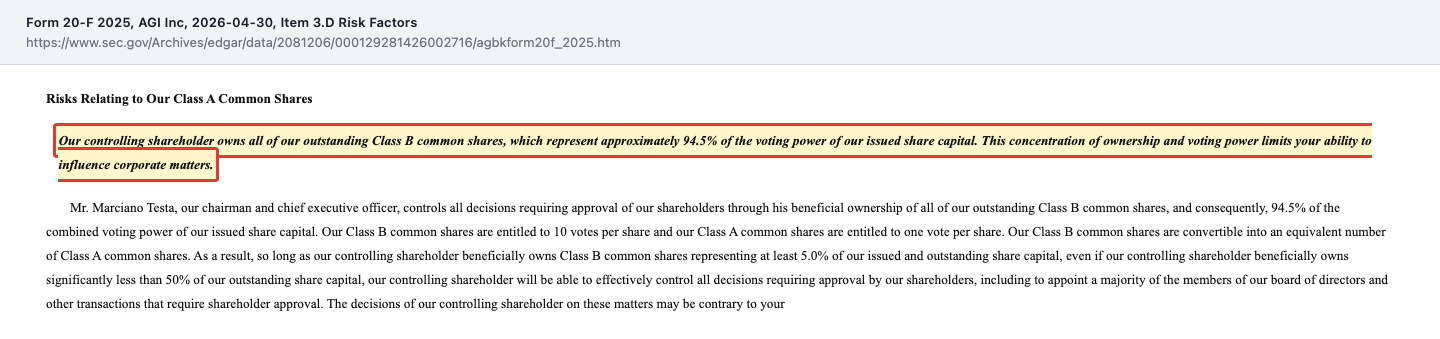
According to the annual report, Testa keeps that control as long as his Class B shares represent at least 5 percent of the share capital. That makes AGI Inc a "controlled company" under NYSE rules, allowed to skip some board independence requirements. Future dilution comes on top: with two Form S-8 registrations, AGI Inc registered 9,775,805 shares (April 29, 2026) for an incentive plan and 7,100,000 shares (Sept. 21, 2026) for a "Partnership Program" — together about 10.5 percent of the share capital as of June 30, 2026 (our calculation). Put plainly: you get a seat at the table, but the founder makes the decisions — and more chairs are set aside for employees. That is not necessarily bad; a founder with a lot of his own money in the company has a stake in its success. But it means minority shareholders have no real say on capital measures, board seats or takeovers.
Valuation: What the Market Pays for Agibank
At the $7.58 close on Oct. 23, 2026, AGI Inc had a market value of about $1.21 billion, based on all 160,135,072 shares (Class A and B, as of June 30, 2026). At 4.9654 reais per dollar, that is about R$6.03 billion. Relative to equity of R$4,799.2 million (June 30, 2026), the stock trades at 1.26 times book value; relative to net income for the last four quarters (R$812.2 million, Q3 2025 through Q2 2026), at 7.4 times earnings (our calculations). A note on the data: on Oct. 24, 2026, the fundamental data showed a market value of about $1.9 billion; that figure does not fit the current price, so we do not use it.
A price-to-earnings ratio of 7.4 sounds cheap, but it rests on net income that carried almost no tax. Applying the first-half 2025 tax rate (29.4 percent) to pre-tax profit for the same four quarters (R$788.4 million) would give earnings of about R$557 million and a P/E of about 10.8 (our calculation, not a forecast). The “As of Today” box above shows a P/E of 7.1: that figure comes from the fundamental data, which use their own earnings and exchange-rate basis; our 7.4 rests on the four reported quarterly profits in reais. The analysts who cover the stock are far more upbeat: according to fundamental data as of Oct. 24, 2026, eight rated it "strong buy," two "buy" and one "hold," with an average price target of about $12.43. Average here means all price targets added up and spread evenly — a single very high target can pull it up noticeably. What stands out most is that this average sits almost exactly at the IPO price. Whether that is a coincidence cannot be read from the data; either way, the IPO price itself is no yardstick for value. How the market values another Brazilian financial platform that earns in reais and trades in dollars is covered in our StoneCo analysis.
Opportunities and Risks at a Glance
The case for Agibank:
- Strong growth: 7.6 million active customers (up 36.4 percent), loan book of R$37,075.8 million (up 21.2 percent), INSS market share of 9.60 percent (June 30, 2026).
- A track record of profits: 2025 net income of R$1,046.6 million, up from R$426.1 million in 2023.
- Solid capital: capital adequacy ratio of 18.7 percent against a 10.5 percent minimum; all three major agencies raised their national-scale ratings to the AA level in 2026.
- Secured lending: 88 percent of the loan book is secured, mostly by direct deduction from pensions or paychecks; the delinquency ratio fell to 3.3 percent in Q2 2026.
- New revenue streams in the works: the Agi+ subscription bundle (more than 250,000 subscriptions in 45 days), an in-house investment platform, and private-sector payroll loans (up 48.1 percent in the quarter).
The case against:
- 73.2 percent of loans depend on agreements with the INSS; the agency partially suspended Agibank twice in 2025, and the settlements require enhanced supervision.
- Q2 2026 pre-tax profit down 68.7 percent to R$115.0 million; net income of R$200.3 million rests on an R$85.3 million tax benefit.
- Net interest margin after provisions of 6.8 instead of 9.9 percent, efficiency ratio of 48.9 instead of 42.9 percent, fee income down 34.4 percent (Q2 2026 versus a year earlier).
- Founder Marciano Testa holds 94.5 percent of the votes; 16.9 million shares registered for equity plans.
- A short trading history with just one annual report; currency risk between earnings in reais and a stock priced in dollars.
A Human Conclusion
Back to the IPO-price anchor. Anyone who bought AGBK at $12 in February is sitting on a loss, and anyone thinking of buying now hears a tempting voice: "A third below the IPO price, and the analysts see $12 again." The filings tell a more sober story. Agibank is a growing, well-capitalized bank with a loan product whose installments are deducted directly from pensions or wages, which lowers the risk of default. But three-quarters of its business depends on an agency that partially suspended Agibank twice in 2025, and its pre-tax profit shrank to less than a quarter of its level within five quarters. The net income that looks steady in Q2 2026 owes that to the tax line.
So the honest question for you is not "How far has the stock fallen below its IPO price?" It is this: Would you buy Agibank if you had never heard the $12 IPO price — and if the next quarterly report has to show, in pre-tax profit, that the promised turnaround comes from lending and not from the tax line again? If so, you have a thesis about a bank. If what convinces you is mainly the distance from February, the anchor has made the decision for you. What you do with this is your call. And that is exactly how it should be.
Sources
All original documents used in this analysis — so you can check them yourself:
- AGI Inc — Q2 2026 earnings release, Exhibit 99.1 to the Form 6-K of Aug. 5, 2026 and IFRS interim financial statements as of June 30, 2026, Exhibit 99.1 to the Form 6-K of Aug. 5, 2026 (most recent periodic report)
- AGI Inc — Q1 2026 earnings release, Exhibit 99.1 to the Form 6-K of May 5, 2026 and Q4 2025 earnings release, Exhibit 99.1 to the Form 6-K of Mar. 23, 2026
- AGI Inc — Annual report on Form 20-F for 2025 (filed Apr. 30, 2026)
- AGI Inc — IPO prospectus on Form 424B1 dated Feb. 10, 2026
- AGI Inc — Form S-8 registrations of Apr. 29, 2026 (2026 Omnibus Incentive Plan) and Sept. 21, 2026 (Partnership Program)
- AGI Inc — announcements (Form 6-K) of June 15, 2026 (Moody's Local; filed with the SEC on June 16), July 30, 2026 (Fitch; filed July 31), Aug. 20, 2026 (S&P; filed Aug. 21), Sept. 23, 2026 (new CTO) and Oct. 1, 2026 (third FIDC fund of R$2.1 billion; filed Oct. 2)
- Insider reports (Form 4) filed Sept. 2, 2026 (Vinicius Aloe, sale on Aug. 31, 2026) and May 11, 2026 (Marciano Testa, purchase on May 7, 2026); ownership report Schedule 13G/A filed July 21, 2026 (Lumina, as of June 30, 2026)
- Complete filing history: EDGAR overview for AGI Inc (sec.gov)
- Fundamental data (prices, real/dollar exchange rate and analyst ratings, as of Oct. 24, 2026), reconciled with the SEC filings.
Transparency & disclaimer: This analysis is a journalistic assessment of publicly available information. It is not investment advice, not financial research in the regulatory sense and not a solicitation to buy or sell securities. Investing in stocks involves substantial risk, up to and including total loss. All information without guarantee; the data date is noted in the text. Positions held by the operator are disclosed daily; where one exists, it appears as a notice at the top of this deep dive.
Key figures at a glance
All monetary figures in millions of R$; earnings per share as reported.
| Metric | 2022 | 2023 | 2024 | 2025 |
|---|---|---|---|---|
| Revenue | 3,322.0 | 4,987.6 | 7,272.6 | 10,694.2 |
| Operating Income (EBIT) | 244.2 | 581.6 | 1,041.0 | 1,336.8 |
| Net Income | 168.9 | 422.0 | 791.0 | 1,037.8 |
| Net Margin | 5.1% | 8.5% | 10.9% | 9.7% |
| Earnings Per Share | 2.88 R$ | 7.19 R$ | 13.48 R$ | 6.49 R$ |
Source: fundamental data & SEC filings (annual and quarterly reports, 10-K/10-Q)
Our Bottom Line at a Glance
- Growth & market position positive
- Loan book of R$37,075.8 million (up 21.2 percent), 7.6 million active customers (up 36.4 percent), INSS market share of 9.60 percent as of June 30, 2026; 2025 net income of R$1,046.6 million.
- Earnings power negative
- Q2 2026 pre-tax profit down 68.7 percent to R$115.0 million; net interest margin after provisions of 6.8 instead of 9.9 percent; net income held steady only by an R$85.3 million tax benefit.
- Capital & funding positive
- Capital adequacy ratio of 18.7 percent against a 10.5 percent minimum, equity of R$4,799.2 million (June 30, 2026); ratings raised to the AA level on the national scale in 2026. Retail deposits, however, fell from 54.4 to 38.5 percent of funding.
- Dependence on the INSS negative
- 73.2 percent of loans are INSS payroll loans (June 30, 2026); two partial suspensions by the agency in 2025 (August, December), lifted by settlements on Nov. 12, 2025, and Jan. 12, 2026, under enhanced supervision.
- Credit quality neutral
- 90-day delinquency ratio of 3.3 percent (prior quarter 3.6, prior year 2.7), provision coverage of 182.6 percent (prior year 240.4); 88 percent of loans secured, mostly by payroll or pension deduction.
- Governance negative
- Founder Marciano Testa holds 94.5 percent of the votes (Class B with ten votes each); controlled company under NYSE rules; 16.9 million shares registered for equity plans (S-8 of Apr. 29 and Sept. 21, 2026).
Agibank is growing strongly and is well capitalized, but pre-tax profit fell by more than two-thirds in Q2 2026, and net income held up thanks to a tax benefit. Three-quarters of its loans depend on agreements with the INSS, which were partially suspended twice in 2025, and the founder holds 94.5 percent of the votes. Not investment advice.
What Our Rating Means
Open questions
The business works in principle, but one material question is open. As long as it stays open, our findings do not carry a quality verdict.
Agibank is profitable and solidly capitalized at an 18.7 percent capital ratio, but it is unclear whether its earnings power will return: pre-tax profit fell from R$367.9 million in Q2 2025 to R$115.0 million in Q2 2026, net income holds up only thanks to a tax benefit, and 73.2 percent of the loan book depends on agreements with the INSS whose termination would change this assessment.
A journalistic assessment by our editorial team at the time of the deep dive, based on public sources — not investment advice and not a solicitation to buy or sell. Your personal circumstances (investment goals, risk capacity, taxes) cannot be taken into account. What our levels mean, how verdicts are formed, and what conflicts of interest exist →
Worth Noting
- AGI Inc made our research list through the Reddit hype scan of Oct. 24, 2026. AGI Inc is a foreign private issuer (Cayman Islands): annual report on Form 20-F instead of 10-K, quarterly figures as an earnings release and unaudited IFRS interim statements on Form 6-K. The most recent periodic report is the interim statements as of June 30, 2026 (6-K of Aug. 5, 2026); all filings through Oct. 2, 2026, were reviewed (6-K reports on ratings, bonds, FIDC funds and the new CTO, S-8 of Sept. 21, 2026, Form 4 insider reports through Sept. 2, 2026, Schedule 13G/A of July 21, 2026); no further filing was made between Oct. 2 and Oct. 24, 2026. Until September 2025, the EDGAR name was spelled "Agi, Inc."
- Market value = 160,135,072 shares (Class A and B, interim statements as of June 30, 2026) × $7.58 (close on Oct. 23, 2026) = about $1.214 billion; × 4.9654 reais per dollar = about R$6,027 million. The market value in the fundamental data (about $1.90 billion on Oct. 24, 2026) does not fit the closing price, deviates by more than a fifth and is not used.
- Net income for the last four quarters = 210.5 + 214.9 + 186.5 + 200.3 = R$812.2 million; pre-tax profit = 219.2 + 238.1 + 216.1 + 115.0 = R$788.4 million; × (1 − 0.294) = about R$557 million (first-half 2025 tax rate per the Q2 2026 earnings release). 2025 quarterly figures from the Q4 2025 and Q1 2026 earnings releases. Our calculations.
- Possible confusion: the holding company is AGI Inc, the operating bank Banco Agibank S.A.; the Agiplan brand was the origin of the business (1999). Figures through Q4 2025 come from the predecessor holding company Agi Financial Holding, from 2026 on from AGI Inc; the capital ratio through year-end 2025 refers to Banco Agibank S.A.
Stock Watch
This analysis is as of October 24, 2026. Stock Watch will tell you what's changed at AGBK since then.
Later $1 a month per stock — signing up is free, and you'll be the first to know when it launches.
The full analysis as a PDF for later
We will send you this analysis as a PDF — to print, file away, and read at your own pace. And we will add you to the free Stock Watch list for AGI Inc (AGBK), so you hear about it when something material in this analysis changes.
Frequently Asked Questions
Agibank is a Brazilian bank based in Campinas; its holding company AGI Inc has traded on the NYSE since Feb. 11, 2026 (ticker AGBK). It mainly makes payroll-deductible loans to retirees and pensioners of Brazil's state social security agency INSS, with installments deducted directly from the pension, and it pays out pensions. As of June 30, 2026, it had 7.6 million active customers and a R$37.1 billion loan book.
Yes, but with declining pre-tax profit. Net income was R$1,046.6 million in 2025. In the second quarter of 2026, pre-tax profit fell 68.7 percent to R$115.0 million; net income of R$200.3 million was higher only because of a R$85.3 million tax benefit (effective tax rate of −74.2 percent).
The INSS is Brazil's state social security agency, which pays out pensions. Agibank needs cooperation agreements with it so that loan installments can be deducted directly from pensions. As of June 30, 2026, 73.2 percent of the loan book consisted of INSS payroll loans. In 2025, the INSS partially suspended Agibank in August and December; both suspensions ended in settlements under enhanced supervision.
Founder, chairman and CEO Marciano Testa owns all Class B shares, which carry ten votes each. As of June 30, 2026, that was 101,229,359 of 160,135,072 shares (63.2 percent of the share capital) and, according to the Form 20-F, about 94.5 percent of the voting power. AGI Inc is a "controlled company" under NYSE rules.
At the $7.58 close on Oct. 23, 2026, AGI Inc was worth about $1.21 billion, or R$6.03 billion. That is 1.26 times equity (R$4,799.2 million) and 7.4 times net income for the last four quarters. At the first-half 2025 tax rate (29.4 percent), the price-to-earnings ratio would be about 10.8 (our calculations).
AGI Inc is incorporated in the Cayman Islands and reports as a foreign private issuer. Instead of Forms 10-K and 10-Q, it files an audited annual report on Form 20-F and current reports on Form 6-K, including earnings releases and unaudited IFRS interim financial statements. The most recent periodic report covers June 30, 2026, and was filed on Aug. 5, 2026.
Found an error?
Did you spot a factual error, an outdated number, or a typo in this deep dive? Let us know briefly — your report goes straight to the editorial team.