OHB SE: A Full Order Book, a Thin Margin — and a Big Shareholder Selling
OHB builds satellites for Europe, and the order book is full: EUR 3,304 million of backlog as of June 30, 2026. In the same half-year the company raised EUR 484 million in fresh capital at EUR 300 per share — and private-equity investor KKR pushed roughly 1.39 million of its own shares into the same window. Meanwhile operating profit fell to EUR 14.8 million, turned slightly negative in the second quarter, and EUR 194.5 million drained out of the operating business. No buy or sell recommendation — only the question of what is left of the rocket once the scarcity is gone.
 Thomas Mücke
Founder & Publisher
Thomas Mücke
Founder & Publisher
Chart
Interactive price chart (TradingView).
Note: pure fact-based analysis, not investment advice and not a solicitation to buy or sell. All figures without guarantee.
There is an investor trap that needs no exaggeration at all — it only needs a small supply. Call it the scarcity trap: when there is almost nothing of a thing to buy, our brain automatically files it as valuable. We know this from limited-edition sneakers and concert tickets, and it works exactly the same way on the stock market. At OHB SE of Bremen, Germany, the goods were extremely scarce for years: of 19,214,905 shares outstanding on December 31, 2025, only 1,092,279 were freely tradable — 5.7 percent. Average daily volume in the first half of 2025 was 6,944 shares. Anyone who wanted to buy in that situation had to take whatever price was on offer. And then the space boom arrived.
So let us make a deal: before we talk about the share price, we read together what the company itself reported — the 2025 annual report and the half-year report 2026 of August 6, 2026. Both are mandatory publications under German and European capital-market law, and the annual accounts are audited. Out of those documents comes the tension this analysis turns on: the order book and the balance sheet have never been stronger — and in that very same half-year operating profit slipped below zero in the second quarter.
What OHB actually does — Europe's satellite builder from Bremen
OHB SE is a space and technology group headquartered in Bremen with sites in ten countries. Translated into an everyday picture: if European spaceflight were a construction site, OHB is the general contractor that builds the houses — the satellites —, also supplies parts of the crane that lifts them up, and finally runs the control room that talks to them. The group is an active holding company: the parent runs no operating business of its own but steers the subsidiaries.
Reporting runs in three segments. SPACE SYSTEMS is by far the largest and develops and builds complete satellite systems — for navigation (Galileo), science, telecommunications, Earth and weather observation, security and exploration; in the first half of 2026 the segment stood for EUR 458.7 million of non-consolidated revenue. ACCESS TO SPACE supplies structures and tanks for European launchers, above all the Ariane programs, and develops small launchers and launch infrastructure (EUR 92.5 million). DIGITAL builds ground systems, antennas and telescopes, operates satellites and delivers data services and IT security (EUR 62.1 million). On June 30, 2026 the group employed 4,094 people, 3,234 of them in Germany — 315 more than at the turn of the year.
The project names sound like cinema and are nevertheless day-to-day business: the PLATO space telescope mission, whose environmental test campaign was completed in the second quarter of 2026 and which is scheduled to launch in January 2027; the RAMSES probe, built in Bremen in only three and a half years to accompany asteroid Apophis in 2029; the joint venture with Rheinmetall for the German armed forces' satellite communications program SATCOMBw Phase 4; and the "KIRK" venture with Helsing, which also involves Kongsberg and HENSOLDT, whose numbers we took apart here.
Why there is no SEC filing here — and where the numbers come from instead
One point up front, because it shapes the entire chain of evidence: there is no 10-K and no 10-Q for OHB. The company is not a U.S. reporting issuer; it does not appear in the ticker registry of the U.S. securities regulator, the SEC. Its mandatory reporting runs through the Prime Standard of the Frankfurt Stock Exchange: audited IFRS consolidated financial statements — the 2025 accounts were signed off by PricewaterhouseCoopers on March 18, 2026, and for the current year the annual general meeting appointed BDO AG on June 8, 2026 —, plus a half-year report and quarterly statements. Every figure in this analysis therefore carries the line "Source: fundamental data & company reports (annual and half-year report, Frankfurt Stock Exchange)". The idea that a mandatory report is honest because it carries consequences still applies — it just runs under German securities law rather than U.S. law.
One peculiarity of the numbers is worth knowing before drawing comparisons: alongside revenue, OHB reports total operating performance as its headline metric. It additionally counts changes in inventories and own work capitalized — EUR 627.9 million in the first half of 2026 against EUR 600.1 million of revenue. Management's guidance and its mid-term targets always refer to total operating performance, never to revenue.
How the stock landed on our desk
Honestly: not through a scanner hit, but through an attention ranking. On August 11, 2026 OHB sat near the top of the most-discussed lists in the wallstreet-online forum — that is, where German retail investors were talking loudest about a stock right then. That is an attention signal and explicitly not a reason to buy. A stock lands on such lists when a lot is being written about it; that can be enthusiasm, annoyance, hope or simply habit.
Even so, a list like that is useful to us — as a topic radar. When a great many people talk about a stock at once, the sober look into the primary reports pays off precisely because the details drown in the noise. Those details are what we pull out now.
The numbers over the years — honestly credited
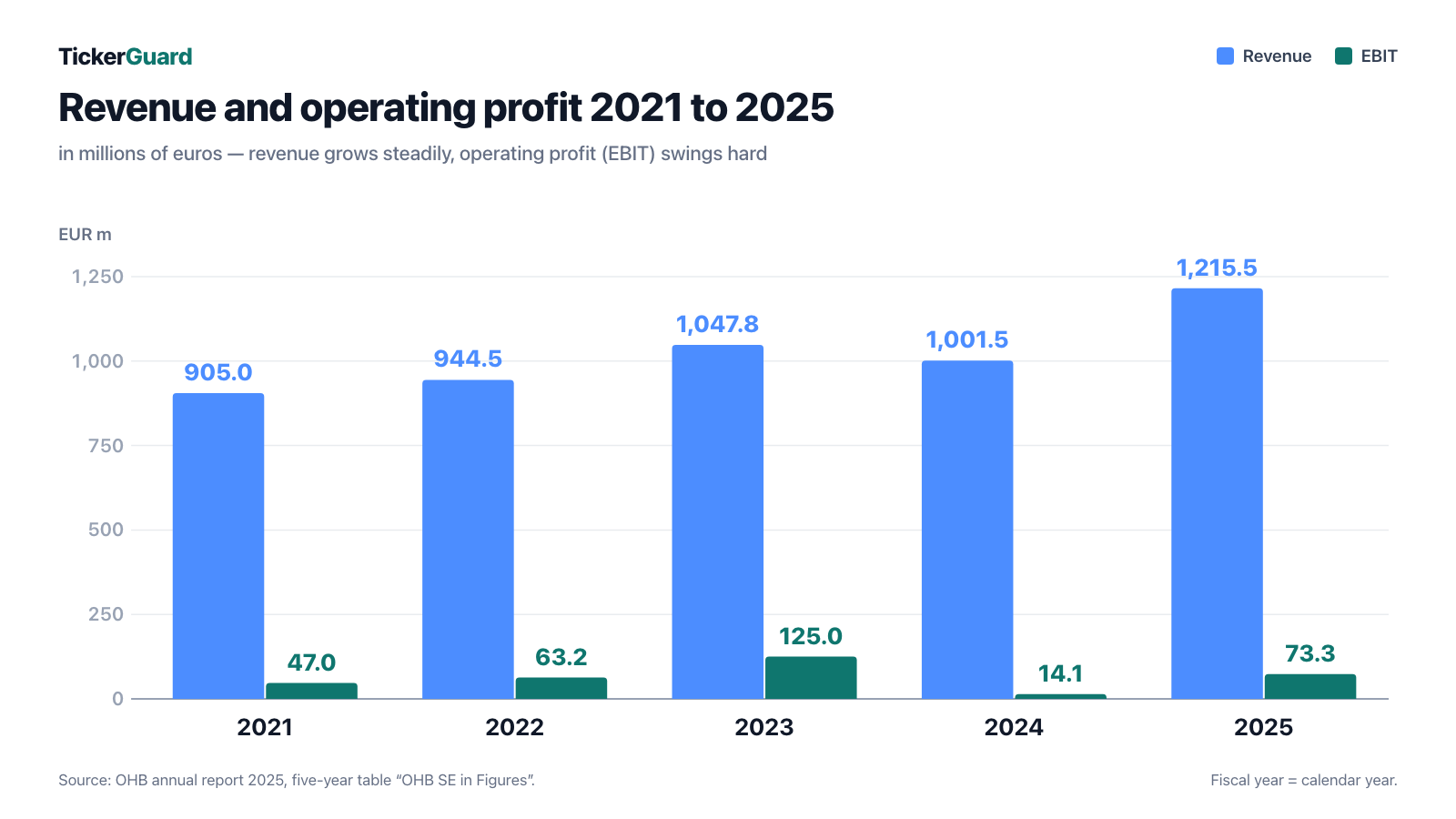
First the part that genuinely impresses. In 2025 OHB delivered the best year in its history: revenue rose 21 percent to EUR 1,215.5 million and total operating performance to EUR 1,247.6 million. EBITDA climbed from EUR 53.2 million to EUR 114.8 million, EBIT from EUR 14.1 million to EUR 73.3 million, and the shareholders' share of the result jumped from minus EUR 0.2 million to EUR 50.0 million — EUR 2.61 per share after minus EUR 0.01 a year earlier.
Read across five years it looks like this — revenue and operating profit, each in millions of euros: 905.0 and 47.0 (2021), 944.5 and 63.2 (2022), 1,047.8 and 125.0 (2023), 1,001.5 and 14.1 (2024), 1,215.5 and 73.3 (2025). Revenue climbs almost without interruption; operating profit jumps around. That is not an accounting quirk but the nature of a project business: when a milestone is signed off decides which year the profit lands in.
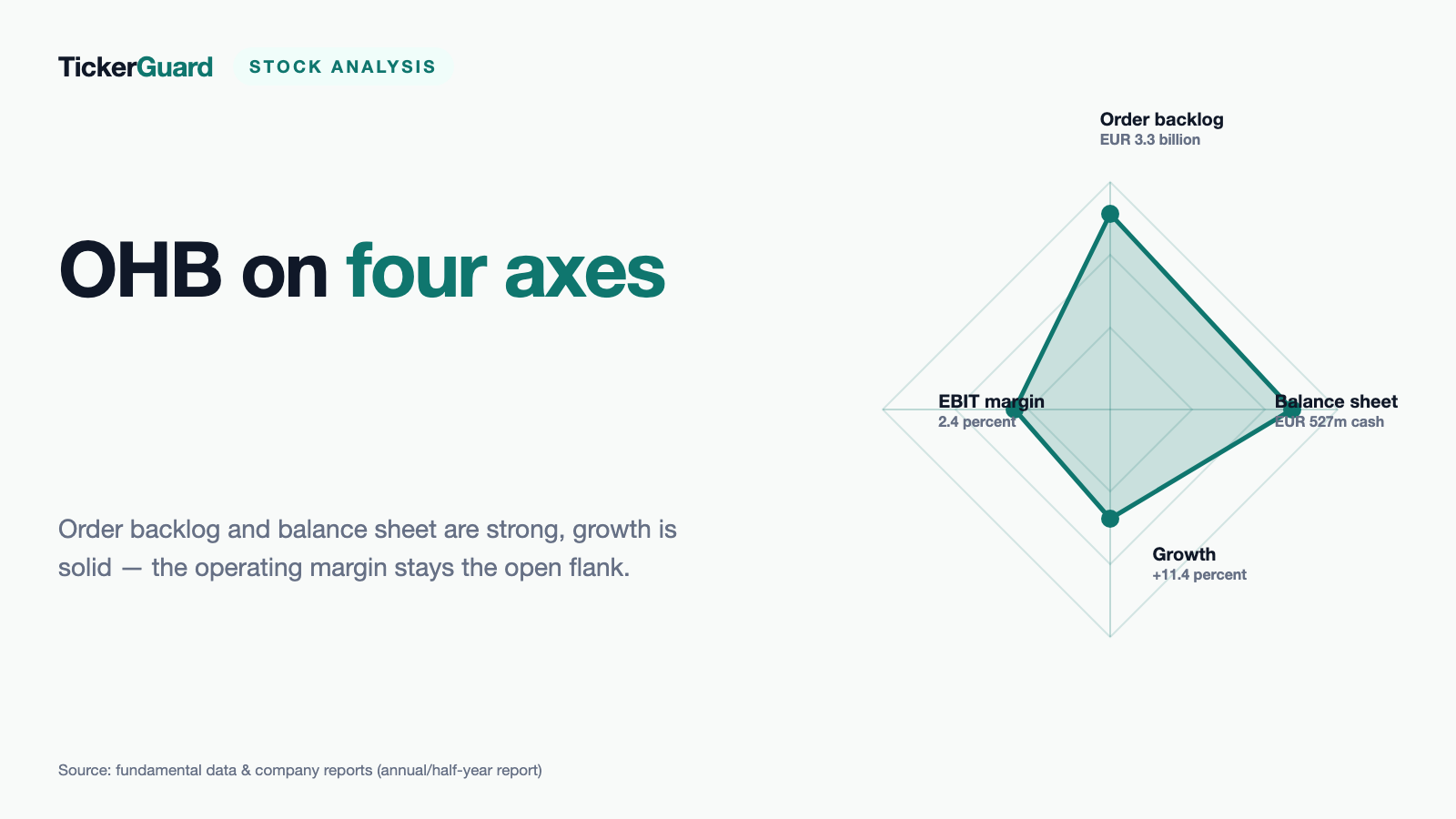
The order situation carries as well. The backlog grew from EUR 1,748.6 million (end of 2023) through EUR 2,382.4 million (end of 2024) to EUR 3,193.6 million at the end of 2025 and stood at EUR 3,303.8 million on June 30, 2026. Against management's own 2026 guidance — EUR 1,400 million of total operating performance — that is a cushion of roughly two and a half years. At the half-year mark, EUR 2,566 million of it sat in SPACE SYSTEMS, EUR 440 million in ACCESS TO SPACE and EUR 298 million in DIGITAL.
And the first half of 2026 kept growing: revenue of EUR 600.1 million (up 11.8 percent) and total operating performance of EUR 627.9 million (up 11.4 percent). Both large segments contributed, with ACCESS TO SPACE up almost 59 percent to EUR 92.5 million of revenue.
The third strong point is the balance sheet — though only since June 2026. The capital increase brought in roughly EUR 484 million gross. Equity rose to EUR 915.6 million (June 30, 2025: EUR 427.2 million) and total assets to EUR 2,113.5 million. That puts the equity ratio at roughly 43 percent, after 27.5 percent on December 31, 2025 — the company itself targets "above 25 percent". Cash and securities added up to EUR 526.9 million on June 30, 2026 after EUR 220.6 million at the turn of the year, and the net financial position including pension provisions swung from net debt of EUR 254.0 million (March 31, 2026) to a net asset of EUR 116.5 million.
That is the sunny side, and it is real. Now the other one.
What the reports say — the uncomfortable truths
Uncomfortable truth no. 1: the headline number is adjusted — by EUR 24 million
Like half the stock market, OHB reports two earnings figures side by side: the reported one and the adjusted one. "Adjusted" translates as: without the parts that are supposed to be one-offs. In the first half of 2026 the gap is unusually wide. Reported EBITDA was EUR 36.4 million — a decline from the EUR 41.6 million of the prior-year period. Adjusted, it is EUR 60.4 million, up 31 percent. Both numbers sit in the same report.
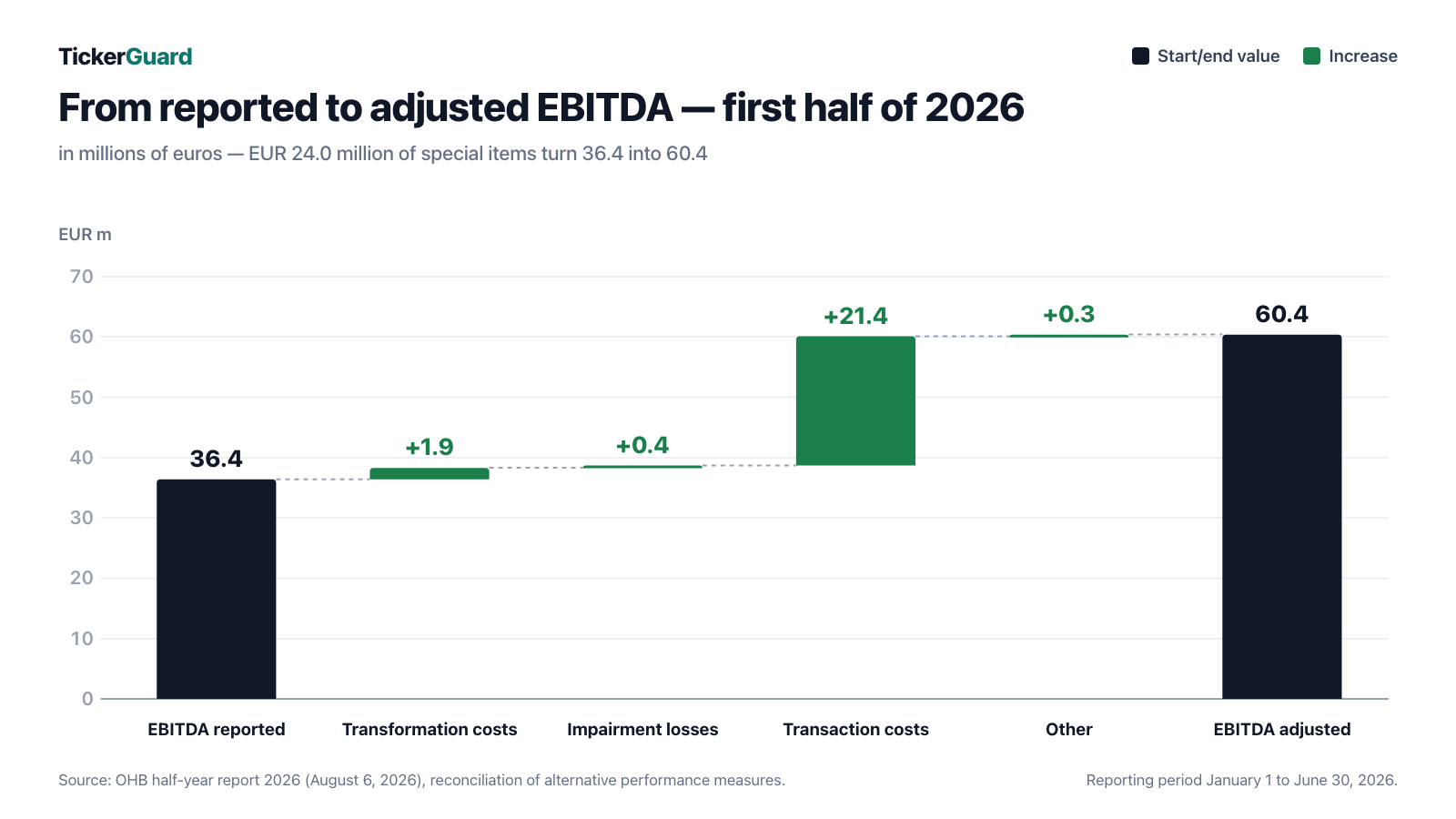
What sits inside those EUR 21.4 million? The notes are unusually precise about it:
"The transaction costs include transactions at Group level. In the six months of 2026, consulting fees amounting to EUR 10,425 thousand (previous year: EUR 0 thousand) as well ass personnel costs amounting to EUR 11,000 thousand were recorded."
— OHB SE, half-year report 2026, notes, "Transaction costs" (the spelling "as well ass" is verbatim from the original)
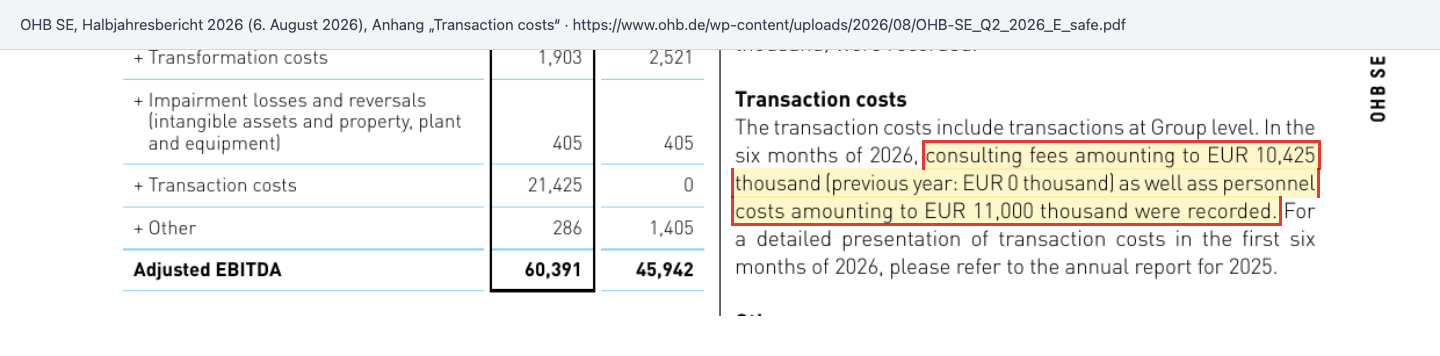
Two things stand out. First, EUR 11.0 million of it is personnel cost, not an outside invoice — money that went to people inside the company. Second, for the details the report points readers to the 2025 annual report, which by definition cannot contain costs incurred in the first half of 2026. Anyone looking for the breakdown will not find it in either document.
And the reported line underneath drops clearly: EBIT fell in the first half from EUR 22.2 million to EUR 14.8 million and earnings before taxes from EUR 17.4 million to EUR 7.8 million. In the second quarter alone, EBIT was minus EUR 0.3 million (prior-year quarter plus EUR 14.5 million) and the shareholders' share of the result minus EUR 5.1 million — minus EUR 0.27 per share. Measured against half-year total operating performance, the reported EBIT margin is 2.4 percent. For comparison: management's full-year guidance calls for an adjusted EBITDA margin of 10.5 to 11.0 percent; after six months it stands at 9.6 percent — and only on the adjusted basis.
Uncomfortable truth no. 2: one client stands for roughly 42 percent of revenue
The segment note in the 2025 annual report carries a disclosure that is easy to skim past because it is written in thousands of euros:
"Three clients of the OHB Group account for revenue of EUR 511,143 thousand (in two operating segments), EUR 165,305 thousand (in the SPACE SYSTEMS segment) as well as EUR 52,070 thousand (in the ACCESS TO SPACE segment), each equivalent to more than 10 % of the total revenue of the respective segment."
— OHB SE, annual report 2025, notes to the consolidated financial statements, "Segment report"
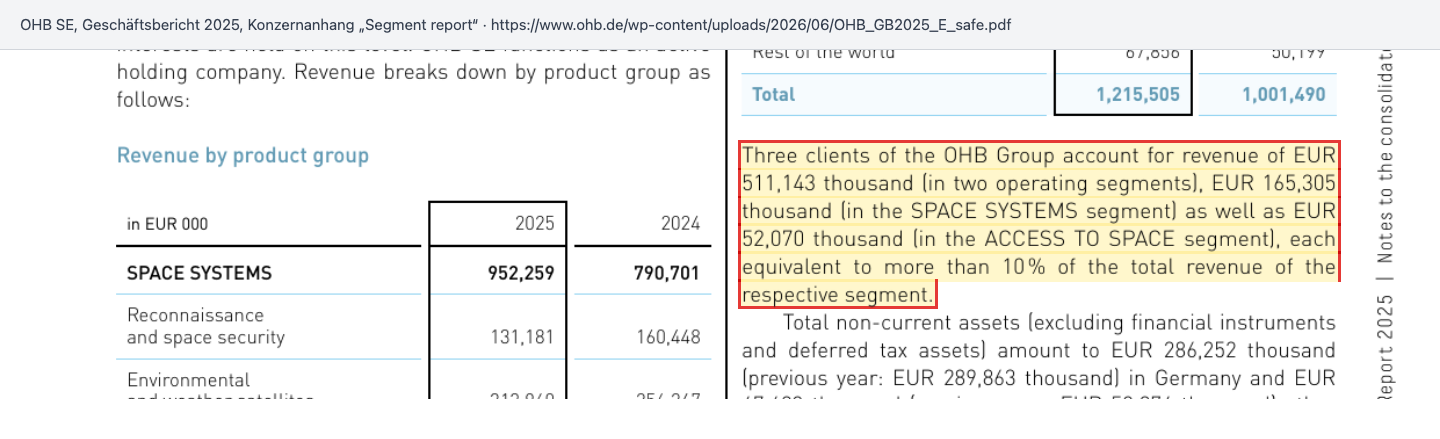
Do the math: EUR 511.1 million out of EUR 1,215.5 million of group revenue is roughly 42 percent — from a single client. The three together account for a good 59 percent. OHB names no names; the half-year report does describe the business as project work "generally awarded by public-sector customers".
This is explicitly not a payment-default risk: the annual report classifies receivables from public-sector customers as free of credit risk, which is why the group does not insure its receivables at all. It is a bargaining-power risk. Whoever decides over four out of ten euros of revenue also decides over prices, schedules and whether a program continues at all.
Uncomfortable truth no. 3: the financial investor sold into the company's own capital increase
The June 2026 capital increase had two parts: a private placement with institutional investors and a rights offering to existing shareholders. The interesting sentence sits in the fine print: the major shareholders waived their subscription rights, which freed roughly 94 percent of the new shares for the placement — together with "existing shares from the holdings of Orchid Lux HoldCo S.à r.l.". That is the Luxembourg entity through which KKR holds its OHB stake.
"After completion of the transaction, KKR retains a majority of its stake at approximately 20 % and thus remains an investor in OHB. The Fuchs family has not sold any shares and remains the majority shareholder of OHB, holding more than 60 % of the share capital."
— OHB SE, half-year report 2026, chapter on the private placement
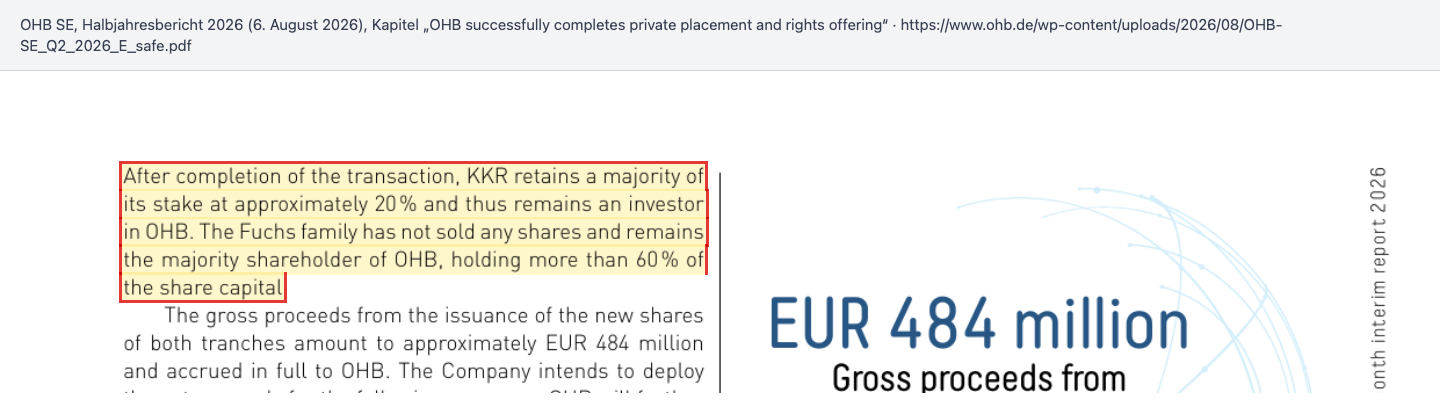
"Retains a majority of its stake" is a friendly way of saying that part of it is gone. The two hard numbers come from reports by the same company. On December 31, 2025 Orchid Lux HoldCo held 5,503,295 shares — 28.64 percent. After the placement it holds 4,108,683 shares — 19.7 percent. The difference is 1,394,612 shares; at the EUR 300 placement price that equals roughly EUR 418 million (our own calculation). KKR Capital Markets was at the same time one of the five joint global coordinators of the transaction.
In fairness, the other half belongs here too: the Fuchs family sold not a single share and still holds 60.3 percent — 12,560,846 shares. And the company itself received the full EUR 484 million from the new shares. Anyone buying today still buys into a changed situation: the free float rose from 1,092,279 to 4,088,779 shares, from 5.7 to 19.7 percent. That is almost four times as much tradable stock — the scarcity from the opening of this analysis has largely gone. Average daily volume rose accordingly, from 6,944 to 26,205 shares.
Uncomfortable truth no. 4: the backlog grows to the three-year beat of an agency
A full order book is reassuring — until you read what sets its rhythm. The half-year report explains the increase itself:
"The increase in the non-consolidated order backlog to EUR 3,304 million is attributable to the scheduling cycle of the ESA Ministerial Conference, which takes place every three years."
— OHB SE, half-year report 2026, interim management report, "Financial performance"
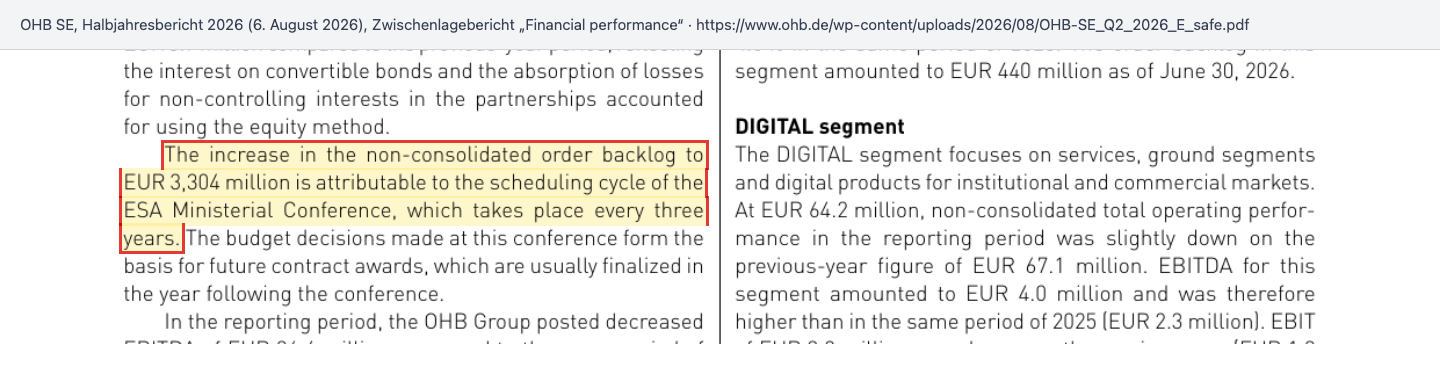
Translated: OHB's order intake follows a political calendar more than a market. Every three years the ESA member states decide budgets, and in the year after that those budgets turn into contracts. That explains why the backlog grows in steps — and why a half-year that adds 3.5 percent over the year-end figure is neither a collapse nor a turning point. It also means the decisive switches are not thrown in the sales department but at conferences.
Uncomfortable truth no. 5: cash left the business — almost EUR 195 million of it
The last number is the most uncomfortable one because it is immune to any adjustment: cash flows cannot be adjusted. In the first half of 2026, operating activities consumed EUR 194.5 million (prior-year period EUR 107.5 million), and free cash flow was minus EUR 210.5 million. That is roughly one third of half-year revenue.
Part of it is project-business mechanics: trade receivables and contract assets rose to EUR 944.2 million while customer prepayments fell from EUR 283.6 million to EUR 271.0 million. OHB works ahead and gets paid later — in a milestone-driven business that is normal. What stands out is the run of full years: plus EUR 9.1 million (2022), minus EUR 61.8 million (2023), plus EUR 159.8 million (2024), plus EUR 38.5 million (2025). Cash swings harder than earnings, and in none of the past five years did it reliably fund what the group invested.
That makes the capital increase more than a growth program: it is also the buffer that absorbs this. With EUR 526.9 million in the bank and a net financial asset position of EUR 116.5 million, that buffer was solid on June 30, 2026. It is simply finite if the trend persists.
Valuation — what the market is charging for this business
First the order-of-magnitude frame, deliberately dated rather than live. On June 30, 2026 OHB put its own market capitalization at EUR 5,882 million at a Xetra closing price of EUR 282.50. On August 10, 2026 the Xetra close was EUR 232.50; across 20,820,293 shares that is roughly EUR 4.84 billion (our own calculation; fundamental data show EUR 4.81 billion for the same date — a deviation of under one percent).
What does that mean in ratios? On 2025 earnings per share of EUR 2.61 the price-earnings ratio is roughly 89. Against 2025 revenue of EUR 1,215.5 million the price-sales ratio is roughly 4. Deducting the net financial asset of EUR 116.5 million gives an enterprise value of roughly EUR 4.7 billion — 38 times adjusted 2025 EBITDA of EUR 125.6 million, or roughly 31 times what management's own 2026 guidance implies (EUR 1,400 million of total operating performance at an adjusted margin of about 10.75 percent, so roughly EUR 150 million).
The most honest yardstick is therefore management's own mid-term target: more than EUR 4.0 billion of total operating performance at an adjusted EBITDA margin of around 13 percent. That would be roughly EUR 520 million of adjusted EBITDA — just under nine times today's enterprise value. Put differently: even if OHB nearly triples its total operating performance and improves its margin by more than two percentage points, the stock at the August 10, 2026 level is not cheap but fair. Without that tripling it is expensive. The half-year report names no target date for the mid-term goals.
The professionals are split accordingly. The half-year report lists four price targets: Goldman Sachs at EUR 250 with "Neutral" (August 5, 2026), Rothschild & Co Redburn at EUR 360 with "Buy" (August 5, 2026), Jefferies at EUR 280 with "Buy" (August 4, 2026) and NuWays at EUR 340 with "Buy" (July 1, 2026). A spread of EUR 250 to EUR 360 on identical figures means one thing above all: the analysts too are pricing the future, not the present. The dividend plays no part in this calculation — EUR 0.60 per share for 2025, approved on June 8, 2026, is roughly 0.26 percent yield at the August 10, 2026 price.
A glance across the Atlantic helps here: with American space names too, the market has long paid multiples of revenue for order books rather than for profits — as documented in our analysis of Redwire, where the same mechanism shows up with different numbers.
Opportunities and risks at a glance
Opportunities
- Order backlog of EUR 3,303.8 million as of June 30, 2026 — roughly 2.4 times the EUR 1,400 million of total operating performance guided for 2026.
- Balance sheet after the capital increase: EUR 526.9 million of liquidity, an equity ratio of roughly 43 percent and a net financial asset of EUR 116.5 million (all as of June 30, 2026).
- Structural tailwind: rising defense budgets and Europe's push for technological sovereignty, visible in the Rheinmetall venture for SATCOMBw Phase 4 and in the "KIRK" consortium with Helsing, Kongsberg and HENSOLDT.
- Internationalization is becoming measurable: OHB Czechspace leads an ESA mission as prime contractor for the first time (SOVA-S), and OHB SPACE UK takes on integration and testing of the EnVision satellite.
- Family control with a long horizon: the Fuchs family holds 60.3 percent and sold nothing in the placement.
Risks
- Thin and volatile margin: a reported EBIT margin of 2.4 percent in the first half of 2026 and EBIT of minus EUR 0.3 million in the second quarter; the 10.5 to 11.0 percent full-year target applies to the adjusted EBITDA margin only.
- Customer concentration: roughly 42 percent of 2025 revenue from a single client, a good 59 percent from three.
- Cash outflow from operations: minus EUR 194.5 million in the first half of 2026, free cash flow minus EUR 210.5 million.
- Supply pressure: the free float rose from 5.7 to 19.7 percent in June 2026 because KKR placed roughly 1.39 million existing shares; the investor's stake fell from 28.64 to 19.7 percent.
- Political timekeeper: order intake follows the three-year cycle of the ESA Ministerial Conference and thus government budget decisions.
- Valuation: roughly 89 times 2025 earnings and roughly 38 times adjusted 2025 EBITDA at the August 10, 2026 price level — the math only works with the mid-term target, for which no target date is given.
A human bottom line
Back to the scarcity trap from the beginning. Its core is not that OHB is a bad company — quite the opposite: a family business from Bremen has been building satellites that actually fly for decades, delivered the best year in its history in 2025, sits on a backlog covering roughly two and a half years of output, and in June 2026 gave itself a balance sheet that can carry growth. That is substance, not storytelling.
Its core is that part of the price rise had nothing to do with that substance. When only 1.1 million of 19.2 million shares are tradable and fewer than 7,000 change hands on an average day, every new buyer moves the price — and the price becomes the news that attracts the next buyer. In June 2026 the company dissolved that scarcity itself: new shares worth EUR 484 million, plus roughly 1.39 million existing shares from the financial investor. The free float almost quadrupled.
That puts the stock in a new position — a more honest one. From here on, what is written in the reports decides: whether 2.4 percent of EBIT margin turns into double digits, whether the money is not only earned but also collected, whether EUR 1.4 billion of total operating performance becomes the promised four. So the honest question is not "is the stock cheap after the pullback?" but rather: would you buy this company even if you could get as many shares as you wanted at any time — with nothing in front of you but the half-year report? If yes, you have a thesis. If no, you had a scarcity.
What you make of it is your decision. And that is exactly as it should be.
Sources
- OHB SE, 6-month interim report 2026, published August 6, 2026 — group key figures, interim management report, chapter on the private placement, reconciliation of alternative performance measures, financial calendar
- OHB SE, annual report 2025 (IFRS consolidated financial statements, auditor’s report dated March 18, 2026) — five-year table, group management report, shareholder structure, segment note with the client disclosure
- OHB SE, quarterly statement as of March 31, 2026 (May 7, 2026)
- OHB SE, investor relations (publications and financial calendar)
- Xetra price history for the dated valuation anchors (source: fundamental data, as of August 10, 2026)
- Ranking of the most-discussed stocks in the wallstreet-online forum, as of August 11, 2026 (the hook for this analysis, not a data source for company figures)
This article is journalistic commentary on publicly available company reports and is explicitly not investment advice and not a solicitation to buy or sell securities. Shares can lose substantial value, and a total loss is possible. All figures come from the original documents listed above and carry the reporting date stated with them; price figures are dated anchors, not current quotes. Positions held by the operator are disclosed daily; where one exists, it appears as a notice at the top of this deep dive.
Our Bottom Line at a Glance
- Growth and order situation positive
- Revenue rose 11.8 percent to EUR 600.1 million in the first half of 2026 and total operating performance 11.4 percent to EUR 627.9 million. The order backlog stood at EUR 3,303.8 million on June 30, 2026 after EUR 3,193.6 million at the end of 2025 — roughly 2.4 times the total operating performance guided for 2026.
- Profitability negative
- Reported EBITDA fell from EUR 41.6 million to EUR 36.4 million in the first half of 2026 and EBIT from EUR 22.2 million to EUR 14.8 million — an EBIT margin of 2.4 percent. In the second quarter alone EBIT was minus EUR 0.3 million and the shareholders' share of the result minus EUR 5.1 million. The friendlier reading of EUR 60.4 million only appears after EUR 24.0 million of adjustments.
- Balance sheet and funding positive
- The June 2026 capital increase brought in roughly EUR 484 million gross. On June 30, 2026 cash and securities stood at EUR 526.9 million and equity at EUR 915.6 million (a ratio of roughly 43 percent after 27.5 percent on December 31, 2025), while the net financial position including pensions swung to a net asset of EUR 116.5 million.
- Cash generation negative
- Operating activities consumed EUR 194.5 million of cash in the first half of 2026 (prior-year period EUR 107.5 million) and free cash flow was minus EUR 210.5 million. Even in full-year 2025 operating cash flow of EUR 38.5 million sat far below the EUR 159.8 million of 2024.
- Customer structure neutral
- Three clients accounted for revenue of EUR 511.1 million, EUR 165.3 million and EUR 52.1 million in 2025 — the largest alone for roughly 42 percent of group revenue of EUR 1,215.5 million. They are mostly public-sector buyers whose receivables the annual report classifies as free of credit risk; the risk sits in budgets, prices and schedules, not in solvency.
- Ownership neutral
- Since the June 2026 placement the Fuchs family holds 60.3 percent and sold not a single share; chief executive Marco Fuchs controls the group as chairman of the Fuchs family foundation. Financial investor KKR, by contrast, cut its stake from 28.64 percent on December 31, 2025 to 19.7 percent, and the free float rose from 5.7 to 19.7 percent.
OHB delivered the best year in its history in 2025, sat on an order backlog of EUR 3,303.8 million on June 30, 2026 and secured roughly EUR 484 million — and with it a solid balance sheet — in the June 2026 capital increase. In that same half-year reported EBIT fell to EUR 14.8 million, turned negative in the second quarter, and EUR 194.5 million of cash left the operating business. The valuation as of August 10, 2026 prices in the mid-term target of more than EUR 4 billion of total operating performance, for which no target date has been given. Not investment advice.
What Our Rating Means
Open questions
The business works in principle, but one material question is open. As long as it stays open, our findings do not carry a quality verdict.
Yellow here is not about an existential question — on the contrary, the balance sheet on June 30, 2026 is stronger than ever: EUR 526.9 million of liquidity, EUR 915.6 million of equity, an equity ratio of roughly 43 percent, a net financial asset of EUR 116.5 million and no going-concern flag. The business carries as well: 2025 was the best year in company history with EUR 1,215.5 million of revenue and EUR 50.0 million attributable to shareholders, the backlog covers roughly two and a half years of output, and the customers are public-sector buyers without default risk. Yellow stands because two operating questions remain open. First the margin: of EUR 627.9 million of total operating performance in the first half of 2026, EUR 14.8 million of EBIT remained — 2.4 percent — and minus EUR 0.3 million in the second quarter; the friendly EUR 60.4 million only appears after EUR 24.0 million of adjustments, EUR 21.4 million of which are transaction costs. Second the cash: EUR 194.5 million of operating outflow in six months is a lot even in a project business, and the run of prior years shows no reliable self-funding trend. On top of that sits customer concentration of roughly 42 percent on one buyer. Both can work out — the next checkable milestone is the nine-month report on November 12, 2026. That the stock is expensive at the August 10, 2026 price level does not drive this rating: price is not a quality attribute. The decision is yours.
A journalistic assessment by our editorial team at the time of the deep dive, based on public sources — not investment advice and not a solicitation to buy or sell. Your personal circumstances (investment goals, risk capacity, taxes) cannot be taken into account. What our levels mean, how verdicts are formed, and what conflicts of interest exist →
Worth Noting
- Data as of August 11, 2026. The most recent periodic report evaluated is the half-year report 2026 of August 6, 2026; the nine-month figures follow on November 12, 2026 according to the financial calendar.
- OHB is not an SEC filer: no 10-K, no 10-Q and no entry in the ticker registry of the U.S. securities regulator. All evidence comes from the 2025 annual report, the 2026 half-year report and the quarterly statement as of March 31, 2026, published on ohb.de.
- The roughly EUR 418 million of proceeds attributed to KKR is our own calculation: 5,503,295 shares (December 31, 2025, annual report 2025) minus 4,108,683 shares (after the placement, half-year report 2026) gives 1,394,612 shares, multiplied by the EUR 300 placement price. OHB itself only discloses gross proceeds of roughly EUR 484 million from the new shares.
- OHB uses total operating performance as its headline metric — it additionally includes changes in inventories and own work capitalized and therefore exceeds revenue (first half of 2026: EUR 627.9 million against EUR 600.1 million). Guidance and mid-term targets refer to total operating performance.
- The hook for this analysis is the ranking of the most-discussed stocks in the wallstreet-online forum (as of August 11, 2026) — an attention signal, not a data source for company figures and not a reason to buy.
The full analysis as a PDF for later
We will send you this analysis as a PDF — to print, file away, and read at your own pace.
Frequently Asked Questions
OHB SE of Bremen, Germany, develops and builds satellites for navigation, science, telecommunications and Earth and weather observation, supplies structures for European launchers and operates ground systems and data services. The group reports in three segments and employed 4,094 people as of June 30, 2026.
OHB is listed in the Prime Standard of the Frankfurt Stock Exchange, not in the United States — there is no 10-K, no 10-Q and no SEC registration. What is mandatory are audited IFRS annual accounts, a half-year report and quarterly statements. This analysis rests on the 2025 annual report and the half-year report of August 6, 2026.
In the first half of 2026 reported EBITDA of EUR 36.4 million stood against EUR 60.4 million adjusted. The gap of EUR 24.0 million consists of EUR 21.4 million of transaction costs, EUR 1.9 million of transformation costs, EUR 0.4 million of impairment losses and EUR 0.3 million of other items. Management guidance refers to the adjusted figure.
OHB issued 1,613,023 new shares at EUR 300 and took in roughly EUR 484 million gross, all of which accrued to the company. The share count rose to 20,820,293. In the same placement, private-equity investor KKR sold existing shares; its stake fell from 28.64 percent on December 31, 2025 to 19.7 percent.
After the June 2026 placement the Fuchs family holds 12,560,846 shares (60.3 percent), the KKR entity Orchid Lux HoldCo 4,108,683 shares (19.7 percent), the free float 4,088,779 shares (19.7 percent) and OHB itself 61,985 treasury shares (0.3 percent). Chief executive Marco Fuchs controls the group as chairman of the Fuchs family foundation.
On August 6, 2026 management confirmed total operating performance of EUR 1,400 million and an adjusted EBITDA margin of 10.5 to 11.0 percent for fiscal 2026. Its mid-term targets are total operating performance above EUR 4.0 billion and an adjusted EBITDA margin of around 13 percent; the report names no target date for them.
Yes. For fiscal 2025 the annual general meeting approved a dividend of EUR 0.60 per share on June 8, 2026, unchanged from the prior year. At the Xetra close of August 10, 2026 (EUR 232.50) that is roughly 0.26 percent yield. The dividend is therefore not a meaningful part of the case for this stock.
The financial calendar in the 2026 half-year report lists the nine-month figures and earnings call for November 12, 2026. Investor conferences are scheduled before that in September 2026. The next audited annual accounts follow in the spring of 2027.
Found an error?
Did you spot a factual error, an outdated number, or a typo in this deep dive? Let us know briefly — your report goes straight to the editorial team.