NextNRG: The AI Segment Booked $6,500 in Six Months — the Fuel Trucks Booked $48.8 Million
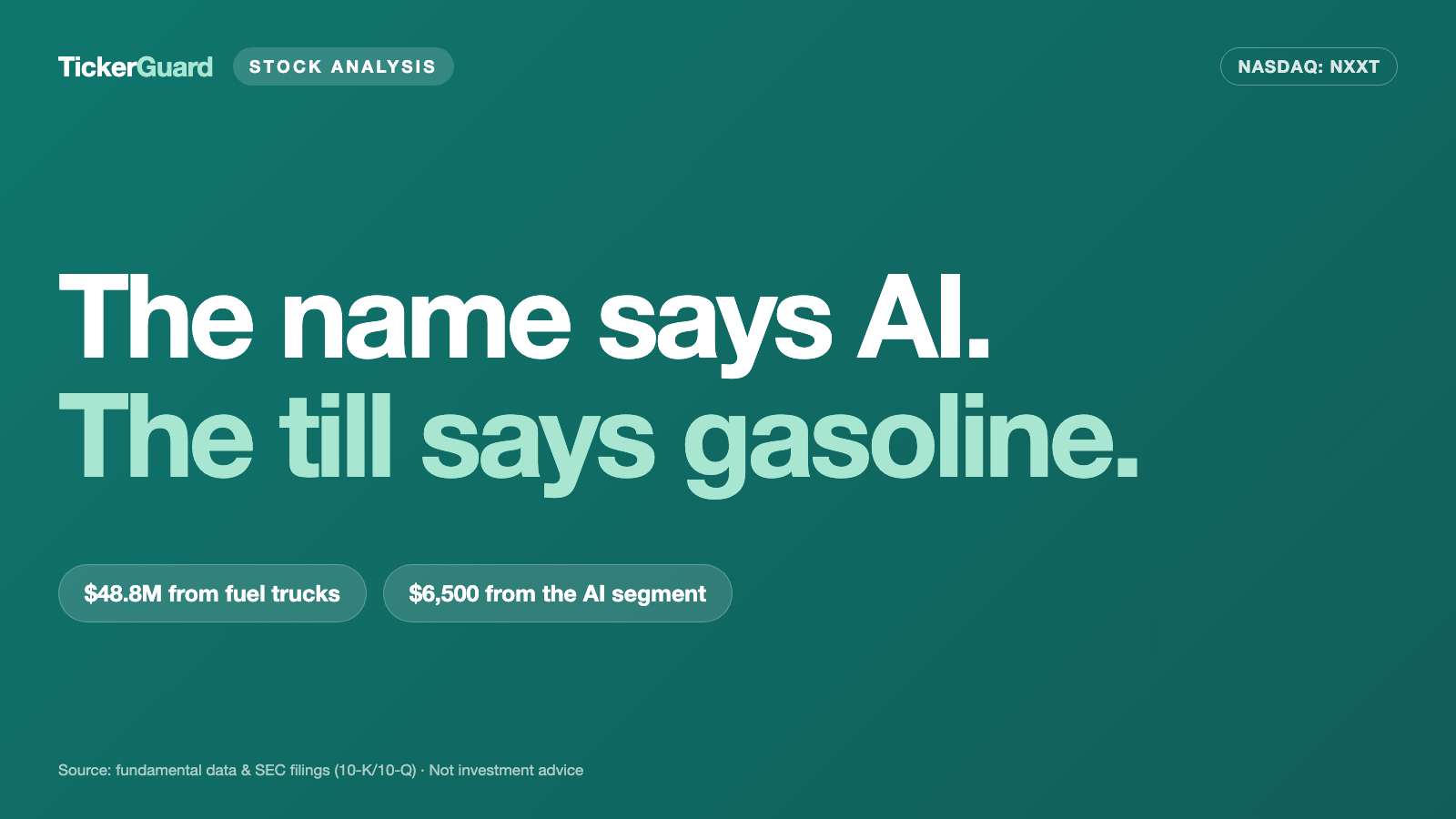
NextNRG describes itself as an AI-driven energy technology company: smart microgrids, battery storage, wireless EV charging. Its quarterly report to the U.S. securities regulator, the SEC, for the period ended June 30, 2026 splits revenue across two segments — and the AI segment shows $6,500 against $48,800,578 from hauling diesel and gasoline. Alongside that: $883,696 in cash, a stockholders' deficit of $21.3 million, a going-concern warning in the company's own accounts and a Nasdaq deadline that expires on September 14, 2026. Not investment advice — just the arithmetic the quarterly report sets out itself.
 Thomas Mücke
Founder & Publisher
Thomas Mücke
Founder & Publisher
As of Today
As of: October 5, 2026
- Closing price
- 0.6691 $ -9.00%
- Market Capitalisation
- 0.1 $B
- P/E
- 0.8
- Growth Score
- 5/10
- AAQS
- 3/10
Price change since August 20, 2026: +194.4%
This analysis has a cut-off date. The Stock Guard tells you when something material changes in the numbers. Reserve your free spot
Chart
Interactive price chart (TradingView).
52-week range: 0.1459 $ to 2.80 $ · Last price: 0.6691 $ (As of: October 5, 2026)
Note: pure fact-based analysis, not investment advice and not a solicitation to buy or sell. All figures without guarantee.
There is an investor weakness that needs no calculator, because it strikes before you reach for one: the label trap. It works like this. A company pins a powerful word to its lapel — "AI," "quantum," "space" — and your mind supplies the whole story unprompted. Growth, future, valuation upside. From then on you no longer check whether the word has earned anything. You only check how much the word costs.
NextNRG, Inc. (NASDAQ: NXXT) of Miami Beach describes itself in its annual report as a company embedding artificial intelligence and machine learning into renewable energy, battery storage and wireless electric vehicle charging. That sounds like 2026. So let us make a deal: before you buy the label, we open together the quarterly report the company filed with the U.S. securities regulator, the SEC, on August 13, 2026 — and read the one table that splits revenue across the two businesses. An SEC filing is honest under penalty of law. What you do with it is your call.
What NextNRG Actually Does — a Tanker Truck With an AI Brochure
NextNRG was called EzFill Holdings until February 14, 2025. Under that name the company ran a simple, easily understood business: on-demand fuel delivery. Instead of a fleet operator sending its vans to a gas station, a NextNRG tanker truck pulls onto the yard at night and fills them up. It saves the customer labor hours and detours. The company calls the segment "Mobile Fuel Delivery"; the customers are commercial fleets, office parks and consumers.
In February 2025 the new name brought a second segment: "Energy Infrastructure." The quarterly report describes it this way:
“The Company’s energy infrastructure segment focuses on the development, deployment, and operation of AI/ML-powered smart microgrids, solar energy systems, battery storage, and wireless EV charging solutions. … Revenue is generated primarily through power purchase agreements, leases, and technology licensing …”
— NextNRG, Inc., Form 10-Q for the period ended June 30, 2026, Note 11 "Segment Reporting"
Two terms, briefly translated. A microgrid is a small, self-sufficient electricity network — picture an apartment block with its own solar array and battery that simply keeps running when the wider grid fails. "AI/ML-powered," in NextNRG's description, means software continuously decides when to charge, store or feed back. The company holds exclusive licenses to four patents for this, acquired in January 2024 through the purchase of a company called Stat-EI for $5.5 million.
For scale: NextNRG employed roughly 177 people as of April 15, 2026, all full-time. The fiscal year ends December 31. And with that the central tension of this analysis is on the table, and it runs through every chapter: the name, the story and the valuation case all hang on the second segment. The money comes entirely from the first.
Company history for investors
-
2021
September: IPO as EzFill Holdings
The fuel delivery service lists on Nasdaq. The starting point for investors: a simple business model with $7.2 million of annual revenue at the time — and already in the red.
-
2024
January: Patent licenses acquired for $5.5 million
The purchase of Stat-EI brings exclusive licenses to four AI/ML microgrid patents — the foundation of the later energy story. By the end of 2025 they carry a value of zero.
-
2025
February: EzFill Holdings becomes NextNRG
The name change on February 14 introduces the Energy Infrastructure segment — and the AI story. For shareholders it mainly means the valuation now rests on a business with no revenue.
-
2025
December: $8.5 million of write-downs in the energy segment
The annual report writes off patent licenses ($4,606,664) and a project deposit ($3,929,161) in full. The year's net loss jumps to $88.18 million.
-
2026
March 16: Nasdaq flags the minimum bid price
The exchange sets a deadline of September 14, 2026. For shareholders the clock starts running toward either a reverse split or a delisting.
-
2026
July 31: Majority decides without a meeting
Holders of 51.43 percent of the votes sign off on the 1-for-5 to 1-for-12 reverse split, the enlarged equity plan and the chief executive's compensation agreement. Everyone else is merely informed.
-
2026
August 13: Series C preferred stock of up to $27.2 million
The funding commitment covers the capital need for several quarters. The first tranche alone can convert into 74,074,074 new common shares — about 30.6 percent of all shares after issuance.
How the Stock Reached Our Desk — a Penny-Stock Listing With an AI Story
NXXT reached our desk through our daily retail-forum screen, which tracks the most-discussed U.S. stocks on the large investing boards (run of August 21, 2026). Why it shows up there is visible in the price data: as of August 21, 2026 the 52-week range ran from $0.203 to $2.88 — the stock has given up roughly 92 percent of its high within a single year. The last Nasdaq closing price documented inside an SEC filing comes from the information statement of August 21, 2026 and reads $0.2273 (trading day August 20, 2026).
With 168,221,739 shares outstanding (quarterly report cover page, as of August 13, 2026), that puts market capitalization at roughly $38 million — independently collected fundamental data show $38.2 million as of the same date, so the two routes differ by less than one percent. That matters for everything that follows: the valuation figures in this analysis are checked against a primary document, not merely against a data feed.
Conventional valuation multiples only get you so far here. There is no price-to-earnings ratio, because there are no earnings. There is no price-to-book ratio, because book value is negative. Note the finding right at the start: at NextNRG you do not measure with the usual multiples, you measure with the segment table and the cash balance. That is exactly where we are heading — starting with what genuinely works.
The Numbers Over the Years — Fairly Credited
It would be unfair to dismiss NextNRG as a pure storytelling machine. The core business is growing, and growing hard. Revenue rose from $27,770,279 in 2024 to $81,835,279 in 2025 — close to a tripling. The first half of 2026 added $48,807,078, against $35,964,241 a year earlier: up 35.7 percent. Both filings give the same reasons: more gallons delivered, new regions, and framework agreements with fleet operators. This is not a paper business — real trucks make real deliveries.
The loss side has improved markedly as well. Net loss was $88,175,997 in 2025 after $21,396,633 in 2024; in the first half of 2026 it was only $17,391,194, against $45,071,274 in the prior-year half. The main reason is prosaic: 2025 carried stock-based compensation of an entirely different order — $25,499,097 in the first half of 2025 alone, versus $9,256,434 in the first half of 2026.
Now the arithmetic that explains the business model. It concerns gross margin — the share of revenue left after the pure cost of goods. In fuel delivery the cost of goods is the fuel itself, and fuel is expensive: in the second quarter of 2026 gross margin came in at 7.05 percent, down from 7.97 percent a year earlier — so it fell even as revenue rose. Out of every dollar taken in, roughly seven cents remain to pay wages, overheads, vehicles and interest. And interest is the problem:
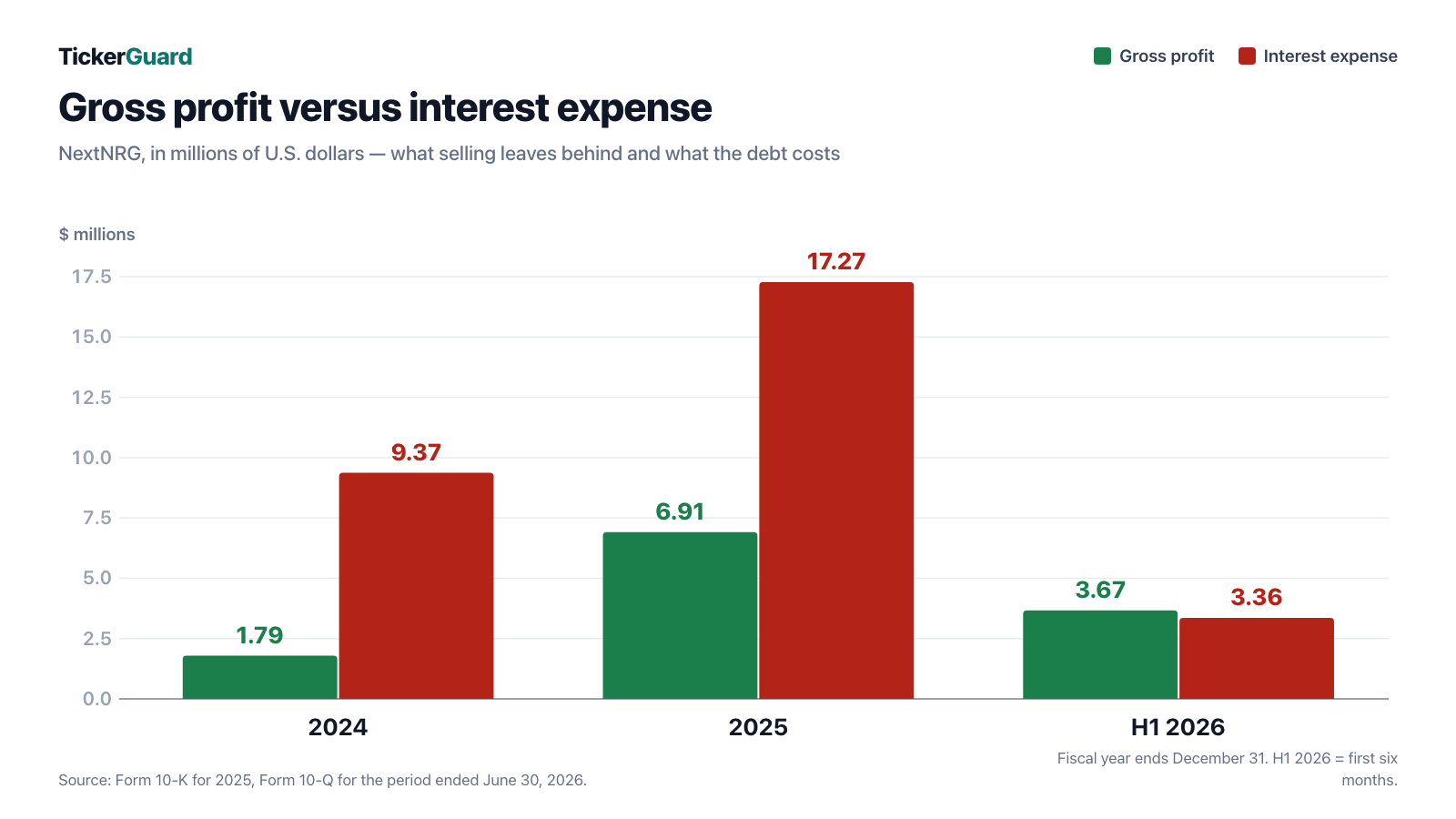
Read that chart in both directions. The bad news: in 2025 interest of $17.27 million swallowed two and a half times what was left after buying the fuel ($6.91 million). The good news: in the first half of 2026 gross profit narrowly covers interest for the first time — $3.67 million against $3.36 million. That is a real improvement and deserves saying.
It simply is not enough, because the whole operating base sits between gross profit and the bottom line. The second chart shows the full path from revenue to loss:
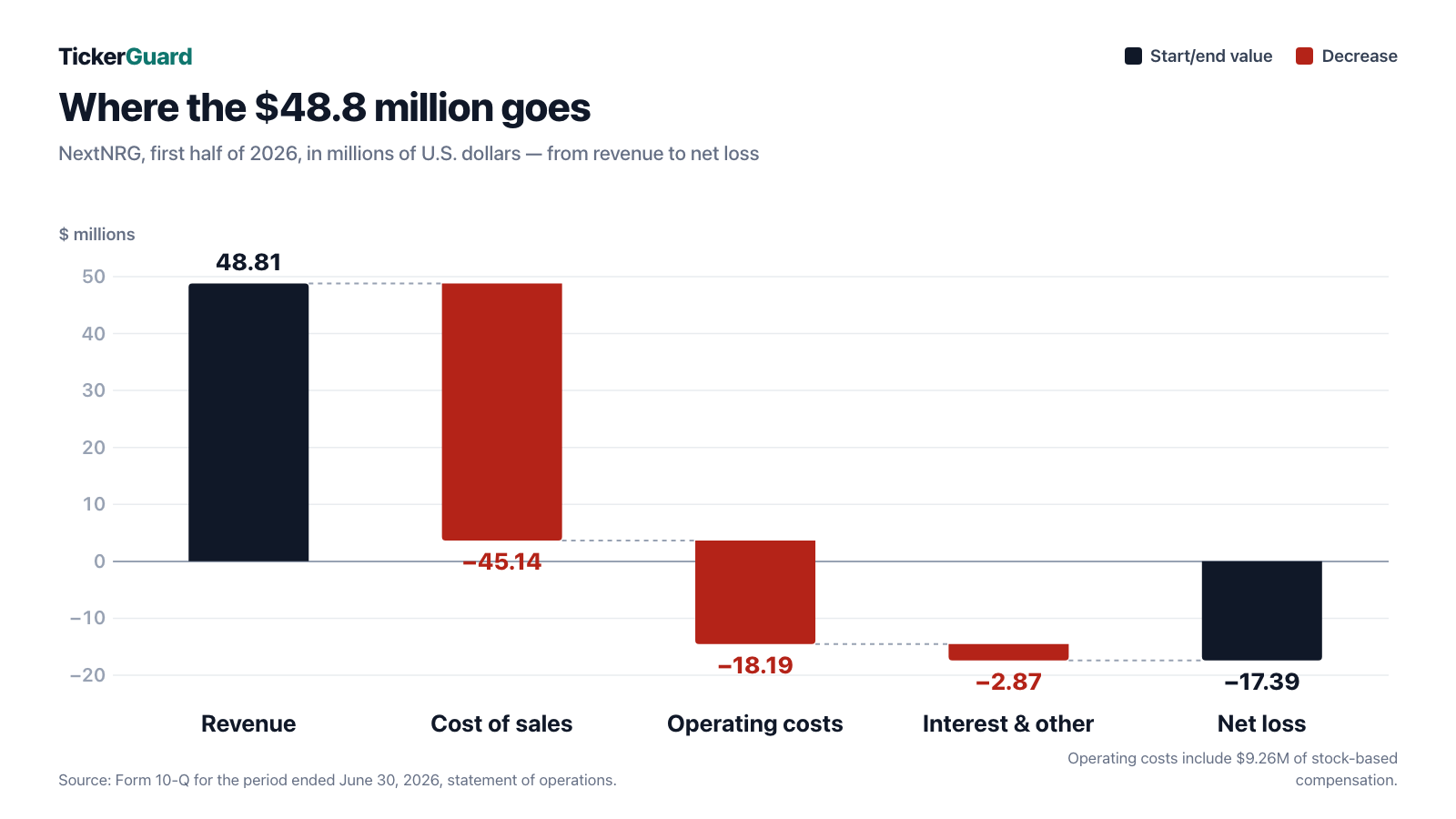
The decisive figure in that waterfall is not at the end but in the middle: stock-based compensation of $9,256,434 for the half year is two and a half times the entire gross profit. Stock-based compensation means the company pays employees and consultants not in cash but in newly issued shares. Cheap for the treasury, not cheap for you as a shareholder — your slice of the company shrinks with every issuance. The technical term is dilution; the everyday image is the same cake cut into ever more pieces, yours getting thinner while you do nothing. Between December 31, 2025 and June 30, 2026 the share count rose from 142,426,924 to 167,864,058 — up roughly 18 percent in six months.
Hard Truth No. 1: The AI Segment Booked $6,500 in Six Months
Now the table we came for. A company with two reportable segments must disclose to the SEC how revenue and costs split between them. NextNRG does so in Note 11 of the quarterly report — and the result is unambiguous:
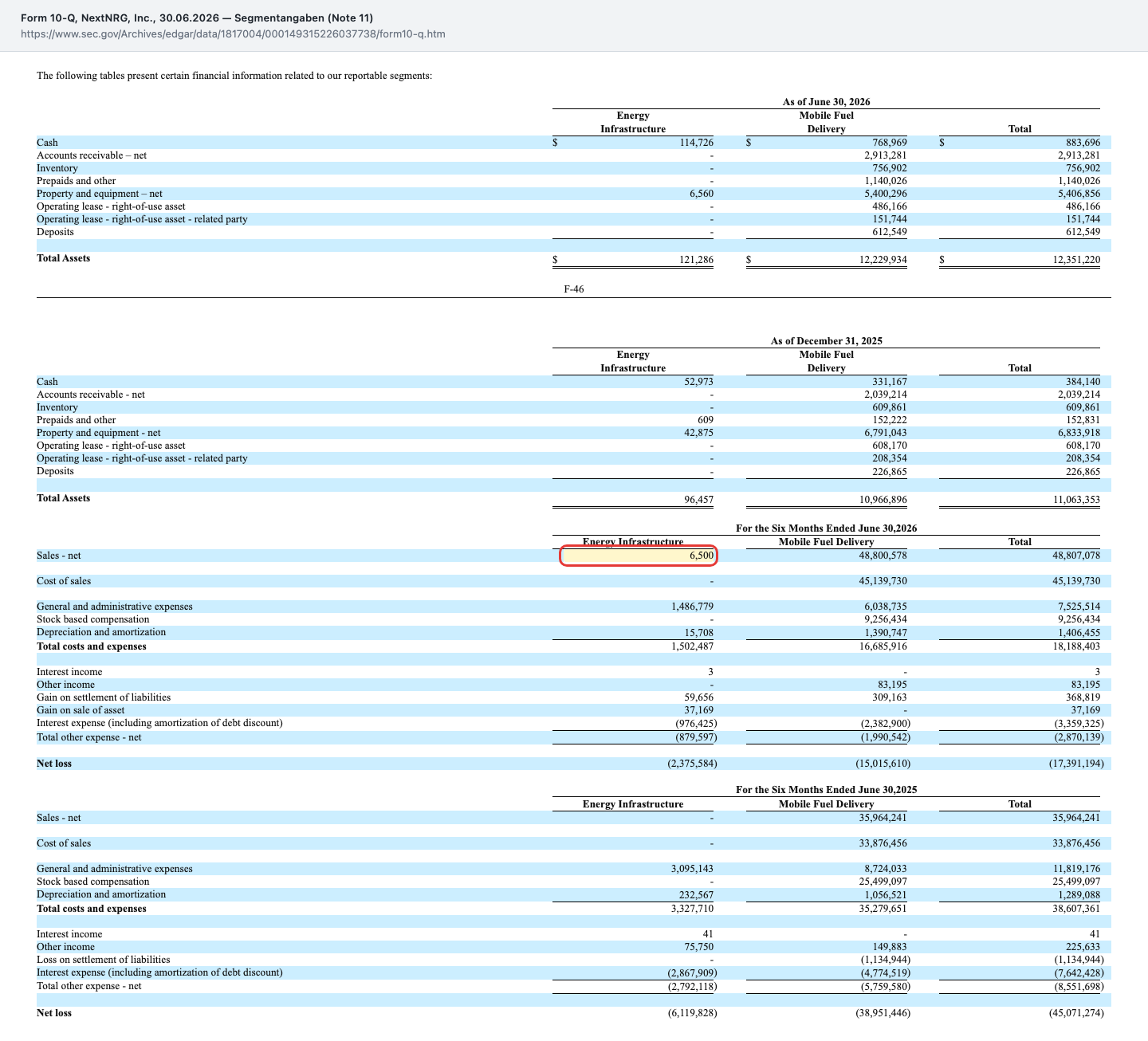
$6,500. That is 0.013 percent of half-year revenue — about what the fuel truck business turns over in a little more than half an hour on average, taking $48,800,578 across 181 days. It is the first revenue this segment has ever reported; in fiscal 2025 and 2024 the line read zero. Meanwhile the costs run on: over the same six months the energy infrastructure segment incurred $1,502,487 in expenses. That is about $231 of cost for every dollar of revenue.
There is another layer. The four patent licenses that form the technological basis of the segment, and that fill pages of the annual report, sat on the balance sheet at $5,500,000 when acquired in January 2024. By the end of 2025 they were gone:
“During the year ended December 31, 2025, the Company recognized a loss on impairment for the remaining value of the intangibles related to the acquisition of Stat-EI in the amount of $4,606,664.”
— NextNRG, Inc., Form 10-K for fiscal 2025, Note 10 "Intangible Assets"

An impairment means the auditor asked how much money this asset will still bring in, and the answer was nothing. The same year also brought a write-off of a project deposit worth $3,929,161, likewise in the energy segment. Being fair here means saying the licenses still exist legally — only their carrying value is zero. But the signal is unmistakable. The AI story gives the company its name, it costs money, it has been written off the balance sheet — and so far it has delivered $6,500.
Hard Truth No. 2: $883,696 in the Bank — and How the Money Gets Raised
The second hard truth is a single number. On June 30, 2026, NextNRG held $883,696 in cash — against half-year revenue of $48.8 million. That is roughly three and a half days of fuel purchases ($45,139,730 of cost of sales spread across 181 days). The accounts therefore carry a paragraph no investor should skim past:
“These factors create substantial doubt about the Company’s ability to continue as a going concern within the twelve-month period subsequent to the date that these unaudited condensed consolidated financial statements are issued.”
— NextNRG, Inc., Form 10-Q for the period ended June 30, 2026, Note 1 "Liquidity and Going Concern"
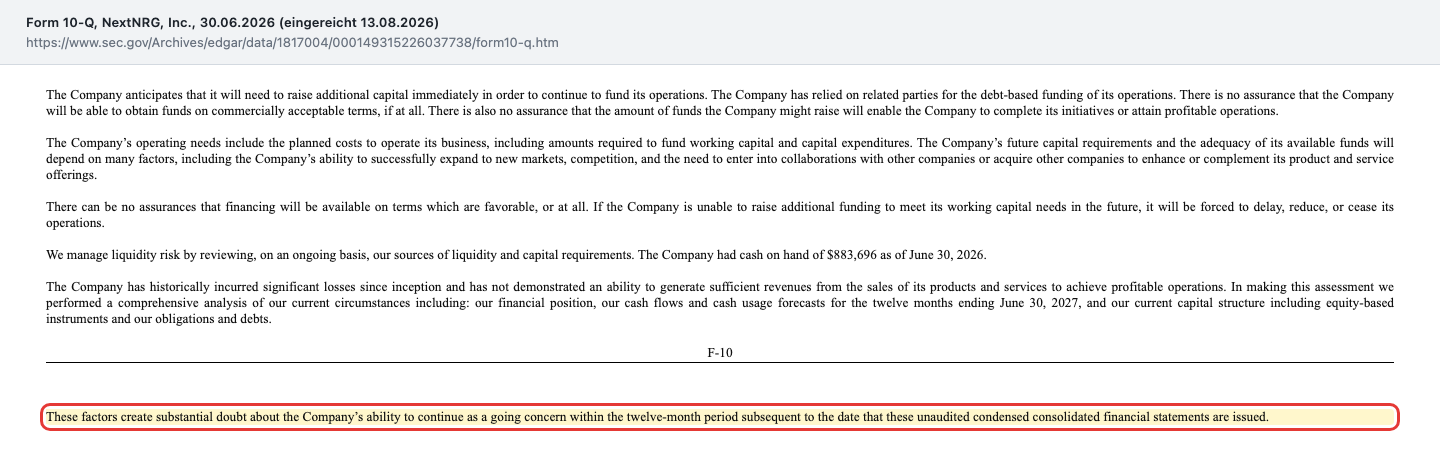
"Going concern" is the accounting term for the assumption that a business will still exist next year. When the filing says "substantial doubt," the company has checked and did not reach a reassuring answer. The balance sheet at June 30, 2026 explains why: $12,351,220 in total assets against $33,673,941 in liabilities — leaving stockholders' equity of minus $21,322,721. The accumulated deficit, the sum of all losses since inception, stands at $171,465,942. For scale: the entire company owns less than it sold in fuel during the first quarter of 2026.
A company with that little cash needs money constantly, and gets it only at a price. For the half year the quarterly report lists eleven loans that are merchant cash advances — advances against future customer receipts. Five of them still carried a balance on June 30, 2026, some $3.9 million in total; the rest had been repaid or refinanced during the six months. The latest is dated June 30, 2026:
“… the Company sold to Avanza $1,499,900 of the Company’s future accounts, contract rights, and other obligations … for a purchase price of $1,000,000. The net funds provided to the Company totaled $940,000, following the deduction of an underwriting and program fee of $60,000.”
— NextNRG, Inc., Form 10-Q for the period ended June 30, 2026, Note 12 "Subsequent Events"
Do the math: $940,000 in, $1,499,900 out — a markup of roughly 60 percent, repaid in weekly installments of $62,496. The obligation is secured by a first priority lien on effectively everything the company owns and personally guaranteed by CEO Michael D. Farkas. The notes also state plainly that old advances are regularly repaid with new ones, which brings "higher cumulative borrowing costs." Even the tanker trucks are part of the financing: in May 2025 NextNRG sold its fleet to a leasing company and leased it back — accounted for as a failed sale, because the vehicles remained with the company in substance. Note the pattern: this company does not fund its operations from operations, it funds them by selling its future.
Hard Truth No. 3: The Nasdaq Clock Is Running — and the Way Out Is a Reverse Split
On March 16, 2026, NextNRG received a letter from Nasdaq. The reason: the exchange requires a minimum bid price of one dollar for continued listing, and the stock had failed that test for thirty consecutive trading days. The notice sets a deadline:
“The Bid Price Notice indicated that the Company will be provided 180 calendar days, or until September 14, 2026, in which to regain compliance.”
— NextNRG, Inc., Form 8-K filed March 20, 2026, Item 3.01
At $0.2273 on August 20, 2026, the stock would have to quadruple in a little over three weeks. That is not realistic, and the company knows it. So it has prepared the second route: a reverse stock split. Several old shares are merged into one new one; five shares at $0.22 become one at $1.10. The everyday image: you do not re-bake the cake, you simply glue several slices together. The value of your holding does not change on paper, the price per piece does.
On July 31, 2026 the majority holders approved exactly that — at a ratio between 1-for-5 and 1-for-12, with the board free to pick the exact number on its own, at any point within a year. The authorization becomes effective September 10, 2026, four days before the deadline. For you as an investor that means two things. First, the listing is likely to be saved. Second, a reverse split solves none of the problems that pushed the price there — it only moves the decimal point. How such candidates can fare afterwards is something we have examined at another capital-hungry energy company, in our Eos Energy analysis.
Hard Truth No. 4: One Man, 45 Percent of the Votes — and an Agreement for Five Times 10 Percent
The reverse split was not decided at a shareholder meeting. It was approved by written consent — a procedure permitted in Delaware under which holders of a simple majority sign, and everyone else is merely informed. The information statement of August 21, 2026 says so on its very first page, in capital letters: "WE ARE NOT ASKING YOU FOR A PROXY AND YOU ARE REQUESTED NOT TO SEND US A PROXY."
The majority came together as follows. CEO and Executive Chairman Michael D. Farkas holds 76,304,717 votes, or 45.19 percent; other, unaffiliated holders contributed 6.24 percent — 51.43 percent together. Executive officers and directors as a group hold 53.66 percent. One detail on the side shows how thin the float is: the statement reports roughly 100 holders of record.
The same round approved Farkas' own employment agreement, dated July 28, 2026. Its centerpiece:
“(c) Market Capitalization Based Bonus. (i) Upon the Company achieving a $500,000,000 market capitalization Farkas shall receive an issuance equal to 10% of the then issued and outstanding shares of the Company’s common stock. (ii) Upon the Company achieving $1,000,000,000 market capitalization Farkas shall receive an issuance equal to 10% …”
— NextNRG, Inc., Schedule 14C filed August 21, 2026, Annex B "Farkas Employment Agreement"
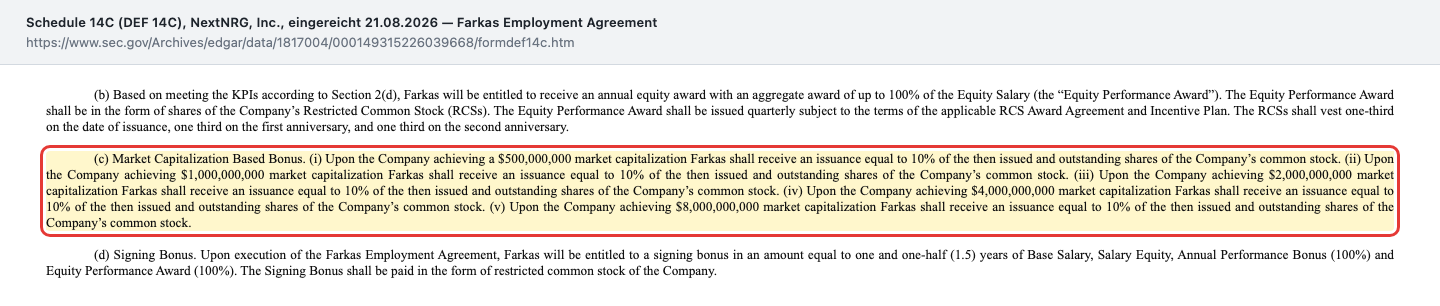
On top of that come $2,000,000 a year in stock as salary equity, a performance award of up to 100 percent of that, and a signing bonus of $8,160,000, likewise in shares — against a market capitalization of roughly $38 million. The same statement grows the equity plan from 22,250,000 to 54,250,000 shares; in 2023 it stood at 900,000. Against 168,221,739 shares outstanding, the new pool equals about 32 percent of the count.
Fairness requires noting that the bonus steps only begin at thirteen times today's market value. Anyone who gets there has done well as a shareholder, and an executive who delivers that deserves reward. But the direction of the incentive is unmistakable: it rewards market capitalization, not profit, not cash, not margin. And the company's third source of capital shows where that can lead. On August 13, 2026, NextNRG agreed to sell up to 3,000,000 shares of new Series C preferred stock for a total of $27.2 million. The first tranche of 1,000,000 shares alone can convert, at the contractual floor price of $0.135, into 74,074,074 new common shares — by the company's own estimate about 30.6 percent of all shares after that issuance.
What the Stock Costs — and Why the Usual Multiples Fail Here
On August 20, 2026 the Nasdaq closing price was $0.2273, documented in the company's own information statement. At 168,221,739 shares that gives a market capitalization of roughly $38 million. Trailing twelve-month revenue — fiscal 2025 less the first half of 2025 plus the first half of 2026 — comes to about $94.7 million. That works out to a price-to-sales ratio near 0.4. It sounds dirt cheap, and that is precisely the trap.
First, a price-to-sales ratio measures something different at a 7 percent gross margin than at a software company's 80. Of $94.7 million in revenue, roughly $8.5 million survives the fuel purchase — measured against that remainder, the company costs not 0.4 times but a good four and a half times. Second, the market capitalization is not the whole claim: add financial liabilities of roughly $23 million, deduct $0.9 million of cash, and enterprise value — the price for the business including its debt — lands near $60 million. Third, the share count is a moving target: the first Series C tranche alone can raise it by about 44 percent, alongside the incentive plan enlarged to 54.25 million shares and the chief executive's signing bonus.
There is no price-to-earnings ratio, because there are no earnings. There is no price-to-book ratio, because book value per share is negative (roughly minus $0.13 as of June 30, 2026). For context on capital appetite, it is worth comparing a company whose story is defined by convertible notes and dilution — see our Enovix analysis. Remember this about NextNRG: the stock is not cheap because it costs 22 cents. It is cheap because the market doubts anything will be left of those 22 cents.
Upside and Risks at a Glance
What speaks for NextNRG:
- The core business is growing, and genuinely: revenue from $27.77 million (2024) to $81.84 million (2025), and up 35.7 percent to $48.81 million in the first half of 2026 — driven by gallons delivered and fleet agreements, not accounting effects.
- The loss is shrinking sharply: $17.39 million in the first half of 2026 after $45.07 million in the prior-year half; stock-based compensation fell over the same comparison from $25.50 million to $9.26 million.
- Gross profit covers interest expense for the first time: $3.67 million against $3.36 million in the first half of 2026, after $6.91 million against $17.27 million for full-year 2025.
- Fresh capital is contractually committed: up to $27.2 million from the Series C agreement of August 13, 2026, of which $9.2 million closed in the first tranche — a multiple of the June 30 cash balance, even though part of it came not as money but through the surrender of an existing convertible note with a $2.0 million principal amount.
- The chief executive is personally exposed: Michael D. Farkas has personally guaranteed several financings and holds 45.19 percent of the voting power, so his interest in survival is direct.
What speaks against it:
- Going-concern doubt in the accounts as of June 30, 2026, negative stockholders' equity of $21.32 million, a working capital deficit of $25.61 million, and $883,696 in cash against $48.8 million of half-year revenue.
- The namesake energy infrastructure segment produced exactly $6,500 of revenue in the first half of 2026 against $1,502,487 of costs; the related patent licenses were written off in full at $4,606,664 at the end of 2025, plus a project deposit at $3,929,161.
- Expensive funding from eleven advances on future receipts — the latest brought in $940,000 against a $1,499,900 repayment obligation — alongside a sale-leaseback of the tanker fleet accounted for as a failed sale.
- Heavy dilution: share count up from 142.4 million to 167.9 million in the first half of 2026; the first Series C tranche alone can create 74,074,074 new shares (30.6 percent after issuance, per the company), and the incentive plan grows to 54.25 million shares.
- Nasdaq minimum bid price deadline of September 14, 2026, at a price of $0.2273 (August 20, 2026); the remedy is a reverse split of 1-for-5 to 1-for-12 set solely by the board, approved without a shareholder meeting by 51.43 percent of the votes.
A Human Conclusion
Back to the label trap. Its core is not that labels always lie — NextNRG really does hold patent licenses, really did create a second segment, and one day that could become a business. Its core is that a powerful word stops you from hunting for the line that says what the word has actually earned. At NextNRG that line sits in Note 11 of the quarterly report, and it reads $6,500.
What you buy instead is plainly visible: a growing, fiercely competitive fuel delivery business on a 7 percent gross margin, funded for years by expensive advances and new shares, with stockholders' equity $21 million under water and its own accounts flagging substantial doubt about survival. Plus a chief executive who assembles the majority without asking the meeting, and whose agreement rewards him five separate times with 10 percent of all shares as market value climbs.
So the honest question is not "is AI the future?" It is this: would you hand this company 22 cents if it were called Tanker Truck Services Inc. and the brochure said what the quarterly report says? If yes, you have a thesis, and the growth of the core business gives you something to hold on to. If no, you had a label. What you make of it is your decision. And that is exactly as it should be.
Sources
Every primary document used in this analysis — to read for yourself:
- NextNRG, Inc. — Form 10-Q for the period ended June 30, 2026 (filed August 13, 2026)
- NextNRG, Inc. — Form 10-K for fiscal 2025 (filed April 16, 2026)
- NextNRG, Inc. — Schedule 14C information statement (filed August 21, 2026)
- NextNRG, Inc. — Form 8-K filed March 20, 2026 (Nasdaq minimum bid price, Item 3.01)
- NextNRG, Inc. — Form 8-K filed August 17, 2026 (Series C preferred stock)
- NextNRG, Inc. — Form 8-K filed July 29, 2026 (senior secured convertible note)
- Complete SEC filing history for NextNRG, Inc. (CIK 0001817004): EDGAR overview (sec.gov)
- Fundamental data (metrics, market capitalization, 52-week range; as of August 21, 2026), reconciled against the SEC filings.
- Retail-forum mentions: daily screen of the most-discussed U.S. stocks, run of August 21, 2026; retrieved through our in-house stock scanner.
Transparency & disclaimer: This analysis is journalistic commentary on publicly available information. It is not investment advice, not a regulated financial analysis and not a solicitation to buy or sell securities. Equity investments carry substantial risk up to total loss; at companies flagged with going-concern doubt that risk is especially pronounced. All information is provided without warranty; the as-of date for each figure is stated in the text. Positions held by the operator are disclosed daily; where one exists, it appears as a notice at the top of this deep dive.
Key figures at a glance
All monetary figures in millions of $; earnings per share as reported.
| Metric | 2021 | 2022 | 2023 | 2024 | 2025 |
|---|---|---|---|---|---|
| Revenue | 7.2 | 15.0 | 23.2 | 27.8 | 81.8 |
| Operating Income (EBIT) | -8.8 | -14.6 | -8.5 | -7.3 | -70.2 |
| Net Income | -9.4 | -17.5 | -10.5 | -16.2 | -85.7 |
| Net Margin | -129.7% | -116.4% | -45.1% | -58.3% | -104.8% |
| Earnings Per Share | -9.29 $ | -132.56 $ | -69.76 $ | -45.14 $ | -7.02 $ |
Source: fundamental data & SEC filings (annual and quarterly reports, 10-K/10-Q)
Our Bottom Line at a Glance
- Core business and growth positive
- Fuel delivery is growing for real: revenue from $27.77 million (2024) to $81.84 million (2025), and up 35.7 percent to $48.81 million in the first half of 2026. The filings attribute this to gallons delivered, new regions and fleet agreements — a genuine business, if a thin-margin one.
- The AI segment negative
- The namesake Energy Infrastructure segment produced exactly $6,500 of revenue out of $48,807,078 in the first half of 2026 (0.013 percent), and zero in 2025 and 2024 — against $1,502,487 of costs in those six months alone. Licenses to four AI/ML patents bought for $5.5 million in 2024 were written off in full at $4,606,664 at the end of 2025, plus a project deposit at $3,929,161.
- Balance sheet and liquidity negative
- As of June 30, 2026: $883,696 in cash against $48.8 million of half-year revenue, stockholders' equity of minus $21,322,721, a working capital deficit of $25,605,123, an accumulated deficit of $171,465,942 — and an explicit going-concern paragraph. Total assets stand at $12,351,220 against $33,673,941 of liabilities.
- Financing and dilution negative
- Advances on future receipts carry the operation — eleven of them in the first half of 2026, five still carrying a balance on June 30 (about $3.9 million in total); the latest brought in $940,000 against a $1,499,900 repayment obligation in weekly installments. Share count rose about 18 percent in the first half of 2026; the first Series C tranche can create 74,074,074 new shares (30.6 percent after issuance, per the company), and the incentive plan grows to 54,250,000 shares.
- Listing and governance negative
- The Nasdaq minimum bid price deadline expires September 14, 2026 (price on August 20, 2026: $0.2273); the remedy is a reverse split of 1-for-5 to 1-for-12 chosen solely by the board. It was approved without a shareholder meeting by 51.43 percent of the votes — 45.19 percent of that the chief executive, whose agreement grants 10 percent of all shares at each of five market capitalization thresholds.
- Earnings trajectory neutral
- The loss narrowed to $17.39 million in the first half of 2026 from $45.07 million a year earlier, and gross profit ($3.67 million) covers interest expense ($3.36 million) for the first time. A large share of that improvement, however, comes from lower stock-based compensation ($9.26 million after $25.50 million) — a line that burdens the shareholder by another route.
NextNRG is the label trap in its purest form: the name, the story and the valuation case all hang on the "Energy Infrastructure" segment with its AI-powered microgrids — while 99.987 percent of revenue comes from tanker trucks hauling diesel and gasoline. In the first half of 2026, $6,500 from the energy segment stood against $48,800,578 from fuel delivery, on a 7 percent gross margin, with $883,696 in cash, stockholders' equity of minus $21.3 million and a going-concern warning. The core business really is growing and the loss really is shrinking — but both are carried by a funding model built on advances against future receipts and a steady stream of new shares. Not investment advice.
What Our Rating Means
Substance risk
We found at least one documented issue that threatens the company itself — regardless of how the stock is currently valued.
The red rating judges the company, not the share price — and it rests on documented threats to substance, not on the penny-stock quotation: a going-concern paragraph in the quarterly report for the period ended June 30, 2026, negative stockholders' equity of $21.3 million, a working capital deficit of $25.6 million, $883,696 in cash against $48.8 million of half-year revenue, and a Nasdaq listing that can only be held through a reverse split. That the core business is growing and the loss is narrowing is real and counts — but it does not lift the rating while the company funds its operations through advances on future receipts and a continuous stream of new shares. The decision is yours.
A journalistic assessment by our editorial team at the time of the deep dive, based on public sources — not investment advice and not a solicitation to buy or sell. Your personal circumstances (investment goals, risk capacity, taxes) cannot be taken into account. What our levels mean, how verdicts are formed, and what conflicts of interest exist →
Worth Noting
- NXXT reached our research list through the daily screen of the most-discussed U.S. stocks on the large investing forums (run of August 21, 2026). It is a Nasdaq-listed penny stock; conventional multiples apply only in a limited way, because neither earnings nor positive equity exist.
- All core figures come from primary documents: the Form 10-Q for the period ended June 30, 2026 (filed August 13, 2026), the Form 10-K for fiscal 2025 (April 16, 2026), the Schedule 14C (August 21, 2026) and the Forms 8-K of March 20, July 29 and August 17, 2026. Market capitalization was cross-checked against the Nasdaq closing price of August 20, 2026 documented in the Schedule 14C ($0.2273); the two routes differ by less than one percent.
- Do not confuse the names: NextNRG, Inc. was called EzFill Holdings Inc. until February 14, 2025, and older sources and databases still list it that way. Figures for 2024 are restated in the 2025 annual report because the combination with Next Holding was accounted for as a common control merger.
Stock Watch
This analysis is as of August 29, 2026. Stock Watch will tell you what's changed at NXXT since then.
Later $1 a month per stock — signing up is free, and you'll be the first to know when it launches.
The full analysis as a PDF for later
We will send you this analysis as a PDF — to print, file away, and read at your own pace. And we will add you to the free Stock Watch list for NextNRG Inc. (NXXT), so you hear about it when something material in this analysis changes.
Frequently Asked Questions
NextNRG, Inc. (NASDAQ: NXXT) of Miami Beach, Florida runs two reportable segments. Mobile Fuel Delivery brings diesel and gasoline by tanker truck straight to commercial fleets, office parks and consumers — that is where essentially all revenue comes from. Energy Infrastructure develops AI/ML-powered smart microgrids, solar systems, battery storage and wireless EV charging. The company was named EzFill Holdings until February 14, 2025.
In the first half of 2026, exactly $6,500 of $48,807,078 in group revenue came from the Energy Infrastructure segment that houses the AI products — 0.013 percent. In fiscal 2025 and 2024 that segment reported no revenue at all. Over the same six months it incurred $1,502,487 in costs. The figures appear in Note 11 of the Form 10-Q for the period ended June 30, 2026.
Yes. The Form 10-Q for the period ended June 30, 2026 explicitly cites substantial doubt about the ability to continue as a going concern over the following twelve months. It is supported by $883,696 in cash, a stockholders' deficit of $21,322,721, a working capital deficit of $25,605,123 and an accumulated deficit of $171,465,942. The auditor's report on fiscal 2025 also contains a going-concern paragraph.
On March 16, 2026, Nasdaq notified the company that the stock no longer meets the $1.00 minimum bid price; the compliance deadline runs to September 14, 2026. The closing price on August 20, 2026 was $0.2273. As a remedy, majority holders approved a reverse stock split of 1-for-5 to 1-for-12 on July 31, 2026, effective September 10, 2026; the board alone selects the exact ratio.
In a reverse stock split several old shares are merged into one new share — five shares at $0.22 become one at $1.10. The value of your holding does not change on paper, only the price per share. At NextNRG the purpose is to satisfy the Nasdaq minimum bid price requirement. A reverse split changes nothing about losses, leverage, negative equity or the cash balance.
CEO and Executive Chairman Michael D. Farkas holds 76,304,717 votes, or 45.19 percent; executive officers and directors together hold 53.66 percent (record date July 31, 2026). On that date, holders of 51.43 percent of the voting power approved four items by written consent without a shareholder meeting, including the reverse split and Farkas' own compensation agreement. The company reports roughly 100 holders of record.
Shares outstanding rose from 142,426,924 (December 31, 2025) to 167,864,058 (June 30, 2026) and 168,221,739 (August 13, 2026). The first tranche of the Series C preferred stock agreed on August 13, 2026 alone can convert, at the $0.135 floor price, into 74,074,074 new common shares — about 30.6 percent of all shares after that issuance, per the company. The equity incentive plan also grows from 22,250,000 to 54,250,000 shares.
The figure is right — roughly $38 million of market capitalization ($0.2273 on August 20, 2026 times 168,221,739 shares) against about $94.7 million of trailing twelve-month revenue. It says little here: at a 7.05 percent gross margin, only about $8.5 million of that revenue survives — measured against that remainder the company costs a good four and a half times. Adding financial liabilities puts enterprise value near $60 million; there is no price-to-earnings ratio for want of earnings and no price-to-book ratio because equity is negative.
Found an error?
Did you spot a factual error, an outdated number, or a typo in this deep dive? Let us know briefly — your report goes straight to the editorial team.