Legacy Education: Revenue Is Up 30 Percent — Shareholders Got 2 Percent
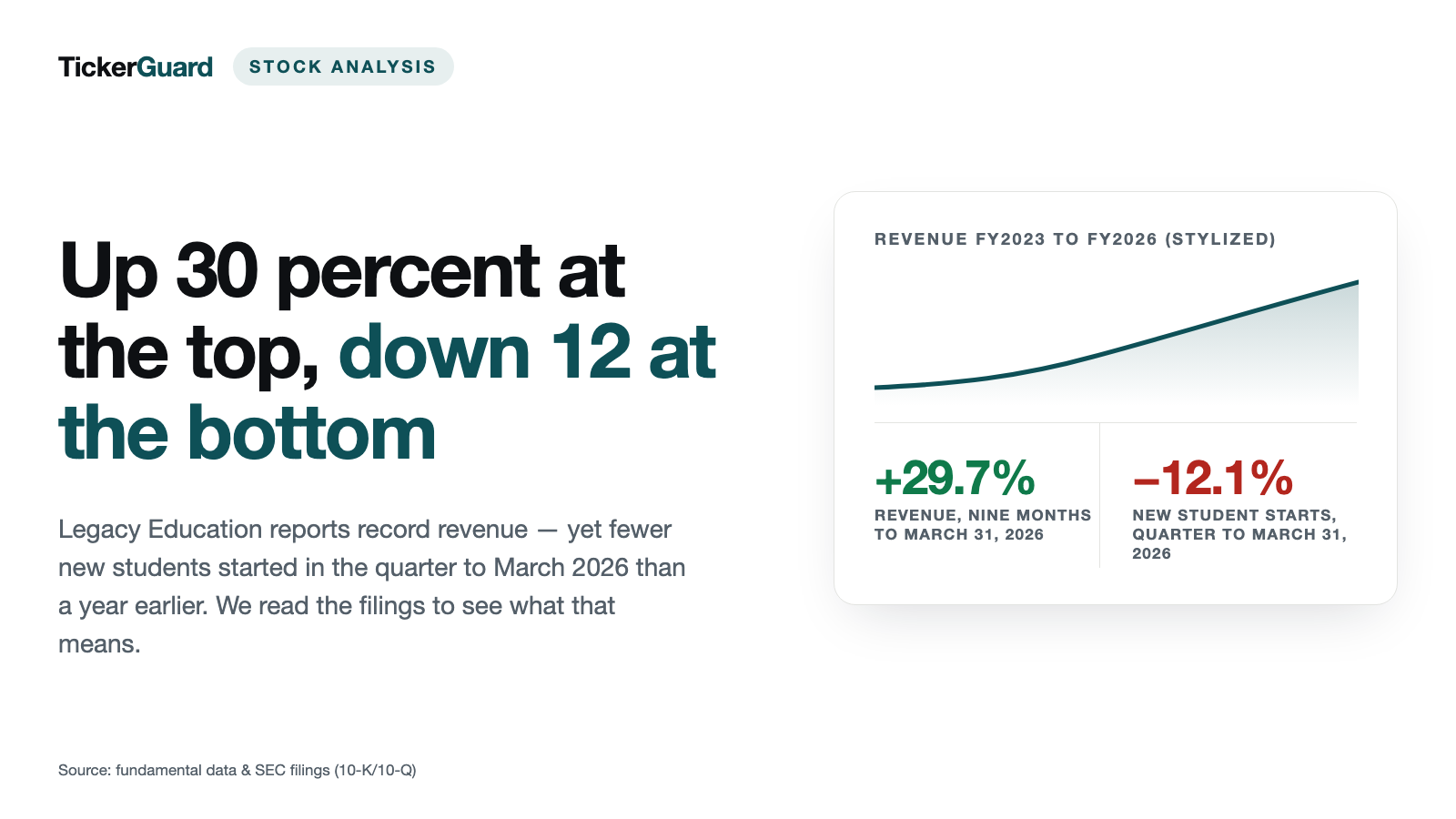
Legacy Education (NYSE American: LGCY) runs four career colleges in California and trains mostly nurses and allied health workers. The headline is true: revenue rose 29.7 percent to $60.0 million in the nine months to March 31, 2026. Very little of that reaches the shareholder — diluted earnings per share rose 2.0 percent over the same stretch, 1,078 new students started in the third quarter against 1,227 a year earlier, and management itself concluded that internal control over financial reporting was not effective as of June 30, 2025, without saying why. We read the filings to find where the force is lost on the way from the cash register to the share.
 Thomas Mücke
Founder & Publisher
Thomas Mücke
Founder & Publisher
As of Today
As of: October 12, 2026
- Closing price
- 10.20 $ +0.10%
- Market Capitalisation
- 0.1 $B
- Growth Score
- 7/10
- AAQS
- 4/10
Price change since August 27, 2026: -6.3%
This analysis has a cut-off date. The Stock Guard tells you when something material changes in the numbers. Reserve your free spot
Chart
Interactive price chart (TradingView).
52-week range: 8.20 $ to 14.30 $ · Last price: 10.20 $ (As of: October 12, 2026)
Note: pure fact-based analysis, not investment advice and not a solicitation to buy or sell. All figures without guarantee.
There is an investor trap you already know from a children's party: telephone. One person whispers a sentence, the next passes it along, and something else arrives at the end of the line. On the stock market the game is played with metrics. The revenue growth number sits at the top of the press release, large and bold. Your brain forwards it automatically — revenue grows, so profit grows, so your slice grows. It almost never works one to one. Between revenue and your slice sit costs, taxes and, above all, the number of shares. At Legacy Education Inc. (NYSE American: LGCY) the arithmetic is unusually clean. Over the nine months to March 31, 2026, revenue rose 29.7 percent, net income rose 15.1 percent — and diluted earnings per share rose 2.0 percent. Three numbers from the same report, the same company, the same period. So here is the deal: before you trust the first number, we will read the filings this company submitted to the U.S. securities regulator, the SEC — the annual report on Form 10-K for fiscal 2025, the three quarterly reports on Form 10-Q for fiscal 2026, the proxy statement and the IPO prospectus. An SEC filing is honest under threat of penalty. This one describes real schools with real students, a business that makes money — and a chain that loses force at every link. What you make of it is your call.
What Legacy Education actually does
Legacy Education is not a software start-up or an online platform. It is a school operator made of people and concrete. The company runs four for-profit career colleges in California: High Desert Medical College, with campuses in Lancaster, Bakersfield and Temecula; Central Coast College in Salinas; Integrity College of Health in Pasadena; and Contra Costa Medical Career College in Antioch. Almost every program trains for a health care occupation: vocational nursing, ultrasound and MRI technology, surgical technology, dental assisting, sterile processing, emergency medical technician. As of March 31, 2026 the four schools enrolled 3,550 students — 2,244 at High Desert Medical College, 600 at Central Coast College, 497 in Antioch and 209 in Pasadena. As of June 30, 2025 the company employed roughly 427 people, including 103 full-time and 147 part-time faculty.
The business model is as simple as it is capital-hungry: a program costs money, the student pays, and the company recognizes the revenue over the length of the course. Prices in the fiscal 2025 annual report range from $2,495 for a twelve-week emergency medical technician certificate to $89,995 for the 96-week Associate Degree Nursing program. Tuition and lab fees make up 88 percent of revenue; books, registration and other fees account for 11 percent. The student body mirrors California's working population precisely: 61 percent Hispanic, 88 percent women, 49 percent older than 25 (as of June 30, 2025). The average placement rate — the share of graduates who find work in the field they trained for — was 74.5 percent at the same date. That is respectable, not outstanding: one graduate in four does not land in the job they paid for.
And now the point where this stops being an ordinary business. Most of the money comes from the government. Most students finance their training through federal student aid — grants and loans from the Title IV programs administered by the Department of Education. The annual report says so in a sentence that appears twice in the document:
“We derive a substantial portion of our revenue and cash flows from the Title IV Programs and a significant portion of our students rely on financial aid received under the Title IV Programs in order to attend our institutions.”
— Legacy Education Inc., SEC annual report 10-K for fiscal 2025, Item 1 “Education Regulations”
That names the central tension of this analysis, and it runs through every chapter: a business that earns decent money, whose license and whose customers both depend on rules written by an agency in Washington — and whose growth loses force at every link on the way to the shareholder.
Company history for investors
-
2009
Founded as Legacy Education, L.L.C.
LeeAnn Rohmann founds the company in California on October 19, 2009 — fifteen years before the IPO. Today's ownership structure, dominated by a single founder, starts here.
-
2010
High Desert Medical College acquired
In July 2010 the company adds the school that is still its largest: 2,244 of 3,550 students studied there as of March 31, 2026. Buying LGCY means buying that one school to a large degree.
-
2019
Central Coast College and a stake in Integrity
Central Coast College in Salinas is acquired in January 2019 and a stake in Integrity in Pasadena at year end. One school becomes a group — growth by acquisition becomes the pattern.
-
2020
Integrity fully acquired, conversion into a corporation
The remaining Integrity interest follows in September 2020; Legacy Education Inc. is incorporated in Nevada in March 2020. The shell for a later listing is now in place.
-
2024
IPO on the NYSE American at $4.00
On September 27, 2024, 2.5 million new shares come to market at $4.00 each and no existing holder sells. For shareholders this is the start of the price history — and of the dilution.
-
2024
Fourth school: Contra Costa Medical Career College
The Antioch school is acquired on December 18, 2024 for a final $7.53 million. It explains roughly a third of fiscal 2025 record growth — bought rather than grown.
-
2026
New Wildomar site on a lease of up to twelve years
On April 1, 2026 the company leases roughly 53,000 square feet in Wildomar. A long-term fixed cost that was not yet on the balance sheet as of March 31, 2026.
How the stock reached our desk
No price breakout and no headline prompted this analysis. Legacy Education landed on the research list as the thing that statistically gets checked least often: a small, profitable newcomer. The stock has only been listed since September 27, 2024 — which is the first correction to make, because February 2025 is occasionally cited as the listing date. The IPO prospectus (Form 424B4) is dated September 25, 2024, the shares were to be delivered “on or about September 27, 2024” according to that prospectus, and the annual report confirms the NYSE American listing under the symbol LGCY from that date. The offering comprised 2,500,000 shares at $4.00 each, or $10.0 million gross; a further 375,000 shares came through the over-allotment option in the following quarter at the same price. Net proceeds to the company were $9,162,845 according to the cash flow statement.
In practice that means there is no long price history to read anything into, and any chart showing more than two years is showing something else. If you find figures for “LGCY” reaching much further back, look twice: before this IPO the symbol belonged to Legacy Reserves LP, an oil and gas partnership whose SEC registration ended with a Form 15-12B on October 1, 2018. There is also a name collision: Legacy Education Alliance, Inc. is a completely different company (SEC CIK 1561880) and has nothing to do with the California schools. Keep this in mind from the start: for a young stock, the data trail is shorter than the memory of the databases. That is exactly why we read only the company's own filings here. As for how closely training and staffing markets are linked, look at it from the other side: RCM Technologies earns part of its money placing precisely the nurses that schools like these train.
The numbers over the years — given their due
Start with what genuinely speaks for this company, and it is more than the critical remainder of this analysis suggests. Legacy Education makes money, every year. Revenue climbed from $35.5 million in fiscal 2023 to $46.0 million in fiscal 2024 and $64.2 million in fiscal 2025 — up 39.5 percent in the last full year. Net income followed the same rhythm: $2.67 million (2023), $5.11 million (2024), $7.53 million (2025). The net margin was 11.7 percent most recently and the operating margin 15.6 percent. For context, so the number means something: a net margin of roughly 12 percent is solid for an education provider — not a software business at 30 percent, but far removed from the one-percent margins of retail.
The balance sheet is sound too. As of March 31, 2026 the company held $21.68 million in cash, equity stood at $49.52 million, and interest-bearing debt amounted to roughly $0.6 million. There is no credit facility — the company states plainly that it is “not party to a revolving line of credit or other debt facility.” Two more figures belong in this chapter because they matter in a regulated industry. The composite score, the Department of Education's measure of a school's financial responsibility, was 3.0 for fiscal 2025 — the top of the scale, against a minimum requirement of 1.5. And the cohort default rate on student loans was 0 percent at all four schools for the three most recently published cohorts. That is a strong number, with a caveat the company itself supplies and we will come back to.
Now the curve this analysis is about — quarterly revenue growth:
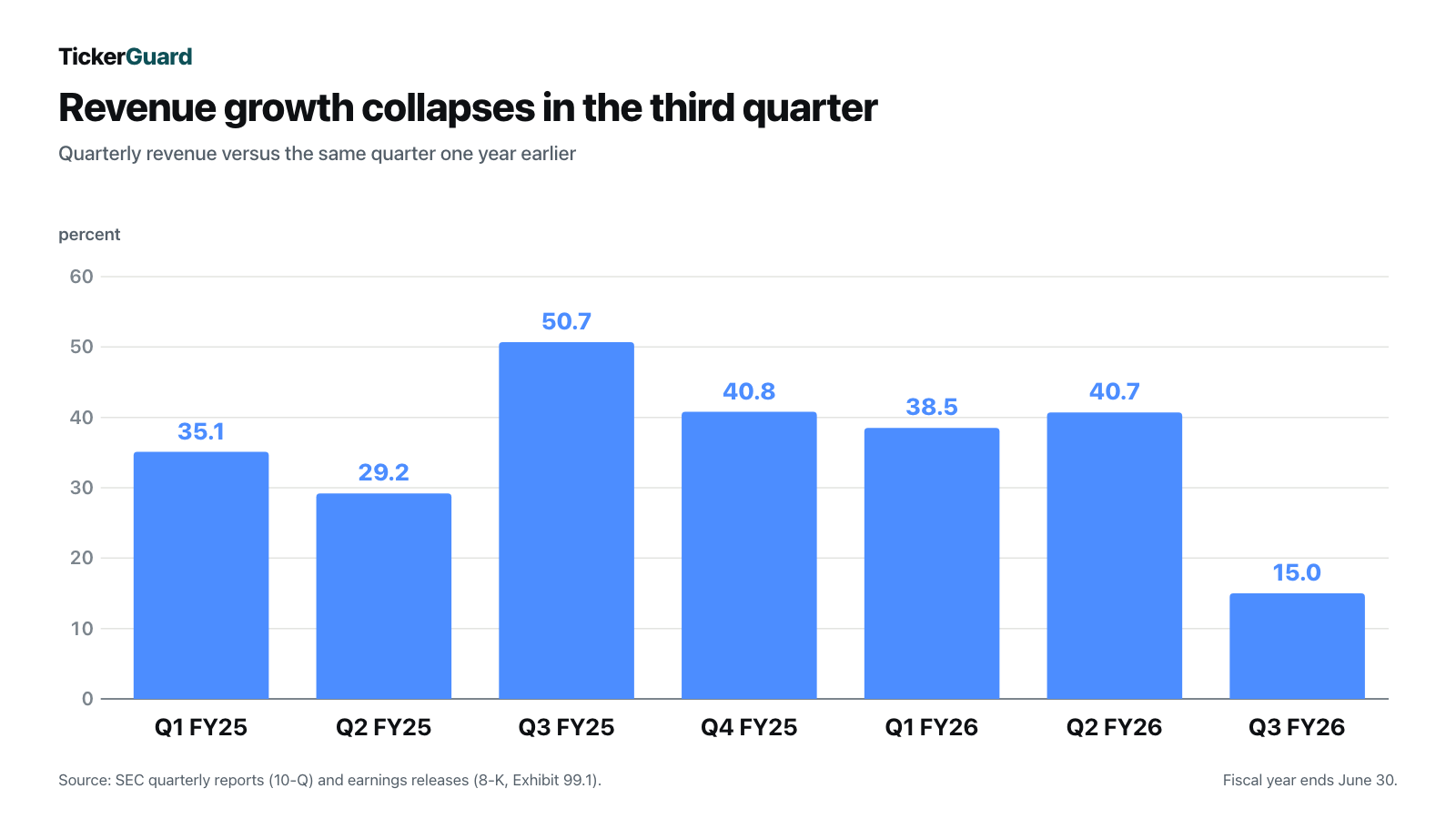
Six bars look alike; the seventh does not. And because a single quarter is not a trend, the second number belongs next to it. New student starts — the people who actually began a program in that quarter — came to 1,078 in the quarter to March 31, 2026. A year earlier, in the quarter to March 31, 2025, there were 1,227. That is a decline of 12.1 percent. Over the full nine months the picture still looks fine (2,788 against 2,473, up 12.7 percent), but all of that growth sits in the first two quarters. Remember the image: today's students are the day-after-tomorrow's revenue — with programs running one to two years, a weaker intake announces itself long in advance and lingers just as long.
What the filings say — the uncomfortable truths
Uncomfortable truth No. 1: the whole business hangs on a percentage with three points of headroom
A U.S. for-profit school that wants to accept federal student aid must satisfy the 90/10 rule. Put in everyday terms: imagine a shop allowed to earn no more than 90 percent of its revenue from a single large customer. Miss it for one year and the shop goes on probation; miss it two years running and it loses that customer for at least two years — and with it almost everything. The quarterly report puts it exactly that way: “If the test is not satisfied for two consecutive years, eligibility to participate in Title IV programs is lost for at least two fiscal years.” Here are the current figures:
“Using ED’s cash-basis, regulatory formula under the 90/10 revenue test, as in effect for its 2025 fiscal year, HDMC, CCC, ICH and CCMCC derived 86.82%, 80.35%, 84.71% and 59.80% for its 90/10 revenue from the Title IV programs and other federal educational assistance funds, respectively, for the fiscal year ended June 30, 2025.”
— Legacy Education Inc., SEC quarterly report 10-Q for March 31, 2026, Note 16 “90/10 Disclosure”
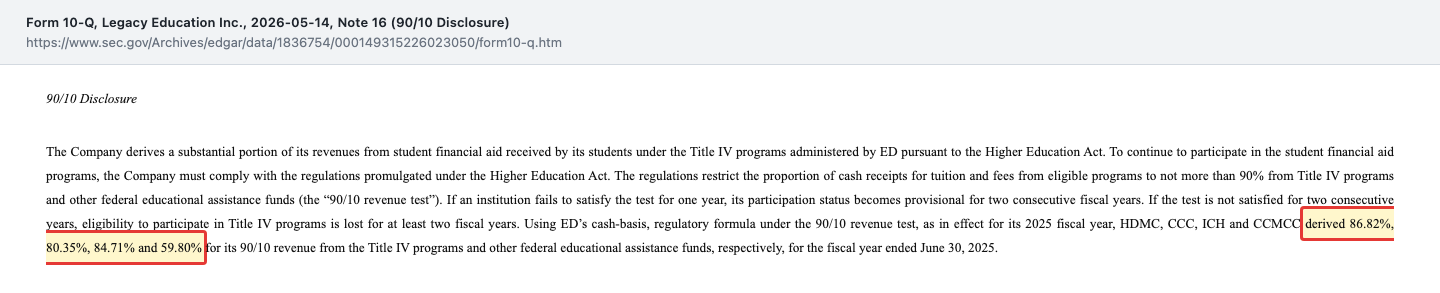
High Desert Medical College, with 2,244 of 3,550 students by far the largest school, therefore has 3.18 percentage points of headroom. Two things make that less comfortable than it sounds. First, the company expects the test to get harder: “We expect the change in the 90/10 Rule will increase our 90/10 Rule percentages and make it more difficult to comply with the 90/10 Rule” — the revised formula now counts additional federal sources toward the 90 percent. Second, the participation agreement for exactly these two largest schools is about to expire:
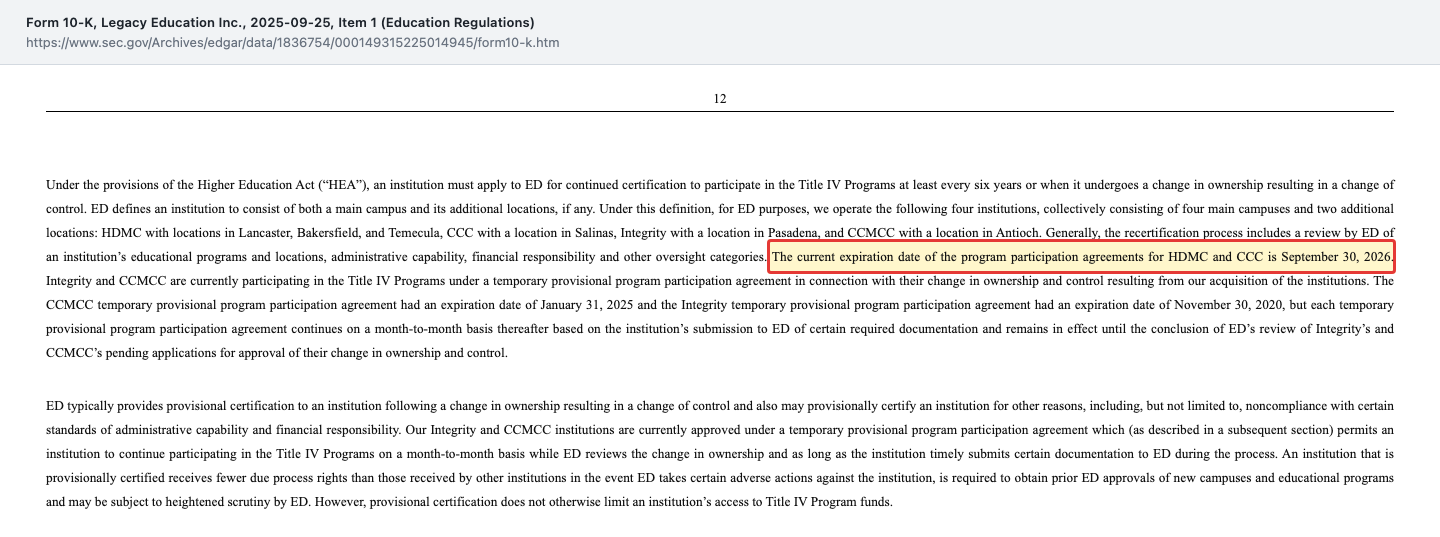
In fairness: such renewals are routine, and the schools currently meet the criteria. In honesty: the same report concedes in its risk factors that the department's reduction in force eliminated “the school participation division that previously oversaw the operations of our institutions” — the very unit responsible. And the much-praised 0 percent default rate comes with the company's own qualification. It stems from the years when repayment of U.S. student loans was suspended during the pandemic. “Our cohort default rates could be substantially higher for the periods after October 2023, when the suspension expired,” the filing says. In plain English: that zero is borrowed.
Uncomfortable truth No. 2: management itself calls internal control not effective — and stays silent on why
Every listed U.S. company must assess once a year whether its internal control over financial reporting works. This is not a formality but the question of whether the numbers in the report are produced reliably at all — roughly the way a restaurant should not only serve good food but also keep a clean kitchen. The fiscal 2025 annual report gives the answer in a single sentence:
“Based on this assessment, our management concluded that, as of June 30, 2025, our internal control over financial reporting was not effective based on such criteria.”
— Legacy Education Inc., SEC annual report 10-K for fiscal 2025, Item 9A “Controls and Procedures”
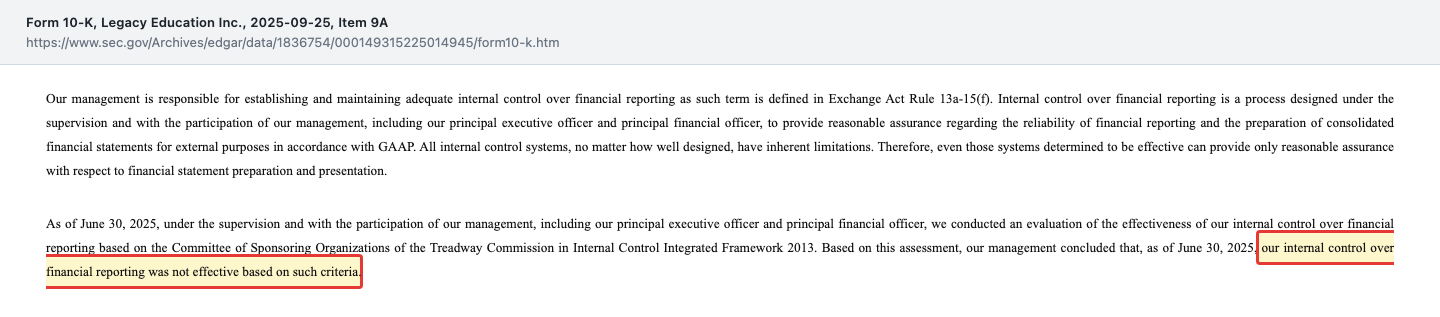
What is remarkable is not only the sentence but what is missing. Normally such a conclusion is followed by a description of the specific material weakness and a plan to remediate it. Neither appears in the report. At the same time the same section rates disclosure controls — the upstream process that ensures information reaches management in time — as effective, without resolving the contradiction. And because Legacy Education qualifies as an emerging growth company, the auditor is not required to examine internal control at all; the opinion of L J Soldinger Associates of Deer Park, Illinois, covers the financial statements only. An investor is therefore left with three things: a self-assessment, no explanation and no independent check. That is the most honest finding of this analysis — and the most uncomfortable.
Uncomfortable truth No. 3: profit converts into cash less and less well
Profit is an opinion, cash flow is a fact — the old adage earns its keep here. Over the nine months to March 31, 2026, Legacy Education reported net income of $7.26 million. Cash generated by the business over the same period came to just $2.88 million — against $4.76 million a year earlier on a smaller profit. Roughly 40 cents of every dollar earned turned into actual money. The report names the reason itself:
“Net cash provided by operating activities was approximately $2.9 million and $4.8 million for the nine months ended March 31, 2026, and 2025, respectively. The decrease of approximately $1.9 million was primarily attributable to increases in accounts receivable, prepaid expenses and other receivables, partially offset by increases in deferred unearned tuition and income taxes payable.”
— Legacy Education Inc., SEC quarterly report 10-Q for March 31, 2026, Item 2 “Cash Flow Activities”

The numbers behind it: current receivables rose from $15.05 million (June 30, 2025) to $19.19 million (March 31, 2026), plus $2.11 million of long-term receivables from the in-house installment program “TuitionFlex,” which lets students pay tuition in instalments. The fine print is worth a look here too: through the quarter ended December 31, 2025 those payment plans ran for up to five years; the quarterly report for March 31, 2026 states up to seven years — so the company stretched its students' payment terms in precisely the quarter in which receivables rose and fewer new students started. Together roughly $21.3 million — more than a third of nine-month revenue. In parallel the allowance for doubtful accounts grew from $1.64 million to $2.65 million, about 12 percent of gross receivables that the company itself no longer counts as safe. Put in everyday terms: the shop sells more, but increasingly on account — and trusts a growing share of those invoices less and less.
Uncomfortable truth No. 4: a third of the record growth was bought
Fiscal 2025 was the year of headlines: “Revenue grew 39.5%,” record revenue, record enrollment. One detail sits in the notes to the annual report under the heading “Pro forma.” On December 18, 2024, Legacy Education acquired Contra Costa Medical Career College in Antioch for a final purchase price of $7.53 million, of which $6.6 million in cash. The school brought several hundred students with it in one step. The report sets out what the two years would have looked like had the school belonged to the group all along: $68.18 million of revenue in fiscal 2025 against $53.12 million in fiscal 2024. That is growth of 28.3 percent rather than the reported 39.5 percent. Roughly a third of the celebrated growth was not grown but bought.
That is not an accusation — acquisitions are a legitimate strategy, and the company discloses the calculation itself. It is a question of expectations: extrapolating 39.5 percent means extrapolating an acquisition that has not been repeated. Through March 31, 2026 Legacy Education bought no further school in fiscal 2026. Notably, the annual report concedes among its risk factors that “we do not have any experience in acquiring other businesses” — no experience in acquiring companies, alongside a strategy that explicitly targets further acquisitions, including outside California.
Uncomfortable truth No. 5: pay grew twice as fast as profit — decided without a single meeting
The proxy statement filed on October 24, 2025 completes the picture. Total compensation for founder and chief executive LeeAnn Rohmann rose from $983,441 in fiscal 2024 to $2,055,477 in fiscal 2025 — up 109 percent, while net income rose 47 percent. Together with chief financial officer Brandon Pope ($916,446), the two accounted for 39.4 percent of fiscal 2025 net income; the larger part of that, however, is not cash but the grant-date value of stock options. The decision was made by a compensation committee that, according to the proxy, held no meeting at all during fiscal 2025 and instead passed two resolutions by written consent.
Add the composition of the board: of six members, exactly three qualify as independent under the proxy — half, not a majority. The roles of chief executive and chairman sit with the same person, with no lead independent director as a counterweight (“we therefore believe that the creation of a lead independent director position is not necessary at this time”). And two of the six receive consulting fees well above their director fees: Gerald Amato $135,875 in fiscal 2025 against a $33,750 director fee, Peggy Tiderman $152,279 against $28,000. Neither is treated as independent, consistently enough. None of this is prohibited and all of it is disclosed — but it is the structure of a family firm, not of a broadly governed public company.
What management said — and what came of it
Legacy Education has held a public earnings call every quarter since the IPO, each at 4:30 p.m. Eastern time. One clarification up front so the basis is clear: we do not have transcripts of those calls — the recordings stay online for 90 days according to the invitations, and the company has been listed for less than two years. So we evaluate what is documented permanently and verbatim: the six earnings releases the company filed with the SEC as Exhibit 99.1 to a Form 8-K between November 14, 2024 and May 14, 2026. Each contains a direct quote from the chief executive. That is a shorter run than at a long-established company — and it is still enough for three defensible findings.
First: the tone shifts, and in exactly the right quarter. The releases through the end of 2025 use big words. November 2024: “Our record first quarter performance reflects our strategic growth initiatives.” May 2025: “This is an excellent quarter for Legacy Education.” November 2025: “building on the transformative momentum from 2025.” Then, on May 14, 2026, covering the quarter with 15.0 percent revenue growth: “We continue to see strong interest in healthcare career training across our markets, supported by student demand and steady enrollment trends.” Steady, where records used to be. “Record” and “transformative” became “steady” and “disciplined execution.” That is not misinformation; it is the ordinary language of a company with nothing to celebrate. But it is a signal you only see when the run is laid out side by side.
Second: the percentage disappears when it turns awkward. Every earnings release before May 2026 states the change in new student starts as a percentage: “New student starts increased 23.3%,” “increased 3.0%,” “increased 70.7%,” “increased 15.7%,” “increased 31.6% to 1,117.” The release of May 14, 2026 words it differently: “New student starts were 1,078” — the absolute number, no comparison. The missing figure can be reconstructed from the same source: the prior-year quarter had 1,227, so the change would have been minus 12.1 percent. Again: nothing here is false and nothing is prohibited. But reporting a metric as a percentage in five of six releases and not in the sixth is a decision.
Third: a promise that was kept only on the second attempt. On November 13, 2025 the chief executive explained the weaker first-quarter margin with investment and offered an outlook: “Our lighter Q1 margins reflect strategic investments in four new programs and expansion costs, which we believe positions us for sequential improvements throughout the year” — improvement from quarter to quarter. The check against the quarterly reports: the operating margin was 13.9 percent in the first quarter of fiscal 2026, 13.3 percent in the second — it fell first — and only then rose to 18.5 percent in the third. The promise was ultimately met, but not along the announced path. And the third-quarter jump has a second side: according to the report it came partly from educational services costs falling from 54.4 to 51.7 percent of revenue — in a quarter with fewer new students.
One more observation, without interpretation: for the quarter ended December 31, 2025 the company filed no earnings release as a Form 8-K, only the quarterly report. It is the single gap in the run since the IPO. There is no obligation to file such a release.
Valuation: what the market pays for these schools
On August 27, 2026 the stock closed at $10.89. That implies a market capitalization of roughly $138 million, a price-to-earnings ratio of about 18, a price-to-sales ratio of about 1.8 and a price-to-book ratio of about 2.8 (book value per share: $3.92 as of March 31, 2026). Enterprise value works out to roughly ten times earnings before interest, taxes, depreciation and amortization. The 52-week range runs from $7.94 to $14.70 (data as of August 28, 2026). Two analysts cover the stock with a price target of $14.80 — far too thin a base to read as a consensus.
Is that expensive? A price-to-earnings ratio of 18 looks moderate for a company that nearly tripled its profit in three years. The question is which growth rate you read into that multiple — and the chain from the opening helps:
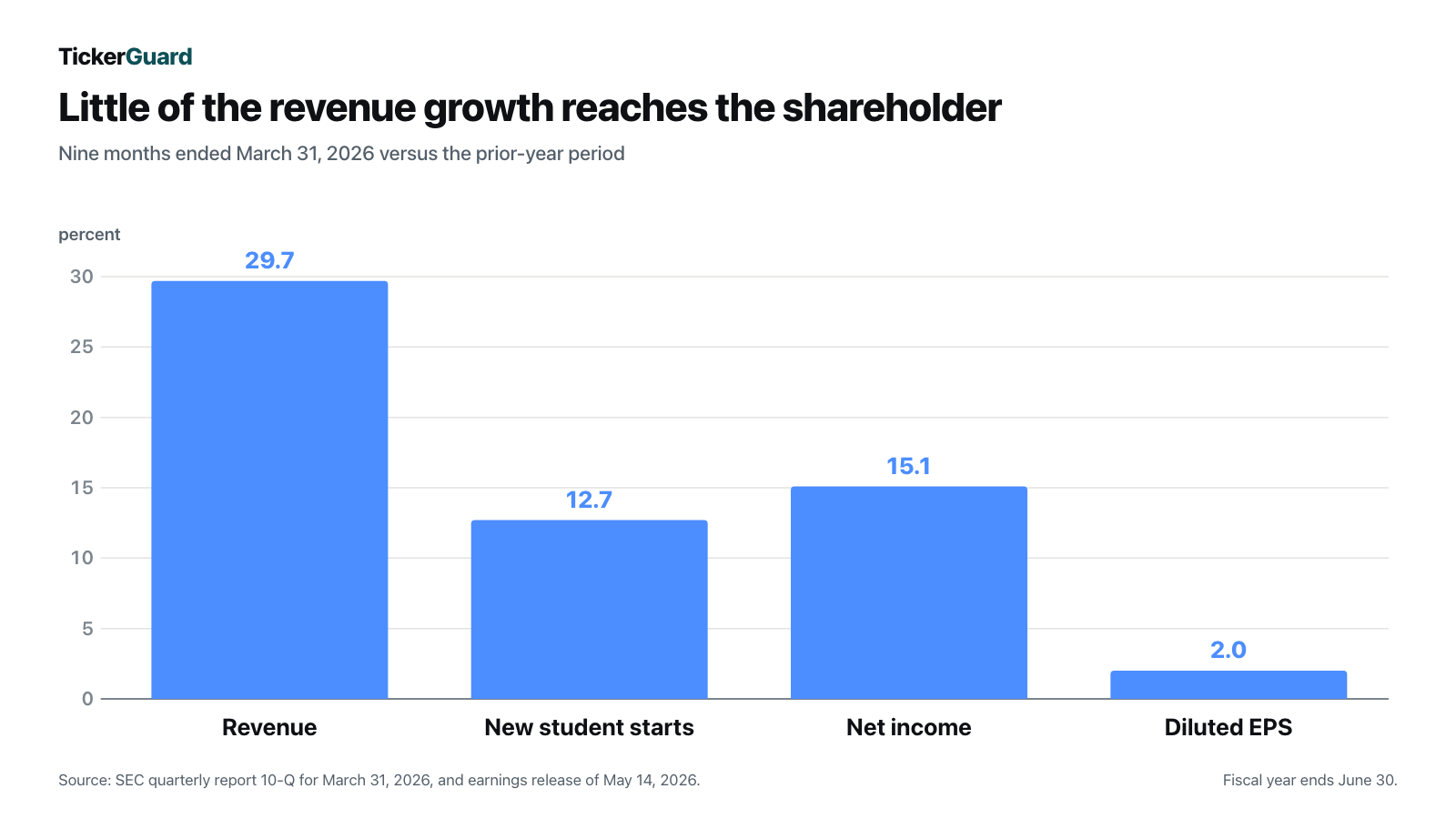
A price-to-earnings ratio refers to earnings per share. And that rose 2.0 percent, not 29.7. The reason is explainable and partly a one-off: the September 2024 IPO fell in the middle of the prior-year quarter, so the comparison figures were computed on a smaller share count. But the share count keeps rising — 12,636,605 shares were outstanding as of March 31, 2026, the diluted count stood at 14,064,470, and 2,298,287 options at a weighted average exercise price of $4.37 sit above all of it. Put in everyday terms: your slice of the cake shrinks while the cake grows. Whether more is left for you depends on which runs faster. For a look at how a company from the same health care market with an entirely different cost structure is valued, see Viemed Healthcare.
Upside and risks at a glance
What speaks for Legacy Education:
- A real, consistently profitable business: revenue of $35.5 million (fiscal 2023), $46.0 million (2024) and $64.2 million (2025), net income of $2.67 million, $5.11 million and $7.53 million, plus another $7.26 million of profit in the nine months to March 31, 2026. Net margin most recently 11.7 percent.
- A sound balance sheet with almost no debt: $21.68 million in cash, roughly $0.6 million of interest-bearing debt and $49.52 million of equity (all as of March 31, 2026); no credit facility needed and no equity raise since the IPO.
- Structural demand: California needs nurses and allied health workers; enrollment rose from 2,187 (June 30, 2024) to 3,101 (June 30, 2025) and 3,550 (March 31, 2026). The placement rate was 74.5 percent as of June 30, 2025.
- Regulatory metrics currently in the clear: a composite score of 3.0 (the maximum, minimum requirement 1.5) for fiscal 2025, a 0 percent cohort default rate at all four schools, and all four schools below the 90 percent threshold.
- The IPO was not an exit for insiders: all 2,500,000 shares sold on September 27, 2024 were newly issued by the company, no existing holder sold a share, and the money went entirely into the business.
What speaks against it:
- Management concluded that internal control over financial reporting was not effective as of June 30, 2025 — without naming the weakness, without a remediation plan and without an auditor attestation, from which the company is exempt as an emerging growth company.
- Existential dependence on a single counterparty: if federal student aid eligibility goes, revenue goes. The largest school stood at 86.82 percent in fiscal 2025 against a 90 percent exclusion threshold; eligibility for the two largest schools expires on September 30, 2026, and two further schools operate under temporary agreements renewed month by month.
- Profit converts into cash less and less well: $2.88 million of cash from operations against $7.26 million of net income (nine months to March 31, 2026; $4.76 million a year earlier). Receivables of $21.3 million, with the allowance for doubtful accounts up from $1.64 million to $2.65 million.
- Growth is slowing and was partly bought: 15.0 percent revenue growth in the quarter to March 31, 2026 after 40.7 percent in the previous quarter, and 1,078 new students against 1,227; on a pro-forma basis fiscal 2025 growth was 28.3 percent rather than 39.5 percent.
- The governance of an owner-run firm: only three of six directors independent, chief executive and chairman in one person with no lead independent director, two directors receiving consulting fees above their director fees, and executive pay up 109 percent against a 47 percent rise in profit — decided by a committee that held no meeting.
- Dilution: 2,298,287 options outstanding equal 18.2 percent of the 12,636,605 shares (March 31, 2026); that is why earnings per share rose only 2.0 percent most recently.
A human bottom line
Back to the game of telephone. The sentence whispered at the top of the line at Legacy Education is: “We grew 30 percent.” It is true. What arrives at the end of the line is: “Two percent.” That is true as well. In between there are no tricks, only explainable things — more shares, more costs, one acquired school, one quarter with fewer new students. That is what makes this case so instructive: you need to accuse nobody of anything to see that the first number is not the number that counts for you.
And then there is the second part, which weighs more than any growth rate. A company that puts on record that its own internal control over financial reporting was not effective, and does not say why, is asking you for a leap of faith it has not made easy. Add a business whose survival depends on the signature of an agency whose responsible division no longer exists. Both can resolve quietly — the next annual report may show a remediated weakness and a renewed agreement, and then the picture changes. So the honest question is not “Is the company growing?” It is growing. It is: are you willing to put money into a company that describes its own accounting kitchen as not effective — and does not tell you what is missing? If yes, you have a thesis and a date in the calendar: September 30, 2026. If no, you have spared yourself a lot of trouble. What you make of it is your call. And that is exactly as it should be.
Sources
Every original document used in this analysis, for you to read yourself:
- Legacy Education Inc. — SEC annual report 10-K for fiscal 2025 (filed September 25, 2025)
- Legacy Education Inc. — SEC annual report 10-K for fiscal 2024 (filed October 1, 2024)
- Legacy Education Inc. — SEC quarterly report 10-Q for March 31, 2026 (filed May 14, 2026)
- Legacy Education Inc. — SEC quarterly report 10-Q for December 31, 2025 (filed February 12, 2026)
- Legacy Education Inc. — SEC quarterly report 10-Q for September 30, 2025 (filed November 13, 2025)
- Legacy Education Inc. — SEC proxy statement DEF 14A for the 2025 annual meeting (filed October 24, 2025)
- Legacy Education Inc. — SEC prospectus 424B4 for the initial public offering (filed September 27, 2024)
- Legacy Education Inc. — Earnings release for the third quarter of fiscal 2026 (Exhibit 99.1 to Form 8-K of May 14, 2026)
- Legacy Education Inc. — Earnings release for the third quarter of fiscal 2025 (Exhibit 99.1 to Form 8-K of May 15, 2025)
- Complete SEC filing history of Legacy Education Inc.: EDGAR overview (sec.gov)
- Fundamental data (price, market capitalization, ratios, analyst estimate; data as of August 28, 2026, closing price of August 27, 2026), reconciled against the SEC filings.
Transparency & disclaimer: this analysis is journalistic commentary on publicly available information. It is not investment advice, not a regulated financial analysis and not a solicitation to buy or sell securities. Equity investments carry substantial risk up to and including total loss. All information is provided without warranty; the as-of date for each figure is stated in the text. The author holds no position in Legacy Education Inc. shares at the time of publication.
Key figures at a glance
All monetary figures in millions of $; earnings per share as reported.
| Metric | 2022 | 2023 | 2024 | 2025 | 2026 |
|---|---|---|---|---|---|
| Revenue | 30.7 | 35.5 | 46.0 | 64.2 | 80.1 |
| Operating Income (EBIT) | 3.2 | 3.6 | 6.2 | 10.0 | 11.8 |
| Net Income | 2.3 | 2.7 | 5.1 | 7.5 | 80.1 |
| Net Margin | 7.6% | 7.5% | 11.1% | 11.7% | 100.0% |
| Earnings Per Share | 0.08 $ | 0.10 $ | 0.43 $ | 0.59 $ | 5.74 $ |
Source: fundamental data & SEC filings (annual and quarterly reports, 10-K/10-Q)
Our Bottom Line at a Glance
- Business model and demand positive
- Four career colleges in California with 3,550 students as of March 31, 2026 (up from 2,187 as of June 30, 2024), focused on nursing and allied health, with a 74.5 percent placement rate as of June 30, 2025. Demand for health care staff is structural and largely insensitive to the economic cycle.
- Numbers and balance sheet positive
- Consistently profitable: net income of $2.67 million (fiscal 2023), $5.11 million (2024) and $7.53 million (2025), plus $7.26 million in the nine months to March 31, 2026. As of March 31, 2026, $21.68 million of cash stood against roughly $0.6 million of interest-bearing debt, with equity of $49.52 million.
- Internal control negative
- The Form 10-K for fiscal 2025 (September 25, 2025, Item 9A) states that internal control over financial reporting was not effective as of June 30, 2025. The underlying weakness is not named, no remediation plan is given, and as an emerging growth company Legacy Education is exempt from an auditor attestation on that control.
- Regulatory dependence negative
- The bulk of revenue depends on eligibility for U.S. federal student aid. The largest school stood at 86.82 percent in fiscal 2025 against the 90 percent exclusion threshold (10-Q for March 31, 2026, Note 16); the participation agreements of the two largest schools expire on September 30, 2026 and two further schools operate under temporary agreements renewed month by month.
- Earnings quality negative
- Over the nine months to March 31, 2026, $7.26 million of net income produced only $2.88 million of cash from operations (prior-year period $4.76 million on a smaller profit). Receivables rose to $19.19 million current plus $2.11 million long-term, and the allowance for doubtful accounts from $1.64 million to $2.65 million.
- Growth pace and valuation neutral
- Revenue growth fell from 40.7 percent in the quarter to December 31, 2025 to 15.0 percent in the quarter to March 31, 2026, and new student starts from 1,227 to 1,078. At $10.89 per share (August 27, 2026) that is roughly $138 million of market value, a P/E of about 18 and a P/S of about 1.8 — moderate against the past, demanding against earnings per share that grew 2.0 percent.
Legacy Education is a real, profitable education company with rising enrollment, a clean balance sheet and structurally demanded programs. Its filings with the U.S. securities regulator, the SEC, show three findings that weigh more than the growth rate: internal control over financial reporting that management itself calls not effective without naming a cause, existential dependence on a federal eligibility whose threshold the largest school fills to 86.82 of 90 percent, and profit of which only about 40 percent recently arrived as actual cash. Of a 29.7 percent revenue gain, 2.0 percent reached the shareholder. Not investment advice.
What Our Rating Means
Substance risk
We found at least one documented issue that threatens the company itself — regardless of how the stock is currently valued.
Red, because two documented substance findings come together. First, in the fiscal 2025 annual report management itself declares internal control over financial reporting not effective as of June 30, 2025, names neither the weakness nor a remediation plan, rates disclosure controls as effective in the same section, and is exempt as an emerging growth company from an independent audit of that control — a documented break in the control framework that underpins the reliability of every other figure. Second, the survival of the business rests on a single counterparty: without eligibility for U.S. federal student aid the revenue disappears, the largest school fills the 90 percent threshold to 86.82 percent, eligibility for the two largest schools expires on September 30, 2026, and two schools operate under temporary agreements renewed month by month. Explicitly not the reason for red are the share price, the valuation or the slowing growth — those are price and pace arguments, not substance arguments. Yellow would be supported by an otherwise healthy position: no going-concern qualification, positive equity of $49.52 million, $21.68 million of cash, almost no debt, a composite score of 3.0 and three profitable years in a row. Where the evidence sits between two levels, the more cautious one applies. The decision is yours.
A journalistic assessment by our editorial team at the time of the deep dive, based on public sources — not investment advice and not a solicitation to buy or sell. Your personal circumstances (investment goals, risk capacity, taxes) cannot be taken into account. What our levels mean, how verdicts are formed, and what conflicts of interest exist →
Worth Noting
- Legacy Education reached the research list as a small, profitable market newcomer with barely two years of price history and only two analyst voices — a setup that rarely gets read closely in public. No price event and no news item prompted it.
- Clarification on the listing: the shares began trading on the NYSE American on September 27, 2024 at $4.00 (prospectus 424B4 dated September 25, 2024), not in February 2025. Charts covering more than two years do not show a genuine history for this stock.
- Two directions of confusion: Legacy Education Alliance, Inc. (SEC CIK 1561880) is a different company and has nothing to do with the California schools. Before this IPO the symbol LGCY belonged to Legacy Reserves LP (SEC CIK 1358831), an oil and gas partnership whose registration ended with a Form 15-12B on October 1, 2018; very long price and ratio series for “LGCY” can therefore mix two different companies.
- Data basis: balance sheet and earnings figures come from the Form 10-K for fiscal 2025 (filed September 25, 2025) and the Form 10-Q for March 31, 2026 (filed May 14, 2026). Price, market capitalization and analyst estimate are as of August 28, 2026, with a closing price of August 27, 2026. The annual report for the fiscal year ended June 30, 2026 was not yet available at the time of writing.
- On accreditation: the fiscal 2025 annual report flagged accreditations expiring for Contra Costa (April 2026) and Integrity (February 2026). The quarterly report for March 31, 2026 lists both as renewed — Contra Costa through April 2031 and Integrity through February 2032. Those deadlines are therefore settled.
Stock Watch
This analysis is as of August 29, 2026. Stock Watch will tell you what's changed at LGCY since then.
Later $1 a month per stock — signing up is free, and you'll be the first to know when it launches.
The full analysis as a PDF for later
We will send you this analysis as a PDF — to print, file away, and read at your own pace. And we will add you to the free Stock Watch list for Legacy Education Inc. (LGCY), so you hear about it when something material in this analysis changes.
Frequently Asked Questions
Legacy Education Inc. (NYSE American: LGCY), based in Lancaster, California, runs four for-profit career colleges: High Desert Medical College (Lancaster, Bakersfield, Temecula), Central Coast College (Salinas), Integrity College of Health (Pasadena) and Contra Costa Medical Career College (Antioch). Almost all programs train for health care occupations — nursing, ultrasound, surgical technology, dental assisting. As of March 31, 2026 the schools enrolled 3,550 students.
On September 27, 2024, on the NYSE American under the symbol LGCY. The prospectus (Form 424B4) is dated September 25, 2024; the company sold 2,500,000 newly issued shares at $4.00 each, followed by 375,000 over-allotment shares in the next quarter. Net proceeds were $9,162,845. A listing date of February 2025, occasionally cited, is incorrect — the price history begins in September 2024.
Because the share count has risen. Over the nine months to March 31, 2026 revenue rose 29.7 percent, net income 15.1 percent and diluted earnings per share only 2.0 percent. The September 2024 IPO fell in the middle of the prior-year period, and on top of that, options on 2,298,287 shares were outstanding as of March 31, 2026 — 18.2 percent of the 12,636,605 shares outstanding.
The Department of Education's 90/10 rule allows a for-profit school to draw no more than 90 percent of its cash receipts from federal student aid and other federal education funds. Exceed it two years running and the school loses eligibility for at least two fiscal years. For fiscal 2025 Legacy Education reports 86.82 percent for High Desert Medical College, 84.71 for Integrity, 80.35 for Central Coast and 59.80 percent for Contra Costa.
The Form 10-K for fiscal 2025 (filed September 25, 2025) states in Item 9A that internal control over financial reporting was not effective as of June 30, 2025. The underlying weakness is not named and no remediation plan is given. As an emerging growth company, Legacy Education is not required to have that control audited; the opinion of L J Soldinger Associates covers the financial statements only.
On June 30. Fiscal 2025 therefore runs from July 1, 2024 to June 30, 2025, and fiscal 2026 through June 30, 2026. Anyone comparing quarters should keep that in mind: the first quarter of fiscal 2026 ended on September 30, 2025 and the third on March 31, 2026. The annual report for fiscal 2026 has in past years been filed in late September.
Considerably less than the profit suggests. Over the nine months to March 31, 2026, net income of $7.26 million produced only $2.88 million of cash from operating activities — against $4.76 million a year earlier on a smaller profit. The report attributes the gap to higher receivables: $19.19 million current plus $2.11 million long-term as of March 31, 2026.
No. No dividend was paid in fiscal 2026 through March 31, 2026, and the option valuations in the quarterly reports consistently assume an expected dividend yield of zero. There were distributions before the IPO: the quarterly report for September 30, 2025 mentions dividends of $929,116 between July 2022 and June 2023. There is no share repurchase program either.
Found an error?
Did you spot a factual error, an outdated number, or a typo in this deep dive? Let us know briefly — your report goes straight to the editorial team.