Viemed Healthcare: A Record Every Quarter — and Less of It Sticking
Viemed Healthcare (NASDAQ: VMD) puts ventilators and respiratory therapists into the homes of seriously ill patients. In the second quarter of 2026 it booked $78.1 million in revenue, the highest quarter in company history and 23.9 percent above the prior year. The same report shows adjusted EBITDA of $13.7 million — 4.0 percent lower than a year earlier. Net margin fell from 5.0 to 3.5 percent, selling and administrative costs grew 28.9 percent while revenue grew 23.9, and the company cut its own 2026 earnings guidance while raising the revenue range. We read the August 3 quarterly report, the 2025 annual report and ten earnings calls — and do the arithmetic on what the records leave behind.
 Thomas Mücke
Founder & Publisher
Thomas Mücke
Founder & Publisher
As of Today
As of: October 9, 2026
- Closing price
- 9.50 $ +1.20%
- Market Capitalisation
- 0.4 $B
- P/E
- 26.4
- Growth Score
- 7/10
- AAQS
- 8/10
Price change since August 26, 2026: +1.8%
This analysis has a cut-off date. The Stock Guard tells you when something material changes in the numbers. Reserve your free spot
Chart
Interactive price chart (TradingView).
52-week range: 6.30 $ to 12.30 $ · Last price: 9.50 $ (As of: October 9, 2026)
Note: pure fact-based analysis, not investment advice and not a solicitation to buy or sell. All figures without guarantee.
There is an investor weakness so harmless-looking that almost nobody files it under "trap": the record reflex. It works like this. You read the phrase "record revenue" in a headline, and your brain stops doing arithmetic right there. Record means good, good means better than before, done. The word is built for exactly that. At Viemed Healthcare (NASDAQ: VMD) it is even accurate: the company from Lafayette, Louisiana reported $78.1 million in revenue for the second quarter of 2026, the highest quarter in its history and 23.9 percent above the prior year. It also served more ventilator patients than ever before. Both true, both checkable. The same report, however, shows that adjusted earnings fell, that the net margin dropped from 5.0 to 3.5 percent, and that the company cut its own 2026 earnings guidance — in the same breath in which it raised the revenue range. So let us make a deal: we read together what Viemed filed with the U.S. securities regulator, the SEC — the quarterly report (Form 10-Q) for June 30, 2026, the annual report (Form 10-K) for 2025, the earnings release of August 3, 2026, and the transcripts of ten earnings calls spanning two and a half years. What you make of it is yours to decide.
So that you know where this is going, here is the central tension of this analysis, and it runs through every chapter: Viemed is growing faster than ever — and keeping less of every revenue dollar than it did a year ago. That is neither a scandal nor an accident. It is a decision management made and defends openly. The question this piece answers is what that decision costs, how long it can hold, and what would have to happen for it to pay off.
What Viemed Healthcare Actually Does
Picture someone whose lungs no longer have the strength. Chronic obstructive pulmonary disease, a neuromuscular condition such as ALS, a spinal cord injury — the causes differ, the outcome is similar: without help, every breath becomes work. A generation ago that meant a hospital or a nursing home. Today the ventilator sits in the bedroom. That device is what Viemed Healthcare delivers, maintains and bills to the insurer — and it sends a trained respiratory therapist to the house on a regular schedule to show the patient how to live with it. The company calls this "technology-enabled, home-based clinical care." In daily life it is equipment rental plus house calls.
This is a rental business, and rental businesses have a distinctive economic shape: Viemed buys the device once, depreciates it over years, and collects a monthly fee for as long as the patient needs it. That ties up a great deal of capital up front and produces very stable, very predictable revenue in return — which is why the company carried $77.2 million of property and equipment at June 30, 2026, more than a third of total assets of $204.2 million. To grow, you first have to buy machines. Hold on to that image, because it explains a good deal later: at Viemed the money goes out before it comes in.
Three further businesses have joined ventilation over the years. Sleep apnea therapy — the masks that deliver gentle positive airway pressure, known in the trade as PAP — together with the resupply business in tubing, filters and mask cushions, which is pure sales with no device purchase and therefore capital-light. Then healthcare staffing, a thin-margin business. And since July 1, 2025, women's health, mainly breast pumps for new mothers, which arrived with the acquisition of Illinois-based Lehan Drugs for roughly $29.2 million, of which $25.9 million was booked as goodwill. At June 30, 2026 Viemed served 12,635 ventilator patients (up 4.0 percent year over year), 37,825 sleep apnea patients (up 44.0 percent) and 37,035 resupply customers (up 46.7 percent). The numbers already tell the story of the shift: ventilation, the heart of the business, is growing the slowest.
One quirk worth knowing: Viemed is incorporated under the laws of British Columbia, Canada, but operates entirely in the United States and reports in U.S. dollars under U.S. accounting rules, filing annual reports on Form 10-K and quarterly reports on Form 10-Q like any American company. The Canadian incorporation is a legacy of the company's history and has no bearing on the numbers.
Company history for investors
-
2017
Listed as a standalone company
Viemed begins trading as an independent company incorporated in British Columbia on December 22, 2017. For investors today, mainly the reason a U.S. operator carries a Canadian legal form.
-
2024
The Philips return program becomes an earnings item
Selling recalled ventilators back to the manufacturer produces $1.9 million of book gains and relieves capital spending. Anyone admiring the margins then was partly admiring a one-off.
-
2025
CMS sets coverage criteria on June 9
The new national rule for noninvasive ventilation at home is first celebrated as a win. Six months later management concedes some patients may no longer qualify under the updated criteria.
-
2025
Lehan Drugs acquired on July 1
Roughly $29.2 million, of which $25.9 million is goodwill, brings women's health in-house. It has driven revenue growth ever since and weighed on the group margin.
-
2026
Record quarter with cut earnings guidance
On August 3 Viemed reports $78.1 million of quarterly revenue, raises the revenue range and cuts the earnings range. For shareholders, the moment growth and earnings visibly diverge.
How This Stock Landed on Our Desk
The trigger for this analysis is not a price move or a message-board surge but a document: the quarterly report (Form 10-Q) for June 30, 2026, which Viemed filed with the SEC on August 3, 2026, alongside the earnings release of the same day (Form 8-K, Exhibit 99.1). What stands out is a combination you rarely see: a company reports record revenue, raises its revenue guidance — and cuts its earnings guidance at the same time. The release puts it plainly:
“Net revenue is now expected to be in the range of $314 million to $320 million, compared with the previous range of $312 million to $320 million. […] Adjusted EBITDA is now expected to range from $64 million to $68 million, compared with the previous range of $65 million to $69 million.”
— Viemed Healthcare, Inc., Form 8-K filed August 3, 2026, Exhibit 99.1 (second-quarter 2026 earnings release)
Adjusted EBITDA, incidentally, is not profit. It is an intermediate figure the company defines itself: earnings before interest, taxes and depreciation — and at Viemed also before stock-based compensation and acquisition costs. It tells you how much the operation throws off before the bill for the equipment arrives. Precisely because the company assembles the figure itself, it pays to look closely at what is inside, which we do below. Readers interested in other companies in post-acute home care will find a related but very differently financed model in our Encompass Health analysis.
The Numbers Over the Years
Start with what genuinely impresses, and at Viemed that is a fair amount. Revenue grew from $183.0 million in 2023 to $224.3 million in 2024 and $270.3 million in 2025 — 20.5 percent growth in the last full year, most of it organic. The first half of 2026 added $153.5 million, up 25.6 percent. Net income for 2025 came to $15.4 million, after $11.4 million in 2024. This company is profitable, and not only since yesterday.
The balance sheet is a statement too. At June 30, 2026 the books showed $204.2 million in total assets, $144.0 million in equity and all of $7.4 million in financial debt, plus $46 million of undrawn credit facilities. In the first half of 2026 Viemed repaid $5.4 million and bought back $6.5 million of its own stock — a company that can do both does not have a financing problem. Operating cash flow for the twelve months to June 30, 2026 was $60.8 million, and free cash flow after equipment spending was $34.4 million. For a company with a market value in the mid hundreds of millions, that is a lot of real money.
One point deserves particular credit because it contradicts the standard worry: dependence on Medicare, the government health insurance program, has been falling for years. Medicare accounted for 44 percent of revenue in 2023, 41 percent in 2024, 38 percent in 2025 — and only 35 percent in the first half of 2026. Anyone worried about the red pen in Washington should note that Viemed has actively reduced that concentration.
And now the number everything turns on — not revenue, but how much of it sticks:
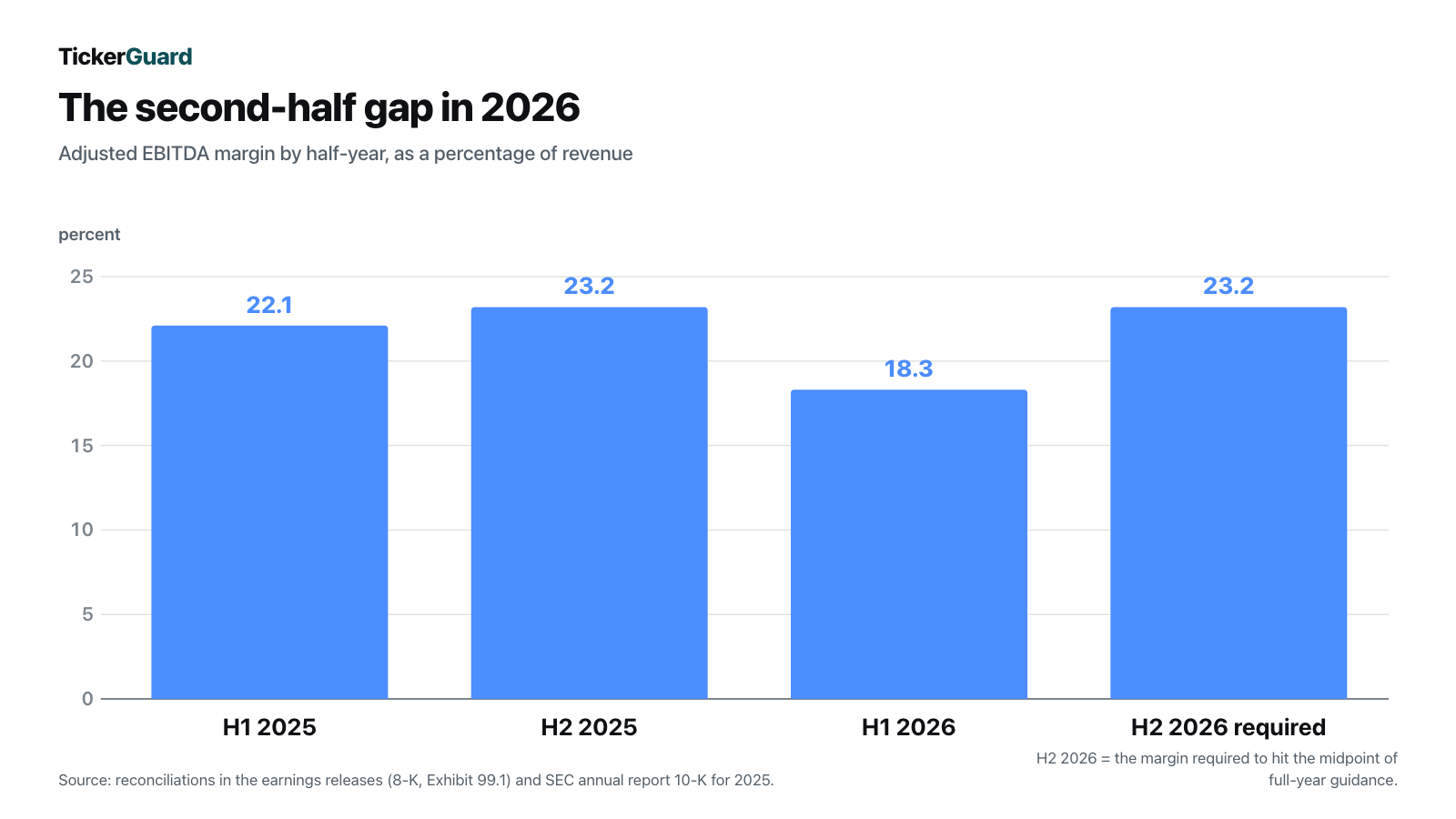
That curve is the real story. It says the company is larger than ever — and less profitable than a year ago. Both at once. Why that is, the filings explain. But first it is worth checking what management itself has promised over the years, because guidance can be held to account.
What Management Promised — Ten Earnings Calls in Review
Earnings call transcripts are an underrated source. They are not SEC filings and carry no comparable legal weight — but they show what a management team expected before it knew how things would turn out. We worked through ten calls, from the first quarter of 2024 to the second quarter of 2026. Three patterns stand out.
First: what is announced loudly gets buried quietly. In early 2024 Viemed presented a joint venture with a hospital and described it as a template, "one that we will replicate around the country." A year later, on the call covering the fourth quarter of 2024, the same subject sounded like this: if the company were to do another one, it would need to be substantial enough to make "the juice worth the squeeze." A growth program had become a case-by-case review. The reversal was never announced; it exists only in the transcript.
Second: the tone turned exactly once, in the fourth quarter of 2025. On the second-quarter 2025 call, management celebrated the new coverage rule from the Centers for Medicare & Medicaid Services (CMS) as a victory: "The big win is that tried and failed approach on BiPAP and step therapy is over." Two quarters later, reviewing the full year, the same rule was described this way: "the updated criteria mean some patients who previously may have qualified under the prior framework may not qualify today." From "big win" to access barrier in six months.
Third, and most important: the central cost promise of 2026 held for exactly one quarter. On the first-quarter 2026 call on May 6, operating leverage was the pride of the house. Management cited the administrative expense ratio as proof that scale was starting to work — "The most telling thing is the 200 basis point improvement in SG&A in one year." And derived the margin guidance from it:
“We continue to expect adjusted EBITDA margin to be in the range of approximately 21% to 22% for the full year 2026, supported by operating leverage in SG&A as the revenue base grows.”
— Viemed Healthcare, Inc., first-quarter 2026 earnings call, May 6, 2026 (transcript)
Ninety days later, on the second-quarter call of August 4, 2026, the same sentence read: "we expect to deliver a full year adjusted EBITDA margin of at least 20%." "Approximately 21 to 22 percent" had become "at least 20 percent." The change was never flagged as a change. And the administrative expense ratio, the pride of May, was no longer quantified by management in August — no percentage, no basis points. Administrative cost appeared only as an increase, explained with a list of drivers and not a single figure: "SG&A increased as we added the capabilities required to support a substantially larger company." That the ratio had deteriorated was raised on that call by an analyst, not by the company. Alongside it stood this: "We are in a growth phase, and we are investing accordingly."
In fairness, management offers a coherent explanation for the margin decline, and it is not easy to dismiss. The newer businesses — resupply, women's health — carry structurally lower margins but need almost no capital. On the same call the argument ran that this is acceptable precisely because net income margins should eventually widen as a result: "net income margins are going to ultimately expand as a result of that." Except that is not what happened in the second quarter of 2026 — the net margin fell from 5.0 to 3.5 percent. The promise is plausible; it simply has not arrived. One detail deserves a footnote of its own: the very metric management named in May as the future yardstick for valuing the company also went backwards. Trailing twelve-month free cash flow fell from $36.3 million to $34.4 million. Nobody commented on it, and nobody asked.
Which brings us to a fourth pattern that is really a warning: the question-and-answer sessions are strikingly thin. On the first-quarter 2026 call a single analyst asked three questions before the operator closed the session; on the second-quarter call two analysts asked six. Dilution, cash position and competitors came up zero times across both calls. Anyone counting on the analyst community as an early warning system for this stock will be waiting a long time. You have to read the filings yourself.
What the Filings Say: The Uncomfortable Truths
Uncomfortable Truth No. 1: The Record No Longer Comes From the Core Business
$78.1 million, up 23.9 percent — that is the headline. The quarterly report breaks down where it came from, and the breakdown looks nothing like the aggregate:
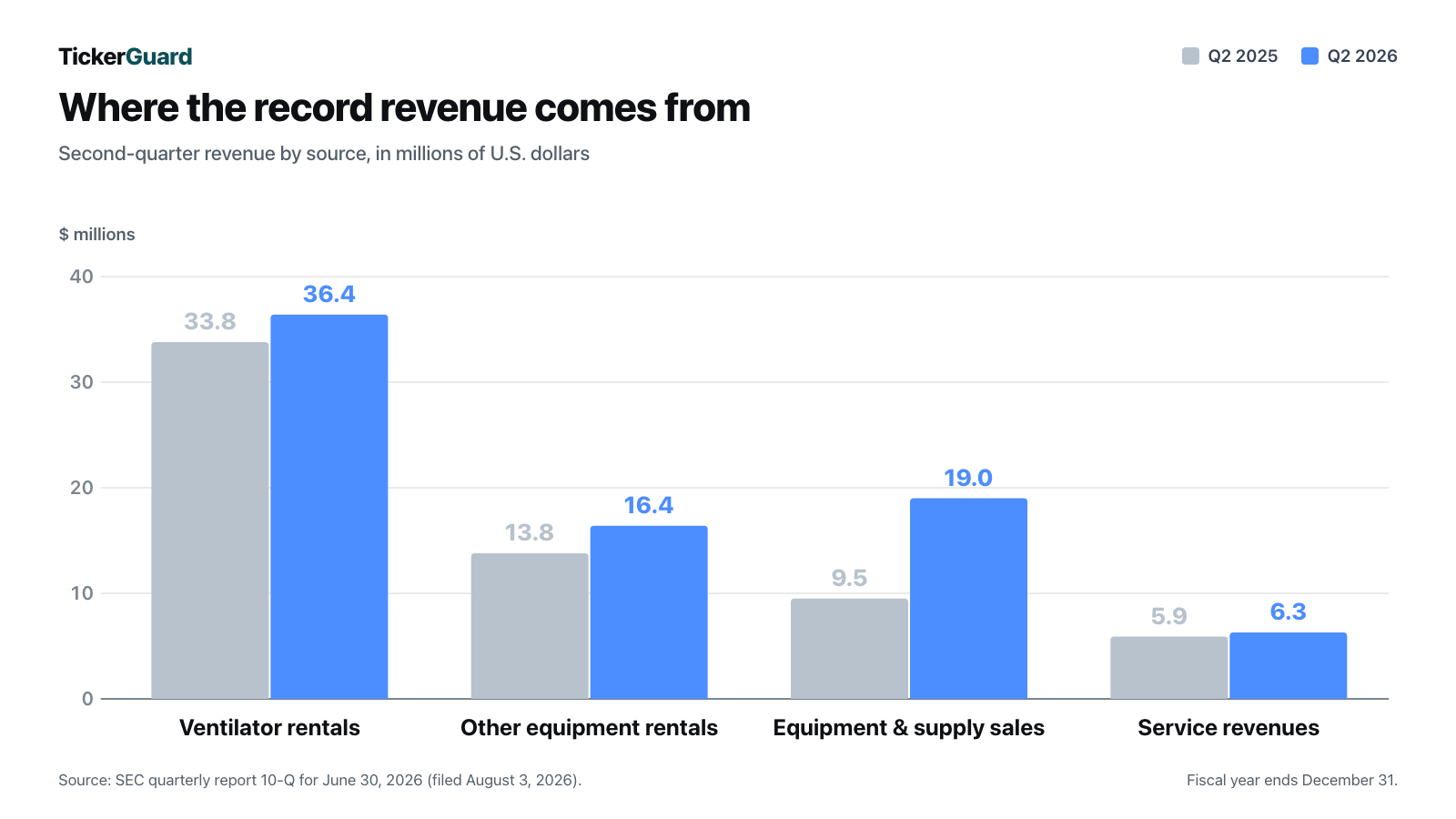
Run the arithmetic. Of the $15.0 million of extra revenue in the quarter, $9.5 million came from equipment and supply sales, which jumped from $9.5 million to $19.0 million — close to a doubling. Ventilator rentals contributed $2.6 million, up 7.7 percent. And a substantial part of the jump in sales was bought rather than built: the Lehan Drugs acquisition closed on July 1, 2025, so it was not in the prior-year quarter at all. The 2025 annual report says as much for the full year, attributing the growth "largely due to the success of our sleep resupply program and the addition of maternal health offerings in connection with the Lehan Drugs, Inc […] acquisition."
The long-run trend is unambiguous. Ventilator rentals as a share of total revenue fell from 59.2 percent in 2023 to 55.6 percent in 2024, 50.6 percent in 2025 and 46.6 percent in the second quarter of 2026. For the first time the heart of the business is no longer the majority of it. That is not automatically bad — diversification lowers risk, and the resupply business needs no capital. But it is a different thing from what the record headline implies. Put in everyday terms: a bakery reports record revenue, and when you look closer the increase comes from the newsstand it opened by the door. The newsstand may be a fine idea. It is just not the same as selling more bread.
Uncomfortable Truth No. 2: Yesterday's One-Off Gains Are Gone — and That Cuts Both Ways
Here the obvious reading misleads, in both directions, so let us be precise.
Across 2024 and 2025, Viemed earned money on the side from a special situation. Device maker Philips had recalled a family of ventilators and offered to buy them back. Viemed used the program to refresh its own fleet — and booked gains on the disposal of that equipment. The 2025 annual report puts a number on them:
“For the year ended December 31, 2025, gain on disposal of property and equipment totaled $2.2 million compared to $1.9 million for the year ended December 31, 2024. In both periods, the gains were primarily attributable to proceeds from the sale of recalled ventilators back to the manufacturer.”
— Viemed Healthcare, Inc., Form 10-K for 2025, Item 7 (MD&A), "Gain on disposal of property and equipment"

The well has run dry, and the company says so explicitly: the buyback program was substantially complete as of December 31, 2025, and no further material gains are expected. The half-year figures show the size of the swing. The income statement line reads "Loss (gain) on disposal of property and equipment":
- First half of 2025: a gain of $3.004 million
- First half of 2026: a loss of $0.954 million
That is a $3.96 million swing in the income statement — and because Viemed does not back this line out when calculating adjusted EBITDA, it sits inside the published figure. Now the arithmetic you have to do in order not to be fooled:
- As reported: first-half adjusted EBITDA of $27.052 million in 2025 against $28.026 million in 2026 — up 3.6 percent, against 25.6 percent revenue growth. It looks like stagnation.
- Excluding disposals in both years: $24.048 million against $28.980 million — up 20.5 percent. It looks considerably better.
- But as a margin: even adjusted, it fell, from 19.7 to 18.9 percent. The decline is smaller than the reported move from 22.1 to 18.3 percent — but it does not disappear.
The second quarter alone follows the same pattern: as reported $13.715 million against $14.287 million, down 4.0 percent; excluding disposals $14.313 million against $13.651 million, up 4.8 percent — with the margin falling from 21.6 to 18.3 percent on the adjusted basis. The company itself flags the comparison effect, telling the second-quarter call that "Excluding that prior year gain, adjusted EBITDA increased year-over-year." That is true, and our own calculation confirms it. It simply does not answer the question that matters: the margin falls on an adjusted basis too, because the incremental business brings in less than the old business did.
One more number, buried in the cash flow statement, tells the same story from another angle: proceeds from the sale of property and equipment fell from $13.355 million in the first half of 2025 to $2.401 million in the first half of 2026. So the buyback did not merely flatter reported earnings; for years it also relieved the capital expenditure line. That relief is now gone. Remember the sentence: anyone using 2024 and 2025 as a benchmark is comparing against years in which a one-off effect was helping.
Uncomfortable Truth No. 3: Operating Leverage Is Running in Reverse
Operating leverage is a simple promise: as a company grows, administrative costs should grow more slowly than revenue, because rent, software and head office spread across more business. That is exactly what Viemed held out for 2026. In the second quarter of 2026 the opposite happened, and the quarterly report states it in one line:
“Selling, general, and administrative expenses as a percentage of revenue was 47.5% for the three months ended June 30, 2026 compared to 45.7% for the three months ended June 30, 2025.”
— Viemed Healthcare, Inc., Form 10-Q for the quarter ended June 30, 2026, Item 2 (MD&A)
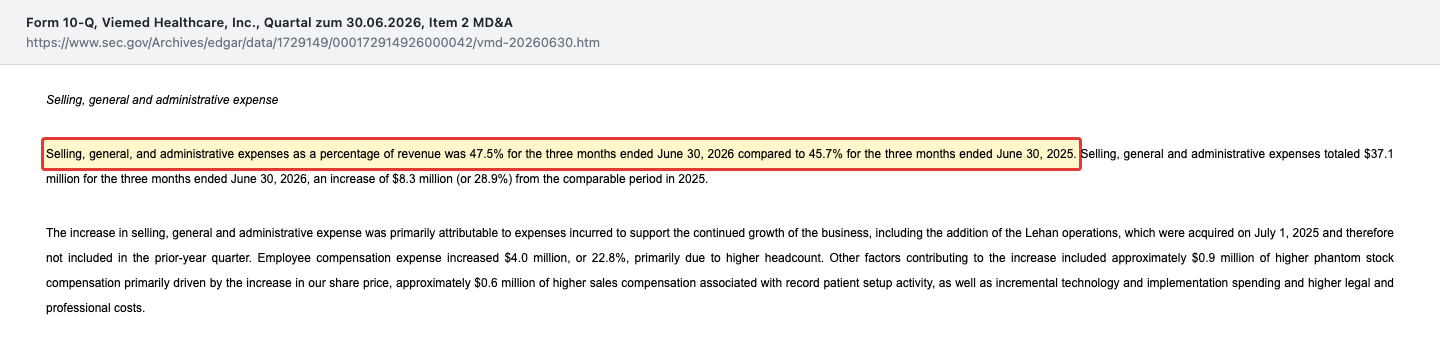
In absolute terms: $37.1 million of administrative expense, up $8.3 million or 28.9 percent — against 23.9 percent revenue growth. Leverage is working against the company. And, in fairness, the filing explains why. The largest piece is $4.0 million of additional employee compensation as headcount rose (from 1,382 at the end of 2025 to 1,453 at June 30, 2026). On top of that sits roughly $0.9 million from revaluing a cash-settled equity award that became more expensive simply because the company's own share price rose — a line item that unwinds on its own if the price falls.
Gross margin softened at the same time, from 58.3 to 57.7 percent in the quarter. The annual report had already described this direction for 2025 and attributed it to the changing revenue mix, with a higher share of revenue that carries higher direct costs relative to ventilator rentals. Taken together: less of every incremental dollar sticks at the top and more of it leaves at the bottom. Not a catastrophe, but not a snapshot either — the trend has been running in the same direction for two years.
Uncomfortable Truth No. 4: Five Points Are Missing From the Company's Own Guidance
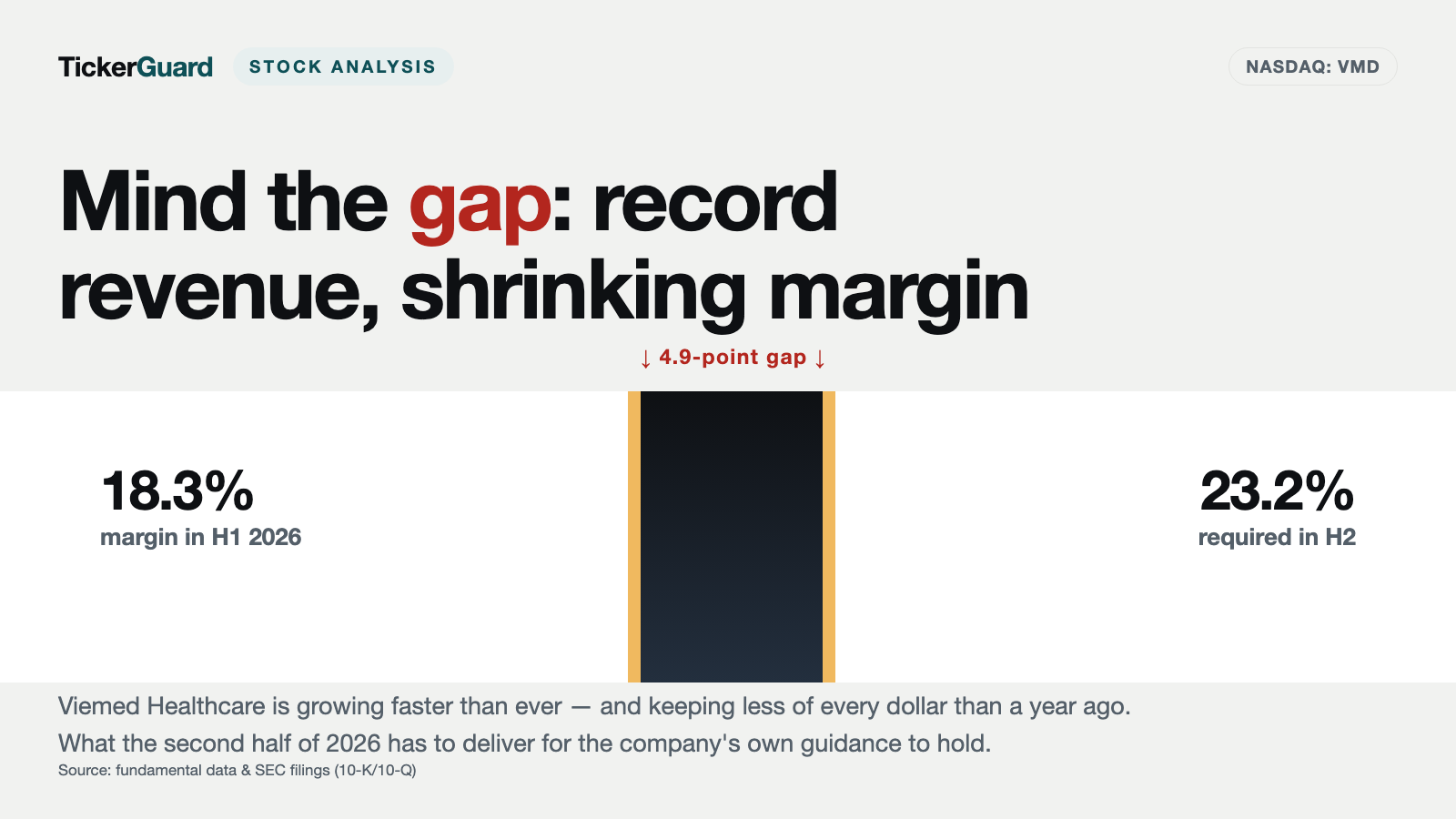
This is the calculation that gives the analysis its title, and you can follow it with a pocket calculator. In the first half of 2026 Viemed produced $28.026 million of adjusted EBITDA — $14.311 million in the first quarter plus $13.715 million in the second — on $153.511 million of revenue. That is 18.3 percent. The guidance updated on August 3, 2026 calls for $64 million to $68 million of adjusted EBITDA on $314 million to $320 million of revenue. Take the midpoint of each and the second half must deliver roughly $38.0 million on roughly $163.5 million — 23.2 percent. Even at the bottom of the range it is 21.6 percent. So between 3.3 and 6.6 margin points are missing, over six months.
And now the objection, which is a fair one: Viemed did exactly this last year. The second half of 2025 delivered $34.3 million of adjusted EBITDA on $148.1 million of revenue, or 23.2 percent, after 22.1 percent in the first half. The business is seasonal: more patients have met their deductibles by the second half, so more gets billed. Management pointed to precisely that on the second-quarter call, saying it expected the back half of 2026 to look roughly like the prior year — "if you look at last year, the back half of the year carried probably 20%, 30% EBITDA margin." That answer, however, is a ten-point range containing two instances of "probably." And when an analyst asked which specific levers would carry the jump, three measures followed — a national distributor, a new intake workflow, a call center brought in-house — with not a single quantified effect. No dollar amount, no basis points, no date.
The honest framing is therefore this: the guidance is not impossible, and it was achieved last year. It is simply unevidenced this time — and the difference from last year is that the one-off benefit from the ventilator buyback, which helped in 2025, has run out. The second half of 2026 is the proof the company still owes.
Uncomfortable Truth No. 5: Two Years of Buybacks, and the Share Count Has Not Moved
Buybacks are popular because the arithmetic sounds so simple: fewer shares, same earnings, more earnings per share — your slice of the pie grows without the pie having to. Viemed has been buying since mid-2025, and seriously: 1,976,441 shares under the 2025 program and another 680,802 in the first half of 2026 for $6.5 million. Roughly 2.6 million shares, retired and cancelled.
The effect on the number that determines earnings per share: none. The diluted share count was 41,125,716 in the second quarter of 2026 against 41,083,760 a year earlier — marginally higher. The reason sits directly beneath it in the earnings-per-share reconciliation: the line "Stock options and other dilutive securities" grew from 1,568,513 to 2,880,225, an increase of 1.31 million share equivalents. What the buyback removed, equity compensation put back.
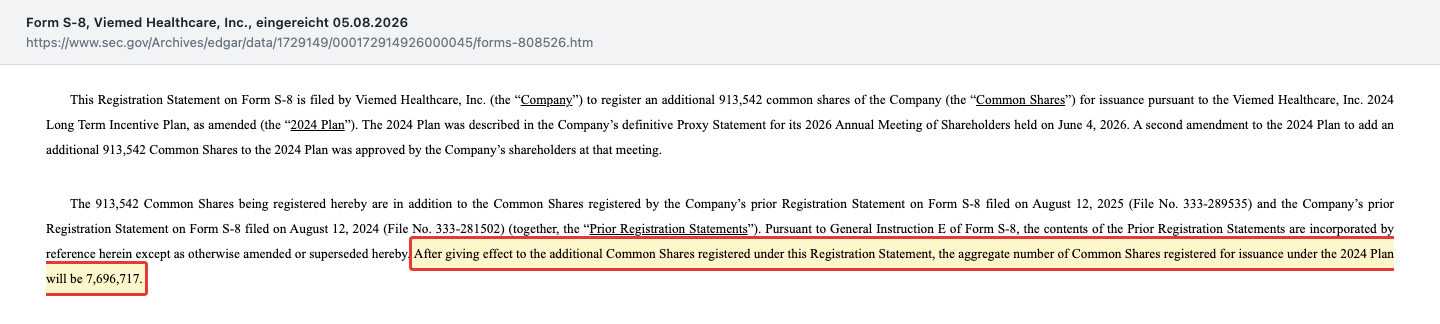
Honesty requires a caveat: part of that increase is mechanics, not a new decision. Under the U.S. treasury stock method, the higher the share price, the more options count toward dilution. The closing price rose from $7.43 at December 31, 2025 to $11.40 at June 30, 2026, so the number had to rise. For a shareholder, though, the result is unchanged: two years of buybacks have not reduced the denominator that earnings are divided by. How much room exists in the other direction is shown by a filing Viemed submitted two days after the quarterly report:
Uncomfortable Truth No. 6: Thin Cash — and Washington Writes the Rules
Two unrelated points that both belong under "watch this." First, cash. For all the operating cash flow, only $10.7 million sat in the accounts at June 30, 2026, down from $13.5 million at the end of 2025. Current assets exceeded current liabilities by just $6.1 million. That is tight — and it is also a consequence of the company's own choices: in the first half, $5.4 million went to debt repayment, $6.5 million to buybacks and $2.0 million to payroll tax on vesting awards. Viemed has $46 million of undrawn credit facilities and confirmed compliance with all covenants at June 30, 2026, so this is not a liquidity problem. It is a thin blanket all the same: if reimbursement from a large payor stalls, the buffer disappears quickly.
Second, regulation. On June 9, 2025 CMS set binding medical necessity criteria for the first time governing when noninvasive ventilation at home is covered for chronic respiratory failure related to chronic obstructive pulmonary disease. The annual report frames this unusually bluntly:
“The final NCD may significantly affect patient access, reimbursement, and utilization of ventilator therapies. Because Medicare coverage policies often influence commercial payors, including Medicare Advantage plans, changes to Medicare policy may have broader implications across our payer base.”
— Viemed Healthcare, Inc., Form 10-K for 2025, Item 1A (Risk Factors)
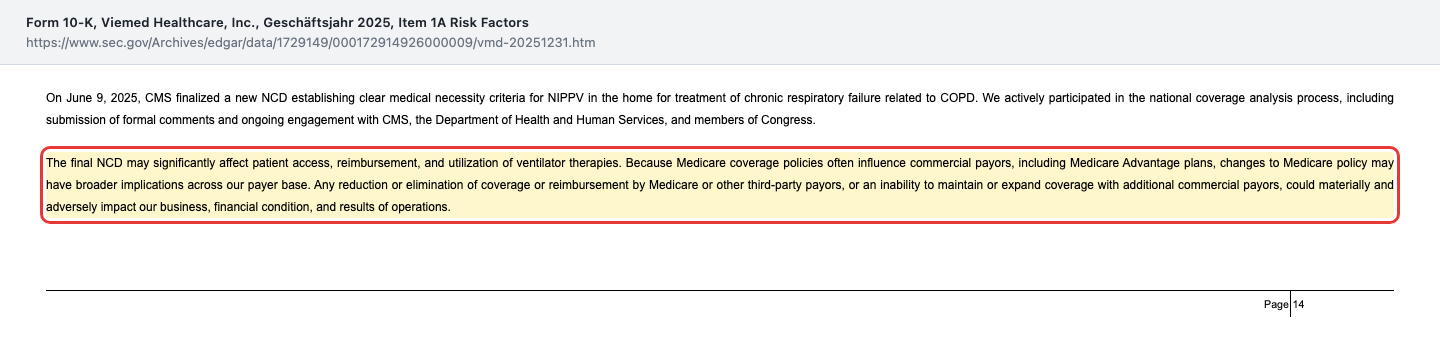
This is where the earnings calls fit in: what was celebrated as a "big win" in the second quarter of 2025 became, two quarters later, an admission that some patients may no longer qualify. For scale: ventilator rentals were 50.6 percent of 2025 revenue, and Medicare and Medicaid together 40 percent. Nor is the matter settled — the agency has also proposed comprehensive reform of the competitive bidding program for durable medical equipment. In its own annual report the company suggests larger providers are generally better positioned under such a restructuring; that will only be certain once the rules are final.
Valuation
Now to what the market is paying for all this — and it is worth putting on two pairs of glasses in turn, because they produce opposite answers. On August 26, 2026 the stock closed at $9.33. With 38,088,228 shares outstanding as of June 30, 2026, that implies a market value of roughly $355 million.
Through the earnings lens, that is expensive. Trailing twelve-month earnings per share were $0.36, which puts the price-to-earnings ratio at roughly 26. For a company whose net income fell 12 percent in the latest quarter, that is not a bargain price. A price-to-earnings ratio of 26 says, in plain terms, that at unchanged earnings the company would need 26 years to earn back today's purchase price.
Through the cash flow lens, the same stock looks cheap. Against $60.8 million of operating cash flow and $34.4 million of free cash flow over twelve months, that same market value is a little over ten times free cash flow — and on an enterprise value basis the multiple of adjusted EBITDA sits in the low single digits. The price-to-sales ratio is roughly 1.2 on $301.6 million of trailing revenue. This very discrepancy came up on an earnings call in late 2025, when an analyst calculated that the stock traded at about four times EBITDA and asked what it would take to get investors interested in the sector again. Management's answer conceded the puzzle openly: a multiple reset would simply have to happen, it said, because the company generates as much discretionary free cash flow as anybody in the industry. As for when and how, the answer was candid — "So I don't know exactly how that will translate into the stock price." Capital allocation would keep being watched, with buybacks the likeliest lever if the price warranted it.
Both lenses are correct, and the contradiction is not a rounding error. Viemed depreciates heavily — $15.1 million in the first half of 2026 alone — because the rental model puts equipment on the balance sheet. Depreciation depresses profit but costs no cash in the current year, which is why cash flow is high and profit is low. Valuing Viemed on earnings counts the depreciation; valuing it on cash flow ignores that the equipment eventually has to be replaced. The honest middle ground is free cash flow after equipment spending, which last stood at $34.4 million — trending down from the $36.3 million reported three months earlier. The average analyst price target was around $11 as of August 27, 2026; with a handful of analysts covering the name at all, that is a mood reading rather than a measurement.
Upside and Risks at a Glance
What speaks for Viemed:
- A market that grows on its own. Shifting care from the hospital to the living room is a politically favored, demographically driven trend; the annual report cites projections that U.S. home healthcare spending will reach $250 billion by 2031.
- A balance sheet without worries. $144.0 million of equity against $7.4 million of financial debt, $46 million of undrawn credit lines, and all covenants met at June 30, 2026.
- Real cash generation. $60.8 million of operating and $34.4 million of free cash flow over twelve months — Viemed funds growth, debt repayment and buybacks out of its own pocket.
- Falling government concentration. Medicare's share of revenue dropped from 44 percent in 2023 to 35 percent in the first half of 2026.
- Capital-light add-on businesses. Resupply and women's health are growing at double-digit rates and tie up almost no capital — which is precisely what lowers the capital expenditure ratio, already cut from a 9 to 10.5 percent range to 8.5 to 10 percent of revenue.
What speaks against it:
- The margin is falling, adjusted too. Excluding disposal gains and losses, the first-half EBITDA margin fell from 19.7 to 18.9 percent; as reported, from 22.1 to 18.3 percent.
- The company's own guidance is unevidenced. Roughly five margin points are missing in the second half for the midpoint to hold, and the levers named were never quantified.
- The one-off benefit is gone. The ventilator buyback program was substantially complete as of December 31, 2025; proceeds from equipment sales fell from $13.4 million to $2.4 million in the half-year.
- A single regulatory decision matters. The coverage rule of June 9, 2025 may, per the annual report, "significantly affect" access to and reimbursement of ventilator therapy — a business that was still 50.6 percent of 2025 revenue.
- Thin cash, thin coverage. $10.7 million of cash and $6.1 million of net working capital at June 30, 2026; one and two analysts respectively asked questions on the 2026 earnings calls.
- The buyback is not landing. Despite 2.6 million shares retired since mid-2025, the diluted share count sits slightly above the prior year.
A Human Conclusion
Remember the record reflex from the opening? It works so well because it does not lie. Viemed genuinely posted the highest revenue and the most patients in its history. The word "record" is accurate — it is simply not the whole answer. The whole answer is that a solid, nearly debt-free company with a worthwhile business has decided to grow fast and to earn less while it does. It says so fairly openly: "We are in a growth phase, and we are investing accordingly." Whether that sentence describes a strategy or an excuse will not be settled in a press release. It will be settled in the next two quarterly reports.
What we like about this stock is that you can check it. Every figure in this article comes from documents filed under penalty of law. What we do not like is that the decisive commitment — five more margin points in the second half — currently rests on an analogy and two instances of "probably." And that a metric management itself named in May as the future yardstick came in lower in August, without comment.
So what you can do is quite concrete. Open the next quarterly report, look at two lines — the adjusted EBITDA margin and the diluted share count — and you will know more about this company than any headline can tell you. If the margin moves toward 22 percent in the third quarter, 2026 really was an investment year. If it stays at 18, it was something else. Either way: what you make of that is your decision. And that is exactly as it should be.
Sources and Transparency
- Form 10-Q for the quarter ended June 30, 2026 (filed August 3, 2026) — income statement, balance sheet, cash flow statement, Note 2 (revenue by source), Note 3 (Lehan), Note 6 (debt), Note 8 (shareholders' equity), Note 11 (earnings per share), Item 2 (MD&A)
- Form 8-K filed August 3, 2026, Exhibit 99.1 — second-quarter 2026 earnings release with guidance and the reconciliations to adjusted EBITDA and free cash flow
- Form 10-K for 2025 (filed March 4, 2026) — Item 1 (business, reimbursement, the CMS coverage rule), Item 1A (risk factors), Item 7 (MD&A)
- Form 10-K for 2024 (filed March 10, 2025) — comparative figures
- Form S-8 filed August 5, 2026 — shares under the 2024 Long Term Incentive Plan
- All SEC filings by Viemed Healthcare (CIK 0001729149)
- Transcripts of the earnings calls for the first quarter of 2024 through the second quarter of 2026 (ten calls, most recently August 4, 2026)
- Price, market value and analyst data: source: fundamental data, as of August 26 to 27, 2026
Transparency and disclaimer. This article is journalistic analysis of publicly available documents. It is expressly not investment advice, not a recommendation to buy or sell, and not a solicitation to buy or sell securities. Share prices can move sharply; a total loss of invested capital is possible. All figures come from the primary sources linked above and carry the as-of dates stated there; later developments are not reflected. The author holds no position in Viemed Healthcare, Inc. at the time of publication. Please make your own investment decisions and consult an independent adviser if in doubt.
Key figures at a glance
All monetary figures in millions of $; earnings per share as reported.
| Metric | 2021 | 2022 | 2023 | 2024 | 2025 |
|---|---|---|---|---|---|
| Revenue | 117.1 | 138.8 | 183.0 | 224.3 | 270.3 |
| Operating Income (EBIT) | 11.6 | 8.3 | 14.3 | 17.9 | 20.7 |
| Net Income | 9.1 | 6.2 | 10.2 | 11.3 | 14.9 |
| Net Margin | 7.8% | 4.5% | 5.6% | 5.0% | 5.5% |
| Earnings Per Share | 0.22 $ | 0.16 $ | 0.25 $ | 0.28 $ | 0.37 $ |
Source: fundamental data & SEC filings (annual and quarterly reports, 10-K/10-Q)
Our Bottom Line at a Glance
- Balance sheet & leverage positive
- At June 30, 2026 the company held $144.0 million of equity against only $7.4 million of financial debt, plus $46 million of undrawn credit facilities and confirmation in the quarterly report that all covenants were met. It repaid $5.4 million in the first half of 2026.
- Growth positive
- Revenue rose from $183.0 million in 2023 to $224.3 million in 2024 and $270.3 million in 2025, with $153.5 million in the first half of 2026, up 25.6 percent. Patient counts hit record levels in all three main lines as of June 30, 2026.
- Profitability & operating leverage negative
- The adjusted EBITDA margin fell to 18.3 percent in the first half of 2026 from 22.1 percent a year earlier; even excluding gains and losses on equipment disposals it declined from 19.7 to 18.9 percent. Administrative costs rose 28.9 percent in the second quarter against 23.9 percent revenue growth.
- Reliability of guidance negative
- In May 2026 management guided to a 21 to 22 percent adjusted EBITDA margin for the year; in August it said "at least 20 percent," and the earnings range was cut from $65 to $69 million to $64 to $68 million. Roughly five margin points are missing in the second half for the midpoint, and the levers named were never quantified.
- Business mix & capital intensity neutral
- Ventilator rentals fell from 59.2 percent of revenue in 2023 to 46.6 percent in the second quarter of 2026, in favor of capital-light sales and resupply. That lowers the capital expenditure ratio, now guided to 8.5 to 10.0 percent from 9.0 to 10.5 percent, but costs margin — whether more sticks at the bottom is an open question.
- Regulation & reimbursement neutral
- Medicare dependence fell from 44 percent in 2023 to 35 percent in the first half of 2026. At the same time the CMS coverage rule of June 9, 2025 may, per the annual report, "significantly affect" access to, reimbursement of and utilization of ventilator therapy — a business that was still 50.6 percent of 2025 revenue.
Viemed Healthcare grows fast, operates profitably and funds itself with almost no debt: $270.3 million of revenue in 2025, $60.8 million of operating cash flow over twelve months, $7.4 million of financial debt against $144.0 million of equity. The record second quarter of 2026, however, came mainly from acquired, lower-margin sales businesses; the adjusted EBITDA margin fell from 22.1 to 18.3 percent in the half-year, and the company cut its own earnings guidance. Whether 2026 was an investment year or the start of structural margin erosion will be decided in the next two quarterly reports. Not investment advice.
What Our Rating Means
Open questions
The business works in principle, but one material question is open. As long as it stays open, our findings do not carry a quality verdict.
Yellow, because one material operating question is open — not because the substance is shaky. The company has real strengths on the record: years of rising revenue to $270.3 million in 2025, net income of $15.4 million, $60.8 million of operating cash flow over twelve months, essentially no financial debt, and falling dependence on government health insurance, down to 35 percent from 44. What is open is earning power. The adjusted EBITDA margin fell to 18.3 percent in the first half of 2026 from 22.1 percent, and even excluding the now-expired gains from the ventilator buyback program it declined from 19.7 to 18.9 percent. The operating leverage management cited in May 2026 as proof of scale ran in reverse in the second quarter, and the company's own margin commitment was pulled back from 21 to 22 percent to "at least 20 percent." Roughly five margin points are missing in the second half for the midpoint of guidance, with no quantified lever offered so far. On top of that sits the CMS coverage rule of June 9, 2025, a single regulatory decision that the annual report says may significantly affect access to ventilator therapy. None of this threatens the substance — the thin $10.7 million cash position stands against $60.8 million of annual cash generation and $46 million of undrawn credit. Hence yellow rather than red: what is missing is the proof, not the foundation. The decision is yours.
A journalistic assessment by our editorial team at the time of the deep dive, based on public sources — not investment advice and not a solicitation to buy or sell. Your personal circumstances (investment goals, risk capacity, taxes) cannot be taken into account. What our levels mean, how verdicts are formed, and what conflicts of interest exist →
Worth Noting
- Trigger for this analysis: the quarterly report (Form 10-Q) for June 30, 2026, filed August 3, 2026, together with the earnings release of the same day (Form 8-K, Exhibit 99.1) and the Form S-8 registration of August 5, 2026.
- As-of dates: annual and quarterly figures come from the Form 10-K for 2025 (filed March 4, 2026) and the Form 10-Q filings for March 31, 2026 and June 30, 2026. Price, market value and analyst figures are as of August 26 to 27, 2026.
- On the earnings calls: transcripts of ten calls (Q1 2024 through Q2 2026) were reviewed. Transcripts are not documents filed with the SEC, so quotations from them are attributed to management as a whole rather than to named individuals. Every figure in the text comes solely from filed reports.
- Possible confusion: "Viemed" is occasionally mixed up with similar brand names used by other medical device suppliers; this analysis concerns only Viemed Healthcare, Inc., SEC identifier CIK 0001729149. Despite its Canadian incorporation, the company is a regular U.S. reporting issuer filing Forms 10-K and 10-Q.
Stock Watch
This analysis is as of August 29, 2026. Stock Watch will tell you what's changed at VMD since then.
Later $1 a month per stock — signing up is free, and you'll be the first to know when it launches.
The full analysis as a PDF for later
We will send you this analysis as a PDF — to print, file away, and read at your own pace. And we will add you to the free Stock Watch list for Viemed Healthcare Inc (VMD), so you hear about it when something material in this analysis changes.
Frequently Asked Questions
Viemed Healthcare, Inc. (NASDAQ: VMD), based in Lafayette, Louisiana, cares for seriously ill patients at home with medical equipment and clinical support. The core business is renting ventilators along with house calls by respiratory therapists. Around it sit sleep apnea therapy and the associated resupply business, oxygen therapy, healthcare staffing, and, since July 2025, women's health products. The company had 1,382 permanent employees as of December 31, 2025.
Three factors combined. First, a comparison effect: the prior year included gains from selling recalled ventilators back to the manufacturer, $3.0 million in the first half of 2025, against a $1.0 million loss in the same line in 2026. Second, administrative costs grew 28.9 percent while revenue grew 23.9 percent. Third, the mix is shifting toward lower-margin businesses. Excluding disposals, first-half adjusted EBITDA rose 20.5 percent — but the margin still fell from 19.7 to 18.9 percent.
Less every year. Medicare accounted for 44 percent of total revenue in 2023, 41 percent in 2024, 38 percent in 2025 and 35 percent in the first half of 2026. Medicare and Medicaid together were roughly 40 percent of 2025 revenue. More important than the share is the coverage rule: on June 9, 2025 the Centers for Medicare and Medicaid Services set binding criteria for noninvasive ventilation at home for the first time, which the annual report says may significantly affect access and reimbursement.
On August 3, 2026 the company guided to full-year revenue of $314 million to $320 million, up from $312 million to $320 million, and adjusted EBITDA of $64 million to $68 million, down from $65 million to $69 million. The revenue range was raised at the low end while the earnings range was cut. Net capital expenditure is guided to 8.5 to 10.0 percent of revenue, down from 9.0 to 10.5 percent. First-half adjusted EBITDA margin was 18.3 percent — hitting the midpoint would require about 23.2 percent in the second half.
The stock closed at $9.33 on August 26, 2026. With 38,088,228 shares outstanding as of June 30, 2026, that implies a market value of roughly $355 million. Against trailing twelve-month earnings per share of $0.36 that is a price-to-earnings ratio of about 26, and against $301.6 million of trailing revenue a price-to-sales ratio of about 1.2. Measured against $34.4 million of free cash flow it is a little over ten times.
Very little. At June 30, 2026 the balance sheet showed $7.4 million of bank borrowings, of which $6.4 million was long-term, against $144.0 million of equity. The company repaid $5.4 million in the first half of 2026. Its 2022 senior credit facilities most recently left $46 million undrawn, and all covenants were met at June 30, 2026. Cash, by contrast, is thin: $10.7 million, with net working capital of only $6.1 million.
Viemed has retired roughly 2.6 million of its own shares since mid-2025. The diluted share count was nevertheless 41,125,716 in the second quarter of 2026, after 41,083,760 a year earlier. The reason sits in the earnings-per-share reconciliation: options and similar securities counted toward dilution rose from 1,568,513 to 2,880,225. Part of that is mechanical, because the U.S. treasury stock method counts more options as the price rises — and the price went from $7.43 to $11.40 between the two dates.
A little of both, but in practice American. Viemed Healthcare, Inc. is incorporated under the laws of British Columbia, Canada, yet its headquarters and all of its operations are in the United States. It reports in U.S. dollars under U.S. accounting rules and files regular annual reports on Form 10-K and quarterly reports on Form 10-Q with the SEC, not the forms used by foreign private issuers. The stock trades on NASDAQ.
Found an error?
Did you spot a factual error, an outdated number, or a typo in this deep dive? Let us know briefly — your report goes straight to the editorial team.