RCM Technologies: A Record Quarter, a Silent Management — and Insiders Selling Stock
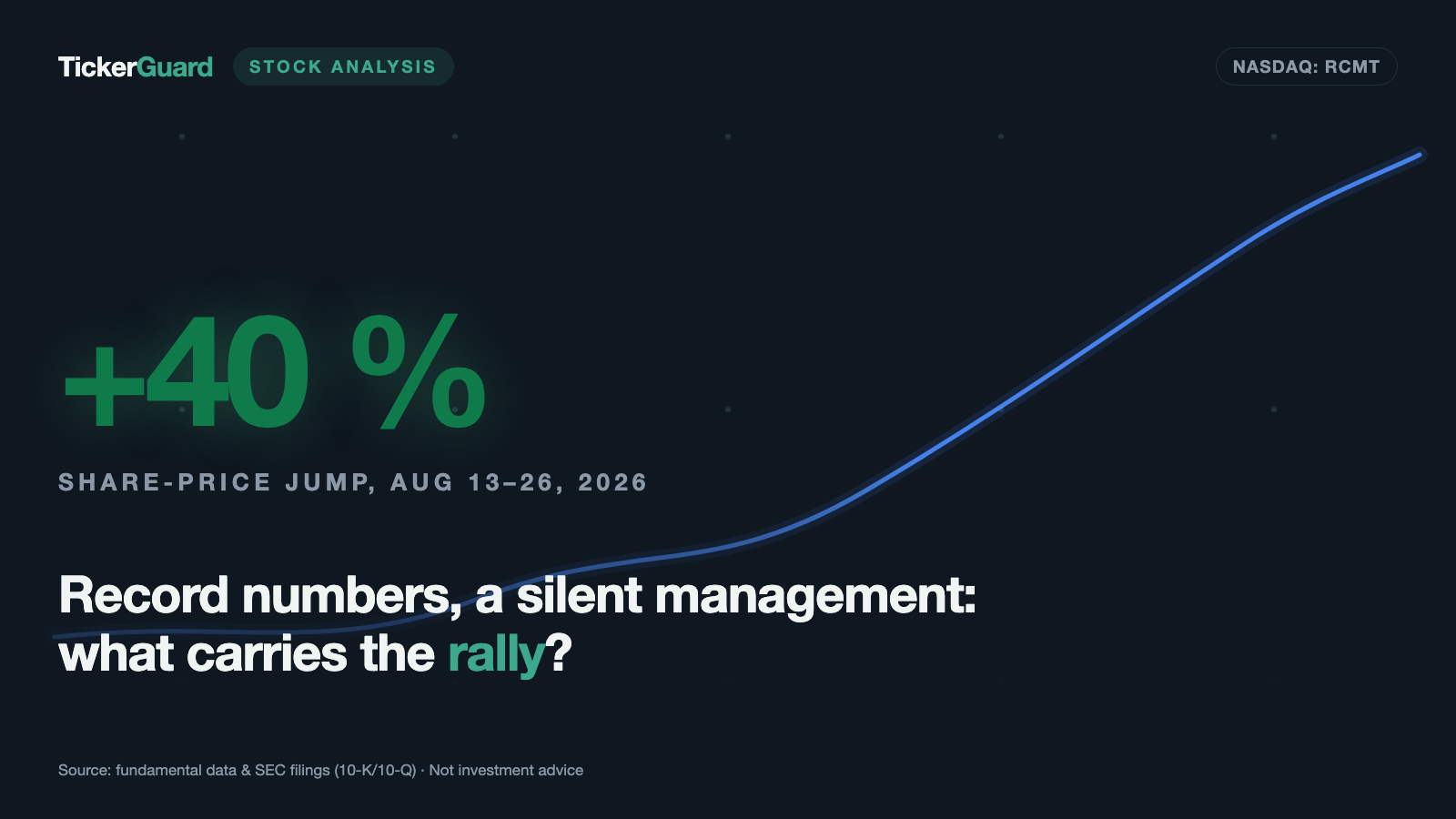
RCM Technologies (Nasdaq: RCMT) staffs school health programs and builds energy projects. After the August 13, 2026 quarterly report — revenue +20.0 percent, net income +29.5 percent, no visible one-time gains — the stock jumped from $28.92 to $40.59 in two weeks. Into those same days fell $8.1 million in insider stock sales, a double auditor switch within ten months, four auditor-identified material weaknesses, and a management that has held no earnings call since April 2026. Not investment advice — just the question of whether real numbers and a turbulent environment cancel each other out, or can be true at the same time.
 Thomas Mücke
Founder & Publisher
Thomas Mücke
Founder & Publisher
As of Today
As of: October 9, 2026
- Closing price
- 41.40 $ -1.10%
- Market Capitalisation
- 0.3 $B
- P/E
- 19.9
- Growth Score
- 6/10
- AAQS
- 8/10
Price change since August 26, 2026: +2.0%
This analysis has a cut-off date. The Stock Guard tells you when something material changes in the numbers. Reserve your free spot
Chart
Interactive price chart (TradingView).
52-week range: 17.60 $ to 42.00 $ · Last price: 41.40 $ (As of: October 9, 2026)
Note: pure fact-based analysis, not investment advice and not a solicitation to buy or sell. All figures without guarantee.
There is a reflex that catches seasoned investors just as easily as beginners — call it the record-quarter reflex. A company reports numbers that are unambiguously good, the stock takes off immediately, and instead of the usual caution, your head produces the opposite: "The numbers are great — don't hesitate now." That's exactly what happened with RCM Technologies, Inc. (Nasdaq: RCMT). On August 13, 2026, the company reported its quarterly results: revenue up 20.0 percent, net income up 29.5 percent. The stock closed that day at $28.92. The next day it was $35.05. By August 26, 2026, the stock closed at $40.59 — a gain of roughly 40 percent in just two weeks, within a 52-week range of $17.26 to $42.26. If you look at that chart, you can almost feel the reflex in your body.
Let's make a deal instead: before you chase the price, let's read together only what RCM Technologies actually reported, under penalty of law, to the U.S. securities regulator, the SEC — the fresh quarterly report (10-Q), the annual report (10-K) for 2025, the press releases, and the insider filings (Form 4) of the past two weeks. And right at first glance, the tension that runs through this whole analysis appears: the record quarter itself is, as far as the filings show, real — no one-time gains, no accounting trick. But the environment it happened in is anything but reassuring: four auditor-identified material weaknesses, an independent auditor that changed twice within ten months, a management that has held no conference call at all since April 2026 — and right into that silence, executives sold $8.1 million of stock in the first week of the rally. Good numbers and a turbulent environment can be true at the same time. That's uncomfortable, but it's exactly what we're about to read through together.
What RCM Technologies actually does
At its core, RCM Technologies is a staffing company with an engineering arm bolted on — a business that places skilled workers with clients and, in one segment, also runs entire projects itself. It is headquartered in Pennsauken, New Jersey; as of January 3, 2026, the company employed about 4,930 people — roughly 3,825 billable professionals in the Specialty Health Care segment, 495 in Engineering, 225 in Life Sciences, Data & Solutions, and 385 in internal roles. The company runs without a classic CEO title: Bradley S. Vizi has held the title Executive Chairman & President since June 2018, and Kevin D. Miller has been CFO for years.
The largest segment, Specialty Health Care, mainly places medical and therapeutic staff in schools — nurses, speech therapists, school psychologists and similar professionals. By far the largest single customer is the New York City Department of Education. That brings a quirk that shows up directly in the quarterly numbers: in the third calendar quarter, when schools close for summer break, this segment's revenue drops sharply for seasonal reasons — a pattern the annual report itself describes as a "significant decline in revenue due to the substantial closure of one of its largest customers … during the third quarter."
The second segment, Engineering, works differently: here RCM doesn't just place staff, it takes on projects directly — including "Engineering, Procurement and Construction Management" (EPC), the complete handling of construction projects from design through execution, mostly for utilities and grid operators. If this market segment interests you, our analysis of MYR Group covers a company that builds similar grid-expansion projects on a much larger scale — a useful yardstick for how differently profitable EPC work can be depending on the project mix. The third segment, Life Sciences, Data & Solutions, places staff for pharma, biotech and IT projects and is the smallest but highest-margin of the three.
Company history for investors
-
2013
A proxy fight brings Bradley Vizi onto the board
The future Executive Chairman joins the board as a co-founder of activist investor Legion Partners through a proxy fight — the former attacker now runs the company from inside.
-
2018
Vizi becomes Executive Chairman & President
Without a separate CEO title, Vizi takes over operating leadership in June 2018 — to this day, nobody at RCM Technologies carries the CEO title.
-
2024
$50 million buyback program approved
The March 29, 2024 program keeps driving the share count lower and accelerates earnings per share faster than profit growth alone.
-
2025
First auditor change: Withum out, EisnerAmper in
On June 30, 2025, RCM Technologies dismisses its longtime auditor — the start of a year with two auditor changes and a growing number of material weaknesses.
-
2025
Last quarterly release with a conference call
On November 5, 2025, management gives its last public commentary on the numbers — after that, the ongoing silence toward shareholders begins.
-
2026
Annual report with no call, second auditor change
On April 3, management cancels the earnings call; on April 29, the auditor changes a second time — back to Withum, just dismissed months earlier.
-
2026
Record quarter, stock rally, insider sales
After the August 13 report, executives sell $8.1 million of stock within a week — more than the entire quarter's net income.
Where this stock landed on our desk
The trigger for this analysis is concrete enough: the quarterly report (10-Q) for the second quarter of fiscal 2026, filed August 13, 2026, covering the 13 weeks through July 4, 2026. A 20.0 percent revenue gain in a single quarter is unusually strong for a staffing company — and that report, together with the roughly 40 percent price jump that followed, is what made us look closer. What turned up afterward in the filings, releases and insider forms of the following two weeks shifted the original story considerably — that's what the rest of this analysis is about.
The numbers over the years
First, what genuinely impresses. RCM Technologies runs on a 52/53-week fiscal year that ends on the Saturday closest to December 31 — fiscal 2025 therefore had 53 weeks instead of the usual 52 and ended on January 3, 2026, one week later than fiscal 2024. Over six fiscal years, revenue grew from $150.4 million (FY2020) to $319.4 million (FY2025); net income went from an $8.9 million loss in 2020 to a $16.3 million profit in 2025 — after the prior record of $20.9 million in 2022 and pullbacks to $16.8 million in 2023 and $13.3 million in 2024. So 2025 is a record year for revenue; for net income, the 2022 high still stands.
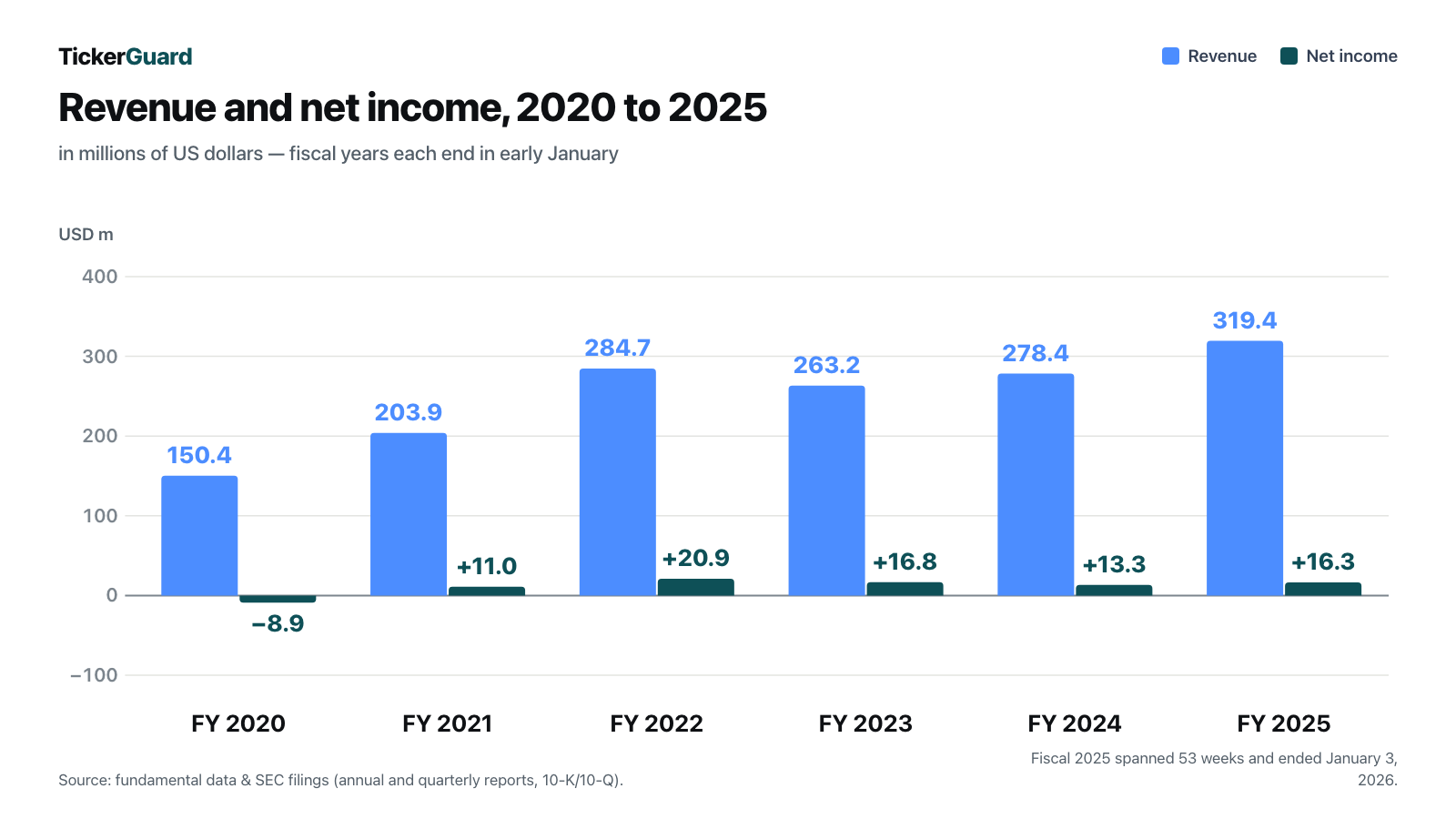
The latest quarter in detail (10-Q filed August 13, 2026, 13 weeks through July 4, 2026): revenue of $93.8 million versus $78.2 million a year earlier, up 20.0 percent — the highest quarterly revenue the company has ever reported (the previous high was the fourth quarter of fiscal 2025, at $86.5 million). That revenue record is what "record quarter" in the headline refers to. Net income was $4.9 million versus $3.8 million, up 29.5 percent. Diluted earnings per share rose from $0.50 to $0.68 — up 36 percent, well ahead of the profit growth. The reason: the diluted share count fell about 4.6 percent over the year (7.54 million to 7.19 million shares), because the company keeps buying back its own stock. Growth split among fewer shares lifts earnings per share on top of the operating improvement — an effect worth separating cleanly from the real business gain.
What's baked into the record numbers — and what isn't
This is where the magnifying glass earns its keep, because this is exactly where wishful thinking and evidence part ways. We went through the quarterly and annual reports systematically looking for one-time effects — insurance recoveries, litigation proceeds, gains on sales, reserve releases, tax one-offs. Here's what we found:
- No one-time gains in the second quarter of 2026. Neither an insurance recovery nor litigation income nor a gain on sale shows up in the income statement. The 20.0 percent revenue gain and 29.5 percent profit gain are, as far as the filings show, genuinely earned from operations — that's the real good news in this analysis.
- The first half of 2026 was, if anything, held back rather than flattered: $0.6 million in unplanned professional fees for the delayed 2025 annual audit weighed on administrative expense. Strip that one-off out and first-half operating income would have been roughly $14.5 million instead of $13.9 million.
- The fiscal 2025 numbers, on the other hand, carry a flattering effect worth knowing about. The effective tax rate fell to 26.0 percent in 2025 (2024: 34.0 percent) — a one-time effect from the full release of $1.2 million in "unrecognized tax benefits" (tax positions previously not booked as certain because they were in dispute). Without that effect, the rate would have been about 31.4 percent, net income about $15.1 million instead of $16.3 million, and diluted earnings per share about $1.98 instead of $2.14.
- Fiscal 2025 also had a 53rd week — an extra week on the calendar that automatically flatters the year-over-year comparison against fiscal 2024 (52 weeks), with no operating performance behind it.
- The actual growth engine came from low-margin project work. Engineering segment revenue jumped 49.0 percent in the second quarter to $39.5 million — practically the entire company-wide increase. The quarterly report attributes this "primarily because of increased activity from EPC (Engineering, Procurement and Construction Management) projects." But those projects are considerably less profitable than the prior business mix: the Engineering segment's gross margin fell from 24.5 to 17.8 percent. Run the math and $13.0 million of extra revenue produced only $0.6 million of extra gross profit — more revenue, barely more contribution margin.
- The balance-sheet items behind the growth are shifting, too. "Contract assets" — revenue the company estimates it has already earned but is contractually allowed to bill customers only later — rose $5.9 million to $16.5 million, while "deferred revenue" — money already collected that still has to be booked as revenue — shrank from $14.8 million to $8.2 million: a cushion is being used up while more estimated, not-yet-billed revenue builds up at the same time. First-half operating cash flow of $13.5 million did exceed net income of $8.7 million — generally a healthy quality signal — but it was also propped up by $5.0 million more in accounts payable, meaning later-paid bills, not purely operating strength.
Remember the pattern: a record quarter with no one-time gains is good news — but "no one-time gains" doesn't mean "no quality questions." Low-margin project growth and rising, judgment-dependent balance-sheet items call for a different kind of caution than a crude accounting trick, but they deserve the same attention.
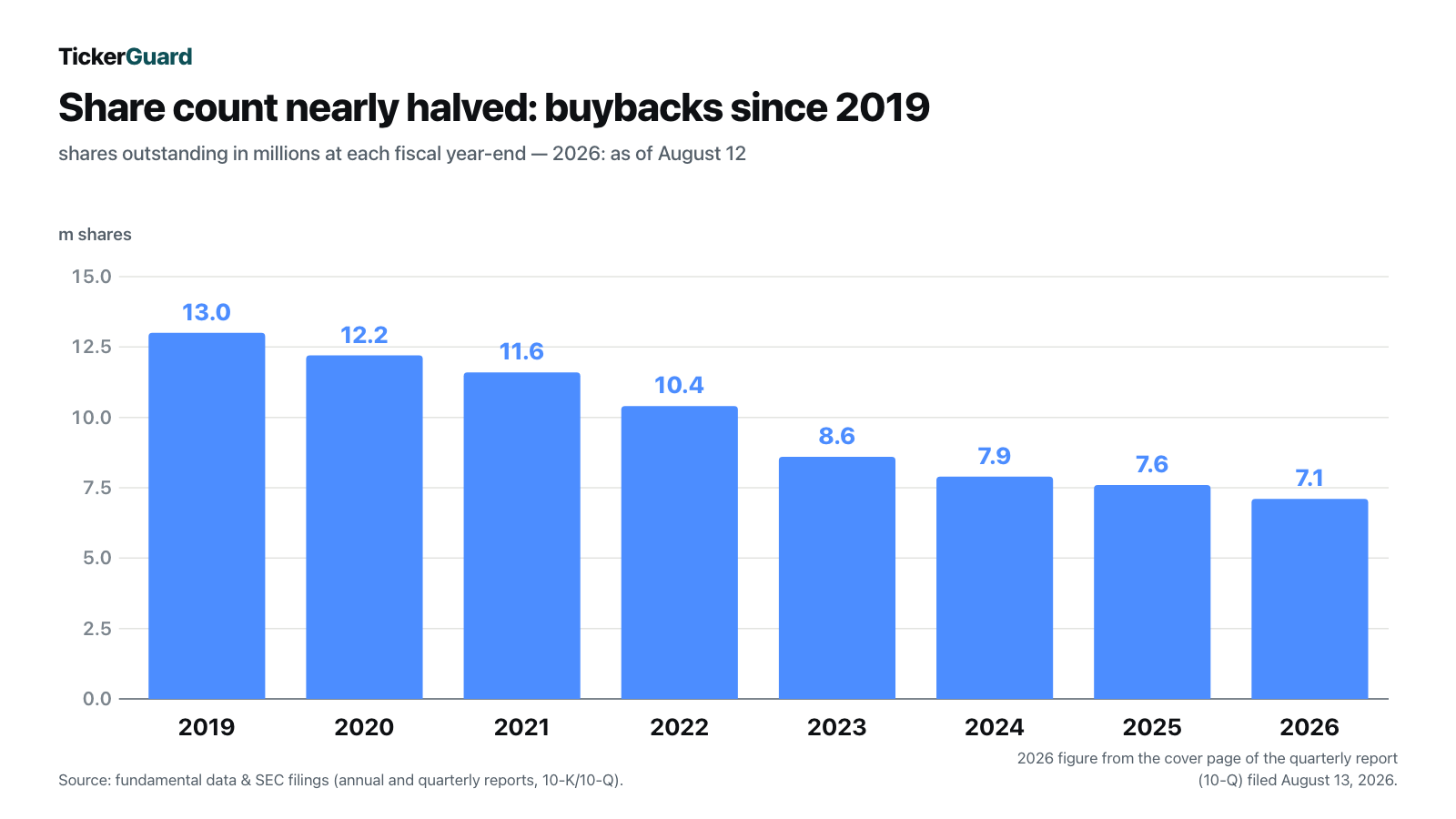
On the balance sheet as of July 4, 2026: the revolving credit line with Citizens Bank was drawn at $23.4 million, and the facility is temporarily expanded through August 31, 2026 to $75 million from the regular $65 million. Equity stood at $48.8 million, cash at $6.6 million. In the first half of 2026 the company bought back 348,366 of its own shares at an average price of $19.03; as of August 12, 2026, 7,110,759 shares remained outstanding. That buyback trend has been running for years and explains much of the EPS acceleration noted above:
What the filings say — the uncomfortable truths
Uncomfortable truth no. 1: four material weaknesses and an auditor revolving door
The annual report (10-K) for fiscal 2025 wasn't on time. On March 18, 2026, RCM Technologies filed an NT 10-K (an official late-filing notice) requesting an extension: it needed more time to finish the annual financial statements. The report followed on April 3, 2026, within the 15-day extension window — but with a finding that carries real weight. Under Item 9A, the company passes judgment on its own controls:
"…our principal executive officer and principal financial officer have concluded that the Company's disclosure controls and procedures … were not effective as of January 3, 2026, because of the material weaknesses in our internal control over financial reporting described below."
— RCM Technologies, Inc., SEC annual report 10-K for fiscal 2025, Item 9A
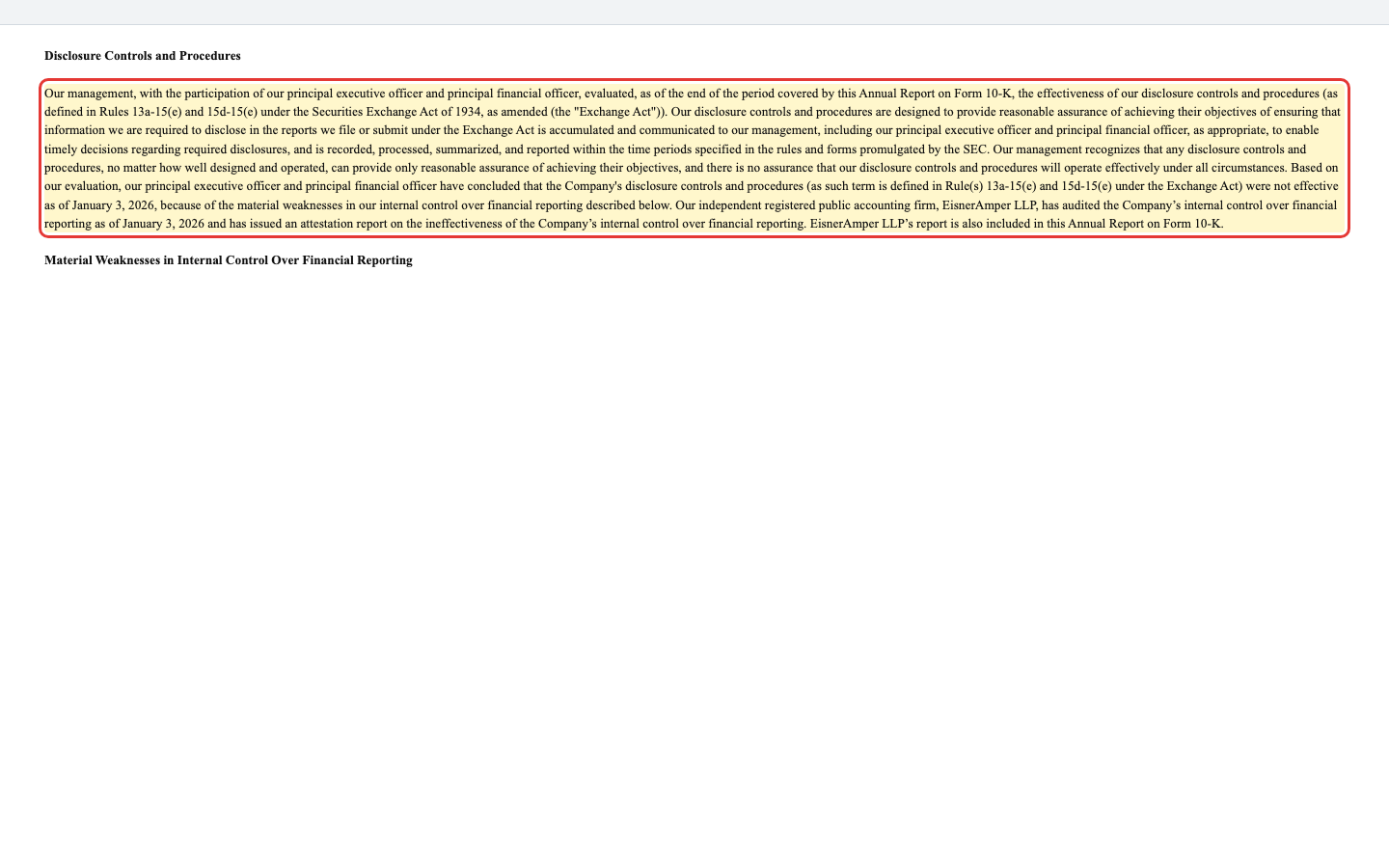
Specifically, the report names four weaknesses: not sufficiently effective entity-level controls and controls over business process cycles; inadequate documentation of management review processes; not sufficiently effective controls over risk assessment and monitoring; and inadequate documentation of controls over change management and access rights for the timekeeping systems. The auditor, EisnerAmper, correspondingly issued an adverse opinion on internal control. In fairness, the report itself makes one important qualification:
"These material weaknesses did not result in a misstatement of our annual or interim consolidated financial statements."
— RCM Technologies, Inc., SEC annual report 10-K for fiscal 2025, Item 9A
So the numbers themselves aren't in question — but the processes behind them are, and the problem hasn't since been fixed: in the quarterly report filed August 13, 2026, the company confirms the weaknesses are still unresolved and that the timing of full remediation is "uncertain."
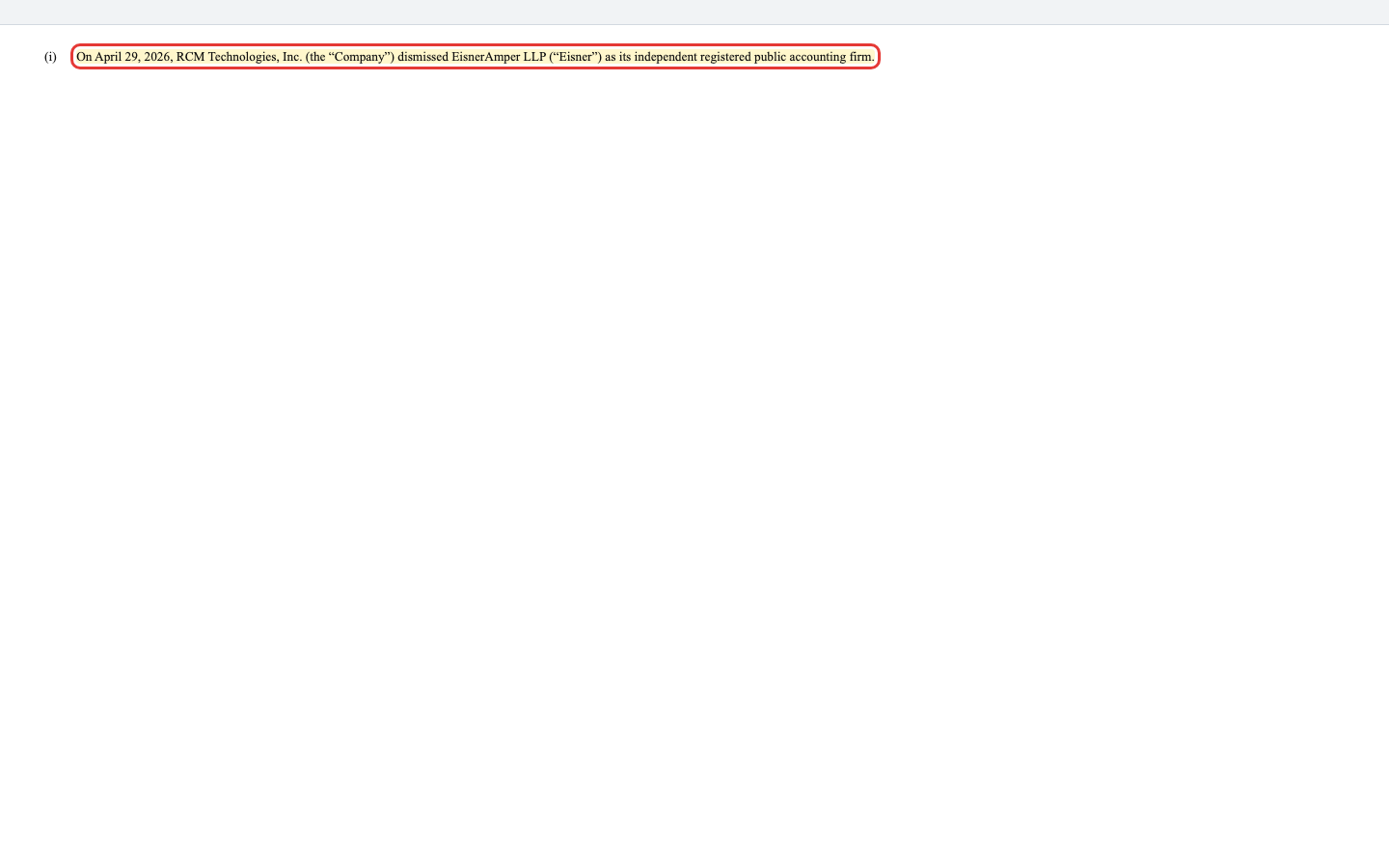
On top of that comes an auditor revolving door you have to read twice to believe. On June 30, 2025, RCM Technologies dismissed its longtime auditor WithumSmith+Brown and appointed EisnerAmper LLP. On December 18, 2025, shareholders ratified exactly that choice at the annual meeting. And barely four months later, on April 29, 2026, the company dismissed EisnerAmper again — and reappointed none other than the very auditor it had just let go, Withum:
"On April 29, 2026, RCM Technologies, Inc. (the 'Company') dismissed EisnerAmper LLP ('Eisner') as its independent registered public accounting firm."
— RCM Technologies, Inc., SEC filing 8-K dated May 4, 2026, Item 4.01
Picture it in everyday terms: your accountant gets fired after a year because four flaws turn up in your books — and as a replacement you rehire the exact accountant you had fired twelve months earlier. Both 8-K filings explicitly confirm there were no "disagreements" (professional disputes) between the company and its auditor — but the material weaknesses themselves are named as "reportable events," and their number grew from a single one in 2025 to four in 2026.
Uncomfortable truth no. 2: the silence — and insiders who trade anyway, just not with you
If you go looking for management commentary on RCM's latest numbers, you won't find any. Even before that, communication was sparse: the invitation for the third-quarter 2025 release lists only a single U.S. dial-in number, with no webcast, no international number and no recording:
"On Thursday, November 6, 2025, RCM Technologies will host a conference call to discuss these results. The call will begin at 11:30 a.m. Eastern Time. The dial-in number is (888) 272-8703."
— RCM Technologies, Inc., Earnings release dated November 5, 2025 (SEC Exhibit 99 to Form 8-K)
No publicly available transcripts of these calls exist — which makes this Q3 2025 release the last documented substantive commentary from management, and it's worth reading closely because it contains two concrete promises. Executive Chairman Vizi looked ahead with optimism:
"As we exit our seasonal third quarter, we are entering the fourth quarter from a position of strength, demonstrating record 2026 Engineering backlog as of the end of October and continued momentum in Healthcare."
— Bradley Vizi, Executive Chairman & President, RCM Technologies, Inc., earnings release dated November 5, 2025
"We expect our fourth quarter will yield our highest quarterly gross profit and adjusted EBITDA in fiscal 2025, and we are excited about our momentum heading into 2026."
— Kevin Miller, CFO, RCM Technologies, Inc., earnings release dated November 5, 2025
In fairness: Miller was right. The fourth quarter of 2025 did bring the highest gross profit and adjusted EBITDA of the fiscal year — as confirmed in the annual earnings release dated April 3, 2026. Only that release itself was kept remarkably lean: not a single management quote, no guidance — and its last sentence rules out communication for the foreseeable future:
"The Company will not be holding a conference call to discuss these results. Additional information can be found in the Company's Form 10-K."
— RCM Technologies, Inc., earnings release dated April 3, 2026 (SEC Exhibit 99 to Form 8-K)
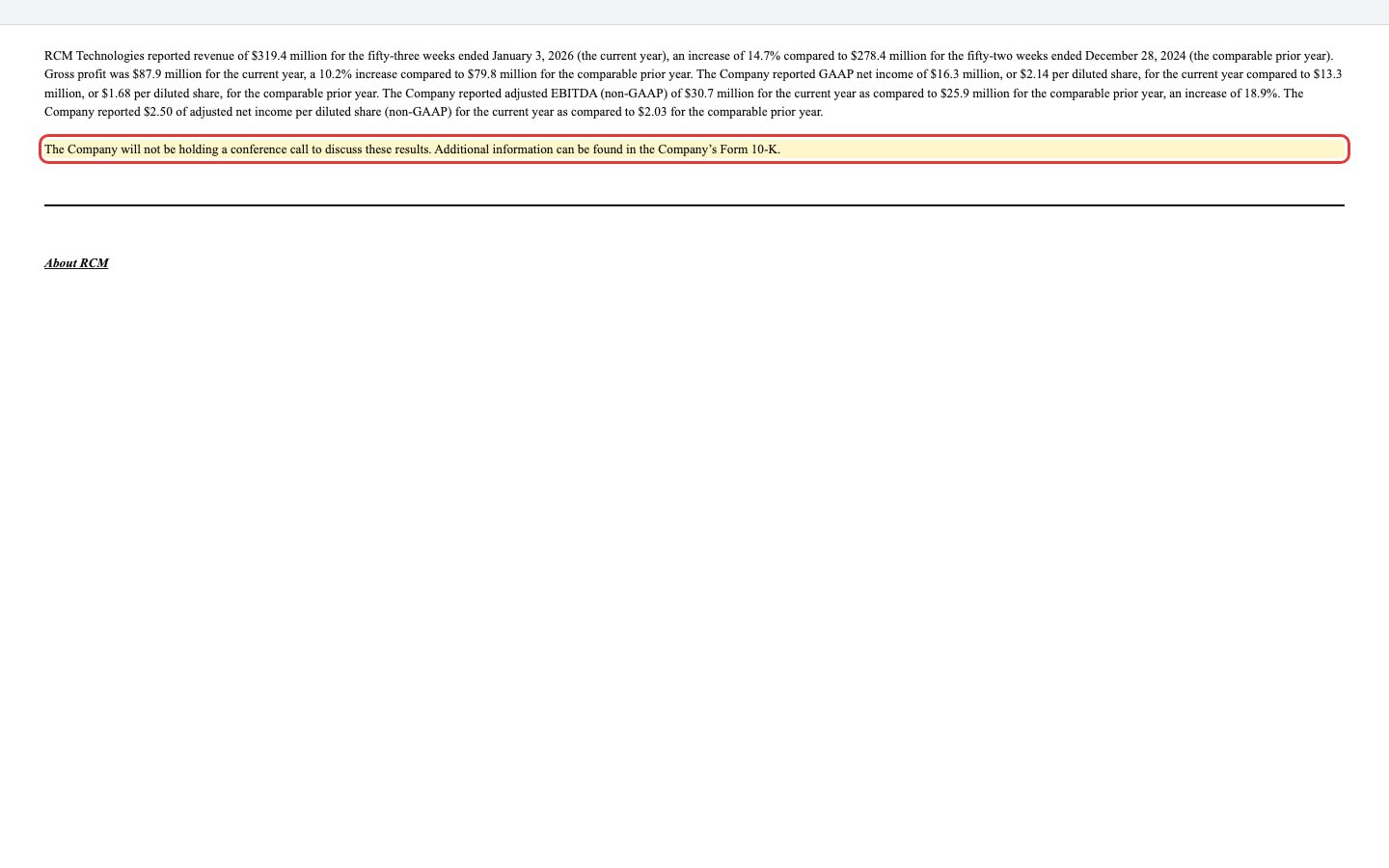
And it didn't stop at one canceled call. For the quarterly reports covering the first and second quarters of 2026 (filed May 14 and August 13, 2026), there was neither an accompanying press release nor a conference call — a clear break from the prior-year quarters, each of which came with an earnings release and an 8-K. Since May 4, 2026, EDGAR shows not a single 8-K filing from RCM Technologies at all — only quarterly reports and insider forms.
And right into that silence, on August 14, 2026 — immediately after the quarterly report — three executives began selling their own shares. Together, 216,911 shares worth about $8.1 million changed hands: Executive Chairman Vizi sold 100,000 shares (≈$3.79 million), CFO Miller sold 94,413 shares (≈$3.48 million), and division head Michael Saks sold 22,498 shares (≈$0.84 million). Most of these sales, per the footnotes on the insider filings (Form 4), ran through pre-established 10b5-1 trading plans — automated sale plans set up months or years in advance so an insider can demonstrably not be trading on current, non-public information. Such plans are legal, and at RCM Technologies they're an established pattern: back in April and May 2026, the same three people sold 111,711 shares worth about $3.4 million under the same plans. What's new in August 2026 is the pace and volume — more than double the volume in just over a quarter of the time, right into a price recovery from around $32 to over $40. And one exception stands out: for Saks' sale of 10,000 shares on August 18, 2026, the insider filing lists no 10b5-1 plan. Plan-based selling isn't a warning sign by itself — it's standard practice, and executives eventually have to realize their wealth. But the timing cluster — right in the first week of the post-earnings rally, and right while the company refuses any public commentary — is a data point worth holding onto.
Uncomfortable truth no. 3: half of revenue rides on three customers
The quarterly report filed August 13, 2026, cites a number you shouldn't underestimate at a staffing company:
"During the twenty-six weeks ended July 4, 2026, the Company had three customers that exceeded 10% of consolidated revenue, two customers in the Company's Specialty Health Care segment, representing 23.3% and 13.3% of consolidated revenue, respectively, and one customer in the Company's Engineering segment, representing 13.5%."
— RCM Technologies, Inc., SEC quarterly report 10-Q as of July 4, 2026, Note 3
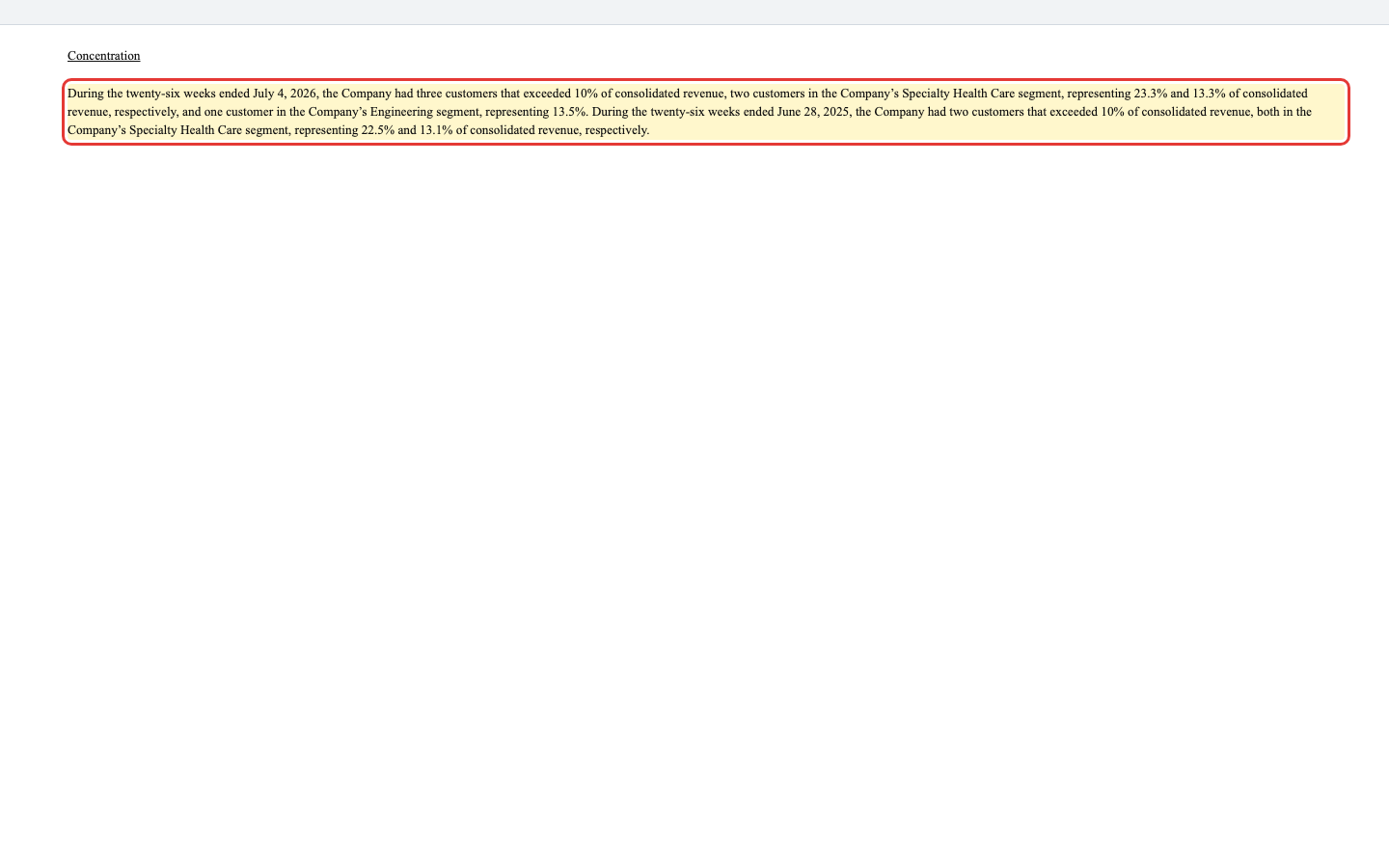
Add that up and you get 50.1 percent of consolidated revenue in the first half of 2026 from just three customers. Across all of fiscal 2025, the top five customers together were 51.0 percent, the top ten 64.9 percent. In everyday terms: picture a contracting business where every second job comes from just three clients — if one of them loses interest, that's not a setback, it's an earthquake. That weighs especially heavily with the largest single customer, the New York City Department of Education: its budget depends on political decisions and budget cycles, not market mechanics — a risk that can't be diversified away as long as the core business depends on that one customer.
The leadership structure fits that same picture of concentration. RCM Technologies has no CEO — Bradley Vizi runs the company as Executive Chairman & President, a title that bundles board chairmanship and operating leadership into one person. Vizi originally joined the board in 2013 as a co-founder of activist investor Legion Partners, through a proxy fight — the former attacker now runs the company from the inside. Per the proxy statement dated November 13, 2025, Vizi holds 18.9 percent of shares, and all executives and directors together hold 28.0 percent. His 2024 compensation was $7.73 million (of which $7.25 million was stock awards) — nearly twenty times CFO Miller's compensation ($0.39 million). The board has only four seats. And at the December 2025 annual meeting, 35 percent of non-broker votes cast went against the company's new equity compensation plan — a notable pocket of shareholder discomfort that was nonetheless approved in the end.
Valuation
How expensive is RCM Technologies after the price jump? With 7,110,759 shares outstanding and a closing price of $40.59 on August 26, 2026, market capitalization works out to roughly $288.6 million. On a trailing-twelve-month basis (fiscal 2025 diluted EPS of $2.14, minus first-half 2025 EPS of $1.04, plus first-half 2026 EPS of $1.20), diluted earnings per share come to about $2.30 — putting the price-to-earnings ratio at roughly 17.6. For comparison: before the price jump, at the $28.92 close on August 13, 2026, that same P/E was only about 12.6. In two weeks, the market repriced the stock noticeably higher without the underlying trailing-twelve-month profit changing at all.
In context: for a staffing company with structurally thin margins — net margin was about 5.1 percent of revenue in fiscal 2025 — a P/E of roughly 17.6 is no longer a bargain valuation. The market is already pricing in some continuation of the growth pace seen in the second quarter of 2026. The open question is whether that pace holds up when much of it comes from low-margin EPC project work — and whether the operating substance deserves the same confidence as a company that declares its own control processes not effective and no longer talks publicly with its shareholders.
Opportunities and risks at a glance
What speaks for RCM Technologies:
- A record quarter with no visible one-time gains: revenue +20.0 percent, net income +29.5 percent in the second quarter of 2026 — genuinely earned from operations, not dressed up on paper.
- Years of continuous share buybacks: the share count fell from about 13.0 million (2019) to 7.1 million (August 2026), which structurally accelerates earnings per share.
- Three diversified segments rather than a single business model, including a growing, higher-margin Life Sciences segment.
- Flexible financing: the credit line was temporarily expanded to $75 million, with no sign of liquidity strain or covenant breach.
- A growing order backlog in the Engineering segment for energy projects, in a market with structural need for grid expansion.
What speaks against it:
- Four auditor-identified material weaknesses and a "not effective" conclusion on disclosure controls, still unresolved per the August 13, 2026 quarterly report, with an "uncertain" remediation timeline.
- Two auditor changes within ten months (Withum → EisnerAmper → Withum) — unusual for a company this size, and with no stated professional disagreement.
- Complete communications silence since April 2026: no more conference calls, no earnings releases for Q1 and Q2 2026, not a single 8-K since May 4, 2026.
- Insider sales of 216,911 shares (≈$8.1 million) within one week right after the quarterly report — more than the entire quarter's net income, mostly plan-based but unusual in pace.
- Customer concentration: 50.1 percent of first-half 2026 revenue from three customers, with the largest single customer a school district carrying budget and political risk.
- The growth quarter rests on low-margin EPC project work (Engineering gross margin 24.5 → 17.8 percent) and rising, judgment-dependent balance-sheet items (contract assets +56 percent in two quarters).
A human conclusion
Back to the record-quarter reflex from the start. It feels like common sense — "the numbers are good, so I'll buy" — but it's actually a shortcut that's most dangerous exactly when the numbers really are good. Because at RCM Technologies they are: the quarter was real, free of one-time gains, with genuine revenue and profit growth. And yet, in that very same window, the picture that emerged is of a company that declares its own control processes not effective, changes auditors twice within ten months, hasn't said a public word to its shareholders since April 2026 — and whose leadership sold $8.1 million of stock in exactly the first week of the rally. Both things are true, at the same time. So the honest question for you isn't "Are the numbers good?" It's: would you trust a company whose numbers convince you but whose behavior makes you ask twice? What you make of it is your decision. And that's exactly as it should be.
Sources
All original documents used in this analysis — to read for yourself:
- RCM Technologies, Inc. — SEC quarterly report 10-Q as of July 4, 2026 (filed August 13, 2026)
- RCM Technologies, Inc. — SEC quarterly report 10-Q as of April 4, 2026 (filed May 14, 2026)
- RCM Technologies, Inc. — SEC annual report 10-K for fiscal 2025 (filed April 3, 2026)
- RCM Technologies, Inc. — SEC annual report 10-K/A for fiscal 2025, Part III only (filed May 4, 2026)
- RCM Technologies, Inc. — SEC late-filing notice NT 10-K / Form 12b-25 (filed March 18, 2026)
- RCM Technologies, Inc. — SEC filing 8-K dated July 7, 2025 (auditor change Withum → EisnerAmper)
- RCM Technologies, Inc. — SEC filing 8-K dated February 24, 2026 (temporary credit-line increase)
- RCM Technologies, Inc. — Earnings release dated April 3, 2026 (SEC Exhibit 99 to Form 8-K)
- RCM Technologies, Inc. — SEC filing 8-K dated May 4, 2026 (auditor change EisnerAmper → Withum)
- RCM Technologies, Inc. — Earnings release dated November 5, 2025 (SEC Exhibit 99 to Form 8-K)
- RCM Technologies, Inc. — SEC filing 8-K dated December 22, 2025 (annual meeting)
- RCM Technologies, Inc. — SEC proxy statement DEF 14A (filed November 13, 2025)
- RCM Technologies, Inc. — insider filings (Form 4), including Acc. 0001437749-26-028415, -028440, -028636: full Form 4 overview (SEC EDGAR)
- Fundamental data (metrics, price anchor, valuation; data as of August 26–27, 2026), reconciled with the SEC filings.
Transparency & disclaimer: This analysis is a journalistic contextualization of publicly available information and is not investment advice, not a financial analysis in the regulatory sense, and not a solicitation to buy or sell securities. Stock investments carry substantial risks up to total loss. All information without warranty; the data cut-off is noted in the text. The author holds no position in RCM Technologies shares at the time of publication.
Key figures at a glance
All monetary figures in millions of $; earnings per share as reported.
| Metric | 2021 | 2022 | 2023 | 2024 | 2025 |
|---|---|---|---|---|---|
| Revenue | 203.9 | 284.7 | 263.2 | 278.4 | 319.4 |
| Operating Income (EBIT) | 14.1 | 28.8 | 23.7 | 22.3 | 25.1 |
| Net Income | 11.0 | 20.9 | 16.8 | 13.3 | 16.3 |
| Net Margin | 5.4% | 7.3% | 6.4% | 4.8% | 5.1% |
| Earnings Per Share | 0.95 $ | 2.00 $ | 1.96 $ | 1.68 $ | 2.15 $ |
Source: fundamental data & SEC filings (annual and quarterly reports, 10-K/10-Q)
Our Bottom Line at a Glance
- Operating substance of the record quarter positive
- Revenue +20.0 percent and net income +29.5 percent in the second quarter of 2026 came without visible one-time gains — no insurance recovery, no litigation income, no gain on sale. The first half was, if anything, held back by $0.6 million in one-time annual-audit costs.
- Quality of the growth mix neutral
- Growth came almost entirely from low-margin EPC project work in the Engineering segment (revenue +49.0 percent, gross margin 24.5 → 17.8 percent); at the same time, estimated, not-yet-billed contract assets rose 56 percent in two quarters to $16.5 million.
- Material weaknesses & auditor changes negative
- The annual report for fiscal 2025 discloses four auditor-identified material weaknesses and a "not effective" conclusion on disclosure controls, still unresolved per the quarterly report filed August 13, 2026. The independent auditor changed twice within ten months (Withum → EisnerAmper → Withum).
- Shareholder communication negative
- Since the annual earnings release on April 3, 2026, management has held no conference call; there was no earnings release for Q1 or Q2 2026, and not a single 8-K since May 4, 2026. Even before that, calls ran through a single U.S. dial-in number with no webcast and no public transcript.
- Customer concentration & governance negative
- Three customers account for 50.1 percent of first-half 2026 revenue, with the largest being the New York City Department of Education. There is no CEO title — Executive Chairman & President Vizi holds 18.9 percent of shares and earned twenty times the CFO's pay in 2024; 35 percent of non-broker votes went against the new equity compensation plan in December 2025.
RCM Technologies delivers a record quarter that, on close inspection, holds up without one-time gains (Q2 2026: revenue +20.0 percent, net income +29.5 percent) — but it was carried by low-margin EPC project work. At the same time, the annual report for fiscal 2025 discloses four auditor-identified material weaknesses and a "not effective" conclusion, the independent auditor changed twice within ten months, management has been publicly silent since April 2026, and right into that silence executives sold $8.1 million of stock in one week. Half of revenue rides on three customers. Not investment advice.
What Our Rating Means
Open questions
The business works in principle, but one material question is open. As long as it stays open, our findings do not carry a quality verdict.
Yellow, because the business is fundamentally profitable and growing — the record numbers of the second quarter of 2026 were, as far as the filings show, earned without one-time gains — but several open operating questions pile up at once: four auditor-identified material weaknesses with an uncertain remediation timeline, an independent auditor that changed twice within ten months, a management that has stopped all public communication with shareholders since April 2026, and a customer concentration where half of revenue rides on three customers, including a single school district. None of these points alone threatens the company's existence — together they paint a picture that calls for more caution than the growth numbers alone would suggest. The $8.1 million of insider selling in the first week of the rally is mostly plan-based and not a stand-alone disqualifier, but it belongs in the same column. The decision is yours.
A journalistic assessment by our editorial team at the time of the deep dive, based on public sources — not investment advice and not a solicitation to buy or sell. Your personal circumstances (investment goals, risk capacity, taxes) cannot be taken into account. What our levels mean, how verdicts are formed, and what conflicts of interest exist →
Worth Noting
- Trigger for this analysis: the quarterly report (10-Q) as of July 4, 2026, filed August 13, 2026, and the roughly 40 percent price jump that followed within two weeks.
- Data cut-off: annual and quarterly figures come from the annual report 10-K for fiscal 2025 (filed April 3, 2026) and the quarterly reports as of April 4 and July 4, 2026. Price, market-cap and valuation figures are dated August 26–27, 2026.
- Possible confusion: several public and private companies carry "RCM" in their name; this analysis relies on the SEC registration number (CIK) 0000700841 of RCM Technologies, Inc., of Pennsauken, New Jersey.
Stock Watch
This analysis is as of August 27, 2026. Stock Watch will tell you what's changed at RCMT since then.
Later $1 a month per stock — signing up is free, and you'll be the first to know when it launches.
The full analysis as a PDF for later
We will send you this analysis as a PDF — to print, file away, and read at your own pace. And we will add you to the free Stock Watch list for RCM Technologies Inc (RCMT), so you hear about it when something material in this analysis changes.
Frequently Asked Questions
RCM Technologies, Inc. (Nasdaq: RCMT, headquartered in Pennsauken, New Jersey) is a staffing and engineering services company with three segments: Specialty Health Care (mainly medical staffing for schools, with the New York City Department of Education as its largest customer), Engineering (staffing and project work, including EPC energy projects), and Life Sciences, Data & Solutions. As of January 3, 2026, the company employed about 4,930 people.
Not explicitly since the annual earnings release on April 3, 2026: the company announced there that it would no longer hold conference calls, and the quarterly reports for Q1 and Q2 2026 came with neither a press release nor a call. Since May 4, 2026, the SEC's EDGAR database shows not a single 8-K filing from RCM Technologies. Public transcripts of older calls don't exist either — the last documented substantive commentary dates to the earnings release of November 5, 2025.
It's a company admitting that its internal processes for checking and controlling its own numbers don't work reliably enough — similar to a business that keeps its books correctly but has no dependable internal cross-check for them. RCM Technologies names four such weaknesses in its annual report (10-K) for fiscal 2025 and explicitly declares its disclosure controls "not effective" as of January 3, 2026. At the same time, the report stresses that the reported numbers themselves were not misstated as a result.
Between August 14 and 21, 2026, Executive Chairman Bradley Vizi, CFO Kevin Miller and division head Michael Saks together sold 216,911 shares worth about $8.1 million — more than the entire quarter's net income. Most of the sales ran through pre-established 10b5-1 trading plans that existed before the quarterly report and had been used before. What was new was the pace and volume; one of Saks' sales is listed without a plan.
Revenue climbed 20.0 percent to $93.8 million, almost entirely driven by the Engineering segment (+49.0 percent to $39.5 million) through more EPC energy projects (Engineering, Procurement and Construction Management — the complete handling of a project from design through construction). But such projects carry thinner margins: the Engineering segment's gross margin fell from 24.5 to 17.8 percent in the same quarter.
At the $40.59 closing price on August 26, 2026, the trailing-four-quarter price-to-earnings ratio is about 17.6 — before the price jump, at $28.92 on August 13, 2026, it was only about 12.6. For a staffing company with roughly a 5 percent net margin, that's no longer a deep-value price; the market is already pricing in part of the recent growth pace.
Found an error?
Did you spot a factual error, an outdated number, or a typo in this deep dive? Let us know briefly — your report goes straight to the editorial team.