Korea Aerospace Industries: Revenue Takes Off — a Helicopter Stays Grounded
47 of 57 helicopter engines at Korea Aerospace Industries came back corroded — the entire LAH fleet is grounded. The company still topped our in-house revenue-inflection scanner: revenue jumped 34 and then 56 percent year over year in back-to-back quarters. Operating profit still fell 12.4 percent in the first half of 2026, and a private rival has quietly quadrupled its stake from 3.2 to 15.89 percent since the start of 2026. Not investment advice — just the question of where all that new money is actually going.
 Thomas Mücke
Founder & Publisher
Thomas Mücke
Founder & Publisher

There is an investor trap that fits a scanner named for revenue inflections almost too well — call it the acceleration trap: you see a number like "revenue up 56 percent" and your brain automatically finishes the sentence for you: "...so the company is booming." Big percentages feel like a finished verdict. But a growth rate answers exactly one question — how much more got sold — and none of the questions that come after it. Where is the money actually going? Is the order backlog growing along with it, or is the company just working through what it already had? And does the product even work reliably? Korea Aerospace Industries (KOSPI: 047810), South Korea's only systems integrator for fighter and trainer jets, sat at No. 1 on our in-house revenue-inflection scanner on August 23, 2026 for exactly that kind of number — after a correction to the scanner's currency conversion made later the same day (August 23, 2026), the list ranks the stock No. 5 of 28. Revenue jumped 34 and then 56 percent year over year in back-to-back quarters, after four prior quarters of well under 15 percent growth — precisely the pattern the scanner is built to catch. So let's make a deal: we'll read together where that jump came from, what it did to profit, and what two more headlines from the same summer — a grounded helicopter and a rival quietly buying its way in — have to do with this growth story. In the end, the decision is yours.
What Korea Aerospace Industries Actually Does
Korea Aerospace Industries (KAI) was formed on October 1, 1999, from the merger of the aerospace divisions of Samsung Aerospace, Daewoo Heavy Industries, and Hyundai Space and Aircraft — a government-ordered consolidation as part of the restructuring that followed the 1997 Asian financial crisis, not unlike several automakers being folded under one roof after a crisis elsewhere. Since its listing on the KOSPI, the main board of the Korea Exchange, on June 30, 2011, KAI has been the only manufacturer in South Korea that builds complete military aircraft from design through final assembly. The portfolio spans four areas: fixed-wing aircraft — the KT-1 trainer, the T-50/TA-50/FA-50 family of light attack jets (exported worldwide), and the new supersonic KF-21 "Boramae," South Korea's first indigenously developed fighter; rotary-wing aircraft — the KUH-1 "Surion" utility helicopter and the LAH "Mir-On" light attack helicopter; unmanned systems; and space — the KOMPSAT satellite family and the Nuri (KSLV-II) launch vehicle. KAI also builds aerostructures for Boeing and Airbus as a supplier — a lower-margin but less cyclical second leg of the business. With 4,788 employees (company disclosure), KAI is a mid-sized company with outsized strategic weight: state-run export bank Korea Eximbank remains the largest shareholder at 26.41 percent, a fact that matters a great deal later in this analysis.
Company history for investors
-
1999
Founded through a government-ordered merger
On October 1, 1999, the aerospace divisions of Samsung Aerospace, Daewoo Heavy Industries, and Hyundai Space and Aircraft merged to form KAI, part of the restructuring after the 1997 Asian financial crisis.
-
2011
Listed on the KOSPI
KAI began trading on the Korea Exchange on June 30, 2011, opening the company to public shareholders for the first time.
-
2024
The first-ever helicopter export contract
On December 23, 2024, Iraq ordered two KUH-1 Surion helicopters for roughly 135.7 billion won — the first international sale of that airframe.
-
2025
The Philippines orders more FA-50 jets
On June 3, 2025, the Philippines ordered twelve more FA-50PH jets for roughly 975.3 billion won (nearly $700 million) — evidence of the export demand that later helps drive the revenue surge.
-
2026
New CEO arrives, KF-21 reaches serial production
Kim Jong-chul took over as CEO on March 18, 2026, after an eight-month vacancy; that same month, the first serial-production KF-21 "Boramae" fighter rolled off the line.
-
2026
Engine defect grounds the helicopter program
In May 2026 (publicly disclosed in mid-June 2026), the military issued a full grounding order for the LAH "Mir-On" helicopter after widespread corrosion and cracking were found — with direct consequences for second-quarter revenue and profit.
-
2026
Hanwha's stake crosses 15 percent
As of August 10, 2026, Hanwha Group's combined stake in KAI reached 15.89 percent — more than quadrupling since late 2025 and enough to trigger an antitrust review.
How the Stock Landed on Our Desk
Our in-house revenue-inflection scanner continuously screens every company we track for a very specific pattern: the most recent two or more quarters must each show 30 to 70 percent revenue growth versus the year-ago quarter, while the four quarters before that each grew less than 15 percent — a signal for a fresh inflection, not an established growth trend. It also requires a minimum revenue base of $100 million (converted into reporting currency), no more than two already-counted acceleration quarters, and no heavy share dilution. The companion backtest is sobering but real: fresh revenue inflections beat the broader market by 16.6 percentage points annually versus 9.9 points for already-established growth companies — read the full backtest here. On August 23, 2026, Korea Aerospace Industries led a list of 33 hits. At that time, the scanner's "$mn" column label still showed the raw won figure mislabeled as dollars for this won-denominated filer; that error was fixed later the same day (August 23, 2026) — the list has since displayed converted dollar figures (2,952.9 $mn for this stock) and now runs to 28 hits, on which Korea Aerospace Industries ranks No. 5. The figures as of August 23, 2026, in reporting currency, won:
- Revenue base (trailing four quarters, as of August 23, 2026): 4,089.8 billion won
- Acceleration quarters: 2 · Market cap: 12,671.8 billion won (roughly $9.1 billion at about 1,386 won per dollar, as of August 21-22, 2026)
- Price/earnings own calculation roughly 65 (scanner shows 14.6 — a data artifact, see the "Valuation" chapter) · price/sales 3.1 · price/book 6.8 · enterprise value/EBITDA 36.9
- EBIT margin 6.2 percent · gross margin 14.1 percent · net margin 4.8 percent · return on equity 10.9 percent · return on assets 1.8 percent
- Debt/equity 0.73 · equity ratio 17.7 percent · trailing-twelve-month revenue growth 1.7 percent · growth score 2 out of 10
The two acceleration quarters can be named specifically: in Q4 2025 (October-December), revenue rose to 1,466.7 billion won, up 34.0 percent from the year-ago quarter (1,094.8 billion). Exports drove most of that: export revenue jumped 134.3 percent to 365.0 billion won, while domestic revenue rose just 3.8 percent to 755.4 billion; aerostructure revenue (Boeing/Airbus parts) rose 55.1 percent to 316.6 billion. In Q1 2026 (January-March), revenue reached a record 1,092.7 billion won, up 56.3 percent — driven by complete-aircraft exports (among them the FA-50 light attack jet and the KUH-1 "Surion" helicopter) that surged 79.5 percent to 307.1 billion won: two T-50i trainers delivered to Indonesia, progress-based revenue recognition on the FA-50M (Malaysia) and FA-50PL (Poland) contracts, and the ramp-up of the new KF-21 "Boramae" fighter, which reached serial production in March 2026.
Is that acceleration organic? In the narrow sense, yes: there is no acquisition and no accounting change behind it — the revenue comes from real hardware delivered and real production work on already-signed contracts. But "organic" here does not mean "new demand": the jump is fundamentally the drawdown of a large, pre-existing order backlog — more jets and helicopters were delivered and booked as revenue, not more new contracts signed. That shows up clearly in the fact that the order backlog is shrinking over the same period, not growing (more on that in the "uncomfortable truths" chapter). Reading this acceleration as the start of a new, self-sustaining wave of demand overstates the case; reading it as "a full backlog is finally becoming visible as revenue" gets it right.
The Numbers Over the Years — Honestly Assessed
Before we get to the uncomfortable parts, here is the wider picture: KAI is not a company with a straight growth line, but one with pronounced order cycles. Annual revenue jumped to 3,819.3 billion won in 2023 (from 2,786.9 billion in 2022, up 37.1 percent), slipped slightly to 3,633.7 billion in 2024, and roughly stagnated at 3,696.4 billion in 2025 (up 1.7 percent) — a quiet, almost boring line at first glance. Only the quarterly figures show how choppy deliveries really are:
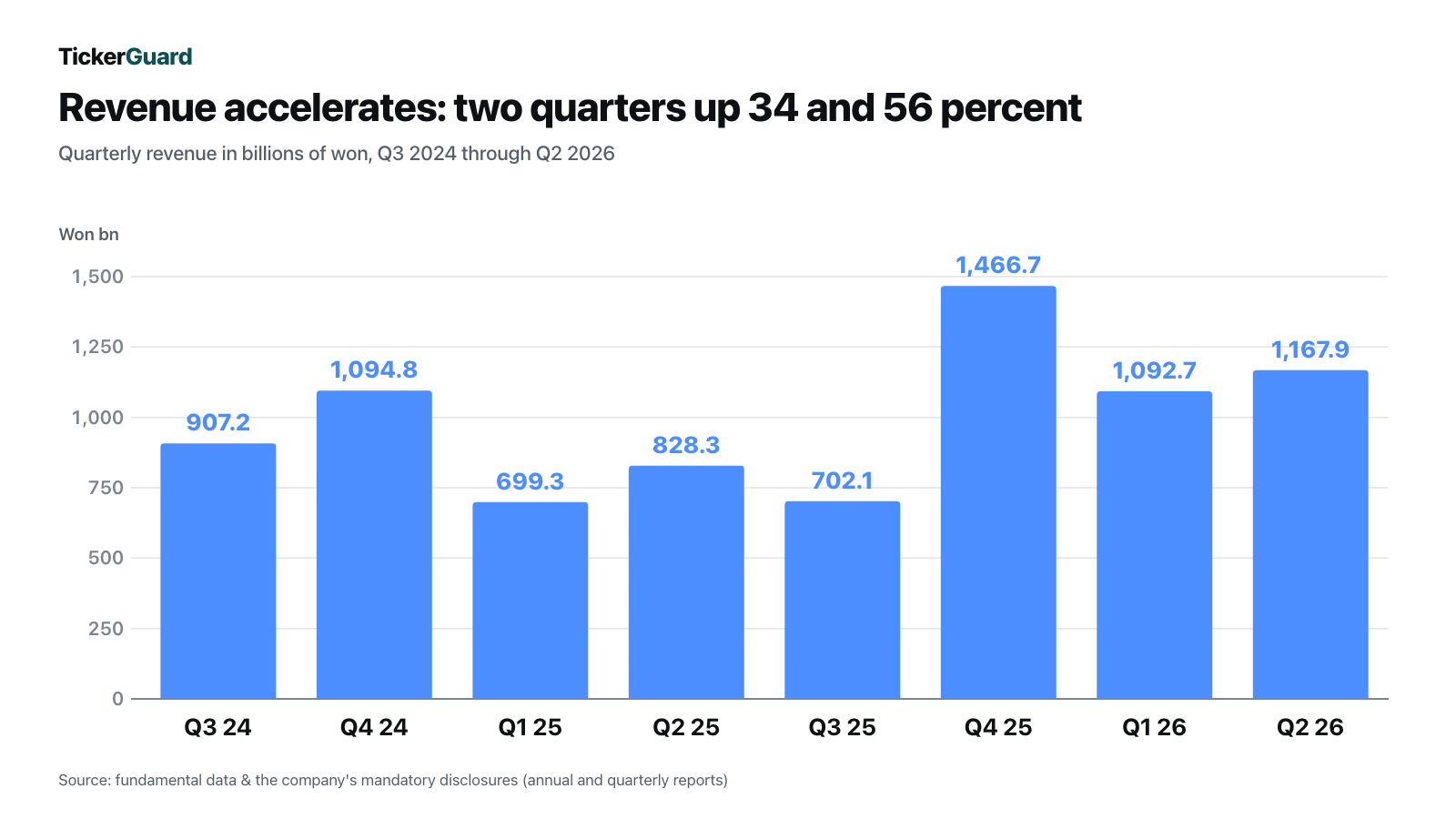
What stands out when you lay this curve next to operating profit: the big swings are almost always export quarters — deliveries to Poland, Malaysia, Indonesia, the Philippines, and Iraq move the needle far more than the relatively stable domestic business with the home-country army. That is both the company's strength (a growing export market for Korean defense technology) and its source of volatility: exactly when an export contract gets booked as revenue depends on production progress and the agreed delivery schedule — and both can slip from one quarter to the next. How much that shows up in profit is the subject of the next chapter.
What the Disclosures Show — the Uncomfortable Truths
Uncomfortable truth No. 1: revenue is racing ahead — profit is not keeping up
The most striking number in this analysis isn't the revenue line — it's the line below it. In the first half of 2026, revenue grew 48.0 percent to 2,260.6 billion won (H1 2025: 1,527.6 billion) — but operating profit fell 12.4 percent over the same period, to 115.6 billion won (prior year: 132.0 billion). That showed up sharply in Q2 2026 alone: operating profit fell 43.1 percent to 48.4 billion won, missing the analyst consensus of 88.9 billion won by 45.6 percent — an "earnings shock," as Korean financial media called July 30, 2026, the day six of nine brokerages cut their price targets.
"The company explained that the sharp drop in operating profit stemmed from a base effect, as the second quarter of last year had included one-time gains of 38 billion won from winning a profit claim lawsuit, while a delay in deliveries of the Light Armed Helicopter (LAH) Mir-On also had a temporary impact."
— Korea Aerospace Industries, quoted in Seoul Economic Daily, "Korea Aerospace Posts Earnings Shock, Brokerages Cut Targets," July 30, 2026
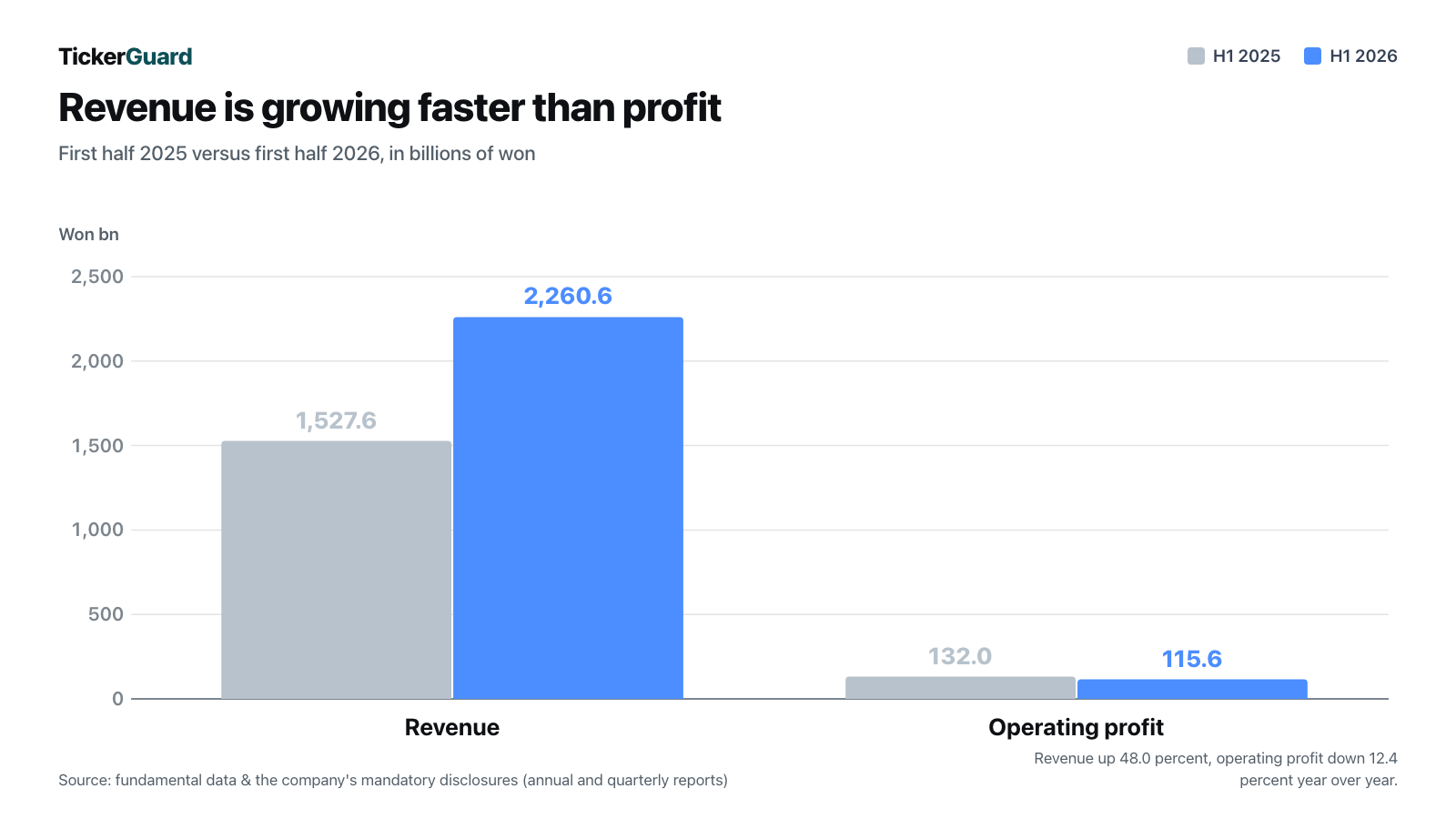
Translated into an everyday picture: imagine a contractor who bills twice as many jobs in one quarter as usual — but also has to pay for warranty rework, and was flattered a year earlier by a one-time court win. More revenue does not automatically mean more profit when part of the new business carries thinner margins, last year's comparison figure was artificially high, and — as in Q4 2025 — 25.0 billion won in one-time warranty repair costs hit at the same time. Keep the core sentence of this analysis in mind: at KAI in 2026, the revenue line has not been a reliable preview of the profit line. A weaker won reportedly played a role too: analyst notes from Korean brokerages covering the Q2 2026 results (for example Hana Securities, as cited by etoday in late July 2026) point to a weaker won as having raised production costs on FA-50 export business — the reports do not give a specific figure, so we do not put a number on it here.
Uncomfortable truth No. 2: one engine component grounds the entire helicopter fleet
The second driver of the earnings miss is not an accounting effect — it's a hard engineering problem. The LAH "Mir-On" light attack helicopter — a roughly 5 trillion won procurement program meant to deliver around 160 aircraft through 2031 and replace the aging 500MD and Cobra attack helicopters — uses a licensed version of the Safran Arriel 2L2 engine, assembled by Hanwha Aerospace. In April 2026, inspectors first flagged problems with the diffuser, a component that stabilizes airflow inside the engine.

"Of the 57 [engines] assembled and delivered by Hanwha Aerospace, 47 (82.5 percent) were found to have corrosion and 38 (66.7 percent) were found to have cracks."
— Newspim, "5-trillion-won 'Mir-On' helicopter fully grounded... engine 80% corroded," June 14, 2026, citing the office of National Assembly Defense Committee member Kang Sun-young and the Defense Acquisition Program Administration (translated from Korean by TickerGuard)
Fifteen helicopters already in service at the army aviation school showed mostly similar defects. The military responded with a complete grounding order for the entire program in May 2026 (publicly disclosed June 13-14, 2026); in June 2026, the Defense Acquisition Program Administration (DAPA) launched a full recall and detailed analysis of the engines. Industry sources suspect (per Newspim's reporting) that gaps between original manufacturer Safran's standard French assembly process and the domestic assembly process accumulated over time into the material failure — the martensitic steel used (grade M152) resists heat and pressure well but is vulnerable to sudden impact loads. For shareholders, one thing matters most: a program whose delivery schedule "requires further consultation," in the words of one Daishin Securities analyst, cannot be reliably planned into a given quarter — exactly the pattern that hit in Q2 2026 and, according to Samsung Securities, remains a risk for the rest of the year.
Uncomfortable truth No. 3: the order backlog is shrinking while revenue sets records
Reading only the revenue line, you might assume KAI is being flooded with new orders. The opposite is true. The order backlog — the portion of already-signed contracts not yet booked as revenue — fell from 27.34 trillion won at the end of 2025 (itself up more than 10 percent year over year at the time) to 26.55 trillion won at the end of Q1 2026 to 25.75 trillion won at the end of Q2 2026, down 3.0 percent in a single quarter. For comparison, KAI had set itself a 2026 target of a 31.7 trillion won backlog, 5.73 trillion won in revenue, and 10.44 trillion won in new orders — the actual mid-year trajectory is far from those marks. New orders in Q1 2026 came to just 309.3 billion won (up 29.4 percent year over year, but tiny next to the annual target); Korean financial media assess that KAI has not secured any notable new international orders in 2026, even as previously booked export volumes — the same ones explaining the revenue jump in the "How the Stock Landed on Our Desk" chapter — keep converting to revenue.
That explains why the answer to the question from the "How the Stock Landed on Our Desk" chapter ("is the acceleration organic?") comes with an asterisk: revenue is growing because an existing stock of contracts is now being delivered — not because new demand keeps arriving. Two of the other three major South Korean defense contractors, Hyundai Rotem and LIG Nex1/D&A, reported similar backlog declines as of the same date (down 2.1 and 3.0 percent, respectively); only Hanwha Aerospace edged up (0.3 percent) — a sign that 2026 is a weaker export year industry-wide, not just a KAI-specific problem. How long the current revenue acceleration lasts depends heavily on whether new large contracts — above all a KF-21 export deal — actually get signed in the second half of 2026.
Uncomfortable truth No. 4: while revenue accelerates, a private rival is publicly buying its way in
The fourth uncomfortable truth is not about the numbers — it's about ownership, and it is moving almost weekly. Korea Eximbank, the state-run export bank, remains KAI's largest shareholder at 26.41 percent, a fact that has long given the company the character of a quasi-state-owned defense contractor. But since late 2025, private conglomerate Hanwha Group — through three entities, Hanwha Aerospace, Hanwha Systems, and Hanwha Aerospace USA — has been systematically buying into KAI: from 3.2 percent at the end of 2025 (per Seoul Economic Daily), to 13.61 percent in mid-July 2026, to 14.64 percent by late July, and 15.89 percent as of August 10, 2026 — more than quadrupling in just over seven months. It is the same Hanwha Group: Hanwha Aerospace, the subsidiary that showed up two chapters ago as the assembler of the defective LAH engines, is — through its sister entities — also the rival now buying its way into KAI.
"Hanwha Systems disclosed on Monday that it now holds a 4.98 percent stake in the aircraft maker. That takes the group's combined holding to 15.89 percent, with Hanwha Aerospace holding a 9.9 percent stake in KAI and Hanwha Aerospace USA a 1.01 percent stake."
— Korea JoongAng Daily, "Hanwha Group surpasses 15 percent stake in Korea Aerospace Industries," August 10, 2026

Why the 15 percent mark matters: past that threshold, a buyer in South Korea must file a business-combination review with the antitrust regulator, the Fair Trade Commission; the industry expects a simplified process, per Korea JoongAng Daily, because the stake does not confer management control. Hanwha had already formally stated the purpose of its stake as "participation in management" back in May 2026 (Seoul Economic Daily, August 5, 2026), while Hanwha's August 10, 2026 statement stressed "synergy through business cooperation" and a voice in "decisions related to supporting the expansion of exports," explicitly framed as short of a takeover bid. The two disclosures emphasize different things but are not mutually exclusive; for you as a reader the key point stands: Hanwha has not, on the record, clearly disclaimed an interest in control. An actual change of control would not be simple in any case: South Korea's Defense Acquisition Program Act requires dual approval from the Ministry of Trade, Industry and Energy and the DAPA commissioner for any change in management control at a defense contractor — a process last used in Hanwha's 2023 acquisition of Daewoo Shipbuilding & Marine Engineering. Politics has fanned the speculation further:
"It is regrettable that KAI is not playing its part amid the rising global demand for Korean defense products," Defense Minister Ahn Gyu-back said during a National Assembly audit last October when asked about the government's privatization plans.
— The Korea Times, "Privatization calls grow as KAI names new CEO," March 18, 2026

Fairness requires the other side of the story too. A KAI spokesman explicitly pushed back on speculation to the Korea Times in March 2026 — "the rumor began after Hanwha's additional share purchases became known," the government has "not taken any official steps toward privatization" so far, and Eximbank has also dismissed the idea. The government has tried, and failed, to privatize KAI multiple times since 2012. What is real and documented: a stake that climbed from 3.2 to 15.89 percent within months, a new CEO since March 18, 2026 (Kim Jong-chul, a former Air Force officer and DAPA staffer who ended an eight-month leadership vacancy), and a public debate that — unlike the revenue growth described in the "How the Stock Landed on Our Desk" chapter — only indirectly touches KAI's day-to-day operations, but may matter just as much for the stock's long-term value.
Valuation — Expensive for a Thin Margin
How should you value a stock whose revenue is accelerating by double digits while its operating margin is shrinking at the same time? At a price of 130,000 won (as of August 21, 2026, roughly $94 at a rate of about 1,386 won per dollar), the stock trades at 3.1 times trailing revenue and 6.8 times book value, with an enterprise value of 36.9 times EBITDA. A price/earnings ratio cannot be reliably taken from the scanner line: the 14.6 figure shown there is a data artifact and contradicts the stock's own other ratios by a factor of four to six. Doing the math independently — a 4.8 percent net margin on the 4,089.8 billion won revenue base works out to roughly 196 billion won in profit, or about 2,013 won per share across 97.5 million shares — puts the trailing-twelve-month P/E at roughly 65; using the 2027 analyst estimate (roughly 2,372 won per share) puts it at roughly 55. For comparison, the EBIT margin (operating profit divided by revenue) is just 6.2 percent, and return on equity is 10.9 percent. That is a valuation more typical of a high-margin growth company than of a defense supplier with a single-digit operating margin and an equity ratio of only 17.7 percent (debt/equity 0.73) — the so-called Altman Z-score, a rough bundle of ratios used to gauge financial stability, sits at 1.8, in the "gray zone" between unremarkable and concerning. Cash flow backs up that caution: operating cash flow turned negative in Q1 2026, at -77.0 billion won (Q1 2025: +161.2 billion won), as part of the revenue jump initially sat in receivables and inventory rather than turning into cash; as of March 31, 2026, cash on hand of 162.6 billion won stood against bonds and borrowings totaling roughly 2,770.1 billion won — net debt of roughly 2,607.5 billion won (source: quarterly report filed with KIND, May 15, 2026). One likely reason for the rich multiple is the implicit bet that the weak order intake described in the previous chapter reverses in the second half of 2026 — several brokerages describe a "weak first half, strong second half" pattern, driven by potential KF-21 and FA-50 export wins. As of this analysis (August 23, 2026), none of that is confirmed: talks with Indonesia over 16 KF-21 aircraft have run for months without agreement on quantity, price, or delivery schedule, and inquiries from the Philippines, Malaysia, and the Middle East have not yet turned into contracts. Buying the stock at this price means buying not just the revenue jump that has already happened, but also the bet that order intake and margin catch up in the quarters ahead.
Opportunities and Risks at a Glance
What speaks for Korea Aerospace Industries:
- South Korea's only domestic systems integrator for fighter jets, in a country with a growing defense budget and rising export demand; record revenue in Q4 2025 (up 34.0 percent) and Q1 2026 (up 56.3 percent) reflects real delivered hardware, not an accounting effect.
- A diversified portfolio (fixed-wing, rotary-wing, aerostructures for Boeing/Airbus, space) with real export wins over the past two years: the first-ever Surion export contract with Iraq (December 2024), a further FA-50 order from the Philippines worth roughly 975 billion won (June 2025).
- The KF-21 "Boramae" reached serial production in March 2026 and formally completed its ten-year system-development program in July 2026 — a potential export hit if talks with Indonesia and other prospects close.
- The largest shareholder, at 26.41 percent, is state-run export bank Eximbank — implicit government backing that signals a degree of stability for a strategically important defense contractor.
- Early in-house AI programs — the "NACS" virtual co-pilot and an on-device AI semiconductor for unmanned systems — point to additional growth potential beyond the core business, though reporting indicates both are still in an early development stage and not yet revenue-generating (Seoul Shinmun, June 25, 2026; Seoul Economic Daily, July 31, 2026).
What speaks against it:
- Operating profit fell 12.4 percent in the first half of 2026 even as revenue rose 48.0 percent; second-quarter 2026 profit alone fell 43.1 percent and missed the analyst consensus by 45.6 percent.
- The LAH "Mir-On" light attack helicopter program (roughly 5 trillion won) has been fully grounded since May 2026 (publicly disclosed June 13-14, 2026) by an engine defect (an 82.5 percent corrosion rate across 57 delivered engines); the timing of a resumption is unknown.
- The order backlog is shrinking despite record revenue — from 27.34 to 25.75 trillion won in two quarters — because new large international orders have not materialized in 2026; the 31.7 trillion won annual target is slipping further out of reach.
- Ownership is in flux: private conglomerate Hanwha Group has more than quadrupled its stake since late 2025 (3.2 to 15.89 percent), triggering an antitrust review and fueling a privatization debate even as the government and KAI deny official steps.
- A thin equity ratio (17.7 percent) paired with a valuation (price/sales 3.1, price/book 6.8, EV/EBITDA 36.9) that is rich for a 6.2 percent EBIT margin — a setback in margin or order intake would hit this valuation harder than a more cheaply priced stock.
Not Investment Advice — a Human Take
Back to the acceleration trap from the opening. The "revenue up 56 percent" figure was never wrong — it happened exactly as stated in Q1 2026, documented and traceable to real delivered jets and helicopters. What is wrong is only the automatic second half of the sentence our brains like to add: "...so the whole company is booming." This analysis has shown why that second half doesn't hold up for Korea Aerospace Industries in the summer of 2026 — not because the company is bad, but because a revenue jump is always only half the story. The other half tells of an operating margin shrinking despite more revenue, a helicopter fleet grounded by an engine defect, an order backlog getting smaller even as quarterly records fall, and an ownership structure being renegotiated in real time as you read this. None of these four observations alone is a death sentence for the stock — defense programs slip, margins swing with contract mix, consolidation waves are nothing new in this industry. Together, though, they paint a far more complicated picture than the headline that first put this stock on our screen. So the honest question isn't "is this company growing fast?" — it clearly is — but rather: do you trust this company to make profit grow faster than revenue again in the quarters ahead — and to get that helicopter flying again? What you make of that is your decision. And that's exactly as it should be.
Sources
All original documents used in this analysis — for your own reading:
- Korea Aerospace Industries, Ltd. — investor-relations site, Condensed Income Statement (27th-24th fiscal years)
- Seoul Economic Daily — "Korea Aerospace Posts Earnings Shock, Brokerages Cut Targets," July 30, 2026
- Newspim — "5-trillion-won 'Mir-On' helicopter fully grounded... engine 80% corroded," June 14, 2026 (Korean-language)
- Korea JoongAng Daily — "Hanwha Group surpasses 15 percent stake in Korea Aerospace Industries," August 10, 2026
- Seoul Economic Daily — "Hanwha Expands KAI Stake, Raising Merger Prospects and Procedures," August 5, 2026
- The Korea Times — "Privatization calls grow as KAI names new CEO," March 18, 2026
- Seoul Economic Daily — "Korea's Big 4 Defense Firms See Order Backlog Shrink on Export Slump," August 14, 2026
- Seoul Shinmun — report on KAI's "NACS" AI program, June 25, 2026 (Korean-language)
- Seoul Economic Daily — report on KAI's on-device AI semiconductor project, July 31, 2026 (Korean-language)
- Our in-house revenue-inflection scanner: live results and the backtest study behind the criterion
- Fundamental data (ratios, valuation, holdings; data as of August 21-23, 2026), cross-checked against the original sources listed above.
Transparency & disclaimer: This analysis is a journalistic assessment of publicly available information. It is not investment advice, not a financial analysis in the regulatory sense, and not a solicitation to buy or sell any securities. Equity investments carry substantial risk, including total loss. All figures are provided without guarantee; data dates are noted in the text. Positions held by the operator are disclosed daily; where one exists, it appears as a notice at the top of this deep dive.
Our Bottom Line at a Glance
- Revenue growth & demand positive
- Real record revenue in Q4 2025 (up 34.0 percent) and Q1 2026 (up 56.3 percent), driven by real export deliveries (FA-50, LAH, T-50i) and the March 2026 ramp-up of the KF-21 fighter — not an accounting effect, but delivered hardware on already-signed contracts.
- Earnings quality negative
- Operating profit fell 12.4 percent in the first half of 2026 even as revenue rose 48.0 percent; second-quarter 2026 profit alone fell 43.1 percent and missed the analyst consensus by 45.6 percent (base effect, LAH delivery delay, repair costs, a weaker won).
- Product quality & operational risk negative
- The LAH "Mir-On" helicopter program (roughly 5 trillion won) has been fully grounded since May 2026 (publicly disclosed June 13-14, 2026) by an engine defect (82.5 percent corrosion rate across 57 delivered engines); no timeline for resuming deliveries had been announced as of August 23, 2026.
- Order pipeline negative
- The order backlog fell from 27.34 to 25.75 trillion won in two quarters, with no meaningful new international orders arriving in 2026; the 31.7 trillion won year-end target is slipping out of reach, and the current revenue acceleration is a backlog drawdown, not a new demand wave.
- Ownership & governance neutral
- State-run Eximbank remains the largest shareholder (26.41 percent), but private conglomerate Hanwha Group has more than quadrupled its stake since late 2025 (3.2 to 15.89 percent as of Aug. 10, 2026) and triggered an antitrust review; the government and KAI deny official privatization steps, and a new CEO took over in March 2026 after an eight-month vacancy.
- Balance sheet & valuation neutral
- The equity ratio is thin at 17.7 percent (debt/equity 0.73), and the Altman Z-score of 1.8 sits in the gray zone; the valuation (P/S 3.1, P/B 6.8, EV/EBITDA 36.9) is demanding for a 6.2 percent operating margin and already prices in a second-half 2026 recovery.
Korea Aerospace Industries shows two real acceleration quarters (revenue up 34.0 and 56.3 percent), but the surge is mostly the drawdown of an existing order backlog that itself shrank 3.0 percent over the same period. Operating profit fell 12.4 percent in the first half of 2026 despite 48.0 percent revenue growth, an engine defect has fully grounded the LAH helicopter program since May 2026 (publicly disclosed June 13-14, 2026), and while all of that unfolds, private conglomerate Hanwha Group has bought its way from 3.2 to 15.89 percent of the shares since late 2025. None of these four observations is alarming on its own; together, they paint a far more complicated picture than the scanner headline suggested. Not investment advice.
What Our Rating Means
Open questions
The business works in principle, but one material question is open. As long as it stays open, our findings do not carry a quality verdict.
The business model holds up — KAI is South Korea's only systems integrator for fighter jets in a structurally growing export market, with implicit government backing through Eximbank. But several material operating questions remain open as of August 23, 2026: whether margin recovers in the second half as analysts expect, when the LAH helicopter is cleared to fly and ship again, whether new large international orders — above all for the KF-21 — refill the shrinking backlog, and how the ownership question between Eximbank and Hanwha develops from here. Anyone waiting should watch precisely those four points in the coming reports. The decision is yours.
A journalistic assessment by our editorial team at the time of the deep dive, based on public sources — not investment advice and not a solicitation to buy or sell. Your personal circumstances (investment goals, risk capacity, taxes) cannot be taken into account. What our levels mean, how verdicts are formed, and what conflicts of interest exist →
Worth Noting
- Korea Aerospace Industries landed on our research list via the No. 1 spot on our in-house revenue-inflection scanner on August 23, 2026 (33 hits at the time); after a correction to the scanner's currency conversion made later the same day (August 23, 2026), the stock ranks No. 5 of 28 there. The scanner's revenue base at the time (4,089.8 billion won, then still carried under the misleading "$mn" column label; 2,952.9 $mn since the correction) and the two counted acceleration quarters are based on data through Q1 2026; this analysis additionally reviews the Q2 2026 figures (from the July 30, 2026 release), which confirm the revenue acceleration but also show the profit decline.
- All won figures are in reporting currency; U.S. dollar conversions here are approximations using a market rate of roughly 1,386 won per dollar (as of August 21-22, 2026) for orientation only, not the company's reporting currency. One trillion won equals 1,000 billion won.
- Ownership is in flux as of August 23, 2026: the 15.89 percent Hanwha stake cited here is the most recent figure known at publication (disclosed August 10, 2026) and may change further given Hanwha's stated plan to buy up to 500 billion won more in shares by the end of 2026.
The full analysis as a PDF for later
We will send you this analysis as a PDF — to print, file away, and read at your own pace.
Frequently Asked Questions
Korea Aerospace Industries (KOSPI: 047810), headquartered in Sacheon-si, is South Korea's only systems integrator for military aircraft: trainers (KT-1), light attack jets (T-50/FA-50), the newly developed KF-21 "Boramae" fighter, helicopters (KUH-1 Surion, LAH "Mir-On"), unmanned systems, and satellites and launch vehicles. KAI also builds aerostructures for Boeing and Airbus as a supplier. State-run export bank Korea Eximbank is the largest shareholder at 26.41 percent (as of August 2026).
Revenue grew 34.0 percent in Q4 2025 and 56.3 percent in Q1 2026 year over year — mainly because previously booked export contracts (helicopters, FA-50 jets for Malaysia and Poland, trainers for Indonesia) were delivered and booked as revenue, plus the ramp-up of the new KF-21 fighter. This is the drawdown of an existing order backlog rather than a wave of new bookings — the backlog itself shrank over the same period.
Revenue rose 48.0 percent in the first half of 2026, but operating profit fell 12.4 percent to 115.6 billion won. Second-quarter 2026 operating profit alone fell 43.1 percent. The company cited a base effect (a one-time 38 billion won legal-settlement gain in the year-ago quarter) and delayed deliveries of the LAH "Mir-On" helicopter as the main causes, plus one-time repair costs and a weaker won that raised the relative cost of lower-margin export contracts.
Of 57 engines delivered to the army, 47 (82.5 percent) showed corrosion and 38 (66.7 percent) showed cracks in a component called the diffuser, part of the licensed Safran Arriel 2L2 engine. The military issued a full grounding order for the roughly 5 trillion won program in May 2026 (publicly disclosed June 13-14, 2026); the Defense Acquisition Program Administration has been investigating since June 2026. As of August 23, 2026, no timeline for resuming deliveries had been announced.
Hanwha Group has more than quadrupled its KAI stake since late 2025 (3.2 percent) to 15.89 percent as of August 10, 2026, crossing the threshold that triggers an antitrust review. Hanwha officially states investment and cooperation purposes, not a bid for control. State-run Eximbank remains the largest shareholder at 26.41 percent; the government and KAI denied official privatization steps in March 2026, even as some lawmakers have pushed for it for years.
The order backlog fell from 27.34 trillion won at the end of 2025 to 25.75 trillion won at the end of Q2 2026 (down 3.0 percent quarter over quarter), as previously booked export contracts convert to revenue without meaningful new international orders arriving in 2026. KAI's own 31.7 trillion won year-end backlog target is far out of reach at midyear; whether the current revenue acceleration continues depends heavily on new contracts in the second half — above all for the KF-21 fighter.
At a price of 130,000 won (August 21, 2026), the stock trades at 3.1 times revenue and 6.8 times book value, against an operating margin of just 6.2 percent and an equity ratio of 17.7 percent. A price/earnings ratio has to be computed independently: net margin (4.8 percent) times the revenue base (4,089.8 billion won) divided by shares outstanding (97.5 million) works out to roughly 2,013 won of profit per share, putting the trailing P/E at roughly 65 (the 14.6 figure our scanner displays is a data artifact). Measured against current earning power, that is a demanding valuation that already prices in a second-half 2026 recovery in order intake and margin.
KAI communicates quarterly results through preliminary disclosures and accompanying analyst briefings, as shown by the swift price-target changes several Korean brokerages made after the Q2 2026 release. Publicly available transcripts or recordings of these briefings could not be found as of this research (August 23, 2026); the company statement on the earnings decline quoted in this analysis comes from contemporaneous coverage by Korean financial media.
Found an error?
Did you spot a factual error, an outdated number, or a typo in this deep dive? Let us know briefly — your report goes straight to the editorial team.