InnoDisk: Profit Jumps 54-Fold – But Not Because of the AI Story
Revenue up 641%, earnings per share up 5,294%, gross margin from 25.9% to 65.0% in four quarters – InnoDisk's second-quarter 2026 numbers read like an AI success story. The company's own breakdown shows otherwise: only 4% of revenue came from the marketed edge-AI unit, 95% from plain DRAM and flash memory chip trading during a global price boom. Not investment advice – just the gap between the headline and what actually drives the profit.
 Thomas Mücke
Founder & Publisher
Thomas Mücke
Founder & Publisher
Chart
Interactive price chart (TradingView).
Note: pure fact-based analysis, not investment advice and not a solicitation to buy or sell. All figures without guarantee.
There is a very specific kind of number that flips a switch in your head straight to FOMO: the doubling, the tenfold jump, the explosion. "Revenue up 641%." "Earnings per share up 5,294%." Numbers like that trigger a reflex — the feeling of walking past a door behind which the party is already in full swing. That is exactly what Taiwan's Innodisk Corporation reported for the second quarter of 2026, and Taiwan's financial press celebrated it in early August 2026 as one of the sharpest earnings jumps on the entire TPEx exchange. We read the 27 August 2026 investor conference, the reviewed first-quarter 2026 financial statements, and the 2024 Annual Report to find out what is really behind the headline. The short answer: the jump is real — but it has almost nothing to do with the "Architect Intelligence" story the company tells in every presentation.
What Innodisk Actually Does
Innodisk Corporation, headquartered in New Taipei City, was founded in 2005 and makes industrial embedded storage. Translated into an everyday picture: where a mainstream laptop uses a standard mass-market memory chip, Innodisk builds the specialized version — flash storage (SSDs, CFexpress cards, SATA modules) and DRAM modules that must keep working reliably for years under vibration and extreme temperatures, in devices such as cameras, ATMs, industrial robots, vehicles, or medical equipment. The company counted more than 4,000 customers and held 211 patents as of August 2026, employing 1,259 people (1,111 in Taiwan, 148 overseas) across 25 locations worldwide — from Boston and Texas to the Netherlands and Germany to Tokyo and Shenzhen (Investor Conference, 27 August 2026, p.5).
Since 2024, Innodisk has added a fourth pillar to its business. Under the new brand axis "Architect Intelligence," the company bundles software platforms (the iCAP cloud management platform, the AccelBrain AI development kit), AI accelerator cards, and reference designs for so-called edge AI — computation performed directly inside the device rather than in a data center. Production runs at its own Yilan Science Park plant, whose first phase has been operating since 2018; a second phase came online in 2024, and a third is planned to break ground in the fourth quarter of 2026. How much of this AI ambition actually shows up in revenue is the subject of the uncomfortable-truths chapter below.
Company history for investors
-
2005
Innodisk Corporation founded
Started as an industrial storage maker in Taiwan — the foundation of today's core business.
-
2018
Yilan plant phase 1 goes operational
Lays the production capacity that would later serve the 2026 memory boom.
-
2024
"Architect Intelligence" brand relaunch
Innodisk officially positions itself as an AI vendor — at the time of this analysis, that business is still only 4% of revenue.
-
2024
Operating profit falls despite higher revenue
Investors who only saw the revenue line missed the year's declining operating profitability.
-
2025
Gross margin starts climbing
From Q2 2025, the global memory pricing cycle begins to turn — the first sign of the record year to come.
-
2026
Record quarter with 641% revenue growth
Investors reading the headline without the product-mix breakdown easily overestimate AI's share of the success.
Why There Is No SEC Filing
One point up front, because it shapes the entire evidence chain of this analysis: there is no 10-K, no 10-Q for Innodisk. The company is not a US-registered filer — an EDGAR search for ticker 5289 returns nothing. Innodisk's stock instead trades on the Taipei Exchange (TPEx), Taiwan's second regulated board for small and mid-sized companies (labeled "Over the Counter" in its own capital-raising records — meaning Taiwan's junior exchange segment, not the US over-the-counter market for unregulated micro-caps). Mandatory disclosures run through Taiwan's Market Observation Post System (MOPS) and the company's own investor-relations page: an audited annual report (most recently for 2024, published 10 April 2025), consolidated quarterly financial statements reviewed by PricewaterhouseCoopers Taiwan (most recently for the first quarter of 2026, published 8 May 2026), and periodic investor conferences with results presentations (most recently on 27 August 2026, covering full second-quarter 2026 figures). Every number in this analysis is therefore sourced as "Source: fundamental data & annual/quarterly reports (Taipei Exchange)", not "SEC filings." This setup — listed at home but not an SEC filer — is shared with other non-US names; our analysis of Hon Precision, also listed on the Taipei Exchange, followed the same chain of original annual and quarterly reports instead of sec.gov.
How This Stock Landed on Our Desk
Honesty first: the hook for this analysis is a headline, not a recommendation. In early August 2026, Taiwan's financial press covered second-quarter results across several of the country's memory chip makers — Innodisk stood out with one of the sharpest percentage earnings jumps on the entire TPEx exchange. No analyst rating, no price target, just a striking number among a run of quarterly reports. That alone is not an investment case — but it is a reason to look closer at what really carries that number. What we found is the rest of this analysis.
The Numbers Over the Years, Honestly Assessed
Let's start with what looks impressive at first glance. In fiscal 2024, Innodisk generated revenue of NT$8,915.6 million (roughly US$282 million), up 7.24% from NT$8,313.8 million in 2023. That was a solid but unspectacular year — operating profit actually fell 14.6% to NT$1,178.5 million, as ongoing investments (including the Yilan plant expansion) weighed on margins. Earnings per share for 2024 came to NT$12.20.
Then came 2026. The quarterly numbers show a break with everything that came before:
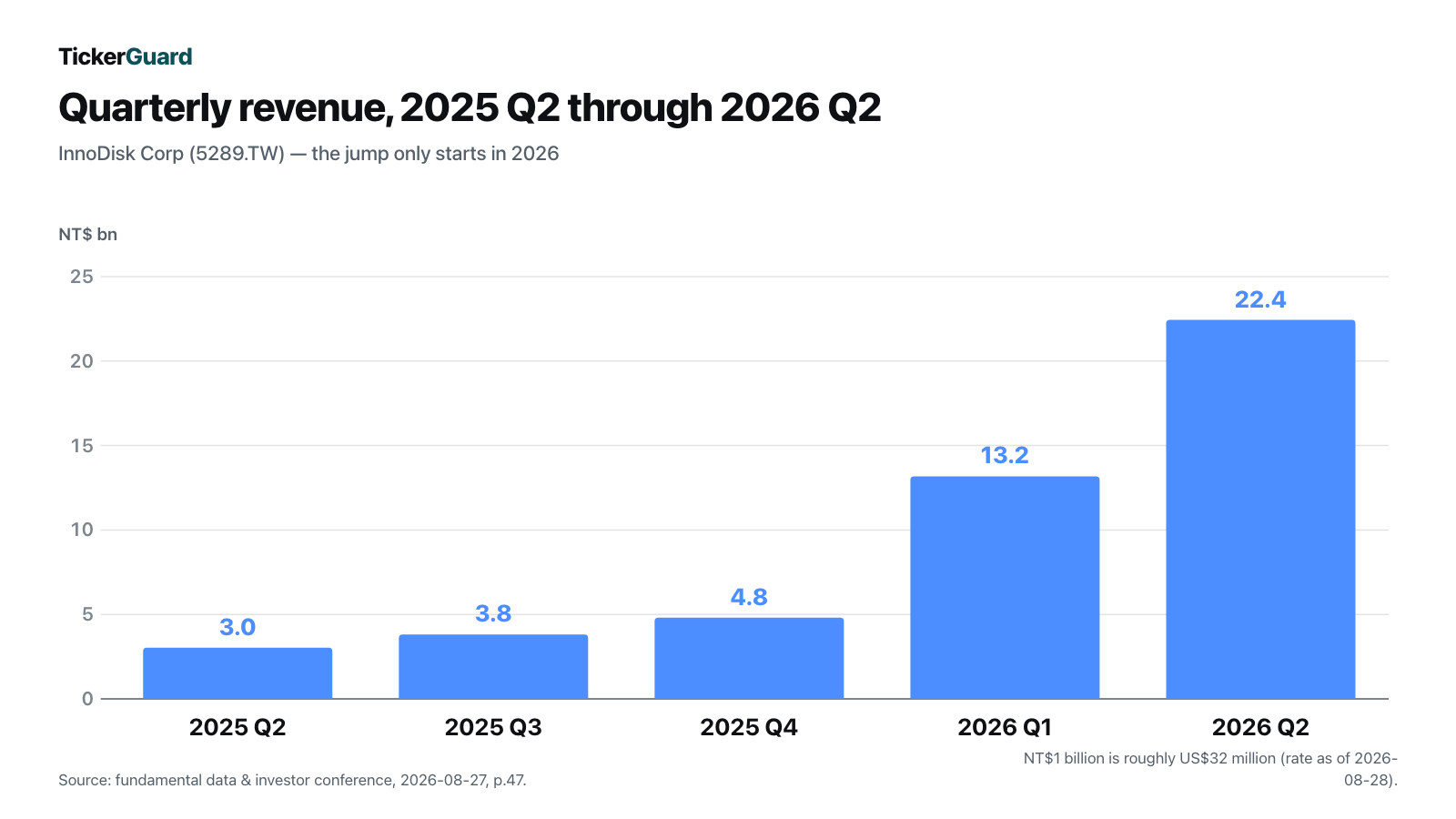
In the second quarter of 2026, Innodisk reported revenue of NT$22,443 million (up 641.1% year over year, up 70.3% versus the first quarter of 2026), net profit of NT$10,368 million (up 5,493.8% year over year), and earnings per share of NT$108.93. For comparison, first-half 2026 revenue alone, at NT$35,626 million, already came to roughly four times all of fiscal 2024.
A word on how to read these swings, because it's easy to get this wrong: the average quarterly earnings per share over the last five quarters (NT$2.02 / 6.87 / 9.15 / 57.49 / 108.93) works out to NT$36.89 — all five values added up and spread evenly. The median, the typical quarter where half the quarters were higher and half lower, was only NT$9.15 — not even a quarter of the average. The gap exists because the two most recent record quarters pull the average sharply upward while four of the five quarters sat far below it. Reading only the average risks mistaking the last two exceptional quarters for the normal case.
What the Investor Conference Says – and What's Missing
For transparency: there is no publicly available, word-for-word earnings-call transcript with a Q&A session for Innodisk, of the kind common for US-listed companies. Our internal check on 29 August 2026 found no captured transcripts for ticker 5289.TW; we substituted the official investor conference presentation from 27 August 2026 (Chairman Randy Chien), which ends with its own agenda slide for a Q&A session — but its content is not available to us. What can still be observed is that the tone of written communication shifted markedly over two years. The letter to shareholders for fiscal 2024 (published 10 April 2025) still sounds cautious: "Looking back at 2024, market demand recovery fell short of industry expectations." And further: "operating profit decreased compared to the previous year due to continued investment expenses."

None of that caution survives into the 27 August 2026 investor conference, which is titled "Exponential Growth" and "4,000+ High-value Customer Base" in large type, staging the brand as a "Global Market Leader." That contrast in tone is itself the key lesson of this chapter: management had said in 2025 it would build edge AI into a "third pillar" for the company — yet the actual record revenue of 2026, as the next chapter shows, comes overwhelmingly from an entirely different direction.
What the Filings Show – the Uncomfortable Truths
Uncomfortable Truth No. 1: Only 4% of the Record Revenue Comes From the AI Unit
Every slide of the 27 August 2026 investor conference revolves around artificial intelligence: "AI Core: Computing, Memory, Storage," "AI in Action Global Campaign," the new "Architect Intelligence" brand axis. Anyone seeing only these slides could assume the record revenue is an AI success. The company's own product-line breakdown tells a different story:

61% of second-quarter 2026 revenue came from DRAM modules, 34% from flash storage, only 4% from "AI Solutions," and 1% from other items. A year earlier (Q2 2025), DRAM's share was a much lower 52%, with flash correspondingly higher at 41% — so the 2026 revenue jump is primarily a shift toward DRAM, not toward AI products. Translated into an everyday picture: a baker who suddenly earns four times as much because the price of flour exploded is not suddenly selling four times as much bread — he is earning more per loaf because his raw material got more expensive. That is exactly what happened to Innodisk with DRAM and flash memory chips: a global demand boom from AI data centers drove up both the buying and selling prices of memory chips, and Innodisk, as a value-adding reseller, benefits from that spread regardless of whether the chip ends up inside an AI server or an industrial camera.
Uncomfortable Truth No. 2: Two Agents Supply 60% of Memory Chip Purchases
When the price of your own raw material explodes, how reliably and on what terms you can get that material becomes the decisive question. The 2024 Annual Report answers it:
"The company's main raw material is memory chips, with the primary suppliers being Samsung Electronics of South Korea and Kioxia of Japan. The procurement is conducted through their agents in Taiwan, Company A and Company Yin, with purchase ratios of 37.69% and 22.23% in 2024, respectively."
— Innodisk Corporation, 2024 Annual Report, Section V.(ix)

Combined, 59.92% of total purchases in 2024 ran through these two agents. The report itself rates the risk as low — "the memory supply is stable with no risk of supply interruption." That was the assessment for a year when memory chips were abundant. Since the AI-data-center-driven demand explosion of 2025/2026, the starting point is different: in a market where memory makers can sell their capacity scarce and expensive, negotiating position with exactly these two agents determines whether Innodisk keeps getting supplied at competitive volumes and prices — a disadvantage against larger buyers who can negotiate their own framework agreements directly with Samsung or Kioxia.
Uncomfortable Truth No. 3: Chairman and General Manager Have Been the Same Person Since 2010
A look at the corporate-governance section of the 2024 Annual Report reveals a concentration of power that many governance frameworks flag as a warning sign: Chien Chuan-Sheng has served as both Chairman (head of the board) and General Manager (chief operating executive) of Innodisk in a single person since 2010. The report explains this itself: "There is one person to serve as the Chairman and General Manager of the Company due to the needs of the business operation" — offset, it notes, by four of nine independent board directors (44%). Ownership is unusually fragmented: the largest reported single shareholder is the investment vehicle Rui Ding Investment at 7.60%, followed by Cathay Life Insurance at 5.25%; Chien Chuan-Sheng himself holds only 1.73% directly (as of 28 March 2025). There is no majority shareholder — but the operational concentration of power in one person persists, backed by a close network of related investment vehicles within the founding family's circle.
Valuation After the Price Jump
The stock closed on 28 August 2026 at NT$1,470 (roughly US$46). Market capitalization on that date stood at about NT$144.5 billion, or US$4.57 billion, on roughly 96.3 million shares outstanding. Based on the latest reported results, that works out to a price-to-earnings ratio of roughly 8.3 and a price-to-book ratio of roughly 6.3 — modest at first glance for a company with this kind of explosive earnings growth. The catch: a P/E built on the last two record quarters is only as reliable as the assumption that those earnings persist. Since the jump is largely a cyclical memory-pricing effect (see above), a "cheap" P/E here is not a reliable undervaluation signal — it can normalize just as fast as it appeared. The balance sheet as of 31 March 2026 shows both strength and speed: equity covered 60% of total assets, which nearly doubled to NT$24,631 million, cash stood at NT$2,729 million — while accounts receivable grew from NT$3,292 million to NT$9,028 million in a single quarter, and inventory from NT$5,385 million to NT$8,371 million, a textbook picture of a company tying up capital in inventory and receivables in the middle of a boom.
Opportunities and Risks
Opportunities: the global DRAM/NAND pricing cycle, driven by data-center demand for AI training, has historically run for multiple years and could persist for some time. Innodisk's Yilan plant expansion (Phase 3 groundbreaking planned for Q4 2026) and its push into edge-AI products give it a structural growth option beyond the pure pricing cycle, even though that unit currently accounts for only 4% of revenue. The balance sheet is soundly financed with a 60% equity ratio.
Risks: the flip side of any commodity price boom is its end — as the 2024 decline in operating profit shows, this business has historically been cyclical. Concentrating purchases through two agents for Samsung and Kioxia (59.92% combined in 2024) sharpens that risk in a seller's market. Operational power concentrated in one person holding both the Chairman and General Manager roles reduces the checks that a clearer separation of oversight and executive leadership would provide.
The Human Bottom Line
FOMO works best with a round, extreme number — and "revenue up 641%" is a very round, very extreme number. The honest question is not whether that number is true (it is), but where it comes from. At Innodisk, it comes 95% from a global memory-chip pricing cycle the company neither triggered nor controls, and only 4% from the AI unit front and center on every slide of the investor conference. That doesn't make Innodisk a bad company — the balance sheet is solid, the core business is real, and the pricing cycle may run for a while yet. It just makes the company something other than what the headline suggests: not an AI highflyer, but a cyclical memory-chip supplier that happens to be in the right place at the right time. What you make of that is your call. Not investment advice.
Sources
- Innodisk Corporate Investor Conference (Symbol: 5289), Randy Chien (Chairman), 2026-08-27 — innodisk.com/en/investor
- Innodisk Corporation and Subsidiaries, Consolidated Financial Statements and Independent Auditor's Review Report, First Quarter of 2026 and 2025, published 2026-05-08 (PricewaterhouseCoopers Taiwan)
- Innodisk Corporation, 2024 Annual Report, published 2025-04-10 — innodisk.com/en/investor
- Fundamental data (price, market cap, ratios), as of 2026-08-28
- TickerGuard: Hon Precision (7769.TW) — Stock Analysis
- TickerGuard: SanDisk — Stock Analysis
This analysis is not a substitute for individual investment advice. All figures to the best of our knowledge based on the sources cited, as of 2026-08-29.
Our Bottom Line at a Glance
- Balance-sheet strength positive
- As of 31 March 2026, equity covered 60% of total assets, with cash of NT$2,729 million (Q1 2026 consolidated financial statements, reviewed by PwC Taiwan).
- Core business riding the price boom positive
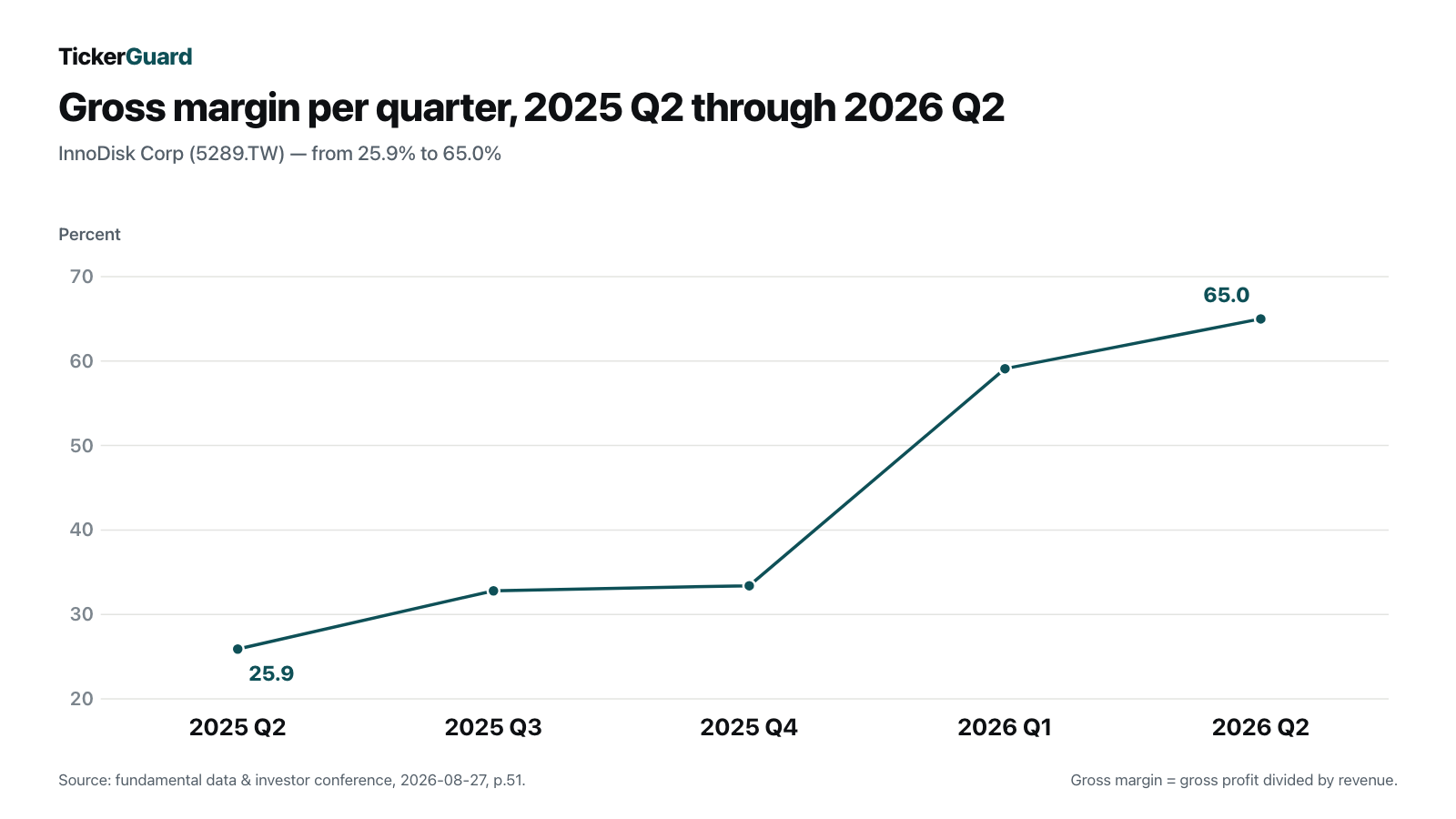
- The global DRAM/flash pricing cycle lifts revenue and gross margin (from 25.9% to 65.0% in four quarters) to historic records (Investor Conference, 2026-08-27).
- AI story vs. revenue share negative
- The marketed edge-AI unit "Architect Intelligence" accounted for only 4% of revenue in Q2 2026; 95% came from the traditional DRAM/flash business.
- Supplier concentration negative
- 59.92% of 2024 memory chip purchases ran through just two agents for Samsung Electronics and Kioxia (2024 Annual Report, Section V.(ix)).
- Historical cyclicality negative
- In fiscal 2024, operating profit fell 14.6% despite 7.24% revenue growth — the current boom follows a weak prior year, not steady growth.
- Governance concentration neutral
- Chairman and General Manager have been the same person since 2010; four of nine board directors are independent (44%). No majority shareholder; the largest single shareholder holds 7.60%.
Innodisk is a soundly financed memory-chip company riding a historic price boom whose AI unit contributes little to revenue so far. Valuation looks modest, but rests on earnings whose durability depends on where a cyclical commodity market goes next. Not investment advice.
What Our Rating Means
Open questions
The business works in principle, but one material question is open. As long as it stays open, our findings do not carry a quality verdict.
The balance sheet is healthy with no substance risk, but a significant operational question remains open: how durable is a record result driven mostly by a historically cyclical memory-chip pricing effect rather than the marketed AI business? Add to that high supplier concentration and an unusual concentration of power in the combined Chairman/General Manager role. The decision is yours.
A journalistic assessment by our editorial team at the time of the deep dive, based on public sources — not investment advice and not a solicitation to buy or sell. Your personal circumstances (investment goals, risk capacity, taxes) cannot be taken into account. What our levels mean, how verdicts are formed, and what conflicts of interest exist →
Worth Noting
- This analysis was prompted by Taiwanese financial press coverage in early August 2026 of second-quarter results across Taiwanese memory chip makers.
- All quarterly figures in this analysis are single-quarter values, not cumulative half-year or year-to-date figures.
- No word-for-word earnings-call transcript with a Q&A session exists for Innodisk as of 2026-08-29; this analysis relies on the public investor conference presentation from 2026-08-27.
The full analysis as a PDF for later
We will send you this analysis as a PDF — to print, file away, and read at your own pace.
Frequently Asked Questions
Since 2024, Innodisk has marketed an edge-AI unit under the "Architect Intelligence" brand axis, but it accounted for only 4% of revenue in Q2 2026. 95% came from the traditional DRAM and flash memory chip business (Investor Conference, 2026-08-27, p.49).
Innodisk is not a US-registered filer and therefore not registered with the SEC. The stock trades on the Taipei Exchange (TPEx) in Taiwan; mandatory disclosures run through Taiwan's MOPS system and the company's investor-relations page.
Mostly a global price boom for DRAM and flash memory chips, driven by AI data-center demand. Gross margin rose from 25.9% (Q2 2025) to 65.0% (Q2 2026) as a result — not from selling more AI products.
Very dependent: per the 2024 Annual Report, 59.92% of all memory chip purchases ran through just two agents for Samsung Electronics and Kioxia.
For fiscal 2024, Innodisk paid a cash dividend of NT$9.4 per share plus a stock dividend of 0.02 shares per share. Its dividend policy targets total distributions of at least 30% of annual earnings.
The TPEx is Taiwan's second regulated exchange segment for small and mid-sized companies, comparable to a growth board. It should not be confused with the US over-the-counter market for unregulated micro-caps.
There is no majority shareholder. The largest reported single shareholder is the investment vehicle Rui Ding Investment at 7.60% (as of 2025-03-28); Chairman and General Manager Chien Chuan-Sheng has combined both leadership roles in one person since 2010.
No. An automated check on 2026-08-29 found no captured transcripts for this ticker. This analysis relies instead on the public investor conference presentation from 2026-08-27, whose Q&A session was not recorded.
Found an error?
Did you spot a factual error, an outdated number, or a typo in this deep dive? Let us know briefly — your report goes straight to the editorial team.