Infineon: Back to 2023 Revenue — at Twice the Market Value
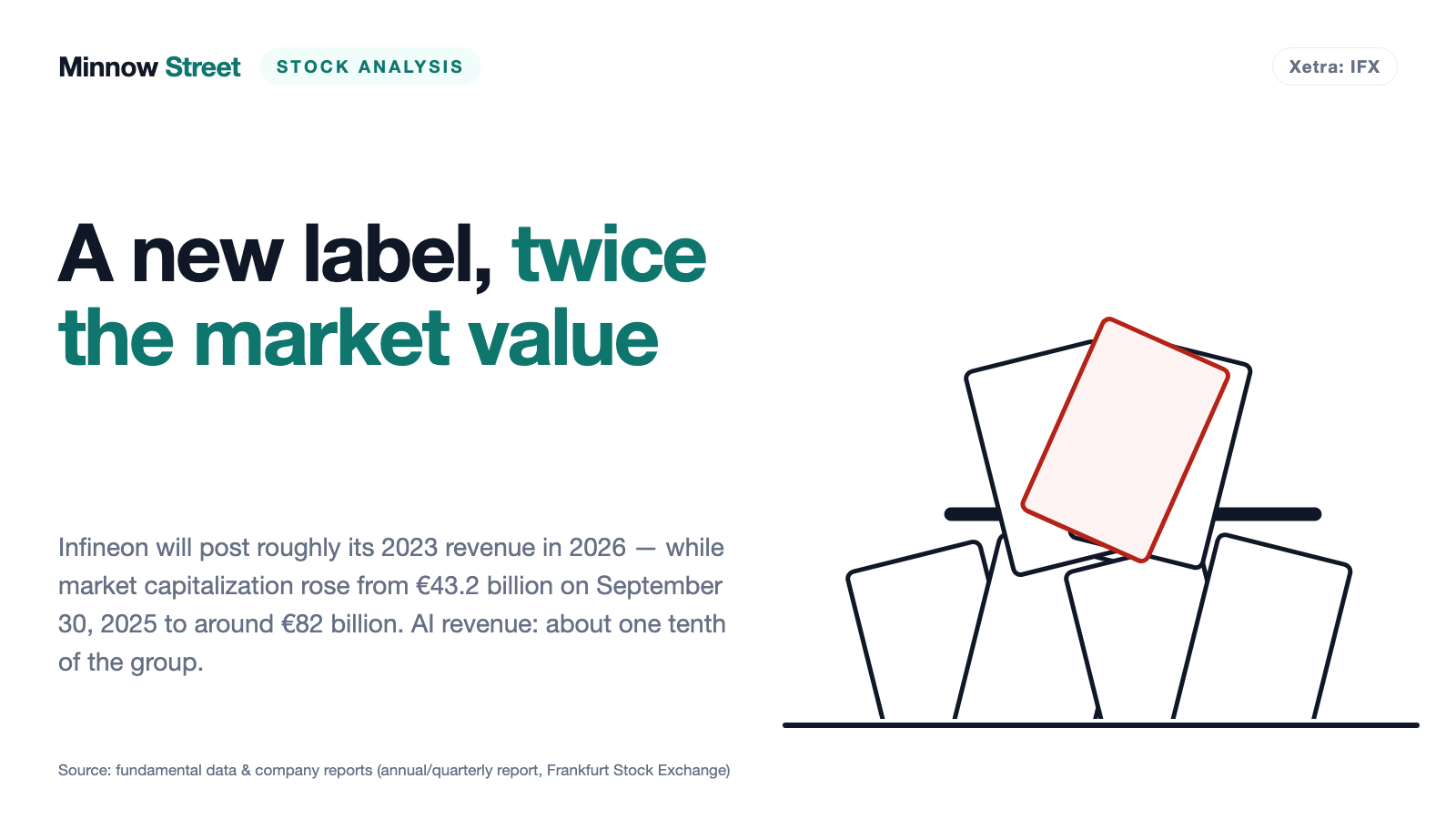
On August 5, 2026, Infineon reported €4,172 million in quarterly revenue, the highest in company history, and raised full-year guidance to around €16.3 billion. That is almost exactly the revenue the group already booked in fiscal 2023 — back then at a Segment Result Margin of 27.0 percent instead of the roughly 20 percent now expected. Market capitalization has climbed from €43.2 billion on September 30, 2025 to around €82 billion. The driver is a business expected to deliver more than €1.6 billion this fiscal year: power supply for AI data centers, roughly one tenth of the group. Not a buy or sell recommendation — just the question of how much company sits behind the new label.
 Thomas Mücke
Founder & Publisher
Thomas Mücke
Founder & Publisher
Chart
Interactive price chart (TradingView).
Note: pure fact-based analysis, not investment advice and not a solicitation to buy or sell. All figures without guarantee.
There is an investor trap that has nothing to do with numbers and still decides billions: the label. A company does the same thing for years, gets filed under "auto supplier" and is paid twelve times its earnings. Then somebody sticks a new label on it — "AI stock" — and suddenly a completely different arithmetic applies to the very same business. Call it the label trap: the company has not changed, the drawer we put it in has. And drawers carry price tags.
With Infineon you can trace that moment almost to the day. On September 30, 2025 — the end of fiscal 2025 — the shares closed at €33.20 and market capitalization stood at €43,231 million. In the annual report for that very year, the company itself notes dryly that the big gains in the U.S. semiconductor indices were "largely driven by companies whose core business activities involve artificial intelligence" — Infineon explicitly was not among them and lagged its benchmark indices. On June 3, 2026, the same share closed at €88.00. On August 11, 2026, at €62.85, which works out to a market value of around €82 billion. So let us make a deal: we leave the label where it belongs and read the reports instead — the Annual Report 2025, the five-year financial data series and the quarterly release of August 5, 2026. They supply the tension running through this analysis: the label is accurate. It just describes roughly one tenth of the group.
What Infineon actually does — taming electricity, not computing
Infineon Technologies AG, based in Neubiberg near Munich, does not build compute chips. It builds the components that tame electricity on its way to the compute chip — and that measure, control and secure everything around it. Put in everyday terms: if the processor is the engine, Infineon builds the gearbox, the ignition, the fuel tank and the sensors. Power semiconductors govern how 400 volts of grid supply become one volt at the chip without the energy escaping as heat along the way. Microcontrollers are small control computers, installed hundreds of times over in a modern car. Sensors detect pressure, motion and radar echoes. Security chips sit in ID cards and payment cards.
In fiscal 2025 Infineon reported in four segments. Automotive (ATV) was by far the largest: €7,402 million of revenue, or 50.5 percent of the group, at a Segment Result of €1,529 million. Power & Sensor Systems (PSS) followed with €4,208 million (28.7 percent) and €683 million of Segment Result — this is where the AI business sits. Green Industrial Power (GIP) came in at €1,631 million (11.1 percent) and Connected Secure Systems (CSS) at €1,418 million (9.7 percent). As of July 1, 2026, the group reorganized into three divisions — Automotive, Power Systems and Edge Systems — but will report the familiar four-way split once more for the closing quarter.
As of September 30, 2025, Infineon employed 57,077 people (prior year 58,065). In calendar 2024 the group ranked eleventh in the global semiconductor market with a 2.4 percent share and fourth in its narrower reference market with 5.3 percent — the leading European manufacturer on both measures. In microcontrollers, Infineon is number one with a 23.2 percent share according to market researcher Omdia.
Why there is no SEC filing here — and where the numbers come from instead
One point up front, because it shapes the entire evidence base: there is no 10-K and no 10-Q for Infineon. The U.S. securities regulator, the SEC, does hold an identifier under the name "Infineon Technologies AG" (CIK 0001107457), but it has carried no periodic reports since Form 15F-12B of August 6, 2010. With that filing Infineon terminated its U.S. registration and withdrew from the New York Stock Exchange. Everything filed since then consists of F-6 forms submitted by a depositary bank for the American depositary receipt IFNNY, which trades over the counter, plus beneficial ownership reports by funds. No 10-K, no 10-Q, not even a 20-F.
Infineon's mandatory reporting runs instead through the regulated market (Prime Standard) of the Frankfurt Stock Exchange: an audited IFRS consolidated annual report, a half-year financial report and unaudited quarterly releases. Every figure in this analysis therefore carries "Source: fundamental data & company reports (annual/quarterly report, Frankfurt Stock Exchange)" rather than "SEC filings". The logic that a report filed under threat of penalty is more honest than a press release still applies — just under German and European capital market law rather than U.S. law.
Infineon shares this setup with many German industrial names. In our HENSOLDT analysis, also Xetra-listed and without a 10-K or 10-Q, the entire chain of evidence likewise ran through the company's own annual and quarterly reports rather than through sec.gov.
A second point has to be kept in mind with every Infineon number: the fiscal year ends on September 30, not December 31. "Fiscal 2026" at Infineon covers October 1, 2025 through September 30, 2026. The third quarter of fiscal 2026, which this piece discusses, is therefore the calendar quarter from April to June 2026.
How this stock landed on our desk
No scanner hit, no reader submission, no analyst price target — but a release and the reaction to it. On August 5, 2026, Infineon published its third-quarter fiscal 2026 figures under a headline stating the quarter had "concluded with record sales", driven by the strong AI business. The group raised full-year guidance in the same breath. And the stock? It closed that day at €60.08, down from €63.72 the day before — a 5.7 percent decline on the day of the best numbers in company history.
That combination is the hook. A record that pushes the price down says nothing about the company and everything about the expectation already priced in. Between April 1, 2026 (closing price €40.15) and June 3, 2026 (€88.00) the shares had more than doubled in barely two months — without a single quarterly report appearing in that window. What had changed was the label.
The numbers over the years — given their due
First what genuinely impresses. Infineon is a company with real substance: €2,227 million of research and development expenses in fiscal 2025, its own fabs in Germany, Austria and Malaysia, market leadership in microcontrollers, an order backlog of close to €30 billion as of June 30, 2026, and an equity ratio of 56.0 percent as of September 30, 2025. And: no single customer accounted for more than 10 percent of revenue in fiscal 2025 or 2024. That is rare in this industry and a genuine plus — many chip companies hang on three large buyers.
Now the series you need before discussing valuation. Revenue rose from €11,060 million (2021) via €14,218 million (2022) to a peak of €16,309 million in fiscal 2023 — and then fell to €14,955 million (2024) and €14,662 million (2025). For fiscal 2026 the group expects around €16,300 million. That is, within a few million, the revenue of 2023.
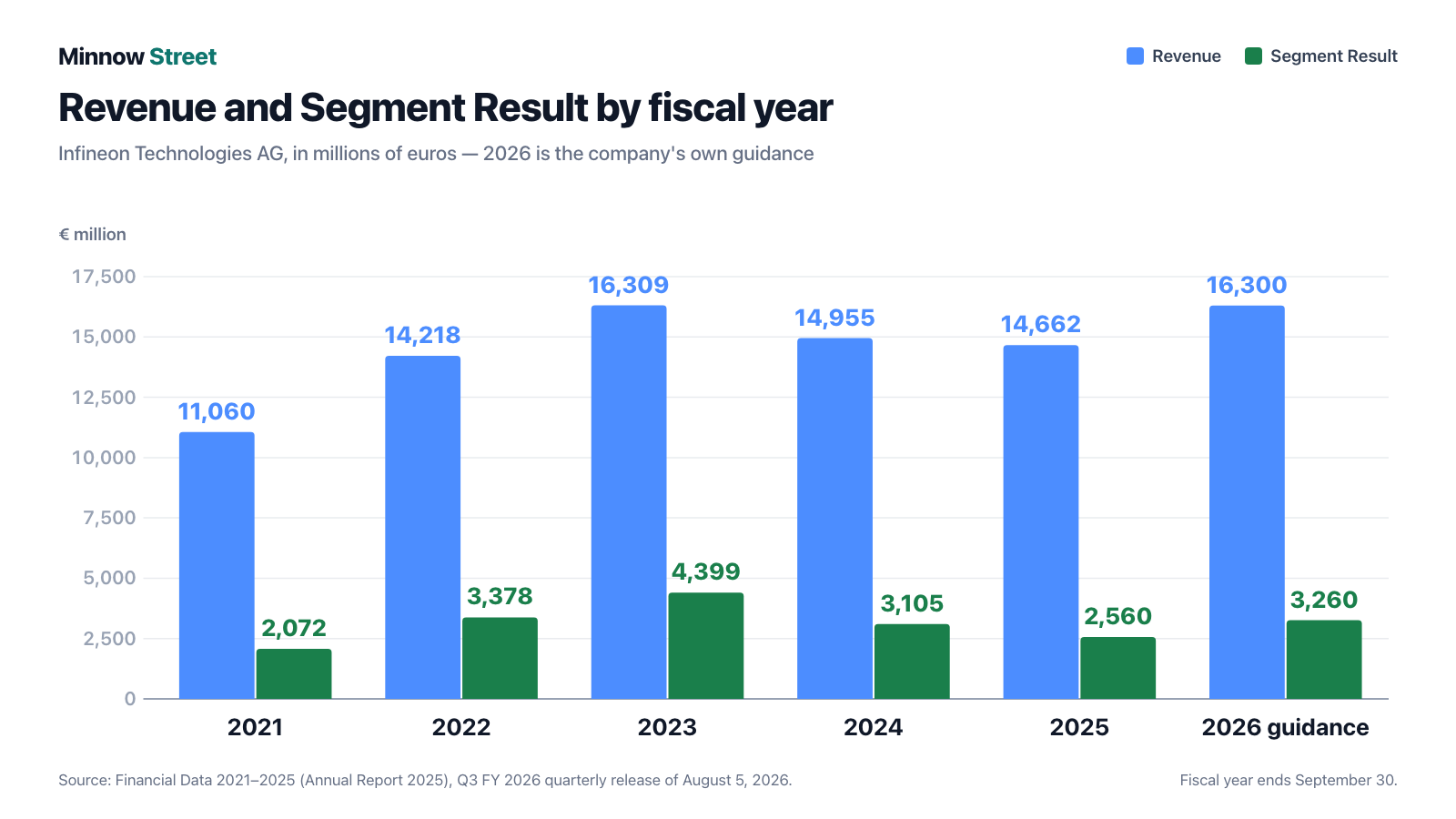
On earnings, the gap is wider. The Segment Result — Infineon's own steering metric, operating profit adjusted for certain impairments, restructuring and closure effects, share-based payment and acquisition-related amortization — peaked in 2023 at €4,399 million and a margin of 27.0 percent. In 2025 it was €2,560 million and 17.5 percent. For 2026 the group targets around 20 percent. Profit for the period fell from €3,137 million (2023) via €1,301 million (2024) to €1,015 million (2025); basic earnings per share from €2.38 via €0.98 to €0.77. Return on capital employed shrank from 16.6 percent (2023) to 4.9 percent (2025).
Remember: revenue coming back is not the same as earnings coming back. Anyone reading the 2023-to-2026 cycle as "a dip, then business as usual" is overlooking that Infineon bought two companies, built a fab and lifted depreciation and amortization from €1,754 million to around €2,000 million over those three years.
The quarter that produced the record
August 5, 2026 delivered good numbers, no question. Revenue in the third quarter of fiscal 2026 rose to €4,172 million — up 9.4 percent on the prior quarter (€3,812 million) and close to 13 percent on the year-earlier quarter (€3,704 million). It was the first quarter in two and a half years above €4 billion and the highest quarterly figure in company history. All four segments grew.
Gross margin climbed from 38.7 to 40.8 percent, the Segment Result from €653 million to €797 million (margin 19.1 percent after 17.1 percent). Operating profit improved from €458 million to €594 million, profit for the period from €301 million to €423 million, basic earnings per share from €0.23 to €0.32. And, importantly after a weak prior quarter, free cash flow turned from minus €63 million to plus €599 million.
Chief Executive Jochen Hanebeck framed the quarter this way:
"Infineon concluded the third quarter of the 2026 fiscal year with record revenue and continues its growth trajectory. An increasing number of our target markets are showing a positive trend. Our power supply solutions for AI data centers remain in very high demand and continue to be our most important growth driver."
— Jochen Hanebeck, CEO, Q3 FY 2026 quarterly release, August 5, 2026
The segment housing the AI business, Power & Sensor Systems, was the engine: €1,442 million of revenue after €1,260 million in the prior quarter — up 14 percent in three months and 34 percent year over year — at a Segment Result Margin of 24.9 percent after 20.4 percent. Automotive grew 6 percent to €1,932 million (margin 18.4 percent), Green Industrial Power 11 percent to €447 million (margin 9.8 percent after 11.7 percent, on temporary operational and inventory effects), Connected Secure Systems 10 percent to €350 million (margin 9.7 percent after 5.6 percent).
Adding up the three quarterly releases published so far in fiscal 2026 — our own addition, since Infineon does not disclose nine-month figures separately in these releases — gives revenue of €11,646 million for October 2025 through June 2026, against €10,719 million in the year-earlier period (up 8.6 percent), a Segment Result of €2,105 million after €1,843 million (margin 18.1 percent after 17.2 percent), profit for the period of €980 million after €784 million (up 25 percent) and free cash flow of plus €337 million. For the closing quarter the group expects around €4.7 billion of revenue at a Segment Result Margin of around 23 percent — comfortably the strongest quarter of the year.
What the reports say — the uncomfortable truths
Uncomfortable truth no. 1: the AI business is roughly one tenth — half the group hangs on cars
AI revenue is real, growing fast and highly profitable. Nobody disputes that here. The Annual Report 2025 spells it out:
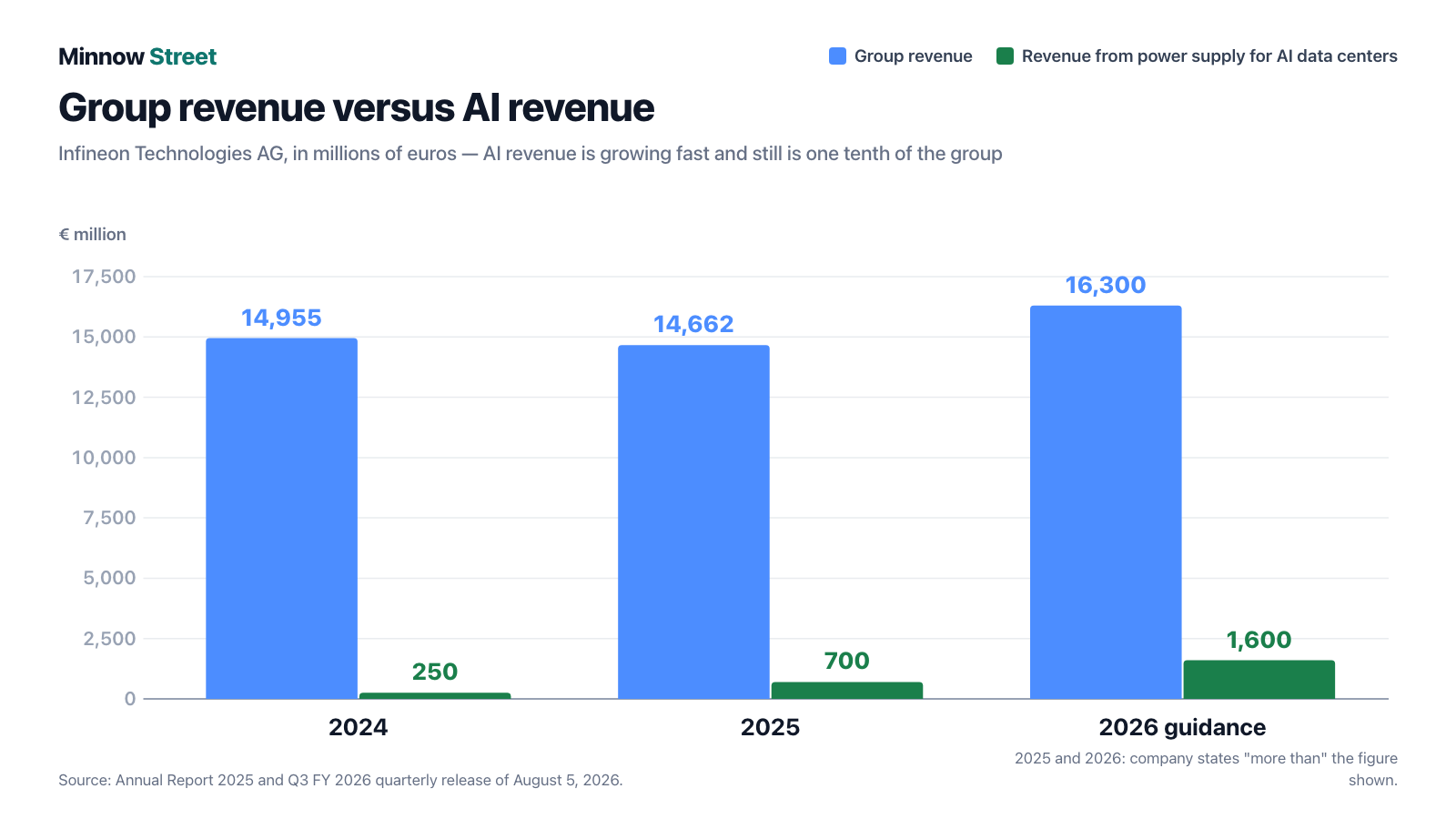
"Data centers recorded another increase in revenue in the 2025 fiscal year. The strongest revenue driver was power supply components for servers used in artificial intelligence. Revenue in this area nearly tripled in the 2025 fiscal year, from around €250 million in the 2024 fiscal year to over €700 million in the 2025 fiscal year."
— Infineon Technologies AG, Annual Report 2025, "Segment performance"
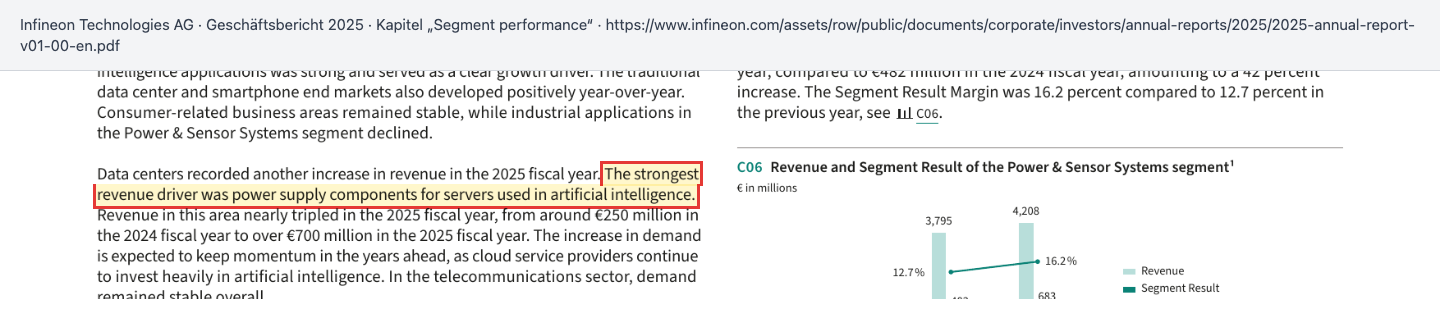
For fiscal 2026 the group raised the target on August 5, 2026 from €1.5 billion to more than €1.6 billion; on top of that comes around €500 million from classic, non-AI data center power supply. Demand exceeds available supply, and Infineon is shipping on allocation. For fiscal 2027 the previous projection stood at €2.5 billion; it is to be raised "materially" in November 2026.
Now the calculation that appears in no headline. More than €1.6 billion out of around €16.3 billion of group revenue is roughly 10 percent. Even including the €500 million of classic data center business, it is about 13 percent. In the same fiscal year, half of revenue came from the Automotive segment — and that segment is guided to grow only "slightly" in 2026, meaning slower than the group. The refocusing of the high-voltage electric drivetrain business additionally burdens the Automotive margin this fiscal year by a low-to-mid single-digit percentage.
It also matters what Infineon sells in this chain. Not the compute chips themselves — those come from others, among them the manufacturer covered in our Nvidia analysis, with which Infineon is jointly developing the industry's first 800-volt power supply architecture for AI data centers. Infineon supplies the conversion stages upstream: silicon carbide for grid-to-rack conversion, gallium nitride for dense intermediate stages, and classic silicon right at the processor. Silicon carbide is a field where specialist competitors are also active, and their road has been anything but straight — as set out in our Wolfspeed analysis.
Uncomfortable truth no. 2: 40 percent sits between "Segment Result" and what is left
When Infineon is written about, the "Segment Result Margin" is usually the number in the text — 19.1 percent in the third quarter of fiscal 2026, around 20 percent for the year. That sounds like solid industrial profitability. But the Segment Result is a self-defined metric, not an IFRS figure. Infineon strips certain impairments out of operating profit, along with restructuring and closure effects, share-based payment, acquisition-related amortization and other income and expenses.
What that amounts to shows up in a single line for fiscal 2025: Segment Result €2,560 million, operating profit €1,515 million, profit for the period €1,015 million. Roughly 60 percent of the starting figure sits between the celebrated metric and what belongs to shareholders. Part of that is interest and tax, which is entirely normal. Another part less so: around €400 million of amortization per year stems from purchase price allocations — the accounting echo of the acquisitions of Cypress and Marvell's automotive Ethernet business. That amortization does not drain cash, but it does reduce real balance sheet value.
The same gap appears in earnings per share. Reported: €0.77 for fiscal 2025. Adjusted: €1.39. The adjusted figure is 81 percent higher. In the third quarter of fiscal 2026, €0.32 reported meets €0.44 adjusted. In everyday terms: it is the difference between what the payslip says and what lands in the account — except that here the gross number is the one in the headlines.
A look at the balance sheet shows where part of these adjustments comes from. As of September 30, 2025, the books carried €7,849 million of goodwill and €3,274 million of other intangible assets — €11,123 million combined against total equity of €17,051 million. So roughly 65 percent of equity is not machines, fabs or cash, but the price paid for past acquisitions. For a group that has bought International Rectifier, Cypress and most recently Marvell's Ethernet business for the equivalent of €2,180 million over a decade, that is no surprise. But it does mean this: if one of those bets fails to pay off, the write-down lands in profit for the period — not in the Segment Result.
Uncomfortable truth no. 3: net debt has more than quadrupled in two years
As of September 30, 2023, Infineon's net debt — financial debt less gross cash — stood at €1,143 million. Two years later, as of September 30, 2025, it was €4,727 million. As of June 30, 2026, the books show €5,185 million. The main reason is stated and easy to follow: the acquisition of Marvell's automotive Ethernet business in August 2025, financed largely with debt.
Alongside that, the investments. For fiscal 2026 Infineon plans around €2,700 million — up from an original €2,200 million, raised in February 2026 to accelerate capacity expansion for AI power supply. Depreciation and amortization sit at around €2,000 million. The group is therefore investing considerably more than it writes off: it is building. In July 2026 the Smart Power Fab in Dresden opened, in the company's words the world's largest cleanroom for cutting-edge power semiconductors and analog/mixed-signal technologies.
Free cash flow shows the same arithmetic from the other side: €1,158 million (2023), €23 million (2024), minus €1,051 million (2025). In the first nine months of fiscal 2026 it is back to plus €337 million. For the full year Infineon expects around €900 million — down from €1,250 million, cut because the figure now includes the purchase price of about €570 million for the ams OSRAM sensor portfolio. Adjusted free cash flow, which excludes major frontend building investments and M&A, is guided up from €1.65 billion to €1.85 billion.
And the return on that capital? Return on capital employed was 16.6 percent in fiscal 2023, 8.5 percent in 2024 and 4.9 percent in 2025. In the third quarter of fiscal 2026 it reached 7.9 percent; for the full year Infineon expects a mid-to-high single-digit percentage. Remember: a company that invests more than it depreciates for three years running has to deliver the return on that capital eventually — otherwise only the balance sheet grows. For balance: net leverage stood at 1.4 times as of June 30, 2026 and gross leverage at 1.8 times — both inside the company's self-imposed ceiling of 2 times. In the third quarter, Infineon redeemed a €750 million Eurobond and a US$350 million private placement at maturity, both as scheduled.
Uncomfortable truth no. 4: 38 percent of revenue comes from Greater China
In fiscal 2025, €5,579 million of €14,662 million in revenue came from Greater China (mainland China, Hong Kong, Taiwan) — 38 percent. Mainland China and Hong Kong alone accounted for €4,212 million, or 29 percent. For comparison: Germany contributed €1,437 million (10 percent) and the United States €1,506 million (10 percent). Revenue is allocated by customer location.
The other direction is just as telling: of €20,055 million in non-current assets, only €165 million sat in Greater China as of September 30, 2025 — 0.8 percent. Infineon sells a great deal there and owns almost nothing there. The group describes the risk in its own risk report:
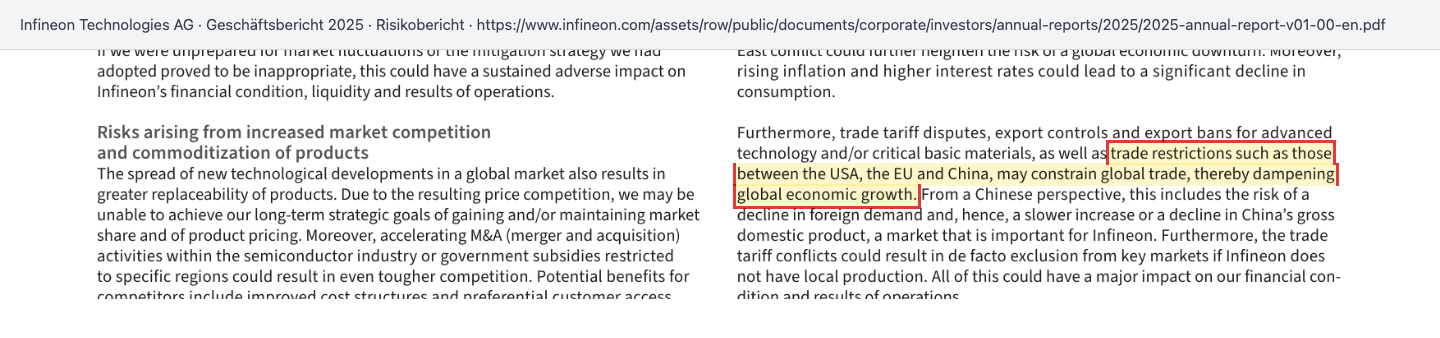
"Furthermore, trade tariff disputes, export controls and export bans for advanced technology and/or critical basic materials, as well as trade restrictions such as those between the USA, the EU and China, may constrain global trade, thereby dampening global economic growth. … Furthermore, the trade tariff conflicts could result in de facto exclusion from key markets if Infineon does not have local production."
— Infineon Technologies AG, Annual Report 2025, risk report
Add the competition in the same market: the power semiconductor vendor ranking Infineon itself reproduces in its investor presentation of August 5, 2026 lists Chinese suppliers Hangzhou Silan and BYD with 4.2 and 3.2 percent market share. For you as an investor this does not read "China is a problem" but something more precise: roughly four out of every ten revenue euros hang on a political configuration Infineon cannot influence — and which, when it matters, is decided in Washington and Beijing, not in Neubiberg.
The contract that is not on the balance sheet yet
One find from the same quarterly release that made no headline and that we logged as a side find. Several leading customers across the AI data center ecosystem have signed multi-year capacity reservation agreements with Infineon or are negotiating them:
"These agreements cover a cumulative revenue volume of a high single-digit billion euro amount and feature also certain prepayments."
— Infineon Technologies AG, Q3 FY 2026 quarterly release, August 5, 2026, page 5
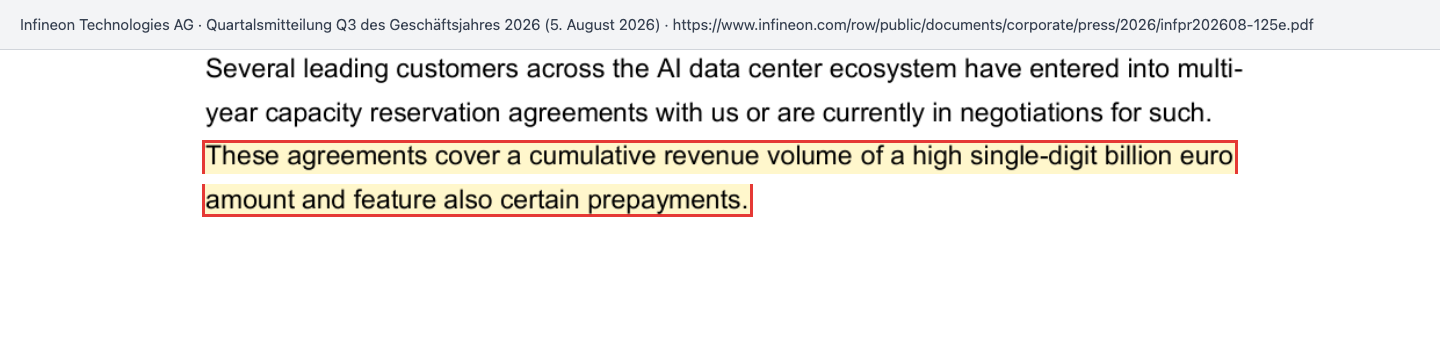
This is a pattern familiar from the foundry business but rare in the classic semiconductor product business: the customer pays in advance to lock in production slots. For Infineon that materially de-risks the billions currently being invested. It only becomes verifiable, however, with the annual results on November 10, 2026 — that is when the prepayments should appear as contract liabilities on the balance sheet. Cash flow from operating activities in the third quarter already jumped from €436 million to €1,114 million; how much of that stems from such prepayments is not disclosed separately.
Valuation: what the market is asking for this business
Back to the label. On September 30, 2025 the shares cost €33.20 and market capitalization stood at €43,231 million. On August 11, 2026 the Xetra close was €62.85; with 1,305,921,137 shares issued, that comes to around €82 billion — a gain of roughly 90 percent in a little over ten months. In between, the highest close of the past twelve months was €88.00 on June 3, 2026, followed by a correction of about 29 percent.
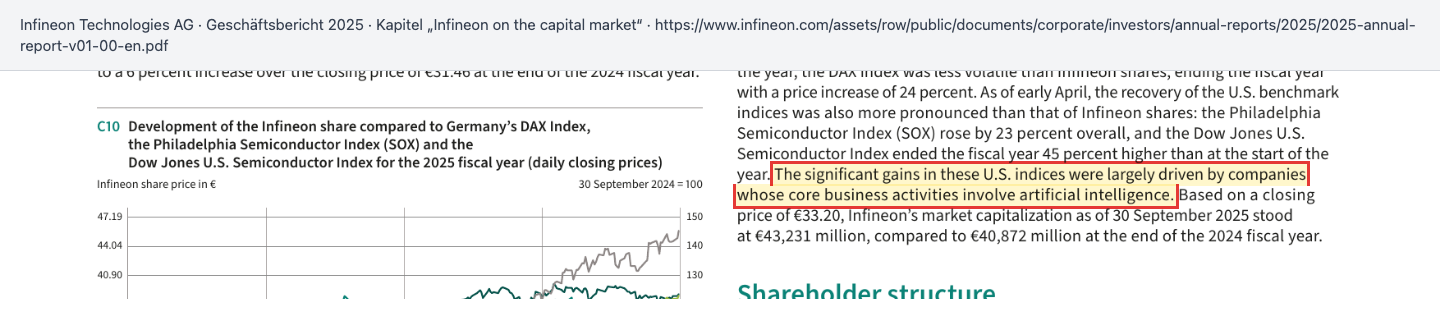
And the Annual Report 2025 records precisely what was not carrying Infineon at the time:
"The significant gains in these U.S. indices were largely driven by companies whose core business activities involve artificial intelligence. Based on a closing price of €33.20, Infineon's market capitalization as of 30 September 2025 stood at €43,231 million, compared to €40,872 million at the end of the 2024 fiscal year."
— Infineon Technologies AG, Annual Report 2025, "Infineon on the capital market"
What does that mean in ratios? On fiscal 2025 basic earnings per share of €0.77, the price-to-earnings ratio works out to roughly 82. On adjusted earnings per share of €1.39, it is about 45. The rolling view is more informative: the four most recently reported quarters — Q4 fiscal 2025 through Q3 fiscal 2026 — sum to €0.91 of earnings per share, giving a multiple of roughly 69. Enterprise value, market capitalization plus net debt, comes to around €87 billion, or roughly 5.4 times the revenue guided for 2026.
The professionals' view, to be read with the usual caution: the average price target of covering analysts stood at €85.09 as of August 11, 2026, roughly 35 percent above the same day's price. Analyst targets are opinions, not filings — they say something about expectations for coming quarters and nothing about the past.
On the dividend: for fiscal 2025 the Annual General Meeting of February 19, 2026 approved an unchanged payout of €0.35 per share, the third identical amount in a row; around €456 million was distributed. At the August 11, 2026 price that is a yield of roughly 0.6 percent. Infineon is plainly not an income stock.
Opportunities and risks at a glance
What speaks for Infineon:
- The AI business is growing faster than planned: more than €1,600 million of revenue in fiscal 2026 instead of the €1,500 million previously assumed, after more than €700 million (2025) and around €250 million (2024); demand exceeds supply by the company's own account. The fiscal 2027 projection stood at €2,500 million and is to be raised materially in November 2026.
- The order backlog stood close to €30 billion as of June 30, 2026, and several leading AI customers have signed capacity reservation agreements covering a cumulative revenue volume in the high single-digit billions — some with prepayments attached.
- The recovery is visible in the numbers and broad-based: all four segments grew in the third quarter of fiscal 2026, the Segment Result Margin rose from 17.1 to 19.1 percent, profit for the period from €301 million to €423 million, free cash flow from minus €63 million to plus €599 million. For the closing quarter Infineon expects around €4.7 billion of revenue at a margin of around 23 percent.
- The balance sheet holds: total equity of €18,020 million as of June 30, 2026 (equity ratio 56.0 percent at the last balance sheet date), net leverage of 1.4 times and gross leverage of 1.8 times against a self-imposed ceiling of 2.0; no customer accounted for more than 10 percent of revenue in 2025 or 2024.
- Capacity and structure are being expanded: the Smart Power Fab in Dresden opened in July 2026, with additional cleanroom space in Austria and Malaysia, and the ams OSRAM sensor portfolio acquisition closed on July 1, 2026 for around €570 million (annualized revenue run rate around €230 million, roughly 230 employees). The "Step Up" efficiency programme is meant to lift the annual Segment Result by a high three-digit million euro amount, with full effect in the first half of fiscal 2027; roughly half had been achieved by the end of fiscal 2025.
What speaks against it:
- At more than €1,600 million, the AI business is roughly one tenth of group revenue; half of fiscal 2025 revenue came from the Automotive segment (€7,402 million of €14,662 million), which is guided to grow only slightly in 2026 — burdened by the refocusing of the high-voltage drivetrain business.
- Revenue of around €16,300 million in fiscal 2026 is almost exactly the 2023 figure (€16,309 million), but the expected Segment Result Margin of roughly 20 percent sits well below the 27.0 percent of that year. Return on capital employed fell from 16.6 percent to 4.9 percent (2025).
- Net debt rose from €1,143 million (September 30, 2023) to €5,185 million (June 30, 2026); free cash flow was negative at minus €1,051 million in 2025 and is guided at around €900 million for 2026 — against planned investments of around €2,700 million.
- Goodwill (€7,849 million) and other intangible assets (€3,274 million) together made up roughly 65 percent of total equity as of September 30, 2025; around €400 million of amortization per year stems from purchase price allocations and is stripped out of the Segment Result.
- 38 percent of 2025 revenue came from Greater China (€5,579 million of €14,662 million), while only €165 million of €20,055 million in non-current assets sits there. The risk report explicitly names trade restrictions between the United States, the EU and China, including the possibility of de facto market exclusion without local production.
- The stock swings hard: from €40.15 on April 1, 2026 to €88.00 on June 3, 2026 and back to €62.85 on August 11, 2026. On the day of the record release, August 5, 2026, it lost 5.7 percent — expectation had run ahead of the numbers. For fiscal 2026 Infineon also projects around €650 million of idle costs from underutilized capacity.
A human conclusion
Back to the label trap. The "AI stock" label is not wrong at Infineon — it is simply much smaller than it sounds. The group earns most of its money on chips for cars, industrial equipment, grid infrastructure and ID documents; the AI business contributes roughly one tenth, but grows faster than anything else in the house and at the best margin. Both statements sit in the same reports, and both are true.
What had changed by June 3, 2026 at €88.00 was not the company. Revenue in the current fiscal year lands roughly where it already was in 2023, the Segment Result well below, net debt four times as high, return on capital a third of what it was. What had changed was the drawer. And when the record actually arrived on August 5, 2026, the price fell — because expectation had long since run past the numbers.
This is not an indictment. It is a reminder that a label is a shortcut, and shortcuts have a price. Anyone investing in Infineon is buying a cyclical European industrial group with a decent balance sheet, real technology leadership, a very good small AI business and a very large dependence on the automotive cycle and on China. Whether around €82 billion is the right price for that is not decided by the label — but by how many of the next ten quarters look like the third quarter of fiscal 2026. What you make of that is your decision. And that is exactly as it should be.
Sources
Every original document used in this analysis — for you to read yourself:
- Infineon Technologies AG — Q3 FY 2026 quarterly release (August 5, 2026), the most recent periodic report available, quarter ended June 30, 2026
- Infineon Technologies AG — Q3 FY 2026 analyst call intro statement (August 5, 2026) — source for the order backlog, leverage, return on capital employed, inventory reach and the AI revenue targets
- Infineon Technologies AG — Q3 FY 2026 investor presentation (August 5, 2026) — market share data and investment planning
- Infineon Technologies AG — Annual Report 2025 (fiscal year ended September 30, 2025, published November 12, 2025) — combined management report, capital market chapter, risk report, notes
- Infineon Technologies AG — Financial Data 2021 to 2025 — source of the entire five-year series in this analysis
- Infineon Technologies AG — FY 2025 results release (November 12, 2025) and Q1 FY 2026 quarterly release (February 4, 2026)
- Infineon Technologies AG — release on the Annual General Meeting of February 19, 2026 (dividend of €0.35 per share approved)
- Investor relations pages at infineon.com/about/investor — publications, financial calendar, shareholder structure
- U.S. Securities and Exchange Commission, EDGAR — filing index for CIK 0001107457: Form 15F-12B of August 6, 2010 (termination of U.S. registration), and since then only F-6 filings for the IFNNY depositary receipt and beneficial ownership reports. No 10-K, no 10-Q, no 20-F.
- Fundamental data (prices, market capitalization, analyst price target; data as of August 11, 2026), reconciled with the figures in the annual and quarterly reports.
Transparency & disclaimer: This analysis is journalistic commentary on publicly available information. It is not investment advice, not a regulated investment recommendation and not a solicitation to buy or sell securities. Equity investments carry substantial risks up to total loss. All information without warranty; the date of each figure is noted in the text, and this edition reflects data as of August 11, 2026. Fiscal 2026 annual results are scheduled for November 10, 2026. Positions held by the operator are disclosed daily; where one exists, it appears as a notice at the top of this deep dive.
Our Bottom Line at a Glance
- Growth and order situation positive
- Revenue reached €4,172 million in the third quarter of fiscal 2026, the highest quarterly figure in company history (prior quarter €3,812 million, year-earlier quarter €3,704 million). All four segments grew. The order backlog stood close to €30 billion as of June 30, 2026, and full-year guidance was raised to around €16,300 million on August 5, 2026.
- Profitability neutral
- The Segment Result Margin rose from 17.1 to 19.1 percent in the third quarter of fiscal 2026 and profit for the period from €301 million to €423 million. Measured against fiscal 2023 (margin 27.0 percent, basic earnings per share €2.38), Infineon still lags considerably: 2025 delivered 17.5 percent and €0.77, and around 20 percent is guided for 2026 — on almost exactly the same revenue as 2023.
- AI business positive
- Revenue from power supply for AI data centers grew from around €250 million (fiscal 2024) through more than €700 million (2025) to an expected more than €1,600 million in fiscal 2026 — raised from €1,500 million on August 5, 2026. Demand exceeds supply by the company's own account. The Power & Sensor Systems segment reached a margin of 24.9 percent in the third quarter of fiscal 2026 after 20.4 percent in the prior quarter.
- Business mix and dependencies negative
- At more than €1,600 million, the AI business is roughly one tenth of expected 2026 group revenue; half of fiscal 2025 revenue came from the Automotive segment (€7,402 million of €14,662 million), which is guided to grow only slightly in 2026. On top of that, 38 percent of 2025 revenue came from Greater China (€5,579 million), while only €165 million of €20,055 million in non-current assets sits there.
- Balance sheet and return on capital negative
- Net debt rose from €1,143 million (September 30, 2023) via €4,727 million (September 30, 2025) to €5,185 million as of June 30, 2026. Return on capital employed fell from 16.6 percent (fiscal 2023) to 4.9 percent (2025) and stood at 7.9 percent in the third quarter of fiscal 2026. Goodwill and other intangible assets together made up roughly 65 percent of total equity as of September 30, 2025.
- Financing and ownership positive
- Total equity stood at €18,020 million as of June 30, 2026, with net leverage of 1.4 times and gross leverage of 1.8 times — both below the company's self-imposed ceiling of 2 times. Two maturities were redeemed on schedule during the quarter. There is no anchor shareholder; the largest single holder as of September 30, 2025 was BlackRock Inc. with 7.35 percent. No customer accounted for more than 10 percent of revenue in 2025 or 2024.
On August 5, 2026, Infineon reported €4,172 million in quarterly revenue, the highest in company history, lifted the Segment Result Margin to 19.1 percent and raised full-year guidance to around €16,300 million. That is almost exactly fiscal 2023 revenue — which came at a 27.0 percent margin instead of the roughly 20 percent now expected, and at a market value of around €41 billion instead of around €82 billion. The AI business is real and doubling, but at more than €1,600 million it remains roughly one tenth of the group, while net debt has risen from €1,143 million to €5,185 million since 2023 and return on capital employed has fallen from 16.6 percent to 4.9 percent. Not investment advice.
What Our Rating Means
Open questions
The business works in principle, but one material question is open. As long as it stays open, our findings do not carry a quality verdict.
Yellow here is explicitly not about the share price. Whether €62.85 (Xetra close, August 11, 2026) is too expensive is a price question, not a quality judgement, and it does not feed into this rating. Infineon's substance is not in doubt: total equity of €18,020 million as of June 30, 2026, an equity ratio of 56.0 percent at the last balance sheet date, net leverage of 1.4 against a self-imposed ceiling of 2.0, no indication of going-concern issues, no customer above 10 percent of revenue, technology leadership in microcontrollers and an order backlog close to €30 billion. Yellow stands because two operating questions remain open that even the record quarter did not answer. First, earning power: the group will reach around €16,300 million of revenue in fiscal 2026, almost exactly the 2023 figure of €16,309 million, but at roughly 20 percent instead of 27.0 percent Segment Result Margin; basic earnings per share stood at €0.77 in 2025 after €2.38 in 2023. Second, return on capital: net debt rose from €1,143 million to €5,185 million in two years, investments of around €2,700 million in 2026 sit well above depreciation and amortization of around €2,000 million, and return on capital employed fell from 16.6 percent to 4.9 percent (2025), recovering only to 7.9 percent in the third quarter of fiscal 2026. Add the business mix: the AI business contributes roughly one tenth, half of revenue hangs on the automotive cycle and 38 percent on Greater China. None of this threatens the substance — but all of it makes the recovery path a promise rather than proof. The next verifiable checkpoint is the annual result on November 10, 2026. The decision is yours.
A journalistic assessment by our editorial team at the time of the deep dive, based on public sources — not investment advice and not a solicitation to buy or sell. Your personal circumstances (investment goals, risk capacity, taxes) cannot be taken into account. What our levels mean, how verdicts are formed, and what conflicts of interest exist →
Worth Noting
- Data as of August 11, 2026. The most recent periodic report evaluated is the Q3 FY 2026 quarterly release of August 5, 2026 (quarter ended June 30, 2026). All disclosures up to August 11, 2026 were reviewed; none of them changes the picture. Fiscal 2026 annual results are scheduled for November 10, 2026.
- Infineon's fiscal year ends on September 30. "Fiscal 2026" covers October 1, 2025 through September 30, 2026; the third quarter of fiscal 2026 is the calendar quarter from April to June 2026.
- The nine-month figures for fiscal 2026 (revenue €11,646 million, Segment Result €2,105 million, profit for the period €980 million, free cash flow plus €337 million) are our own addition of the three published quarterly releases; Infineon does not disclose them separately there. Likewise, the €3,260 million Segment Result for 2026 in the first chart is our own calculation from company guidance (roughly 20 percent margin on around €16,300 million of revenue), not a reported figure.
- Infineon is not an SEC reporting company. The SEC identifier 0001107457 carries the company name but has contained no periodic reports since Form 15F-12B of August 6, 2010 — only F-6 filings by a depositary bank for the IFNNY depositary receipt and beneficial ownership reports. Every company figure in this analysis comes from the group's IFRS reports, not from sec.gov.
- Possible confusion: the shorthand IFX.DE used in this analysis simply means "Infineon, listed in Germany" — it is not an official exchange code. The shares trade as Xetra: IFX and on Tradegate, Frankfurt, Gettex and other regional exchanges; the U.S. depositary receipt trades as IFNNY on OTCQX.
The full analysis as a PDF for later
We will send you this analysis as a PDF — to print, file away, and read at your own pace.
Frequently Asked Questions
Infineon Technologies AG, based in Neubiberg near Munich, develops and manufactures power semiconductors, microcontrollers, sensors and security chips. These components regulate and convert electrical power, control devices and protect data — in cars, industrial equipment, power grids, data centers and ID documents. As of September 30, 2025 the group employed 57,077 people and generated €14,662 million in revenue.
Revenue rose to €4,172 million — the highest quarterly figure in company history, up 9.4 percent on the prior quarter and close to 13 percent on the year-earlier quarter. The Segment Result climbed from €653 million to €797 million (margin 19.1 percent after 17.1 percent) and profit for the period from €301 million to €423 million. Free cash flow turned from minus €63 million to plus €599 million. All of this was reported on August 5, 2026.
More than €1,600 million is expected in fiscal 2026, after more than €700 million in fiscal 2025 and around €250 million the year before. Measured against expected group revenue of around €16,300 million, that is roughly 10 percent. Adding the classic data center business of around €500 million takes it to about 13 percent. What Infineon sells is the power supply for the data centers, not the compute chip itself.
Because Infineon strips acquisition-related amortization, restructuring effects and share-based payment, among other items, out of operating profit. In fiscal 2025, reported basic earnings per share of €0.77 met an adjusted figure of €1.39 — 81 percent higher. Around €400 million of amortization per year alone comes from purchase price allocations for the Cypress and Marvell automotive Ethernet acquisitions.
On September 30. Fiscal 2026 therefore covers October 1, 2025 through September 30, 2026, and the third quarter of fiscal 2026 is the calendar quarter from April to June 2026. Fiscal 2026 annual results are scheduled for November 10, 2026, and the Annual General Meeting for February 25, 2027.
Heavily. In fiscal 2025, €5,579 million of €14,662 million in revenue came from Greater China (mainland China, Hong Kong, Taiwan) — 38 percent, allocated by customer location. At the same time, only €165 million of €20,055 million in non-current assets sat there. The risk report explicitly names trade restrictions between the United States, the EU and China, including de facto market exclusion without local production.
Infineon terminated its U.S. registration on August 6, 2010 with Form 15F-12B and withdrew from the New York Stock Exchange. Since then, only a depositary bank files F-6 forms with the U.S. securities regulator, the SEC, for the IFNNY depositary receipt. The shares trade in the Prime Standard of the Frankfurt Stock Exchange, where an audited IFRS annual report, a half-year report and quarterly releases are mandatory.
Yes, but a small one. For fiscal 2025 the Annual General Meeting of February 19, 2026 approved an unchanged dividend of €0.35 per share — the third identical amount in a row; around €456 million was distributed. At the Xetra close of August 11, 2026 (€62.85) that is a yield of roughly 0.6 percent. Infineon presents itself as a growth company, not an income stock.
Found an error?
Did you spot a factual error, an outdated number, or a typo in this deep dive? Let us know briefly — your report goes straight to the editorial team.