Wolfspeed after Chapter 11: The company was rescued — the share you remember no longer exists
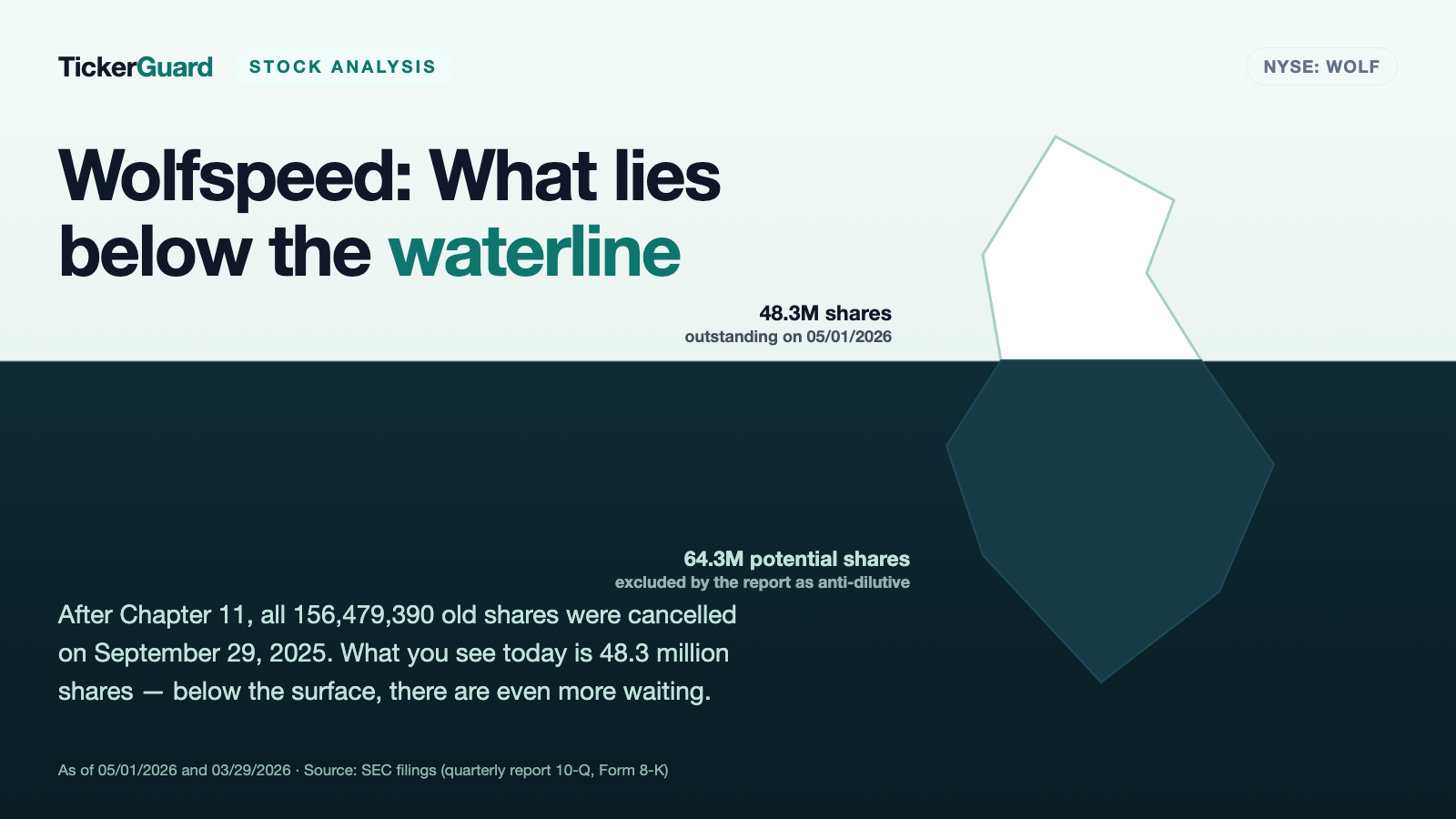
Wolfspeed invented the silicon carbide power chip and still trades on the New York Stock Exchange under the same ticker, WOLF. But on September 29, 2025 the Chapter 11 plan cancelled all 156,479,390 old shares: creditors took roughly 95 percent of the reorganized company, and existing shareholders split 1,306,896 new shares — roughly 5 percent. Since then the share count has climbed from 25.8 million to 48.3 million, and another 64.3 million potential shares sit in convertible notes, warrants and employee plans. Reddit has picked the name up again (2 mentions in 24 hours, as of August 8, 2026). Not a buy recommendation — just the question of who actually owns the new Wolfspeed.
 Thomas Mücke
Founder & Publisher
Thomas Mücke
Founder & Publisher
As of Today
As of: September 24, 2026
- Closing price
- 26.30 $ -3.10%
- Market Capitalisation
- 1.5 $B
- Growth Score
- 1/10
- AAQS
- 2/10
This analysis has a cut-off date. The Stock Guard tells you when something material changes in the numbers. Reserve your free spot
Chart
Interactive price chart (TradingView).
52-week range: 14.80 $ to 73.50 $ · Last price: 26.30 $ (As of: September 24, 2026)
Note: pure fact-based analysis, not investment advice and not a solicitation to buy or sell. All figures without guarantee.
There is an investor trap that springs shut whenever a well-known company survives a bankruptcy — call it the ghost-price trap. It works like this: you open a stock chart, see a price well above $100 on the far left, see a fraction of that on the right, and your brain does the arithmetic automatically: "Same company, cheaper." The catch is that the price on the left belongs to a security that legally no longer exists. At Wolfspeed (NYSE: WOLF) this is not a metaphor but a matter of record. The company — the inventor of the silicon carbide power semiconductor, known as Cree, Inc. until October 2021 — filed a prepackaged Chapter 11 petition on June 30, 2025 and was out again by September 29, 2025. The ticker stayed, the New York Stock Exchange listing stayed, the fabs stayed. Only the shares were cancelled: all 156,479,390 of them. Reddit has picked the name up again since — our in-house Reddit hype scanner first flagged WOLF on August 8, 2026 with 2 mentions in 24 hours. So here is the deal: before you read that chart as a discount sign, let us read together what Wolfspeed itself told the U.S. securities regulator, the SEC — the quarterly report (10-Q) as of March 29, 2026, the annual report (10-K) for fiscal 2025 and the current report (8-K) covering the day of emergence. An SEC filing is honest under penalty of law. And this one describes a rescued company, an almost entirely wiped-out former shareholder, a share count that is already growing again, and an interest rate that deserves its own calendar entry.
What Wolfspeed actually makes — the chip that takes the heat
Wolfspeed builds power semiconductors out of silicon carbide. In everyday terms: nearly every chip in the world is made of silicon, a material that eventually gives up under heat and high voltage. Silicon carbide is the tougher option — a crystal of silicon and carbon that tolerates far more voltage and temperature while wasting less energy as heat. That is exactly what you need wherever large amounts of electricity are switched: in the drivetrain of an electric vehicle, in fast chargers, in solar inverters, in rail equipment — and increasingly in the power supply of data centers. The business runs in two product lines. Power Products are the finished devices; they generated revenue of $100.1 million in the quarter ended March 29, 2026 (66.6 percent of the total). Materials Products are the raw crystals and wafers that Wolfspeed also sells to other chipmakers; they came to $50.1 million (33.4 percent), down from $77.9 million a year earlier.
Wolfspeed did not merely master this material early — it also sank a great deal of money into it early: a 200-millimeter fab in the Mohawk Valley in New York State, a materials plant in Siler City, North Carolina, plus the historic operation in Durham. Both large projects were substantially complete toward the end of fiscal 2025, and both were paid for with debt the company then could not carry. That frames the central tension of this analysis, and it runs through every chapter: the technology and the fabs came through the proceeding intact — the rescue was paid for almost entirely by the shareholder, and that bill is not finished.
How the stock landed on our desk
Wolfspeed did not reach us through a momentum or value filter but through the Reddit hype module of our in-house stock scanner: first flagged on August 8, 2026 with 2 mentions in 24 hours. That is a rustle, not a storm — and it is still worth a look, because two ingredients that attract retail investors come together here. First, a name with a long way down: anyone who knows "Wolfspeed" knows it from the electric-vehicle boom. Second, a very thin stock: of roughly 52.0 million shares, only about 28.2 million were in free float according to fundamental data as of August 9, 2026, and roughly 29 percent of that float was sold short (data as of August 9, 2026). Thinly traded names with high short interest move violently when many people have the same idea at once. Which is precisely why the basic question matters more here than any chart pattern: what exactly are you buying when you buy "WOLF" today? The answer is not in the chart. It is in the filings.
The numbers over the years — credit where credit is due
First, what genuinely speaks for Wolfspeed. This is not a paper company: it has real customers, real fabs and a material that electrification really does need. Revenue held between $757.6 million and $807.2 million across fiscal 2023 through fiscal 2025. The U.S. share of revenue rose to 34.1 percent in the quarter ended March 29, 2026, up from 20.7 percent a year earlier, while the China share fell from 11.8 percent to 2.7 percent over the same period. And one growth field is expanding: the company reported roughly 30 percent sequential growth in AI data center applications in the third quarter of fiscal 2026 and launched what it describes as the first commercially available 10 kV silicon carbide power MOSFET. Costs are moving too: research and development fell from $42.2 million to $27.2 million year over year, and selling, general and administrative expense from $41.1 million to $37.0 million.
Now the curve that explains the rest of the story. It does not show revenue — revenue is stable — but the gross result: what is left after subtracting the pure cost of making each chip sold, before any research, sales or interest is paid.
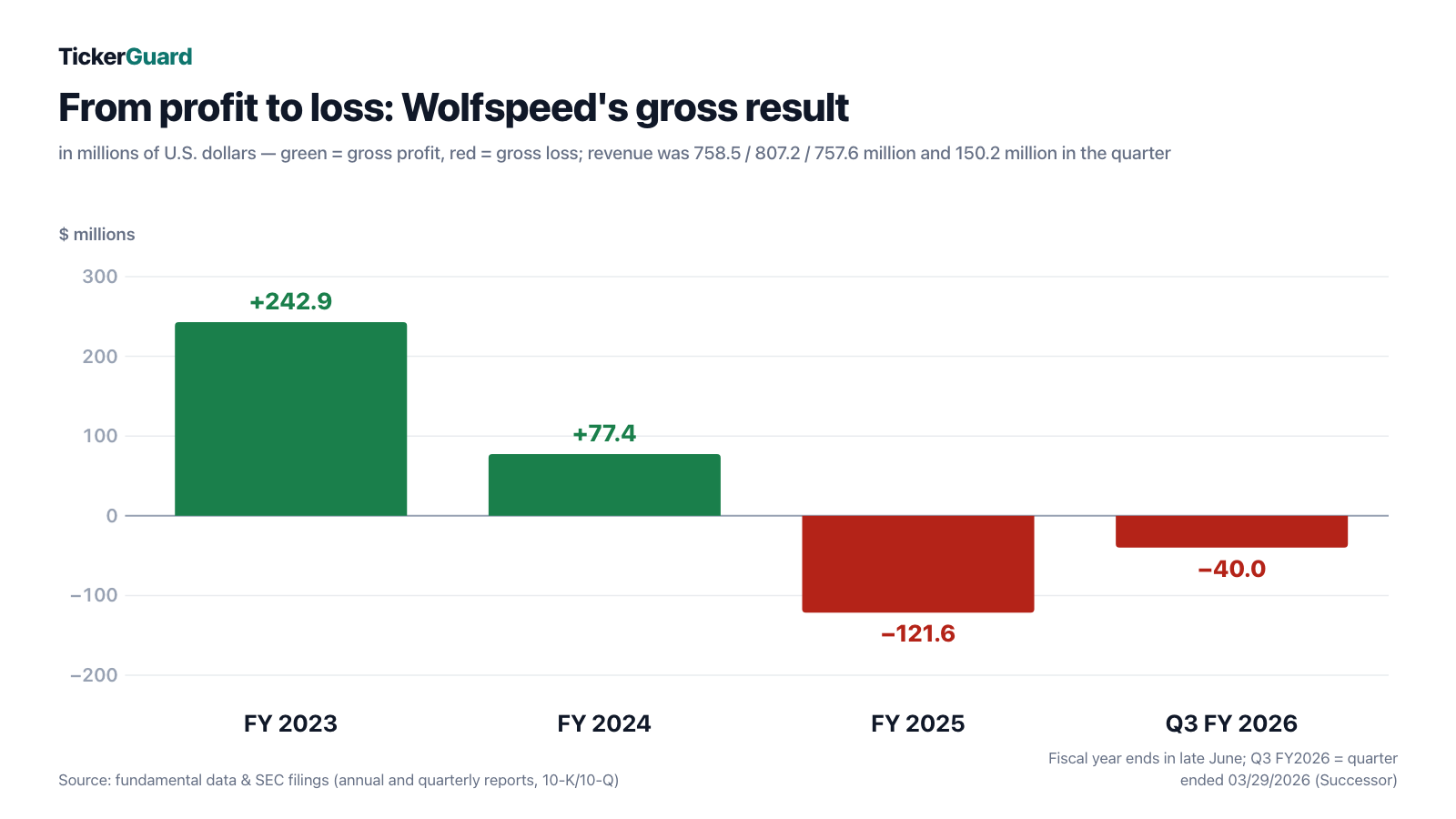
That curve is the heart of the problem, and the reason is simple: Wolfspeed built fabs for volumes that did not arrive on schedule. A fab costs almost the same whether it runs half full or full; if the volume is missing, fixed costs are spread across too few chips, and at some point each unit sold costs more than it earns. That is where the company stands: a gross margin of negative 27 percent in the quarter ended March 29, 2026, after negative 12 percent a year earlier. Remember the sentence: a negative gross margin means that growth makes the loss bigger before it makes it smaller. The net losses of fiscal 2023 through fiscal 2025 add up to $2.80 billion ($329.9 million, $864.2 million and $1,609.2 million). Which brings us to the uncomfortable truths.
What the filings say — the uncomfortable truths
Uncomfortable truth No. 1: On day one, creditors owned 95 percent of the new company
A Chapter 11 case is a court-supervised debt restructuring with the business still running. Wolfspeed used the fastest version: a prepackaged plan, negotiated with creditors in advance, filed with the bankruptcy court in Houston on June 30, 2025, confirmed on September 8, 2025, effective on September 29, 2025. Three months, which is record speed. The price is spelled out in the filing:
“On the Plan Effective Date, all previously issued and outstanding equity interests in Wolfspeed were cancelled and extinguished. Pursuant to the Plan, (i) holders of certain claims under Wolfspeed’s pre-petition debt received approximately 95% of the shares of New Common Stock issued on the Plan Effective Date and (ii) holders of shares of Old Common Stock received their pro rata portion of approximately 5% of the shares of New Common Stock issued on the Plan Effective Date.”
— Wolfspeed, Inc., SEC Form 8-K filed September 30, 2025, Item 5.01 "Changes in Control of Registrant"

In share counts: 156,479,390 old shares turned into 1,306,896 new ones for the former holders — arithmetically about one new share for every 120 old ones, a loss of 99.2 percent of their stake in the company. Anyone who owned the stock before September 29, 2025 does not hold "the same share at a different price" but a sliver of it. That is the ghost-price trap in numbers. The legal shell changed in the same breath: Wolfspeed converted from a North Carolina corporation into a Delaware corporation, with a new certificate of incorporation and a largely new board. Only three of the previous directors stayed; four new ones joined, and another followed on July 28, 2026. What that kind of molt looks like when a brand has already been through it once is described in our analysis of Hertz — there, too, the name survived and the share did not.
Uncomfortable truth No. 2: The dilution continued after the rescue — and most of it is still ahead
You might assume that once shareholders are wiped out, the matter is settled. The plan says otherwise. Alongside the 25,840,656 shares issued immediately, it set up a reserve:
“As of the Plan Effective Date, Wolfspeed had an aggregate of approximately 25,840,656 shares of New Common Stock issued and outstanding and approximately 73,030,424 shares of New Common Stock reserved for issuance pursuant to the Plan (such reserve, the ‚Share Reserve‘).”
— Wolfspeed, Inc., SEC Form 8-K filed September 30, 2025, Item 3.02 "Unregistered Sales of Equity Securities"
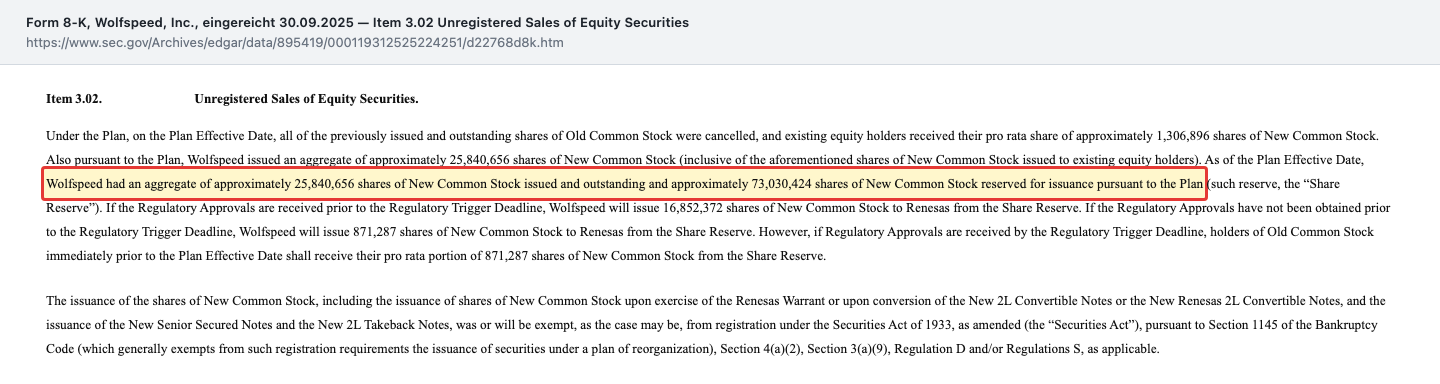
That reserve has been drawn on. Japanese chipmaker Renesas, owed roughly $2.1 billion in customer deposits before the bankruptcy, received 16,852,372 shares on January 29, 2026 after U.S. foreign-investment clearance; the former shareholders received an additional 871,287 shares at the same time. In March 2026 Wolfspeed also sold 3,250,030 new shares at $18.458 plus pre-funded warrants over another 2,000,000 shares. Here is how the share count has moved:
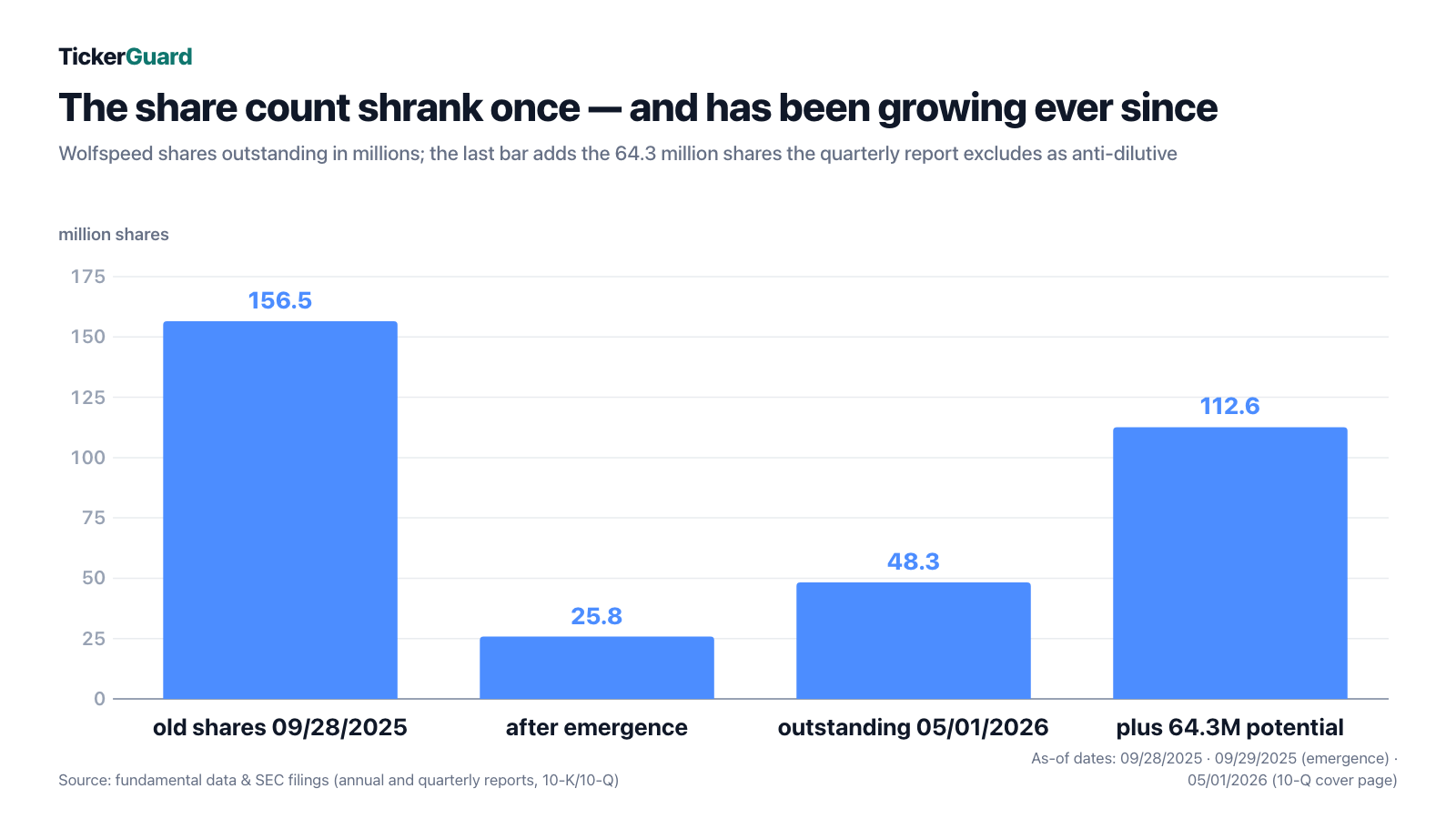
The last bar needs an explanation, because it contains the real news. When a company reports a loss, it may leave potential new shares from convertible notes, warrants and employee plans out of the per-share calculation — including them would make the loss per share look smaller, which is not allowed. But the company has to disclose how many shares it left out:
“For the three months ended March 29, 2026, the period from June 30, 2025 to September 29, 2025, and the period from September 30, 2025 to March 29, 2026, 64.2 million, 0.0 million and 64.3 million of weighted average shares, respectively, were excluded from the calculation of diluted loss per share because their effect would be anti-dilutive.”
— Wolfspeed, Inc., SEC quarterly report 10-Q as of March 29, 2026, Note 12 "Loss Per Share"

Where those 64.3 million come from can be traced line by line: the second-lien convertible notes held by non-Renesas creditors convert at $12.23 per share, the Renesas convertible notes at $18.35, the 1.5-lien convertible notes issued in March 2026 at $20.14; on top of that sit a Renesas warrant over 4,943,555 shares at $23.95 and 4,058,925 plus 8,117,851 shares reserved under the two new employee equity plans. None of these convert at the push of a button — but they are waiting. Remember the image: your slice of the cake did not just get smaller once; a second cut is pencilled in.
Uncomfortable truth No. 3: On June 23, 2026 the interest rate flips — and the grace period ends
The new capital structure is far smaller than the old one, but it is expensive. As of March 29, 2026 five notes with combined principal of $1,821.4 million sat on the balance sheet. The largest and most important is the first-lien New Senior Secured Note, due June 23, 2030, with $629.5 million outstanding at the last report. Its coupon comes in two phases, and the first was a reprieve: through June 22, 2026 the company paid 9.875 percent in cash and simply added a further 4.00 percent to the principal instead of wiring it ($10.2 million on December 23, 2025 and $10.9 million on March 23, 2026). After that it gets serious:
“The Interest Rate Step-Down Condition is met if (a)(i) the Company redeems or repurchases (other than redemptions or repurchases with the proceeds of dispositions) the New Senior Secured Notes, resulting in the aggregate principal amount of New Senior Secured Notes outstanding being less than $1,000,000,000 and (ii) the Company receives at least $450,000,000 of award disbursements pursuant to governmental grants under the CHIPS Act or (b) as of the most recent June 23rd, the ratio of the outstanding principal amount of the New Senior Secured Notes to EBITDA … is less than or equal to 2.00:1.00.”
— Wolfspeed, Inc., SEC quarterly report 10-Q as of March 29, 2026, Note 2 "Emergence from Voluntary Reorganization under Chapter 11"
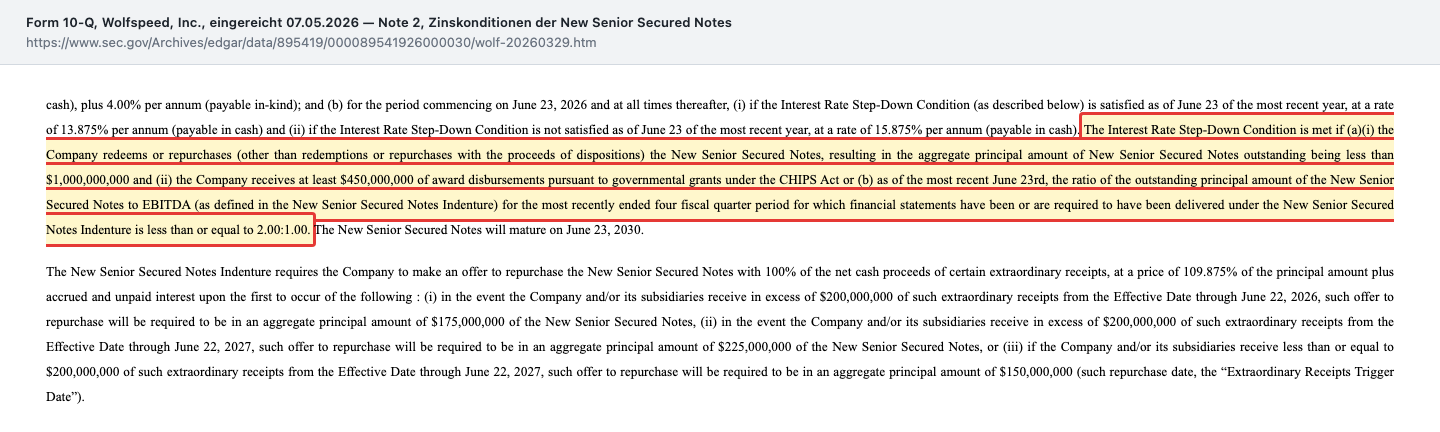
Let us work through this soberly, without claiming to know the future. The first half of condition (a) was met as of March 29, 2026: $629.5 million is below one billion. The report does not state that the second half was met — Wolfspeed did receive $698.6 million in fiscal 2026, but as a refund of the AMIC investment tax credit, not as a grant; on grants, the filing says the company "continues to actively pursue" federal funding opportunities. And condition (b) is unreachable while adjusted earnings before interest, taxes, depreciation and amortization are negative — they came to negative $62 million in the quarter ended March 29, 2026. What that actually means from June 23, 2026 will only appear in the annual report for the fiscal year ended June 28, 2026, which was not yet on file on August 11, 2026. The order of magnitude is already visible, though: 15.875 percent on $629.5 million of principal is roughly $100 million of cash interest a year instead of roughly $62 million before — against quarterly revenue of $150.2 million. Net interest expense already reached $52.1 million in the third quarter of fiscal 2026, a good third of revenue. Translated: about a third of every revenue dollar goes to creditors before a single chip is paid for.
Uncomfortable truth No. 4: The beautiful new balance sheet is partly a bookkeeping event
Put the balance sheet as of March 29, 2026 next to the one as of June 29, 2025 and you see a miracle: shareholders' equity swung from negative $447.1 million to positive $1,021.7 million, and the accumulated deficit shrank from $4,537.6 million to $270.5 million. Part of that is real — debt genuinely fell by roughly 70 percent, or $4.6 billion. Another part is accounting. On leaving a Chapter 11 case a company must, under certain conditions, apply fresh start accounting: it counts as a new reporting entity, all assets and liabilities are remeasured at fair value, and the accumulated losses disappear from the balance sheet. Wolfspeed had to apply it because the reorganization value of its assets, $3.8 billion, was below the roughly $7.6 billion of post-petition liabilities and allowed claims.
What happened next is remarkable: property and equipment — fabs, machines, buildings — was written down from $3,916.5 million to $717.1 million; the fresh start adjustment alone took $3,006.6 million off the books. In exchange, intangible assets for customer relationships, developed technology and trade names appeared for the first time: $409.2 million instead of $23.8 million. In plain terms: the valuation concluded the fabs were worth a good fifth of what they had cost. That has two consequences for future reports. First, depreciation falls, which improves reported results without a single extra chip being sold. Second, the figures before and after September 29, 2025 are not comparable — the report itself warns that statements after that date are "not comparable" with those before. The old loss carryforwards do not help much either: the debt discharge created roughly $3.4 billion of cancellation-of-debt income against which those losses are applied, and the ownership change on the effective date additionally triggered the limitation under Section 382 of the U.S. tax code. We described a similar picture — new opening balance sheet, same old operation — in our analysis of Vroom.
Uncomfortable truth No. 5: The cash pile grew because the tax authorities paid
Cash and short-term investments of $1,164.8 million as of March 29, 2026 sound restful. The cash flow statement shows where they came from. Between September 30, 2025 and March 29, 2026 operations consumed $126.4 million, and another $67.8 million went into property and equipment. What came in was $733.1 million of reimbursement of capital expenditures from incentives and investment credits; the notes put the refunds from the refundable AMIC credit for fiscal 2026 at $698.6 million, after $189.1 million the year before. That source is largely exhausted: the remaining receivable stood at only $71.5 million short-term and $109.5 million long-term. On top of that comes a clause that pins down part of the liquidity: the first-lien notes require at least $350 million of unrestricted cash in secured accounts at the end of every calendar month. And obligations keep running: at least $165 million of take-or-pay purchase commitments with suppliers over the next four years, plus roughly $57 million for electricity in Siler City over four years and roughly $23 million in Durham over eight years.
Valuation: what you pay for the new Wolfspeed
For a company with no profit and a negative gross margin, every earnings multiple misleads; the only sensible question is what total price the market puts on the business. As a dated anchor we take the one price an SEC filing names itself: $16.78 per share on March 18, 2026, recorded in the quarterly report as the reference for the conversion price of the new convertible notes. Run two paths from there. Path one: 48.3 million shares give roughly $0.81 billion of market value; add $1.82 billion of debt, subtract $1.16 billion of cash, and the enterprise value is roughly $1.47 billion. Path two: assume all 64.3 million potential shares come into existence and the convertible notes settle in stock rather than cash — then 112.6 million shares are worth roughly $1.89 billion, $0.93 billion of debt remains, and the enterprise value is roughly $1.65 billion. Both paths land at roughly $1.5 billion to $1.7 billion, or about two and a half times annualized revenue ($150.2 million in the quarter, about $600 million a year).
That is the genuinely interesting finding in this arithmetic: dilution barely changes the price of the business — it only changes who owns it. Whether two and a half times revenue is a lot or a little hangs on a single question: when does the gross margin turn positive again? As long as every chip costs more than it earns, you are not buying earning power but a bet on capacity utilization. And because this stock swings hard, one caveat matters here in particular: the anchor above is a dated reference point, not a current quote — today it may sit well above or well below. If you want to redo the math, swap $16.78 for the price of the day and keep the other inputs.
Opportunities and risks at a glance
What speaks for Wolfspeed:
- The balance sheet is relieved: debt fell by roughly 70 percent, or $4.6 billion, to $1,821.4 million of principal, shareholders' equity swung from negative $447.1 million to positive $1,021.7 million, and $1,164.8 million sits in cash and short-term investments (as of March 29, 2026). The quarterly report contains no going-concern warning.
- The big construction bills are paid: the Mohawk Valley and Siler City fabs were substantially complete toward the end of fiscal 2025; purchases of property and equipment fell from $1,059.5 million (nine months to March 30, 2025) to $67.8 million (two quarters to March 29, 2026).
- A real growth field: AI data center applications grew roughly 30 percent sequentially in the third quarter of fiscal 2026, and revenue from power devices for industrial applications rose despite weak materials demand.
- Less China exposure: the U.S. share of quarterly revenue rose to 34.1 percent (from 20.7 percent a year earlier) while the China share fell from 11.8 percent to 2.7 percent — an advantage in an environment of tariffs and export controls.
- Costs are visibly falling: research and development dropped from $42.2 million to $27.2 million year over year and selling, general and administrative expense from $41.1 million to $37.0 million; the March 2026 refinancing cut annual interest expense by an estimated $62 million according to the company.
What speaks against it:
- Every chip sold costs more than it earns: a gross margin of negative 27 percent in the quarter ended March 29, 2026 (negative 12 percent a year earlier), an operating loss of $114.3 million and a net loss of $119.9 million. For the following quarter the company itself guided to revenue of $140 million to $160 million and to gross margins that would stay negative.
- Dilution is not finished: against 48.3 million shares outstanding (May 1, 2026) stand 64.3 million potential shares that the quarterly report excludes as anti-dilutive — convertible notes at $12.23, $18.35 and $20.14, a warrant at $23.95 and two employee plans covering 12.2 million shares in total.
- Expensive money with a deadline: from June 23, 2026 the first-lien notes pay 13.875 or 15.875 percent — in cash, rather than partly as an addition to principal; the step-down condition requires, among other things, $450 million of CHIPS Act grants, which the latest filing does not report as received. Net interest expense already reached $52.1 million in the third quarter of fiscal 2026, a good third of revenue.
- The cash inflow was a one-off: operations consumed $126.4 million, while the cash pile grew mainly through $733.1 million of reimbursements from investment credits, of which only $181.0 million remains as a receivable. At the same time the notes permanently tie up $350 million of minimum liquidity at every month end.
- Concentration and control: two customers accounted for 19 percent and 18 percent of fiscal 2025 revenue (37 percent combined). Renesas is now simultaneously a large shareholder, a creditor and a customer; the 9.9 percent voting limitation and the 39.9 percent beneficial ownership limitation run through January 1, 2027 and renew automatically only for as long as Renesas does not terminate them.
A human conclusion
Back to the ghost-price trap from the opening. Its core is not that the restructuring failed — quite the opposite: Wolfspeed did in three months what takes others years, shed $4.6 billion of debt, kept its fabs and works on a material that electrification genuinely needs. Its core is that two things carrying the same ticker are not therefore the same thing. Whoever buys WOLF today is not buying "the fallen high-flyer of yesterday" but a reorganized company whose owners are mostly its former creditors, whose share count nearly doubled in seven months, which has as many potential shares waiting as it has outstanding, and which currently pays about a third of every revenue dollar in interest before a single machine runs. That can still be a good bet — when utilization rises, a negative gross margin flips faster than you expect, and then the leverage works the other way. So the honest question is not "how far has the stock fallen?" but: do you trust yourself to time the point at which the fabs run full enough — and can you sit through the dilution that continues until then? If yes, you have a thesis. If no, you had a chart. What you do with it is your decision. And that is exactly as it should be.
Sources
Every original document used in this analysis, for you to read yourself:
- Wolfspeed, Inc. — SEC quarterly report 10-Q as of 03/29/2026 (filed May 7, 2026)
- Wolfspeed, Inc. — SEC quarterly report 10-Q as of 12/28/2025 (filed February 6, 2026)
- Wolfspeed, Inc. — SEC annual report 10-K for fiscal 2025 (filed August 26, 2025)
- Wolfspeed, Inc. — SEC Form 8-K filed September 30, 2025 (emergence from Chapter 11, Items 1.01 through 5.03)
- Wolfspeed, Inc. — SEC Form 8-K filed March 19, 2026 (private placement of shares and 1.5-lien convertible notes)
- Wolfspeed, Inc. — SEC Form 8-K filed May 5, 2026, Exhibit 99.1 (third-quarter fiscal 2026 results and outlook)
- Full SEC filing history for Wolfspeed, Inc.: EDGAR overview (sec.gov)
- Fundamental data (listing venue, free float, short interest; data as of August 9, 2026), cross-checked against the SEC filings.
- Reddit mentions: our in-house Reddit hype scanner, which first flagged WOLF on August 8, 2026 with 2 mentions in 24 hours.
Transparency & disclaimer: This analysis is journalistic commentary on publicly available information. It is not investment advice, not a regulated financial analysis and not a solicitation to buy or sell securities. Equity investments carry substantial risk up to and including total loss. All information is provided without warranty; the as-of date of each figure is stated in the text. Positions held by the operator are disclosed daily; where one exists, it appears as a notice at the top of this deep dive.
Key figures at a glance
All monetary figures in millions of $; earnings per share as reported.
| Metric | 2022 | 2023 | 2024 | 2025 | 2026 |
|---|---|---|---|---|---|
| Revenue | 572.1 | 758.5 | 807.2 | 757.6 | 665.1 |
| Operating Income (EBIT) | -203.1 | -311.8 | -445.3 | -1,329.2 | -485.4 |
| Net Income | -200.9 | -329.9 | -864.2 | -1,609.2 | 4.4 |
| Net Margin | -35.1% | -43.5% | -107.1% | -212.4% | 0.7% |
| Earnings Per Share | -5.01 $ | -7.94 $ | -20.59 $ | -34.09 $ | 0.08 $ |
Source: fundamental data & SEC filings (annual and quarterly reports, 10-K/10-Q)
Our Bottom Line at a Glance
- Balance sheet after the restructuring positive
- The relief is real: debt fell by roughly 70 percent, or $4.6 billion, to $1,821.4 million of principal, shareholders' equity swung from negative $447.1 million (June 29, 2025) to positive $1,021.7 million (March 29, 2026), and $1,164.8 million sits in cash and short-term investments. The quarterly report contains no going-concern warning.
- Earning power negative
- In the quarter ended March 29, 2026 the gross margin was negative 27 percent, against negative 12 percent a year earlier: every chip sold cost more than it brought in. Operating loss of $114.3 million, net loss of $119.9 million, adjusted EBITDA of negative $62 million. For the following quarter the company guided to revenue of $140 million to $160 million and to gross margins that would stay negative.
- Dilution negative
- Former shareholders lost roughly 99.2 percent of their stake on September 29, 2025 (156,479,390 old shares against 1,306,896 new ones). The share count then rose from 25.8 million to 48.3 million (May 1, 2026), and the quarterly report excludes a further 64.3 million potential shares as anti-dilutive — more than the number outstanding.
- Interest burden and covenants negative
- Net interest expense was $52.1 million in the quarter ended March 29, 2026, a good third of quarterly revenue of $150.2 million. From June 23, 2026 the first-lien notes pay 13.875 or 15.875 percent entirely in cash, instead of 9.875 percent in cash plus 4.00 percent added to principal; on top of that, $350 million of minimum liquidity is tied up at every month end.
- Technology and end markets neutral
- Silicon carbide remains in demand for electric drivetrains, charging infrastructure and data center power supply; AI data center applications grew roughly 30 percent sequentially in the third quarter of fiscal 2026, and the U.S. share of revenue rose to 34.1 percent. At the same time, 37 percent of fiscal 2025 revenue depended on just two customers, and the materials business shrank 35.7 percent year over year in the quarter.
Wolfspeed went through Chapter 11 in three months and shed $4.6 billion of debt — and shareholders paid for it: all 156,479,390 old shares were cancelled on September 29, 2025, the former owners split 1,306,896 new ones, and creditors took roughly 95 percent. The restructuring healed the balance sheet, not the business: a gross margin of negative 27 percent in the quarter ended March 29, 2026, net interest expense of $52.1 million against revenue of $150.2 million, and 64.3 million potential shares waiting beside 48.3 million outstanding. Anyone buying in here is buying a bet on fab utilization, not the old Wolfspeed at a discount. Not investment advice.
What Our Rating Means
Substance risk
We found at least one documented issue that threatens the company itself — regardless of how the stock is currently valued.
Red here refers to documented substance risk in the company itself, not to the share price. Three such findings sit in the latest quarterly report: the gross margin is negative 27 percent, so the business does not even cover its own cost of production; net interest expense of $52.1 million stands against an operating loss of $114.3 million, putting interest coverage far below one; and operations consumed $126.4 million over two quarters while the cash pile grew almost entirely on one-off tax refunds of $698.6 million. The fact that the balance sheet looks healthy after the restructuring — $1,021.7 million of equity, $1,164.8 million of liquidity, no going-concern warning — does not change that picture; it buys time. Yellow would be defensible if utilization were the only open question; the combination of a negative gross margin, interest coverage below one and a coupon that becomes fully payable in cash from June 23, 2026 is more than an open operating question. The decision is yours.
A journalistic assessment by our editorial team at the time of the deep dive, based on public sources — not investment advice and not a solicitation to buy or sell. Your personal circumstances (investment goals, risk capacity, taxes) cannot be taken into account. What our levels mean, how verdicts are formed, and what conflicts of interest exist →
Worth Noting
- Wolfspeed reached our research list through our in-house Reddit hype scanner: first flagged on August 8, 2026 with 2 mentions in 24 hours. The stock is thin: of roughly 52.0 million shares, about 28.2 million were in free float according to fundamental data as of August 9, 2026, and roughly 29 percent of that float was sold short.
- Risk of confusion: the WOLF ticker and the SEC identifier CIK 0000895419 are the same as before the case; the share is not. Price series drawn across September 29, 2025 splice together two different securities. The corporate history misleads too: until October 2021 the company was called Cree, Inc.
- Valuation figures are dated and evergreen: the anchor is the only price documented in an SEC filing, $16.78 on March 18, 2026 (the reference for the conversion price of the 1.5-lien convertible notes). The market capitalization from the fundamental data feed deviates from it by more than a fifth and is therefore not used; figures before and after the September 29, 2025 emergence are not comparable because of fresh start accounting.
Stock Watch
This analysis is as of August 29, 2026. Stock Watch will tell you what's changed at WOLF since then.
Later $1 a month per stock — signing up is free, and you'll be the first to know when it launches.
The full analysis as a PDF for later
We will send you this analysis as a PDF — to print, file away, and read at your own pace. And we will add you to the free Stock Watch list for Wolfspeed, Inc. (WOLF), so you hear about it when something material in this analysis changes.
Frequently Asked Questions
Yes, but it is a new share. Wolfspeed emerged from Chapter 11 on September 29, 2025. On that day all 156,479,390 old shares were cancelled and 25,840,656 new ones were issued. The WOLF ticker and the New York Stock Exchange listing were preserved, as was the company's SEC identifier (CIK 0000895419). Holders of the old shares received 1,306,896 new ones in total — roughly 5 percent of the new equity.
Roughly 99.2 percent of their stake. The 156,479,390 old shares became 1,306,896 new shares for the former holders, arithmetically about one new share for every 120 old ones. Another 871,287 shares from the plan reserve went to the same group after U.S. foreign-investment clearance in January 2026. Creditors received roughly 95 percent of the reorganized company.
As of March 29, 2026 five notes with combined principal of $1,821.4 million sat on the balance sheet; the carrying amount was $1,720.5 million. Before the filing the figure was $6,658.2 million. The company puts the reduction at roughly 70 percent, or $4.6 billion. Against that stand $1,164.8 million of cash and short-term investments, of which $350 million is tied up as minimum liquidity.
Because the fabs are underutilized. Revenue ran between $757.6 million and $807.2 million across fiscal 2023 to fiscal 2025, while the gross result fell from plus $242.9 million to minus $121.6 million over the same span. The fixed costs of a semiconductor fab accrue almost regardless of volume; if the volume is missing, every chip costs more than it earns. In the quarter ended March 29, 2026 the gross margin was negative 27 percent.
On leaving a Chapter 11 case, a company counts as a new reporting entity under certain conditions: all assets and liabilities are remeasured at fair value and the accumulated deficit disappears. At Wolfspeed this cut property and equipment from $3,916.5 million to $717.1 million and raised intangible assets from $23.8 million to $409.2 million. Figures before and after September 29, 2025 are therefore not comparable.
On June 23, 2026. Through June 22, 2026 the first-lien notes paid 9.875 percent in cash plus 4.00 percent added to the principal. After that the rate is 13.875 percent in cash if the interest rate step-down condition is met, and 15.875 percent if it is not. That condition requires, among other things, at least $450 million of CHIPS Act grant disbursements. On the $629.5 million last outstanding, that is roughly $100 million of cash interest a year.
As of May 1, 2026 there were 48,339,081 shares outstanding. The quarterly report as of March 29, 2026 names an additional 64.3 million weighted-average shares that it excludes from the earnings calculation as anti-dilutive — more than the number outstanding. They sit in convertible notes with conversion prices of $12.23, $18.35 and $20.14, a warrant at $23.95 and two employee plans covering 12.2 million shares in total.
Yes. The company was called Cree, Inc. from 1987 until October 2021 and was first known for light-emitting diodes. After selling the LED business it renamed itself Wolfspeed and moved to the New York Stock Exchange. The SEC lists both names under the same identifier, CIK 0000895419. The fiscal year ends in late June — fiscal 2025 ran through June 29, 2025 and fiscal 2026 through June 28, 2026.
Found an error?
Did you spot a factual error, an outdated number, or a typo in this deep dive? Let us know briefly — your report goes straight to the editorial team.