Icahn Enterprises: Carl Icahn’s Holding Company Pays 50 Cents a Quarter — Mostly in New Units, While the Losses Keep Growing
On paper, the Icahn Enterprises distribution looks like a gift: almost 80 percent a year by arithmetic at the November 27, 2026 price, paid mostly in units. Its filings with the U.S. securities regulator, the SEC, show how it is paid for: the unit count has more than doubled since the end of 2022, the investment funds lost 43.8 percent in the first nine months of 2026, and about $1.4 billion of notes come due in May 2027. A walk through the mandatory filings before the percentage puts you in a trance.
 Thomas Mücke
Founder & Publisher
As of Today
As of: November 25, 2026
- Closing price
- 2.60 $ -5.90%
- Market Capitalisation
- 2.0 $B
- Growth Score
- 1/10
- AAQS
- 0/10
This analysis has a cut-off date. The Stock Guard tells you when something material changes in the numbers. Reserve your free spot
Chart
Interactive price chart (TradingView).
52-week range: 2.60 $ to 8.40 $ · Last price: 2.60 $ (As of: November 25, 2026)
Note: pure fact-based analysis, not investment advice and not a solicitation to buy or sell. All figures without guarantee.
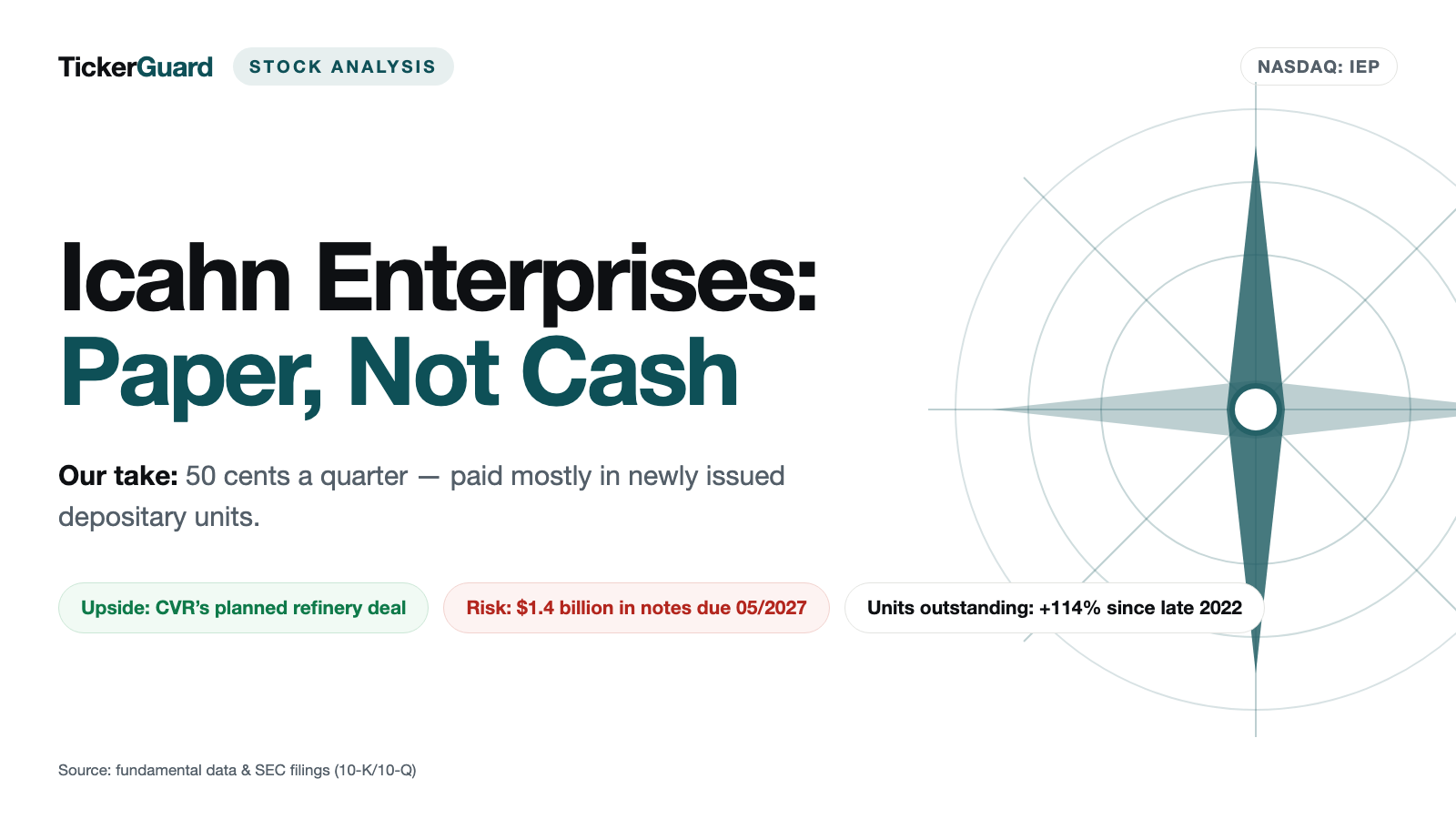
There is an investor trap that works with a single number. Let’s call it the percentage trance. A distribution of $2 a year on a unit that now costs only about $2.50 works out to a yield of almost 80 percent. Once you have seen that number, you stop seeing anything else: not what the payout is paid with, not where the money comes from, not what else weighs on the company. Icahn Enterprises (Nasdaq: IEP), the holding company of investor Carl Icahn, is a textbook case. Let’s make a deal: we set the percentage aside for a moment and read what Icahn Enterprises reported to the U.S. securities regulator, the SEC — under legal liability, because false statements there can carry criminal and civil consequences. At the end, you decide.
What Icahn Enterprises actually is — a holding company with units instead of shares
Icahn Enterprises L.P. is not a corporation but a publicly traded limited partnership organized under Delaware law and based in Sunny Isles Beach, Florida. Until September 2007 it was called American Real Estate Partners. What trades on Nasdaq are not shares but depositary units — partnership interests packaged for the stock exchange. What a corporation calls a dividend is called a distribution here. The partnership is run by its general partner, Icahn Enterprises G.P. Inc., which is indirectly owned and controlled by Carl Icahn. Think of it as a family business with publicly traded stakes: you can buy in, but who sits behind the wheel is settled.
Under the roof sit seven segments, as listed in the earnings release of November 3, 2026: Investment (its own investment funds), Energy (the refiner and fertilizer producer CVR Energy, about 71 percent owned as of September 30, 2026), Automotive, Food Packaging (Viskase), Real Estate, Home Fashion (WestPoint Home) and Pharma (Vivus). IEP sold the largest automotive piece, the service chain Pep Boys, to Mavis on August 20, 2026 for about $700 million; it kept the real estate and the franchise brands AAMCO and Precision Tune. At the end of 2025, the holding company and the investment segment employed just 47 people combined, the other segments about 13,500, roughly 55 percent of them in automotive at the time.
That sets the central tension of this analysis: Icahn Enterprises has declared a distribution every quarter since 2005 without interruption — on November 2, 2026 the 86th in a row, payable on or about December 23. But it pays mostly with newly printed units, while the holding company has posted a loss every year since 2022 and IEP must repay a large bond in May 2027.
Company history for investors
-
2007
American Real Estate Partners becomes Icahn Enterprises
The September 2007 name change makes plain what the partnership is: the vehicle for Carl Icahn’s holdings, run by his general partner.
-
2023
Short-seller report and distribution cut
After the report of 05/02/2023 the unit price falls significantly; the declared distribution drops from $8.00 (2022) to $6.00 per unit.
-
2024
SEC settlement on 08/19/2024
IEP pays $1.5M (pledges not disclosed in 2018–2020 annual reports), Icahn $0.5M (13D not amended for loan agreements) — non-scienter, without admitting or denying.
-
2025
$2.00 in distributions, 104.4 million new units
Units outstanding reach 637.2 million by year-end; the IEP result stays negative at −$299 million.
-
2026
Funds down 43.8 percent, Pep Boys sold, refinery deal at CVR
Nine months of fund losses, the Pep Boys sale for about $700 million and CVR’s agreed purchase of two refineries. Units outstanding reach 757.0 million (09/30/2026).
How the stock landed on our desk
Icahn Enterprises made our research list through the Reddit hype scan — unusually frequent mentions in investor forums — not through a quality or valuation screen. On November 27, 2026, the unit appeared on four lists in our in-house stock scanner: Reddit Hot Stocks, “Near 52-week low,” “Below 50- and 200-day SMA” (price below both moving averages) and “Pros 80%.” The stock page lists these hits in its section on the scanners it appears in.
The last list deserves a second look. “Pros 80%” collects stocks more than 80 percent held by funds, asset managers and insiders. Here, that is mostly one man: on September 23, 2026, Carl Icahn held 87.69 percent through his entities. That is not “smart money” from many hands; it is control. The Piotroski F-Score, a nine-point health check of the books, stood at 3 out of 9 the same day — 7 or more counts as very solid, below 3 is warning territory. A 3 sits just above the red zone.
On price, with a date: at the end of September 2026 a unit still cost about $7 (close on September 30: $6.75); on November 27, 2026 it closed at $2.53 (per fundamental data). With 756,961,276 units outstanding (as of November 3, 2026), the November 27 close implies a market value of about $1.9 billion.
What has happened since the end of September
The sequence by date, without interpretation: on September 30, 2026, the unit closed at $6.75 and CVR stock at $50.99. On November 2, IEP declared a $0.50 distribution per unit with a record date of November 16, and CVR Energy signed the purchase agreement for two refineries. On November 3, IEP reported its third-quarter results; CVR closed that day at $48.60. On November 5, CVR completed the sale of 10,515,248 new shares at $47.55, and IEP’s stake fell to 64.1 percent; CVR closed at $39.84. According to fundamental data, November 16 was the ex-date of the $0.50 distribution. On November 25, CVR reported a $1.25 billion offering of 9.25 percent notes to fund the refinery purchase. On November 27, CVR closed at $30.45 and the IEP unit at $2.53. In its mandatory filings through November 27, 2026, IEP gives no reason for the price decline.
We reviewed the annual reports (10-K) for 2023, 2024 and 2025, the four most recent quarterly reports (10-Q) through September 30, 2026 — filed November 4, 2026 —, the earnings release of November 3, 2026, all current reports (8-K) of 2026, and the ownership filings (Schedule 13D/A) and insider filings (Form 4) of Carl Icahn and management through November 27, 2026. For the refining subsidiary CVR Energy, we added its November 2026 filings. We did not review earnings call transcripts.
The numbers over the years — honestly appraised
First, what deserves credit. Icahn Enterprises is not an empty shell. The group generated revenue of $9.7 billion in 2025, and $8.4 billion in the first nine months of 2026 versus $7.0 billion a year earlier. CVR Energy is a real industrial company with refineries and fertilizer plants, and on November 2, 2026 it agreed to buy two refineries in St. Paul Park, Minnesota, and Mandan, North Dakota, from Marathon Petroleum for about $4.2 billion. The Pep Boys sale brought in $645 million in proceeds according to the earnings release. And IEP has declared a distribution every quarter since 2005; the 86th in a row is payable on or about December 23, 2026.
Now the second look. A holding company’s revenue says little about what reaches the unitholder. What counts is the result attributable to Icahn Enterprises, and that has not been positive in any year since 2022: minus $183 million in 2022, minus $684 million in 2023, minus $445 million in 2024, minus $299 million in 2025 and minus $1.04 billion in the first nine months of 2026 alone. Per unit, that is minus $0.57, minus $1.75, minus $0.94, minus $0.52 and minus $1.51. Declared distributions over the same periods were $8.00, $6.00, $3.50, $2.00 and $1.50.
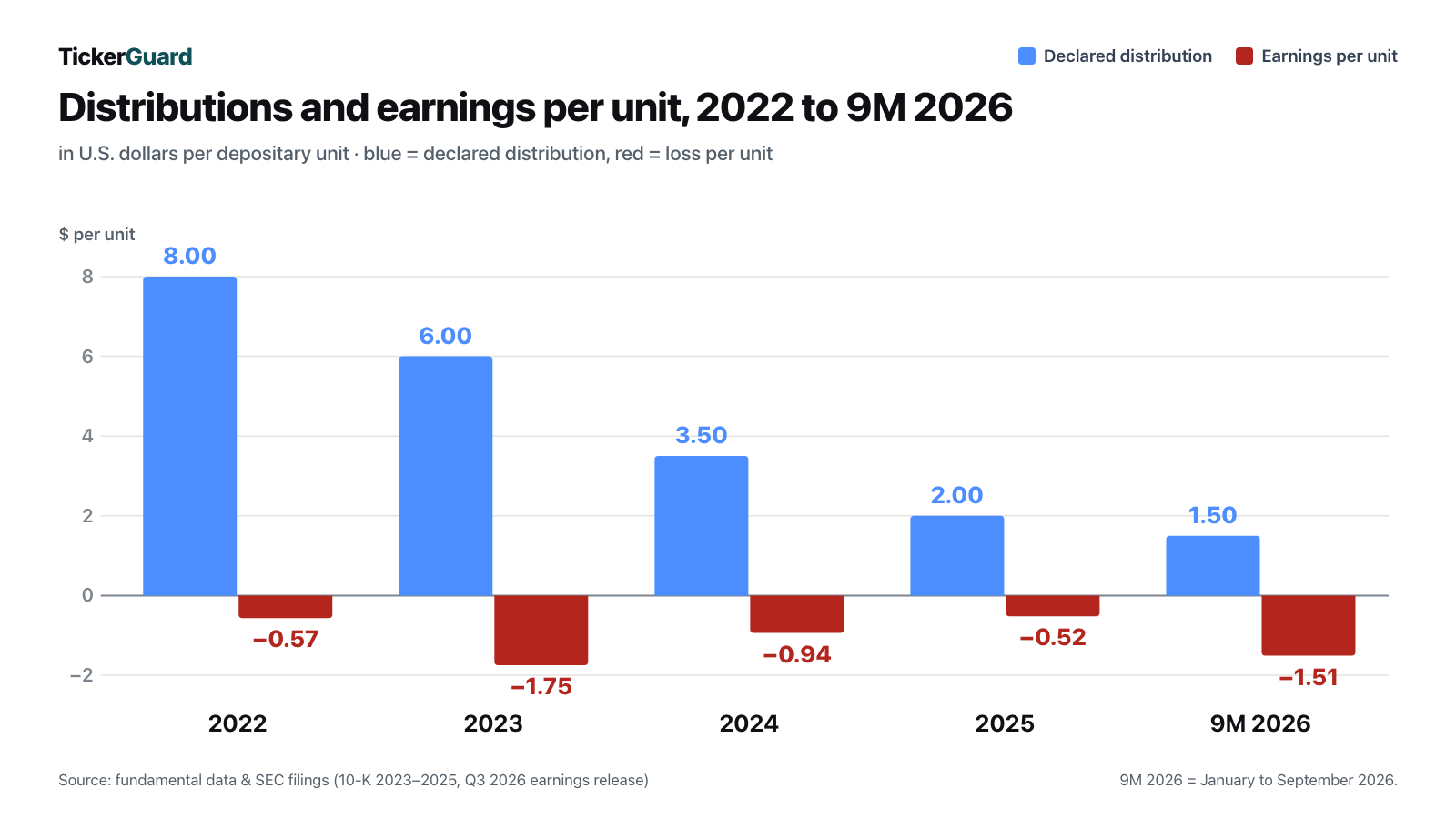
The chart shows the core problem in two colors: blue is what is promised, red is what is earned. The distribution has been cut sharply since 2022, but it still sits above a result that is below zero. Remember this: a distribution that isn’t earned has to be paid by someone else. At IEP, that is mostly new units.
What the filings say — the uncomfortable truths
Uncomfortable truth no. 1: The distribution is paid mostly with new units
At Icahn Enterprises, every unitholder can choose: cash or new units. Anyone who does nothing automatically receives units — that is spelled out in the distribution announcements of February 25, August 5 and November 3, 2026. Carl Icahn, the largest owner, takes most of his in units. The latest quarterly report describes it this way:
“For the quarterly distributions paid in April, June and September of 2026, Mr. Icahn elected to take his distributions in a mix of cash and units, and we anticipate that Mr. Icahn will elect to take his distributions in a mix of cash and units with respect to future distributions, which could further reduce the ability of the Company to maintain its current or historical cash distribution amounts.”
— Icahn Enterprises L.P., SEC quarterly report 10-Q as of September 30, 2026, Part II, Item 1A (Risk Factors)

A few pages earlier, the report shows what the mix looks like: for the September distribution IEP issued 42.8 million new units, 40.5 million of them to Icahn and his entities; $56 million went out in cash, $25 million of it to Icahn. According to his insider filing (Form 4), the new units were valued at $7.0118 each. Over the years it adds up: IEP issued 72.1 million units as distributions in 2023, 87.9 million in 2024, 104.4 million in 2025 and 116.5 million from January through September 2026. On top came at-the-market sales on the exchange (about 22.5 million units in total from 2023 through September 2026).
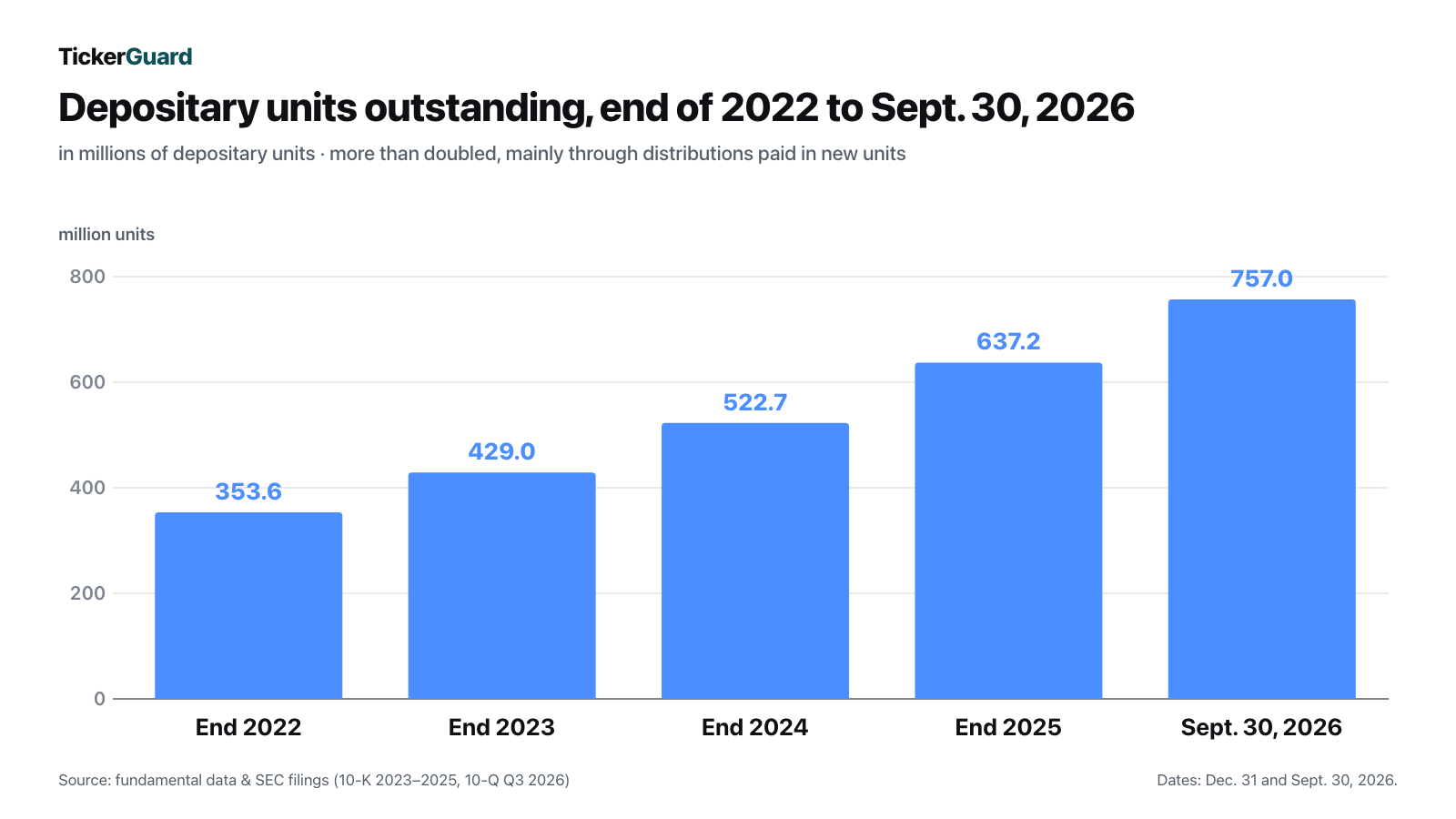
The result: up 114 percent in just under four years, with about 94 percent of the increase coming from distributions. That is dilution, and the picture for it is a cake that keeps getting cut into more slices: if you take your distribution in cash, you end up holding a smaller share of the whole. If you take units, you hold more slices — of the same cake, which did not get any bigger. For the minority, cash is still real: whoever elects cash gets the 50 cents paid out. From 2023 through September 2026, about $1.13 billion in cash went to all unitholders combined, while losses over the same stretch added up to about $2.47 billion. The lower the price, the more new units each distribution costs: 100 units earned about 7 new ones in September; at $2.53 it would be almost 20.
Uncomfortable truth no. 2: The funds lost 43.8 percent — mostly on hedges against the company’s own subsidiary
The heart of Icahn Enterprises is its own investment funds, in which IEP and Carl Icahn invest side by side. Their recent record is weak: minus 0.3 percent in 2021, minus 2.4 percent in 2022, minus 16.9 percent in 2023, minus 3.5 percent in 2024, plus 0.4 percent in 2025. And then came 2026:
“For the nine months ended September 30, 2026 and 2025, our Investment Funds’ returns were (43.8)% and (9.3)%, respectively.”
— Icahn Enterprises L.P., SEC quarterly report 10-Q as of September 30, 2026, Part I, Item 2 (MD&A, Investment segment)

The reason is unusual. The funds held so-called refining hedges — according to the report, equity and commodity derivatives intended as an economic hedge against the value of CVR Energy. Think of it as insurance against the company’s own refining subsidiary losing value. When CVR rises instead, the insurance loses. That is exactly what happened: in the first nine months of 2026, these hedges cost the funds $1.2 billion, plus $269 million in losses on broad market hedges. Of the losses on the refining hedges, $917 million was attributable to IEP. The gain on the CVR stake itself — about $1.8 billion over those nine months, according to the earnings release — is not in the result, because CVR is a majority-owned subsidiary whose revenue and costs are consolidated; it only shows up in the indicative net asset value. The report itself warns that hedge and hedged item need not move in lockstep:
“These positions are intended to serve as economic hedges against the value of CVR Energy; however, changes in energy market conditions and the value of the relevant derivative positions may not correlate with changes in the value of CVR Energy and therefore may not produce the intended offset.”
— Icahn Enterprises L.P., SEC quarterly report 10-Q as of September 30, 2026, Part I, Item 2 (MD&A, Investment segment)
For the holding company, what ultimately counts is what reaches its cash and its stake in the funds. The value of that stake fell from $2.71 billion (December 31, 2025) to $1.37 billion (September 30, 2026). Equity attributable to Icahn Enterprises dropped from $1.94 billion to $746 million over the same period — down 62 percent in nine months.
Uncomfortable truth no. 3: $1.4 billion comes due in May 2027 — more than there is in the till
On September 30, 2026, the holding company had notes with a carrying value of $4.4 billion outstanding (principal held by third parties about $4.43 billion), with maturities from 2027 to 2030 and coupons between 4.375 and 10 percent. The next hurdle is close:
“Approximately $1.4 billion aggregate principal amount of the 2027 Notes held by third parties matures in May 2027. Our Holding Company cash and cash equivalents of approximately $921 million at September 30, 2026 were less than that amount, and repayment or refinancing of the 2027 Notes will require us to use additional sources of liquidity.”
— Icahn Enterprises L.P., SEC quarterly report 10-Q as of September 30, 2026, Part II, Item 1A (Risk Factors)

The next sentence in the report is fair to quote as well: IEP expects to meet the notes through refinancing, cash on hand, redemptions from the funds or a combination, and considers its liquidity sufficient for at least the next 12 months. Besides the cash, about $1.4 billion sat in its fund stake on that date. But every redemption from the funds shrinks exactly the part that is supposed to generate gains, and on the interest level: three of the remaining holding company notes carry coupons of 9.0 to 10.0 percent, the maturing ones 5.25 percent. The interest burden is already heavy: in 2025 the consolidated income statement showed $504 million of interest expense against a pre-tax loss of $345 million — earnings before interest covered only about a third of the interest. In February 2026, IEP had already repaid its 2026 notes out of cash.
Uncomfortable truth no. 4: Carl Icahn has pledged all of his units — and the yardstick is NAV
Carl Icahn finances himself privately with loans, secured by his IEP units. How many, the quarterly report states:
“As of September 30, 2026, Mr. Icahn and his affiliates have pledged 658,924,537 depositary units and approximately $33 million of interests in the Investment Funds.”
— Icahn Enterprises L.P., SEC quarterly report 10-Q as of September 30, 2026, Part II, Item 1A (Risk Factors)
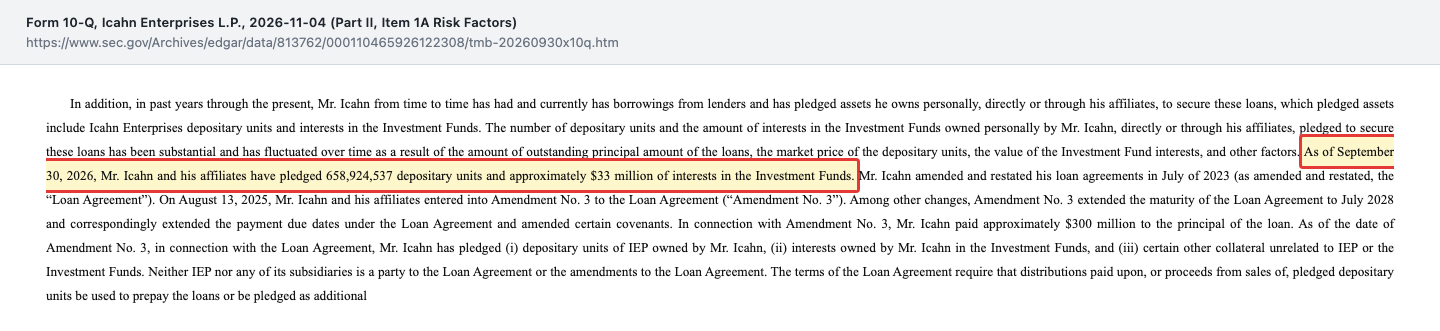
The number matches Icahn’s ownership filing (Schedule 13D/A No. 86) of September 25, 2026 to the unit: 658,924,537 units, 87.69 percent. His entire holding is pledged. According to the report, IEP itself is not a party to these loan agreements, which run until July 2028. One feature is decisive: whether Icahn has to post more collateral depends, for the pledged IEP units, not on the market price but on net asset value:
“For purposes of the loan-to-value ratio set forth in the Loan Agreement, the value of the pledged depositary units is calculated based upon the Company’s indicative net asset value rather than the market price of the depositary units.”
— Icahn Enterprises L.P., SEC quarterly report 10-Q as of September 30, 2026, Part II, Item 1A (Risk Factors)
That sounds reassuring as long as NAV holds steady. The report names the flip side itself: a further decline in NAV or in the value of the fund interests could trigger margin calls, and Icahn could sell units or withdraw money from the funds to service his loans. According to the report, he has already made withdrawals from the funds in recent months; the value of his own fund interests (excluding IEP) fell from $908 million at the end of 2025 to $161 million on September 30, 2026. If his stake in IEP were to fall below 25 percent, the general partner could potentially be removed without his consent, according to the report; that requires a vote of more than 75 percent of all units.
This is where the refining subsidiary comes back in. In the September 30, 2026 NAV, the CVR stake is carried at $3.63 billion according to the earnings release, calculated at the closing price on that date. Since then, CVR stock has fallen from $50.99 to $30.45 (November 27, 2026). What that means for the loan-to-value ratio cannot be read from the filings: they disclose neither the size of the loans nor the level the ratio must maintain — only that a margin call can be triggered only if the ratio is not maintained, and that NAV is what counts for the units, alongside the value of the pledged fund interests. The point to watch is therefore the next NAV reported by IEP, together with any new ownership filings (Schedule 13D/A) by Carl Icahn.
Uncomfortable truth no. 5: What is settled, what remains open — and what investors outside the U.S. need to know
Since May 2, 2023, IEP has been under particular scrutiny. On that day a short seller — an investor betting on falling prices — published a report with allegations against the company; according to the quarterly report, the unit price declined significantly afterward. What became official is described precisely in the filings. First: on August 19, 2024, IEP and Carl Icahn settled with the SEC. The agency found, without any finding of intent (non-scienter based), that IEP had not disclosed Icahn’s pledges of units in its annual reports for 2018 through 2020, and that Icahn’s ownership filings (Schedule 13D), which according to the report generally disclosed the pledges, had not been amended to describe the loan agreements and their amendments; IEP paid $1.5 million and Icahn $500,000, both without admitting or denying the allegations (10-K 2024). Second: a derivative suit against the general partner was dismissed without prejudice on December 6, 2024. Third: the inquiry by the U.S. Attorney’s office for the Southern District of New York of May 3, 2023 is still listed in the latest report:
“The Company produced documents in response to that inquiry and has had no substantive communication with the U.S. Attorney’s office since the initial inquiry on May 3, 2023.”
— Icahn Enterprises L.P., SEC quarterly report 10-Q as of September 30, 2026, Note 17 (Commitments and Contingencies)
For investors outside the United States, the legal form adds one more point. A U.S. partnership passes its income through to the unitholders for tax purposes, and the annual report explicitly warns non-U.S. investors:
“Distributions to non-U.S. persons will be reduced by withholding taxes at the highest applicable effective tax rate, and non-U.S. persons will be required to file U.S. federal income tax returns and pay tax on their share of our taxable income. Withholding taxes may also apply to proceeds received from a sale, exchange or other disposition of our units.”
— Icahn Enterprises L.P., SEC annual report 10-K for 2025, Item 1A (Risk Factors)
In everyday terms: if you invest from outside the U.S., the attractive gross figure is not what lands in your account, and something may be withheld even when you sell. How that plays out in your case only your tax advisor or broker can tell you. We traced a related pattern — Icahn as a large shareholder reducing his stake — in our JetBlue analysis.
Valuation: what the market pays for a dollar of net asset value
For a loss-making holding company, the price-to-earnings ratio is no help. Instead, Icahn Enterprises publishes an indicative net asset value (NAV) every quarter: market value of the listed holdings (CVR Energy, CVR Partners), book equity for the fund stake, WestPoint Home and Vivus, and a value estimated by management with outside consultants for Viskase, the real estate and the automotive business, plus cash, minus holding company debt. As of September 30, 2026, IEP arrived at $3.47 billion, about $4.58 per unit. For comparison: $3.34 billion at the end of 2024, $3.82 billion at the end of September 2025, $3.17 billion at the end of 2025, $2.60 billion at the end of June 2026. The company itself stresses that NAV is not a valuation of IEP and that units cannot be redeemed at that value.
At the November 27, 2026 close of $2.53, a unit cost about 55 cents per dollar of September 30 NAV. A large discount, then — but the September NAV is no longer today’s either. Its largest single piece is the CVR Energy stake at $3.63 billion, calculated at $50.99 per share. By November 27, CVR stock had fallen to $30.45. Across 71.2 million CVR shares (as of the ownership filing of November 6, 2026), that is roughly $1.46 billion less by our calculation. Part of that may come back through the refining hedges in the funds, which are designed precisely for falling CVR prices; how much will only be visible in the next published NAV. Our own calculation is therefore only a pointer to the direction, not an estimate of the new value.
Carried to the end, the directional math looks like this — explicitly our own, incomplete calculation, not a figure from IEP: the September 30, 2026 NAV ($3,467 million) minus the calculated decline in the CVR stake through November 27, 2026 (71,201,875 shares × a $20.54 price difference ≈ $1,462 million) leaves about $2.0 billion, or about $2.65 per unit across 756,961,276 units (as of November 3, 2026). Not included: gains or losses on the hedges in the funds, price changes in all other positions and holdings, interest and operating results since that date, and the new units from the December distribution. The roughly 45 percent discount to the September NAV is therefore not a reliable yardstick for today’s value; how much of it remains will only show in the next NAV reported by IEP.
One more point on the CVR stake: for the refinery purchase, IEP had committed to provide up to $500 million of equity if CVR did not raise enough by selling shares in the market. On November 5, 2026, CVR sold 10,515,248 new shares at $47.55, about $500 million in total; according to the quarterly report, that eliminates the commitment. IEP’s stake in CVR fell from about 71 to 64.1 percent as a result. For a look at a pure-play refiner, see our Delek US analysis.
And the yield? $2 of annual distributions on a $2.53 price works out to 79 percent. That number is the percentage trance from the beginning. Whoever receives units instead of cash does not get 79 percent more value, but 79 percent more slices of a cake that does not grow because of it. And whoever chooses cash receives money that IEP did not earn in those years.
Opportunities and risks at a glance
What speaks for Icahn Enterprises:
- Real substance: majority of CVR Energy (64.1 percent after the November 5, 2026 offering), plus real estate, Viskase, WestPoint Home and Vivus; NAV of $3.47 billion as of September 30, 2026.
- Growth step at CVR: planned purchase of two refineries from Marathon Petroleum for about $4.2 billion, according to IEP for less than 3.5 times management’s 2026 estimate of earnings before interest, taxes, depreciation and amortization (EBITDA); financed among other things through the share offering and $1.25 billion of notes issued on November 25, 2026. The deal still needs regulatory approvals.
- Shedding ballast: Pep Boys sold for about $700 million (August 20, 2026), 2026 notes repaid out of cash in February 2026.
- Cash distribution on request: whoever elects cash receives $0.50 per quarter at present; IEP has declared 86 quarterly distributions without interruption since 2005.
- Price below the last reported NAV: about 55 cents per dollar of September 30, 2026 NAV (price as of November 27, 2026) — with a caveat, because NAV has not been updated since, and the calculated decline in the CVR stake alone takes it to about $2.65 per unit in our incomplete calculation.
What speaks against it:
- Losses in every year since 2022, minus $1.04 billion in the first nine months of 2026 alone; equity down 62 percent in nine months.
- Dilution: units outstanding from 353.6 to 757.0 million (end of 2022 to September 30, 2026), because distributions are paid mostly in new units.
- Funds down 43.8 percent in the first nine months of 2026, driven mainly by hedges against the company’s own subsidiary.
- About $1.4 billion of notes due in May 2027, more than the holding company’s $921 million of cash; interest expense well above earnings before interest.
- Control and pledges: Carl Icahn held 87.69 percent on September 23, 2026 and has pledged all of his units; according to the report, margin calls depend on NAV and the value of the pledged fund interests.
- Tax burden for non-U.S. investors: withholding on distributions and possibly on sale proceeds.
A human conclusion
Back to the percentage trance from the beginning. “Almost 80 percent” is arithmetically correct and still the wrong question. Behind it stands a holding company that has posted a loss every year since 2022, whose funds lost almost half their value in nine months, that has to repay more in May 2027 than it holds in cash, and that pays its distribution mostly with new units — so many that their number has more than doubled since the end of 2022. On the other side stand real businesses, above all the refiner CVR Energy with a large agreed acquisition, and a price below the net asset value reported for September 30 — although CVR stock has fallen sharply since, and that very NAV is the yardstick for Icahn’s pledged loans. So the honest question for you is not “How high is the yield?” but: Are you buying a piece of a business that earns what it pays out — or a percentage that is worth a little less with every new unit? The answer lies in two numbers IEP publishes itself: the next net asset value — which is also what the collateral value of Icahn’s pledged units is measured against — and the unit count after the December distribution. What you make of it is your decision.
Sources
All original documents used in this analysis — to check for yourself:
- Icahn Enterprises L.P. — SEC quarterly report 10-Q as of 09/30/2026 (filed November 4, 2026)
- Icahn Enterprises L.P. — Q3 2026 earnings release (8-K, Exhibit 99.1, November 3, 2026)
- Icahn Enterprises L.P. — SEC current report 8-K of November 5, 2026 (investor presentation)
- Icahn Enterprises L.P. — SEC current report 8-K of August 20, 2026 (Pep Boys sale completed)
- Icahn Enterprises L.P. — SEC quarterly report 10-Q as of 06/30/2026 (filed August 5, 2026)
- Icahn Enterprises L.P. — SEC quarterly report 10-Q as of 03/31/2026 (filed May 6, 2026)
- Icahn Enterprises L.P. — SEC quarterly report 10-Q as of 09/30/2025 (filed November 5, 2025)
- Icahn Enterprises L.P. — Q4 2025 earnings release (8-K, Exhibit 99.1, February 25, 2026)
- Icahn Enterprises L.P. — SEC annual report 10-K for 2025 (filed February 26, 2026)
- Icahn Enterprises L.P. — SEC annual report 10-K for 2024 (filed February 26, 2025)
- Icahn Enterprises L.P. — SEC annual report 10-K for 2023 (filed February 29, 2024)
- Carl C. Icahn et al. — ownership filing Schedule 13D/A No. 86 (September 25, 2026) and insider filing Form 4 (September 25, 2026)
- CVR Energy, Inc. — Schedule 13D/A No. 41 filed by Icahn Enterprises Holdings (November 6, 2026) and 8-K of November 25, 2026 ($1.25 billion notes offering)
- Complete SEC filing history of Icahn Enterprises L.P.: EDGAR overview (sec.gov)
- Fundamental data (closing prices of IEP and CVR Energy through November 27, 2026; data as of November 27, 2026), reconciled with the SEC filings.
- Mentions in investor forums: Reddit hype scan, automated analysis run of November 27, 2026; scanner hits per our in-house stock scanner (as of November 27, 2026).
Transparency & disclaimer: This analysis is a journalistic contextualization of publicly available information and is not investment advice, not a financial analysis in the regulatory sense, not tax advice and not a solicitation to buy or sell securities. Investing in stocks carries substantial risks, up to and including total loss. All information without guarantee; the data date is noted in the text in each case. Positions held by the operator are disclosed daily; where one exists, it appears as a notice at the top of this deep dive.
Key figures at a glance
All monetary figures in millions of $; earnings per share as reported.
| Metric | 2021 | 2022 | 2023 | 2024 | 2025 |
|---|---|---|---|---|---|
| Revenue | 12,293.0 | 14,417.0 | 11,924.0 | 10,170.0 | 9,411.0 |
| Operating Income (EBIT) | 1,092.0 | 950.0 | 1,097.0 | 152.0 | -3.0 |
| Net Income | -604.0 | -179.0 | -670.0 | -436.0 | -293.0 |
| Net Margin | -4.9% | -1.2% | -5.6% | -4.3% | -3.1% |
| Earnings Per Share | -2.32 $ | -0.57 $ | -1.75 $ | -0.94 $ | -0.51 $ |
Source: fundamental data & SEC filings (annual and quarterly reports, 10-K/10-Q)
Our Bottom Line at a Glance
- Results negative
- The result attributable to IEP was negative from 2023 through 2025 (−$684 million, −$445 million, −$299 million) and came to −$1.04 billion in the first nine months of 2026. Equity attributable to IEP fell from $1.94 billion (12/31/2025) to $746 million (09/30/2026).
- Distribution and dilution negative
- The $0.50 quarterly distribution is paid mostly in new units. Their number rose from 353.6 million (12/31/2022) to 757.0 million (09/30/2026); about 94 percent of the increase came from distributions.
- Debt and 2027 maturity negative
- Holding company notes with a carrying value of $4.4 billion; about $1.4 billion of principal matures in May 2027, while holding company cash was about $921 million on 09/30/2026. In 2025, earnings before interest covered only about a third of the $504 million interest expense.
- Investment funds negative
- Return of −43.8 percent in the first nine months of 2026, mainly from a $1.2 billion loss on hedges against the value of CVR Energy; previously −16.9 percent (2023), −3.5 percent (2024) and +0.4 percent (2025).
- Holdings positive
- Majority of CVR Energy (64.1 percent after the 11/05/2026 offering) with a planned refinery purchase of about $4.2 billion; Pep Boys sold on 08/20/2026 for about $700 million; NAV of $3.47 billion as of 09/30/2026. CVR stock has since fallen from $50.99 to $30.45 (11/27/2026); no new NAV has been reported yet.
- Control neutral
- Carl Icahn holds 87.69 percent (09/23/2026) and the general partner; all of his 658.9 million units are pledged for personal loans, and margin calls depend on NAV and the value of the pledged fund interests. SEC settlement of 08/19/2024: IEP had not disclosed the pledges in its 2018–2020 annual reports, and Icahn had not amended his 13D filings to describe the loan agreements; non-scienter findings, without admitting or denying the allegations.
Icahn Enterprises is a textbook case of the percentage trance: at the late-November 2026 price, the $0.50 quarterly distribution looks like a yield of almost 80 percent, but it is paid mostly in new units, whose number has more than doubled since the end of 2022. IEP has posted a loss every year since 2022, the funds lost 43.8 percent through September 2026, and about $1.4 billion of notes come due in May 2027. On the other side stand real holdings such as CVR Energy and a price below the September 30, 2026 NAV, which carries limited weight given the drop in CVR stock since. Not investment advice.
What Our Rating Means
Substance risk
We found at least one documented issue that threatens the company itself — regardless of how the stock is currently valued.
Red, because a substantive risk is documented: earnings before interest did not cover the interest burden in 2023, 2024 and 2025 (pre-tax losses of $922 million, $567 million and $345 million against $554 million, $523 million and $504 million of interest expense), losses from 2023 through September 2026 add up to about $2.47 billion, and about $1.4 billion comes due in May 2027 while holding company cash stood at $921 million on 09/30/2026. The distribution is paid mostly with new units. IEP itself considers its liquidity sufficient for at least 12 months, and holdings such as CVR Energy have real value — that does not change the documented finding. The low price relative to NAV is a price argument, not a quality verdict. The decision is yours.
A journalistic assessment by our editorial team at the time of the deep dive, based on public sources — not investment advice and not a solicitation to buy or sell. Your personal circumstances (investment goals, risk capacity, taxes) cannot be taken into account. What our levels mean, how verdicts are formed, and what conflicts of interest exist →
Worth Noting
- Icahn Enterprises made our research list through the Reddit hype scan (automated analysis run of 11/27/2026), not through a quality or valuation screen.
- Terms: Icahn Enterprises is a limited partnership. What trades are depositary units (here: units); distributions correspond to the dividend of a corporation.
- Market value computed: 756,961,276 units (10-Q cover, as of 11/03/2026) × $2.53 (close on 11/27/2026) ≈ $1.92 billion. The last price documented in a filing ($7.0118, valuation of the unit distribution per Form 4 of 09/25/2026) would give $5.31 billion; the gap is the price decline documented in the daily closes (09/30/2026: $6.75), not a different unit count.
- NAV per unit computed: $3,467 million ÷ 756,961,276 ≈ $4.58. The change in the CVR stake is our own calculation (71,201,875 CVR shares per 13D/A of 11/06/2026 × price difference from $50.99 to $30.45), not a company figure; offsetting effects of the hedges in the funds are not included.
- Share of the increase from distributions computed: 380.9 million units issued (2023: 72.1; 2024: 87.9; 2025: 104.4; 9M 2026: 116.5 million) versus 22.5 million at-the-market sales; total increase 403.4 million.
- Proceedings and allegations: we only report what IEP discloses in its filings (short-seller report of 05/02/2023, SEC settlement of 08/19/2024 without a finding of intent and without admission, dismissal of the derivative suit on 12/06/2024, SDNY inquiry of 05/03/2023 with no substantive communication since).
- Latest periodic report reviewed: 10-Q as of 09/30/2026 (filed 11/04/2026), plus all filings through 11/27/2026. A Form 144 filed under IEP’s CIK on 11/10/2026 actually concerns a sale of Cadence Design shares and was therefore disregarded.
Stock Watch
This analysis is as of November 27, 2026. Stock Watch will tell you what's changed at IEP since then.
Later $1 a month per stock — signing up is free, and you'll be the first to know when it launches.
The full analysis as a PDF for later
We will send you this analysis as a PDF — to print, file away, and read at your own pace. And we will add you to the free Stock Watch list for Icahn Enterprises LP (IEP), so you hear about it when something material in this analysis changes.
Frequently Asked Questions
Icahn Enterprises L.P. is a publicly traded limited partnership organized under Delaware law, not a corporation. Under the symbol IEP, Nasdaq trades depositary units — interests in the partnership. Instead of dividends, unitholders receive distributions. The partnership is run by its general partner, Icahn Enterprises G.P. Inc., which is indirectly owned and controlled by Carl Icahn.
Most recently, on November 2, 2026, IEP declared $0.50 per unit, payable on or about December 23, 2026. Each unitholder can choose cash or new units; anyone who makes no election by December 11, 2026 automatically receives units. In September 2026, IEP issued 42.8 million new units and paid $56 million in cash.
According to his ownership filing of September 25, 2026, Carl Icahn held 658,924,537 units through several entities, or 87.69 percent. According to the quarterly report as of September 30, 2026, exactly that many units are pledged for his personal loans. He also owns the general partner that runs the partnership.
NAV is a company calculation: market value of listed holdings such as CVR Energy, book value for the fund stake, WestPoint Home and Vivus, estimated value for Viskase, real estate and automotive, plus holding company cash, minus holding company debt. As of September 30, 2026, it stood at $3.47 billion, about $4.58 per unit. IEP stresses that NAV is not a valuation of the company and that units cannot be redeemed at that value.
On September 30, 2026, the holding company had notes with a carrying value of $4.4 billion outstanding (principal held by third parties about $4.43 billion). First up are the 5.25 percent notes due May 2027, of which about $1.4 billion are held by third parties. Holding company cash stood at about $921 million on the same date. IEP plans to pay through refinancing, cash on hand, redemptions from its funds or a combination.
The investment funds lost 43.8 percent in the first nine months of 2026. According to the quarterly report, the main cause was refining hedges: derivatives meant to protect against a decline in the value of the CVR Energy subsidiary. As CVR rose, they cost the funds $1.2 billion. The gain on the CVR stake itself is not booked as income by IEP.
Yes. On August 19, 2024, IEP and Carl Icahn settled with the SEC: IEP had not disclosed unit pledges in its annual reports for 2018 through 2020, and Icahn had not amended his ownership filings, which generally disclosed the pledges, to describe the loan agreements. IEP paid $1.5 million and Icahn $500,000, under non-scienter findings and without admitting or denying the allegations. According to the latest report, there has been no substantive communication on the May 3, 2023 inquiry by federal prosecutors in New York since then.
Found an error?
Did you spot a factual error, an outdated number, or a typo in this deep dive? Let us know briefly — your report goes straight to the editorial team.