Value Line: The famous research publisher has long earned its money elsewhere — and that is where fund assets shrank by nearly a third
Value Line is known as the publisher of The Value Line Investment Survey. Its filings with the U.S. securities regulator, the SEC, show a different picture: in fiscal 2026, $19.0 million of $29.4 million in pre-tax income came from an interest in the fund manager EAM — with no voting rights. The assets of those funds fell 32.2 percent in the twelve months to the end of July 2026, to $3.40 billion. We show where the money really comes from — and why the sign above the door tells you so little about it.
 Thomas Mücke
Founder & Publisher
As of Today
As of: November 25, 2026
- Closing price
- 37.90 $ -0.80%
- Market Capitalisation
- 0.4 $B
- P/E
- 18.4
- Growth Score
- 5/10
- AAQS
- 3/10
Price change since November 24, 2026: -0.8%
This analysis has a cut-off date. The Stock Guard tells you when something material changes in the numbers. Reserve your free spot
Chart
Interactive price chart (TradingView).
52-week range: 32.00 $ to 46.30 $ · Last price: 37.90 $ (As of: November 25, 2026)
Note: pure fact-based analysis, not investment advice and not a solicitation to buy or sell. All figures without guarantee.
There is an investor trap that snaps shut most readily on old, familiar names. Call it the shop-window trap. You walk past a store that has had the same thing in its window for decades, and so you assume you know how it makes its money. Something entirely different may have been paying the rent out back for years. Value Line (Nasdaq: VALU) is that kind of store. In the window sits The Value Line Investment Survey, an investment research service that Value Line sells to individual investors, professionals, and municipal and university libraries. If that makes you think the stock is a research publisher, you have only seen the window. Together we will read what Value Line has reported to the U.S. securities regulator, the SEC — under liability: false statements there can have criminal and civil consequences. In the end, you decide for yourself.
What Value Line actually does — a publisher with a second leg to stand on
Value Line, Inc. is headquartered on Fifth Avenue in New York and employed 106 people as of April 30, 2026. The company was formed in 1982 and took over the operations of Arnold Bernhard & Co. — which still holds the majority today; more on that below. The fiscal year ends on April 30, so “fiscal 2026” means May 2025 through April 2026.
The product in the window is The Value Line Investment Survey, which according to the annual report (10-K) is published weekly in print and daily on the web. At its core is a ranking system: every stock gets a rank from 1 (highest) to 5 (lowest) for how it is expected to perform over the next six to twelve months relative to all the others. The digital package Value Line Pro Premium covers more than 3,300 companies. Customers pay by subscription, mostly a year in advance; Value Line says prices range from basic services to $100,000 or more a year for comprehensive professional packages.
Next to that are two sources of money that are not in the window:
- Copyright fees: Third-party sponsors may use the ranks and the Value Line name for their own investment products, mainly exchange-traded funds (ETFs) and unit investment trusts. Value Line collects a fee that depends on the assets invested. On April 30, 2026, $8.27 billion sat in such products, down from $9.01 billion a year earlier.
- The interests in EAM: The mutual funds that carry the Value Line name are not managed by Value Line itself. Since December 23, 2010, that has been done by a separate entity, EULAV Asset Management Trust, or EAM, to which Value Line contributed capital valued at $55.8 million at the time. Depending on revenue levels, Value Line has since received 41 to 55 percent of EAM’s management fee revenues plus half of the residual profits — but it has no vote there. EAM is run by five trustees, each holding 20 percent of the voting interest.
Picture a baker who handed his bakery to others years ago. He still gets a fixed cut of every loaf sold, but he no longer has a say in what gets baked. As long as customers keep coming, that is comfortable. When they stay away, all he can do is watch.
That names the central tension of this analysis: Value Line is debt-free, profitable and has paid a rising dividend for years. But most of the profit does not come from the publisher. It comes from a fund manager that Value Line does not control — whose funds are losing assets fast, while the publishing business itself gets smaller year after year.
Company history for investors
-
1982
Value Line, Inc. is formed
The company takes over the operations of Arnold Bernhard & Co. The holding company remains the majority owner — most recently with 92.02 percent (as of 8/11/2026).
-
2010
Fund business moves to EAM
Since 12/23/2010 EAM has managed the Value Line Funds. Shareholders have since held a share of fees without a vote instead of a fund business of their own.
-
2011
Howard A. Brecher becomes Chairman and CEO
The longtime chief legal officer has led Value Line since October 2011 and is also a director of the majority holder — management and owner are closely tied.
-
2025
Fund assets reach $5.01 billion
At the end of July 2025 fund assets hit $5.01 billion; income from EAM rises 37.9 percent in fiscal 2025 and carries earnings.
-
2026
Fiscal 2026: equity fund redemptions of $1.91 billion
Redemptions far exceed new sales of $0.66 billion. By 7/31/2026 fund assets fall to $3.40 billion, and quarterly net income drops 27.9 percent.
How the stock landed on our desk
Value Line made our research list through the Reddit hype scanner, which recorded the stock on November 25, 2026 — that is, through mentions in investor forums, not a hit from a quality or valuation scanner. For a stock that trades only a few thousand shares on a normal day, that alone is unusual.
On price, with dates: the stock closed at $38.20 on November 24, 2026 (per fundamental data). The annual report gives a closing price of $35.19 for April 30, 2026; in the quarter through the end of January 2025 the stock had traded as high as $57.68. With 9,382,098 shares outstanding (as of August 31, 2026), the November 24 close implies a market value of about $358 million.
We evaluated the annual reports (10-K) for fiscal 2025 and 2026, the four most recent quarterly reports (10-Q) through July 31, 2026 — filed on September 14, 2026 —, the proxy statement (DEF 14A) of August 2026 and the current report (8-K) of October 6, 2026 on the annual meeting vote. There were no newer filings as of November 26, 2026; the quarterly report as of October 31, 2026 was still outstanding. We do not draw on analyst estimates.
The numbers over the years — honestly appraised
First, what deserves respect. Value Line makes money reliably: net income rose from $18.1 million in fiscal 2023 to $19.0 million (2024), $20.7 million (2025) and $21.6 million in fiscal 2026, or $2.30 per share. There is no bank debt. On July 31, 2026, the company held $88.5 million in cash and short-term securities, and shareholders’ equity was $109.2 million. The quarterly dividend went from $0.30 to $0.325 and most recently to $0.35 per share within two years.
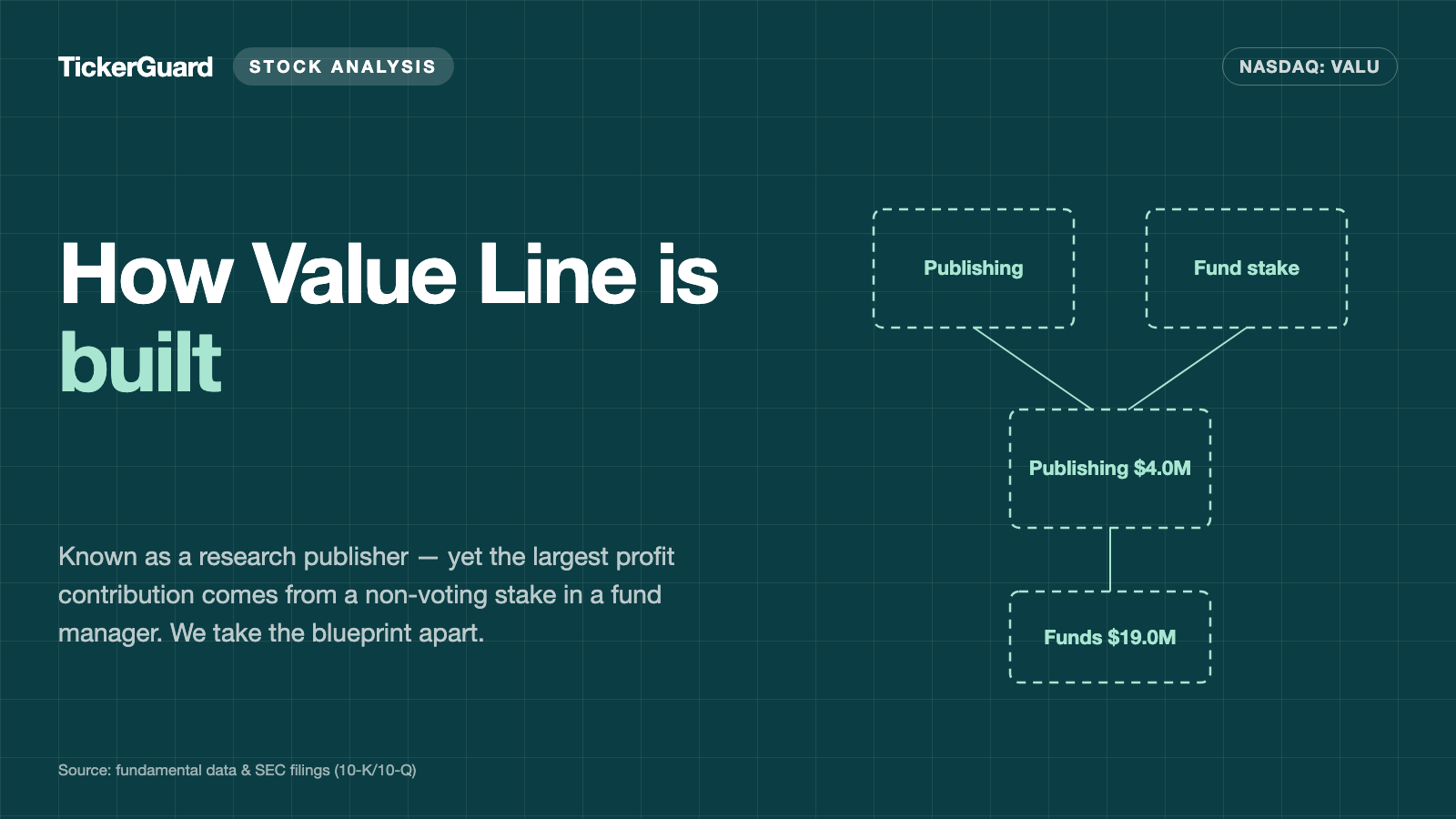
Now the look behind the window. Pre-tax income of $29.4 million in fiscal 2026 came from three pots: $19.0 million from EAM, $6.4 million from interest, dividends and gains on the company’s own securities portfolio — and only $4.0 million from the publishing business itself. Put differently: of every $100 in pre-tax income, just under $14 came from the business Value Line is known for. In fiscal 2023 the publisher, with $11.5 million in income from operations, was still slightly ahead of EAM at $11.1 million; since fiscal 2024 EAM has been ahead.
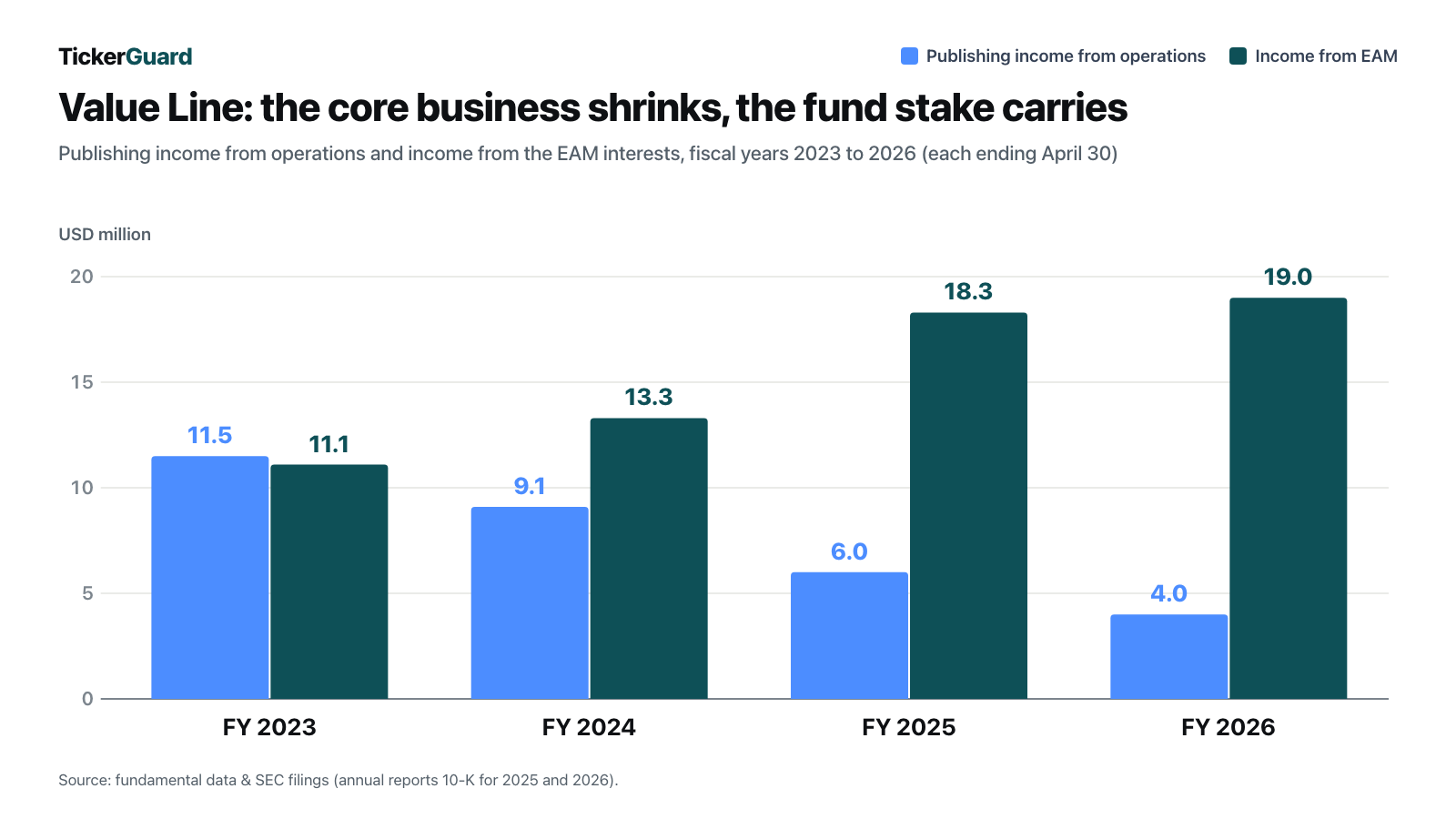
The chart shows two sets of bars pulling apart. Publishing revenue fell from $39.7 million (fiscal 2023) to $37.5 million, $35.1 million and then $33.4 million (fiscal 2026), while operating expenses rose from $28.2 million to $29.4 million. In the final quarter of fiscal 2026, February through April, publishing left income from operations of just $19,000 — after $830,000 a year earlier. That total profit rose anyway was down to EAM and to investment income, which doubled from $3.2 million to $6.4 million. Keep this in mind: a rising profit does not tell you which part of the company earned it.
What the filings say — the uncomfortable truths
Uncomfortable truth no. 1: The funds that carry the profit shrank by nearly a third in twelve months
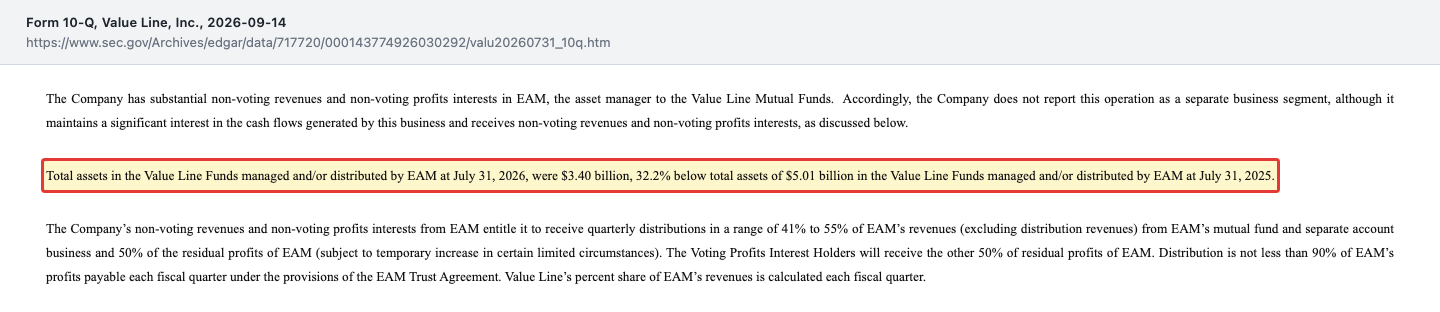
A fund manager earns a percentage of the money it manages. When assets fall, fees fall — and with them the share Value Line receives. The latest quarterly report (10-Q) states the number plainly:
“Total assets in the Value Line Funds managed and/or distributed by EAM at July 31, 2026, were $3.40 billion, 32.2% below total assets of $5.01 billion in the Value Line Funds managed and/or distributed by EAM at July 31, 2025.”
— Value Line, Inc., SEC quarterly report 10-Q as of July 31, 2026, Note 7
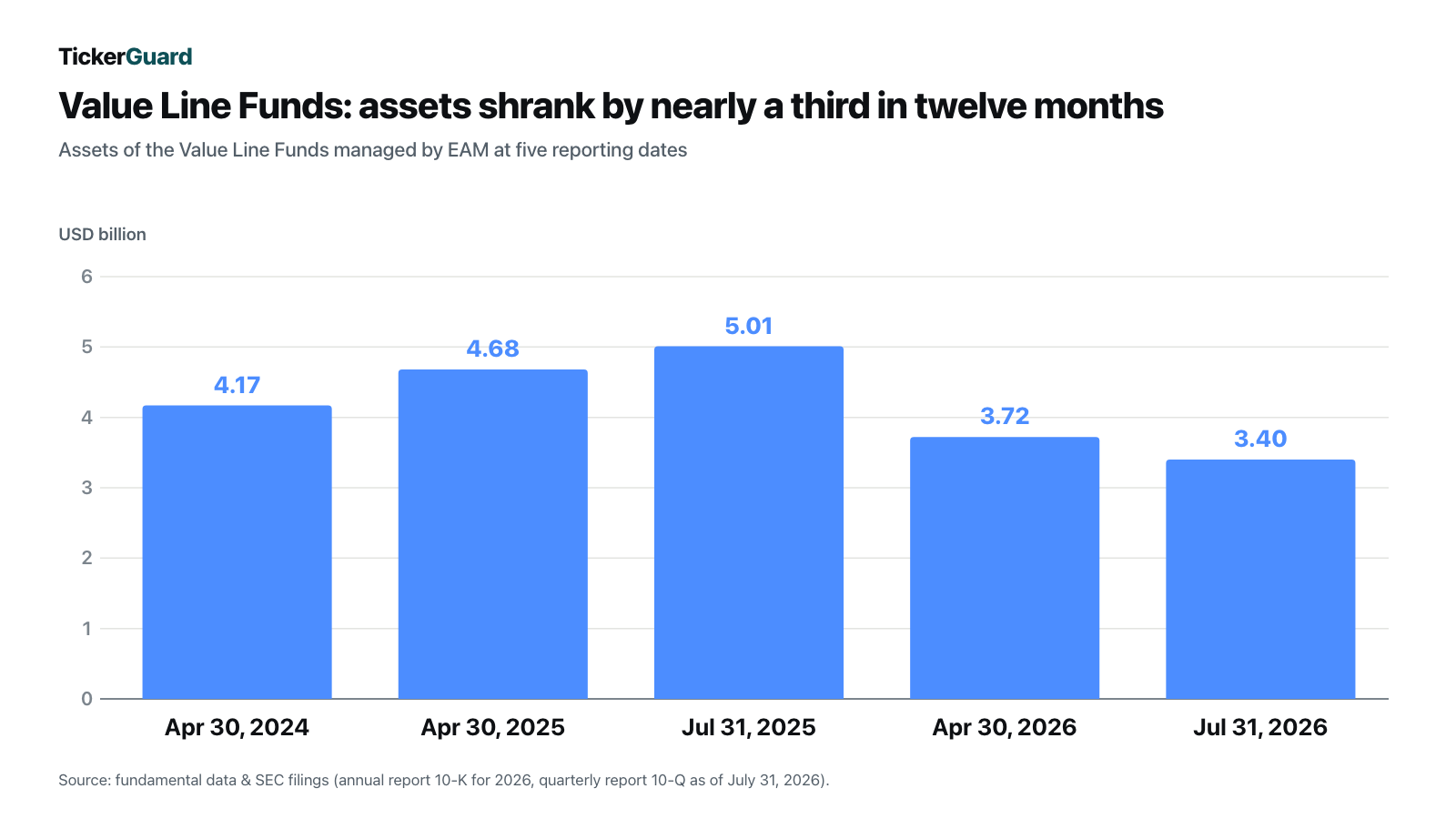
For fiscal 2026 (through April 30, 2026), when fund assets fell from $4.68 billion to $3.72 billion, the annual report breaks the decline down. Falling stock prices were not the cause in that period: the equity funds actually gained $339 million from market appreciation. Assets shrank because investors pulled their money: they redeemed $1.91 billion, while new sales came to only $0.66 billion. A year earlier, sales ($1.19 billion) and redemptions ($1.02 billion) had still roughly balanced. For May through July 2026, when fund assets fell further from $3.72 billion to $3.40 billion, the quarterly report gives no such breakdown. The second chart shows the path.
This reaches Value Line’s own accounts with a lag, but it does reach them. In the first quarter of fiscal 2027 (May through July 2026), EAM took in $6.2 million in management fees, after $8.3 million in the prior-year quarter. Value Line’s income from EAM fell from $5.1 million to $3.9 million, down 24.3 percent. Net income dropped 27.9 percent to $4.7 million, or $0.50 per share.
Uncomfortable truth no. 2: Value Line gets the money but has no say
A company whose most important source of earnings is weakening would normally step in: change managers, cut fees, launch new products. Value Line cannot do that at EAM. The quarterly report puts it this way:
“Value Line does not hold any voting stock of EAM and it does not have any involvement in the day-to-day activities or operations of EAM.”
— Value Line, Inc., SEC quarterly report 10-Q as of July 31, 2026, Note 3
Value Line only has consent rights for extraordinary events, such as a proposed sale of EAM or substantial borrowings. The annual report (10-K) names the dependence explicitly as a risk: the company derives a significant portion of its cash flow from its interests in EAM. On the balance sheet the investment is carried at $60.0 million (July 31, 2026) — more than half of shareholders’ equity. According to the quarterly report, EAM has not recorded any impairment losses in fiscal 2026 or 2027 so far. How a large fund company deals with outflows is the subject of our Franklin Resources analysis.
Uncomfortable truth no. 3: The publishing business has been shrinking for years — and Value Line itself expects nothing else
Among the risk factors in the annual report for fiscal 2026 is a heading every shareholder should read twice:
“The Company believes that the negative trend in retail print subscription revenue is likely to continue.”
— Value Line, Inc., SEC annual report 10-K for fiscal 2026, Item 1A (Risk Factors)
The numbers behind it: subscription revenue fell from $26.2 million (fiscal 2023) to $23.9 million (fiscal 2026) within three years. Print brought in $8.5 million in fiscal 2026, digital $15.4 million — and digital revenue declined too, by 3.1 percent. In the first quarter of fiscal 2027 (May through July 2026) the decline accelerated in print (down 11.6 percent after down 3.8 percent in fiscal 2026) and in total publishing revenue (down 6.4 percent after down 4.7 percent, the latter our own calculation from $33.4 million after $35.1 million). Digital fell a little more slowly at 2.8 percent than in fiscal 2026 (3.1 percent), and copyright fees declined at practically the same rate, 7.7 percent (7.8 percent). As reasons, Value Line cites that fewer individual investors manage their own portfolios and that comparable information is available online at low or no cost. Its own ranking system recently lagged the benchmark index: in the twelve months through the end of July 2026, stocks in the two top ranks rose 26.0 percent, while the Russell 2000 Index rose 32.5 percent.
Uncomfortable truth no. 4: A single customer accounts for more than a quarter of publishing revenue
“During the three months ended July 31, 2026, 28.3% of total publishing revenues of $8,051,000 were derived from a single customer.”
— Value Line, Inc., SEC quarterly report 10-Q as of July 31, 2026, MD&A, section “Concentration”

Value Line does not say who that customer is. But one piece of arithmetic stands out: copyright fees in the same quarter were $2.277 million — also 28.3 percent of $8.051 million. In fiscal 2026, 2025 and 2024 the single customer’s share was 28.7, 29.6 and 32.2 percent, and each time it matches the share of copyright fees in publishing revenue to the decimal. Arithmetically, that suggests practically the entire copyright business hangs on one counterparty; Value Line has not confirmed it. That is what concentration risk means: too many eggs in one basket, and someone else is carrying the basket.
Uncomfortable truth no. 5: As an outside shareholder, you are a guest here
“As of July 31, 2026, the Parent owned 92.01% of the outstanding shares of common stock of the Company.”
— Value Line, Inc., SEC quarterly report 10-Q as of July 31, 2026, Note 7
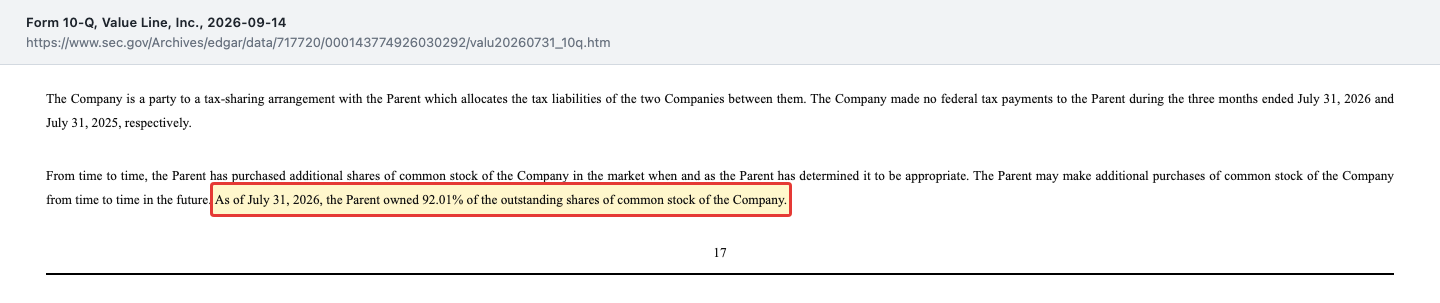
The parent is Arnold Bernhard & Co., Inc. According to the proxy statement, it owned exactly 8,633,733 of 9,382,273 shares on August 11, 2026, or 92.02 percent, and all of its voting stock belongs to a single person, Jean B. Buttner. Value Line’s chief executive, Howard A. Brecher, is also a director and general counsel of that holding company. That leaves about 749,000 shares for everyone else — just under $29 million at the November 24, 2026 close. The company counted approximately 30 holders of record on April 30, 2026; investors whose shares are held through banks and brokers come on top.
What does that mean in practice? First, the holding company alone decides who sits on the board. Value Line is therefore a “controlled company” under Nasdaq rules and is exempt from several protections for minority shareholders, such as a majority of independent directors. At the annual meeting on October 6, 2026, 8,798,585 shares voted to hold the advisory vote on executive pay only every three years; 376,574 shares wanted it every year. Second, trading is thin: between November 10 and November 24, 2026, between 500 and 8,200 shares changed hands per day, per fundamental data. Anyone buying or selling a larger position moves the price. Third, a good nine-tenths of every dividend goes to the holding company.
Valuation: what you pay for a dollar of earnings
At the $38.20 close on November 24, 2026 and 9,382,098 shares, Value Line is worth about $358 million in the market. Measured against fiscal 2026 earnings of $2.30 per share, that is a price-to-earnings ratio (P/E) of just under 17. The P/E tells you how many years of earnings you pay for the stock. Using the trailing four quarters through July 2026 ($2.11 per share, our own calculation from the filings), it is about 18.
Part of the price is backed by money: cash and securities of $88.5 million equal about $9.43 per share, and total shareholders’ equity of $109.2 million about $11.64. The stock thus costs a little more than three times book equity. The dividend, most recently $0.35 a quarter or $1.40 a year, works out to a yield of about 3.7 percent at that price. In the first quarter of fiscal 2027, 70 percent of earnings per share ($0.50) went out as dividends.
The real valuation question sits in the denominator. An illustration, explicitly our assumption and not a company forecast: if income from EAM stayed at the level of the latest quarter ($3.9 million) for four quarters, it would add up to roughly $15.5 million a year instead of $19.0 million. That would be $3.5 million less in pre-tax income, or roughly $0.27 per share after taxes. If fund assets keep falling, it will be more; if they recover, less. Value Line gives no guidance of its own, and we do not draw on analyst estimates for a stock with so few freely traded shares.
Opportunities and risks at a glance
What speaks for Value Line:
- Solid balance sheet: no bank debt, $88.5 million in cash and securities, $109.2 million in shareholders’ equity (July 31, 2026).
- Dependable profits: net income up three fiscal years in a row, from $18.1 million (fiscal 2023) to $21.6 million (fiscal 2026).
- Rising dividend: quarterly dividend raised from $0.30 (fiscal 2025) to $0.35; a small $2 million share repurchase program was renewed in July 2026.
- Cash up front: subscribers mostly pay in advance; on July 31, 2026, the balance sheet showed $20.9 million in subscriptions already paid but not yet delivered.
- Priority at EAM: the share of management fee revenues comes before the profit split, and per the filing Value Line has no obligation to fund EAM.
What speaks against it:
- Shrinking fund assets: down 32.2 percent in twelve months (July 31, 2026); in fiscal 2026, equity fund redemptions of $1.91 billion against new sales of $0.66 billion. Income from EAM down 24.3 percent in the latest quarter.
- No control: Value Line has no vote at EAM and is not involved in day-to-day operations.
- A shrinking core: publishing revenue from $37.5 million to $33.4 million in two years, income from operations from $11.5 million (fiscal 2023) to $4.0 million (fiscal 2026).
- Concentration risk: one customer with 28.3 percent of publishing revenue, copyright fees falling for three years.
- A minority without weight: 92 percent of the shares with one holding company, exemptions from Nasdaq protections, very thin trading.
A human conclusion
Back to the shop-window trap from the beginning. In Value Line’s window sits a storied investment service, and anyone who only looks there sees a calm, debt-free publisher with a rising dividend. That is not wrong. But since fiscal 2024 the rent has mostly been paid by the back room: a share of the fees of a fund manager where Value Line has no say — and from whose equity funds investors pulled almost three times as much money in fiscal 2026 as they put in. Publishing revenue has fallen every year since fiscal 2023. And above it all sits a holding company that owns nine out of ten shares. So the honest question for you is not “Is this a solid old name?” but: do you know what you are buying when most of the profit comes from a business that neither Value Line nor you can influence — and can you live with fund assets there having shrunk by nearly a third in twelve months? The answer will be in the next quarterly report, in a single line: EAM’s fund assets. What you make of that is your decision. And that is a good thing.
Sources
All original documents used in this analysis — so you can read them yourself:
- Value Line, Inc. — SEC quarterly report 10-Q as of July 31, 2026 (filed September 14, 2026)
- Value Line, Inc. — SEC current report 8-K of October 6, 2026 (annual meeting voting results)
- Value Line, Inc. — proxy statement DEF 14A for the annual meeting (filed August 18, 2026)
- Value Line, Inc. — SEC annual report 10-K for fiscal 2026 (filed July 29, 2026)
- Value Line, Inc. — SEC quarterly report 10-Q as of January 31, 2026 (filed March 17, 2026)
- Value Line, Inc. — SEC quarterly report 10-Q as of October 31, 2025 (filed December 15, 2025)
- Value Line, Inc. — SEC quarterly report 10-Q as of July 31, 2025 (filed September 15, 2025)
- Value Line, Inc. — SEC annual report 10-K for fiscal 2025 (filed July 29, 2025)
- Complete SEC filing history of Value Line, Inc.: EDGAR overview (sec.gov)
- Fundamental data (closing prices and trading volumes through November 24, 2026; data as of November 25, 2026), reconciled with the SEC filings.
- Mentions in investor forums: Reddit hype scanner (recorded November 25, 2026); accessed via our in-house stock scanner.
Transparency & disclaimer: This analysis is a journalistic contextualization of publicly available information and is not investment advice, not a financial analysis in the regulatory sense and not a solicitation to buy or sell securities. Investing in stocks carries substantial risks, up to and including total loss. All information without guarantee; the data date is noted in the text in each case. Positions held by the operator are disclosed daily; where one exists, it appears as a notice at the top of this deep dive.
Key figures at a glance
All monetary figures in millions of $; earnings per share as reported.
| Metric | 2022 | 2023 | 2024 | 2025 | 2026 |
|---|---|---|---|---|---|
| Revenue | 40.5 | 39.7 | 37.5 | 35.1 | 33.4 |
| Operating Income (EBIT) | 10.8 | 11.5 | 9.1 | 6.0 | 4.0 |
| Net Income | 23.8 | 18.1 | 19.0 | 20.7 | 21.6 |
| Net Margin | 58.8% | 45.5% | 50.7% | 59.0% | 64.7% |
| Earnings Per Share | 2.50 $ | 1.91 $ | 2.02 $ | 2.20 $ | 2.30 $ |
Source: fundamental data & SEC filings (annual and quarterly reports, 10-K/10-Q)
Our Bottom Line at a Glance
- Balance sheet positive
- No bank debt, $88.5 million in cash and securities and $109.2 million in shareholders’ equity as of 7/31/2026. Liabilities of $43.5 million consist mainly of prepaid subscriptions and deferred income taxes.
- EAM as earnings source negative
- The fund interests delivered $19.0 million of $29.4 million in pre-tax income in fiscal 2026. Fund assets fell 32.2 percent in the twelve months to 7/31/2026, to $3.40 billion, and income from EAM fell 24.3 percent in the latest quarter. Value Line has no vote there.
- Publishing business negative
- Publishing revenue fell from $37.5 million (fiscal 2024) to $33.4 million (fiscal 2026), income from operations from $11.5 million (fiscal 2023) to $4.0 million (fiscal 2026). Per its annual report, Value Line expects the decline in retail print revenue to continue.
- Customer concentration neutral
- A single customer accounted for 28.3 percent of publishing revenue in the quarter through 7/31/2026; arithmetically, that share equals all copyright fees. The dependence is substantial but concerns the smaller part of earnings.
- Ownership and trading neutral
- The holding company Arnold Bernhard & Co. owns 92.02 percent of the shares (8/11/2026); as a controlled company, Value Line uses exemptions from Nasdaq rules. About 749,000 shares are in public hands, and daily volume in November 2026 was a few thousand shares.
- Payout positive
- Quarterly dividend raised from $0.30 to $0.35 per share within two years; in the quarter through 7/31/2026 that equaled 70 percent of earnings per share. A $2 million share repurchase program was renewed in July 2026.
Value Line is a case study in the shop-window trap: known as a research publisher, it earns most of its profit through non-voting interests in the fund manager EAM — $19.0 million of $29.4 million in pre-tax income in fiscal 2026. Those fund assets fell 32.2 percent in the twelve months to the end of July 2026, while the publishing business has been shrinking for years. Against that stand a debt-free balance sheet and a rising dividend. Not investment advice.
What Our Rating Means
Open questions
The business works in principle, but one material question is open. As long as it stays open, our findings do not carry a quality verdict.
Yellow, because the company is soundly financed and profitable, but one material operating question is open: the largest contribution to earnings comes from the fund manager EAM, whose assets under management fell 32.2 percent in twelve months and over which Value Line has no control; at the same time the publishing business is shrinking and depends on one customer for more than a quarter of its revenue. No threat to the company’s substance is documented — no debt, $88.5 million in liquid assets. The small public float and thin trading are price and trading arguments, not a quality verdict. The decision is yours.
A journalistic assessment by our editorial team at the time of the deep dive, based on public sources — not investment advice and not a solicitation to buy or sell. Your personal circumstances (investment goals, risk capacity, taxes) cannot be taken into account. What our levels mean, how verdicts are formed, and what conflicts of interest exist →
Worth Noting
- Value Line made our research list through the Reddit hype scanner (recorded 11/25/2026), not through a quality or valuation scanner.
- Market value calculated by us: 9,382,098 shares (10-Q cover, as of 8/31/2026) × $38.20 (close on 11/24/2026) ≈ $358 million. Cross-check with the last price cited in a filing (10-K: $35.19 on 4/30/2026) ≈ $330 million.
- Trailing four-quarter earnings per share calculated by us: $2.30 (FY 2026) − $0.69 (Q1 FY 2026) + $0.50 (Q1 FY 2027) = $2.11. Per-share balance sheet figures based on 9,382,098 shares.
- The quarterly report gives the change in EAM income as 24.3 percent in one place and, unsigned, as 20.7 percent in a second table; the reported amounts ($3.879 million after $5.121 million) yield a decline of 24.3 percent.
- The filings do not name the major customer. That its revenue share equals the share of copyright fees is our own calculation from the reported figures, not a statement by the company.
- Holding company stake: the proxy statement gives 91.98 percent as of 8/11/2026 in one place; we use the share counts reported there (8,633,733 of 9,382,273 shares = 92.02 percent). The annual report gives 91.98 percent as of 4/30/2026, the quarterly report 92.01 percent as of 7/31/2026.
- Dividend: the declaration of 7/17/2026 ($0.35, payable 8/11/2026) is from the annual report. The later distribution (ex-dividend date 10/26/2026, payment date 11/10/2026, annual rate $1.40) is from fundamental data; no SEC filing on it was available through 11/26/2026.
- Latest periodic report evaluated: 10-Q as of 7/31/2026 (filed 9/14/2026). After it, only the 8-K of 10/6/2026 on the annual meeting appeared through 11/26/2026; the 10-Q as of 10/31/2026 was still outstanding.
Stock Watch
This analysis is as of November 26, 2026. Stock Watch will tell you what's changed at VALU since then.
Later $1 a month per stock — signing up is free, and you'll be the first to know when it launches.
The full analysis as a PDF for later
We will send you this analysis as a PDF — to print, file away, and read at your own pace. And we will add you to the free Stock Watch list for Value Line Inc (VALU), so you hear about it when something material in this analysis changes.
Frequently Asked Questions
Value Line has three sources. In fiscal 2026 (ended April 30, 2026), pre-tax income of $29.4 million consisted of $19.0 million from its interests in the fund manager EAM, $6.4 million from interest, dividends and gains on its own securities, and $4.0 million from publishing — investment research subscriptions and copyright fees.
EAM (EULAV Asset Management) has managed the Value Line mutual funds since December 23, 2010. Depending on revenue levels, Value Line receives 41 to 55 percent of EAM’s management fee revenues plus half of the residual profits, but it holds no voting interest and is not involved in day-to-day operations. The investment was carried at $60.0 million on July 31, 2026.
In the quarter from May through July 2026, net income fell 27.9 percent to $4.7 million. The main reason: assets in the Value Line Funds were $3.40 billion on July 31, 2026, 32.2 percent below the prior year, and income from EAM dropped 24.3 percent. Publishing revenue also declined 6.4 percent.
According to the proxy statement, the holding company Arnold Bernhard & Co., Inc. owned 8,633,733 of 9,382,273 shares on August 11, 2026, or 92.02 percent. Jean B. Buttner owns all of the holding company’s voting stock. About 749,000 shares are in public hands; Value Line is a controlled company under Nasdaq rules.
Yes. The quarterly dividend rose from $0.30 per share in fiscal 2025 to $0.325 and most recently $0.35. According to the annual report, a dividend of $0.35 was declared on July 17, 2026, payable on August 11, 2026. Fundamental data then show a further distribution with an ex-dividend date of October 26, 2026 and a payment date of November 10, 2026, and give an annual rate of $1.40 (data as of November 26, 2026). In the quarter through July 2026 the $0.35 equaled 70 percent of earnings per share of $0.50.
Value Line does not report on a calendar year: its fiscal year runs from May 1 to April 30. Fiscal 2026 therefore covers May 2025 through April 2026, and the first quarter of fiscal 2027 covers May through July 2026. The annual report (10-K) is filed in late July, the quarterly reports (10-Q) in mid-September, December and March.
Value Line has no bank debt and, according to its quarterly report, does not anticipate any borrowings over the next twelve months. On July 31, 2026, $88.5 million in cash and short-term securities stood against total liabilities of $43.5 million, of which $20.9 million was prepaid subscriptions and $14.3 million deferred income taxes. Shareholders’ equity was $109.2 million.
Found an error?
Did you spot a factual error, an outdated number, or a typo in this deep dive? Let us know briefly — your report goes straight to the editorial team.