Ambarella: A Record Quarter — and Guidance That Erases More Than a Third of It
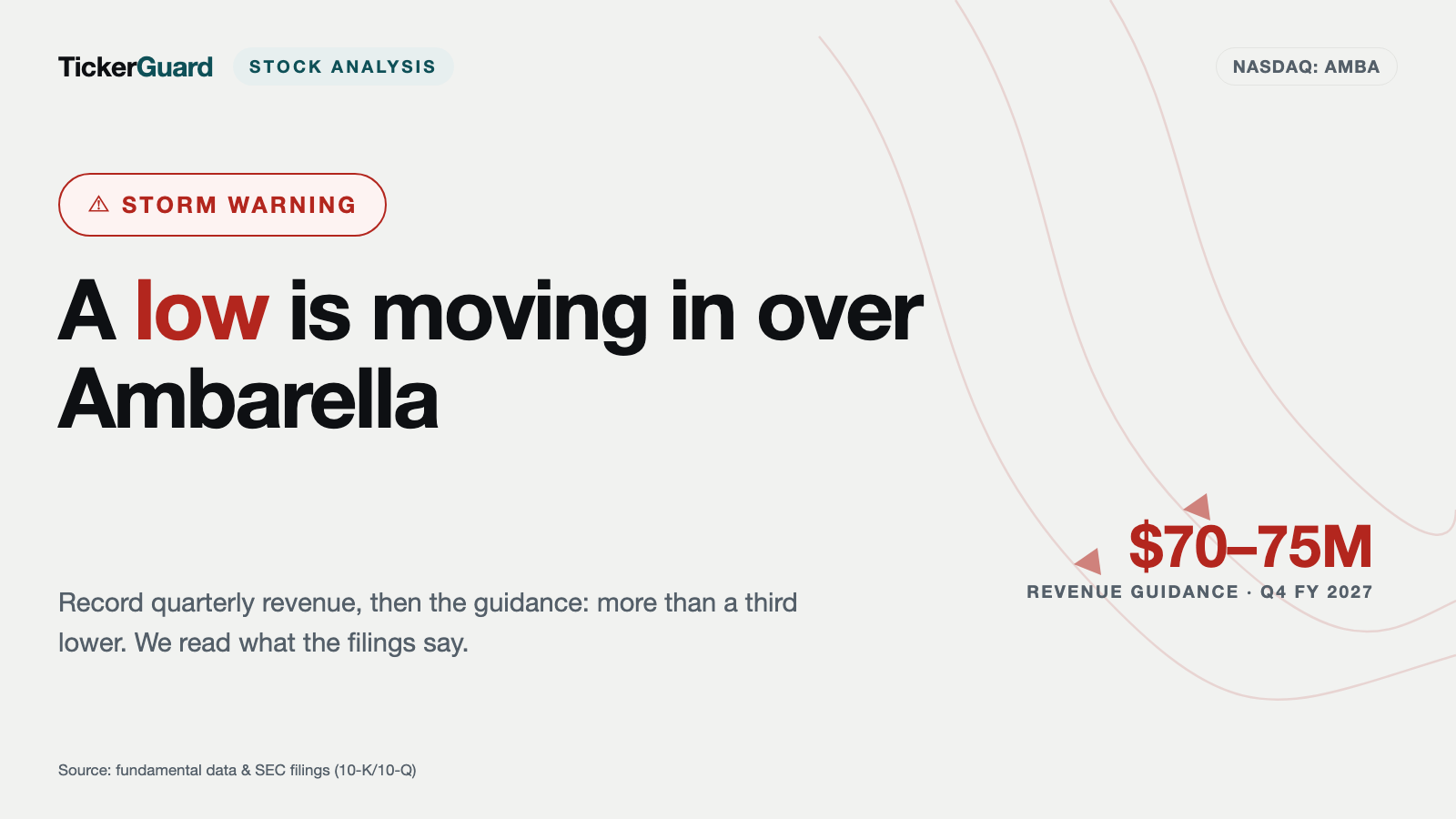
Ambarella designs the chips that let cameras understand what they see instead of merely recording it. On November 24, 2026 the company reported the highest quarterly revenue in its history: $115.2 million. The same document carries the guidance for the current quarter: $70 million to $75 million — because, the company says, memory chips have become so scarce and expensive that many customers are reducing their outlooks. And the same quarter comes with two results: a $12.7 million loss under GAAP and a $12.7 million profit in the non-GAAP version. Not investment advice — just the paragraph that sits below the record headline.
 Thomas Mücke
Founder & Publisher
As of Today
As of: November 25, 2026
- Closing price
- 35.70 $ -19.80%
- Market Capitalisation
- 1.7 $B
- Growth Score
- 5/10
- AAQS
- 4/10
Price change since November 25, 2026: +0.1%
This analysis has a cut-off date. The Stock Guard tells you when something material changes in the numbers. Reserve your free spot
Chart
Interactive price chart (TradingView).
52-week range: 44.50 $ to 93.60 $ · Last price: 35.70 $ (As of: November 25, 2026)
Note: pure fact-based analysis, not investment advice and not a solicitation to buy or sell. All figures without guarantee.
There is an investor weakness that has nothing to do with greed and everything to do with convenience: the headline trap. You read the first line of an announcement, it contains the word “record,” and your brain files the matter under “going well.” The second paragraph? Later. Maybe. At Ambarella (NASDAQ: AMBA), that second paragraph is where the decisive part sat in November 2026. The first line of the November 24, 2026 earnings release said, in essence: record revenue from AI chips, $115.2 million in total for the quarter — more than ever before. A few lines further down came the guidance for the current quarter: $70 million to $75 million. That is not a typo and it is not seasonality; it is a decline of more than a third in three months. On November 25, the first trading day after the release, the stock closed just under 20 percent lower. And the same release contains a second pair worth remembering: a $12.7 million loss under GAAP and a $12.7 million profit in the non-GAAP version — for the same quarter. So here is the deal: we read that release and the filings behind it together, all the way to the end — the quarterly report, the annual report, the footnotes. Ambarella filed them with the U.S. securities regulator, the SEC, and is legally answerable for what they say. They describe a company with real technology and a well-filled bank account that has nonetheless not reported a GAAP profit in eight years — and whose revenue currently hinges on a component it does not sell. In the end, the call is yours.
What Ambarella actually does — chips that teach cameras to see
Picture a security camera from ten years ago: it records, compresses the image and sends it somewhere for a person to watch. Today’s camera is expected to recognize on its own whether that is a delivery driver or a cat — instantly, on the device, without a detour through a data center. The industry calls this on-device computing edge AI, and the building block that does the work is an SoC (“system on a chip”): a complete small computer on a single chip that processes the image, compresses the video and runs a neural network over it. Ambarella designs exactly these chips and the software that goes with them. Its SEC filings list security cameras, action cameras, drones, wearables, vehicle cameras and driver-assistance systems, and robots as end uses; the in-house AI architecture is called CVflow. The sales pitch is always the same: a lot of computing power for very little electricity — decisive for anything that runs on a battery or must not overheat in a small housing.
Three things matter about the business model. First, Ambarella has no factory. The company designs the chips and has them manufactured — according to the annual report, the substantial majority by Samsung in Texas and South Korea. As of January 31, 2026, Ambarella employed 959 people, about three quarters of them in research and development; 372 are in Taiwan, 252 in the United States and 225 in China. Second, the road to revenue is long. A camera maker selects a chip (a “design win”), spends twelve to eighteen months building it into a product — and money flows only once that product sells. Orders usually do not come directly but through distributors and contract manufacturers in Asia. Third, the fiscal year does not match the calendar. It ends on January 31. “Fiscal 2027” therefore runs from February 1, 2026 to January 31, 2027, and its third quarter ended on October 31, 2026. We spell out the months throughout for that reason.
Legally the company has been domiciled in the Cayman Islands since its founding in January 2004; operationally it is run from Santa Clara, California, with Fermi Wang as president and chief executive. It reports like any U.S. company, with annual reports on Form 10-K and quarterly reports on Form 10-Q.
That names the central tension of this analysis, and it runs through every chapter: Ambarella supplies the brain of the camera and earns a gross margin of just under 58 percent on it — but whether the camera gets built at all is decided by others: the customer, its distributor and the price of a memory chip. In the fall of 2026, exactly one paragraph separated the record quarter from the slump.
Company history for investors
-
2004
Founded in the Cayman Islands
Ambarella is formed in January 2004. For shareholders that still means owning a Cayman company that is run from California.
-
2012
IPO on NASDAQ
The stock has traded since October 2012. In the years that followed Ambarella made money — net income peaked at $76.5 million in fiscal 2016.
-
2018
Last annual profit
The fiscal year ended January 31, 2018 closes with net income of $18.9 million. Every annual report since has shown a net loss.
-
2024
Revenue drops by a third
In the fiscal year ended January 31, 2024 revenue falls to $226.5 million and the loss widens to $169.4 million. Holders saw how fast demand can turn.
-
2026
Record year with $390.7 million in revenue
The fiscal year ended January 31, 2026 brings 37.2 percent growth and $73.5 million of operating cash flow — but still a $75.9 million net loss.
-
2026
$50 million buyback program
On May 27, 2026 the board authorizes repurchases through June 30, 2027. No shares were bought through July 31, 2026, while the share count kept rising through compensation.
-
2026
Record quarter and guidance cut
On November 24, 2026 Ambarella reports $115.2 million in quarterly revenue and guides to $70 million to $75 million for the next quarter. On November 25, the first trading day afterward, the stock closes just under 20 percent lower.
How the stock reached our desk
Not through one of our valuation or momentum scanners, but through the noise: on November 25, 2026, one day after the earnings release, Ambarella showed up in our Reddit hype scanner — the filter that counts which stocks are drawing unusually heavy discussion in the big investing forums. That is an attention signal and explicitly not a reason to buy. The closing prices show why so much was written: $55.56 on November 23, 2026, $44.47 on November 24 and $35.68 on November 25 — together more than a third in two trading days. The order matters: the earnings release reached the SEC only after the market close on November 24, and the conference call was scheduled for 4:30 p.m. Eastern Time. The first decline of roughly 20 percent therefore came before publication; what triggered it does not emerge from the documents we reviewed. The second, just under 20 percent on November 25, followed the results and the guidance. After a move like that, forums fill up with people who see the decline as an opportunity and with people who have just lost a lot of money. Many of them have probably seen only the headline — that is our assumption, and we cannot prove it. For us, a day like that is the cue to open the primary documents — the November 24, 2026 earnings release (filed with the SEC on Form 8-K), the quarterly report for the period ended July 31, 2026 and the annual report for the year ended January 31, 2026. One note for completeness: the full quarterly report for the period ended October 31, 2026 had not been filed as of November 26, 2026; third-quarter figures therefore come from the earnings release, while customer concentration and cash flow come from the report before it. Where that is the case, the date is stated.
Eight years of losses — and the cash still has not run out
First, what genuinely impresses. In fiscal 2024 (ended January 31, 2024) revenue had dropped by a third to $226.5 million. Two years later it stood at $390.7 million — up 25.8 percent in fiscal 2025 and 37.2 percent in fiscal 2026, driven according to the annual report by higher unit shipments and a larger share of higher-priced AI processors. That is the highest annual revenue in the company’s history. Operations generated $73.5 million of cash in fiscal 2026, more than double the prior year ($33.8 million). The first nine months of fiscal 2027 looked good as well: revenue of $323.7 million, up 11.7 percent from the same period a year earlier.
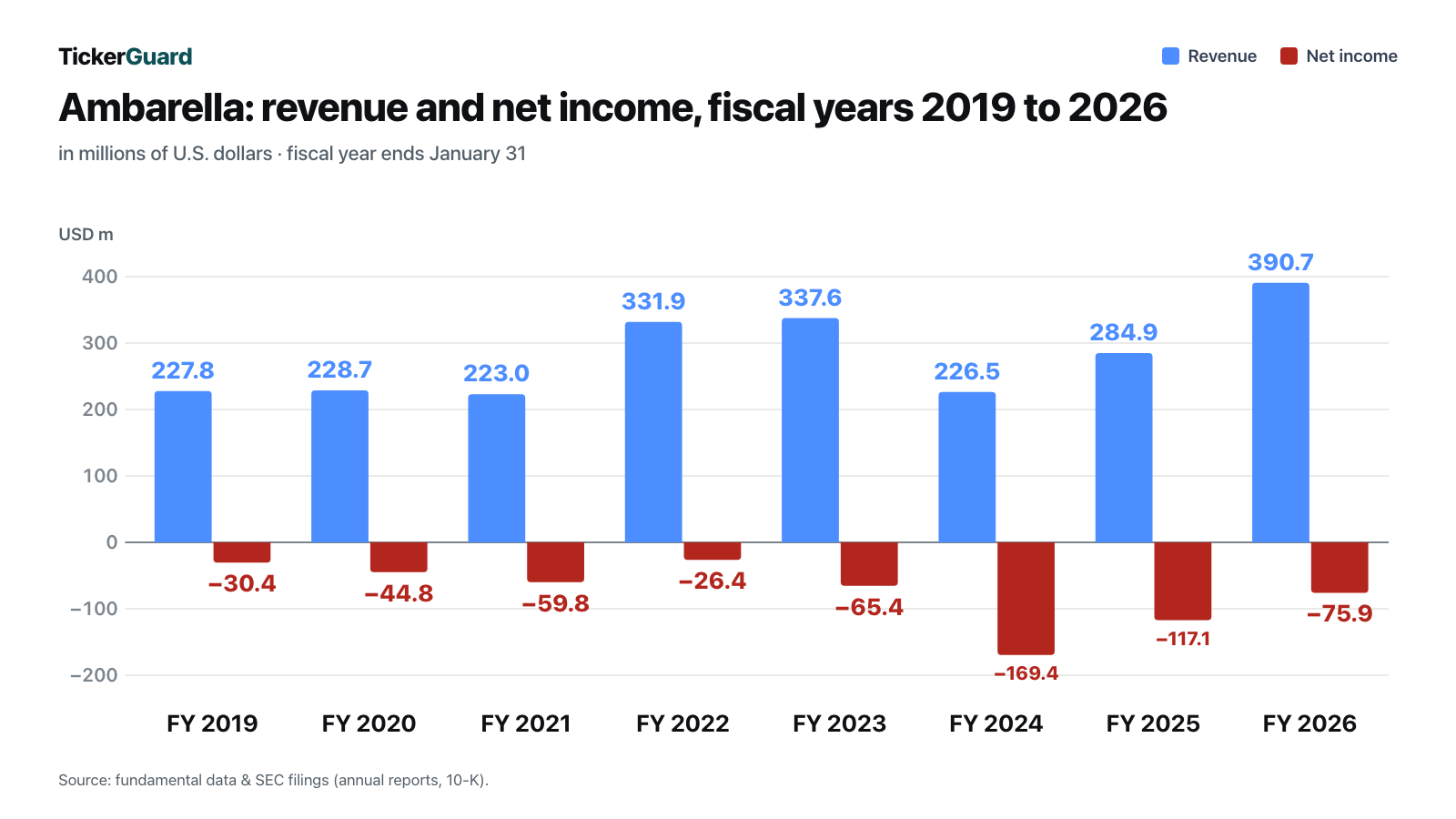
Now the red series in the same chart. The last annual profit dates from fiscal 2018 ($18.9 million). Since then Ambarella has reported a net loss in eight consecutive fiscal years, roughly $589 million in total — including $75.9 million in the record year of fiscal 2026. The first nine months of fiscal 2027 added $37.5 million, and the accumulated deficit stood at $365.4 million on October 31, 2026. Keep the contradiction in mind, because it is the key to the next chapter: a company that reports a loss year after year, and whose cash still does not run out.
Then the picture that arrived in November 2026 — revenue quarter by quarter, with the company’s guidance as the final bar:
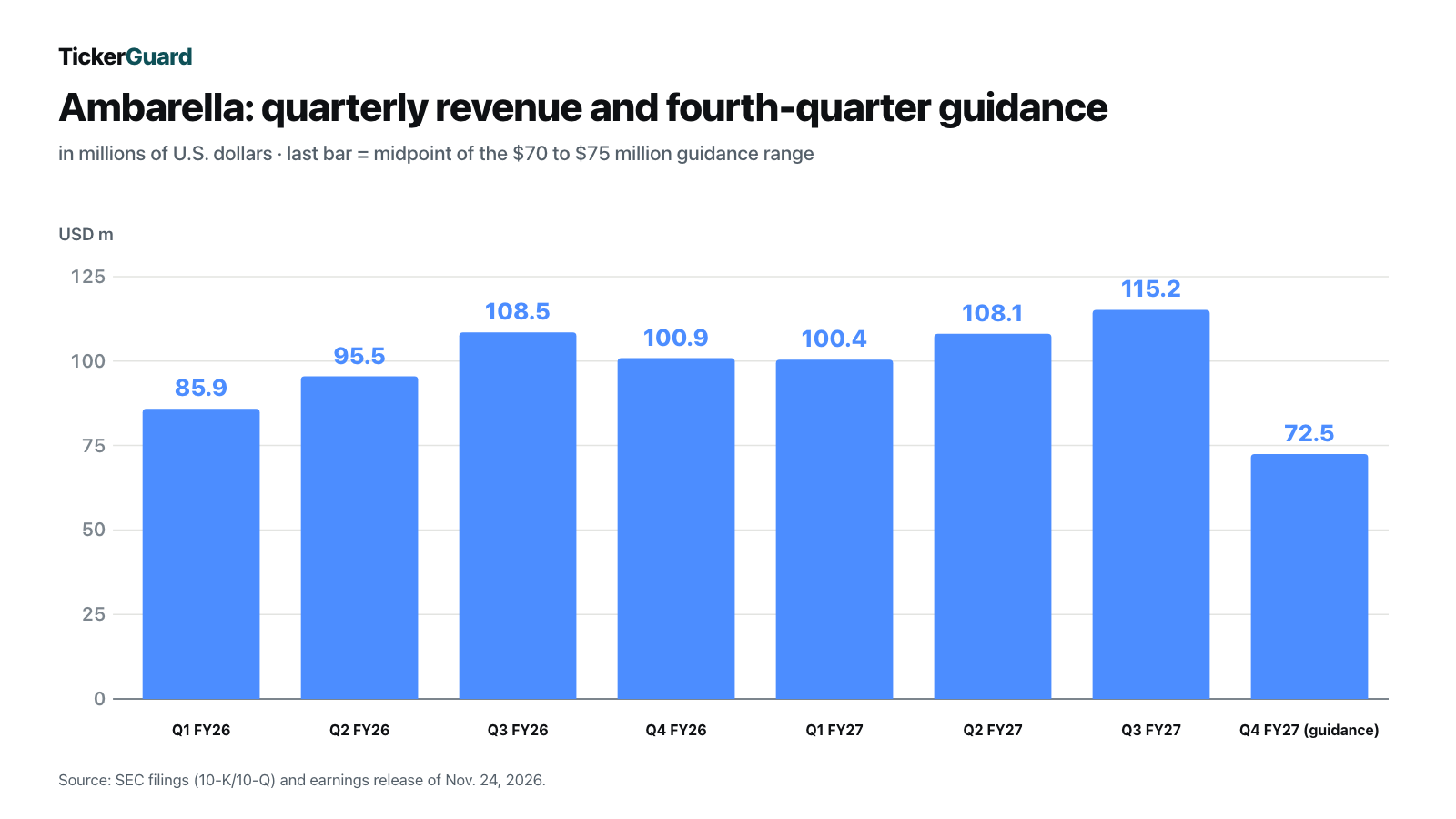
A word on seasonality, because that argument comes up immediately: yes, the fourth quarter is usually weaker at Ambarella, and the annual report says so. Last year the decline from the third to the fourth quarter was 7 percent (from $108.5 million to $100.9 million). This time it is 37 percent at the midpoint of guidance. Seasonality explains a small part — the rest has another cause. Which brings us to the uncomfortable truths.
What the filings say — the uncomfortable truths
Uncomfortable truth No. 1: Revenue hinges on a component Ambarella does not sell
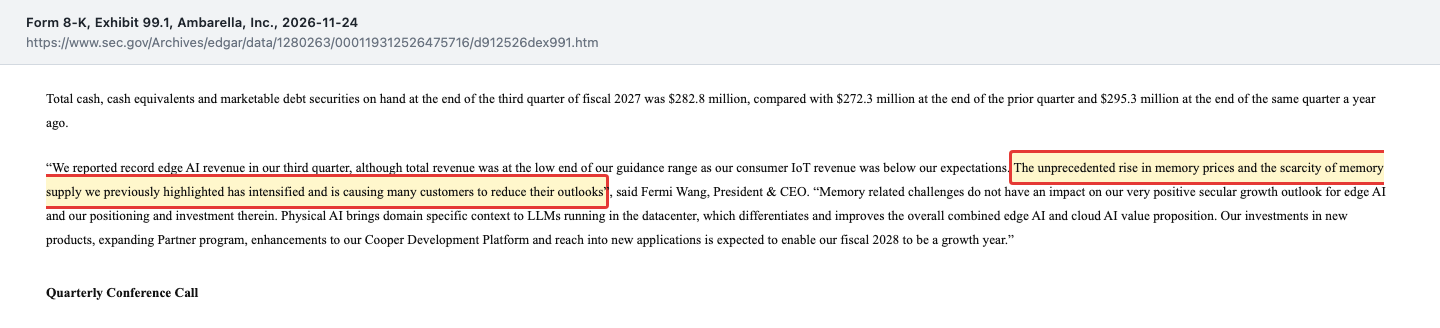
A camera is made of many parts: lens, image sensor, wireless chip, power management, memory — and Ambarella’s processor. If one of them is missing or becomes too expensive, the camera is not built, and then no processor is ordered either. By the company’s account, that is exactly what happened in the fall of 2026, and the part in question is memory. Chief executive Fermi Wang puts it this way in the earnings release:
“We reported record edge AI revenue in our third quarter, although total revenue was at the low end of our guidance range as our consumer IoT revenue was below our expectations. The unprecedented rise in memory prices and the scarcity of memory supply we previously highlighted has intensified and is causing many customers to reduce their outlooks”
— Fermi Wang, President and CEO of Ambarella, Inc., Form 8-K of November 24, 2026, Exhibit 99.1 (earnings release for the third quarter of fiscal 2027)
It was not a complete surprise. The quarterly report filed on September 4, 2026 already carried a new sentence among the factors affecting performance:
“Recently, there have been tightening supply conditions for memory chip components that our customers use in their end products, which could have an impact on their demand for our products.”
— Ambarella, Inc., Form 10-Q for the quarter ended July 31, 2026, MD&A, “Impact of Global Supply Chain Conditions on Our Business”
Within just under twelve weeks, “could” turned into guidance, so let us run the numbers. $70 million to $75 million in the fourth quarter means 35 to 39 percent less than the third quarter ($115.2 million) and 26 to 31 percent less than the year-ago quarter ($100.9 million). At the midpoint it would be the lowest quarterly revenue since the quarter ended July 2024 ($63.7 million). For all of fiscal 2027 that implies roughly $394 million to $399 million — after $390.7 million the year before. A year that was still up 11.7 percent after nine months would end with growth of one to two percent.
The guidance contains two more figures: non-GAAP gross margin of 59.0 to 60.25 percent and non-GAAP operating expenses of $57.5 million to $59.5 million. Something follows from them that the release does not spell out — the following calculation is our own: at $72.5 million of revenue and a margin of just under 60 percent, gross profit comes to roughly $43 million. Against that stand costs of roughly $58.5 million. Even on the non-GAAP basis, which leaves out stock-based compensation, that yields an operating loss of roughly $15 million for the quarter; across the full range the result lies between roughly $12 million and $18 million. On the same basis the third quarter still showed an operating profit of roughly $11 million. A chip designer’s costs consist almost entirely of engineering salaries and development work — they do not fall when revenue falls.
What Ambarella does not say matters here: how long this lasts. The chief executive stresses that the memory challenges do not affect the long-term growth outlook and that the company’s investments are expected to enable fiscal 2028 (February 2027 through January 2028) “to be a growth year.” That is an expectation, not a commitment, and the release attaches no number to it. Two more things the documents do not quantify: neither the earnings release nor the quarterly report for the period ended July 31, 2026 breaks revenue down between automotive and consumer devices — the release says only that consumer IoT revenue fell short of expectations. And they do not explain where the memory shortage comes from or what would signal its end.
Uncomfortable truth No. 2: Profit exists only in the version without stock compensation
Ambarella publishes two results every quarter. One follows U.S. generally accepted accounting principles (GAAP); the other is its own “non-GAAP” version. For the third quarter of fiscal 2027 they read: a net loss of $12.7 million under GAAP — and net income of $12.7 million on the non-GAAP basis. Same amount, opposite sign. The difference consists almost entirely of one item: $24.2 million of stock-based compensation.
What does that mean in plain terms? Ambarella pays its engineers to a considerable degree not in cash but in new shares. That spares the bank account — which is why a company can report eight years of losses and still keep money in the bank. But it is not free: shareholders foot the bill, because their slice of the pie gets a little smaller every year. The scale: stock-based compensation was $98.0 million in fiscal 2026, about 25 percent of revenue. Over the eight loss-making years since fiscal 2019 it adds up to roughly $714 million — more than the reported net losses of roughly $589 million combined. Shares outstanding rose from 41.7 million (November 30, 2024) to 44.1 million (August 31, 2026), just under 6 percent in 21 months. And it continues:
“Total unrecognized compensation cost of unvested awards at July 31, 2026 was approximately $174.1 million and is expected to be recognized over a weighted-average period of 2.50 years.”
— Ambarella, Inc., Form 10-Q for the quarter ended July 31, 2026, Note 11 (Stock-based Compensation)
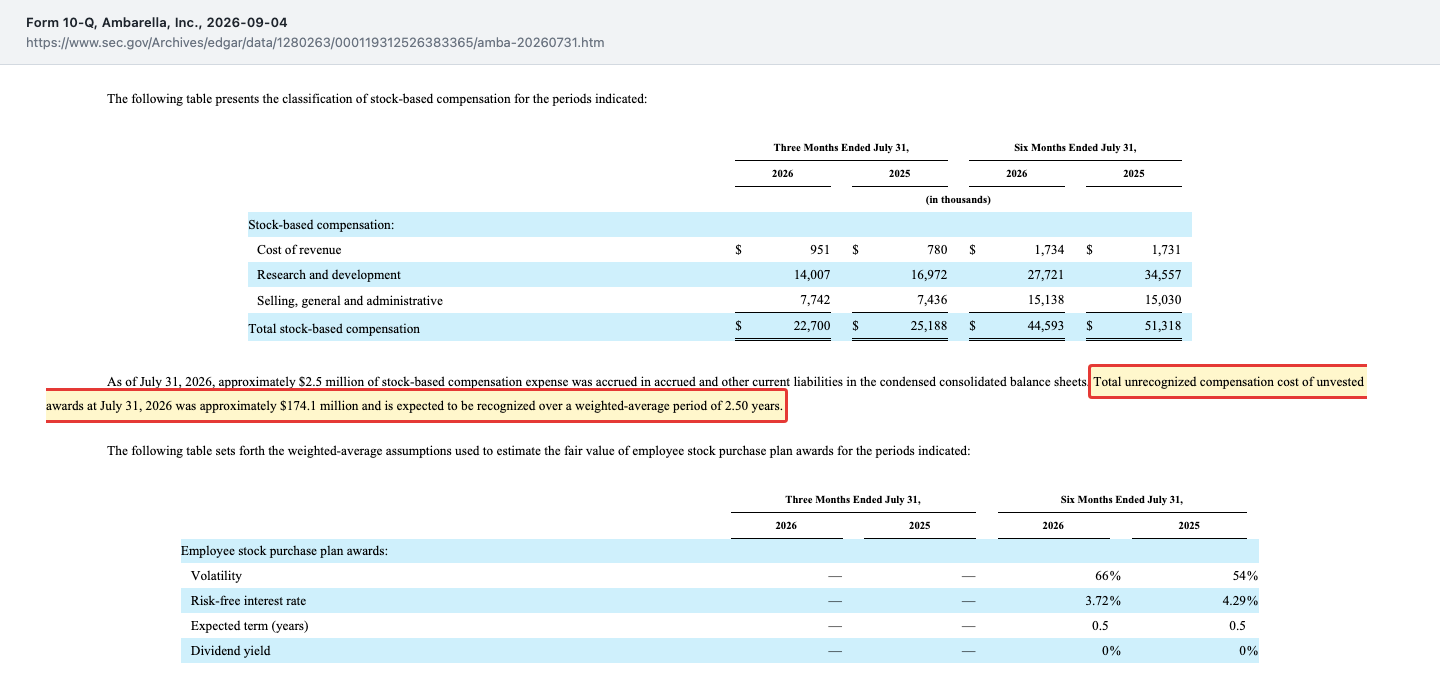
$174.1 million of stock compensation already granted but not yet expensed — that is cost which, as things stand today, remains to be expensed over a weighted average of two and a half years, largely regardless of how revenue develops. In the summer of 2026 shareholders also approved another 2,750,000 shares for the equity incentive plan, about 6 percent of shares outstanding; they were registered with the SEC on August 3, 2026. Set against this is a $50 million share repurchase program that the board authorized on May 27, 2026 for the period from July 1, 2026 to June 30, 2027. According to the quarterly report, not a single share had been bought under it through July 31, 2026; more recent information will come only with the next quarterly report. The takeaway: the non-GAAP version shows what the business would earn without paying people in stock. The GAAP version shows what it costs with it. As a shareholder, you live in the second one.
Uncomfortable truth No. 3: About 60 percent of revenue passes through a single door
Ambarella mostly does not sell its chips to camera makers itself but through distributors. By far the most important is WT Microelectronics of Taiwan; the second is Japanese distributor Hakuto. The quarterly report puts numbers on it:
“For the three and six months ended July 31, 2026, the customers representing 10% or more of revenue were WT and Hakuto, which accounted for approximately 60.2% and 11.0% of total revenue for the three months ended July 31, 2026, respectively, and accounted for approximately 60.5% and 10.1% of total revenue for the six months ended July 31, 2026, respectively.”
— Ambarella, Inc., Form 10-Q for the quarter ended July 31, 2026, Note 15 (Segment Reporting, Major Customers)

To be fair: WT is not an end customer but a fulfillment partner — many device makers stand behind it, and its share has come down from fiscal 2026 (about 70 percent). But one level down the customer base is narrow as well: according to the annual report, the top ten end customers accounted for about 67 percent of fiscal 2026 revenue; Ambarella names camera maker Insta360 (Arashi Vision) as the largest, supplied through WT and several contract manufacturers. About 88 percent of revenue came from Asia. Two further bottlenecks are disclosed openly in the annual report: the substantial majority of chips are made by a single manufacturer, Samsung, without long-term supply contracts; and several Chinese customers are on the U.S. Commerce Department’s Entity List, an export control list that restricts what Ambarella may ship to them. The annual report does not name those customers, and nothing in it links the list to the companies named here. Anyone comparing Ambarella with a broadly diversified chip group such as NVIDIA — which the annual report names as a competitor — is comparing one ship with a fleet. What that means for the fourth quarter is our reading, not the company’s: the release speaks of “many customers” reducing their outlooks and names none. But the narrower the customer base, the less there is left to offset a cut like that.
Uncomfortable truth No. 4: The summer improvement included $9 million from a terminated project — and operations used cash for a larger inventory
In the second quarter of fiscal 2027 (May through July 2026) the operating loss narrowed from $22.0 million to $8.1 million. That looked like a leap toward breakeven. Part of it was not. A footnote explains where $9.0 million of that improvement came from: a customer had paid Ambarella $13.5 million as an advance for a development project. The project was terminated.
“On May 12, 2026, the Company terminated the development project with the customer. Pursuant to the terms of the termination agreement, the Company refunded $4.5 million of the deposit to the customer. The remaining $9.0 million of the deposit was recognized as a reduction of research and development expense in the second quarter ended July 31, 2026.”
— Ambarella, Inc., Form 10-Q for the quarter ended July 31, 2026, Note 6 (Accrued and Other Current Liabilities)
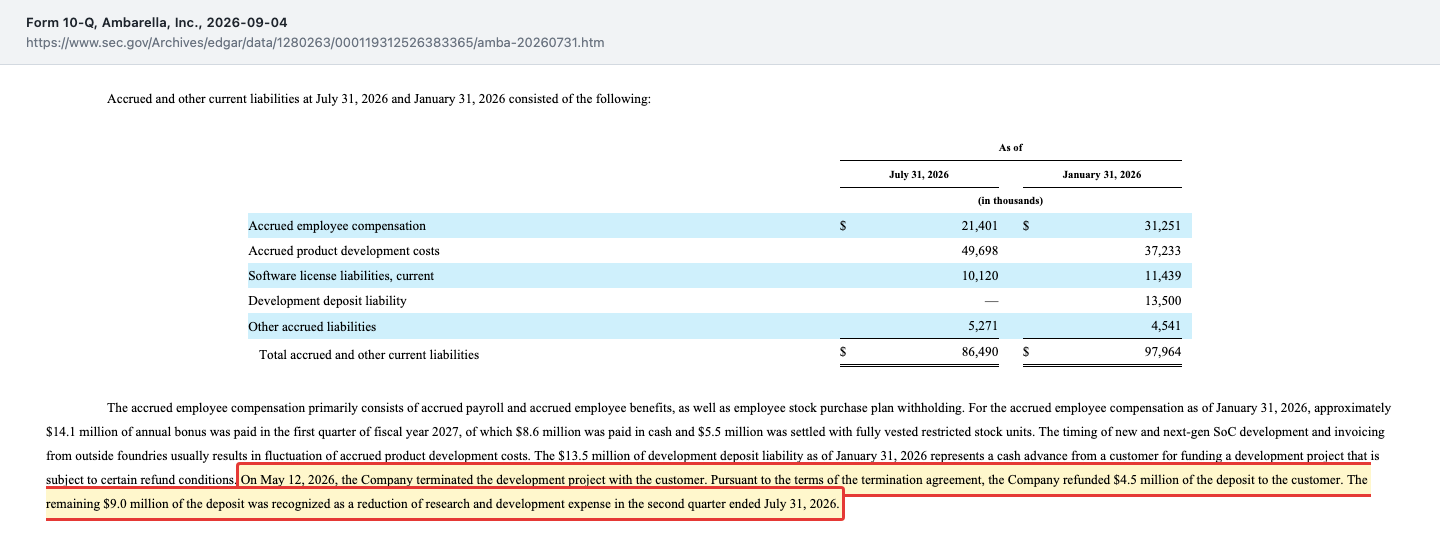
Without that one-time credit, the second-quarter operating loss would have been roughly $17 million — better than a year earlier, but no leap. Ambarella itself backs the amount out of its non-GAAP results, which is the clean way to handle it. The news behind the entry remains: a development project pre-funded by a customer was terminated. According to the report, Ambarella terminated it on May 12, 2026 and refunded $4.5 million to the customer under a termination agreement. Why it ended, which customer was involved and what the project was, the report does not say.
The second half of this truth is about cash. In fiscal 2026 operations had brought in $73.5 million. In the first half of fiscal 2027 the sign flipped: operations used $25.9 million, after generating $20.3 million in the same period a year earlier. The quarterly report names increased inventory purchases as the main reason. The balance sheets show the path: inventories rose from $52.2 million (January 31, 2026) to $80.4 million (April 30, 2026), the highest of the values cited here, then fell to $76.9 million (July 31, 2026) and $61.4 million (October 31, 2026). So inventory has been worked down since the spring but remains well above the year-ago level ($39.2 million on October 31, 2025). Measured against the cost of revenue of a quarter with roughly $72.5 million in sales, it covers about two quarters on paper. It may prove an advantage if demand returns. If demand stays weak for longer, write-downs loom, because chips age. Cash and marketable securities together fell from $312.6 million (January 31, 2026) to $282.8 million (October 31, 2026).
Valuation: what the market still pays after the guidance
We deliberately do not use a daily price as a verdict, but every valuation needs a dated anchor. On November 25, 2026 the stock closed at $35.68; two trading days earlier, on November 23, it was $55.56. With the 44.1 million shares from the latest quarterly report (as of August 31, 2026), that gives a market value of roughly $1.57 billion. Of that, $282.8 million sits inside the company as cash and securities, and there is no bank debt. So the market is paying roughly $1.29 billion for the business itself.
What do you get for it? A price-to-earnings ratio cannot be formed because there are no GAAP earnings. That leaves price-to-sales: in the twelve months ended October 31, 2026 Ambarella generated revenue of $424.6 million. Market value therefore equals just under four times revenue, or roughly three times excluding cash. At the November 23 closing price the same ratio was just under six. But be careful with the denominator: those twelve months contain three of the strongest quarters in the company’s history. If the guided level persists, the revenue the ratio refers to shrinks — and with it the impression that the stock has become “cheaper.”
On substance: shareholders’ equity was $634.3 million on October 31, 2026. Of that, $303.6 million is goodwill from past acquisitions and $51.9 million is other intangible assets. Subtract both and roughly $279 million remains — almost exactly the amount held in cash and securities. The professionals’ view: as of November 25, 2026 the fundamental data showed fourteen analyst ratings (six buys, eight holds, no sells) and a mean price target of $84.27. Averages like that lag the news; after guidance like this, price targets are typically revised. For now the figure is of little use as a guide.
For how we read another company from the world of “machines that see,” one that also sits between a technology promise and losses, see our Ouster analysis.
Opportunities and risks: cash and technology versus losses and dependence
What speaks for Ambarella:
- A balance sheet without bank debt: $282.8 million in cash and marketable securities as of October 31, 2026, shareholders’ equity of $634.3 million against total liabilities of $156.0 million.
- Technology customers pay for: GAAP gross margin of 57.8 percent in the third quarter of fiscal 2027; by the company’s own account, an installed base of more than 55 million AI chips.
- Two strong years: revenue from $226.5 million (fiscal 2024) to $390.7 million (fiscal 2026); the third quarter of fiscal 2027 brought the highest quarterly revenue to date.
- Operations generated cash in each of the ten fiscal years from 2017 to 2026, most recently $73.5 million — despite the reported losses.
- By the company’s account, the cause of the slump lies with customers’ memory chips; the release names no lost customer. If supply eases, demand can return.
- The largest distributor’s share is falling: about 60 percent in the second quarter of fiscal 2027 after about 70 percent in fiscal 2026.
What speaks against it:
- The guidance: revenue of $70 million to $75 million in the fourth quarter of fiscal 2027 after $115.2 million in the third — and no indication of how long the weakness lasts.
- Eight consecutive years of GAAP losses, roughly $589 million in total; another $37.5 million in the first nine months of fiscal 2027.
- Stock-based compensation of about a quarter of revenue ($98.0 million in fiscal 2026), with another $174.1 million already granted; the share count keeps growing.
- At the guidance midpoint, our calculation yields an operating loss of roughly $15 million for the quarter even on the non-GAAP basis.
- A narrow base: about 60 percent of revenue through one distributor, about 67 percent from ten end customers, about 88 percent from Asia, and manufacturing mostly at Samsung without long-term supply contracts.
- Export restrictions: according to the annual report, several Chinese customers are on the U.S. Commerce Department’s Entity List, an export control list; the report names none of them.
- Inventories still well above a year ago ($61.4 million as of October 31, 2026 versus $39.2 million a year earlier; $80.4 million in April 2026) against sharply lower revenue guidance; operations used $25.9 million of cash in the first half.
- Almost half of shareholders’ equity is goodwill ($303.6 million of $634.3 million); competitors, including NVIDIA and Qualcomm, are many times larger.
A human conclusion
Back to the headline trap from the beginning. It works in both directions, and that is what makes it treacherous. Anyone who read only “record revenue” on November 24, 2026 missed the most important sentence of the release. Anyone who saw only the plunge the day after is now missing the rest: a company with $282.8 million in the bank, no bank debt, chips on which it earns a gross margin of just under 58 percent, and a business that generated cash every year for ten years. Both are in the same documents, a few paragraphs apart.
What the documents do not answer is the question that matters now: is the slump a dent caused by a missing third-party component — or the moment that reveals how little control Ambarella has over its own revenue? The dent reading is supported by the fact that the company reports no lost customer and expects growth in fiscal 2028. The second reading is supported by the structure: few buyers, one foundry, inventory that remains well above the year-ago level despite the drawdown, and costs that do not come down with revenue. On top of that comes what was already true before November — eight years without a GAAP profit, because a quarter of revenue goes to employees as stock. So the honest question for you is not “Is the stock cheap after the slide?” but: do you trust yourself to judge the duration of a memory shortage that even the company does not quantify — and are you willing to keep paying your share of the stock compensation in the meantime? If your answer is yes, you will find real technology here and a balance sheet that buys time. If you hesitate, the filings have given you good reasons. Either way, read the second paragraph. What you make of it is your call. And that is how it should be.
Sources
All primary documents used in this analysis — to read for yourself:
- Ambarella, Inc. — Form 8-K of November 24, 2026, Exhibit 99.1: earnings release for the third quarter of fiscal 2027 (ended October 31, 2026) with fourth-quarter guidance
- Ambarella, Inc. — Form 10-Q for the quarter ended July 31, 2026 (filed September 4, 2026)
- Ambarella, Inc. — Form 10-Q for the quarter ended April 30, 2026 (filed June 2, 2026)
- Ambarella, Inc. — Form 10-K for fiscal 2026 ended January 31, 2026 (filed March 23, 2026)
- Ambarella, Inc. — Form 10-Q for the quarter ended October 31, 2025 (filed December 4, 2025)
- Complete SEC filing history of Ambarella, Inc.: EDGAR overview (sec.gov)
- Fundamental data (closing prices, analyst data; data as of November 25, 2026), reconciled with the SEC filings and the SEC’s XBRL series.
Note on timing: the Form 10-Q for the quarter ended October 31, 2026 had not been filed as of November 26, 2026. Third-quarter figures come from the earnings release and are preliminary according to the company.
Transparency & disclaimer: This analysis is a journalistic assessment of publicly available information. It is not investment advice, not a financial analysis in the regulatory sense and not a solicitation to buy or sell securities. Investing in stocks involves substantial risks, up to and including total loss. All information is provided without warranty; the date of the data is stated in the text. Positions held by the operator are disclosed daily; where one exists, it appears as a notice at the top of this deep dive.
Key figures at a glance
All monetary figures in millions of $; earnings per share as reported.
| Metric | 2022 | 2023 | 2024 | 2025 | 2026 |
|---|---|---|---|---|---|
| Revenue | 331.9 | 337.6 | 226.5 | 284.9 | 390.7 |
| Operating Income (EBIT) | -29.6 | -74.3 | -154.6 | -126.6 | -82.5 |
| Net Income | -26.4 | -65.4 | -169.4 | -117.1 | -75.9 |
| Net Margin | -8.0% | -19.4% | -74.8% | -41.1% | -19.4% |
| Earnings Per Share | -0.72 $ | -1.70 $ | -4.25 $ | -2.84 $ | -1.78 $ |
Source: fundamental data & SEC filings (annual and quarterly reports, 10-K/10-Q)
Our Bottom Line at a Glance
- Balance sheet & financial strength positive
- As of October 31, 2026 the balance sheet showed $282.8 million in cash and marketable securities and $634.3 million of shareholders’ equity, with no bank debt reported. The caveats: $303.6 million of that equity is goodwill, and operations used $25.9 million of cash in the first half of fiscal 2027.
- Revenue & guidance negative
- The highest quarterly revenue to date ($115.2 million for the quarter ended October 31, 2026) is followed by guidance of $70 million to $75 million for the quarter ending January 31, 2027 — 35 to 39 percent lower. The November 24, 2026 earnings release cites scarce and expensive memory chips at customers; it gives no duration.
- Profitability negative
- Ambarella has reported a net loss in every fiscal year since fiscal 2019, about $589 million in total; the nine months ended October 31, 2026 added $37.5 million. The non-GAAP profit ($12.7 million in the third quarter) results from excluding stock-based compensation of $24.2 million.
- Technology & margin positive
- GAAP gross margin was 57.8 percent in the quarter ended October 31, 2026; revenue rose from $226.5 million in fiscal 2024 to $390.7 million in fiscal 2026, driven according to the annual report by higher-priced AI processors. Operations generated $73.5 million of cash in fiscal 2026.
- Dependencies negative
- About 60.2 percent of revenue went through distributor WT Microelectronics in the quarter ended July 31, 2026, and the top ten end customers made up about 67 percent of fiscal 2026 revenue. The substantial majority of chips come from Samsung without long-term supply contracts, about 88 percent of revenue came from Asia, and several Chinese customers are subject to U.S. export restrictions.
- Dilution negative
- Stock-based compensation was $98.0 million in fiscal 2026, about 25 percent of revenue; another $174.1 million was unrecognized as of July 31, 2026. Shares outstanding rose from 41.7 million on November 30, 2024 to 44.1 million on August 31, 2026. The $50 million repurchase program was unused through July 31, 2026.
Ambarella designs low-power AI and image processors and lifted revenue from $226.5 million to $390.7 million in two years. The balance sheet is solid: $282.8 million in cash and securities as of October 31, 2026 and no bank debt. Against that stand eight consecutive years of GAAP losses, stock-based compensation of about a quarter of revenue and heavy reliance on a few buyers and one foundry. The November 24, 2026 guidance — quarterly revenue of $70 million to $75 million after $115.2 million — shows how much the business depends on its customers’ supply chain. Not investment advice.
What Our Rating Means
Open questions
The business works in principle, but one material question is open. As long as it stays open, our findings do not carry a quality verdict.
The evidence does not support a red rating: the balance sheet shows no bank debt, cash and securities of $282.8 million are many times the non-GAAP operating loss we calculate for the fourth quarter (about $15 million), and operations generated cash in each of the ten fiscal years from 2017 to 2026. For green, proof that the business carries itself is missing: eight years of GAAP losses, revenue guided to fall by more than a third within one quarter, and a narrow base of few buyers and one foundry. The open operating question is how long the memory shortage will weigh on demand — the company does not quantify it. The share-price decline itself plays no role in this rating. The decision is yours.
A journalistic assessment by our editorial team at the time of the deep dive, based on public sources — not investment advice and not a solicitation to buy or sell. Your personal circumstances (investment goals, risk capacity, taxes) cannot be taken into account. What our levels mean, how verdicts are formed, and what conflicts of interest exist →
Worth Noting
- Trigger: Reddit hype scanner, as of November 25, 2026, one day after the earnings release.
- Price path (closing prices): $55.56 on November 23, 2026, $44.47 on November 24, 2026, $35.68 on November 25, 2026. The earnings release reached the SEC after the market close on November 24, 2026; the decline on November 24 came before it, and its trigger does not emerge from the documents reviewed.
- The 10-Q as of October 31, 2026 had not been filed on November 26, 2026; third-quarter figures come from the earnings release (Form 8-K of November 24, 2026) and are preliminary according to the company. Customer concentration, unrecognized stock compensation and cash flow are as of July 31, 2026.
- The fiscal year ends January 31: “fiscal 2027” means February 2026 through January 2027.
- The non-GAAP operating result for the fourth quarter (about −$15 million at the guidance midpoint) is our own derivation from the company’s three guidance figures.
- Market value is our own calculation: 44,140,971 shares (10-Q cover page, as of August 31, 2026) × closing price of $35.68 on November 25, 2026.
Stock Watch
This analysis is as of November 26, 2026. Stock Watch will tell you what's changed at AMBA since then.
Later $1 a month per stock — signing up is free, and you'll be the first to know when it launches.
The full analysis as a PDF for later
We will send you this analysis as a PDF — to print, file away, and read at your own pace. And we will add you to the free Stock Watch list for Ambarella Inc (AMBA), so you hear about it when something material in this analysis changes.
Frequently Asked Questions
Ambarella, Inc. (NASDAQ: AMBA) designs low-power chips and software that let cameras and other devices process images, compress video and run artificial intelligence directly on the device. End uses include security cameras, action cameras, drones, vehicle cameras and robots. Ambarella owns no factory; the substantial majority of its chips are made by Samsung. It employed 959 people as of January 31, 2026.
On November 24, 2026 Ambarella reported revenue of $115.2 million for the quarter ended October 31, 2026 but guided to only $70 million to $75 million for the following quarter. The company cites sharply higher prices and scarce supply of memory chips, which is causing many customers to reduce their outlooks. On November 25, 2026, the first trading day afterward, the closing price fell from $44.47 to $35.68. It had already dropped from $55.56 to $44.47 on November 24 — before the release, which reached the SEC only after the market close; the documents we reviewed do not name the trigger for that move.
Not under GAAP. Ambarella has reported a net loss in every fiscal year since fiscal 2019: $75.9 million in fiscal 2026 (ended January 31, 2026) and $12.7 million in the quarter ended October 31, 2026. On its own non-GAAP basis, which mainly excludes stock-based compensation of $24.2 million for the quarter, the company shows net income of $12.7 million for that same quarter.
Heavily. In the quarter ended July 31, 2026 about 60.2 percent of revenue went through Taiwanese distributor WT Microelectronics and 11.0 percent through Japanese distributor Hakuto. The top ten end customers accounted for about 67 percent of fiscal 2026 revenue; the annual report names camera maker Insta360 as the largest. About 88 percent of revenue came from Asia.
The balance sheet as of October 31, 2026 shows no bank debt. Total liabilities of $156.0 million — mainly supplier payables and accrued development costs — compare with $282.8 million in cash and marketable securities and $634.3 million of shareholders’ equity. Of that equity, however, $303.6 million is goodwill from past acquisitions.
On January 31. Fiscal 2027 runs from February 1, 2026 to January 31, 2027; the third quarter ended on October 31, 2026 and the fourth covers November 2026 through January 2027. Anyone comparing Ambarella with companies on a calendar fiscal year has to shift the periods by about one month.
Found an error?
Did you spot a factual error, an outdated number, or a typo in this deep dive? Let us know briefly — your report goes straight to the editorial team.