Helus Pharma: One Date in the Fourth Quarter Decides Everything — and 20 Million Shares Became 73 Along the Way
Helus Pharma (Nasdaq: HELP) is the new name of Cybin Inc., a Toronto company that has pushed a deuterated psilocin analog for major depressive disorder into Phase 3 and won Breakthrough Therapy designation from the U.S. drug regulator, the FDA. Revenue: zero. Net loss for the fiscal year ended March 31, 2026: $148.0 million. Cash stood at $166.4 million on June 30, 2026, against a quarterly burn of $37.1 million. Everything hangs on topline data from the APPROACH trial in the fourth quarter of 2026 — and while the market waits, the share count has grown from 20.0 million in March 2024 to 73.1 million. No recommendation — just the question of how many slices the cake gets cut into before the answer arrives.
 Thomas Mücke
Founder & Publisher
Thomas Mücke
Founder & Publisher
As of Today
As of: September 17, 2026
- Closing price
- 14.00 $ +4.10%
- Market Capitalisation
- 0.9 $B
- Growth Score
- 2/10
- AAQS
- 0/10
Price change since August 25, 2026: +0.1%
This analysis has a cut-off date. The Stock Guard tells you when something material changes in the numbers. Reserve your free spot
Chart
Interactive price chart (TradingView).
52-week range: 3.90 $ to 14.00 $ · Last price: 14.00 $ (As of: September 17, 2026)
Note: pure fact-based analysis, not investment advice and not a solicitation to buy or sell. All figures without guarantee.
There is an investor weakness that disguises itself as discipline: the countdown trap. The moment a date is fixed — a trial readout, an approval decision, a court ruling — the arithmetic stops and the waiting starts. You suddenly know exactly when the answer arrives, and you care less and less about what happens in between. That is where the mistake lives. While you stare at the date, the thing you are betting on quietly changes shape.
At Helus Pharma the date sits in the fourth quarter of 2026: topline data from the Phase 3 APPROACH trial. So the deal for this piece is simple: no recommendation, no price target. We read the annual report for the year ended March 31, 2026, and the interim report for the quarter ended June 30, 2026, both filed with the U.S. securities regulator, the SEC — and we count along. The central tension that runs through every chapter: this company’s value depends on one data point, but the number of slices that value gets divided into is growing faster than the trial is moving.
What Helus Pharma Actually Does — and Why It Has Two Names
Helus Pharma is a clinical-stage pharmaceutical company in Toronto. The company was incorporated on October 13, 2016, as an exploration shell company named “Clarmin Explorations Inc.” under the Business Corporations Act of the Canadian province of British Columbia, and was continued under the Business Corporations Act (Ontario) on November 4, 2020, following the reverse takeover that created today's pharmaceutical business — it has been an Ontario company ever since. It develops what it calls novel serotonergic agonists — in plain terms, synthetic molecules that bind to the same switches in the brain as the messenger serotonin and are believed to prompt new connections there. The starting points are relatives of classic psychedelic substances. The lead candidate HLP003 (formerly CYB003) is a deuterated psilocin analog: psilocin is the compound the body converts the mushroom alkaloid psilocybin into after ingestion, and it is psilocin that produces the actual effect; “deuterated” means individual hydrogen atoms have been swapped for their heavier isotope — a chemical trick that slows breakdown in the body and is meant to make the effect more predictable. HLP003 is being developed as an adjunctive treatment for major depressive disorder, meaning it is added on top of an existing antidepressant. The second candidate, HLP004, a deuterated DMT, is in Phase 2 for generalized anxiety disorder; HLP005 is still preclinical.
So why two names? The company was called Cybin Inc. until the end of 2025 and traded on NYSE American as CYBN. On January 2, 2026, it filed a Form 25 (voluntary withdrawal from NYSE American) and a Form 8-A12B (registration on Nasdaq) on the same day; trading on the Nasdaq Global Market began on January 5, 2026, under the new symbol HELP. That same day the group adopted the business name Helus Pharma. One thing matters for anyone searching for filings: the legal entity is still Cybin Inc. — that is the name on file with the SEC, the head office is in Toronto, and the shares also trade on Cboe Canada (HELP) and in Frankfurt (R7E1). A change of the legal name to Helus Pharma Inc. sits as its own resolution on the agenda of the virtual shareholder meeting on September 22, 2026; the record date for voting was August 14, 2026, when the notice states 73,060,172 common shares were outstanding. Any news item about “Cybin” is a news item about HELP.
One more thing to understand before comparing numbers: Helus Pharma is a foreign private issuer reporting under the Canada-U.S. multijurisdictional disclosure system. That means no 10-K and no 10-Q — instead an annual report on Form 40-F and interim reports on Form 6-K, prepared under IFRS. The fiscal year ends on March 31: fiscal 2026 substantially covers calendar 2025. And since April 1, 2025, the company has reported in U.S. dollars rather than Canadian dollars, with prior-period figures restated under IAS 21.39. Every figure in this piece is in U.S. dollars and comes from that restated basis; older releases quoting Canadian dollars are not directly comparable.
Company history for investors
-
2024
Breakthrough Therapy and a 1-for-38 consolidation
On March 13, 2024, the FDA grants expedited status to HLP003. On September 19 the shares are consolidated 1-for-38 — the price becomes exchange-friendly, the shareholder's stake stays the same.
-
2025
A convertible with a VWAP clause
On June 30, 2025, the company takes $50 million from High Trail — convertible at the lower of $10.92 or the five-day average price. For shareholders that means: the lower the price, the more new shares.
-
2025
A $175 million registered direct offering
On October 31, 2025, 22,277,750 shares and 4,605,500 pre-funded warrants are placed at $6.51. The share count more than doubles in the fiscal year — the treasury is full, each existing holder's stake is halved.
-
2026
New name, new exchange
From January 5, 2026, the stock trades as HELP on Nasdaq instead of CYBN on NYSE American, and the company operates as Helus Pharma. For shareholders the ticker and the visibility change, not the substance.
-
2026
Enrollment complete, a third leadership team
On July 21, 2026, APPROACH is fully enrolled with 223 participants; on August 3, Michael Halstead becomes the third chief executive in six months. For shareholders the decisive date comes into view — with a team assembled only weeks earlier.
How the Stock Reached Our Desk
Helus Pharma did not arrive through one of our metrics screens — it cannot, because a company with no revenue and no earnings falls through every valuation filter. What caught our eye was the price. Between August 3 and August 25, 2026, the stock closed up from $8.06 to $13.99. The twelve-month low was $3.76 (data as of August 25, 2026). The trigger is not hard to find: on July 21, 2026, the company reported that enrollment in APPROACH was complete with 223 participants; on August 14 the quarterly report confirmed that topline data remained on track for the fourth quarter of 2026. A trial that is fully enrolled has a date. And a date attracts money.
It is also worth noting who is already inside. As of June 30, 2026, holdings data showed Adage Capital Partners with 3,060,000 shares and Millennium Management with 2,632,156 shares; as of March 31, 2026, VR Adviser held 3,851,654 and OrbiMed Advisors 3,832,843 shares. Institutions held roughly 43.8 percent in total and insiders roughly 11.2 percent (data as of August 25, 2026). These are specialist biotech addresses, not accidental buyers. Their presence is a reason to read the filings, not a substitute for it. If you want to sort this field, our analysis of Compass Pathways covers a competitor with the related compound psilocybin in the same indication, and our analysis of Atai covers the platform version of the same theme.
The Numbers Over the Years — Given Their Due
First, what genuinely impresses — and at Helus Pharma it is not revenue, because there is none. It is the HLP003 data. In the completed Phase 2 trial, scores on the MADRS depression scale fell by roughly 23 points from baseline at 12 months following two 16 milligram doses given three weeks apart. Using a remission benchmark of 10 or fewer MADRS points, response and remission rates at 12 months were 100 percent and 71 percent respectively (earnings release of August 14, 2026) — the company does not disclose the exact number of participants in this 12-month readout, and it is a small, unblinded cohort with no placebo arm. The randomized, placebo-controlled confirmation is the job of the ongoing Phase 3 APPROACH trial with 223 participants. Those are nonetheless numbers for which the FDA granted Breakthrough Therapy designation on March 13, 2024 — an expedited pathway with closer regulatory guidance. Add more than 350 patent applications filed and more than 100 patents granted worldwide. Anyone reading this company purely as a loss machine is reading it wrong.
Now the arithmetic. In the fiscal year ended March 31, 2026, research expense rose from $39.2 million to $86.6 million and general and administrative costs from $32.6 million to $45.1 million; share-based compensation fell from $31.3 million to $10.9 million. Total expenses came to $142.6 million against $103.1 million a year earlier. The bottom line was a net loss of $148.0 million versus $81.6 million — an increase of 81 percent. Cash used in operating activities was $133.3 million (prior year: $72.3 million). The accumulated deficit reached $389.5 million at March 31, 2026, and $437.4 million at June 30, 2026.
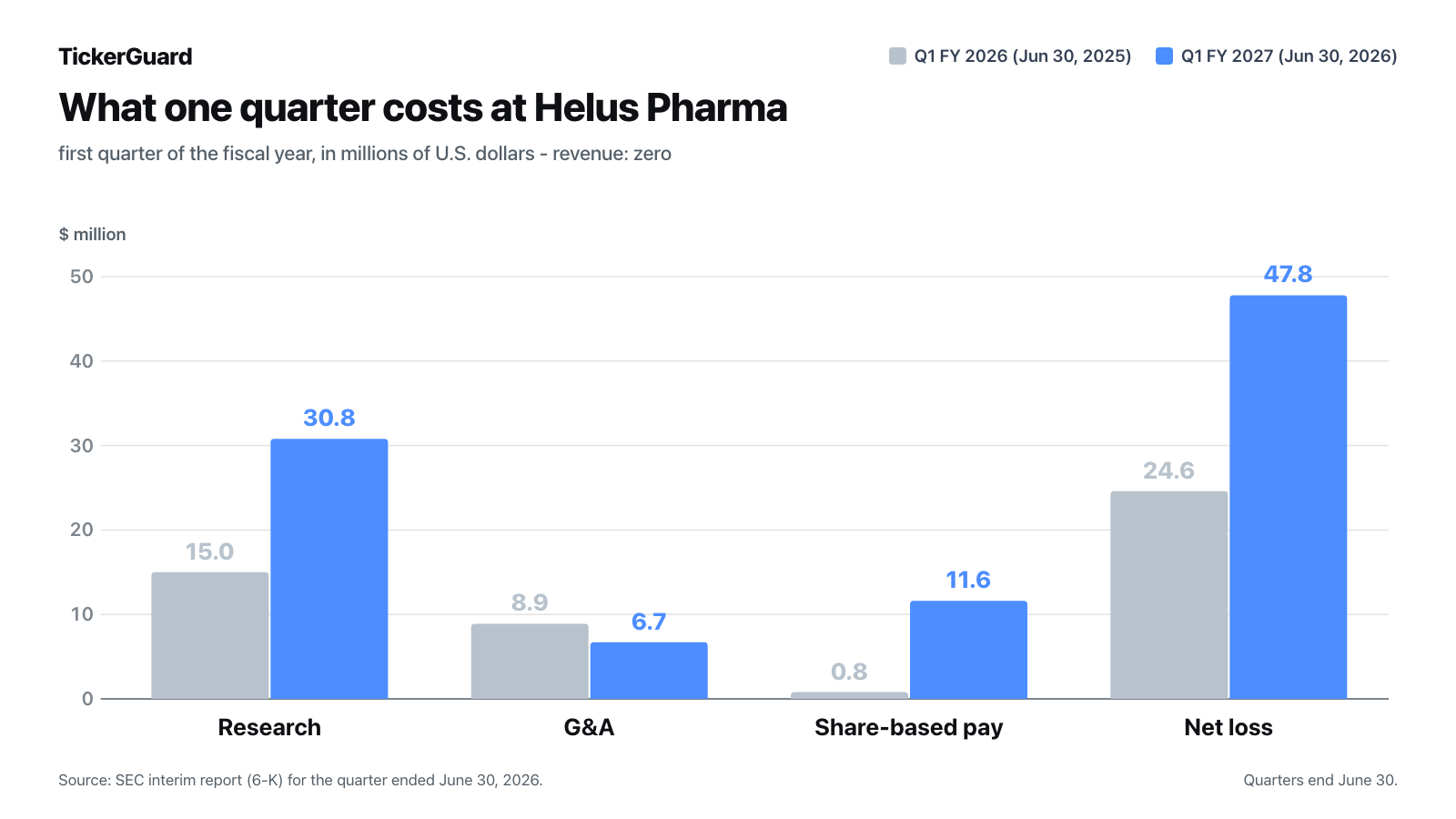
The latest quarter shows where this is heading. In the quarter ended June 30, 2026, research expense doubled from $15.0 million to $30.8 million, of which $25.3 million sat in the single line “advancement of development programs” — the cost of running the trials themselves. General and administrative costs fell from $8.9 million to $6.7 million. Share-based compensation jumped from $0.8 million to $11.6 million. The net loss nearly doubled, from $24.6 million to $47.8 million. Cash used in operating activities was $37.1 million against $29.5 million in the prior-year quarter.
The good news sits on the other side of the balance sheet. At June 30, 2026, Helus Pharma held $166.4 million in cash, total assets of $259.7 million, liabilities of only $17.6 million — entirely payables and accruals — and shareholders equity of $242.1 million. Interest-bearing debt: none. Working capital was $175.1 million. Look only at the balance sheet and you see a soundly financed research operation. The price of that financing is the next chapter.
What the Filings Say — the Uncomfortable Truths
Uncomfortable truth number one: 20 million shares became 73 — and the 1-for-38 consolidation is already baked in.
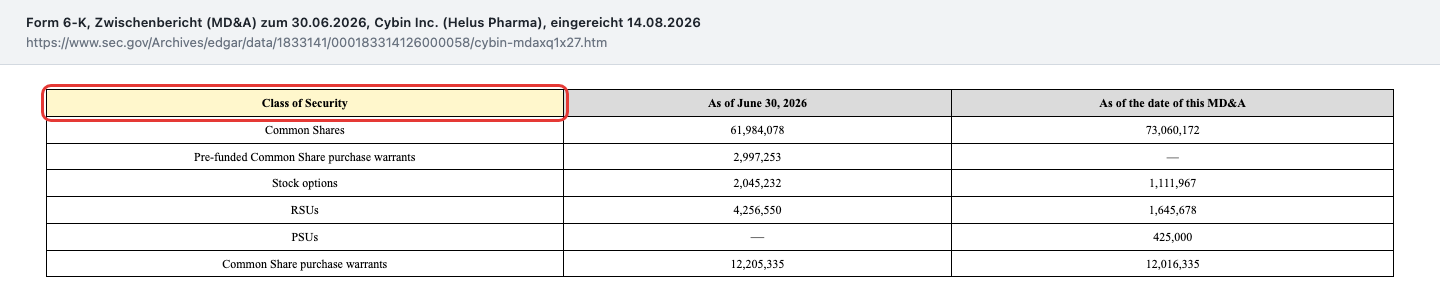
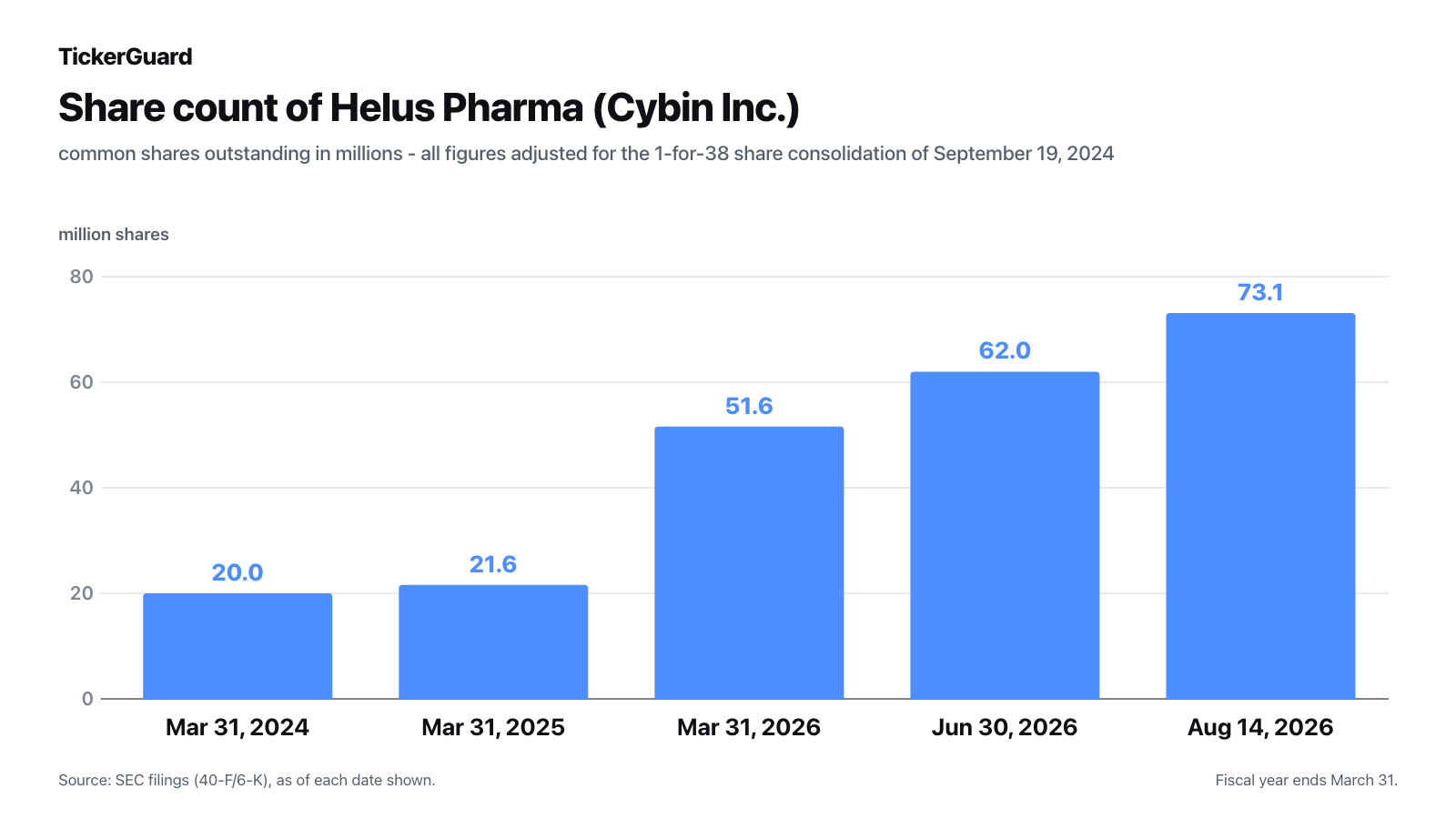
On September 19, 2024, the company consolidated its shares on the basis of one new share for every 38 old ones. Nobody does that for fun; it is the standard way to lift a single-digit price back into a range a U.S. listing tolerates. All share figures in the financial statements were restated retrospectively for it — including every figure in this piece. And the series still reads like this: 20,001,404 shares at March 31, 2024; 21,610,704 at March 31, 2025; 51,631,804 at March 31, 2026; 61,984,078 at June 30, 2026; and 73,060,172 as of the interim report dated August 14, 2026. That is an increase of 265 percent in barely two years. In cake terms: whoever held one slice in March 2024 holds less than a third of it today for the same money.
What matters is not only how many shares were added but at what price. Under the fiscal 2025 at-the-market program the company sold 1,609,298 shares at an average of $9.52. In fiscal 2026 it sold 1,422,423 shares at an average of $7.36. On October 31, 2025, a registered direct offering placed 22,277,750 shares and 4,605,500 pre-funded warrants at $6.51 — gross proceeds of roughly $175.0 million, issuance costs of $11.0 million. On June 25, 2026, another 10,309,280 shares went out at $4.85, gross proceeds $50.0 million, of which $3.0 million went to the underwriters as commission. Every round was cheaper than the one before. And the tap is not closed: a further at-the-market program of up to $100 million has been in place since December 30, 2025, and remained untouched as of June 30, 2026 as well.
Uncomfortable truth number two: a $50 million loan ended up costing about $11 million in fees — plus 4.58 million shares.
On June 30, 2025, the company entered a securities purchase agreement with the investor High Trail Special Situations for up to $500 million of convertible debentures; $50 million was issued at the outset. At closing, Helus Pharma pre-paid $5.5 million of guaranteed interest — 11 percent of principal for the two-year term, equivalent to 5.5 percent a year. The catch sits in the conversion price. It was the lower of two values: $10.92 or the volume-weighted average price over the five trading days before conversion. A clause like that has no floor: the lower the price, the more shares the lender receives for the same amount. The annual financial statements show what came of it.
“During the year ended March 31, 2026, High Trail converted portions of the Convertible Debentures with aggregate principal amounts $29,850 less issuance costs of $35 for which the Company issued 4,584,856 Common Shares at an average conversion price of $6.5106 which represented the VWAP of the Common Shares for the five trading days immediately prior to each conversion.”
— Cybin Inc. (Helus Pharma), audited financial statements for the year ended March 31, 2026 (Form 40-F), note 7 (amounts in thousands)

Add up the hard fees on that money: $5.5 million of pre-paid interest, $2.917 million of debt issuance costs and $2.615 million of early repayment fees for retiring the balance on November 3, 2025. Together roughly $11.0 million — plus 4.58 million new shares — for a $50 million loan that was gone again after barely four months. The income statement carries a further $5.5 million fair value loss on top; that is a pure valuation item, which we deliberately do not add to the fees here so that nothing is counted twice. As of March 31, 2026, none of the debentures remained on the books. That is the good news: the company got out of the structure as soon as it could afford to. The bad news: it entered it at all.
Uncomfortable truth number three: three chief executives in six months — and 7.9 million shares in a single day.
The interim report describes the leadership situation in one remarkably flat paragraph.
“On February 10, 2026, the Company announced the appointment of Michael Cola as Chief Executive Officer, effective immediately. Michael Cola served as Chief Executive Officer from February 10, 2026 to April 20, 2026. The Board appointed Co-founder and Executive Chairman Eric So to resume his role as Interim Chief Executive Officer for a short period of time while a search was conducted for a successor …”
— Cybin Inc. (Helus Pharma), interim MD&A as of June 30, 2026, section “Transactions Between Related Parties”
Sixty-nine days. On August 3, 2026, Michael Halstead was appointed chief executive; he was previously president of Intra-Cellular Therapies, the company that took the depression and schizophrenia drug CAPLYTA through approval and into the market and was acquired by Johnson & Johnson in April 2025. On August 18, 2026, Regina Donohue joined as chief people officer (previously chief human resources officer at Intra-Cellular) and Suresh Durgam joined the scientific advisory board. You can read that positively: Helus Pharma is buying in the team that has already walked this exact road. You can also read it the other way: a company that appoints its third chief executive in six months three months before the most important data point in its history did not have a stable leadership structure until then.
This reshuffle has a price, and it is paid in shares. On May 27, 2026, the company cancelled 1,919,290 options with exercise prices between C$13.11 and C$21.28, and on July 1 a further 1,023,721 with prices from C$8.39 to C$21.28. Options struck far above the market are worthless — they vanished. On the same day, restricted share units were granted — share awards with no exercise price that are worth something regardless of where the stock trades. On July 1, 2026, 4,103,974 such units were granted, of which 4,033,304 vested immediately. And on the same day, this happened.

One more figure fits here, from the related-party note: remuneration of key management personnel for the quarter ended June 30, 2026, was $12.479 million against $1.229 million in the prior-year quarter — ten times as much, at zero revenue and $37.1 million of cash burn. Part of that is accounting share-based expense rather than cash going out the door. But it is capital, and it comes from shareholders.
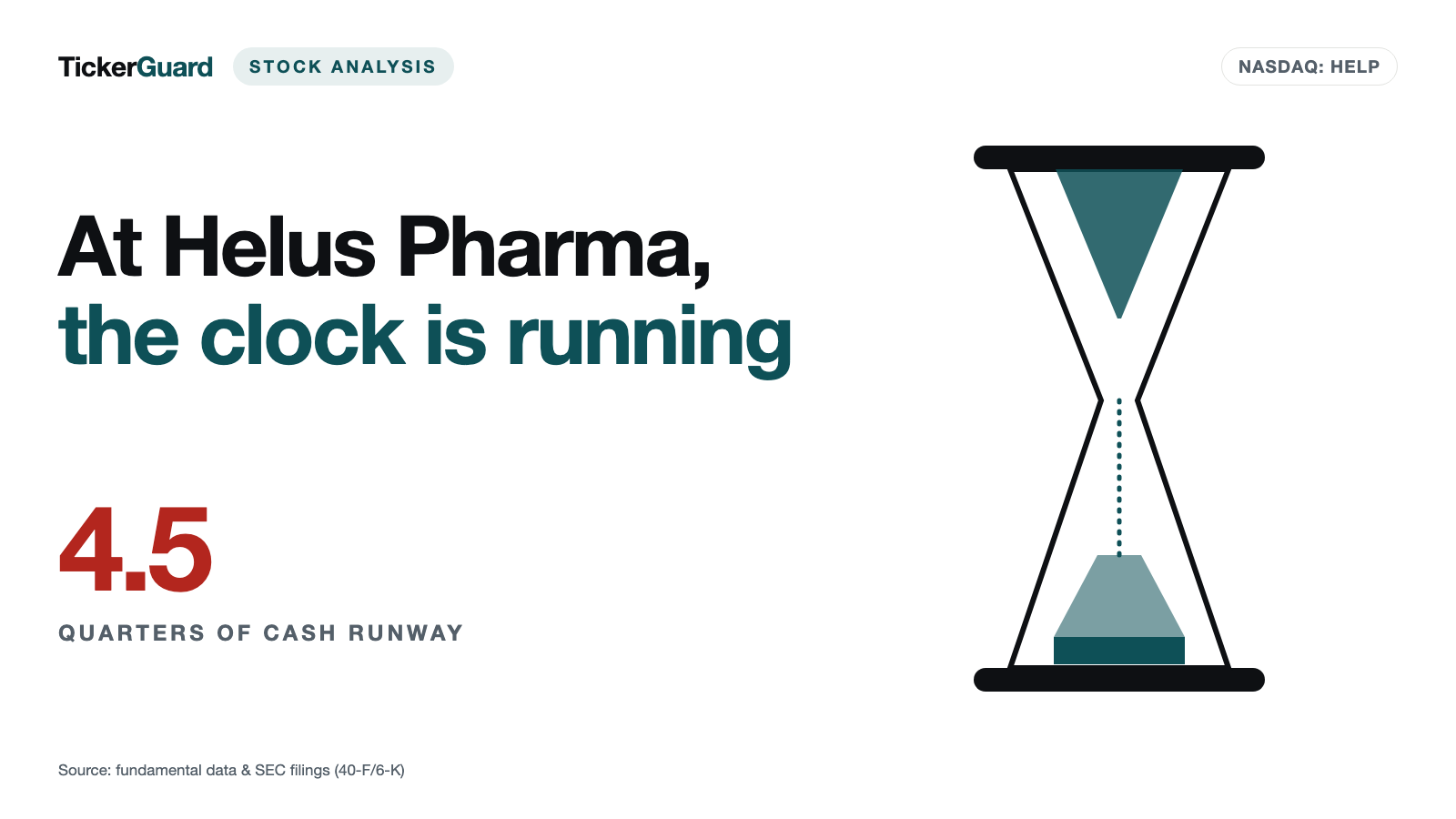
Uncomfortable truth number four: the cash lasts about 4.5 quarters — and the company itself says further financings may be required.
$166.4 million of cash at June 30, 2026, divided by $37.1 million of cash used in the most recently reported quarter, gives roughly 4.5 quarters — broadly to the middle or end of 2027. The calculation is deliberately rough: the burn moves around, and it rose 26 percent against the prior-year quarter. On top of that sit study agreements of up to $82.7 million payable in the 24 months to June 30, 2028, plus a license agreement with Mindset Pharma carrying up to $9.5 million of milestone payments and a sales royalty of roughly 2 percent on licensed products. The company states the position in its own MD&A clearly enough that nothing needs adding.
“The Company intends to continue to advance its non-revenue generating programs over the next twelve to twenty-four months. These intended advancements, along with the expectation of operating at a loss for at minimum the next 12 months, will diminish the Company’s working capital. As such, further financings may be required to develop the Company’s pipeline, make acquisitions, meet ongoing obligations, and discharge its liabilities in the normal course of business.”
— Cybin Inc. (Helus Pharma), interim MD&A as of June 30, 2026, section “Liquidity and Capital Resources”
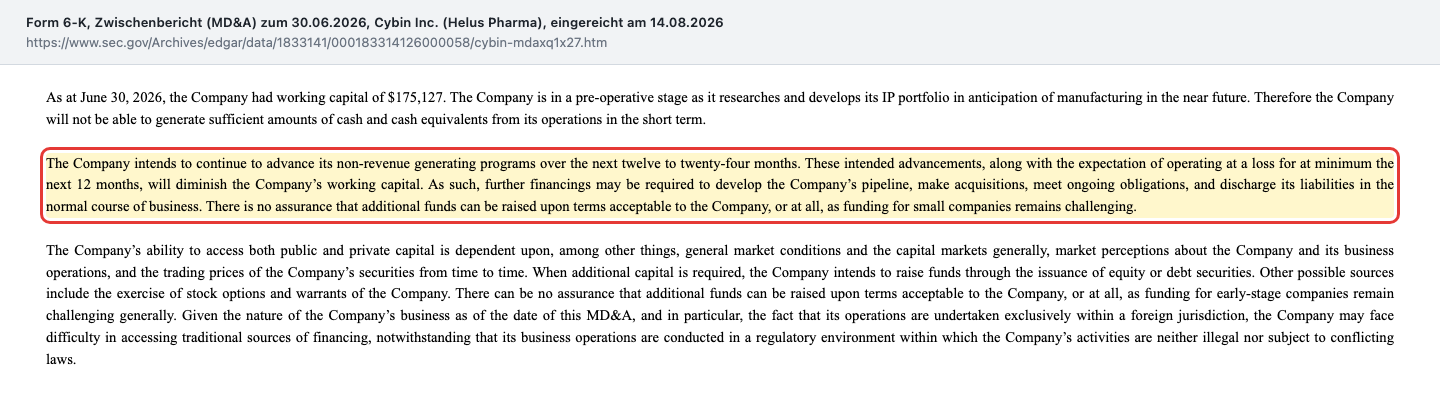
An important qualification so nothing false is left standing: this is not a going-concern warning in the accounting sense. The statements for the year ended March 31, 2026, are prepared on a going-concern basis, the auditors report carries no related emphasis, and with $242.1 million of equity against $17.6 million of liabilities the balance sheet is robust for a company of this kind. It is the normal position of a clinical-stage developer — only with a clock running.
And one more thing to hold in mind: HLP003 is a Schedule I controlled substance in the United States and a Class A, Schedule 1 drug in the United Kingdom. Manufacturing, import and storage each require their own licences, in the U.S. annual registrations with the Drug Enforcement Administration and production quotas. Even a successful trial ends not only with FDA approval but with a rescheduling of the substance as an additional step. That is not fatal — it is simply a step an ordinary antidepressant does not have.
Valuation: What the Market Pays for One Data Point
Conventional valuation metrics do not work here. No revenue means no price-to-sales ratio; a loss means no price-to-earnings ratio. What remains are orders of magnitude. At 73,060,172 shares (as of August 14, 2026) and a closing price of $13.99 on August 25, 2026, the market capitalization was roughly $1.0 billion. Against that sit $242.1 million of equity and $166.4 million of cash (June 30, 2026). In other words: roughly three quarters of the market value is pure expectation about HLP003 and HLP004 — assets that do not yet exist. Put differently, the market pays about four dollars for every dollar of carried equity.
We have no analyst consensus for this name, so we use the prices professionals have actually paid instead. On June 25, 2026, institutional investors bought 10,309,280 shares at $4.85 — the most recent price at which a large account put capital at risk. The August 25, 2026 close is almost three times that. And one more anchor from the filings: 12,205,335 warrants from all issuances combined were outstanding at June 30, 2026, at a weighted average exercise price of $10.11. Of those, 9,409,138 are struck at $8.14 and stem from the October 31, 2025 registered direct offering — they expire 30 days after the APPROACH topline data are published. The remainder, 2,796,197 warrants, breaks down into several older tranches: 635,887 struck at $15.20 (expiring August 4, 2028), 1,754,386 struck at $19.38 (expiring May 14, 2029), and 405,924 Canadian-dollar-denominated legacy warrants from 2020 (exercise prices between C$9.50 and C$24.32, extended to 2030 in August 2024). That structure cuts both ways: if the data are good, the warrants get exercised, bringing the company roughly $76.6 million of fresh cash and shareholders 9.4 million more shares. If the data are bad, they expire worthless and the company is without that money. As of the interim report, 189,000 had already been exercised (August 10, 2026, gross proceeds $1.538 million).
Add together everything that can become shares as of the August 14, 2026 report — 73,060,172 shares outstanding, 12,016,335 warrants, 1,111,967 options, 1,645,678 restricted share units plus 509,798 committed, and 425,000 performance share units — and you land at roughly 88.8 million. That is the number to weigh a potential drug against, not today’s 73 million.
Upside and Risks at a Glance
Upside
- A binary event with real data behind it. The HLP003 Phase 2 results — roughly 23 points of MADRS improvement at 12 months, 71 percent remission, cohort size undisclosed, unblinded, no placebo arm — are exceptional for this field, and the FDA signalled it takes them seriously with Breakthrough Therapy designation on March 13, 2024. The statistically powered, placebo-controlled answer comes only with Phase 3 APPROACH.
- Enrollment is done. APPROACH is fully enrolled with 223 participants (announced July 21, 2026), removing the most common cause of delay at this stage.
- A debt-free balance sheet. $242.1 million of shareholders equity against $17.6 million of liabilities, no interest-bearing debt, plus an untouched at-the-market program of up to $100 million (as of June 30, 2026 and March 31, 2026 respectively).
- A team with precisely this résumé. Chief executive Michael Halstead, chief people officer Regina Donohue and advisory board member Suresh Durgam all come from Intra-Cellular Therapies, which made the journey from clinical developer to commercial company in the same indication with CAPLYTA.
- A second leg to stand on. HLP004 for generalized anxiety disorder showed roughly 10 points of improvement on the Hamilton Anxiety Rating Scale at six weeks in Phase 2 (36 participants, randomized, double-blind; p less than 0.0001); at six months, the pooled population showed 67 percent responders and 39 percent remitters.
Risks
- Dilution as a permanent state. Up 265 percent in shares in barely two years, every round cheaper than the last, plus roughly 15.7 million shares embedded in warrants, options and share awards (as of August 14, 2026).
- One date, two outcomes. If APPROACH fails, the roughly 9.2 million warrants from the October 2025 offering still outstanding as of the interim report expire worthless, access to fresh capital narrows, and a market value of roughly a billion dollars stands without support.
- Roughly 4.5 quarters of cash runway against a rising burn (up 26 percent year over year) and study agreements of up to $82.7 million over 24 months.
- Leadership instability with a price tag. Three chief executives in six months, 2.94 million options cancelled, 7.89 million shares vested in one day, and $12.479 million of key management remuneration in a single quarter.
- Controlled substance law. HLP003 is Schedule I in the U.S. and Class A, Schedule 1 in the U.K. — approval requires an additional rescheduling step, and manufacturing requires its own licences and quotas.
- No revenue, no valuation anchor. Without sales there is no metric on which to call the price too high or too low — only expectations.
A Human Conclusion
Back to the countdown trap. What makes it dangerous is not that the date is unimportant — at Helus Pharma it is the single most important thing there is. What makes it dangerous is that a fixed date narrows the view. You think in “before” and “after” and miss that the “before” keeps changing. Between March 31, 2024, and August 14, 2026, the share count more than tripled. Anyone who was waiting for this same readout back in spring 2024 is now waiting with less than a third of the stake.
Nothing here says whether HLP003 works. Nobody knows, and claiming otherwise would be dishonest. What it does say is what you buy alongside the trial: a company with no revenue, a quarterly burn of $37.1 million, cash for roughly 4.5 quarters, a leadership team assembled only weeks ago, and a capital markets door that has been used every time it stood open. Plus three quarters of a roughly billion-dollar market value that is pure expectation.
Anyone stepping in here should do so not because a date is on the calendar, but because they have weighed the size of a possible drug against roughly 88.8 million possible shares and can live with either outcome. And anyone staying out is not missing a sure thing — they are missing a bet. What you make of it is your decision. And that is exactly as it should be.
Sources
- Interim report on Form 6-K for the quarter ended June 30, 2026, filed August 14, 2026 (Cybin Inc. doing business as Helus Pharma, CIK 0001833141) — with interim financial statements, MD&A and earnings release
- Annual report on Form 40-F for the fiscal year ended March 31, 2026, filed June 29, 2026 — with audited financial statements, MD&A and Annual Information Form
- Form 25 dated January 2, 2026 (voluntary withdrawal of the common shares from NYSE American) and Form 8-A12B dated January 2, 2026 (registration of the common shares on Nasdaq)
- News release of August 18, 2026 on the appointment of Regina Donohue as chief people officer and Suresh Durgam to the scientific advisory board
- Notice and management information circular for the shareholder meeting of September 22, 2026, filed August 19, 2026 (record date August 14, 2026, 73,060,172 common shares outstanding; agenda item 4: change of name to Helus Pharma Inc.)
- Fundamental data (prices, market capitalization, ownership; data as of August 25, 2026)
This analysis is journalistic commentary. It is not investment advice and not a solicitation to buy or sell securities. Shares of clinical-stage pharmaceutical companies with no revenue can lose their entire value; a total loss is explicitly possible if a trial fails. All figures come from the original documents linked above and carry the reporting date stated there. The author holds no position in Helus Pharma (Cybin Inc.) at the time of publication.
Key figures at a glance
All monetary figures in millions of $; earnings per share as reported.
| Metric | 2022 | 2023 | 2024 | 2025 | 2026 |
|---|---|---|---|---|---|
| Revenue | 0.2 | 0.3 | -18.1 | 0.5 | -44.7 |
| Operating Income (EBIT) | -63.8 | -51.5 | -78.8 | -143.1 | -141.7 |
| Net Income | -67.6 | -47.5 | -78.1 | -113.1 | -147.1 |
| Net Margin | -40,314.1% | -18,919.2% | 430.2% | -23,956.0% | 329.1% |
| Earnings Per Share | -15.36 $ | -9.73 $ | -3.90 $ | -5.59 $ | -4.23 $ |
Source: fundamental data & SEC filings (annual and quarterly reports, 10-K/10-Q)
Our Bottom Line at a Glance
- Scientific evidence positive
- The Phase 2 results for HLP003 are unusually strong for this field: roughly 23 points of improvement on the MADRS depression scale at 12 months after two 16 milligram doses, with 100 percent response and 71 percent remission at a benchmark of 10 or fewer points (earnings release of August 14, 2026) — a small, unblinded cohort with no disclosed participant count and no placebo arm. The FDA nonetheless granted Breakthrough Therapy designation on March 13, 2024. The statistically powered, placebo-controlled confirmation comes only with the pivotal APPROACH trial, which is fully enrolled with 223 participants (announced July 21, 2026).
- Dilution negative
- The share count rose from 20,001,404 (March 31, 2024) to 73,060,172 as of the interim report dated August 14, 2026 — up 265 percent, and that is after a 1-for-38 consolidation on September 19, 2024. Issue prices fell from an average of $9.52 to $7.36, $6.51 and $4.85 (June 25, 2026). Fully diluted, roughly 88.8 million shares are in play.
- Balance sheet and liquidity neutral
- At June 30, 2026, $166.4 million of cash and $242.1 million of shareholders equity stood against just $17.6 million of liabilities, with no interest-bearing debt — a robust position for a clinical-stage company. But $37.1 million of quarterly cash burn leaves only about 4.5 quarters of runway, and the company itself names further financings as possibly required in its MD&A.
- Leadership and pay negative
- Three chief executives in six months: Michael Cola from February 10 to April 20, 2026, then co-founder Eric So on an interim basis, and Michael Halstead since August 3, 2026. On May 27 and July 1, 2026, a combined 2,943,011 options were cancelled; on July 1, 2026, 7,889,846 shares were issued on the vesting of share awards. Key management remuneration for the quarter ended June 30, 2026, was $12.479 million against $1.229 million a year earlier.
- Financing history negative
- The High Trail convertible debenture of June 30, 2025, carried a conversion price with no floor: the lower of $10.92 or the five-day volume-weighted average price. $29.85 million was converted into 4,584,856 shares at an average of $6.5106; the remainder was repaid in cash on November 3, 2025. Hard fees totalled roughly $11.0 million from pre-paid interest ($5.5M), issuance costs ($2.917M) and early repayment fees ($2.615M); a further $5.5 million fair value loss ran through the income statement as a pure valuation item.
- Valuation neutral
- Roughly $1.0 billion of market capitalization (73,060,172 shares × $13.99 close on August 25, 2026) against $242.1 million of equity and $166.4 million of cash: about three quarters of the value is expectation. The most recent price at which institutional investors actually bought was $4.85 on June 25, 2026. With no revenue and no earnings there is no reliable valuation anchor.
Helus Pharma is the countdown trap in its purest form: one date in the fourth quarter of 2026 — topline data from the Phase 3 APPROACH trial — decides a market value of roughly $1 billion, while the company earns no revenue at all, lost $148.0 million in the year ended March 31, 2026, and a further $47.8 million in the quarter ended June 30, 2026. The scientific evidence is unusually strong, the balance sheet is debt-free, and the new leadership team comes from Intra-Cellular Therapies, the company that commercialized CAPLYTA. The price sits in the share count: from 20.0 million (March 31, 2024) to 73.1 million (August 14, 2026), every capital round cheaper than the last, and roughly 88.8 million shares fully diluted. Anyone buying here is buying a bet with two possible outcomes and a cash position that lasts about 4.5 quarters. Not investment advice.
What Our Rating Means
Open questions
The business works in principle, but one material question is open. As long as it stays open, our findings do not carry a quality verdict.
Yellow, because exactly one material operating question is open and everything hangs on it: does HLP003 perform in the pivotal APPROACH trial the way the Phase 2 data suggest? Red lacks evidence — the statements for the year ended March 31, 2026, are prepared on a going-concern basis with no related audit emphasis, there is no interest-bearing debt, equity is firmly positive at $242.1 million, and cash lasts roughly 4.5 quarters at the most recently reported burn. Green lacks a business: no revenue, no approved product, no evidence of earning power. That the stock looks expensive and has run hard plays no part in this rating — that is a price argument, not a quality argument. What does count: the dilution is a pattern rather than a slip, and the leadership team has only been complete since August 2026. The decision is yours.
A journalistic assessment by our editorial team at the time of the deep dive, based on public sources — not investment advice and not a solicitation to buy or sell. Your personal circumstances (investment goals, risk capacity, taxes) cannot be taken into account. What our levels mean, how verdicts are formed, and what conflicts of interest exist →
Worth Noting
- Helus Pharma reached our research list through its price action: between August 3 and August 25, 2026, the stock closed up from $8.06 to $13.99 after the July 21, 2026 announcement that enrollment in the Phase 3 APPROACH trial was complete. A metrics screen cannot find this name — with no revenue and no earnings, no valuation filter applies.
- Easy to confuse: the entity is still filed with the SEC as Cybin Inc. (CIK 0001833141) and traded as CYBN on NYSE American until January 2, 2026. The Form 25 filed there is not a forced delisting but the voluntary withdrawal that accompanied the move to Nasdaq; trading under HELP began on January 5, 2026. The shares also trade on Cboe Canada (HELP) and in Frankfurt (R7E1).
- Data basis and currency: balance sheet and income figures come from the annual report for the year ended March 31, 2026 (Form 40-F, filed June 29, 2026) and the interim report as of June 30, 2026 (Form 6-K, filed August 14, 2026). The presentation currency has been the U.S. dollar since April 1, 2025; earlier Canadian dollar figures were restated under IAS 21.39 and are not directly comparable with older releases. Prices and ownership data are as of August 25, 2026.
Stock Watch
This analysis is as of September 5, 2026. Stock Watch will tell you what's changed at HELP since then.
Later $1 a month per stock — signing up is free, and you'll be the first to know when it launches.
The full analysis as a PDF for later
We will send you this analysis as a PDF — to print, file away, and read at your own pace. And we will add you to the free Stock Watch list for Cybin Inc. (HELP), so you hear about it when something material in this analysis changes.
Frequently Asked Questions
Yes. Cybin Inc. adopted the business name Helus Pharma on January 5, 2026, and moved that same day from NYSE American to the Nasdaq Global Market, changing its symbol from CYBN to HELP. The legal entity is still Cybin Inc., and all SEC filings appear under that name. A change of the legal name to Helus Pharma Inc. is to be put to the next shareholder meeting.
Because Helus Pharma is a Canadian company and therefore a foreign private issuer. It reports under the Canada-U.S. multijurisdictional disclosure system: an annual report on Form 40-F, interim reports on Form 6-K, prepared under IFRS. The most recent annual report was filed on June 29, 2026, for the fiscal year ended March 31, 2026; the most recent interim report was filed on August 14, 2026.
The company expects topline data from the APPROACH trial in the fourth quarter of 2026 and described that timeline as on track on August 14, 2026. Enrollment of 223 participants was reported complete on July 21, 2026. Drug development timelines are forecasts, not commitments — the company says so itself in every release.
At June 30, 2026, cash stood at $166.4 million against $17.6 million of liabilities and no interest-bearing debt. Cash used in operating activities in that same quarter was $37.1 million. Arithmetically that is about 4.5 quarters of runway. In addition, study agreements of up to $82.7 million are payable through June 30, 2028.
Heavily. The share count rose from 20,001,404 on March 31, 2024, to 73,060,172 as of the interim report dated August 14, 2026 — up 265 percent, and that is after a 1-for-38 share consolidation on September 19, 2024. Issue prices fell along the way from an average of $9.52 to $7.36, $6.51 and $4.85 in the offering of June 25, 2026.
Effective April 1, 2025, Helus Pharma changed its presentation currency from Canadian to U.S. dollars, because the majority of its cash expenses are denominated in U.S. dollars and comparability with peers improves. Prior-period figures were restated under IAS 21.39. Older releases quoting Canadian dollars are therefore not directly comparable with today's numbers.
At June 30, 2026, 12,205,335 warrants were outstanding at a weighted average exercise price of $10.11. Of those, 9,409,138 struck at $8.14 expire thirty days after the APPROACH topline data are published, and by June 30, 2027 at the latest. If they are exercised, the company receives roughly $76.6 million — and 9.4 million further shares come into existence.
It uses AI; it does not sell it. The annual report states that the company uses AI technologies to support research, development, data analysis and operational activities. Specifically, it describes real-time AI screening of monitoring sessions in the pivotal trials to check monitor fidelity and patient safety. The company sells no AI product.
Found an error?
Did you spot a factual error, an outdated number, or a typo in this deep dive? Let us know briefly — your report goes straight to the editorial team.