Compass Pathways: Two Successful Phase 3 Trials, Zero Revenue — and 23.8 Million Shares That Appear in No Share Count
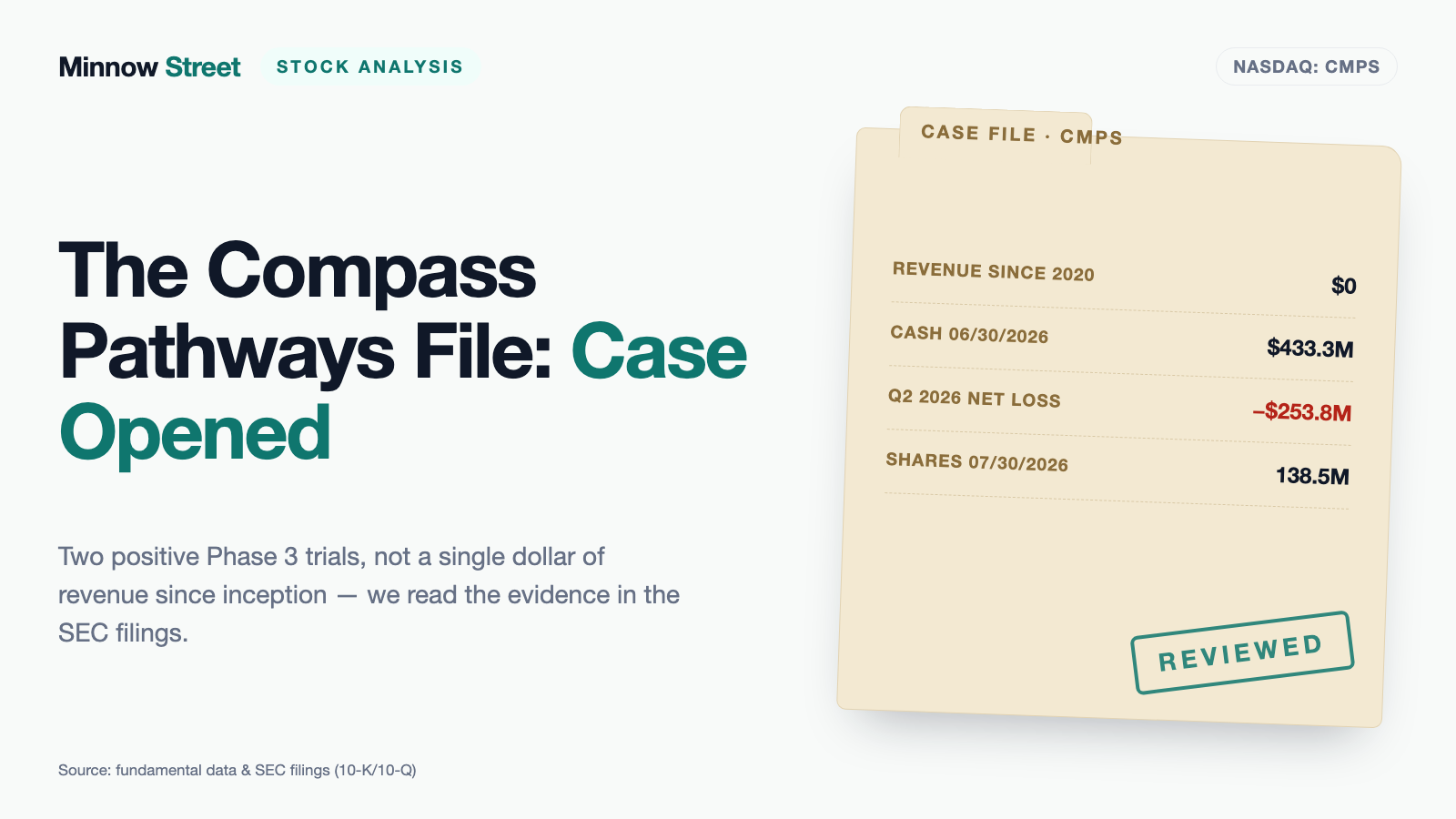
Few biotechnology companies stand as close to a drug approval as Compass Pathways: two positive Phase 3 trials of COMP360, a synthetic psilocybin treatment for treatment-resistant depression, a rolling submission with the U.S. Food and Drug Administration, and a commercial launch planned for the first half of 2027. And yet the filings with the U.S. securities regulator, the SEC, still show zero revenue, an accumulated deficit of $985.2 million, and a share count that has more than doubled since the end of 2023, from 61.9 million to 138.5 million — plus 23.8 million purchase rights priced at one hundredth of a cent that appear in no official share count. We read the fresh quarterly report filed August 5, 2026, and count what still stands between the successful trial and the first milligram sold.
 Thomas Mücke
Founder & Publisher
Thomas Mücke
Founder & Publisher
As of Today
As of: September 21, 2026
- Closing price
- 15.00 $ -1.20%
- Market Capitalisation
- 2.0 $B
- AAQS
- 1/10
This analysis has a cut-off date. The Stock Guard tells you when something material changes in the numbers. Reserve your free spot
Chart
Interactive price chart (TradingView).
52-week range: 4.90 $ to 15.20 $ · Last price: 15.00 $ (As of: September 21, 2026)
Note: pure fact-based analysis, not investment advice and not a solicitation to buy or sell. All figures without guarantee.
There is an investor trap that springs precisely when everything looks good: the home-stretch trap. It works like this — a project is nearly finished, the finish line is in sight, and your mind files it under "done." The last few yards feel like a formality. That is exactly where you stop doing the math. Compass Pathways (Nasdaq: CMPS) is a textbook case. The London biotechnology company has completed two large Phase 3 trials of COMP360, a synthetic psilocybin treatment for treatment-resistant depression, and both were positive. The U.S. Food and Drug Administration, or FDA, is letting the company submit its application in pieces while review is already under way. Commercial launch is planned for the first half of 2027. That sounds like a finish line. So let's make a deal before you buy the label "about to be approved": we read together what the company itself reported to the U.S. securities regulator, the SEC — the quarterly report (10-Q) as of June 30, 2026, filed August 5, 2026, the annual report (10-K) for 2025, the earnings release of August 5, 2026, and the shelf registration (Form S-3ASR) filed the same day. A filing to the SEC is honest under penalty of law. And this one describes a drug that appears to work — and three doors between the trial and the cash register that Compass Pathways cannot open itself. In the end, the decision is yours.
What Compass Pathways actually does — one company, one compound, no revenue
Compass Pathways plc is a clinical-stage biotechnology company — in plain terms, a firm that does nothing but research medicines and has never sold one. There is no factory, no customer base, no revenue. There is an idea, trial data, and a cash balance that drains slowly. The company is registered in England and Wales and headquartered in London (33 Broadwick Street); its shares trade on Nasdaq as American Depositary Shares, where one ADS equals exactly one ordinary share. As of December 31, 2025 it employed 156 people, 101 of them in research and development — 6 percent fewer than a year earlier.
The only product is COMP360: a synthetic, proprietary formulation of psilocybin, the active compound in so-called magic mushrooms. The target condition is treatment-resistant depression, or TRD — patients for whom several standard antidepressants have failed in sequence. This is not a prescription you take home: the patient receives the dose in a medically supervised session lasting several hours, monitored by trained staff throughout. The company puts the U.S. TRD population at roughly four million people and notes that the only approved medicine for that group has captured less than 3 percent market share. A late-stage trial in post-traumatic stress disorder is running as a second indication.
That frames the central tension of this analysis, and it runs through every chapter: the efficacy data exist — but the path to the first dose sold runs through doors that Compass Pathways cannot open itself, and shareholders pay for the waiting time with an ever-growing pile of new shares.
How this stock reached our desk
Not through a price screener — for a company with no revenue and no earnings, the classic filters return nothing useful. Compass Pathways reached our research list through the EDGAR event radar, which watches new arrivals at the U.S. securities regulator. On August 5, 2026, three documents landed on a single day: the quarterly report (10-Q) as of June 30, 2026, an earnings release as Exhibit 99.1 to a Form 8-K, and a shelf registration (Form S-3ASR), the filing a company uses to obtain standing permission to sell new securities at any time. That combination always deserves a close look: the company reports, comments, and simultaneously opens the door to its next capital raise.
One detail made the date more interesting still. An S-3ASR is not an ordinary shelf registration but the automatically effective version, available only to "well-known seasoned issuers" — companies whose publicly traded float exceeds $700 million. Compass Pathways itself writes that as of June 30, 2026 the aggregate market value of its shares held by non-affiliates exceeded that threshold. Note the finding right at the start: what is growing here is not revenue but market capitalization — and with it the ability to sell new shares.
The numbers over the years — given their due
First what genuinely impresses, which for a company without revenue means the clinical record. Compass Pathways has completed two pivotal Phase 3 trials of a scale rarely seen in psychiatry. COMP005 is a placebo-controlled trial with 258 participants dosed in the United States; in June 2025 the company reported that the primary endpoint was met — a single 25 mg dose lowered the MADRS depression score after six weeks with high statistical significance (p < 0.001) by 3.6 points more than placebo. COMP006, the larger sibling, dosed 581 participants across North America and Europe and compares two fixed doses given three weeks apart. On July 7, 2026 the company reported the 26-week results: 39 percent of participants in the 25 mg arm achieved a clinically meaningful improvement after six weeks — defined as a MADRS reduction of at least 25 percent — and maintained it, on average, through at least week 26. In COMP005 the figure was 25 percent after a single dose. Serious adverse events were similarly rare in both arms (6.3 percent in the 1 mg arm versus 5.7 percent in the 25 mg arm over 26 weeks).
The regulatory picture is equally favorable: Breakthrough Therapy designation since 2018; in April 2026 the FDA granted a rolling submission of the new drug application and additionally awarded a National Priority Voucher, which the company says could compress review time to one or two months. Final submission is planned for the fourth quarter of 2026, with launch targeted for the first half of 2027.
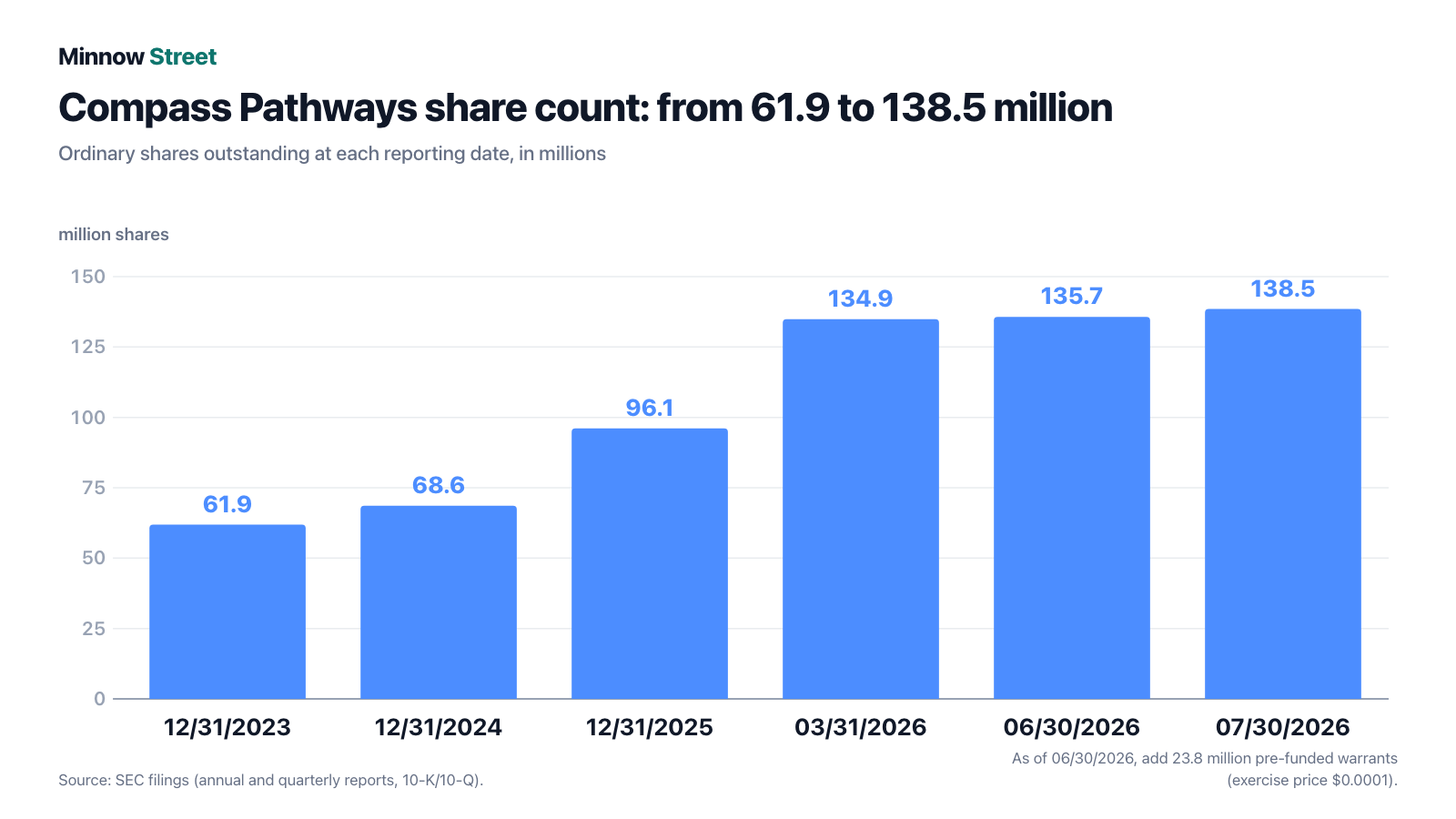
And the cash? Fuller than ever: $433.3 million as of June 30, 2026, up from $149.6 million six months earlier. Shareholders' equity swung over the same period from negative $52.8 million to positive $84.5 million. But none of that money came from the business. It came from new shareholders. The chart below shows what that cost.
The second figure you need is the operating cash outflow — money that actually leaves the building. In the first half of 2026 that was $88.2 million (first half of 2025: $84.3 million); for the full year 2025 it was roughly $157.2 million. Set the $433.3 million cash balance against that burn and you get a little over two and a half years — which is exactly what the company says: the funds are sufficient "into 2028." For a biotechnology company on the doorstep of approval that is comfortable, not lavish. Remember the image: the cash balance is a tank with a gauge, not a well.
What the filings say — the uncomfortable truths
Uncomfortable truth No. 1: the $253.8 million quarterly loss appeared because the stock went up
Read the headline "net loss of $253.8 million in the second quarter of 2026" and you picture a company burning money like paper. The quarterly report adds it up differently: the operating loss was $52.4 million (research and development $29.2 million, general and administrative $23.2 million). The remaining $200 million and change comes from a line with the unwieldy name "fair value change of warrant liabilities."
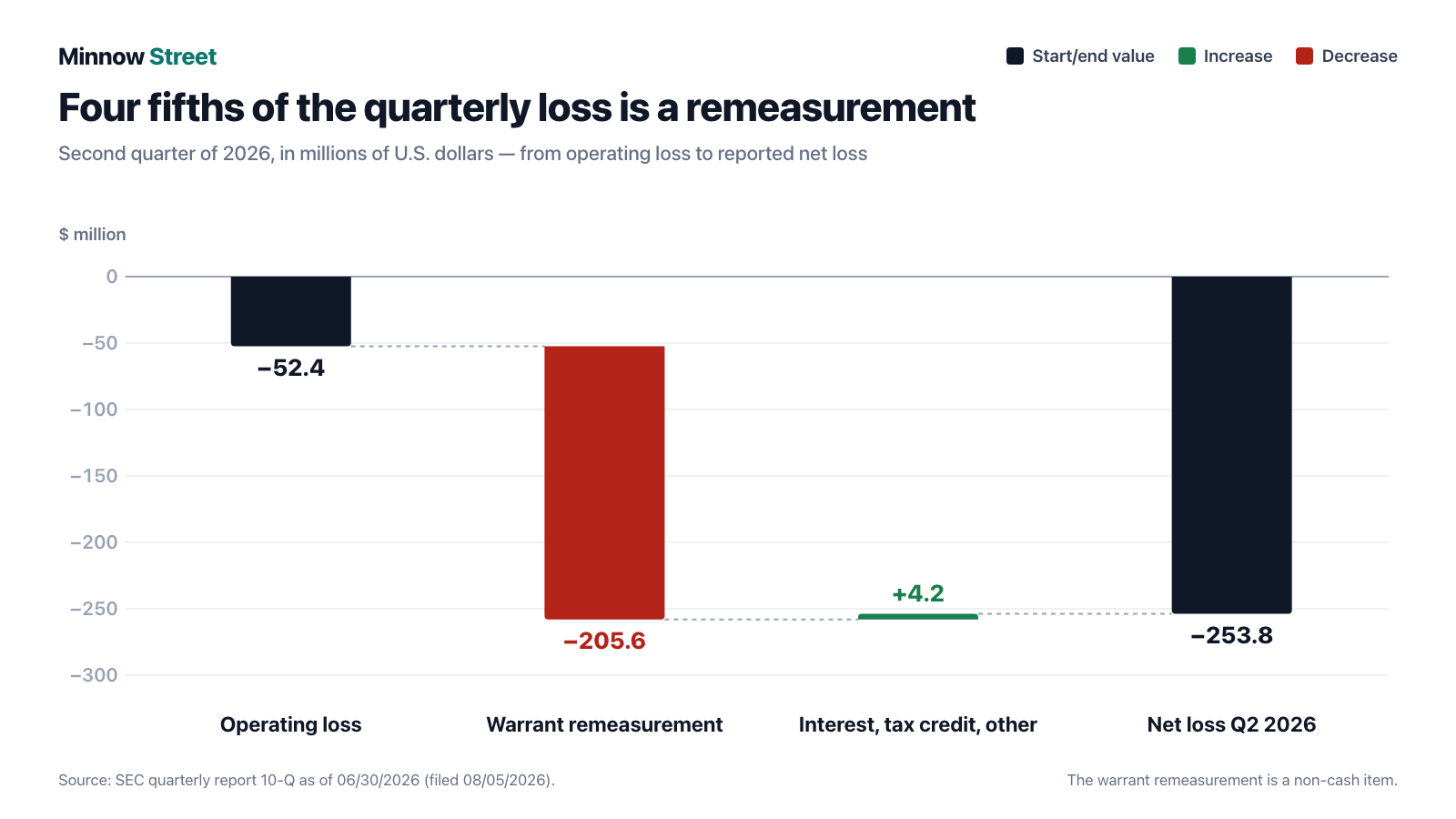
Why that happens needs a plain-language picture. In several financing rounds Compass Pathways sold not only shares but attached warrants — instruments entitling the holder to buy shares later at a fixed price. Because of how they are structured, the company must carry those warrants not as equity but as a liability and remeasure them each quarter at market value. When the share price rises, the warrants become more valuable — and because they sit on the balance sheet as a debt, the debt grows. That increase runs through the income statement as an expense. In plain English: the better the news, the larger the reported loss. The company says as much in its own earnings release:
"As the fair value of the warrants fluctuates with our share price, this adjustment can result in significant variability in our reported net income or net loss."
— Compass Pathways plc, Form 8-K, Exhibit 99.1, filed August 5, 2026

The control experiment is the immediately preceding quarter. In the first quarter of 2026 Compass Pathways reported net income of $91.2 million — without a dollar of revenue, because the same measurement line ran the other way. Across the full first half of 2026 a net loss of $162.6 million remained (first half of 2025: $56.3 million). For a reader that means one thing: the "net income" line is not a performance measure at this company. Look at the operating loss and the cash outflow — $95.3 million and $88.2 million in the first half of 2026. Those are the real numbers.
Uncomfortable truth No. 2: 23.8 million shares appear in no share count
Now the part you have to read twice. The cover page of the quarterly report carries the share count every market capitalization is built on: 138,476,822 shares as of July 30, 2026. The shelf registration filed the same day names what comes on top:
"As of June 30, 2026, we also had 23,848,829 outstanding pre-funded warrants, each exercisable for one ADS representing one ordinary share at an exercise price of $0.0001 per ADS."
— Compass Pathways plc, Form S-3ASR shelf registration, filed August 5, 2026

A pre-funded warrant is economically a share that has already been paid for. The buyer has handed over essentially the full price and leaves only the last hundredth of a cent outstanding, so that formally the share is not yet owned — usually to stay below beneficial-ownership reporting thresholds. All 23.8 million of them together would cost roughly $2,385 to exercise. The everyday picture: they are tickets sold and paid for but not yet handed in at the door. The hall is fuller than the seating list says.
Count them in and you arrive at roughly 162 million economic shares — 17.2 percent more than the official figure. And that is only the start: as of June 30, 2026 the quarterly report lists 47,163,568 potentially dilutive securities (23.8 million liability-classified and 11.9 million equity-classified warrants, 9.9 million employee options, 1.5 million restricted share units). Dilution means your slice of the cake gets smaller without the cake getting bigger. The first half of 2026 alone shows the pace — from 96.1 million to 135.7 million shares, a rise of roughly 41 percent in six months. To be fair, part of that is fresh money. Of the $370.0 million that came in from financing activities in the first half, $140.6 million came from the share offering of February 19, 2026 (17,500,000 ADSs at $8.00) and $203.2 million from the exercise of older warrants.
Uncomfortable truth No. 3: even with FDA approval, Compass Pathways may not sell anything
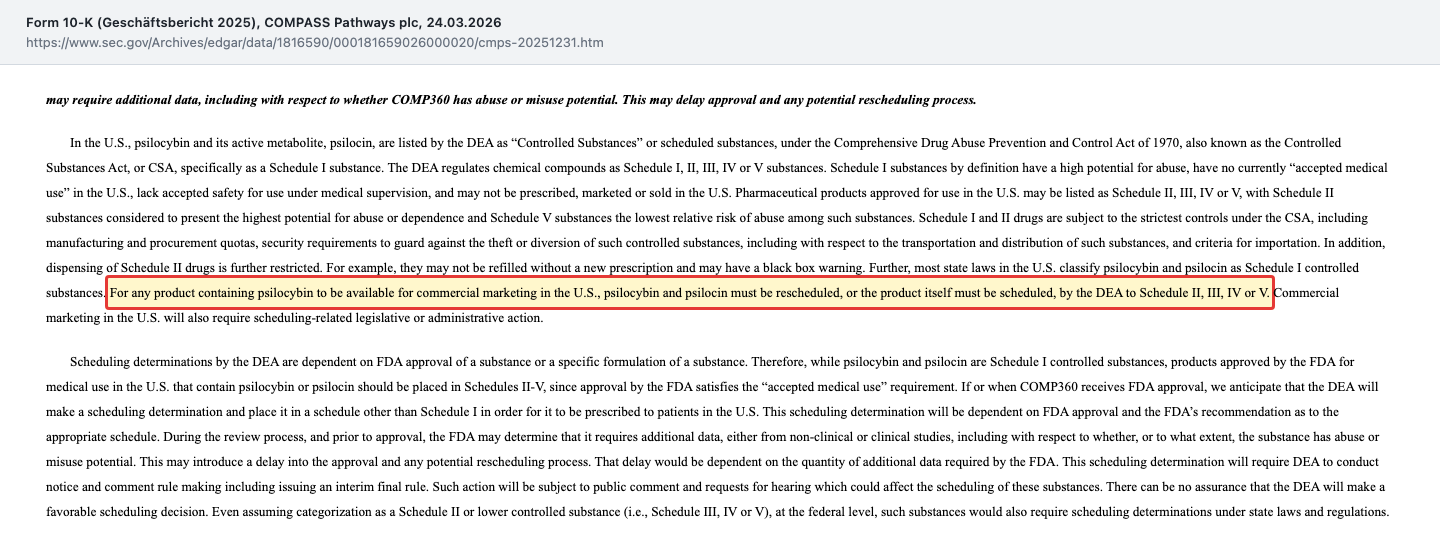
This is the door missing from almost every headline. In the United States, psilocybin is listed on Schedule I of the Controlled Substances Act — the list of substances the law treats as having no accepted medical use. Anything on that list may not be prescribed, marketed or sold, full stop. An FDA approval alone changes nothing; a second act by the Drug Enforcement Administration, or DEA, is required. The annual report puts it plainly:
"For any product containing psilocybin to be available for commercial marketing in the U.S., psilocybin and psilocin must be rescheduled, or the product itself must be scheduled, by the DEA to Schedule II, III, IV or V."
— Compass Pathways plc, Annual report 10-K for 2025, "Government Regulation"
And the chain is longer than one agency. After federal rescheduling, individual states must follow, because most list psilocybin as Schedule I in their own statutes. Compass Pathways says roughly 90 percent of the U.S. patient population lives in states that intend to reschedule within 30 days of the federal DEA — an intention, not a law. There is political tailwind: an executive order of April 18, 2026, "Accelerating Medical Treatments for Serious Mental Illness," directs the DEA to begin and complete its review of psychedelic treatments that have finished Phase 3 as quickly as possible. But "as quickly as possible" is not a date. Remember the chain: approval, federal rescheduling, state rescheduling, reimbursement — four doors, and Compass Pathways holds the key to none of them. How violently a single regulatory or clinical decision can move a biotechnology valuation was on display recently at atai Life Sciences, the other large listed psychedelics developer, which was a shareholder in Compass Pathways for years.
Uncomfortable truth No. 4: the company itself names the reason its data are attackable
Two positive Phase 3 trials sound like a closed case. It is worth setting two details beside them. First, the magnitude: in COMP005 the difference between drug and placebo after six weeks was 3.6 MADRS points on a scale that runs to 60 — highly significant statistically, modest clinically. And even in the stronger COMP006 trial, 39 percent of those treated reached the clinically meaningful threshold; a majority therefore did not.
Second, the methodological problem the company itself names in its annual report. A patient who receives 25 milligrams of psilocybin notices it. A patient who receives 1 milligram notices that nothing happened. Blinding — the rule that neither patient nor investigator may know who received what — works only partially with a substance whose effect is this obvious. The technical term is "functional unblinding," and the risk section of the annual report says, verbatim:
"For example, concerns about functional unblinding, expectancy bias or the impact of our model for supporting and monitoring participants in our clinical trials evaluating COMP360 could hinder interpretability or regulatory acceptability of data from clinical trials of our investigational COMP360 psilocybin treatment."
— Compass Pathways plc, Annual report 10-K for 2025, Item 1A "Risk Factors"
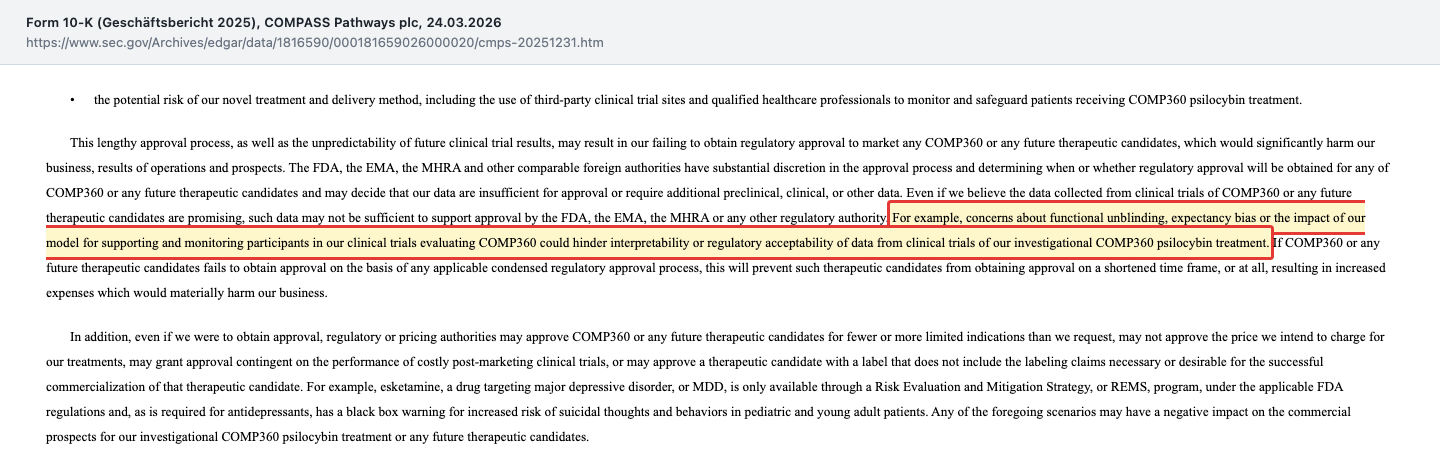
That is not an outside critique; it is the test the company placed in its own file. And it explains why the application is no formality despite two positive trials.
Uncomfortable truth No. 5: a loan covenant tied to the share price
On January 5, 2026, Compass Pathways amended its loan with the specialty lender Hercules Capital for the third time: a facility of up to $150 million across five tranches, of which $50 million was drawn immediately; roughly $31.1 million of that repaid older debt. Interest runs at the greater of 9.75 percent or the Wall Street Journal prime rate plus 2.75 percent; the effective rate was 12.9 percent as of June 30, 2026. Principal payments do not begin until the first quarter of 2029, with final maturity on January 5, 2031 — a remarkably long leash for a company without revenue. But one clause in the fine print stands out: from October 1, 2027, Compass Pathways must hold cash equal to at least 55 percent of the outstanding loan balance — unless it hits certain milestones and its market capitalization is at least $850 million. A credit condition tied to the share price is unusual and uncomfortable: it tightens precisely when the stock falls, which is exactly when fresh money is hardest to find. As of June 30, 2026 the company was in compliance with all covenants.
Valuation: how much of the future is already in the price?
There is no price-to-earnings ratio (no earnings) and no price-to-sales ratio (no sales). What remains is the question of what the market pays for the whole company. The shelf registration supplies a clean, dated anchor: on August 3, 2026 the stock closed, per the prospectus, at $11.25. Applied to the 138.5 million shares outstanding, that is roughly $1.6 billion; add the 23.8 million pre-funded warrants and you reach roughly $1.8 billion. Subtract $433.3 million of cash and add $50.7 million of debt, and the enterprise value lands in the region of $1.2 to $1.4 billion — the price the market pays purely for the prospect that COMP360 will be approved, rescheduled, reimbursed and prescribed.
Is that a lot? It depends on what you believe. Compass Pathways calls COMP360 a "blockbuster opportunity" and cites roughly four million U.S. TRD patients, of whom the only approved competing medicine has reached less than 3 percent. If that holds, $1.4 billion is cheap. If approval slips by two years or fails, the same amount is close to a total loss — the cash balance covers barely a third of it. Here is how the professionals see it: as of August 7, 2026, eleven analyst ratings were on record, seven at the highest and four at the second-highest level, with no neutral or negative rating at all; the average price target was $24.06. That is a remarkably uniform picture — and simultaneously a warning sign: where everyone expects the same outcome, the good news is already paid for.
Opportunities and risks at a glance
What speaks for Compass Pathways:
- Two positive Phase 3 trials with more than 800 participants dosed in total: COMP005 met its primary endpoint in June 2025 (p < 0.001), and COMP006 showed in July 2026 that 39 percent of participants in the 25 mg arm achieved a durable, clinically meaningful improvement through at least week 26.
- Regulatory tailwind: Breakthrough Therapy designation since 2018, a rolling NDA submission since April 2026, a National Priority Voucher that could compress review to one or two months, and an executive order of April 18, 2026 favoring psychedelic therapies.
- A large, poorly served market: roughly four million U.S. TRD patients, with the only approved medicine holding less than 3 percent share by the company's account; the treatment is said to fit into more than 8,000 existing centers already equipped for multi-hour therapies.
- A solid cash position for this stage: $433.3 million as of June 30, 2026, shareholders' equity of positive $84.5 million (after negative $52.8 million at year-end 2025), and runway into 2028 per the company; the first loan principal payment is not due until 2029.
- Costs are already falling where the work is finished: research and development declined to $55.7 million in the first half of 2026 (prior-year period $61.2 million) as the Phase 3 program winds down.
What speaks against it:
- No revenue since inception in 2020 and an accumulated deficit of $985.2 million as of June 30, 2026 — the entire value of the company rests on a single product candidate.
- Even with FDA approval, nothing may be sold until the DEA reschedules psilocybin and the states follow; the reimbursement question comes after that. The company can open none of those doors itself.
- Heavy dilution: the share count rose from 61.9 million (December 31, 2023) to 138.5 million (July 30, 2026), joined by 23.8 million pre-funded warrants at $0.0001 and 47.2 million potentially dilutive securities in total. The shelf registration filed August 5, 2026 makes further offerings possible at any time.
- The reported result is useless as a metric: negative $253.8 million in the second quarter and positive $91.2 million in the first quarter of 2026, both almost entirely warrant remeasurement. The warrant liability of $337.5 million as of June 30, 2026 amounts to two thirds of total assets.
- The trials have a methodological soft spot: the company names functional unblinding and expectancy bias itself as risks to regulatory acceptability, the placebo difference in COMP005 was 3.6 MADRS points, and the analyst consensus is already maximally friendly with eleven positive and zero neutral ratings.
A human conclusion
Back to the home-stretch trap. Its core is not that the goal is unreachable — Compass Pathways does have two positive Phase 3 trials, an accelerated review path, and enough money into 2028. Its core is that the sight of the finish line replaces the arithmetic. Whoever buys today is not buying "an approved medicine about to launch." They are buying a chain of four conditions — approval, federal rescheduling, state rescheduling, reimbursement — not one of which is in the company's hands, and they are buying it at a price in which, per the analyst consensus, everything already goes right. And they are buying a stake that shrinks while they wait: the share count has more than doubled since the end of 2023, and the next prospectus already sits on the shelf.
So the honest question is not "does the drug work?" — after two Phase 3 trials, much suggests it does. The question is: are you willing to walk the whole way, including the possibility that it takes a year longer, that another twenty million shares are created in the meantime, and that your slice ends up considerably smaller than you thought? If yes, you have a thesis. If no, you had a headline. What you make of it is your decision. And that is exactly as it should be.
Sources
Every original document used in this analysis — for you to read yourself:
- Compass Pathways plc — SEC quarterly report 10-Q as of 06/30/2026 (filed August 5, 2026)
- Compass Pathways plc — SEC annual report 10-K for 2025 (filed March 24, 2026)
- Compass Pathways plc — SEC Form 8-K, Exhibit 99.1: second-quarter 2026 results (August 5, 2026)
- Compass Pathways plc — SEC Form S-3ASR shelf registration (August 5, 2026)
- Compass Pathways plc — SEC Form 8-K of July 7, 2026: 26-week results from the Phase 3 trial COMP006
- Compass Pathways plc — SEC Form 8-K of January 5, 2026: third amendment to the loan agreement with Hercules Capital
- AtaiBeckley Inc. — SEC Schedule 13D/A of February 17, 2026 (crossing below the 5 percent threshold)
- Full SEC filing history of Compass Pathways plc: EDGAR overview (sec.gov)
- Fundamental data (market capitalization, analyst consensus; data as of August 7, 2026), reconciled with the SEC filings.
Transparency & disclaimer: this analysis is journalistic commentary on publicly available information. It is not investment advice, not a regulated financial analysis, and not a solicitation to buy or sell securities. Equity investments carry substantial risk up to and including total loss. All information without warranty; the as-of date of each figure is stated in the text. Positions held by the operator are disclosed daily; where one exists, it appears as a notice at the top of this deep dive.
Key figures at a glance
All monetary figures in millions of $; earnings per share as reported.
| Metric | 2021 | 2022 | 2023 | 2024 | 2025 |
|---|---|---|---|---|---|
| Revenue | 0.0 | 0.0 | 0.0 | 0.0 | 0.0 |
| Operating Income (EBIT) | -83.2 | -110.4 | -136.9 | -178.2 | -179.0 |
| Net Income | -71.7 | -91.5 | -118.5 | -155.1 | -287.9 |
| Earnings Per Share | -1.79 $ | -2.16 $ | -2.32 $ | -2.30 $ | -3.08 $ |
Source: fundamental data & SEC filings (annual and quarterly reports, 10-K/10-Q)
Our Bottom Line at a Glance
- Clinical data & regulatory path positive
- Two pivotal Phase 3 trials with more than 800 participants dosed are positive: COMP005 met its primary endpoint in June 2025 (MADRS −3.6 versus placebo, p < 0.001), and COMP006 showed on July 7, 2026 that 39 percent of participants in the 25 mg arm sustained a clinically meaningful improvement through at least week 26. A rolling NDA submission since April 2026 plus a National Priority Voucher put this program further ahead regulatorily than almost any other psychedelics candidate.
- Business model & earnings negative
- Not a single dollar of revenue since inception in 2020, an accumulated deficit of $985.2 million as of June 30, 2026, and operating expenses of $95.3 million in the first half of 2026 alone. The entire value of the company rests on one product candidate in one principal indication.
- Regulatory dependence negative
- Even an FDA approval permits no sale: psilocybin sits on Schedule I, and the annual report for 2025 states that the DEA must reschedule it first; the states must then follow, and the reimbursement question comes after that. The company can open none of these doors itself, and none of them carries a binding date.
- Dilution negative
- The share count rose from 61,943,471 (December 31, 2023) to 138,476,822 (July 30, 2026), joined by 23,848,829 pre-funded warrants at $0.0001 that appear in no share count and 47,163,568 potentially dilutive securities in total as of June 30, 2026. The shelf registration filed August 5, 2026 makes further offerings possible at any time.
- Balance sheet & liquidity positive
- Solid for a company without revenue: $433.3 million of cash as of June 30, 2026 (December 31, 2025: $149.6 million), shareholders' equity of positive $84.5 million after negative $52.8 million at year-end, and runway into 2028 per the company against an operating cash outflow of $88.2 million in the first half. No going-concern warning, and the first loan principal payment is not due until 2029.
- Earnings quality & reporting clarity neutral
- The reported result is useless as a metric: negative $253.8 million in the second quarter and positive $91.2 million in the first quarter of 2026, in both cases driven almost entirely by the remeasurement of warrants (warrant liability of $337.5 million as of June 30, 2026). The company explains the effect explicitly in its earnings release — transparently disclosed, but worthless for any ratio comparison.
Compass Pathways is the home-stretch trap in pure form. Two positive Phase 3 trials, an accelerated FDA review path and a launch announced for the first half of 2027 make the finish line look within reach. Alongside that, the SEC filings show a company with no revenue at all, a $985.2 million accumulated deficit, a share count that has more than doubled from 61.9 million to 138.5 million, and 23.8 million purchase rights at $0.0001 that appear in no share count. Four doors stand between the successful trial and the first milligram sold — approval, federal rescheduling, state rescheduling, reimbursement — and the company holds the key to none of them. Not investment advice.
What Our Rating Means
Open questions
The business works in principle, but one material question is open. As long as it stays open, our findings do not carry a quality verdict.
The balance sheet gives no cause for alarm: $433.3 million of cash as of June 30, 2026, positive shareholders' equity, no going-concern warning, and no loan principal due before 2029 — that is not a substance risk, so not red. Green is ruled out by the one large open question everything hangs on: the company has never earned a dollar, and whether it ever will is decided in sequence by the FDA, the Drug Enforcement Administration, the individual states and the payers. A business whose entire value rests on a single approval event, and whose shareholders buy the waiting time by doubling the share count, is demonstrably risky but not structurally impaired. That the stock looks expensive and the analyst consensus is uniformly positive deliberately plays no part in this rating — those are price arguments, not quality arguments. The decision is yours.
A journalistic assessment by our editorial team at the time of the deep dive, based on public sources — not investment advice and not a solicitation to buy or sell. Your personal circumstances (investment goals, risk capacity, taxes) cannot be taken into account. What our levels mean, how verdicts are formed, and what conflicts of interest exist →
Worth Noting
- Compass Pathways reached our research list through the EDGAR event radar: on August 5, 2026 the quarterly report (10-Q) as of June 30, 2026, the earnings release (Form 8-K, Exhibit 99.1) and a shelf registration (Form S-3ASR) all arrived on the same day. Every filing dated on or after that day was reviewed for this analysis.
- The reported net result is not a performance measure at this company: it tracks the valuation of warrants carried as liabilities, and therefore the company's own share price. The meaningful figures are the operating loss ($52.4 million in the second quarter of 2026) and the operating cash outflow ($88.2 million in the first half of 2026).
- Valuation figures are dated and evergreen: the $11.25 price anchor comes from the company's own shelf registration and refers to August 3, 2026; market capitalization and analyst consensus carry the data date of August 7, 2026. Do not confuse the two: COMPASS Pathways plc (CMPS) is a different company from its former shareholder atai Life Sciences, now named AtaiBeckley Inc., which reduced its stake below the 5 percent threshold by January 21, 2026.
Stock Watch
This analysis is as of August 26, 2026. Stock Watch will tell you what's changed at CMPS since then.
Later $1 a month per stock — signing up is free, and you'll be the first to know when it launches.
The full analysis as a PDF for later
We will send you this analysis as a PDF — to print, file away, and read at your own pace. And we will add you to the free Stock Watch list for Compass Pathways Plc (CMPS), so you hear about it when something material in this analysis changes.
Frequently Asked Questions
COMPASS Pathways plc (Nasdaq: CMPS) is a clinical-stage biotechnology company headquartered in London. It develops COMP360, a synthetic, proprietary psilocybin treatment for treatment-resistant depression (TRD) and post-traumatic stress disorder (PTSD). The treatment is given in a medically supervised session lasting several hours. The company has generated no revenue since its inception in 2020 and employed 156 people as of December 31, 2025, 101 of them in research and development.
Per the company statement of August 5, 2026, the rolling submission of the new drug application (NDA) with the FDA is under way, with final submission planned for the fourth quarter of 2026. The commercial launch is targeted for the first half of 2027 — expressly subject to FDA approval and subsequent rescheduling by the Drug Enforcement Administration. That is not a firm date: both agencies decide independently of the company.
Because the reported loss is mostly accounting. The operating loss was $52.4 million. Another $205.6 million came from remeasuring warrants that the company must carry as a liability: when the share price rises, those rights become more valuable, and the increase runs through the income statement as an expense. In the first quarter of 2026 the same mechanism ran the other way and produced reported net income of $91.2 million.
Considerably. The share count rose from 61,943,471 (December 31, 2023) through 96,085,785 (December 31, 2025) to 138,476,822 as of July 30, 2026. On top of that, the shelf registration of August 5, 2026 reports 23,848,829 pre-funded warrants at an exercise price of $0.0001 that appear in no share count. In total the quarterly report lists 47,163,568 potentially dilutive securities as of June 30, 2026.
By its own account, yes. Cash stood at $433.3 million as of June 30, 2026 (December 31, 2025: $149.6 million), and the company states this funds operating expenses and capital expenditure "into 2028." The operating cash outflow was $88.2 million in the first half of 2026. The quarterly report contains no going-concern warning. A further $100 million remains available in undrawn tranches of the Hercules loan, tied to milestones.
No. Psilocybin is listed on Schedule I of the U.S. Controlled Substances Act and may not be prescribed or marketed in that classification. The annual report for 2025 states that psilocybin and psilocin must first be rescheduled by the Drug Enforcement Administration to Schedule II through V. Individual states must then follow, because most maintain their own Schedule I lists. Only after that comes the question of insurance reimbursement.
Statistically strong, clinically more modest than the headlines suggest. In COMP005 the difference versus placebo after six weeks was 3.6 MADRS points (p < 0.001) on a scale running to 60; in COMP006, 39 percent of participants in the 25 mg arm reached the clinically meaningful threshold. The company itself names functional unblinding and expectancy bias in its annual report as risks to regulatory acceptability, because a substance with an obvious effect makes blinding difficult.
The shelf registration of August 5, 2026 cites a closing price of $11.25 per share on August 3, 2026. Applied to the 138.5 million shares outstanding, that is roughly $1.6 billion, or roughly $1.8 billion including the 23.8 million pre-funded warrants. Subtracting $433.3 million of cash and adding $50.7 million of debt gives an enterprise value of roughly $1.2 to $1.4 billion. Price-to-earnings and price-to-sales ratios cannot be formed, since there are neither earnings nor sales.
Found an error?
Did you spot a factual error, an outdated number, or a typo in this deep dive? Let us know briefly — your report goes straight to the editorial team.