Hawaiian Electric: The Power Keeps Flowing — and in April 2027 the Next $479 Million Installment Comes Due
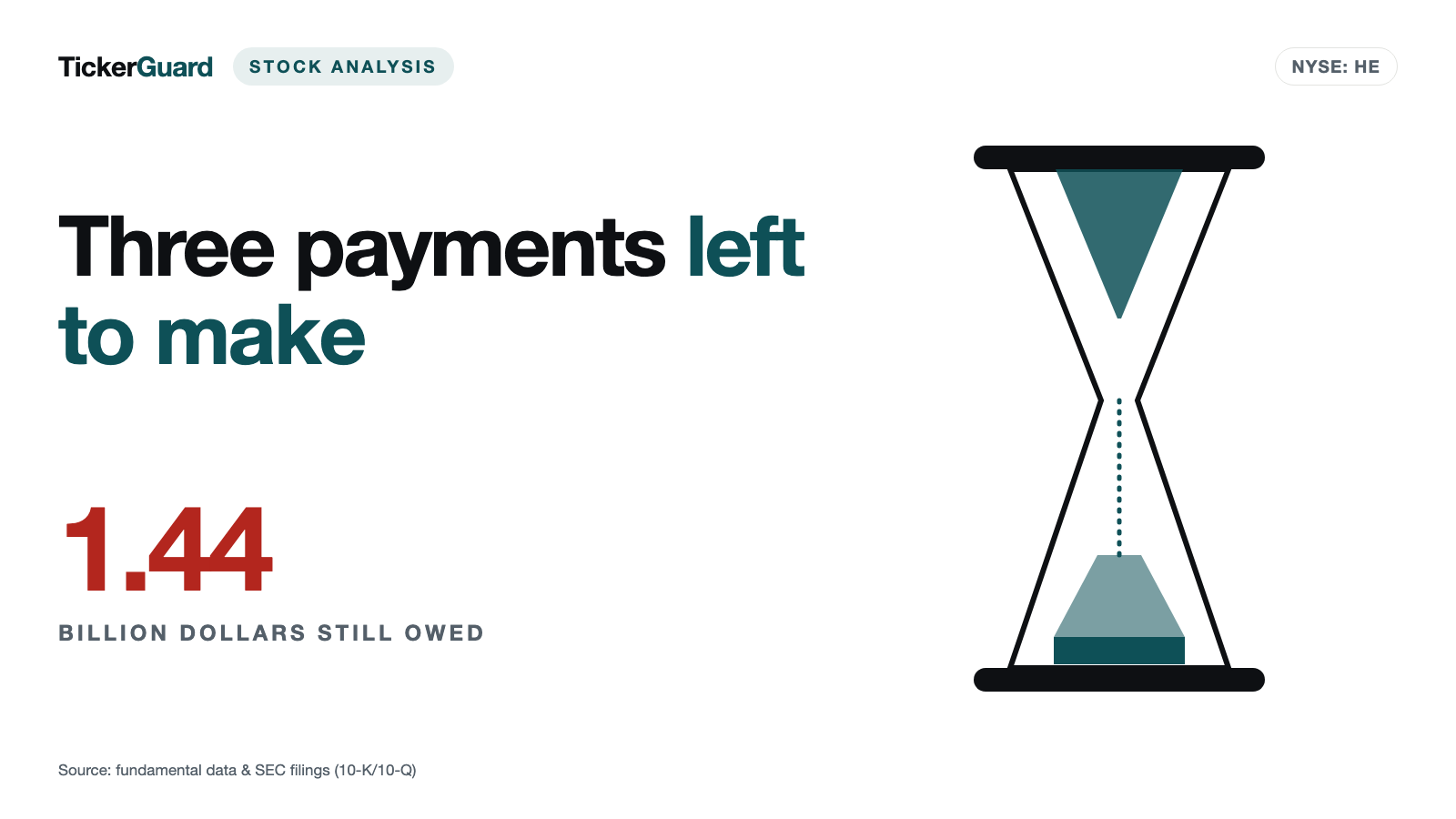
Hawaiian Electric supplies electricity to roughly 95 percent of the people of Hawaii, a monopoly in the literal sense. After the August 2023 Maui windstorm and wildfires the group agreed to contribute $1.99 billion to a global settlement and paid the first of four annual installments on April 10, 2026. Three installments of $479 million each are still outstanding — April 2027, 2028 and 2029. Against them stand the roughly $50 million left over after investment in 2025, a capital plan of $2.2 billion to $2.4 billion for 2026 to 2028, a dividend suspended since 2023 and credit ratings that remain deep below investment grade despite two upgrades in 2026. The Form 10-Q for June 30, 2026 says outright that the financing for the remaining payments is not yet in place. Not investment advice — just a sober look at this utility's payment calendar.
 Thomas Mücke
Founder & Publisher
Thomas Mücke
Founder & Publisher
As of Today
As of: September 17, 2026
- Closing price
- 10.10 $ -1.40%
- Market Capitalisation
- 1.7 $B
- Growth Score
- 3/10
- AAQS
- 2/10
Price change since September 4, 2026: -8.9%
This analysis has a cut-off date. The Stock Guard tells you when something material changes in the numbers. Reserve your free spot
Chart
Interactive price chart (TradingView).
52-week range: 10.10 $ to 17.10 $ · Last price: 10.10 $ (As of: September 17, 2026)
Note: pure fact-based analysis, not investment advice and not a solicitation to buy or sell. All figures without guarantee.
There is a trap almost every investor falls into sooner or later, and it has a friendly name: the everything-is-known trap. A company is hit by a disaster, the stock collapses, the headlines move on — and eventually a quiet, very reasonable-sounding voice speaks up: Everything is known by now. It cannot get worse. And it is cheap.
With Hawaiian Electric that voice sounds especially convincing. The group supplies electricity to roughly 95 percent of the people of Hawaii, the stock trades at about its book value, and the price-earnings ratio sits near 8.6 — bargain territory for a utility. The great litigation over the August 2023 Maui wildfires is settled, the first installment has been paid, and two rating agencies upgraded the company in 2026. It sounds like a line drawn and a fresh start.
Before the numbers, one sentence belongs at the top that no valuation ratio captures: in the Maui wildfires of August 8, 2023, according to the company's own annual report, 102 people in Lahaina lost their lives, and much of the town was destroyed. The settlements this analysis deals with were entered into, in the words of HEI and Hawaiian Electric, without any admission of liability. This text therefore judges no question of fault — it reads the payment schedule that follows from those settlements.
The deal for this article: we read the actual filings made with the U.S. securities regulator, the SEC — the annual report on Form 10-K for 2025 and the quarterly report on Form 10-Q for June 30, 2026. And we look at the one number that appears in no headline: the payment calendar. Because that is what answers the question of whether the clean-up is really finished — or whether the invoice simply has not landed yet.
What Hawaiian Electric actually does — the power company for almost everyone in Hawaii
Hawaiian Electric Industries, Inc. is a holding company — in plain terms, a roof over operating businesses that turns no generator itself. Under that roof sit three electric utilities: Hawaiian Electric (Oahu, home of Honolulu), Hawaii Electric Light (the Big Island of Hawaii) and Maui Electric (Maui, Lanai and Molokai). Together they serve about 1.4 million people — roughly 95 percent of the state population — across some 5,800 square miles.
One detail makes this business unusual, and it explains a great deal later: there are five entirely separate island grids. No line to the mainland, no line between most of the islands. When two generating units on Hawaii Island are out for extended maintenance — as the Form 10-Q for June 30, 2026 describes, one of them not expected back until the fourth quarter of 2026 — you cannot simply import power from next door. An island grid has to carry every reserve itself. That costs money and leaves the system exposed.
Economically the group is a regulated monopoly. Prices are set not by a market but by the Public Utilities Commission of the State of Hawaii. The rate-making framework grants an authorized return on average common equity of 9.5 percent; if the achieved return lands more than 300 basis points above or below that level, the difference is shared between customers and the utility. Fuel costs are largely passed through, leaving the utility with roughly $3.7 million a year of exposure through a fuel cost risk sharing mechanism. That matters for reading the numbers: when the average price of fuel oil per barrel jumped from $100.40 to $145.67 in the second quarter of 2026, it inflated revenue but changed profit very little.
Since December 31, 2024 the group has been considerably leaner. On that date HEI sold 90.1 percent of its bank, American Savings Bank, keeping only 9.9 percent. Since then there has been one reportable segment: electricity. And it will not broaden again: on March 23, 2026 the regulator approved a simplification of the corporate structure — on condition that HEI divests all remaining affiliated assets and pursues no new diversification. The last holding, the 7.5-megawatt Mahipapa biomass facility on Kauai, is up for sale.
That frames the central tension of this analysis, and it runs through every chapter: a dependable, regulated monopoly business meets a fixed contractual payment schedule larger than three quarters of the market value — one that no electricity customer helps carry.
Company history for investors
-
2023
Maui windstorm and wildfires (August)
Credit ratings fell below investment grade within weeks and the board suspended the quarterly dividend after the second-quarter payment. Overnight, a dividend stock became a litigation case.
-
2024
Equity offering of 62.2 million shares (September)
Net proceeds of about $557.7 million, earmarked for the first settlement installment. For existing holders it meant their slice of the company shrank before a single dollar was paid out.
-
2024
Sale of American Savings Bank (December 31)
HEI sold 90.1 percent of its bank and kept 9.9 percent. The group lost its second leg — and the stock became a pure bet on the utility.
-
2025
Three State of Hawaii statutes (June and July)
Act 191, Act 258 and Act 301 backstop power purchase agreements, allow a liability cap plus securitization, and settle the state's share. For shareholders it was the first political relief since 2023.
-
2026
First settlement installment paid (April 10)
The $479 million raised in the autumn of 2024 left the group. The prefunding was used up — and at that point there was still no plan for the three installments that follow.
-
2026
Two credit rating upgrades (April and July)
Moody's lifted HEI to Ba2 on April 21, S&P to BB- on July 22. Both remain below investment grade, but every notch cuts the interest HEI must pay to finance the rest.
-
2026
Wildfire mitigation cost recovery approved (June 25)
The regulator allowed up to $350 million of recovery for 2025 through 2027 — but only once it has ruled on the planned securitization. For shareholders: the promise is there, the cash is not.
How the stock landed on our desk — a quarterly profit that was almost all accounting
The trigger was not a screening metric but a document: the second-quarter 2026 earnings release that HEI filed with the SEC on August 7, 2026 as Exhibit 99 to a current report on Form 8-K (Item 2.02). The headline number was spectacular: $123 million of quarterly net income, against $26 million a year earlier. A gain of 372 percent.
The company itself took the trouble to walk that impression back immediately — in the same release, in the third bullet point: the result included a non-cash after-tax gain of $101 million from remeasuring the remaining settlement liability at present value. The adjusted figure that HEI reports as "core" came to $22 million — against $35 million a year earlier. So not plus 372 percent, but minus 37 percent.
Read only the first line and you see a company past the worst. Read on and you see a company whose operating result is shrinking while an accounting entry rescues the headline. That was the reason to open the filings themselves — and readers who want to see how quickly a balance-sheet item can flatter a result will find a related pattern in our analysis of Babcock & Wilcox, where a heavy debt load raises the same question: what is actually going to pay for this?
The numbers over the years — given their due
Start with what genuinely works. Revenue is large and stable: $3,287.5 million (2023), $3,219.9 million (2024) and $3,086.9 million (2025). The mild decline comes mostly from lower fuel prices that are passed through, so it is not a demand problem. Kilowatt-hour sales in the second quarter of 2026 came to 2,015 million, down 0.8 percent year over year, attributed to cooler weather. A utility whose volumes move by less than one percent is exactly the predictable business investors buy utilities for.
The cash generation is equally solid. Operations delivered $391.1 million in 2025 ($428.1 million in 2024 and $443.4 million in 2023, each on a continuing-operations basis). That is real money, not a book gain.
And then there is 2024.
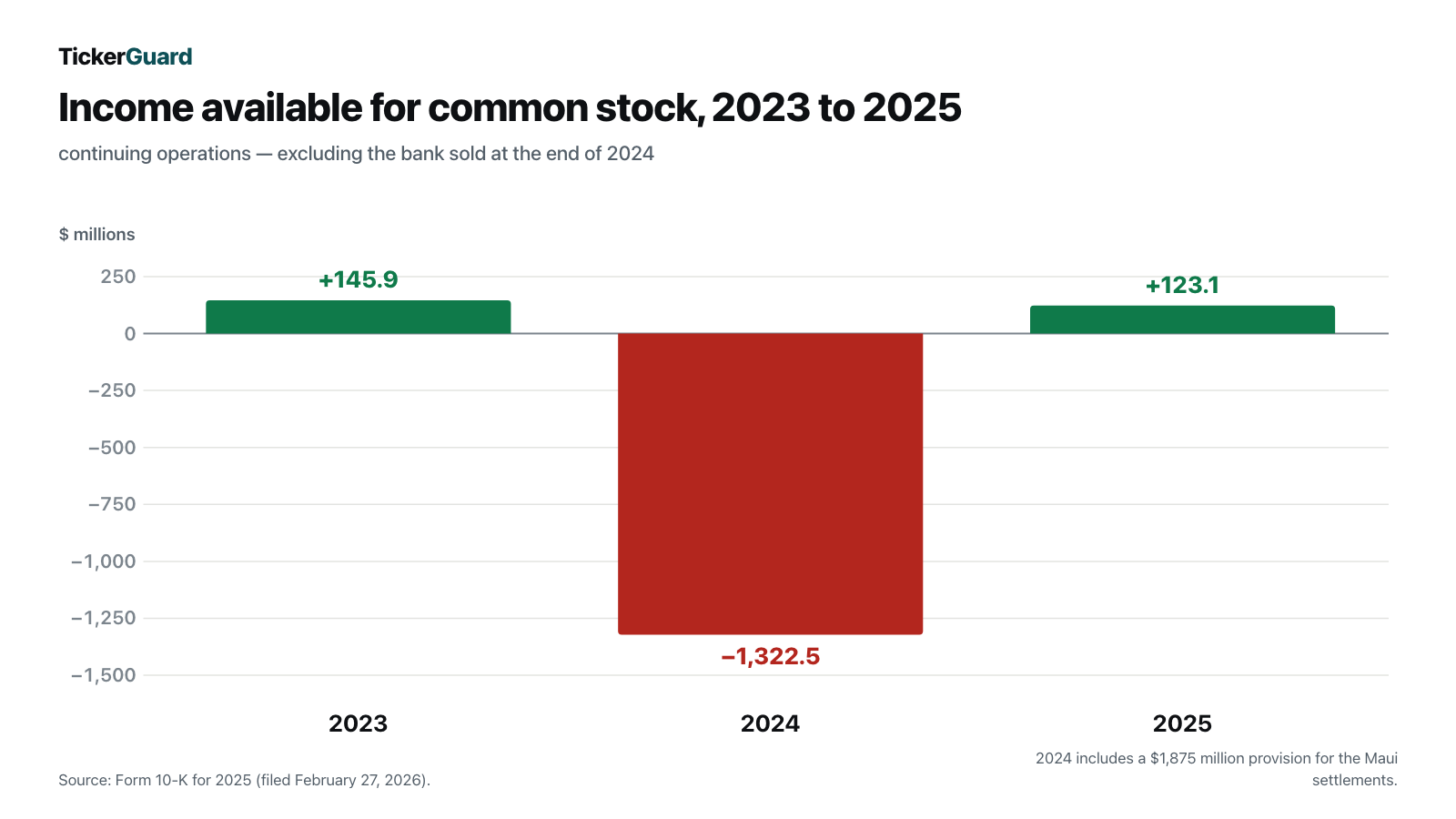
The $1,322.5 million loss in 2024 is not an operating number. It arose because the group had to record a provision of $1,875 million for the settlements. For the full year that meant a loss per share of $10.42. In 2025 the business was back where it belongs: $123.1 million of income, $0.71 per share.
One figure has to sit beside that, or the picture is wrong: the share count. The weighted average rose from 109.7 million (2023) to 126.9 million (2024) and 172.6 million (2025) — up 57 percent. Dilution in plain terms means your slice of the cake gets smaller even if the cake stays the same size. Anyone invested in 2023 owns considerably less of the company today for the same money.
What the filings say — the uncomfortable truths
Uncomfortable truth no. 1: only a quarter of the invoice has been paid
On April 10, 2026 the last condition of the settlement was satisfied and the group wired the first installment. The Form 10-Q for June 30, 2026 sets out the overall position in two sentences:
"Under the Settlement Agreements, HEI and Hawaiian Electric are obligated to contribute a total of $1.99 billion, including $75 million previously contributed to the One 'Ohana Initiative, of the total defendant contribution of approximately $4.04 billion. HEI and Hawaiian Electric paid the first of four equal annual $479 million installments on April 10, 2026."
— Hawaiian Electric Industries, Form 10-Q for June 30, 2026, Note 2
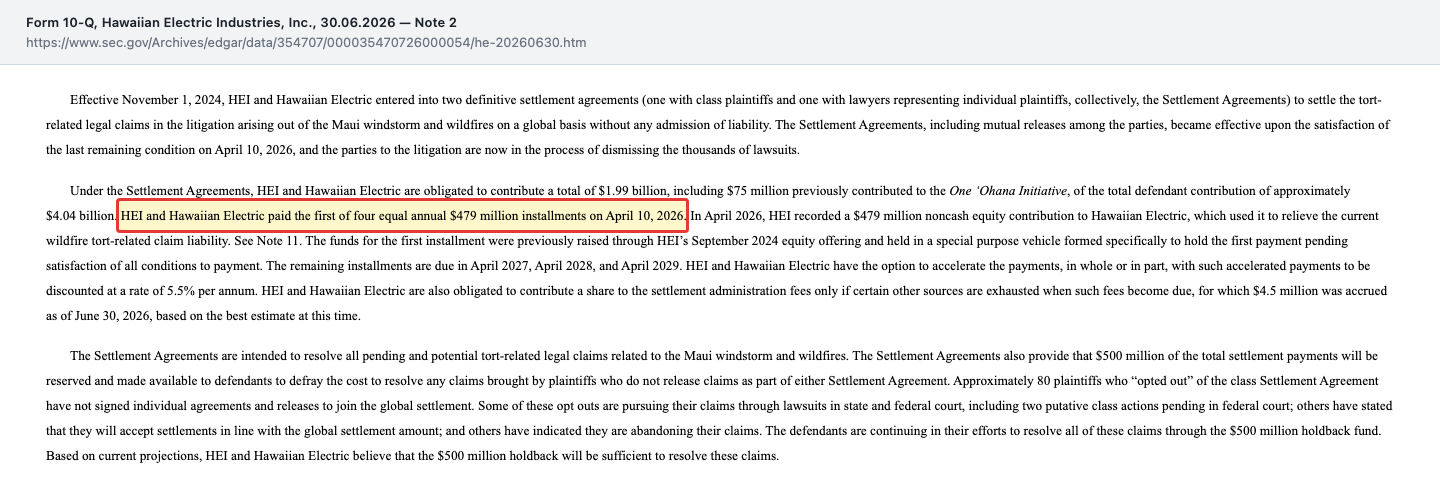
In plain terms: three installments of $479 million each are still outstanding, due in April 2027, 2028 and 2029. That is a nominal $1.437 billion. On the balance sheet at June 30, 2026 they are carried at a present value of $1.30 billion, split into $410 million current and $890 million non-current. The group may prepay, in which case the amounts are discounted at 5.5 percent a year.
One more sentence from the filing belongs alongside, because it settles who bears the cost: the utilities have stated that customers will not be impacted by payments related to the settlement agreements; rate-making calculations remove those effects. A regulated utility can put almost anything on the bill — but not this $1.437 billion.
Uncomfortable truth no. 2: a full year of business earns about a tenth of one installment
Work out what the business leaves over on its own. In 2025, operations brought in $391.1 million. At the same time $341.2 million went out as capital expenditure — lines, plants, meters, wildfire hardening. What remains is free cash flow, and it came to roughly $50 million. One installment is $479 million.
At the reporting date the coverage looks better, because credit lines and an equity program count toward it:
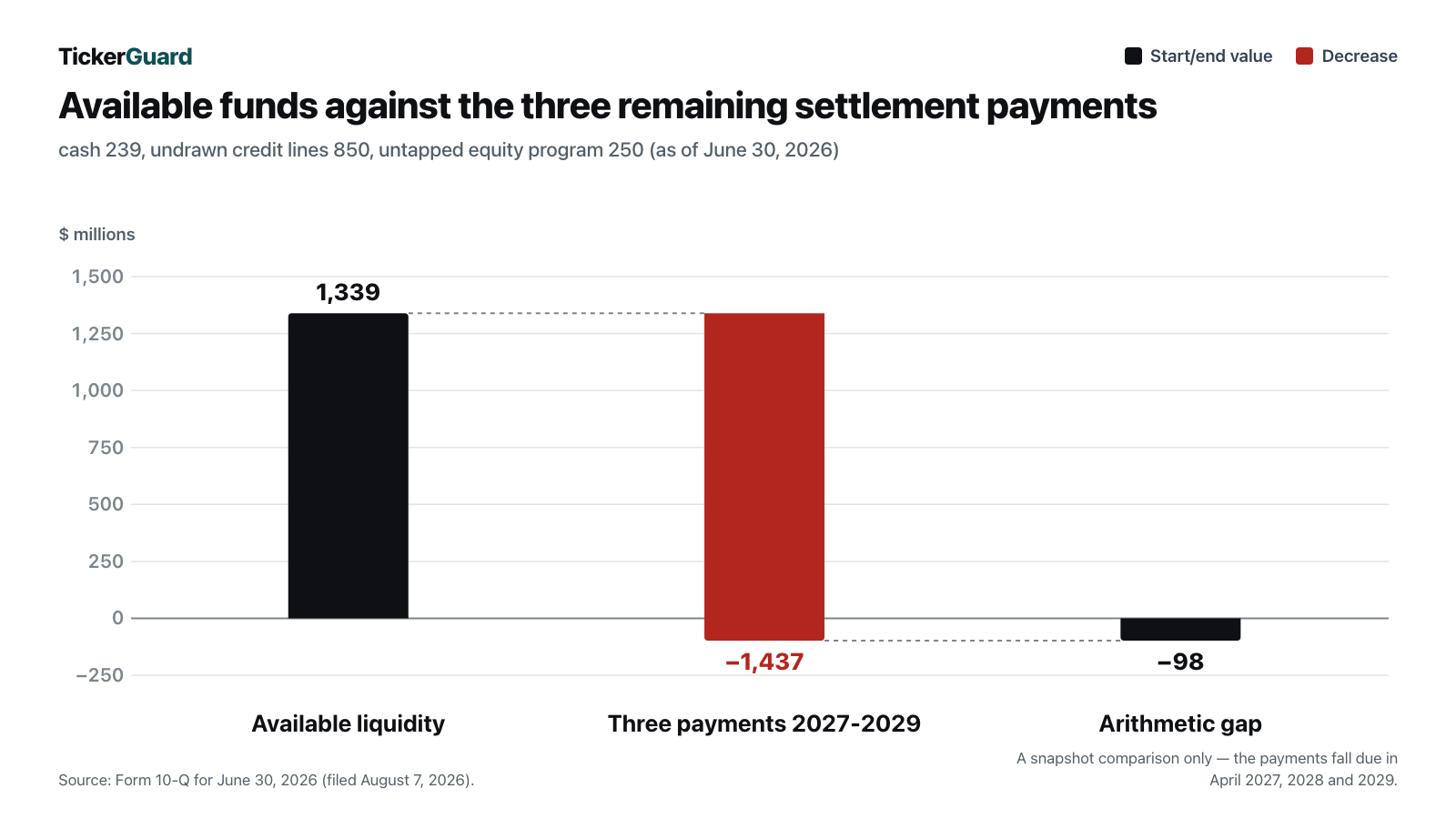
This comparison is deliberately rough and should not claim more than it shows: it puts a single reporting date against a three-year schedule. In between, the utility keeps earning. But it makes the order of magnitude visible — and it shows that a large part of the "available liquidity" is not money at all, but permission to borrow ($850 million of credit lines) or to sell new shares ($250 million). Both cost today's shareholders something.
The first half of 2026 shows what one installment feels like: operating cash flow was minus $350 million, because the $479 million payment runs through that line. That is not a warning signal in itself — it is the installment, made visible.
And that $50 million is a look backwards, not a promise for the installment years. The investor presentation of September 8, 2026 contains the group's own capital plan, and it doubles the previous pace: after $347 million (2024) and $368 million (2025), the plan calls for $700 million to $750 million in 2026, roughly $700 million to $800 million in 2027 and roughly $750 million to $850 million in 2028 — $2.2 billion to $2.4 billion over three years. Arithmetically that settles it: in exactly the years the installments fall due, nothing is left over from operations; free cash flow turns negative. The group does say where the money is meant to come from — the 2025 debt issuance, retained earnings and a planned securitization. That does not contradict the calculation above; it sharpens it. The installments and the capital program compete for the same till.
Uncomfortable truth no. 3: the company itself says the financing is not settled
Nothing has to be inferred here. The filing spells it out:
"The Company is currently working with its financial advisors on a financing plan to raise the additional capital necessary to fund the remaining settlement payments for the wildfire tort claims. While management believes the Company will be able to raise the necessary capital, there is no assurance that management's plans will be successful. If the financing plans are unsuccessful, the Company may need to consider other strategic alternatives."
— Hawaiian Electric Industries, Form 10-Q for June 30, 2026, "Liquidity and capital resources"
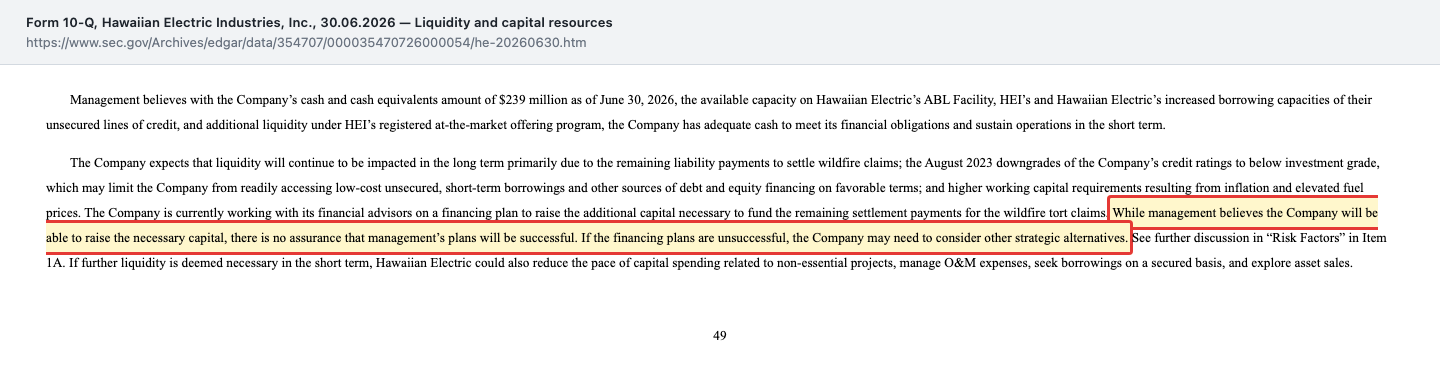
"Other strategic alternatives" is a set phrase in American filings, and it is rarely good news for shareholders: it covers selling business units, large equity raises and, in the extreme, selling the whole company. For the short term the filing also names the obvious brakes: slower capital spending on non-essential projects, tighter operating expenses, secured borrowings and asset sales.
Fairness demands the counterweight: as of June 30, 2026 all financial covenants were met, and the group expressly expects to remain in compliance over the next twelve months. Nothing was drawn on the credit lines and no commercial paper was outstanding. This is not a company at the edge. It is a company with a very large, very fixed invoice and a plan that is only now taking shape.
That shape is brand new. On September 8, 2026 HEI furnished an investor presentation to the SEC (Form 8-K, Item 7.01) and, for the first time, wrote down where each installment is meant to come from. The slide is headed "Maintaining Solid Liquidity as Financing Plan Progresses," and beneath it sits the payment calendar with four bars, each carrying a funding source:
- the $75 million for the One ‘Ohana Initiative: reimbursed by insurance;
- the first installment in 2026: paid out of the 2024 equity offering — the bill existing shareholders have already settled;
- the second installment in April 2027: "To be funded by debt / convertible debt";
- the third and fourth installments in 2028 and 2029: "To be funded by mix of capital".
That is genuine news relative to the quarterly report, and it reads as good news rather than bad: the next installment is shaping up to be debt-funded rather than a plain issue of new shares. Two caveats belong beside it. First, the slide carries its own footnote: financing and timing may still change "based on capital market conditions and other factors." Second, a convertible bond is not a dilution-free solution but a deferred one — it is debt carrying the right to swap into shares later, so the dilution simply arrives a few years on, at a conversion price fixed today. And for the last two installments, $958 million together, "mix of capital" is all that has been said so far. The wording in the quarterly report — no assurance, and failing that "other strategic alternatives" — has not been withdrawn; it has merely become a little more concrete.
Uncomfortable truth no. 4: a dividend stock without a dividend
For decades Hawaiian Electric was exactly what investors buy utilities for: a dependable dividend payer. That ended in the summer of 2023.
"In August 2023, in consideration of the potential impact from the Maui windstorm and wildfires, the HEI Board of Directors voted to suspend the quarterly cash dividend, starting after the second quarter 2023 dividend, and has not declared a cash dividend since that time."
— Hawaiian Electric Industries, Form 10-Q for June 30, 2026, "Dividends"
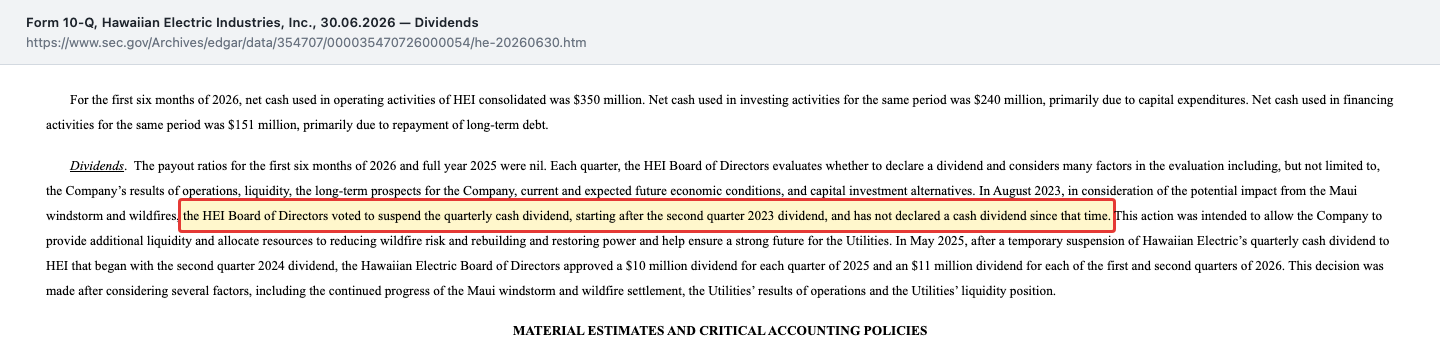
The contrast one level down is instructive: the subsidiary Hawaiian Electric has been paying its parent again since May 2025 — $10 million per quarter in 2025 and $11 million in each of the first two quarters of 2026. The money stays in the group. It simply does not reach shareholders; it moves toward the outstanding installments.
Then there is the second bill existing holders have already paid: in September 2024 HEI sold 62.2 million new shares for net proceeds of about $557.7 million — money used exclusively for the first settlement installment. A further at-the-market program of $250 million has been available since September 2024 and was untouched as of June 30, 2026. Shares outstanding stood at 172,728,004 as of July 31, 2026.
Uncomfortable truth no. 5: the ratings improved — and are still deep in junk territory
This is the good news with an asterisk. Moody's upgraded HEI on April 21, 2026 and S&P on July 22, 2026. Here is the result:
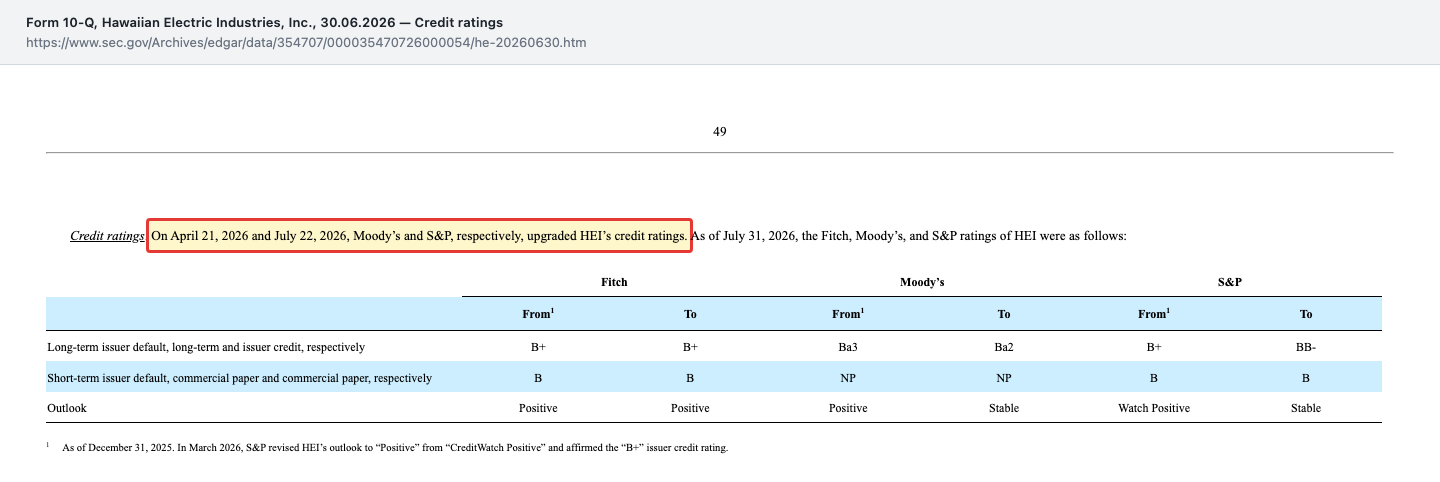
For orientation: investment grade begins at Baa3 at Moody's and BBB- at S&P. HEI sits two and three notches below that at Ba2 and BB-, with the subsidiary Hawaiian Electric slightly better at Ba1 and BB-. In plain terms: the bank still lends, but at a premium. The filing says as much itself — the August 2023 downgrades continue to limit access to low-cost unsecured capital, and the wider credit spreads remain.
Why that matters especially here: each of the three outstanding installments will have to be financed partly with debt. One rating notch decides millions in interest — and, in the worse case, whether a bond can be placed at all. Chief Executive Scott Seu says exactly that in the August 7, 2026 earnings release: stronger credit ratings lower the cost of borrowing, which ultimately improves customer affordability.
There is a third piece of good news that should not be left out: in 2025 the State of Hawaii passed three statutes that back the utility — Act 191 (the state can step in on power purchase agreements in the event of financial distress), Act 258 (a study of a wildfire relief fund, a liability cap and authority to securitize) and Act 301 (the state's share of the settlement). And on June 25, 2026 the regulator approved cost recovery of up to $350 million for the 2025 to 2027 wildfire mitigation plan — though only effective once it has ruled on the planned securitization. Project costs incurred through June 30, 2026 amounted to roughly $101 million.
The group's most recent contract filing points the same way: on July 27, 2026 Hawaiian Electric signed a new power purchase agreement with Kalaeloa Partners L.P. for 208 megawatts of firm capacity over a 30-year term, reported on Form 8-K on July 31, 2026. The fixed capacity charge falls from $100 to $93 per kilowatt per year — roughly $1.5 million a year less across the full 208 megawatts. That order of magnitude says everything about the kind of news this is: a building block, not a turning point. The agreement also takes effect only once the regulator approves it, and it replaces the existing contract only when that one terminates, which is expected in early 2033.
The biggest earnings lever of the next two years sits elsewhere, though, and it belongs here because it is the counterweight to everything above: the rate case. On July 17, 2026 the utility re-submitted its rate rebasing application in a new docket (2026-0162). It asks for $125.0 million of additional revenue for 2027 — $83.2 million of inflation adjustment and $46.9 million for higher insurance premiums, netted against $5.1 million of operating cost reductions — plus a further $44.8 million for 2028 from a depreciation adjustment, a total of $169.8 million. The company itself proposes an interim decision by December 18, 2026 so that new rates can take effect on January 1, 2027. For scale: income available for common stock was $123.1 million in 2025. None of it is approved yet — the presentation states plainly that there is no assurance the increase will be authorized, and that a disallowance or delay could have a material effect.
Uncomfortable truth no. 6: a week after the quarterly report, the next storm arrived
Anyone writing about an island utility has to expect the weather to intervene. That is exactly what happened here — and it happened after the quarterly report, which is why none of the balance sheet figures quoted so far reflect it.
From August 14 to 16, 2026, Hurricane Lala tracked across the southern part of the island chain. In its September 8, 2026 investor presentation the group describes "extensive statewide damage." At the peak on August 16, 41.6 percent of all customer accounts in the service territory were without power — the largest share of that on Oahu, where most of the group's customers live. On August 25, 2026 the President signed an emergency declaration in view of the severity of the damage.
Restoration moved fast: more than 95 percent of affected customers had power back by August 19. While repairing, the utility is swapping copper conductors for aluminium in high wildfire-risk areas — the repair doubles as a hardening measure.
The bill, as estimated on September 4, 2026: operating and maintenance costs from Lala run to $15 million to $20 million; together with the Kona low storms earlier in the year the figure is $25 million to $30 million. On top of that come $30 million to $40 million of capital expenditure. The group expects that roughly 20 to 25 percent of the storm-related operating costs may be classified as non-incremental and therefore not recoverable; for the rest it intends to file a deferral request in 2026 and a recovery request later. The company itself notes that these are management estimates, that they could change materially, and that they do not reflect any potential insurance recoveries.
For scale, so the number does not loom larger than it is: even the upper estimate of $30 million of operating cost is small against annual revenue of roughly $3.1 billion. Measured against the roughly $50 million that was left over after investment in 2025 it is not — in the unfavourable case a single storm swallows more than a third of that. And that is the point beyond the specific sum: the physical baseline risk of this utility did not disappear with the settlement. It returns every hurricane season. The group's 2026 to 2028 capital plan appeared in that same presentation with an explicit note that it reflects the August 7 outlook and does not yet include Lala.
Valuation: why the low price-earnings ratio misleads here
At this analysis's price anchor — $11.09, the closing price of September 4, 2026 — and 172,728,004 shares, the market capitalization comes to roughly $1.92 billion. Three ratios follow, and all three look friendly at first: a price-sales ratio of about 0.58, a price-book ratio of about 1.09 (common equity of $1,763 million, or $10.21 per share) and a price-earnings ratio of about 8.6.
That 8.6 is the trap. It rests on trailing twelve-month earnings of roughly $224 million (fiscal 2025: $123.1 million, plus the first half of 2026: $153.7 million, less the first half of 2025: $52.8 million), or $1.30 per share. Inside that $224 million sit the $101 million from discounting — not cash, but a reclassification. Strip it out and roughly $123 million remains, about $0.71 per share, putting the price-earnings ratio at roughly 15.6. That is no longer a bargain multiple; it is the ordinary price of a utility — one that owes $1.437 billion.
There is more: the book gain was not only cash-free, it comes back. The discounted liability accretes through interest expense to its full amount by the due dates. In the second quarter of 2026 that already cost $18 million of interest expense.
The professionals are correspondingly cautious: of three recorded ratings as of September 8, 2026, two were hold and one strong sell, with a mean target price of $11.92 — roughly where the stock trades. The 52-week range ran from $10.79 to $17.38. Readers interested in how predictable power generation revenue really is will find the same underlying conflict from another angle in our analysis of Energiekontor.
Opportunities and risks at a glance
Opportunities
- A genuine monopoly with regulated revenue: about 1.4 million people served, roughly 95 percent of Hawaii's population, an authorized return on equity of 9.5 percent, and fuel costs passed through with the utility's own exposure capped at roughly $3.7 million a year.
- The big litigation is settled as to amount: the settlement became fully effective on April 10, 2026 and the sum is fixed. The shareholder derivative actions are finally resolved — final approval on May 28, 2026, judgment final on June 29, 2026, funded entirely by $100 million of directors and officers liability insurance. The securities class action is settled for $47.8 million out of that same insurance and was preliminarily approved on March 3, 2026; the final approval hearing is set for September 24, 2026.
- Political backing: the 2025 statutes Act 191, Act 258 and Act 301 backstop power purchase agreements, open the door to securitization and settle the state's share of the settlement.
- A rate increase of $169.8 million requested: $125.0 million for 2027 and $44.8 million for 2028, filed on July 17, 2026 (docket 2026-0162), with a proposed interim decision by December 18, 2026 and new rates from January 1, 2027. None of it is approved yet.
- Credit quality on the way up: two upgrades in 2026 (Moody's on April 21, S&P on July 22), with positive to stable outlooks. Every further notch lowers the interest cost of the remaining financing.
- An investment program with approved recovery: up to $350 million of cost recovery for the 2025 to 2027 wildfire mitigation plan, plus the procurement filed in July 2026 for nearly 1,650 gigawatt-hours of variable renewable energy, 465 megawatts of grid-forming resources and 111 megawatts of firm capacity — invested capital on which a regulated utility earns its return.
Risks
- A fixed $1.437 billion payment schedule through April 2029 — roughly three quarters of the market value, with no contribution from customers.
- The financing plan is only half drawn: for the 2027 installment the September 8, 2026 presentation names debt or convertible debt; for 2028 and 2029 only a "mix of capital." The quarterly report still says "no assurance" and, in the event of failure, "other strategic alternatives."
- The capital program and the installments compete for the same till: $2.2 billion to $2.4 billion of planned capital expenditure for 2026 to 2028 after $368 million in 2025 — in exactly the installment years, arithmetically nothing is left over from operations.
- Dilution: a $250 million at-the-market program stands ready after a 57 percent increase in shares since 2023.
- No dividend since the payment for the second quarter of 2023 — the classic holding premium of a utility is gone.
- Residual litigation risk: approximately 80 plaintiffs opted out of the settlement; $500 million of the settlement total is held back for them, which the company projects will be sufficient.
- The physical risk remains — and has just shown itself again: five isolated island grids, drought and wind. Hurricane Lala left 41.6 percent of all customer accounts without power at its peak on August 16, 2026 and led to a presidential emergency declaration on August 25. Add the wildfire safety shutoffs that weigh on reliability and customer experience. Remaining property insurance coverage stood at $489.6 million as of December 31, 2025.
- Cost pressure this year: the group expressly expects adjusted operating and maintenance expense in 2026 to significantly outpace inflation — higher insurance premiums, more vegetation management and costlier cyber defenses. Plus the storms: $25 million to $30 million of operating cost from Lala and the Kona lows and $30 million to $40 million of capital expenditure (estimate of September 4, 2026), of which roughly a fifth to a quarter may not be recoverable.
A human conclusion
Back to the everything-is-known trap. It works so well because it is half right. At Hawaiian Electric a great deal genuinely is known: the settlement amount is fixed, the litigation is decided as to size, the side proceedings are closed apart from final approval of the securities class action, the state is helping with legislation, the credit ratings are climbing again. And the business underneath is honest work — electricity for 1.4 million people, every day, on five island grids with no mainland to fall back on.
What the trap leaves out is the difference between known and paid. The invoice has been known since November 2024. A quarter of it has been paid. The remaining $1.437 billion is not a risk in the sense of a probability — it is a date. Three dates, to be precise: April 2027, April 2028, April 2029. And the question this analysis cannot answer, because the company has not answered it either, is: who pays? New lenders, new shareholders — or today's shareholders, through a smaller stake in the same firm?
For some this is the classic special situation: you buy a monopoly that is working off a one-time burden and wait until the burden is gone. For others it is a bet on how far the stake is diluted by 2029. Both readings rest on the same numbers — which is why there is no recommendation here.
What you make of it is your decision. And that is exactly as it should be.
Sources
- Hawaiian Electric Industries, Inc. — quarterly report (Form 10-Q) for June 30, 2026, filed August 7, 2026 (SEC EDGAR, CIK 0000354707)
- Hawaiian Electric Industries, Inc. — annual report (Form 10-K) for 2025, filed February 27, 2026
- Hawaiian Electric Industries, Inc. — annual report (Form 10-K) for 2024, filed February 24, 2025
- Hawaiian Electric Industries, Inc. — quarterly report (Form 10-Q) for March 31, 2026, filed May 8, 2026
- Investor presentation "September 2026 Investor Meetings" — Exhibit 99 to the current report (Form 8-K, Item 7.01) of September 8, 2026 (funding plan for the 2027 to 2029 installments, first cost estimate for Hurricane Lala)
- Earnings release "HEI Reports Second Quarter 2026 Results" — Exhibit 99 to the current report (Form 8-K, Item 2.02) of August 7, 2026
- Current report (Form 8-K, Item 1.01) of July 31, 2026 — new 208 megawatt power purchase agreement with Kalaeloa Partners L.P.
- Fundamental data (ratios, price history, analyst coverage), as of September 8, 2026
Journalistic analysis, not investment advice and not a solicitation to buy or sell securities. Stocks can lose their entire value; that is especially true of a company carrying billions of dollars in outstanding payment obligations. All figures come from the original sources named above and carry the as-of date stated there. The author holds no position in the stock discussed at the time of publication.
Key figures at a glance
All monetary figures in millions of $; earnings per share as reported.
| Metric | 2021 | 2022 | 2023 | 2024 | 2025 |
|---|---|---|---|---|---|
| Revenue | 2,850.4 | 3,420.9 | 3,287.5 | 3,219.9 | 3,086.9 |
| Operating Income (EBIT) | 386.1 | 279.6 | 275.0 | -1,706.8 | 235.3 |
| Net Income | 246.2 | 241.1 | 199.2 | -1,424.1 | 126.3 |
| Net Margin | 8.6% | 7.0% | 6.1% | -44.2% | 4.1% |
| Earnings Per Share | 2.25 $ | 2.20 $ | 1.81 $ | -11.22 $ | 0.73 $ |
Source: fundamental data & SEC filings (annual and quarterly reports, 10-K/10-Q)
Our Bottom Line at a Glance
- Business model positive
- A regulated monopoly in the literal sense: three island utilities supply about 1.4 million people, roughly 95 percent of Hawaii's population, across five separate grids with no interconnection to the mainland. Revenue was $3,086.9 million in 2025 and cash from operations $391.1 million. Fuel costs are largely passed through, with the utility's own exposure capped at roughly $3.7 million a year.
- Settlement obligation negative
- Three installments of $479 million each fall due through April 2029 — a nominal $1.437 billion, and thus roughly three quarters of the $1.92 billion market capitalization; on the balance sheet they are carried at a present value of $1.30 billion as of June 30, 2026. Electricity customers expressly contribute nothing; the burden falls entirely on the owners.
- Financing negative
- Against that schedule stood roughly $50 million of free cash flow in 2025 ($391.1 million from operations less $341.2 million of capital expenditure) — and for 2026 to 2028 the group itself plans $2.2 billion to $2.4 billion of capital expenditure, which arithmetically leaves nothing over in the installment years. The Form 10-Q for June 30, 2026 states there is "no assurance" the financing plan will succeed and that failure would mean considering "other strategic alternatives." Available liquidity at the reporting date was $1,339 million, including $239 million of cash.
- Earnings quality negative
- The $123.2 million of net income in the second quarter of 2026 includes $101 million of non-cash gain from discounting the settlement liability. That book gain reverses as accretion expense through 2029. The company's own core measure fell from $35 million to $22 million in the same quarter.
- Balance sheet and ratings neutral
- Common equity rose from $1,606 million to $1,763 million between December 31, 2025 and June 30, 2026 and carries 44 percent of the capital structure; all financial covenants were met at the reporting date. Moody's and S&P upgraded twice in 2026, to Ba2 and BB- respectively — still below investment grade. Operating income covered net interest expense roughly twice in 2025 ($235.3 million against $117.3 million, our calculation).
- Shareholder return negative
- The dividend has been suspended since the payment for the second quarter of 2023, with a payout ratio of nil in 2025 and the first half of 2026. The weighted-average share count rose from 109.7 million (2023) to 172.6 million (2025), up 57 percent. A $250 million at-the-market program sits ready and untouched.
Hawaiian Electric is the everything-is-known trap in its purest form: the operating business is a regulated monopoly that earned $123.1 million again in 2025 and took in $391.1 million from operations — and yet the payment calendar through April 2029 shows a fixed schedule of $1.437 billion that no electricity customer helps carry. The company itself writes that the financing for those installments is not yet in place. Dividend suspended, share count up 57 percent since 2023, ratings still below investment grade despite two upgrades in 2026: buying here means buying a good business with an open invoice — and betting on how much of your stake survives the final payment. Not investment advice.
What Our Rating Means
Open questions
The business works in principle, but one material question is open. As long as it stays open, our findings do not carry a quality verdict.
Yellow judges the company, not the share price. Green is ruled out by one unanswered question: three installments of $479 million each through April 2029 stand against a business that left roughly $50 million over after investment in 2025 and that plans $2.2 billion to $2.4 billion of capital expenditure for 2026 to 2028; the Form 10-Q for June 30, 2026 itself states there is "no assurance that management's plans will be successful." Red is ruled out because none of the substance findings that grade demands is present — not one: no current going-concern language — substantial doubt did in fact exist in the second quarter of 2024 and was resolved in the third quarter of 2024, and the 2025 annual report still carries the possibility as a risk factor —, common equity positive and up from $1,606 million to $1,763 million, operating income covering net interest expense roughly twice in 2025, all financial covenants met as of June 30, 2026 with an express expectation of continued compliance over the next twelve months, $1,339 million of available liquidity against $479 million due in April 2027, positive operating cash flow in fiscal 2025 and two credit rating upgrades during 2026. Price and valuation were expressly excluded from this judgment; those are price arguments. What remains is a material open question: until the financing for the remaining installments is settled, shareholder value depends on whether the gap is closed with new shares, new debt or asset sales. Add a going-concern note, a breached covenant or a failed offering and red would be the right grade. The decision is yours.
A journalistic assessment by our editorial team at the time of the deep dive, based on public sources — not investment advice and not a solicitation to buy or sell. Your personal circumstances (investment goals, risk capacity, taxes) cannot be taken into account. What our levels mean, how verdicts are formed, and what conflicts of interest exist →
Worth Noting
- HE reached our research list through the second-quarter 2026 earnings release of August 7, 2026 (Form 8-K, Item 2.02): a quarterly profit of $123 million, $101 million of which came from a non-cash remeasurement, is a reason to open the filing itself.
- Every figure in this analysis comes from original SEC documents (Form 10-Q for June 30, 2026, filed August 7, 2026; Forms 10-K for 2025 and 2024; Form 10-Q for March 31, 2026; Forms 8-K of July 31, August 7 and September 8, 2026). Two further documents were filed after the quarterly report and both have been evaluated — most recently, on September 8, 2026, an investor presentation that for the first time quantifies where the 2027 to 2029 installments are meant to come from and estimates the cost of Hurricane Lala. The price anchor of $11.09 is the closing price of September 4, 2026 and deliberately not an intraday quote.
- Revenue and earnings series are deliberately limited to 2023 through 2025 and shown on a continuing-operations basis: the sale of American Savings Bank on December 31, 2024 is treated retrospectively as a discontinued operation, so older group figures measure something different. Including the bank, income for common stock was $199.2 million in 2023 and minus $1,426.0 million in 2024.
- Easily confused: Hawaiian Electric Industries, Inc. (NYSE: HE) is the listed holding company. Its subsidiary Hawaiian Electric Company, Inc. files jointly with the parent but is not listed — the holding company owns all 17,854,278 of its shares. Figures labelled "Hawaiian Electric" in quarterly reports often refer to the subsidiary rather than the group.
Stock Watch
This analysis is as of September 8, 2026. Stock Watch will tell you what's changed at HE since then.
Later $1 a month per stock — signing up is free, and you'll be the first to know when it launches.
The full analysis as a PDF for later
We will send you this analysis as a PDF — to print, file away, and read at your own pace. And we will add you to the free Stock Watch list for Hawaiian Electric Industries Inc (HE), so you hear about it when something material in this analysis changes.
Frequently Asked Questions
Hawaiian Electric Industries, Inc. (NYSE: HE), headquartered in Honolulu, is the holding company above three island utilities: Hawaiian Electric, Hawaii Electric Light and Maui Electric. They generate, purchase, transmit and sell electricity on every principal Hawaiian island except Kauai, serving about 1.4 million people, roughly 95 percent of the state population. Since the sale of American Savings Bank on December 31, 2024 the group has had a single reportable segment.
HEI and Hawaiian Electric are obligated to contribute a total of $1.99 billion under the settlement agreements, including $75 million already paid into the One 'Ohana Initiative. The first of four equal annual installments of about $479 million was paid on April 10, 2026. The three remaining installments — a nominal $1.437 billion — fall due in April 2027, 2028 and 2029. They are carried at a present value of $1.30 billion as of June 30, 2026.
No. The board suspended the quarterly cash dividend on HEI common stock in August 2023, starting after the second-quarter 2023 payment, and has not declared one since. The payout ratio was nil for fiscal 2025 and for the first six months of 2026. The subsidiary Hawaiian Electric, by contrast, resumed paying its parent: $10 million per quarter in 2025 and $11 million in each of the first two quarters of 2026.
Because most of the jump came from an accounting entry rather than operations. After the settlement became fully effective in April 2026, the utilities remeasured the remaining liability at present value, cutting it from $1.44 billion to $1.30 billion. That produced a non-cash gain of $101 million after tax. Excluding it, the company's own core measure showed only $22 million for the quarter, down from $35 million a year earlier.
Still below investment grade, but better than in 2023. As of July 31, 2026 Fitch rated the holding company HEI at B+, Moody's at Ba2 and S&P at BB-; the subsidiary Hawaiian Electric stood at BB-, Ba1 and BB-. Moody's upgraded on April 21, 2026 and S&P on July 22, 2026. The company notes that the August 2023 downgrades continue to limit its access to low-cost capital.
No. The Form 10-Q for June 30, 2026 states expressly that customers will not be impacted by payments related to the settlement agreements; rate-making calculations remove those effects. The burden therefore falls on the owners — through retained earnings, new debt or new shares. For the wildfire mitigation investments themselves, by contrast, the regulator approved recovery of up to $350 million on June 25, 2026.
At first glance yes, on closer inspection hardly. At the September 4, 2026 anchor of $11.09 the market capitalization is roughly $1.92 billion, the price-earnings ratio about 8.6 and the price-book ratio about 1.09. But the low earnings multiple rests on the $101 million book gain from discounting the settlement liability. Strip that out and the ratio works out at roughly 15.6 — an ordinary utility multiple.
The Form 10-Q for June 30, 2026 names the possibility outright: management is working with financial advisors on a financing plan, there is no assurance it will succeed, and if it fails the company may need to consider other strategic alternatives. As short-term brakes the filing lists slower capital spending on non-essential projects, tighter operating expenses, secured borrowings and asset sales. All financial covenants were met as of June 30, 2026.
Found an error?
Did you spot a factual error, an outdated number, or a typo in this deep dive? Let us know briefly — your report goes straight to the editorial team.