Babcock & Wilcox: $2.4 Billion for Four Power Plants — And Why Only a Sliver Belongs to the Company
A boiler maker whose name dates to 1867 was staring at insolvency in 2024. Today its order book holds a $2.4 billion contract: four 300-megawatt gas-fired power plants for an AI factory. The backlog jumped from $405.6 million to $2,569.0 million in twelve months. But the quarterly report for the period ended June 30, 2026 spells out the fine print: $2.0 billion of the $2.4 billion is reimbursable cost plus mark-up — money that flows through the company rather than staying in it. Add 10.46 million shares the customer may buy at $4.11, and a large shareholder who collected $18.1 million in fees in the first half alone. We read the filings to see how much of a billion-dollar headline actually reaches the company.
 Thomas Mücke
Founder & Publisher
Thomas Mücke
Founder & Publisher
As of Today
As of: September 29, 2026
- Closing price
- 5.80 $ +1.00%
- Market Capitalisation
- 0.8 $B
- Growth Score
- 3/10
- AAQS
- 3/10
This analysis has a cut-off date. The Stock Guard tells you when something material changes in the numbers. Reserve your free spot
Chart
Interactive price chart (TradingView).
52-week range: 2.70 $ to 21.90 $ · Last price: 5.80 $ (As of: September 29, 2026)
Note: pure fact-based analysis, not investment advice and not a solicitation to buy or sell. All figures without guarantee.
There is an investor trap that springs shut whenever a number is bigger than the company reporting it: the sluice trap. It works like this. On a good day, millions of cubic metres of water pour through a canal lock. Anyone standing beside it thinks: what a fortune. None of it belongs to the lock keeper. What belongs to him is the toll. That is exactly how the headline reads at Babcock & Wilcox Enterprises (NYSE: BW), a boiler maker in Akron, Ohio, whose lineage runs back to 1867: "$2.4 billion order for four gas-fired power plants serving an AI factory." That is more than the company is worth on the stock market. The brain converts it into wealth automatically. The quarterly report for the period ended June 30, 2026 does the arithmetic differently. So let us make a deal: before you buy the big number, we read together what Babcock & Wilcox told the U.S. Securities and Exchange Commission — the quarterly report (10-Q) for the period ended June 30, 2026, the annual report (10-K) for 2025, the prospectus supplement for the May 2026 equity offering and the earnings release of August 10, 2026. An SEC filing is honest under penalty of law. And this one tells a story of a genuine rescue from genuine distress, of an order book that grew sixfold — and of how much of a billion-dollar headline flows through the lock without staying there. In the end you decide for yourself.
What Babcock & Wilcox actually builds — boilers, steam, flue gas cleaning
Babcock & Wilcox is not a technology company. It is heavy engineering. Here is the business in everyday terms: a power plant is essentially a very large kettle. You burn something — coal, natural gas, waste, biomass — heat water into high-pressure steam, and the steam drives a turbine that produces electricity. Babcock & Wilcox builds the kettle: steam generators and boilers, plus the piping, the flue gas cleaning equipment (nitrogen oxide and sulphur removal, particulate capture) and carbon dioxide capture technology. A second, quieter leg is at least as important: spare parts and maintenance for the installed base worldwide. The company says it has supplied equipment in more than 90 countries; every one of those plants eventually needs new tube bundles, new burners, new filters. That aftermarket business carries better margins and keeps running even when nobody orders a new plant. Since its reorganisation the group reports in a single segment, employed roughly 1,650 people as of December 31, 2025 (about 1,600 of them full-time), and manufactures in the United States, Canada and Mexico.
The corporate history is unusually long and unusually broken up. The name comes from George Babcock and Stephen Wilcox, who patented a water-tube boiler in 1867; today's listed entity was only created in 2015, when the power generation business was spun off from the nuclear technology group BWXT. Anyone who confuses BW with BWXT is confusing two very different companies. And that frames the central tension of this analysis, which runs through every chapter: a 159-year-old industrial company that has only just escaped insolvency lands the largest order of its recent history — from a single customer riding the data center boom, and on terms that pass most of the contract value straight through.
Where this stock landed on our desk
Babcock & Wilcox did not come to us through a valuation or quality screener, but through the Reddit hype scanner, which counts how often individual tickers are mentioned in retail investor forums (ApeWisdom, as of August 14, 2026). That is the honest account of where this analysis came from — and it is itself a warning sign: where there is a lot of talk, there is rarely much reading. Conventional metrics only get you so far here. There is no meaningful price-to-earnings ratio, because the trailing twelve months show a loss. The price-to-sales ratio sits at roughly 1.7 (market capitalization of about $1.4 billion against $834.4 million of trailing twelve-month revenue, data as of August 14, 2026) — not cheap for a plant builder, but not absurd either. And the price-to-book ratio, with equity at $57.4 million, is arithmetically enormous yet close to meaningless, because that equity has only just climbed back out of a deep hole. So note this from the start: at Babcock & Wilcox you measure with the order book and the balance sheet, not with multiples. Let us start with the order book.
The numbers over the years — given their due
First what genuinely speaks for the company — and that is considerably more than the net loss suggests. Revenue from continuing operations was remarkably immobile for years: $587.4 million (2023), $581.0 million (2024), $587.7 million (2025). Three years drawn with a ruler. Operating income over the same stretch moved from minus $20.1 million (2023) through minus $6.3 million (2024) to plus $20.7 million (2025) — cost cutting worked before growth arrived. Then growth arrived. In the second quarter of 2026 revenue reached $319.7 million against $138.9 million a year earlier, a 130 percent increase. The bottom line showed net income of $14.3 million after a $58.5 million loss a year before, and adjusted EBITDA rose to $21.8 million from $13.9 million. With the earnings release of August 10, 2026 the company raised the top end of its full-year adjusted EBITDA target to a range of $80.0 million to $105.0 million.
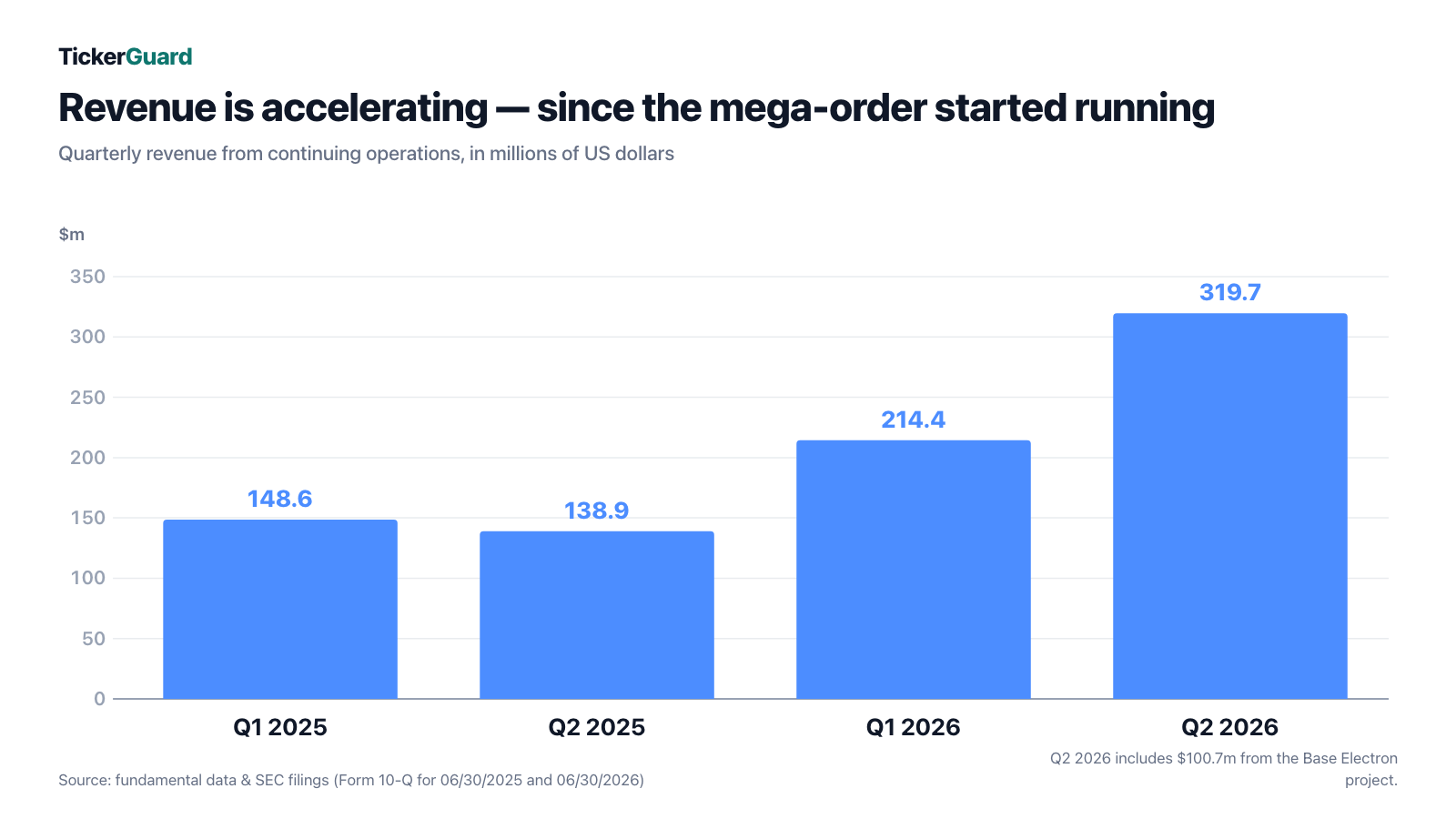
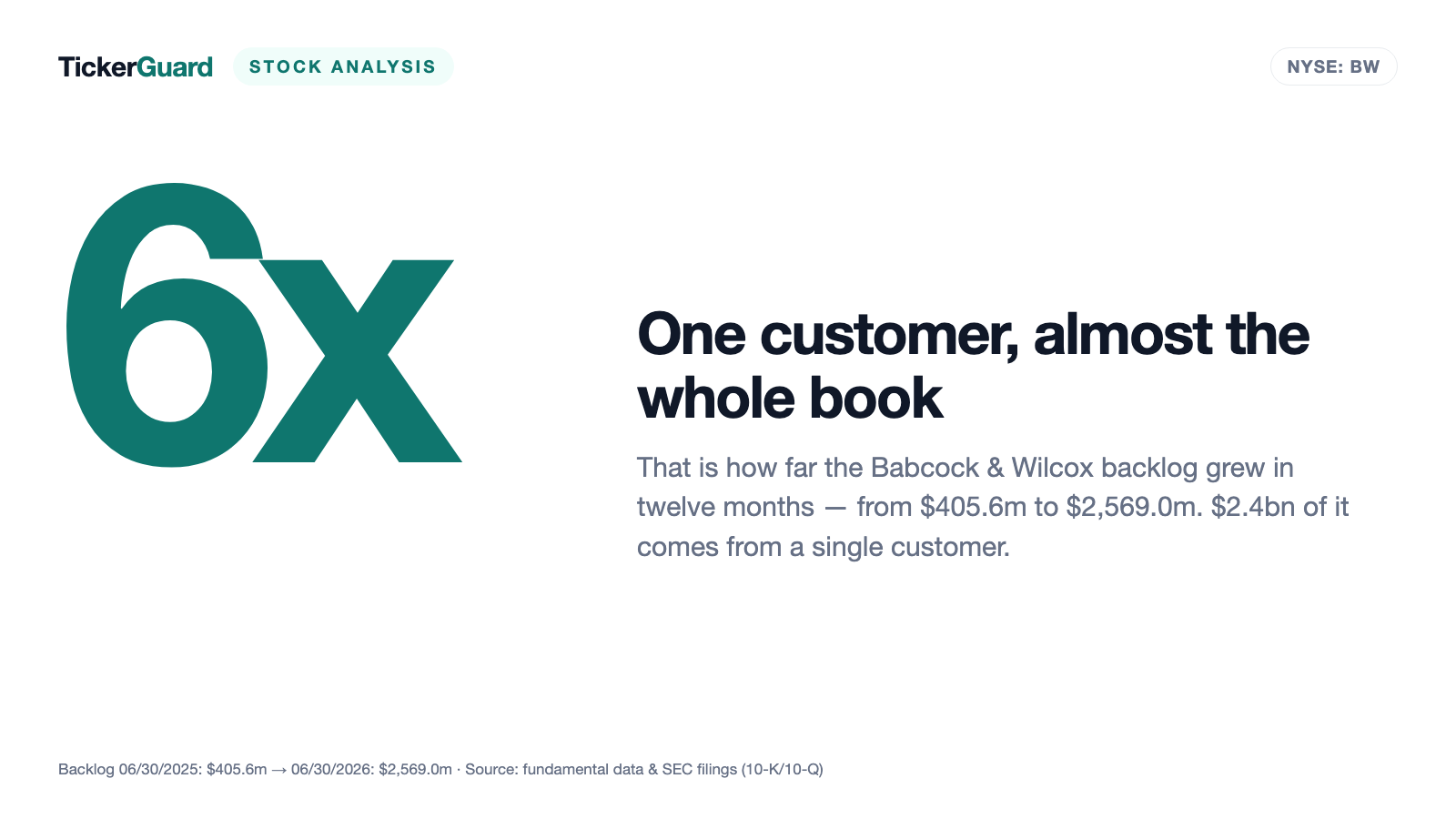
More striking than revenue is the backlog — the total of work already under contract but not yet performed. It stood at $405.6 million on June 30, 2025 and at $2,569.0 million on June 30, 2026. Bookings in the first half of 2026 came to $2,663.0 million, of which the footnote in the quarterly report attributes $2.4 billion to Base Electron. Measured against the backlog, roughly 93 percent of the order book rests on one customer. The company expects to work it off at $403.8 million over the rest of 2026, $674.5 million in 2027 and $1,490.7 million thereafter; the plant is targeted to begin commercial operation in 2030. The balance sheet has turned as well: cash rose from $89.5 million (December 31, 2025) to $308.6 million (June 30, 2026), or $382.8 million including restricted cash, against secured debt and bonds of $239.8 million per the earnings release. Equity swung from minus $131.5 million to plus $57.4 million. On July 13, 2026 the board additionally authorised a share repurchase programme of up to $50 million — remarkable for a company that was fighting for survival eighteen months earlier.
Because that is the second piece of good news, and it is a big one: the substantial-doubt warning is gone. It was still in the annual report for 2024. The annual report for 2025 says this:
"Due to the various actions completed by management during 2025, including debt restructuring activities, repayment of outstanding debt balances, equity raises, and divestitures of non-core businesses, the Company’s liquidity, financial condition and capital structure improved as of December 31, 2025 and through the date of this Form 10-K filing. As a result, we have concluded that conditions and events no longer raise substantial doubt about the Company’s ability to continue as a going concern."
— Babcock & Wilcox Enterprises, Inc., SEC annual report 10-K for 2025, Note 2

That is no small thing. A going-concern warning is the formal sentence in which a company concedes it may not survive the coming year. Shedding one is hard work — and Babcock & Wilcox did it: between 2024 and the end of 2025 the group divested seven businesses (BWRS, SPIG, GMAB, Vølund, Diamond Power, Allen-Sherman-Hoff and the solar unit), exchanged old notes in May 2025 for new 8.75 percent notes maturing in 2030, and raised fresh money through share sales. The report names the exchange plainly: it was accounted for as a troubled debt restructuring, the treatment applied when creditors grant concessions to a distressed borrower. So much for the good half of the story. Now the other half.
What the filings say — the uncomfortable truths
Uncomfortable truth no. 1: of the $2.4 billion, $2.0 billion is pass-through cost
Here is the sentence the entire headline hangs on — and it sits not in a press release but in the notes to the quarterly report:
"The total consideration in exchange for completion of this project is $2.4 billion, of which $2.0 billion is for variable charges and the remaining is a fixed fee. The variable charges are based on reimbursable costs incurred plus mark-up."
— Babcock & Wilcox Enterprises, Inc., SEC quarterly report 10-Q for the period ended 06/30/2026, Note 6 "Revenue Recognition and Contracts"

Put it in everyday terms. Picture a builder putting up a house for $500,000. In one version he has agreed a fixed price — everything he saves on materials he keeps, everything that runs over comes out of his profit. In the other version the client pays the invoices for bricks, concrete and tradesmen and gives the builder a mark-up on top. The $500,000 appears in the contract either way, but in the second version the builder only earns the mark-up. That is precisely the structure at Base Electron: most of the $2.4 billion is materials and subcontracted work passing through the books of Babcock & Wilcox. It is not a bad contract — quite the opposite. A cost-reimbursable contract protects the contractor from the very hazard that has sunk plant builders for a century: mispricing a fixed-price job over a five-year build. But its effect on earnings is nothing like what the headline suggests. When the project delivered $100.7 million of revenue in the second quarter of 2026 while total operating income for the quarter was $11.8 million, you can see the order of magnitude. Remember this image: the order does not make Babcock & Wilcox rich, it makes it big — and those are not the same thing. For how far the data center boom is reshaping the supply chain, we have written about the customer itself and about other operators: see our analysis of Applied Digital and our piece on Riot Platforms.
Uncomfortable truth no. 2: the customer holds warrants — and their value moves against the company
The order came with a consideration attached. In November 2025 Applied Digital bought 0.5 million shares in a private placement for $2.0 million and additionally received two warrant packages: an initial warrant over 2.6 million shares and an additional warrant over 7.86 million shares, both at an exercise price of $4.11. Signing the definitive agreement vested the additional warrant in full; in March 2026, 5.23 million of the warrant shares were assigned to Base Electron. Together that is 10.46 million potential new shares — roughly 7 percent of the 148,965,066 shares outstanding as of August 4, 2026.
On the balance sheet these warrants are not equity but a liability, remeasured at every reporting date. The report spells out what that means:
"The Warrants are classified as liability-based awards which require calculation of fair value for each reporting period until settled or expired. As of June 30, 2026 and December 31, 2025, we calculated the fair value of the Initial Warrant at $34.0 million and $8.3 million, respectively, and as of June 30, 2026, we calculated the fair value of the Additional Warrant at $102.9 million … As a result, we recorded other income of $5.9 million for the three months ended June 30, 2026, and other expense of $64.4 million for the six months ended June 30, 2026 …"
— Babcock & Wilcox Enterprises, Inc., SEC quarterly report 10-Q for the period ended 06/30/2026, Note 14 "Capital Stock"
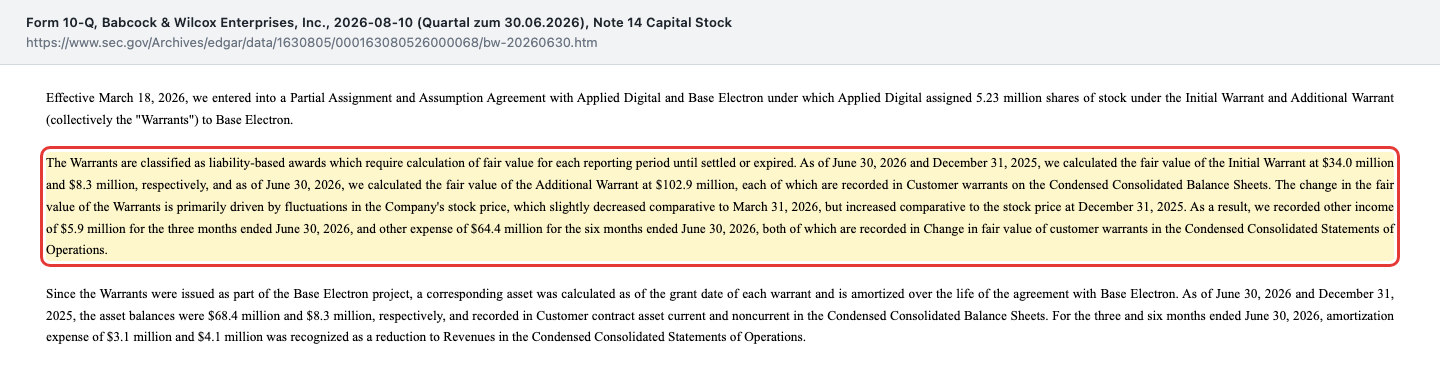
The direction of this mechanism is counter-intuitive and important: the better the stock performs, the more expensive the order becomes in the income statement. A rising share price lifts the fair value of the warrants, and the increase is booked as an expense. That explains the lopsided half-year picture: against operating income of $10.1 million, the first six months of 2026 show a net loss of $62.7 million — the bulk of it from that single non-cash line. In fairness: no money leaves the building, and in the second quarter the line even produced $5.9 million of income, because the share price slipped slightly against March 31, 2026. But the $136.9 million liability as of June 30, 2026 is more than double the entire $57.4 million of equity. Anyone reading this company's quarterly numbers is also reading its own share price.
Uncomfortable truth no. 3: the rescue was paid for in shares — the count has nearly doubled since 2022
Where did the $308.6 million of cash come from? Not from the business. Operating cash flow — the money the running operation actually produces — was $0.4 million in the first half of 2026. Not $0.4 billion. $0.4 million. The report explains it plainly: the half-year loss was offset by non-cash items, plus a $100.3 million increase in accounts payable — suppliers are financing the growth — which was in turn partly offset by a $60.9 million rise in receivables and a $30.5 million decline in advance billings. The cash in the bank came overwhelmingly from somewhere else: from shareholders.
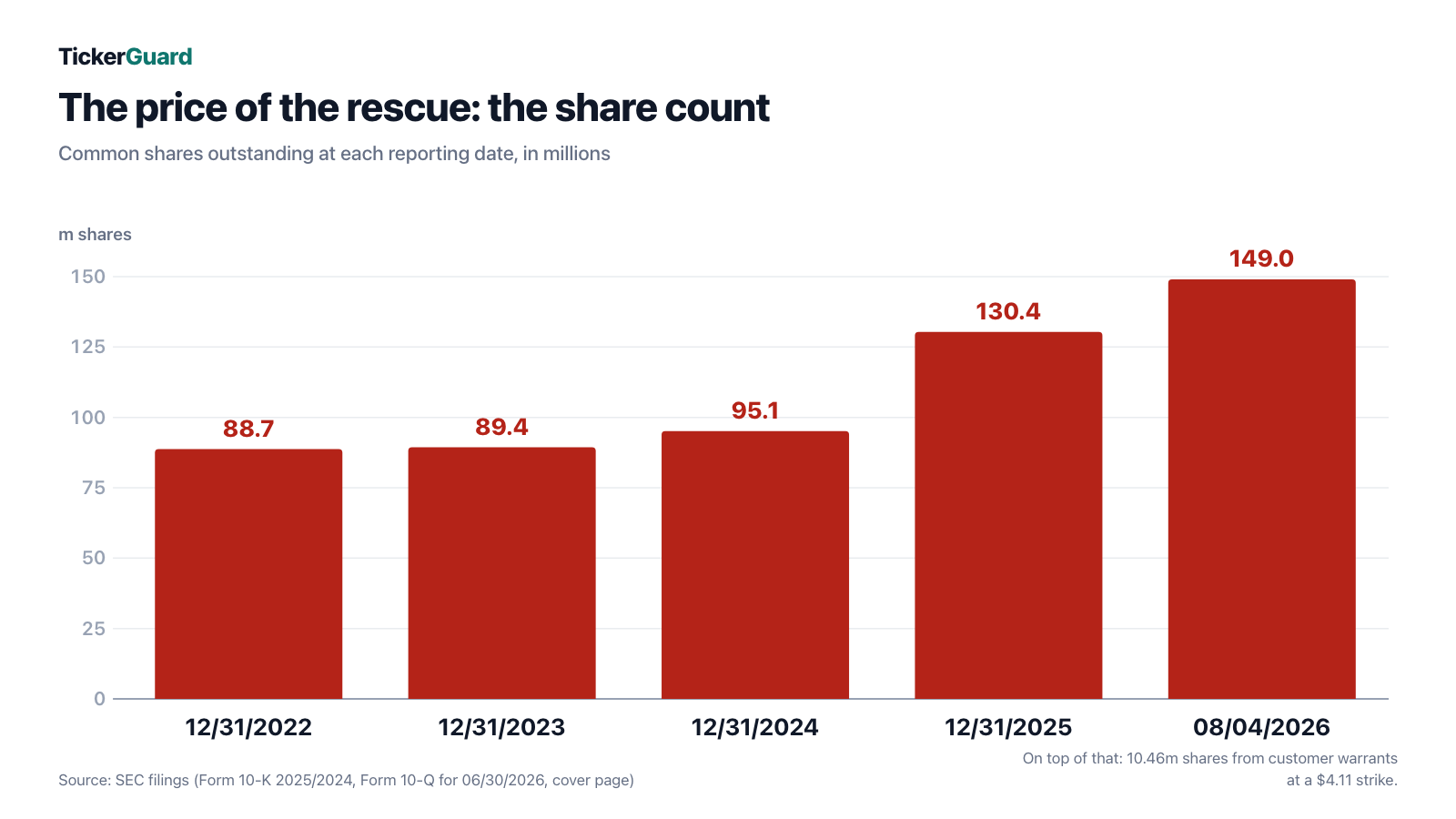
The individual items are in the prospectus supplement and the quarterly report. Through the first at-the-market programme — the continuous sale of new shares straight into the market — 20.0 million shares were sold for net proceeds of $40.4 million by the end of 2025, roughly $2.02 per share. Its successor programme, launched in November 2025, added a further 23.1 million shares for net proceeds of $137.5 million through May 12, 2026. Then came the big raise on May 18, 2026: 12.4 million shares at a public offering price of $18.50, net proceeds of $218.2 million after $11.8 million of underwriting fees. Two details from the prospectus that are rarely quoted: the $18.50 offering price sat roughly 13 percent below the last reported sale price of $21.22 on May 14, 2026. And the prospectus puts the immediate dilution to buyers in the offering at $18.84 per share — because net tangible book value per share as of March 31, 2026 was minus $1.76 (minus $239.1 million in total). Anyone subscribing then paid $18.50 for a share behind which, on a tangible basis, sat less than nothing. That is not an accusation — for a turnaround it is normal, and without that money the company might not exist. But it belongs in every calculation: the pie got bigger, and so did the number of slices.
Uncomfortable truth no. 4: one shareholder sits on both sides of the table
Ask who owns Babcock & Wilcox and you always arrive at one name: B. Riley, a U.S. financial firm that is simultaneously large shareholder, underwriter, sales agent and financial adviser. The quarterly report lists the roles:
"Based on Schedule 13D filings with the SEC, B. Riley beneficially owns approximately 19% of our outstanding common stock as of June 30, 2026. B. Riley currently has the right to nominate one member of our Board of Directors pursuant to the investor rights agreement we entered into with B. Riley in April 2019. The investor rights agreement also provides pre-emptive rights to B. Riley with respect to certain future issuances of our equity securities."
— Babcock & Wilcox Enterprises, Inc., SEC quarterly report 10-Q for the period ended 06/30/2026, Note 20 "Related Party Transactions"

What that dual role costs can be quantified. In the first half of 2026 Babcock & Wilcox paid B. Riley $11.8 million in underwriting discounts and commissions for the May 18, 2026 offering, $5.0 million under a financial advisory agreement signed in the first quarter of 2026, and $1.3 million in placement commissions (3.0 percent of gross proceeds) from the at-the-market programme. That is $18.1 million in six months — against operating income of $10.1 million over the same period. In fairness, the other side of the ledger: B. Riley guaranteed the January 2024 credit agreement, which is what made the facility possible in the first place; in February 2026 that guaranty and its roughly $3.0 million annual fee were cancelled because the company no longer needed them. A large shareholder who guarantees your debt in a crisis is valuable. A large shareholder who takes a cut of every capital measure and holds pre-emptive rights on the next tranche of shares is an interest structure worth knowing about. Both are true here — at the same time.
Valuation: you are buying an order book, not earnings
How expensive is the stock? There is no price-to-earnings ratio, because trailing twelve-month earnings are negative (minus $0.67 per share). The price-to-sales ratio sits at roughly 1.7: a market capitalization of about $1.4 billion against $834.4 million of trailing twelve-month revenue (data as of August 14, 2026; cross-checked against 148,965,066 shares as of August 4, 2026 times $9.65 — the price documented in the Form 4 insider filing for the August 12, 2026 purchase). For a thin-margin plant builder that is no bargain. The more relevant comparison fits the business model: the $2,569.0 million backlog is roughly one and a half times the market capitalization. Buying the stock means, at its core, betting that this order book gets executed on time and at an adequate mark-up — and that further orders follow. There is one data point for the latter: on August 10, 2026 the company said it had placed additional orders with Siemens Energy to secure a further gigawatt of steam turbines over the next twelve to fifteen months. It is arming itself for the next order before that order exists. That is a bet placed in advance.
A second, well-dated anchor sits in the insider filings: chief executive Kenneth Young bought 7,000 shares at $9.65 on August 12, 2026 in the open market and held 1,709,254 shares directly afterwards (Form 4 filed August 13, 2026). A purchase by the company's own chief executive at less than half the May offering price proves nothing on its own — but it is a signal worth noting. Finally, the debt side is far more relaxed than a year ago: on July 13, 2026 the company issued a redemption notice for the remaining $61.4 million of its 6.50 percent notes, effective August 13, 2026; the New York Stock Exchange filed the formal delisting notification for those notes the same day (Form 25). That leaves essentially the 8.75 percent notes maturing in June 2030 ($147.9 million as of June 30, 2026) and the Axos credit facility, whose maturity was extended to January 18, 2028 in February 2026. Interest expense halved in the second quarter of 2026 to $5.0 million from $11.0 million a year earlier.
Opportunities and risks at a glance
What speaks for Babcock & Wilcox:
- The turnaround is documented, not asserted: the going-concern warning from the 2024 annual report is explicitly withdrawn in the 2025 report; equity swung from minus $131.5 million to plus $57.4 million and cash from $89.5 million to $308.6 million (December 31, 2025 versus June 30, 2026).
- The order book is real and disclosed: $2,569.0 million as of June 30, 2026 after $405.6 million a year earlier — roughly one and a half times the market capitalization, with a run-off schedule extending past 2027.
- The cost-reimbursable structure guards against the classic plant-builder trap: on a five-year project it is the client, not Babcock & Wilcox, who carries the cost of a mispriced estimate — the mark-up is secured even if steel gets more expensive.
- The spare parts and service business for an installed base in more than 90 countries carries better margins than new-build work and keeps running independently of the data center boom; more than 90 percent of revenue is recognised over time, which aids predictability.
- The interest burden is falling markedly: $5.0 million of interest expense in the second quarter of 2026 after $11.0 million a year earlier; the 6.50 percent notes were fully redeemed effective August 13, 2026, and a repurchase programme of up to $50 million has been authorised since July 13, 2026.
What speaks against it:
- Extreme customer concentration: roughly 93 percent of the backlog and $73.9 million of $170.7 million in trade receivables sit with Base Electron. If that one customer delays or cancels, what remains is a company with roughly $590 million of annual revenue — the growth story would be over.
- Of the $2.4 billion, $2.0 billion is reimbursable cost plus mark-up; the revenue jump does not translate into an equally large earnings jump. Operating income in the first half of 2026 was $10.1 million on $534.1 million of revenue.
- Operating cash flow in the first half of 2026 was just $0.4 million; growth is being funded through payables (up $100.3 million) and equity, not out of the business.
- Dilution as a standing condition: 88.7 million shares (December 31, 2022) became 148,965,066 (August 4, 2026), plus 10.46 million warrants at $4.11; the $136.9 million warrant liability exceeds the $57.4 million of equity by more than double.
- The balance sheet stays thin and carries legacy weight: $942.2 million of liabilities against $999.6 million of total assets, including $167.7 million of pension and postretirement obligations, and an accumulated deficit of $1,766.9 million. And a large shareholder with roughly 19 percent, a board nomination right and pre-emptive rights collected $18.1 million in fees in the first half.
A human bottom line
Back to the sluice trap. Its core is not that big numbers lie — the $2.4 billion is in the contract, the order book is real, the plants are being built, and the rescue of this company is a remarkable piece of work that should not be talked down. Its core is that our minds confuse throughput with earnings. An enormous volume of water passes through the lock; the lock keeper earns the toll. At Babcock & Wilcox, $2.0 billion of the $2.4 billion is the water and the mark-up is the toll — and how large that toll turns out to be appears in no filing. It shows up quarter by quarter in operating income. So far it has been $10.1 million in a half year. Buying today, then, is not buying a billion-dollar order; it is betting that four years of throughput turn into a decent toll, that a second and third customer follow, and that the one customer everything rests on pays its bills. The honest question is therefore not "is the order big?" — it is enormous. It is: how much of what flows through this company stays with its shareholders, and is that enough for the price the stock asks today? If your answer is yes, you have a thesis. If not, you had a headline. What you do with that is your decision. And that is exactly as it should be.
Sources
Every original document used in this analysis — to read for yourself:
- Babcock & Wilcox Enterprises, Inc. — SEC quarterly report 10-Q for the period ended 06/30/2026 (filed August 10, 2026)
- Babcock & Wilcox Enterprises, Inc. — SEC quarterly report 10-Q for the period ended 03/31/2026 (filed May 11, 2026)
- Babcock & Wilcox Enterprises, Inc. — SEC quarterly report 10-Q for the period ended 09/30/2025 (filed November 10, 2025)
- Babcock & Wilcox Enterprises, Inc. — SEC annual report 10-K for 2025 (filed March 16, 2026)
- Babcock & Wilcox Enterprises, Inc. — SEC prospectus supplement 424B5 for the equity offering (filed May 15, 2026)
- Babcock & Wilcox Enterprises, Inc. — SEC earnings release 8-K, Exhibit 99.1, second quarter 2026 (filed August 10, 2026)
- Babcock & Wilcox Enterprises, Inc. — SEC insider filing Form 4 by Kenneth M. Young (filed August 13, 2026)
- Complete SEC filing history for Babcock & Wilcox Enterprises, Inc.: EDGAR overview (sec.gov)
- Fundamental data (market capitalization, metrics, share count; data as of August 14, 2026), reconciled with the SEC filings.
- Reddit mentions: ApeWisdom (as of August 14, 2026); surfaced through our in-house Reddit hype scanner.
Transparency & disclaimer: this analysis is a journalistic assessment of publicly available information. It is not investment advice, not a financial analysis in the regulatory sense and not an invitation to buy or sell securities. Equity investments carry substantial risk up to and including total loss. All information without warranty; the data cut-off is stated in the text. Positions held by the operator are disclosed daily; where one exists, it appears as a notice at the top of this deep dive.
Key figures at a glance
All monetary figures in millions of $; earnings per share as reported.
| Metric | 2021 | 2022 | 2023 | 2024 | 2025 |
|---|---|---|---|---|---|
| Revenue | 710.9 | 609.4 | 727.3 | 717.3 | 587.7 |
| Operating Income (EBIT) | 19.4 | -1.2 | 16.6 | 25.1 | 22.9 |
| Net Income | 30.9 | -22.9 | -197.2 | -59.9 | -36.2 |
| Net Margin | 4.3% | -3.8% | -27.1% | -8.4% | -6.2% |
| Earnings Per Share | 0.37 $ | -0.26 $ | -2.22 $ | -0.65 $ | -0.34 $ |
Source: fundamental data & SEC filings (annual and quarterly reports, 10-K/10-Q)
Our Bottom Line at a Glance
- Balance sheet & turnaround positive
- The going-concern warning from the 2024 annual report is explicitly withdrawn in the 2025 report. Equity swung from minus $131.5 million (December 31, 2025) to plus $57.4 million (June 30, 2026), and cash from $89.5 million to $308.6 million; against $239.8 million of secured debt and bonds stand $382.8 million of cash including restricted balances. The 6.50 percent notes were fully redeemed effective August 13, 2026.
- Order book positive
- The backlog rose from $405.6 million (June 30, 2025) to $2,569.0 million (June 30, 2026) — roughly one and a half times the market capitalization, with a run-off schedule extending past 2027. Quarterly revenue more than doubled ($319.7 million after $138.9 million), adjusted EBITDA rose to $21.8 million, and the top end of the 2026 target range was raised to $80.0 million to $105.0 million.
- Earnings quality of the mega-order negative
- Of the $2.4 billion contract value, $2.0 billion is variable charges based on reimbursable costs plus mark-up. Revenue therefore grows far faster than value added: $534.1 million of half-year revenue produced $10.1 million of operating income, and operating cash flow came to $0.4 million. A cost-reimbursable contract lowers estimating risk, but it does not turn a billion-dollar headline into matching profit.
- Concentration risk negative
- Roughly 93 percent of the backlog and $73.9 million of $170.7 million in trade receivables sit with Base Electron. A delay, scope cut or cancellation of that single contract would end the entire growth story — the core business with roughly $590 million of annual revenue would survive, but the basis for the valuation would be a different one.
- Dilution & ownership negative
- Shares outstanding rose from 88.7 million (December 31, 2022) to 148,965,066 (August 4, 2026), plus 10.46 million warrants at $4.11 whose $136.9 million fair value exceeds the $57.4 million of equity by more than double. B. Riley holds roughly 19 percent, nominates a board member, has pre-emptive rights and received $18.1 million of fees in the first half of 2026.
Babcock & Wilcox has pulled itself out of an existential crisis with seven divestitures, a note exchange and a great deal of new equity — the going-concern warning is gone, equity is positive again, the cash box is full. At the same time the entire growth story rests on a single $2.4 billion contract of which $2.0 billion is reimbursable cost plus mark-up: revenue is doubling while half-year operating income sits at $10.1 million and operating cash flow at $0.4 million. Buying here means buying a real industrial business anchored in more than 90 countries plus the bet that four years of throughput on one mega-project turn into an adequate margin — and that the one customer holds. Not investment advice.
What Our Rating Means
Open questions
The business works in principle, but one material question is open. As long as it stays open, our findings do not carry a quality verdict.
The substance question has been answered: survival is no longer in doubt, equity is positive, cash exceeds secured debt, and the interest burden has halved. What remains open is the decisive operating question — whether a sixfold order book turns into earnings. Against $534.1 million of half-year revenue stood $10.1 million of operating income and $0.4 million of operating cash flow; roughly 93 percent of the backlog hangs on one customer, and the contract passes through $2.0 billion of its $2.4 billion as cost. That is no longer a substance risk, but it is an unproven turnaround with extraordinary customer concentration — hence yellow. This rating says nothing about the entry point; that is for the screeners and your own review. The decision is yours.
A journalistic assessment by our editorial team at the time of the deep dive, based on public sources — not investment advice and not a solicitation to buy or sell. Your personal circumstances (investment goals, risk capacity, taxes) cannot be taken into account. What our levels mean, how verdicts are formed, and what conflicts of interest exist →
Worth Noting
- Babcock & Wilcox reached our research list through the Reddit hype scanner (ApeWisdom, as of August 14, 2026), not through a valuation or quality screener. Conventional multiples mislead here: there is no price-to-earnings ratio for want of earnings, and the price-to-book ratio is arithmetically enormous but meaningless because equity has only just climbed back out of negative territory.
- Risk of confusion: Babcock & Wilcox Enterprises (NYSE: BW, SEC CIK 0001630805) is not BWX Technologies (NYSE: BWXT), the nuclear technology group it was spun out of in 2015. It is also distinct from Babcock International (United Kingdom) and Doosan Babcock. The related listed securities BWNB (6.50% notes, redeemed and delisted since August 13, 2026) and BW PRA (preferred stock) are not common shares.
- Data basis and evidence chain: the most recent periodic report reviewed is the quarterly report (10-Q) for the period ended June 30, 2026, filed August 10, 2026; filings submitted afterwards were also reviewed (earnings release 8-K of August 10, 2026, Form 25 delisting notification for the 6.50 percent notes of August 13, 2026, Form 4 insider filing of August 13, 2026 and a Schedule 13G filed August 14, 2026). Market capitalization was cross-checked against 148,965,066 shares times $9.65 — the price documented in the insider filing for the August 12, 2026 purchase. Analyses are evergreen; daily prices are not a reason to buy.
Stock Watch
This analysis is as of August 26, 2026. Stock Watch will tell you what's changed at BW since then.
Later $1 a month per stock — signing up is free, and you'll be the first to know when it launches.
The full analysis as a PDF for later
We will send you this analysis as a PDF — to print, file away, and read at your own pace. And we will add you to the free Stock Watch list for Babcock & Wilcox Enterprises Inc (BW), so you hear about it when something material in this analysis changes.
Frequently Asked Questions
Babcock & Wilcox Enterprises, Inc. (NYSE: BW), based in Akron, Ohio, builds steam generators, boilers and emissions control equipment for power plants, industrial facilities, waste-to-energy plants and — more recently — data centers, alongside a spare parts and maintenance business serving an installed base in more than 90 countries. The name traces back to an 1867 boiler patent; today's listed entity was created in 2015 when the business was spun off from BWXT. As of December 31, 2025 the company employed roughly 1,650 people, about 1,600 of them full-time, and reports in a single segment.
Base Electron is an independent power producer backed by Applied Digital. On February 26, 2026 Babcock & Wilcox signed a definitive agreement with it to design and install four 300-megawatt gas-fired power plants supplying an AI factory, with commercial operation targeted for 2030. Total consideration is $2.4 billion. The fine print in the quarterly report for the period ended June 30, 2026 matters: $2.0 billion of that is variable charges based on reimbursable costs incurred plus mark-up, and only the remainder is a fixed fee. Most of the headline number therefore passes through the books as cost reimbursement.
Because the loss comes mostly from a non-cash remeasurement line. The customer holds warrants over 10.46 million shares at $4.11. Those warrants are carried as a liability and remeasured at every reporting date; when the share price rises, the liability rises and the difference is booked as an expense. In the first half of 2026 that expense was $64.4 million. So against operating income of $10.1 million there is a half-year net loss of $62.7 million — while the second quarter of 2026 itself closed with net income of $14.3 million.
The formal doubt about survival has been removed: the 2024 annual report carried a going-concern warning, and the 2025 report explicitly withdraws it — after seven divestitures (BWRS, SPIG, GMAB, Vølund, Diamond Power, Allen-Sherman-Hoff, solar), a note exchange in May 2025 and several equity raises. Equity swung from minus $131.5 million (December 31, 2025) to plus $57.4 million (June 30, 2026) and cash from $89.5 million to $308.6 million. The balance sheet remains thin nonetheless: $942.2 million of liabilities including $167.7 million of pension obligations, and an accumulated deficit of $1,766.9 million.
Considerable. Common shares outstanding rose from 88.7 million (December 31, 2022) through 95.1 million (December 31, 2024) and 130.4 million (December 31, 2025) to 148,965,066 as of August 4, 2026. Add 10.46 million customer warrants at $4.11. The single largest measure was the May 18, 2026 offering: 12.4 million shares at $18.50 with net proceeds of $218.2 million. The prospectus puts the immediate dilution to buyers at $18.84 per share, because net tangible book value per share as of March 31, 2026 was minus $1.76.
A threefold one. As of June 30, 2026 B. Riley beneficially owns roughly 19 percent of the shares, may nominate one member of the board of directors and holds pre-emptive rights on future equity issuances. At the same time it is a service provider: in the first half of 2026 it received $11.8 million in underwriting fees from the equity offering, $5.0 million for financial advisory work and $1.3 million in placement commissions — $18.1 million in total, against operating income of $10.1 million. On the other hand, B. Riley guaranteed the January 2024 credit agreement for an annual fee of roughly $3.0 million; that guaranty was cancelled in February 2026.
Dependence on one customer. Roughly 93 percent of the $2,569.0 million backlog (June 30, 2026) comes from the Base Electron contract, and $73.9 million of the $170.7 million in trade receivables is owed by that same customer. Delays, scope cuts or a cancellation would leave a company with roughly $590 million of annual revenue — the core business would carry on, but the growth story would be over. On top of that, the entire project rests on the durability of the data center boom.
Found an error?
Did you spot a factual error, an outdated number, or a typo in this deep dive? Let us know briefly — your report goes straight to the editorial team.