GC Biopharma: Record Revenue, a Third Straight Loss, and a 2026 Profit That Won't Come From Medicine
GC Biopharma Corp. (KOSPI: 006280) closed 2025 with the highest revenue in its 58-year history and a U.S. approval investors had waited roughly seven years for — and still posted its third consecutive annual net loss, ₩29.7 billion in the red. The profit the company now points to for 2026 will not come from blood plasma, vaccines, or the U.S. launch everyone is watching, but from selling a subsidiary to Eli Lilly for up to ₩462.06 billion (about $305 million). No buy or sell recommendation here — just the plain observation that a company selling its own profit has not yet shown it can earn one.
 Thomas Mücke
Founder & Publisher
Thomas Mücke
Founder & Publisher

You've felt it before: a headline lands — a drug gets approved, a company signs a deal worth hundreds of millions — and your brain skips straight to the payoff. Call it milestone faith. It's the belief that a single dated event tells you everything about the business behind it, so you buy the announcement instead of reading what the announcement is actually attached to. It's a comfortable shortcut, because milestones are simple and businesses are not.
GC Biopharma Corp. (KOSPI: 006280), South Korea's largest blood-plasma company, hands you two milestones within roughly two and a half years. In December 2023 the U.S. Food and Drug Administration approved its immunoglobulin drug ALYGLO after two rejected applications over roughly seven years — the company's first approved product on American soil. In July 2026, Eli Lilly agreed to pay up to ₩462.06 billion for a GC Biopharma subsidiary that had barely started selling anything. Both made headlines. Neither, on its own, tells you whether the underlying business is healthy.
Here is the tension this analysis keeps returning to: GC Biopharma just booked the highest revenue in its history, ₩1,991.3 billion for fiscal 2025, and still closed the year with its third consecutive net loss. And the profit the company is set to report for 2026 will not come from plasma, vaccines, or the U.S. launch everyone is watching — it will come almost entirely from selling a company to Eli Lilly. No recommendation follows from any of this. Just the numbers, read together instead of one headline at a time.
What GC Biopharma Actually Does
Start with the core business, because it's less exotic than the FDA headlines suggest. Plasma fractionation is essentially a refinery process: donated human blood plasma goes in, and it comes out separated into its component proteins — much like crude oil is refined into gasoline, diesel and asphalt. GC Biopharma pulls out immunoglobulin (concentrated antibodies, the immune system's own defenders, used for patients whose bodies can't make enough of them), albumin (a blood protein used in trauma and burn care), and clotting factors for hemophilia. This plasma-derivatives business supplied 44.7 percent of the company's revenue in the first half of 2026 — ₩383.0 billion of ₩856.7 billion — making it by far the largest single segment.
Around that core sit four smaller businesses, all visible in the same half-year segment note: vaccines (₩112.1 billion, 13.1 percent — flu shots supplied under contracts with the Pan American Health Organization, WHO, Thailand and UNICEF), prescription drugs (₩168.1 billion, 19.6 percent), diagnostics (₩79.9 billion), and over-the-counter products (₩59.8 billion). There's also a small agricultural line (₩15.0 billion) run by the subsidiary Inbackfarm. It's a different risk shape than a single-drug pharma giant like the one in our analysis of Novo Nordisk: GC Biopharma's revenue is spread across five segments rather than concentrated in one blockbuster franchise, which cushions any single setback but also means no one product carries the whole growth story.
The U.S. business runs through GC Biopharma USA (Teaneck, New Jersey) and, since a December 2024 acquisition, ABO Holdings Inc. (Irvine, California), which operates eight plasma-collection subsidiaries. Plasma exports to the U.S. rose from ₩217.3 billion in 2024 to ₩453.9 billion in 2025 — up 108.9 percent, almost entirely the ALYGLO effect. Whether that pace held into 2026 is a question the chapters ahead come back to. A separate biologics subsidiary, GC Cell, works on cell and gene therapies; the group also runs GC Medis, GC MS, GC CL, a Brazilian unit and, oddly for a pharmaceutical group, a livestock-farming subsidiary called Inbackfarm.
None of this sits in a simple corporate box. GC Biopharma is part of a chaebol — the family-controlled conglomerate structure common in South Korea, where a founding family runs a web of companies through cross-shareholdings and a holding company at the top, often owning only a small fraction of the total capital while directing the entire group. Here, Green Cross Holdings Corp. (KOSPI: 005250) owns 50.06 percent of GC Biopharma directly, 51.41 percent including related parties (as of Jun 30, 2026). One level further up, chairman Huh Il-sup holds 12.29 percent of Green Cross Holdings itself — a stake small enough to look modest and large enough, inside a 54-company group, to steer everything beneath it. Call that the family lever: a little capital at the very top, controlling a great deal of business underneath. Chief executive Huh Eun-chul, who holds a PhD from Cornell and has sat on the board for more than 16 years, owns 0.25 percent of GC Biopharma directly and was reappointed to a term running until Mar 26, 2028. The company employed 2,422 people as of Jun 30, 2026.
One more thing before the numbers: GC Biopharma is not a filer with the U.S. securities regulator, the SEC. There is no 10-K, no 10-Q, no 20-F. Its mandatory disclosures — annual reports, half-year and quarterly reports, one-off filings on material events — sit in DART, the electronic filing system run by South Korea's Financial Supervisory Service, prepared under Korean IFRS (K-IFRS) with a fiscal year matching the calendar year. Every figure in this analysis that comes from a company filing carries the label "Source: fundamental data & company reports … DART/Korea Exchange" rather than an SEC citation, and every DART filing referenced below links to its original document through its receipt number, or rcpNo.
Company history for investors
-
1967
Founded as a microbiological supplies maker
Sudo Microorganism Medical Supplies is founded on Oct 5, 1967, decades before the plasma and vaccine business investors know today existed.
-
1988
World's first hantavirus vaccine
Hantavax becomes the world's first approved hantavirus vaccine, an early sign of the R&D ambition behind today's plasma-derivatives push.
-
2016
First FDA rejection for the U.S. plasma drug
The FDA issues a Complete Response Letter over manufacturing issues, the first of two rejections that delay the U.S. push by seven years.
-
2022
Second FDA rejection; company renamed GC Biopharma
A missed plant inspection triggers a second rejection on Feb 27, 2022; the company renames itself GC Biopharma on Mar 29, 2022, seeking "global leadership and sustainable growth."
-
2023
FDA approval for ALYGLO
On Dec 17, 2023 the company finally clears the FDA, a years-long milestone that becomes the centerpiece of every growth narrative that follows.
-
2026
FY2025 result corrected downward
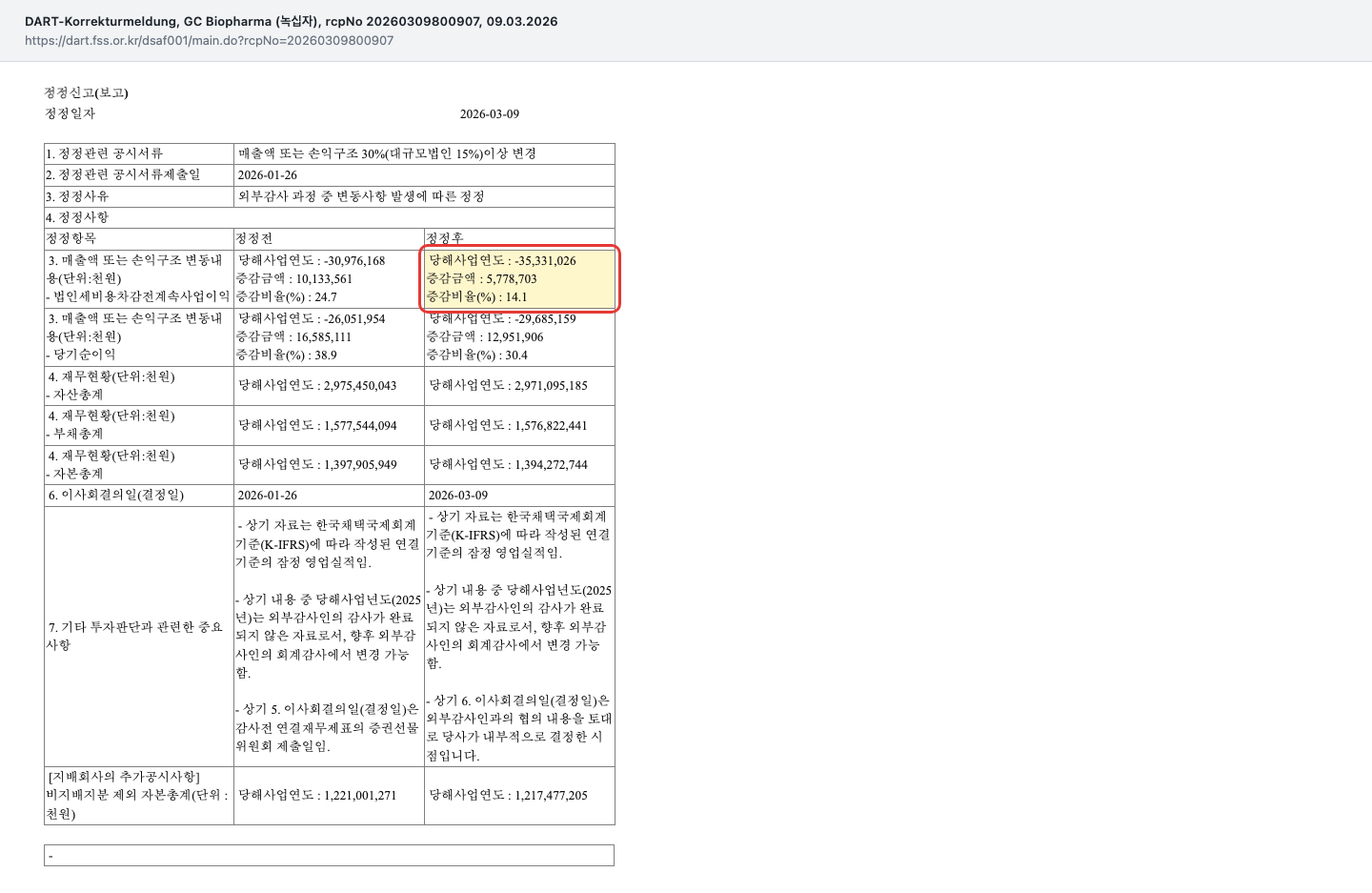
On Mar 9, 2026 the preliminary pre-tax loss widens from ₩30.98 billion to ₩35.33 billion, a change the filing attributes to changes arising during the audit process — the first sign the record-revenue year was more fragile than reported.
-
2026
Curevo sold to Eli Lilly as Q2 profit collapses
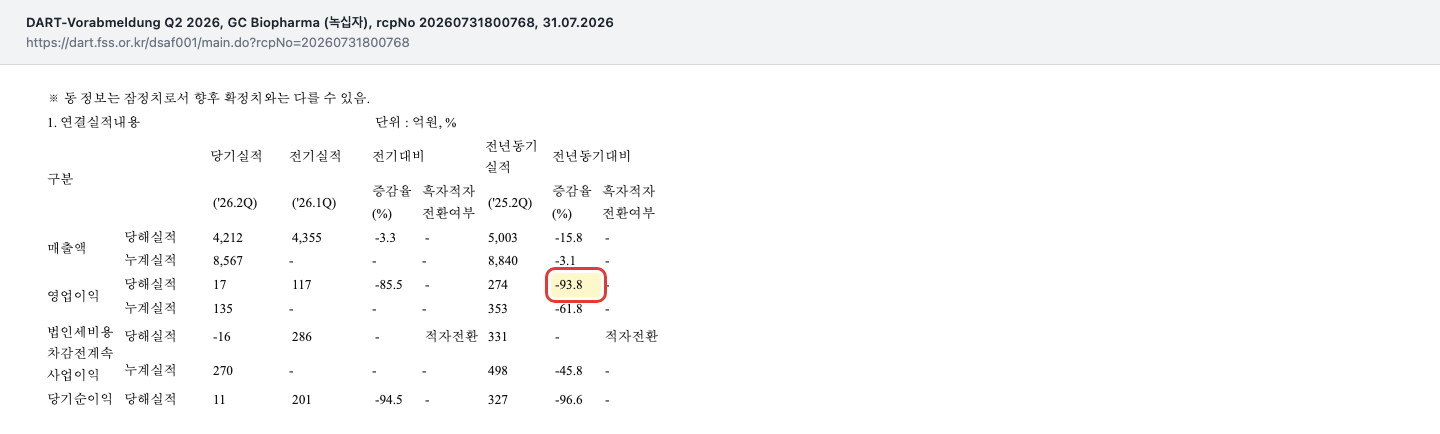
The Curevo sale to Eli Lilly closes on Jul 8, 2026 and is disclosed the next day: up to ₩462.06 billion; three weeks later, Q2 2026 operating profit is reported down 93.8 percent.
How This Stock Landed on Our Desk
GC Biopharma reached our desk the way it probably reached yours: through the Eli Lilly deal. When a pharmaceutical giant agrees to pay up to ₩462.06 billion for a piece of a mid-sized Korean plasma company, it's the kind of headline that makes you want to know who's on the other side of that check. So we went looking — and what we found underneath the headline was less about Eli Lilly and more about the company signing the deal.
Being honest about the evidence up front matters here, because it shapes everything that follows: there are no publicly available earnings-call transcripts for GC Biopharma. That's normal, not a red flag specific to this company — Korean issuers generally don't hold the quarterly analyst calls that U.S. investors are used to, and GC Biopharma is no exception. What exists instead is a paper trail of regulatory filings, dividend resolutions, one-off disclosures on material events, and dated press statements from executives. That's the evidence base for this analysis, and it's what the "what management promised" chapter below is built from — filings and quotes with dates, not a call transcript.
The Numbers Over the Years
Give the company its due first. Revenue climbed from ₩1,537.8 billion in 2021 to ₩1,991.3 billion in 2025 — a record, and a five-year run interrupted only by a dip in 2023. Operating profit followed a bumpier path: ₩73.7 billion in 2021, ₩81.3 billion in 2022, then a sharp fall to ₩34.4 billion in 2023 and ₩32.1 billion in 2024, before recovering to ₩69.1 billion in 2025. Expressed as a margin, that's operating profit running at 4.8, 4.8, 2.1, 1.9 and 3.5 percent of revenue across the five years — a business that, even in its best recent year, converts well under 4 cents of every won in sales into operating profit.
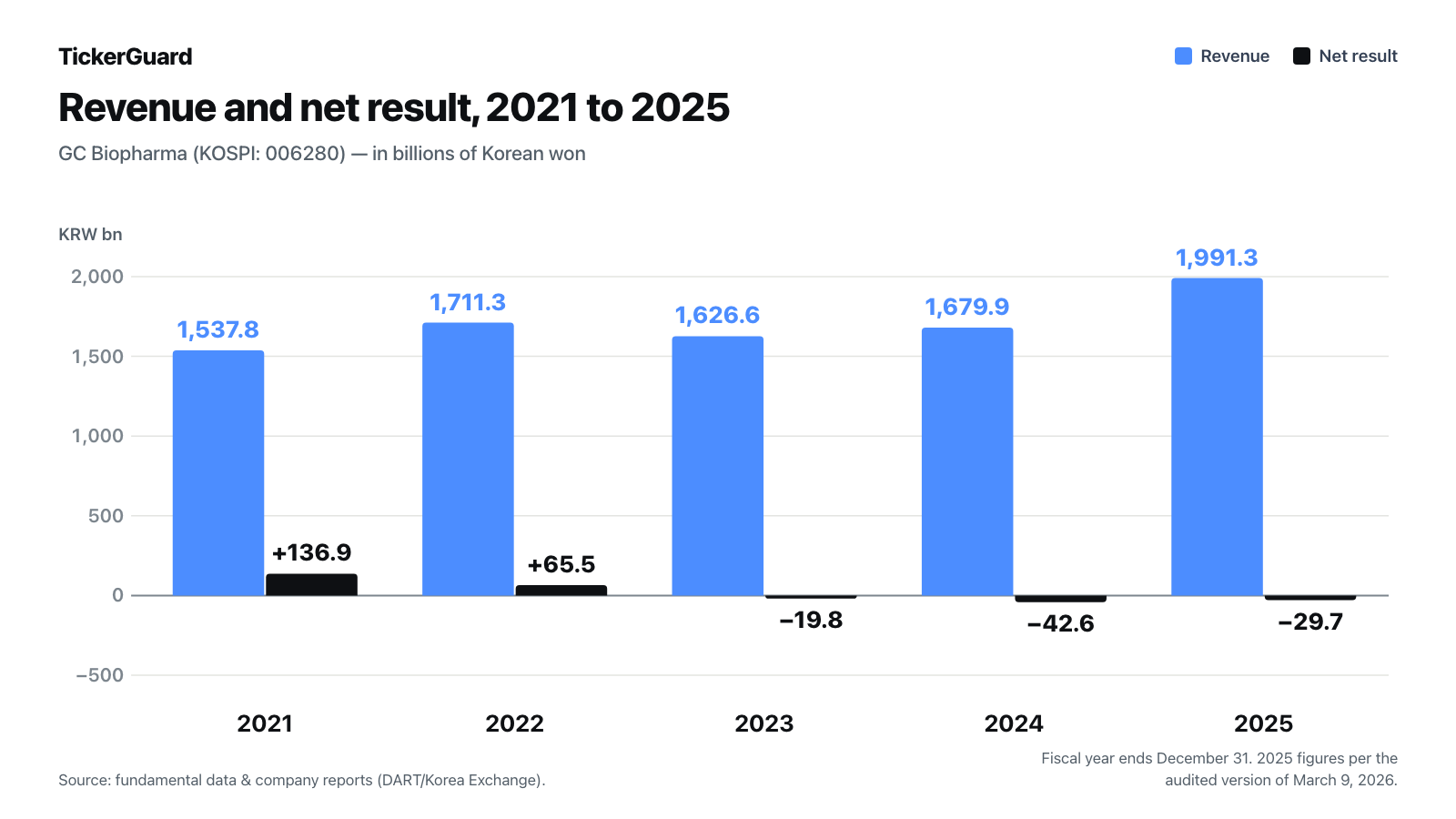
The line that explains the gap between "record revenue" and "loss" is interest expense: ₩12.5 billion in 2021, rising every year to ₩50.3 billion in 2025 — a fourfold increase while revenue grew by less than a third. Pre-tax income swung from ₩172.6 billion in 2021 to a loss of ₩27.1 billion in 2023, ₩41.1 billion in 2024 and ₩35.3 billion in 2025. The net result attributable to the group, including minority interests, came in at minus ₩19.8 billion, minus ₩42.6 billion and minus ₩29.7 billion for 2023 through 2025 — three consecutive loss years, with earnings per share of minus ₩2,332, minus ₩2,303.63 and minus ₩408.97 across the same period.
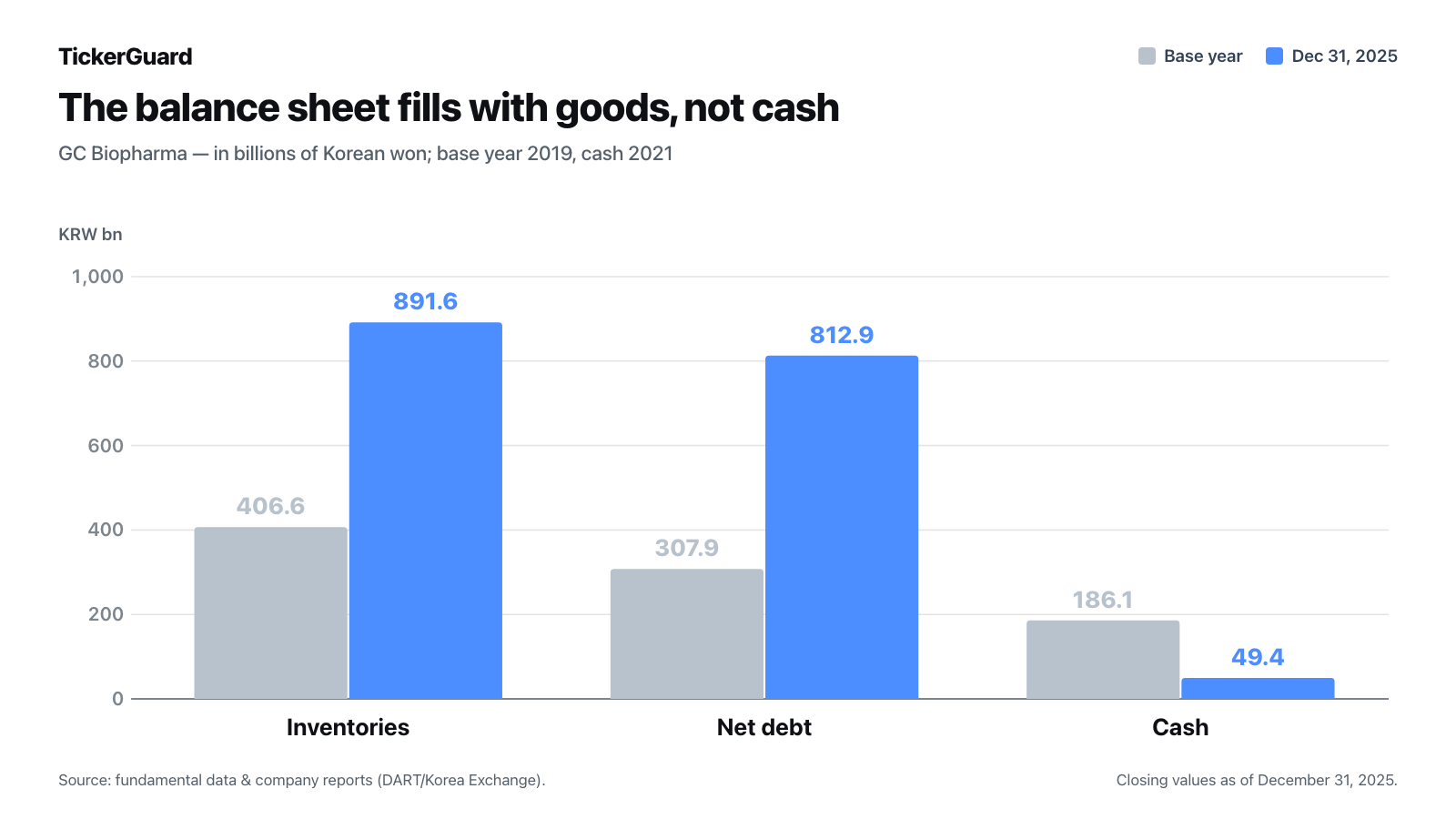
The balance sheet tells a quieter but equally important story. Total assets reached ₩2,971.1 billion at the end of 2025. Inventories stood at ₩891.6 billion, up from ₩406.6 billion in 2019 — a 119 percent increase against revenue growth of roughly 45 percent over the same stretch, pushing the inventory-to-sales ratio from 29.7 to 44.8 percent. Cash fell to ₩49.4 billion at the end of 2025, down from ₩186.1 billion in 2021. Net debt rose to ₩812.9 billion, more than double the ₩307.9 billion recorded in 2019.
Operating cash flow tells a more mixed story than the net-debt trend alone suggests: plus ₩126.0 billion in 2021, plus ₩119.2 billion in 2022, then negative in 2023 (minus ₩5.5 billion) and 2024 (minus ₩53.5 billion), before recovering to plus ₩99.5 billion in 2025. Free cash flow — operating cash flow after capital spending — has been negative in six of the past seven years, including 2025, when it came in at minus ₩5.8 billion despite the positive operating figure, because capital expenditure (including new plasma-collection and production capacity) outpaced what operations brought in.
The first half of 2026 initially looked like a continuation of the good story. Revenue for the six months reached ₩856.7 billion, and the first quarter alone brought in ₩435.5 billion, up 13.5 percent year over year, with operating profit up 46.3 percent to ₩11.7 billion. Korean trade press reported ALYGLO's own quarterly revenue at ₩34.9 billion in the first quarter of 2026, roughly quadruple the ₩8.6 billion reported for the same quarter of 2025 (Seoul Economic Daily, May 8, 2026) — a figure worth flagging clearly as press-sourced, not a DART disclosure, since GC Biopharma doesn't break out ALYGLO revenue in its own filings. Then came the second quarter, and the story changed — the subject of the next two chapters.
What Management Promised — And What Actually Happened
Because there's no earnings-call transcript to check management's tone against, this chapter runs entirely on dated public statements, disclosed filings, and press coverage tied to specific dates — with press-sourced figures flagged as such throughout.
The promises started big. On the day of FDA approval, chief executive Huh Eun-chul framed it as a turning point:
"The approval of ALYGLO by the US FDA is a significant milestone for GC Biopharma and patients with primary immunodeficiency disease. It reinforces GC Biopharma's commitment to patients and health care professionals by expanding our product portfolio globally to serve individuals with rare diseases."
— Huh Eun-chul, CEO, GC Biopharma, PR Newswire, December 17, 2023
By February 2024, the ambitions had numbers attached. Lee Woo-jin, CEO of GC Biopharma USA, told Korea Economic Daily's KED Global that the company targeted $50 million in ALYGLO revenue for 2024, rising to $300 million by 2028: "We expect sales to top the target as the current US blood product market is very large." The first shipment followed in July 2024, with the $50 million target for 2024 still standing at that point; the official U.S. market launch, per GC Biopharma's own half-year report, came in August 2024. By press accounts, ALYGLO's contribution stayed small through 2024 — trade press later put it at roughly ₩150 billion (about $108 million at the Aug 23, 2026 exchange rate) only once 2025 was complete.
December 2024 brought the ABO Holdings acquisition, framed as completing a supply chain rather than just adding revenue. A company spokesperson told KED Global at the time:
"With this acquisition of the blood banks, we have completed vertical integration from securing raw materials for plasma fractionation to production and sales."
— Company spokesperson, GC Biopharma, as reported by KED Global, December 12, 2024
That acquisition brought ₩70.3 billion of new goodwill onto the 2025 balance sheet — a figure that matters again two chapters from now. By May 2025, the company was reporting roughly 400 patients on ALYGLO with a target of 1,000 by the end of 2025 and $100 million in revenue for the year (Korea Biomedical Review, May 12, 2025); press coverage later suggested the revenue target was beaten, but the patient-count figure was never publicly updated after that — a gap worth naming rather than filling in. The same month, Huh doubled down on the growth framing:
"With all six FDA-approved plasma centers now operational, the company is well-positioned to achieve sustainable revenue growth for Alyglo. This milestone represents a significant contribution to our overall business profitability."
— Huh Eun-chul, CEO, GC Biopharma, PR Newswire, May 14, 2025
Hold that phrase — "sustainable revenue growth" — because it's the one this analysis keeps testing against what actually happened. In November 2025, Korea Biomedical Review reported a record third quarter: ₩609.5 billion in revenue, up 31.1 percent, with ALYGLO up 117 percent. Press coverage at the time noted a detail that reads differently in hindsight: the growth was partly driven by deliberate U.S. stockpiling ahead of threatened tariffs — a pull-forward effect that borrows from future quarters rather than adding demand.
Then the tone changed, and the shift can be dated precisely. Through May 2025, every public statement leaned on growth. From that point, two divestments were announced in quick succession, each justified not in growth language but in balance-sheet language: the sale of GC Wellbeing on Mar 31, 2026, described as "improving the financial structure," and the sale of Curevo to Eli Lilly, disclosed on Jul 9, 2026 and described in the DART filing itself as securing funds for investment in new businesses. Ten to fourteen months after "sustainable revenue growth," the language had moved from expansion to repair.
What the Filings Say: The Uncomfortable Truths
Uncomfortable truth no. 1: the 2025 loss got worse after the year was already closed
GC Biopharma first reported preliminary 2025 results on Jan 26, 2026, showing a pre-tax loss of ₩30.98 billion. On Mar 9, 2026, the company filed a correction: the pre-tax loss widened to ₩35.33 billion, and reported equity was cut from ₩1,397.9 billion to ₩1,394.3 billion. The filing itself attributes the change to "changes arising during the audit process" (DART correction filing, rcpNo 20260309800907, Mar 9, 2026). A back-of-envelope calculation using the audited full-year and nine-month figures suggests the fourth quarter alone carried a pre-tax loss of roughly ₩110 billion — by far the worst quarter of the year, arriving right as the annual figures were being finalized. That's our own arithmetic from the audited numbers, not a disclosed quarterly breakdown, and it's worth treating with the caution any back-calculated figure deserves.
Uncomfortable truth no. 2: a goodwill roundabout, in and out in the same year
A second item weighed on the same year, independently of that correction: a ₩93.1 billion impairment charge against intangible assets in 2025 — the largest items being ₩77.9 billion of goodwill and ₩14.5 billion of capitalized development costs — against just ₩17.0 billion the year before. That charge was already contained in the preliminary figures published on Jan 26, 2026, well before the March correction; Korean press coverage (Youthdaily, Feb 4, 2026, a secondary source we haven't independently verified against the filing) reported it with company comment more than a month before the correction filing and linked the impairment to GC Cell, the biologics subsidiary formed through a 2021 merger; the company's own characterization, per the same coverage, was that this was "a one-off accounting treatment without cash outflow." What the annual report's Note 14 shows more precisely is the roundabout: goodwill on the books actually fell only from ₩125.6 billion to ₩118.1 billion in 2025 — not by the full ₩77.9 billion written off — because ₩70.3 billion of brand-new goodwill arrived in the same year from the ABO Holdings first-time consolidation. One hand wrote off old goodwill from a struggling business; the other added fresh goodwill from the very U.S. plasma acquisition this analysis keeps circling back to.
Uncomfortable truth no. 3: the balance sheet is filling with goods, not cash
Go back to the five-year figures: inventories up 119 percent since 2019 against 45 percent revenue growth, cash down from ₩186.1 billion to ₩49.4 billion between 2021 and 2025, net debt more than doubled since 2019, interest expense more than quadrupled since 2021, and free cash flow negative in six of the last seven years. None of these numbers, on its own, is alarming for a manufacturer expanding capacity. Together, they describe a company that is growing its top line by tying up more capital in inventory and financing that growth increasingly with debt rather than with cash generated internally.
Uncomfortable truth no. 4: a dividend paid on top of a loss
For fiscal 2025 — a year that closed with a ₩29.7 billion group net loss — GC Biopharma's board resolved a dividend of ₩1,500 per share (DART filing, rcpNo 20260211801829, Feb 11, 2026), a total distribution of ₩17.1 billion, payable in 2026. Keep those two numbers apart: the ₩17.1 billion is what was resolved for fiscal 2025, while the cash flow statement for calendar 2025 shows a different figure — ₩18.8 billion of dividends actually paid out during that year, which is the prior-year distribution including the share paid to minority shareholders in subsidiaries. That actual outflow of ₩18.8 billion on its own exceeded 2025's negative free cash flow of ₩5.8 billion. Paying a dividend in a loss year isn't unusual for an established company with cash reserves to draw on; doing it while free cash flow is negative and cash on hand has fallen to ₩49.4 billion is a choice that spends down the company's cushion rather than distributing what the year actually generated.
Uncomfortable truth no. 5: the quarter that was supposed to prove the growth story instead broke it
Remember "sustainable revenue growth" from the May 2025 quote, and the record Q3 2025 that Korean press attributed partly to U.S. tariff stockpiling. The second quarter of 2026 is where that thread snaps. GC Biopharma's own preliminary filing shows revenue of ₩421.2 billion, down 15.8 percent year over year; operating profit of ₩1.7 billion, down 93.8 percent from ₩27.4 billion a year earlier; a swing to a pre-tax loss of ₩1.6 billion; and profit attributable to shareholders down 94.7 percent. For the first half of 2026 as a whole, operating profit fell 61.8 percent to ₩13.5 billion on revenue of ₩856.7 billion, an operating margin of just 1.58 percent — consistent with the idea that some of 2025's growth was pulled forward rather than sustained.
Uncomfortable truth no. 6: the 2026 profit will come from a sale, not from the business
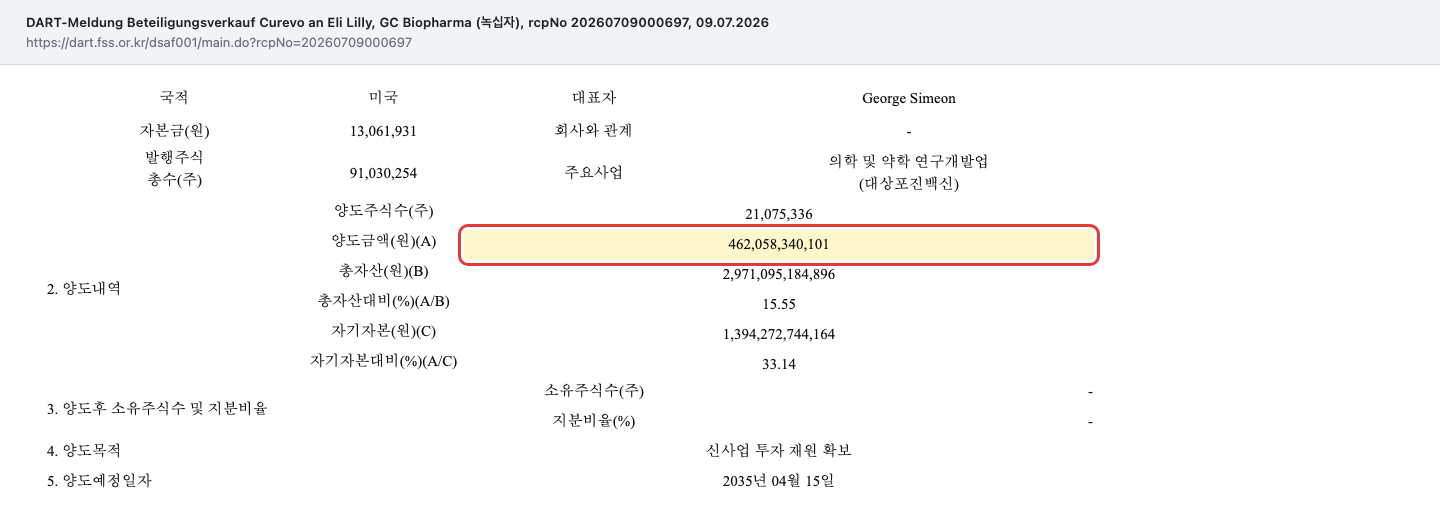
This is the truth that ties the whole tension together. GC Biopharma closed the sale of its entire stake in Curevo — a shingles-vaccine subsidiary — to Eli Lilly on Jul 8, 2026 and disclosed it the following day, Jul 9, 2026, for up to ₩462.06 billion (about $305.3 million), in a deal representing 15.55 percent of GC Biopharma's total assets and 33.14 percent of its equity (DART divestment filing, rcpNo 20260709000697). The company's own stated purpose for the sale is disclosed in Korean in the same filing:
신사업 투자 재원 확보
English rendering (original Korean wording, our translation): "securing funds for investment in new businesses."
— GC Biopharma, DART divestment filing, "purpose of disposal" section, rcpNo 20260709000697, filed July 9, 2026
The arithmetic behind that sale is the real story. Curevo was carried on GC Biopharma's books at ₩43.2 billion. The upfront payment alone from Eli Lilly, which closed on Jul 8, 2026, came to ₩308.7 billion ($204.0 million) — more than seven times the carrying value, and disclosed in the company's own half-year report notes 38 and 39. That gap, booked as a gain, is expected to land almost entirely in the third quarter of 2026 and to account for roughly a quarter-trillion won of reported profit. Consensus among covering analysts puts third-quarter 2026 earnings per share at ₩20,358.76 — a figure that is, by the math above, almost entirely a one-off gain rather than operating profit, since the same consensus estimate for full-year 2027 falls back to just ₩4,190 per share. Simultaneously, on Jul 16, 2026, GC Biopharma committed ₩140 billion (10.04 percent of equity) to a new production line at its Ochang plant for "next-generation immunoglobulin products," running through Dec 31, 2030 — spending the Eli Lilly proceeds on the very plasma business that just posted a 93.8 percent profit collapse.
None of this is improper — divestment gains are real cash and real profit under any accounting standard, and reinvesting the proceeds into core plasma capacity is a defensible strategic choice. But it is not the story "milestone faith" tells you when it reads "GC Biopharma returns to profit in 2026" as a headline. The return to profit and the return to growth are two different claims, and only one of them is currently supported by the numbers.
Valuation: What the Market Pays for the Turnaround Story
At a closing price of ₩122,100 on Aug 21, 2026, GC Biopharma's market capitalization stood at roughly ₩1,393.5 billion — about $1,005.5 million or €861.5 million. For scale, that means every ₩1 trillion of Korean won converts to roughly $722 million or €618 million at the exchange rates prevailing on Aug 23, 2026 (€1 = ₩1,617.50, $1 = ₩1,385.91); 2025's record revenue of ₩1,991.3 billion works out to about $1.44 billion at that rate.
Against that market capitalization, the price-to-sales ratio comes to about 0.70 and price-to-book to about 1.14 — neither cheap nor expensive by pharmaceutical-industry standards, but notable for a company mid-collapse in quarterly profit. Enterprise value per the fundamental data set reaches roughly ₩2,265.1 billion, giving an EV/sales ratio of about 1.14 and an EV/EBITDA multiple of 13.07 — a multiple that prices in real earnings power the second-quarter numbers didn't show. Net debt stood at 5.1 times EBITDA, a leverage level that would concern a lender even before accounting for the interest-expense trend described above. Both EBITDA-based ratios come straight from the fundamental data set and won't reconcile exactly against the enterprise value and net debt quoted here, because the EBITDA definition behind them can differ from the one implied by those individual figures. Trailing price-to-earnings isn't a meaningful number here, given three consecutive loss years; consensus among covering analysts puts forward P/E at roughly 17.7, though that figure blends the expected 2026 one-off Curevo gain with a far smaller 2027 profit estimate of ₩4,190 per share, so it should be read as a rough sketch rather than a clean multiple.
The dividend picture adds one more layer, already touched on above: ₩1,500 per share for fiscal 2025, a yield of roughly 1.2 percent at the current valuation anchor — resolved for a year in which the company reported a net loss and negative free cash flow. The ₩17.1 billion resolved for fiscal 2025 is payable in 2026; the ₩18.8 billion that shows up in the 2025 cash flow statement is the prior-year distribution including minority shareholders, paid out during 2025 itself. Over the past 52 weeks through the valuation anchor, the stock has traded between a close of ₩113,200 (Jul 29, 2026) and ₩180,300 (Feb 12, 2026) — a range of roughly 59 percent, with the Aug 21, 2026 price sitting 32.3 percent below that high. Beta of 0.73 suggests the stock has historically moved somewhat less than the broader Korean market, which sits a little oddly next to a share price down roughly a third from its 52-week high. Insiders and related parties hold 51.4 percent of shares outstanding, institutions 14.6 percent — a shareholder base concentrated enough that the free float doesn't decide much on its own, a structural pattern this analysis of LOTTE Corporation documents in more detail for another Korean chaebol holding company.
Opportunities and Risks at a Glance
What speaks for GC Biopharma:
- Record consolidated revenue of ₩1,991.3 billion in 2025, the highest in company history, with operating profit recovering to ₩69.1 billion (3.5 percent margin) after a two-year dip.
- A hard-won U.S. foothold: ALYGLO's FDA approval came in December 2023 after two prior rejections (2016 and 2022), and the plasma-derivatives business built around it now supplies 44.7 percent of group revenue.
- The Eli Lilly transaction brings real cash — a ₩308.7 billion upfront payment, closed Jul 8, 2026 — that management has already earmarked for a ₩140 billion investment in new Ochang production capacity through 2030.
- A diversified revenue base across plasma, vaccines, prescription drugs and diagnostics, including public-health supply contracts (PAHO/WHO, Thailand, UNICEF) for flu vaccines.
- A dividend maintained even through the loss years, signaling continued shareholder distributions despite the turbulence.
What speaks against it:
- Three consecutive annual net losses — ₩19.8 billion (2023), ₩42.6 billion (2024) and ₩29.7 billion (2025) — despite record revenue, and a downward correction to the FY2025 result after the original filing.
- Second-quarter 2026 operating profit down 93.8 percent to ₩1.7 billion on revenue down 15.8 percent — evidence the 2025 U.S. growth may have been partly tariff-driven stockpiling rather than sustainable demand.
- Net debt of ₩812.9 billion at year-end 2025 (up from ₩307.9 billion in 2019), net debt/EBITDA of 5.1, and free cash flow negative in six of the past seven years, including 2025.
- The 2026 profit outlook depends almost entirely on the one-off Curevo divestment gain rather than operating performance; consensus 2027 EPS of ₩4,190 is a small fraction of the Q3 2026 consensus figure of ₩20,358.76.
- Regulatory friction in the core business itself: a ₩334 million fine from Korea's Ministry of Food and Drug Safety on Aug 21, 2025 for non-compliance with raw-plasma management standards, followed by a further ₩5 million fine on Jul 1, 2026, plus an unresolved labor dispute working through an administrative lawsuit filed Jan 8, 2026 (all per the half-year report's litigation section).
- A concentrated ownership structure — insiders and related parties hold 51.4 percent — that limits how much influence outside shareholders have over capital-allocation decisions like the Curevo sale and its reinvestment.
A Human Conclusion
Back to milestone faith. The FDA approval was real, and so is the Eli Lilly check. Neither one was an illusion. What milestone faith gets wrong isn't the milestone — it's the assumption that reaching one milestone means the business around it is now solved. GC Biopharma's ledger shows a company that hit two genuine milestones within roughly two and a half years and still posted a third straight annual loss, still saw its flagship U.S. product's growth stall the very quarter it was supposed to prove itself, and is about to report a 2026 profit that traces back to a subsidiary sale rather than to plasma, vaccines or diagnostics.
That doesn't make GC Biopharma a bad company — a business generating record revenue and holding a hard-won FDA approval has real assets most competitors would want. It does mean the milestone and the balance sheet are answering two different questions, and only you can decide how much weight each one deserves in your own read of this stock. What you make of the gap between a record-revenue year and a third consecutive loss is your call — not ours, and not the next press release's either.
Sources
Every original document used in this analysis, for you to read yourself:
- GC Biopharma Corp. — FY2025 annual report correction filing (DART, filed March 9, 2026) — revised pre-tax loss and equity, stated reason for the correction
- GC Biopharma Corp. — Q2 2026 preliminary results filing (DART, filed July 31, 2026) — second-quarter revenue, operating profit and pre-tax result
- GC Biopharma Corp. — Curevo divestment filing (DART, filed July 9, 2026) — Eli Lilly transaction terms, purpose of disposal
- GC Biopharma Corp. — dividend resolution (DART, filed February 11, 2026) — dividend per share and total payout for fiscal 2025
- GC Biopharma Corp. — half-year report for H1 2026 (DART, filed August 14, 2026) — segment revenue, employee count, ownership structure, litigation disclosures, notes 38-39 on the Curevo transaction
- GC Biopharma Corp. — annual report for fiscal 2025 (DART, filed March 18, 2026) — audited five-year financial series
- PR Newswire — "GC Biopharma's ALYGLO... Receives US FDA Approval" (December 17, 2023) and "GC Biopharma Reports..." (May 14, 2025) — executive quotes
- KED Global (Korea Economic Daily) — coverage of the 2024 U.S. sales targets (February 28, 2024), first U.S. shipment (July 8, 2024) and the ABO Holdings acquisition (December 12, 2024)
- Korea Biomedical Review — coverage of ALYGLO patient counts and revenue targets (May 12, 2025) and record Q3 2025 results (November 4, 2025)
- Businesswire — rebranding announcement to GC Biopharma (March 29, 2022)
- Seoul Economic Daily — ALYGLO quarterly revenue estimates (May 8, 2026) and analyst commentary (April 16, 2026) — press-sourced figures, flagged as such in the text
- Youthdaily — commentary on the 2025 impairment charge (February 4, 2026) — secondary source, flagged as such in the text
- Fundamental data & company reports (prices, five-year financial series, valuation ratios), as of the dates stated throughout the text; foreign-exchange rates as of August 23, 2026
Transparency & disclaimer: this analysis is journalistic commentary on publicly available information. It is not investment advice, not a regulated financial analysis, and not a solicitation to buy or sell securities. Equity investments carry substantial risk up to total loss; foreign shares add currency risk. All information is provided without warranty; the date of each data point is stated in the text. The author holds no position in shares of GC Biopharma Corp. at the time of publication.
Our Bottom Line at a Glance
- Revenue and market position positive
- Consolidated revenue reached a record ₩1,991.3 billion in 2025, up from ₩1,537.8 billion in 2021, with the plasma-derivatives business built around the FDA-approved ALYGLO now supplying 44.7 percent of group revenue in the first half of 2026 (₩383.0 billion of ₩856.7 billion).
- Profitability track record negative
- Three consecutive annual net losses — ₩19.8 billion (2023), ₩42.6 billion (2024) and ₩29.7 billion (2025) — despite the record revenue; operating margin never exceeded 4.8 percent across the past five years and stood at just 1.58 percent in the first half of 2026.
- Second-quarter 2026 collapse negative
- Operating profit fell 93.8 percent year over year to ₩1.7 billion on revenue down 15.8 percent to ₩421.2 billion (DART preliminary filing, Jul 31, 2026); for the first half of 2026 as a whole, operating profit fell 61.8 percent to ₩13.5 billion, an operating margin of 1.58 percent.
- Balance sheet trend negative
- Net debt rose to ₩812.9 billion at year-end 2025 from ₩307.9 billion in 2019, net debt/EBITDA stood at 5.1, inventories grew 119 percent over the same period against roughly 45 percent revenue growth, and free cash flow was negative in six of the past seven years, including 2025 (−₩5.8 billion).
- Source of the expected 2026 profit neutral
- The Curevo divestment to Eli Lilly, closed Jul 8, 2026, is expected to produce most of 2026's reported profit — a ₩308.7 billion upfront payment against a ₩43.2 billion book value — while consensus 2027 EPS of ₩4,190 is a fraction of the Q3 2026 consensus figure of ₩20,358.76, reflecting the one-off nature of the gain.
- Governance and disclosure quality neutral
- The FY2025 result was corrected downward by ₩4.35 billion on Mar 9, 2026, a change the filing attributes to changes arising during the audit process, and the company resolved a ₩1,500-per-share dividend in a loss-making year; both are disclosed transparently in DART filings rather than concealed, but both point to volatility in the reported numbers.
GC Biopharma posted record revenue in 2025 and holds a hard-won U.S. FDA approval, yet closed the year with its third consecutive net loss, saw operating profit collapse 93.8 percent in the second quarter of 2026, and carries rising net debt against a shrinking cash position. The profit expected for 2026 stems overwhelmingly from selling a subsidiary to Eli Lilly rather than from the plasma, vaccine or diagnostics business. Not investment advice.
What Our Rating Means
Open questions
The business works in principle, but one material question is open. As long as it stays open, our findings do not carry a quality verdict.
This is rated yellow because the core operating story is genuinely unresolved rather than structurally broken. Record 2025 revenue and the ALYGLO approval are real, documented strengths, and net debt of ₩812.9 billion against equity of ₩1,217.5 billion at year-end 2025 does not amount to a going-concern threat. But a thin operating margin that never cleared 4.8 percent across five years, three consecutive annual net losses, a 93.8 percent second-quarter 2026 operating-profit collapse in the very product line meant to carry the company's growth story, and a 2026 profit outlook that depends almost entirely on the one-off Curevo divestment rather than on operations together describe a business whose turnaround is asserted more often than it is yet proven in the numbers. That is an open operational question, not a verdict on today's share price — the decision is yours.
A journalistic assessment by our editorial team at the time of the deep dive, based on public sources — not investment advice and not a solicitation to buy or sell. Your personal circumstances (investment goals, risk capacity, taxes) cannot be taken into account. What our levels mean, how verdicts are formed, and what conflicts of interest exist →
Worth Noting
- Data basis: FY2025 annual report and its Mar 9, 2026 correction filing, Q2 2026 preliminary results filing (Jul 31, 2026), half-year report H1 2026 (filed Aug 14, 2026), Curevo divestment filing (Jul 9, 2026), dividend resolution (Feb 11, 2026). Price and valuation data as of Aug 21-23, 2026.
- Not an SEC filer: there is no 10-K, no 10-Q and no 20-F. Mandatory reports sit in the Korean DART disclosure system and are prepared under K-IFRS.
- No publicly available earnings-call transcripts exist for 006280. The chapter on management promises therefore relies on filings, one-off disclosures and dated press quotes rather than call transcripts.
- Several figures in the article (ALYGLO's standalone quarterly revenue, patient counts, the specific KFTC cartel-fine share) come from Korean trade press rather than DART filings and are flagged as press-sourced in the text.
- Easily confused: GC Biopharma Corp. (KOSPI: 006280) was known as "GC Pharma" until Mar 29, 2022 and as "Green Cross Corp." before that — older press coverage and databases may use either name for the same company.
The full analysis as a PDF for later
We will send you this analysis as a PDF — to print, file away, and read at your own pace.
Frequently Asked Questions
GC Biopharma Corp. (KOSPI: 006280) is South Korea's largest blood-plasma company. It refines donated plasma into protein-based medicines — immunoglobulin, albumin and clotting factors — and also makes vaccines, prescription and OTC drugs, and diagnostics. Plasma derivatives supplied 44.7 percent of revenue in the first half of 2026 (₩383.0 billion of ₩856.7 billion).
Interest expense quadrupled from ₩12.5 billion in 2021 to ₩50.3 billion in 2025, operating margin never exceeded 4.8 percent, and a ₩93.1 billion impairment charge on intangible assets — already contained in the preliminary figures of Jan 26, 2026 — weighed on the result. A separate correction filing on Mar 9, 2026 widened the pre-tax loss by a further ₩4.35 billion. The result was a third consecutive net loss, ₩29.7 billion, even as revenue hit a record ₩1,991.3 billion.
ALYGLO is GC Biopharma's intravenous immunoglobulin (IVIG) drug — a concentrated dose of donated antibodies given to patients whose immune systems can't produce enough on their own. It won FDA approval on Dec 17, 2023 after two prior rejections (2016 and 2022) and launched in the U.S. in August 2024, becoming the company's first approved U.S. product.
GC Biopharma closed the sale of its Curevo shingles-vaccine subsidiary to Eli Lilly on Jul 8, 2026 and disclosed it in a DART filing on Jul 9, 2026: up to ₩462.06 billion ($305.3 million) in total. The ₩308.7 billion upfront payment, against a ₩43.2 billion book value, is expected to generate most of GC Biopharma's reported 2026 profit — a one-off gain rather than a sign of stronger core operations.
Green Cross Holdings Corp. (KOSPI: 005250) owns 50.06 percent directly and 51.41 percent including related parties (as of Jun 30, 2026). One level further up, Green Cross Holdings chairman Huh Il-sup holds just 12.29 percent of the holding company itself — enough, inside the 54-company GC Group, to control the entire structure beneath it.
Yes. The board resolved a dividend of ₩1,500 per share for fiscal 2025 (Feb 11, 2026), a yield of roughly 1.2 percent at the current valuation anchor — paid despite a ₩29.7 billion net loss and negative free cash flow (−₩5.8 billion) for that year.
GC Biopharma is listed only on the Korea Exchange and is not a filer with the U.S. securities regulator, the SEC. Its mandatory disclosures — annual, half-year and quarterly reports, plus one-off filings on material events — sit in DART, South Korea's electronic filing system, prepared under Korean IFRS (K-IFRS).
No. Publicly available earnings-call transcripts don't exist for this company, which is typical for Korean issuers rather than a red flag specific to GC Biopharma. This analysis relies instead on DART filings, one-off disclosures and dated press statements from company executives.
Found an error?
Did you spot a factual error, an outdated number, or a typo in this deep dive? Let us know briefly — your report goes straight to the editorial team.