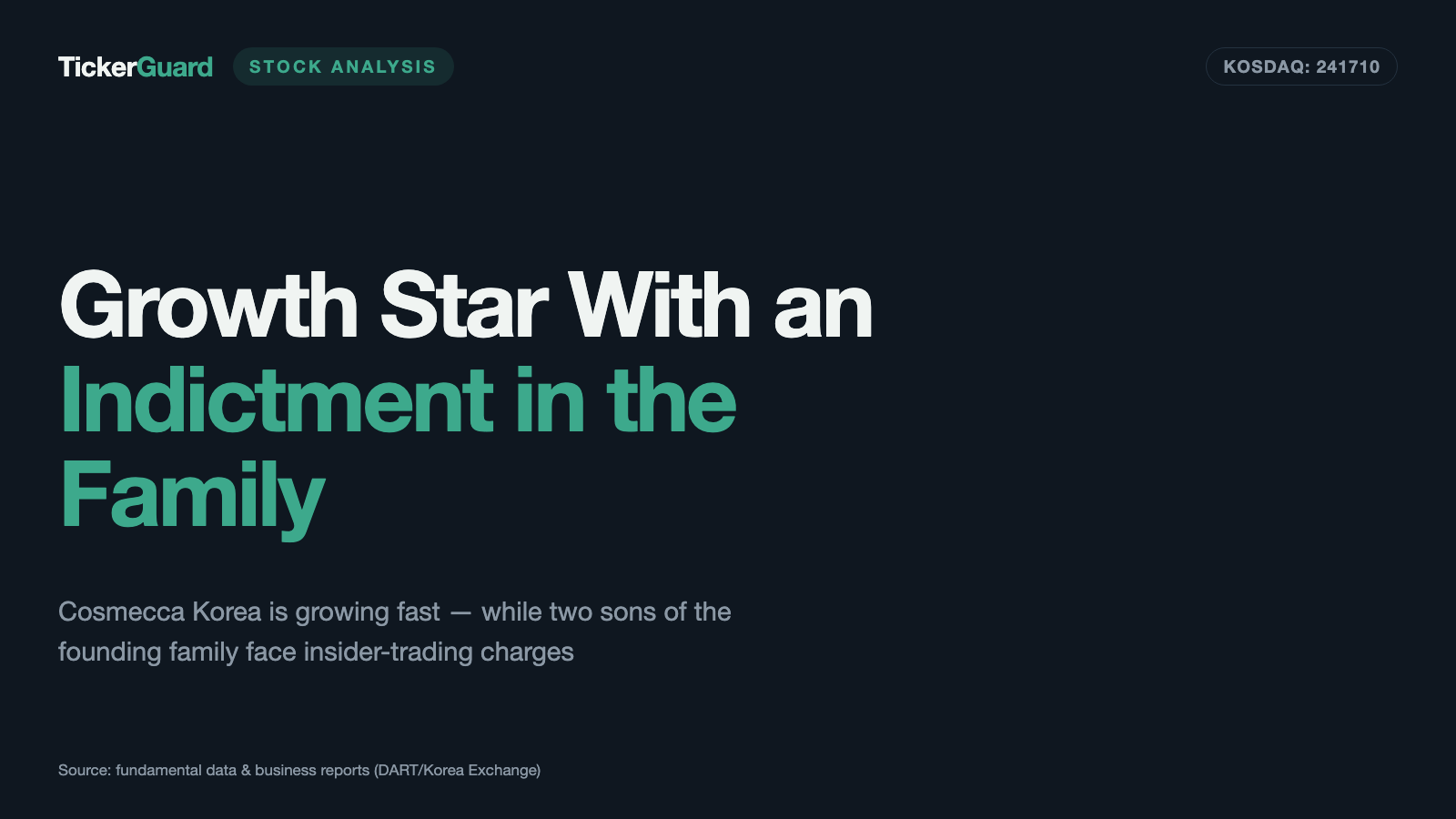
Cosmecca Korea: From Eternal Third Place to K-Beauty Star — With an Indictment in the Family
Cosmecca Korea (KOSDAQ: 241710) makes BB creams, sheet masks and makeup for Amorepacific, Missha and a dozen K-Beauty indie brands, without ever putting its own name on the tube. In 2025, group revenue grew 22.2 percent to 640.9 billion won, roughly 471 million US dollars, operating profit grew 38.4 percent — and the stock has climbed roughly 92 percent since the start of 2026 (briefly more than doubling). On August 11, 2026, the founding family's two sons were indicted on suspicion of insider trading, a year after the exchange rejected the company's bid to move up to the senior board. Not investment advice — just the question of what is left of the shiny numbers once you read the footnotes, too.
 Thomas Mücke
Founder & Publisher
Thomas Mücke
Founder & Publisher
There is a bias quieter than the fear of missing out, but just as expensive: the halo effect. When a company shines in one number — revenue growth, stock price, market share — our brain automatically assumes the other numbers are just as solid and that management can be trusted. With Cosmecca Korea, it is worth checking that reflex directly. The company grew 22.2 percent in 2025, accelerated further in the first half of 2026, and the stock has climbed roughly 92 percent since the start of the year (briefly more than doubling). On August 11, 2026, prosecutors indicted two sons of the founding family on suspicion of insider trading. Both things happened within the same eight months — and both belong to the same company.
The deal for this piece: no recommendation, no price target. We read the half-year report filed August 14, 2026, the audited 2025 annual report and South Korea's mandatory disclosures on the DART system — and check what remains of the shiny surface once you read the footnotes. The central tension running through this analysis: Cosmecca Korea's operating numbers are as good as they have been in years. So are its governance questions — just in the opposite direction.
What Cosmecca Korea actually does
Cosmecca Korea, based in Eumseong, roughly 100 kilometers south of Seoul, has made cosmetics for other brands since 1999: toners, creams, serums, sheet masks, sunscreen and makeup products such as BB and CC cream, foundation, lipstick and eyeshadow — as an ODM manufacturer (Original Development Manufacturing) that offers customers ready-made formulations rather than just filling order slips. The company is considered one of the pioneers of BB cream, the product that helped kick off the K-Beauty trend in the early 2010s. Clients include established Korean brands such as Amorepacific, Missha, Hanskin, Tonymory and Etude House, as well as a growing number of independent brands — such as Roundlab or Abib, whose products became social-media hits without the Cosmecca name ever appearing on the packaging. The 2025 annual report describes the company's own approach this way:
“당사는 화장품의 단순 주문생산(OEM)을 수행하기보다 보유한 처방을 고객사에 적극 제시하는 자체 연구개발 경쟁력(ODM)을 보유하였습니다. 특히, 코스메카코리아의 OGM(Original Global Standard and Good Manufacturing)은 글로벌 화장품 시장에서 고객사의 비즈니스에 최적화된 서비스를 제공하기 위해 개발된 시스템입니다.”
— Cosmecca Korea, 2025 annual report (사업보고서), section IV.2 "Overview", filed (corrected version) March 30, 2026. In substance: rather than simple contract manufacturing (OEM), the company holds its own R&D competitiveness (ODM), actively offering clients ready formulations. Its OGM system (Original Global Standard and Good Manufacturing) is built to deliver a service tailored to each client's business across the global cosmetics market.
Production runs through three separate country entities: the Korean parent (a plant in Incheon, an expansion in Cheongju for hydrogel masks, and a new research center in Pangyo), a Chinese subsidiary in Pinghu, and — since 2018 — Englewood Lab, based in Totowa, New Jersey, which secured additional US production capacity. In 2025, before intercompany elimination, the country entities generated 441.5 billion won in Korea, 216.8 billion in the US, and 34.0 billion in China; after eliminating intercompany sales, the group's consolidated statement shows the 640.9 billion won cited above (2025 annual report, segment results by country entity). One thing matters for everything that follows: Cosmecca Korea does not file a 10-K or a 10-Q — its mandatory reports live on the Korean DART system, prepared under K-IFRS. Under every figure in this analysis you will therefore find "Source: fundamental data & business reports (annual and half-year report, DART/Korea Exchange)" instead of "SEC filings."
Company history for investors
-
1999
Founding
Cosmecca Korea is founded on October 5, 1999 — the start of a company that would later pioneer BB cream and ride the K-Beauty wave.
-
2016
KOSDAQ listing
Cosmecca Korea lists on the KOSDAQ on October 28, 2016 — the stock becomes publicly tradable, but confined to Korea's second-tier exchange.
-
2018
Acquisition of Englewood Lab
Acquiring US company Englewood Lab secures Cosmecca additional production capacity in the United States — years later, this very stake becomes the center of an insider-trading allegation against two family members.
-
2025
KOSPI move rejected
On September 1, 2025, the Korea Exchange rejects the application to move from the KOSDAQ to the senior KOSPI board — reportedly over doubts about management independence.
-
2026
Governance reform
In March 2026 the company abolishes the full-time internal auditor system and sets up audit and compliance committees — the founding family's operational dual role remains unchanged.
-
2026
Stake raised to up to 66.7 percent
Via tender offer through March 23, 2026, Cosmecca Korea raises its Englewood Lab stake to up to 66.7 percent, for roughly 43 billion won in self-funded cash.
-
2026
Insider-trading indictment
On August 11, 2026, Suwon/Seongnam prosecutors indict two sons of the founding family on suspicion of insider trading in Englewood Lab shares dating back to 2018 — an open case that directly touches operational leadership.
How the stock landed on our desk
Cosmecca Korea spent years as the number three of a three-company industry, overshadowed by rivals Cosmax and Kolmar Korea, both of which post several times its revenue. That started to shift in 2025 and 2026: according to Korean business media, Cosmecca's stock gained 31.8 percent in the month leading up to August 11, 2026 — more than Cosmax (21.6 percent) and far more than Kolmar Korea (1.3 percent). On August 11, 2026 itself, the stock jumped 15.2 percent to 109,400 won, an intraday high of 116,800 won, a fresh 52-week high. On August 28, 2026, the stock closed at a 52-week high of 153,900 won (intraday high of 155,500 won on August 31, 2026; fundamental data). Several brokerages raised targets repeatedly: Samsung Securities from 110,000 to 130,000 won, NH Investment from 115,000 to 140,000 won, Kyobo Securities from 130,000 to 150,000 won, Hana Securities initiated coverage at 147,000 won.
The timing stands out: the rally followed, by a few months, a tender offer through which Cosmecca Korea itself raised its stake in US subsidiary Englewood Lab from 50 to up to 66.7 percent (offer period through March 23, 2026, price 13,000 won per share, roughly 43 billion won, self-funded) — and fell in the same year as the indictment of two family members over private share purchases at that very subsidiary dating back to 2018, more on that shortly. A stock that jumps double digits in a matter of weeks while a governance story plays out in the background is, for us, a reason to read the filings — not a substitute for it. No transcripts of analyst calls exist for this company; more on that in the next section.
The numbers over the years — an honest look
First, what genuinely impresses: group revenue grew from 470.7 billion won (2023) through 524.3 billion (2024) to 640.9 billion won in 2025 — up 22.2 percent, roughly $471 million at the reference exchange rate as of September 3, 2026 (1,359.46 won per US dollar). Operating profit grew even faster: from 49.2 through 60.4 to 83.5 billion won, up 38.4 percent — the gross margin climbed from 22.9 to 24.7 percent. In the first half of 2026, the pace accelerated further: 411.2 billion won in revenue (Q1: 185.1 billion, up 56.4 percent year over year; Q2: 226.1 billion, up 39.8 percent) and 53.9 billion won in operating profit — already about 89 percent of the entire fiscal year 2024 (60.4 billion won). The 2025 annual report attributes the growth to a mix of market cycle and positioning:
“당사는 2025년(제27기) 연결 기준 매출은 전기대비 22.2% 성장한 640,929백만원, 영업이익은 전기대비 38.4% 증가한 83,537백만원을 기록하였습니다.”
— Cosmecca Korea, 2025 annual report (사업보고서), section IV.2 "Overview", filed March 30, 2026. In substance: on a consolidated basis, our company posted 2025 (fiscal year 27) revenue of 640,929 million won, up 22.2 percent year over year, and operating profit of 83,537 million won, up 38.4 percent.
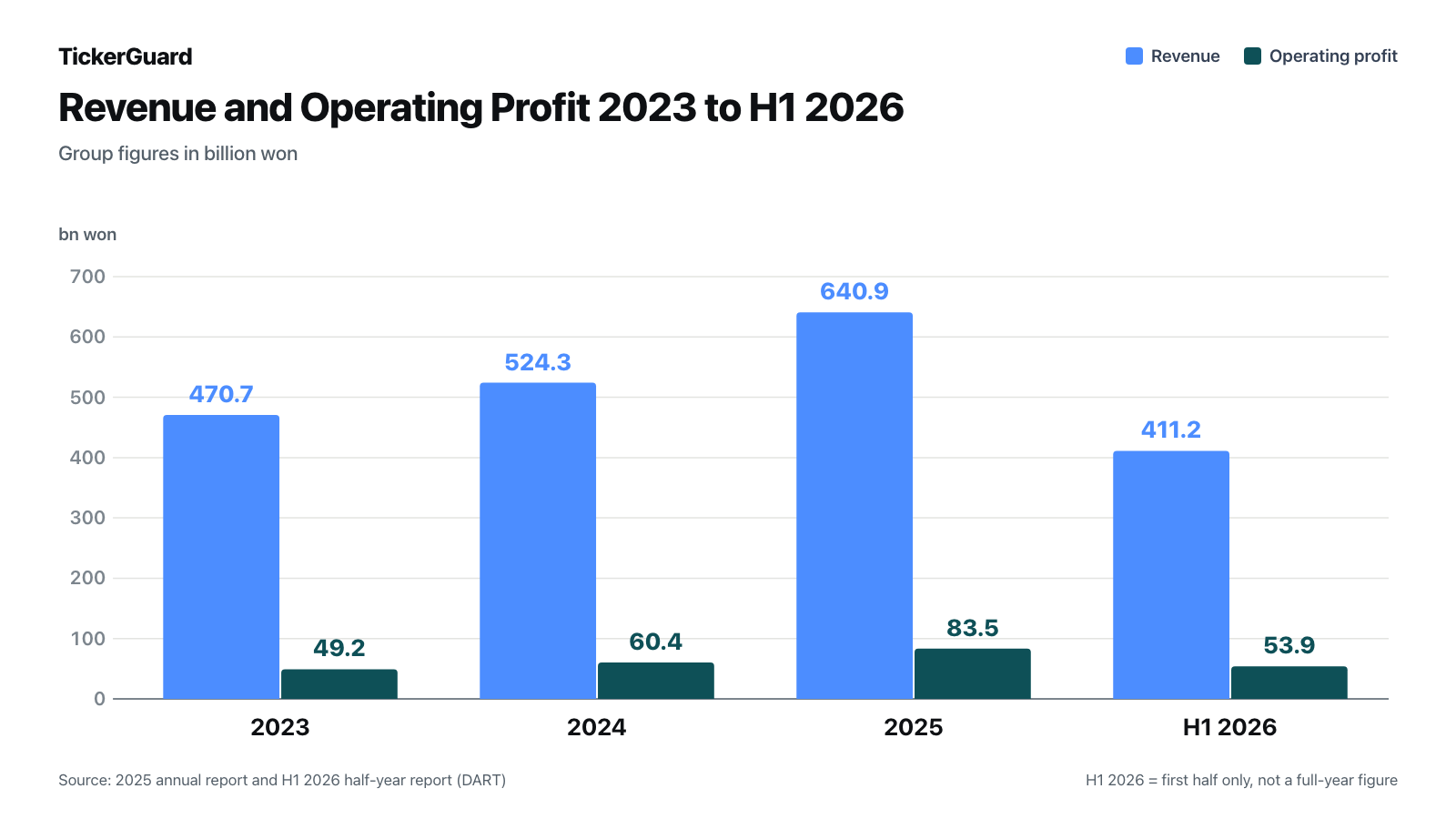
Net profit tells a more nuanced story, because roughly a fifth of it does not belong to Cosmecca shareholders: group net income rose from 33.9 (2023) through 53.7 (2024) to 57.8 billion won (2025, up 7.7 percent) — but only 45.4 billion won of that was attributable to parent-company shareholders, with the remaining 12.4 billion won going to minority interests. Why that is, and why it matters for more than a footnote, is the first uncomfortable truth.
What management promised — and what came of it
First, the transparency note: no publicly available analyst or earnings call transcripts exist for Cosmecca Korea — we specifically queried our transcript archive on September 3, 2026, with zero hits for this ticker. What management announces can therefore only be reconstructed from the MD&A chapter of the annual report and from mandatory disclosures — the most reliable source available, but one written by the company itself.
Promise 1: growth beyond the market cycle. The 2025 annual report cites a Global Growth Insights study projecting the global cosmetics ODM/OEM market to grow from roughly $73.3 billion (2025) to $77.4 billion (2026) and, long term, to $126.0 billion by 2035 — driven by product customization, private-label demand and outsourcing of development and production by both global and indie brands. Cosmecca positions itself explicitly as an ODM rather than a pure OEM player, offering its own formulations. First-half 2026 results so far confirm the growth story: the operating pace accelerated further versus 2025, and according to Korean business media (Hankyung, August 11, 2026) the company has since raised its own 2026 revenue guidance to 30 percent growth.
Promise 2: diversification instead of customer concentration. The segment note bears this out plainly: no single external customer reached 10 percent of group revenue in either the first half of 2026 or the year-earlier period. For the US business, the 2025 annual report specifically cites the expansion of FDA OTC sunscreen product lines among local and K-Beauty brands as the growth driver — and it showed: US operating profit nearly doubled in 2025 (up 98.8 percent to 37.4 billion won). This promise was kept — with one caveat covered in the uncomfortable-truths chapter: that most profitable leg happens to be the one carrying the governance questions.
Promise 3: a "solid financial structure" despite acquisitions. The 2025 annual report describes its own balance sheet as a "solid financial structure" ("견실한 재무구조"), citing a group equity ratio of 53.2 percent and a debt ratio of 87.9 percent — both moderate, not alarming figures. That is true on its own terms. What the sentence leaves out: part of the equity gain is eaten right back up by the very acquisition that strengthens the profitable US business. More on that next.
What the filings say — the uncomfortable truths
Uncomfortable truth #1: record profit, shrinking equity
The 2025 annual report explains the mechanism in a single sentence:
“자본잉여금은 전년 69,037백만원에서 62,803백만원으로 6,234백만원(9.0%) 감소하였습니다. 이는 잉글우드랩㈜ 지분 추가 취득(공개매수 방식, 지분율 39% → 50%)에 따른 종속기업 지분 변동 효과가 자본잉여금에서 차감 반영된 결과입니다.”
— Cosmecca Korea, 2025 annual report (사업보고서), section IV.3 "Capital", filed March 30, 2026. In substance: capital reserves fell 6,234 million won (9.0 percent) year over year to 62,803 million won, the result of the change in subsidiary equity interest from the additional acquisition of Englewood Lab Inc. shares (via tender offer, stake ratio 39 to 50 percent) being deducted from capital reserves.
Translated for non-accountants: when a majority owner buys shares from minority holders without a change of control, the purchase price does not run through the income statement — it is charged directly against equity. That happened in 2025 (39 to 50 percent of Englewood Lab) and again in the first half of 2026 (50 to up to 66.7 percent, roughly 43 billion won). The effect shows up directly in the numbers: despite a 39.9 billion won first-half profit, reported group equity fell from 336.2 billion won (December 31, 2025) to 334.6 billion won (June 30, 2026) — a decline you will not find anywhere in the income statement.
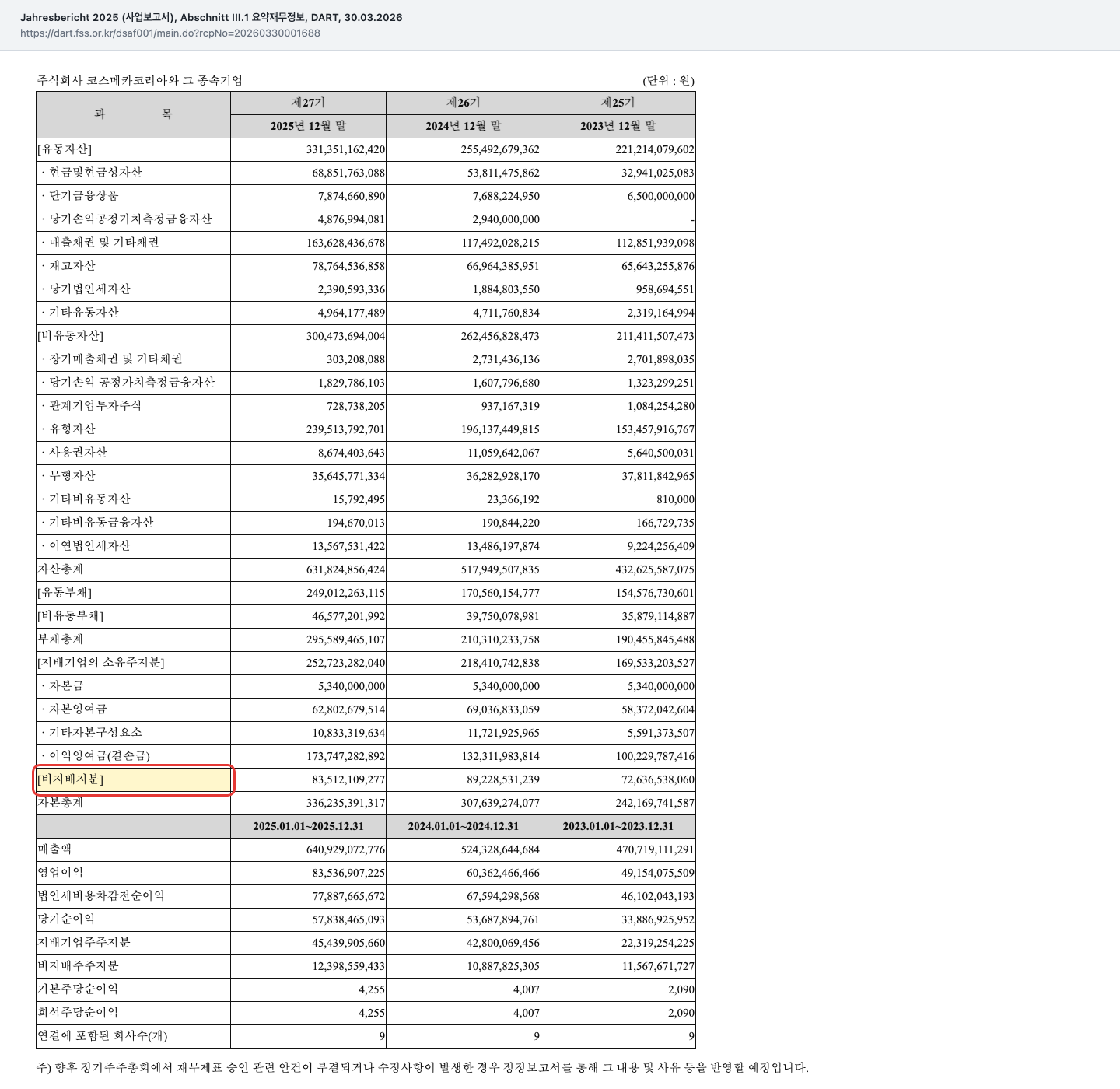
For scale: in 2023, 72.6 of 242.2 billion won in group equity (30 percent) belonged to minority holders; in 2024 it was 89.2 of 307.6 billion (29 percent). The share fluctuates but stays structurally high — buying Cosmecca shares means buying only part of the reported group assets; the rest is shared with the remaining Englewood Lab minority holders.
Uncomfortable truth #2: the second generation is in court over that very subsidiary
On August 11, 2026 — three days before the half-year report — prosecutors in Suwon (Seongnam branch) indicted two sons of the founding family, according to Korean business media, on suspicion of violating the Capital Markets Act, without pretrial detention (불구속 기소): the president of Cosmecca Korea's Korea business, and the CEO of US subsidiary Englewood Lab. The allegation, per reporting: in 2018, both allegedly knew in advance that Englewood Lab's quarterly revenue would rise more than 30 percent year over year — non-public information. According to the indictment, they are alleged to have used loans of roughly 2.5 billion won each, collateralized by Cosmecca Korea shares, to buy roughly 900,000 shares of Englewood Lab (445,000 at 5,550 won, 430,000 at 4,960 won), netting a combined illicit profit of roughly 2.1 billion won. Prosecutors were quoted as saying they would "maintain the indictment and continue to act firmly against unfair practices in the capital markets" (Joongboo Ilbo, August 11, 2026). No statement from either of the accused or from Cosmecca Korea regarding the allegations was available as of this analysis's data cutoff. The case has not been finally adjudicated as of this analysis's data cutoff — the presumption of innocence applies, and the company itself does not list the matter as a contingent liability in its own DART filings, presumably because it formally runs against individuals, not the company.
The timing is notable: precisely while Cosmecca Korea has been using its own funds in 2025 and 2026 to raise its Englewood Lab stake from 39 to as much as 66.7 percent, that same stake sits at the center of an insider-trading allegation against two family members who also hold operational leadership responsibility for the Korea and US businesses, respectively.
Uncomfortable truth #3: the move to the senior board was rejected
On September 2, 2025, Cosmecca Korea itself disclosed via mandatory DART filing that its application to move from the KOSDAQ to the KOSPI, South Korea's senior board, had been rejected on September 1, 2025:
“1. 유가증권시장 상장을 위한 상장예비심사 미승인 통보 접수 - 상장주선인: 엔에이치투자증권 주식회사 - 상장예비심사 청구일자: 2025년 06월 30일 - 상장예비심사 미승인일자: 2025년 09월 01일 - 당사는 유가증권시장 상장을 위한 상장예비심사에 대하여 미승인 통보를 받았습니다.”
— Cosmecca Korea, Other management matter (기타 경영사항), "Notice of non-approval of preliminary listing review for the securities market", filed September 2, 2025. In substance: notice received of non-approval for the preliminary listing review to list on the securities market (KOSPI) — listing sponsor: NH Investment & Securities; application date: June 30, 2025; non-approval date: September 1, 2025; our company received notice that its preliminary listing review for the securities market (KOSPI) was not approved.
The filing itself gives no reason — it only points back to its own history, a resolution approving delisting from the KOSDAQ dated May 10, 2024, and the outcome of the extraordinary general meeting on August 29, 2024, which approved the move. According to the business news outlet News.tf (May 19, 2026), the Korea Exchange cited doubts over management independence as the reason for rejection — specifically, the joint leadership of Cho Im-rae and Park Eun-hee, concentrated within the founding family, which the exchange said could weaken board oversight and transparency. The company initially responded, per the same report, by pledging to "humbly accept" the required governance improvements. In March 2026 it followed up with concrete measures: it abolished the full-time internal auditor system and instead set up an audit committee made up mostly of outside directors, along with a compliance committee. At the operational core of leadership — Park Eun-hee and Cho Im-rae remain executive directors, while their two sons run day-to-day operations in Korea and the US, respectively — nothing changed. Whether that will satisfy the Korea Exchange on a future attempt is unclear as of this analysis's data cutoff; no new application appears in the DART filings reviewed through September 3, 2026.
Valuation: what the market pays for the number three
At the September 3, 2026 closing price (134,200 won, roughly $99) and 10,680,000 shares outstanding, Cosmecca Korea is valued at roughly 1,433.3 billion won on the market — about $1.05 billion. Measured against audited 2025 earnings per share (4,255 won), that works out to a price-to-earnings ratio of roughly 32; measured against parent-company book value (23,663 won per share as of December 31, 2025), a price-to-book ratio of roughly 5.7 — both valuations that price in continued growth, not just the status quo. Annualizing first-half 2026 operating profit (53.9 billion won) would paint a considerably cheaper picture — with the usual caveat about extrapolating a single strong half in a cosmetics business that is not always seasonally even. A price-to-sales ratio says little about actual value creation at an ODM manufacturer, since material intensity swings heavily with product mix; we deliberately skip it. For context, our analysis of PharmaResearch, another Korean KOSDAQ stock from the skincare-adjacent space, shows how sharply dilution can reshape the shareholder stake. And our analysis of MK Electron shows how closely family control, minority interests and governance questions can intertwine at Korean KOSDAQ conglomerates.
Opportunities and risks at a glance
Opportunities:
- Accelerating growth: group revenue up 22.2 percent and operating profit up 38.4 percent in 2025; in H1 2026 revenue up roughly 47 percent, operating profit already at roughly 89 percent of all of 2024 (half-year report, filed August 14, 2026).
- Diversified customer base: no single customer reaches 10 percent of group revenue — growth rests on a broad base of established and indie brands rather than a few large accounts.
- Profitable US business: Englewood Lab nearly doubled operating profit in 2025 (up 98.8 percent to 37.4 billion won), driven by FDA OTC sunscreen products and automated manufacturing.
- Improved creditworthiness: NICE D&B upgraded the rating from BBB+ to A- in April 2026, Korea Ratings confirmed A- in June 2026 — a solid group equity ratio of 53.2 percent (December 31, 2025).
Risks:
- Governance and pending case: two family members in operational leadership were indicted on August 11, 2026, on suspicion of insider trading (alleged illicit gain of roughly 2.1 billion won); the case is open, and the presumption of innocence applies.
- KOSPI move rejected: on September 1, 2025, the Korea Exchange rejected the bid to move up to the senior board; the March 2026 reforms (audit and compliance committees) leave the founding family's operational dual role unchanged.
- Minority interests: roughly a quarter of group equity belongs to minority holders, chiefly of US subsidiary Englewood Lab — further stake purchases directly erode equity without running through the income statement.
- China business in the red: a second straight loss year (2025: minus 1.9 billion won operating loss, revenue down 15.9 percent) amid weaker demand and intensified local competition.
- Rich valuation: a price-to-earnings ratio of roughly 32 and a price-to-book ratio of roughly 5.7 based on 2025 results price in sustained high growth; a slowdown would hit the stock disproportionately.
- No secondary listing: the stock trades exclusively on the KOSDAQ; trading from outside Korea runs through brokers with Korea Exchange access, with won currency risk and often higher order fees.
A human bottom line
Back to the halo effect from the opening. Cosmecca Korea is delivering exactly the numbers a cosmetics ODM manufacturer dreams of: double-digit revenue growth, accelerating margins, a US business that doubled its profit in a single year. That is real, and it has rightly moved the stock. But the same company failed to win a move to the senior exchange in 2025, and in August 2026 two members of the leading family stand accused of insider trading tied to the very subsidiary the company itself is currently investing in with both hands. Neither fact cancels the other out. Anyone who reads the growth numbers and skips the footnotes on equity, listing status and the indictment is seeing only half the company — and that is the halo effect in action. What you make of it is your decision. And that is exactly as it should be.
Sources
- Cosmecca Korea — H1 2026 half-year report (반기보고서, filed August 14, 2026) — most recent periodic report; source of half-year figures, product and regional revenue, customer concentration, ownership structure, share count, contingent liabilities, subsequent events
- Cosmecca Korea — 2025 annual report (사업보고서, [기재정정], filed March 30, 2026) — audited consolidated and standalone financials 2023–2025, MD&A, segment results by country entity, equity bridge, dividend section
- Cosmecca Korea — Other management matter, "유가증권시장 상장예비심사 미승인 통보" (filed September 2, 2025) — KOSPI listing rejection, referencing the May 10 and August 29, 2024 resolutions
- Joongboo Ilbo — indictment report of two sons of the founding family over alleged insider trading, Suwon/Seongnam prosecutors (August 11, 2026)
- Hankyung — reporting dated August 11, 2026 on share-price performance, competitor comparison (Cosmax, Kolmar Korea) and raised 2026 guidance
- Herald Business / eDaily / Digital Today — reporting from February/March 2026 on the Englewood Lab tender offer (39 to 50 percent in 2025, up to 66.7 percent in 2026)
- News.tf — reporting dated May 19, 2026 on the KOSPI rejection and governance criticism of the founding family's continued dual leadership
- Fundamental data — share price, market capitalization, P/E and P/B ratios; data as of September 3, 2026. Exchange rates: reference rates as of September 3, 2026 (1 US dollar = 1,359.46 won, 1 euro = 1,576.60 won)
Disclosure: this analysis is a journalistic assessment of publicly available information and not investment advice, and not a recommendation to buy or sell. Stocks are subject to price fluctuations up to total loss. No publicly available earnings-call transcripts exist for Cosmecca Korea; the chapter on management statements relies on mandatory filings and IR materials published by the company. The investigation described in the text against two family members has not been finally adjudicated; the presumption of innocence applies. The author holds no position in securities of Cosmecca Korea Co., Ltd. at the time of publication.
Our Bottom Line at a Glance
- Operating momentum positive
- Group revenue up 22.2 percent and operating profit up 38.4 percent in 2025; H1 2026 accelerated further (revenue up roughly 47 percent, operating profit of 53.9 billion won — roughly 89 percent of all of 2024).
- Customer base positive
- No single customer reaches 10 percent of group revenue (H1 2026 half-year report); growth rests on a broad base of established and indie brands rather than a few large accounts.
- Balance sheet and financing positive
- Group equity ratio of 53.2 percent, debt ratio of 87.9 percent (December 31, 2025) — moderate, not alarming figures; credit rating upgraded from BBB+ to A- in April 2026 (NICE D&B).
- Governance and pending case negative
- Two family members in operational leadership were indicted on August 11, 2026, on suspicion of insider trading (alleged illicit gain of roughly 2.1 billion won); the case is open and the presumption of innocence applies.
- Listing status negative
- The KOSPI move was rejected on September 1, 2025, reportedly over doubts about governance independence; the March 2026 reforms leave the founding family's operational dual role unchanged.
- Group structure and valuation negative
- Roughly a quarter of group equity belongs to minority holders of the US subsidiary; further stake purchases directly erode equity. At the same time, a P/E ratio of roughly 32 and a P/B ratio of roughly 5.7 price in sustained high growth.
Cosmecca Korea is the fastest-growing of South Korea's three major cosmetics ODM companies, with a diversified customer base and a solid, improving balance sheet. At the same time, two family members in operational leadership were indicted on suspicion of insider trading in August 2026, the exchange rejected a move to the senior board a year earlier, and a significant share of reported equity does not belong to Cosmecca shareholders at all. Not investment advice.
What Our Rating Means
Open questions
The business works in principle, but one material question is open. As long as it stays open, our findings do not carry a quality verdict.
The yellow rating reflects an open governance question, not a solvency risk: operationally and financially, Cosmecca Korea looks solid — moderate leverage, an improving credit rating, a broad customer base, and no sign of going-concern issues or a genuinely deteriorating equity position. What keeps the rating from green is the combination of a pending investigation against two family members in operational leadership, the KOSPI rejection over governance doubts, and an equity structure where a significant share belongs to minority shareholders. None of these three issues is existential on its own — together, they amount to a material open operating question, not merely a pricing question. The decision is yours.
A journalistic assessment by our editorial team at the time of the deep dive, based on public sources — not investment advice and not a solicitation to buy or sell. Your personal circumstances (investment goals, risk capacity, taxes) cannot be taken into account. What our levels mean, how verdicts are formed, and what conflicts of interest exist →
Worth Noting
- Hook: the stock climbed roughly 92 percent since the start of 2026 (briefly more than doubling), and two family members were indicted on August 11, 2026, almost simultaneously with the half-year report filed August 14, 2026 as the most recent periodic report.
- Not a SEC filer: source chain runs through DART (반기보고서/사업보고서), K-IFRS, fiscal year = calendar year; no earnings-call transcripts available (transcript archive checked September 3, 2026: zero hits).
- The insider-trading case has not been finally adjudicated; the presumption of innocence applies. The company itself does not list the matter as a contingent liability — in our assessment, presumably because it formally runs against individuals, not the company.
The full analysis as a PDF for later
We will send you this analysis as a PDF — to print, file away, and read at your own pace.
Frequently Asked Questions
Cosmecca Korea (KOSDAQ: 241710), based in Eumseong, South Korea, develops and manufactures skincare and makeup products on behalf of other brands (ODM/OEM) — including Amorepacific, Missha and numerous K-Beauty indie brands. The company is considered one of the pioneers of BB cream. It produces through three country entities in Korea, the US (Englewood Lab, since 2018) and China.
Group revenue grew from 470.7 billion won (2023) through 524.3 billion (2024) to 640.9 billion won in 2025 — up 22.2 percent. In the first half of 2026, growth accelerated further to 411.2 billion won, more than 60 percent of the entire prior year's revenue in just six months (half-year report, filed August 14, 2026).
On August 11, 2026, prosecutors in Suwon/Seongnam, according to Korean business media, indicted two sons of the founding family — who hold operational leadership over the Korea and US businesses — on suspicion of insider trading related to shares of US subsidiary Englewood Lab. The case has not been finally adjudicated; the presumption of innocence applies.
The Korea Exchange rejected the application for preliminary listing review for the KOSPI on September 1, 2025 (DART filing dated September 2, 2025). According to the business news outlet News.tf (May 19, 2026), the exchange cited doubts about management independence, specifically the joint leadership of Cho Im-rae and Park Eun-hee, concentrated within the founding family. Reform measures (audit committee, compliance committee) followed in March 2026.
Because a significant portion of US subsidiary Englewood Lab remains owned by minority shareholders. As of December 31, 2025, 83.5 of 336.2 billion won in group equity — roughly a quarter — was attributable to minority interests. Purchases of further Englewood Lab stakes (39 to 50 percent in 2025, up to 66.7 percent in 2026) are charged directly against equity, not through the income statement.
Yes, since fiscal year 2024. For 2024, the company paid out 1,068 million won in total (payout ratio 2.02 percent); for 2025 it was 3,952 million won (payout ratio 6.83 percent). There was no dividend for 2023. According to the H1 2026 half-year report, no share buyback program exists.
Cosmecca Korea is a distant third in South Korea's cosmetics ODM industry behind Cosmax and Kolmar Korea, both of which generate several times its revenue. According to Korean business media, however, Cosmecca showed the strongest growth and share-price momentum of the three companies in 2025/2026.
Cosmecca Korea trades exclusively on the South Korean KOSDAQ (ticker 241710); its DART filings do not mention a secondary listing. Trading therefore runs through brokers with Korea Exchange access, which carries won currency risk and, depending on the broker, higher order fees.
Found an error?
Did you spot a factual error, an outdated number, or a typo in this deep dive? Let us know briefly — your report goes straight to the editorial team.