PharmaResearch Is Growing — and Diluting
PharmaResearch (KOSDAQ: 214450) sells injections made from a salmon-DNA compound — and is riding a record year for South Korea's medical-aesthetics tourism. Yet the stock still fell from an average of KRW 454,857 in January 2026 to KRW 299,738 within five months — a 34 percent drop — while the company grew first-half 2026 revenue 26 percent, on top of 53 percent growth for full-year 2025. By late August the stock had recovered to KRW 461,500. Read only the growth numbers, and you see a record-setting company. Read the half-year report down to the last footnote, and you find two lawsuits that have gone unresolved for years, plus a preferred share worth about KRW 207 billion that, per the report's more specific detail table, can already convert into common stock at a fraction of today's price — a separate part of the same report instead names October 2027. Not investment advice — just the question of who ultimately pays for the growth.
 Thomas Mücke
Founder & Publisher
Thomas Mücke
Founder & Publisher
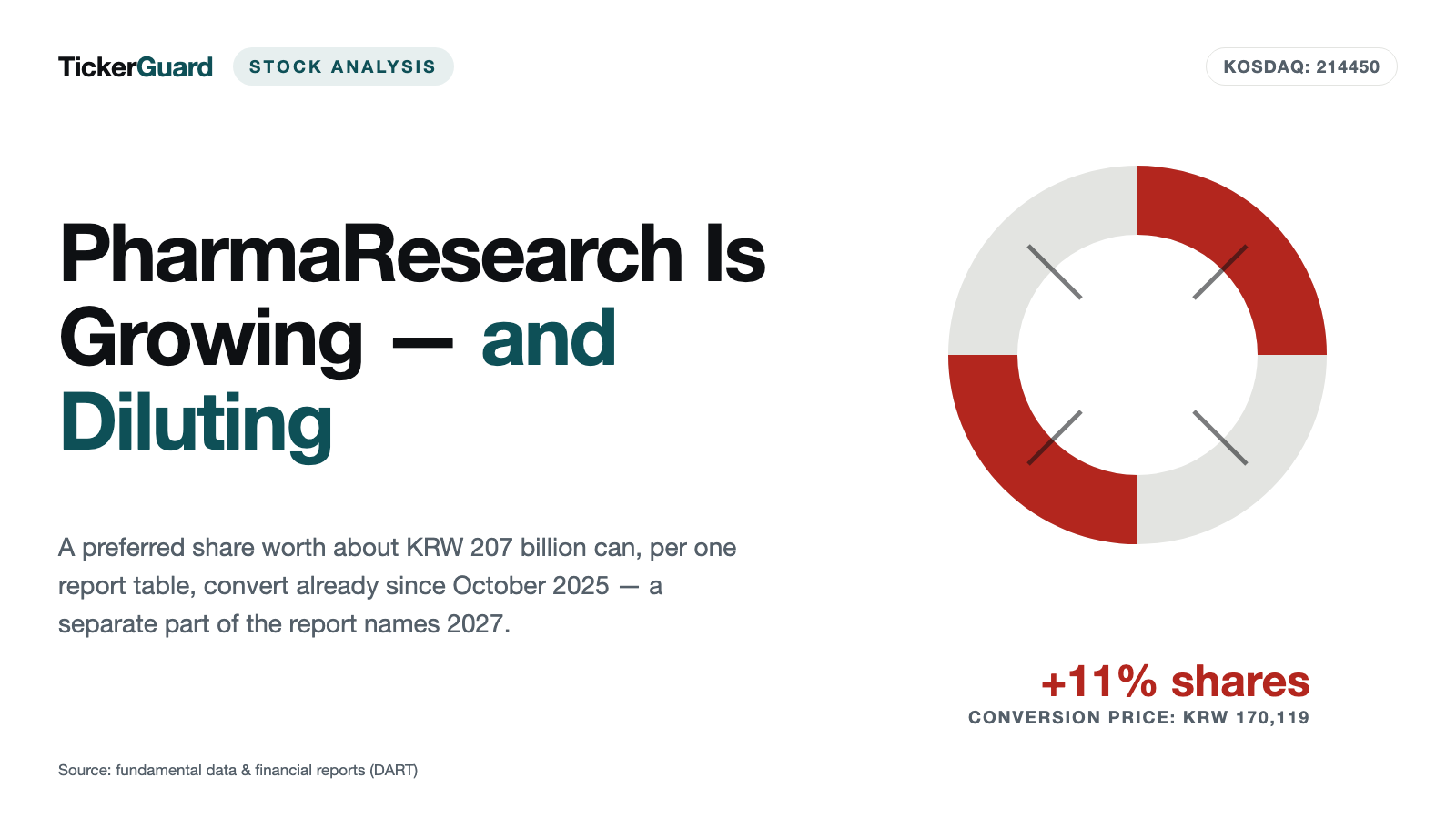
In dermatology clinics across Seoul, a needle is becoming a routine ritual: Rejuran, a so-called skin booster whose active ingredient comes from DNA fragments of salmon reproductive cells. In 2025, more foreign patients than ever traveled to Korea for treatments like it. The maker behind it, PharmaResearch (KOSDAQ: 214450), has reported record revenue for years — and yet the stock lost a third of its value in the first half of 2026 before recovering. Every investor knows the reflex that follows a headline number: once it's big enough, reading stops. Plus 53 percent revenue, one record year after another, a cosmetics brand sold across China, Japan, the US, and Southeast Asia — read that, and you feel like you already know everything that matters. Psychologists call this reflex confirmation bias: we seek information that supports an opinion we already hold, and skim past the rest. At PharmaResearch, that reflex costs at least one footnote — the one about a preferred share worth roughly KRW 207 billion whose conversion right, per one table in the same report, has already been open since October 2025, and which can convert into common stock at a fraction of today's price.
The deal for this piece: no buy recommendation, no price target. We read the half-year report filed August 14, 2026, and the financial reports that came before it, in Korea's mandatory disclosure system DART — down to the last footnote. The central tension running through every chapter: the company is growing at double-digit rates — profit attributable to shareholders rose from KRW 92.0 billion to KRW 165.1 billion in 2025 alone, up 79 percent — but a slice of that growth, literally more than one in ten future shares, is already contractually promised to someone else.
What PharmaResearch Actually Sells — and Why Salmon DNA Is Involved
PharmaResearch, based in Gangneung on Korea's east coast, was founded on March 3, 2001 as a consulting and distribution business for imported pharmaceuticals. In 2013 it renamed itself "Pharma Research Products Co., Ltd." — the name under which it still appears in some international databases today — before reverting to its current name in 2021. The stock has traded on the KOSDAQ since July 24, 2015. Its core business rests on a patented technology: PDRN and PN (polydeoxyribonucleotide and polynucleotide), regenerative compounds derived from DNA fragments of salmon reproductive cells. It sounds unusual, but it is a medically established ingredient — the fragments stimulate the body's own tissue regeneration and are processed into injections, creams, and implants.
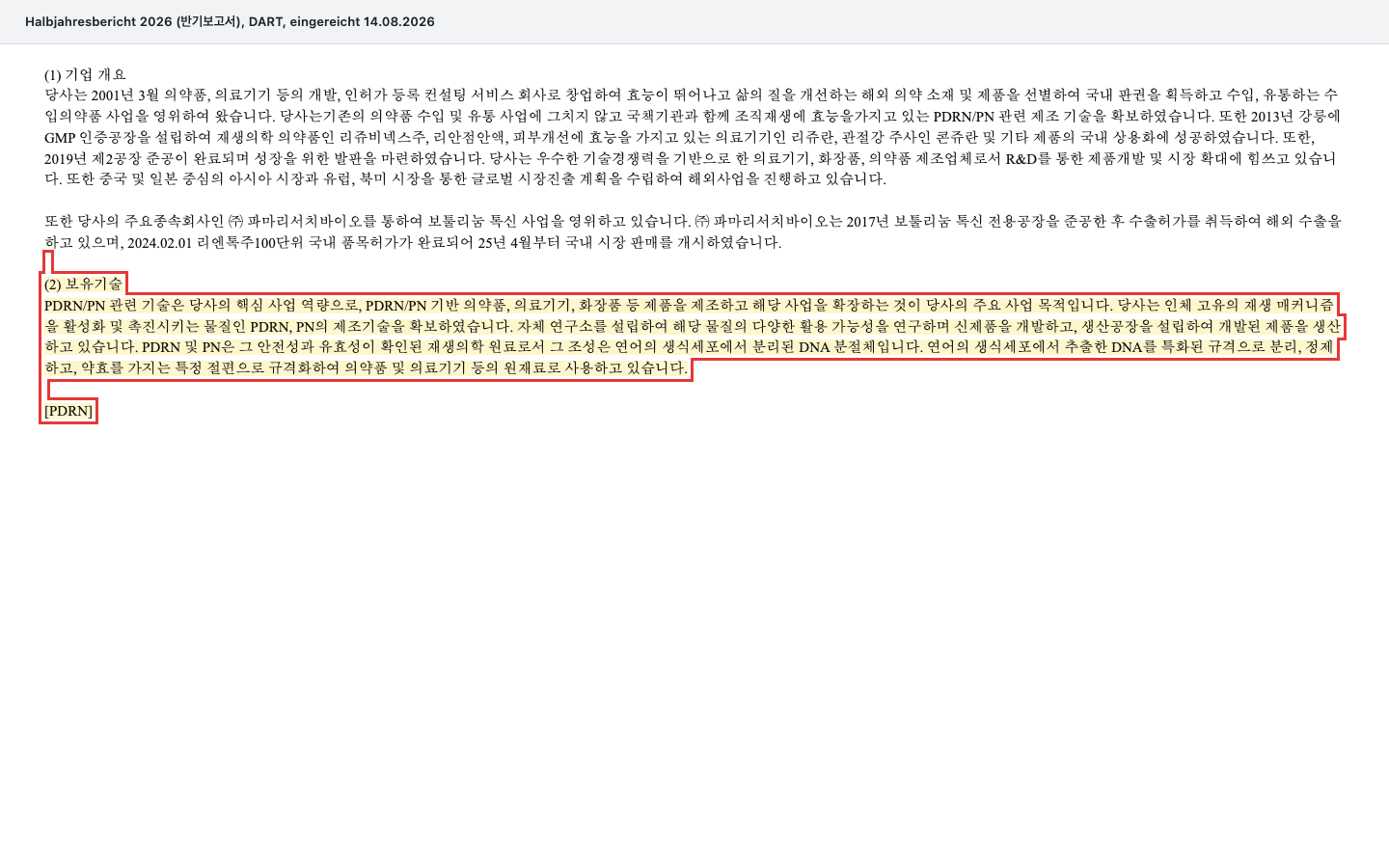
„PDRN 및 PN은 그 안전성과 유효성이 확인된 재생의학 원료로서 그 조성은 연어의 생식세포에서 분리된 DNA 분절체입니다.“
— PharmaResearch, half-year report H1 2026 (반기보고서), Section II.1 "보유기술", filed August 14, 2026 ("PDRN and PN are regenerative-medicine raw materials with confirmed safety and efficacy, composed of DNA fragments isolated from salmon reproductive cells.")
The technology is sold across three segments. Medical devices (54.2 percent of first-half 2026 revenue) — led by the skin booster Rejuran for dermatology and plastic surgery, and the joint injection Conjuran for orthopedics. Cosmetics (31.5 percent) under the same Rejuran brand, sold through Korean drugstore chains, duty-free shops, and online retail across China, Japan, the US, and Southeast Asia. Pharmaceuticals (12.3 percent) — PDRN injections plus, through subsidiary PharmaResearch Bio, the botulinum toxin product Reentox, exported since 2017 and, since April 2025, also sold domestically in Korea (approval granted February 1, 2024). The remainder (2.0 percent) comes from ancillary business. Forty-one domestic and 70 international patents protect the technology; 107 R&D staff (15 with doctorates, 57 with master's degrees) were working in the first half of 2026 on new applications — from a liquid botulinum toxin competitor to an FDA-cleared Phase 1 oncology trial. The global market the company positions itself in is growing fast according to the studies cited in the report: the global anti-aging market is projected to grow from about $73 billion (2024) to $140.9 billion (2034), and the narrower skin-booster injectables market from $1.17 billion to $1.91 billion by 2029. Patents aside, part of the competitive protection comes from the report's own R&D chapter, which states that the joint injection Conjuran has "no direct competing product other than our own" among medical devices — alternatives are only pharmaceuticals such as hyaluronic-acid or pain-relief injections, not a second PN-based device. Competition is broader for the skin booster Rejuran, where HA- and PLLA-based boosters from other makers compete for the same market, so PharmaResearch defends its position there mainly through clinical studies, physician education, and brand building rather than an exclusive claim on the ingredient.
Company history for investors
-
2001
Founded as a pharmaceutical distribution business
Started as a consulting and import business for foreign pharmaceuticals — the foundation for the later PDRN/PN development.
-
2013
Renamed "Pharma Research Products"
The name under which the company still appears in some international databases today — a naming risk for investors.
-
2015
IPO on the KOSDAQ
First listed on July 24, 2015 — the starting point of the stock's public trading history.
-
2017
Subsidiary PharmaResearch Bio completes botulinum toxin plant
The foundation for the later Reentox export business — and for the lawsuit that follows in 2021.
-
2021
Reentox export approval revoked
A six-month manufacturing suspension and a lawsuit by the subsidiary that remains unresolved to this day.
-
2024
Domestic approval granted for Reentox
Alongside the ongoing export lawsuit, the product can be sold in Korea for the first time starting 2025.
-
2025
Son Ji-hoon becomes new CEO
The former Hugel and Baxter Korea chief takes over operational leadership of the group.
How This Stock Landed on Our Desk
What first caught attention was the price itself: a stock that loses a third of its value in five months while the company simultaneously reports record numbers is unusual enough to warrant a closer look. The monthly averages from the shareholder register in the half-year report trace the path: from KRW 454,857 in January 2026, through KRW 362,324 (February) and KRW 314,952 (March), to KRW 299,738 in June — a 34 percent decline in five months, with a trading range from KRW 534,000 in January to KRW 259,000 in June. By August 28, 2026, the price had recovered to KRW 461,500. The second point of interest came from the half-year report itself: South Korea's Ministry of Health and Welfare reported a record 2,011,822 foreign medical patients in 2025 — of whom 1,312,700 (65.2 percent) sought dermatology care, up 86.2 percent from the prior year. A company whose core product sits exactly in that segment deserves a second look in such an environment, regardless of where the stock happens to trade.
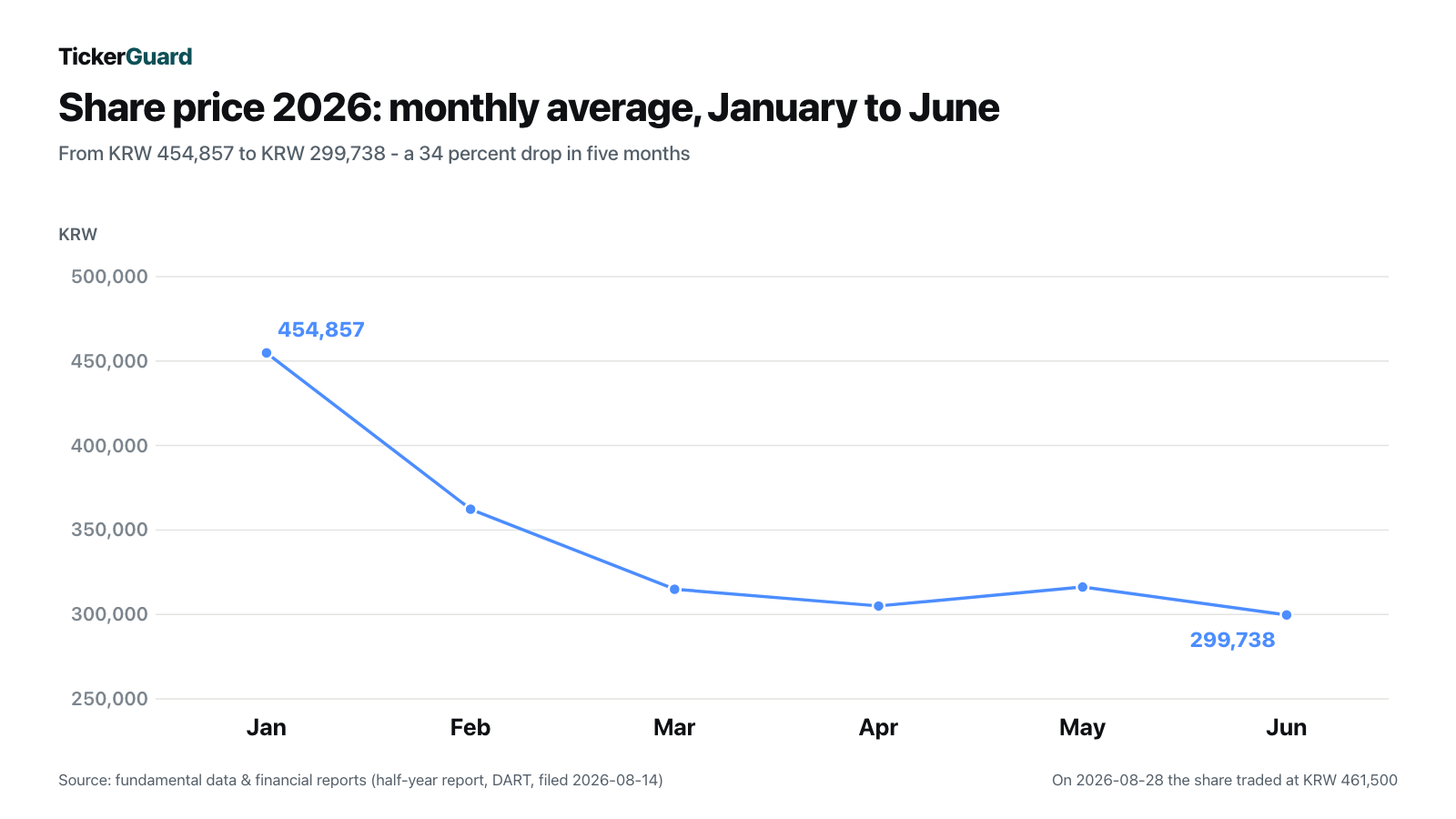
Buy at the June low of KRW 259,000, and you are up roughly 78 percent since; buy at the June average of KRW 299,738, and you are up roughly 54 percent. Buy at the January high, and despite the recovery you are still underwater. Both happened while the company reported record numbers throughout — a sign that the price was, at least at times, reacting more to sentiment than to the underlying business.
The Numbers Over the Years — More Cash Than the Growth Needs
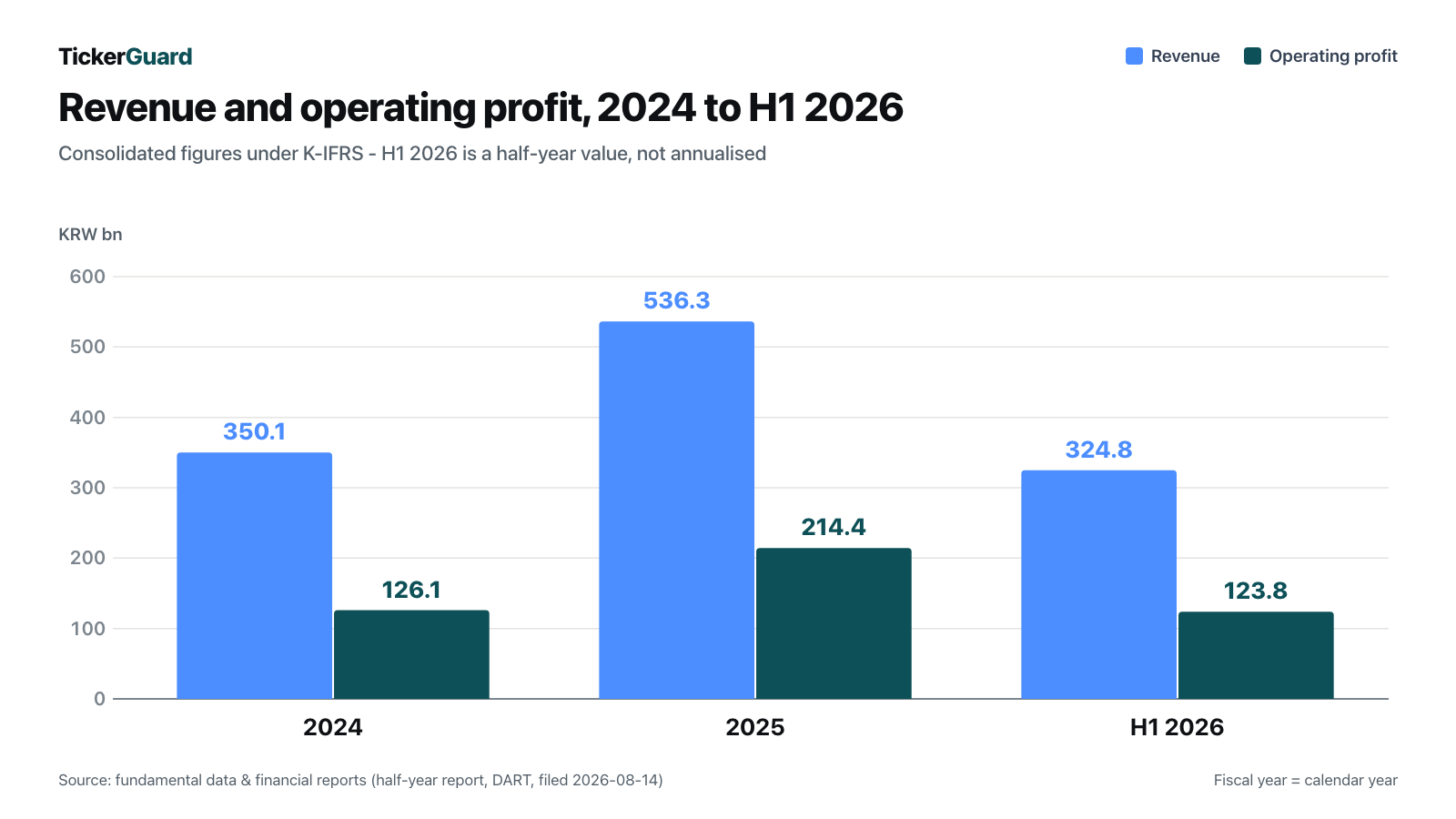
Consolidated revenue rose from KRW 350.1 billion (2024) to KRW 536.3 billion (2025) — up 53.2 percent — and had already reached KRW 324.8 billion in the first half of 2026, up 26.1 percent from the first half of 2025 (KRW 257.5 billion). Operating profit climbed over the same span from KRW 126.1 billion to KRW 214.4 billion to KRW 123.8 billion in the half-year — operating margin came in at 36.0 percent (2024), 40.0 percent (2025), and 38.1 percent (H1 2026): high and stable, not the picture of a company buying growth with margin. Earnings per share rose from KRW 8,941 (2024) through KRW 15,893 (2025) to KRW 10,024 in the first half of 2026 alone. Growth is led by exports: the export share rose from 36.9 percent (2024) to 38.6 percent (2025) to 43.9 percent in the first half of 2026, with particularly strong cosmetics export growth (from KRW 46.3 billion for full-year 2024 to KRW 70.4 billion in the first half of 2026 alone).
The balance sheet as of June 30, 2026 is unusually solid for a company at this growth stage: total assets of KRW 1,107.2 billion, equity of KRW 788.9 billion (an equity ratio of roughly 71 percent), cash and short-term financial assets of KRW 538.1 billion against financial liabilities of KRW 213.7 billion — a net cash position of roughly KRW 324.4 billion. Those financial liabilities consist almost entirely of the one position the chapter after next is about: the KRW 207.3 billion convertible preferred share. Net cash and dilution risk are two sides of the same balance-sheet line. The Altman Z-score most recently stood at 11.59, well above the 1.8 distress threshold. This is not a company at risk of running out of money — which makes the next two sections no less worth reading, just different in kind: this is not about survival, but about who gets what.
What Management Promises on Calls — and Why We Couldn't Check It
The honest transparency footnote first: no publicly available transcripts of analyst or earnings calls exist for PharmaResearch. We queried our internal transcript archive on August 31, 2026, specifically for this ticker (zero hits, even with a twelve-month lookback) and checked common providers. DART lists several "기업설명회(IR)개최" (investor briefing held) filings for 2025 — for instance on June 16 and June 27, 2025 — but these are pure announcements of time and venue, without a transcript or attached presentation. What management says cannot be quoted directly; the audited numbers serve as the best available substitute.
The most informative substitute is the auditor's opinion. Accounting firm Reean issued unqualified opinions for fiscal years 2024 and 2025 and confirmed the review of the 2026 half-year report without objection — there is no indication of a material going-concern uncertainty. What is notable, though, is what the auditor flagged as a key audit matter in both years:
„수익인식 기간귀속의 적정성“
— Reean Accounting Corp., half-year report H1 2026 (반기보고서), Section V.1 "회계감사인의 감사의견", filed August 14, 2026 ("Appropriateness of the periodic allocation of revenue recognition.")
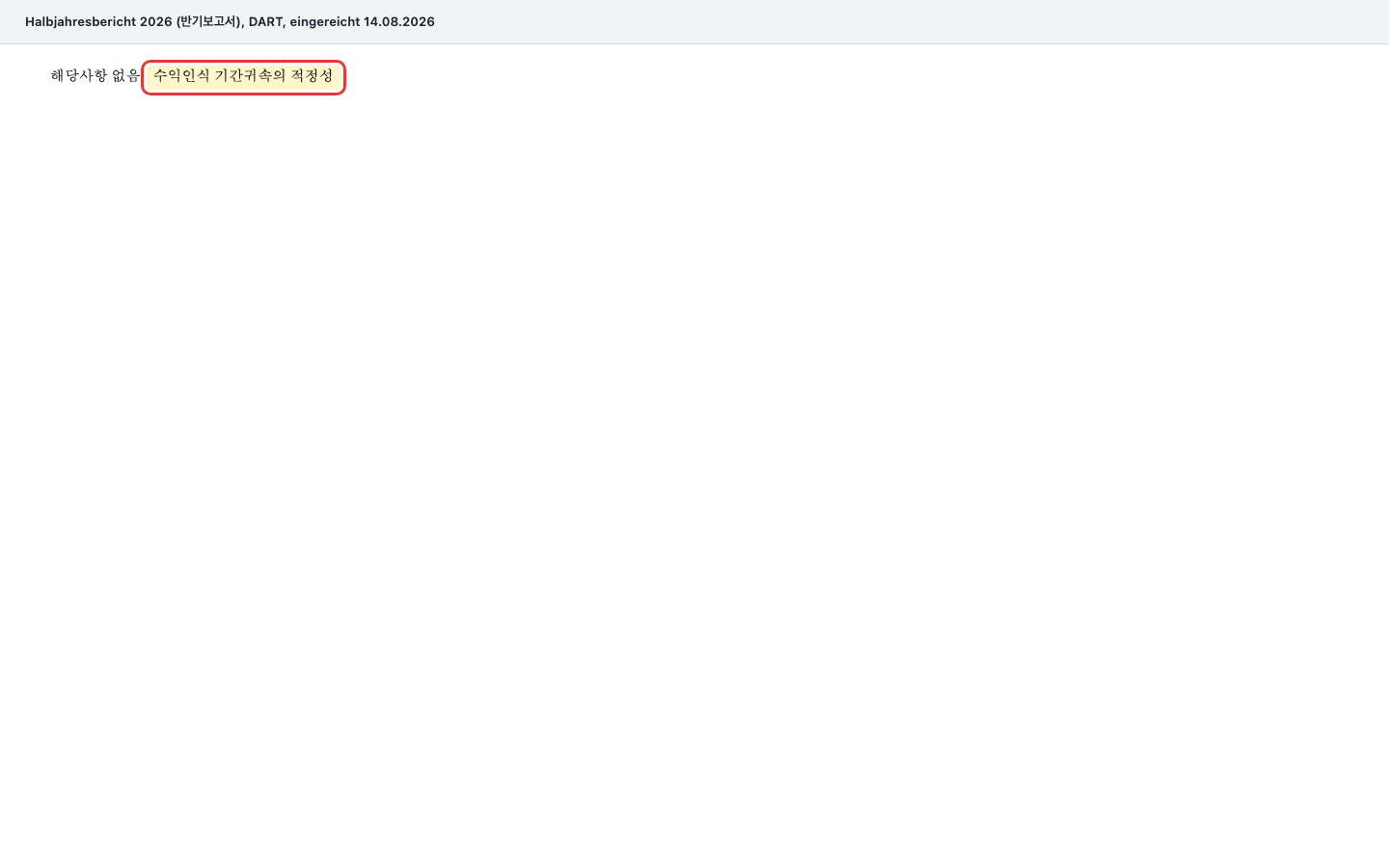
That is not a red flag by itself — revenue recognition is a natural audit focus for a company with export sales, distribution partners, and multi-tier rebate programs. But it is the most concrete publicly available signal of where independent auditors are looking most closely at this growth rate — the question that would typically surface in an earnings call's Q&A is instead answered here by the audit report.
The Uncomfortable Truths
Uncomfortable truth #1: a nearly five-year-old lawsuit is still unresolved
In December 2021, Seoul's regional food and drug safety office revoked subsidiary PharmaResearch Bio's approval for two export variants of the botulinum toxin product Reentox — and imposed a six-month manufacturing suspension:
„㈜ 파마리서치바이오는 2021년 12월 2일 서울지방식품의약품안전청으로부터 리엔톡스주100단위(클로스트리디움보툴리눔독소A형)(수출용), 리엔톡스주200단위(클로스트리디움보툴리눔독소A형)(수출용) 품목에 대하여 2021년 12월 13일부로 품목허가 취소 및 전제조업무 정지 6개월 처분을 받았습니다.“
— PharmaResearch, half-year report H1 2026 (반기보고서), Section XI.2 "우발부채 등에 관한 사항", filed August 14, 2026 ("PharmaResearch Bio received, effective December 13, 2021, revocation of approval and a six-month manufacturing suspension from the Seoul Regional Food and Drug Safety Office for the products Reentox 100 units (Clostridium botulinum toxin type A, export) and Reentox 200 units (export), notified December 2, 2021.")
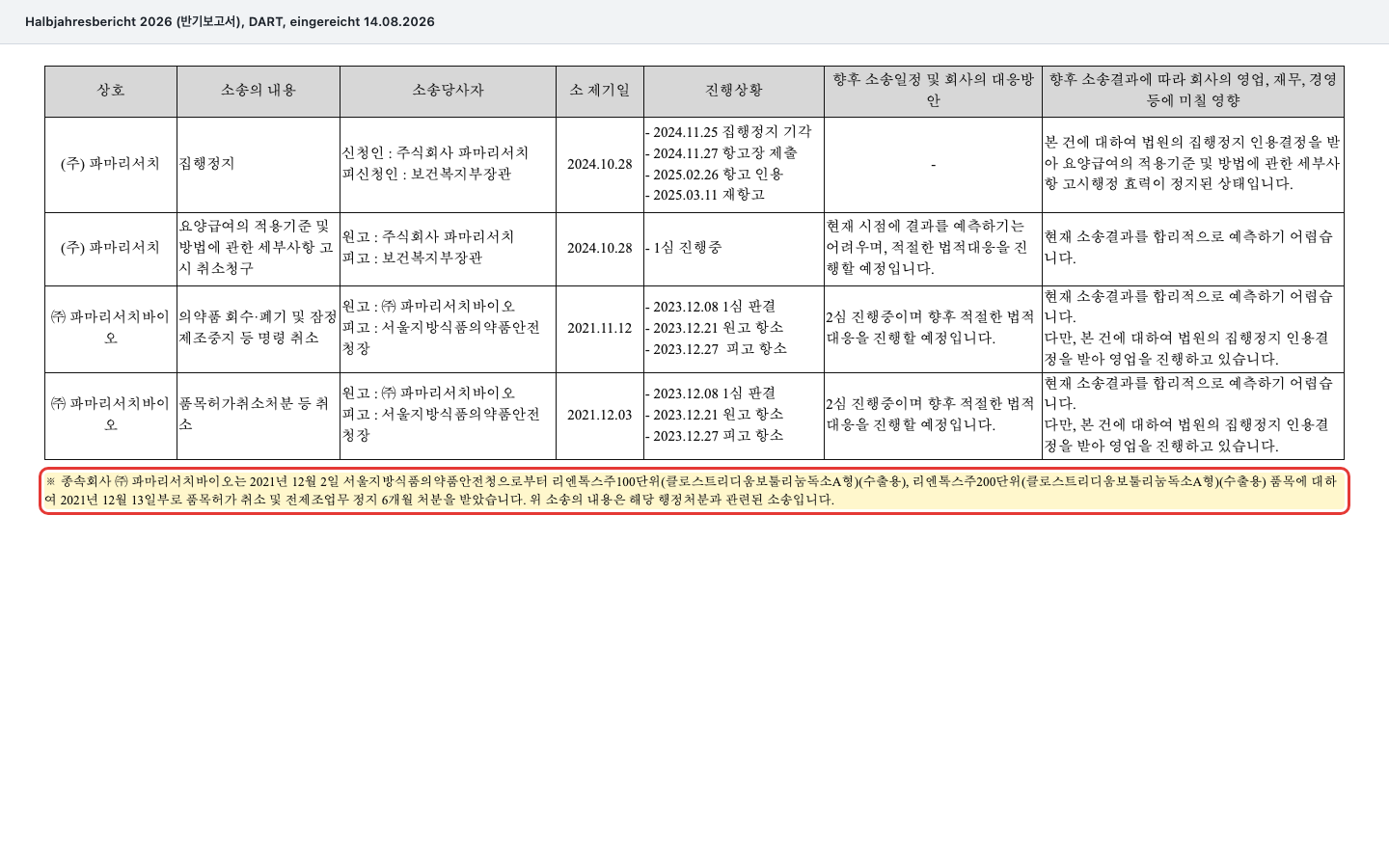
PharmaResearch Bio obtained a court stay and was able to keep manufacturing — the first-instance ruling of December 8, 2023 was appealed by both sides, and the second instance is, per the half-year report, still ongoing, with the company stating the outcome "cannot reasonably be predicted." Nearly five years after the regulatory decision, the legal status of the Reentox export business remains unresolved — even as domestic sales of the same product, under a separate approval, have already begun since April 2025.
Uncomfortable truth #2: the parent is suing over its own reimbursement framework
Since October 2024, the parent company itself has been pursuing two lawsuits against the Ministry of Health and Welfare — one of them challenging a notice on the "criteria and methods" for reimbursement under Korea's national health insurance. The company obtained a court stay of that notice in February 2025; the main case is, per the report, still in its first instance. The outcome bears directly on the terms under which core products can be billed through Korea's national health insurance — and here too, the company's own assessment is: unpredictable.
Uncomfortable truth #3: one in ten future shares already contractually belongs to someone else
The balance sheet carries a KRW 207.3 billion liability labeled 전환상환우선주부채 — a preferred share accounted for as a liability because it carries a holder redemption right. The sole holder, per the shareholder register, is a party named "Polish Company Limited," holding all 1,175,647 preferred shares — 10.16 percent of the 11,565,295 total shares outstanding (common and preferred combined). The shares were issued October 8, 2024; the report does not disclose who is economically behind the "Polish Company Limited" name. The terms:
„2. 전환청구가능시기: 2027.10.08 3. 전환가격: 170,119“
— PharmaResearch, half-year report H1 2026 (반기보고서), Note 18 "복합금융상품", filed August 14, 2026 ("2. Date from which conversion can be requested: 2027-10-08. 3. Conversion price: KRW 170,119.")
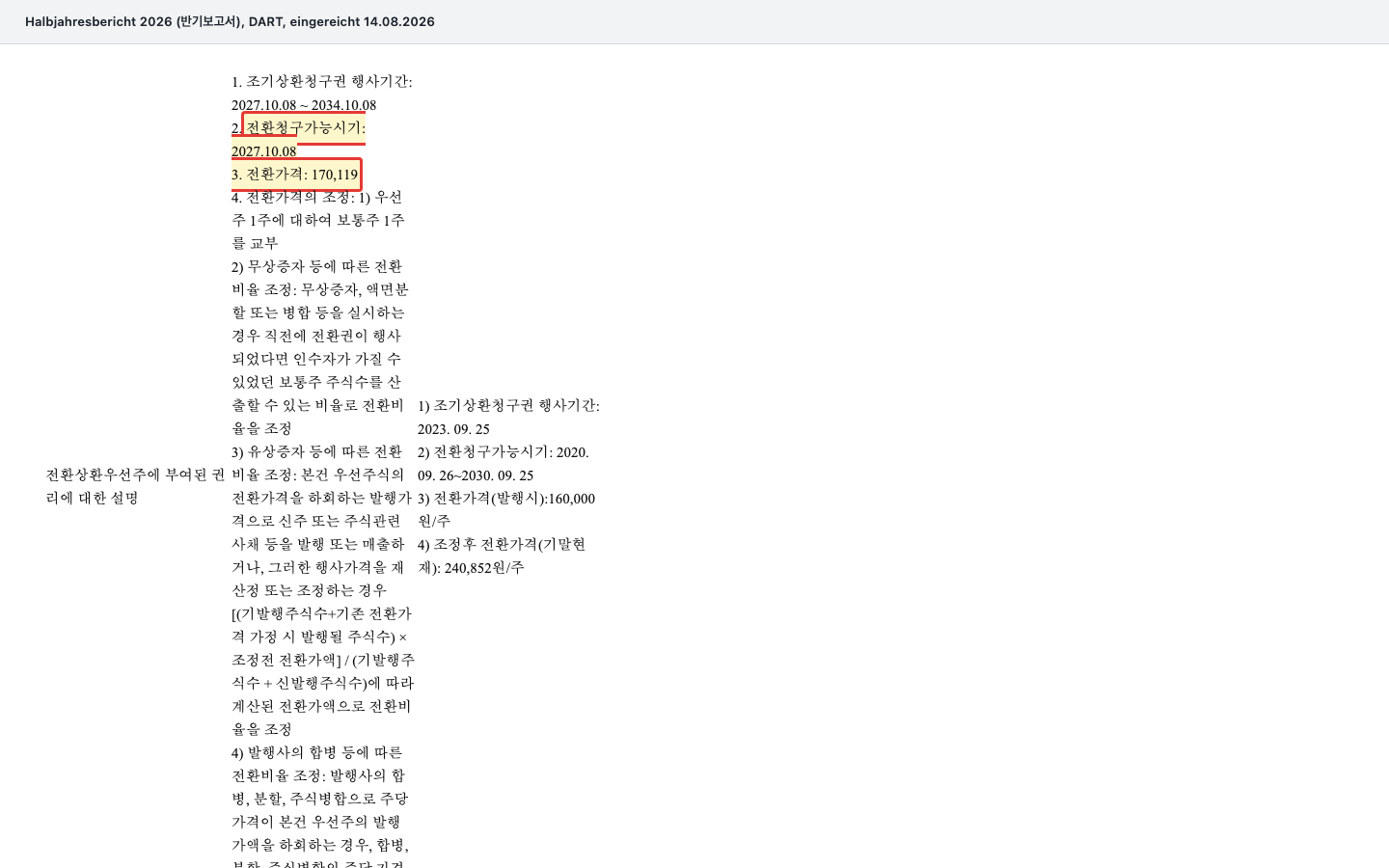
At a share price of KRW 461,500, the common shares trade roughly 171 percent above the KRW 170,119 conversion price — a cash redemption would be economically unattractive to the holder compared with converting. The report states the resulting share count directly, not as a calculation: 1,175,647 new common shares (Section I.4, a 1:1 conversion ratio), more than 11 percent above the 10,389,648 shares outstanding today. This is not an acute danger — the company could easily fund the amount from its own net cash of KRW 324 billion — but it is a structural dilution that none of the currently communicated earnings-per-share figures yet price in, and which, per the more specific report table, may already be due.
Valuation: What the Market Pays for the Growth
At a price of KRW 461,500 and 10,389,648 common shares outstanding, PharmaResearch carries a market capitalization of roughly KRW 4,794.8 billion — about €3.0 billion at the ECB reference rate of August 28, 2026 (KRW 1,600.39 per euro). Against first-half net income attributable to shareholders of KRW 104.1 billion (roughly KRW 208 billion annualized), that implies a price-to-earnings ratio of roughly 23; on the audited 2025 net income (EPS KRW 15,893), it works out to roughly 29 — not a bargain, but not a pure story valuation without earnings behind it either. An operating margin around 38 to 40 percent, a return on equity of 27.3 percent, and a fundamental rating of B (73 out of 100) describe a profitable, growing company; a Piotroski score of 8 (out of 9) confirms solid balance-sheet quality. What the valuation does not show is the potential dilution from the preferred-share conversion: anyone calculating earnings per share today is calculating against a share count that, per the more specific report table, may already be inaccurate. More shares against the same profit lower earnings per share and therefore raise the price-to-earnings ratio: on a fully diluted basis (11,565,295 shares), it would rise from roughly 23 to roughly 26 (half-year basis) or from roughly 29 to roughly 32 (2025 basis) — dilution makes the stock arithmetically more expensive, not cheaper. The free float sits at 51.09 percent, spread across more than 82,000 largely retail shareholders — a broad but also sentiment-sensitive ownership structure, as the first half of 2026's price action demonstrated. This isn't the first time a shiny KOSDAQ growth story revealed its other side only on a close reading of the balance sheet: MK Electron carried a similar gap between the headline numbers and a corporate structure that only became clear in the footnotes.
Opportunities and Risks at a Glance
- Opportunity: The global anti-aging market is growing at roughly 7 percent a year and the narrower skin-booster market at roughly 10 percent, according to the studies cited in the report — a tailwind for the core business.
- Opportunity: South Korea's medical tourism hit a record above two million foreign patients in 2025, with dermatology the largest single segment — a structural advantage for a Korean company with exactly that focus.
- Opportunity: A net cash position of roughly KRW 324 billion leaves room for research, acquisitions, or an orderly cash settlement of the preferred shares without touching the operating business.
- Risk: Two multi-year lawsuits — the Reentox export approval and the parent's reimbursement rules — are, by the company's own account, unpredictable in outcome and touch core products.
- Risk: The convertible preferred share can, per the report's detail table, already create roughly 11 percent new common shares — a structural headwind for earnings per share that doesn't appear to be priced into current trading.
- Risk: The 2026 share price showed how strongly it can swing independent of the operating numbers — a sign of thin, sentiment-driven trading.
A Human Conclusion
The confirmation bias from the opening of this piece isn't the company's mistake — it's the reader's. PharmaResearch genuinely delivers impressive numbers: 53 percent revenue growth, a 38 percent operating margin, a net cash position that smothers any solvency question at birth. Stop there, and you have half the story. The other half sits in the same reports, just not on the first page: two lawsuits whose outcome the company itself won't predict, and a preferred share that, per the more specific report table, can already be reshaping the share count today — a different part of the same report instead points to October 2027. None of that turns a solid company into a bad one — but it belongs in the same calculation as the growth rates. Whether that's worth this price is a question of your own time horizon and risk appetite. Not investment advice.
Sources
- Half-year report H1 2026 (반기보고서 제26기), DART, filed August 14, 2026
- DART filing overview, PharmaResearch Co., Ltd., Korea's Financial Supervisory Service (FSS) electronic disclosure system
- Fundamental data (price, market capitalization, ratios), data as of August 28, 2026
- ECB reference rates as of 2026-08-28 (EUR/KRW) and 2026-08-21 (EUR/USD)
Disclosure: This article is for informational purposes only and does not constitute investment advice. All figures without guarantee. Not investment advice.
Our Bottom Line at a Glance
- Business model positive
- Patented PDRN/PN platform (41 domestic, 70 international patents) with a leading position in skin-booster injectables; revenue spread across medical devices, cosmetics, and pharmaceuticals (half-year report filed 2026-08-14).
- Balance sheet positive
- Equity ratio of roughly 71 percent, net cash of roughly KRW 324.4 billion, Altman Z-score of 11.59 as of 2026-06-30 — no solvency risk visible.
- Growth & margin positive
- Revenue up 53.2 percent (2025), operating margin stable between 36 and 40 percent across three reporting periods — growth is not being bought with declining profitability.
- Litigation negative
- Two multi-year cases, unpredictable in outcome by the company's own account, touch the Reentox export approval and the reimbursement rules for a core product.
- Dilution negative
- A convertible preferred share well below the market price (KRW 207.3 billion, conversion price KRW 170,119) can, per the report's detail table, already create roughly 11 percent new common shares.
- Price volatility neutral
- The stock swung more sharply in 2026 than the operating business did (down 34 percent January through June, then recovering) — a sign of sentiment-driven trading amid broad free float.
PharmaResearch shows double-digit revenue growth at a consistently high margin and a very solid balance sheet — set against two unresolved lawsuits and a structural dilution from a deeply in-the-money convertible preferred share that, per the report's more specific detail table, can already become effective (a separate part of the same report instead names 2027). Not investment advice.
What Our Rating Means
Open questions
The business works in principle, but one material question is open. As long as it stays open, our findings do not carry a quality verdict.
Financially this is an unusually robust company — net cash, high margins, a clean audit opinion. But two multi-year lawsuits touching core products, unpredictable in outcome by the company's own account, plus an approaching, deeply in-the-money dilution event, are material open operational questions that rule out a green light. Not a solvency risk, but genuine uncertainty about the path ahead. The decision is yours.
A journalistic assessment by our editorial team at the time of the deep dive, based on public sources — not investment advice and not a solicitation to buy or sell. Your personal circumstances (investment goals, risk capacity, taxes) cannot be taken into account. What our levels mean, how verdicts are formed, and what conflicts of interest exist →
Worth Noting
- Data as of the half-year report filed August 14, 2026 (figures as of 2026-06-30); price figures as of August 28, 2026.
- Naming risk: the company operated as "Pharma Research Products Co., Ltd." from 2013 to 2021 — that name still circulates as a legacy label in some databases.
- Not an SEC filer: the evidence chain runs through Korea's disclosure system DART, accounted under K-IFRS.
The full analysis as a PDF for later
We will send you this analysis as a PDF — to print, file away, and read at your own pace.
Frequently Asked Questions
PharmaResearch (KOSDAQ: 214450) is a South Korean regenerative-medicine company. PDRN and PN are patented compounds derived from DNA fragments of salmon reproductive cells that stimulate the body's own tissue regeneration and are processed into products such as the skin booster Rejuran.
The price fell from a monthly average of KRW 454,857 in January 2026 to KRW 299,738 in June — a 34 percent drop — and recovered to KRW 461,500 by August 28, 2026. The half-year report offers no explicit explanation for the swing; it occurred while the company was reporting record revenue.
A preferred share with a carrying value of KRW 207.3 billion can, per a detail table in the report, convert at KRW 170,119 per share into exactly 1,175,647 common shares already since October 8, 2025 (a different part of the same report instead states October 8, 2027). That would raise the common share count by more than 11 percent and dilute earnings per existing share accordingly.
PharmaResearch Bio has been appealing the late-2021 revocation of its export approval for the botulinum toxin product Reentox; the appeal is ongoing. Separately, the parent company has been suing the Ministry of Health and Welfare since October 2024 over reimbursement rules for one of its products. Both cases are, per the company, unpredictable in outcome.
No. No publicly available call transcripts exist for PharmaResearch. Korea's disclosure system DART lists only announcements of investor briefings, without a transcript or presentation attached.
Very solid: as of June 30, 2026, an equity ratio of roughly 71 percent stood against a net cash position of roughly KRW 324.4 billion, and the Altman Z-score was 11.59. This is not a company at risk of financial distress.
No. The half-year report reviewed for this analysis shows no reference to artificial intelligence in the business model, product descriptions, or research agenda.
Found an error?
Did you spot a factual error, an outdated number, or a typo in this deep dive? Let us know briefly — your report goes straight to the editorial team.