Climb Global Solutions: The Dividend Is Gone, and Its Own Savings Target Was Just Missed by the Widest Margin Ever
Climb Global Solutions (Nasdaq: CLMB) spent years looking like the definition of reliability: a dividend every year, a management team that answers every hard question, net sales that climbed from $352 million to $652.5 million (2023 to 2025). Then, in early 2026, the dividend was suspended without warning — and reading back through all ten public earnings calls since 2024 reveals a pattern: a savings target stricter than what was communicated publicly, missed by the widest margin ever right after it was revealed; a sales restriction that stayed out of two straight earnings calls; vendor forecasts walked back without anyone calling it out. Not investment advice — just a question of how closely you look once reliability has become a habit.
 Thomas Mücke
Founder & Publisher
Thomas Mücke
Founder & Publisher
As of Today
As of: October 9, 2026
- Closing price
- 33.30 $ +2.00%
- Market Capitalisation
- 0.6 $B
- Growth Score
- 8/10
- AAQS
- 9/10
Price change since August 25, 2026: +22.0%
This analysis has a cut-off date. The Stock Guard tells you when something material changes in the numbers. Reserve your free spot
Chart
Interactive price chart (TradingView).
52-week range: 16.70 $ to 140.20 $ · Last price: 33.30 $ (As of: October 9, 2026)
Note: pure fact-based analysis, not investment advice and not a solicitation to buy or sell. All figures without guarantee.
There's an investing trap that catches the most cautious investors of all — the reliability trap. It works like this: a company pays its dividend like clockwork, management answers every hard question on every earnings call, revenue keeps growing at a double-digit clip. You get used to the reliability — and at some point you stop listening closely. Climb Global Solutions (Nasdaq: CLMB), an IT distributor based in Eatontown, New Jersey, was exactly that company for years: a dividend every year, a CEO who answers tough analyst questions directly, revenue that climbed from $352 million to $652 million. Then, in early 2026, the dividend was suspended without warning — and anyone who reads back through the last ten earnings calls finds a pattern: a savings target stricter than what was communicated publicly, missed by the widest margin ever right after it was revealed. Let's make a deal: before you trust the reliability, let's read together what the company told the U.S. Securities and Exchange Commission — and what management actually said on ten recorded conference calls. The decision is yours.
What Climb Global Solutions Actually Does
Climb Global Solutions is a value-added IT distributor — think of it as a wholesaler standing between software makers and the resellers who sell that software to businesses. The fiscal 2025 annual report (10-K) puts it this way:

Two segments make up the business. Distribution (branded "Climb Channel Solutions") accounted for 96 percent of net sales and 87 percent of gross profit in 2025: Climb buys software, maintenance contracts, and security, networking, and storage products from roughly 84 vendors — 45 of which each generate more than $10 million in annual sales for Climb (as of summer 2026, per management's Q2 2026 earnings call) — and resells them to channel partners — both large "direct market resellers" and thousands of smaller "value added resellers" (VARs). Solutions (branded "Grey Matter") is much smaller at 4 percent of net sales and sells directly to end customers. Climb runs distribution facilities in Millersville, Maryland, and Dublin, Ireland; it sells across the U.S., Canada, the U.K., and — since a February 2026 acquisition — Greece and southeastern Europe.
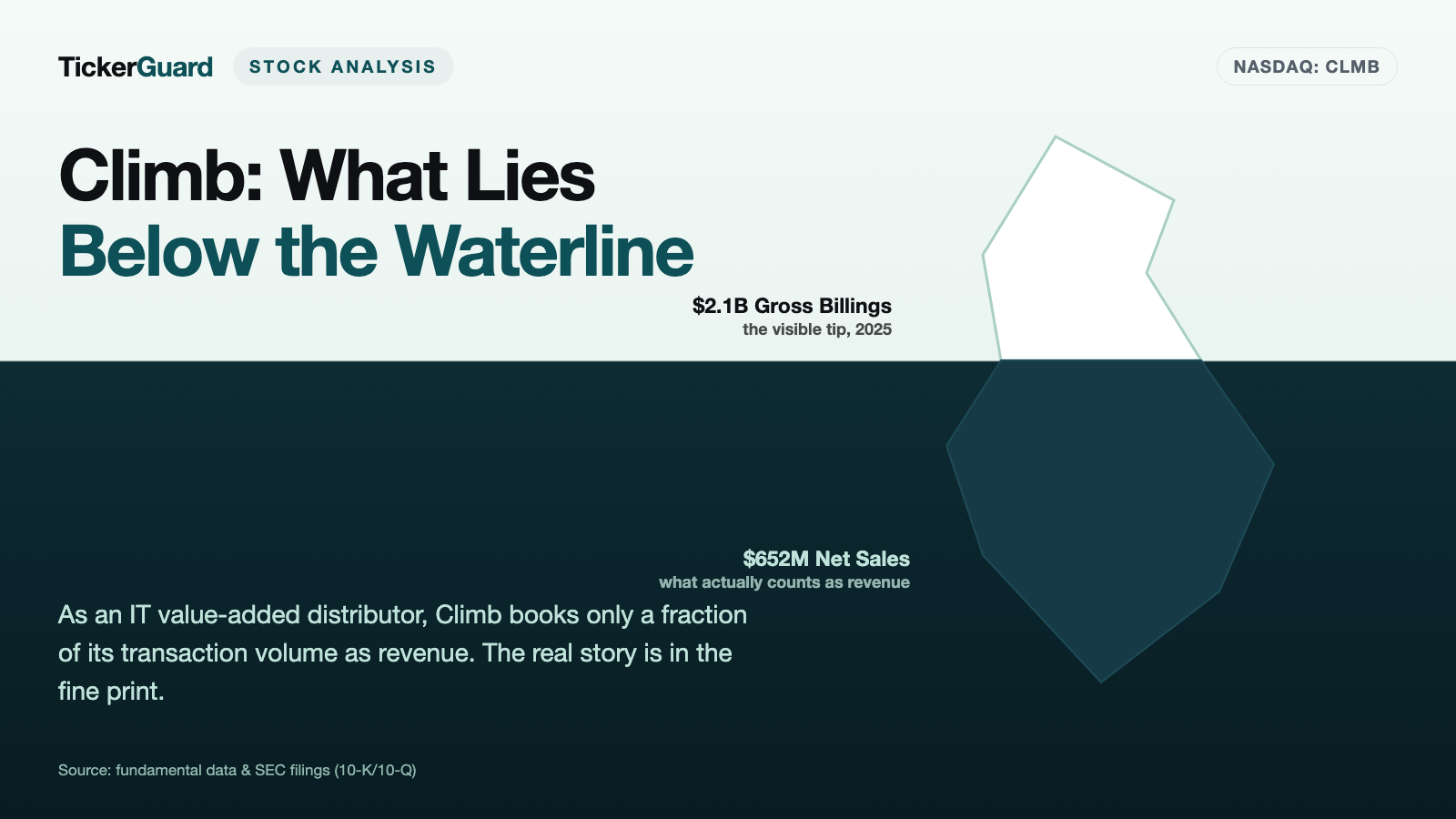
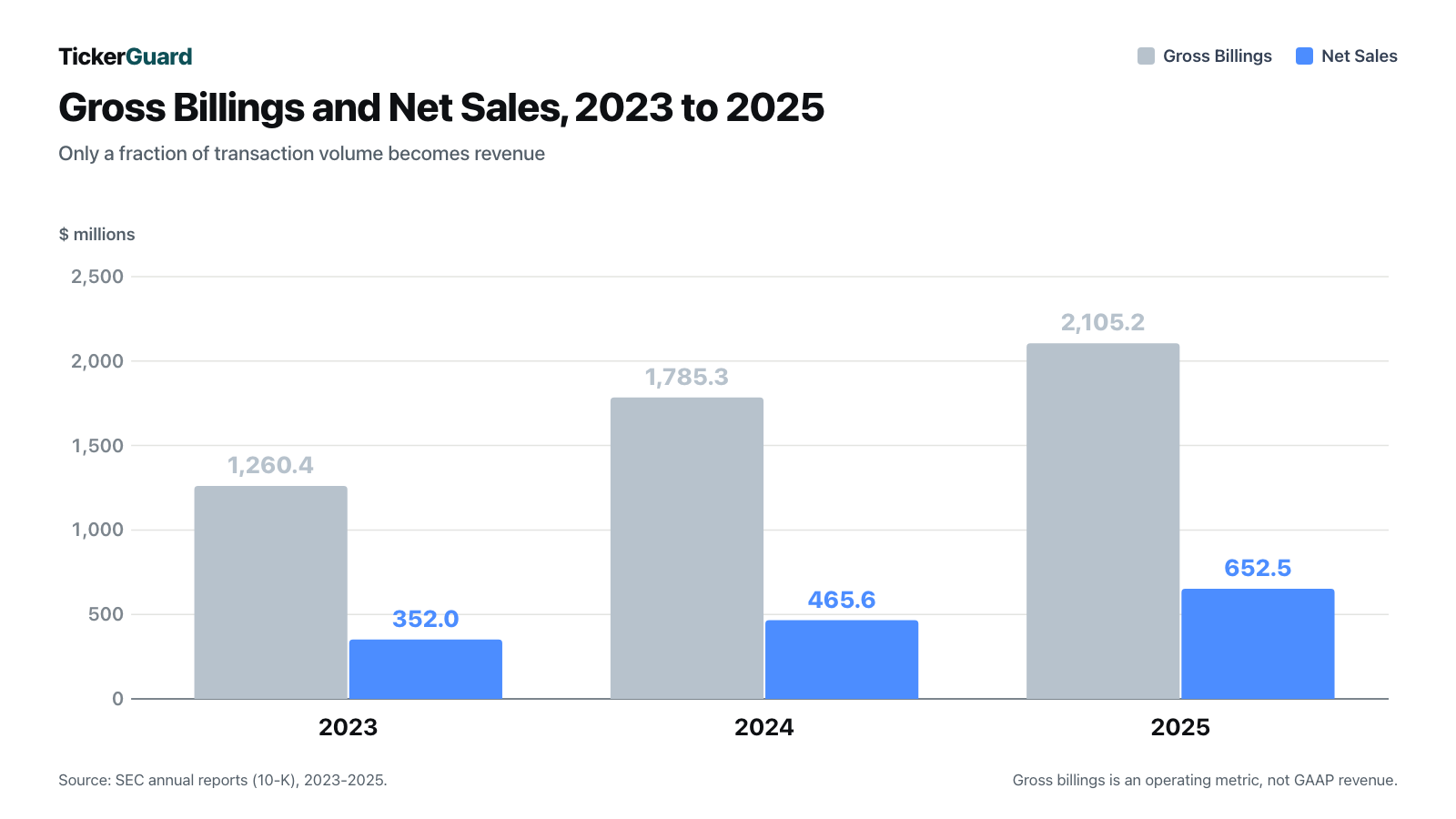
The single most important concept for understanding Climb is the gap between gross billings and net sales. For some transactions — mostly hardware and traditional software licenses — Climb books the full purchase price as revenue ("gross"). For others — mostly security, maintenance, and cloud products — Climb books only its own margin as revenue while the rest flows directly between vendor and customer ("net"). Gross billings therefore show the total transaction volume moving through Climb's platform; net sales show only the slice that actually lands on the income statement — for 2025, that was just 31 percent of gross billings. This isn't an accounting trick; it's standard revenue recognition for distribution businesses. But anyone sizing up Climb from a single number needs to know which one they're reading.
Company history for investors
-
1995
IPO as Programmers Paradise
The company goes public as Programmers Paradise on July 18, 1995. For today's shareholders, the start of a listing history spanning more than 30 years under changing names but the same SEC identifier.
-
2006
Renamed Wayside Technology Group
On October 27, 2006, the company begins trading as Wayside Technology Group. The name changes for shareholders, not the business — a source of confusion in older references under this name.
-
2022
New name: Climb Global Solutions
As of October 27, 2022, Wayside Technology Group becomes today's Climb Global Solutions, Inc. — the same legal entity, the same SEC identifier, CIK 0000945983.
-
2024
Acquires Douglas Stewart Software & Services
On July 31, 2024, Climb acquires North American software distributor DSS for roughly $20.3 million, expanding its Adobe business in the education sector, among others.
-
2026
Dividend cut, Interworks acquired
For fiscal 2025 (reported February 27, 2026), the board suspends the dividend; on February 24, 2026, Climb acquires the Greek cloud platform Interworks for roughly $13.0 million.
-
2026
4-for-1 stock split
On March 20, 2026, the stock splits 4-for-1. Shareholders' ownership stake doesn't change — only the share count quadruples and the per-share price is cut to a quarter.
-
2026
First Investor Day: a 2030 doubling target
In early July 2026, Climb holds its first Investor Day at the Nasdaq MarketSite and sets a target of more than doubling adjusted EBITDA from 2025 to 2030 — a publicly dated, checkable long-term goal.
How the Stock Came Onto Our Radar
What caught our attention was Climb's first Investor Day, held at the Nasdaq MarketSite in New York in early July 2026 — an unusual move for a roughly $500 million small-cap, and one that signals management is courting more institutional visibility. There, and in the following second-quarter 2026 earnings release (July 29, 2026), CEO Dale Foster laid out a long-term target worth noting:
"We expect to more than double FY 2025 adjusted EBITDA by 2030."
— Climb Global Solutions, Inc., second-quarter 2026 earnings release (Exhibit to Form 8-K filed July 29, 2026)
Adjusted EBITDA came in at $42.9 million in 2025 — so the target implies more than $85.8 million by 2030. That's a five-year promise built on a metric the company itself doesn't reconcile to GAAP net income: in the same release, Climb states it "has not provided a target for net income" because taxes, interest, depreciation, and stock-based compensation "cannot be reasonably predicted without unreasonable efforts." That's exactly where this analysis starts — big announcements, fuzzy numbers, and the question of how much weight to give them. The Investor Day also gives us a clean, dated starting point: on August 25, 2026, the stock closed at $27.30, following a 4-for-1 stock split in March 2026.
The Numbers Over the Years — An Honest Look
First, what genuinely works in Climb's favor. Net sales grew from $352.0 million (2023) to $465.6 million (2024) to $652.5 million (2025) — a 40 percent jump last year alone. Gross billings climbed from $1,260.4 million to $1,785.3 million to $2,105.2 million over the same span. Gross profit rose from $64.2 million to $91.1 million to $105.3 million, adjusted EBITDA from $24.6 million to $39.6 million to $42.9 million. Net income grew from $12.3 million to $18.6 million to $21.3 million, and earnings per share from $2.72 to $4.06 to $4.64 (all pre-split as of March 2026; post-split that's $0.68, $1.02 and $1.16 per share). Three straight years of profitability, three straight years of double-digit revenue growth — a solid starting point.
Now look at the current year, where things get more interesting. In the second quarter of 2026 (ended June 30), net sales grew 9 percent to $174.2 million and gross billings grew 17 percent to $587.3 million — but net income fell, from $6.0 million to $5.5 million, and diluted earnings per share slipped from $0.33 to $0.30. Effective margin (adjusted EBITDA as a percentage of gross profit) dropped from 43.3 percent (Q2 2025) to 37.5 percent (Q2 2026). Growth, yes — but growth that's costing more than it used to. Part of that break, though, traces back to an unusually strong year-ago quarter; the full counter-check sits further down in the section on one-off effects. Why costs rose is what the next section explains.
What Management Promised — And What Actually Happened
Climb has held ten public quarterly earnings calls since early 2024, each with a full question-and-answer session. We read all ten — from Q1 2024 (May 2, 2024) through Q2 2026 (July 30, 2026) — because a management team's tone across ten quarters reveals more than any single press release. Three patterns stand out. We should note upfront: this chapter is unusually well-sourced for a small-cap, since Climb's calls have full public transcripts going back more than two years.
First: a savings target that was stricter than what got communicated publicly — and then got missed worse than ever right after. Since 2024, Climb's finance chiefs — CFO Matthew Sullivan since January 2025, his predecessor Drew Clark before that — have cited a target for selling, general and administrative expense (SG&A): roughly 3 percent of gross billings. "Our goal … is that we really would like that SG&A expense level as a percentage of AGB to be in that 3% range," Clark said on the Q3 2024 call. On the Q4 2025 call (February 26, 2026), responding to a follow-up from investor Howard Root, Dale Foster volunteered a tougher goal: SG&A should fall to 2.5 percent of gross billings long-term while margin rises to 2.5 percent too — a "50-50 split" Foster described as his goal "for the last couple of years." At that point, actual results stood at 2.8 percent (Q4 2024) and roughly 2.9 percent (Q4 2025) — close to the old 3 percent band. Here's what actually happened, quarter by quarter, before and after:
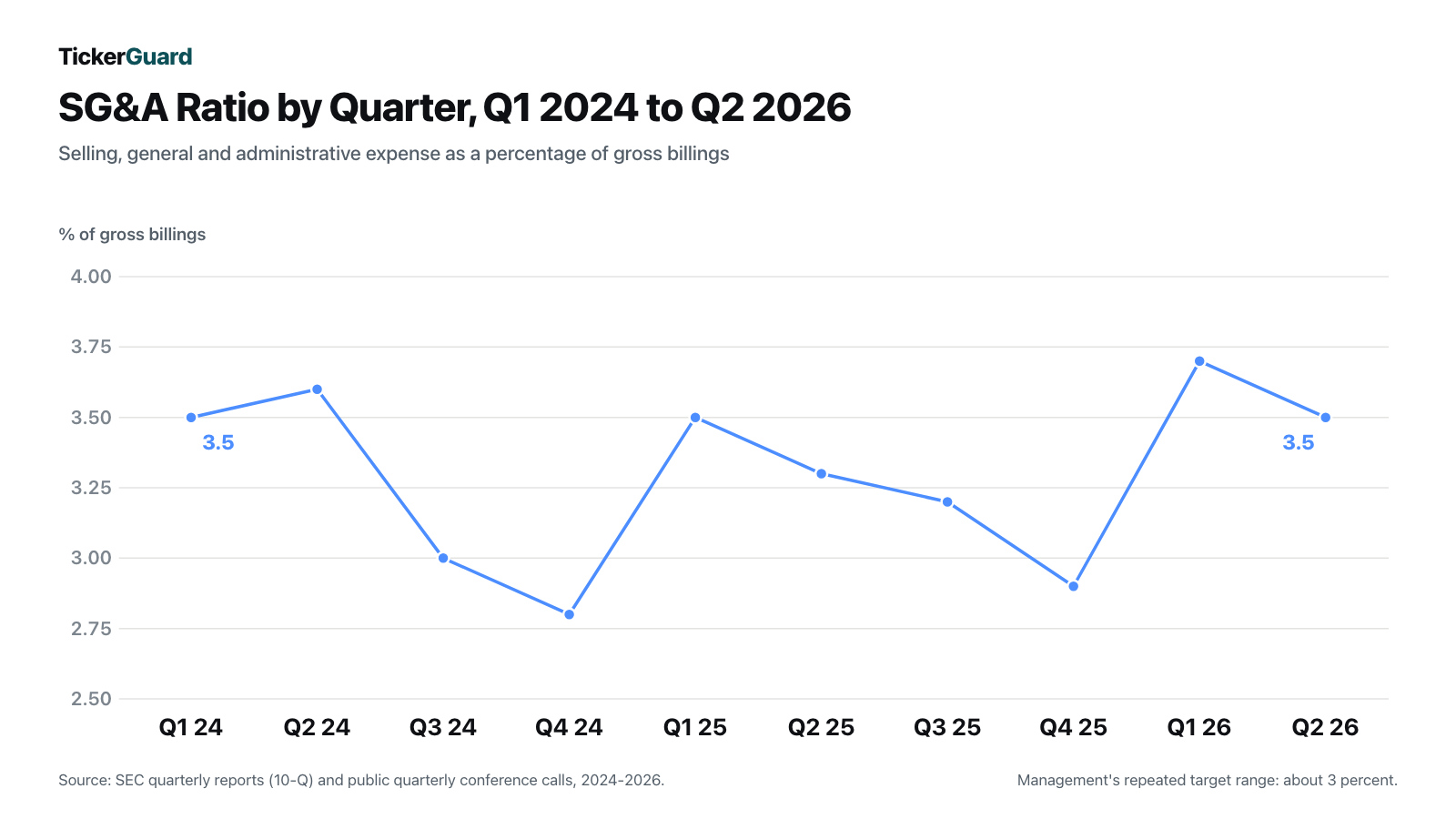
At the end of 2024 and 2025, the ratio stood at 2.8 and 2.9 percent — close to the publicly cited 3 percent band, meaning Foster revealed the tougher 50-50 goal from a position of relative strength. In the very next quarter, of all times, the ratio jumped to 3.7 percent (Q1 2026) — the worst reading in the whole series — and stayed clearly above both the old and the new target the quarter after that too, at 3.5 percent (Q2 2026). On the Q2 2026 call, Foster put it candidly: "I hate talking about onetimers because it seems like every quarter, you have a 1 timer, right?"
Second: a sales restriction that stayed out of two straight earnings calls. On the Q4 2025 call (February 26, 2026), management celebrated a new partnership with security vendor Fortinet as a strategic win. On the following Q1 2026 call (April 30, 2026), Foster explained the associated startup costs — without mentioning that Climb was, at that very moment, still actively barred from selling to Fortinet's 50 largest existing customers. The restriction was first named publicly at Climb's first Investor Day in early July 2026; on the Q2 2026 call, investor William Dezellem followed up directly, and Foster confirmed the exact window: "So we were restricted until May 4 of this year. I think it was the top 50 customers. They didn't want disruption." Neither of the two earnings calls that actually fell within that restricted window — Q4 2025 and Q1 2026 — mentioned the restriction itself, only the upside of the new partnership.
Third: vendor growth forecasts that were quietly walked back. On the Q1 2025 call (May 1, 2025), Foster predicted that security vendor Darktrace would become "a strong #3 or 4" among Climb's vendors. Fifteen months later, on the Q2 2026 call, the description had shrunk to Darktrace becoming "one of our top 20 vendors" — a clear downgrade that nobody called out as such. The same pattern repeated within months for Fortinet: "top 3 vendor this time next year" (Q4 2025 call) became "1 of our top 5 vendors probably" (Q2 2026 call).
In fairness, there's a counterexample too: when an investor on the Q4 2025 call pointed out that 18 months had passed since Climb's last acquisition, Foster answered directly: "Without giving you specifics, Howard, you're spot on." And the most technically demanding question in the whole series — about an unusually high tax rate in Q2 2026 — got a clear, non-evasive answer from CFO Matthew Sullivan. The overall picture still holds, though: a management team that keeps hard, dated commitments (like its ERP rollout timeline) but tends to reword softer targets rather than openly flag them as missed.
What the Filings Reveal — Three Uncomfortable Truths
Uncomfortable truth #1: the dividend was cut without warning
From 2023 through 2025, Climb paid $0.68 per share in dividends every single year (pre-split; $0.17 post-split) — a reliability signal many investors read as a quality marker. The fiscal 2025 annual report states the end of that streak matter-of-factly:
"In each of 2025, 2024 and 2023, we declared dividends totaling $0.68 per share on our Common Stock. Following the end of fiscal year 2025, our Board of Directors determined to suspend quarterly cash dividends on our Common Stock beginning with the first quarter of 2026 in order to preserve financial flexibility and prioritize capital allocation objectives."
— Climb Global Solutions, Inc., fiscal 2025 Form 10-K, Item 5, "Dividends"

That capital is meant to flow into growth and acquisitions instead — cash built accordingly, from $36.6 million (end of 2025) to $56.6 million (June 30, 2026); the last $0.2 million of debt was paid off on schedule by that date, and Climb has been debt-free since. The first half wasn't entirely credit-free, though: for a short-term operating need, Climb drew $9.0 million against its credit facility in the first quarter of 2026 and repaid it in full within that same quarter — the facility stood at zero as of March 31 and June 30, 2026, as it had on December 31, 2025 (Forms 10-Q, statement of cash flows and liquidity discussion). There's a notable shift hiding in the same breath: through 2025, management consistently emphasized funding acquisitions entirely out of cash on hand. On the Q2 2026 call, discussing two potential large acquisitions, Foster said for the first time: "We're not afraid if we want to take on some debt." Anyone who bought the dividend as an anchor of stability now owns a company that is redeploying its capital differently — and opening the door to debt. How quickly the picture can change at a seemingly dependable dividend payer also shows up in our analysis of International Seaways, where analysts now model roughly 57 percent less profit for 2027 than they did a year earlier.
Uncomfortable truth #2: more than half of revenue rests on five customers — and the share keeps rising
Climb doesn't sell directly to end users; it sells through resellers — and a small circle of them carries outsized weight. From the risk factors section of the annual report:
"Our top five customers accounted for 55%, 54% and 51% of consolidated net sales in 2025, 2024 and 2023, respectively. The loss of a key customer or a group of customers could have an adverse effect on the Company."
— Climb Global Solutions, Inc., fiscal 2025 Form 10-K, Item 1A, "Risk Factors"
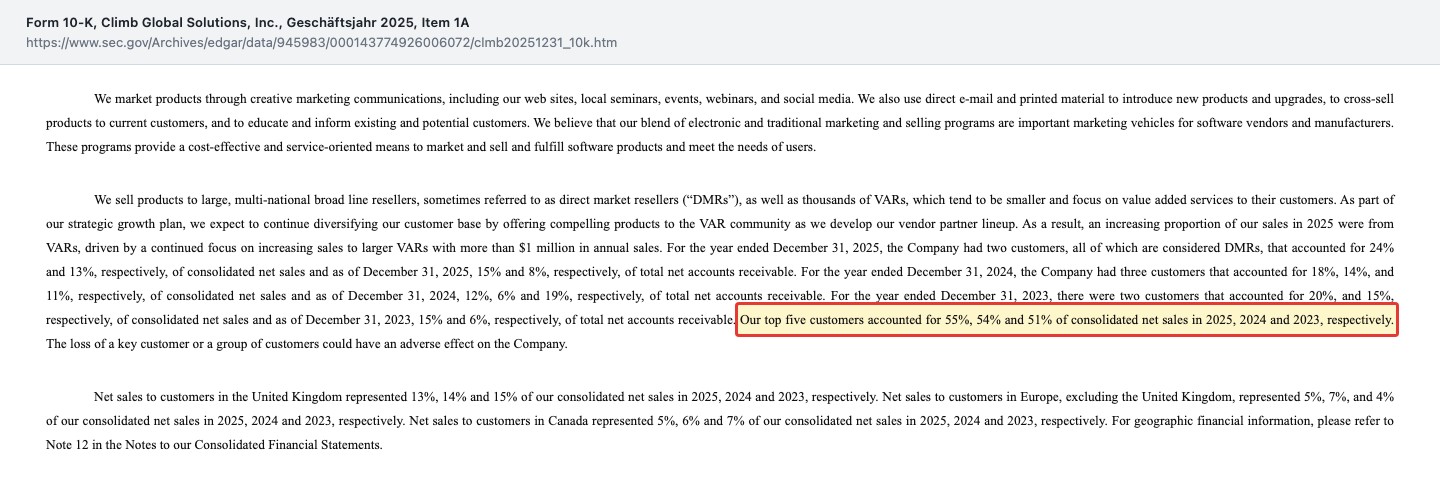
Context matters here: these are reseller partners, not end customers concentrated in a single industry — if Climb lost one, another reseller could in principle serve the same underlying demand. Still, a 55 percent concentration among five business partners is a real concentration risk, and it has grown every year since 2023, not shrunk. On the flip side, Climb has diversified its vendor base: from 22 vendors generating more than $10 million in sales in 2022 to 45 today, according to management on the Q2 2026 call. The reseller circle is narrowing while the vendor circle widens — two opposing trends worth watching together.
One more piece of context, in fairness: the most recent quarterly report lists three major customers at 21, 14, and 13 percent of net sales in the second quarter of 2026 — 48 percent combined, down from 57 percent in the year-ago quarter. On a half-year basis it's 52 percent versus 51 percent, essentially unchanged. So the concentration has not tightened further this year; the upward trend in the 2023-2025 annual figures comes from the 10-K and is the more reliable yardstick, but it is not automatic for 2026. How awkward a single customer relationship can still get shows up in our analysis of ReposiTrak — where millions flowed into a customer that was soon kicked off the Nasdaq.
Uncomfortable truth #3: recent growth is costing more margin than it used to
Net sales grew 9 percent in the second quarter of 2026, while gross billings grew 17 percent:
"Net sales for the three months ended June 30, 2026 increased 9%, or $14.9 million, to $174.2 million compared to $159.3 million for the same period in the prior year. Gross billings, an operational metric, for the three months ended June 30, 2026 increased 17%, or $86.7 million, to $587.3 million compared to $500.6 million for the same period in the prior year."
— Climb Global Solutions, Inc., Form 10-Q for Q2 2026, Item 2, MD&A
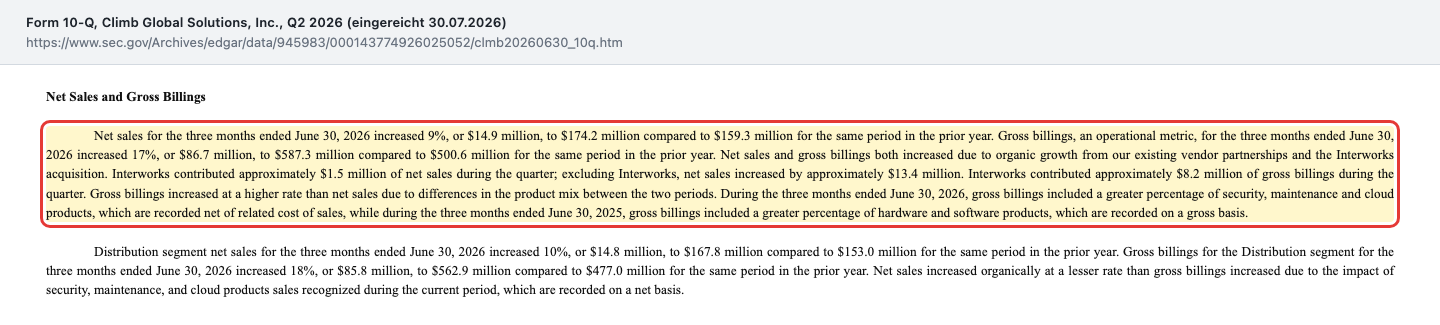
The filing itself explains why: the product mix shifted toward more net-recognized security, maintenance, and cloud products during the quarter — categories that show up strongly in gross billings but barely in net sales. The Greek cloud platform Interworks, acquired in February 2026, contributed roughly $1.5 million to net sales and $8.2 million to gross billings during the quarter — excluding Interworks, organic net sales would have grown by roughly $13.4 million. At the same time, SG&A rose from $16.4 million to $20.7 million (see the ratio chart above), and the effective tax rate climbed from 22.9 percent to 26.8 percent. Add it up, and net income and earnings per share both fell even though both revenue metrics grew by double digits. Right now, growth at Climb isn't free.
The counter-check: how much of this is one-off effects?
Turning a lower profit into a trend reversal would be sloppy without running the counter-check first — because both comparison quarters carry special items, and they pull in opposite directions. Start with revenue: the year-ago quarter was unusually well stocked. Analyst Keith Housum (North Coast Research) raised exactly that on the earnings call, and CEO Dale Foster confirmed it:
"We knew it was going to be a tough comp going into Q2 because we had a $30 million deal with Vast data and then another 1 that was going to be in Q3 got pulled into Q2."
— Dale Foster, CEO, public Q2 2026 earnings call (July 30, 2026), question-and-answer session
So the $500.6 million of gross billings in the year-ago quarter included at least $30 million from a single transaction — plus a second, unquantified deal pulled forward. Strip out just the $30 million that was named, and gross billings would have grown roughly 25 percent rather than 17 percent. That is our own back-of-the-envelope calculation; Climb does not present it that way.
And the current quarter? Asked how much of the increase in selling, general and administrative expense was one-time in nature, CFO Matthew Sullivan answered:
"In the quarter, we had about $500,000 of what I would call nonrecurring type expenses. It relates to some of the legal and professional costs and then some of the investments in our IT infrastructure."
— Matthew Sullivan, CFO, public Q2 2026 earnings call (July 30, 2026), question-and-answer session
Add that $0.5 million back and adjusted EBITDA would be roughly $11.8 million instead of $11.3 million — about 4 percent above the year-ago quarter instead of 0.7 percent below it — with effective margin around 39 percent instead of 37.5 percent. That, too, is our own estimate: the filing itself does not quantify the one-time share, mentioning only "one-time investments" in new vendor relationships and in the company's own infrastructure for the half year.
This is where the relief stops. In the income statement, it is the current quarter that is almost free of special items — $19,000 of acquisition-related costs and a $120,000 foreign currency loss, and that's it. The year-ago quarter carried two: a remeasurement of contingent acquisition consideration that reduced earnings by $379,000, and a one-time excess tax benefit from share-based compensation of $0.2 million that cut the effective tax rate by 2.6 percentage points at the time (Form 10-Q as of June 30, 2026, income taxes note). Adjust both quarters for these items and pre-tax income comes to roughly $7.7 million (Q2 2026) against roughly $8.1 million (Q2 2025) — the decline survives, and widens slightly.
And an adjustment stays a claim until someone shows the arithmetic. Sullivan said on the same call:
"If you take the impact of that out, and take the impact of Interworks' contribution from Q2 of this year, who obviously wasn't in Q2 of last year, we still grew adjusted EBITDA at the strong double-digit organic growth or strong double-digit growth levels of gross billings and gross profit."
— Matthew Sullivan, CFO, public Q2 2026 earnings call (July 30, 2026), question-and-answer session
The company puts no numbers behind that doubly adjusted calculation — not on the call, not in the quarterly report. It cannot be verified. What remains is an honest interim conclusion: the drop in effective margin from 43.3 to 37.5 percent reads more dramatically than it is, because it stands against an unusually strong year-ago quarter. But whichever of the three calculations you use — as reported, adjusted for the $0.5 million of one-time costs, or adjusted for the income-statement special items — earnings per share come in below the year-ago quarter every time, and effective margin gets nowhere near 43.3 percent in any of them.
Valuation: The View of a Single Analyst
At $27.30 per share (August 25, 2026) and 18,660,639 shares outstanding (as of July 30, 2026), the market capitalization comes to roughly $510 million. Measured against net sales over the last four reported quarters, that's a price-to-sales ratio of roughly 0.7 — for a thin-margin distributor, that's the more relevant yardstick than the price-to-earnings ratio (P/E). Working out a rough P/E anyway — trailing four-quarter earnings per share of roughly $1.11 (post-split) against the current price — gets you to roughly 25 times earnings; on 2026 consensus earnings, the multiple runs closer to 20. Enterprise value to EBITDA sits at roughly 12 — not a bargain for a thin-margin but growing distributor, but not a growth premium either.
A word on analyst coverage, because it puts the valuation in context: exactly one analyst currently covers Climb with a published price target ($32.67, roughly 20 percent above the August 25, 2026 close). A sample size of one is nearly meaningless statistically — unlike large caps followed by 20 or 30 analysts, there's no broad "consensus" here, just a single opinion. Anyone leaning on that price target should know only one voice is speaking.
Opportunities and Risks at a Glance
What favors Climb Global Solutions:
- Three straight years of double-digit revenue growth (net sales up 40 percent in 2025) alongside consistent profitability, backed by an increasingly diversified vendor base (45 vendors generating more than $10 million each in 2026, up from 22 in 2022, per company statements).
- A genuinely healthy balance sheet: $56.6 million in cash and no more debt (both as of June 30, 2026), and a $50 million JPMorgan Chase credit facility undrawn as of that date (maturing May 18, 2028).
- An active, consistently funded M&A program — four acquisitions since 2022 (most recently Interworks in Greece, February 2026) — with additional debt capacity now on the table too.
- A management team that keeps hard, dated commitments (like its ERP rollout) and doesn't dodge uncomfortable questions during Q&A.
- A valuation that's neither cheap nor rich: roughly 0.7x sales, roughly 12x EV/EBITDA — no growth premium priced in.
- The margin drop in the second quarter of 2026 looks bigger than it is: management says the year-ago quarter contained a $30 million single transaction plus a deal pulled forward, and the current quarter carried roughly $0.5 million of one-time costs inside SG&A.
What weighs against it:
- Effective margin is falling: from 43.5 percent (2024) to 40.7 percent (2025) to 37.5 percent in the second quarter of 2026; the SG&A ratio ran above the company's own roughly 3 percent target in both quarters of 2026, at 3.7 and 3.5 percent.
- Five customers accounted for 55 percent of net sales in 2025 — a concentration that has risen every year since 2023.
- The dividend (last $0.68 per share annually, pre-split) was suspended starting in the first quarter of 2026 without any lead time; there's no timeline for resumption.
- A communication pattern worth watching: a stricter savings target was revealed and then missed by the widest margin in the whole series the very next quarter, a sales restriction (Fortinet) stayed out of two straight earnings calls, and individual vendor growth forecasts (Darktrace, Fortinet) were quietly scaled back.
- Only one analyst covers the stock — no broad market consensus to check it against, and trading volume is thin, typical for a small-cap this size.
A Human Verdict
Back to the reliability trap from the opening. Its core isn't that Climb is a bad company — the last three years of numbers are solid, the balance sheet is clean, and a management team that answers a detailed tax-rate question in full is not something you find at every small-cap this size. Its core is that reliability, sustained for years, builds an expectation that rarely gets questioned — until the dividend falls without warning, or a company's own savings target gets missed by the widest margin ever in the very quarter right after it was revealed. None of that makes Climb a bad company. It makes Climb a company where you should read the next earnings call a little more carefully whenever management starts talking about "onetimers" again, or restates a target in new language. So the honest question isn't "is this still the same reliable company?" It's this: will you read the next ten earnings calls as closely as the last ten — or will you fall back on habit? The decision is yours.
Sources
All original documents used in this analysis — for further reading:
- Climb Global Solutions, Inc. — Form 10-K for fiscal year 2025 (filed February 27, 2026)
- Climb Global Solutions, Inc. — Form 10-Q for the quarter ended June 30, 2026 (filed July 30, 2026)
- Climb Global Solutions, Inc. — Second-quarter 2026 earnings release (Exhibit to Form 8-K, filed July 29, 2026)
- Climb Global Solutions, Inc. — ten public quarterly earnings call transcripts, Q1 2024 (May 2, 2024) through Q2 2026 (July 30, 2026)
- Full SEC filing history for Climb Global Solutions, Inc. (CIK 0000945983): EDGAR filing history (sec.gov)
- Fundamental data (price, market capitalization, analyst estimate; as of August 25, 2026), cross-checked against SEC filings.
Transparency & disclaimer: This analysis is journalistic commentary on publicly available information. It is not investment advice, not a regulated financial analysis, and not a solicitation to buy or sell securities. Stock investments carry substantial risk, including total loss. All figures are provided without warranty; data dates are noted in the text. The author holds no position in Climb Global Solutions stock as of publication.
Key figures at a glance
All monetary figures in millions of $; earnings per share as reported.
| Metric | 2021 | 2022 | 2023 | 2024 | 2025 |
|---|---|---|---|---|---|
| Revenue | 282.6 | 304.3 | 352.0 | 465.6 | 652.5 |
| Operating Income (EBIT) | 12.1 | 17.9 | 16.5 | 28.0 | 29.2 |
| Net Income | 9.2 | 12.2 | 12.3 | 18.6 | 21.3 |
| Net Margin | 3.3% | 4.0% | 3.5% | 4.0% | 3.3% |
| Earnings Per Share | 0.54 $ | 0.70 $ | 0.70 $ | 1.04 $ | 1.18 $ |
Source: fundamental data & SEC filings (annual and quarterly reports, 10-K/10-Q)
Our Bottom Line at a Glance
- Business Model & Growth positive
- Value-added IT distribution with a diversified vendor portfolio (45 vendors generating more than $10 million each in 2026, up from 22 in 2022, per management). Net sales grew 40 percent to $652.5 million in 2025, double digits for three straight years and profitable throughout.
- Margin Trend negative
- Effective margin fell from 43.5 percent (2024) to 40.7 percent (2025) to 37.5 percent in the second quarter of 2026 (Form 10-Q filed July 30, 2026). The SG&A ratio ran above the company's own roughly 3 percent target in both quarters of 2026 (3.7 and 3.5 percent), a target cited since 2024. Part of the break is a base effect — management says the year-ago quarter contained a $30 million single transaction — yet earnings per share still decline once adjusted.
- Customer Concentration negative
- The top five customers accounted for roughly 55 percent of net sales in 2025, up from 51 percent in 2023 (Form 10-K, Item 1A) — a rising concentration among reseller partners; not existential, but a real and growing dependency.
- Balance Sheet & Capital Allocation neutral
- Genuinely healthy balance sheet: $56.6 million cash (June 30, 2026), zero debt, undrawn $50 million credit facility. At the same time, a regime change: the dividend was suspended starting Q1 2026 without lead time, and management is now openly considering debt for future acquisitions.
- Management Communication negative
- Ten earnings calls read in full (2024-2026) reveal a recurring pattern: a stricter SG&A target was revealed and then missed by the widest margin in the whole series the very next quarter; a Fortinet sales restriction stayed out of two straight earnings calls; vendor growth forecasts (Darktrace, Fortinet) were quietly walked back. Hard, dated commitments (the ERP rollout) were kept, by contrast.
- Valuation neutral
- Market capitalization roughly $510 million (August 25, 2026), price-to-sales roughly 0.7, EV/EBITDA roughly 11.9 — neither a bargain nor a growth premium. Only one analyst covers the stock with a published price target ($32.67), a statistically thin basis.
Climb Global Solutions is the reliability trap in its purest form: a dependable dividend for years, a management team that answers every analyst question directly, net sales that grew 40 percent in 2025. Yet effective margin has been falling since 2024 (43.5 to 37.5 percent), the dividend was cut without warning in 2026, and ten earnings calls read in full show a pattern of restated rather than openly corrected targets. The balance sheet is clean and the business is growing — but reliability, lately, isn't quite what it used to be. Not investment advice.
What Our Rating Means
Open questions
The business works in principle, but one material question is open. As long as it stays open, our findings do not carry a quality verdict.
Yellow, because the core business holds up but one significant question is open: is the effective margin decline since 2024 a temporary investment phase (Interworks integration, Fortinet ramp-up, IT infrastructure spend) or a structural problem? Red would need more evidence — the balance sheet and liquidity are healthy, there's no debt, no going-concern language, and three straight years of profitable growth. Green is out of reach because of reliability: the no-notice dividend cut, the delayed disclosure of the Fortinet restriction, and the quiet rewording of the SG&A target right at its widest miss are communication patterns that justify extra scrutiny, even though none of them is a standalone solvency risk. That a single analyst covers the stock plays no role in this rating — that's a market-data characteristic, not a quality argument. The decision is yours.
A journalistic assessment by our editorial team at the time of the deep dive, based on public sources — not investment advice and not a solicitation to buy or sell. Your personal circumstances (investment goals, risk capacity, taxes) cannot be taken into account. What our levels mean, how verdicts are formed, and what conflicts of interest exist →
Worth Noting
- This stock came onto our radar through Climb's first Investor Day at the Nasdaq MarketSite (July 2026) and the target announced there — more than doubling adjusted EBITDA from 2025 to 2030 — a five-year promise on a metric the company itself doesn't reconcile to GAAP net income.
- Naming note: the company traded as Wayside Technology Group, Inc. (same CIK, 0000945983) through October 2022, and as Programmers Paradise Inc. before that (through 2006). Older references under those names refer to the same company.
- Data as of: balance sheet and earnings figures come from the fiscal 2025 Form 10-K (filed February 27, 2026) and the Form 10-Q for the quarter ended June 30, 2026 (filed July 30, 2026). Price, market cap, and analyst data are as of August 25, 2026. Some data feeds still showed an expected forward dividend at research time, even though payments have been suspended since the first quarter of 2026 per the annual report — the SEC filing governs.
Stock Watch
This analysis is as of August 28, 2026. Stock Watch will tell you what's changed at CLMB since then.
Later $1 a month per stock — signing up is free, and you'll be the first to know when it launches.
The full analysis as a PDF for later
We will send you this analysis as a PDF — to print, file away, and read at your own pace. And we will add you to the free Stock Watch list for Climb Global Solutions (CLMB), so you hear about it when something material in this analysis changes.
Frequently Asked Questions
Climb Global Solutions, Inc. (Nasdaq: CLMB), based in Eatontown, New Jersey, is a value-added IT distributor: it buys software, maintenance contracts, and security and storage products from roughly 84 vendors (45 of which each generate more than $10 million in annual sales for Climb) and resells them to thousands of channel partners under the "Climb Channel Solutions" brand (96 percent of 2025 net sales). Its smaller unit, "Grey Matter," sells directly to end customers (4 percent).
Because Climb books some transactions — mostly security, maintenance, and cloud products — as revenue only for its own margin, while the rest flows directly between vendor and customer. "Gross billings" capture the full transaction volume ($2,105.2 million in 2025), while net sales capture only the recognized slice ($652.5 million, 31 percent) — standard revenue recognition for distributors, not an accounting trick.
Per the fiscal 2025 Form 10-K, the board decided to suspend the quarterly dividend starting in the first quarter of 2026 "in order to preserve financial flexibility and prioritize capital allocation objectives." Climb had paid $0.68 per share annually from 2023 through 2025. The freed-up capital is meant to fund growth and acquisitions instead; there's no timeline for resumption.
Mixed. Hard, dated commitments — like the ERP rollout — were kept. On softer targets, ten earnings calls read in full (2024 through 2026) show a pattern: a stricter "50-50" target was revealed while results still ran close to the old roughly-3-percent band — the very next quarter missed it by the widest margin in the whole series (3.7 percent in Q1 2026), and the quarter after that stayed clearly above target too.
The top five customers — all large resellers, not end customers — accounted for roughly 55 percent of net sales in 2025, up from 54 percent in 2024 and 51 percent in 2023 (Form 10-K, Item 1A). The ratio has risen for three straight years. Running the other way, Climb has broadened its vendor base significantly, from 22 to 45 vendors generating more than $10 million each since 2022.
At $27.30 (August 25, 2026), market capitalization runs roughly $510 million, price-to-sales sits at roughly 0.7, and enterprise value to EBITDA at roughly 12 — neither a bargain nor a growth premium. Exactly one analyst covers the stock with a published price target ($32.67), a statistically thin sample.
Partly a base effect: according to CEO Dale Foster, the year-ago quarter contained a single $30 million transaction with vendor Vast Data, plus a deal pulled forward out of the third quarter. Partly operational: selling, general and administrative expense rose 26 percent (to $20.7 million) while gross profit rose only 15 percent, and the effective tax rate climbed from 22.9 to 26.8 percent. The CFO puts roughly $0.5 million of the costs in the one-time bucket; the quarterly report itself does not quantify that share. Adjust for it and earnings per share still land below the year-ago quarter.
Climb acquired the Greek cloud platform Interworks (interworks.cloud) on February 24, 2026, for a final purchase consideration of $13.0 million (the allocation of that price to individual balance sheet items is still preliminary, per the Q2 2026 Form 10-Q), expanding its European business into southeastern Europe. In the second quarter of 2026, Interworks contributed roughly $1.5 million to net sales and $8.2 million to gross billings.
Found an error?
Did you spot a factual error, an outdated number, or a typo in this deep dive? Let us know briefly — your report goes straight to the editorial team.