ReposiTrak: Nine Quarters of Growth — Then the Streak Snaps, Right as Millions Flow Into a Customer That Would Soon Get Kicked Off the Nasdaq
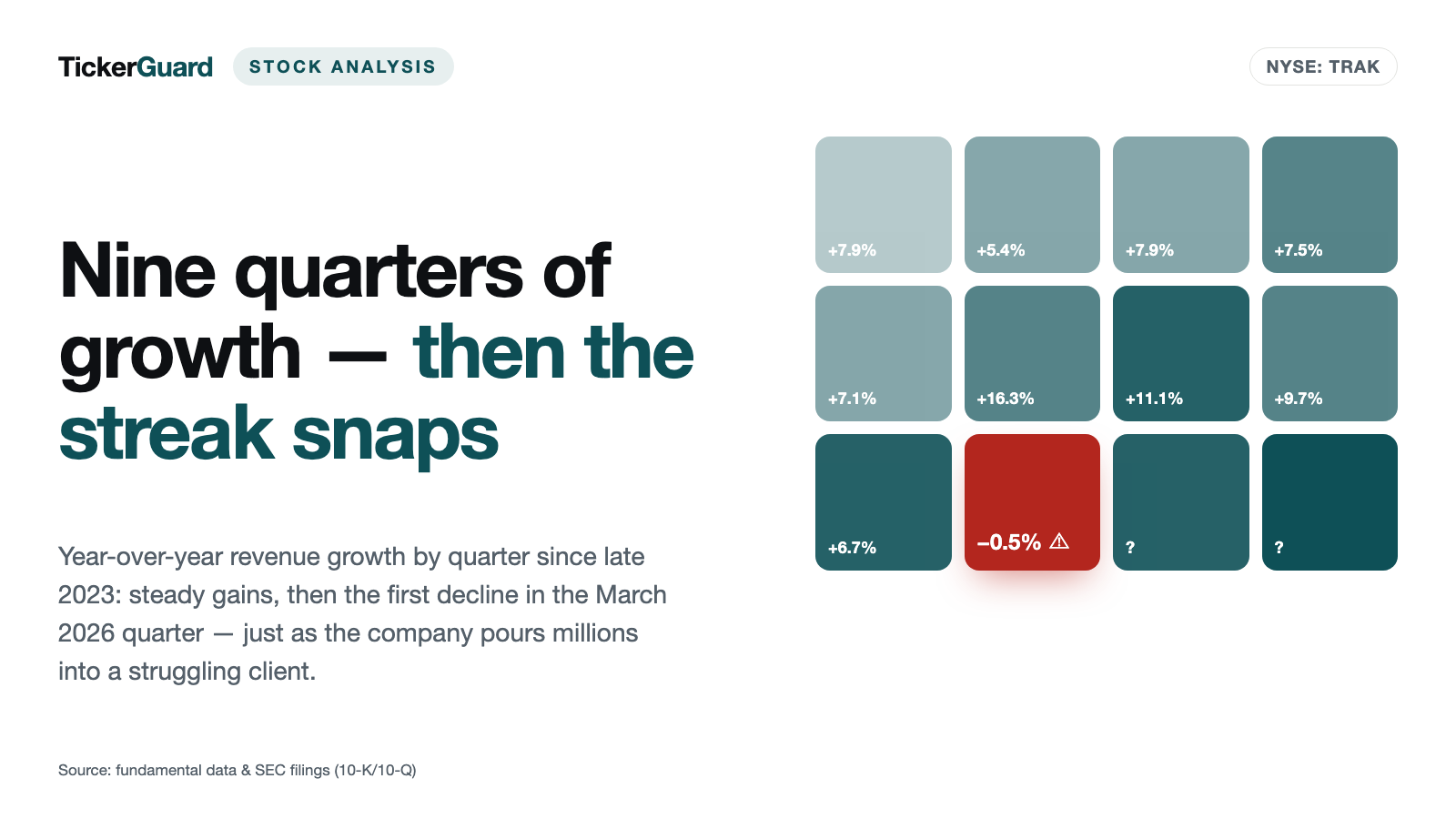
ReposiTrak (NYSE: TRAK) delivered nine straight quarters of revenue growth between 5.4 and 16.3 percent — until the third quarter of fiscal 2026 brought the first decline. In that very same window, the company built a 31.4 percent stake in SPAR Group through stock payments, a share purchase and a loan — a customer that was downgraded from Nasdaq to the over-the-counter market weeks later for trading below $1 and falling short of minimum equity requirements. Four earnings calls we read in full also show how a big 2024 promise quietly disappeared from management's script without ever being met or walked back. Not investment advice — just a look at how much benefit of the doubt a previously reliable management team deserves.
 Thomas Mücke
Founder & Publisher
Thomas Mücke
Founder & Publisher
As of Today
As of: October 9, 2026
- Closing price
- 7.90 $ +0.60%
- Market Capitalisation
- 0.1 $B
- P/E
- 22.5
- Growth Score
- 8/10
- AAQS
- 7/10
Price change since August 21, 2026: -1.2%
This analysis has a cut-off date. The Stock Guard tells you when something material changes in the numbers. Reserve your free spot
Chart
Interactive price chart (TradingView).
52-week range: 7.20 $ to 15.70 $ · Last price: 7.90 $ (As of: October 9, 2026)
Note: pure fact-based analysis, not investment advice and not a solicitation to buy or sell. All figures without guarantee.
There's an investing weakness that catches experienced observers especially hard, because it feels like the opposite of naivety: the halo effect. A management team delivers once — scales a compliance business from zero to a hundred thousand locations, pays a dividend year after year, answers every analyst question directly — and from then on, every new, big announcement from that same team gets a benefit of the doubt it hasn't actually re-earned. ReposiTrak, Inc. (NYSE: TRAK) of Murray, Utah, is a case study in exactly that. Nine straight quarters of revenue growth between 5.4 and 16.3 percent, an immaculate balance sheet, and a CEO in Randall Fields who really did scale a small compliance business to over a hundred thousand connected locations in the past. And in the very quarter that growth streak broke for the first time, the same management began pouring millions into a struggling, unrelated company. So let's do what the halo effect works against: read not the press release, but the reports ReposiTrak must file with the SEC under penalty of law — the fiscal 2025 Form 10-K, the Form 10-Q for the quarter ended March 31, 2026, and everything filed in the four months since. And because a management team shows its truest self in the Q&A after the prepared remarks, we also worked through four earnings calls from the past two years, transcribed word for word and filed with the SEC itself. By the end, you decide how much benefit of the doubt a previously reliable management team deserves.
What ReposiTrak Actually Does
ReposiTrak is a software-as-a-service (SaaS) provider for the food industry — think of it as a digital ledger that sits between grocery chains and their thousands of suppliers, showing both sides whether every rule is being followed and where every ingredient came from. The company's filings describe three product lines: Compliance Management checks whether suppliers meet food-safety rules such as the Food Safety Modernization Act (FSMA); the ReposiTrak Traceability Network (RTN) captures the data elements Section 204(d) of FSMA requires for farm-to-shelf tracing; Supply Chain Solutions helps manage supplier relationships themselves. The business model follows a hub-and-spoke pattern: retailers and wholesalers ("hubs") require their suppliers ("spokes") to use the platform — a single large customer can pull in hundreds of smaller suppliers. As of June 30, 2025, the company employed 69 people, 20 of them overseas; no single customer accounted for more than 10 percent of fiscal 2025 revenue. Until December 2023, the company was still named Park City Group, Inc. — the ReposiTrak name it now trades under on the NYSE isn't even three years old.
Company history for investors
-
2023
Renamed from Park City Group to ReposiTrak
On December 21, 2023, the company begins trading as ReposiTrak, Inc. The name changes for shareholders, not the SEC filer number — a source of confusion in older references under the old name.
-
2026
Financing arrangement with SPAR Marketing Force
On March 17, 2026, a ReposiTrak subsidiary extends up to $4.0 million in credit at 8 percent interest to SPAR Group subsidiary SPAR Marketing Force — the first building block of the later SPAR position.
-
2026
First SPAR Group shares received as payment instead of cash
On May 29, 2026, ReposiTrak elects to settle a $2.325 million invoice in 3,190,569 SPAR Group shares rather than cash.
-
2026
Debt-financed share purchase
On July 1, 2026, ReposiTrak buys 4,709,837 more SPAR Group shares for roughly $3.3 million, partly financed through an unsecured promissory note at 6 percent interest.
-
2026
31.4 percent stake disclosed — SPAR Group delisted from Nasdaq
On July 20, 2026, ReposiTrak discloses the 31.4 percent stake via Schedule 13D — just three days after SPAR Group was downgraded from Nasdaq to the OTC market.
-
2026
New employment agreement for CFO John Merrill
On August 18, 2026, CFO John Merrill receives a new three-year contract with a $325,000 base salary and an equity award — a signal of management continuity.
-
2026
$35 million shelf registration filed
On August 24, 2026, ReposiTrak files a stand-by securities registration for up to $35 million — additional financing flexibility with no stated use of proceeds.
How This Stock Landed on Our Desk
ReposiTrak didn't catch our attention because of a hot price chart, but because of a mismatch between two public filings from the same company, published weeks apart: a quarterly report showing the first revenue decline in nine quarters — and a mandatory SEC disclosure revealing a 31.4 percent stake in an unrelated, small company that already carried months of publicly disclosed Nasdaq deficiency notices and would be kicked off Nasdaq just three days later. That combination — a solid core business alongside an unusual, thinly explained capital decision in the exact same window — is why we looked closer. Keep this tension in mind from the start: ReposiTrak's core business is boring in the best sense — predictable, profitable, recurring. The capital decisions of the past six months are not.
The Numbers Over the Years
First, an honest look at what actually favors ReposiTrak — and over a multi-year span, that's quite a bit. Revenue rose from $18.0 million in fiscal 2022 to $22.6 million in fiscal 2025 (each ended June 30), and operating income climbed from $4.4 million to $6.2 million in the same span — a business growing its profit faster than its revenue, a classic sign of a scaling SaaS model.
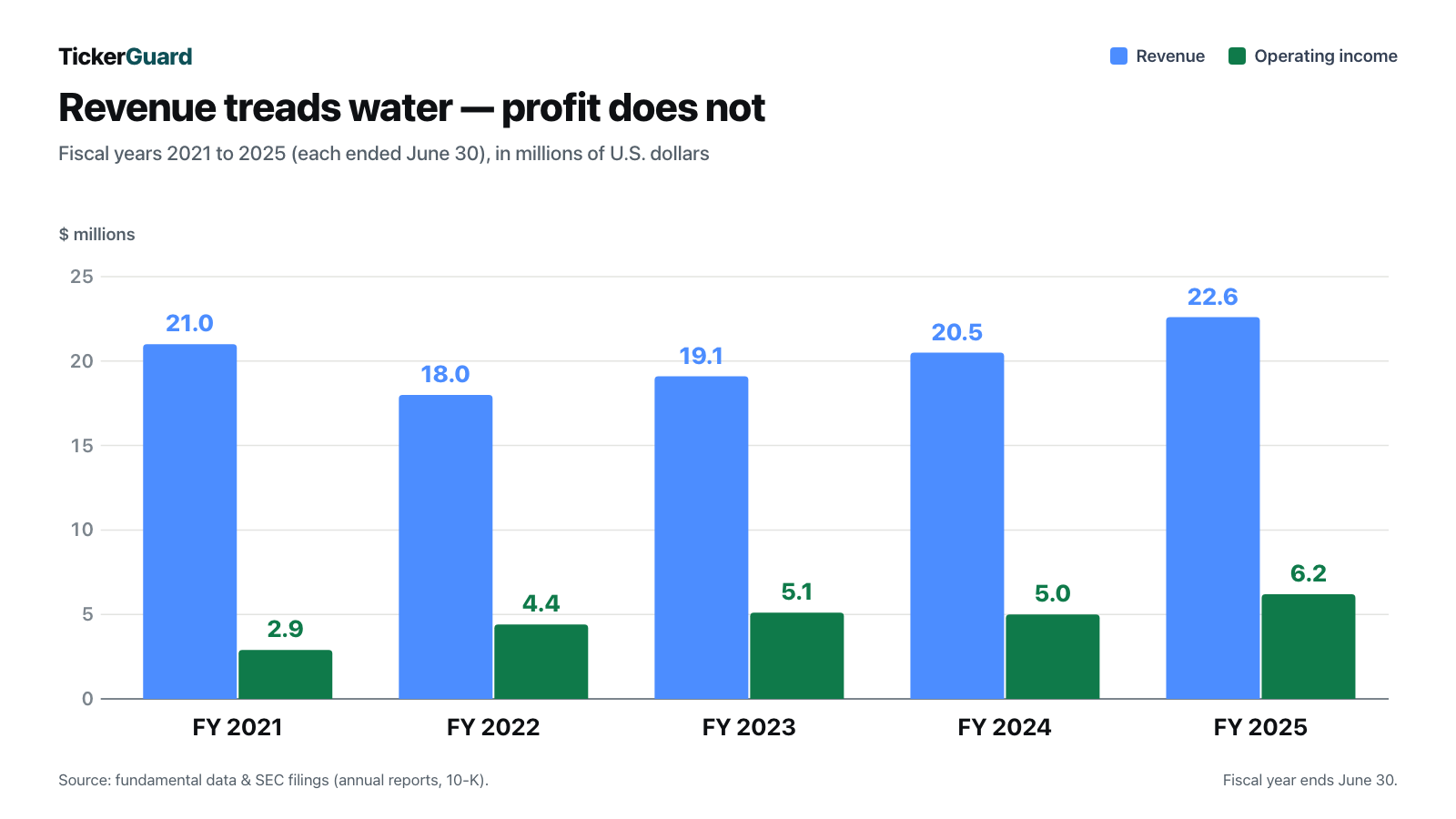
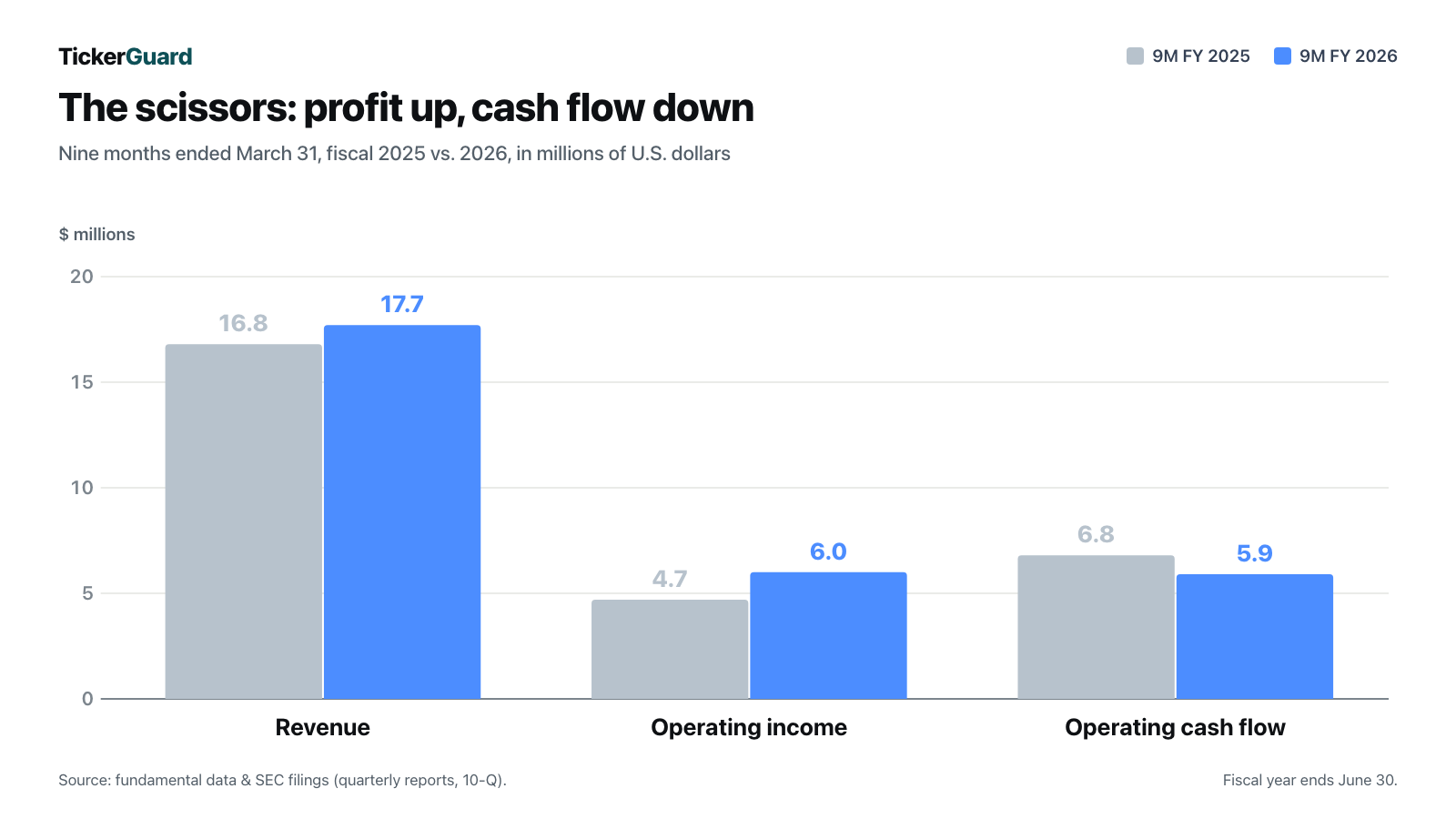
Then the pattern breaks. Over the first nine months of the current fiscal year 2026 (through March 31, 2026), revenue still edged up 5.1 percent to $17.71 million — but in the third quarter alone, the January-through-March 2026 period, it declined year over year for the first time in nine quarters: down 0.5 percent to $5.88 million. Nine straight quarters — from Q2 FY2024 (quarter ended December 31, 2023, +7.9 percent) through Q2 FY2026 (ended December 31, 2025, +6.7 percent) — had each grown between 5.4 and 16.3 percent year over year. That's not yet a collapse — a single quarter at −0.5 percent isn't the same as a trend reversal. But it's the first quarter of a nine-quarter growth streak to break that streak, and it lines up with the largest capital commitment ReposiTrak has made in years — more on that shortly.
What Management Promised — and What Came of It
Before we get to the capital decisions, it's worth looking back. We read four public quarterly earnings calls in full — not from a third-party transcript database, but straight from the exhibits ReposiTrak itself attaches to its Form 8-K filings with the SEC: the calls from May 15, 2024, May 14, 2025, September 29, 2025 (fiscal year-end), and May 14, 2026. The Q&A matters more here than the prepared remarks — that's where a management team either answers a hard number or dodges it.
In May 2024, the mood was euphoric. CEO Randall Fields pointed to the new FSMA 204 traceability mandate as a growth driver and got specific:
“We said track and trace would double the revenue of the Company over the next two years or so. In view of what we see now, we certainly stand by that.”
— ReposiTrak, Inc., fiscal Q3 2024 earnings call transcript, May 15, 2024 (SEC Exhibit 99.2 to Form 8-K)
On the same call, Fields put a sharper number on the target: traceability revenue then ran around $1 million a year but could reach "as much as $20 million" once the queue of suppliers was fully onboarded. He added that the company would ramp onboarding speed from "50 to 70 per week" to "500 to 1,000 per week."
A year later, in September 2025, the same story sounded far more cautious. CFO Merrill now framed the growth target as a range, not a doubling:
“Our strategy is unwavering and remains the same, grow annual recurring revenues somewhere between 10% to 20% and grow profitability even faster.”
— ReposiTrak, Inc., fiscal Q4 and full-year 2025 earnings call transcript, September 29, 2025 (SEC Exhibit 99.2 to Form 8-K)
Fiscal 2025 actually delivered 11 percent revenue growth — near the low end of that new, far more modest range, and nowhere close to doubling. The $20 million traceability target, the headline number of the May 2024 call, hasn't been mentioned by name in any of the three subsequent calls we reviewed — never reported as achieved, but never explicitly withdrawn either. It simply dropped out of the narrative.
On the May 14, 2026 call — the same day the quarter with the first revenue decline in nine quarters was reported — the next big, unquantified promise had already surfaced. Asked directly by analyst Thomas Forte of Maxim Group how investors could measure the success of the new SPAR Group stake, CEO Fields answered:
“It's too early for you to see the KPIs, but in about six months we would expect to see the impact on us financially in terms of the relationship with SPAR. […] the revenue should show up in six to nine months.”
— ReposiTrak, Inc., fiscal Q3 2026 earnings call transcript, May 14, 2026 (SEC Exhibit 99.2 to Form 8-K)
The pattern is recognizable: a specific, large number at the launch of a new growth story, an "it's too early for KPIs" once the Q&A starts, and a six-to-nine-month window in which everything is supposed to show up — almost the same shape as the 2024 pattern. That doesn't automatically make the SPAR Group bet wrong. But it's why we're reading it with the same distance we apply to the 2024 traceability promise, not the benefit of the doubt a previously reliable management team would otherwise earn.
What the Filings Reveal — the Uncomfortable Truths
Uncomfortable truth #1: the regulatory push the whole growth story rests on was delayed by 30 months
ReposiTrak's central growth narrative — from the RTN traceability business to the newer "touchless traceability" automation — hangs on a single regulatory deadline: Section 204(d) of the Food Safety Modernization Act (FSMA 204), which requires retailers and their suppliers to maintain end-to-end digital traceability. The fiscal 2025 Form 10-K flags the risk itself, under Risk Factors:
“A delay in the deadline for compliance with FSMA 204 may slow the adoption of our technology as a compliance tool for FMSA, therefore negatively affecting our revenue.”
— ReposiTrak, Inc., fiscal 2025 Form 10-K, Item 1A "Risk Factors"

That risk has already materialized — and significantly so. The same section of the filing explains: the original compliance deadline of January 20, 2026 was pushed back by the FDA in March 2025, by 30 months, to July 20, 2028. Think of it this way: if a shop owner justifies buying new equipment because a new regulation kicks in on a specific date — and that date then moves back by two and a half years — the need for the equipment doesn't disappear, but the urgency to buy it right now does. That's precisely the mechanism management used in 2024 to justify doubling revenue: retailers would pressure suppliers because the FDA deadline was approaching. That deadline is now further away than it was a year and a half ago.
Uncomfortable truth #2: as the growth streak broke, more capital than a full quarter's revenue flowed into a customer carrying two open Nasdaq deficiency notices — one that would be delisted just three days after the disclosure
This is the core of this analysis. SPAR Group, Inc. (formerly Nasdaq: SGRP) provides merchandising and in-store services — and is also a customer of ReposiTrak under a services agreement. In the very window in which ReposiTrak's nine-quarter growth streak broke, the company built a significant position in that same customer, in three steps:
Step 1 — payment in stock instead of cash (May 29, 2026): In March 2026, ReposiTrak had amended a services agreement with SPAR Group so an outstanding invoice could be settled in either cash or SPAR Group shares. ReposiTrak chose the shares:
“On May 29, 2026, the Company elected to receive payment of the outstanding balance owed to the Company under the Amendment in shares of Client Stock, resulting in the issuance by Client to the Company of 3,190,569 shares of Client Stock at a deemed value of $0.728710119 per share, in consideration of the payment of $2,325,000 otherwise payable to the Company under the terms of the Agreement.”
— ReposiTrak, Inc., Form 8-K filed June 3, 2026, Item 8.01

Step 2 — a debt-financed share purchase (July 1, 2026): Weeks later, ReposiTrak bought 4,709,837 more SPAR Group shares from two private sellers for roughly $3.3 million — partly financed through an unsecured promissory note:
“On July 1, 2026, the Company issued to Bartels an unsecured promissory note in the principal amount of $2,571,885 (the "Note") in consideration for the issuance of the SPAR Shares. The Note bears interest at 6.0% per annum and matures on the fourth anniversary of its issuance.”
— ReposiTrak, Inc., Form 8-K filed July 8, 2026, Item 2.03
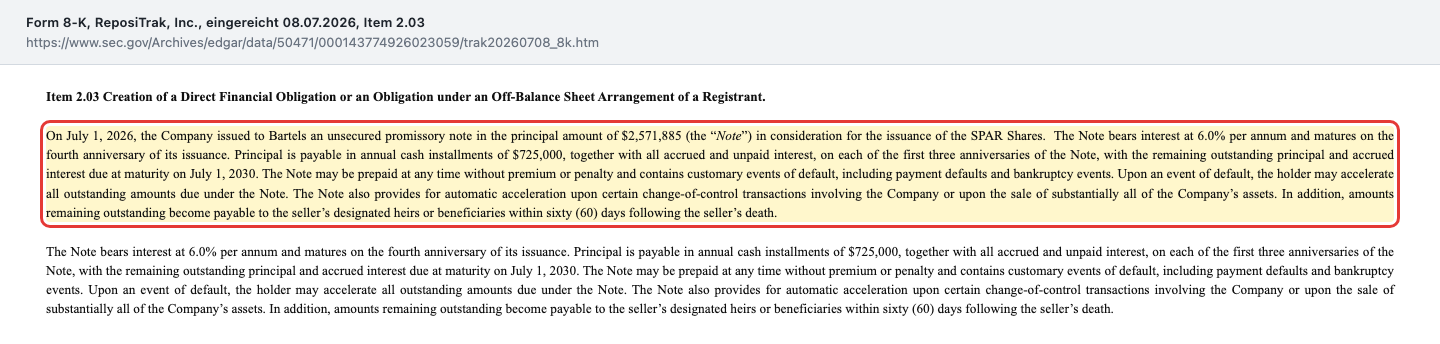
On top of that, a ReposiTrak subsidiary had already extended a credit facility of up to $4.0 million to SPAR Group subsidiary SPAR Marketing Force, Inc. back in March 2026 (8 percent interest, $3.0 million advanced as of March 31, 2026), including an equity kicker of 1,000,000 more SPAR Group shares:
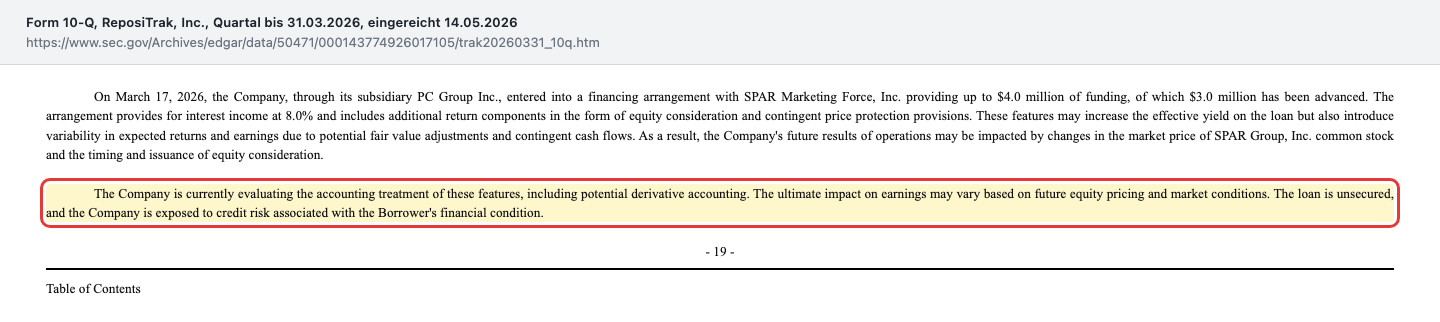
“On March 17, 2026, the Company, through its subsidiary PC Group, Inc. […] entered into a financing arrangement with SPAR Marketing Force, Inc. […] providing up to $4.0 million of funding, of which $3.0 million has been advanced.”
— ReposiTrak, Inc., Form 10-Q for the quarter ended March 31, 2026, "Notes Receivable"
Step 3 — the disclosure (July 20, 2026): Added together, ReposiTrak held 8,900,406 shares, or 31.4 percent, of SPAR Group — enough to trigger a Schedule 13D filing, a form generally reserved for larger, potentially control-influencing stakes. The filing itself acknowledges the stake "may be deemed to have the resulting effect of changing or influencing control" of SPAR Group. What that filing leaves out is the context: SPAR Group already carried two publicly disclosed Nasdaq deficiency notices — the first disclosed before all three ReposiTrak capital moves, the second before the stock election and the share purchase. As early as January 12, 2026 — before the loan to SPAR Marketing Force (March 17), before the stock-in-lieu-of-cash election (May 29), and before the share purchase (July 1) — SPAR Group had received a first notice from Nasdaq: its share price had stayed below $1 for more than 30 trading days. A second notice followed on April 8, 2026 — after the loan to SPAR Marketing Force, but before the stock election and the share purchase — because SPAR Group's stockholders' equity had fallen below the $2.5 million minimum required for the Nasdaq Capital Market. Both notices were publicly disclosed via SPAR Group's own Form 8-K filings before ReposiTrak committed the bulk of its capital — the stock election and share purchase together account for roughly $5.6 million of the more than $8 million total. Only six days before ReposiTrak's 13D filing, on July 14, 2026, Nasdaq told SPAR Group the bid-price compliance period had run out; Nasdaq then delisted SPAR Group's stock at the open of trading on July 23, 2026 — three days after ReposiTrak's 13D filing, not before it. SPAR Group has traded on the OTCQB market, not a national exchange, ever since, and its Form 10-Q for the quarter ended June 30, 2026 shows net revenue down year over year ($36.9 million versus $38.6 million) and only $2.9 million in cash.
Picture it this way: imagine a solid, debt-free shop owner suddenly putting more than eight million dollars — a substantial share of their own equity — into taking a large stake in a struggling competitor, partly on borrowed money, in the exact month that competitor gets expelled from the trade association. You'd want to know why. None of the SEC filings published so far answer that question with specifics; on the May call, CFO John Merrill's prepared remarks spoke of "extending supply chain intelligence into operational execution," and CEO Fields only added the unquantified KPI answer already quoted above during the Q&A — a strategic intent, not yet a number. The accounting treatment is unsettled too: ReposiTrak's own Form 10-Q says it is still evaluating how to account for the loan's embedded price-protection provisions, "including potential derivative accounting" — a sign that even the company's own books haven't fully settled on how to carry the position.
A look at earnings quality rounds out the picture: while operating income rose 28 percent over the first nine months of fiscal 2026, actual operating cash flow fell 13 percent in the same period — a gap partly explained by the capital tied up in the SPAR position.
Uncomfortable truth #3: one man controls 34 percent of the vote — and effectively makes the big capital decisions alone
The fiscal 2025 Form 10-K states the control structure plainly, also under Risk Factors:
“Our officers and directors control approximately 40% of our Common Stock. Randall K. Fields, our Chief Executive Officer, controls 34% of our Common Stock.”
— ReposiTrak, Inc., fiscal 2025 Form 10-K, Item 1A "Risk Factors"
That's not automatically a red flag — a founder with a large personal stake also has a strong interest in the company's long-term value, and ReposiTrak's operating track record speaks to Fields's ability. But combined with the two findings above, it's worth noting: someone who controls 34 percent of the vote can effectively make capital decisions like the SPAR Group stake without meaningful pushback from other shareholders. That exact decision has, so far, barely been explained publicly — beyond a general reference to "long-term shareholder value" on the May call.
Valuation
How expensive is ReposiTrak? On August 21, 2026, ReposiTrak's Form S-3 registration statement disclosed a last reported sale price of $8.00 per share. With 18,173,565 shares outstanding (as of May 14, 2026, per the 10-Q cover page), that puts market capitalization at roughly $145 million. Against the trailing four reported quarters, that implies a price-to-earnings ratio around 20 and a price-to-book ratio around 2.9 — not a bargain, but not a growth premium either, for a company whose revenue growth has just slowed to zero. The balance sheet remains the strongest asset: $26.4 million in cash, $50.5 million in equity, and essentially no bank debt as of March 31, 2026 (the new SPAR promissory note is dated July 1, 2026 and doesn't yet appear on that balance sheet). On August 24, 2026, the company also registered a shelf offering of up to $35 million in common or preferred stock, warrants or units — a pure stand-by registration with no stated use of proceeds, but one that shows ReposiTrak is keeping additional financing flexibility open shortly after committing a meaningful share of its own cash to the SPAR Group position.
Opportunities and Risks at a Glance
What favors ReposiTrak:
- Solid, recurring-revenue core business: revenue up from $18.0 million to $22.6 million (fiscal 2022 through 2025), operating income up from $4.4 million to $6.2 million over the same span, no customer concentration above 10 percent of revenue.
- Immaculate balance sheet: $26.4 million in cash, $50.5 million in equity, essentially no bank debt as of March 31, 2026; a reliable quarterly dividend raised three times by 10 percent each.
- A management team with a proven track record: Randall Fields really did scale the compliance business from zero to more than a hundred thousand connected locations in the past — not just a promise, but a documented result.
- Underlying demand for food traceability remains structurally intact, even though the regulatory time pressure has eased.
What argues against it:
- The nine-quarter growth streak broke for the first time in the quarter ended March 31, 2026 (−0.5 percent) — in the very window management was directing capital toward an outside stake instead of the core business.
- More than $8 million of capital now sits in or with SPAR Group, Inc. — a customer that already carried two open Nasdaq deficiency notices (since January and April 2026) before the stock election and share purchase, was downgraded from Nasdaq to the OTC market three days after ReposiTrak's own 31.4 percent stake was disclosed, and itself reports declining revenue and only $2.9 million in cash.
- The FSMA 204 regulatory push underpinning ReposiTrak's central growth story was delayed by 30 months, to July 2028, in March 2025.
- The pattern of a large, unquantified promise followed by its quiet disappearance repeated itself between 2024 (traceability, "$20 million") and 2026 (SPAR Group, "six to nine months," "too early for KPIs").
- CEO Randall K. Fields personally controls 34 percent of the vote, and all officers and directors together control roughly 40 percent — capital decisions like the SPAR Group stake can effectively be made without meaningful shareholder pushback.
A Human Conclusion
The halo effect from the opening has a real reason to stick around: Randall Fields has genuinely delivered, and over years. That's exactly what makes the SPAR Group bet so hard to place — it comes from a management team that has honestly earned some benefit of the doubt, at the exact moment the numbers themselves stumbled for the first time in nine quarters. So the honest question for you isn't "do I trust this management team?" It's: would you accept the same capital decision — more than eight million dollars, partly on borrowed money, into a customer that actually got kicked off Nasdaq three weeks after the purchase — from a management team that hadn't proven anything yet? If the answer is yes, you have a thesis built on the facts themselves. If the answer is no, and you'd have said yes anyway, it was the name that convinced you, not the number. What you do with that is your call. And that's exactly how it should be.
Sources
All original documents used in this analysis — for your own reading:
- ReposiTrak, Inc. — fiscal 2025 Form 10-K (filed September 29, 2025)
- ReposiTrak, Inc. — Form 10-Q for the quarter ended March 31, 2026 (filed May 14, 2026)
- ReposiTrak, Inc. — Form 8-K filed June 3, 2026 (payment in SPAR Group shares)
- ReposiTrak, Inc. — Form 8-K filed July 8, 2026 (share purchase and promissory note)
- ReposiTrak, Inc. — Schedule 13D filed July 20, 2026 (31.4 percent stake in SPAR Group)
- ReposiTrak, Inc. — Form S-3 registration statement filed August 24, 2026
- ReposiTrak, Inc. — earnings call transcripts: May 15, 2024, May 14, 2025, September 29, 2025, May 14, 2026 (each SEC Exhibit 99.2 to Form 8-K)
- SPAR Group, Inc. — Form 8-K filed January 15, 2026 (first Nasdaq deficiency notice), Form 8-K filed July 15, 2026 (Nasdaq delisting notice) and Form 10-Q for the quarter ended June 30, 2026 (filed August 13, 2026)
- Full SEC filing history for ReposiTrak, Inc.: EDGAR overview (sec.gov)
- Fundamental data (metrics, valuation; as of August 26, 2026), reconciled against the SEC filings.
- For comparison, on how concentrated ownership and unusual capital decisions read elsewhere: our analysis of International Seaways.
Transparency & disclaimer: This analysis is a journalistic assessment of publicly available information and does not constitute investment advice, a regulated financial analysis, or a solicitation to buy or sell any security. Equity investments carry significant risk, including total loss. All information is provided without warranty; data as-of dates are noted throughout the text. Positions held by the operator are disclosed daily; where one exists, it appears as a notice at the top of this deep dive.
Key figures at a glance
All monetary figures in millions of $; earnings per share as reported.
| Metric | 2022 | 2023 | 2024 | 2025 | 2026 |
|---|---|---|---|---|---|
| Revenue | 18.0 | 19.1 | 20.5 | 22.6 | 23.3 |
| Operating Income (EBIT) | 4.4 | 5.1 | 5.0 | 6.2 | 7.8 |
| Net Income | 4.0 | 5.6 | 6.0 | 7.0 | 7.6 |
| Net Margin | 22.2% | 29.3% | 29.1% | 30.9% | 32.5% |
| Earnings Per Share | 0.21 $ | 0.30 $ | 0.31 $ | 0.36 $ | 0.40 $ |
Source: fundamental data & SEC filings (annual and quarterly reports, 10-K/10-Q)
Our Bottom Line at a Glance
- Business model & track record positive
- B2B SaaS with recurring revenue, a diversified customer base (no customer above 10 percent of revenue), and a proven track record: the compliance business was genuinely scaled to more than a hundred thousand connected locations in the past.
- Growth momentum negative
- After nine straight quarters of growth (5.4 to 16.3 percent), revenue declined slightly for the first time in the quarter ended March 31, 2026 (-0.5 percent). The regulatory driver, FSMA 204, was delayed 30 months to July 2028 in March 2025.
- Balance sheet & earnings quality neutral
- Cash and equity are strong ($26.4 million and $50.5 million as of March 31, 2026), essentially no bank debt. At the same time, operating cash flow fell 13 percent over the first nine months of fiscal 2026 even as reported operating income rose 28 percent.
- SPAR Group stake negative
- More than $8 million flowed between March and July 2026 into shares of and a loan to SPAR Group, Inc. and its subsidiary — a customer that carried a Nasdaq deficiency notice since January 2026 and a second since April 2026, was downgraded from Nasdaq to the OTC market three days after ReposiTrak's 31.4 percent stake was disclosed, and itself reports declining revenue and only $2.9 million in cash. Partly financed through an unsecured promissory note.
- Management communication negative
- Four earnings calls reviewed (2024-2026) show a pattern: a specific $20 million growth figure from 2024 was replaced in 2025 by a far more modest range and then vanished from the narrative without ever being confirmed or walked back. The new SPAR Group bet repeats the shape: a big announcement followed by "too early for KPIs."
- Control structure neutral
- CEO Randall K. Fields controls 34 percent of common stock; all officers/directors together roughly 40 percent (fiscal 2025 Form 10-K). That aligns incentives with shareholders but also lets large capital decisions proceed effectively without meaningful pushback.
ReposiTrak is a solid, profitable SaaS business with a proven operating track record — but the past six months show a management team pouring millions into an unrelated, struggling stake at the exact moment its own growth streak stumbled for the first time. The balance sheet remains healthy; the communication around the new bet has so far been thin. Not investment advice.
What Our Rating Means
Open questions
The business works in principle, but one material question is open. As long as it stays open, our findings do not carry a quality verdict.
Yellow, because the core business holds up — profitable, recurring revenue, almost no debt, no existential customer dependency — but a material operating question is open: whether the more than $8 million committed to the SPAR Group stake and its related loan turns out to be a smart strategic extension, or capital tied up exactly when a revenue-shrinking customer carrying two open Nasdaq deficiency notices needed extra liquidity most — one that actually got kicked off Nasdaq three days after ReposiTrak's own disclosure. Red would require more evidence — ReposiTrak itself reports no going-concern flag, no negative equity, and no signs of payment distress. Green would require more reliability: an unquantified, thinly explained capital decision in the exact quarter of the first revenue decline in nine quarters, and a communication pattern of announcing big numbers that quietly disappear later, both warrant extra scrutiny. The decision is yours.
A journalistic assessment by our editorial team at the time of the deep dive, based on public sources — not investment advice and not a solicitation to buy or sell. Your personal circumstances (investment goals, risk capacity, taxes) cannot be taken into account. What our levels mean, how verdicts are formed, and what conflicts of interest exist →
Worth Noting
- Naming note: the company was named Park City Group, Inc. until December 21, 2023 (same SEC CIK, 0000050471). Older references under that name concern the same company.
- As-of dates: balance sheet and earnings figures come from the fiscal 2025 Form 10-K (filed September 29, 2025) and the Form 10-Q for the quarter ended March 31, 2026 (filed May 14, 2026). Price and valuation data are as of August 21-26, 2026.
- The four earnings calls we reviewed come from SEC Exhibit 99.2 to the respective Form 8-K filings — ReposiTrak publishes full transcripts as part of its mandatory disclosures, so no third-party transcript source was needed.
Stock Watch
This analysis is as of August 29, 2026. Stock Watch will tell you what's changed at TRAK since then.
Later $1 a month per stock — signing up is free, and you'll be the first to know when it launches.
The full analysis as a PDF for later
We will send you this analysis as a PDF — to print, file away, and read at your own pace. And we will add you to the free Stock Watch list for ReposiTrak (TRAK), so you hear about it when something material in this analysis changes.
Frequently Asked Questions
ReposiTrak, Inc. (NYSE: TRAK) of Murray, Utah runs a B2B SaaS platform for grocery retailers and their suppliers: compliance checks (against rules like the Food Safety Modernization Act), the RTN traceability network (mandatory data under FSMA 204), and supply chain management. Until December 2023 the company was named Park City Group, Inc. It employed 69 people as of June 30, 2025.
From Q2 FY2024 through Q2 FY2026, revenue grew year over year for nine straight quarters, between 5.4 and 16.3 percent. In the third quarter of fiscal 2026 (ended March 31, 2026), it declined slightly for the first time — down 0.5 percent to $5.88 million (Form 10-Q filed May 14, 2026). The filings don't point to a single cause; the company continues to note that no single customer exceeds 10 percent of revenue.
Between May and July 2026, ReposiTrak built a position of 8,900,406 shares, or 31.4 percent, in SPAR Group, Inc. (formerly Nasdaq: SGRP) — a ReposiTrak customer — through a stock-in-lieu-of-cash payment, a share purchase, and a loan to a SPAR Group subsidiary. The purchase was partly financed through an unsecured promissory note at 6 percent interest (Schedule 13D filed July 20, 2026).
According to its own SEC filings, SPAR Group was delisted from the Nasdaq Capital Market effective July 23, 2026 — over a share price below $1 since December 2025 and equity below the $2.5 million minimum (Form 8-K filed July 15, 2026). Its stock has traded on the OTCQB market since; the quarter ended June 30, 2026 showed declining net revenue and only $2.9 million in cash.
In May 2024, CEO Randall Fields said the traceability business would double the company's revenue within two years and could reach $20 million in annual revenue. By September 2025 that had become a growth target of "10 to 20 percent"; revenue actually grew 11 percent in 2025. The $20 million target hasn't appeared in any call we reviewed since.
Yes, a quarterly dividend of $0.02 per share ($0.08 annually), most recently payable starting August 14, 2026 to shareholders of record as of June 30, 2026. The dividend has been raised three times by 10 percent each since the program began in 2022.
CEO Randall K. Fields personally controls 34 percent of common stock according to the fiscal 2025 Form 10-K; all officers and directors together control roughly 40 percent. That effectively gives management the ability to make large capital decisions without meaningful pushback from other shareholders.
Yes. The original compliance deadline of January 20, 2026 was pushed back by the FDA in March 2025 by 30 months, to July 20, 2028 (fiscal 2025 Form 10-K, Item 1A). The regulatory time pressure ReposiTrak used to justify its 2024 growth forecast has eased considerably as a result.
Found an error?
Did you spot a factual error, an outdated number, or a typo in this deep dive? Let us know briefly — your report goes straight to the editorial team.