Aura Biosciences: an 81 percent response rate — and that is the program being shut down
In August 2026 Aura Biosciences reported two things at once. First, encouraging interim data from its bladder cancer study — 81 percent of treated patients responded at three months. Then, the decision not to pursue that program and to cut roughly 20 percent of its workforce. What remains is a single path: bel-sar against a rare eye cancer. The balance sheet holds $323.8 million, more than ever before — and so does the share count at 103.7 million. Pivotal data are not due before the second half of 2027. We read the filings to see what a company is worth when it voluntarily walks away from its prettiest number.
 Thomas Mücke
Founder & Publisher
Thomas Mücke
Founder & Publisher
As of Today
As of: September 17, 2026
- Closing price
- 6.60 $ -2.10%
- Market Capitalisation
- 0.7 $B
- Growth Score
- 2/10
- AAQS
- 1/10
Price change since September 4, 2026: -12.7%
This analysis has a cut-off date. The Stock Guard tells you when something material changes in the numbers. Reserve your free spot
Chart
Interactive price chart (TradingView).
52-week range: 5.00 $ to 8.90 $ · Last price: 6.60 $ (As of: September 17, 2026)
Note: pure fact-based analysis, not investment advice and not a solicitation to buy or sell. All figures without guarantee.
There is an investor trap that feels like diligence: the cherry-picking trap. It works like this. You read a quarterly report, find a genuinely beautiful number — say, 81 percent of treated patients responded to the therapy — and put it straight into your investment thesis. What you skip is the sentence two lines below, in which the same company says it will not pursue that program. At Aura Biosciences (NASDAQ: AURA) of Boston, those two sentences actually sit in a single paragraph of the quarterly report filed on August 11, 2026. So let us make a deal: before we pick a cherry, we read together what the company itself told the U.S. securities regulator, the SEC — the Form 10-Q for the quarter ended June 30, 2026, the Form 10-K for 2025, and the current reports on Form 8-K from May and August 2026. An SEC filing is honest under penalty of law. And this one describes a company that has never earned a dollar of revenue, that holds more cash than at any point in its history, and that has voluntarily narrowed itself to a single path whose outcome will not be known before the second half of 2027. What you make of it is up to you.
What Aura Biosciences actually does
Aura Biosciences is a clinical-stage biotechnology company. In plain terms: a workshop building and testing a single prototype, with nothing yet on sale. The company was incorporated in Delaware in 2009, sits in Boston, Massachusetts, and employed 113 full-time staff as of February 28, 2026, of whom 88 worked in research and development. It went public on October 29, 2021.
The underlying technology is unusual enough to explain briefly. Aura builds what it calls virus-like drug conjugates. Take the empty shell of a human papillomavirus — the protein coat without any genetic material, so a virus that can neither replicate nor infect — and attach hundreds of light-activated toxic molecules to it. That shell binds selectively to a particular sugar structure found on the surface of many tumor cells. Only when a physician shines a laser on the site does the payload become active and destroy the cell. Without light, nothing happens. Think of a delivery van that unloads its cargo only where someone switches on the street lamp.
The compound is called bel-sar (belzupacap sarotalocan). Its lead target is early choroidal melanoma, a rare malignant tumor in the choroid of the eye. The quarterly report is matter-of-fact about why this matters: today's standard of care is radiation delivered either by radioactive plaque or by proton beam, both of which frequently cause substantial vision loss and potential legal blindness in the treated eye; the third option is surgical removal of the eye. No vision-preserving drug has ever been approved for this disease. In a Phase 2 study of 22 participants, bel-sar achieved tumor control in 80 percent of the ten Phase 3-eligible patients (8 of 10), and 90 percent of those patients preserved their visual acuity.
That frames the central tension of this analysis, and it runs through every chapter: Aura Biosciences holds more cash than ever before — and fewer programs than ever before. The entire company now hangs on a single trial whose result will not arrive before the second half of 2027.
Company history for investors
-
2021
Nasdaq listing
Aura goes public on October 29, 2021. For shareholders it starts a financing series that reaches roughly $797.9 million in gross proceeds by mid-2026 — against zero revenue.
-
2024
Phase 3 design agreed with the FDA in writing
The U.S. drug regulator signs off on the trial design. For investors the risk shifts from the regulatory process to the pure outcome of the trial itself.
-
2026
Leadership change: the founder departs
Natalie Holles succeeds founder Elisabet de los Pinos on April 30, 2026. Modifying equity awards drives second-quarter administrative expense from $5.7 million to $17.3 million.
-
2026
Largest financing in company history — and an exit
On May 5, 2026 the company nets $280.8 million. Roughly $39.0 million goes to large holder Matrix, whose 6,922,870 shares are repurchased at $5.64 — new investors paid $6.00.
-
2026
All in on one bet: bladder cancer program shelved
On August 11, 2026 Aura reports an 81 percent response rate in bladder cancer and shelves the program in the same filing. From here the value of the company rests on a single trial.
How this stock reached our desk
The trigger is a single paragraph. In the Form 10-Q filed on August 11, 2026, the encouraging interim data from the bladder cancer program and the decision to all but stop funding that program sit directly back to back — and on the same day came a current report on Form 8-K announcing a cut of roughly 20 percent of the workforce and a new $500.0 million shelf authorization. When a company posts its best number, buries a program, shrinks its team and opens its financing frame all on one day, that is worth researching. (Incidentally: the stock was not covered by our in-house stock scanner until September 8, 2026 and was added as a catch-up.)
Conventional filters do not engage with clinical-stage biotech in any case. You cannot form a price-to-earnings ratio without earnings. You cannot form a price-to-sales ratio without sales. Even credit measures such as the Altman Z-score, which build on revenue and operating income, say little about a company that has neither. So note the finding right at the start: with a company that has no revenue, you do not measure profitability, you measure time. Two spans in particular — how long the money lasts, and when the data arrive that decide everything. Aura states both figures itself: cash into the first half of 2029, decisive data in the second half of 2027. Whether the buffer between them is comfortable is what we work out below.
The numbers over the years, honestly assessed
First what genuinely speaks for Aura, which for a company without revenue is mainly the balance sheet. As of June 30, 2026, cash and marketable securities stood at $323.8 million against total assets of $348.1 million and equity of $315.3 million. Total liabilities came to $32.9 million — and not one dollar of that is financial debt: no bank loan, no convertible note, no royalty-backed borrowing. For a clinical-stage biotech, that is the comfortable version. There is also no going-concern paragraph from the auditor, the warning accountants attach when they doubt a company's ability to continue.
What it costs is in the first chart. Aura has never recorded revenue in any year of its existence, so its loss is not the difference between income and expense — it is simply the sum of the expense:
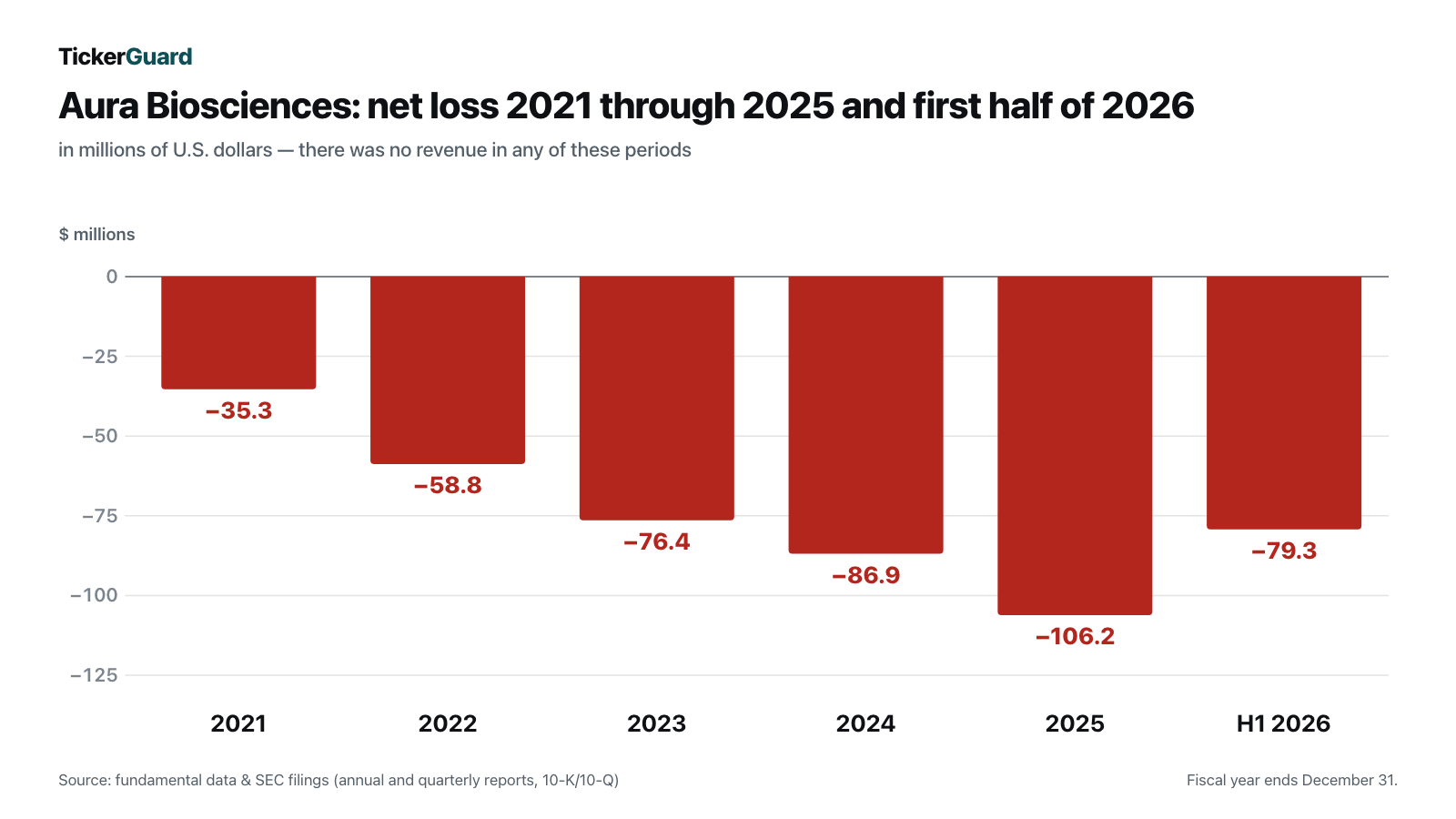
Two figures in that curve deserve context. First, the jump in the first half of 2026 is not purely a research effect. Research and development expense rose in the second quarter of 2026 from $22.9 million to $30.7 million, which is the Phase 3 trial. General and administrative expense in the same quarter jumped from $5.7 million to $17.3 million, roughly tripling. The filing gives the reason: primarily higher "equity award modifications in connection with executive leadership transitions", plus higher professional fees. That is a paper charge, not cash out the door, but it distorts the quarter considerably. If you want to know whether the new leadership is also putting its own money into the stock, the insider filings on Form 4 dated September 1, 2026 give a clear answer: all five filings for the newly appointed officers report grants under the compensation program only (transaction code "A") — shares and options issued by the company itself. Not one is an open-market purchase.
Second, where the money comes from. Since its founding in 2009 Aura has raised roughly $797.9 million in gross proceeds (as of June 30, 2026), $280.8 million of it net in May 2026 alone. Against that stands an accumulated deficit of $559.7 million. Put differently: about 70 cents of every dollar raised has already been spent. That is normal for a company in clinical development — someone simply has to pay for it. The second chart shows who does.
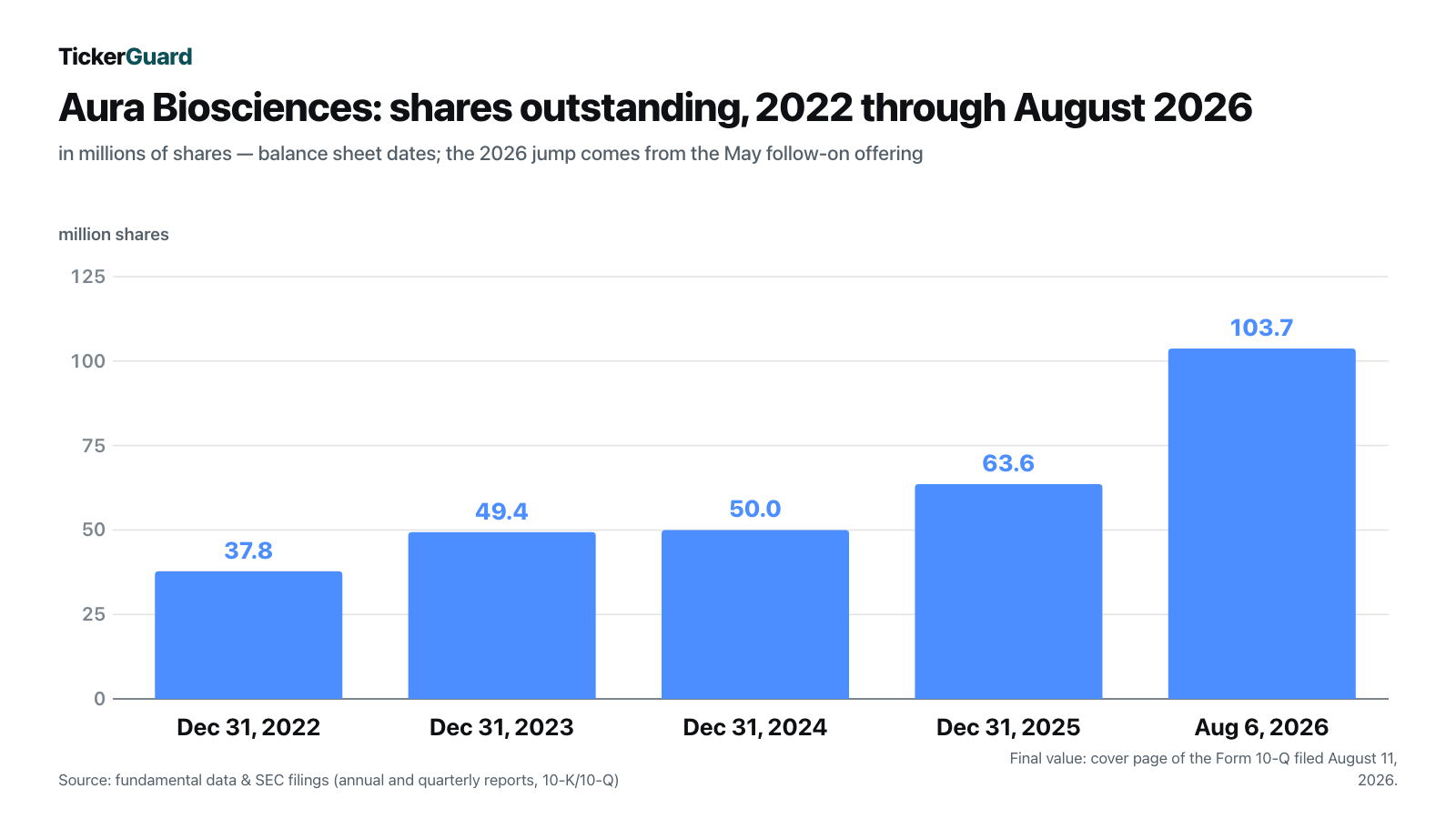
Dilution is the technical term, and the everyday picture is simple. The company is a cake and your share is a slice. If the cake does not grow but is cut into almost three times as many slices, your slice shrinks accordingly. At Aura the cake did grow — the $280.8 million was real money. But an investor from the end of 2022 now holds roughly 36 percent of the proportional stake they held then. Remember the pattern: at a company without revenue, shareholders fund the research, and they fund it in ownership.
What the filings say: the uncomfortable truths
Uncomfortable truth no. 1: the best number of the quarter belongs to the program being shut down
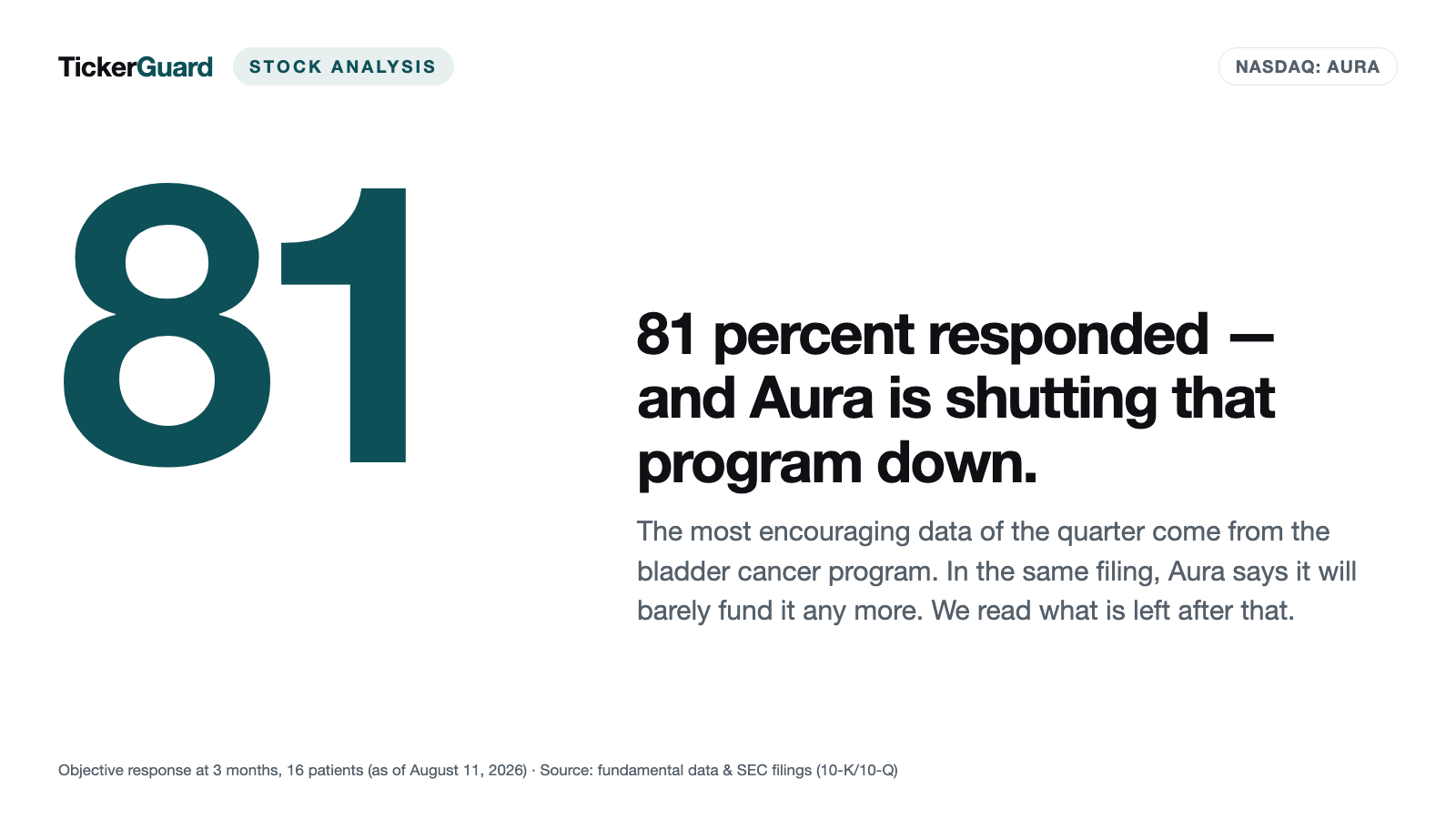
Until August 2026 Aura ran on two legs: ocular oncology with bel-sar against choroidal melanoma, and a second program in non-muscle invasive bladder cancer (NMIBC in the filings). In August the company reported interim data from the ongoing Phase 1b/2 dose-escalation study in that second program, and the numbers are striking. Of 16 intermediate-risk patients treated with bel-sar alone (8 patients) or with tumor resection (8 patients), 81 percent achieved an objective response at three months — and in 69 percent of all 16 patients the tumor had cleared completely at that timepoint. The complete responses are therefore part of the 81 percent, not a share on top of it. Among patients who had reached the nine- or twelve-month timepoints, all remained disease-free at assessment. Every treatment-related adverse event was limited to the mildest grade.
In the same paragraph sits the sentence that changes the company's direction:
"While these early data are encouraging, as part of our strategic refocus on ocular oncology, we are minimizing resource allocation toward the NMIBC program on a going forward basis."
— Aura Biosciences, Inc., Form 10-Q for the quarter ended June 30, 2026, "NMIBC Program Update"

You can consider that decision wise or wasteful, but you should not miss it. For Aura it is consistent: a company with 113 employees cannot carry two late-stage programs in two entirely different specialties. The filing adds that data collection continues through the twelve-month follow-up period defined in the study protocol to preserve "optionality for value creation in the context of future potential strategic discussions" — in plain terms, to keep the program saleable or licensable later. For an investor, though, the point is blunt: the most impressive number in this report is not a number Aura intends to make money from. Anyone who writes it into a thesis has picked the cherry and skipped the rest of the paragraph.
Uncomfortable truth no. 2: everything rests on one trial, and its result lands no earlier than late 2027
After the refocus, one decisive program remains: the global Phase 3 trial CoMpass testing bel-sar in early choroidal melanoma. The Form 10-K for 2025 describes the design in detail: roughly 100 patients randomized 2:1:2 to a high-dose regimen, a low-dose regimen or a sham control; the primary endpoint is time to tumor progression; the comparison is made only once the last patient completes 15 months of follow-up. The design was agreed with the FDA under a Special Protocol Assessment, a written pre-agreement that a successful trial can support a marketing application. Statistical power is set above 90 percent.
All of that is carefully constructed. It simply takes time. The quarterly report puts it plainly as a risk factor in its own words:
"We have completed enrollment in our pivotal Phase 3 clinical trial, but we do not expect topline data until the second half of 2027, and we have not yet completed such trial nor commercialized any pharmaceutical products, which may make it difficult to evaluate our future prospects."
— Aura Biosciences, Inc., Form 10-Q for the quarter ended June 30, 2026, Part II Item 1A "Risk Factors"

Work it through for yourself: from the cut-off date of this analysis to the second half of 2027 lie at least four quarterly reports in which nothing new will be said about the decisive question. And the outcome is binary — either the primary endpoint reaches statistical significance or it does not. The filing warns in addition that the FDA and the European regulator EMA might ultimately require two Phase 3 trials rather than one. The everyday image: you are not buying a business with income, you are buying a ticket with a fixed draw date — and the draw is more than a year away.
Uncomfortable truth no. 3: of $280.8 million raised, $39.0 million went to a departing holder
On May 5, 2026 Aura placed 46,099,650 new shares at $6.00 each, plus pre-funded warrants for a further 3,800,000 shares. After all costs, $280.8 million came in — the largest financing in company history. What happened to part of it is notable:
"We received approximately $280.8 million in net proceeds from the 2026 Follow-On Offering after deducting underwriting discounts and commissions and offering expenses, of which approximately $39.0 million were used to repurchase 6,922,870 shares from Matrix Capital Management Master Fund, LP, or Matrix, at a price per share of $5.64, on May 7, 2026, or the Matrix Repurchase."
— Aura Biosciences, Inc., Form 10-Q for the quarter ended June 30, 2026, "Financing History"

Matrix Capital held roughly 10.8 percent of Aura before the transaction, and the repurchase covered what the company believes was the fund's entire position. The deal was reviewed and approved by the audit committee of the board, composed of three independent directors unaffiliated with Matrix, and the balance sheet at June 30, 2026 carries the repurchased stock as 6,922,870 treasury shares at a cost of $39.1 million — explicitly not retired. All disclosed, all in order.
It is still worth translating into plain language. A company raises money from new investors for research and uses about one seventh of it to let an existing large holder exit — at a price 6 percent below what those new investors paid the same day. For remaining shareholders that is not inherently bad: the overhang of a seller wanting out disappears in one move, and the buyback was cheaper than the issue price. But it is also $39.0 million that did not go into the Phase 3 trial — a good full quarter of operating cash burn, which ran at $32.5 million in the second quarter of 2026 ($62.4 million for the half year less $29.9 million in the first quarter).
Uncomfortable truth no. 4: funded into 2029, and still opening the frame for the next round
As of June 30, 2026 Aura held $323.8 million in cash and marketable securities and states these funds will last "into the first half of 2029". Let us run the promised check. At an operating cash burn of $32.5 million in the second quarter of 2026 — $62.4 million for the half year less $29.9 million in the first quarter — the cash covers roughly ten quarters, so into late 2028. The company guidance of the first half of 2029 sits slightly above that, which is plausible after the headcount reduction. What matters more is the gap to the data date: between the expected readout in the second half of 2027 and the arithmetic end of the cash lie roughly four to five quarters. Which makes the August 2026 decisions all the more notable. On August 5 a special meeting of stockholders approved a charter amendment raising authorized share capital from 150,000,000 to 500,000,000 shares. On August 11, the day of the quarterly report, Aura filed a new shelf registration for $500.0 million — a standing authorization to issue securities at any time. Included in it is a $200.0 million program under which shares can be sold gradually and quietly into the open market.
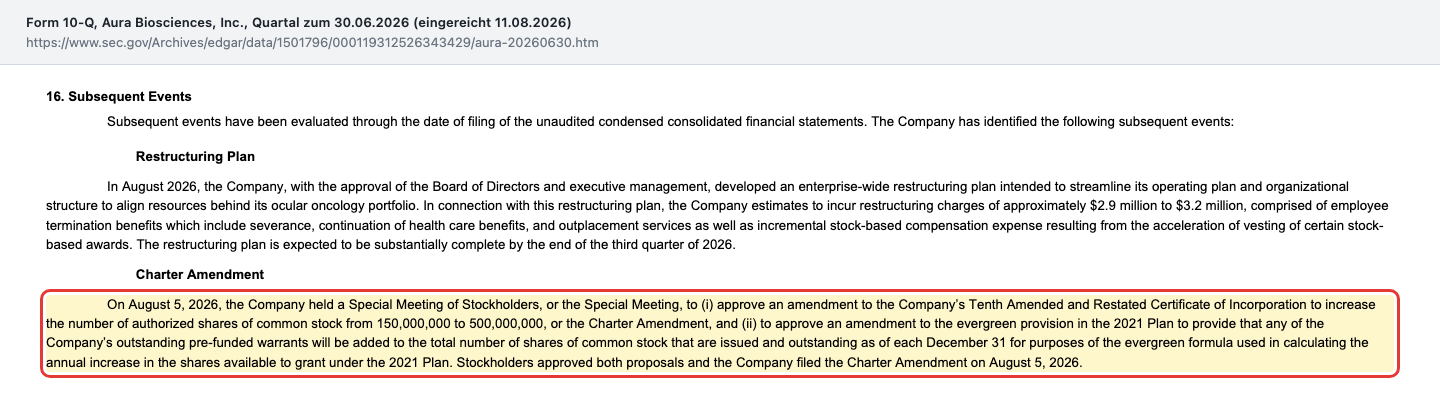
In fairness: a shelf registration is not an offering. It costs nothing, dilutes nothing, and is standard practice for U.S. biotechs — it merely creates the ability to move quickly when the share price allows. But the size is a statement in itself. The $200.0 million sales program equals roughly a quarter of the market capitalization of about $784 million (price $7.56 on September 4, 2026). And above the shares hover a further 11,173,185 warrants from the 2025 and 2026 placements (as of June 30, 2026), which create additional stock when exercised. Remember the sentence: at a company without revenue, the share count is not a constant but a variable — and the frame for it was just tripled.
Valuation: what $784 million means for a date in 2027
Conventional valuation measures do not apply here: no revenue, no earnings, so neither a price-to-sales nor a price-to-earnings ratio. What remains is simple subtraction. At $7.56 per share on September 4, 2026, market capitalization stood at roughly $784 million. Of that, $323.8 million is covered by cash and marketable securities (as of June 30, 2026), and book equity is $315.3 million, or about $3.04 per share. The remainder, roughly $460 million, is pure expectation — the price the market pays today for bel-sar working in the second half of 2027.
What do you measure that $460 million against? The Form 10-K for 2025 gives the size of the target market: the company says more than 11,000 patients are diagnosed with choroidal melanoma each year across the United States and Europe, and estimates that roughly 96 percent are diagnosed without clinical evidence of metastatic disease — precisely the early stage bel-sar targets. Put plainly: the market is small, but it is unserved today, and a medicine for a rare, life-threatening disease with no alternative typically commands a high price per course of treatment. In fairness, Aura concedes in the risk section of the same filing that the incidence and prevalence of its target population have not been established with precision and that its own estimates may prove too high. Anyone who considers $460 million appropriate is therefore assuming two things: that the trial succeeds, and that those few thousand patients a year can be reached at a workable price. The filing names no specific competitor in early choroidal melanoma, describing competition only in general terms as large pharmaceutical and biotechnology companies. The real rival remains today's standard of care — plaque brachytherapy, proton beam, or removal of the eye.
For context: as of September 4, 2026 the analyst consensus target price was $16.60, more than double the price at the time. That is the usual finding for clinical-stage biotech, and it says less than it appears to — at heart it describes the same binary outcome, multiplied by a probability. A look over the fence helps more than a target price. At Alpha Tau Medical we described the same basic setup: a localized tumor therapy, a narrow focus, a result in the future. And at Zymeworks you can inspect what happens when a biotech still has no durable recurring income after approval. Both cases show the same thing: the price of a stock like this is not a valuation of numbers, it is a probability calculation with a date attached.
Upside and risks at a glance
What speaks for Aura Biosciences:
- An unusually clean balance sheet for a clinical-stage biotech: $323.8 million in cash and marketable securities, $315.3 million of equity, no financial debt and no going-concern paragraph (all as of June 30, 2026); management's own runway guidance is the first half of 2029.
- Genuine medical need: no approved medicine exists for early choroidal melanoma, and standard therapies frequently cost the vision of the treated eye or the eye itself.
- Encouraging earlier evidence: in the Phase 2 study, bel-sar achieved tumor control in 80 percent of Phase 3-eligible patients (8 of 10) and preserved visual acuity in 90 percent.
- Regulatory groundwork done: the Phase 3 design is agreed in writing with the FDA under a Special Protocol Assessment, enrollment is complete, and statistical power is set above 90 percent.
- Clear focus and a refreshed leadership team: Natalie Holles has led the company since April 30, 2026, and August 2026 added a chief operating officer, a chief regulatory and quality officer and a chief people officer; the bladder cancer program is preserved as a potential sale or licensing asset.
What speaks against it:
- A single program decides everything: after the refocus, the value of the company rests on the Phase 3 CoMpass trial with roughly 100 patients, whose topline data are not expected before the second half of 2027; the FDA and EMA could additionally require a second Phase 3 trial.
- No revenue since inception in 2009 and a widening loss: $35.3 million (2021), $58.8 million (2022), $76.4 million (2023), $86.9 million (2024) and $106.2 million (2025), plus $79.3 million in the first half of 2026 alone; accumulated deficit $559.7 million.
- Heavy dilution with an open frame: shares outstanding rose from 37.8 million (end of 2022) to 103.7 million (August 6, 2026), plus 11,173,185 warrants; authorized share capital was raised from 150 million to 500 million shares on August 5, 2026, and a $500.0 million shelf registration including a $200.0 million sales program was filed on August 11.
- Questions about use of proceeds: $39.0 million of the fresh money went into repurchasing the Matrix stake at $5.64 per share in May 2026 while new investors paid $6.00; the August restructuring costs a further $2.9 million to $3.2 million.
- Reliance on third-party technology and patents: for delivery into the eye Aura uses an in-licensed microinjector from Clearside Biomedical, and parts of the patent portfolio are licensed from or co-owned with the U.S. health agencies (NIH/DHHS), Inserm and Rakuten.
A human conclusion
Back to the cherry-picking trap. The striking thing about Aura Biosciences is that the company itself did not fall into it. In August 2026 it held a beautiful number — 81 percent response rate, no serious side effects — and set it aside anyway, because it did not fit the path it wants to walk. That is unusually disciplined. It also means everything that follows hangs on a single trial of roughly 100 patients whose result will not be on the table before the second half of 2027. Until then there is a balance sheet with $323.8 million, a calendar and patience.
So the honest question is not "how good are the data?" but: can you hold a position for more than a year in which every quarter says nothing new about the only question that matters — and in which the company may issue new shares at any time without asking you? If yes, you have a thesis and a date. If no, you had a cherry. What you make of it is up to you. And that is exactly as it should be.
Sources
Every original document used in this analysis, for you to read yourself:
- Aura Biosciences, Inc. — Form 10-Q for the quarter ended June 30, 2026 (filed August 11, 2026)
- Aura Biosciences, Inc. — Form 10-Q for the quarter ended March 31, 2026 (filed May 11, 2026)
- Aura Biosciences, Inc. — Form 10-K for 2025 (filed March 30, 2026)
- Aura Biosciences, Inc. — Form 10-K for 2024 (filed March 24, 2025)
- Aura Biosciences, Inc. — Form 8-K of August 11, 2026 (restructuring, results, COO appointment, departure of the chief financial officer)
- Aura Biosciences, Inc. — Form 8-K of May 4, 2026 (repurchase agreement with Matrix Capital)
- Aura Biosciences, Inc. — Form 8-K of May 4, 2026 (change of chief executive)
- Aura Biosciences, Inc. — Form S-3 shelf registration filed August 11, 2026
- Complete SEC filing history for Aura Biosciences, Inc.: EDGAR overview (sec.gov)
- Fundamental data (market capitalization, price, 52-week range, analyst consensus, balance sheet and income series; data as of September 4, 2026), reconciled with the SEC filings.
Transparency & disclaimer: this analysis is journalistic commentary on publicly available information. It is not investment advice, not a regulated financial analysis and not a solicitation to buy or sell securities. Equity investments carry substantial risk up to and including total loss; for clinical-stage biotechnology companies without an approved product, that risk is particularly pronounced. All information is provided without warranty, and the as-of date of each figure is noted in the text. The author holds no position in Aura Biosciences shares at the time of publication.
Key figures at a glance
All monetary figures in millions of $; earnings per share as reported.
| Metric | 2021 | 2022 | 2023 | 2024 | 2025 |
|---|---|---|---|---|---|
| Revenue | 0.0 | 0.0 | 0.0 | 0.0 | 0.0 |
| Operating Income (EBIT) | -35.3 | -60.3 | -85.0 | -96.1 | -112.8 |
| Net Income | -35.3 | -58.8 | -76.4 | -86.9 | -106.2 |
| Earnings Per Share | -1.21 $ | -1.96 $ | -1.93 $ | -1.75 $ | -1.76 $ |
Source: fundamental data & SEC filings (annual and quarterly reports, 10-K/10-Q)
Our Bottom Line at a Glance
- Balance sheet and funding positive
- As of June 30, 2026, cash and marketable securities of $323.8 million stood against equity of $315.3 million, with liabilities of only $32.9 million and no financial debt whatsoever. There is no going-concern paragraph from the auditor. Management guides to a runway into the first half of 2029 — comfortably beyond the trial date.
- Business model and earning power negative
- Since inception in 2009 Aura has never recorded a dollar of revenue. The loss widens every year: $76.4 million (2023), $86.9 million (2024), $106.2 million (2025) and $79.3 million in the first half of 2026 alone; the accumulated deficit stands at $559.7 million. No ongoing business carries anything.
- Concentration risk negative
- After the refocus announced on August 11, 2026, the value of the company rests on one trial: Phase 3 CoMpass with roughly 100 patients. The second program in bladder cancer was effectively shelved despite an 81 percent response rate at three months. Aura does not expect the decisive topline data before the second half of 2027.
- Dilution negative
- Shares outstanding rose from 37,771,918 (December 31, 2022) to 103,704,809 as of August 6, 2026, plus 11,173,185 warrants. Authorized share capital was raised from 150 million to 500 million shares on August 5, 2026, and a $500.0 million shelf registration including a $200.0 million sales program was filed on August 11 — roughly a quarter of the market capitalization.
- Use of proceeds and leadership neutral
- Of the $280.8 million raised in May, $39.0 million went into repurchasing the Matrix stake at $5.64 per share while new investors paid $6.00; the audit committee approved the transaction. Leadership was almost entirely replaced during 2026, which lifted administrative expense in the second quarter by $11.6 million — primarily from equity award modifications, alongside higher professional fees.
- Medical starting position positive
- No approved medicine exists for early choroidal melanoma, and standard therapies frequently cost the vision or the eye. In the Phase 2 study, bel-sar achieved tumor control in 80 percent of the ten Phase 3-eligible patients and preserved visual acuity in 90 percent. The Phase 3 design is agreed with the FDA in writing.
Aura Biosciences is clinical-stage biotech in its purest form: no approval, no revenue since 2009, an accumulated deficit of $559.7 million — set against an unusually clean balance sheet holding $323.8 million in cash and marketable securities with no financial debt at all (June 30, 2026). In August 2026 the company narrowed itself radically: the bladder cancer program was effectively shelved despite an 81 percent response rate at three months, and roughly 20 percent of jobs will go. That leaves everything resting on the Phase 3 CoMpass trial in early choroidal melanoma, whose topline data are not expected before the second half of 2027. Buying today means buying a probability calculation with a fixed date — and a dilution frame that was tripled to 500 million authorized shares on August 5, 2026. Not investment advice.
What Our Rating Means
Open questions
The business works in principle, but one material question is open. As long as it stays open, our findings do not carry a quality verdict.
A substance risk in the narrow sense is not documented, and for a company without revenue that is remarkable: the accounts to June 30, 2026 carry no going-concern paragraph, equity is clearly positive at $315.3 million, there is no financial debt, and $323.8 million in cash and marketable securities covers far more than the critical four quarters at a burn rate of $32.5 million per quarter — company guidance is a runway into the first half of 2029. What is missing for green is the decisive property: there is no ongoing business carrying anything at all. The entire result hangs on one event, the Phase 3 CoMpass trial with roughly 100 patients, whose data are not expected before the second half of 2027. That case — a functioning operation whose outcome depends on a single event — is precisely what the yellow level describes. That authorized capital was tripled to 500 million shares and a $200.0 million sales window opened is one more reason not to judge this green here. Whether a price of roughly $784 million for that outcome is too high is a separate question, and this rating does not answer it. The decision is yours.
A journalistic assessment by our editorial team at the time of the deep dive, based on public sources — not investment advice and not a solicitation to buy or sell. Your personal circumstances (investment goals, risk capacity, taxes) cannot be taken into account. What our levels mean, how verdicts are formed, and what conflicts of interest exist →
Worth Noting
- What triggered this analysis was the Form 10-Q filed August 11, 2026, in which the encouraging interim data from the bladder cancer program and its discontinuation sit in a single paragraph; in our in-house stock scanner Aura Biosciences was not covered until September 8, 2026 and was added as a catch-up. Conventional metrics mislead on this stock — without revenue or earnings neither a P/E nor a price-to-sales ratio can be formed, and credit measures built on revenue such as the Altman Z-score say little.
- Data as of: balance sheet and income figures come from the Form 10-Q for the quarter ended June 30, 2026, filed August 11, 2026; the share count of 103,704,809 comes from the cover page of that same report (as of August 6, 2026) and not from the weighted average in the income statement. Price, market capitalization, 52-week range and analyst consensus carry a data date of September 4, 2026.
- Risk of confusion: Aura Biosciences, Inc. (ticker AURA, CIK 0001501796) is not the same company as Aurinia Pharmaceuticals Inc. (ticker AUPH). They are two legally and commercially separate businesses.
Stock Watch
This analysis is as of September 8, 2026. Stock Watch will tell you what's changed at AURA since then.
Later $1 a month per stock — signing up is free, and you'll be the first to know when it launches.
The full analysis as a PDF for later
We will send you this analysis as a PDF — to print, file away, and read at your own pace. And we will add you to the free Stock Watch list for Aura Biosciences Inc (AURA), so you hear about it when something material in this analysis changes.
Frequently Asked Questions
Aura Biosciences, Inc. (NASDAQ: AURA) of Boston is a clinical-stage biotechnology company with no approved medicine and no revenue. It develops virus-like drug conjugates: empty shells of the human papillomavirus loaded with light-activated toxic molecules that bind to tumor cells and become active only when a laser is applied. Its lead candidate, bel-sar, is being tested against early choroidal melanoma, a rare cancer of the eye.
According to the Form 10-Q for the quarter ended June 30, 2026, enrollment in the pivotal Phase 3 CoMpass trial is complete, but the company does not expect topline data until the second half of 2027. The trial randomizes roughly 100 patients 2:1:2 against a sham control; the primary endpoint is time to tumor progression, and the comparison is made only after the last patient completes 15 months of follow-up.
In August 2026 Aura reported an objective response rate of 81 percent at three months from its Phase 1b/2 study in non-muscle invasive bladder cancer, across 16 treated patients. Even so, the same quarterly report announced that the company will minimize resource allocation to that program and focus entirely on ocular oncology. Data collection continues through the twelve-month timepoint defined in the study protocol to keep the program saleable or licensable.
As of June 30, 2026 Aura held $323.8 million in cash and marketable securities against equity of $315.3 million and no financial debt. On that basis the company expects a runway into the first half of 2029. Operating cash burn was $32.5 million in the second quarter of 2026 ($62.4 million for the half year less $29.9 million in the first quarter); the August 2026 restructuring is expected to cost $2.9 million to $3.2 million and to lower ongoing expense.
Shares outstanding rose from 37,771,918 (December 31, 2022) to 103,704,809 as of August 6, 2026. Between March 24, 2026 (64,150,468 shares) and August 2026 alone the count grew by roughly 62 percent, mostly from the May 5, 2026 placement at $6.00 per share. A further 11,173,185 warrants were outstanding as of June 30, 2026, and authorized share capital was raised from 150 million to 500 million shares on August 5, 2026.
Out of the May 2026 offering, Aura used roughly $39.0 million to repurchase all 6,922,870 shares held by Matrix Capital Management Master Fund, LP on May 7, 2026, at $5.64 per share, while new investors paid $6.00. Matrix previously held about 10.8 percent of the company. The audit committee of the board, composed of three independent directors, reviewed and approved the transaction. The balance sheet at June 30, 2026 carries the stock as 6,922,870 treasury shares at a cost of $39.1 million; the shares were not retired.
Natalie Holles has been chief executive officer and president since April 30, 2026, succeeding founder Elisabet de los Pinos, who left the company. Holles previously led Third Harmonic Bio and Audentes Therapeutics. In August 2026 Susan Abu-Absi joined as chief operating officer, Erica Kratz as chief regulatory and quality officer and Julie Person as chief people officer. Anthony Gibney, previously chief financial and business officer, left on September 1, 2026; Amy Elazzouzi has served as interim principal financial officer since September 2, 2026, until a new chief financial officer is appointed.
No. Aura Biosciences, Inc. trades on the Nasdaq under the ticker AURA and is registered with the U.S. securities regulator, the SEC, under CIK 0001501796. Aurinia Pharmaceuticals Inc. is a different company trading under the ticker AUPH. The similar names can lead to confusion; the business models, compounds and financials have nothing in common.
Found an error?
Did you spot a factual error, an outdated number, or a typo in this deep dive? Let us know briefly — your report goes straight to the editorial team.