4iG: A 28 Billion Forint Group Profit — and a Loss for Its Own Shareholders
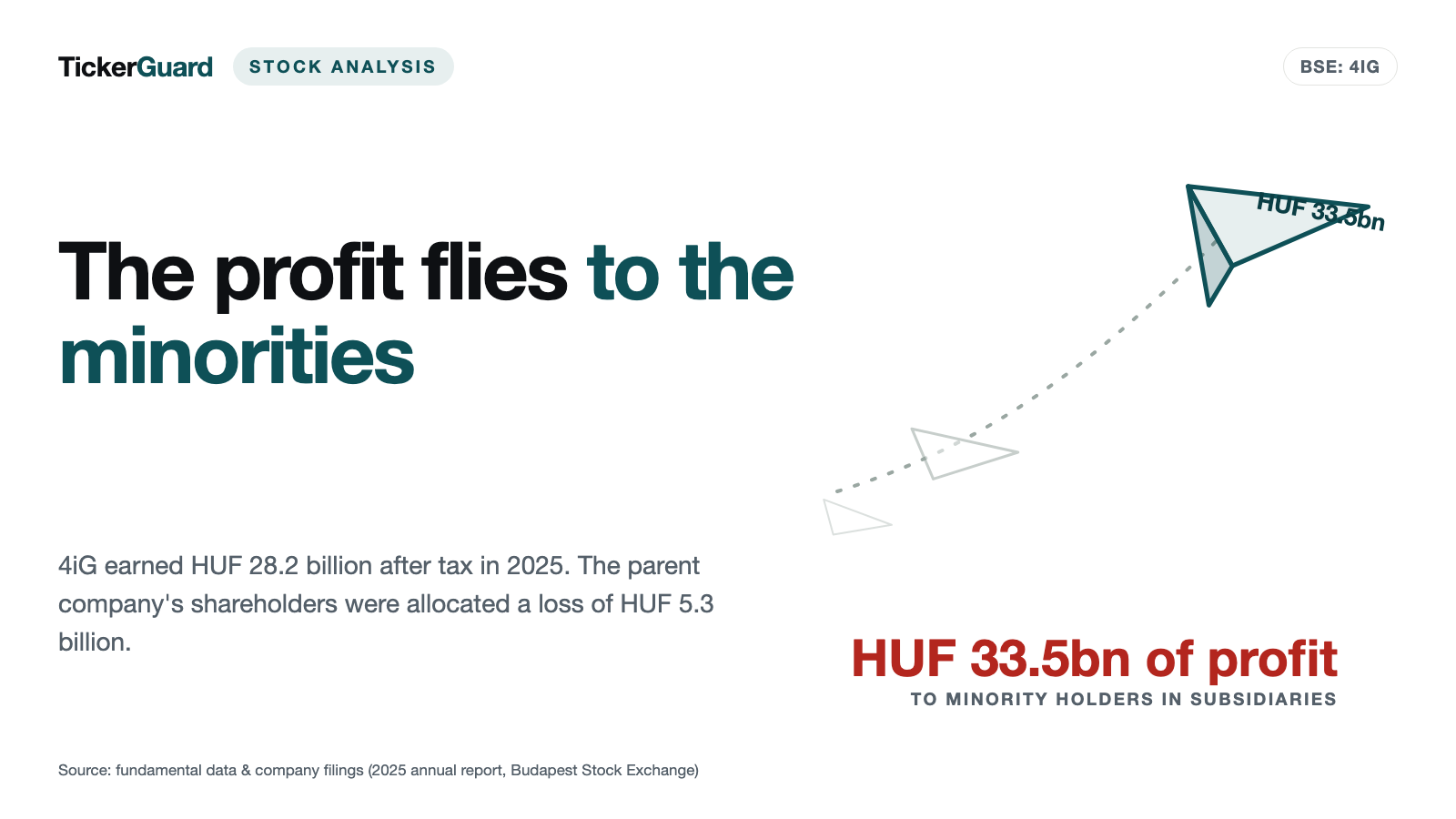
4iG Plc (Budapest Stock Exchange: 4IG) has grown revenue eighteenfold in six years, from HUF 41.1 billion in 2019 to HUF 745.3 billion in 2025, roughly 2.06 billion euros. In 2025 the group posted its first profit in years: HUF 28.2 billion after tax. Its own shareholders were allocated a loss of HUF 5.3 billion, while HUF 33.5 billion went to the minority holders in the subsidiaries. The growth was paid for with debt: HUF 1,068.0 billion net as of March 31, 2026, roughly 37 percent more than the market capitalisation on the same day. Not investment advice. This piece simply does the arithmetic on how much of an eighteenfold revenue increase reaches the parent company's own shareholders.
 Thomas Mücke
Founder & Publisher
Thomas Mücke
Founder & Publisher
Chart
Interactive price chart (TradingView).
Note: pure fact-based analysis, not investment advice and not a solicitation to buy or sell. All figures without guarantee.
There is a thought that feels like arithmetic even though it is nothing of the sort: “But it used to be worth so much more.” Psychologists call it anchoring. A price you once saw lodges in your head and becomes the yardstick for everything that follows — even when it never said anything about the value of a business, only about the mood of one particular November day.
At 4iG Plc, listed on the Budapest Stock Exchange under the ticker 4IG, one such anchor lies around in plain sight. On November 12, 2025 the shares traded as high as 4,965 forint. On August 19, 2026 they closed at 1,515 forint. That is roughly 69 percent lower. Anyone who knows only those two numbers already has half a verdict.
The deal for this piece: no recommendation, no price target. We read the 2025 annual report the Board approved on April 24, 2026, the flash report as of March 31, 2026 and the company's investor materials — and look at what those 69 percent actually contain. The central tension running through every chapter: the group has grown enormously. But who owns that growth?
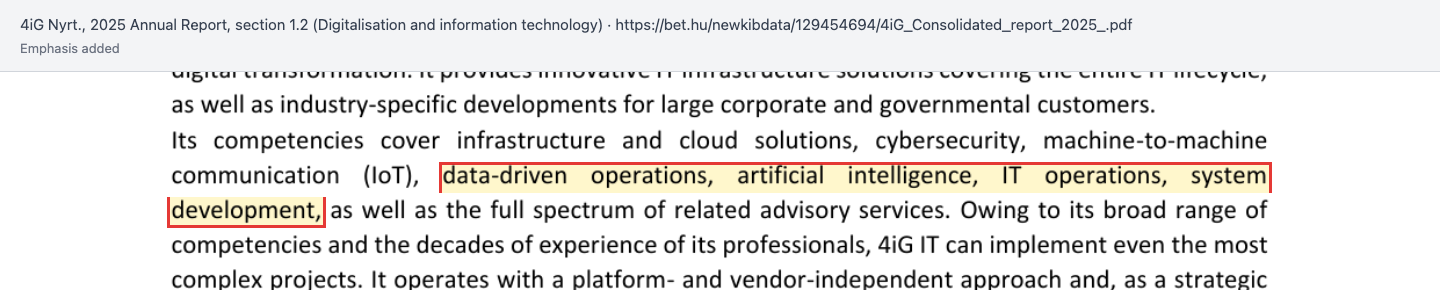
What 4iG actually does — from IT house to telecom and defence group
Picture a company that in 2019 was about the size of a mid-sized European IT service provider: HUF 41.1 billion in revenue, roughly 114 million euros. It built software, ran data centres and sold system integration to large Hungarian customers and government bodies. Six years later the same group turns over HUF 745.3 billion — roughly 2.06 billion euros — and consists of three very different operating parts. The annual report treats them as three of four reportable segments; the fourth is simply called “Other” and mainly holds the holding-level costs.
Telecommunications is by far the largest. In 2025 it delivered 84.8 percent of consolidated revenue: mobile and fixed-line services in Hungary under the ONE brand, the network company 2Connect, plus mobile operators in Albania and Montenegro. The annual report puts this segment's share of 2025 EBITDA at 91.9 percent; in the first quarter of 2026 it was 88 percent — HUF 61.5 billion of HUF 69.3 billion.
Information technology is the original business: 14.3 percent of 2025 revenue, bundled in 4iG Informatikai Zrt. The annual report describes it as one of Hungary's leading system integrators, selling to large corporate and governmental customers.
Space and defence is the youngest and loudest business. In 2025 it accounted for only 0.9 percent of revenue; in the first quarter of 2026 it was already 11 percent, because the acquisitions only then entered the accounts. They include a 75 percent plus one vote majority in N7 Defence Holding Zrt. with ammunition, small arms and aviation businesses, 74.34 percent of vehicle maker Rába Nyrt. and stakes in satellite programmes. On March 27, 2026 the company put the order book of this division at more than 3.5 billion euros, plus framework agreements without purchase obligation of more than 4.5 billion euros.
One detail investors outside Hungary rarely meet: the second-largest shareholder in 4iG is Rheinmetall AG with 25.12 percent (as of March 31, 2026). The link is operational too: there is a joint venture, Rheinmetall 4iG Digital Services Kft., and the state-held 49 percent stakes in Rheinmetall Hungary Munitions Zrt. and Rheinmetall Hungary Zrt. were contributed to the new defence holdings in 2026.
Headcount grew accordingly: the annual report cites almost 8,500 employees at the end of 2025 and expects 11,000 once the planned acquisitions complete. In its own statement of August 18, 2026 the company speaks of more than 11,000 — so the deals have closed.
Important for everything that follows: 4iG files no 10-K and no 10-Q. It is not a U.S. reporting company; its mandatory reports appear at the Budapest Stock Exchange, it reports under IFRS, and its fiscal year matches the calendar year. Every figure in this analysis therefore carries the line “Source: fundamental data & company filings (annual and quarterly reports, Budapest Stock Exchange)” rather than “SEC filings”.
Company history for investors
-
2021
The jump into telecoms begins
Revenue rose from HUF 57.3 billion to HUF 93.7 billion. For shareholders it was the last year with clearly positive earnings per share before the acquisitions took over the accounts.
-
2023
Revenue doubles to HUF 592.8 billion
The telecom acquisitions hit the accounts in full for the first time. They were paid for with debt — interest grew faster than the earnings shareholders saw from them.
-
2024
A loss year: minus HUF 45.8 billion for shareholders
Group profit after tax was minus HUF 47.7 billion and earnings per share minus 159.5 forint. Net debt equalled 3.88 times EBITDA.
-
2025
June: the state raises its telecom holding stake to 37.9 percent
Corvinus Nemzetközi Befektetési Zrt. raised its stake in the telecom holding from 23.22 to 37.90 percent. For shareholders it meant a smaller share of the group's main earnings engine.
-
2025
November: peak at 4,965 forint
The stock ended 2025 up 351 percent as the best performer on the Budapest Stock Exchange. Anyone entering only here captured most of the later decline.
-
2026
January to April: defence deals and new financings
N7 Defence Holding, Rába and HeliControl were acquired, funded partly by a 176.6 million euro bond and a 50 million dollar convertible loan. Leverage rose from 3.12x to 3.6x.
-
2026
August: government orders a comprehensive review
After the resolution of August 15 the stock fell 14.5 percent to 1,590 forint on August 17. For shareholders the political environment became a quantifiable price factor.
How the stock landed on our desk
Honesty first: 4iG did not reach our research list through a recommendation or an analyst note, but through a combination in the fundamental data that rarely appears together. As of August 24, 2026 it showed a group whose revenue has grown eighteenfold in six years, whose shares have lost about two thirds since the November 2025 peak — and whose equity attributable to its own shareholders is smaller than the stake outside investors hold in the same subsidiaries.
Such combinations almost always have a reason. Sometimes it is a misunderstanding by the market; more often it is a calculation already reflected in the price and not yet in the growth story. Which of the two applies here is decided not by ratios but by the reports. So we read them: the annual report of April 24, 2026, the flash report as of March 31, 2026 published on May 28, 2026, the investor presentations for the fourth quarter of 2025 and the first quarter of 2026, and the company's own statement of August 18, 2026.
One disclosure that shapes the evidence base: there are no analyst call transcripts for this company. We checked our own transcript archive — 21,116 transcripts, none for 4iG — and the company's investor archive as well. 4iG does hold investor events; the privacy notice in its own presentation makes clear that recordings are made “for internal use only”. Nothing is published. The chapter on management promises therefore rests on written materials rather than transcripts — and says so wherever it matters.
And one more constraint worth knowing: the H1 2026 report is only due on August 31, 2026 according to the financial calendar. The most recent full periodic report behind this analysis is therefore the flash report as of March 31, 2026. Everything after that appears in the text as a dated event, not as a balance sheet figure.
The numbers over the years — given their due
First the part that genuinely impresses. This revenue curve is not window dressing; it is real and documented in audited accounts.
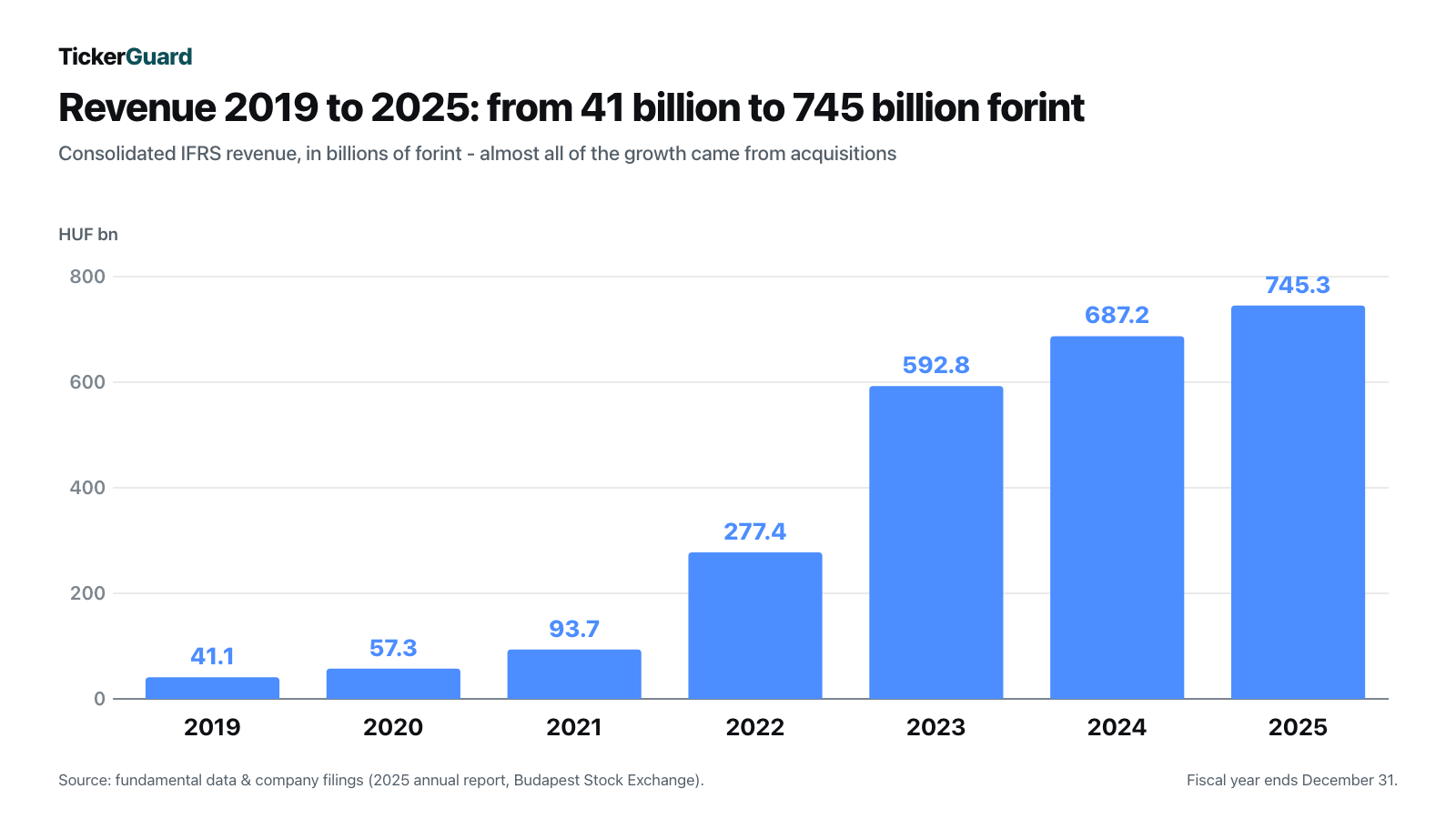
Operationally the group is also in better shape than three years ago. EBITDA — earnings before interest, taxes, depreciation and amortisation, roughly what the running business leaves behind before banks and the tax office help themselves — rose 27.1 percent to HUF 293.7 billion in 2025, about 812 million euros. The EBITDA margin climbed to 39.4 percent of revenue. Operating profit (EBIT) rose from HUF 40.7 billion to HUF 102.5 billion. And operating cash flow came in at HUF 246.0 billion in 2025. This is not a paper business; real cash moves.
The first quarter of 2026 continued the trend: revenue rose 18.4 percent to HUF 203.0 billion (roughly 561 million euros), EBITDA 15.3 percent to HUF 69.3 billion. The EBITDA margin, however, fell from 35.1 to 34.2 percent — the newly acquired defence businesses earn less per forint of revenue than the telecom operations.
And then comes the line that puts everything else in context.
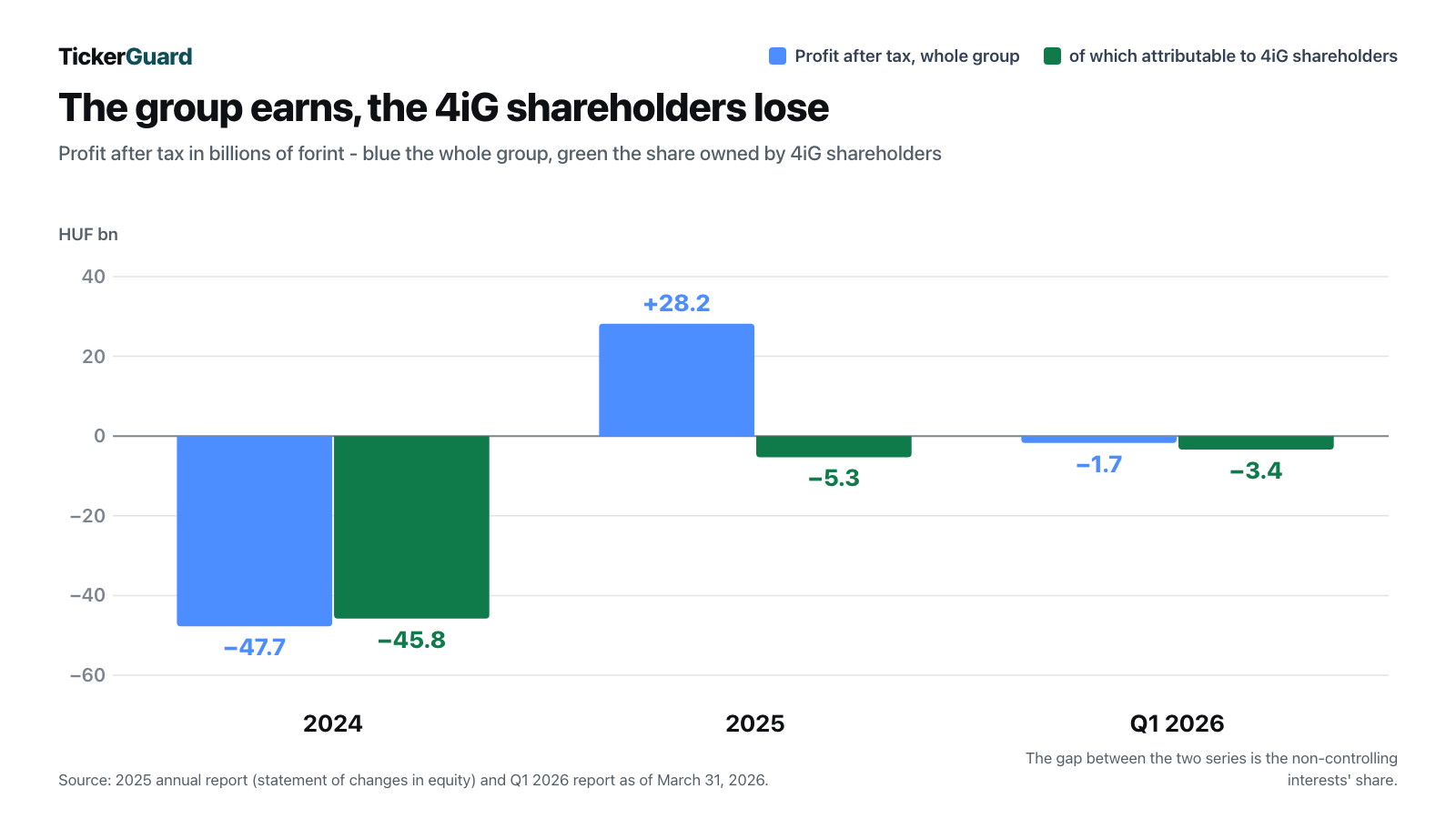
How that works comes down to one concept worth understanding once: non-controlling interests. When a group owns 62 percent of a subsidiary, it still consolidates one hundred percent of that subsidiary's revenue and profit. Right at the bottom the result is then split: part of it belongs to the parent's own shareholders, the rest to the subsidiary's other owners. Put visually: the cake on the table is enormous — but a large share of the slices is spoken for before you reach.
What management promised — and what came of it
Because there are no analyst call transcripts, management has to be measured against what it has published in writing. There is plenty of that: an investor presentation for every quarter, plus the reports themselves.
The fourth-quarter 2025 presentation of February 27, 2026 states the ambition plainly. It calls 4iG the region's IT, telecom and space and defence champion, points to normalised EBITDA up 19 percent and to a net debt to EBITDA ratio of 3.2x that “underpins the group's disciplined financial policy”. That presentation still used preliminary, normalised figures — HUF 733.9 billion of revenue and HUF 275 billion of normalised EBITDA; the annual accounts approved two months later show HUF 745.3 billion and HUF 293.7 billion, which works out at 3.12x. And it notes that the share price and market capitalisation both rose 350 percent in 2025, making 4iG the best-performing stock on the Budapest Stock Exchange. That checks out: from a close of 924 forint on December 30, 2024 to 4,170 forint on December 30, 2025 is a gain of 351 percent.
A whole series of announced steps was delivered, and that belongs in an honest account: the transformation programme separating commercial telecom from network infrastructure was completed in 2025. The defence acquisitions closed — N7 Defence Holding on February 27, 2026, Rába in early January 2026, HeliControl on April 1, 2026. Funding sources were broadened: a bond from the space and defence subsidiary worth 176.6 million euros at a fixed 5.10 percent over eight years (February 27, 2026) and the 50 million dollar loan from sovereign fund Mubadala.
What quietly changed along the way sits in the annual report itself. The large domestic bond NKP 2031/II was restructured:
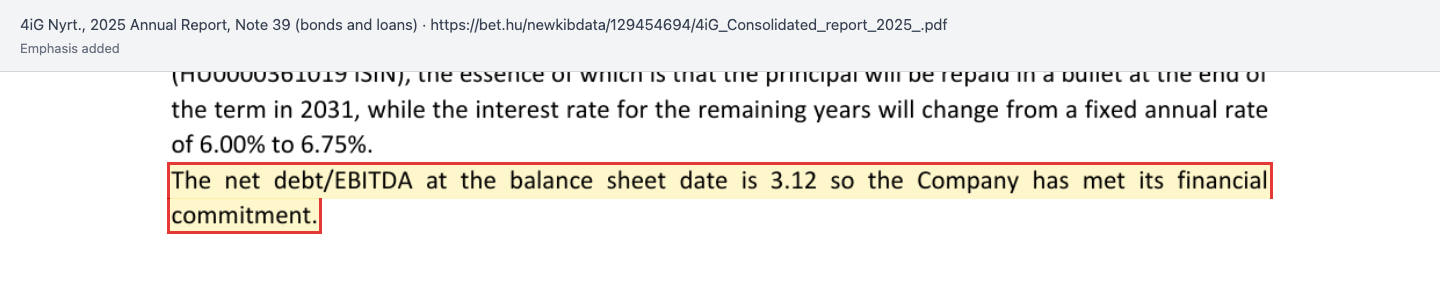
Read soberly: the company bought itself room by pushing repayment out, and accepted 75 basis points more interest for it. For a group in the middle of an acquisition spree that is a defensible decision — the bill arrives in 2031, and then all at once.
One thing was not delivered that was never actually promised, though many investors assume it: a dividend. The 2025 cash flow statement shows only one such line, and it does not go to 4iG shareholders but to the minority holders in the subsidiaries — HUF 545 million in 2025 and HUF 1,081 million in 2024. Shareholders of 4iG Plc itself received nothing in either year.
What the reports say — the uncomfortable truths
Uncomfortable truth no. 1: the group earns, its own shareholders lose
The 2025 annual report shows profit after tax of HUF 28,154 million, after minus HUF 47,658 million the year before. That is the number that makes headlines. Two lines further down it gets split.
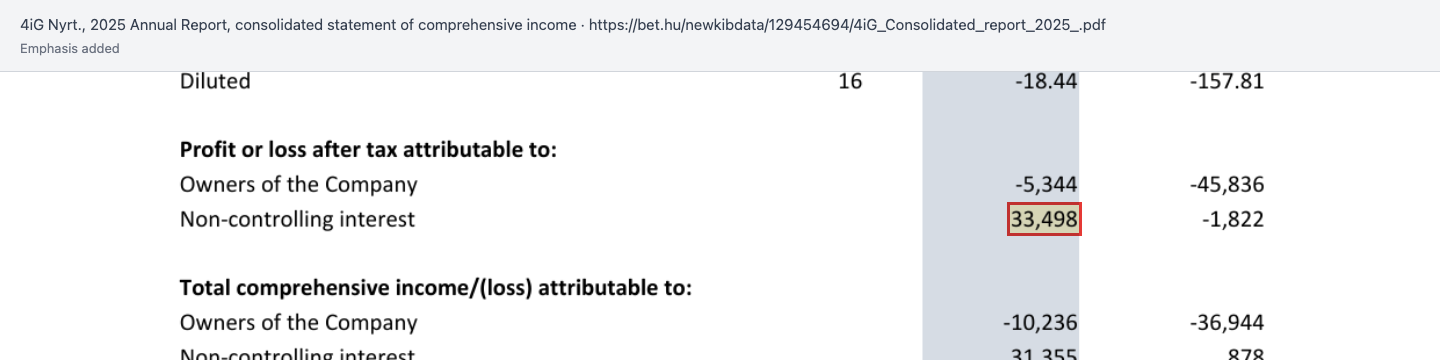
Why does this happen? Because the most important subsidiaries are not wholly owned. The telecom holding, which produced roughly four fifths of 2025 revenue and about 88 percent of first-quarter 2026 EBITDA, is 62.1 percent owned by 4iG Plc and 37.9 percent by Corvinus Nemzetközi Befektetési Zrt., a Hungarian state entity. When that business does well, 37.9 percent of the success flows to the co-owner — while much of the depreciation and interest from the acquisitions stays with the parent.
This is neither an accounting trick nor an accusation; it is simply how group structures work. For an investor holding 4iG shares it is nonetheless the most important number in the report: the relevant earnings line is not the top one, but the one labelled “attributable to owners of the company”.
And that line has now been negative three reporting periods in a row: minus HUF 45,836 million in 2024, minus HUF 5,344 million in 2025 and minus HUF 3,376 million in the first quarter of 2026. Accordingly, retained earnings stood at minus HUF 19,947 million as of March 31, 2026 — over its history the group has accumulated more losses than profits.
Uncomfortable truth no. 2: a large part of the balance sheet is purchase price
When you buy a company and pay more than its assets are worth, the difference has to go on your own balance sheet. Part of it gets a name — customer relationships, brands, licences — and the rest is simply called goodwill. That is not a machine or a plot of land, but the expectation that the purchase price will pay off. A promise in balance sheet form.
As of March 31, 2026 that looked as follows at 4iG: HUF 309,375 million of goodwill, HUF 155,401 million of customer relationships and HUF 246,132 million of other intangible assets — together HUF 710,908 million, roughly 1.97 billion euros. Against total assets of HUF 1,943,709 million that is a good third.
The more interesting comparison is with what shareholders own of it. Equity attributable to owners of 4iG Plc was HUF 124,712 million on the same date — roughly 345 million euros. Goodwill and intangibles are therefore 5.7 times that amount. Put differently: write those book values down by a little over a sixth and the equity of 4iG shareholders would arithmetically be gone.
For context, so this does not read the wrong way: no auditor and no standard requires such a write-down as long as the acquired businesses hit their plans. Goodwill is tested annually for impairment, not amortised on a schedule. So this is not a statement about the present but a measure of leverage: with this balance sheet structure, any disappointment at a large subsidiary hits shareholders' equity disproportionately. How a heavily indebted group copes when a division falters is worth reading in our TUI analysis.
The remaining equity, incidentally, also belongs mostly to others: of HUF 449,702 million in total equity as of March 31, 2026, HUF 324,990 million was attributable to non-controlling interests — roughly 72 percent.
Uncomfortable truth no. 3: HUF 1,068 billion of net debt — and a covenant at 4.0x
The Q1 2026 investor presentation lays out the financial debt clearly. As of March 31, 2026: HUF 887,575 million of non-current borrowings, loans and bonds, HUF 39,574 million current, plus HUF 165,386 million of lease liabilities and HUF 93,851 million of other financial liabilities. Together HUF 1,186,386 million. Less HUF 118,370 million of cash, that leaves HUF 1,068,016 million of net debt — roughly 2.95 billion euros.
For scale: the market capitalisation of the entire company was HUF 777,595 million on March 31, 2026. Net debt was therefore about 37 percent larger than the company on the stock market. The company itself reports an enterprise value — market capitalisation plus net debt — of HUF 1,845,611 million for that date.
The decisive ratio is net debt to EBITDA. It answers the question: how many years would the group have to devote its entire operating result to repayment in order to be debt free? As of December 31, 2025 the annual report puts it at 3.12x, down from 3.88x — a clear improvement. As of March 31, 2026 it stood at 3.6x. And the telecom holding's loan agreements set a ceiling: 4.0x, tested annually, plus a debt service coverage ratio of at least 1.2. The cushion shrank from 0.88 to roughly 0.4 in one quarter. What happens if the covenant is breached is not written down in the report — it names the ratio, the testing deadline and the finding that the ratio was met, but no legal consequence.
The group itself sees no problem in this — and says why in the notes:
“The Group's high cash balance and the exceptionally strong operating cash flow presented in the statement of cash flows ensure the timely settlement of outstanding liabilities despite the high level of debt. This is further supported by the fact that the substantial principal repayments on the bond portfolio, which constitutes a significant portion of the Group's debt, are not due before 2031.”
— 4iG Plc, 2025 Annual Report, Note 54 “Going concern”, approved April 24, 2026
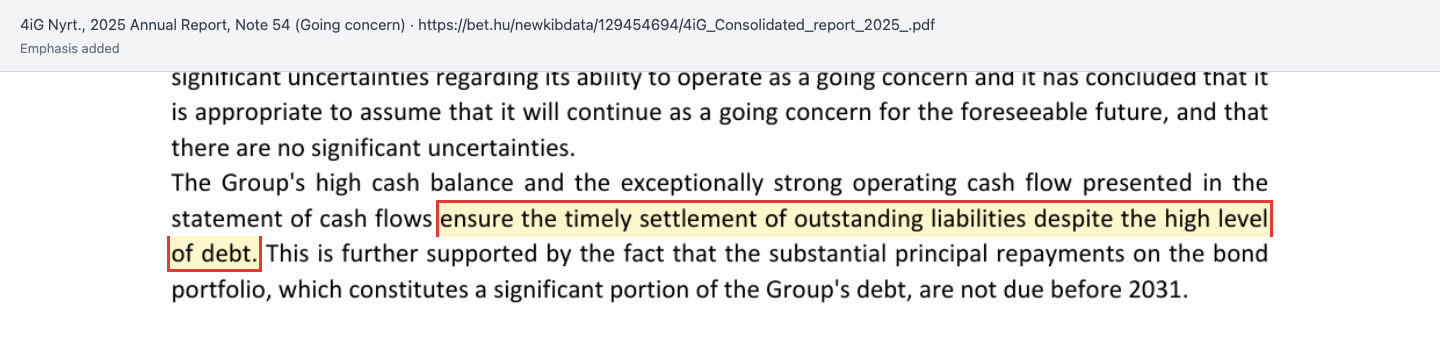
Both arguments hold. Operating cash flow was HUF 246.0 billion in 2025, and cash stood at HUF 118.4 billion on March 31, 2026. Rating agency Scope confirmed a BB− rating with a stable outlook in January 2026. BB− sits below investment grade — high yield, in market parlance — but it is not a distress rating. Reading acute payment risk into it would be overreaching.
Uncomfortable truth no. 4: the most important partner is now auditing the partnership
The biggest risk in this company appears in no balance sheet but in an official gazette. To see it you have to read the structure together: 87.9 percent of 2025 revenue came from Hungary. The Hungarian state holds 37.9 percent of the telecom holding through Corvinus Nemzetközi Befektetési Zrt. The defence business lives on state orders: in the first quarter of 2026, 4iG Űr és Védelmi Zrt. signed two framework cooperation agreements with the Ministry of Defence and the Defence Staff — 1.5 billion euros for military-grade off-road trucks and related maintenance, and 2.5 billion euros for 4x4 modular combat vehicles. And the contributed stakes came out of state ownership: per the 2025 annual report, the state-owned N7 Holding Nemzeti Védelmi Ipari Innovációs Zrt. contributed its holdings in four defence businesses to N7 Defence Holding Zrt. — 100 percent each in Aeroplex and Arzenál Fegyvergyár and 49 percent each in the joint ventures Colt CZ Hungary and Rheinmetall Hungary Munitions; the 49 percent in Rheinmetall Hungary Zrt. went into VAB Kft. 4iG has held 75 percent plus one vote in both holdings since February 27, 2026. The real estate of those businesses remained in state ownership per the quarterly report, and the companies pay rent for it.
In short: the Hungarian state is co-owner, largest customer and former owner of the contributed stakes at the same time — and, through the real estate, still the landlord. That single counterparty carries a substantial part of the business.
On August 15, 2026, the Hungarian official gazette Magyar Közlöny published a government resolution titled, in translation, “Government resolution on the comprehensive review of the relationship between the Hungarian State and the 4iG Group”. It orders a review of the ownership, financial, economic and contractual relationships between the state and 4iG Plc together with its directly and indirectly held companies, names four responsible ministers — for economy and energy, defence, finance, and science and technology — and states explicitly that no conclusions may be drawn before the reviews are complete.
The company responded on August 18, 2026 with a statement of its own:
“A 4iG Csoport magyar és nemzetközi tőkepiacok elismert szereplőként, működése és fejlődése során mindenkor a hatályos magyar és európai uniós jogszabályoknak megfelelően járt el, tranzakcióit és szerződéses kapcsolatait a szükséges vállalatirányítási, jogi és pénzügyi kontrollok mellett alakította ki. […] Részvényeseink érdekeinek védelmében is elengedhetetlennek tartjuk a szakszerű és tényeken alapuló vizsgálatot, ennek során minden szükséges dokumentumot és információt rendelkezésre bocsátunk annak érdekében, hogy az objektív megítéléséhez valamennyi tény rendelkezésre álljon.”
Translation: “As a recognised participant in the Hungarian and international capital markets, the 4iG Group has at all times acted in accordance with applicable Hungarian and European Union law in its operations and development, and has structured its transactions and contractual relationships with the necessary corporate governance, legal and financial controls. […] In order to protect the interests of our shareholders as well, we consider a professional, fact-based review indispensable, and we will make all necessary documents and information available so that every fact is on the table for an objective assessment.”
— 4iG Plc, press release “The 4iG Group's position on the government review”, August 18, 2026
The distinction matters here, and we stick to it: no allegation has been established, nothing has been decided, and the government resolution itself forbids drawing conclusions in advance. What is established is that the review exists — and that the market reacted. From a close of 1,860 forint on August 14, 2026 the stock fell to 1,590 forint on August 17, a drop of 14.5 percent in a single session, on volume of 593,322 shares against 22,814 shares a week earlier. On August 18 it touched 1,430 forint intraday, its lowest level in twelve months.
For valuation this means: part of the business rests on contracts with a counterparty that is currently reviewing those contracts itself. What comes of it, nobody knows today — including us. Anyone judging the stock has to price that uncertainty in rather than argue it away.
Valuation: what the market is asking for 4iG
At a price of 1,515 forint (closing price August 19, 2026) and 299,074,974 shares issued, the market capitalisation comes to roughly HUF 453.1 billion — about 1.25 billion euros. Strip out the 3.13 percent of treasury shares and you get HUF 438.9 billion; both conventions are common and the gap is about three percent. We use the company's own convention, because that is how it builds its own metrics.
Against 2025 revenue of HUF 745.3 billion that is a price-to-sales ratio of roughly 0.61. It sounds cheap. It is also the least meaningful ratio for this business, because a substantial part of that revenue economically belongs to the co-owners of the subsidiaries.
The calculation including debt says more. Market capitalisation plus net debt gives an enterprise value of roughly HUF 1,521 billion (about 4.21 billion euros) — 5.2 times the HUF 293.7 billion of 2025 EBITDA. For a telecom group in Central and Eastern Europe that is not a striking number; European network operators frequently trade in a similar range. For a comparison with a mature, heavily indebted telecom balance sheet, see our Deutsche Telekom analysis.
Book value tells a different story. The quarterly report puts equity per share attributable to 4iG shareholders at 430.0 forint as of March 31, 2026. At the anchor price of 1,515 forint that is a price-to-book ratio of 3.5. A word on the basis, because the two differ: the report states book value per share excluding treasury stock, while the market capitalisation above is calculated on all 299,074,974 issued shares. Put both on the full share count and you get 417.0 forint of book value per share and a ratio of 3.6. The point does not change. Even after a 69 percent decline, the market still pays three and a half times what the balance sheet holds for its own shareholders. This is where the anchor from the opening becomes dangerous: “down 69 percent” and “cheaply valued” are two entirely different statements.
No earnings multiple can be formed, because earnings per share were minus 18.4 forint in 2025. And there is no dividend yield, because no dividend is paid.
One final valuation point that is easy to miss: free float is 10.11 percent (as of March 31, 2026). The remaining nearly 90 percent sits with strategic and related owners — iG COM Magántőkealap with 38.93 percent, Rheinmetall AG with 25.12 percent, KZF Vagyonkezelő Zrt. with 12.12 percent, Bartolomeu ICT Kft. with 5.72 percent, Türkiye's ÇALIK HOLDING with 3.16 percent, iG TECH Invest Kft. with 1.71 percent and the company itself with 3.13 percent in treasury shares. According to the quarterly report, chairman and chief executive Gellért Zoltán Jászai indirectly controls 157,787,385 shares, or 52.76 percent.
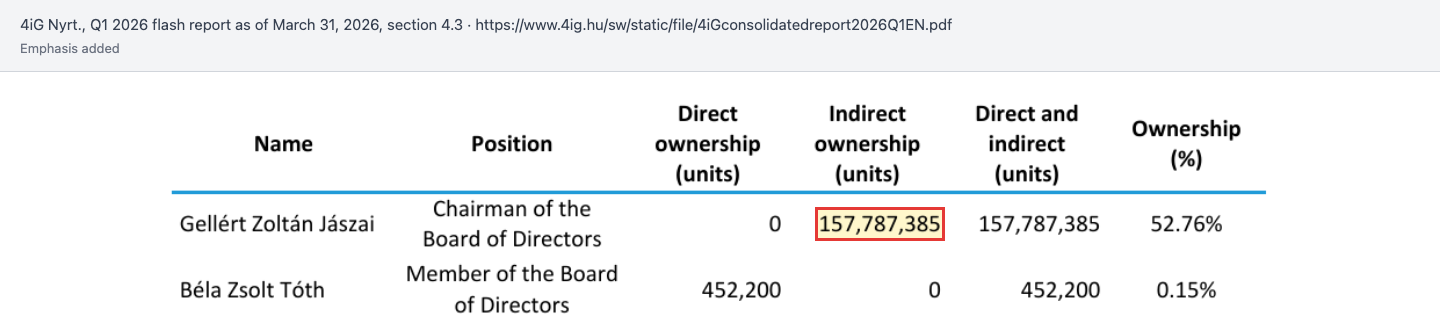
A narrow free float is not a quality defect. It does have two practical consequences everyone trading here should know: price swings are larger, because few shares set the price — and the direction of the company is set by others.
Opportunities and risks at a glance
What speaks for 4iG:
- The operating business is growing and earning: 2025 revenue up 8.46 percent to HUF 745.3 billion, EBITDA up 27.13 percent to HUF 293.7 billion, EBITDA margin 39.4 percent. First-quarter 2026 revenue added another 18.4 percent to HUF 203.0 billion.
- Operating cash flow was HUF 246.0 billion in 2025 — more than three quarters of EBITDA arrives as cash, not merely as book profit.
- Leverage improved: net debt to EBITDA fell from 3.88x (December 31, 2024) to 3.12x (December 31, 2025). Scope confirmed a BB− rating with a stable outlook in January 2026.
- The space and defence order book exceeded a net 3.5 billion euros per the announcement of March 27, 2026, plus framework agreements without purchase obligation of 4.5 billion euros — against group revenue of roughly 2.06 billion euros in 2025.
- The large bond repayments are not due before 2031 per the annual report; the NKP 2031/II bond was switched to a bullet repayment.
- The planned network partnership with e& PPF Telecom Group — up to 49 percent of CETIN Hungary in exchange for up to 38 percent of 2Connect — could, according to the company, unlock up to 1 billion euros in cost savings and additional revenues in the years after closing.
What speaks against it:
- The earnings share of its own shareholders has been negative three periods running: minus HUF 45.8 billion (2024), minus HUF 5.3 billion (2025) and minus HUF 3.4 billion (first quarter of 2026) — including the year in which the group as a whole earned HUF 28.2 billion.
- Net debt of HUF 1,068.0 billion as of March 31, 2026, roughly 37 percent more than the market capitalisation on the same day. The ratio to EBITDA rose from 3.12x to 3.6x, against a telecom holding covenant of 4.0x.
- Goodwill and intangible assets of HUF 710.9 billion face HUF 124.7 billion of equity attributable to 4iG shareholders — 5.7 times. Retained earnings are negative at minus HUF 19.9 billion.
- Concentration on Hungary and the state: 87.9 percent of 2025 revenue came from Hungary, the state holds 37.9 percent of the telecom holding through Corvinus Nemzetközi Befektetési Zrt. and is also the customer of the defence business.
- Since August 15, 2026 a government-ordered comprehensive review of all relationships between the state and the 4iG Group has been under way. Outcome and timetable are open.
- No dividend: in 2024 and 2025 distributions went exclusively to minority holders in the subsidiaries (HUF 1,081 million and HUF 545 million respectively).
- Free float of 10.11 percent (March 31, 2026) against 52.76 percent indirectly controlled by the chief executive — a thin market, large price swings, and no controlling stake in public hands.
A human conclusion
Back to anchoring. In this case it did not lie: the stock really did trade as high as 4,965 forint on November 12, 2025, and it really is about 69 percent lower now. It simply answers the wrong question. It asks “how big is my discount?” — and overlooks that a discount is always granted on something. On what value, exactly?
The balance sheet gives an uncomfortably clear answer. The quarterly report puts equity attributable to 4iG shareholders at 430.0 forint per share as of March 31, 2026. Even after the crash, at the anchor price of 1,515 forint the market pays three and a half times that. That may well be justified — a growing telecom and defence group with an order book above 3.5 billion euros is worth more than its book value. But it is the precise opposite of a bargain.
On the other side sits a business that genuinely works: HUF 293.7 billion of EBITDA, HUF 246.0 billion of operating cash flow, a rating with a stable outlook and repayments that only start in 2031. Anyone calling 4iG a house of cards has not read the annual report.
Both are true, and both belong in the same analysis. So the honest question to you is not “is the stock cheap after minus 69 percent?” but rather: do you want a share in growth whose returns have most recently landed with the co-owners of the subsidiaries rather than with the parent's shareholders — while the most important partner in that business is reviewing every contract? What you make of that is your decision. And that is exactly as it should be.
Sources
Every original document used in this analysis, for you to read yourself:
- 4iG Plc — 2025 Annual Report (English edition, approved by the Board of Directors on April 24, 2026) — source of the 2024 and 2025 figures, the statement of comprehensive income, the statement of changes in equity, Note 39 (bonds, loans, covenants), Note 54 (going concern) and the business description
- 4iG Plc — Flash report as of March 31, 2026 (English edition, approved May 28, 2026) — most recent periodic report, source of the March 31, 2026 balance sheet, segment and regional splits, ownership structure and officers' holdings
- 4iG Plc — Q1 2026 investor presentation (May 29, 2026) — source of the financial debt and capitalisation table, the order book, the rating and the events overview
- 4iG Plc — Q4 2025 investor presentation (February 27, 2026) — source of management's full-year statements and the 2025 price performance
- 4iG Plc — Press release “The 4iG Group's position on the government review” (August 18, 2026) — the company's own statement, source of the headcount above 11,000
- 4iG Plc — Financial calendar 2026 (published December 19, 2025) — H1 2026 report due August 31, 2026
- Magyar Közlöny — Government resolution on the comprehensive review of the relationship between the Hungarian State and the 4iG Group, published August 15, 2026 — wording and responsible ministries
- Scope Ratings — Rating announcement on 4iG (BB−, stable outlook), most recently confirmed in January 2026
- Fundamental data (prices and trading volumes 2021 to 2026, valuation metrics, exchange rates; as of August 24, 2026), reconciled with the company filings.
Transparency & disclaimer: This analysis is a journalistic assessment of publicly available information. It is not investment advice, not a regulated investment recommendation and not a solicitation to buy or sell securities. Equity investments carry substantial risk up to total loss; foreign shares add currency risk. The government review mentioned in the text is an ongoing process; nothing has been decided about its outcome, and the resolution itself prohibits drawing conclusions before the reviews are complete. All information without warranty; the as-of date of each figure is noted in the text. Positions held by the operator are disclosed daily; where one exists, it appears as a notice at the top of this deep dive.
Our Bottom Line at a Glance
- Growth and operating strength positive
- Revenue rose from HUF 41.1 billion (2019) to HUF 745.3 billion (2025) and by another 18.4 percent to HUF 203.0 billion in the first quarter of 2026. EBITDA grew 27.1 percent to HUF 293.7 billion in 2025 and the margin reached 39.4 percent. Operating cash flow was HUF 246.0 billion.
- Who owns the earnings negative
- Of the HUF 28,154 million group profit in 2025, HUF 33,498 million was allocated to non-controlling interests and minus HUF 5,344 million to owners of 4iG Plc. The earnings share of its own shareholders has been negative three periods running (2024, 2025 and the first quarter of 2026); retained earnings stood at minus HUF 19,947 million as of March 31, 2026.
- Leverage negative
- As of March 31, 2026, HUF 1,186,386 million of financial debt faced HUF 118,370 million of cash — HUF 1,068,016 million net, roughly 37 percent more than the market capitalisation of HUF 777,595 million on the same day. The ratio to EBITDA rose from 3.12x (December 31, 2025) to 3.6x, against a telecom holding covenant of 4.0x.
- Balance sheet quality negative
- Goodwill (HUF 309,375 million), customer relationships (155,401) and other intangible assets (246,132) summed to HUF 710,908 million as of March 31, 2026 — 5.7 times the HUF 124,712 million of equity attributable to 4iG shareholders. Of HUF 449,702 million in total equity, HUF 324,990 million belonged to non-controlling interests.
- Dependence on the Hungarian state negative
- 87.9 percent of 2025 revenue came from Hungary. The state holds 37.9 percent of the telecom holding through Corvinus Nemzetközi Befektetési Zrt., is the customer behind the defence framework agreements of the first quarter of 2026 worth 1.5 and 2.5 billion euros and was, through N7 Holding Zrt., the former owner of the contributed stakes. On August 15, 2026 the government ordered a comprehensive review of all of these relationships; outcome and timetable are open.
- Funding and rating neutral
- Scope Ratings confirmed a BB− rating with a stable outlook in January 2026. Per Note 54 of the annual report the large bond repayments are not due before 2031; in exchange the coupon on the NKP 2031/II bond rose from 6.00 to 6.75 percent. New funding came from a 176.6 million euro bond at 5.10 percent and a 50 million dollar loan with mandatory conversion into shares in 2029.
4iG Plc is a fast-growing Hungarian telecommunications, IT and defence group with rapidly rising revenue and strong operating cash flow. The growth was paid for with debt and minority stakes: of the HUF 28.2 billion group profit in 2025, its own shareholders were allocated a loss of HUF 5.3 billion, net debt exceeds the market capitalisation, and goodwill plus intangibles are 5.7 times shareholders' equity. On top of that sits a heavy dependence on the Hungarian state, which has been reviewing every relationship with the group since August 15, 2026. Not investment advice.
What Our Rating Means
Substance risk
We found at least one documented issue that threatens the company itself — regardless of how the stock is currently valued.
The traffic light is red because two findings concern substance rather than price. First, dependence on a single counterparty: 87.9 percent of 2025 revenue came from Hungary, the state holds 37.9 percent of the telecom holding, is the customer behind a defence order book of more than 3.5 billion euros and was the former owner of the contributed stakes — and it has been reviewing all of those relationships since August 15, 2026. Second, the balance sheet structure: HUF 710.9 billion of goodwill and intangible assets face HUF 124.7 billion of shareholders' equity, retained earnings are negative at minus HUF 19.9 billion, and the earnings share of its own shareholders was negative in each of the three most recently reported periods. This is expressly not a price judgment: the roughly 69 percent decline since November 2025 changes none of that arithmetic, and the operating business is undeniably strong with HUF 293.7 billion of EBITDA and HUF 246.0 billion of operating cash flow. Where the evidence sits between two levels, the more cautious one applies. The decision is yours.
A journalistic assessment by our editorial team at the time of the deep dive, based on public sources — not investment advice and not a solicitation to buy or sell. Your personal circumstances (investment goals, risk capacity, taxes) cannot be taken into account. What our levels mean, how verdicts are formed, and what conflicts of interest exist →
Worth Noting
- Data basis: 2025 annual report (approved April 24, 2026), flash report as of March 31, 2026 (approved May 28, 2026, most recent periodic report), investor presentations for the fourth quarter of 2025 (February 27, 2026) and the first quarter of 2026 (May 29, 2026), and the company statement of August 18, 2026. Price and valuation data as of August 24, 2026.
- The H1 2026 report is only due on August 31, 2026 per the financial calendar and was not available at the time of writing. All balance sheet figures are therefore as of March 31, 2026.
- Not an SEC filer: there is no 10-K, no 10-Q and no 20-F. Mandatory reports appear at the Budapest Stock Exchange, prepared under IFRS.
- No publicly available analyst call transcripts exist for 4IG.BUD; the company records its own investor events for internal use only per its presentation privacy notice. The chapter on management promises therefore relies on written materials.
- Two earnings figures to keep apart: the 2025 accounts show HUF 28,154 million of profit for the whole group and minus HUF 5,344 million attributable to owners of 4iG Plc. For shareholders of 4iG Plc the second figure is the relevant one.
- Two conventions for market capitalisation: HUF 453.1 billion from all 299,074,974 issued shares (the company's convention, used here) and HUF 438.9 billion excluding the 3.13 percent of treasury shares (fundamental data). Anyone comparing ratios must name the basis.
- The government review mentioned in the text is an ongoing process. The resolution of August 15, 2026 states explicitly that no conclusions may be drawn before the reviews are complete; the company said on August 18, 2026 that it had always acted lawfully.
The full analysis as a PDF for later
We will send you this analysis as a PDF — to print, file away, and read at your own pace.
Frequently Asked Questions
4iG is a Hungarian group with three businesses: telecommunications (about 84.8 percent of 2025 revenue, mobile and fixed-line services in Hungary, Albania and Montenegro), information technology (14.3 percent, system integration for large corporate and government customers) and space and defence (0.9 percent in 2025, already 11 percent in the first quarter of 2026). Group revenue was HUF 745.3 billion in 2025, roughly 2.06 billion euros.
Because the most important subsidiaries are not wholly owned. Profit after tax was HUF 28,154 million in 2025; of that, HUF 33,498 million was allocated to non-controlling interests and minus HUF 5,344 million to owners of 4iG Plc. Earnings per share were therefore minus 18.4 forint. The telecom holding is 62.1 percent owned by 4iG; the remaining 37.9 percent is held by a Hungarian state entity.
As of March 31, 2026 total financial debt was HUF 1,186,386 million; less HUF 118,370 million of cash, that leaves HUF 1,068,016 million net — roughly 2.95 billion euros. Net debt to EBITDA stood at 3.6x, up from 3.12x on December 31, 2025. The telecom holding's loan agreements cap the ratio at 4.0x. The large bond repayments are not due before 2031 per the annual report.
No. In the cash flow statement of the 2025 annual report, distributions appear solely as dividends to non-controlling interests in the subsidiaries: HUF 545 million in 2025 and HUF 1,081 million in 2024. Shareholders of 4iG Plc itself received nothing in either year. No dividend yield can therefore be calculated for the stock.
As of March 31, 2026 iG COM Magántőkealap held 38.93 percent, Rheinmetall AG 25.12 percent, KZF Vagyonkezelő Zrt. 12.12 percent, Bartolomeu ICT Kft. 5.72 percent, ÇALIK HOLDING 3.16 percent, the company itself 3.13 percent in treasury shares and iG TECH Invest Kft. 1.71 percent. Free float was 10.11 percent. Chairman and chief executive Gellért Zoltán Jászai indirectly controls 157,787,385 shares, or 52.76 percent.
On August 15, 2026 the official gazette Magyar Közlöny published a government resolution ordering a comprehensive review of the ownership, financial, economic and contractual relationships between the Hungarian State and 4iG Plc together with its subsidiaries. Four ministries are responsible. The resolution states explicitly that no conclusions may be drawn before the reviews are complete. On August 18, 2026 4iG said it had always acted lawfully and would provide all documents.
Because 4iG Plc is listed only on the Budapest Stock Exchange and is not a U.S. reporting company. Its mandatory filings appear at the Budapest Stock Exchange: one annual report, one half-year report and two quarterly reports per year. It reports under IFRS and its fiscal year matches the calendar year. The H1 2026 report is scheduled for August 31, 2026 according to the financial calendar.
Not measured against book value. Equity per share attributable to 4iG shareholders was 430.0 forint as of March 31, 2026; at the closing price of 1,515 forint on August 19, 2026 that is a price-to-book ratio of roughly 3.5. Enterprise value equalled 5.2 times 2025 EBITDA. No price-to-earnings ratio can be formed, because earnings per share were negative in 2025.
Found an error?
Did you spot a factual error, an outdated number, or a typo in this deep dive? Let us know briefly — your report goes straight to the editorial team.