Visteon: $200 Million for Its Own Shares at $100 — Then Warranty Costs Ate the Profit
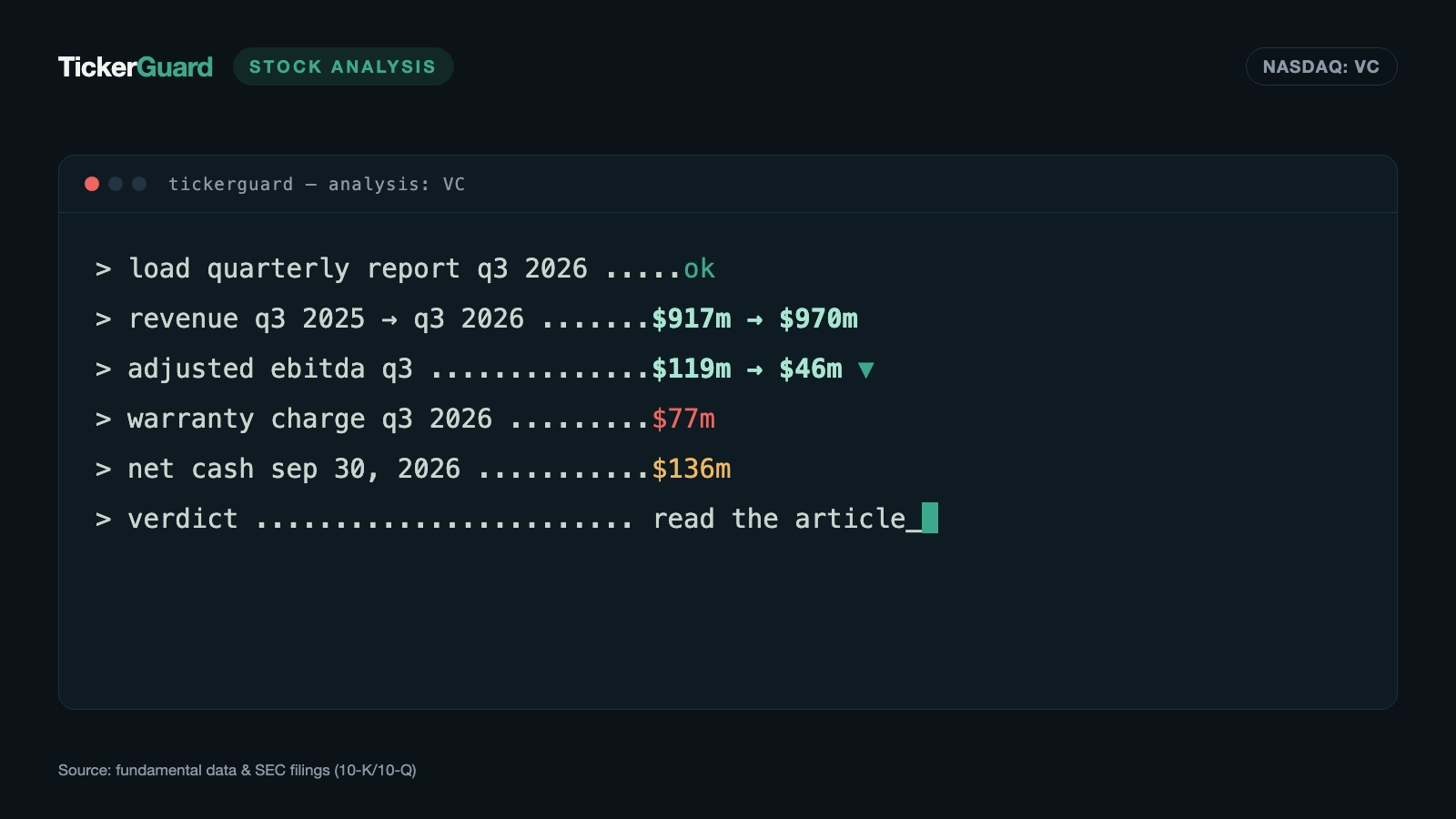
First Visteon spent $200 million on its own shares at an average of $100.17, then two warranty matters cost about $77 million and the midpoint of the adjusted EBITDA guidance fell by about 18 percent — on October 23, 2026 the stock closed at $76.37. Revenue still rose 6 percent to $970 million in the third quarter of 2026; only $5 million of profit was left. Visteon builds the screens and computers that light up the dashboard between the steering wheel and the passenger seat. We read the annual and quarterly reports and the earnings releases through October 22, 2026. What we found is a supplier with a full order book and net cash whose own warning light just started flashing red.
 Thomas Mücke
Founder & Publisher
As of Today
As of: October 23, 2026
- Closing price
- 76.40 $ -6.50%
- Market Capitalisation
- 2.1 $B
- P/E
- 12.6
- Growth Score
- 3/10
- AAQS
- 5/10
This analysis has a cut-off date. The Stock Guard tells you when something material changes in the numbers. Reserve your free spot
Chart
Interactive price chart (TradingView).
52-week range: 76.40 $ to 123.90 $ · Last price: 76.40 $ (As of: October 23, 2026)
Note: pure fact-based analysis, not investment advice and not a solicitation to buy or sell. All figures without guarantee.
Picture a red warning light suddenly coming on in your dashboard. Some drivers pull over on the shoulder right away and call a tow truck. Others put a piece of tape over it and keep driving. Both are familiar mistakes in investing: psychologists call the first the horn effect — a single bad trait colors the whole picture — and the second the ostrich effect: we would rather look away from bad news.
The image fits Visteon especially well, because Visteon builds those dashboards. And on October 22, 2026, something lit up red at the company itself: about $77 million for two warranty matters, quarterly net income of $5 million, a guidance cut — just three months after Visteon spent $200 million on its own shares at about $100. So let’s make a deal: before you pull over or reach for the tape, let’s read out the fault memory together — the reports Visteon files with the U.S. securities regulator, the SEC.
The tension running through this analysis: Visteon is growing faster than its customers’ vehicle production, is winning billions of dollars in new business and has more cash than debt. At the same time, the third quarter of 2026 shows how thin a supplier’s margin can get when quality problems, expensive memory chips and one dominant customer come together — and the company had just spent $200 million on its own shares. In the end, the decision is yours.
What Visteon actually does
Visteon designs and builds cockpit electronics for cars, trucks and motorcycles: digital instrument clusters behind the steering wheel, large center and passenger displays, Android-based infotainment, head-up displays and battery management systems for electric vehicles. The heart of the new generation is called SmartCore: a central cockpit computer that runs several screens at once on a single chip — one brain for the whole dashboard instead of many small control units. According to the annual report, its most powerful variant (HPC, “high-performance compute”) is explicitly designed for artificial intelligence workloads in the cockpit; on top of that comes Visteon’s own AI software, CognitoAI, for on-board voice control.
Its biggest customer is Ford, followed by General Motors and Volkswagen. According to its 2025 annual report, Visteon employed about 10,500 people in about 17 countries, and it reports a single segment, “Electronics.” Here is how third-quarter 2026 revenue broke down:
- Instrument clusters: $445 million (prior-year quarter: $421 million) — almost half of revenue.
- Information displays: $167 million (prior year: $117 million), up 43 percent — the growth engine.
- Infotainment: $122 million (prior year: $131 million).
- Cockpit domain controllers: $104 million (prior year: $96 million).
- Body and electrification electronics (including battery management): $81 million (prior year: $111 million), down 27 percent.
- Other: $51 million (prior year: $41 million).
By region, Europe grew from $288 million to $343 million in the third quarter of 2026, while sales to Chinese domestic customers shrank from $82 million to $68 million. Visteon does not sell to you and me but to automakers: prices are negotiated over the life of a vehicle model, and according to the annual report, the automakers demand price cuts virtually every year. Rule of thumb: a supplier doesn’t make money with a good product, it makes money with a good product that gets cheaper every year.
Company history for investors
-
2023
Tax assets back on the balance sheet
Visteon releases a $395M valuation allowance on U.S. deferred tax assets. Net income jumps to $568M — an accounting gain, not extra cash.
-
2025
Fifth straight year of a rising margin, dividend returns
Adjusted EBITDA of $492M on $3.77B in revenue, $7.4B of new business. From September, Visteon pays a dividend again ($0.275 per quarter).
-
2026
Buyback program and ASR
Dividend raised to $0.375 in February. $800M buyback program in June; in July–September, 1.997M shares repurchased for $200M at $100.17.
-
2026
Warranty charge and guidance cut
On 10/22, Visteon reports about $77M for two warranty matters and cuts EBITDA guidance to $370–410M. Close on 10/23: $76.37.
How the stock landed on our desk
Visteon made our research list with its earnings release of October 22, 2026. The stock had closed at $84.83 on October 21 and at $76.37 on October 23 — down 10 percent in two trading days; the intraday low of $74.14 was also the lowest level of the past twelve months (source: fundamental data). A sell-off is an attention signal, not a quality verdict — it only tells you that many investors saw a warning light at the same time.
The ratios on the Visteon stock page paint a calmer picture than the share price. The Piotroski score, a health check made up of nine yes-or-no questions on profit, cash flow, leverage and efficiency, stands at 7 out of 9 according to fundamental data for the quarter ended September 30, 2026 — that is good; a rock-solid company scores 8 or 9. The Altman Z-score, an early-warning system for bankruptcy risk, is 3.54, clearly in the safe zone (above roughly 3). Remember this pattern: when the share price falls but the balance-sheet filters stay calm, the question isn’t “Will the company go bust?” but “How much will it earn going forward?”
Visteon is a Delaware corporation headquartered in Michigan, listed on Nasdaq, and reports to the SEC as a U.S. domestic filer; its fiscal year is the calendar year. We reviewed the annual report on Form 10-K for 2025 filed on February 19, 2026, the quarterly reports on Form 10-Q for the second quarter (July 23) and the third quarter (October 22, 2026) — the latest periodic report — and the earnings releases on Form 8-K filed the same days. No further filing had come in as of October 25, 2026.
The numbers over the years — given their due
First, what genuinely impresses. According to fundamental data, revenue rose from $2.77 billion (2021) to $3.76 billion (2022); according to the annual report, it then came in at $3.95 billion (2023), $3.87 billion (2024) and $3.77 billion (2025). The slight decline since 2023 has understandable causes: the annual report cites lower pass-through of higher chip costs to customers, weakness in China and lower demand for battery management systems. At the same time, adjusted EBITDA — operating profit before interest, taxes, depreciation and amortization, excluding one-off items — rose from $434 million (2023) to $474 million and then $492 million (2025). According to Visteon, that was the fifth consecutive year of margin expansion, most recently 13.1 percent of revenue.
The cash showed up, too. Operating cash flow — the money that actually comes in from the business — was $267 million (2023), $427 million (2024) and $410 million (2025). After capital spending, free cash flow came to about $142 million, $290 million and $277 million. That allowed Visteon to reinstate a dividend in 2025 and buy back stock in 2026. And the order book keeps growing: in 2025, Visteon booked $7.4 billion in new business, $3.6 billion of it for displays across 17 automakers; in 2026 it added about $2.0 billion in the second quarter and $0.9 billion in the third. In the third quarter, Visteon by its own count grew 10 percentage points faster than its customers’ production, which fell 5 percent.
A word on net income, because it can confuse: $568 million (2023), $296 million (2024) and $201 million (2025) look like a collapse but are mainly tax effects. In 2023, Visteon released a $395 million valuation allowance on U.S. deferred tax assets — an accounting gain, not cash. At the end of 2025, Visteon also changed the method it uses to assess the value of those tax assets and restated all prior years. The figures above are the restated ones. Rule of thumb: at Visteon, cash flow tells you more about the business than net income.
So much for the good news. Now let’s read out the fault memory.
What the reports say — the uncomfortable truths
A report to the SEC is filed under penalty of law. What follows is in there — you just have to read all the way into the notes.
Uncomfortable truth No. 1: Two warranty matters eat an entire quarter
In the third quarter of 2026, only $47 million of gross profit was left from $970 million of revenue, compared with $131 million a year earlier. The reason is in Note 15 of the quarterly report:
“During the nine months ended September 30, 2026 the Company recorded $117 million of warranty expense, including approximately $77 million related to two distinct warranty matters, which were recorded during the three months ended September 30, 2026. Based on information currently available, it is reasonably possible the Company could incur additional warranty charges of up to $20 million in excess of the amount accrued for one of the matters.”
— Visteon, quarterly report on Form 10-Q for Q3 2026, Note 15 (10-Q 2026)
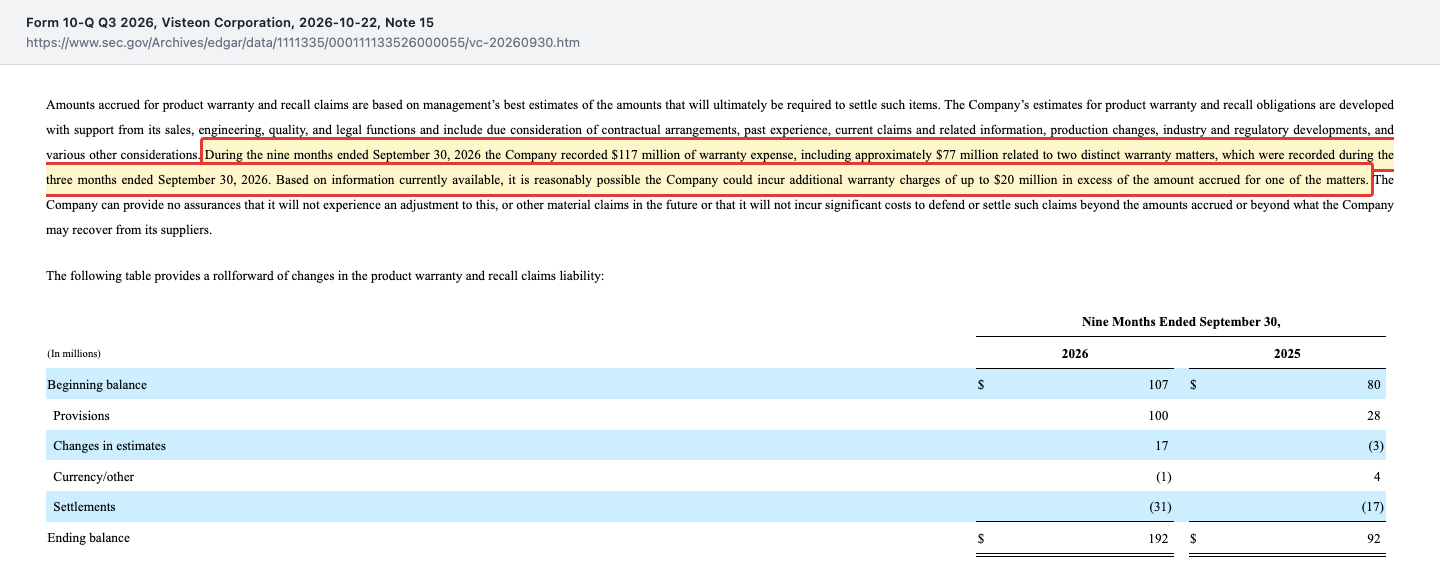
Warranty means: if a Visteon component fails in a car, Visteon pays for the repair — often for as long as the automaker’s own warranty to its customers runs, and in a recall it can share the cost of the campaign. The report does not say which products or customers are affected. How much the pot has grown is visible in the reserve:
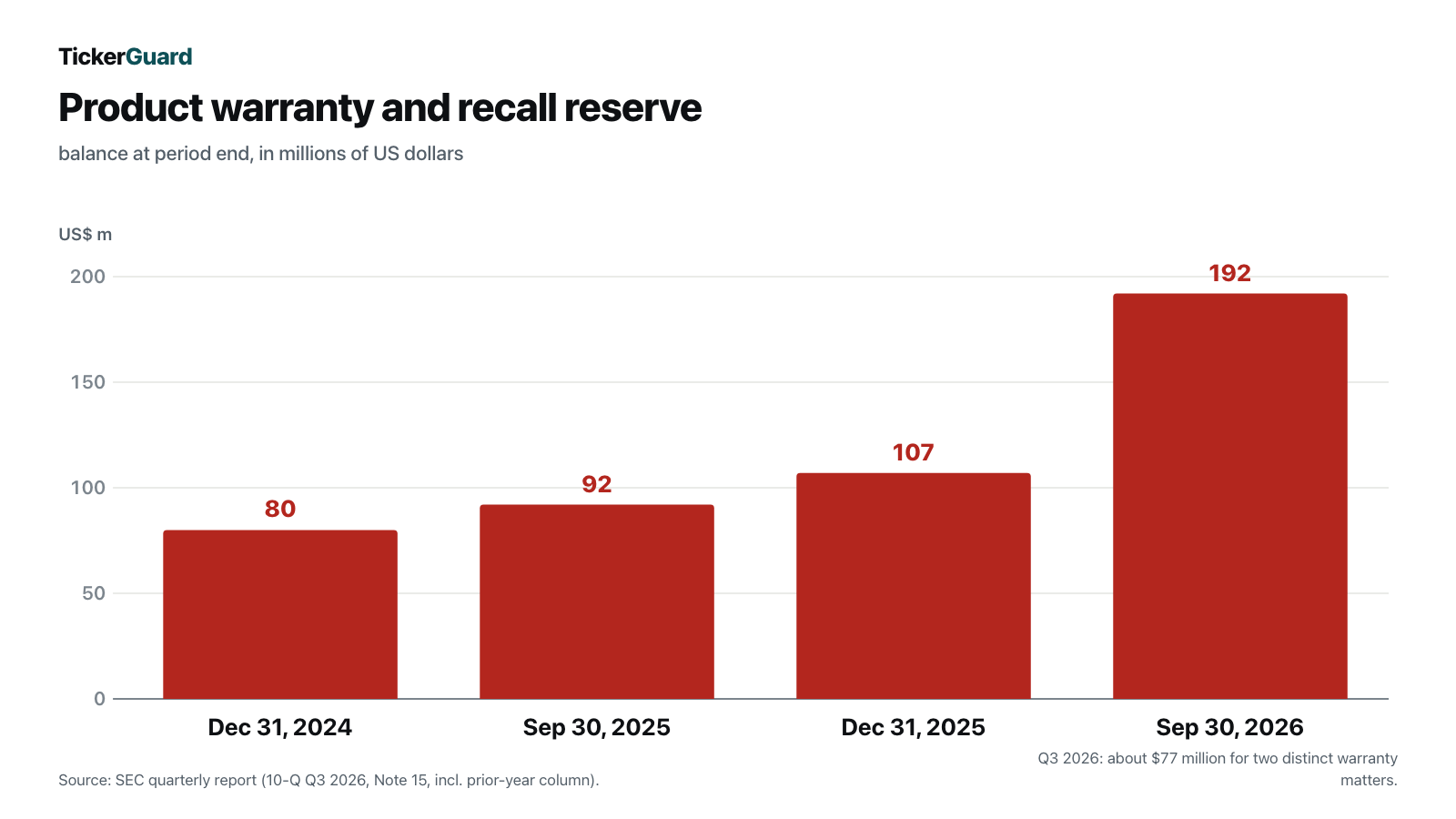
Two things deserve credit: Visteon states the amount clearly, and it does not strip it out of “adjusted” EBITDA — the $46 million in the third quarter includes the charge. Two things call for caution: the reserve grew by about 80 percent in nine months, and according to Note 15 the final word has not been spoken. The 2025 annual report had already named “higher warranty expense” as a drag. A one-off is only a one-off once it doesn’t happen again.
Uncomfortable truth No. 2: Revenue up, profit down — and AI is eating the memory chips
Alongside its third-quarter results, Visteon reset its expectations for 2026:
“Based on year-to-date performance and our outlook for the fourth quarter, Visteon is raising its full-year 2026 sales guidance range to $3.80 – $3.85 billion, while lowering its full-year adjusted EBITDA range to $370 – $410 million, and its adjusted free cash flow range to $90 – $130 million.”
— Visteon, third-quarter 2026 earnings release (Form 8-K, Exhibit 99.1) (8-K 2026)

The size of the cut becomes clear against July. Back then the EBITDA range had a midpoint of $475 million; now it is $390 million — down about 18 percent in three months. The midpoint for adjusted free cash flow fell from $170 million to $110 million.
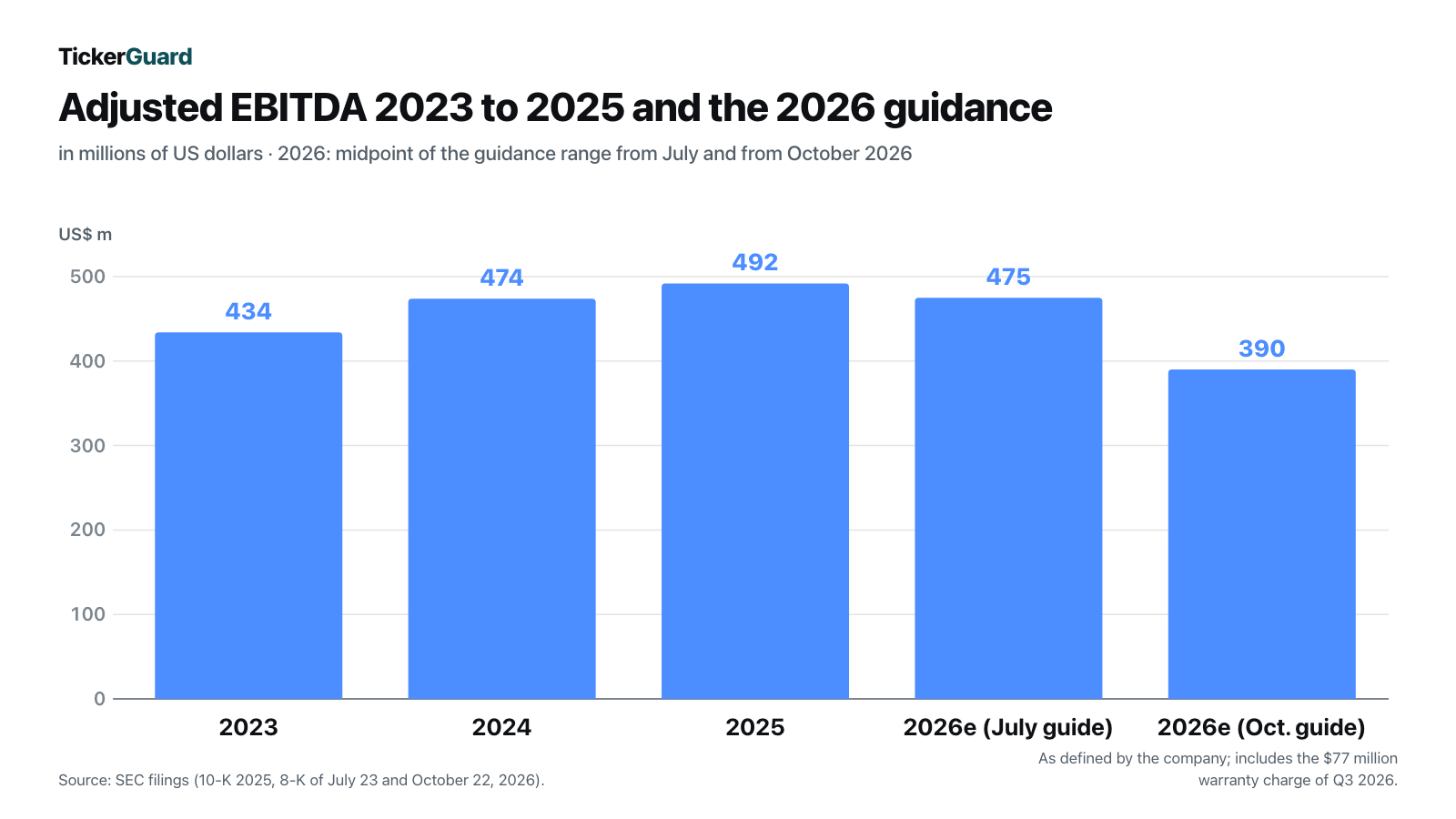
The warranty charge explains most of it, but not all. In its quarterly report, Visteon describes a headwind that comes with a certain irony:
“Memory chip market conditions are creating cost pressures and have the potential to affect industry production volumes, as memory supplier capacity is increasingly allocated to support growth in data center infrastructure.”
— Visteon, quarterly report on Form 10-Q for Q3 2026, MD&A (Item 2) (10-Q 2026)
In plain English: the data centers built for artificial intelligence are buying up memory makers’ output, and Visteon has to pay more for the chips in its screens and computers. The same AI Visteon markets in the cockpit is making its components more expensive. Visteon passes part of that on to customers — in the third quarter, such pricing actions added a net $5 million in revenue — and the margin absorbs the rest. Then there is inventory: it rose from $269 million to $359 million in nine months, and operating cash flow for the first nine months of 2026 was only $81 million, versus $292 million a year earlier. After $103 million of capital spending, free cash flow was an outflow of $22 million.
Uncomfortable truth No. 3: The buyback ran at $100
In June 2026, the board authorized a new $800 million share repurchase program running through 2029. On July 23 — the day of its second-quarter results — Visteon signed a $200 million accelerated share repurchase (ASR) with Bank of America. Under an ASR, the bank buys the shares in the market over several weeks, while the company pays up front and receives the shares. The outcome is in Note 12; according to the quarterly report, the ASR also used up the last $38 million of the older $300 million program from 2023, with the rest charged to the new program, which has $638 million left:
“The share repurchase agreement concluded during the nine months ended September 30, 2026, resulting in a total amount of 1,996,589 shares repurchased at an average cost of $100.17 per share, for a total of $200 million.”
— Visteon, quarterly report on Form 10-Q for Q3 2026, Note 12 (10-Q 2026)

To be fair: a buyback isn’t a mistake just because the stock falls afterward — nobody knows the future, and the remaining shareholders now own a bigger slice of the pie. The share count fell from 26.8 million at the end of 2025 to 24,707,936 on October 15, 2026, about 8 percent fewer. The uncomfortable part is the timing. Visteon bought while its own guidance still promised $475 million of EBITDA, and spent $200 million doing so — net cash fell from $351 million to $136 million during the quarter, and Visteon drew $179 million on its revolving credit facility along the way, $26 million of which was still outstanding at quarter-end. At the October 23, 2026 close, the repurchased shares are worth about $47.5 million less than they cost. $638 million remains available under the new program.
Uncomfortable truth No. 4: Three customers, almost half of revenue
Supplying automakers means depending on their production. At Visteon, a lot depends on one name in particular:
“Ford and General Motors are the Company’s largest customers as a percentage of sales. Accordingly, any change in Ford or General Motors' vehicle production volumes may have a significant impact on the Company’s sales volume and profitability.”
— Visteon, annual report on Form 10-K for 2025, Item 1A (Risk Factors) (10-K 2025)

Ford’s share of revenue rose from 22 percent (2023) to 23 percent and then 26 percent (2025); General Motors stood at 12, 15 and 12 percent, Volkswagen at 9, 9 and 10 percent. As of September 30, 2026, Ford accounted for 19 percent of receivables, up from 12 percent at year-end. On top of that, according to the annual report, customers don’t commit to fixed volumes, most of them can terminate contracts for convenience, and some intend to make components in-house. And in China, automakers such as BYD and Chery are growing — brands where Visteon, by its own account, has less content per vehicle than with traditional automakers. Fittingly, Visteon’s first HPC-generation cockpit computer went into production in the third quarter of 2026 at Chery — the first series start of this computer generation at a Chinese automaker. For how another supplier fares whose product is tied to the combustion engine, see our analysis of Garrett Motion.
Uncomfortable truth No. 5: A tax claim that only surfaces now
This sentence is brand new in the quarterly report of October 22, 2026:
“The Company is contesting an approximately $52 million assessment by the Brazilian tax authorities related to the application of reduced PIS/COFINS tax rates for certain operations in the Manaus Free Trade Zone.”
— Visteon, quarterly report on Form 10-Q for Q3 2026, Note 15 (10-Q 2026)
Visteon considers an unfavorable outcome reasonably possible but has not accrued anything, because it believes its tax treatment is correct. $52 million is more than a third of net cash on September 30, 2026 — not an existential issue, but an item worth keeping in mind.
Valuation: what the market pays for Visteon
At the $76.37 close on October 23, 2026 and 24,707,936 shares (as of October 15, 2026, cover page of the quarterly report), Visteon has a market value of about $1.89 billion. By our back-of-the-envelope math, that implies:
- Enterprise value of about $1.75 billion: market value minus net cash of $136 million (cash of $466 million including $2 million restricted, debt of $330 million, as of September 30, 2026). That is about 4.5 times the 2026 EBITDA guidance midpoint ($390 million) and 3.6 times 2025 EBITDA ($492 million).
- Price-to-earnings ratio of about 12: net income for the last four quarters (fourth quarter of 2025 through third quarter of 2026) was $159 million. The ratio tile on this page may show a different figure because it is calculated differently.
- Price-to-sales ratio of about 0.5 on $3.83 billion of revenue over the last four quarters.
- Price-to-book ratio of about 1.3 (Visteon shareholders’ equity of $1.41 billion, about $57 per share). More than a third of that, however, consists of deferred tax assets ($519 million) — claims to lower future taxes that are only worth something if there are future profits.
- Dividend: $0.375 per quarter since February 2026, $1.50 a year — a yield of about 2 percent at the October 23, 2026 price.
Measured against earnings, that is a low valuation — but not unusual for an auto supplier. The market rarely grants suppliers high valuations because of automaker pricing pressure and cyclical vehicle production. The question is whether $390 million of EBITDA for 2026 is a trough with a one-off charge or the new normal.
The view from the pros: according to fundamental data, 11 analysts cover the stock (4 “strong buy,” 3 “buy,” 4 “hold,” no sell), with an average price target of $111.70 (as of October 23, 2026). Average here means all price targets added up and divided by their number — a single very high or very low target shifts it noticeably. Whether those targets already reflect the cut guidance is an open question. And a note on psychology: if you have the $100 buyback price or the twelve-month high of about $127 (intraday high on June 22, 2026: $126.95) in your head as “fair value,” you are falling for the anchoring effect — a past price says nothing about what the company is worth today.
Opportunities and risks at a glance
What speaks for Visteon:
- Full order book. $7.4 billion of new business in 2025, another $2.9 billion in the second and third quarters of 2026; growth 10 percentage points above customer production in the third quarter.
- Displays as growth engine. Information display revenue up 43 percent to $167 million in the third quarter of 2026.
- Solid balance sheet. Net cash of $136 million, $374 million available on the revolving credit facility, credit ratings of BB+ (S&P) and Ba1 (Moody’s), one notch below investment grade.
- AI in the cockpit. Production start of the first SmartCore HPC computer with AI capabilities at Chery, in-house AI software CognitoAI.
- Capital returns. Dividend of $1.50 a year, share count down about 8 percent in nine months, $638 million of buyback authorization remaining.
What speaks against it:
- Quality problems. About $77 million for two warranty matters, up to $20 million more possible; reserve at $192 million.
- Cut guidance. 2026 EBITDA midpoint down from $475 million to $390 million, free cash flow from $170 million to $110 million.
- Expensive memory chips. Data centers are tying up memory makers’ capacity, which squeezes Visteon’s margin.
- Customer concentration. Ford, GM and VW together accounted for 48 percent of 2025 revenue.
- China. Sales to Chinese domestic customers down 17 percent in the third quarter of 2026; Chinese automakers and suppliers are pushing into global markets.
- Open tax question. About $52 million Brazilian tax assessment, not accrued.
A human conclusion
Remember the red warning light from the beginning? After reading out the fault memory, one thing is clear: the engine of the business keeps running, according to the filings. Visteon is growing faster than its customers, winning billions of dollars in new business, holds more cash than debt, and its balance-sheet ratios are calm. Anyone who looks only at this one quarter risks falling for the horn effect — one bad quarter doesn’t make a bad company.
But the light isn’t on for nothing. Two warranty matters wiped out an entire quarter, memory chips are getting more expensive, Ford remains the dominant customer, and management spent $200 million at a price the stock fell well below three months later. Putting tape over the light is the ostrich mistake. The next diagnostic checkpoints are clear: does the warranty reserve keep growing in the 2026 annual report, does Visteon hit its reduced guidance, and how does the margin develop once the one-off charge drops out?
What you make of it is your decision. And that’s how it should be.
Sources and data
- Quarterly report on Form 10-Q for Q3 2026 (October 22, 2026, latest periodic report) and 10-Q for Q2 2026 (July 23, 2026)
- Annual report on Form 10-K for 2025 (February 19, 2026) with restated prior-year figures
- Earnings releases on Form 8-K: third quarter 2026 and cut guidance (October 22, 2026) and second quarter 2026 and accelerated share repurchase (July 23, 2026)
- Price and ratio data: source fundamental data, as of October 23, 2026 (revenue for 2021 and 2022, prices, Piotroski score, Altman Z-score, analyst data)
Data as of: company figures as of December 31, 2025 and September 30, 2026 (latest periodic report of October 22, 2026); we reviewed the list of SEC filings through October 25, 2026, and nothing further was filed after the quarterly report. Prices: closing prices of October 21 and 23, 2026. Net income figures follow the method for deferred tax assets changed at the end of 2025. Computed values (market value, enterprise value, price-to-earnings, price-to-sales and price-to-book ratios, free cash flow 2023 to 2025, the paper loss on the repurchased shares, dividend yield) are our own back-of-the-envelope calculations and labeled as such. The ratio tiles on this page show the current database state and may differ from the values used here: the tile shows a P/E of about 22 because it uses the data feed’s earnings per share ($3.43), while we compute with the $159 million of net income over the last four quarters (Q4 2025 through Q3 2026), which gives about 12.
Disclaimer: This article is journalistic commentary and not investment advice. It is not a recommendation or a solicitation to buy or sell securities. Stocks can be highly volatile; you can lose some or all of the money you invest. We disclose the operator’s own positions daily; if one exists, it is noted at the top of this analysis.
Key figures at a glance
All monetary figures in millions of $; earnings per share as reported.
| Metric | 2021 | 2022 | 2023 | 2024 | 2025 |
|---|---|---|---|---|---|
| Revenue | 2,773.0 | 3,756.0 | 3,954.0 | 3,866.0 | 3,768.0 |
| Operating Income (EBIT) | 87.0 | 188.0 | 280.0 | 133.0 | 330.0 |
| Net Income | 41.0 | 124.0 | 486.0 | 274.0 | 201.0 |
| Net Margin | 1.5% | 3.3% | 12.3% | 7.1% | 5.3% |
| Earnings Per Share | 1.44 $ | 4.35 $ | 17.05 $ | 9.82 $ | 7.28 $ |
Source: fundamental data & SEC filings (annual and quarterly reports, 10-K/10-Q)
Our Bottom Line at a Glance
- Growth and order book positive
- Q3 2026 revenue up 6% to $970M while customer production fell 5%; new business of $7.4B in 2025 and another $2.9B in the second and third quarters of 2026.
- Profitability negative
- Q3 2026 adjusted EBITDA only $46M (prior year $119M) after about $77M of warranty charges; 2026 guidance midpoint cut from $475M to $390M on 10/22/2026.
- Balance sheet positive
- Net cash of $136M as of 09/30/2026, $374M available on the revolver, ratings BB+/Ba1; Piotroski 7 of 9, Altman Z 3.54.
- Customer concentration negative
- Ford 26%, GM 12%, VW 10% of 2025 revenue; Ford’s share of receivables at 19% as of 09/30/2026.
- Capital allocation neutral
- $200M buyback at an average of $100.17 (Jul–Sep 2026), close on 10/23/2026: $76.37; share count down about 8% in nine months, dividend of $1.50 a year.
Visteon is a growing cockpit supplier with a full order book and net cash whose third quarter of 2026 was spoiled by two warranty matters and expensive memory chips. Profit and cash flow guidance was cut sharply, a large buyback ran shortly before at about $100, and Ford remains the key customer. Not investment advice.
What Our Rating Means
Open questions
The business works in principle, but one material question is open. As long as it stays open, our findings do not carry a quality verdict.
Yellow, because a material operating question is open: whether the warranty matters of about $77 million stay a one-off and how much margin is left as memory chips get more expensive. 2026 guidance was cut by about 18 percent, and cash flowed out over the first nine months. It is not red: Visteon has more cash than debt, earned solid money every year from 2023 to 2025, and its dependence on Ford is high but not existential. It would be green if the next reports show the margin coming back without the one-off charge. The low market value relative to earnings is a question of price and does not change the color. The decision is yours.
A journalistic assessment by our editorial team at the time of the deep dive, based on public sources — not investment advice and not a solicitation to buy or sell. Your personal circumstances (investment goals, risk capacity, taxes) cannot be taken into account. What our levels mean, how verdicts are formed, and what conflicts of interest exist →
Worth Noting
- This analysis was triggered by the October 22, 2026 earnings release and the slide to a twelve-month low (intraday low of $74.14 on 10/23/2026), not by a single scanner hit.
- Net income for all years follows the method for U.S. deferred tax assets changed as of 12/31/2025 (restated retrospectively); 2023 includes the release of a $395M valuation allowance.
- Basis: annual report on Form 10-K for 2025 (02/19/2026), quarterly reports on Form 10-Q for Q2 2026 (07/23/2026) and Q3 2026 (10/22/2026, latest periodic report), 8-K earnings releases of 07/23 and 10/22/2026; SEC filing list reviewed through 10/25/2026, no Form 15, only Form 25 dated 12/26/2017.
- Computed values are our back-of-the-envelope math: market value from 24,707,936 shares (10/15/2026) times $76.37 (10/23/2026); enterprise value net of $136M net cash; P/E on $159M net income from Q4 2025 through Q3 2026; buyback paper loss 1,996,589 × ($100.17 − $76.37).
Stock Watch
This analysis is as of October 25, 2026. Stock Watch will tell you what's changed at VC since then.
Later $1 a month per stock — signing up is free, and you'll be the first to know when it launches.
The full analysis as a PDF for later
We will send you this analysis as a PDF — to print, file away, and read at your own pace. And we will add you to the free Stock Watch list for Visteon Corp (VC), so you hear about it when something material in this analysis changes.
Frequently Asked Questions
Visteon designs and builds cockpit electronics for automakers: digital instrument clusters, displays, infotainment systems, central cockpit computers (SmartCore) and battery management systems. The Michigan-based company employed about 10,500 people in about 17 countries according to its 2025 annual report and generated $3.77 billion in revenue in 2025. Its largest customers are Ford, General Motors and Volkswagen.
Visteon booked about $77 million for two distinct warranty matters in the third quarter of 2026. As a result, gross profit fell from $131 million to $47 million and adjusted EBITDA from $119 million to $46 million, even though revenue rose 6 percent to $970 million. Higher material costs, especially for memory chips, added to the pressure. Net income came to $5 million.
On October 22, 2026, Visteon raised its revenue guidance to $3.80 to $3.85 billion. Adjusted EBITDA, however, is now expected at only $370 to $410 million (July midpoint: $475 million), and adjusted free cash flow at $90 to $130 million (July midpoint: $170 million). Visteon cites the warranty charge, cost pressures and the inventory build.
Ford was the largest customer in 2025 with 26 percent of revenue, up from 22 percent in 2023. General Motors accounted for 12 percent and Volkswagen for 10 percent — 48 percent combined. As of September 30, 2026, Ford made up 19 percent of receivables. In its annual report, Visteon describes itself as “highly dependent” on Ford and General Motors.
As of September 30, 2026, Visteon had $466 million in cash (including $2 million restricted) and $330 million of debt, or net cash of $136 million. Three months earlier, net cash was $351 million; the decline is mainly due to the $200 million share buyback. Of its $400 million revolving credit facility, $374 million was available.
Yes. After paying no dividend in 2024, Visteon paid $0.275 per share in both September and December 2025. Since February 2026, it has paid $0.375 per quarter, or $1.50 a year. At the $76.37 close on October 23, 2026, that is a dividend yield of about 2 percent. Visteon also buys back its own shares.
Visteon sells AI-capable cockpit technology: according to its 2025 annual report, the HPC variant of its SmartCore cockpit computer is designed for AI workloads, and its own CognitoAI software enables on-board voice control. In the third quarter of 2026, the first HPC computer with AI capabilities went into production at Chery. At the same time, the AI data center boom is driving up the cost of the memory chips Visteon buys.
Found an error?
Did you spot a factual error, an outdated number, or a typo in this deep dive? Let us know briefly — your report goes straight to the editorial team.