Lake Victoria Gold: The Excavators Are Rolling in Tanzania — the Money for the Mine Isn’t There Yet
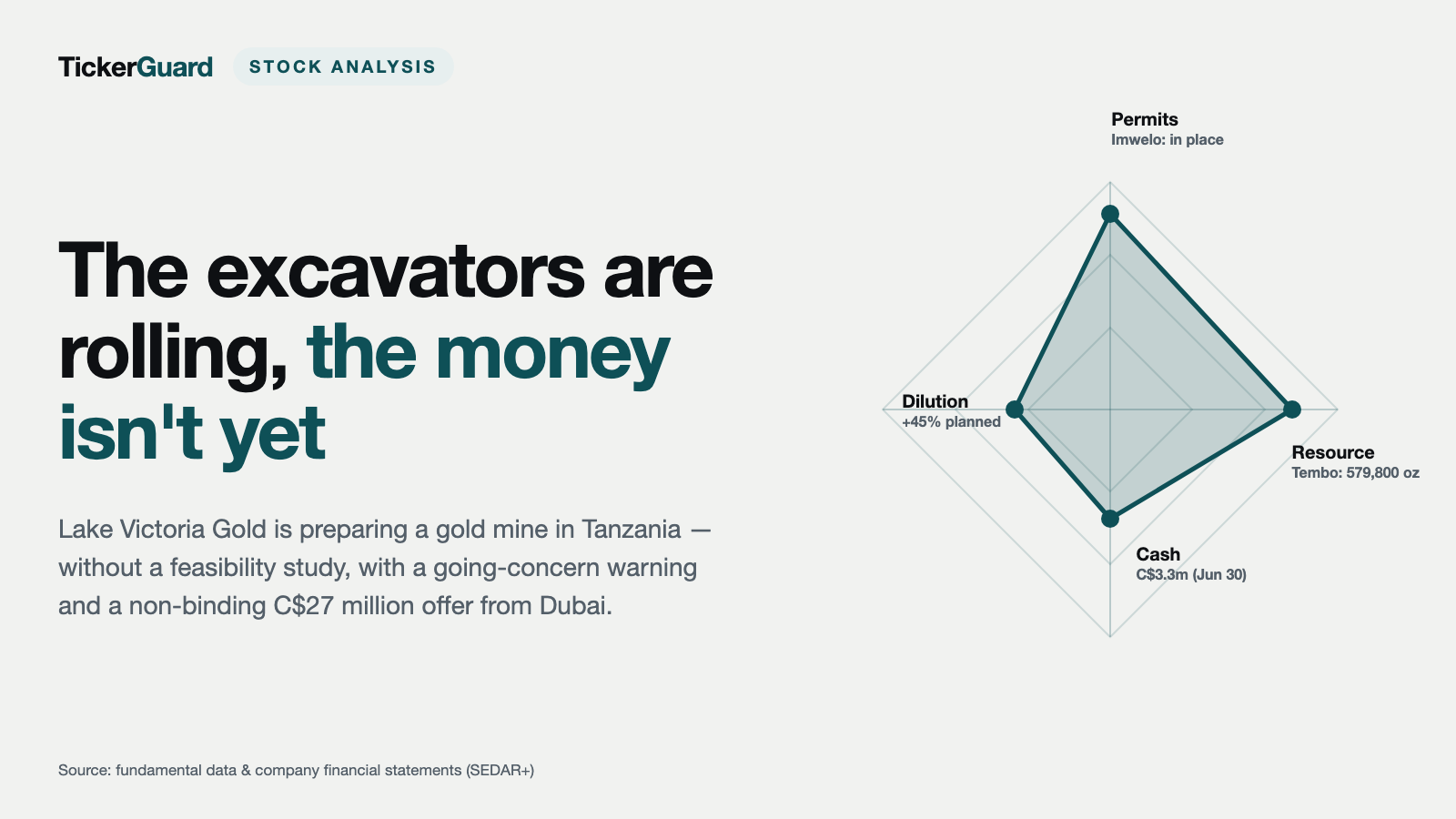
Since July 2026, Lake Victoria Gold (TSXV: LVG, OTCQB: LVGLF) has been preparing a gold mine at its Imwelo project in Tanzania: access road repaired, camp nearly finished, a used mill bought. As of June 30, 2026, it had C$3.3 million in cash to pay for it, its auditor flags doubt about its ability to continue as a going concern, and there is no feasibility study. A gold loan of about US$25 million has been announced since April but not closed, and an investor from Dubai is offering C$27.2 million — so far only in a non-binding term sheet. We separate what is being built from what has actually been paid for.
 Thomas Mücke
Founder & Publisher
As of Today
As of: October 25, 2026
- Closing price
- 0.34 C$ +3.03%
- Market Capitalisation
- 68.9 C$M
This analysis has a cut-off date. The Stock Guard tells you when something material changes in the numbers. Reserve your free spot
Chart
Interactive price chart (TradingView).
Last price: 0.34 C$ (As of: October 25, 2026)
Note: pure fact-based analysis, not investment advice and not a solicitation to buy or sell. All figures without guarantee.
You know the feeling when an excavator suddenly shows up on an empty lot? Your brain does something remarkable in that moment: it finishes the house. We see piles of dirt and think move-in day; we see a construction sign and think housewarming. Call it the construction-site illusion — the visible start feels like halfway there.
With small mining stocks, that illusion is especially strong. A photo of a grader on a gravel road in Tanzania hits harder than any table — Lake Victoria Gold included, which has been reporting construction progress regularly since the summer of 2026: earthworks started, access road repaired, camp nearly finished, project manager on site. All of it is real. The only question is whether the money a gold mine costs is standing behind those excavators.
That is the tension running through this analysis: visible construction progress versus invisible financing. The deal is the same as always: we set the photos aside and read the financial statements, the MD&A and the fine print of the news releases together. Then you decide what you are looking at.
What Lake Victoria Gold Actually Owns
Lake Victoria Gold Ltd. is an old company with a new name. It was incorporated on March 3, 1937, in the Canadian province of Ontario, has been governed by British Columbia law since October 2020 and is headquartered in Vancouver. Until December 2023 it was called Tembo Gold Corp. — after the project with which it has been searching for gold in Tanzania for years. Over the decades it has built up an accumulated deficit of C$71,554,269 (as of June 30, 2026); by its own account, it has not yet earned any production revenue.
Today it owns 100 percent of two projects in the Lake Victoria Goldfield, a major African gold region that is also home to the Geita and Bulyanhulu mines, in northwestern Tanzania:
- Imwelo in Chato District (Geita Region), west of AngloGold Ashanti’s Geita mine. The project holds a mining licence (ML 538/2015) and, according to the company, is fully permitted for construction and operation. It was acquired on February 28, 2025, for C$5.5 million, paid almost entirely with 24,064,723 of the company’s own shares at a deemed C$0.22 each. This is where the excavators have been rolling since July 2026.
- Tembo, with four mining licences covering about 34 square kilometers, immediately next to Barrick’s Bulyanhulu mine. Since August 11, 2026, Tembo has a first mineral resource under the Canadian standard NI 43-101: 99,700 ounces in the “indicated” category and 480,100 ounces “inferred,” at grades of around 1.1 grams of gold per tonne.
These categories are worth translating once, because everything else rests on them. “Inferred” means there is drilling, but too little to know the quantity reliably — an educated estimate. “Indicated” is one step more certain. Only a reserve is the part a feasibility study has shown can be mined profitably. Lake Victoria Gold has no reserves on either project.
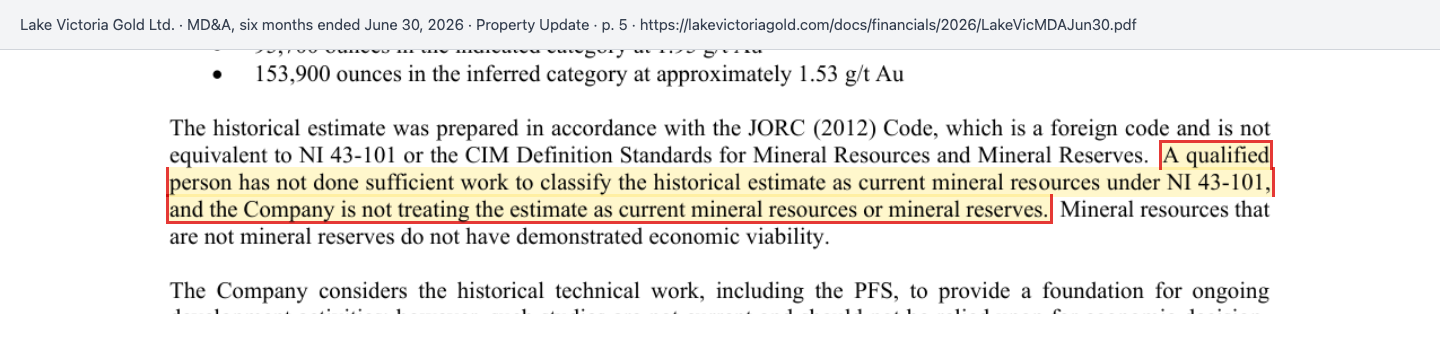
At Imwelo the footing is thinner still. There is an older estimate of 291,600 ounces under Australia’s JORC code, plus a pre-feasibility study from 2021. Under Canadian rules, that estimate does not count as a current resource, and the company says so itself:
“A qualified person has not done sufficient work to classify the historical estimate as current mineral resources under NI 43-101, and the Company is not treating the estimate as current mineral resources or mineral reserves.”
— Lake Victoria Gold Ltd., MD&A as of June 30, 2026, Property Update, p. 5
Two more parties belong on the map. Under Tanzania’s mining law, the state receives a free, non-dilutable carried interest of at least 16 percent in every project; for Imwelo there has been an agreement in principle since September 2025, and for Tembo the Mining Commission opened the process in March 2026. And the Tanzanian mining contractor Taifa is a shareholder and, according to the company, is to carry out all contract mining and civil works at Imwelo. If Tanzania makes you think of another gold stock: we described what it looks like when a mine near Lake Victoria actually produces and still has to share with the state in our analysis of TRX Gold.
Company history for investors
-
2022
Six Tembo licences sold to Barrick
For US$6 million plus up to US$45 million in contingent payments; US$1.79 million went to Tanzania in tax. The money brought the drill rigs back.
-
2023
Tembo Gold becomes Lake Victoria Gold
In August 2023 the company agreed to buy Imwelo and to bring in mining contractor Taifa; the new name followed in December — the pivot from explorer to mine developer.
-
2025
Imwelo acquired, share count nearly doubled
Bought for 24.1 million shares, placements of C$11.5 million — shares rose from 107.1 to 195.2 million. The auditor’s report on 2025 includes a going-concern paragraph.
-
2026
Gold loan announced, earthworks started
On April 1 the roughly US$25 million gold loan, on July 28 the start of earthworks — without the loan being committed by the end of August.
-
2026
First resource for Tembo
On August 11 the company reported 579,800 ounces under NI 43-101, 99,700 of them indicated. For shareholders, the first reliable ounce count in years.
-
2026
Non-binding offer from Dubai
HOB Energy wants about 29 percent for C$27.2 million, with approval rights over reserved matters. Closing planned by November 30, 2026 — until then it remains a promise.
Why There Is No Annual Report With the U.S. SEC
First, because it shapes the entire evidence base: there is no annual report (10-K) and no quarterly report (10-Q) from Lake Victoria Gold with the U.S. securities regulator, the SEC. The company is not even on the SEC’s ticker list. For a Canadian company with its home listing in Canada, that is normal and not a red flag. The U.S. symbol LVGLF trades on the OTCQB, an over-the-counter market without SEC reporting requirements.
Reporting follows Canadian rules (National Instrument 51-102) via the SEDAR+ platform: audited annual financial statements with Management’s Discussion and Analysis (MD&A), plus interim statements for every quarter. The company posts the same PDF files on its investor-relations page; all quotes in this analysis come from there. One detail matters: the auditor has not reviewed the interim statements — a mandatory notice on page 2 of each quarterly report says so. That is why every number here carries “Source: fundamental data & company financial statements (SEDAR+).”
How the Stock Landed on Our Desk
Lake Victoria Gold made our research list through wallstreet-online’s list of the most discussed and searched stocks in October 2026 — a German retail-investor portal. That is an attention signal, not a quality signal. In Frankfurt the stock trades under the symbol E1K (ISIN CA5109151012); actual price discovery happens on the TSX Venture Exchange under LVG — in Canadian dollars.
Our in-house stock scanner is the wrong tool for a company with no revenue: its quality filters work with earnings, margins and cash flow. The one metric that still says something is the Piotroski score of 3 out of 9 points (data as of the quarter ended June 30, 2026) — a financially healthy company scores 8 or 9. You can look up the price data and metrics at any time on our Lake Victoria Gold stock page.
The recency check belongs here too: the latest periodic report is the interim statement as of June 30, 2026, with an MD&A dated August 28, 2026. That MD&A already covers the drill results of August 27. Through October 25, 2026, four news releases followed — on road works and earthworks (September 3), land compensation (September 10), metallurgy (September 24) and the HOB financing (October 20). The statements as of September 30, 2026, were not yet available at the time of writing; the statutory deadline for TSX Venture issuers is 60 days after quarter-end.
The Numbers Over the Years — An Honest Look
Let’s start with what genuinely speaks for the company. As of June 30, 2026, the balance sheet showed C$21.7 million in assets against only C$4.5 million in liabilities; equity stood at C$17.2 million. The largest item is C$15.0 million in capitalized exploration costs — C$9.0 million for Imwelo, C$6.0 million for Tembo. There is no bank debt, only convertible debentures of C$4,165,200 at 5 percent interest with a three-year term, plus a small promissory note owed to Barrick.
Technically, the company delivered in 2026 what it promised: the results of about 4,000 meters of drilling at Imwelo’s “Area C,” metallurgical tests with gold recoveries of up to roughly 96 to 97 percent for the deeper ore, sterilization drilling beneath the planned plant site without significant mineralization and, on August 27, 2026, near-surface hits such as 28.71 grams of gold per tonne over 2.75 meters. Tembo got its first official resource in August. And management has skin in the game: in the October 2025 placement, directors, close family members and associated companies bought 6,109,800 shares for C$1,069,215.
Now the other half. Revenue: zero, every year. The net loss was C$3.30 million in 2022, C$2.94 million in 2023, C$3.25 million in 2024 and C$3.44 million in 2025; in the first half of 2026 it already reached C$2.09 million, versus C$1.03 million a year earlier. How tight money has been is visible in the cash balance at each reporting date:
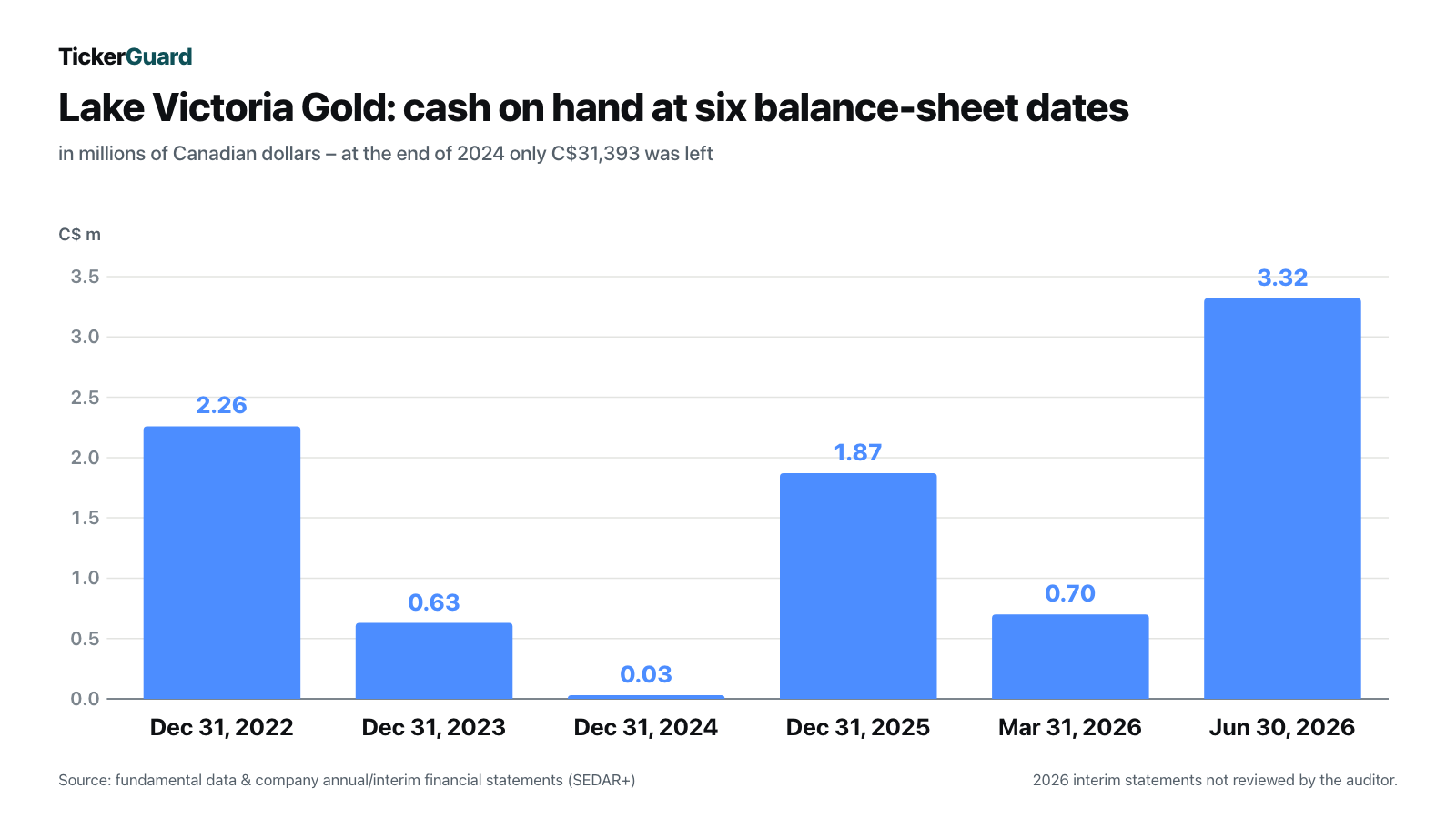
The pattern is typical for a small explorer: money arrives in bursts from placements and convertible debentures and is gone again within a few quarters. In the second quarter of 2026, operating and exploration outflows were about C$1.56 million, in the first quarter about C$1.19 million. And the burn is growing, not shrinking, because construction work at Imwelo has begun.
So far it has been paid for with new shares. The second chart shows how much the share count has grown — and what the announced plans could add:
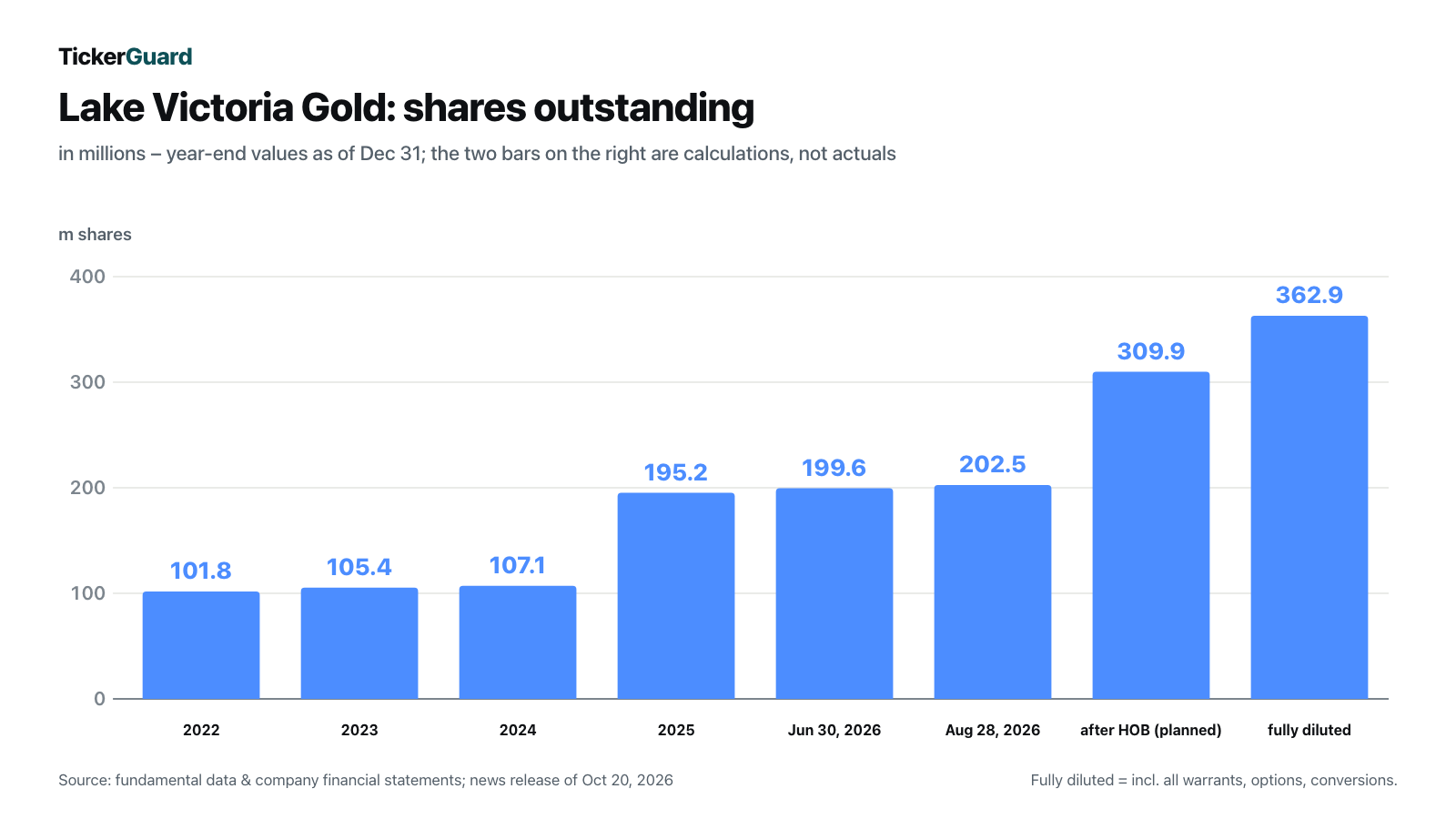
The image of dilution — your slice of the pie gets smaller when more people sit down at the table — is literal here. Anyone who owned 1 percent of the company at the end of 2024 would, after the planned placements, hold a little more than a third of a percent unless they buy more. That is not an accusation: an explorer without revenue can only finance itself this way. But it is the price of every excavator in the photos.
One last item stands out because it has nothing to do with geology. In the first half of 2026, the company spent C$588,004 on corporate development and investor relations, up from C$60,680 a year earlier — almost ten times as much. The MD&A explains that it “engaged and retained numerous consulting groups” to raise its profile in the investment community. For a company without revenue, that is a sizable item next to its exploration spending.
What the Filings Say — the Uncomfortable Truths
Now for the passages you cannot see in a construction photo. All of them come from the company’s own documents.
Uncomfortable Truth No. 1: The Auditor Doubts the Company Can Continue
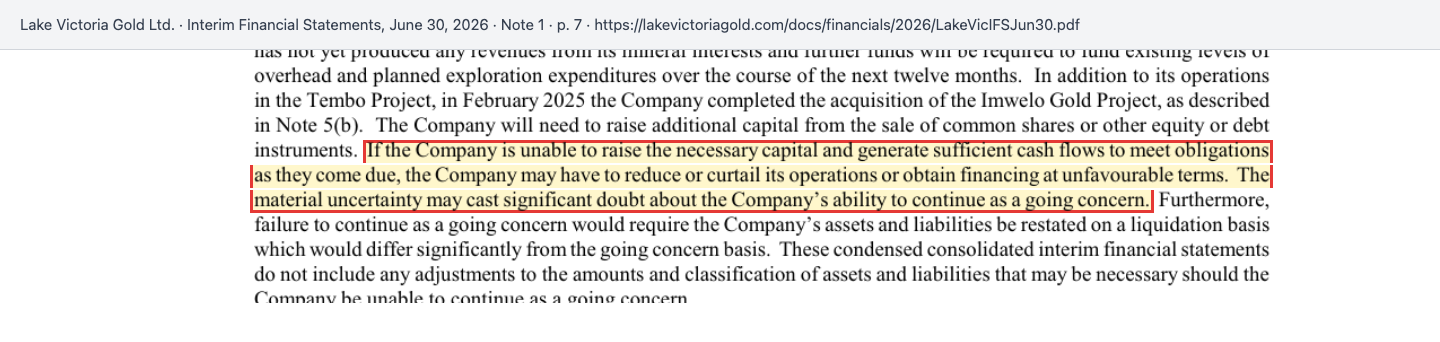
Auditor D&H Group LLP of Vancouver signed off on the 2025 financial statements on April 23, 2026, and specifically drew attention to a material uncertainty about the company’s ability to continue as a going concern; at year-end, current assets exceeded current liabilities by only C$137,391. The interim statements as of June 30, 2026, repeat the warning unchanged:
“If the Company is unable to raise the necessary capital and generate sufficient cash flows to meet obligations as they come due, the Company may have to reduce or curtail its operations or obtain financing at unfavourable terms. The material uncertainty may cast significant doubt about the Company’s ability to continue as a going concern.”
— Lake Victoria Gold Ltd., interim financial statements as of June 30, 2026, Note 1, p. 7
In numbers: C$3.32 million of cash as of June 30, 2026, against about C$1.56 million of outflows in the second quarter. At the second-quarter pace, that lasts a little over two quarters — before the cost of building a mine. That does not make the situation hopeless, but it makes it unambiguous: without new outside money, it does not go on.
Uncomfortable Truth No. 2: Construction Without a Feasibility Study
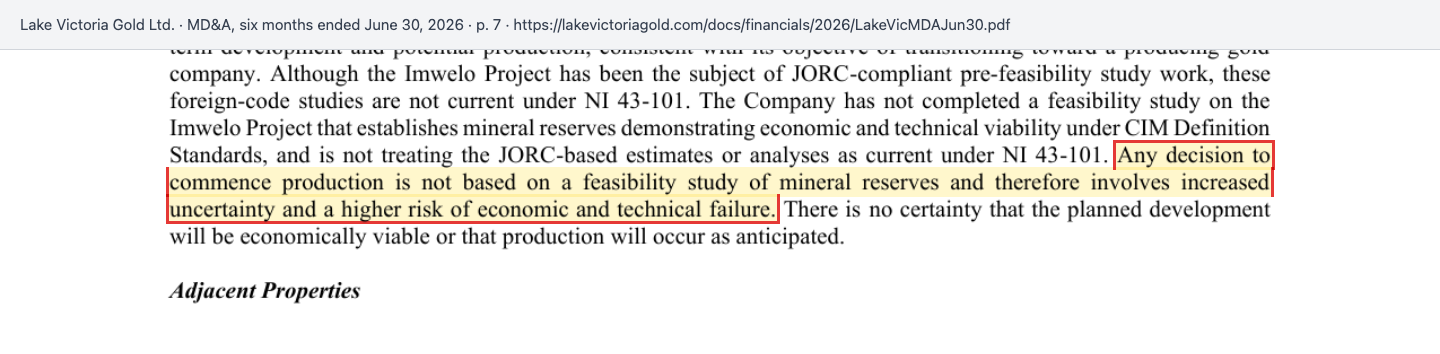
Mining has a fixed sequence: resource, pre-feasibility study, feasibility study, financing, construction. The feasibility study is the document in which independent experts work out whether mining pays at given costs, grades and gold prices — only then do reserves exist. Lake Victoria Gold has no such study for Imwelo and says so explicitly:
“Any decision to commence production is not based on a feasibility study of mineral reserves and therefore involves increased uncertainty and a higher risk of economic and technical failure.”
— Lake Victoria Gold Ltd., MD&A as of June 30, 2026, p. 7
That is permitted as long as it is disclosed — and here it is disclosed. But it does mean nobody has independently run the economics to today’s Canadian standard. The data themselves show how surprising the rock can be: for the near-surface, heavily weathered ore, lab tests without pretreatment recovered only 49.99 percent of the gold in 24 hours; only scrubbing and desliming lifted that to 84.54 percent (release of September 24, 2026). And four of eight holes drilled in August hit voids left behind by artisanal miners.
Uncomfortable Truth No. 3: The Gold Loan Was Announced, Not Closed
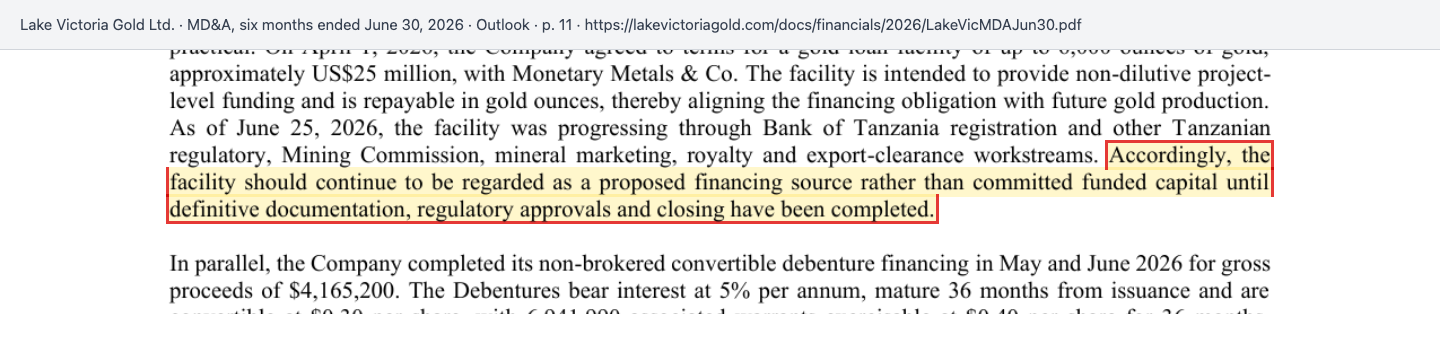
On April 1, 2026, the company announced a gold loan of up to 6,000 ounces, about US$25 million, from Monetary Metals & Co. It is borrowed and repaid in gold, and the interest rate according to the release is 15 percent a year; the company calls it “non-dilutive” because no shares are issued. Closing was targeted within 60 to 90 days. Almost five months later, the MD&A dated August 28, 2026, reads like this:
“Accordingly, the facility should continue to be regarded as a proposed financing source rather than committed funded capital until definitive documentation, regulatory approvals and closing have been completed.”
— Lake Victoria Gold Ltd., MD&A as of June 30, 2026, Outlook, p. 11
Two things are worth keeping in mind. First, 15 percent interest on a gold-denominated loan of 6,000 ounces equals about 900 ounces a year that have to come out of a mine that is not yet running. A loan is “non-dilutive” only for the share count, not for the gold output. Second, the big financing release of October 20, 2026, does not mention the gold loan at all. Whether the loan is still being pursued, the release leaves open; the report for the quarter ended September 30, 2026, should bring clarity.
Uncomfortable Truth No. 4: The C$27 Million Offer Is Non-Binding — and Costs Control
On October 20, 2026, came the release that drew the most attention in the forums: HOB Energy FZCO of Dubai, wholly owned by Ozcan Halaç of a Turkish gold and refining family, wants to buy 90,733,960 new shares at C$0.30 — C$27,220,188, a little more than eight times the cash of June 30, 2026. Existing significant shareholders are also to be allowed to buy up to 16,666,666 shares at the same price. The price is about 12 percent below the C$0.34 close of October 23, 2026.
Three points are in the same release, just not in the headline. First, it is a non-binding term sheet; mutual due diligence, exchange approval and shareholder approval are outstanding, and the company itself writes that there is no assurance the transaction will be completed. Second, with about 29.17 percent, HOB would become a “Control Person” under TSX Venture rules — with three of seven board seats, a HOB-appointed chief operating officer reporting to the CEO, the chair and casting vote of a technical steering committee (with an independent expert consultation procedure for deadlocks) and approval rights over financing, capital allocation, material transactions and senior management appointments. Third, disinterested shareholder approval is to be obtained by written consent rather than at a meeting; according to the company, management, directors and partners own more than 60 percent of the shares.
The other side deserves fairness too: for an explorer carrying a going-concern warning, a strategic investor with refining and gold-trading experience who comes in close to the market price and without finder’s fees is, on balance, good news. The outside date for closing is November 30, 2026. Until then, the money is a promise.
Uncomfortable Truth No. 5: Who Shares in Success
Even if everything works out, the profit from Imwelo does not belong to shareholders alone. Tanzania receives at least 16 percent for free. Taifa has agreed to subscribe for another 16 million units (one share plus one warrant each) at C$0.24 once final engineering is complete and to exercise the associated 16 million warrants at C$0.26 six months after ground is broken — up to 32 million more shares in total. Monetary Metals is to receive 2,500,000 warrants if the gold loan closes. And the 2022 sale of six Tembo licences to Barrick shows how Tanzania participates: of the US$6 million purchase price, US$1,790,882 went to the state as capital gains tax.
Valuation: What You Pay per Ounce
With 202,544,968 shares (August 28, 2026) and a closing price of C$0.34 on the TSX Venture on October 23, 2026, Lake Victoria Gold is valued by the market at about C$68.9 million. Subtracting the June 30, 2026, cash and adding the convertible debentures and the Barrick promissory note gives an enterprise value of about C$70 million.
With neither revenue nor earnings, price-to-earnings or price-to-sales ratios are meaningless. The usual yardstick for explorers is the price per ounce in the ground. Only what counts as a resource under the Canadian standard is included — the 579,800 ounces at Tembo, not the historical Imwelo ounces. That works out to about C$121 per ounce. Measured only against the 99,700 indicated ounces, it is about C$703. For context: almost 83 percent of the Tembo ounces are “inferred,” the least certain category, and Tembo does not even have a preliminary economic assessment yet.
One small cross-check: the percentages in the October 20, 2026, release imply that about 203.7 million shares were outstanding at that point, a little over one million more than on August 28 — presumably from further redeemed share units. That changes the market value by less than one percent. There is hardly any professional view here: our data show a price target of C$0.65, but neither who set it nor how many analysts stand behind it — an unverifiable single data point that we therefore give no weight.
Opportunities and Risks at a Glance
Opportunities
- Imwelo holds a mining licence and, according to the company, is fully permitted; road, camp and earthworks have been under way since July 2026.
- Metallurgy: recoveries of up to roughly 96 to 97 percent for deeper ore, and a preferred route for the weathered surface ore (84.54 percent after pretreatment).
- Since August 2026, Tembo has a first resource of 579,800 ounces, right next to Barrick’s Bulyanhulu mine.
- If the HOB placement closes, C$27.2 million would flow in — a little more than eight times the June 30, 2026, cash — plus a partner with gold-industry experience.
- Contingent payments from Barrick of up to US$45 million if resources are defined on the licences sold in 2022.
- Management itself bought C$1.07 million of shares in October 2025.
Risks
- Going-concern paragraph from the auditor; C$3.32 million in cash lasts a little over two quarters at the second-quarter pace (as of June 30, 2026).
- No feasibility study, no reserves; under Canadian rules the Imwelo estimate does not count as a current resource.
- Gold loan announced in April, still not committed at the end of August; denominated in gold, 15 percent annual interest.
- HOB deal non-binding; on closing, about 45 to 53 percent more shares and a major shareholder with approval rights over reserved matters.
- Tanzania country risk: free state carried interest of at least 16 percent, approvals for the loan, gold exports and royalties, and a tax deposit blocked since 2025.
- Spending on corporate development and investor relations up almost tenfold in the first half of 2026 (C$588,004 versus C$60,680), while construction funding is still open.
A Human Conclusion
Remember the construction-site illusion from the beginning? Lake Victoria Gold is feeding it generously right now, and most of it is real: the road is repaired, the camp stands, the drill core is at the lab. What the photos don’t show is in three sentences of the company’s own reports. The auditor doubts it can continue as a going concern. There is no feasibility study. And the money for the mine is, so far, an announcement and a term sheet — not a wire transfer.
The coming weeks bring two hard tests with dates attached: the statements for the quarter ended September 30, 2026, due by the end of November, and November 30, 2026, as the outside date for closing with HOB. If the money comes, Lake Victoria Gold becomes a funded but substantially diluted and co-controlled mine developer without a feasibility study. If it doesn’t, what remains is a camp, a road and cash for a few months.
What you make of it is your decision. And that is how it should be.
Sources and Data Status
- Interim financial statements as of June 30, 2026 (not reviewed by the auditor, approved August 28, 2026) and MD&A as of June 30, 2026 (dated August 28, 2026) — latest periodic report
- Interim financial statements as of March 31, 2026 and the related MD&A (dated May 27, 2026)
- 2025 consolidated financial statements with the D&H Group LLP auditor’s report of April 23, 2026, and the 2025 MD&A
- 2024 consolidated financial statements, 2024 MD&A and 2023 consolidated financial statements
- News release of October 20, 2026: up to C$32.2 million financing with HOB Energy
- News release of April 1, 2026: Monetary Metals gold loan and update of June 25, 2026
- News release of August 11, 2026: maiden Tembo mineral resource
- News release of September 24, 2026: metallurgy of the weathered ore, plus the releases of August 27, September 3 and September 10, 2026, in the company’s news archive
- Price, volume and metric data: source fundamental data, as of October 23, 2026
Data status: company figures as of June 30, 2026, or the date stated; share count as of August 28, 2026; price and market value as of October 23, 2026. The news archive was last checked on October 25, 2026; the latest release is dated October 20, 2026. All amounts in Canadian dollars unless marked as U.S. dollars.
Disclaimer: This article is a journalistic contextualization of publicly available information and is not investment advice. It contains no buy or sell recommendation and is not a solicitation to buy or sell securities. Shares in exploration and development companies without revenue are especially volatile; a total loss of the capital invested is possible. Positions held by the operator are disclosed daily; where one exists, it appears as a notice at the top of this deep dive.
Our Bottom Line at a Glance
- Project progress positive
- Imwelo holds a mining licence and, according to the company, is fully permitted. Earthworks have been under way since July 28, 2026, the access road has been repaired, and the camp was substantially complete on September 3, 2026. Metallurgy shows recoveries of up to roughly 96 to 97 percent for the deeper ore.
- Confidence level of the deposit negative
- There are no reserves and no feasibility study. The Imwelo estimate of 291,600 ounces is not current under the Canadian standard; Tembo has had a resource of 579,800 ounces since August 11, 2026, almost 83 percent of it in the least certain “inferred” category.
- Financial strength negative
- As of June 30, 2026, the company held C$3,316,346 in cash, against about C$1.56 million of outflows in the second quarter. Auditor D&H Group LLP flagged a material uncertainty about its ability to continue as a going concern on April 23, 2026.
- Funding the build negative
- According to the MD&A, the gold loan of about US$25 million was not committed as of August 28, 2026. The C$27.2 million HOB financing announced October 20, 2026, is a non-binding term sheet with an outside closing date of November 30, 2026.
- Dilution and control negative
- The share count rose from 107.1 million at the end of 2024 to 202.5 million on August 28, 2026. The HOB plans would add up to 107.4 million more shares and a major shareholder with about 29 percent, three of seven board seats and approval rights.
Since July 2026, Lake Victoria Gold has been preparing a gold mine at its permitted Imwelo project in Tanzania, and since August 2026 its neighboring Tembo project has had a first resource of 579,800 ounces. Construction is proceeding without a feasibility study and without reserves, with C$3.3 million in cash (June 30, 2026) and a going-concern paragraph from the auditor. The gold loan of about US$25 million was not committed at the end of August; HOB Energy’s C$27.2 million is so far a non-binding term sheet that, on closing, would raise the share count by almost half and give HOB far-reaching say. The market value was about C$68.9 million on October 23, 2026. Not investment advice.
What Our Rating Means
Substance risk
We found at least one documented issue that threatens the company itself — regardless of how the stock is currently valued.
Red, because two documented threats to the company itself are present: the auditor flagged a material uncertainty about its ability to continue as a going concern in its report of April 23, 2026, and C$3.32 million of cash as of June 30, 2026, lasts a little over two quarters at the second-quarter burn rate — well under four, just as construction of a mine begins. Neither announced source of money, the gold loan nor the HOB placement, had closed at the time of writing. Yellow would only be defensible once one of them actually funds; then the big operational question would remain whether Imwelo can operate profitably without a feasibility study. This rating has nothing to do with the share price: at a lower price the financing situation would be exactly the same. The decision is yours.
A journalistic assessment by our editorial team at the time of the deep dive, based on public sources — not investment advice and not a solicitation to buy or sell. Your personal circumstances (investment goals, risk capacity, taxes) cannot be taken into account. What our levels mean, how verdicts are formed, and what conflicts of interest exist →
Worth Noting
- This analysis was triggered by wallstreet-online’s list of the most discussed and searched stocks (October 2026), a German retail-investor portal — not by a scanner hit. We track the company under its home listing LVG on the TSX Venture Exchange (internally LVG.TO); the U.S. symbol LVGLF and the Frankfurt symbol E1K refer to the same stock.
- Lake Victoria Gold is not an SEC reporting company. All company figures come from the Canadian mandatory documents (SEDAR+), retrieved from the financial-reports page of its investor-relations site: interim statements and MD&A as of 06/30/2026 (dated 08/28/2026, not reviewed by the auditor) and as of 03/31/2026, consolidated financial statements 2023 to 2025 and news releases through 10/20/2026. The statements as of 09/30/2026 were not yet available on 10/25/2026.
- Possible mix-up: until December 2023 the company was called Tembo Gold Corp. The “Old LVG” in the financial statements is a private Australian Lake Victoria Gold Ltd., from which the listed company bought the Imwelo project in February 2025.
- All amounts in Canadian dollars unless marked as U.S. dollars. Conversions from U.S. to Canadian dollars use the rate stated in the interim statements as of 06/30/2026 (1 Canadian dollar = 0.70 U.S. dollars).
Stock Watch
This analysis is as of October 25, 2026. Stock Watch will tell you what's changed at LVG.TO since then.
Later $1 a month per stock — signing up is free, and you'll be the first to know when it launches.
The full analysis as a PDF for later
We will send you this analysis as a PDF — to print, file away, and read at your own pace. And we will add you to the free Stock Watch list for Lake Victoria Gold Ltd. (LVG.TO), so you hear about it when something material in this analysis changes.
Frequently Asked Questions
Lake Victoria Gold is a Canadian gold explorer and developer based in Vancouver; until December 2023 it was called Tembo Gold. It owns 100 percent of two projects in northwestern Tanzania: Imwelo, which holds a mining licence and where earthworks have been under way since July 2026, and Tembo next to Barrick’s Bulyanhulu mine, which has had a first mineral resource since August 2026. The company has no revenue.
Not on its own. As of June 30, 2026, it held C$3.32 million in cash, and about C$1.56 million flowed out in the second quarter. The auditor flagged a material uncertainty about the company’s ability to continue as a going concern in its report of April 23, 2026. A gold loan of about US$25 million was not committed at the end of August 2026; the C$27.2 million HOB financing is a non-binding term sheet.
HOB Energy of Dubai wants to buy 90,733,960 new shares at C$0.30; with the tranche for significant shareholders, up to 107.4 million new shares would be added to the 202.5 million outstanding on August 28, 2026. HOB would hold about 29 percent, three of seven board seats and approval rights over key decisions. The outside date for closing is November 30, 2026.
Under the Canadian standard NI 43-101, only Tembo has a resource: 99,700 indicated ounces at 1.16 grams per tonne and 480,100 inferred ounces at 1.12 grams per tonne (effective May 29, 2026, announced August 11, 2026). Imwelo has only an older JORC estimate of 291,600 ounces, which the company itself does not treat as a current resource. There are no reserves anywhere.
Lake Victoria Gold is a Canadian company with its home listing on the TSX Venture Exchange and reports under Canadian rules (National Instrument 51-102) via SEDAR+: audited annual financial statements with an MD&A plus interim statements every quarter. The U.S. symbol LVGLF trades over the counter on the OTCQB without SEC reporting obligations. The auditor did not review the 2026 interim statements.
Its home market is the TSX Venture Exchange in Toronto under the symbol LVG, traded in Canadian dollars. Over the counter in the U.S. it trades as LVGLF (OTCQB), in Frankfurt as E1K; the ISIN is CA5109151012. Buying in U.S. dollars or euros adds currency risk against the Canadian dollar. The notes to the June 30, 2026, interim statements list a different Frankfurt symbol, T23.
Found an error?
Did you spot a factual error, an outdated number, or a typo in this deep dive? Let us know briefly — your report goes straight to the editorial team.