Ubiquiti stock: fourth-quarter profit grew just 6.8% — and that is exactly the number that misleads you
Ubiquiti builds networking hardware, employs 1,818 people and turns 3.27 billion dollars of revenue with just 127 staff in sales and administration. On 21 August 2026 the company filed its annual report: record quarter, record year — and a reported profit increase of a meagre 6.8%. We did the arithmetic on why that number is worthless, why Ubiquiti has not held a single earnings call in years, who actually owns the company, and what sits inside a buyback programme that has not moved a dollar in twelve months. Not investment advice — just a look at what lies behind the first number.
 Thomas Mücke
Founder & Publisher
Thomas Mücke
Founder & Publisher
As of Today
As of: October 13, 2026
- Closing price
- 621.10 $ +0.20%
- Market Capitalisation
- 37.6 $B
- Growth Score
- 10/10
- AAQS
- 10/10
Price change since August 28, 2026: +3.6%
This analysis has a cut-off date. The Stock Guard tells you when something material changes in the numbers. Reserve your free spot
Chart
Interactive price chart (TradingView).
52-week range: 515.40 $ to 1,084.50 $ · Last price: 621.10 $ (As of: October 13, 2026)
Note: pure fact-based analysis, not investment advice and not a solicitation to buy or sell. All figures without guarantee.
There is one number you read first in every quarterly release, and most of the time it is the wrong one. It sits in the headline, it is a percentage, and your brain has passed judgment before the second sentence begins. Psychologists call it anchoring: the first number we see sets the frame for everything that follows. Correcting for it takes deliberate effort — and most people do not bother, because effort is expensive and because the first number feels so satisfyingly final.
On 21 August 2026 Ubiquiti Inc. filed its annual report for the fiscal year ended 30 June. The number many readers stopped at reads: up 6.8%. That is how much net income grew in the final quarter against the same quarter a year earlier. For a company whose revenue rose 23.5% in that same quarter, it sounds like braking distance — rising costs, margin pressure, the point where a growth story turns.
It is not. The 6.8% is an arithmetic artefact, and Ubiquiti explains it in the very same document, just further down. We went through that report: what the company does, how the numbers look across four years, why the year-on-year comparison limps, what management says — and above all what it does not say.
What Ubiquiti actually does — networking hardware without a sales force
Ubiquiti builds the boxes that hold networks together: routers and switches, Wi-Fi access points, surveillance cameras, door access systems, phone systems, plus radio links for internet providers in places without cable. Two product families split the revenue very unevenly. Enterprise Technology — essentially the UniFi brand — brought in 2,972.3 million dollars in fiscal 2026, or 91% of revenue, growing 32%. The older Service Provider Technology line with airMAX, airFiber and UFiber contributed 301.9 million and shrank 5%. Ubiquiti today is at heart a supplier of enterprise networks, not of wireless links.
What stands out is not the product but the apparatus behind it — or rather its absence. As of 30 June 2026 Ubiquiti employed or contracted 1,818 full-time equivalents. Of those, 1,321 worked in research and development, 370 in operations and 127 in sales, general and administrative functions. One hundred and twenty-seven people for a company turning 3.27 billion dollars. That works out at roughly 1.8 million dollars of revenue per employee — a figure almost nobody in hardware matches.
This is deliberate, and Ubiquiti writes it into the annual report itself:
"We do not employ a traditional direct sales force, but instead drive brand awareness through online reviews and publications, our website, our distributors and our user community where customers can interface directly with our R&D, marketing, and support teams."
— Ubiquiti Inc., SEC annual report on Form 10-K for fiscal 2026, Part II, Item 7
The customers do the selling. Anyone who has ever read a forum thread about setting up a UniFi network knows the mechanism: the user community writes the guides, films the videos and answers the questions that elsewhere would require a paid support team. In accounting terms this shows up in a figure worth reading twice: total operating expenses — research, development, sales and administration combined — came to 325.9 million dollars, or 10% of revenue, in fiscal 2026. At most competitors the sales line alone consumes several times that.
Distribution runs through more than 100 distributors and online retailers plus the company\'s own webstores. In fiscal 2026, 55% of revenue came through distributors and 45% through direct sales. North America leads regionally with 1,744.0 million dollars (53%), ahead of Europe, the Middle East and Africa with 1,179.2 million (36%). Nothing is manufactured in-house; contract manufacturers do the building, and Ubiquiti runs warehouses in the US, Europe and Asia Pacific with further logistics outsourced to Vietnam and Panama.
Company history for investors
-
2019
Renamed and moved to the NYSE
At the close of business on 19 August 2019 "Ubiquiti Networks, Inc." became "Ubiquiti Inc."; the next day trading began on the NYSE under the ticker UI instead of UBNT.
-
2023
Profit reported, cash lost
In fiscal 2023, 407.6 million dollars of reported profit met an operating cash outflow of 145.4 million, caused by inventory build-up. Equity stood at minus 115.7 million at 30 June 2023.
-
2025
A 53.7 million tax benefit in the final quarter
An intercompany transfer of rights into the US created a deferred tax asset recognised at once. It artificially lifts the fiscal 2025 fourth-quarter base.
-
2026
Debt repaid, balance sheet turned
On 27 February 2026 Ubiquiti fully repaid the term loan; a new revolving facility with PNC followed on 7 May 2026. Stockholders' equity stood at plus 1,440.2 million dollars at 30 June 2026.
-
2026
Record year and a first margin warning
The report of 21 August 2026 shows 3,274.2 million dollars of revenue — and warns for the first time of margin pressure from costlier components.
How the stock landed on our desk
The trigger is the fresh annual report. Ubiquiti\'s fiscal year ends on 30 June, so "fiscal 2026" broadly covers the second half of calendar 2025 and the first half of 2026. On 21 August 2026 the company filed its annual report on Form 10-K with the US Securities and Exchange Commission, and on the same day a current report on Form 8-K carrying the earnings release as an exhibit.
Filing both on one day is routine — which is precisely why it is easy to miss that the two documents say different things. The annual report supplies the audited numbers and the footnotes. The earnings release supplies the company\'s own explanation of how to read those numbers and, in this case, the only forward-looking sentence about margins that Ubiquiti has written in years. We read both, plus the prior year\'s annual report and the twelve earnings releases of the three years before that.
A note on identity, because this one attracts confusion: on the New York Stock Exchange the ticker UI belongs to Ubiquiti Inc., registered with the SEC under CIK 1511737. Until the close of business on 19 August 2019 the company was called "Ubiquiti Networks, Inc." and traded on Nasdaq under the ticker UBNT; trading under today\'s ticker UI on the New York Stock Exchange began on 20 August 2019. Some data vendors still carry the old name. There is no deregistration, no bankruptcy proceeding and no successor entity — Ubiquiti is an ordinary US domestic filer with annual and quarterly reports.
The numbers over the years — fairly judged
Four fiscal years, each ended 30 June, all from the audited financial statements:
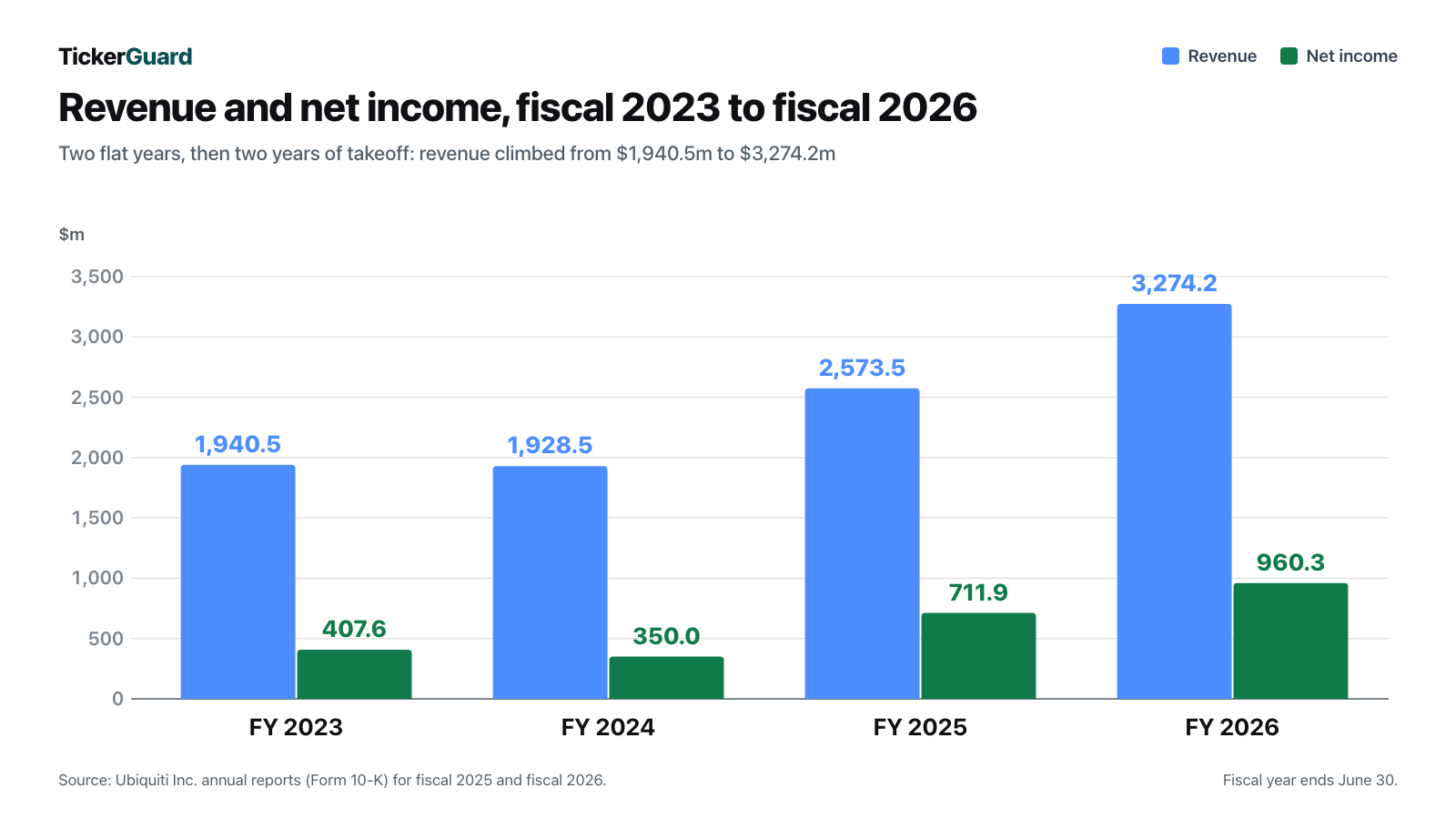
Revenue was 1,940.5 million dollars in fiscal 2023 and 1,928.5 million in fiscal 2024 — a year of standstill, a shade of decline even. Then 2,573.5 million (2025) and 3,274.2 million (2026). Revenue has nearly doubled in two years.
Net income travelled the same road with a dip: 407.6 million (2023), 350.0 million (2024), 711.9 million (2025), 960.3 million (2026). Per diluted share that is 6.74 / 5.79 / 11.76 / 15.85 dollars.
Gross margin climbed from 39.2% (2023) via 38.4% (2024) to 43.4% (2025) and 46.2% (2026). The operating margin rose from 28.1% to 36.2% over the same span. For context: a 36% operating margin means 36 cents of every dollar taken in survives to the line before interest and tax. For a maker of physical devices that is exceptional.
More interesting than any of those lines, though, is a figure that rarely reaches headlines — operating cash flow, the money the running business actually deposits in the till.
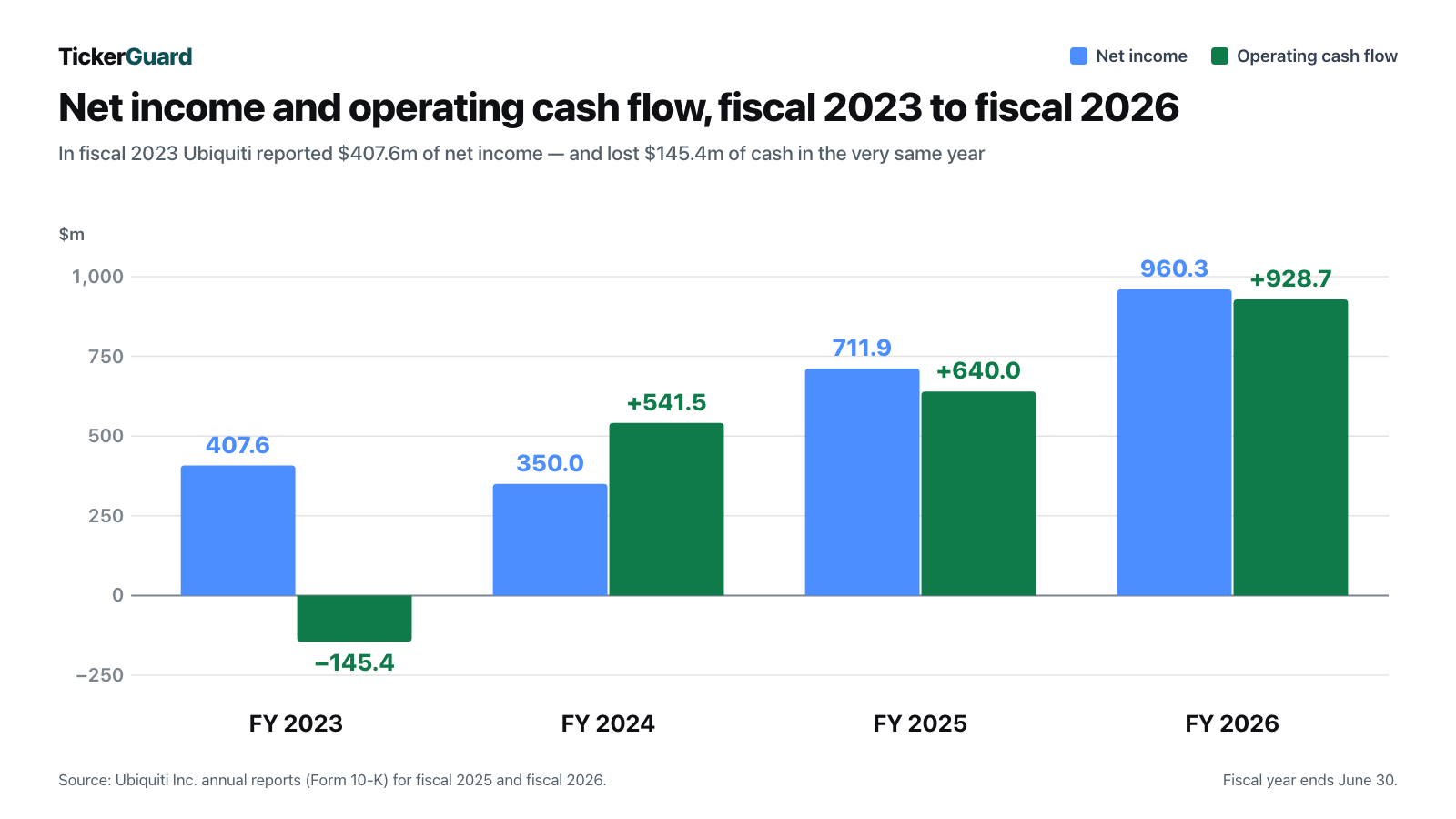
In fiscal 2023, reported profit of 407.6 million dollars met an operating cash outflow of 145.4 million. A gap of more than half a billion. The cause was not an accounting trick but a warehouse: through the supply-chain crisis Ubiquiti had hoarded components and finished goods simply to be able to ship. At 30 June 2023, 737.1 million dollars sat in inventory, financial debt had passed a billion, and stockholders\' equity was negative at minus 115.7 million dollars — the residue of years of credit-financed share buybacks.
Anyone valuing the stock back then was valuing a company that reported profits and lost cash. That is exactly what makes today\'s figures meaningful: at 30 June 2026 equity stands at plus 1,440.2 million dollars. On 27 February 2026 Ubiquiti repaid the term loan in full; no short-term financial debt remained on the balance sheet at year end. On 7 May 2026 the company signed a new, undrawn revolving facility with PNC. Cash and short-term investments totalled 611.2 million dollars, up from 149.7 million a year earlier.
For completeness, the counter-entry you should also know: inventories rose again in fiscal 2026, to 780.4 million dollars. And of the 928.7 million of cash generated, 172.1 million came from an increase in accounts payable and accrued liabilities — that is, from Ubiquiti paying its suppliers later. That is ordinary working-capital management rather than an accusation, but it means the running business would have delivered roughly 757 million instead of 929 million without it. Outstanding purchase commitments to contract manufacturers stood at 1,532.6 million dollars.
Uncomfortable truth no. 1: the profit comparison limps because last year held a tax gift
Back to the number from the opening. In the fourth quarter of fiscal 2026 (April to June 2026) Ubiquiti booked 937.3 million dollars of revenue — a record and 23.5% more than the prior-year quarter. Operating income rose from 261.4 to 340.0 million dollars, up 30.1%. Everything holds so far: revenue grows, earnings grow faster, the cost structure keeps its shape.
At net income the sequence breaks. It rose from 266.7 to 284.9 million dollars — up 6.8%. How can operating income climb 30% while the profit beneath it moves only 7?
The answer does not sit in the current quarter but in the comparison quarter a year earlier. In the fourth quarter of fiscal 2025 Ubiquiti transferred certain intangible properties from foreign subsidiaries into the United States. Under US accounting rules that produced a deferred tax asset of 53.7 million dollars that had to be recognised immediately and in full as income. The tax line of that quarter accordingly showed a benefit of 8.5 million dollars — in the final quarter of fiscal 2025 the company did not pay tax, it effectively received some. That made the 266.7 million of profit roughly 54 million too high relative to the ongoing business.
Ubiquiti says as much itself, in the release of 21 August 2026:
"As discussed elsewhere in this press release, the difference between GAAP net income and non-GAAP net income for the fourth quarter of fiscal 2025 is primarily driven by the immediate recognition under GAAP of the $53.7 million deferred tax asset described in the prior paragraph."
— Ubiquiti Inc., earnings release of 21 August 2026 (Exhibit 99.1 to the SEC current report on Form 8-K)
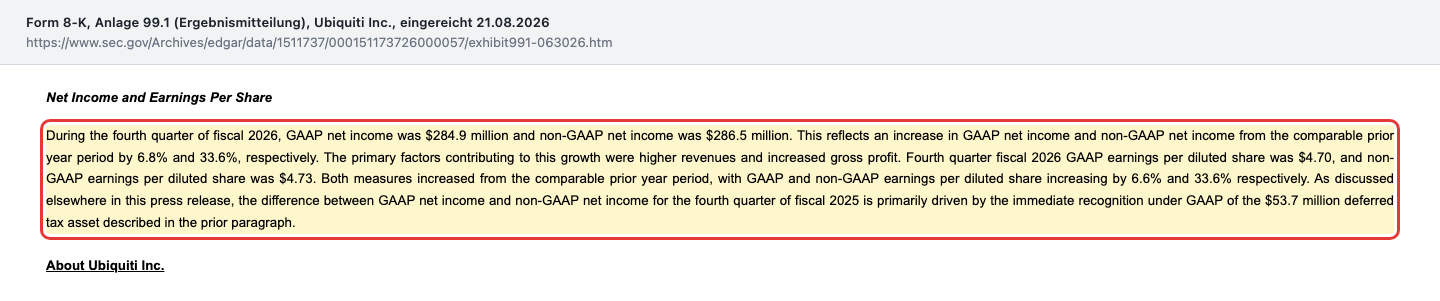
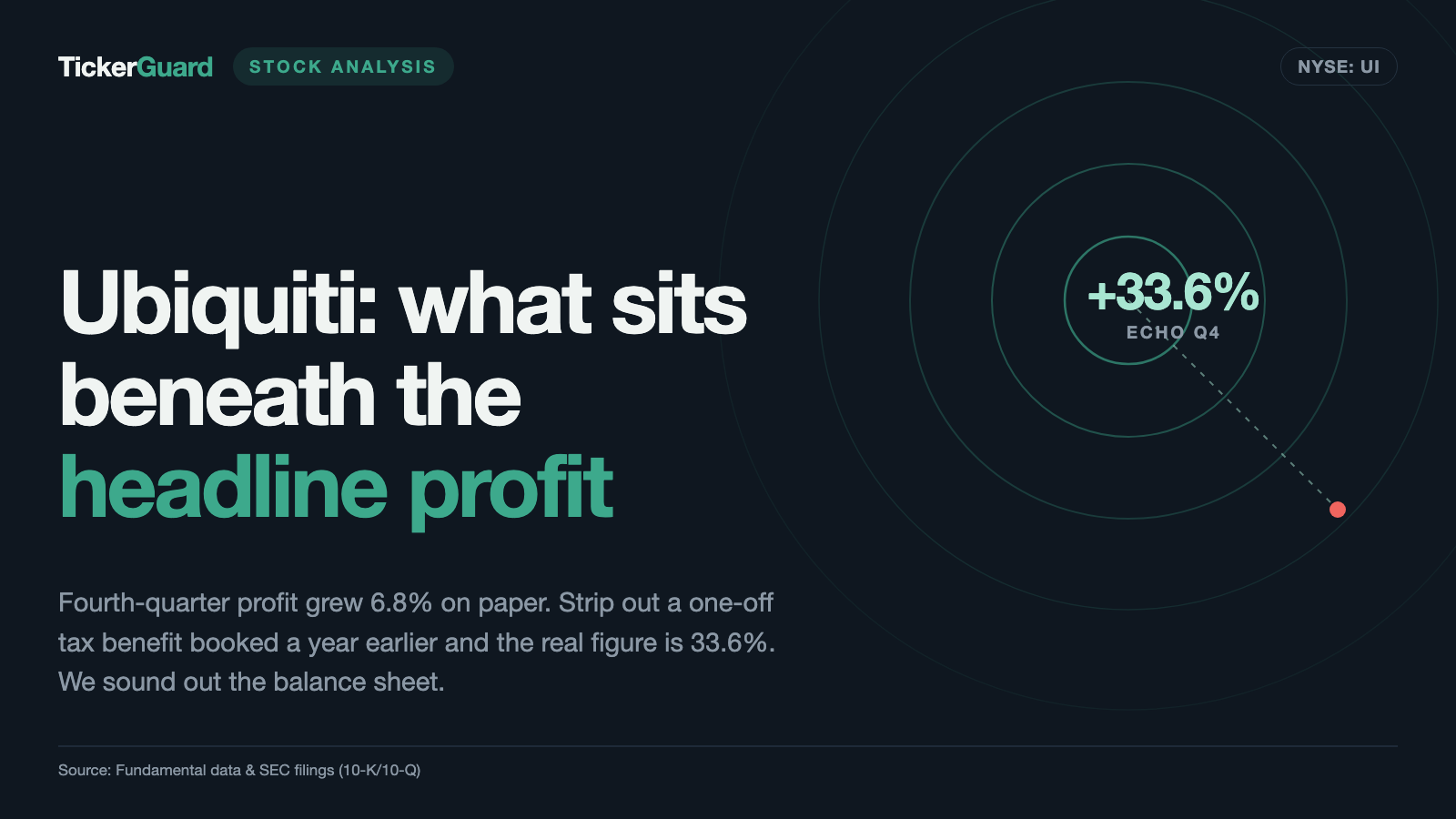
The adjusted calculation, which strips that one-off out, gives fourth-quarter fiscal 2026 profit of 286.5 million dollars against 214.4 million a year earlier — an increase of 33.6%. Per share: 4.73 against 3.54 dollars, likewise up 33.6%.
There is a simple detection test for cases like this, and Ubiquiti supplies it free of charge. Normally the adjusted profit sits above the figure reported under accounting rules — companies like stripping costs out. In the fourth quarter of fiscal 2025 it was the other way round: 4.41 dollars per share under GAAP against 3.54 adjusted. Across the thirteen quarters we examined, that is the only instance of its kind. Wherever reported profit clearly exceeds the adjusted figure, a one-off gain is almost always hiding inside.
The same applies to the full year on a smaller scale. Net income for fiscal 2026 rose from 711.9 to 960.3 million dollars, up 34.9%. Take the 53.7 million out of the prior year and the increase would be roughly 46%. The effective tax rate shows the same thing: 11.6% in fiscal 2025 against 18.8% in fiscal 2026. Not because Ubiquiti suddenly pays more tax, but because the prior-year figure was artificially suppressed by the one-off entry.
Twelve earnings releases without a single conference call
At most listed companies you test management statements like this: take the transcripts of the analyst calls from recent years, look at what the board promised, and compare it with what actually happened. The question-and-answer section carries more weight than the prepared remarks, because that is where follow-up questions arrive for which nobody holds a script.
With Ubiquiti this is impossible. There are no transcripts, because there are no calls.
We searched twelve consecutive earnings releases from 25 August 2023 to 8 May 2026 in full — for "conference call", "webcast", "dial-in" and "listen-only". The result is identical in every single file: zero hits. Ubiquiti announces no conference call, no webcast, no dial-in. The only contact route printed each time is the same investor relations block with an email address and a phone number. There are no analyst questions, no follow-ups, no moments in which a chief executive has to commit to anything.
A second finding follows from this and says even more. Across those twelve releases the words "expect", "anticipate" and "continue" appear exclusively inside the boilerplate safe-harbour language, never in the explanatory text. Ubiquiti explains its margins strictly in retrospect: what rose, what fell, why. A forecast for gross margin, a revenue expectation, a target — none of that appears in these documents. The only forward-looking commitment across three years concerns the dividend. And that one Ubiquiti honoured: at least 0.80 dollars per quarter was announced for fiscal 2026, and exactly 0.80 was paid every quarter.
What this means for investors is visible in the third quarter of fiscal 2024. Gross margin there fell to 35.3% — the worst reading of the entire period, triggered by additional inventory write-downs. The prior quarter\'s release of 9 February 2024 had not hinted at it with a single word. The reverse holds too: when margin peaked at 47.0% in the third quarter of fiscal 2026, there had been no advance notice either. Anyone hoping to extract an early warning signal from these releases will not find one.
Which is exactly why 21 August 2026 is remarkable. Because there, for the first time in at least three years, stands a sentence about the future of the margin:
"Component costs may continue to rise and availability may remain constrained. These factors may result in near-term pressure on our gross profit margins, particularly to the extent we are unable to offset higher component costs through pricing or other measures."
— Ubiquiti Inc., earnings release of 21 August 2026 (Exhibit 99.1 to the SEC current report on Form 8-K)
A company that has consistently avoided saying anything about future margins for three years suddenly says something — and it is a warning. The numbers already support it: fourth-quarter gross margin of 45.8% came in 1.2 percentage points below the prior quarter\'s 47.0%. Ubiquiti attributes this to higher component and shipping costs. Tariffs have appeared as a drag in four consecutive quarters without the amount ever being quantified. The annual report states plainly that historical and current gross margins may not be indicative of future periods.
We have worked through in detail how a tariff line can hollow out a record margin from the inside — at a supplier whose best-ever figure contained a duty refund: our Amphenol analysis. For a look at how another maker of enterprise hardware handles the same cost waves, see our Zebra Technologies analysis.
Uncomfortable truth no. 2: 93 percent of the shares belong to one man
Ubiquiti is a listed company, but only in small part. As of 20 August 2026, 60,528,381 shares were issued and outstanding. As of 21 August 2026, founder, chairman and chief executive Robert J. Pera beneficially owned 56,278,181 of them — roughly 93%.
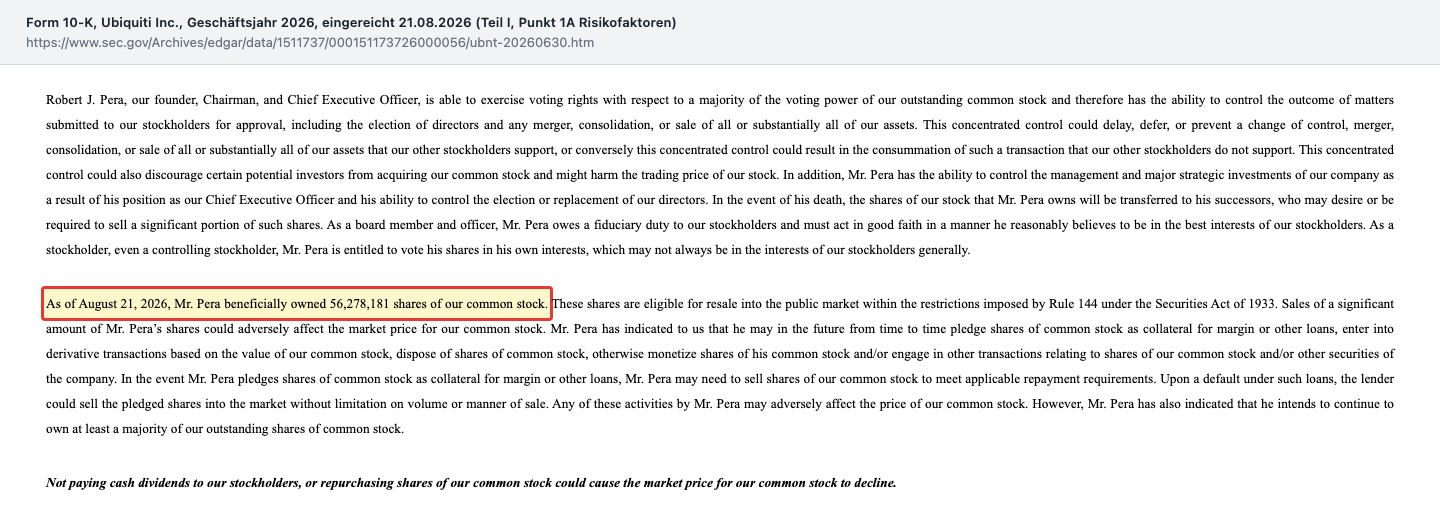
That leaves roughly 4.2 million shares in free float. The annual report puts the aggregate market value of shares held by non-affiliates at roughly 2.34 billion dollars as of 31 December 2025 — the date the SEC prescribes for that calculation — based on a closing price of 553.35 dollars at the time. For comparison: the company\'s total market capitalisation stood at roughly 36.3 billion dollars on 28 August 2026. So the market is valuing a 36 billion dollar business of which just under 2.5 billion is actually available to trade.
Three consequences follow, and Ubiquiti names them in its own risk section. First, Pera alone decides everything put to a stockholder vote — board composition, mergers, sale of substantially all assets. A takeover against his will is impossible; one with his blessing is enforceable against every other holder. Second, the report records that Pera may in future pledge shares as collateral for margin or other loans, enter derivative transactions on them, or otherwise monetise them — and that on a default a lender could sell the pledged stock "without limitation on volume or manner of sale". Against a float of 4.2 million shares, that would be a considerable event. Third, the report explicitly addresses death: the shares would pass to successors who may wish or be required to sell a significant portion.
To that add the operational dependency. Ubiquiti writes that Pera is "central to our product development efforts and overall strategic direction" and records that it maintains no significant key person insurance on any of its personnel. The development model sharpens the point: teams are deliberately small and independent, with — in the report\'s own words — "little overlap in knowledge and responsibilities". Efficient, certainly. Fail-safe, no.
Uncomfortable truth no. 3: a buyback programme that buys nothing
On 21 August 2025 the board approved a share repurchase programme of 500 million dollars, running to 30 September 2026. A year later, in the notes to the annual report, it gets a single sentence.
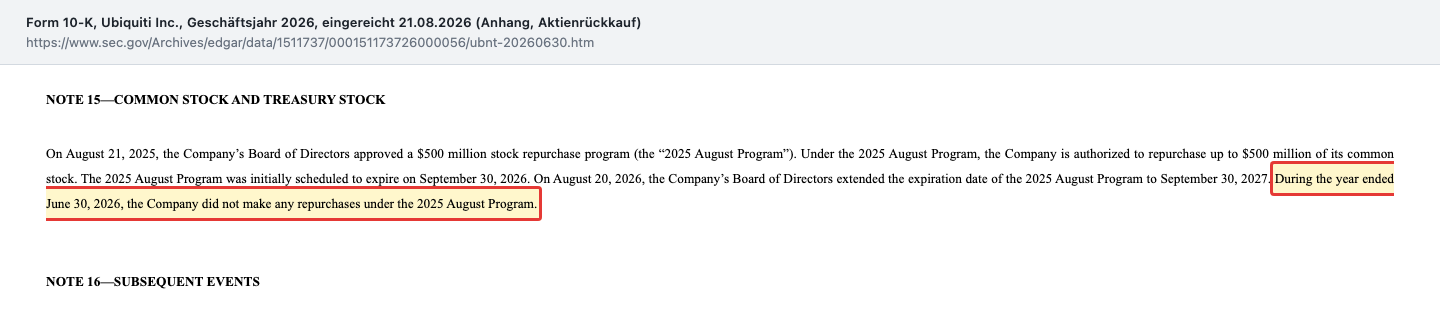
Verbatim: "During the year ended June 30, 2026, the Company did not make any repurchases under the 2025 August Program." Not one share was bought back under the programme in the entire fiscal year. On 20 August 2026 the board nevertheless extended the authorisation to 30 September 2027 — and Ubiquiti flagged that extension both in the current report and separately under "additional financial highlights" in the earnings release.
There is a charitable reading: a board that declines to exercise an authorisation because it considers the share price too high is acting in shareholders\' interest. Between 2018 and 2022 Ubiquiti spent roughly 2.5 billion dollars on its own stock and bought itself into negative equity in the process — a degree of restraint after that experience is understandable. Since fiscal 2023 the company has bought back virtually nothing; the diluted share count has stayed near-flat at 60.45 / 60.53 / 60.57 million over three years.
There is also the literal reading: an announcement without an action, repeated in every release and extended anyway. And the scale is not small. 500 million dollars equals roughly 52% of fiscal 2026 net income and about 82% of all cash and short-term investments at 30 June 2026. Above all: against a free float of roughly 4.2 million shares worth about 2.5 billion dollars, a fully executed programme would amount to about a fifth of the tradable market. Whether the authorisation becomes purchases will show in the repurchase table of the next quarterly report. So far it shows zero.
Uncomfortable truth no. 4: two tax disputes with no reserve recorded
The tax note to the annual report sets out two proceedings worth knowing about, because both are carried at zero on the balance sheet.
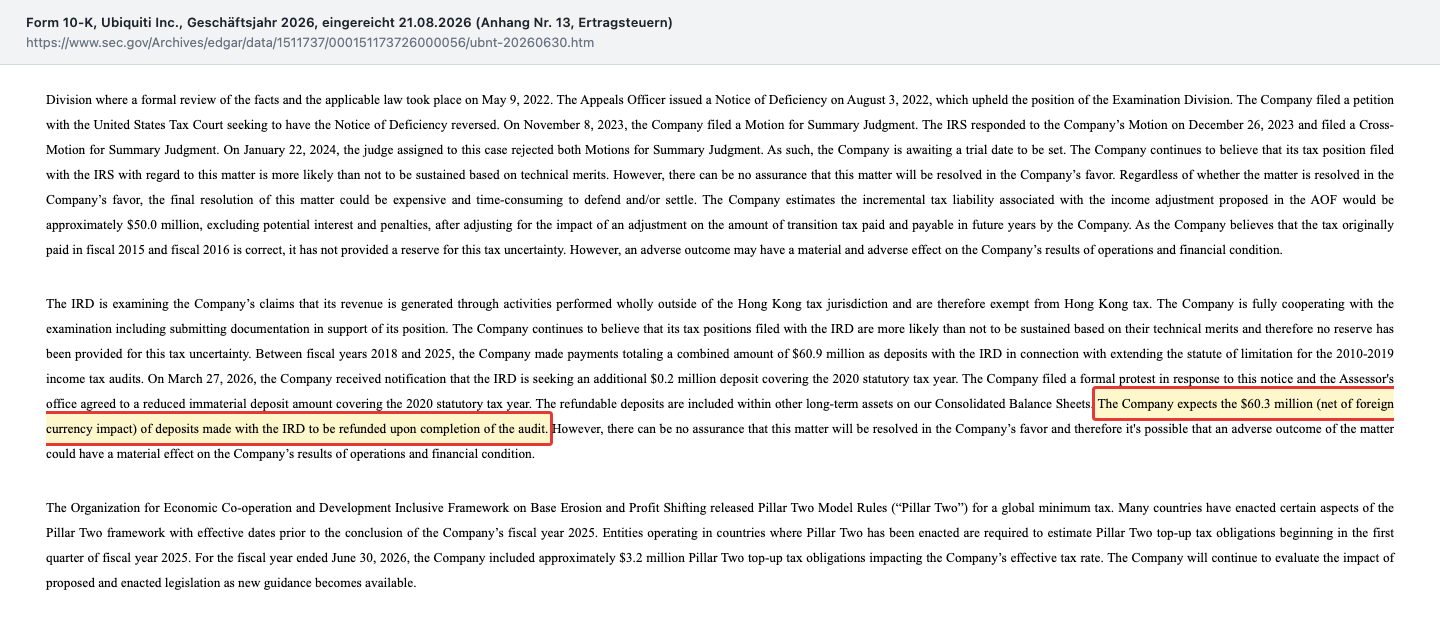
The first runs against the US Internal Revenue Service and concerns fiscal 2015 and 2016. After an examination, a Notice of Deficiency was issued on 3 August 2022; Ubiquiti petitioned the US Tax Court. On 22 January 2024 the assigned judge rejected both sides\' motions for summary judgment — since then the company has been awaiting a trial date. Ubiquiti puts its own estimate of the incremental tax liability at approximately 50.0 million dollars, expressly excluding interest and penalties.
The second concerns Hong Kong. The Inland Revenue Department there is auditing the years 2010 to 2020 and challenges the company\'s position that its revenue is generated wholly outside the Hong Kong tax jurisdiction and is therefore exempt. Between fiscal 2018 and fiscal 2025 Ubiquiti paid 60.9 million dollars in deposits to extend the statute of limitations; net of currency effects, 60.3 million of that sits in other long-term assets as refundable. On 27 March 2026 the authority sought a further deposit covering 2020; Ubiquiti filed a formal protest and agreed a reduced amount.
Both matters receive the same accounting treatment, and on the US dispute Ubiquiti puts it beyond doubt:
"As the Company believes that the tax originally paid in fiscal 2015 and fiscal 2016 is correct, it has not provided a reserve for this tax uncertainty. However, an adverse outcome may have a material and adverse effect on the Company\'s results of operations and financial condition."
— Ubiquiti Inc., SEC annual report on Form 10-K for fiscal 2026, Note 13
This is permissible and by no means unusual where a company considers its own position more likely than not to prevail. But it also means that if either proceeding goes the wrong way, the amount hits the income statement in full and without warning. Together it is more than 110 million dollars — roughly 18% of cash and short-term investments at 30 June 2026. Against annual profit of 960.3 million that is not existential. It is, however, a position that appears in none of the metrics people normally compare.
For completeness a third item belongs here, because it falls in the same category: at 30 June 2026 Ubiquiti carried 31.5 million dollars of unrecognised tax benefits plus 6.7 million of accrued interest. And from the OECD global minimum tax framework — Pillar Two — the company booked roughly 3.2 million dollars of top-up tax obligations in fiscal 2026.
What the stock costs
At the 28 August 2026 closing price of 599.35 dollars and 60,528,381 shares outstanding, market capitalisation stood at roughly 36.3 billion dollars. Against fiscal 2026 diluted earnings per share of 15.85 dollars that is about 38 times annual earnings. Against revenue of 3,274.2 million it is a little over 11 times sales — a very high multiple for a hardware business, though one that gets to be measured against a 46.2% gross margin and a 36.2% operating margin.
Free cash flow in fiscal 2026 — operating cash flow of 928.7 million less capital expenditure of 19.7 million — came to 909.0 million dollars, roughly 2.5% of market value. The dividend of at least 1.00 dollar per quarter going forward yields about 0.7% on the closing price; in fiscal 2026 Ubiquiti paid 3.20 dollars per share, or 193.6 million in total, after 2.40 dollars in each of the two preceding years. Against 909.0 million of free cash flow the payout is comfortably covered.
A word on the share price without turning it into a forecast: the 52-week high was 1,098.58 dollars and the low 504.52 (as of 28 August 2026). The closing price of 599.35 therefore sits roughly 45% below the twelve-month high and roughly 19% above the low. The market has already marked the stock down substantially while the operating numbers improved in every line. What to conclude from that is each reader\'s own business — though with a free float of 4.2 million shares, it is reasonable to expect moves in both directions to be sharper here than in a widely held name.
Upside and risks at a glance
What speaks for Ubiquiti. The earnings power is documented and not the product of a one-off: a 46.2% gross margin, a 36.2% operating margin, 928.7 million dollars of operating cash flow in fiscal 2026. The cost structure is exceptionally lean — 10% of revenue for all operating expenses combined, 127 people in sales and administration, 7.4 million of share-based compensation. The balance sheet has turned completely in three years, from minus 115.7 to plus 1,440.2 million of equity, with no short-term debt at year end. The growth source is clearly identifiable: the UniFi family, up 32% in fiscal 2026 and now 91% of revenue. And the share count has been effectively constant for three years — existing holders are not being diluted.
What speaks against it. First the margin: Ubiquiti itself warns of near-term pressure from costlier components, and the slide from 47.0% to 45.8% between the third and fourth quarters of fiscal 2026 has already begun. Tariffs have sat in the text as an unquantified drag for four quarters. Second, disclosure practice: no conference calls, no analyst questions, no guidance. Investing here means voluntarily giving up every early-warning mechanism other companies provide. Third, the ownership structure: 93% with one person, 4.2 million freely tradable shares, and a pledging option the filing expressly reserves. Fourth, the dependence on the founder, which the company names as a risk itself and which its deliberately small, barely overlapping engineering teams amplify. Fifth, the two tax disputes carried without reserve. Sixth, the supply chain: no guaranteed supply arrangements for key components, no short-term alternative for chipsets, plus purchase commitments of 1,532.6 million dollars and inventories of 780.4 million that would need writing down in a demand air pocket — as already happened in fiscal 2024.
A human conclusion
Back to the opening, to the number that sets the frame. Anyone who read only "up 6.8%" on 21 August 2026 saw a company that is stalling. Anyone who read two paragraphs further saw a company that earned 33.6% more in its final quarter and whose operating income rose 30%. It is the same report. The only difference is how far you read.
That is one half of the story, and it is the pleasant half. The other is that the same diligence turns up things you would rather not know. A buyback programme announced a year ago, never used, and extended anyway. Two tax proceedings worth more than 110 million dollars combined, carried at nothing on the balance sheet. A company 93% owned by one man who answers no analyst questions and issues no guidance — and which, for the first time in years, writes a sentence about the future of its margin, and that sentence is a warning.
Ubiquiti is an unusually well-run business with numbers this industry rarely produces. It is at the same time a business that grants investors less visibility than almost any comparable name — not secretly, but entirely openly, and unchanged for years. Buying in here means buying the numbers and forgoing the conversation. That is a defensible choice. You should simply know that you are making it, and you should not make it on the strength of a percentage in a headline.
We issue no buy or sell recommendation. What this analysis provides is the arithmetic behind the first number — and the list of what sits in the footnotes.
Sources
- Ubiquiti Inc., annual report on Form 10-K for the fiscal year ended 30 June 2026, filed with the SEC on 21 August 2026 (CIK 1511737) — Part I Items 1 and 1A, Part II Items 5 and 7, financial statements and Notes 13 and 15
- Ubiquiti Inc., fourth quarter fiscal 2026 earnings release, Exhibit 99.1 to the current report on Form 8-K of 21 August 2026 (Item 2.02 results, Item 8.01 buyback extension)
- Ubiquiti Inc., annual report on Form 10-K for fiscal 2025, filed 22 August 2025 — comparative figures for fiscal 2023 and 2024
- Ubiquiti Inc., twelve earnings releases (each Exhibit 99.1 to a current report on Form 8-K) from 25 August 2023 to 8 May 2026 — reviewed for margin commentary, tariff references, guidance and conference call announcements
- Source: fundamental data & SEC filings (annual and quarterly reports, 10-K/10-Q) — price, market capitalisation and valuation figures as of 28 August 2026
Disclaimer: this article is journalistic analysis, not investment advice. It contains no buy or sell recommendation. All figures come from the primary sources named above and carry the date of their respective report. Prices and metrics derived from them are as of 28 August 2026 and change daily. The author holds no position in the stock discussed at the time of publication.
Key figures at a glance
All monetary figures in millions of $; earnings per share as reported.
| Metric | 2022 | 2023 | 2024 | 2025 | 2026 |
|---|---|---|---|---|---|
| Revenue | 1,691.7 | 1,940.5 | 1,928.5 | 2,573.5 | 3,274.2 |
| Operating Income (EBIT) | 462.3 | 544.6 | 499.0 | 836.3 | 1,185.4 |
| Net Income | 378.7 | 407.6 | 350.0 | 711.9 | 960.3 |
| Net Margin | 22.4% | 21.0% | 18.1% | 27.7% | 29.3% |
| Earnings Per Share | 6.13 $ | 6.74 $ | 5.79 $ | 11.76 $ | 15.85 $ |
Source: fundamental data & SEC filings (annual and quarterly reports, 10-K/10-Q)
Our Bottom Line at a Glance
- Earnings power positive
- In fiscal 2026 (ended 30 June) Ubiquiti earned 1,185.4 million dollars before interest and tax on 3,274.2 million of revenue — an operating margin of 36.2%. Gross margin rose from 43.4% to 46.2%. Both are unusually high for networking hardware.
- Cost structure positive
- Total operating expenses in fiscal 2026 were 325.9 million dollars, or 10% of revenue — 204.2 million for research and development, 121.8 million for sales, general and administrative. Just 127 people work in sales and administration. Share-based compensation was 7.4 million, roughly 0.2% of revenue.
- Balance sheet positive
- Stockholders' equity swung from minus 115.7 million dollars (30 June 2023) to plus 1,440.2 million (30 June 2026). On 27 February 2026 Ubiquiti fully repaid the term loan; no short-term debt remained on the balance sheet at year end, against 611.2 million in cash and short-term investments.
- Earnings quality neutral
- The fourth-quarter year-on-year comparison is distorted by a one-off: the fourth quarter of fiscal 2025 contained an immediately recognised deferred tax asset of 53.7 million dollars. That is why reported profit grew only 6.8% while the adjusted figure grew 33.6%. For the full year, operating cash flow of 928.7 million came in slightly below net income of 960.3 million.
- Margin outlook neutral
- In the release of 21 August 2026 Ubiquiti warns for the first time in at least three years of near-term margin pressure from rising component costs. Fourth-quarter gross margin of 45.8% was already below the 47.0% of the prior quarter. Tariffs have been named as a drag for four consecutive quarters.
- Ownership and disclosure practice negative
- Founder and chief executive Robert J. Pera held roughly 93% of the shares as of 21 August 2026; only about 4.2 million shares trade freely. Ubiquiti holds no conference calls — none is announced in any of twelve earnings releases from August 2023 to May 2026 — and gave no margin guidance in any of them.
Ubiquiti is an exceptionally profitable hardware business whose numbers improved in every important line in fiscal 2026 — and whose most-quoted fourth-quarter metric is simultaneously the least informative one. Anyone reading only the 6.8% profit increase mistakes a prior-year tax benefit for a growth stall. Two things remain genuinely open: whether the margin holds against the component costs the company itself has flagged, and how to value a business that is 93% owned by one person, holds no analyst calls and issues no guidance. Not investment advice.
What Our Rating Means
Open questions
The business works in principle, but one material question is open. As long as it stays open, our findings do not carry a quality verdict.
The business model clearly works: a 46.2% gross margin, a 36.2% operating margin, 928.7 million dollars of operating cash flow, no short-term debt left and equity that swung from minus 115.7 million to plus 1,440.2 million in three years. What keeps us from green is an open operational question: on 21 August 2026 Ubiquiti itself warned of near-term margin pressure from more expensive components, fourth-quarter gross margin already came in 1.2 percentage points below the prior quarter, and no reserve has been recorded against two tax disputes worth more than 110 million dollars combined. On top of that sits a disclosure practice that makes management hard to hold to account: no conference calls, no guidance, 93% of the votes with one individual. This is not a solvency risk — the balance sheet is healthy — but these are open questions, and where the evidence sits between two levels we take the more cautious one. The decision is yours.
A journalistic assessment by our editorial team at the time of the deep dive, based on public sources — not investment advice and not a solicitation to buy or sell. Your personal circumstances (investment goals, risk capacity, taxes) cannot be taken into account. What our levels mean, how verdicts are formed, and what conflicts of interest exist →
Worth Noting
- Trigger for this analysis: the annual report on Form 10-K for the fiscal year ended 30 June 2026, filed 21 August 2026, together with the earnings release of the same day (Form 8-K, Item 2.02, Exhibit 99.1).
- Price and valuation data as of 28 August 2026, closing price 599.35 dollars. All filing figures carry the date of their own report, not the date of the price snapshot.
- Possible confusion: on the New York Stock Exchange the ticker UI stands for Ubiquiti Inc. The company was named "Ubiquiti Networks, Inc." until 19 August 2019 and some data vendors still carry the old name. The fiscal year ends on 30 June, so "fiscal 2026" broadly covers the second half of calendar 2025 and the first half of 2026.
- No analyst call transcripts exist for Ubiquiti because the company holds none. The assessment of management statements therefore rests on twelve consecutive earnings releases (Exhibit 99.1 to Form 8-K) from August 2023 to May 2026 plus the release of 21 August 2026.
Stock Watch
This analysis is as of August 30, 2026. Stock Watch will tell you what's changed at UI since then.
Later $1 a month per stock — signing up is free, and you'll be the first to know when it launches.
The full analysis as a PDF for later
We will send you this analysis as a PDF — to print, file away, and read at your own pace. And we will add you to the free Stock Watch list for Ubiquiti Networks Inc (UI), so you hear about it when something material in this analysis changes.
Frequently Asked Questions
Because the comparison base is distorted. In the fourth quarter of fiscal 2025 Ubiquiti recognised a one-off deferred tax asset of 53.7 million dollars, arising from an intercompany transfer of intangible rights into the United States, which US accounting rules required it to book immediately. That amount artificially lifted profit at the time. Excluding it, fourth-quarter profit in fiscal 2026 grew 33.6% rather than 6.8%. Operating income — untouched by tax effects — rose 30.1%, from 261.4 to 340.0 million dollars.
No, it does not. We searched twelve consecutive earnings releases from August 2023 to May 2026 for "conference call", "webcast", "dial-in" and "listen-only". Every single file returned zero hits. No call, no webcast, no dial-in is ever announced; the only contact route printed each time is an investor relations block with an email address and a phone number. There are therefore no question-and-answer sessions against which management statements could later be checked. Ubiquiti also issues no gross-margin guidance in these documents; the only forward-looking commitment concerns the dividend.
Overwhelmingly the founder. According to the fiscal 2026 annual report, Robert J. Pera — founder, chairman and chief executive — beneficially owned 56,278,181 shares as of 21 August 2026. Shares outstanding as of 20 August 2026 were 60,528,381. That is a stake of roughly 93%, leaving only about 4.2 million shares in free float. The filing explicitly notes that Pera may in future pledge shares as collateral for margin or other loans, and that on a default the lender could sell the pledged shares into the market without limitation on volume or manner of sale.
Far healthier than three years ago. At 30 June 2023 stockholders' equity was negative at minus 115.7 million dollars, the legacy of years of debt-funded share buybacks. At 30 June 2026 it stood at plus 1,440.2 million. On 27 February 2026 Ubiquiti fully repaid its term loan, and no short-term debt remained on the balance sheet at year end. Cash and short-term investments totalled 611.2 million dollars. On the other side sit inventories of 780.4 million and purchase commitments to contract manufacturers of 1,532.6 million dollars.
Ubiquiti has named tariffs as a drag on gross margin for four consecutive quarters without ever quantifying the amount. Gross margin nevertheless rose from 43.4% to 46.2% in fiscal 2026, as favourable product mix and lower other indirect costs more than offset the burden. In the annual report the company states plainly that its historical and current gross margins may not be indicative of future periods for as long as the tariffs remain. The release of 21 August 2026 adds a concrete warning for the first time: rising component costs may put near-term pressure on gross margins.
So far, nothing. The board approved the programme on 21 August 2025 with a term running to 30 September 2026. The notes to the annual report state that no shares at all were repurchased under it during the whole of fiscal 2026. On 20 August 2026 the board nevertheless extended the authorisation to 30 September 2027. For context: 500 million dollars equals roughly 52% of fiscal 2026 net income and about 82% of cash and short-term investments at year end — and roughly a fifth of the freely tradable share count.
At the 28 August 2026 closing price of 599.35 dollars and 60,528,381 shares outstanding, market capitalisation was roughly 36.3 billion dollars. Against fiscal 2026 net income of 960.3 million that is about 38 times earnings; against revenue of 3,274.2 million it is a little over 11 times sales. Free cash flow in fiscal 2026 — operating cash flow of 928.7 million less 19.7 million of capital expenditure — came to 909.0 million, or roughly 2.5% of market value. The stock sits about 45% below its 52-week high of 1,098.58 dollars. Whether that is expensive is for each reader to judge; we make no recommendation.
It makes every metric built on market capitalisation shakier than it looks. On paper Ubiquiti is worth roughly 36.3 billion dollars (as of 28 August 2026), but only about 4.2 million shares worth roughly 2.5 billion are actually tradable. The annual report itself puts the aggregate market value of shares held by non-affiliates at roughly 2.34 billion dollars as of 31 December 2025. A market that thin reacts sharply to comparatively small buy or sell orders — in both directions.
Found an error?
Did you spot a factual error, an outdated number, or a typo in this deep dive? Let us know briefly — your report goes straight to the editorial team.