Amphenol: Record Sales, Record Margin, Record Orders — and $80 Million of It Came From Customs
Amphenol broke every record it could break in the second quarter of 2026: $8,758.1 million in revenue (up 55 percent), a 29.5 percent operating margin, $10.7 billion in orders. But that record margin contains an $80.0 million tariff recovery the company does not remove from its own adjusted figures; in the first half, $329.0 million of discrete tax items — $290.0 million of it from a China tax matter pushed the reported tax rate to 32.4 percent; and while quarterly net income climbed 62 percent, free cash flow rose just 7.5 percent. We read the Form 10-Q for June 30, 2026 line by line and listen back through fourteen earnings calls. Record is a word — proof is a number.
 Thomas Mücke
Founder & Publisher
Thomas Mücke
Founder & Publisher
As of Today
As of: October 13, 2026
- Closing price
- 85.90 $ -0.30%
- Market Capitalisation
- 105.7 $B
- P/E
- 24.4
- Growth Score
- 7/10
- AAQS
- 10/10
Price change since August 30, 2026: -45.5%
This analysis has a cut-off date. The Stock Guard tells you when something material changes in the numbers. Reserve your free spot
Chart
Interactive price chart (TradingView).
52-week range: 77.30 $ to 176.30 $ · Last price: 85.90 $ (As of: October 13, 2026)
Note: pure fact-based analysis, not investment advice and not a solicitation to buy or sell. All figures without guarantee.
There is an investor trap that does not ambush you — it lulls you. Call it the superlative trap. It works like this: a company reports a quarter, and the first line says "record." So does the second. So does the third. Your brain treats each of those words as a small reward, and by the fifth one you are reading only the word record — not the number behind it, and certainly not the footnote below it. That is exactly what happened with Amphenol (NYSE: APH) in the summer of 2026: record revenue, record margin, record orders, record earnings per share. All of it true. And yet that record margin contains $80.0 million that came not from selling a single connector but from a refund of customs duties. So let us make a deal: before you buy the word "record," we read together what Amphenol filed with the U.S. securities regulator, the SEC — the Form 10-Q for the period ended June 30, 2026, the Form 10-K for 2025 and the earnings release of July 29, 2026. Then we listen back through fourteen earnings calls since early 2023 to see what management promised and what came of it. At the end, you decide.
What Amphenol actually does — one of the biggest connector companies in the world
Amphenol sells the dullest parts in electronics. Connectors — the couplings that join two cables or two circuit boards — plus sensors, antennas and specialty cable: coaxial, high-speed, fiber optic. Nobody buys an Amphenol product in a store. But without those parts no data center runs, no electric car drives, no airliner flies, no cell tower transmits and no factory line moves. A plain image: if the data center is the brain and the graphics chips are the neurons, Amphenol sells the synapses — the joints in between. Small, invisible, and without them nothing happens at all.
The company is headquartered in Wallingford, Connecticut, has traded on the New York Stock Exchange since November 1991, and employed roughly 170,000 people across approximately 40 countries as of December 31, 2025, about 15,000 of them in the United States. Structurally it is less a corporation than a federation: the Form 10-K for 2025 describes more than 140 general managers, each running an independent business. Reporting runs through three segments — Communications Solutions (roughly 62 percent of second-quarter 2026 sales), Harsh Environment Solutions for defense and aerospace, and Interconnect and Sensor Systems.
More useful than the segments are the seven end markets. In the second quarter of 2026 management reported the split as follows: IT datacom 43 percent, industrial 20 percent, communications networks 11 percent, automotive 10 percent, defense 8 percent, mobile devices 4 percent, commercial aerospace 4 percent. And there stands the central tension of this analysis, which runs through every chapter that follows: Amphenol has told a story of breadth for decades — no customer above 10 percent, seven markets, 140 independent units. Meanwhile one of those markets has grown from 18 percent in the second quarter of 2023 to 43 percent of revenue in three years, and it rides on the capital budgets of a handful of data center operators.
Company history for investors
-
1991
Return to the public market
The stock relisted on the New York Stock Exchange in November 1991. Anyone holding since then has lived through several splits, each doubling the share count without changing portfolio value.
-
2024
Carlisle Interconnect acquired for roughly $2 billion
The largest deal in company history at the time. For investors one question stayed open: management never put a margin figure on the acquired business.
-
2025
CommScope antenna business acquired
Expected accretion was raised from $0.06 to $0.09 per share within the acquisition year — evidence that the deals actually deliver.
-
2026
CommScope cable business for $10.7 billion
Closed January 9, 2026 and funded with new term loans and notes. Total debt reached $18,811.3 million by June 30, 2026.
-
2026
China tax notices totaling $230 million
Paid in full in the second quarter of 2026, alongside a $160.0 million reassessment. The GAAP tax rate for the half year jumped to 32.4 percent.
-
2026
Two-for-one stock split approved
Approved August 5, 2026, with additional shares distributed on September 2, 2026. From that day the price, earnings per share and dividend per share all halve arithmetically.
How the stock landed on our desk
Not through one of our screens. A company worth roughly $194.5 billion (data as of August 30, 2026) falls out of every filter built for smaller names — our in-house stock scanner simply excludes companies this size. The trigger was the fresh Form 10-Q for the period ended June 30, 2026, filed July 31, 2026, and the accompanying earnings release of July 29, 2026. Read the eight bullet points at the top of that release and you see eight pieces of good news. Read the seventh bullet twice and you see something else: it states in plain language that operating income includes an $80 million net benefit from a tariff recovery — in both the GAAP and the adjusted figure.
Note the finding right at the start: a company that names a one-time item itself but leaves it inside the adjusted number has told you everything — just in the footnote rather than the headline. So we read the footnotes.
The numbers over the years — fairly credited
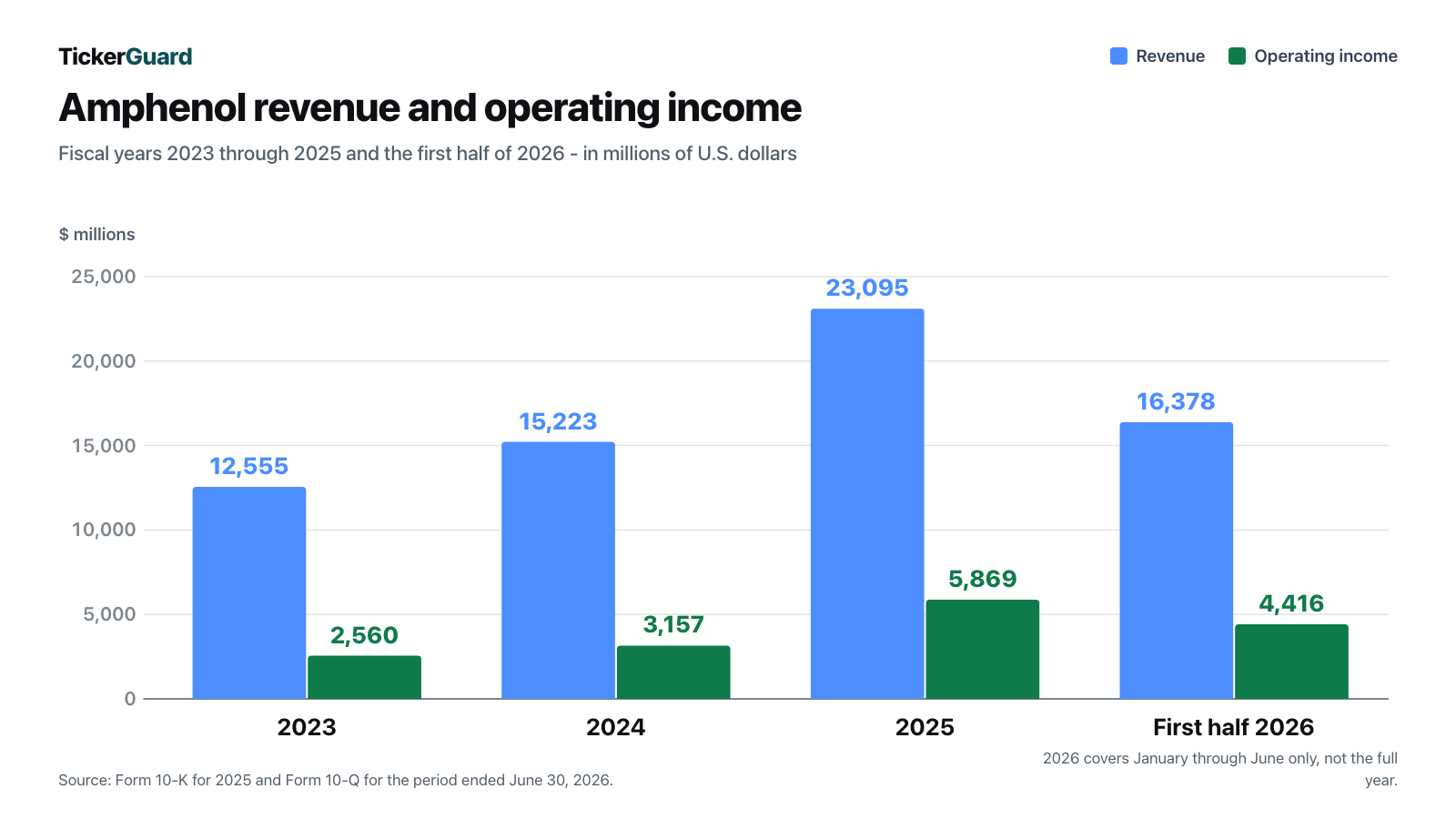
First what genuinely impresses, and there is plenty. Revenue rose from $12,554.7 million in 2023 through $15,222.7 million in 2024 to $23,094.7 million in 2025 — a doubling in two years at a company that was already large. And it is not only bought growth: the Form 10-K for 2025 reports organic growth of 38 percent, meaning excluding acquisitions and currency. In the first half of 2026 revenue already reached $16,378.2 million, up 57 percent, with 32 percent organic.
More remarkable still is the margin. Operating margin — the share of revenue left after all ongoing costs — climbed from 20.4 percent in 2023 through 20.7 percent in 2024 to 25.4 percent in 2025, and reached 29.5 percent in the second quarter of 2026. For context: a maker of physical components running close to a 30 percent operating margin sits in a league normally occupied by software companies. That is not an accounting trick; it is management.
The breadth still holds. One sentence in the Form 10-K for 2025 settles a lot of worries:
"No single customer accounted for 10% or more of the Company’s net sales during the years ended December 31, 2025, 2024 and 2023."
— Amphenol Corporation, Form 10-K for 2025, Item 1 (Business)
That is a hard, checkable statement, and it is worth more than any slide claiming "diversification." A supplier whose largest customer sits below 10 percent can survive losing one account. The second layer of distribution holds too: sales through electronics distributors — the middlemen who buy for many small customers — represented 19 percent of sales in 2025, against 18 percent the year before.
Fourteen earnings calls — what management promised and what came of it
Numbers tell you what happened. Earnings calls tell you whether to believe management about what happens next. So we listened through all fourteen quarterly calls from the first quarter of 2023 to the second quarter of 2026, with particular attention to the question-and-answer section — that is where analysts push and where management either answers or does not.
The good news first: on acquisitions, Amphenol keeps its word. For the CommScope antenna business, management guided in the first quarter of 2025 to roughly $0.06 per share of accretion and raised that to roughly $0.09 within the same year. For the far larger cable business added in January 2026, the January guidance was $4.1 billion of annual revenue and $0.15 of accretion. On July 29, 2026, CEO Adam Norwitt said:
"we now expect CommScope to deliver $4.6 billion of sales and $0.30 of accretion for the full year 2026. And this represents a significant upgrade from our previous expectations of $4.1 billion and $0.15."
— Adam Norwitt, second-quarter 2026 earnings call, July 29, 2026
Doubling expected accretion within two quarters is rare. It explains a good part of the valuation the market grants this stock.
The less good news: on margins, one thing has gone undelivered for years — not the margin, the number. Asked about margin dilution from the roughly $2 billion Carlisle Interconnect deal in 2024, Norwitt said: "I don't know that we have a specific number to give you for the margin dilution. I mean, we'll talk about it when we own the company." Two quarters later CFO Craig Lampo said "we're not going to talk so much specifically about their margins," and a quarter after that, "We're not going to give specific margin information on CIT." To this day there is no margin figure for that acquisition. That is not a scandal — but anyone wanting to check integration quality independently cannot.
And the most important finding: management's own forecasting in its largest market is weak, in both directions. In July 2025 Norwitt guided IT datacom sales to decline in the mid to high single digits in the third quarter. In October 2025 he reported: "sales increased by 13% from the second quarter, and that was substantially better than our expectation for mid to high single-digit decline." Sales rose 13 percent instead of falling. That is a roughly 20 percentage point miss in a single quarter, in the company's largest market. The takeaway for you: if management itself cannot see where this market is going, do not anchor your conviction on its outlook.
Asked about concentration on April 23, 2025, Norwitt answered with rare candor:
"if folks stop spending money on next-generation generative AI-based data centers, we won't be immune to that."
— Adam Norwitt, first-quarter 2025 earnings call, April 23, 2025
A year later, with the share of revenue already above 40 percent, he added: "who knows what the cadence of AI investments will be and when and whether it will be ups and downs, of course, there will be ups and downs." Remember that: the CEO tells you plainly that he does not steer this cycle. That is honest — and it is a risk disclosure.
Uncomfortable truth no. 1: $80 million of the record margin came from customs
Now to the heart of it. In the earnings release of July 29, 2026, Amphenol reports a GAAP operating margin of 29.5 percent and an adjusted margin of 29.8 percent — both records. Footnote (iv) to the reconciliation then says this:
"GAAP and Adjusted Operating Income for both the three and six months ended June 30, 2026 included an $80.0 million, or $0.04 per share, net benefit related to the recovery of IEEPA tariffs."
— Amphenol Corporation, earnings release of July 29, 2026, Exhibit 99.1 to Form 8-K, footnote (iv)

In plain terms: IEEPA is a U.S. emergency statute used to impose tariffs. Some of those tariffs were refunded, so Amphenol got back money it had previously paid to the government. That is a one-time item: it does not come from selling components and does not repeat on a schedule. The genuinely notable part is that Amphenol does not remove it from the adjusted figure either, even though the adjusted figure exists precisely to exclude one-time items. From the company's point of view that is defensible — tariffs are part of running a global manufacturer. From your point of view it means you have to subtract the item yourself.
To Amphenol's credit, the CEO did that arithmetic on the call. Adam Norwitt put the margin excluding the net tariff refunds at "nearly 29%" — just under 29 percent instead of 29.8 percent. So the item is worth roughly 90 basis points, or nine tenths of a percentage point. That sounds small. On $8,758.1 million of quarterly revenue it is exactly those $80 million — roughly a quarter of everything the entire Interconnect and Sensor Systems segment earned in operating income that same quarter ($318.9 million).
Two numbers make the significance concrete. First: adjusted earnings were $1.35 per share; without the $0.04 tariff effect they would have been $1.31 — growth of roughly 62 percent year over year rather than 67 percent. Still exceptional, but not the same figure. Second, and more important: for the third quarter of 2026 Amphenol guides to $9.3 billion to $9.4 billion of revenue and $1.40 to $1.42 of adjusted earnings per share, with the explicit note "This guidance does not include any additional tariff recoveries." The company is telling you it does not rely on this item. Neither should you.
A second item pulls the same way, one floor further down the income statement. In the second quarter of 2026 GAAP earnings came in at $1.37 per share, above the adjusted figure of $1.35 — an unusual inversion, since the adjusted number is normally the prettier one. The reason sits in the income tax note: employee stock option exercises cut the quarterly tax charge by $80.5 million and the effective tax rate by roughly 340 basis points (for the first half: $131.4 million and roughly 330 basis points). Amphenol strips this benefit out of its adjusted figures — correctly, because it is not part of the business. What matters is the mechanism: a benefit like this arises when the share price has risen between grant and exercise. It rides on the stock, not on revenue. If the stock stops rising it shrinks, and GAAP earnings per share fall back below the adjusted figure.
Uncomfortable truth no. 2: profit is outrunning the cash
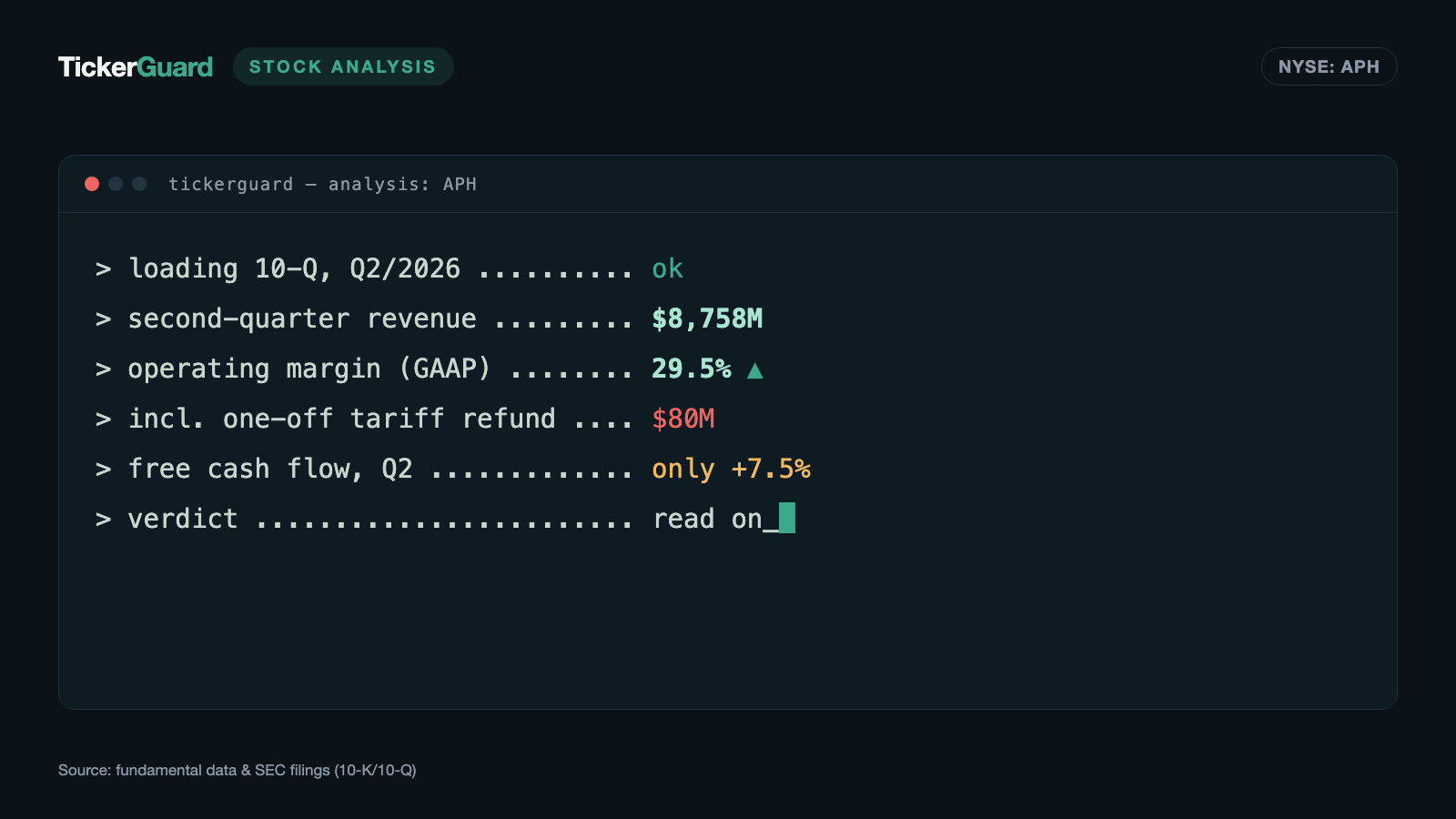
There is one figure investors routinely skip because it never makes the headline: free cash flow. In plain terms, profit is what the accountant calculates at period end; free cash flow is what is actually in the bank once every bill is paid and every machine is bought. Over time the two should track each other. In the second quarter of 2026 they did not.
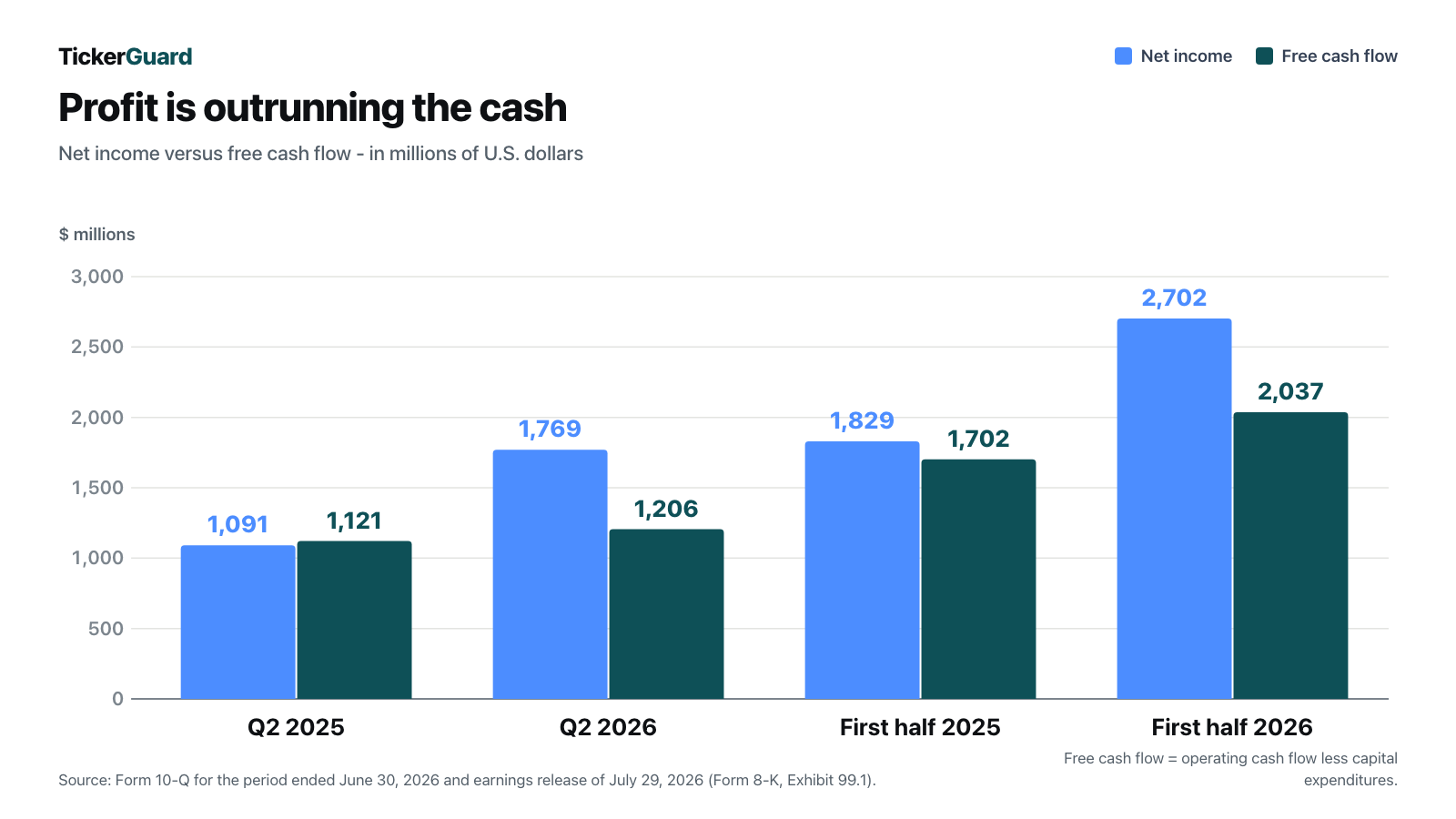
The detail, all from the Form 10-Q for the period ended June 30, 2026 and the accompanying reconciliation. Second-quarter net income rose to $1,769.2 million from $1,091.3 million a year earlier, up roughly 62 percent. Free cash flow over the same span rose from $1,121.3 million to $1,205.5 million, up 7.5 percent. In the prior-year quarter cash flow ran above profit; now it runs about a third below.
Across the first half the picture is milder but points the same way: $2,702.2 million of net income against $2,036.7 million of free cash flow — a conversion rate of 75 percent, down from 93 percent a year earlier. The cash flow statement names the cause: the outflow into working capital — inventories and unpaid customer invoices — was $1,176.4 million in the first half of 2026 against $374.3 million a year earlier. Receivables grew from $4,717.1 million to $6,790.1 million and inventories from $3,424.9 million to $4,551.6 million.
How bad is that? Honestly: explainable. A company that grows revenue 55 percent while integrating a $10 billion business has to hold more material and wait on more invoices. That is growth financing, not an alarm — free cash flow remains solidly positive at $2.0 billion for the half year, and capital expenditure of $647.1 million grew more slowly than revenue. But the rule of thumb stands: profit growing faster than cash is a promise about later. Whether it gets kept shows up in the next quarterly report.
Uncomfortable truth no. 3: $390 million of tax trouble in China
The third item is the largest, and it lives entirely in the notes. Chinese tax authorities ruled against Amphenol on prior-period tax positions. The Form 10-Q for the period ended June 30, 2026 describes it plainly:
"As a result of these unfavorable determinations, the Company received tax payment notices totaling $230.0. To fully accrue for this amount, the Company recorded an accrual of $130.0 during the three months ended March 31, 2026, which was in addition to the accrual of $100.0 recorded in the three months ended December 31, 2025. During the second quarter of 2026, the $230.0 was paid in full."
— Amphenol Corporation, Form 10-Q for the period ended June 30, 2026, Note 6 (Income Taxes)

The story does not end there. The same paragraph states that developments in the China matter led Amphenol to reassess certain tax rate assumptions applied to prior years' results that were not subject to the Chinese inquiries. The result of that reassessment: a further $160.0 million of additional tax obligations. That is $390.0 million in total — $230.0 million from the assessments plus $160.0 million from voluntary caution.
The effect on the numbers is substantial. Discrete tax items for the first half of 2026 total $329.0 million, or $0.26 per share, and raised the effective tax rate by roughly 820 basis points. The GAAP effective tax rate for the half year therefore came in at 32.4 percent against an adjusted rate of 27.0 percent. Concretely: reported first-half earnings per share rose from $1.44 to $2.10, up 46 percent, while adjusted earnings rose from $1.44 to $2.42, up 68 percent. Read only the adjusted figure and those $329 million appear nowhere.
Two things belong on the other side of the ledger. First, excluding these items is permissible and standard — back taxes for prior years genuinely are not the current business. Second, Amphenol drew the consequence and raised its adjusted effective tax rate for 2026 to 27.0 percent from 24.5 percent in the prior-year half, citing both this matter and a "continued shift in income to higher-tax jurisdictions." That second part is not a one-off but a permanent headwind of roughly 2.5 percentage points on the tax rate. And as of June 30, 2026 a further $386.1 million of unrecognized tax benefits sits on the books, of which roughly $49.3 million could be resolved within twelve months.
Uncomfortable truth no. 4: half the balance sheet was bought
Amphenol has grown through acquisitions for years, and successfully. The first half of 2026 added three deals for roughly $10,684.0 million — the largest being the connectivity and cable business that carries the CommScope name, bought from Vistance Networks, the company that itself used to be called CommScope Holding Company. The closing date was January 9, 2026.

The deal delivers. From the closing date through June 30, 2026 CommScope contributed $2,100.9 million of revenue and $190.2 million of net income. Norwitt put the business's operating margin in the second quarter of 2026 at "over 20%" including amortization, and made clear the improvement did not come from pricing but from operational execution. That is a good report card.
The bill for it sits on the balance sheet. As of June 30, 2026: goodwill of $17,554.7 million (December 31, 2025: $10,575.4 million) and other intangible assets of $5,288.9 million ($2,241.4 million). Together $22,843.6 million — against stockholders' equity of $15,491.6 million. What is goodwill? Briefly: the premium paid above the fair value of the machines, inventories and receivables acquired — paid for the team, the market position and expected savings. It sits on the balance sheet, it cannot be sold, and if the business misses expectations it has to be written down.
The financing side got heavier too. Total debt rose from $15,502.0 million to $18,811.3 million between December 31, 2025 and June 30, 2026, while cash plus short-term investments fell from $11,434.2 million to $5,419.1 million. Quarterly interest expense climbed from $80.9 million to $213.7 million — annualized, from roughly $320 million to roughly $850 million.
And now the context that also belongs here: this is carryable. Against half-year interest expense of $421.6 million stands operating income of $4,416.4 million — interest coverage, meaning how many times over the company could pay its interest from current earnings, of roughly ten times. For orientation: below three times it gets tight, below one it gets dangerous. Amphenol is nowhere near either. Net debt of roughly $13.4 billion equals about one and a half times annual earnings before interest, taxes, depreciation and amortization. That is the balance sheet of an acquirer, not of a borrower in trouble.
Uncomfortable truth no. 5: 43 percent rides on a single market
Back to the tension from the opening. Amphenol's strongest argument is breadth — and breadth is exactly what is thinning. IT datacom accounted for 43 percent of company revenue in the second quarter of 2026, growing 89 percent in U.S. dollars and 63 percent organically. In the first quarter of 2025 it was 33 percent; in the first quarter of 2026, "just over 40%" — while in the second quarter of 2023 it was only 18 percent.
What that market is, the Form 10-K for 2025 states in a sentence that captures the AI exposure exactly: Amphenol is "a global provider of interconnect solutions to designers, manufacturers and operators of internet and artificial intelligence ('AI')-enabling systems." And in 2025 alone revenue in that market rose by roughly $4,593.7 million — attributed in the filing to "the continued acceleration in and strong demand for products used in next-generation AI-related applications."
Three things make the concentration trickier than it first appears. First, there is no number. Across fourteen earnings calls Amphenol has never disclosed an AI revenue figure. Asked directly in July 2024, Norwitt said: "it's not always easy to tell what is exactly AI and what is exactly not AI. And so we've tried to be a little bit more directional about those numbers." Honest — but it means anyone anchoring a valuation on an AI revenue figure is working with a quantity the company itself says it cannot cleanly define.
Second, the record order book is not straightforwardly comparable with earlier figures. The $10.7 billion of second-quarter 2026 orders and the 1.23 to 1 book-to-bill look superb. But for the preceding quarters management itself explained that management itself explained that it had "seen customers open their order window a bit in certain cases" — in exchange for Amphenol pre-funding capacity. An order book that grows through changed ordering behavior is a weaker signal than one that grows through end demand.
Third, the very market Amphenol has spent billions acquiring into since 2023 is shrinking. Communications networks — mobile network operators and wireless equipment makers, the target market of the RFS, PCTEL, Andrew and part of the CommScope deals — represented 11 percent of second-quarter 2026 sales and grew 55 percent in U.S. dollars, but shrank 6 percent organically. For the third quarter management expects a decline "in the mid teens" from second-quarter levels. Growth in that segment is currently bought, not earned.
Fairness demands the counterpoint: there is so far no customer concentration. Norwitt stated in January 2026 that Amphenol had no 10 percent customers in 2025. The concentration sits in the market, not in a single relationship — an important distinction. Buying Amphenol is not a bet on one company; it is a bet on an investment theme. For the networking side of the same theme, see our analysis of Arista Networks.
What the stock costs — and the stock split on September 2, 2026
On valuation, orders of magnitude only, no intraday prices. At roughly $194.5 billion of market value (data as of August 30, 2026), Amphenol ranks among the hundred most valuable companies in the world. The price-to-earnings ratio — how many annual profits you pay for one share — stands at roughly 39 on a trailing twelve-month basis. Note that those earnings include the $0.26 per share hit from the China tax matter; back that out and the ratio falls to about 37. Against current-year earnings estimates it sits near 30. Price-to-sales runs at roughly 6.7 and enterprise value to earnings before interest, taxes, depreciation and amortization at roughly 23 (all data as of August 30, 2026).
What does that mean in plain terms? This is not a bargain price. Nearly 40 years of earnings for a maker of physical components is a price that assumes growth — against current-year earnings estimates the ratio falls to roughly 30, and only if those estimates hold. The premium is the bill for two things: the exceptional margin and the expectation that the AI build-out continues. Both are documented today — and documented is not the same as durable.
One more thing you need to know before comparing figures on this stock over the coming weeks: on September 2, 2026 Amphenol doubles its share count. The board approved a two-for-one stock split in the form of a stock dividend on August 5, 2026.

A stock split is the most harmless event in markets: one share becomes two, each worth half as much, and your portfolio is worth exactly the same afterwards. The image: the pizza does not get bigger, it just gets cut into twice as many slices. Practically, though, it means every per-share figure halves from September 2, 2026 — the price, earnings per share, the dividend. The $0.25 quarterly dividend becomes $0.125; guidance of $1.40 to $1.42 becomes $0.70 to $0.71. Every per-share figure in this analysis reflects the position before the split, exactly as filed with the SEC. So if you find a source in September quoting a much lower figure than we do here, that is not a contradiction — that is the split.
Upside and risk at a glance
Both lists are meant equally seriously. The upside first:
- Documented market position: no customer above 10 percent of sales in 2023, 2024 or 2025 — in writing in the Form 10-K for 2025.
- A software-grade margin: 29.5 percent operating margin in the second quarter of 2026, nearly 29 percent even excluding the tariff effect — at a maker of physical components.
- Acquisitions that deliver: expected accretion from the CommScope business was raised from $0.15 to $0.30 per share within two quarters, and the revenue outlook from $4.1 billion to $4.6 billion.
- A structure that absorbs growth: more than 140 independently run operating units, so acquisitions need not be forced into a central apparatus.
- A full order book: $10.7 billion of orders in the second quarter of 2026, a book-to-bill ratio of 1.23 to 1.
- Financing that holds: interest coverage of roughly ten times, no drawings on the $3 billion revolving credit facility, and compliance with all financial covenants confirmed as of June 30, 2026.
And the risks:
- 43 percent in one market: IT datacom has grown from 18 percent in the second quarter of 2023 to 43 percent of revenue in three years. The CEO himself says there will be "ups and downs."
- Record numbers with one-time items: $80.0 million of tariff recoveries in operating income and $80.5 million of stock option tax benefits in net income — both in the second quarter of 2026, neither from the operating business.
- Free cash flow lagging: up 7.5 percent in the quarter against 62 percent profit growth; a 75 percent half-year conversion rate against 93 percent a year earlier.
- Tax risk not closed: $390.0 million from the China matter is booked, but $386.1 million of unrecognized tax benefits remained as of June 30, 2026, with examinations open for tax years 2017 and after.
- A heavier balance sheet: goodwill and intangibles of $22,843.6 million exceed stockholders' equity of $15,491.6 million, and the purchase price allocation for the largest deal is still preliminary.
- One end market shrinking organically: communications networks down 6 percent organically in the second quarter of 2026 — precisely where billions have been acquired since 2023.
- A valuation carrying expectations: just over 39 times trailing earnings as of August 30, 2026. That valuation needs the AI build-out to continue.
A human conclusion
Remember the superlative trap from the opening? It is unusually subtle at Amphenol, because the superlatives are true. It really is record revenue. It really is a record margin. It really is a record order book. None of it is dressed up and none of it is hidden — the $80 million tariff recovery is in the release, the $390 million of China tax is in the notes, the gap between profit and cash is in the cash flow statement. Amphenol discloses everything. The trap is not that anyone is deceiving you. The trap is that after the fifth "record" you stop reading.
What is left when you read to the end? An exceptionally well-run industrial company with a margin unmatched in its industry, an acquisition machine that keeps its promises, and a customer base without a single lump. And next to that: a quarter whose record margin owes 90 basis points to a customs refund, a profit that rose 62 percent while cash rose 7.5 percent, a balance sheet where goodwill and intangibles exceed equity, and one end market now carrying 43 percent of revenue — one the CEO says plainly he does not steer.
None of this is an indictment. It is the complete version of the same story. Whether the strengths are worth the price to you, or whether you would rather wait until the cycle turns once against this company and you can see what is left of the margin — that is yours to decide, not ours. We have read you the footnotes. The rest is up to you, and that is exactly as it should be.
Sources and disclosures
- Form 10-Q for the period ended June 30, 2026, filed July 31, 2026 (balance sheet, income statement, cash flow statement, Note 4 Debt, Note 6 Income Taxes, Note 11 Acquisitions, Note 13 Reportable Business Segments)
- Form 10-Q for the period ended March 31, 2026, filed May 1, 2026
- Form 10-K for 2025, filed February 11, 2026 (Item 1 Business, Human Capital, Management's Discussion and Analysis)
- Second-quarter 2026 earnings release, Exhibit 99.1 to Form 8-K dated July 29, 2026 (GAAP to non-GAAP reconciliation, free cash flow, guidance)
- Stock split announcement, Exhibit 99.1 to Form 8-K dated August 6, 2026
- Quarterly earnings call transcripts, first quarter 2023 through second quarter 2026 (fourteen calls); all quotations checked verbatim
- Source: fundamental data & SEC filings (annual and quarterly reports, 10-K/10-Q) — market capitalization, share count and valuation ratios carry a data date of August 30, 2026
Disclosure: This article is journalistic analysis. It is expressly not investment advice and not a solicitation to buy or sell securities. Stocks can lose value sharply at any time, and a total loss of invested capital is possible with any single stock. All figures come from the primary sources linked above and carry the reporting date stated there; valuation ratios carry a data date of August 30, 2026 and change with the share price. Per-share figures reflect the position before the stock split of September 2, 2026. The author holds no position in Amphenol Corporation at the time of publication and does not intend to initiate one within the next 72 hours.
Key figures at a glance
All monetary figures in millions of $; earnings per share as reported.
| Metric | 2021 | 2022 | 2023 | 2024 | 2025 |
|---|---|---|---|---|---|
| Revenue | 10,876.3 | 12,623.0 | 12,554.7 | 15,222.7 | 23,094.7 |
| Operating Income (EBIT) | 2,175.5 | 2,607.3 | 2,559.6 | 3,284.3 | 5,868.6 |
| Net Income | 1,590.8 | 1,902.3 | 1,928.0 | 2,424.0 | 4,270.3 |
| Net Margin | 14.6% | 15.1% | 15.4% | 15.9% | 18.5% |
| Earnings Per Share | 1.27 $ | 1.53 $ | 1.55 $ | 0.96 $ | 1.67 $ |
Source: fundamental data & SEC filings (annual and quarterly reports, 10-K/10-Q)
Our Bottom Line at a Glance
- Market position and breadth positive
- Amphenol serves seven end markets across three segments through more than 140 largely self-directed operating units. The Form 10-K for 2025 states explicitly that no single customer accounted for 10 percent or more of net sales in 2025, 2024 or 2023. Customer concentration is documented to be absent.
- Earnings power positive
- The operating margin rose from 20.4 percent in 2023 to 20.7 percent in 2024 to 25.4 percent in 2025, reaching 29.5 percent in the second quarter of 2026. Even excluding the $80.0 million tariff recovery, the CEO put it at nearly 29 percent on the July 29, 2026 call. For a maker of physical components that is exceptional.
- Quality of the record numbers neutral
- Second-quarter 2026 results contain an $80.0 million tariff recovery ($0.04 per share) that Amphenol does not strip out of its adjusted figures, plus $80.5 million of excess tax benefits from stock options ($0.06 per share) that cut the effective tax rate by roughly 340 basis points. Both are properly disclosed — but neither came from the operating business.
- Conversion into cash neutral
- In the first half of 2026, $2,702.2 million of net income converted into $2,036.7 million of free cash flow — 75 percent, down from 93 percent a year earlier. The cause is a $1,176.4 million working capital outflow. With 55 percent revenue growth that is explainable, but it is a line item worth finding again in the next report.
- Balance sheet and financing neutral
- Total debt rose from $15,502.0 million to $18,811.3 million between December 31, 2025 and June 30, 2026, and quarterly interest expense from $80.9 million to $213.7 million. Goodwill and intangibles of $22,843.6 million exceed stockholders' equity of $15,491.6 million. Interest coverage nevertheless stands at roughly ten times operating income.
- Dependence on the AI build-out negative
- IT datacom accounted for 43 percent of second-quarter 2026 sales, up from roughly a third in the first quarter of 2025. CEO Adam Norwitt said on April 23, 2025: "if folks stop spending money on next-generation generative AI-based data centers, we won't be immune to that." The company still discloses no AI revenue figure.
Amphenol is operationally one of the strongest industrial companies in the world: 55 percent revenue growth, a 29.5 percent operating margin, no customer above 10 percent of sales, and an acquisition record of promises kept. That is precisely why it is worth looking at what else sits inside the record numbers — an $80.0 million tariff recovery, excess tax benefits from stock options, a $390.0 million tax matter in China, and free cash flow that rose 7.5 percent in the quarter while profit rose 62 percent. Not investment advice.
What Our Rating Means
Open questions
The business works in principle, but one material question is open. As long as it stays open, our findings do not carry a quality verdict.
The quality of the company is not in doubt: the business model has worked for decades, the balance sheet carries interest coverage of roughly ten times, no customer accounts for 10 percent or more of sales, and operational execution is exceptional. Yellow here reflects an open operating question, not a solvency risk. A single end market has grown from 18 percent to 43 percent of revenue in three years; the record order book rests, by the company's own account, partly on customers deliberately opening their order window, which makes it less comparable to earlier order figures; and the record second-quarter 2026 margin contains $80.0 million of tariff recoveries that third-quarter guidance explicitly excludes. Whether the earnings power of the last four quarters is a durable base or the peak of an investment cycle cannot be settled from the filings today. The decision is yours.
A journalistic assessment by our editorial team at the time of the deep dive, based on public sources — not investment advice and not a solicitation to buy or sell. Your personal circumstances (investment goals, risk capacity, taxes) cannot be taken into account. What our levels mean, how verdicts are formed, and what conflicts of interest exist →
Worth Noting
- This analysis was triggered by the Form 10-Q for the period ended June 30, 2026, filed July 31, 2026, together with the earnings release of July 29, 2026.
- All per-share figures reflect the position BEFORE the two-for-one stock split. Additional shares are distributed on September 2, 2026; from that day the price, earnings per share and dividend per share all halve arithmetically.
- Market capitalization, share count and valuation ratios carry a data date of August 30, 2026; balance sheet and income figures carry the reporting date of the respective filing.
- Easily confused: the connectivity and cable business acquired in 2026 still carries the CommScope name. The seller was Vistance Networks, Inc. — the company that itself used to be called CommScope Holding Company and remains separately listed.
Stock Watch
This analysis is as of August 30, 2026. Stock Watch will tell you what's changed at APH since then.
Later $1 a month per stock — signing up is free, and you'll be the first to know when it launches.
The full analysis as a PDF for later
We will send you this analysis as a PDF — to print, file away, and read at your own pace. And we will add you to the free Stock Watch list for Amphenol Corporation (APH), so you hear about it when something material in this analysis changes.
Frequently Asked Questions
Amphenol makes the connecting pieces of electronics: connectors, sensors, antennas and coaxial, high-speed and fiber optic cable. Those parts sit inside data centers, cars, aircraft, defense systems, cell towers and factory equipment. As of December 31, 2025 the company employed roughly 170,000 people across approximately 40 countries.
Heavily, and increasingly so. IT datacom accounted for 43 percent of company revenue in the second quarter of 2026, up from roughly 33 percent in the first quarter of 2025. The Form 10-K for 2025 puts the increase in that market alone at approximately $4,593.7 million and attributes it explicitly to AI applications. Amphenol discloses no separate AI revenue figure.
Per the earnings release of July 29, 2026, second-quarter operating income includes an $80.0 million net benefit from the recovery of tariffs imposed under the U.S. emergency statute known as IEEPA, equal to $0.04 per share. What is unusual is that Amphenol does not remove this one-time item from its adjusted figures either. Third-quarter guidance contains no further recoveries.
In the second quarter of 2026, GAAP earnings were $1.37 per share against $1.35 adjusted. The reason: Amphenol strips out excess tax benefits from stock option exercises. Those cut the quarterly tax charge by $80.5 million and the effective tax rate by roughly 340 basis points. The benefit depends on the share price — if the stock stops rising, it shrinks.
Chinese tax authorities ruled against Amphenol regarding prior-period tax positions. The company received tax payment notices totaling $230.0 million, which it paid in full during the second quarter of 2026. It also recorded $160.0 million for a reassessment of years that were never under inquiry. Together $390.0 million; the GAAP tax rate for the first half of 2026 rose to 32.4 percent as a result.
Arithmetically nothing about portfolio value. The board approved a two-for-one split in the form of a stock dividend on August 5, 2026. Holders of record on August 17, 2026 receive one additional share per share on September 2, 2026. After that the price, earnings per share and dividend all halve: third-quarter guidance becomes $0.70 to $0.71 instead of $1.40 to $1.42 per share.
Sound, but considerably heavier. Total debt rose from $15,502.0 million to $18,811.3 million between December 31, 2025 and June 30, 2026, and quarterly interest expense from $80.9 million to $213.7 million. Against that stand $5,419.1 million of cash and short-term investments plus $4,416.4 million of first-half operating income — interest coverage of roughly ten times.
No. On January 9, 2026 Amphenol bought the connectivity and cable business that carries the CommScope name, for roughly $10.7 billion together with two other acquisitions. The seller was Vistance Networks, Inc., which itself used to be called CommScope Holding Company and remains separately listed. The name stayed with the business sold, not with the seller.
Found an error?
Did you spot a factual error, an outdated number, or a typo in this deep dive? Let us know briefly — your report goes straight to the editorial team.