Arista Networks: A Nearly Perfect Company — and a $243 Billion Bet on Two Customers
Arista Networks just reported the first $3 billion quarter in its history: 37.7 percent revenue growth, zero financial debt, $13.3 billion in liquidity. We read the quarterly report as of June 30, 2026 and three years of earnings calls — and found a company that shows almost no weakness, yet has stacked up $9.7 billion in non-cancelable purchase commitments and depends on two customers for 42 percent of revenue. Not investment advice, just the arithmetic of what you actually buy when you reach for a nearly perfect company.
 Thomas Mücke
Founder & Publisher
Thomas Mücke
Founder & Publisher
As of Today
As of: September 22, 2026
- Closing price
- 205.20 $ -0.10%
- Market Capitalisation
- 278.1 $B
- P/E
- 69.3
- Growth Score
- 10/10
- AAQS
- 9/10
This analysis has a cut-off date. The Stock Guard tells you when something material changes in the numbers. Reserve your free spot
Chart
Interactive price chart (TradingView).
52-week range: 116.10 $ to 210.50 $ · Last price: 205.20 $ (As of: September 22, 2026)
Note: pure fact-based analysis, not investment advice and not a solicitation to buy or sell. All figures without guarantee.
There is an investor trap that snares good companies most dangerously of all: the extrapolation trap. It works like this — a company delivers quarter after quarter of growth rates that other firms only promise in marketing decks, and your brain automatically draws a straight line through the last few data points into the future. "If it grew 37 percent for three years, why not the next three too?" That is exactly the moment you stop buying a company and start buying a curve. Arista Networks (NYSE: ANET) is, in August 2026, the acid test for that temptation: a network-equipment maker out of Santa Clara that just reported its first-ever $3 billion quarter, carries no meaningful debt on its balance sheet, and runs a gross margin most industrial companies can only dream of. So let's make a deal: before you extend 37 percent growth into the future, let's read the fresh quarterly report (10-Q) as of June 30, 2026, the annual report (10-K) for 2025, and three years of earnings calls together. An SEC filing is honest under penalty of law. And alongside the impressive numbers, it shows what this nearly perfect company is actually built on: two large customers, a single essential chip supplier, and a $9.7 billion purchase-commitment bet on the AI cycle. In the end, you decide for yourself what a perfect company is worth once its perfection is already fully priced in.
What Arista Networks actually builds — the internet's traffic-control center
Arista Networks builds network switches and routers — in everyday terms, the traffic hubs that route data packets to the right place inside data centers, AI compute clusters, corporate campus networks and wide-area links, the way a well-designed highway interchange moves cars in every direction without gridlock. The centerpiece isn't just the hardware, but Arista's own operating system, EOS (Extensible Operating System), which runs on every Arista device — a single control layer for the entire network, whether on the smallest campus switch or the largest AI cluster. Arista organizes its business strategically into four "Centers of Data": AI Centers (networking for AI training and inference clusters), Data Centers (classic cloud data centers), Campus Centers (office and enterprise networks) and WAN Centers (wide-area links between sites). Its customer base splits into three groups: the "Cloud and AI Titans" — a handful of the world's largest technology companies — "AI and Specialty Providers," and traditional enterprise customers. Arista doesn't manufacture in-house: it uses contract manufacturers and sources the critical switching chips mainly from a single semiconductor vendor — more on that shortly, since it's one of this analysis's three uncomfortable truths. The company was founded in 2004 and went public in June 2014; Jayshree Ullal has led as Chief Executive Officer and Chairperson for many years, with Chantelle Breithaupt as CFO. As of December 31, 2025, Arista employed roughly 5,115 full-time workers — a lean headcount for a company of this size, which already says something about the margin structure we'll get to shortly.
That sets up the tension at the heart of this analysis, and it runs through every chapter that follows: Arista is a nearly perfect company — growing, highly profitable, completely debt-free — but that perfection rests on two large customers, a single essential chip supplier, and a multibillion-dollar bet on an uninterrupted AI cycle. And the stock price already assumes none of that ever breaks.
Where this stock landed on our desk — the first $3 billion quarter
Arista Networks landed on our research list via the calendar: on August 4, 2026, the company published its earnings release (8-K, Exhibit 99.1) for the second quarter of 2026, followed a day later, on August 5, 2026, by the full quarterly report (10-Q). The headline is easy to back up with numbers: $3,035.7 million in revenue — the first quarter in company history above the $3 billion mark, up 37.7 percent year over year. A figure that would look utopian for most established industrial companies of this size is, for Arista, already the fourth or fifth consecutive quarter running at a similarly blistering pace. That contrast — a mature, profitable, 5,115-person company still growing like a startup — is exactly why we're taking a closer look now: growth rates like these tempt you to simply extrapolate them without asking what they're actually made of. So next we'll first walk through the longer history of the numbers before dissecting the fresh quarter in detail.
The numbers over the years — an honest look
First, what genuinely impresses. Arista has more than tripled revenue in four years: from $2.9 billion (2021) through $4.4 billion (2022) and $5.9 billion (2023) to $7.0 billion (2024) and finally $9.0 billion in fiscal 2025 — exactly $9,005.7 million per the annual report (10-K). Net income over the same period grew from $0.8 billion to $3.5 billion (exactly $3,511.4 million), a net margin of roughly 39 percent — a level you'd typically expect from a software-licensing business, not a hardware maker.
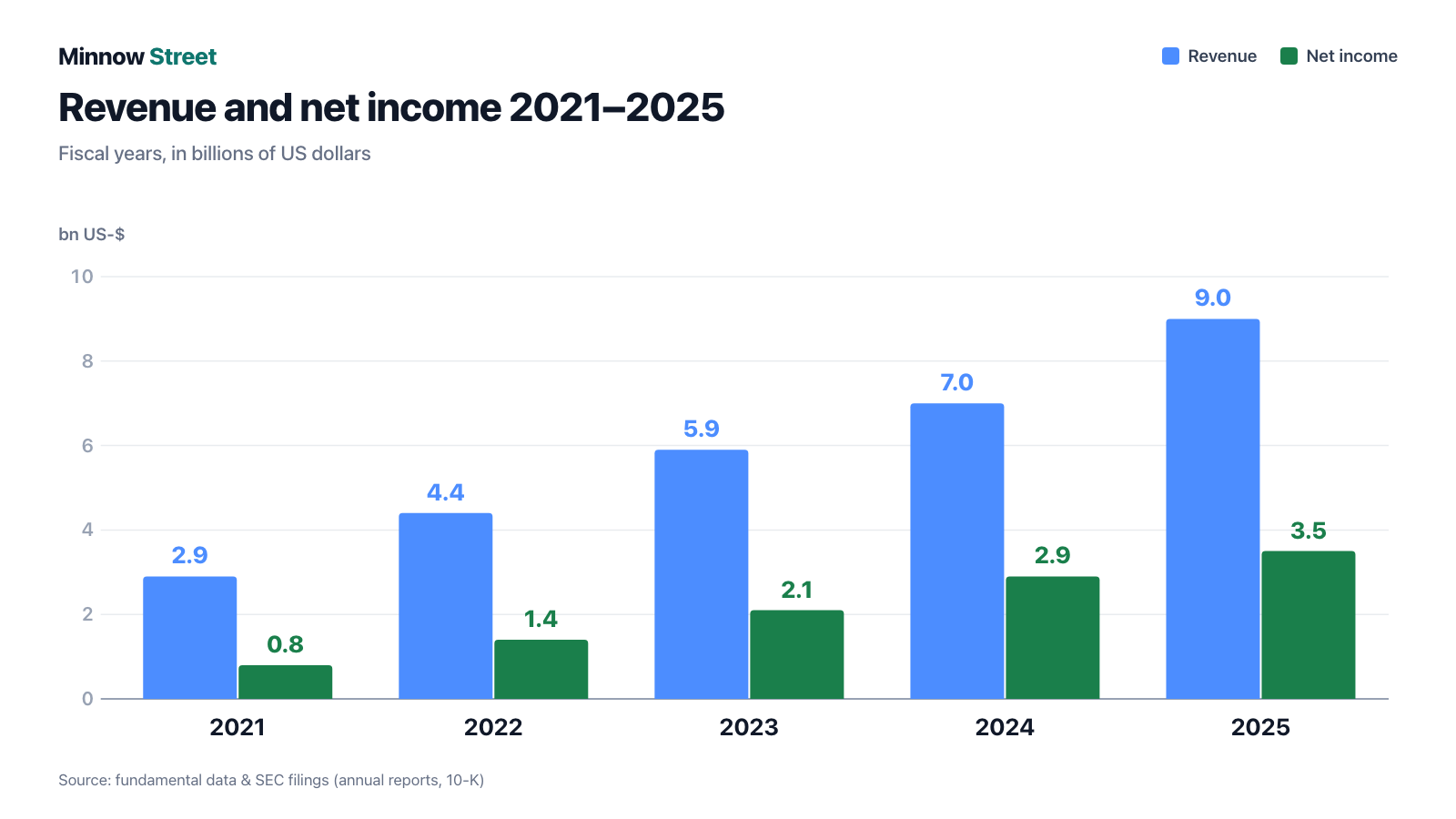
What sets this series apart from most growth stories: there's no outlier year, no loss year, no capital raise that bought the growth. Every single year since 2021 was more profitable than the one before, in both absolute and relative terms. That consistency is exactly what lures investors into the extrapolation trap — a curve that has known only one direction for five years starts to look like a law of nature. Whether it stays one, though, depends not on the past but on the customers, suppliers and purchase commitments we'll tackle one by one in the following chapters. First, though, to the freshest data point: the second quarter of 2026 in detail.
The fresh quarterly report under the microscope: reported vs. adjusted
Read only the second-quarter 2026 headlines and you see a flawless picture: $3,035.7 million in revenue (+37.7 percent), GAAP net income $1,212.9 million (prior year: $888.8 million), diluted earnings per share $0.95 (prior year: $0.70), GAAP operating margin 45.4 percent. Non-GAAP — the adjusted metric Arista reports in addition to its legally required GAAP figures — comes in even higher, at $1.02 in earnings per share versus $0.73 a year earlier, a gain of nearly 40 percent. Before taking that headline at face value, it's worth looking at the bridge between the two numbers — it appears verbatim in the earnings release (8-K, Exhibit 99.1):
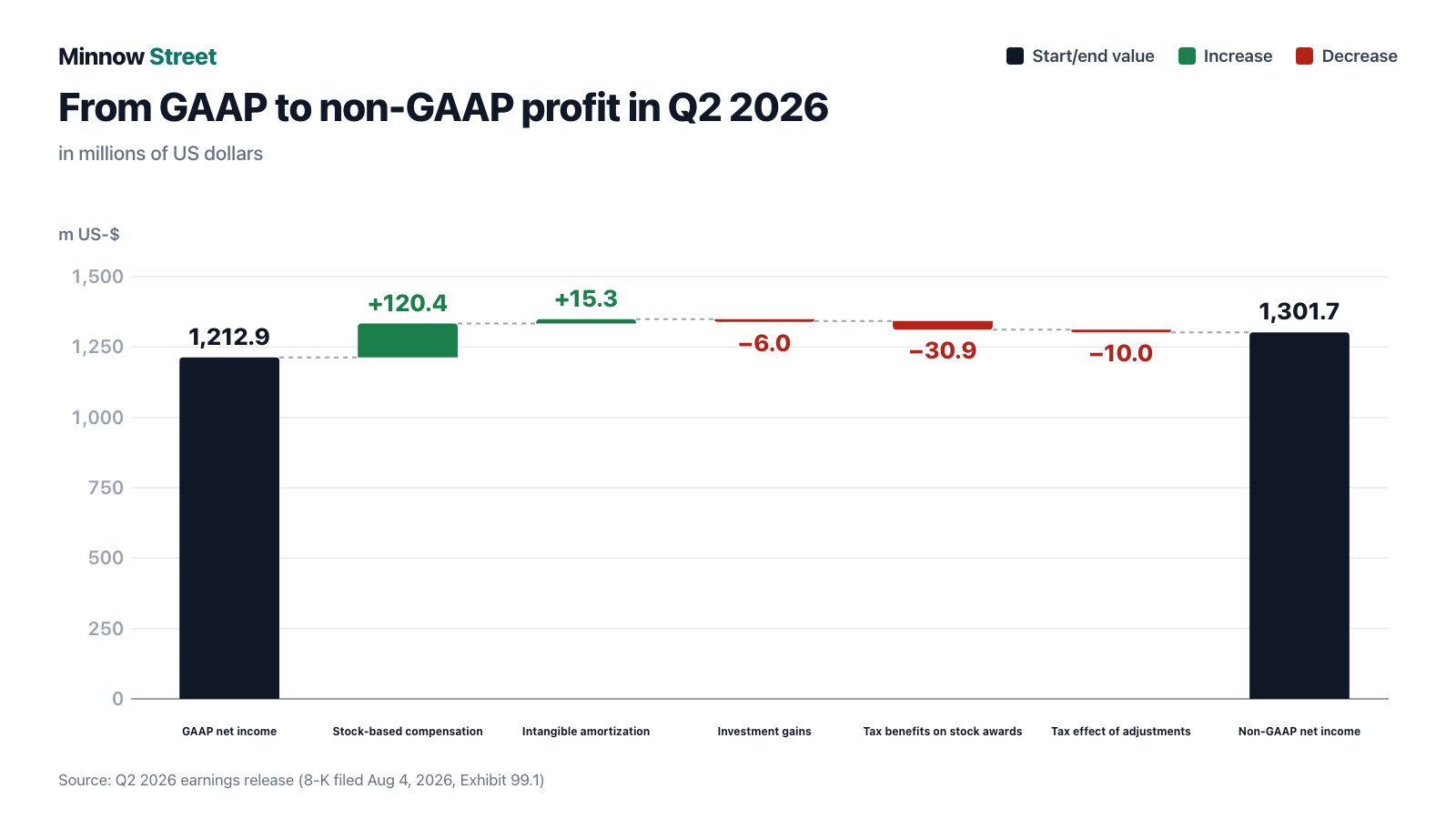
Three things matter here before you form a judgment. First: the gap between GAAP and non-GAAP earnings consists almost entirely of stock-based compensation — $120.4 million, roughly 9 percent of total non-GAAP earnings. Stock-based compensation isn't an accounting trick; it's a real personnel expense: Arista pays part of its workforce in stock instead of cash, and reading the non-GAAP number effectively strips that cost out. Second, Arista revised its non-GAAP tax methodology and applied it retroactively to prior-year figures — the earnings release states this literally in a footnote: prior-year-quarter non-GAAP earnings were revised up by $10.7 million as a result (first half 2025: +$30.4 million), which made no difference to earnings per share in the quarter and a $0.03 difference over the half-year. The widely cited non-GAAP EPS growth rate is therefore measured partly against a newly recalculated, higher prior-year base. Third, $122.4 million of interest income (plus $3.9 million of other income) came entirely from the $13.3 billion cash and investment pile — about 8 percent of pretax income, earned on the cash, not on the networking business. The GAAP tax rate of 19.4 percent for the quarter is also pushed down by tax benefits tied to stock-based compensation ($30.9 million), and on the earnings call management additionally credited tariff refunds and a more favorable customer mix for helping gross margin. The honest takeaway: even after stripping out all of these effects, the quarter remains strong — a 45.4 percent GAAP operating margin is exceptional. The distortion isn't in the profit itself, but in the optics of the growth and margin headlines, which look even more impressive at first glance than they turn out to be on closer inspection.
And one more point belongs in this chapter: reported gross margin fell from 65.2 percent (Q2 2025) to 62.9 percent (Q2 2026) — a drop of more than two percentage points in a single year, despite record revenue. Operating margin did tick up slightly on scale effects (GAAP 45.4 versus 44.7 percent a year earlier), but the sliding gross margin is a thread that runs through the chapters that follow.
What three years of conference calls reveal
Numbers from a single quarter only tell half the story. The other half sits in what management has publicly promised over multiple years — and then actually delivered — and in how the tone shifts in the question-and-answer sessions that follow the scripted opening remarks. We reviewed the earnings calls from late 2023 through the current quarter, Q2 2026.
Promise kept, then exceeded. In late 2023 the AI target still sounded cautious:
"We are cautiously optimistic about achieving our AI revenue goal of at least $750 million in AI networking in 2025."
— Jayshree Ullal, Arista Networks, Q4/2023 earnings call
A year later that turned into a considerably larger target:
"We remain optimistic about achieving our AI revenue goal of $1.5 billion in AI centers, which includes the $750 million in AI back-end clusters in 2025."
— Jayshree Ullal, Arista Networks, Q4/2024 earnings call
And in early 2026, the scorecard — both targets not just met, but beaten:
"As expected, we have exceeded our strategic goals of $800,000,000 in campus and branch expansion as well as $1,500,000,000 in AI center networking."
— Jayshree Ullal, Arista Networks, Q4/2025 earnings call
That guidance history speaks to management's credibility: set a cautious target first, raise it, then deliver. The same pattern is repeating right now for 2026 — the AI-revenue target moved from $2.75 billion (September 2025) through $3.25 billion (Q4 call, February 2026) to "at least $3.5 billion" (the Q1 and Q2 2026 calls). Worth noting: on the Q2 2026 call, Ullal's prepared remarks even cited "our overall AI target of at least $3.6 billion in 2026," while the CFO on the same call stuck with $3.5 billion — a small but visible inconsistency between the two executives. That lines up with the latest full-year guidance raise:
"We increase our guidance for the third time this year to $12.6 billion revenue in 2026 … 40% revenue growth, equating to approximately $12.6 billion."
— Arista Networks, Q2/2026 earnings call
A third guidance raise inside a single year is a strong signal — but it's also a sign of how readily the market now reads every quarterly result as confirmation of a linear future. The tone shift on demand is notable too: in 2023 management still sounded measured ("we expect near-term cloud titan demand to moderate, with spend favoring their AI investments"), while by 2025 the language had turned bold: "We find ourselves amid an undeniable and explosive AI megatrend." On the supply chain, though, the tone swings the other way — more sober, not more euphoric. On the most recent call, Ullal warned bluntly:
"I don't want you to believe that suddenly, we waved the magic wand and all our problems have gone away. The industry is going to have a 2-year problem. I don't think we get out of it as an industry until 2028."
— Jayshree Ullal, Arista Networks, Q2/2026 earnings call
The question-and-answer sessions, where analysts get to push back, are even more revealing. On the Q2 2025 call, analyst Tal Liani asked bluntly about the sustainability of Arista's high operating margin:
"At 49% — almost 49% operating margin, when do you start to upset your customers … because they have an alternative to buy white boxes and it's cheaper."
— Tal Liani, analyst, Q2/2025 earnings call
Ullal's answer was a counter-question, not a number:
"Okay, Tal. That's a loaded question on sustainability. So have we had sustainability over the last 15 years? Have we had white box over the last 15 years? I mean, I'm asking these questions rhetorically."
— Jayshree Ullal, Arista Networks, Q2/2025 earnings call
And on the first-quarter 2026 call, management effectively conceded, in its own words, what the side-find numbers above document: qualification cycles for new products have stretched from "two to four quarters" in the past to "more like six to even eight quarters" now — exactly why the prepayment balance is growing faster than reported revenue. This chapter's bottom line: on the strategic AI targets, management has consistently set cautious goals first and then beaten them — that speaks to reliability. On supply chain, qualification cycles and white-box competition, though, the open Q&A sounds noticeably more defensive than the polished opening statement.
Uncomfortable truth #1: two customers carry 42 percent of revenue
The annual report (10-K) for 2025 puts it plainly:
"Two of our customers accounted for more than 10% of our sales for the year ended December 31, 2025. Sales to these two customers represented 26% and 16% of our total revenue for the year ended December 31, 2025, respectively."
— Arista Networks, Inc., SEC annual report 10-K for 2025

The 2025 10-K anonymizes the customer names. The 2024 annual report (10-K), however, still names them — and the time series lines up cleanly:
"sales to our end customer Microsoft represented 20%, 18% and 16% of our total revenue for the years ended 2024, 2023 and 2022 respectively. And sales to our end customer Meta Platforms represented 15%, 21% and 26% of our total revenue, respectively for the years ended 2024, 2023 and 2022."
— Arista Networks, Inc., SEC annual report 10-K for 2024
The quarterly report (10-Q) as of June 30, 2026 continues the anonymized series: one customer at 16/15/21 percent (2025/2024/2023), the other at 26/20/18 percent — exactly the continuation of the 2024 series for Meta Platforms (15/21/26) and Microsoft (20/18/16), respectively. The natural conclusion: the 26-percent customer in 2025 is very likely still Microsoft, and the 16-percent customer Meta Platforms — even though the current annual report no longer names them itself. In everyday terms: picture a contracting business where two clients together bring in 42 of every 100 dollars of revenue. If either one says "we're building less this year," it hits the whole business, no matter how well everyone else is doing. That's precisely what the quarterly report itself warns about:
"We have experienced unpredictability in the timing of orders from our high-volume customers, primarily due to the inherent complexity of large-scale orders and fluctuations in their specific demand."
— Arista Networks, Inc., SEC quarterly report 10-Q as of June 30, 2026
And there's another side effect of this concentration spelled out explicitly in the filing: large orders come with discounts that weigh on margin — "the pricing discounts typically required for these large-scale orders adversely impact our gross margins." At Arista, customer concentration isn't just a revenue-side risk, then; it's also structural pressure on the very gross margin that, as the deep-dive chapter above showed, has already slipped from 65.2 to 62.9 percent.
Uncomfortable truth #2: the $9.7 billion bet on the AI cycle
We flagged the second uncomfortable truth above as a side-find already, but it belongs at the center of this analysis too: as of June 30, 2026, Arista has committed to $9.7 billion in non-cancelable purchase obligations — more than all of 2025's revenue ($9.0 billion). At the end of 2025 it was $6.8 billion, and per a statement on the Q2 2026 call, only about $3.6 billion a year earlier — the commitments have nearly tripled in twelve months.
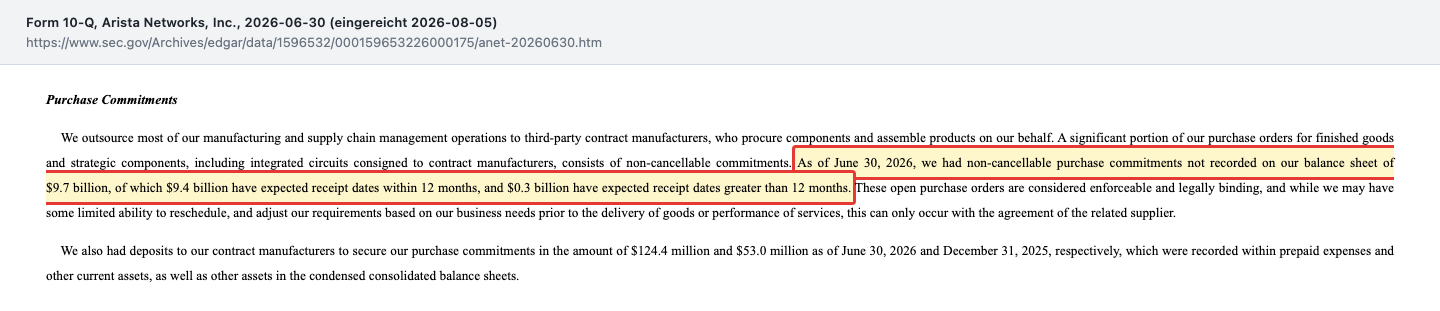
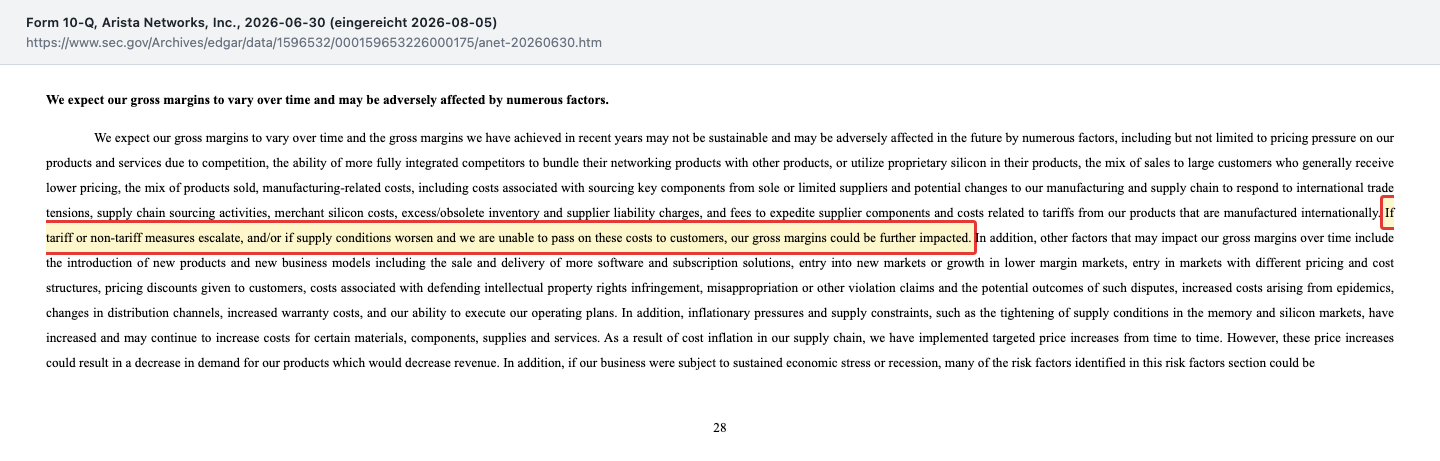
That fits with the gross-margin trend already covered in the deep-dive chapter: down from 65.2 to 62.9 percent. The quarterly report spells out the downside of this hedging strategy directly:
"If tariff or non-tariff measures escalate, and/or if supply conditions worsen and we are unable to pass on these costs to customers, our gross margins could be further impacted."
— Arista Networks, Inc., SEC quarterly report 10-Q as of June 30, 2026
In everyday terms: Arista is acting like a restaurant owner who, seeing a fully booked reservation book, orders two years of food supplies in advance so the next shortage wave doesn't leave the kitchen empty. Smart, as long as the guests keep coming. If they don't — because the cloud and AI titans throttle their investment budgets, as Ullal herself hinted for the industry through 2028 on the most recent call — Arista is left holding $2.5 billion of inventory and non-cancelable purchase obligations it still has to pay for regardless. That's exactly the picture behind the second side-find above: $8.4 billion of contractually secured future revenue sounds reassuring, but it sits against an even larger pile of Arista's own obligations.
Uncomfortable truth #3: a single chip supplier underpins nearly the entire business
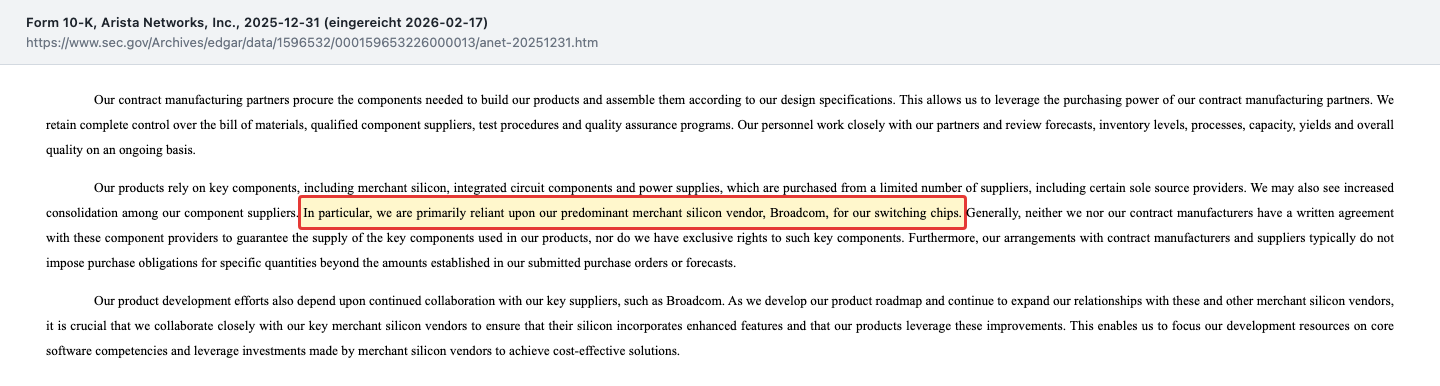
The third uncomfortable truth sits deeper in the supply chain. Arista develops its own operating system, EOS, and designs its own switches, but for the critical components — the switching chips that actually process network traffic in hardware — it relies almost entirely on a single vendor. The annual report (10-K) for 2025 names it directly:
"In particular, we are primarily reliant upon our predominant merchant silicon vendor, Broadcom, for our switching chips."
— Arista Networks, Inc., SEC annual report 10-K for 2025
It gets even more striking once you look at the contractual basis for this dependency — there essentially isn't one:
"Generally, neither we nor our contract manufacturers have a written agreement with these component providers to guarantee the supply of the key components used in our products."
— Arista Networks, Inc., SEC annual report 10-K for 2025
In everyday terms: Arista has built its entire business model on a supplier relationship that legally feels more like a handshake than an enforceable contract. That's not unusual in the chip industry — supply guarantees are rarely the norm there — but it doesn't make the dependency any less real. At the very moment Arista is aggressively ramping its own purchase volume to $9.7 billion to hedge against supply shortages, the entire chain hangs on the goodwill of a single vendor with no written commitment. For a sense of how capital-intensive and fiercely contested the AI-infrastructure ecosystem has become on the selling side of this boom, see our Nvidia stock analysis — and for how a smaller networking company with a similar customer mix (hyperscalers wiring up their AI clusters) faces the same tension between growth and dependency, we dissected it in our Credo stock analysis.
Valuation: priced-in perfection
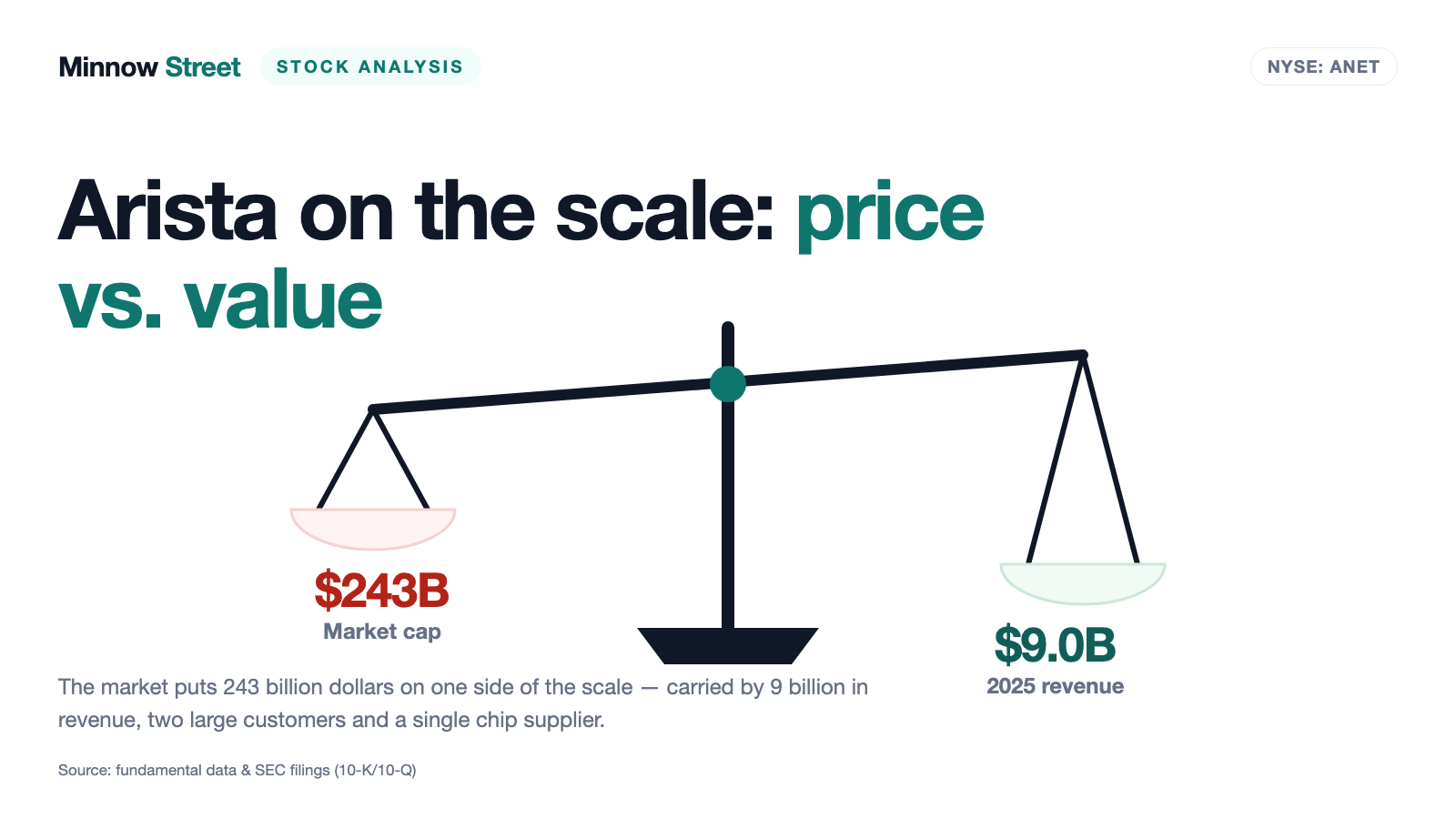
How expensive is this nearly perfect company? Market capitalization stood at roughly $243 billion on August 8, 2026. Against the trailing four completed quarters (TTM net income $4,044.6 million), that's a price-to-earnings ratio of roughly 60; against TTM revenue of $10,540.8 million, a price-to-sales ratio of roughly 23 — both figures as of August 8, 2026. To put that in perspective, a simple sensitivity check: even if Arista hits its own, already three-times-raised $12.6 billion revenue target for 2026 (about 40 percent growth) and net margin holds steady at roughly 38 percent, profit would land at around $4.8 billion — earnings would need to more than double from the current TTM base just for the P/E ratio to fall from roughly 60 to about 30, a level that would still sit well above the market average. In other words: even an investor who fully believes and extrapolates the 40 percent growth guidance for 2026 is already paying a steep multiple for it today. That's not a statement about whether the stock rises or falls in the coming months — valuation and price action are two different things — but a statement about margin of safety: there is practically none. Not one of the three uncomfortable truths above — customer concentration, the purchase-commitment bet, supplier dependency — even needs to materialize to weigh on the stock; it's enough for the market to start doubting one of them.
Opportunities and risks at a glance
What speaks for Arista Networks:
- Five straight years of accelerating, uninterrupted growth: revenue from $2.9 to $9.0 billion (2021–2025), net income from $0.8 to $3.5 billion — at a net margin of roughly 39 percent that many software companies don't reach.
- A fundamentally healthy, debt-free balance sheet: $13.3 billion in liquidity (June 30, 2026), zero financial debt, equity of $14.8 billion.
- A documented track record of guidance discipline: the 2025 AI-revenue targets ($750 million, later $1.5 billion) were not just met but exceeded; the full-year 2026 target has already been raised three times, most recently to $12.6 billion.
- $8.4 billion in contractually secured future revenue (remaining performance obligations, June 30, 2026) provides visibility into coming quarters.
What speaks against it:
- Customer concentration: two customers — Microsoft and Meta Platforms, based on a year-by-year comparison — bought a combined 42 percent of 2025 revenue; the annual report itself warns of unpredictable ordering behavior from these large customers.
- $9.7 billion in non-cancelable purchase obligations (June 30, 2026) — nearly tripled in twelve months — plus $2.5 billion of inventory: a binding bet on an uninterrupted AI investment cycle.
- Gross margin has already fallen from 65.2 to 62.9 percent, with an explicit risk warning about further pressure from tariffs and supply conditions.
- Near-total reliance on a single chip supplier (Broadcom) with no written supply guarantee.
- No margin of safety in the valuation: P/E around 60, price-to-sales around 23 (as of August 8, 2026) — even 40 percent 2026 growth fully extrapolated would only bring the P/E down to roughly 30.
A human verdict
Back to the extrapolation trap from the opening. Its core isn't that the curve is wrong — Arista Networks has delivered for five straight years, just reported its first-ever $3 billion quarter, and carries no meaningful financial debt on its balance sheet. Its core is that a track record this flawless tempts your brain to treat next year, or the next five years, as a simple extension of the line — without asking what that line actually rests on. After reading the quarterly report, the annual report, and three years of earnings calls, the answer can be stated precisely: on two large customers who together carry 42 percent of revenue and whose ordering behavior the company itself calls unpredictable; on a single chip supplier with no written supply guarantee; and on a $9.7 billion purchase-commitment bet that has nearly tripled in a year and only pays off if the AI investment cycle keeps running the way it has — an assumption management itself cautioned against on the most recent call, when it spoke of a "two-year problem" for the industry through 2028. None of that makes Arista a bad company. But it does turn the curve into something other than a law of nature: a bet with very specific, named conditions. So the honest question isn't "will Arista keep growing 37 percent in 2027 too?" but rather: are you willing to pay a price, for a nearly perfect company, that leaves no room for a single disappointment from two customers, one supplier, or one purchase cycle? What you make of that is your call. And that's exactly as it should be.
Sources
All original documents used in this analysis — for further reading:
- Arista Networks, Inc. — SEC quarterly report 10-Q as of June 30, 2026 (filed August 5, 2026)
- Arista Networks, Inc. — Earnings release 8-K of August 4, 2026, Exhibit 99.1
- Arista Networks, Inc. — SEC annual report 10-K for 2025
- Arista Networks, Inc. — SEC annual report 10-K for 2024
- Earnings-call transcripts Q4/2023 through Q2/2026: investors.arista.com
- Complete SEC filing history for Arista Networks: EDGAR overview (sec.gov)
- Fundamental data (metrics, valuation; data as of August 8, 2026), reconciled against the SEC filings.
Transparency & disclaimer: This analysis is a journalistic assessment of publicly available information and not investment advice, not a regulated financial analysis, and not a solicitation to buy or sell securities. Equity investments carry substantial risk, including total loss. All figures without guarantee; the data-as-of date is noted in the text. Positions held by the operator are disclosed daily; where one exists, it appears as a notice at the top of this deep dive.
Key figures at a glance
All monetary figures in millions of $; earnings per share as reported.
| Metric | 2021 | 2022 | 2023 | 2024 | 2025 |
|---|---|---|---|---|---|
| Revenue | 2,948.0 | 4,381.3 | 5,860.2 | 7,003.1 | 9,005.7 |
| Operating Income (EBIT) | 924.7 | 1,527.1 | 2,257.2 | 2,944.6 | 3,856.1 |
| Net Income | 840.9 | 1,352.4 | 2,087.3 | 2,852.1 | 3,511.4 |
| Net Margin | 28.5% | 30.9% | 35.6% | 40.7% | 39.0% |
| Earnings Per Share | 0.66 $ | 1.07 $ | 1.65 $ | 2.23 $ | 2.75 $ |
Source: fundamental data & SEC filings (annual and quarterly reports, 10-K/10-Q)
Our Bottom Line at a Glance
- Market Position & Business Model positive
- Market leader in high-speed Ethernet switches for data centers, with its own EOS operating system as a moat and more than 10,000 customers worldwide. The "Centers of Data" strategy covers data center, AI cluster, campus and WAN from a single platform.
- Growth & Profitability positive
- Revenue has more than tripled since 2021 ($2.9 to $9.0 billion, 2025), at a net margin of roughly 39 percent (2025). Q2 2026 was the company's first-ever $3 billion quarter, at $3,035.7 million (+37.7 percent).
- Balance Sheet positive
- $13.3 billion in liquidity and zero financial debt as of June 30, 2026. A $1.5 billion share buyback program went unused in the first half of 2026, leaving room for future capital allocation.
- Customer Concentration negative
- Two customers — Microsoft and Meta Platforms, based on a year-by-year comparison — bought a combined 42 percent of 2025 revenue (26% plus 16%). The annual report itself warns of unpredictable ordering behavior from these large customers.
- AI-Cycle Bet negative
- $9.7 billion in non-cancelable purchase obligations (6/30/2026, nearly tripled in twelve months) against a gross margin that has already fallen from 65.2 to 62.9 percent — a binding bet on an uninterrupted AI investment cycle.
Arista Networks is the extrapolation trap in its purest form: five straight years of uninterrupted growth, a net margin around 39 percent, zero financial debt, and a management team that has consistently beaten its own AI targets. The same filings, though, show what that's built on: 42 percent of revenue from two customers, $9.7 billion in non-cancelable purchase commitments, and near-total reliance on chip supplier Broadcom — at a valuation (P/E around 60) that leaves no margin of safety for any of the three. Not investment advice.
What Our Rating Means
Open questions
The business works in principle, but one material question is open. As long as it stays open, our findings do not carry a quality verdict.
Quality and balance sheet are beyond question at Arista — the business model, margin and capital structure are as solid as almost any company in this series. The light sits at yellow because the result operationally hinges on the investment cycles of two large customers (42 percent of 2025 revenue) and because the $9.7 billion purchase commitments would make a demand slowdown expensive — both are material open operational questions, not a substance risk. The light rates the company, not the stock price: that the valuation (P/E around 60) leaves no margin of safety is a price argument and does not change this rating. The decision is yours.
A journalistic assessment by our editorial team at the time of the deep dive, based on public sources — not investment advice and not a solicitation to buy or sell. Your personal circumstances (investment goals, risk capacity, taxes) cannot be taken into account. What our levels mean, how verdicts are formed, and what conflicts of interest exist →
Worth Noting
- Arista Networks landed on our research list via the calendar: the second-quarter 2026 earnings release (8-K of 8/4/2026) and the quarterly report (10-Q, filed 8/5/2026) — the company's first-ever $3 billion quarter.
- The customer names Microsoft and Meta Platforms are anonymized in the current annual report (10-K 2025); the identification rests on a year-by-year comparison with the 2024 annual report (10-K), which still names them.
- Valuation figures (market cap roughly $243 billion, P/E roughly 60, P/S roughly 23) are as of 8/8/2026 and should be read as evergreen — not a buy signal, just a dated anchor.
Stock Watch
This analysis is as of August 26, 2026. Stock Watch will tell you what's changed at ANET since then.
Later $1 a month per stock — signing up is free, and you'll be the first to know when it launches.
The full analysis as a PDF for later
We will send you this analysis as a PDF — to print, file away, and read at your own pace. And we will add you to the free Stock Watch list for Arista Networks (ANET), so you hear about it when something material in this analysis changes.
Frequently Asked Questions
Arista Networks, Inc. (NYSE: ANET, Santa Clara, California, about 5,115 employees as of December 31, 2025) builds network switches, routers and its own EOS operating system for data centers, AI clusters, campus networks and wide-area links. Manufacturing runs through contract manufacturers; the switching chips come mainly from silicon vendor Broadcom. 2025 revenue: $9.0 billion, net income $3.5 billion.
With $3,035.7 million in revenue (+37.7 percent versus Q2 2025), Arista reported on August 4, 2026 its first-ever $3 billion quarter. GAAP net income came in at $1,212.9 million, though gross margin slipped from 65.2 to 62.9 percent. For the third quarter of 2026, management guided to roughly $3.3 billion in revenue.
Per the annual report (10-K) for 2025, two customers together bought 42 percent of full-year revenue (26 percent and 16 percent). A comparison with the 2024 annual report, which still names them, suggests they are Microsoft and Meta Platforms. Arista itself warns of "unpredictability in the timing of orders" from these large customers.
As of June 30, 2026, Arista has committed to $9.7 billion in non-cancelable purchase orders with suppliers — more than all of 2025's revenue ($9.0 billion). It was $6.8 billion at the end of 2025, and only about $3.6 billion a year earlier per management. The figure doesn't sit on the balance sheet itself but in the notes (10-Q, Note 5) as a commitment — it hedges Arista against supply shortages, but carries risk if large-customer AI demand cools.
Yes. As of June 30, 2026, Arista reported no financial debt, instead holding $13,343.3 million in liquidity (cash plus investments) and equity of $14,797.7 million. The $1.5 billion share buyback program (May 2025) went unused in the first half of 2026 — zero repurchases, versus $983.0 million in the prior-year half.
At a market capitalization of roughly $243 billion (as of August 8, 2026), the stock trades at a price-to-earnings ratio of roughly 60 and a price-to-sales ratio of roughly 23 on a trailing four-quarter basis. Even if Arista hits its own $12.6 billion revenue target for 2026, the P/E ratio would still sit at roughly 30 — well above the market average.
Per the annual report (10-K) for 2025, Arista is "primarily reliant upon our predominant merchant silicon vendor, Broadcom" for its switching chips — and without a written agreement guaranteeing supply. That dependency on a single essential vendor is one of the three uncomfortable truths in this analysis.
Management raised its AI-revenue targets repeatedly: from at least $750 million for 2025 (Q4/2023 call) to $1.5 billion (Q4/2024 call) — both targets were exceeded per the Q4/2025 call. For 2026 the target moved from $2.75 billion through $3.25 billion to at least $3.5 billion; the full-year revenue guidance for 2026 has already been raised three times, most recently to $12.6 billion.
Found an error?
Did you spot a factual error, an outdated number, or a typo in this deep dive? Let us know briefly — your report goes straight to the editorial team.